

Skip Content
You are currently on the new version of our website. Access the old version .

Journal of Theoretical and Applied Electronic Commerce Research, Volume 21, Issue 1

2026 January - 40 articles

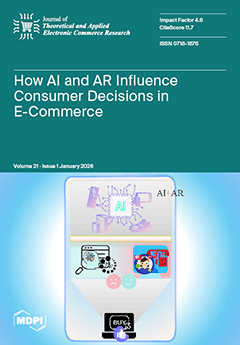
Cover Story: This study advances understanding of consumer decision-making in e-commerce by theorizing how artificial intelligence (AI) and augmented reality (AR) jointly shape consumer responses. Building on the stimulus–organism–response (S–O–R) framework, we conceptualize AI–AR integration as a psychologically coupled system in which algorithmic personalization and immersive experiences dynamically interact to influence emotions and continued usage intentions. Our findings reveal that AI and AR do not operate as isolated technologies; rather, their effects are contingent on consumers’ trust, which functions as a critical boundary condition. By uncovering the psychological mechanisms through which integrated digital technologies transform consumer behavior, this research offers significant theoretical contributions and actionable insights for the strategic design of immersive e-commerce platforms. View this paper
  • Issues are regarded as officially published after their release is announced to the table of contents alert mailing list .
  • You may sign up for email alerts to receive table of contents of newly released issues.
  • PDF is the official format for papers published in both, html and pdf forms. To view the papers in pdf format, click on the "PDF Full-text" link, and use the free Adobe Reader to open them.

Articles (40)

  • Article
  • Open Access
433 Views
24 Pages

This study addresses a pivotal strategic issue in hospitality e-commerce: how hotels can optimize cooperation with heterogeneous online travel agencies (OTAs). Moving beyond the conventional question of whether to cooperate, we investigate the interr...

  • Article
  • Open Access
327 Views
21 Pages

Mapping Morality in Marketing: An Exploratory Study of Moral and Emotional Language in Online Advertising

  • Mauren S. Cardenas-Fontecha,
  • Leonardo H. Talero-Sarmiento and
  • Diego A. Vasquez-Caballero

Understanding how moral and emotional language operates in paid social advertising is essential for evaluating persuasion and its ethical contours. We provide a descriptive map of Moral Foundations Theory (MFT) language in Meta ad copy (Facebook/Inst...

  • Article
  • Open Access
261 Views
25 Pages

In the rapidly evolving digital economy, the expansion of business-to-business e-commerce ecosystems has compelled traditional industries to integrate into digital supply chains to achieve sustainable development. Industrial e-commerce is no longer l...

  • Article
  • Open Access
205 Views
28 Pages

The entrepreneurial ecosystem theory posits that regional development emerges from synergistic interactions among entrepreneurs, institutions, and markets. This study positions entrepreneurial vitality as the core catalyst synchronizing digital inclu...

  • Article
  • Open Access
527 Views
27 Pages

The electronic word of mouth (eWOM) has emerged as a communication tool that significantly influences consumers’ attitudes and purchasing behavior in the online market. Research indicates that the effect of eWOM sources, such as (strong ties, w...

  • Article
  • Open Access
392 Views
26 Pages

As chatbots are increasingly deployed to address service failures, understanding their role in facilitating consumer forgiveness has become essential. Several studies have compared consumers’ reactions to service recovery efforts conducted by a...

  • Article
  • Open Access
290 Views
27 Pages

When are emotional appeals effective for entrepreneurial ventures seeking funding? Questioning the assumption that all positive emotions are equally effective, we propose and empirically validate the idea that only emotions well-aligned with an organ...

  • Article
  • Open Access
592 Views
28 Pages

Digital retail is undergoing a paradigm shift driven by the deep integration of artificial intelligence (AI) and augmented reality (AR). Although prior studies have examined the independent effects of AI-based personalized recommendation (cognitive p...

  • Article
  • Open Access
280 Views
24 Pages

Grounded in Social Impact Theory, this study examines the effects of virtual experiences generated by Mere Virtual Presence (MVP), Mere Virtual Presence with Product Experience (MVPE), and pure brand websites on consumers’ brand attitudes and p...

of 4

Get Alerted

Add your email address to receive forthcoming issues of this journal.

XFacebookLinkedIn
J. Theor. Appl. Electron. Commer. Res. - ISSN 0718-1876