
Optimal Sales Channel and Business Model Strategies for a Hotel Considering Two Types of Online Travel Agency


Abstract
1. Introduction
2. Literature Review
2.1. OTA Research in Tourism and Hospitality
2.2. Sales Channel Choice and Consumer Behavior
2.3. Business Model Selection
2.4. Uniqueness and Contributions of Our Study
3. The Model
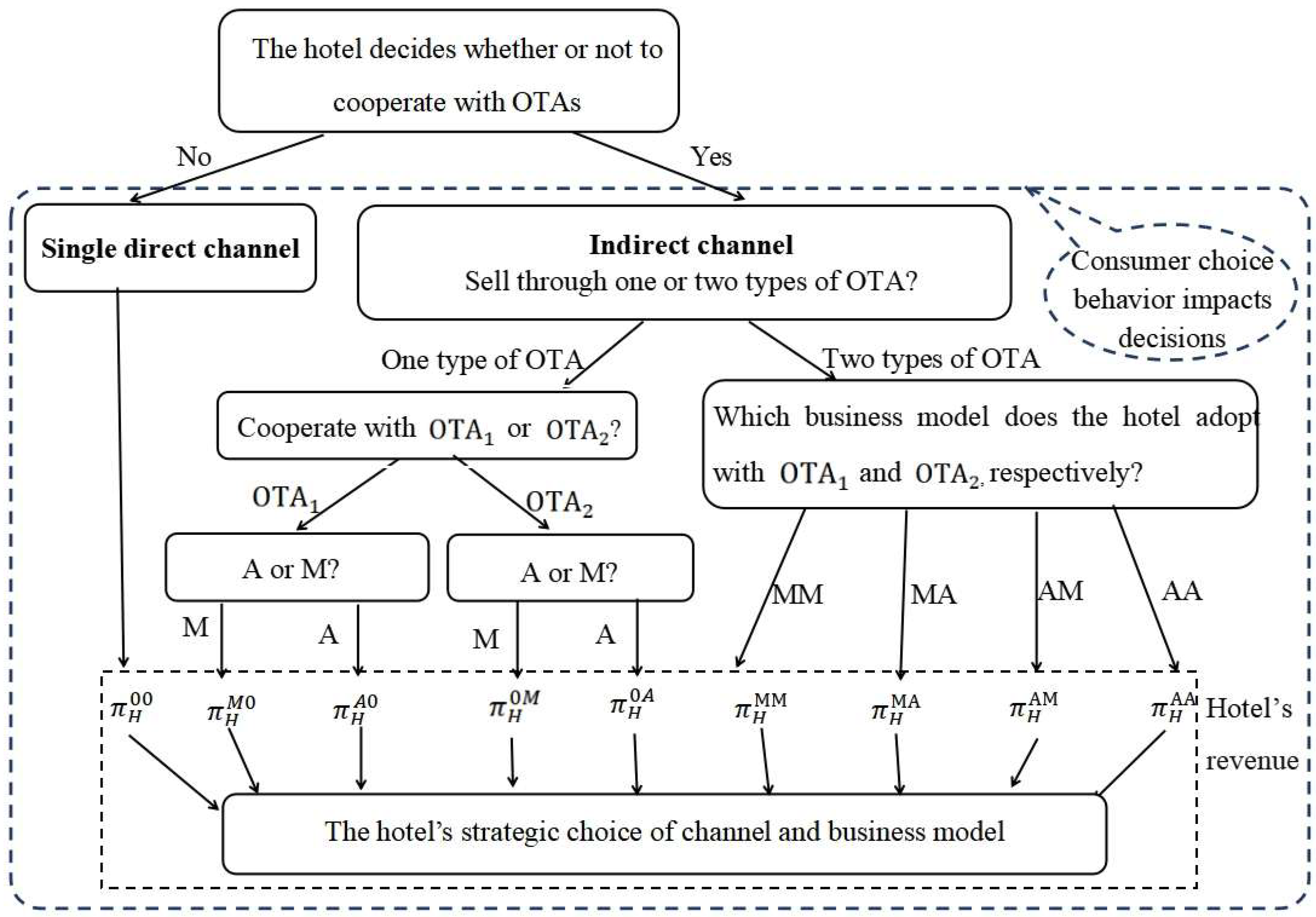
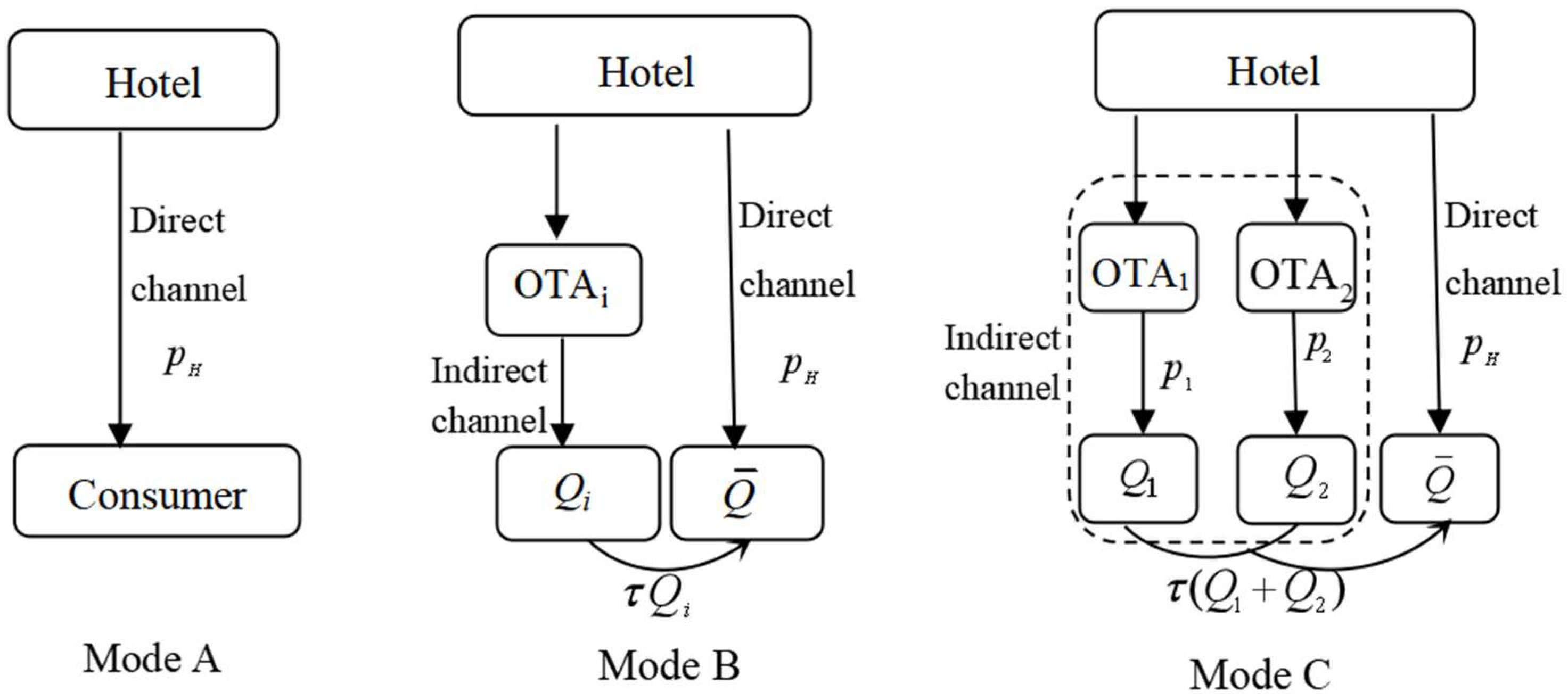
3.1. Sequence of Events and Decisions
3.2. Basic Assumptions
- (1)
- Market Potential: The base market potential for the hotel’s direct channel is . For analytical clarity and without loss of generality, the total potential consumer population for the OTA channel is normalized to 1 [8].
- (2)
- Cross-Channel Spillover Effect: We assume that OTA listings generate a positive spillover effect on the hotel’s direct channel demand, a well-documented phenomenon known as the “billboard effect” [6]. Empirical evidence supports this: for instance, a Cornell University study found that listings on Expedia increased total hotel bookings by 9–26%, with 75% of consumers visiting an OTA before a direct booking and 65% of direct bookers consulting an OTA first [6]. Complementary data from the Chinese market, such as traffic skew on Ctrip.com, further confirms that OTA exposure stimulates overall demand [7]. To model this cross-channel spillover, we let the total demand potential attracted by the OTAs be . A portion of this demand, , spills over to the direct channel, where the spillover coefficient quantifies the billboard effect’s strength [6]. Thus, the direct channel’s total effective demand becomes .
- (3)
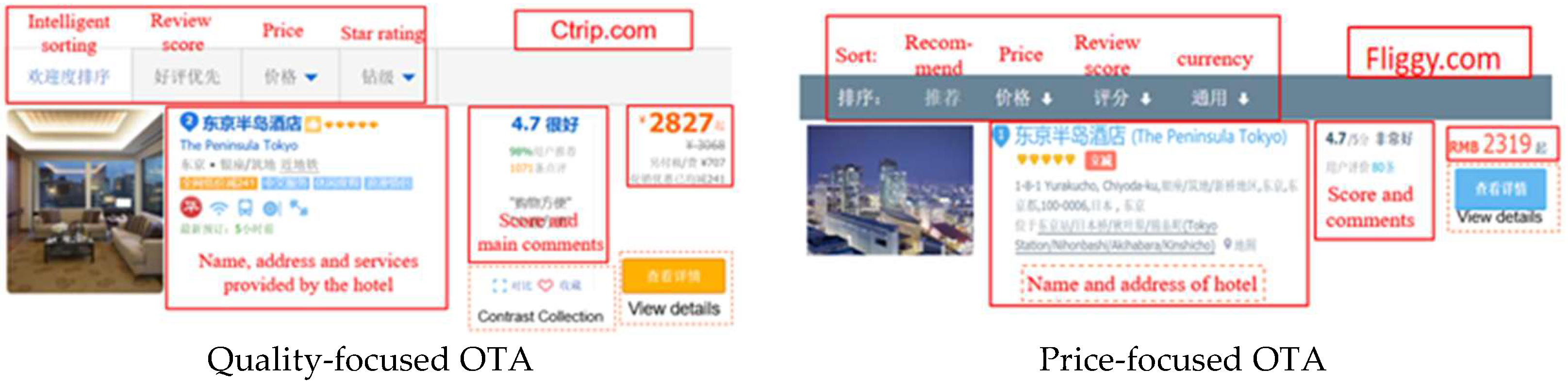
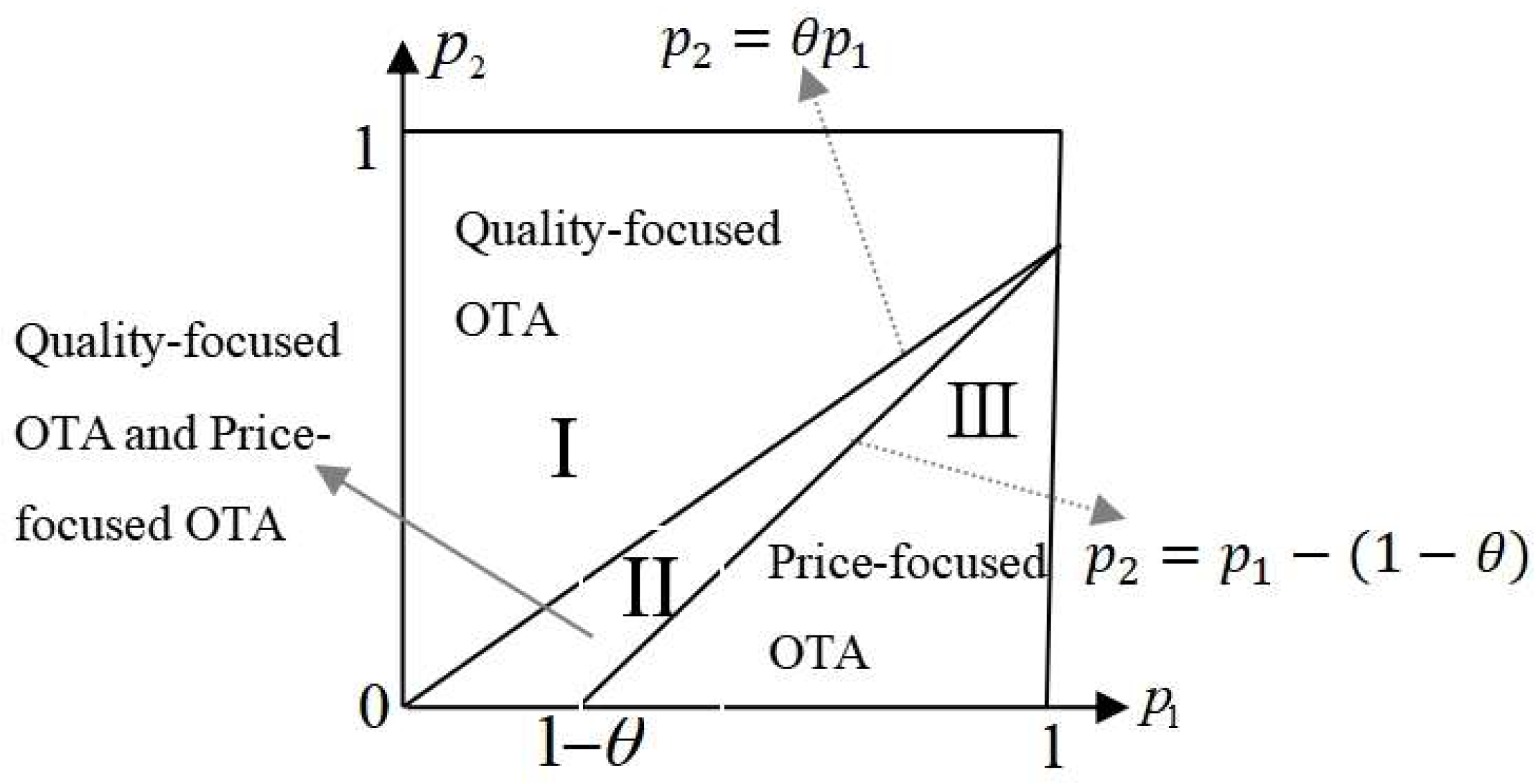
- Price Differential and Consumer Heterogeneity: Reflecting the commonly observed market pattern where OTA prices are often lower than direct prices, we normalize the selling price of the direct channel to 1 and assume the price on any OTA channel is less than 1 [39]. This accounts for the typically higher price elasticity of demand in the online channel and the competitive pressure on OTAs to offer attractive rates [39,40]. Consumers are heterogeneous in their valuation for a hotel room, which is uniformly distributed over [0, 1]. They make purchase decisions to maximize utility [3]. Building on the observation that OTAs employ different strategies to cater to travelers with different reservation values [41], we distinguish between OTA types. A consumer’s acceptance rate for the quality-focused OTA is 1, yielding a valuation of . For the price-focused OTA, the consumer acceptance rate is , yielding a valuation of . Since the quality-focused OTA provides superior services and information transparency, we reasonably bound the relative valuation by restricting to the range (0.5, 1), implying the maximum valuation for the quality-focused OTA is at most twice that for the price-focused OTA.
- (4)
- Commission Rates: Quality-focused OTAs typically charge a higher commission rate () than price-focused OTAs () due to the superior services and marketing they provide. For notational simplicity, we define and where .
3.3. Consumer Utility and Demand Model
4. Model Analysis
4.1. Single Direct Channel
4.2. Cooperation with One Type of OTA
4.2.1. Cooperation Under the Merchant Model
4.2.2. Cooperation Under the Agency Model
- (1)
- If ,
- (a)
- If , then the hotel should cooperate with under the agency model, and , , .
- (b)
- If , then the hotel should again cooperate with under the agency model, but the optimal price will change, that is, , , .
- (c)
- If then the hotel should cooperate with under the merchant model, and , , , .
- (2)
- If
- (a)
- If , then the hotel should cooperate with under the agency model, and , , .
- (b)
- If , then the hotel should again cooperate with through the agency model, but the optimal price will change, that is, , , .
- (c)
- If , then the hotel’s optimal sale platform selection, optimal price, and corresponding profit are the same as Proposition 2 (1C).
4.3. Cooperation with Both Types of OTA
- (1)
- Cooperation through the MM business model combination
- (2)
- Cooperation through the MA business model combination
- (3)
- Cooperation through the AM business model combination
- (4)
- Cooperation through the AA business model combination:
5. The Hotel’s Equilibrium Strategy
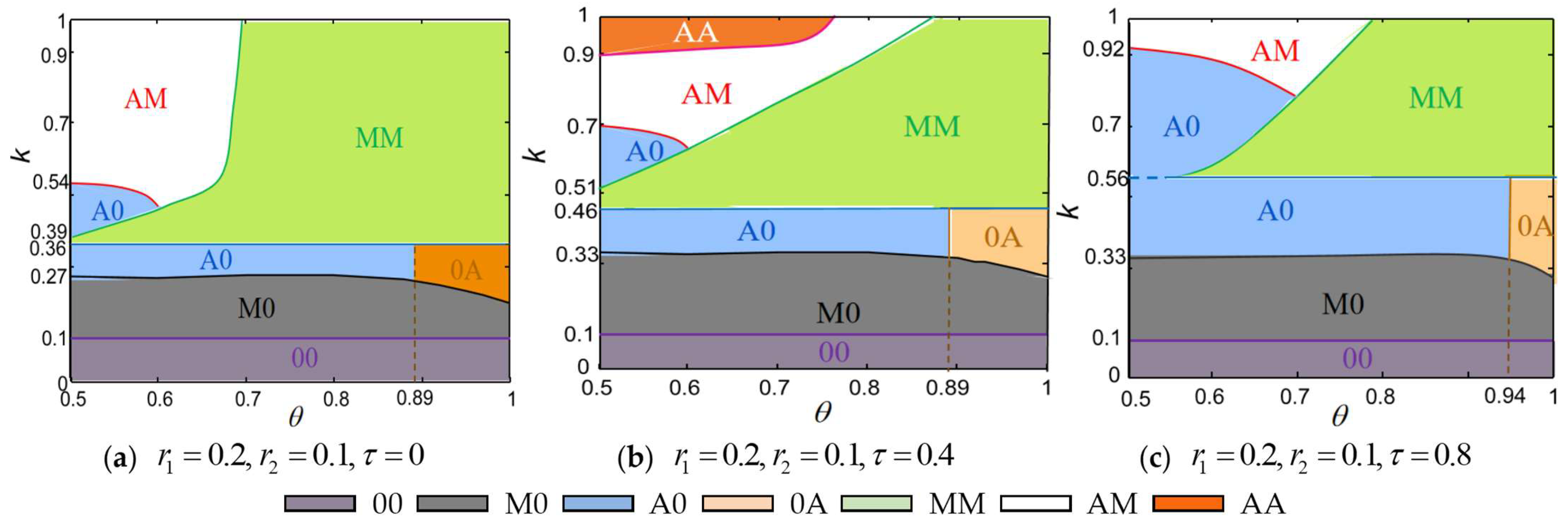
5.1. The Equilibrium Strategy as a Function of and
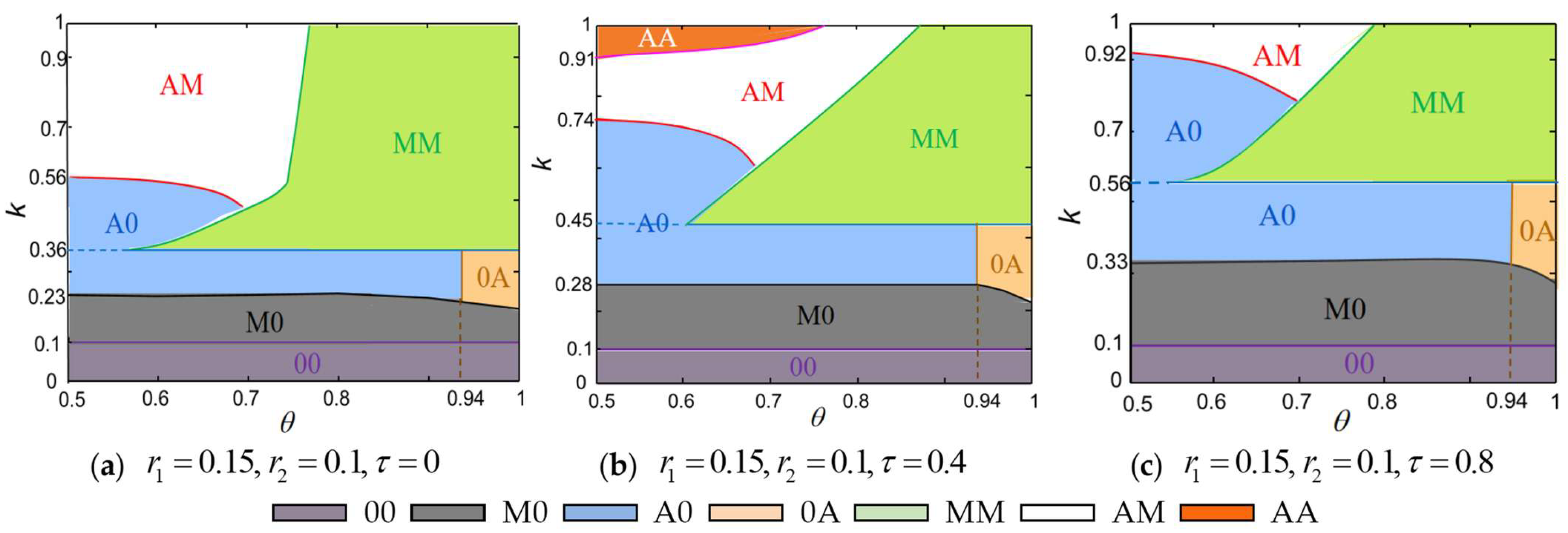
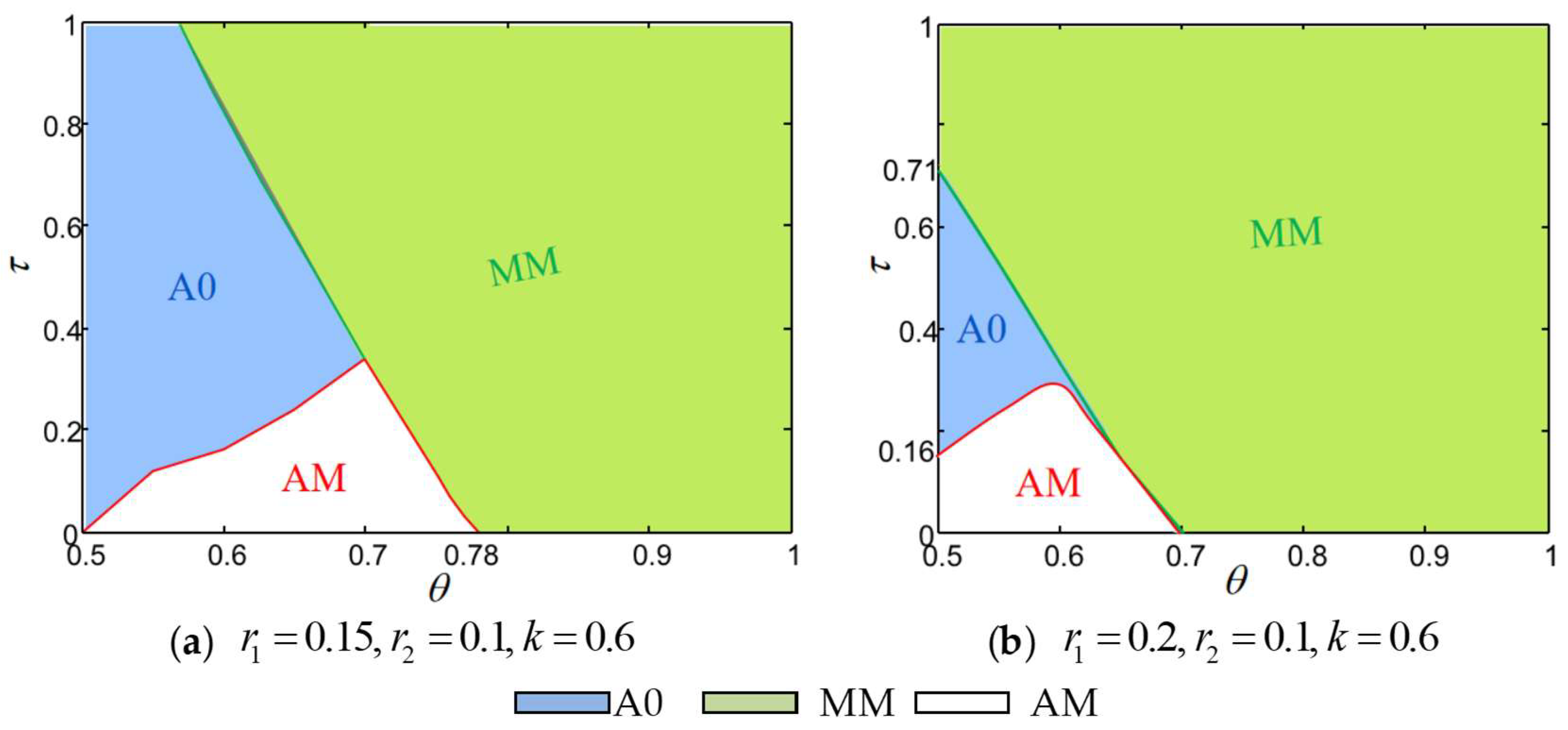
5.2. The Equilibrium Strategy as a Function of and
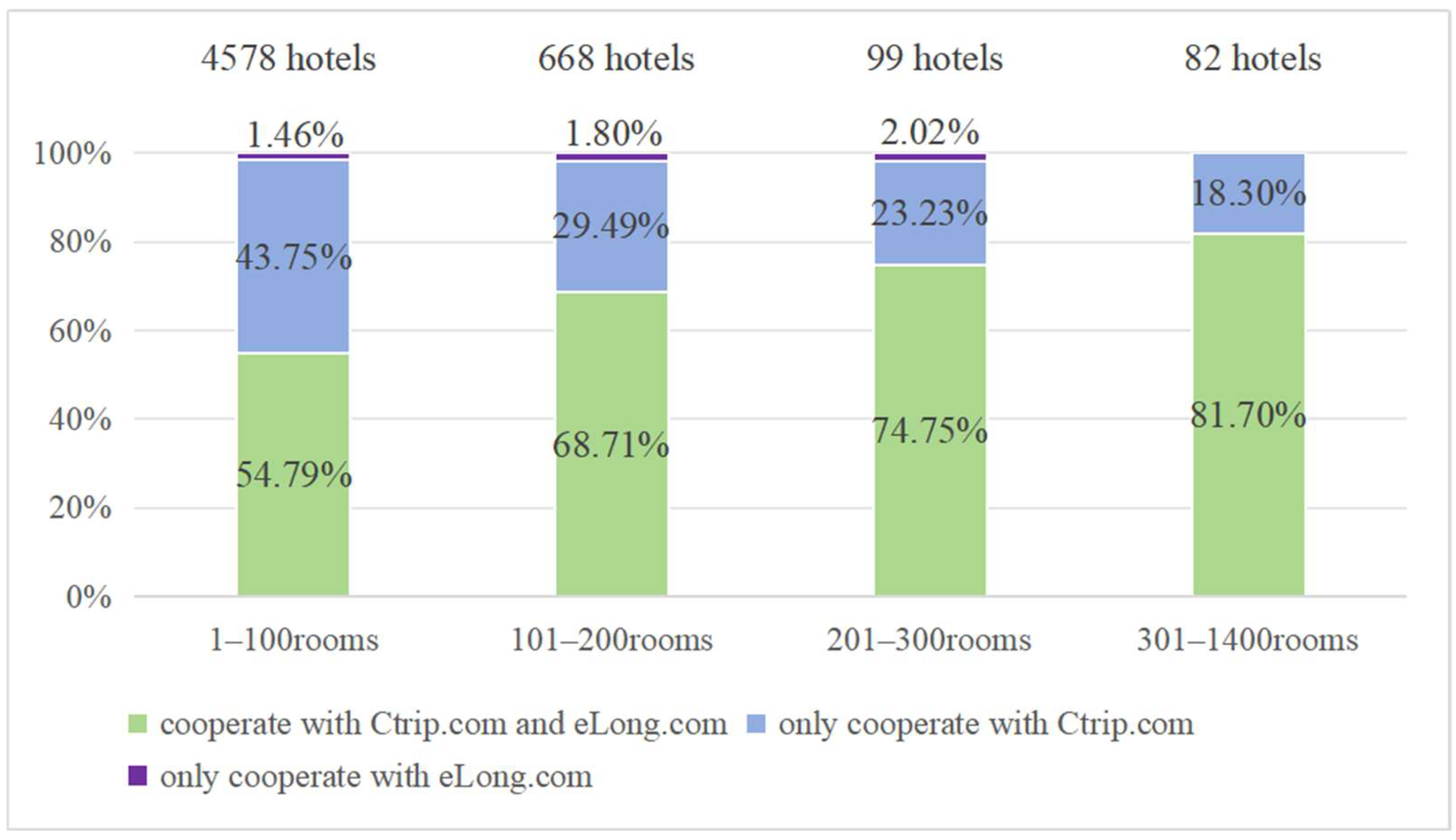
5.3. Empirical Survey Research
6. Conclusions and Implications
6.1. Conclusions
6.2. Theoretical and Practical Implications
6.3. Limitations and Future Research
Author Contributions
Funding
Institutional Review Board Statement
Informed Consent Statement
Data Availability Statement
Acknowledgments
Conflicts of Interest
Appendix A
- (1)
- If , then , . This requires . The profits of the hotel, , and are , , , respectively.
- (2)
- If , then , . This requires . The profits of the hotel, , and are , , , respectively.
- (3)
- If , then , . Then , that is, will not purchase rooms from the hotel and then sell them.
- (4)
- If , then , . Then , that is, will not purchase rooms from the hotel and then sell them.
- (5)
- If , then , . Then , that is, will not purchase rooms from the hotel and then sell them.
- (6)
- If , then , . Then , that is, will not purchase rooms from the hotel and then sell them.
- (7)
- If , then , . That is, the hotel cooperates with neither OTA.
- (8)
- If , then there is no feasible solution.
- (1)
- If , optimal prices are , , , . Profits are , , .
- (2)
- If , optimal prices are , , , . Profits are , , .
- (3)
- If , no feasible solution exists for dual cooperation under MM
References
- Verhoef, P.C.; Kannan, P.K.; Inman, J.J. From multi-channel retailing to Omni-channel retailing: Introduction to the special issue on multi-channel retailing. J. Retail. 2015, 91, 174–181. [Google Scholar] [CrossRef]
- Lee, H.; Guillet, B.D.; Law, R. An examination of the relationship between online travel agents and hotels: A case study of choice hotels international and Expedia.com. Cornell Hosp. Q. 2013, 54, 95–107. [Google Scholar] [CrossRef]
- Ye, F.; Zhang, L.; Li, Y. Strategic choice of sales channel and business model for the hotel supply chain. J. Retail. 2018, 94, 33–44. [Google Scholar] [CrossRef]
- Li, Y.; Tong, Y.; Ye, F.; Chen, Y.; Zhao, X. Sales channel choice in the hotel industry: The impact of online reviews. IEEE Trans. Eng. Manag. 2022, 71, 5230–5241. [Google Scholar] [CrossRef]
- Chennamaneni, P.R.; Ramarao, D.; Anand, K. Advance sales of services: Using direct versus indirect channels. J. Serv. Res. 2017, 20, 135–151. [Google Scholar] [CrossRef]
- Expedia Group. What Is the ‘Billboard Effect’ and How Can It Work for You? 2025. Available online: https://www.expediagroup.com/news/resource-library/articles/what-is-the-billboard-effect-and-how-can-it-work-for-your-hotel/ (accessed on 20 November 2025).
- Liu, C. Digital Process and Online Market Allocation Efficiency: Micro-Evidence from Platform Traffic Skew. J. Quant. Tech. Econ. 2023, 40, 175–194. [Google Scholar]
- Abhishek, V.; Jerath, K.; Zhang, Z.J. Agency selling or reselling? Channel structures in electronic retailing. Manag. Sci. 2015, 62, 2259–2280. [Google Scholar] [CrossRef]
- Wei, J.; Lu, J.; Wang, Y. How to choose online sales formats for competitive e-tailers. Int. Trans. Oper. Res. 2021, 28, 2055–2080. [Google Scholar] [CrossRef]
- Xu, X.; Tang, Y.; Zhang, W. Strategic Third-Party Product Entry and Mode Choice under Self-Operating Channels and Marketplace Competition: A Game-Theoretical Analysis. J. Theor. Appl. Electron. Commer. Res. 2024, 19, 73–94. [Google Scholar] [CrossRef]
- Chiang, W.K.; Chhajed, D.; Hess, J.D. Direct marketing, indirect profits: A strategic analysis of dual-channel supply-chain design. Manag. Sci. 2003, 49, 1–20. [Google Scholar]
- Arya, A.; Mittendorf, B.; Sappington, D.E. The bright side of supplier encroachment. Mark. Sci. 2007, 26, 651–659. [Google Scholar] [CrossRef]
- Gioia, D.; Minner, S. On the value of multi-echelon inventory management strategies for perishable items with on-/off-line channels. Transp. Res. Part E 2023, 180, 103354. [Google Scholar] [CrossRef]
- Xia, Y.; Zhang, G.P. The impact of the online channel on retailers’ performances: An empirical evaluation. Decis. Sci. 2010, 41, 517–546. [Google Scholar] [CrossRef]
- Cattani, K.; Gilland, W.; Heese, H.S.; Swaminathan, J. Boiling frogs: Pricing strategies for a manufacturer adding a direct channel that competes with the traditional channel. Prod. Oper. Manag. 2006, 15, 40–56. [Google Scholar] [CrossRef]
- Cai, G.S. Channel selection and coordination in dual-channel supply chains. J. Retail. 2010, 86, 22–36. [Google Scholar] [CrossRef]
- Saha, S.; Sarmah, S.P.; Modak, N.M. Single versus dual-channel: A strategic analysis in perspective of retailer’s profitability under three-level dual-channel supply chain. Asia Pac. Manag. Rev. 2018, 23, 148–160. [Google Scholar] [CrossRef]
- Zhang, P.; He, Y.; Shi, C. Retailer’s channel structure choice: Online channel, offline channel, or dual channels? Int. J. Prod. Econ. 2017, 191, 37–50. [Google Scholar] [CrossRef]
- Niu, B.; Cui, Q.; Jie, Z. Impact of channel power and fairness concern on supplier’s market entry decision. J. Oper. Res. Soc. 2017, 68, 1570–1581. [Google Scholar] [CrossRef]
- Zheng, B.; Niu, Y.; Chu, J. Managing sales channel selection for a manufacturer in the presence of remanufacturing. J. Syst. Sci. Syst. Eng. 2021, 30, 26. [Google Scholar] [CrossRef]
- Song, B.; Li, M.; Zhuang, W. Dynamic Channel Control and Pricing of a Single Perishable Product on Multiple Distribution Channels. Eur. J. Oper. Res. 2021, 288, 539–551. [Google Scholar] [CrossRef]
- Hsiao, L.; Chen, Y. The perils of selling online: Manufacturer competition, channel conflict, and consumer preferences. Mark. Lett. 2013, 24, 277–292. [Google Scholar]
- Nagy, I.D.; Dabija, D.C.; Cramarenco, R.E.; Burcă-Voicu, M.I. The Use of Digital Channels in Omni-Channel Retail—An Empirical Study. J. Theor. Appl. Electron. Commer. Res. 2024, 19, 797–817. [Google Scholar]
- Yi, Z.; Wang, Y.; Liu, Y.; Chen, Y.J. The impact of consumer fairness seeking on distribution channel selection: Direct selling vs. agent selling. Prod. Oper. Manag. 2018, 27, 1148–1167. [Google Scholar] [CrossRef]
- Wang, R.; Nan, G.; Chen, L.; Li, M. Channel integration choices and pricing strategies for competing dual-channel retailers. IEEE Trans. Eng. Manag. 2022, 69, 2260–2274. [Google Scholar] [CrossRef]
- Karray, S.; Sigué, S.P. Multichannel retailing and price competition. Int. Trans. Oper. Res. 2020, 28, 2002–2032. [Google Scholar] [CrossRef]
- Wu, H.; Cai, G.; Chen, J. Online manufacturer referral to heterogeneous retailers. Prod. Oper. Manag. 2016, 24, 1768–1782. [Google Scholar] [CrossRef]
- Tsay, A.A.; Agrawal, N. Channel conflict and coordination in the ecommerce age. Prod. Oper. Manag. 2004, 13, 93–110. [Google Scholar] [CrossRef]
- Yan, S.; Hua, Z.; Bian, Y. Does retailer benefit from implementing “online-to-store” channel in a competitive market? IEEE Trans. Eng. Manag. 2020, 67, 496–512. [Google Scholar]
- Hassanzadeh, A.; Martínez-de-Albéniz, V. Positioning of omnichannel inventories to protect revenue. Int. J. Prod. Econ. 2026, 291, 109853. [Google Scholar] [CrossRef]
- Yu, Y.; Sun, L.; Guo, X. Dual-channel decision in a shopping complex when considering consumer channel preference. J. Oper. Res. Soc. 2020, 71, 1638–1656. [Google Scholar]
- Wang, C.; Leng, M.; Liang, L. Choosing an online retail channel for a manufacturer: Direct sales or consignment? Int. J. Prod. Econ. 2018, 195, 338–358. [Google Scholar] [CrossRef]
- Zhou, Y.; Liu, J.; Wu, X. How to implement the wholesale price contract: Considering competition between supply chains. J. Syst. Sci. Syst. Eng. 2022, 31, 24. [Google Scholar] [CrossRef]
- Wang, T.; Gal-Or, E.; Chatterjee, R. The name-your-own-price channel in the travel industry: An analytical exploration. Manag. Sci. 2009, 55, 968–979. [Google Scholar] [CrossRef]
- Ma, S.G.; Gu, R.; Liang, S.; Yang, Y. Agent or merchant? Unpacking hotel-OTA selling formats with differential games. Tour. Manag. 2025, 111, 105223. [Google Scholar] [CrossRef]
- Chen, X.; Li, B.; Chen, W.; Wu, S. Influences of information sharing and online recommendations in a supply chain: Reselling versus agency selling. Ann. Oper. Res. 2023, 329, 717–756. [Google Scholar] [CrossRef]
- Bao, M.; Dai, X. A superior sales mode for a two-echelon supply chain of perishable products. J. Syst. Sci. Inf. 2024, 12, 274–293. [Google Scholar] [CrossRef]
- Radomska, J.; Kawa, A.; Hajdas, M.; Klimas, P.; Silva, S.C. Unveiling retail omnichannel challenges: Developing an omnichannel obstacles scale. Int. J. Retail Distrib. Manag. 2025, 53, 1–20. [Google Scholar] [CrossRef]
- Ye, F.; Yan, H.; Wu, Y.Z. Optimal online channel strategies for a hotel considering direct booking and cooperation with an online travel agent. Int. Trans. Oper. Res. 2019, 26, 968–998. [Google Scholar] [CrossRef]
- Granados, N.; Gupta, A.; Kauffman, R.J. Online and Offline Demand and Price Elasticities: Evidence from the Air Travel Industry. Inf. Syst. Res 2012, 23, 164–181. [Google Scholar] [CrossRef]
- Mao, Z.; Liu, T.; Li, X. Pricing mechanism of variable opaque products for dual-channel online travel agencies. Ann. Oper. Res. 2023, 329, 901–930. [Google Scholar] [CrossRef]
- Ctrip Merchants Seek More Burden Reduction. Available online: https://m.jiemian.com/article/12441287.html (accessed on 10 December 2025).
- Regulatory Efforts May Usher in New Landscape for Trillion-Yuan Online Travel Market. Available online: https://cn.chinadaily.com.cn/a/202508/12/WS689aa88fa31062672004228c.html (accessed on 20 December 2025).
- Díaz, E.; Martín-Consuegra, D.; Esteban, Á. Perceptions of service cannibalization: The moderating effect of the type of travel agency. Tour. Manag. 2015, 48, 329–342. [Google Scholar] [CrossRef]
- Has the Relationship Changed Between Hotels and OTAs? Available online: https://www.hospitalitynet.org/opinion/4093679.html (accessed on 20 December 2025).
- Guo, Q.; Cheng, S.; Zhao, P. How to introduce a livestreaming channel: A case of the hotel at a fixed capacity. Int. Trans. Oper. Res. 2024, 31, 3531–3552. [Google Scholar] [CrossRef]




| Characteristics | Consumer Behavior | Capacity | Channel Spillovers | Multiple Retailers | Internet Channel | Merchant Model | Agency Model |
|---|---|---|---|---|---|---|---|
| Ye et al. [3] | ✓ | ✓ | ✓ | ✓ | ✓ | ||
| Abhishek et al. [8] | ✓ | ✓ | ✓ | ✓ | ✓ | ||
| Wei et al. [9] | ✓ | ✓ | ✓ | ✓ | |||
| Saha et al. [17] | ✓ | ✓ | ✓ | ✓ | |||
| Zhang et al. [18] | ✓ | ✓ | ✓ | ||||
| Wang et al. [25] | ✓ | ✓ | ✓ | ||||
| Wu et al. [27] | ✓ | ✓ | ✓ | ✓ | |||
| Yu et al. [31] | ✓ | ✓ | ✓ | ✓ | |||
| Ye et al. [39] | ✓ | ✓ | ✓ | ✓ | |||
| This study | ✓ | ✓ | ✓ | ✓ | ✓ | ✓ | ✓ |
| Precondition | |||||
| Precondition | ||||
| Threshold | |||
|---|---|---|---|
| Business Model | |||
Disclaimer/Publisher’s Note: The statements, opinions and data contained in all publications are solely those of the individual author(s) and contributor(s) and not of MDPI and/or the editor(s). MDPI and/or the editor(s) disclaim responsibility for any injury to people or property resulting from any ideas, methods, instructions or products referred to in the content. |
© 2026 by the authors. Licensee MDPI, Basel, Switzerland. This article is an open access article distributed under the terms and conditions of the Creative Commons Attribution (CC BY) license.
Share and Cite
Zhang, L.; Han, X.; Mou, Z. Optimal Sales Channel and Business Model Strategies for a Hotel Considering Two Types of Online Travel Agency. J. Theor. Appl. Electron. Commer. Res. 2026, 21, 40. https://doi.org/10.3390/jtaer21010040
Zhang L, Han X, Mou Z. Optimal Sales Channel and Business Model Strategies for a Hotel Considering Two Types of Online Travel Agency. Journal of Theoretical and Applied Electronic Commerce Research. 2026; 21(1):40. https://doi.org/10.3390/jtaer21010040
Chicago/Turabian StyleZhang, Li, Xi Han, and Ziqi Mou. 2026. "Optimal Sales Channel and Business Model Strategies for a Hotel Considering Two Types of Online Travel Agency" Journal of Theoretical and Applied Electronic Commerce Research 21, no. 1: 40. https://doi.org/10.3390/jtaer21010040
APA StyleZhang, L., Han, X., & Mou, Z. (2026). Optimal Sales Channel and Business Model Strategies for a Hotel Considering Two Types of Online Travel Agency. Journal of Theoretical and Applied Electronic Commerce Research, 21(1), 40. https://doi.org/10.3390/jtaer21010040