
Is a Chatbot More Effective? Investigating the Effect of Service Recovery Agents and Consumer Loss on Consumer Forgiveness
Abstract
1. Introduction
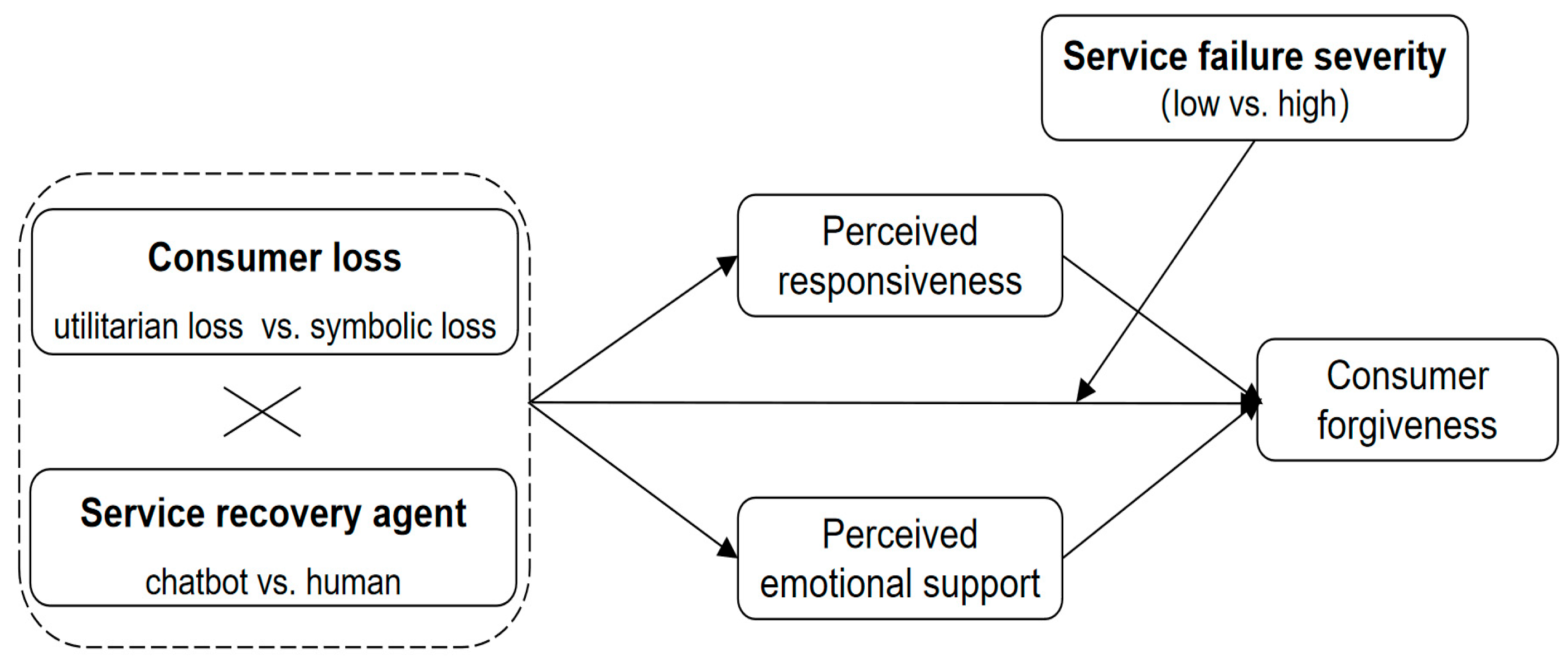
2. Literature Review and Research Model
2.1. Service Failure and Consumer Forgiveness
2.2. Responses to Decisions and Services Provided by a Human Versus AI
2.3. Task-Technology Fit Model: Interaction Between Consumer Loss and Service Recovery Agent
2.4. Moderating Effect of Service Failure Severity
3. Study 1
3.1. Design and Participants
3.2. Procedure
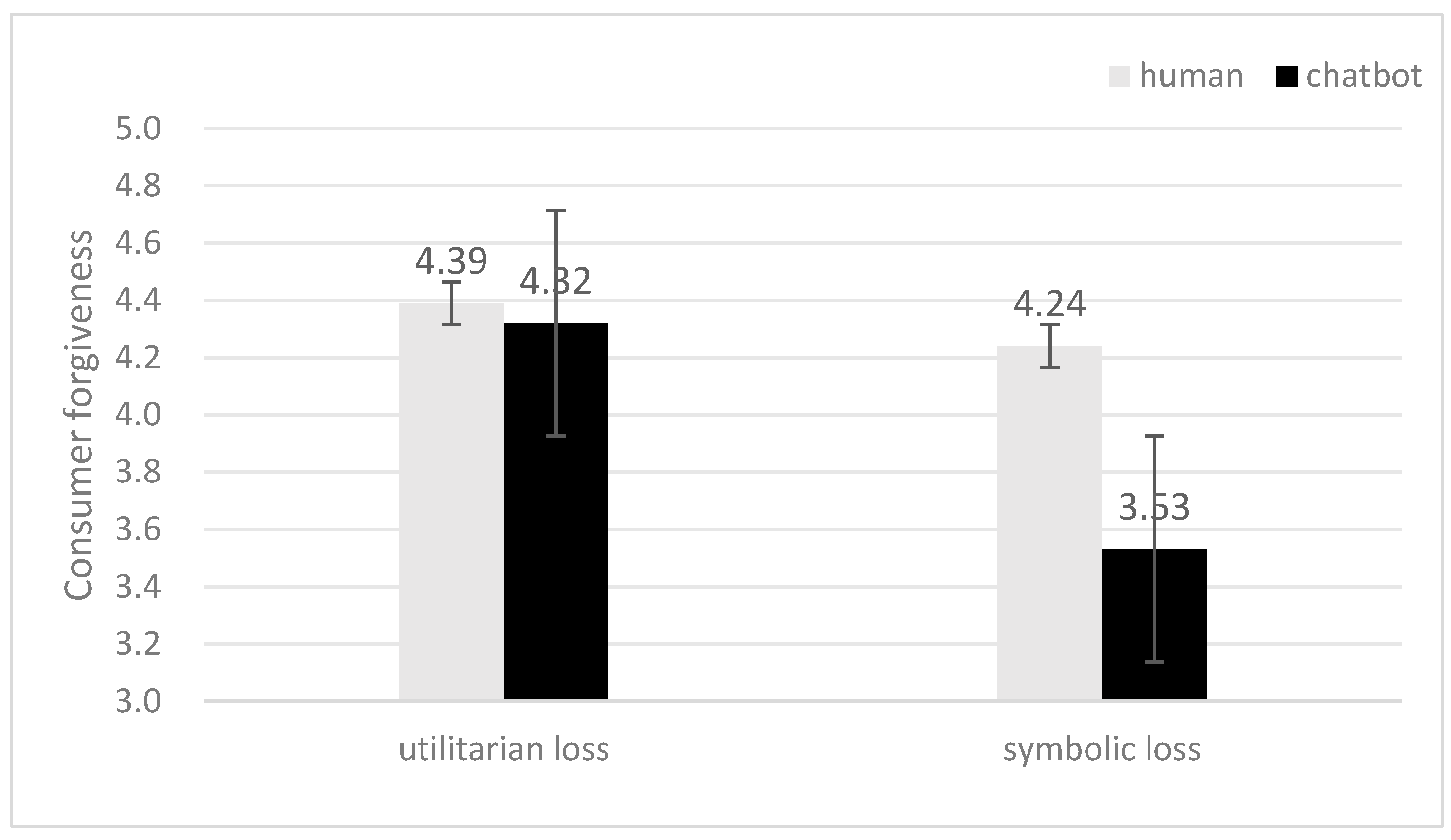
3.3. Results
4. Study 2
4.1. Design and Participants
4.2. Procedure
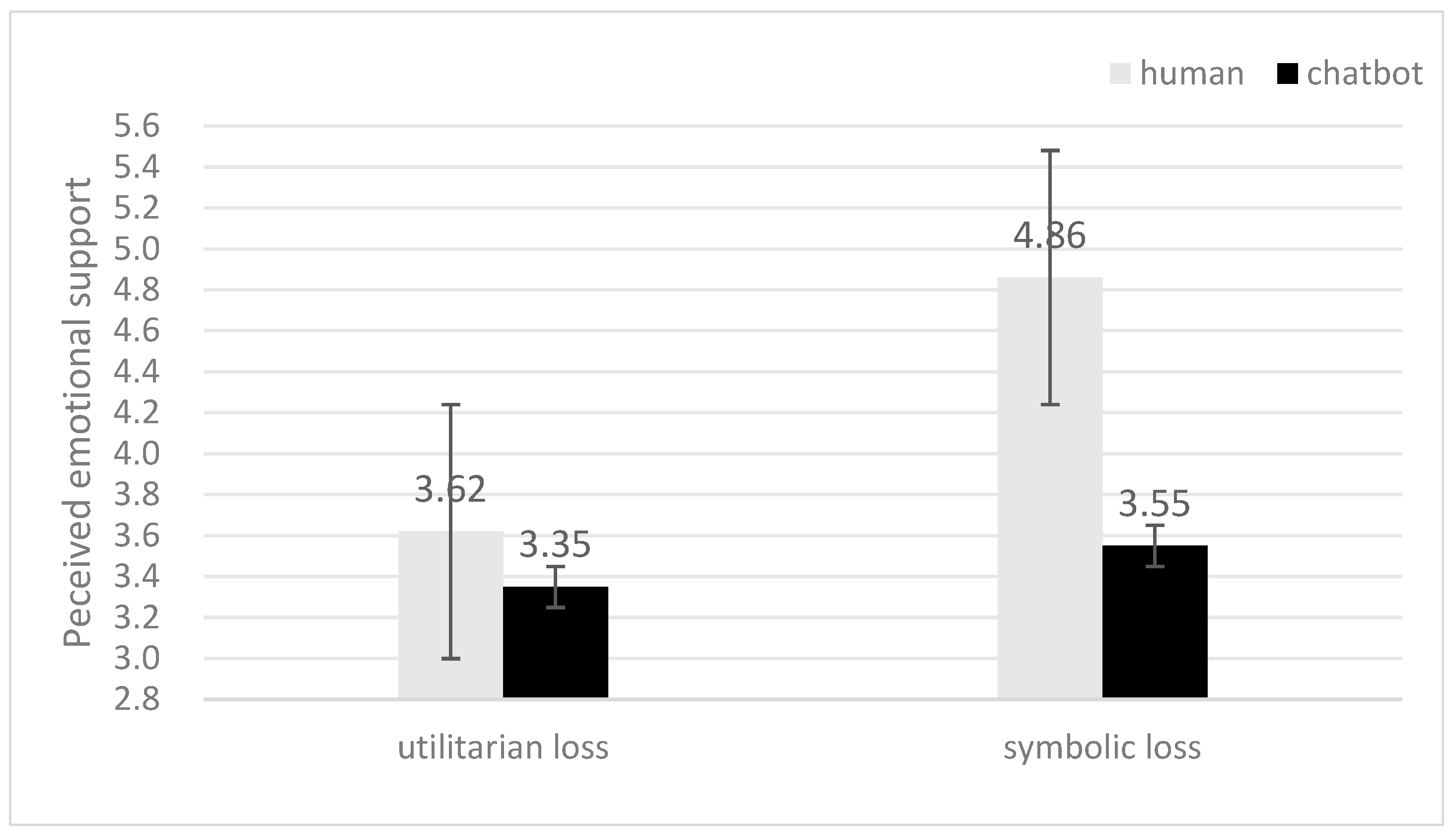
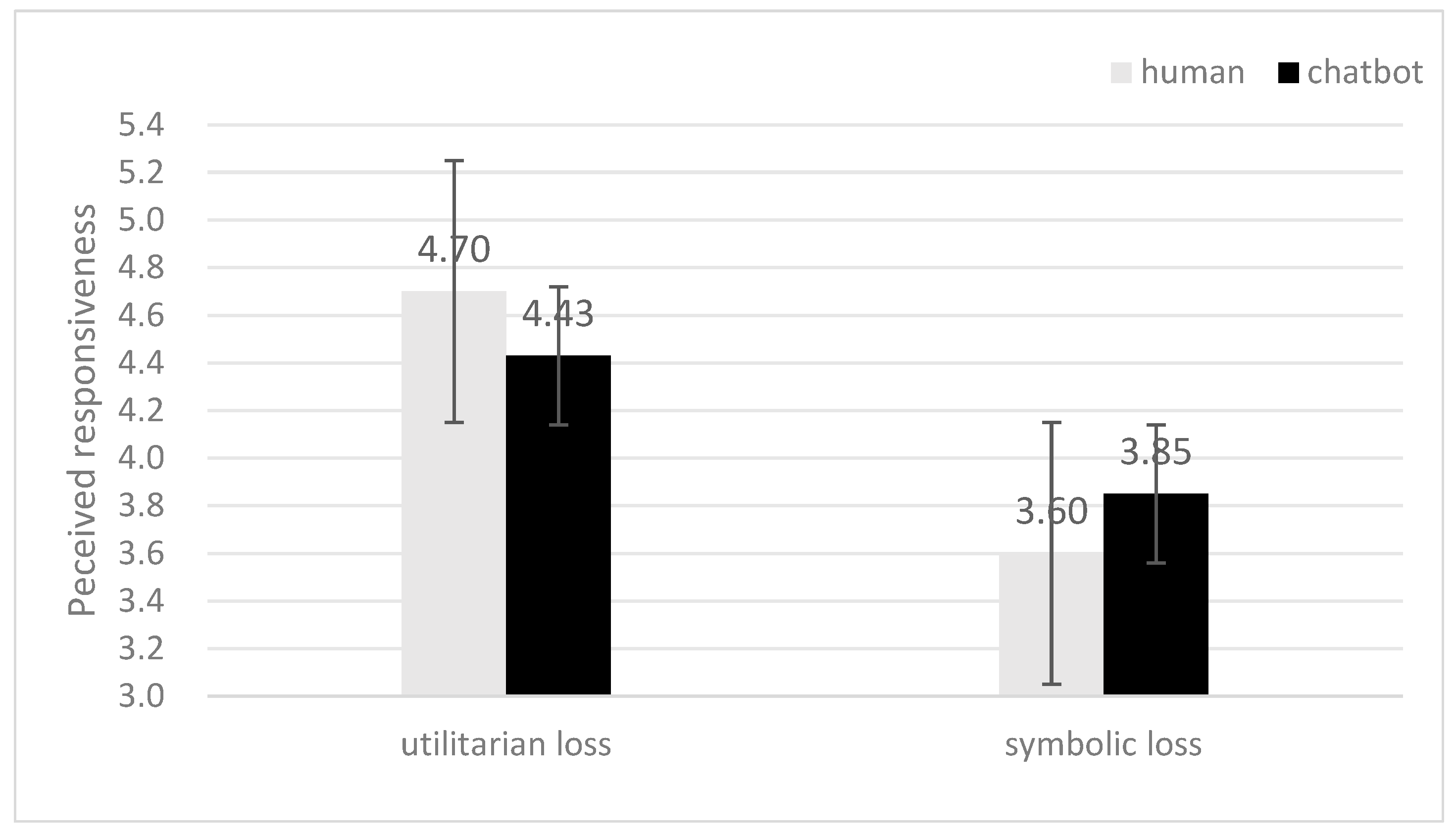
4.3. Results
5. Study 3
5.1. Pretest
5.2. Design and Participants
5.3. Procedure
5.4. Results
6. Discussion
6.1. General Discussion
6.2. Theoretical Contributions
6.3. Managerial Insights
6.4. Limitations and Future Research
Author Contributions
Funding
Institutional Review Board Statement
Informed Consent Statement
Data Availability Statement
Conflicts of Interest
Appendix A
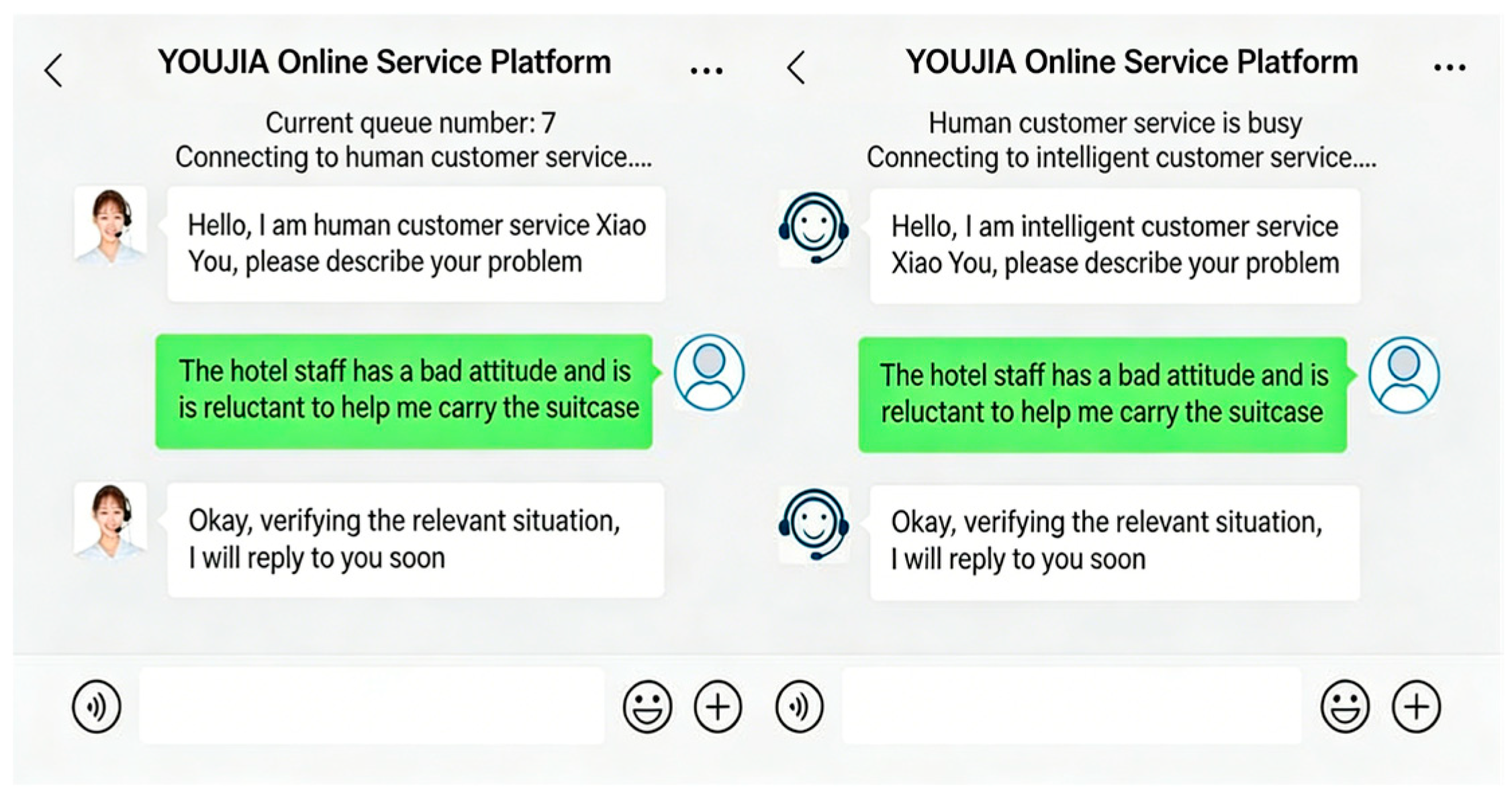
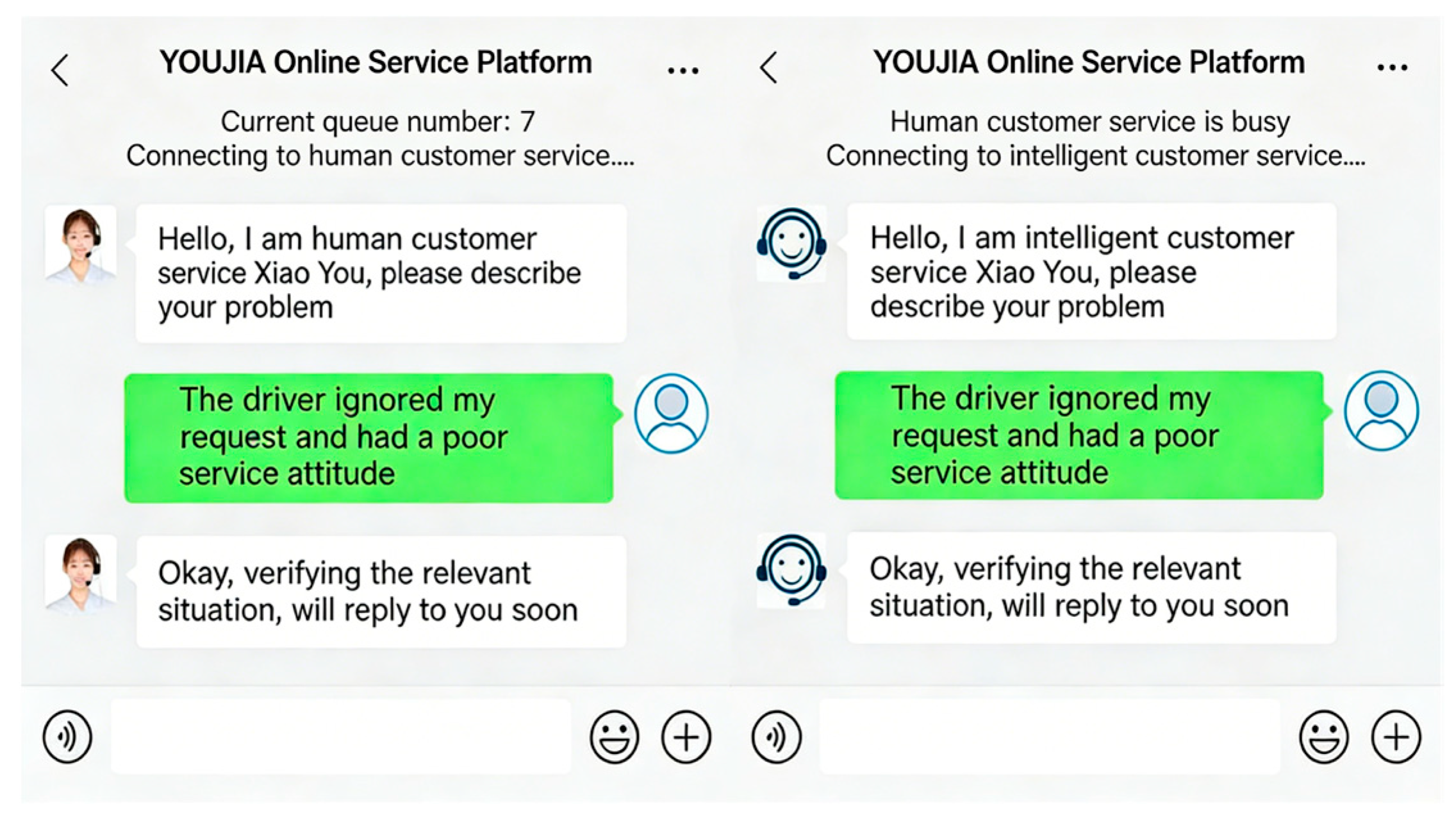
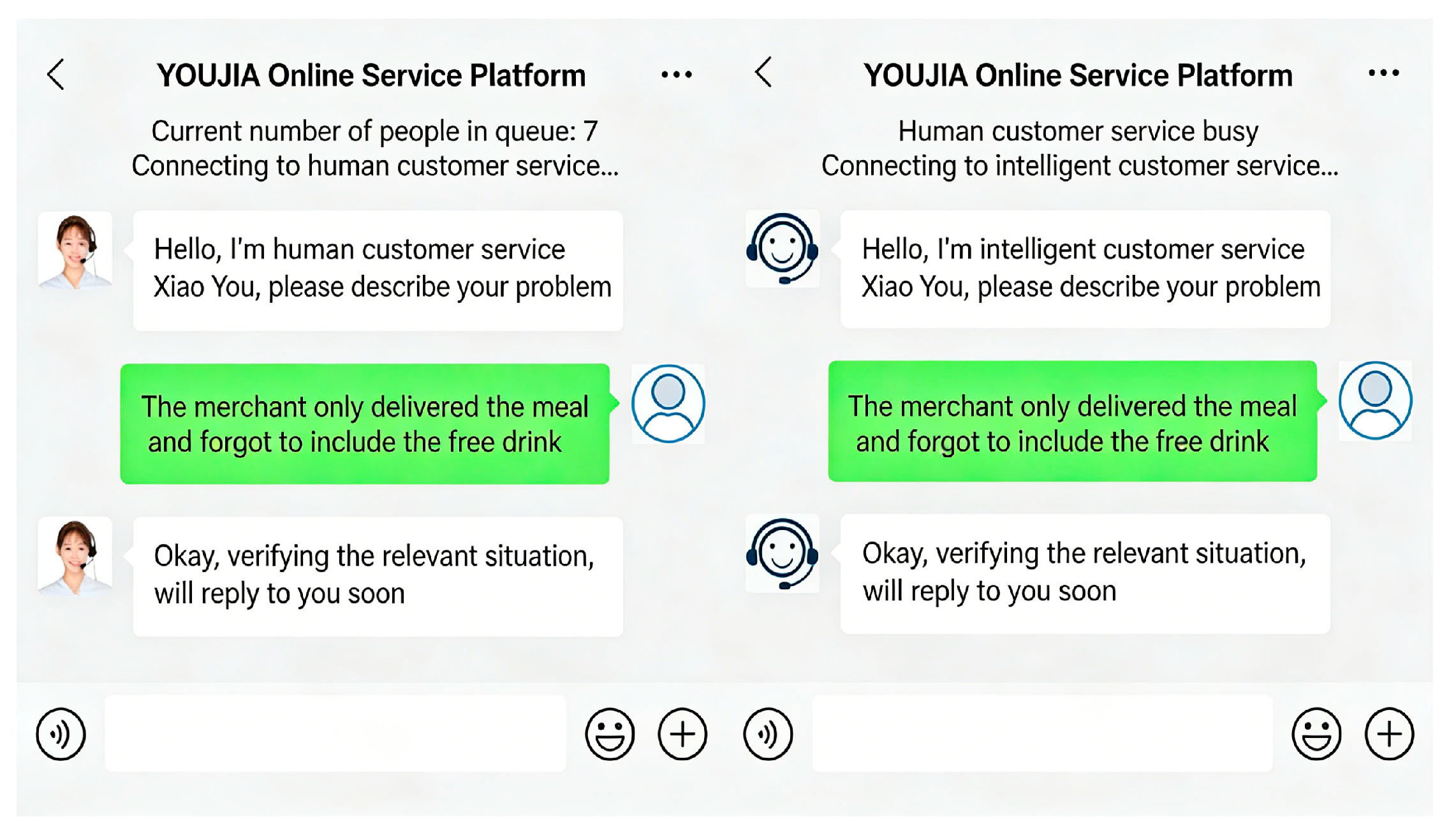
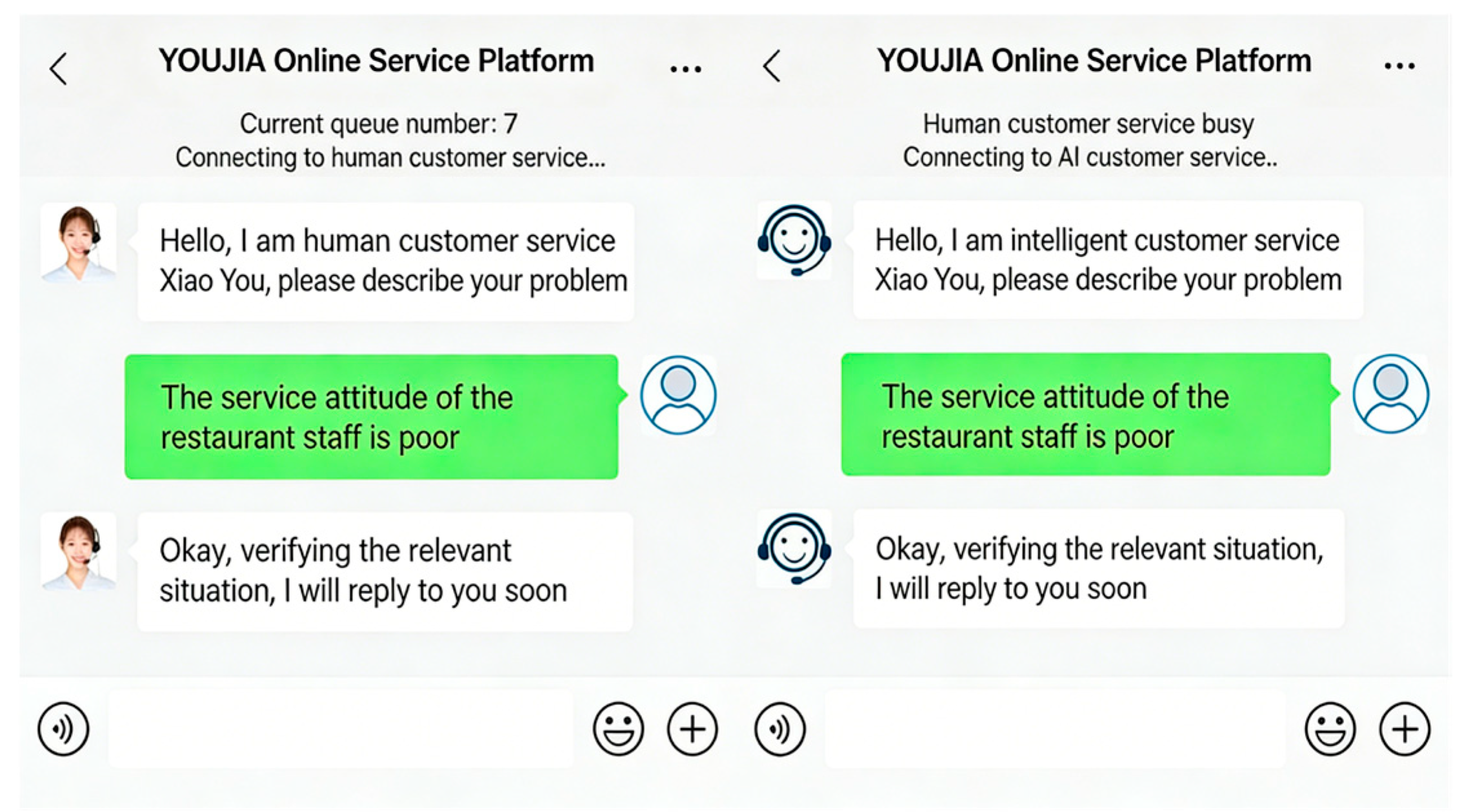
Appendix A.1. Experimental Stimuli Used in Study 1


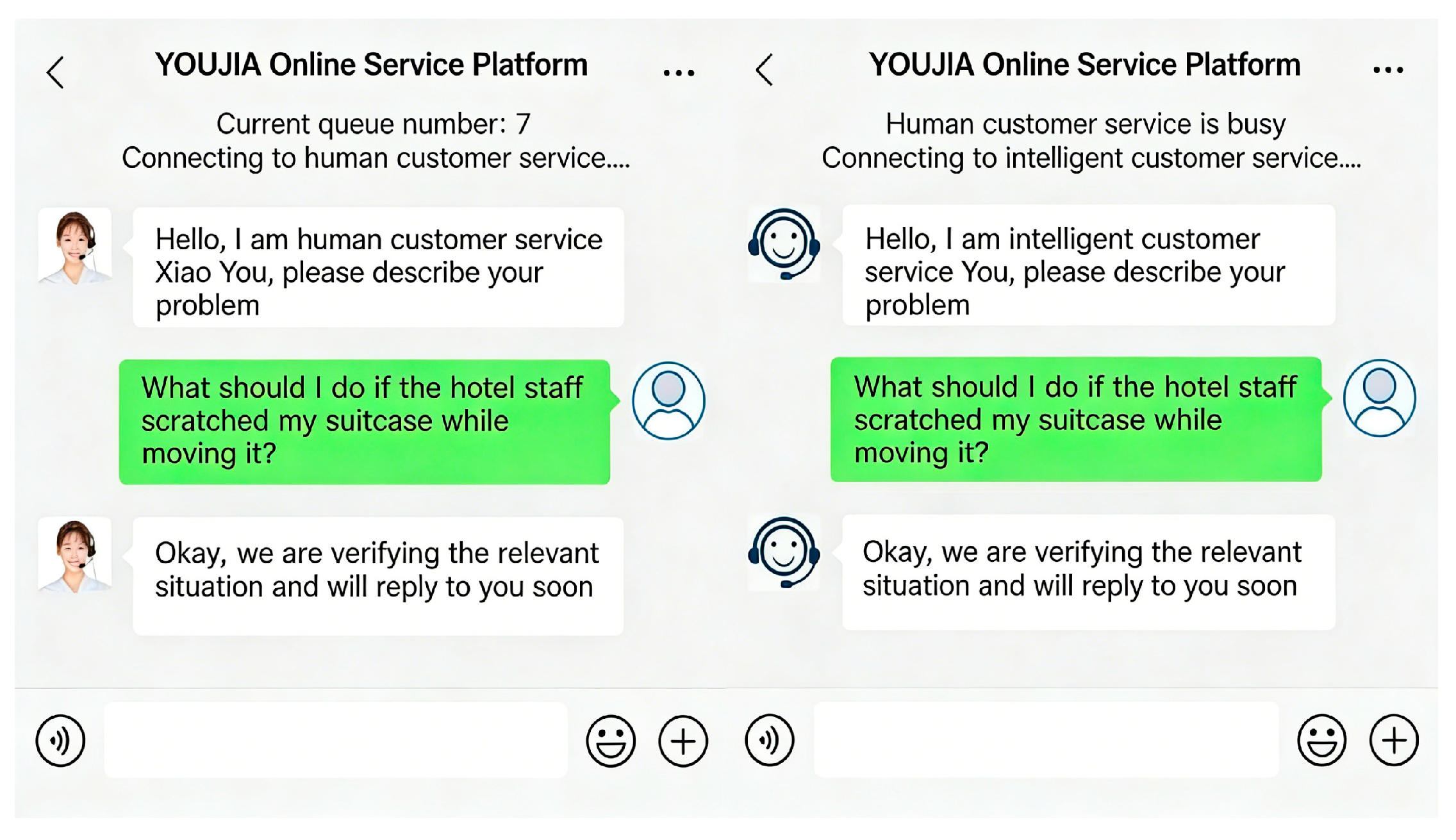
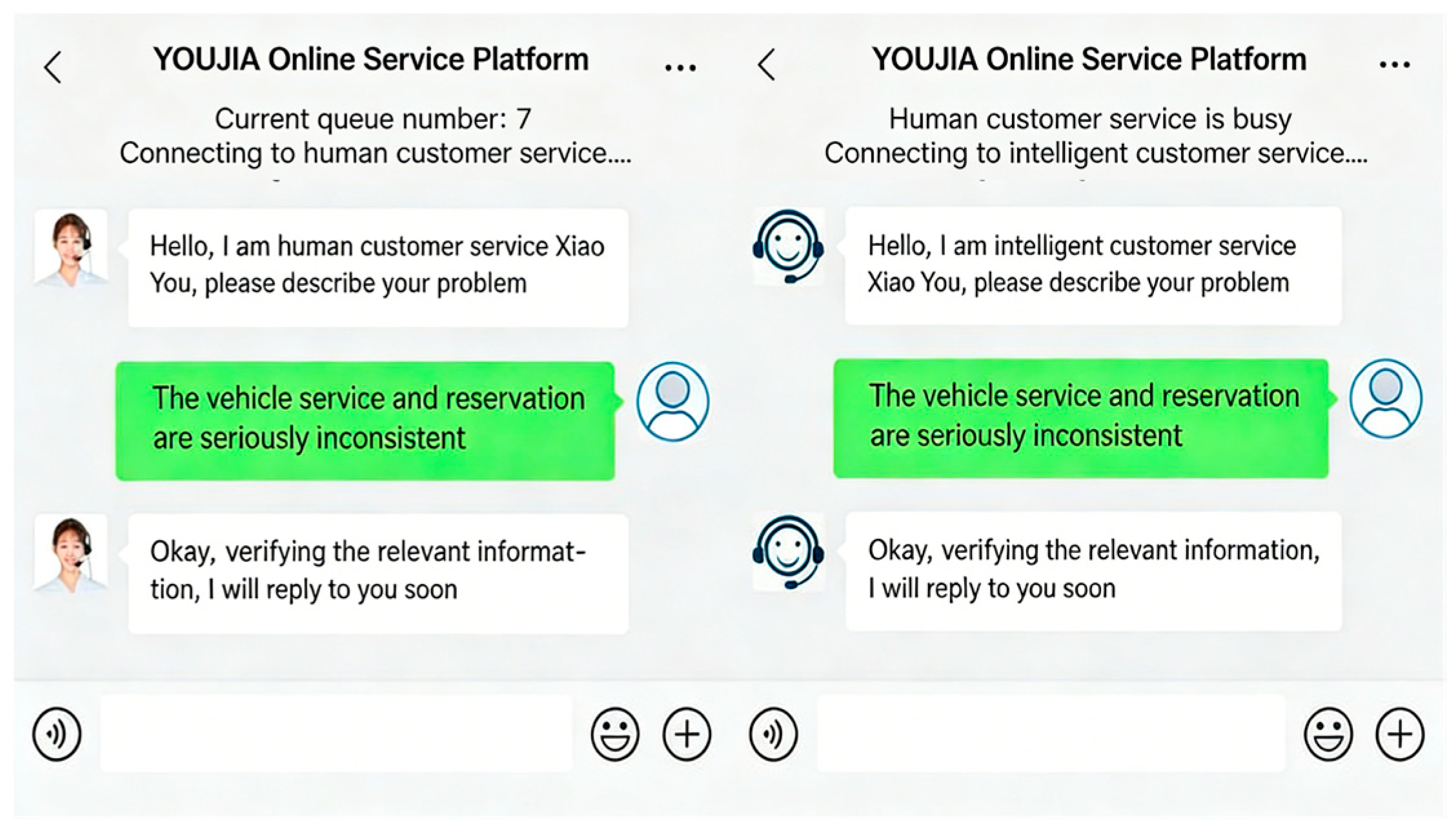
Appendix A.2. Experimental Stimuli Used in Study 2


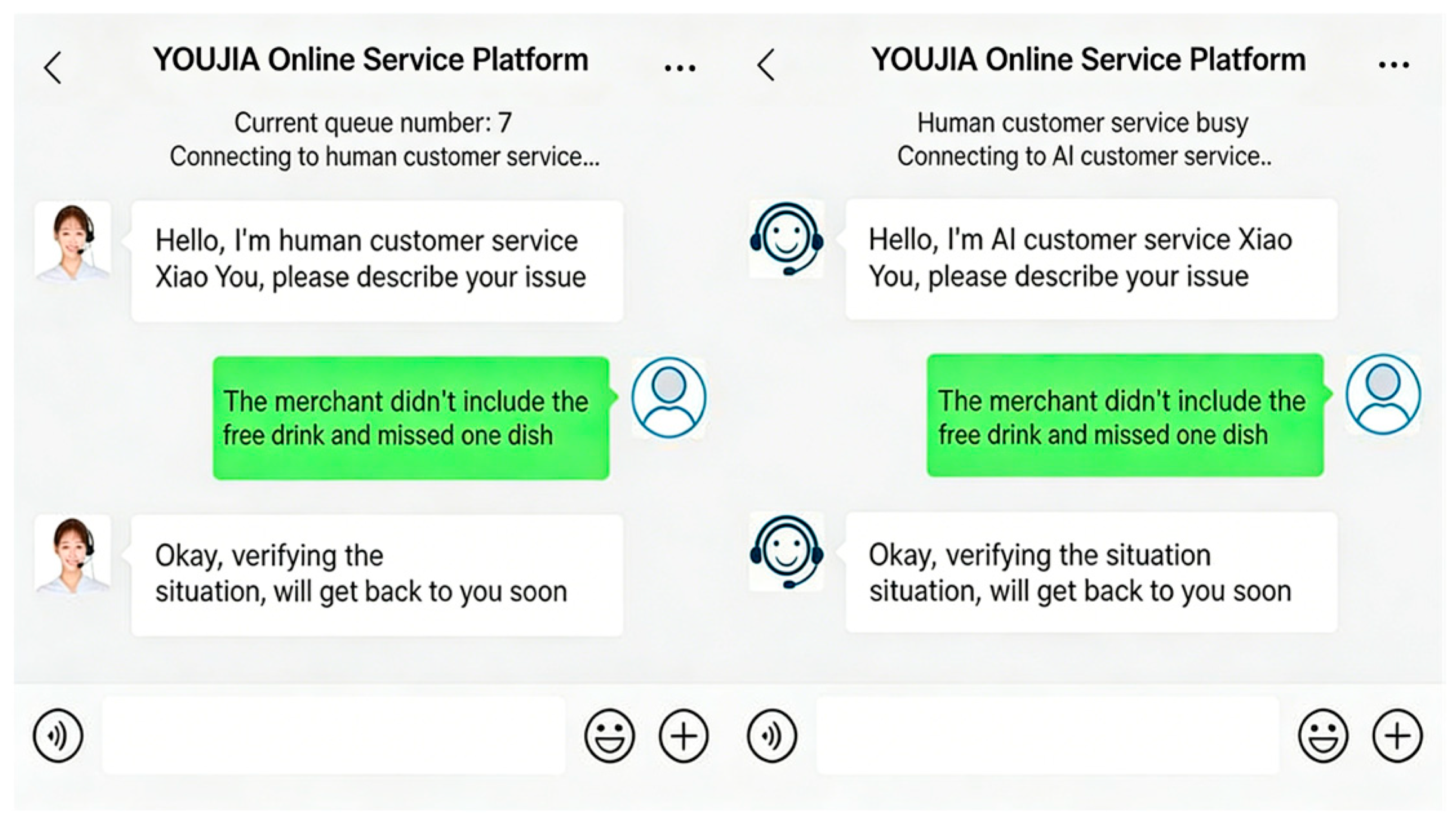
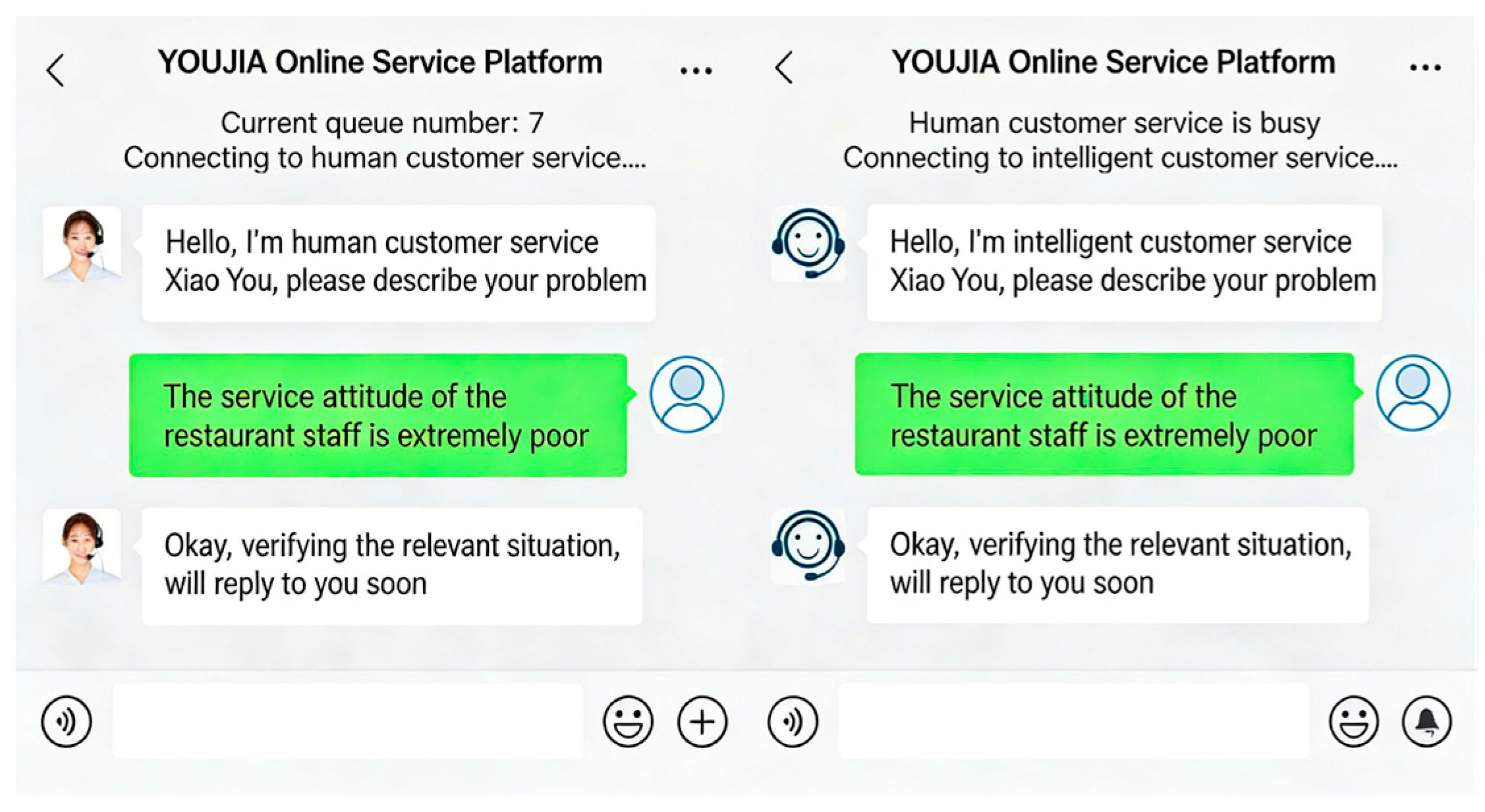
Appendix A.3. Experimental Stimuli Used in Study 3


Appendix B. Items

| Construct | Source | Items |
|---|---|---|
| Utilitarian loss | Smith et al., 1999 [77] |
|
| Symbolic loss | Smith et al., 1999 [77] |
|
| Consumer forgiveness | Fedorikhin et al., 2008 [87] |
|
| Emotional state | Townsen & Sood, 2012 [76] | I feel:
|
| Perceived responsiveness | Chen et al., 2024 [61] |
|
| Perceived emotional support | Gelbrich et al., 2021 [51] | Feedback from the agent makes me feel …
|
| Service failure severity | Ho et al., 2020 [11] | The above-mentioned service failure that happened to me was …
|
Appendix C
Appendix C.1. Confirmation Factor Analysis of Study 1
| Variable | Item | Factor Loading | Cronbach’s α | CR | AVE |
|---|---|---|---|---|---|
| Symbolic loss | SL1 | 0.900 | 0.904 | 0.758 | 0.926 |
| SL2 | 0.930 | ||||
| SL3 | 0.804 | ||||
| SL4 | 0.844 | ||||
| Utilitarian loss | UL1 | 0.808 | 0.848 | 0.692 | 0.899 |
| UL2 | 0.772 | ||||
| UL3 | 0.856 | ||||
| UL4 | 0.886 | ||||
| Consumer forgiveness | CF1 | 0.886 | 0.900 | 0.769 | 0.930 |
| CF2 | 0.901 | ||||
| CF3 | 0.856 | ||||
| CF4 | 0.865 |
Appendix C.2. Confirmation Factor Analysis of Study 2
| Variable | Item | Factor Loading | Cronbach’s α | CR | AVE |
|---|---|---|---|---|---|
| Symbolic loss | SL1 | 0.873 | 0.861 | 0.906 | 0.707 |
| SL2 | 0.818 | ||||
| SL3 | 0.824 | ||||
| SL4 | 0.847 | ||||
| Utilitarian loss | UL1 | 0.899 | 0.902 | 0.932 | 0.774 |
| UL2 | 0.816 | ||||
| UL3 | 0.889 | ||||
| UL4 | 0.913 | ||||
| Consumer forgiveness | CF1 | 0.877 | 0.917 | 0.941 | 0.801 |
| CF2 | 0.907 | ||||
| CF3 | 0.915 | ||||
| CF4 | 0.880 | ||||
| Perceived responsiveness | PR1 | 0.843 | 0.856 | 0.878 | 0.645 |
| PR2 | 0.869 | ||||
| PR3 | 0.787 | ||||
| PR4 | 0.703 | ||||
| Perceived emotional support | PE1 | 0.904 | 0.936 | 0.955 | 0.842 |
| PE2 | 0.920 | ||||
| PE3 | 0.917 | ||||
| PE4 | 0.929 |
Appendix C.3. Confirmation Factor Analysis of Study 3
| Variable | Item | Factor Loading | Cronbach’s α | CR | AVE |
|---|---|---|---|---|---|
| Symbolic loss | SL1 | 0.910 | 0.909 | 0.936 | 0.786 |
| SL2 | 0.926 | ||||
| SL3 | 0.858 | ||||
| SL4 | 0.851 | ||||
| Utilitarian loss | UL1 | 0.775 | 0.842 | 0.895 | 0.681 |
| UL2 | 0.799 | ||||
| UL3 | 0.882 | ||||
| UL4 | 0.841 | ||||
| Consumer forgiveness | CF1 | 0.865 | 0.890 | 0.924 | 0.754 |
| CF2 | 0.898 | ||||
| CF3 | 0.897 | ||||
| CF4 | 0.810 | ||||
| Service failure severity | SF1 | 0.838 | 0.841 | 0.904 | 0.759 |
| SF2 | 0.881 | ||||
| SF3 | 0.893 |
References
- Migacz, S.J.; Zou, S.; Petrick, J.F. The “Terminal” Effects of Service Failure on Airlines: Examining Service Recovery with Justice Theory. J. Travel Res. 2018, 57, 83–98. [Google Scholar] [CrossRef]
- Owusu, P.; Li, Z.; Mensah, I.A.; Omari-Sasu, A.Y. Consumer response to E-commerce service failure: Leveraging repurchase intentions through strategic recovery policies. J. Retail. Consum. Serv. 2025, 82, 104137. [Google Scholar] [CrossRef]
- Liu, Y.; Cheng, P.; Ouyang, Z. How trust mediate the effects of perceived justice on loyalty: A study in the context of automotive recall in China. J. Retail. Consum. Serv. 2021, 58, 102322. [Google Scholar] [CrossRef]
- Wang, X.; Zhang, Q. Does online service failure matter to offline customer loyalty in the integrated multi-channel context? The moderating effect of brand strength. J. Serv. Theory Pract. 2018, 28, 774–806. [Google Scholar] [CrossRef]
- Grégoire, Y.; Tripp, T.M.; Legoux, R. When customer love turns into lasting hate: The effects of relationship strength and time on customer revenge and avoidance. J. Mark. 2009, 73, 18–32. [Google Scholar] [CrossRef]
- Gelbrich, K.; Roschk, H. A meta-analysis of organizational complaint handling and customer responses. J. Serv. Res. 2011, 14, 24–43. [Google Scholar] [CrossRef]
- Park, J.; Yoo, J.W.; Cho, Y.-E.; Park, H. Examining the impact of service robot communication styles on customer intimacy following service failure. J. Retail. Consum. Serv. 2023, 75, 103511. [Google Scholar] [CrossRef]
- Zhang, Y.; Huang, J.; Pang, Q. Turning setbacks into smiles: Exploring the role of self-mocking strategies in consumers’ recovery satisfaction after e-commerce service failures. J. Theor. Appl. Electron. Commer. Res. 2025, 20, 183. [Google Scholar] [CrossRef]
- Harrison-Walker, L.J. The critical role of customer forgiveness in successful service recovery. J. Bus. Res. 2019, 95, 376–391. [Google Scholar] [CrossRef]
- Muhammad, L.; Gul, E.R. Mediating role of customer forgiveness between perceived justice and satisfaction. J. Retail. Consum. Serv. 2020, 52, 101886. [Google Scholar] [CrossRef]
- Ho, T.H.; Tojib, D.; Tsarenko, Y. Human staff vs. service robot vs. fellow customer: Does it matter who helps your customer following a service failure incident? Int. J. Hosp. Manag. 2020, 87, 102501. [Google Scholar] [CrossRef]
- Majeed, S.; Kim, W.G.; Nimri, R. Conceptualizing the role of virtual service agents in service failure recovery: Guiding insights. Int. J. Hosp. Manag. 2024, 123, 103889. [Google Scholar] [CrossRef]
- Peng, Y.; Wang, Y.; Li, J.; Yang, Q. Impact of AI-oriented live-streaming e-commerce service failures on consumer disengagement—Empirical evidence from China. J. Theor. Appl. Electron. Commer. Res. 2024, 19, 1580–1598. [Google Scholar] [CrossRef]
- Kale, A.; Nguyen, T.; Harris, F.C.H., Jr.; Li, C.H.; Zhang, J.Y.; Ma, X.G. Provenance documentation to enable explainable and trustworthy AI: A literature review. Data Intell. 2023, 5, 139–162. [Google Scholar] [CrossRef]
- Pizzi, G.; Scarpi, D.; Pantano, E. Artificial intelligence and the new forms of interaction: Who has the control when interacting with a chatbot? J. Bus. Res. 2021, 129, 878–890. [Google Scholar] [CrossRef]
- Li, Y.; Li, Y.; Chen, Q.; Chang, Y. Humans as teammates: The signal of human–AI teaming enhances consumer acceptance of chatbots. Int. J. Inf. Manag. 2024, 76, 102771. [Google Scholar] [CrossRef]
- Longoni, C.; Cian, L. Artificial intelligence in utilitarian vs. hedonic contexts: The “word-of-machine” effect. J. Mark. 2022, 86, 91–108. [Google Scholar] [CrossRef]
- Markovitch, D.G.; Stough, R.A.; Huang, D. Consumer reactions to chatbot versus human service: An investigation in the role of outcome valence and perceived empathy. J. Retail. Consum. Serv. 2024, 79, 103847. [Google Scholar] [CrossRef]
- Castelo, N.; Bos, M.W.; Lehmann, D.R. Task-dependent algorithm aversion. J. Mark. Res. 2019, 56, 809–825. [Google Scholar] [CrossRef]
- Du, J.; Fan, X. The impact of customer’s loss and emotion on recovery expectation and complaining intention under the service failure circumstance. Nankai Bus. Rev. 2007, 10, 4–10. [Google Scholar]
- Zhang, W.; Yang, B.; Yang, M.; Xie, L.; Zheng, Y. Sincerity or incompetence? The double-edged sword effect of sadness expression in chatbots service failure. J. Retail. Consum. Serv. 2025, 86, 104325. [Google Scholar] [CrossRef]
- Liu, D.; Lv, Y.; Huang, W. How do consumers react to chatbots’ humorous emojis in service failures. Technol. Soc. 2023, 73, 102244. [Google Scholar] [CrossRef]
- Zhang, J.; Lu, X.; Zheng, W.; Wang, X. It’s better than nothing: The influence of service failures on user reusage intention in AI chatbot. Electron. Commer. Res. Appl. 2024, 67, 101421. [Google Scholar] [CrossRef]
- Crolic, C.; Thomaz, F.; Hadi, R.; Stephen, A.T. Blame the bot: Anthropomorphism and anger in customer–chatbot interactions. J. Mark. 2022, 86, 132–148. [Google Scholar] [CrossRef]
- Xie, C.; Zhu, J.; Xie, Y.; Liang, C. Apologizing with a smile or crying face? Exploring the impact of emoji types on customer forgiveness within chatbots service recovery. Electron. Commer. Res. Appl. 2025, 70, 101488. [Google Scholar] [CrossRef]
- Joireman, J.; Grégoire, Y.; Devezer, B.; Tripp, T.M. When do customers offer firms a ‘second chance’ following a double deviation? the impact of inferred firm motives on customer revenge and reconciliation. J. Retail. 2013, 89, 315–337. [Google Scholar] [CrossRef]
- Li, Y.; Zhang, C.; Fang, S. Can beauty save service failures? The role of recovery employees’ physical attractiveness in the tourism industry. J. Bus. Res. 2022, 141, 100–110. [Google Scholar] [CrossRef]
- Kuang, D.; Ma, B.; Wang, H. The relative impact of advertising and referral reward programs on the post-consumption evaluations in the context of service failure. J. Retail. Consum. Serv. 2022, 65, 102849. [Google Scholar] [CrossRef]
- Tih, S.; Wong, K.-K.; Lynn, G.S.; Reilly, R.R. Prototyping, customer involvement, and speed of information dissemination in new product success. J. Bus. Ind. Mark. 2016, 31, 437–448. [Google Scholar] [CrossRef]
- Akarsu, T.N.; Marvi, R.; Foroudi, P. Service failure research in the hospitality and tourism industry: A synopsis of past, present and future dynamics from 2001 to 2020. Int. J. Contemp. Hosp. Manag. 2023, 35, 186–217. [Google Scholar] [CrossRef]
- Sann, R.; Lai, P.-C. Understanding homophily of service failure within the hotel guest cycle: Applying NLP-aspect-based sentiment analysis to the hospitality industry. Int. J. Hosp. Manag. 2020, 91, 102678. [Google Scholar] [CrossRef]
- Yang, W.; Mattila, A.S. The role of tie strength on consumer dissatisfaction responses. Int. J. Hosp. Manag. 2012, 31, 399–404. [Google Scholar] [CrossRef]
- Kim, H.; So, K.K.F. The evolution of service failure and recovery research in hospitality and tourism: An integrative review and future research directions. Int. J. Hosp. Manag. 2023, 111, 103457. [Google Scholar] [CrossRef]
- Grönroos, C. A service quality model and its marketing implications. Eur. J. Mark. 1984, 18, 36–44. [Google Scholar] [CrossRef]
- Sparks, B.A.; Browning, V. Complaining in cyberspace: The motives and forms of hotel guests’ complaints online. J. Hosp. Mark. Manag. 2010, 19, 797–818. [Google Scholar] [CrossRef]
- Joireman, J.; Grégoire, Y.; Tripp, T.M. Customer forgiveness following service failures. Curr. Opin. Psychol. 2016, 10, 76–82. [Google Scholar] [CrossRef]
- Habib, M.D.; Attri, R.; Salam, M.A.; Yaqub, M.Z. Retail consumers’ conundrum: An in-depth qualitative study navigating the motivations and aversion of chatbots. J. Retail. Consum. Serv. 2025, 82, 104147. [Google Scholar] [CrossRef]
- Dietvorst, B.J.; Simmons, J.P.; Massey, C. Algorithm aversion: People erroneously avoid algorithms after seeing them err. J. Exp. Psychol. Gen. 2015, 144, 114–126. [Google Scholar] [CrossRef]
- Garvey, A.M.; Kim, T.; Duhachek, A. Bad news? send an AI. good news? send a human. J. Mark. 2021, 87, 10–25. [Google Scholar] [CrossRef]
- Gunaratne, J.; Zalmanson, L.; Nov, O. The persuasive power of algorithmic and crowdsourced advice. J. Manag. Inf. Syst. 2018, 35, 1092–1120. [Google Scholar] [CrossRef]
- Yalcin, G.; Lim, S.; Puntoni, S.; van Osselaer, S.M.J. Thumbs Up or Down: Consumer Reactions to Decisions by Algorithms Versus Humans. J. Mark. Res. 2021, 59, 696–717. [Google Scholar] [CrossRef]
- Logg, J.M.; Minson, J.A.; Moore, D.A. Algorithm appreciation: People prefer algorithmic to human judgment. Organ. Behav. Hum. Decis. Process. 2019, 151, 90–103. [Google Scholar] [CrossRef]
- Mahmud, H.; Islam, A.K.M.N.; Luo, X.; Mikalef, P. Decoding algorithm appreciation: Unveiling the impact of familiarity with algorithms, tasks, and algorithm performance. Decis. Support Syst. 2024, 179, 114168. [Google Scholar] [CrossRef]
- Sands, S.; Campbell, C.; Plangger, K.; Pitt, L. Buffer bots: The role of virtual service agents in mitigating negative effects when service fails. Psychol. Mark. 2022, 39, 2039–2054. [Google Scholar] [CrossRef]
- Shams, G.; Kim, K.K.; Kim, K. Enhancing service recovery satisfaction with chatbots: The role of humor and informal language. Int. J. Hosp. Manag. 2024, 120, 14. [Google Scholar] [CrossRef]
- Agnihotri, A.; Bhattacharya, S. Chatbots’ effectiveness in service recovery. Int. J. Inf. Manag. 2024, 76, 102679. [Google Scholar] [CrossRef]
- Xie, Y.; Zhou, P.; Liang, C.; Zhao, S.; Lu, W. Affiliative or self-defeating? exploring the effect of humor types on customer forgiveness in the context of ai agents’ service failure. J. Bus. Res. 2025, 194, 115381. [Google Scholar] [CrossRef]
- Cao, Z.; Yu, K. To facial or not to facial? From emoji to empathy in shaping customer satisfaction with chatbot service recovery. J. Retail. Consum. Serv. 2026, 89, 104633. [Google Scholar] [CrossRef]
- Xing, X.; Song, M.; Duan, Y.; Mou, J. Effects of different service failure types and recovery strategies on the consumer response mechanism of chatbots. Technol. Soc. 2022, 70, 102049. [Google Scholar] [CrossRef]
- Hook, J.N.; Worthington, E.L.; Utsey, S.O. Collectivism, Forgiveness, and Social Harmony. Couns. Psychol. 2009, 37, 821–847. [Google Scholar] [CrossRef]
- Gelbrich, K.; Hagel, J.; Orsingher, C. Emotional support from a digital assistant in technology-mediated services: Effects on customer satisfaction and behavioral persistence. Int. J. Res. Mark. 2021, 38, 176–193. [Google Scholar] [CrossRef]
- Horning, M.A. Interacting with news: Exploring the effects of modality and perceived responsiveness and control on news source credibility and enjoyment among second screen viewers. Comput. Hum. Behav. 2017, 73, 273–283. [Google Scholar] [CrossRef]
- Goodhue, D.; Thompson, R.L. Task-technology fit and individual performance. MIS Q. 1995, 19, 213–236. [Google Scholar] [CrossRef]
- Zhou, T.; Lu, Y.; Wang, B. Integrating TTF and UTAUT to explain mobile banking user adoption. Comput. Hum. Behav. 2010, 26, 760–767. [Google Scholar] [CrossRef]
- Ponsignon, F. Making the customer experience journey more hedonic in a traditionally utilitarian service context: A case study. J. Serv. Manag. 2023, 34, 294–315. [Google Scholar] [CrossRef]
- Hill, J.; Randolph Ford, W.; Farreras, I.G. Real conversations with artificial intelligence: A comparison between human-human online conversations and human-chatbot conversations. Comput. Hum. Behav. 2015, 49, 245–250. [Google Scholar] [CrossRef]
- Zhang, J.; Zhu, Y.; Wu, J.; Yu-Buck, G.F. A natural apology is sincere: Understanding chatbots’ performance in symbolic recovery. Int. J. Hosp. Manag. 2023, 108, 103387. [Google Scholar] [CrossRef]
- Hua, S.Y.; Jin, S.C.; Jiang, S.Y. The limitations and ethical considerations of chatgpt. Data Intell. 2024, 6, 201–239. [Google Scholar] [CrossRef]
- Azaria, A.; Azoulay, R.; Reches, S. Chatgpt is a remarkable tool-for experts. Data Intell. 2024, 6, 240–296. [Google Scholar] [CrossRef]
- Heather, M.; Gray, K.; Wegner, D.M. Dimensions of mind perception. Science 2007, 315, 619. [Google Scholar] [CrossRef]
- Chen, G.; Dang, J.; Liu, L. After opening the black box: Meta-dehumanization matters in algorithm recommendation aversion. Comput. Hum. Behav. 2024, 161, 108411. [Google Scholar] [CrossRef]
- Zhang, J.; Wang, X.; Lu, J.; Liu, L.; Feng, Y. The impact of emotional expression by artificial intelligence recommendation chatbots on perceived humanness and social interactivity. Decis. Support Syst. 2024, 187, 114347. [Google Scholar] [CrossRef]
- Taheri, B.; Olya, H.; Ali, F.; Gannon, M.J. Understanding the influence of airport services cape on traveler dissatisfaction and misbehavior. J. Travel Res. 2020, 59, 1008–1028. [Google Scholar] [CrossRef]
- Borah, S.B.; Prakhya, S.; Sharma, A. Leveraging service recovery strategies to reduce customer churn in an emerging market. J. Acad. Mark. Sci. 2020, 48, 848–868. [Google Scholar] [CrossRef]
- Wang, Y.S.; Wu, S.C.; Lin, H.H.; Wang, Y.Y. The relationship of service failure severity, service recovery justice and perceived switching costs with customer loyalty in the context of e-tailing. Int. J. Inf. Manag. 2011, 31, 350–359. [Google Scholar] [CrossRef]
- Schuetzler, R.M.; Grimes, G.M.; Giboney, J.S.; Rosser, H.K. Deciding whether and how to deploy chatbots. MIS Q. Exec. 2021, 20, 1–15. [Google Scholar] [CrossRef]
- Chang, W.; Kim, K. Appropriate service robots in exchange and communal relationships. J. Bus. Res. 2022, 141, 462–474. [Google Scholar] [CrossRef]
- Shan, M.; Zhu, Z.; Chen, H.; Sun, S. Service robot’s responses in service recovery and service evaluation: The moderating role of robots’ social perception. J. Hosp. Mark. Manag. 2023, 33, 145–168. [Google Scholar] [CrossRef]
- Obeidat, Z.M.I.; Xiao, S.H.; Iyer, G.R.; Nicholson, M. Consumer revenge using the internet and social media: An examination of the role of service failure types and cognitive appraisal processes. Psychol. Mark. 2017, 34, 496–515. [Google Scholar] [CrossRef]
- Sengupta, A.; Balaji, M.S.; Krishnan, B. How customers cope with service failure? A study of brand reputation and customer satisfaction. J. Bus. Res. 2015, 68, 665–674. [Google Scholar] [CrossRef]
- Jerger, C.; Wirtz, J. Service employee responses to angry customer complaints: The roles of customer status and service climate. J. Serv. Res. 2017, 20, 362–378. [Google Scholar] [CrossRef]
- Lv, X.; Liu, Y.; Luo, J.; Liu, Y.; Li, C. Does a cute artificial intelligence assistant soften the blow? The impact of cuteness on customer tolerance of assistant service failure. Ann. Tour. Res. 2021, 87, 103114. [Google Scholar] [CrossRef]
- Wang, X.; Guchait, P.; Paşamehmetoğlu, A. Tolerating errors in hospitality organizations: Relationships with learning behavior, error reporting and service recovery performance. Int. J. Contemp. Hosp. Manag. 2020, 32, 2635–2655. [Google Scholar] [CrossRef]
- Roehm, M.L.; Brady, M.K. Consumer responses to performance failures by high-equity brands. J. Consum. Res. 2007, 34, 537–545. [Google Scholar] [CrossRef]
- Rapp, A.; Curti, L.; Boldi, A. The human side of human-chatbot interaction: A systematic literature review of ten years of research on text-based chatbots. Int. J. Hum.-Comput. Stud. 2021, 151, 102630. [Google Scholar] [CrossRef]
- Townsend, C.; Sood, S. Self-affirmation through the choice of highly aesthetic products. J. Consum. Res. 2012, 39, 415–428. [Google Scholar] [CrossRef]
- Smith, A.K.; Bolton, R.N.; Wagner, J. A model of customer satisfaction with service encounters involving failure recovery. J. Mark. Res. 1999, 36, 356–372. [Google Scholar] [CrossRef]
- Hayes, A. Introduction to mediation, moderation, and conditional process analysis. J. Educ. Meas. 2013, 51, 335–337. [Google Scholar]
- Wang, C.; Li, Y.; Fu, W.; Jin, J. Whether to trust chatbots: Applying the event-related approach to understand consumers’ emotional experiences in interactions with chatbots in e-commerce. J. Retail. Consum. Serv. 2023, 73, 103325. [Google Scholar] [CrossRef]
- Yuan, C.; Zhang, C.; Wang, S. Social anxiety as a moderator in consumer willingness to accept AI assistants based on utilitarian and hedonic values. J. Retail. Consum. Serv. 2022, 65, 102878. [Google Scholar] [CrossRef]
- Lin, H.; Chi, O.H.; Gursoy, D. Antecedents of customers’ acceptance of artificially intelligent robotic device use in hospitality services. J. Hosp. Mark. Manag. 2019, 29, 530–549. [Google Scholar] [CrossRef]
- Zhu, Y.; Zhang, J.; Wu, J.; Liu, Y. AI is better when I’m sure: The influence of certainty of needs on consumers’ acceptance of AI chatbots. J. Bus. Res. 2022, 150, 642–652. [Google Scholar] [CrossRef]
- Fan, A.; Wu, L.; Miao, L.; Mattila, A.S. When does technology anthropomorphism help alleviate customer dissatisfaction after a service failure?—The moderating role of consumer technology self-efficacy and interdependent self-construal. J. Hosp. Mark. Manag. 2020, 29, 269–290. [Google Scholar] [CrossRef]
- Leo, X.; Huh, Y.E. Who gets the blame for service failures? Attribution of responsibility toward robot versus human service providers and service firms. Comput. Hum. Behav. 2020, 113, 106520. [Google Scholar] [CrossRef]
- Wu, J.; Na, R.S.; Zheng, Y.X. Analysis of consumer complaints of the e-commerce to help farmers based on online reviews. J. Syst. Eng. 2025, 40, 15–32. [Google Scholar]
- Su, Y.L.; Du, Z.Q. Data risk warning model of Internet entrepreneurship under the background of digitalization. J. Syst. Eng. 2025, 40, 215–231. [Google Scholar]
- Fedorikhin, A.; Park, C.W.; Thomson, M. Beyond fit and attitude: The effect of emotional attachment on consumer responses to brand extensions. J. Consum. Psychol. 2008, 18, 281–291. [Google Scholar] [CrossRef]


| Core Feature | Utilitarian Loss | Symbolic Loss |
|---|---|---|
| Definition | Obvious and significant flaws or functional deficiencies that reduce the practical value of a service | Psychological or social deficiencies that may harm the consumer’s identity, dignity, or relational value |
| Focus | Outcome-relevant threats (e.g., practical, transactional, etc.) | Identity-relevant threats (e.g., relational, self-relate, etc.) |
| Features | Tangible, measurable, functional, resource-based | Intangible, subjective, relational, norm-based |
Disclaimer/Publisher’s Note: The statements, opinions and data contained in all publications are solely those of the individual author(s) and contributor(s) and not of MDPI and/or the editor(s). MDPI and/or the editor(s) disclaim responsibility for any injury to people or property resulting from any ideas, methods, instructions or products referred to in the content. |
© 2026 by the authors. Licensee MDPI, Basel, Switzerland. This article is an open access article distributed under the terms and conditions of the Creative Commons Attribution (CC BY) license.
Share and Cite
Fan, L.; Li, S.; Wang, C.; Zhang, X. Is a Chatbot More Effective? Investigating the Effect of Service Recovery Agents and Consumer Loss on Consumer Forgiveness. J. Theor. Appl. Electron. Commer. Res. 2026, 21, 35. https://doi.org/10.3390/jtaer21010035
Fan L, Li S, Wang C, Zhang X. Is a Chatbot More Effective? Investigating the Effect of Service Recovery Agents and Consumer Loss on Consumer Forgiveness. Journal of Theoretical and Applied Electronic Commerce Research. 2026; 21(1):35. https://doi.org/10.3390/jtaer21010035
Chicago/Turabian StyleFan, Liu, Shanshan Li, Can Wang, and Xiaoping Zhang. 2026. "Is a Chatbot More Effective? Investigating the Effect of Service Recovery Agents and Consumer Loss on Consumer Forgiveness" Journal of Theoretical and Applied Electronic Commerce Research 21, no. 1: 35. https://doi.org/10.3390/jtaer21010035
APA StyleFan, L., Li, S., Wang, C., & Zhang, X. (2026). Is a Chatbot More Effective? Investigating the Effect of Service Recovery Agents and Consumer Loss on Consumer Forgiveness. Journal of Theoretical and Applied Electronic Commerce Research, 21(1), 35. https://doi.org/10.3390/jtaer21010035