1. Introduction
In entrepreneurial settings like crowdfunding campaigns and startup pitches, both the content of their business proposals and the way they present them can affect their success. Indeed, it is common to see project creators and founders evoke positive emotions by showing passion and enthusiasm. Earlier studies have shown that when entrepreneurs use passionate, warm, or emotionally charged language, they tend to secure better funding because these emotional appeals help attract attention and foster connections with potential backers and investors [
1,
2,
3]. More recent research has also examined whether this effect extends beyond written words to include multimodal delivery. Some studies found that certain delivery styles, like high-energy, animated speech, can also make entrepreneurs appear more enthusiastic and prepared, encouraging people to support their projects [
4,
5].
Signaling entrepreneurs’ credibility and commitment is crucial for their success in securing resources from others, especially given the high uncertainty involved in early-stage ventures. However, it remains unclear whether all positive emotions reliably signal creators’ credibility in entrepreneurial settings, such as crowdfunding campaigns.
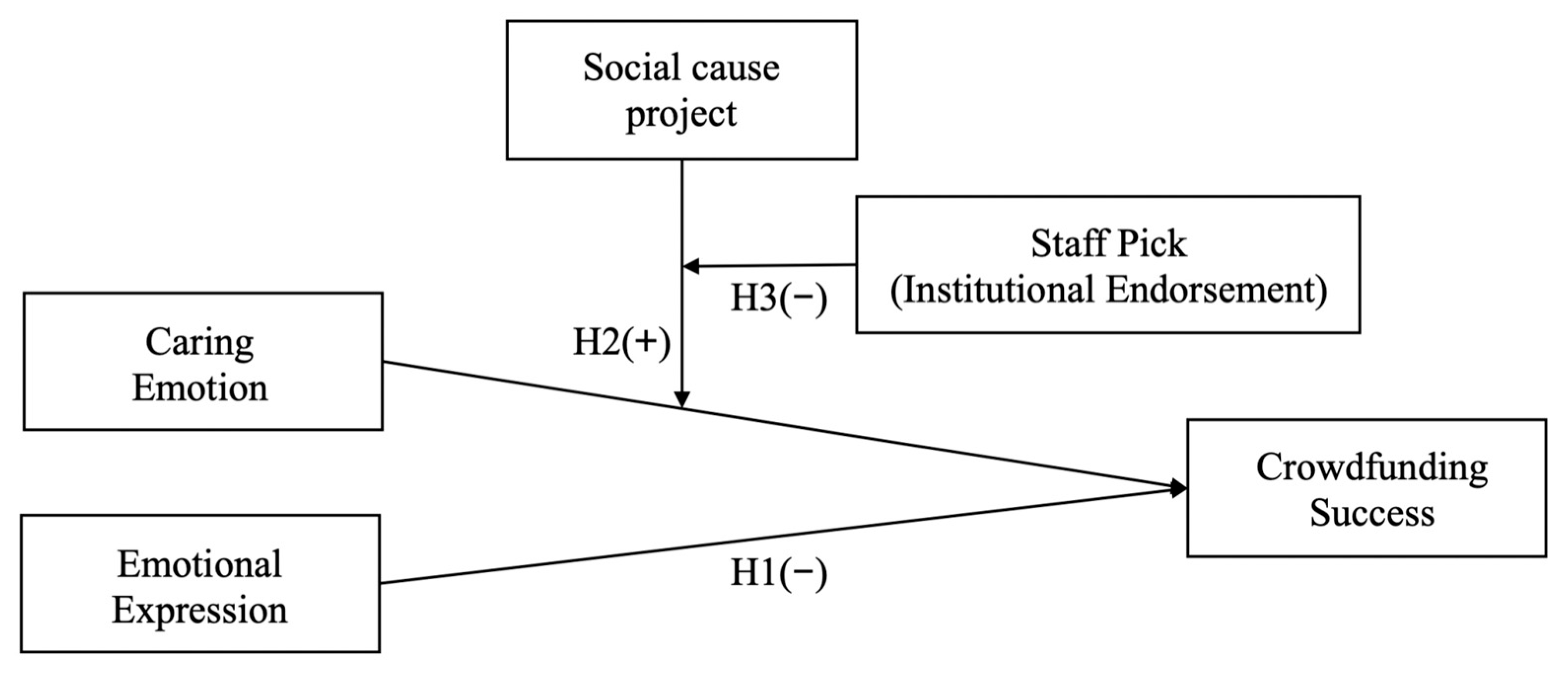
To fill this lacuna in the literature, we explore whether, as the crowdfunding marketplace matures, the positive influence of emotional appeals persists or diminishes. And if they do matter, how organizational identity affects the extent to which emotional appeals benefit the funding success. While previous research often highlights the overall advantages of expressing positive emotions, the reversal of backer expectations and the diversity of project goals show that positive emotions are likely to be persuasive only when they are congruent with the organization’s purpose in the eyes of potential backers and investors. Building on earlier studies of crowdfunding and identity-based signaling, this paper outlines three related yet distinct arguments.
To start with, as crowdfunding becomes more established, it is essential for potential backers and investors to differentiate credible creators from less credible ones, given the many offers they encounter. Therefore, entrepreneurs are increasingly using data-driven, professional communication, focusing on clear plans rather than emotional appeals in their fundraising campaigns [
6,
7,
8]. In this context, general emotional words, like those expressing excitement or optimism, can send mixed messages. They might reflect genuine quality or just the appearance of overconfidence. When audiences are overwhelmed with many projects, they are more likely to trust signals they can verify, such as the creator’s experience, social proof, and recommendations, rather than low-cost emotional appeals [
7]. Therefore, we argue that generic positive language is becoming less effective in professional crowdfunding environments.
Despite the decreasing effectiveness of emotional appeals in the mature crowdfunding market, we propose that certain positive emotions can still be influential if they are congruent with the organization’s overall mission. The identity signaling theory [
9] implies that audiences evaluate the identities and missions of purely commercial and social ventures differently. Therefore, projects with social missions are more likely to attract better funding when they include signals of caring emotions, as these linguistic cues can make social ventures seem more credible and committed, which in turn triggers a prosocial drive. The unique aspect of social ventures is that their goal of benefiting others rather than generating profits is hard to demonstrate upfront. A study by Parhankangas and Renko (2017) notes that, because social ventures are a new and ambiguous category, they tend to use more language to reassure supporters [
7]. However, not all social signals work the same way. For example, Lee et al. (2019) found that excessive use of generic social language can harm success by making a venture appear less professional [
2]. We thus differentiate caring emotion from general social talk, suggesting that caring emotion reflects genuine prosocial motivation, while generic positive emotions merely indicate enthusiasm and do not imply altruism.
Furthermore, we argue that the signaling benefit of caring emotion for more socially-oriented crowdfunding projects may also be influenced by the level of institutional endorsement they receive. We argue that expressing caring emotion is helpful as long as the project lacks support from other authorities, but this effect diminishes once projects are approved by platforms or official bodies. Legitimacy can be grassroots-based, where the community shows trust, or institution-based, where an authority certifies the project. Signaling theory indicates that strong signals, such as third-party endorsements, are usually costly and credible [
6,
10,
11], whereas emotional appeals tend to be inexpensive and often met with skepticism [
6,
12]. Social ventures rely on language to convey their credibility and commitment, which are difficult to prove beforehand, but those with institutional validation address this concern directly [
7]. Therefore, caring emotion loses significance once a project gains institutional approval. Unlike crowd support, such as a large number of supporters that can boost emotional cues through collective action [
4,
6], we contend that expert validation eliminates the need for grassroots emotional appeals.
In this study, we analyzed these conjectures using data from 275,197 Kickstarter campaigns between 2009 and 2020. We rely on EmoBERTa, a sophisticated emotion-classification model, to identify 28 emotions in project descriptions, called blurbs, on Kickstarter. We also employed a logit regression model to validate our predictions. As expected, we found that expressing emotion in crowdfunding descriptions tends to decrease campaign funding success. However, caring emotion alone is helpful in making social ventures successful, whereas other positive emotions, such as admiration, desire, excitement, joy, love, and optimism, do not have the same effect. This shows that it is not just about being positive but about aligning the emotion with the mission. Another pattern we observed was a legitimacy substitution pattern. Caring emotion is especially beneficial for social ventures in projects lacking institutional support. This suggests that emotional authenticity and platform credibility act as substitutes, rather than complements, and the value of signals depreciates as audiences need or are capable of absorbing so many signals.
Our study has three primary contributions to the literature on the impact of emotions in entrepreneurial and organizational endeavors. First, we provide a more specific theory of emotional signaling by demonstrating when and why emotions are persuasive. In contrast to most studies that either assume emotions are always useful or that all positive emotions have the same effect, we demonstrate that the effect is contingent on the degree to which the emotion is congruent with the organization’s identity or mission. We do not say that positive emotions help; rather, we say that caring helps social ventures, but only when institutional validation is limited.
Second, we introduce the concept of signal depreciation to the field of entrepreneurship. The more a signal is used, the less effective it becomes, and this has not been taken into account in earlier studies. This contributes to signaling theory by demonstrating that the cost of a signal is not just the difficulty of its production, but also the frequency with which it occurs, which lowers its value.
Third, we demonstrate that the legitimacy substitution can limit the effectiveness of emotional signals. Previous research has focused on gathering many legitimacy signals to address the challenges new ventures face [
13], and it assumes that these signals tend to interact in mutually reinforcing ways. We find that, in the presence of institutional validation, legitimacy signals replace rather than supplement the benefits of emotional signals. This suggests that legitimacy signals can be substitutes if they demonstrate the same quality. This observation can help entrepreneurs decide when to invest in different forms of legitimacy.
Methodologically, we show the usefulness of fine-grained emotion measurement in organizational studies. Typically, valence (positive/negative) is used in prior crowdfunding research, thereby obscuring theoretically significant differences. The emotion taxonomy we have deployed indicates that emotions with positive valence (caring, excitement, optimism) have different, even opposite, effects depending on mission fit. Recent advances in NLP (natural language processing) make this granularity possible, in turn allowing the testing of subtle conjectures involving emotional communication in entrepreneurship and organizational studies.
The paper continues as follows:
Section 2 examines the literature and develops testable hypotheses.
Section 3 explains our data and methods.
Section 4 presents results.
Section 5 covers implications, limitations, and future directions.
3. Methodology
3.1. Data and Sample
We built a dataset of Kickstarter crowdfunding campaigns through web scraping in 2021. Our Kickstarter project dataset spans the platform’s entire history from its start in April 2009 to December 2020. This includes projects from all geographic regions and categories. This 11-year period lets us capture how the platform evolved from a niche, emotion-friendly marketplace to a more professional funding ecosystem.
We concentrate solely on Kickstarter for several reasons. First, Kickstarter runs a reward-based crowdfunding model, which is fundamentally different from donation-based (e.g., GoFundMe), equity crowdfunding (e.g., AngelList), and peer-to-peer lending (e.g., Prosper). In reward-based crowdfunding, backers participate in quasi-commercial transactions, in which they expect to receive tangible rewards in return for their pledge, not to make charitable donations or investment decisions. This transactional nature means there are unique dynamics of decision-making in which backers are not only considering the credibility of the creator but also the appeal of the product. Second, Kickstarter’s all-or-nothing funding model sets clear criteria for success and great incentives for creators to write good campaign descriptions. Third, Kickstarter’s scale, global reach, and diversity of categories offer enough variation to test our hypotheses across different types of projects and creator backgrounds. While our results may not directly generalize to other crowdfunding models in which other emotional and decision-making mechanisms are at work, the theoretical principles of emotional-mission congruence and legitimacy substitution should apply broadly to evaluative situations that are characterized by information asymmetry.
For each crowdfunding project, we collected key variables of interest, including the project title, blurb (short project description), funding goal, amount pledged, number of backers, campaign duration, launch date, category classification, creator information (such as the number of prior projects created and backed), and staff pick status. We excluded projects with missing information or data corruption caused by web scraping. Our final sample consists of 275,197 projects spanning 396 Kickstarter subcategories, over 11 years (2009–2020), and campaigns from creators worldwide.
3.2. Measuring Emotional Expression with EmoBERTa
Our focus in this study is not just on emotional valence, whether positive or negative, but more specifically on specific emotional categories. To achieve this, we use a RoBERTa-base model fine-tuned on the GoEmotions dataset for multi-label emotion classification called RoBERTa [
17,
25]. RoBERTa (Robustly Optimized BERT Pretraining Approach) is a transformer encoder that improves upon BERT (Bidirectional Encoder Representations from Transformers) through dynamic masking [
26,
27] and larger batch sizes [
25]. The model was fine-tuned on GoEmotions, a dataset of 58,000 Reddit comments manually labeled for 26 emotion categories [
17]. Evaluation on the GoEmotions test split shows an overall accuracy of 0.474, precision of 0.575, recall of 0.396, and F1 score of 0.450, metrics that are consistent with the SamLowe/roberta-base-go_emotions benchmark.
The 26 emotion categories organized by valence and arousal include the following:
Positive emotions (12): admiration, amusement, approval, caring, desire, excitement, gratitude, joy, love, optimism, pride, and relief.
Negative emotions (12): anger, annoyance, disappointment, disapproval, disgust, embarrassment, fear, grief, nervousness, remorse, and sadness.
Ambiguous emotions (4): confusion, curiosity, realization, and surprise.
This detailed emotional taxonomy covers different levels of intensity within valence categories. For example, among positive emotions, approval indicates calm positivity while excitement signifies high-arousal positivity. This level of detail allows us to test emotion-specific effects instead of viewing all positive emotions as the same—a key benefit for our congruence hypothesis, which predicts that caring should uniquely benefit social ventures.
We used this model to classify the emotional content of each project’s main description text (the “blurb”). Description text was extracted exactly as written, without stemming or stop word removal, to keep the natural language structure. Descriptions were shortened to 512 tokens if needed. Each description was processed to produce 28 probability scores. Following common practice for multi-label classification, we used a threshold of 0.5 to convert predictions into binary labels. For each project, the emotion with the highest probability above this threshold was labeled as the “dominant emotion.” Projects with no emotion exceeding the threshold were marked as “neutral.” We created 28 binary indicator variables for regression analysis to maintain mutual exclusivity and avoid multicollinearity. For robustness checks, we also kept the continuous probability scores.
Table 1 displays the frequency distribution of the model’s dominant emotion labels across 275,197 project descriptions. As expected in multi-label emotion classification tasks on natural language text, the distribution is highly imbalanced. “Neutral” is the most common category, accounting for 71.82% of the sample, followed by “desire” (6.78%) and “admiration” (6.18%), reflecting the persuasive and aspirational nature of crowdfunding pitches. In contrast, high-arousal negative emotions like “anger” (0.03%) and “disgust” (0.03%) occur very rarely. Notably, of the 28 original GoEmotions categories, “grief” and “relief” were not identified as the top emotion for any project, leaving 26 observed categories for the subsequent analysis.
3.3. Variable Measurement
Table 2 shows descriptive statistics for all variables in our analysis. Below, we offer detailed definitions and reasons for our measurement choices.
3.3.1. Dependent Variable
Crowdfunding success is a binary indicator equal to 1 if the project raises funds of at least its stated goal by the campaign deadline, and 0 otherwise. This definition aligns with Kickstarter’s “all-or-nothing” funding model, in which creators receive funds only upon reaching their goal [
14]. In our sample, 45.2 percent of the projects (124,388 out of 275,197) were successful.
3.3.2. Independent Variables
From the multiple emotion indicators, we developed the following variables for hypothesis testing. For H1, we created Emotion expression, a binary indicator set to 1 if any non-neutral emotion surpassed the 0.5 threshold and 0 if the project was classified as neutral. This reflects overall emotional expression regardless of specific emotion type. In our sample, 28% of the projects were coded as emotionally expressive, while 72% were neutral, reflecting the professionalization of the crowdfunding market that places less value on emotional appeals.
For H2, we created ‘Caring’ emotion, a binary indicator set to 1 if “caring” was the primary emotion, and 0 otherwise. Caring was the dominant emotion in 1.2% of the projects (n = 3226), making it somewhat rare but still enough for statistical analysis.
We also created binary indicators for six other positive emotions—admiration, desire, excitement, joy, love, and optimism—to serve as falsification tests. If our emotion-mission congruence theory is correct, only caring should have a positive interaction with social mission; other positive emotions should not.
3.3.3. Moderating Variables
Our first moderating variable for H2, Social cause, is a binary indicator for projects with explicit prosocial missions. We identified social ventures through keyword matching combined with manual validation. Projects whose descriptions contained keywords such as “social impact,” “charity,” “nonprofit,” “community service,” “humanitarian,” “social good,” “give back,” or “help [people/community]” were flagged as potential social ventures.
Our second moderating variable for H3, Staff pick, is a binary indicator that is set to 1 if the project received Kickstarter’s “Projects We Love” badge (formerly “Staff Pick” before 2016), which signals platform endorsement. According to Kickstarter, staff selections are based on those projects that demonstrate creativity, innovation, and a clear, compelling presentation, though the specific selection criteria and process are partially opaque. This badge is prominently featured on project pages, greatly increases visibility through featured placement, and serves as an authoritative signal of project quality from the platform’s editorial team. The selection process involves Kickstarter staff reviewing projects and curating those they find particularly noteworthy, though whether this selection process is more about identifying higher-quality projects or about independently conferring legitimacy remains an open question. In our sample, 28,830 projects (10.5%) were staff-endorsed.
3.3.4. Control Variables
In our regression models, we included a set of control variables at the project, creator, category, and time levels, which have been shown to predict crowdfunding success in previous research [
14].
Project Characteristics:
Funding goal: Natural logarithm of the funding goal in USD. The average log-transformed goal is 8.42, which corresponds to about $4500. The untransformed distribution is highly right-skewed (range: $1 to $100 million), making log transformation necessary for regression analysis.
Campaign duration: Length in days. Kickstarter permits campaigns from 1 to 60 days, although some grandfathered projects exceeded this range. The average campaign lasted 33.4 days, a bit longer than the platform’s recommended 30 days.
Description length: Natural log of the word count in the project blurb. The average log-transformed length is 4.61, which equals about 100 words. Blurbs are the main text used to make initial impressions, so length is an important factor in information richness.
Creator Characteristics:
Creator experience is measured by taking the natural logarithm of (1 + the number of previous projects by the same creator). This metric indicates a creator’s experience on the platform. The average value of 0.353 corresponds to about 0.42 previous projects, implying that most creators are first-timers. We use the log(1 + x) transformation to handle zero values and to reduce right skew.
Categorical Controls:
Category fixed effects: 396 Kickstarter subcategory dummies to control for category-specific success rates, norms, and audience characteristics.
Year fixed effects: 11-year dummies (2010–2020, with 2009 as reference) to capture platform evolution, economic cycles, and temporal trends in backer behavior.
Month fixed effects: 11 month dummies (February–December, with January as reference) to control for seasonal variation in campaign launches and backer activity.
3.4. Analytical Strategy and Robustness Checks
We adopted a three-stage empirical approach to test our hypotheses, first examining general effects and then moving to specific contexts. We also conducted several robustness checks to verify our results. All analyses were performed using Stata 17.
As robustness checks, we estimated an alternative dependent variable—the log of the total amount of funds raised—using linear regression to determine whether our findings apply to continuous performance outcomes in addition to binary success. Second, we examined various samples to assess temporal and substantive stability. We compared the results from the early and later periods (2009–2014 and 2015–2020, respectively), and re-estimated models after eliminating projects with goals under $1000 to avoid small-scale or non-serious campaigns skewing results. Third, we used a different operationalization of emotional expression by substituting emotion intensity for binary emotion presence to test whether the results persist when considering the strength, rather than the presence, of the emotional content. Finally, we compared caring with six other positive emotions (i.e., desire, excitement, joy, admiration, love, and optimism) to determine whether similar interaction patterns occurred for other emotions. These analyses are consistent with our main findings.
4. Results
We present our findings in three stages corresponding to our hypotheses. First, we test whether emotional expression generally reduces the likelihood of crowdfunding success (H1). Second, we examine whether caring emotion specifically benefits social ventures through what we theorize as emotional-mission congruence (H2). Third, we test whether this benefit is more pronounced when institutional endorsement is absent, reflecting legitimacy substitution (H3). All models use logistic regression with robust standard errors and include comprehensive controls for project characteristics (funding goal, duration, description length, creator experience), category fixed effects (396 subcategories), year fixed effects (2010–2020), and month fixed effects (February–December).
4.1. Main Effect of Emotional Expression (H1)
Hypothesis 1 predicted that emotional expression in project descriptions would be negatively associated with crowdfunding success.
Table 3 presents logistic regression results testing this prediction. Model 1 includes only control variables, establishing baseline predictors of success (Pseudo R
2 = 0.313). Model 2 adds our focal independent variable, emotional expression, improving model fit (Pseudo R
2 = 0.314).
The results strongly support H1. Emotional expression significantly decreases the likelihood of campaign success (β = −0.237, p < 0.001). Converting to odds ratios, projects that express non-neutral emotion have 21% lower odds of success compared to projects that use neutral language (OR = 0.789, 95% CI = [0.773, 0.807]), while holding all other variables constant. This effect is both statistically significant and practically meaningful; a one-fifth decrease in success probability indicates a substantial disadvantage in a highly competitive crowdfunding market, where overall success rates stay around 45%.
The control variables behave as expected based on previous research. Higher funding goals significantly decrease success (β = −0.294,
p < 0.001), which is consistent with the challenge of attracting larger amounts. Longer campaign durations also lower success (β = −0.028,
p < 0.001), aligning with findings that extended campaigns indicate creator uncertainty [
15]. Description length has a positive impact (β = 0.264,
p < 0.001), implying that informational richness benefits campaigns. Creator experience, measured by the number of prior projects launched, shows a small positive effect (β = 0.037,
p < 0.001), supporting the professionalization hypothesis.
These findings confirm our prediction that emotional language has declined as crowdfunding platforms mature. What once conveyed genuine passion in a developing marketplace now indicates amateurism or desperation in a professionalized system where backers increasingly seek verifiable proof over emotional appeals.
4.2. Emotional-Mission Congruence: The Caring Exception (H2)
While H1 established the general negative effect of emotional expression, H2 predicted a critical exception: caring emotion should specifically benefit social ventures through emotional-mission congruence.
Table 4 presents the results from tests of this interaction hypothesis.
Model 3 in
Table 4 examines the interaction between social cause status and caring emotion. The results strongly support H2. The interaction term is positive and statistically significant (β = 0.598,
p = 0.007), showing that caring language has a different impact on social ventures compared to non-social ventures.
To interpret this interaction, we calculate the net effect of caring for social ventures: β_caring + β_interaction = −0.109 + 0.598 = +0.489 (p = 0.023). This indicates that while caring emotion decreases success by 11% for non-social projects (consistent with H1’s general negative effect, although the magnitude is smaller than the overall emotion_present coefficient), it increases success by 63% (OR = e0.489 = 1.631) for social ventures. This shows a complete reversal—a crossover interaction where caring shifts from being a liability to an asset when it aligns with the mission.
The main effect of social cause status is also positive and significant (β = 0.209, p = 0.009), suggesting that social ventures enjoy a modest legitimacy advantage even in the absence of caring language. This may reflect backer preferences for prosocial projects or selection effects where only higher-quality social ventures launch campaigns. However, the interaction effect magnitude (β = 0.598) is nearly three times larger than the main effect (β = 0.209), indicating that the true advantage of social status emerges primarily when combined with appropriate emotional signaling.
A key theoretical question is whether any positive emotion advantages social ventures (a general “positivity” effect) or if caring is uniquely effective because of mission alignment. To decide between these explanations,
Table 5 shows parallel analyses testing interactions between social cause status and six other positive-valence emotions: admiration, desire, excitement, joy, love, and optimism.
The results are striking: none of the other positive emotions show significant interactions with social cause status. Admiration × social yields β = 0.054 (p = 0.737), desire × social yields β = 0.066 (p = 0.548), excitement × social yields β = 0.023 (p = 0.921), joy × social yields β = −0.308 (p = 0.142), love × social yields β = 0.119 (p = 0.754), and optimism × social yields β = 0.337 (p = 0.251). While optimism shows a directionally positive coefficient of similar magnitude to caring’s interaction effect, it fails to reach statistical significance, and its standard error is 33% larger than caring’s, indicating substantial uncertainty.
This pattern provides compelling evidence for emotional-mission congruence over generic positivity. If any positive emotion sufficed, we should observe similar interactions across multiple positive emotions. Instead, only caring—the emotion that explicitly communicates other-regarding motivation—shows a significant positive interaction with social mission. This specificity strengthens our theoretical claim that signal effectiveness depends on alignment between emotional content and organizational purpose, not merely on hedonic valence.
For reference, caring accounts for only 1.2% of all projects (3226 campaigns), while the six other positive emotions together account for 17.8% (48,242 campaigns). The relative rarity of descriptions of caring emotion in crowdfunding descriptions is theoretically expected: campaign blurbs are generally intended to introduce products, highlight features, and build excitement about rewards, and naturally favor emotions such as desire (6.78%), admiration (6.18%), and excitement (2.45%) over other-regarding emotions such as caring. This is a rare occurrence, however, and strengthens our findings rather than weakens them. The fact that caring alone is associated with a significant interaction, despite its low base rate, whereas more prevalent positive emotions are associated with null effects, highlights its theoretical uniqueness and indicates that our results reflect true mission-alignment effects rather than statistical artifacts. From a practical standpoint, the lack of caring language is an underutilized opportunity for differentiation between social ventures, as discussed in our implications section.
4.3. Legitimacy Substitution: Moderating Role of Staff Endorsement (H3)
Having established that caring benefits social ventures (H2), we now explore boundary conditions: when is this benefit strongest? H3 predicted that caring’s effectiveness would be greater when institutional endorsement is absent, reflecting substitution between emotional authenticity and platform validation as alternative legitimacy pathways.
Table 6 shows stratified analyses estimating the H2 interaction model separately for projects without staff endorsement (Panel A,
n = 246,367; 89.5%) and projects with staff endorsement (Panel B,
n = 28,821; 10.5%). The results strongly support the substitution hypothesis.
For projects lacking staff endorsement (Panel A), the caring × social interaction is strongly positive and highly significant (β = 0.737, p = 0.003). This effect is 23% larger than the pooled interaction reported in H2 (0.737 vs. 0.598), indicating that caring is most valuable precisely when institutional legitimacy signals are absent. In this low-legitimacy context, emotional authenticity becomes a critical differentiator. Backers scrutinize the creator’s language for evidence of genuine prosocial motivation, and caring emotion provides that evidence.
Calculating the net effect: for non-endorsed social ventures that express caring, the combined effect is β_social + β_caring + β_interaction = 0.171 + (−0.076) + 0.737 = +0.832 (
p = 0.001). This corresponds to a 130% increase in the odds of success (OR = e
0.832 = 2.30), representing a significant advantage. To put this into perspective,
Table 6 reports that non-endorsed social ventures with caring achieve a 57.0% success rate, compared to just 36.2% for non-endorsed non-social projects with caring, an advantage of 20.8 percentage points due to mission-emotion alignment.
In stark contrast, for projects with staff endorsement (Panel B), the caring × social interaction becomes statistically insignificant and negatively inclined (β = −0.424, p = 0.512). The coefficient not only loses statistical significance but also reverses its sign. While the large standard error (SE = 0.646, 2.6 times larger than in Panel A) prevents firm conclusions about caring being harmful with endorsement, the main finding is clear: caring’s benefit completely vanishes.
The predicted probabilities in
Table 6 (Panel B) indicate this compression effect. With staff endorsement, success rates are consistently high regardless of caring or social status: non-social projects without caring reach 86.2% success, while social projects with caring reach 84.2% success—a minor 2.0 percentage point difference. When Kickstarter’s editorial team has already endorsed a project, adding caring language offers no extra benefit. Backers trust the platform’s judgment, making emotional authenticity unnecessary.
To formally assess whether the caring × social effect varies across endorsement contexts, we calculated the difference in interaction coefficients: Δβ = 0.737 − (−0.424) = 1.161. Using standard errors from both models, we computed a z-statistic: z = 1.161/√(0.2472 + 0.6462) = 1.161/0.692 = 1.68, resulting in p = 0.093. Although this p-value is just above the typical 0.05 threshold, the effect size is considerable, and the overall pattern remains clear. More importantly, the qualitative pattern strongly indicates substitution: a highly significant positive effect (p = 0.003) when endorsement is absent versus a nonsignificant null effect (p = 0.512) when endorsement is present.
The predicted probabilities clearly show substitution effects. Among non-endorsed projects (Panel A,), social ventures with caring achieve 57.0% success, while non-social ventures without caring reach only 38.1% success—an 18.9 percentage point difference driven by emotional-mission alignment. Among endorsed projects (Panel B), this gap narrows to nearly zero (84.2% vs. 86.2%), with all project types showing similarly high success rates. Institutional endorsement levels the outcomes by providing a common legitimacy signal that overrides creator-generated emotional cues.
4.4. Robustness Checks
We performed various additional analyses to examine the robustness of our results in different specifications, time periods, and sample restrictions (unreported tables).
To ensure that our findings generalize to other types of success outcomes, we re-estimated all models using the log-transformed funding amount as the dependent variable. Linear regression results mostly confirm our main results, but with some nuances.
For H1, emotional expression has a significant effect on funding amounts (b = −0.258, p < 0.001), confirming that the negative effect of emotions extends beyond the probability of success to actual dollars raised. The size is similar to the logistic regression coefficient (−0.258 vs. −0.237), showing consistent effects across both measures.
For H2, the social x caring interaction has a positive but slightly significant effect (b = 0.412, p = 0.108). Although this is just below the traditional significance level, the direction and magnitude are consistent with our main binary outcome findings. The decreased precision is likely due to greater variability in the amount of funding (which varies by orders of magnitude) than in binary success. The p-value of 0.108 means that the effect is there, but that our large sample size is required to detect it reliably.
To assess whether we find consistent results across different phases of platform development, we split the sample into early (2009–2014, n = 62,600) and late (2015–2020, n = 211,804) periods. This split is indicative of Kickstarter’s transformation from an emerging platform to a mature crowdfunding ecosystem. The negative impact of emotional expression (H1) is still significant in both periods (bearly = −0.315, p < 0.001; blate = −0.211, p < 0.001).
To make sure that our results are not biased by hobby projects or unrealistic funding goals, we re-estimated H1, excluding projects with funding goals below $1000 (n = 225,607; 82% of the full sample). The negative impact of emotional expression is still highly significant (b = −0.241, SE = 0.012, z = −19.53, p < 0.001), and its magnitude is almost the same as the full-sample estimate (−0.241 vs. −0.237). This confirms that emotional depreciation does not only apply to casual campaigns, but also to serious commercial projects.
The robustness checks help ensure that our key findings are not a result of model specification, time period, or sample composition. The negative impact of emotional expression (H1) is replicated in continuous and binary outcomes, early and late periods, and restricted samples. The emotional-mission congruence effect (H2) is consistent in direction across specifications, but with lower statistical power when employing noisier continuous outcomes.
5. Discussion
This study develops and tests a contextualized theory of emotional signaling in crowdfunding that explains when and why emotions persuade. Analyzing 275,197 Kickstarter campaigns from 2009 to 2020 using detailed emotion classification, we found that generic emotional expression reduces success on professionalized platforms, but caring emotion benefits social ventures specifically through what we call emotional-mission alignment, an advantage that disappears when platforms provide institutional validation. These findings advance entrepreneurial communication theory by moving beyond universal claims about emotional effectiveness to identify specific boundary conditions that vary depending on emotion type, organizational mission, and legitimacy context.
5.1. Summary of Findings
Our three hypotheses received strong empirical support. First, emotional expression broadly reduces campaign success, with emotional projects achieving substantially lower success rates than neutral projects. This confirms that in contemporary crowdfunding—a professionalized marketplace where audiences evaluate thousands of competing projects—generic emotional appeals have become ineffective signals. Backers prioritize verifiable credentials (creator experience, social proof, institutional endorsements) over affective language that any creator can produce, regardless of quality.
Second, caring emotions interact with organizational mission in distinct ways. In commercial ventures, caring can hinder success by causing identity confusion about whether the organization is a business or a charity. In social ventures, caring enhances success by credibly signaling prosocial motivation and mission authenticity. This pattern illustrates emotional-mission congruence: effectiveness relies not solely on expressing positive emotions in general, but on aligning the specific emotion (caring) with the organization’s core purpose (serving beneficiaries). Importantly, six other positive emotions—admiration, desire, excitement, joy, love, optimism—do not show similar benefits for social ventures, confirming that mission-specific positivity, rather than general positivity, drives effectiveness.
Third, institutional endorsement removes the caring advantage by replacing legitimacy. Projects without Kickstarter’s “Staff Pick” badge see a big benefit from caring, especially social ventures. However, when platform experts endorse projects, this advantage vanishes. This shows that grassroots authenticity (emotional signaling) and institutional validation serve similar roles: both confirm the mission’s authenticity for social ventures. Once the platform offers trusted validation, extra creator-driven emotional signals become unnecessary.
Together, these findings show a gradual narrowing from widespread ineffectiveness to specific exceptions with strict limits: emotions usually fail, except when caring for social ventures, or when institutional validation exists.
5.2. Theoretical Implications
Our main theoretical contribution is to have developed a framework that addresses tensions in previous research by explaining the conditions for and reasons behind emotional persuasion. Early crowdfunding research found positive associations between the use of emotional language and funding outcomes [
4,
16], indicating that passion is generally useful in the business of persuasion in entrepreneurship. Our results show a more detailed pattern than was evident in those previous analyses.
First, prior research made use of broad measures of emotion (e.g., “passion” as a single construct, positive/negative valence categories) that mask important theoretical distinctions. What seemed to be “affect helps social ventures” in previous analyses turns out to be “caring specifically helps social ventures” when analyzed with the 28-emotion classification [
7]. Generic positive emotions such as excitement or optimism are not necessarily beneficial to social ventures; only caring is. This semantic specificity, which is captured by advanced NLP but lost by valence-based approaches, allows for accurate theoretical predictions about emotion-mission alignment.
Second, early studies analyzed small samples (150–6000 projects) from the initial phase of crowdfunding (2012–2015), when emotional diversity was less prevalent. Our large-scale dataset (275,197 projects, 2009–2020) captures the platform’s entire evolution. Strategies that might have worked in the early days, when emotional appeal was new, and there were few competing projects, might not be as effective in competitive, professional markets facing a flood of millions of campaigns.
Third, assuming emotional effectiveness is constant across different ventures and mission types and various institutional contexts hides important factors. Our analyses of interactions show that the same emotion (caring) can have opposite effects depending on organizational identity (benefits social ventures but harms commercial ones) and that even positive effects can disappear in different legitimacy settings (when staff pick is present versus absent). This shifts entrepreneurial communication theory away from universal main effects (“emotions help” or “emotions hurt”) toward specific conditional predictions about which emotions support which ventures under particular circumstances.
Our results introduce emotional-mission congruence as an important mechanism explaining when given emotions continue to serve as valuable signals in spite of general ineffectiveness. Using identity signaling theory [
9], we show that emotions work when they provide diagnostic information about organizational identity that audiences specifically need and cannot easily find elsewhere.
Caring is a unique signal of prosocial, other-regarding motivation—information that social venture backers need to verify mission authenticity. Other positive emotions with the same valence (excitement, optimism, or joy) are indicators of enthusiasm or confidence, but cannot distinguish between prosocial and profit-driven motives. The little things matter: Our task of falsification reveals that the feeling of admiration, desire, excitement, joy, love, and optimism are not fruitful in social ventures, confirming that semantic content and not affective connotations are responsible for effectiveness.
This adds to the signaling theory by emphasizing that the effectiveness of signals is not only dependent on cost and observability [
23] but also on the precision of the diagnosis: whether the signal provides specific information that resolves specific uncertainty. In the case of crowdfunding, generic positive emotions have become cheap talk—costless to produce, easy to mimic, uninformative about quality. But caring retains value in the context of social ventures because it addresses a particular verification problem (is this creator genuinely prosocially motivated?) that other signals cannot address.
The congruence framework also expands the research on authenticity in entrepreneurial communication. Previous studies have looked at how entrepreneurs establish legitimacy through consistent identity claims [
9], but have not theorized or tested which specific emotional expressions match with particular organizational identities. Our crossover interaction, where caring is good for social ventures but bad for commercial ventures, shows that emotional expression is not always good or bad but has to fit the claimed identity. For commercial ventures, caring is associated with identity ambiguity, which suggests either strategic manipulation (inauthentic prosocial rhetoric) or confused objectives (mission drift threatening execution). Only when emotion and mission are in accordance is signaling effective.
Our third contribution arose from pointing out legitimacy substitution as a major boundary condition for emotional effectiveness. Previous studies have focused on aggregating multiple signals of legitimacy in order to overcome the liability of newness [
13]. Rather, it was assumed that credible sources would be strategic complements-that more signals of credibility would be better. Our findings reveal a more complex dynamic at play: institutional validation and grassroots emotional authenticity may serve as strategic substitutes when they affirm the same basic quality.
For social ventures, caring emotion (grassroots authenticity) and staff picks (institutional validation) are responses to one and the same kind of uncertainty: is the creator really motivated by the prospect of a prosocial mission? When institutional validation is lacking, caring is a source of critical reassurance, leading to the significant positive effect seen among non-endorsed social ventures. However, once platforms have authoritative certification via editorial vouching for, caring signals are redundant. The bases of audiences make us rely on reliable third-party evaluation rather than investing any cognitive effort in decoding emotional language.
This substitution pattern has several theoretical implications. First, it indicates that legitimacy pathways do not simply add up; instead, they overlap in function. Entrepreneurs need to choose which paths to take: grassroots strategies that emphasize emotional relationships, or institutional strategies that seek official endorsements. Second, it means that the value of additional signals depends on the presence of other signals. Caring is very valuable when it is the only form of quality assurance, but its importance is reduced when platform endorsements are also available. Third, it highlights strategic sequencing: appeals to emotion may be most helpful early in the life of a venture, before an institutional stamp of approval is obtained, and then become less necessary as ventures mature and attract external recognition. This adds to institutional theory by showing that sources of legitimacy can crowd out rather than reinforce one another. While multiple weak signals may complement [
24], strong institutional signals can substitute for weaker signals from individuals by offering authoritative answers to the same questions audiences are trying to resolve.
5.3. Practical Implications
Our findings challenge the common belief that founders should always “show passion” to attract support. For most campaigns, whether commercial ventures, regardless of staff pick status, or endorsed social ventures, emotional restraint is more effective than emotional expression. Creators should focus on clear plans, timelines, budgets, team credentials, and execution details rather than emotional appeals. Professional, data-driven communication conveys competence and alleviates uncertainty better than emotive communication, which audiences have learned to filter out.
The exception, using caring language in social ventures without institutional backing, points to a strategic opportunity for mission-driven groups to differentiate themselves by making authentic emotional appeals. Social ventures without platform support face credibility issues: supporters cannot verify the authenticity of the mission through third-party validation. Genuine emotion is an indicator that prosocial motivation is real and not a marketing ploy. However, this approach requires accuracy: vague positive emotions (excitement, optimism) do not work, and caring can even be detrimental to commercial ventures. Creators must carefully consider whether their organizational identity is truly consistent with their prosocial goals before using caring language.
Given that caring emotion is only used in 1.2% of campaigns, founders of social ventures should see this scarcity as a strategic opportunity rather than a constraint. In a marketplace where the majority of campaigns are based on generic positive emotions such as excitement or desire, authentic caring language can be a powerful differentiator for mission-driven projects. However, this strategy needs to be carefully executed. Founders should make sure that caring language is not just a shallow appeal, but a genuine prosocial commitment, because audiences may be good at detecting inauthenticity. Specific linguistic choices, such as highlighting beneficiary welfare, concern for community needs, or how the project solves social problems, are more likely to resonate than prosocial rhetoric. Additionally, founders should calibrate their emotional expression depending on the status of their legitimacy: caring language has the highest returns for social ventures that have not yet received institutional endorsement, while endorsed projects should focus more on execution details and deliverables.
Even for social ventures, the caring advantage has definite limits. Once projects have staff picks or other institutional endorsements, emotional signals are no longer necessary. At this stage, communication should shift from demonstrating the authenticity of the mission (already established by the platform) to demonstrating the project’s ability to execute and its viability. Entrepreneurs should know that different phases of legitimacy require different communication strategies: emotional authenticity is important before endorsement; details of execution are important after endorsement.
For crowdfunding platforms, our results indicate the impact of editorial policies on communication patterns and market efficiency. Staff pick endorsements strongly influence the signals that matter: endorsed projects succeed regardless of emotional content, while non-endorsed projects are heavily dependent on emotion-mission alignment. This leads to tension between the promotion of quality projects and informational efficiency.
On one hand, platforms try to detect and present good projects in order to establish a reputation and attract backers. On the other hand, the informational value of creator-generated signals may inadvertently be diminished by the wide-based endorsements. When quality is certified by platforms, backers may no longer make such a consideration, and this might create larger information gaps for such projects, which might not have an endowment. If there are a few projects that are staff picks, most of them have their own signaling strategies, but endorsements can set audience expectations, and projects that lack endorsements are perceived to be worse in quality by comparison, even when their actual quality is the same.
Platforms may consider a number of responses. First, transparent criteria should be considered: it is helpful for backers to know what additional information they need to look for, but transparent criteria are necessary for that (what, specifically, are staff picks certifying?) Second, instead of a binary feature/not-featured, platforms could implement multiple levels of validation (e.g., “mission verified”, “team verified”, “prototype verified”) that could replace certain signals while leaving other dimensions for creator signaling. Third, dynamic endorsements should be used. Timing endorsements strategically could help sustain early-stage signaling dynamics and offer a form of authoritative validation.
5.4. Limitations Future Research Directions
Several limitations need to be discussed, some of which also suggest interesting directions for future research. First, our dataset covers the period from April 2009 to December 2020, so it stops before the full impact of the COVID-19 pandemic on the dynamics of crowdfunding could be observed. Emerging research indicates that the pandemic may have changed the patterns of emotional expression in campaign narratives, which may have made people more receptive to caring and community-oriented appeals as a collective crisis triggered prosocial motivations. Future studies should expand this analysis to post-pandemic time periods to determine if the emotional-mission congruence effects we documented were sustained, enhanced, or altered during and after the global health crisis.
A concern with observational data is that emotional appeal might be linked to unobserved project quality; poor-quality projects may use emotional appeals when they lack significant merits. Several factors help address this concern. Our control variables, ranging from funding goal, duration, description length, creator experience, to 396 category fixed effects, capture many plausible quality indicators. Moreover, if emotion were simply a reflection of desperation, we would expect consistently negative effects across different types of projects. Instead, we observe positive effects of caring in social ventures, suggesting that selection alone cannot explain this crossover pattern. The substitution effect (H3) also contradicts a pure selection explanation: if emotional projects were all low quality, staff endorsement should increase, rather than decrease, the caring advantage. Nonetheless, experimental manipulation would better establish causality. Randomly assigning emotional language to descriptions may more effectively identify causal effects, although such approaches raise ethical issues of deception in live crowdfunding environments.
Additionally, attributing each project a single dominant emotion, while methodologically necessary for the creation of mutually exclusive categories for use in regression analysis, might be an oversimplification of the complexity of campaign narratives. Real crowdfunding descriptions tend to have mixed emotional profiles where more than one emotion is present at the same time, and different decision-making processes may be activated at the same time by these different emotional cues. Our robustness checks using continuous probability scores address this concern to some extent by retaining intensity information, but future research could examine patterns of emotional co-occurrence, investigating whether particular combinations of emotions (e.g., caring paired with optimism versus caring paired with urgency) have different effects.
Our measures are based on EmoBERTa’s classifications, which, although state-of-the-art, may introduce measurement error. Several features make it more confident. EmoBERTa is built on human-annotated data, which imposes human judgment, and we are relying on the top emotion definition from every single project to reduce the noise level in our project, differentiating it from low-confidence classifications. The fact that results are specific (that caring can work, but six other positive emotions cannot) also suggests that we are picking up meaningful distinctions and not random variation. While EmoBERTa focuses on perceived emotional content rather than the founder’s felt emotion, if the model misclassifies, then the estimates will not be biased towards zero, and thus our significant findings are conservative. From an audience perspective, perceived emotion may ultimately be more important than felt emotion as persuasion rests on what backers perceive rather than what founders feel.
A related measurement concern is the external validity of the emotion classification of EmoBERTa. The model was fine-tuned on GoEmotions, a dataset of Reddit comments, which may be stylistically different from crowdfunding campaign descriptions. Reddit comments are more conversational and reactive, while Kickstarter blurbs are marketing texts aimed at persuasion. While the GoEmotions dataset contains a variety of topics and emotional expressions, and while our focus on perceived rather than felt emotion is well in line with audience-centric persuasion research, we cannot exclude the possibility that some emotions are systematically misclassified in the crowdfunding context. Future research could validate these classifications by having human raters independently code a subsample of project descriptions and compare the raters to model predictions. Such validation would help to build confidence in the use of NLP-based emotion measurement for organizational research.
Our findings are specific to the institutional context of Kickstarter, and different platforms with varying norms or audiences may display different dynamics. Equity crowdfunding sites like AngelList tend to attract sophisticated investors who may be even more dismissive of emotional expression than reward-based backers. Donation-based sites such as GoFundMe might be more conducive to emotional sharing since donors often have altruistic motives. However, Kickstarter’s global reach and broad categories enhance external validity, and the core theoretical mechanisms of signal depreciation, identity/mission-emotion congruence, and legitimacy substitution are likely applicable to other settings in which audiences evaluate organizational claims amid uncertainty.
Our analysis also focuses on textual emotional expression in campaign blurbs only, but crowdfunding campaigns are multimodal in nature. Videos, images, and visual design elements also convey emotional content and may interact with textual cues in complex ways. A campaign video with one of the founders passionately discussing beneficiaries may amplify or replace caring language in the written description. Future research should investigate these multimodal dynamics, perhaps with the help of computer vision and audio analysis tools, in conjunction with NLP, to capture the range of emotional communication in crowdfunding.
Future research should explore these mechanisms in contexts such as equity crowdfunding, peer-to-peer lending, accelerator pitching, and other evaluative environments.
Our research design prescribes one category of emotion dominance for each project, with mutually exclusive classification, despite the fact that multiple emotional descriptions are often found in the descriptions. A campaign may begin with caring but later display excitement. By paying attention to the main emotion of each project, we approximate the dominant impression that audiences probably form. Robustness checks with continuous probability scores lead to grippy patterns, which help achieve more confidence. However, emotional sequences or mixed-emotion profiles might capture important nuances that our dominant emotion analysis approach misses.
Our theoretical framework posits emotional-mission congruence as a general principle, but we empirically tested only one particular instantiation: caring emotion in line with social cause missions. This begs the question of whether there are other emotion-mission pairings that might exhibit similar congruence effects. For example, could excitement be especially useful for entertainment or technology projects in which innovation and novelty are important criteria for evaluation? Could admiration be particularly effective with projects led by creators with demonstrated expertise? While our tests of falsification revealed that six of the positive emotions did not have beneficial effects on social ventures—consistent with the specificity of caring—we did not systematically examine alternative congruence hypotheses across Kickstarter’s diverse category structure. Future research could develop and test a more general taxonomy of emotion-category or emotion-mission alignments, potentially identifying multiple congruence patterns, depending on the type of project.
While our notion of emotion-mission congruence predicts which emotion should benefit social ventures, we have not directly tested the psychological mechanisms through which caring increases success. Caring may boost perceived trustworthiness, signal authentic dedication to the mission, or create tighter affective relations with backers. More process-based approaches, either in the form of mediation analyses or experiments, which can measure trust, authenticity perceptions, and affective reactions, could be helpful in understanding these pathways. Campaign success is also a flawed proxy for persuasion success. Some failed campaigns may have produced positive spillovers, which we know in the future in the form of future pledge sub-volume, word of mouth, and follow-on behavior, that our waste basket measure cannot account for. Although results using continuous funding outcomes are consistent, richer measures of performance, such as post-campaign trajectory or long-term venture survival, would strengthen inferences.
Our cross-sectional design captures emotion expressed in project descriptions only at campaign launch, leaving unanswered questions about how emotional expression develops over the course of a campaign or across a founder’s portfolio. Founders may modify their use of emotion based on real-time backer feedback or previous failures. Longitudinal methods tracking within-founder variation could shed light on learning processes and provide clearer insights into causal effects. Additionally, our model implicitly assumes an “average backer,” but backers likely differ in their receptivity to emotion. Early adopters or individuals with prosocial motivations may respond positively to caring, while experienced backers of commercial ventures might react negatively. Heterogeneous treatment effect models could uncover these audience-specific patterns and enable more targeted communication strategies.
Although our taxonomy of emotion makes more detailed distinctions than in the prior research, emotions often occur concurrently and sequentially rather than as isolated categories. Future research could investigate the common emotion pairings, for example, “caring plus optimism” or “caring plus sadness,” and explore whether these pairs yield interaction effects. Caring may be particularly effective when it is combined with confidence signals, for example, but may be less effective or even counterproductive when combined with signs of desperation. Cross-platform and cross-cultural comparisons would also be useful to determine the generality of these findings. Since norms of emotion vary across organizational contexts and cultural backgrounds, collectivist cultures may value other-regarding caring more than individualist cultures, and norms on sites like AngelList, Kiva, or Prosper may differ significantly from those on Kickstarter. Comparative studies may help to expose the limits and cultural factors that affect these effects.
Finally, although we report that staff endorsement moderates the caring effect, the exact mechanism by which Kickstarter selects projects for endorsement is partially opaque. If the staff picks are mostly identifying higher quality projects, then our moderating effect may be reflecting quality differences, and not pure legitimacy substitution. Alternatively, if staff endorsement is an independent source of legitimacy regardless of underlying quality, then our interpretation of substitution dynamics is strengthened. Future research with access to platform data on selection criteria, or natural experiments exploiting changes in endorsement policies, could help to disentangle these mechanisms. Additionally, it would be interesting to investigate whether institutional endorsement moderates the negative effect of emotional expression more generally—not just the caring × social interaction—to get a more complete picture of how platform validation affects the signaling landscape in crowdfunding.
Finally, there is a deeper probe into why caring resonates with social venture audiences to be done. Insights from neuroscience point to the possibility that caring language activates empathy-related reward circuits, pointing to promising directions for experimental work using psychophysiological measures. Our framework also assumes that caring indicates genuine prosocial motivation when it is consistent with the mission, but the audience still needs to be able to distinguish between genuine caring and manipulative appeals to emotion. Future research might help identify linguistic cues that distinguish between genuine caring and strategic or exaggerated caring and can offer both theoretical knowledge and practical advice to founders who want to communicate mission-driven intentions without provoking skepticism.
6. Conclusions
Analyzing 275,197 Kickstarter campaigns over a decade, we find that there is generally a decrease in success when emotional expression is high (−21%), reflecting a decline in the value of emotional signals as platforms mature and audiences become more professional. The typical advice to founders to “show passion” is, for most ventures, counterproductive in the current crowdfunding landscape. However, emotional-mission congruence is an important exception. Caring emotion, unique in its ability to communicate prosocial, other-regarding motivation, raises the value of social ventures by 63% and hurts commercial ones. This crossover pattern, which was not found with six other positive emotions (admiration, desire, excitement, joy, love, or optimism), demonstrates that the effectiveness of signals depends on an alignment between the content of emotion and organizational identity. Emotions are not necessarily good or bad, but they are tools that audiences use to assess the motivation behind founders and confirm claims of identity. Furthermore, caring has a positive effect on the social ventures that are not endorsed by institutions, but this effect vanishes completely when the staff of the platform validates projects. Emotional authenticity and institutional validation, therefore, serve as strategic substitutes—one strong signal of legitimacy is enough, and further signals of the same underlying quality are redundant.
These findings advance theory by explaining when and why emotions are persuasive, taking us beyond the rather diffuse claims about the importance of passion to identify specific combinations of emotions and missions that are effective. They challenge practitioners to tailor communications strategies to organizational identity and legitimacy environments instead of generic appeals to emotions. Additionally, they remind us that signals change: what worked yesterday (emotional expression in early crowdfunding) may not work today (emotional restraint in professionalized platforms) as markets develop and audiences become more informed.
The more general lesson is not just about crowdfunding. Entrepreneurial communication occurs in a network of signals in which strategies succeed or fail depending on the sophistication of the audience, institutional context, and organizational identity. As digital platforms grow and the ability to communicate professionally using an AI tool becomes more accessible, showing emotions in a way that is authentic to the individual may be one of the last remaining ways of gaining a competitive edge—but in a strategic and mission-aligned manner and at the right time in relation to institutional validation. The entrepreneurs who succeed will be those who know that displaying the right emotion to the right audience at the right time is far more important than simply displaying emotion.