
Article

The Effect of eWOM Sources on Purchase Intention: The Moderating Role of Gender

1
Department of Business Management and Marketing, Faculty of Business and Economics, Institute of Social & Applied Sciences, Girne American University, Mersin 10, Girne 99300, Turkey
2
Department of Marketing, Girne American University, Mersin 10, Girne 99300, Turkey
*
Authors to whom correspondence should be addressed.
J. Theor. Appl. Electron. Commer. Res. 2026, 21(1), 37; https://doi.org/10.3390/jtaer21010037
Submission received: 2 December 2025 / Revised: 6 January 2026 / Accepted: 7 January 2026 / Published: 14 January 2026
(This article belongs to the Topic Digital Marketing Dynamics: From Browsing to Buying)

Abstract

The electronic word of mouth (eWOM) has emerged as a communication tool that significantly influences consumers’ attitudes and purchasing behavior in the online market. Research indicates that the effect of eWOM sources, such as (strong ties, weak ties, and influencers) varies in terms of perceived value components (price, quality, emotional, and social value) and purchase intention, particularly with regard to gender. This study, which is based on the SOR framework; examines the role of eWOM as a stimulus affecting student responses and considers the mediating role of perceived value components and the moderate effect of gender. A sample of 901 students from Westbank universities was analyzed using Smart PLS software. The findings reveal that strong ties and influencer eWOM are positively associated with perceived value components and purchase intention, while weak tie eWOM does not directly correlate with purchase intention. Mediation analyses show that perceived quality and social value act as mediators of purchase intent towards eWOM sources, while emotional value specifically mediates strong relationships and influencers. Notably, price value exerts only a mediating effect on purchase intention when communicated through influencers, highlighting the unique role of the influencer in shaping price perceptions and its broad impact on all components of perceived value. Gender differences were observed in students’ responses to eWOM content; particularly in terms of price, quality, and emotional appeal but not in terms of social factors. The outcomes of this study underscore the significance of considering both the source of the message and the characteristics of the audience when formulating targeted marketing strategies.

1. Introduction

Recently, consumers in the digital marketplace have become increasingly reliant on reviews and recommendations provided by other consumers through online platforms and social media to help them evaluate competing products and make the right decision based on information and experiences shared by previous consumers [1,2]. As a result, social media has turned into a reliable information source that helps to form attitudes and behaviors of consumers prior to purchase, offering them personalized and interactive content that affects their intention to purchase [3,4,5].
Compared to traditional marketing methods, marketing via social media demonstrates greater persuasive power and authenticity, as it is typically created by satisfied consumers rather than by the businesses themselves [6,7,8]. This shift has enhanced the shopping experience by integrating purchase opportunities directly into the context of social media, which allows consumers to instantly compare products and adopt deep engagement [9,10].
Electronic word of mouth (eWOM) is viewed as one of the main tools in this transformation, which is defined as “any positive or negative statement made by actual, potential or former customers about particular product or company, and is shared and disseminated online to a widespread audience” [11]. Communication with consumers through eWOM helps them to obtain more reliable information, which contributes to reducing hesitation, and thus contributes to shaping consumers’ attitudes and intentions towards purchasing, because it helps them to evaluate the perceived value (PV) of the product before making a purchase decision [12,13,14]. This is because of its ability to reach and communicate opinions and reviews online, empowering consumers to evaluate the product and the value that can be obtained, all through shared past experiences and collective assessments [7,15,16]. Recent studies have shown that the nature of an eWOM source significantly affects its credibility and the extent of its persuasive impact [5,14,17,18]. There are various sources of eWOM including strong ties (Stie) from close friends and family, weak ties from acquaintances who are rarely contacted (Wtie) [19,20], and influencers with trustworthy, well-known, and experienced social media personalities [21,22,23]. These all affect consumer perceptions and behavioral intentions in different ways [19,24,25]. Among these sources, influencer eWOM has gained a special influence due to influencers’ authenticity and expertise, who often combine their personal and professional credibility to influence consumers’ PV and brand relevance [23,26,27,28].
In the same context, the role of gender has arisen as an intermediary in affecting consumers’ responses to marketing communications. Empirical research proposes a systematic difference between females and males, particularly in information processing, emotional sensitivity, and cognitive assessments [29,30]. Numerous studies have indicated that females are generally more responsive to emotional and experiential cues, while males tend to prioritize functional and social aspects such as price and social status [31,32,33,34]. Thus, these findings confirm that the presence of gender differences can influence the extent of relations between eWOM sources, PV components, and purchase intention (PI) [35,36,37].
Despite the growing academic interest in the topic of eWOM, there are still important research gaps that have not been addressed. Among these gaps is the fact that previous studies have not adequately addressed the different sources of eWOM (Stie, Wtie, and influencer) and their separate effects on PV components including price, quality, emotional and social value, and how these sources correlate and influence PI in turn.
Therefore, this study provides a comprehensive framework that systematically compares the role of different eWOM sources as a central explanatory mechanism influencing purchase intention in terms of their interrelationships and effects within a unified model, their effect on PV components, and how these sources, in turn, affect PI. This study expands the existing literature on eWOM by highlighting the variability that impacts the effect of each source on PI and enriches the literature by demonstrating that their effects are conditional rather than uniform.
Moreover, given that gender is often descriptively studied or seen as a controlling factor, its role as moderator in the effectiveness of eWOM remains noticeably unexplored and has not been sufficiently addressed across these relationships. This research contributes to ongoing theoretical debates by including gender as a moderating variable, offering a more accurate and context-sensitive understanding of the eWOM sources effect. It also contributes to current knowledge by examining socio-gender analysis as a moderator across multiple eWOM sources toward PI, providing a clearer understanding of how male and female consumers interact and respond differently to Stie, Wtie, and influencer eWOM.
Studying these gaps contributes to developing theoretical understanding in the field of digital marketing and enables marketers and decision-makers to design more effective digital marketing strategies.
In order to make a concrete contribution, this study aims to develop an integrative model that examines the relationships between eWOM sources through the mediating role of PV components and PI, while investigating the moderate role of gender. This is done by relying on the stimulus, organism, and response (SOR) framework [38] to understand and analyze online consumer behavior in order to make practical contributions by understanding the mechanisms by which eWOM affects PI.
Hence, the purpose of this study is to develop and validate an integrated model based on the framework of SOR to investigate the diverse effects of eWOM sources on consumer PV components and PI. Furthermore, this study also examines the mediating role of PV components and the moderate role of gender in these interdependences. Consequently, the research investigates the following questions:
RQ1: Do distinct sources of eWOM (Stie, Wtie, and influencer) exhibit significant correlation with consumers’ PV components and PI?
RQ2: Do the PV components mediate the associations between eWOM sources and PI?
RQ3: Does gender moderate the associations between the components of PV and PI, as well as between eWOM sources and PI?

2. Theoretical Background and Development of Hypothesis

The SOR framework proposed by [38] consists of three elements: stimulus (S), organism (O), and response (R). Aims to explore the effect of environmental stimuli on human responses [39]. This model has been widely applied in the context of marketing, to explain the effect of external stimuli on the internal perceptions of the organism, which subsequently trigger the response [40,41].
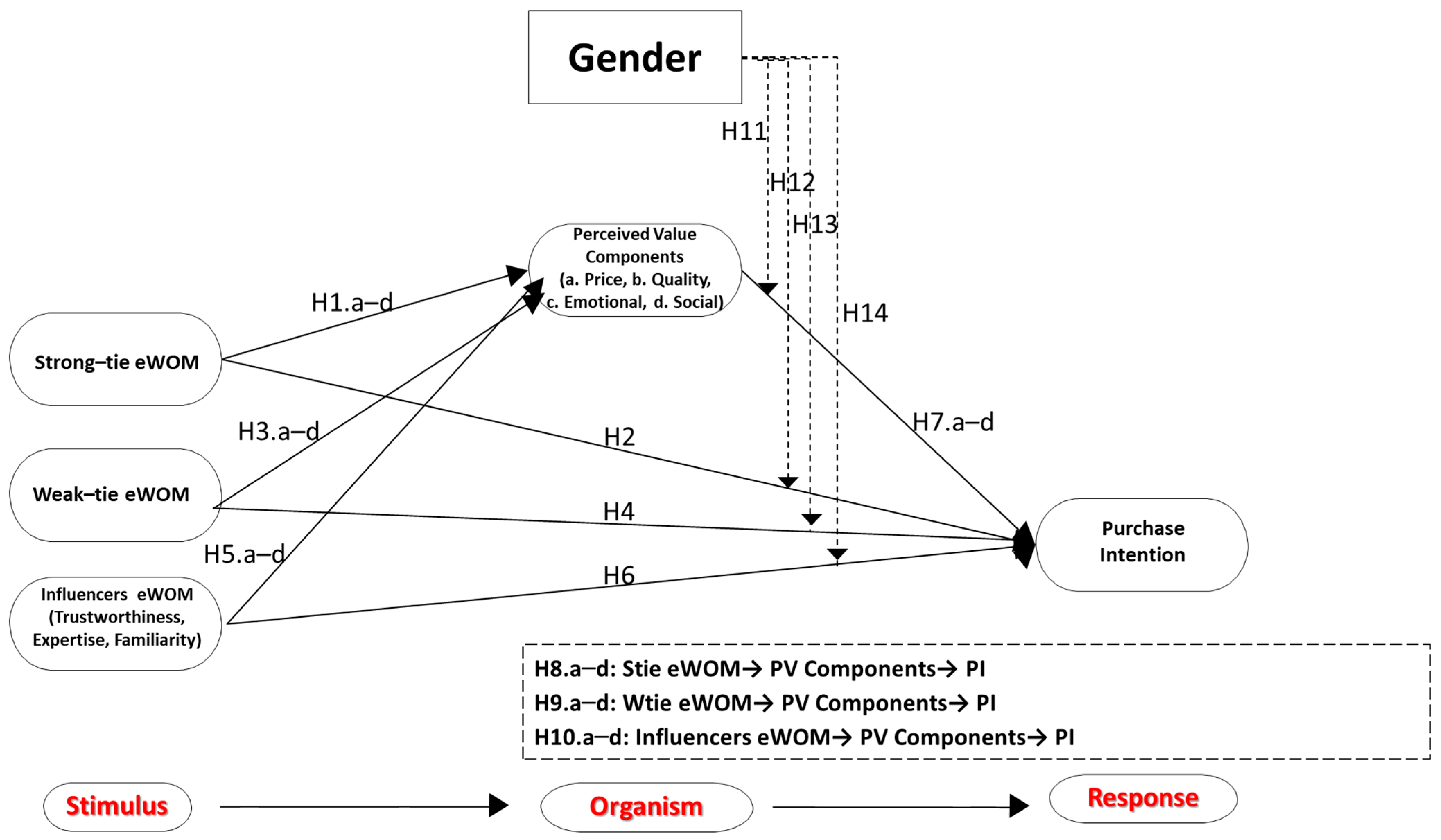
Building on the SOR model, this study conceptualizes different eWOM sources—namely Stie, Wtie, and influencer eWOM—as the stimuli (S) that trigger consumer responses. The PV components are viewed as the organism (O) that captures consumers’ internal evaluations and psychological processes. The response (R) is represented by consumers’ PI, which reflects the final behavioral outcome. Additionally, gender is introduced as a moderating factor influencing the strength of the paths between the organism and the response, as well as between stimuli and response.

2.1. Stie eWOM

Word of mouth (WOM) is a powerful driver of consumer purchasing decisions because personalized recommendations usually carry more credibility and importance to consumers in comparison to traditional advertising [42,43]. The importance of eWOM has emerged with the advent of digital platforms; they have given consumers access to abundant reviews and opinions that help them feel more confident before making their purchasing decisions [11,44]. In this context, several sources of eWOM have emerged, including Stie eWOM, which expresses information from family members, close friends, or trusted peers, and its impact has been evident because individuals usually place trust and involvement in close social connections compared to Wtie [45,46,47,48,49].
Previous research has proven the role of Stie eWOM in affecting consumers by familiarizing them with product features by an evaluation based on the prior experience of a particular product, and by sharing information related to product quality, functionality, and price fairness [19,50,51]. This affects their overall PV, which reflects the tradeoff between what is received and what is given [52,53]. PV is consistently regarded as a critical determinant of PI [54,55,56]. However, findings are not entirely conclusive: while some studies confirm that Stie eWOM positively affects both PV and PI [57,58,59,60], others suggest that the effect on PI may occur indirectly through PV rather than directly [19,61,62,63]. Another group of researchers found that Stie eWOM characteristics affected recipients’ behavior, but their effects varied across different stages of the decision-making process. It was reported that relationship strength increased awareness, and cognitive proximity increased recipients’ interest; however, they found that demographic similarity had a negative impact on decision-making stages [64,65]. This inconsistency would suggest that the mechanism of Stie eWOM’s effect on consumer behavior still needs to be studied.
In terms of the strength of the relationship and its ability to stimulate the behavior of consumers, a number of studies have shown that consumers perceive the information from Stie to be authentic because of the trust that comes from having a deep relationship and frequent interactions [49,66,67]. Thus, having positive recommendations from Stie leads to increased PV and increased possibility of purchase, while negative contributions from Stie can have a role in reducing the product evaluation and the probability of purchase [68,69,70]. When comparing Stie to other eWOM sources, a number of studies have shown that consumers trust the information and recommendations from Stie eWOM more than other sources, and that their trust in that source affects PI [71,72,73]. These theoretical implications of the findings are discussed by [14]; this study reported that a credible source of information is easier for an individual to accept, whereas if the source is unreliable and unknown, its content may be difficult to accept until it becomes more familiar to the recipient. Therefore, the strength of the connection to the information source plays a positive role in content acceptance [74].
In summary, the literature suggests that Stie eWOM is likely to play a dual role in influencing consumer perceptions of value across its various components (price, quality, emotional, and social) and directly affecting PI. However, given the mixed results, more empirical research is still needed to detangle the direct and indirect pathways through which Stie eWOM affects consumer PI. Accordingly, the following hypotheses are proposed:
Hypothesis 1.
Stie eWOM affects PV components (H1.a Price), (H1.b Quality), (H1.c Emotional), (H1.d Social).
Hypothesis 2.
Stie eWOM directly affects Customer’s PI.

2.2. Wtie eWOM

Unlike Stie, which relies on close personal relationships, Wtie eWOM from acquaintances or distant connections can provide access to a broader range of information and diverse perspectives [74,75]. Previous studies have shown that Wtie is often more effective at disseminating new information at scale, thus offering consumers broader brand insights and user experiences that can help evaluate a product or service [64,76,77,78,79].
Although some research indicates that information from Stie eWOM has a greater effect on PI than that from Wtie sources, others suggest that some information from Wtie sources has been rated as more useful and influential despite its lack of personal contact [47,76,80]. Therefore, the divergence in views regarding Wtie eWOM means that there may be stronger influences on some components of PV related to price and quality, compared to Stie sources, indicating that while individuals typically rely on information from Stie, they do not necessarily rate this information as more reliable or important than that obtained from Wtie eWOM sources, regardless of their proximity [76].
Furthermore, the objectivity and diversity of Wtie eWOM enable consumers to access information that can be considered less biased and more objective [81], especially when it comes to functional attributes such as cost and quality [82]. At the same time, this informational feature may come at the expense of emotional resonance and trust, which are usually found in Stie interactions. While what distinguishes Wtie is that it can increase credibility through social proof and the possibility of exposure to diverse opinions, they may not provide the same level of affective assurance that Stie offers [83,84,85,86].
Moreover, Wtie contributes significantly to affecting social value by broadening consumer perspectives and enhancing the products reliability through widespread endorsement [25,87,88]. However, the ability of Wtie to enhance emotional value remains limited, as the relationship between consumers and Wtie sources lacks a deep relational connection and credibility, as its content remains difficult to stimulate customer behaviors and responses until it becomes more familiar to the recipient due to the lack of connections and trustworthiness [14,74,85,89,90].
These findings suggest that Wtie eWOM may have a limited impact on PI by giving consumers an opportunity to obtain information related to price fairness and product credibility, while at the same time this Wtie source lacks emotional dimensions.
Thus, the previous literature suggests that Wtie eWOM can influence consumer perceptions of value across multiple components such as price, quality, and social value, with a weaker impact on emotional value compared to Stie. This means that Wtie eWOM can directly affect the PI—but weakly; despite this, the following hypotheses are proposed:
Hypothesis 3.
Wtie eWOM affects PV components (H3.a Price), (H3.b Quality), (H3.c Emotional), (H3.d Social).
Hypothesis 4.
Wtie eWOM directly affects customer’s PI.

2.3. Influencer’s eWOM

Most consumers have come to rely on social media influencers as a prominent source of information before making purchasing decisions; they provide personalized information and engaging content that can influence consumer perceptions and PI [23,91,92]. Relying on the theory of Source Credibility [14], influencers are perceived as trustworthy, knowledgeable, and have more persuasive power than others in their audience, and this stimulates both engagement and PI [5,18,93].
Empirical evidence suggests that influencer marketing typically achieves higher visibility and stronger brand effect compared to traditional marketing methods, due to the originality and perceived nature of influencer content [94,95,96,97]. However, the ability and effectiveness of influencers to affect consumer behavior depends crucially on aligning the influencer’s values, emotions, and experience with those of their followers, so that misalignment or low credibility may weaken their ability to stimulate consumers PV and PI [14,92,98,99,100,101].
Influencers typically use hands-on approaches to product review and promotion, with a focus on quality, ease of use, and suitability for followers’ needs, and this practical and transparent approach fosters trust and reflects on the PV of the products that are being marketed, making it easier for consumers to make informed decisions [94,102,103,104]. In line with the theory of reasoned action, marketing messages affect consumers’ attitudes toward products, which are affected by perceptions of price, quality, emotional appeal, and social acceptance; products perceived as valuable are more likely to provoke positive PIs action [105,106].
Furthermore, when the content provided by an influencer is highly aligned with their audience’s beliefs and cultural values, it encourages trust and engagement with them. This maintains the effectiveness of the role of eWOM in stimulating purchasing behavior [26,107,108,109] by generating a social proof that collectively reinforces perceived quality and emotional connection [110,111,112,113].
In conclusion, the literature demonstrates that influencers’ eWOM acts as a significant driver of consumers’ PV components, ultimately affecting PI. The strength of this effect is linked to the compatibility between the values of influencers and the expectations of followers, reinforcing the relevance of including influencers as an independent variable in eWOM studies.
Hypothesis 5.
Influencers’ eWOM affects PV components (H5.a Price), (H5.b Quality), (H5.c Emotional), (H5.d Social).
Hypothesis 6.
Influencers’ eWOM directly affects customer’s PI.

2.4. PV

PV expresses the consumer’s overall evaluation of the benefit of a product based on the balance between the benefits received and the costs incurred [52]. Within the framework of SOR, PV components reflect consumers’ internal cognitive and emotional assessments that mediate the effect of external stimuli such as eWOM sources on behavioral responses like PI [41,114]. Ref. [53] categorize PV into four components: price value (value for money), quality value (product performance and reliability), emotional value (feelings of satisfaction and pleasure), and social value (social approval and image enhancement). These components explain how consumers transform external marketing stimuli into evaluative and behavioral outcomes.
Empirical research shows that different eWOM sources affect PV differently. For instance, [19] found that celebrity eWOM exerts a stronger influence on PV compared to Stie eWOM, while Wtie eWOM showed no mediating effect on PI. This distinction is attributed to the higher trustworthiness and relational closeness associated with celebrities and Stie eWOM compared to Wtie [56,115,116]. These findings align with prior research showing that consumers’ PV increases when the information source is credible and emotionally engaging [14,25,71,74,117].
Furthermore, studies emphasized that eWOM communication and tie strength enhances PV by strengthening consumers’ brand understanding, emotional connection, and sense of social belonging [74,118,119]. The informative and trustworthy eWOM message enables consumers to assess value components, leading to higher PI [14,115,120].
PV has been widely recognized as a predictor of consumer behavior and a key mediator between marketing communications and purchasing decisions [56,121,122]. Once consumers perceive high product value—whether derived from reasonable price, quality, emotional fulfillment, or social value—they are more likely to react in the same direction and move forward with the PI [123,124]. Consequently, positive social interactions and experiences shared online enhance PV through emotional resonance and collective approval [57,115,125,126,127].
Although previous studies have demonstrated the role of PV and its components in the relationships that eWOM associates with PI, examinations of its role as a mediator across various eWOM sources—particularly when incorporating influencers as a distinct source along with Stie and Wtie connections in influencing PI—have not been satisfactory and clear.
This study addresses this gap by exploring how PV components mediate the effect of each eWOM source on PI, accordingly. The below hypotheses were formulated along the lines of the previous literature.
Hypothesis 7.
PV components (H7.a Price), (H7.b Quality), (H7.c Emotional), (H7.d Social), affect customer’s PI.
Hypothesis 8.
PV components (H8.a Price), (H8.b Quality), (H8.c Emotional), (H8.d Social), mediate the effect of Stie eWOM on customer’s PI.
Hypothesis 9.
PV components (H9.a Price), (H9.b Quality), (H9.c Emotional), (H9.d Social), mediate the effect of Wtie eWOM on customer’s PI.
Hypothesis 10.
PV components (H10.a Price), (H10.b Quality), (H10.c Emotional), (H10.d Social), mediate the effect of influencers eWOM on customer’s PI.

2.5. Gender as a Moderator

Gender has been widely recognized as an important determinant affecting consumers’ cognitive, emotional, and behavioral responses in marketing contexts [36,128,129,130,131,132,133]. In the SOR framework, gender functions as a moderating factor that influences how individuals process external stimuli—eWOM messages and how these are transformed into internal evaluations—and organisms—PV and behavioral responses translated into PI. Prior research suggests that men and women differ in information processing styles, emotional sensitivity, and motivations when forming brand attitudes or purchase decisions [30,134,135,136].
In the context of digital marketing, particularly through eWOM, a number of empirical evidence shows that there is a gender difference in terms of how consumers perceive the credibility of the message, its emotional appeal, and the PV of the product [34,137,138]. For women, previous studies have shown that they showed a higher reliability and response to eWOM compared to men before making a purchase decision. Women also showed stronger PI than men, which is likely because women are more inspired by self-promotion and rely on content from well-known people, emotional content, and other perceptions of quality [139,140]. Conversely, studies have shown that men tend to focus more on functional and social components, such as price competitiveness, status signs, and social identity [141,142].
This gender-based difference in the way information is received is also consistent with the results of other previous studies that reported that women are involved in more emotional and societal information processing, while men rely more on analytical, goal-oriented indications [36,128]. Thus, the same eWOM stimuli may activate different evaluative pathways in each gender, thereby altering the strength of the relationships between eWOM sources, PV components, and PI.
For instance, recommendation messages from Stie or influencer eWOM may cause greater emotional and social value among women, while men may respond more strongly to information about price or quality values. Therefore, integrating gender as a moderating variable enhances the interpretation power of the proposed SOR framework by capturing these methodical differences in consumer response forms. This consideration also allows for a more accurate understanding of how gender affects the transformation of online communication stimuli into consumer perceptions and behaviors.
Consequently, the following hypotheses are proposed concerning the moderating role of gender in the model:
Hypothesis 11.
Gender Moderates the effect of PV components (H11.a Price), (H11.b Quality), (H11.c Emotional), (H11.d Social) on customer’s PI.
Hypothesis 12.
Gender moderates the effect of Stie eWOM on customer’s PI.
Hypothesis 13.
Gender moderates the effect of Wtie eWOM on customer’s PI.
Hypothesis 14.
Gender moderates the effect of influencers eWOM on customer’s PI.

2.6. Conceptual Framework

The model of this research is based on the SOR framework [38] and adapted from [19] with key extensions. While the original model by [19] focused on Stie and Wtie eWOM sources, recent studies such as [107,110] have highlighted the growing effect of social media influencers as a credible and powerful eWOM source. Previous theories and studies such as source credibility and tie strength have shown that the credible source of information and the strength of the relationship play an important role in influencing the ease of accepting information [14,74]. Therefore, this study extends the model by incorporating influencers eWOM as an additional independent variable that represents a new source of stimuli to examine its effect and the acceptability of its content.
Within the SOR framework, stimuli represent the three sources of eWOM: Stie, Wtie, and influencer, where these external factors represent the source of motivation that affects the PV components. The organism represents these components of the PV that mediate the relationship between eWOM sources that stimulate the consumer’s behavioral tendency and transmit it to behavioral outcomes through response via PI. Furthermore, gender is introduced as a moderating variable, recognizing potential differences between males and females in processing eWOM and value perceptions. This framework enhances the theoretical alignment of the study by clearly linking eWOM stimuli to consumers’ psychological evaluations and PI through the SOR lens. (see Figure 1).

3. Methodology and Analysis

Palestine has a population of approximately 5.56 million people, with a gender distribution of 49.6% male and 50.4% female [143], approximately 4.80 million Palestinian users access the internet, representing 86% of the total population. Notably, 48% of internet users are active on social media platforms, amounting to 2.3 million users [144].
In the educational sector, higher education in Palestine encompasses institutions in both the West Bank and the Gaza Strip, the total number of students enrolled in higher education across these regions was approximately 225,975 students [145]. In the academic year 2023–2024 the number of accredited and licensed higher education institutions in both the West Bank and the Gaza Strip reached 51 and they are distributed as follows: 19 traditional universities, 1 open education university, 15 university colleges, and 16 intermediate community colleges. The focus of the current research was necessarily limited to institutions within the West Bank. Higher education institutions in the West Bank include several types of institutions: 13 traditional universities, 9 university colleges, and 11 community colleges, alongside one open university system. This study specifically concentrated on the 13 traditional universities located in the West Bank [146]. Detailed information about these universities is presented in Table 1.
Regarding the sample composition, a sample of university students has been used in many previous studies, particularly in the field of digital marketing, consumer behavior, and social media interactions [147,148,149,150]. While the reliance on university students may limit the broad generalizability of the results, it is highly appropriate for the current research objectives. University students are digital natives and considered the focal point for eWOM interaction as well as their tendency to buy products online. Therefore, approaching university students as a sample is suitable for this study, because they represent a generation who engage in and are exposed to many forms of eWOM like peer-to-peer communications and following social media influencers extensively, making them an ideal sample for exploring SOR framework in the context of digital marketing. Furthermore, using a homogeneous sample of university students would minimize unwanted variation, allowing for a more nuanced examination of the underlying psychological mechanisms (PV and PI) triggered by different sources of eWOM.
Researchers in [151] used a priori power analysis calculator for SEM to calculate the minimum sample size. A total of 11 latent variables, as well 53 items and an anticipated effect size of 0.15 with statistical power of 0.80 was entered in the calculator. The calculator result showed a sample size of 93 to run the model structure and a minimum of 900 samples for identifying specific effect size.
Due to the ongoing conflict beginning in late 2023 and the resulting impossibility of accessing the Gaza Strip, the sampling frame was restricted to universities located within the West Bank. Data collection occurred over a three-month period, from 1 February 2025, to 30 April 2025.
To select participants, this study used the multistage cluster sampling technique. The target population of traditional universities in the West Bank was grouped based on the geographical location in three areas: North, Middle, and South, with the aim of balancing geographic representation throughout the West due the limited resources (time, budget, and access). Two universities were randomly selected from each group through online random number generator (Calculator.net), the six universities, representing 46% of the thirteen traditional universities in west bank. The selected universities were:
  • North: Arab American University and An-Najah National University
  • Middle: Al-Quds University and Birzeit University
  • South: Hebron University and Bethlehem University
Thereafter, paper-based questionnaires were administered within classrooms at different times and on various days throughout the specified data collection timeframe. Informed consent was obtained from each participant before they began the survey. The questionnaire was divided into two main sections. The first section contained 4 items capturing relevant demographic information. The second section consisted of 46 items designed to measure the variables included in the research model utilizing 5-point Likert scale. Items for eWOM dimensions (Stie, Wtie) were adapted from [19,20]. Furthermore, influencer eWOM was operationalized as a second-order, reflective-reflective construct, justified by its formation from the three first-order reflective dimensions of Trustworthiness, Familiarity, and Expertise [21,22,23]. PV components (Price, Quality, Emotional, and Social) from [53]. PI from [71,152,153].
For the data analysis, the study utilized Partial Least Squares Structural Equation Modeling (PLS-SEM) through SmartPLS version 4 software. PLS-SEM was chosen due to its superior capability in handling complex models [154]. In order to ensure the validity and suitability of the instrument with the study context, a multi-stage process was followed. First, the questionnaire was translated from English to Arabic and then back-translated by an independent bilingual expert to ensure linguistic equivalence. Second, to validate the content, the adapted instrument was reviewed by a committee of three academic professors, whose feedback was incorporated. The revised instrument was pre-tested with 50 students in Palestine to ensure item clarity; initial reliability testing of this pilot data confirmed that all constructs had a Cronbach’s alpha above the recommended threshold 0.70.
The researchers collected 1012 questionnaires from participants. Questionnaires with large amounts of missing data or incomplete sections were excluded from the final analysis. A total of 111 questionnaires were removed through this process, resulting in a final usable sample size of 901 respondents.
After the main data were collected, a complete psychometric analysis was performed to establish the reliability and validity of the scales within the specific sample. The final analysis confirmed the strong psychometric properties of all scales, with all measures for reliability (Cronbach’s alpha, CR) and validity (AVE, HTMT) surpassing the specified thresholds. Table 2 details the demographic profiles of the 901 respondents. The majority of participants were aged between 19 and 22 years (combined 61.0%). Males represented 52.9% of the sample, while females comprised 47.1%. An overwhelming proportion of the respondents were undergraduate students (92.2%). Participation was distributed relatively evenly across the six selected universities, with each institution representing between 15.6% and 17.6% of the total sample.

3.1. Reliability Analysis

Table 3 presents the factor loadings, Cronbach’s alpha, composite reliability (CR), and average variance extracted (AVE) for each construct. All factor loadings exceeded the cutoff criterion (>0.70) [154]. However, Trt3, emo5, and PI6 were below 0.70, and were therefore removed then the model was reanalyzed. The Cronbach’s alpha values ranged from 0.832 to 0.897, surpassing the recommended minimum of 0.70 [155]. The CR values also remained above 0.70, with the highest reaching 0.924. Furthermore, the AVE values exceeded the 0.50 threshold proposed by [156]. As a result, constructs in the model demonstrated strong internal consistency, reliability, and convergent validity within the current sample of students from traditional universities in the West Bank.

3.2. Heterotrait–Monotrait Ratio (HTMT)

Table 4 shows the values of (HTMT) and the Fornell-Larcker Criterion for the constructs. All pairs of constructs showed ratios below the threshold of 0.85, each construct was distinct from each other, the Fornell-Larcker test was satisfied as the square root of the AVE for each construct (shown in bold) exceeded its correlation with any other construct. As a result, this provides strong evidence for the discriminant validity of the measurement model.
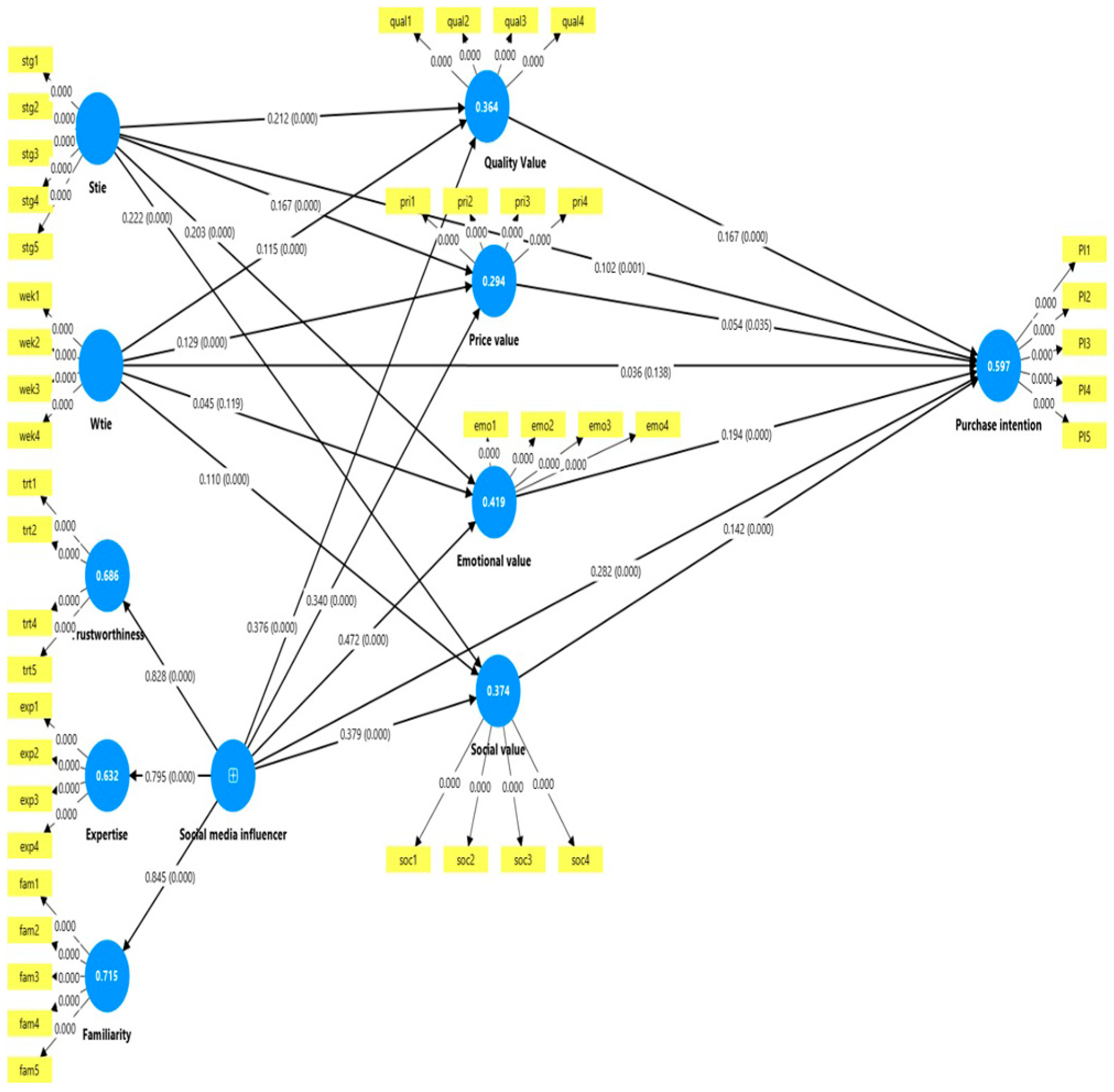
Furthermore, as shown in Figure 2, the model shows a moderate amount of variation in emotional value (0.419), price value (0.294), quality value (0.364), and social value (0.374), at the same time it illustrates a much stronger explanation of the variance of PI (0.597). Furthermore, the model shows that there is a variance of 41.9% in emotional value, 29.4% in price value, 36.4% in quality value, 37.4% in social value, and 59.7% in PI.
Following the confirmation of discriminant validity, tests for common method bias were conducted. The results of Harman’s single-factor test from SPSS software (version 24) showed that the first unrotated factor explained 36.22% of the total variance, which is well below the 50% threshold. Additionally, the full collinearity VIF values for all constructs were examined. As reported in Table 5, all VIF values were well below the conservative threshold of 3.3, with the highest recorded VIF being 2.59. Taken together, these results showed that common method bias is not a significant concern in this study.

3.3. Measurement Invariance Assessment

A measurement invariance test was performed using the permutation-based MICOM procedure in SmartPLS 4. This three-step process is necessary to ensure that constructs are measured equivalently across the male and female groups. The first step was assured for Configural Invariance as the same model structure and indicators were used for both the male and female samples. However, when testing the compositional invariance, most constructs passed this test (p > 0.05). However, significant differences were found for Emotional value (p = 0.013) and Familiarity (p < 0.001). Finally, the result of the equality of means and variances across groups indicated that this step was not fully supported, with significant differences observed for constructs including Social value (p = 0.004), Familiarity (p = 0.023), Social media influencer (p = 0.025), and Trustworthiness (p = 0.013). Given these results, partial measurement invariance was established. This allows for the comparison of path coefficients, but the findings related to constructs that failed the invariance tests must be interpreted with caution.

3.4. Structural Model and Hypothesis Testing

3.4.1. Direct Hypotheses Results

Table 5 presents the direct effect results. Related to Hypothesis (H1), which examined the association between Stie eWOM and the PV components: price (H1.a), quality (H1.b), emotional (H1.c), and social value (H1.d). The findings show that Stie eWOM is positively associated with all PV dimensions. Overall, students who received eWOM from close and trusted sources tended to perceive higher value across all components. Specifically, male students exhibited a stronger association with social value (H1.d), whereas female students showed a stronger association with emotional value (H1.c). These results indicate that information from close personal relationships can be comprehensively associated with the PV of student consumers across rational (price, quality) and affective (emotional, social) dimensions.
Table 5. Direct hypotheses.
CompleteMalesFemales
#PathVIFβT Valuep ValueResultβT Valuep ValueResultβT Valuep ValueResult
H1.aStie → Price value1.760.1674.260.000.1543.290.0010.1632.7370.006
H1.bStie → Quality Value1.760.2125.920.000.1733.540.0000.2444.7680.000
H1.cStie → Emotional value1.760.2035.760.000.1683.230.0010.2374.8940.000
H1.dStie → Social value1.760.2226.440.000.2374.830.0000.2204.5000.000
H2Stie → PI1.930.1023.360.000.1082.280.0220.0922.6390.008
H3.aWtie → Price value1.320.1294.110.000.1052.740.0060.1553.1230.002
H3.bWtie → Quality Value1.320.1153.700.000.1272.880.0040.1002.2620.024
H3.cWtie → Emotional value1.320.0451.560.12X0.0390.950.343X0.0531.3780.168X
H3.dWtie → Social value1.320.1103.630.000.0902.040.0410.1383.2710.001
H4Wtie → PI1.370.0361.480.14X0.0290.770.441X0.0301.0230.306X
H5.aSocial media influencer → Price value1.950.3408.830.000.48010.880.0000.2173.6010.000
H5.bSocial media influencer → Quality Value1.950.37610.280.000.3988.530.0000.3646.4130.000
H5.cSocial media influencer → Emotional value1.950.47213.830.000.4689.310.0000.48410.2470.000
H5.dSocial media influencer → Social value1.950.37910.300.000.3496.660.0000.3987.6960.000
H6Social media influencer → PI2.590.2827.890.000.1923.540.0000.3327.6670.000
H7.aPrice value → PI1.530.0542.110.040.1383.130.0020.0260.8480.396X
H7.bQuality Value → PI1.770.1675.630.000.2596.240.0000.0471.3870.165X
H7.cEmotional value → PI1.910.1946.140.000.0591.350.177X0.3719.7000.000
H7.dSocial value → PI1.740.1424.840.000.1403.520.0000.1273.4700.001
Hypothesis (H2) examined the association between Stie eWOM and customers’ PI. The analysis revealed a positive association between Stie eWOM and PI across the full sample of student customers. These results suggest that Stie eWOM contributes in affecting PI of students.
Hypothesis (H3) examined the relationship between Wtie eWOM and PV components. The results showed that within the full sample of students, Wtie eWOM showed a positive correlation with price (H3.a), quality (H3.b), and social value (H3.d), but it failed to affect emotional value (H3.c). This can be explained by the fact that student consumers may evaluate information from sources that are unknown and not close to them because they are aware of the potential for practical and social benefits, but at the same time they lack the relational depth that is an important factor in order to create an emotional connection with a product, brand, or service. This has been consistently demonstrated across groups.
Hypothesis (H4) inspected the association between Wtie eWOM and customers’ PI. Crucially, the results revealed that Wtie eWOM (H4) had no significant direct effect on students’ PI, as no significant association was observed for either gender of students. This outcome suggests that Wtie eWOM functions primarily as an informational source rather than a persuasive one, indicating that students’ exposure to Wtie messages does not directly translate into behavioral intention to purchase.
The hypothesis (H5) that examined whether influencer eWOM is associated with the components of PV, which are as follows: price (H5.a), quality (H5.b), emotional (H5.c), and social (H5.d). The results showed support for all sub hypotheses (H5.a–H5.d) across the entire student’s sample, confirming the association of influencer eWOM with all dimensions of PV and for both male and female students. These positive findings can be explained by the fact that influencer eWOM differs from other sources of eWOM in that it integrates cognitive and affective characteristics, making it a particularly powerful form of eWOM.
Hypothesis (H6) proposed that influencer eWOM is associated with customers’ PI. The findings confirmed a positive association across the full sample for both genders of students, with a notably stronger relationship among female students. These results highlight that influencer eWOM can shape and play a meaningful role in stimulating students’ purchase behavioral responses.
Finally, in the direct hypotheses (H7), the analysis examined the association between PV components and PI. For the complete sample of students, the results showed that all four PV components significantly predicted PI. The results for gender students revealed a statistically significant difference. For males, PI was more influenced by rational and social factors; price (H7.a), quality (H7.b), and social value (H7.d), critically, emotional value (H7.c) was not a significant predictor for males. In stark contrast, the primary driver for female students was emotional value (H7.c), which demonstrated a large and significant association, along with a smaller but significant association with social value (H7.d). For this female group, the functional PV of price (H7.a) and quality value (H7.b) were not significant predictors of PI.

3.4.2. Mediation Hypotheses Results

Table 6 presents the indirect effects. It examined via mediation analysis whether PV components mediate the relationships between eWOM sources and PI.
Hypothesis (H8) tested the mediating role of PV components in the relationship between Stie eWOM and PI. The results showed that while quality (H8.b), emotional (H8.c), and social value (H8.d) all significantly mediate this association, the indirect effect through price value (H8.a) was not significant. Among males, mediation was evident through price (H8.a) and quality value (H8.b), which means that men use a friend’s endorsement as a cognitive shortcut to affirm the product’s usefulness and contribution to their social status. While among females, the indirect effects through emotional (H8.c), and social value (H8.d) were the only significant mediators. These results provide strong evidence that men and women process the credibility of a close friend’s recommendation differently: men translate it into an assessment of functional and social benefits, while women translate it into an emotional connection and a sense of social validation.
Hypothesis (H9), which explored the mediating role of PV components between Wtie eWOM and PI, received limited support. Wtie eWOM was indirectly associated with PI through quality value (H9.b) and social value (H9.d), while no significant mediation was found through price value (H9.a) or emotional value (H9.c) for the full sample. When examined by gender, the mediating effects varied. Among males, mediation significance was observed only through price value (H9.a) and quality value (H9.b), while the emotional (H9.c) and social value (H9.d) pathways were not. Among females, the sole significant mediating pathway was social value (H9.d). This reinforces that consumers in general leverage their wider network of Wtie primarily to provide them with informational diversity to measure a product’s functional quality and its level of social consensus, rather than for affective persuasion.
Finally, Hypothesis (H10) examined the mediating effect of PV components between influencer eWOM and PI. The results for the full sample showed that the mediating effect of PV components was the broadest and strongest in influencing relationships, confirming the unique and distinctive role of the influencer eWOM as a stimuli and motivation source. It was shown that all four PV components—price (H10.a), quality (H10.b), emotional (H10.c), and social (H10.d)—played a mediating role in the influencer effect as a driver of PI. This also suggests that influencer eWOM is linked to both cognitive and affective value perceptions, which in turn positively influences PI.
Despite this broad effect, the consumer’s internal processing of the influencer’s message remained a dominant factor, as the underlying gender-specific patterns persisted. For males, the effect of influencer eWOM was significantly mediated by price (H10.a), quality (H10.b), and social value (H10.d), while the emotional pathway (H10.c) was again non-significant, For females, the effect was mediated only by emotional (H10.c) and social value (H10.d), with the functional paths of price (H10.a) and quality (H10.b) being non-significant. This highlights that influencer eWOM functions as a unique hybrid source that stimulates rational, emotional, and social pathways to purchase simultaneously, a feat not achieved by either Stie and Wtie.
Overall, the results support the applicability of the SOR framework in explaining how distinguished eWOM sources affect online consumer behavior, highlighting both cognitive and affective pathways as mediators of PI. The findings demonstrate that Stie and influencer eWOM primarily enhance consumers’ internal feelings and emotional and cognitive evaluations, which serve as key mechanisms linking the stimulus to the behavioral response.

3.4.3. Multi Group Moderation Results

Table 7 presents the results of the multi-group analysis examining the moderating role of gender in the relationships between the PV components as well as eWOM sources and PI. The results confirmed several significant differences in the strength of these associations, while also reinforcing the need for cautious interpretation due to the previously established partial measurement invariance. First, the findings confirmed that gender significantly moderates the relationship between PV and PI (H11). Specifically, the positive associations of price value (H11.a) and quality value (H11.b) with PI were significantly stronger for males compared to female students. In simple terms, a good price and high quality were more powerful factors for convincing males to buy.
In contrast, the relationship between emotional value (H11.c) and PI was significantly stronger for female students. Indicating that the good feelings from a purchase were a much stronger driver for female students. This latter finding, however, must be interpreted with caution, as the emotional value construct did not establish full measurement invariance. No significant gender difference was found for the relationship between social value (H11.d) and PI.
When examining the moderating effect of gender on the direct path from eWOM sources on PI (H12–H14), the results showed that gender did not significantly moderate the relationships between Stie (H12) or Wtie (H13) eWOM and PI. This suggests that the strength of the association between these interpersonal eWOM sources and the intention to purchase is consistent across genders for the university students in Palestine. However, a significant moderation was found for influencer eWOM (H14), where its association with PI was significantly stronger for females than for males. This finding shows that females were much more likely to be influenced by social media influencers than males were. This conclusion should be considered tentative, as the social media influencer construct did not achieve full measurement invariance, which is a necessary condition for a definitive comparison.

4. Discussion

The current study examined how different eWOM sources—Stie, Wtie, and social media influencer—are associated with student consumers’ PV components and PI, considering the mediating role of PV and the moderating role of students’ gender. Overall, the results indicate a nuanced pattern of associations across eWOM sources, value components, and gender.
As hypothesized, Stie eWOM were positively associated with all PV components across the full sample of student consumers and both student genders. These findings align with prior research [19,46,58] emphasizing that consumers tend to have mutual characteristics with their Stie, develop a sense of connection and attachment to them, and view them as a trustworthy advisor. This improves consumers’ perceptions of product quality and information, enhancing their awareness of the value of efficiency.
Moreover, the findings of this study suggest that Stie eWOM is associated with PI of student consumers. This is consistent with earlier studies highlighting the relevance of eWOM from close personal connections as a stimulus in affecting the consumers’ behaviors and subsequent intention responses [45,46,74,75]. Mediation analysis indicated that for male students price, quality, and social value partially mediated the relationship between Stie eWOM and PI, whereas for females, emotional and social value served as significant mediators. These findings suggest that Stie recommendations operate through both cognitive and emotional channels, and gender differences modulate which value components are most influential, suggesting that student customers consider a combination of rational and emotional factors when making purchasing decisions. The belief that PV components are key factors in determining student consumers PI, which align with previous studies [15,63,83,118], indicated that consumers are more likely to follow recommendations from Stie than Wtie, as sources with strong relationships are perceived as providing more truthful, reliable, and accurate information [14,48,74,157]. This strengthens the idea that relational closeness enhances message credibility. Consequently, PI fills the gap of contradiction regarding the mechanism by which Stie eWOM affects consumers’ behavior and responses.
Wtie eWOM was significantly associated with price, quality, and social value, but not emotional value. Furthermore, Wtie eWOM was not directly associated with PI of student consumers, indicating that the effect of Wtie may be more informational than effective for student consumers. This aligns with earlier studies emphasizing that Wtie often serve as information sources rather than emotional triggers [76,81,82]. Mediation analyses confirmed full mediation for certain components: for male consumer students price and quality fully mediated the effect of Wtie eWOM, while for females, only social value acted as a mediator. These results highlight that Wtie recommendations may primarily affect student consumers through evaluative rather than emotional mechanisms, and the pathways differ by students’ gender.
One of the most important theoretical results of this research is that influencer eWOM was positively associated with all PV components and was the strongest predictor of PI for both student consumers’ gender. These findings support the consequence effects where consumers tend to feel closeness and positive emotion towards the persons who have a combination of traits and qualities such as credibility, experience or enthusiasm, and who have a reputation, familiarity, connection with the public, which enables them to influence a large audience [92,93,97,98]. Consequently, customers consider the eWOM content shared via influencers more knowledgeable, trustworthy and reliable, making their endorsements more persuasive compared to traditional marketing, which enhances PI [96,110,111].
Mediation analyses showed that all value components significantly mediated the association for the full sample of student consumers, although students’ gender-specific differences emerged—for males price, quality, and social value mediated the effect, while for females, emotional and social value were significant mediators. These findings aligned with prior research [11,93,94,158] reinforcing the idea that influencer recommendations can affect both rational perceptions—through the information objectivity—and emotional perceptions, with stronger emotional effect for female consumers, emphasizing that student consumers tend to have mutual characteristics with their influencers, develop a sense of connection and attachment to them, believing that personal recommendations from influencers with familiarity and expertise are seen as a powerful, trustworthy, and influential persuasive force, leading consumers to assign greater value to products and services, and often build trust and credibility through continuous engagement and content creation, making them effective drivers of purchasing behavior [23,159].
Multi-group analysis confirmed that gender moderated several relationships. Price and quality value were more influential for male consumer students, while emotional value had a stronger effect for female students. Social value showed similar effects across student consumers’ gender. Regarding eWOM sources, student consumers’ gender differences were evident only for influencer recommendations, but no moderating effect of gender was found for eWOM created from Wtie or Stie, suggesting that interpersonal eWOM operates through relatively stable effect mechanisms that are not strongly shaped by gender differences. In contrast, gender significantly moderated the effect of influencer-based eWOM, with stronger effects observed among female consumers. This effect was driven through gender-based differences in price perception and emotional quality, while no significant influence was identified through the social dimension. These findings reinforce the theoretical implication that gender effects in eWOM are both source contingent and mechanism specific, indicating that female students are more responsive to influencer eWOM than males. These findings corroborate prior research suggesting systematic differences in cognitive and affective processing between men and women [29,33,34,37,139], with practical implications for university-aged student consumers in the West Bank and for designing targeted marketing strategies applicable to similar developing or collectivist contexts.

4.1. Theoretical and Practical Contribution

Theoretically, this study refines the traditional SOR model to account for the multidimensional nature of digital stimuli in online environments. By incorporating influencers as a stimulus that evoke both cognitive (e.g., quality, price evaluation) and affective (e.g., emotional, social connection) organismic responses, the study bridges the gap between interpersonal communication theories and the emerging paradigm of parasocial interaction in influencer marketing [112,142,159]. This combination enhances the explanatory power of the SOR framework and develops its application to digital market and social media platforms, where users engage with eWOM in interactive and dynamic ways.
Moreover, this study extends the existing eWOM literature by moving beyond a one size fits all assumption, regarding eWOM effectiveness. While earlier studies have largely treated the effect of eWOM as homogeneous across consumers, the findings of the present study demonstrate that the effect of eWOM sources varies systematically depending on gender. This contributes to current debates by emphasizing the importance of consumer heterogeneity in eWOM processing, and by showing that source effects should be theorized as conditional rather than universal. Accordingly, this study enriches the concept of eWOM by integrating source-based explanations with moderating mechanisms, thereby offering a more advanced theoretical interpretation of how and for whom eWOM shapes PI.
In practical terms, the findings of this study reveal scalable value propositions for companies and e-business practitioners in terms of advertising effectiveness, concluded that the sources of eWOM should be strategically differentiated rather than treated as alternatives, as the alignment of values between the message source and the target audience plays a crucial role in the success of promoting a product or service through eWOM. Therefore, companies should prioritize those with greater credibility and social standing, as these channels have a stronger influence on PI. The observed gender differences suggest that eWOM based marketing strategies should adopt a more segmented approach. Practitioners can design their marketing strategies and campaigns in a way that the message framing, source selection, and communication align with gender-specific information processing tendencies, thereby enhancing their emotional engagement and awareness of the importance of the marketing message.

4.2. Limitations and Future Research

Like any further research, this study has its limitations and restrictions. First, the sample of this research is limited to university students in the West Bank, which limits the ability to generalize the results to the Palestinian population in general or to other cultural or demographic contexts. While university students are active users of digital platforms; their information assessment processes and purchasing behavior may differ from those of older or more diverse age groups, this should be considered with caution when interpreting the conclusions about consumers in general or in other contexts or countries. Therefore, it is essential to expand the scope of future studies using this model, with the need to take more various sampling in different countries, contexts, and age groups, in order to strengthen the model. Second, this research examined several relationships related to the effect of different eWOM sources (Stie, Wtie, and influencers) on PV and PI in general without focusing on examining the effects of these variables on a particular product type or industry context. Future research can explore these dynamics across specific product categories or service sectors.
Third, as this study has excavated the moderation role of gender, the study of other demographic variables such as age, income, and education in future studies would provide valuable additional understanding of the effects among the relationships addressed in this study. Fourth, the cross-sectional character of the data in this study limits the ability to infer causality. Future longitudinal or experimental studies can better explore how the relationships of eWOM sources, PV components and PI can change over time in their interactions, thereby improving causal interpretation. Furthermore, despite efforts to reduce methodological bias, the study may still be subject to common methodological bias and self-reporting limitations because the data collection process was conducted through a single source and using self-administered questionnaires. Therefore, to enhance the validity of the results and causal inference, future research can use behavioral tracking or experimental designs.
Moreover, this study showed partial, but not complete, variation in measurements between male and female student samples. The MICOM procedure revealed statistically significant differences in key constructs such as emotional value, familiarity, and social value. This finding means that measurement parity has not been fully achieved for these gender combinations. As a result, trajectory coefficient comparisons of these specific variables should be interpreted with caution. Finally, while the main findings were discussed, conflicting or insignificant findings such as Wtie eWOM and their inability to affect certain values particularly of emotional value. Studying such results in depth in future studies can contribute to improving theoretical understanding. Future studies can also look at additional variables and interactions such as product, consumer experience, and cultural context, to provide a more holistic understanding of the mediation role of the PV and its sustainable effect over time.

5. Conclusions

It was our purpose to learn not only whether eWOM sources are associated with the PI, but also how it changes the student consumers’ view of a product in terms of its price, quality, emotional, and social value. From the data analyzed it follows that the content of close friends and social media influencers greatly stimulates the student consumers’ perceptions of a product from all perspectives and, therefore, directly leads to the increase in purchasing possibilities. Statements from people whom the student does not know may only have a slight effect on certain values like price and quality but there is no indication of a direct purchasing response. Apart from that, we have come to the conclusion that gender is also an important factor; as it differentiates the way students react to eWOM sources in terms of price, quality, and emotional appeal but not when it comes to social factors.
This research helps businesses understand the extent of the effects that different kinds of online messages and messengers have on their consumers. What is more, it points to the importance of gender consideration when digital marketing strategies are being devised. By knowing which messages are most potent for which audience, marketers achieve the power to take their communication with customers to a higher level in the digital world.

Author Contributions

Conceptualization, I.S. and R.N.; Formal Analysis, I.S.; Investigation, I.S.; Methodology, I.S.; Project Administration, R.N.; Supervision, R.N.; Writing—Original Draft, I.S.; Writing—Review and Editing, R.N. and I.S. All authors have read and agreed to the published version of the manuscript.

Funding

This research received no external funding.

Institutional Review Board Statement

The study was reviewed and approved by Business Faculty Research Ethics Committee of GIRNE AMERICAN UNIVERSITY (protocol code 2024-25-Spring-011, Approval Date: 3 March 2025).

Informed Consent Statement

Informed consent was obtained from all subjects involved in the study.

Data Availability Statement

The data presented in this study are available on request from the corresponding author due to privacy.

Conflicts of Interest

The authors declare no conflicts of interest.

References

  1. Zhu, Y.Q.; Chen, H.G. Social media and human need satisfaction: Implications for social media marketing. Bus. Horiz. 2015, 58, 335–345. [Google Scholar] [CrossRef]
  2. Zhu, H.; Yang, Z.; Ou, C.X.J.; Liu, H.; Davison, R.M. Investigating the impacts of recommendation agents on impulsive purchase behaviour, 2 theoretical development. In Proceedings of the Australasian Conference on Information Systems, Adelaide, Australia, 30 November–4 December 2015. [Google Scholar]
  3. Karayalçın, C.; Yaraş, E. Consumers’ Psychology Regarding Attachment to Social Media and Usage Frequency: A Mediated-Moderated Model. Behav. Sci. 2024, 14, 676. [Google Scholar] [CrossRef] [PubMed]
  4. Kim, K.S.; Sin, S.C.J. Selecting quality sources: Bridging the gap between the perception and use of information sources. J. Inf. Sci. 2011, 37, 178–188. [Google Scholar] [CrossRef]
  5. Westerman, D.; Spence, P.R.; Van Der Heide, B. Social Media as Information Source: Recency of Updates and Credibility of Information. J. Comput. Commun. 2014, 19, 171–183. [Google Scholar] [CrossRef]
  6. Chu, S.C.; Kim, Y. Determinants of consumer engagement in electronic Word-of-Mouth (eWOM) in social networking sites. Int. J. Advert. 2011, 30, 47–75. [Google Scholar] [CrossRef]
  7. Kim, H.L.; Hyun, S.S. The relationships among perceived value, intention to use hashtags, eWOM, and brand loyalty of air travelers. Sustainability 2019, 11, 6523. [Google Scholar] [CrossRef]
  8. Bruhn, M.; Schoenmueller, V.; Schäfer, D.B. Are social media replacing traditional media in terms of brand equity creation? Manag. Res. Rev. 2012, 35, 770–790. [Google Scholar] [CrossRef]
  9. Chang, S.H.; Chih, W.H.; Liou, D.K.; Yang, Y.T. The mediation of cognitive attitude for online shopping. Inf. Technol. People 2016, 29, 618–646. [Google Scholar] [CrossRef]
  10. Jothi, C.A.; Gaffoor, A.M. Impact of social media in online shopping. ICTACT J. Manag. Stud. 2017, 3, 576–586. [Google Scholar] [CrossRef]
  11. Hennig-Thurau, T.; Gwinner, K.P.; Walsh, G.; Gremler, D.D. Electronic word-of-mouth via consumer-opinion platforms: What motivates consumers to articulate themselves on the internet? J. Interact. Mark. 2004, 18, 38–52. [Google Scholar] [CrossRef]
  12. Baber, A.; Thurasamy, R.; Malik, M.I.; Sadiq, B.; Islam, S.; Sajjad, M. Online word-of-mouth antecedents, attitude and intention-to-purchase electronic products in Pakistan. Telemat. Inform. 2016, 33, 388–400. [Google Scholar] [CrossRef]
  13. Yang, L.; Cheng, Q.; Tong, S. Empirical study of eWOM’s influence on consumers’ purchase decisions. In The Strategies of China’s Firms: Resolving Dilemmas; Chandos Publishing: Buckingham, UK, 2015; pp. 123–135. [Google Scholar] [CrossRef]
  14. Hovland, C.I.; Weiss, W. The influence of source credibility on communication effectiveness. Public Opin. Q. 1951, 15, 635–650. [Google Scholar] [CrossRef]
  15. Ismagilova, E.; Dwivedi, Y.K.; Slade, E. Perceived helpfulness of eWOM: Emotions, fairness and rationality. J. Retail. Consum. Serv. 2020, 53, 101748. [Google Scholar] [CrossRef]
  16. Zhang, N.; Liu, R.; Zhang, X.Y.; Pang, Z.L. The impact of consumer perceived value on repeat purchase intention based on online reviews: By the method of text mining. Data Sci. Manag. 2021, 3, 22–32. [Google Scholar] [CrossRef]
  17. Pornpitakpan, C. The Persuasiveness of Source Credibility: A Critical Review of Five Decades’ Evidence. J. Appl. Soc. Psychol. 2004, 34, 243–281. [Google Scholar] [CrossRef]
  18. Luo, C.; Luo, X.; Schatzberg, L.; Sia, C.L. Impact of informational factors on online recommendation credibility: The moderating role of source credibility. Decis. Support Syst. 2013, 56, 92–102. [Google Scholar] [CrossRef]
  19. Nofal, R.; Bayram, P.; Emeagwali, O.L.; Al-Mu’ani, L. The Effect of eWOM Source on Purchase Intention: The Moderation Role of Weak-Tie eWOM. Sustainability 2022, 14, 9959. [Google Scholar] [CrossRef]
  20. Farzin, M.; Fattahi, M. eWOM through social networking sites and impact on purchase intention and brand image in Iran. J. Adv. Manag. Res. 2018, 15, 161–183. [Google Scholar] [CrossRef]
  21. Coutinho, M.F.; Dias, Á.L.; Pereira, L.F. Credibility of social media influencers: Impact on purchase intention. Hum. Technol. Interdiscip. J. Hum. ICT Environ. 2023, 19, 220–237. [Google Scholar] [CrossRef]
  22. Magano, J.; Au-Yong-oliveira, M.; Walter, C.E.; Leite, Â. Attitudes toward Fashion Influencers as a Mediator of Purchase Intention. Information 2022, 13, 297. [Google Scholar] [CrossRef]
  23. Venciute, D.; Mackeviciene, I.; Kuslys, M.; Correia, R.F. The role of influencer–follower congruence in the relationship between influencer marketing and purchase behaviour. J. Retail. Consum. Serv. 2023, 75, 103506. [Google Scholar] [CrossRef]
  24. Bakshy, E.; Karrer, B.; Adamic, L.A. Social influence and the diffusion of user-created content. In Proceedings of the ACM Conference on Electronic Commerce, Stanford, CA, USA, 6–10 July 2009; pp. 325–334. [Google Scholar] [CrossRef]
  25. Wang, J.J.; Wang, L.Y.; Wang, M.M. Understanding the effects of eWOM social ties on purchase intentions: A moderated mediation investigation. Electron. Commer. Res. Appl. 2018, 28, 54–62. [Google Scholar] [CrossRef]
  26. Wiedmann, K.P.; von Mettenheim, W. Attractiveness, trustworthiness and expertise—Social influencers’ winning formula? J. Prod. Brand Manag. 2020, 30, 707–725. [Google Scholar] [CrossRef]
  27. Ryu, E.A.; Han, E.K. Social media influencer’s reputation: Developing and validating a multidimensional scale. Sustainability 2021, 13, 631. [Google Scholar] [CrossRef]
  28. Vohra, A. Strategic Influencers and the Shaping of Beliefs. RAND J. Econ. 2025, 1–14. [Google Scholar] [CrossRef]
  29. Meyers-Levy, J.; Loken, B. Revisiting gender differences: What we know and what lies ahead. J. Consum. Psychol. 2015, 25, 129–149. [Google Scholar] [CrossRef]
  30. Lin, X.; Wang, X. Examining gender differences in people’s information-sharing decisions on social networking sites. Int. J. Inf. Manag. 2020, 50, 45–56. [Google Scholar] [CrossRef]
  31. Chiu, Y.B.; Lin, C.P.; Tang, L.L. Gender differs: Assessing a model of online purchase intentions in e-tail service. Int. J. Serv. Ind. Manag. 2005, 16, 416–435. [Google Scholar] [CrossRef]
  32. Broos, A. Gender and information and communication technologies (ICT) anxiety: Male self-assurance and female hesitation. CyberPsychology Behav. 2005, 8, 21–31. [Google Scholar] [CrossRef]
  33. Craciun, G.; Zhou, W.; Shan, Z. Discrete emotions effects on electronic word-of-mouth helpfulness: The moderating role of reviewer gender and contextual emotional tone. Decis. Support Syst. 2020, 130, 113226. [Google Scholar] [CrossRef]
  34. Craciun, G.; Moore, K. Credibility of negative online product reviews: Reviewer gender, reputation and emotion effects. Comput. Hum. Behav. 2019, 97, 104–115. [Google Scholar] [CrossRef]
  35. Benson, V.; Ezingeard, J.N.; Hand, C. An empirical study of purchase behaviour on social platforms: The role of risk, beliefs and characteristics. Inf. Technol. People 2019, 32, 876–896. [Google Scholar] [CrossRef]
  36. Joung, H.W.; Choi, E.K.; Wang, E. Effects of Perceived Quality and Perceived Value of Campus Foodservice on Customer Satisfaction: Moderating Role of Gender. J. Qual. Assur. Hosp. Tour. 2016, 17, 101–113. [Google Scholar] [CrossRef]
  37. Riquelme, I.P.; Román, S. The Influence of Consumers’ Cognitive and Psychographic Traits on Perceived Deception: A Comparison Between Online and Offline Retailing Contexts. J. Bus. Ethics 2014, 119, 405–422. [Google Scholar] [CrossRef]
  38. Russell, J.A.; Mehrabian, A. Distinguishing anger and anxiety in terms of emotional response factors. J. Consult. Clin. Psychol. 1974, 42, 79–83. [Google Scholar] [CrossRef]
  39. Perumal, S.; Ali, J.; Shaarih, H. Exploring nexus among sensory marketing and repurchase intention: Application of S-O-R Model. Manag. Sci. Lett. 2021, 11, 1527–1536. [Google Scholar] [CrossRef]
  40. Mishra, M.K.; Kesharwani, A.; Gautam, V.; Sinha, P. Stimulus-Organism-Response (S-O-R) Model Application in Examining the Effectiveness of Public Service Advertisements. Int. J. Bus. 2022, 27, 1. [Google Scholar] [CrossRef]
  41. Jacoby, J. Stimulus-Organism-Response Reconsidered: An Evolutionary Step in Modeling (Consumer) Behavior. J. Consum. Psychol. 2002, 12, 51–57. [Google Scholar] [CrossRef]
  42. Oliver, R.L.; Swan, J.E. Consumer Perceptions of Interpersonal Equity and Satisfaction in Transactions: A Field Survey Approach. J. Mark. 1989, 53, 21–35. [Google Scholar] [CrossRef]
  43. Frenzen, J.; Nakamoto, K. Structure, Cooperation, and the Flow of Market Information. J. Consum. Res. 1993, 20, 360–375. [Google Scholar] [CrossRef]
  44. Pitta, D.A.; Fowler, D. Online consumer communities and their value to new product developers. J. Prod. Brand Manag. 2005, 14, 283–291. [Google Scholar] [CrossRef]
  45. Gilbert, E.; Karahalios, K. Predicting tie strength with social media. In Proceedings of the Conference on Human Factors in Computing Systems, Boston, MA, USA, 4–9 April 2009; pp. 211–220. [Google Scholar] [CrossRef]
  46. Zheng, C.; Yu, X.; Jin, Q. How user relationships affect user perceived value propositions of enterprises on social commerce platforms. Inf. Syst. Front. 2017, 19, 1261–1271. [Google Scholar] [CrossRef]
  47. Brown, J.J.; Reingen, P.H. Social ties and word-of-mouth referral behavior. J. Consum. Res. 1987, 14, 350–362. [Google Scholar] [CrossRef]
  48. Bansal, H.S.; Voyer, P.A. Word-of-mouth processes within a services purchase decision context. J. Serv. Res. 2000, 3, 166–177. [Google Scholar] [CrossRef]
  49. Rossmann, A.; Ranjan, K.R.; Sugathan, P. Drivers of user engagement in eWoM communication. J. Serv. Mark. 2016, 30, 541–553. [Google Scholar] [CrossRef]
  50. Lee, W.I.; Cheng, S.Y.; Shih, Y.T. Effects among product attributes, involvement, word-of-mouth, and purchase intention in online shopping. Asia Pac. Manag. Rev. 2017, 22, 223–229. [Google Scholar] [CrossRef]
  51. Chen, X.; Jiao, C.; Ji, R.; Li, Y. Examining customer motivation and its impact on customer engagement behavior in social media: The mediating effect of brand experience. SAGE Open 2021, 11, 21582440211052256. [Google Scholar] [CrossRef]
  52. Zeithaml, V.A. Consumer Perceptions of Price, Quality, and Value: A Means-End Model and Synthesis of Evidence. J. Mark. 1988, 52, 2–22. [Google Scholar] [CrossRef]
  53. Sweeney, J.C.; Soutar, G.N. Consumer perceived value: The development of a multiple item scale. J. Retail. 2001, 77, 203–220. [Google Scholar] [CrossRef]
  54. Hsu, C.L.; Lin, J.C.C. Effect of perceived value and social influences on mobile app stickiness and in-app purchase intention. Technol. Forecast. Soc. Change 2016, 108, 42–53. [Google Scholar] [CrossRef]
  55. Hwang, Y.; Kim, D.J. Customer self-service systems: The effects of perceived Web quality with service contents on enjoyment, anxiety, and e-trust. Decis. Support Syst. 2007, 43, 746–760. [Google Scholar] [CrossRef]
  56. Yang, X. Consumers’ purchase intentions in social commerce: The role of social psychological distance, perceived value, and perceived cognitive effort. Inf. Technol. People 2022, 35, 330–348. [Google Scholar] [CrossRef]
  57. Gan, C.; Wang, W. The influence of perceived value on purchase intention in social commerce context. Internet Res. 2017, 27, 772–785. [Google Scholar] [CrossRef]
  58. Gruen, T.W.; Osmonbekov, T.; Czaplewski, A.J. eWOM: The impact of customer-to-customer online know-how exchange on customer value and loyalty. J. Bus. Res. 2006, 59, 449–456. [Google Scholar] [CrossRef]
  59. Hoang, L.N.; Tung, L.T. A moderated mediation model of situational context and brand image for online purchases using eWOM. J. Prod. Brand Manag. 2023, 32, 661–672. [Google Scholar] [CrossRef]
  60. Wang, P.; Huang, Q.; Zhang, Y. How do social network ties influence purchases in social commerce communities? A lens of attachment theory. Internet Res. 2023, 33, 1495–1518. [Google Scholar] [CrossRef]
  61. Song, Z.; Su, X.; Li, L. The Indirect Effects of Destination Image on Destination Loyalty Intention Through Tourist Satisfaction and Perceived Value: The Bootstrap Approach. J. Travel Tour. Mark. 2013, 30, 386–409. [Google Scholar] [CrossRef]
  62. Ziegler, R.; Diehl, M.; Ruther, A. Multiple source characteristics and persuasion: Source inconsistency as a determinant of message scrutiny. Pers. Soc. Psychol. Bull. 2002, 28, 496–508. [Google Scholar] [CrossRef]
  63. Chang, T.Z.; Wildt, A.R. Price, product information, and purchase intention: An empirical study. J. Acad. Mark. Sci. 1994, 22, 16–27. [Google Scholar] [CrossRef]
  64. De Bruyn, A.; Lilien, G.L. A multi-stage model of word-of-mouth influence through viral marketing. Int. J. Res. Mark. 2008, 25, 151–163. [Google Scholar] [CrossRef]
  65. Trusov, M.; Bucklin, R.E.; Pauwels, K. Effects of word-of-mouth versus traditional marketing: Findings from an internet social networking site. J. Mark. 2009, 73, 90–102. [Google Scholar] [CrossRef]
  66. Haythornthwaite, C. Strong, weak, and latent ties and the impact of new media. Inf. Soc. 2002, 18, 385–401. [Google Scholar] [CrossRef]
  67. Lee, S.S.; Johnson, B.K. Are they being authentic? The effects of self-disclosure and message sidedness on sponsored post effectiveness. Int. J. Advert. 2022, 41, 30–53. [Google Scholar] [CrossRef]
  68. Folse, J.A.G.; Porter, M.; Godbole, M.B.; Reynolds, K.E. The Effects of Negatively Valenced Emotional Expressions in Online Reviews on the Reviewer, the Review, and the Product. Psychol. Mark. 2016, 33, 747–760. [Google Scholar] [CrossRef]
  69. Zinko, R.; Patrick, A.; Furner, C.P.; Gaines, S.; Kim, M.D.; Negri, M. Responding to negative electronic word of mouth to improve purchase intention. J. Theoret. Appl. Elect. Comm. Res. 2021, 16, 1945–1959. [Google Scholar] [CrossRef]
  70. Burnham, T.A.; Leary, R.B. Word of mouth opportunity: Why recommendation likelihood overestimates positive word of mouth. J. Mark. Theory Pract. 2018, 26, 368–389. [Google Scholar] [CrossRef]
  71. Wang, J.C.; Chang, C.H. How online social ties and product-related risks influence purchase intentions: A Facebook experiment. Electron. Commer. Res. Appl. 2013, 12, 337–346. [Google Scholar] [CrossRef]
  72. Sun, L.; Wang, T.; Guan, F. How the strength of social ties influences users’ information sharing and purchase intentions. Curr. Psychol. 2023, 42, 7712–7726. [Google Scholar] [CrossRef]
  73. Mim, K.B.; Jai, T.; Lee, S.H. The Influence of Sustainable Positioning on eWOM and Brand Loyalty: Analysis of Credible Sources and Transparency Practices Based on the S-O-R Model. Sustainability 2022, 14, 12461. [Google Scholar] [CrossRef]
  74. Marsden, P.V.; Campbell, K.E. Measuring tie strength. Soc. Forces 1984, 63, 482. [Google Scholar] [CrossRef]
  75. Granovetter, M.S. The strength of weak ties. Am. J. Sociol. 1973, 78, 1360–1380. [Google Scholar] [CrossRef]
  76. Steffes, E.M.; Burgee, L.E. Social ties and online word of mouth. Internet Res. 2009, 19, 42–59. [Google Scholar] [CrossRef]
  77. Ruiz-Ortega, M.J.; Molina-Morales, F.X.; Parra-Requena, G.; García-Villaverde, P.M. Strength of ties and pioneering orientation: The moderating role of scanning capabilities. BRQ Bus. Res. Q. 2020, 25, 296–311. [Google Scholar] [CrossRef]
  78. Johnson, B.; Ross, W.T. It’s not just ‘who’ you know, but ‘how’ you know them: How social and commercial relationships differentially influence customer discounts. J. Res. Mark. Entrep. 2024, 26, 527–547. [Google Scholar] [CrossRef]
  79. Wuyts, S.; Stremersch, S.; Van Den Bulte, C.; Franses, P.H. Vertical Marketing Systems for Complex Products: A Triadic Perspective. J. Mark. Res. 2004, 41, 479–487. [Google Scholar] [CrossRef]
  80. Constant, D.; Sproull, L.; Kiesler, S. The Kindness of Strangers: The Usefulness of Electronic Weak Ties for Technical Advice. Organ. Sci. 1996, 7, 119–135. [Google Scholar] [CrossRef]
  81. Moreton, J.; Kelly, C.S.; Sandstrom, G.M. Social support from weak ties: Insight from the literature on minimal social interactions. Soc. Pers. Psychol. Compass 2023, 17, 12729. [Google Scholar] [CrossRef]
  82. Schneider, S.; Huber, F. The Diffusion of Price-Related Word-of-Mouth: A Study Exploring the Role of Market Mavens and Social Ties. J. Relatsh. Mark. 2022, 21, 50–80. [Google Scholar] [CrossRef]
  83. Li, M.; Xu, D.; Ma, G.; Guo, Q. Strong tie or weak tie? Exploring the impact of group-formation gamification mechanisms on user emotional anxiety in social commerce. Behav. Inf. Technol. 2021, 41, 2294–2323. [Google Scholar] [CrossRef]
  84. Habib, S.; Hamadneh, N.N.; Khan, M.A. Influence of electronic word of mouth (Ewom) and relationship marketing on brand resonance: A mediation analysis. Sustainability 2021, 13, 6833. [Google Scholar] [CrossRef]
  85. Ladhari, R.; Souiden, N.; Dufour, B. The role of emotions in utilitarian service settings: The effects of emotionalsatisfaction on product perception and behavioral intentions. J. Retail. Consum. Serv. 2017, 34, 10–18. [Google Scholar] [CrossRef]
  86. Levin, D.Z.; Cross, R. The strength of weak ties you can trust: The mediating role of trust in effective knowledge transfer. Manag. Sci. 2004, 50, 1477–1490. [Google Scholar] [CrossRef]
  87. Kim, S.; Ham, S.; Moon, H.; Chua, B.L.; Han, H. Experience, brand prestige, perceived value (functional, hedonic, social, and financial), and loyalty among GROCERANT customers. Int. J. Hosp. Manag. 2019, 77, 169–177. [Google Scholar] [CrossRef]
  88. Ramadan, Z.B.; Abosag, I.; Zabkar, V. All in the value: The impact of brand and social network relationships on the perceived value of customer endorsed Facebook advertising. Eur. J. Mark. 2018, 52, 1704–1726. [Google Scholar] [CrossRef]
  89. Serra-Cantallops, A.; Cardona, J.R.; Salvi, F. Antecedents of positive eWOM in hotels. Exploring the relative role of satisfaction, quality and positive emotional experiences. Int. J. Contemp. Hosp. Manag. 2020, 32, 3457–3477. [Google Scholar] [CrossRef]
  90. Rimé, B. Emotion Elicits the Social Sharing of Emotion: Theory and Empirical Review. Emot. Rev. 2009, 1, 60–85. [Google Scholar] [CrossRef]
  91. Belanche, D.; Casaló, L.V.; Flavián, M.; Ibáñez-Sánchez, S. Understanding influencer marketing: The role of congruence between influencers, products and consumers. J. Bus. Res. 2021, 132, 186–195. [Google Scholar] [CrossRef]
  92. Ruiz-Mafe, C.; Bigné-Alcañiz, E.; Currás-Pérez, R. The effect of emotions, eWOM quality and online review sequence on consumer intention to follow advice obtained from digital services. J. Serv. Manag. 2020, 31, 465–487. [Google Scholar] [CrossRef]
  93. Spörl-Wang, K.; Krause, F.; Henkel, S. Predictors of social media influencer marketing effectiveness: A comprehensive literature review and meta-analysis. J. Bus. Res. 2025, 186, 114991. [Google Scholar] [CrossRef]
  94. Sharma, V.M.; Klein, A. Consumer perceived value, involvement, trust, susceptibility to interpersonal influence, and intention to participate in online group buying. J. Retail. Consum. Serv. 2020, 52, 101946. [Google Scholar] [CrossRef]
  95. Bhardwaj, S.; Kumar, N.; Gupta, R.; Baber, H.; Venkatesh, A. How Social Media Influencers Impact Consumer Behaviour? Systematic Literature Review. Vision 2024, 09722629241237394. [Google Scholar] [CrossRef]
  96. Bharej, K. Electronic Word of Mouth (eWOM) And Its Impact on Consumer Buying Behaviour. J. Inf. Syst. Eng. Manag. 2025, 10, 1154–1175. [Google Scholar] [CrossRef]
  97. Martínez-López, F.J.; Anaya-Sánchez, R.; Giordano, M.F.; Lopez-Lopez, D. Behind influencer marketing: Key marketing decisions and their effects on followers’ responses. J. Mark. Manag. 2020, 36, 579–607. [Google Scholar] [CrossRef]
  98. Cardoso, A.; Pereira, M.S.; Silva, A.; Souza, A.; Oliveira, I.; Figueiredo, J. The Influence of Digital Influencers on Generation Y’s Adoption of Fintech Banking Services in Brazil. Sustainability 2024, 16, 9604. [Google Scholar] [CrossRef]
  99. Bu, Y.; Parkinson, J.; Thaichon, P. Influencer marketing: Homophily, customer value co-creation behaviour and purchase intention. J. Retail. Consum. Serv. 2022, 66, 102904. [Google Scholar] [CrossRef]
  100. Lou, C.; Yuan, S. Influencer Marketing: How Message Value and Credibility Affect Consumer Trust of Branded Content on Social Media. J. Interact. Advert. 2019, 19, 58–73. [Google Scholar] [CrossRef]
  101. Jiménez-Castillo, D.; Sánchez-Fernández, R. The role of digital influencers in brand recommendation: Examining their impact on engagement, expected value and purchase intention. Int. J. Inf. Manag. 2019, 49, 366–376. [Google Scholar] [CrossRef]
  102. Basil, M.D. Identification as a mediator of celebrity effects. J. Broadcast. Electron. Media 1996, 40, 478–495. [Google Scholar] [CrossRef]
  103. Lou, C. Social Media Influencers and Followers: Theorization of a Trans-Parasocial Relation and Explication of Its Implications for Influencer Advertising. J. Advert. 2022, 51, 4–21. [Google Scholar] [CrossRef]
  104. Steils, N.; Martin, A.; Toti, J.F. Managing the Transparency Paradox of Social-Media Influencer Disclosures: How to Improve Authenticity and Engagement When Disclosing Influencer-Sponsor Relationships. J. Advert. Res. 2022, 62, 148–166. [Google Scholar] [CrossRef]
  105. Fishbein, M.; Ajzen, I. Belief, Attitudes, Intention and Behaviour; Addison Westly: Reading, MA, USA, 1975. [Google Scholar]
  106. Shahzad, A.; Rashid, H.; Nadeem, A.; Bilal, M.; Ahmad, W. Social Media Influencer Marketing: Exploring the Dynamics of Follower Engagement. J. Policy Res. 2023, 12, 1–8. [Google Scholar] [CrossRef]
  107. Ki, C.; Cuevas, L.M.; Chong, S.M.; Lim, H. Influencer marketing: Social media influencers as human brands attaching to followers and yielding positive marketing results by fulfilling needs. J. Retail. Consum. Serv. 2020, 55, 102133. [Google Scholar] [CrossRef]
  108. Wang, X.; Wang, J. Information Matching: How Regulatory Focus Affects Information Preference and Information Choice. Front. Psychol. 2021, 12, 618537. [Google Scholar] [CrossRef]
  109. Farrell, J.R.; Campbell, C.; Sands, S. What Drives Consumers To Engage with Influencers? Segmenting Consumer Response to Influencers: Insights for Managing Social-Media Relationships. J. Advert. Res. 2022, 62, 35–48. [Google Scholar] [CrossRef]
  110. Schouten, A.P.; Janssen, L.; Verspaget, M. Celebrity vs. Influencer endorsements in advertising: The role of identification, credibility, and Product-Endorser fit. Int. J. Advert. 2020, 39, 258–281. [Google Scholar] [CrossRef]
  111. Yoon, S.; Zhang, D. Social media, information presentation, consumer involvement, and cross-border adoption of pop culture products. Electron. Commer. Res. Appl. 2018, 27, 129–138. [Google Scholar] [CrossRef]
  112. Argyris, Y.A.; Muqaddam, A.; Miller, S. The effects of the visual presentation of an Influencer’s Extroversion on perceived credibility and purchase intentions—Moderated by personality matching with the audience. J. Retail. Consum. Serv. 2021, 59, 102347. [Google Scholar] [CrossRef]
  113. Nafees, L.; Cook, C.M.; Nikolov, A.N.; Stoddard, J.E. Can social media influencer (SMI) power influence consumer brand attitudes? The mediating role of perceived SMI credibility. Digit. Bus. 2021, 1, 100008. [Google Scholar] [CrossRef]
  114. Zhu, L.; Li, H.; Wang, F.K.; He, W.; Tian, Z. How online reviews affect purchase intention: A new model based on the stimulus-organism-response (S-O-R) framework. Aslib J. Inf. Manag. 2020, 72, 463–488. [Google Scholar] [CrossRef]
  115. Bhakar, S.; Bhakar, S.; Dubey, A. Analysis of the Factors Affecting Customers’ Purchase Intention: The Mediating Role of Customer Knowledge and Perceived Value. Adv. Soc. Sci. Res. J. 2015, 2, 87–101. [Google Scholar] [CrossRef]
  116. Parayitam, S.; Kakumani, L.; Muddangala, N.B. Perceived risk as a moderator in the relationship between perception of celebrity endorsement and buying behavior: Evidence from rural consumers of India. J. Mark. Theory Pract. 2020, 28, 521–540. [Google Scholar] [CrossRef]
  117. Lu, H.P.; Hsiao, K.L. The influence of extro/introversion on the intention to pay for social networking sites. Inf. Manag. 2010, 47, 150–157. [Google Scholar] [CrossRef]
  118. Ma, L.; Zhang, X.; Ding, X.; Wang, G. How social ties influence customers’ involvement and online purchase intentions. J. Theor. Appl. Electron. Commer. Res. 2021, 16, 395–408. [Google Scholar] [CrossRef]
  119. Bushara, M.A.; Abdou, A.H.; Hassan, T.H.; Sobaih, A.E.E.; Albohnayh, A.S.M.; Alshammari, W.G.; Aldoreeb, M.; Elsaed, A.A.; Elsaied, M.A. Power of Social Media Marketing: How Perceived Value Mediates the Impact on Restaurant Followers’ Purchase Intention, Willingness to Pay a Premium Price, and E-WoM? Sustainability 2023, 15, 5331. [Google Scholar] [CrossRef]
  120. Asgarpour, R.; Hamid, A.B.A.; Sulaiman, Z. A Review on Customer Perceived Value and Its Main Components. GATR Glob. J. Bus. Soc. Sci. Rev. 2014, 2, 1–9. [Google Scholar] [CrossRef]
  121. Adapa, S.; Fazal-e-Hasan, S.M.; Makam, S.B.; Azeem, M.M.; Mortimer, G. Examining the antecedents and consequences of perceived shopping value through smart retail technology. J. Retail. Consum. Serv. 2020, 52, 101901. [Google Scholar] [CrossRef]
  122. Menidjel, C.; Bilgihan, A. How perceptions of relationship investment influence customer loyalty: The mediating role of perceived value and the moderating role of relationship proneness. J. Strat. Mark. 2023, 31, 296–319. [Google Scholar] [CrossRef]
  123. Chang, C.; Dibb, S. Reviewing and conceptualising customer-perceived value. Mark. Rev. 2013, 12, 253–274. [Google Scholar] [CrossRef]
  124. Fornell, C.; Johnson, M.D.; Anderson, E.W.; Cha, J.; Bryant, B.E. The American Customer Satisfaction Index: Nature, Purpose, and Findings. J. Mark. 1996, 60, 7–18. [Google Scholar] [CrossRef]
  125. Bao, Y.; Bao, Y.; Sheng, S. Motivating purchase of private brands: Effects of store image, product signatureness, and quality variation. J. Bus. Res. 2011, 64, 220–226. [Google Scholar] [CrossRef]
  126. Rimkute, J.; Moraes, C.; Ferreira, C. The effects of scent on consumer behaviour. Int. J. Consum. Stud. 2016, 40, 24–34. [Google Scholar] [CrossRef]
  127. Duarte, P.; Silva, S.C.E.; Ferreira, M.B. How convenient is it? Delivering online shopping convenience to enhance customer satisfaction and encourage e-WOM. J. Retail. Consum. Serv. 2018, 44, 161–169. [Google Scholar] [CrossRef]
  128. Manuel, R. Impact of Gender-Specific Marketing on Consumer Purchasing Behavior in Philippines. J. Confl. Manag. 2024, 4, 13–26. [Google Scholar] [CrossRef]
  129. Stefko, R.; Bacik, R.; Fedorko, R.; Olearova, M. Gender-generation characteristic in relation to the customer behavior and purchasing process in terms of mobile marketing. Oeconomia Copernic. 2022, 13, 181–223. [Google Scholar] [CrossRef]
  130. Hernández, B.; Jiménez, J.; Martín, M.J. Age, gender and income: Do they really moderate online shopping behaviour? Online Inf. Rev. 2011, 35, 113–133. [Google Scholar] [CrossRef]
  131. Bronfman, N.; Repetto, P.; Cordón, P.; Castañeda, J.; Cisternas, P. Gender differences on psychosocial factors affecting covid-19 preventive behaviors. Sustainability 2021, 13, 6148. [Google Scholar] [CrossRef]
  132. Fekete-Farkas, M.; Gholampour, A.; Bouzari, P.; Jarghooiyan, H.; Ebrahimi, P. How gender and age can affect consumer purchase behavior? Evidence from A microeconomic perspective from Hungary. AD-minister 2021, 39, 25–46. [Google Scholar] [CrossRef]
  133. Richard, M.O.; Chebat, J.C.; Yang, Z.; Putrevu, S. A proposed model of online consumer behavior: Assessing the role of gender. J. Bus. Res. 2010, 63, 926–934. [Google Scholar] [CrossRef]
  134. Chen, C.H.; Zhai, W. The Effects of Information Layout, Display Mode, and Gender Difference on the User Interface Design of Mobile Shopping Applications. IEEE Access 2023, 11, 47024–47039. [Google Scholar] [CrossRef]
  135. Armstrong, C.L.; Mcadams, M.J. Blogs of information: How gender cues and individual motivations influence perceptions of credibility. J. Comput. Commun. 2009, 14, 435–456. [Google Scholar] [CrossRef]
  136. Amperawati, E.D.; Rahmawati, R.; Hariningsih, E.; Winarno, W.W.; Airawaty, D.; Dwianto, A. Role of Gender in Shaping Consumer Responses to Doctor Influencer: Insights into Brand Perceptions and Repurchase Intentions in the Indonesian Mineral Water Industry. Qubahan Acad. J. 2024, 4, 393–411. [Google Scholar] [CrossRef]
  137. Marsasi, E.G.; Yuanita, A.D. Investigating the Causes and Consequences of Brand Attachment of Luxury Fashion Brand: The Role of Gender, Age, and Income. Media Ekon. Manaj. 2023, 38, 71–93. [Google Scholar] [CrossRef]
  138. Sabina, A.S.; Marsasi, E.G. Influencer’s Trustworthiness and Attitude to Increase Purchase Intention in Generation Z Based on Theory of Planned Behavior. J. Ilm. Univ. Trunojoyo 2024, 17, 23984. [Google Scholar] [CrossRef]
  139. Sohaib, M.; Hui, P.; Akram, U. Impact of eWOM and risk-taking in gender on purchase intentions: Evidence from Chinese social media. Int. J. Inf. Syst. Change Manag. 2018, 10, 101. [Google Scholar] [CrossRef]
  140. Saidani, A.; Nechoud, L.; Ghidouche, F.; Ait-Yahia, K.G. Serial Mediation of Perceived Usefulness and eWOM adoption in Virtual Communities and the Moderating Effect of Gender. Tour. Hosp. Manag. 2023, 29, 87–102. [Google Scholar] [CrossRef]
  141. Seo, S.K.; Lang, C. Psychogenic antecedents and apparel customization: Moderating effects of gender. Fash. Text. 2019, 6, 19. [Google Scholar] [CrossRef]
  142. Erkan, I.; Evans, C. The influence of eWOM in social media on consumers’ purchase intentions: An extended approach to information adoption. Comput. Hum. Behav. 2016, 61, 47–55. [Google Scholar] [CrossRef]
  143. Population Today. Available online: https://populationtoday.com/ps-palestine/ (accessed on 14 April 2025).
  144. Global Digital Insights. Available online: https://datareportal.com/reports/digital-2025-palestine (accessed on 4 May 2025).
  145. Ministry of Higher Education & Scientific Research. Distribution of Students Enrolled in Palestinian Higher Education Institutions by Specialization and Sex, 2021/2022. In Higher Education Statistical Yearbook for Scholastic Year 2021/2022; Ministry of Higher Education & Scientific Research: Ramallah, Palestinian, 2023. Available online: https://www.pcbs.gov.ps/Portals/_Rainbow/Documents/Higher_Education_2021_02E%20.html (accessed on 5 May 2025).
  146. Ministry of Education & Higher Education. Higher Education Statistical Yearbook for the Academic Year 2023/2024; Ministry of Education & Higher Education: Ramallah, Palestinian, 2025. Available online: https://www.mohe.pna.ps/LinkClick.aspx?fileticket=iYNk3lN1x3Y%3d&tabid=138&portalid=0&mid=924 (accessed on 4 May 2025).
  147. Buil, I.; Catalán, S.; Martínez, E. Exploring students’ flow experiences in business simulation games. J. Comput. Assist. Learn. 2018, 34, 183–192. [Google Scholar] [CrossRef]
  148. Lim, S. College students’ credibility judgments and heuristics concerning wikipedia. Inf. Process. Manag. 2013, 49, 405–419. [Google Scholar] [CrossRef]
  149. Leeder, C.; Shah, C. Practicing Critical Evaluation of Online Sources Improves Student Search Behavior. J. Acad. Libr. 2016, 42, 459–468. [Google Scholar] [CrossRef]
  150. Lachance, M.J.; Choquette-Bernier, N. College students’ consumer competence: A qualitative exploration. Int. J. Consum. Stud. 2004, 28, 433–442. [Google Scholar] [CrossRef]
  151. Free A-priori Sample Size Calculator for Structural Equation Models—Free Statistics Calculators. Available online: https://www.danielsoper.com/statcalc/calculator.aspx?id=89 (accessed on 31 December 2025).
  152. Tien, D.H.; Rivas, A.A.A.; Liao, Y.K. Examining the influence of customer-to-customer electronic word-of-mouth on purchase intention in social networking sites. Asia Pac. Manag. Rev. 2019, 24, 238–249. [Google Scholar] [CrossRef]
  153. Coyle, J.R.; Thorson, E. The effects of progressive levels of interactivity and vividness in web marketing sites. J. Advert. 2001, 30, 65–77. [Google Scholar] [CrossRef]
  154. Hair, J.F.; Risher, J.J.; Sarstedt, M.; Ringle, C.M. When to use and how to report the results of PLS-SEM. Eur. Bus. Rev. 2019, 31, 2–24. [Google Scholar] [CrossRef]
  155. Nunnally, J.C.; Bernstein, I.H. Psychometric Theory; McGraw-Hill: New York, NY, USA, 1994; pp. 9–11. Available online: https://lib.ugent.be/catalog/rug01:000331515 (accessed on 7 April 2025).
  156. Fornell, D.L.C. Evaluating structural equation models with unobservable variables and measurement error. J. Mark. Res. 1981, 18, 39–50. [Google Scholar] [CrossRef]
  157. Wooten, D.B.; Reed, A. A conceptual overview of the self-presentational concerns and response tendencies of focus group participants. J. Consum. Psychol. 2000, 9, 141–153. [Google Scholar] [CrossRef][Green Version]
  158. Akdim, K. The influence of eWOM. Analyzing its characteristics and consequences, and future research lines. Span. J. Mark. ESIC 2021, 25, 239–259. Available online: https://www.emerald.com/sjme/article-pdf/25/2/239/2262446/sjme-10-2020-0186.pdf (accessed on 31 December 2025).
  159. Breves, P.L.; Liebers, N.; Abt, M.; Kunze, A. The perceived fit between instagram influencers and the endorsed brand: How influencer–brand fit affects source credibility and persuasive effectiveness. J. Advert. Res. 2019, 59, 440–454. [Google Scholar] [CrossRef]
Figure 1. Research model.
Jtaer 21 00037 g001
Figure 2. Structural model.
Jtaer 21 00037 g002
Table 1. Traditional Universities in the West Bank.
University NameNumber of StudentsCityGeographical Cluster
1The Arab American University11,961JeninNorth
2Al-Zaytoonah126Salfit
3Palestine Technical University -Kadoori/Tulkarm (Headquarter) + Ramallah (branch) + Aroub branch)10,300Tulkarm
4An-Najah National University24,630Nablus
5Nablus University for Vocational and Technical Education371
6Al-Quds University (Abu Deis)11,677JerusalemMiddle
7Palestinian Academic Security College (Al-Istiqlal University)1097Jericho
8Birzeit University14,333Ramallah
9Hebron University8022HebronSouth
10Palestine Polytechnic University6532
11Bethlehem University3263Bethlehem
12Dar Al-Kalima University520
13Palestine Ahliya University3053
Total95,885
Table 2. Demographic profile of the respondents.
VariableCategoryFrequency (n)Percentage (%)VariableCategoryFrequency (n)Percentage (%)
Age Group17–18 years10211.3%Degree of the StudyUndergraduate83192.2%
19–20 years27330.3%Graduate Studies707.8%
21–22 years27730.7%UniversityThe Arab American University14115.6%
23–24 years15116.8%An-Najah National University15917.6%
25 years or older9810.9%Al-Quds University15617.3%
GenderMale47752.9%Birzeit University15417.1%
Female42447.1%Hebron University14816.4%
Bethlehem University14315.9%
Table 3. Reliability analysis.
FactorsItemsLoadingsSDαCR (rho_c)MeanAVE
PIPI10.8371.1940.8860.9162.9980.687
PI20.8211.213
PI30.7931.217
PI40.8481.188
PI50.8431.206
Emotional valueemo10.8911.1890.8820.9192.9610.738
emo20.8211.218
emo30.8741.181
emo40.8491.199
Expertiseexp10.8021.2040.8320.8882.9950.665
exp20.7871.207
exp30.8411.199
exp40.831.185
Familiarityfam10.8531.1950.8970.9243.0000.709
fam20.8491.253
fam30.8561.192
fam40.8321.240
fam50.8191.242
Price valuepri10.8661.2190.8620.9062.9640.708
pri20.8391.189
pri30.8521.249
pri40.8071.235
Quality Valuequal10.8091.2270.8330.8893.0370.666
qual20.821.223
qual30.8311.229
qual40.8041.230
Social valuesoc10.8241.2300.8600.9052.9760.704
soc20.8691.189
soc30.8271.213
soc40.8351.185
Stiestg10.8421.2270.8860.9172.8900.687
stg20.8261.190
stg30.8131.198
stg40.8381.189
stg50.8251.193
Trustworthinesstrt10.8121.2060.8490.8982.9940.688
trt20.8361.234
trt40.8511.218
trt50.8191.234
Wtiewek10.8361.2400.8680.9103.0170.716
wek20.8591.236
wek30.8271.237
wek40.8611.211
Table 4. Heterotrait–monotrait ratio (HTMT) and Fornell-Larcker.
12345678910
1. Emotional value0.860.640.580.480.700.640.600.600.580.40
2. Expertise0.550.820.580.480.670.540.560.620.640.47
3. Familiarity0.510.510.840.490.630.530.570.630.600.44
4. Price value0.420.410.430.840.550.560.540.500.500.41
5. Purchase intention0.630.580.560.480.830.690.660.660.660.48
6. Quality Value0.550.450.460.470.590.820.560.580.600.45
7. Social value0.520.480.500.460.580.470.840.580.530.44
8. Stie0.530.530.560.440.580.500.510.830.600.45
9. Trustworthiness0.500.540.520.430.580.510.450.520.830.48
10. Wtie0.350.400.390.360.420.380.380.390.410.85
Table 6. Mediation hypotheses.
#PathβT Valuep ValueResultβT Valuep ValueResultβT Valuep ValueResult
H8.aStie → PV → PI0.0091.8570.063X0.022.100.040.000.790.43X
H8.bStie → QV → PI0.0354.1440.0000.043.210.000.011.300.19X
H8.cStie → EV → PI0.0394.0060.0000.011.180.24X0.094.280.00
H8.dStie → SV → PI0.0323.9200.0000.032.800.010.032.840.00
H9.aWtie → PV → PI0.0071.8400.066X0.012.090.040.000.750.45X
H9.bWtie → QV → PI0.0193.0050.0030.032.510.010.001.120.26X
H9.cWtie → EV → PI0.0091.5090.131X0.000.660.51X0.021.360.17X
H9.dWtie → SV → PI0.0162.8500.0040.011.720.09X0.022.350.02
H10.aSMI → PV → PI0.0182.0240.0430.072.990.000.010.790.43X
H10.bSMI → QV → PI0.0634.9110.0000.104.960.000.021.340.18X
H10.cSMI → EV → PI0.0915.7140.0000.031.330.18X0.187.020.00
H10.dSMI → SV → PI0.0544.3170.0000.053.090.000.053.000.00
Table 7. Multi group moderation analysis.
#PathDifference
(Males − Females)
p ValueResult
H11.aPrice value→ PI0.1120.039
H11.bQuality Value→ PI0.2120.000
H11.cEmotional value→ PI−0.3120.000
H11.dSocial value→ PI0.0120.817X
H12Stie→ PI0.0160.777X
H13Wtie→ PI−0.0020.965X
H14Social media influencer→ PI−0.140.046
Disclaimer/Publisher’s Note: The statements, opinions and data contained in all publications are solely those of the individual author(s) and contributor(s) and not of MDPI and/or the editor(s). MDPI and/or the editor(s) disclaim responsibility for any injury to people or property resulting from any ideas, methods, instructions or products referred to in the content.