

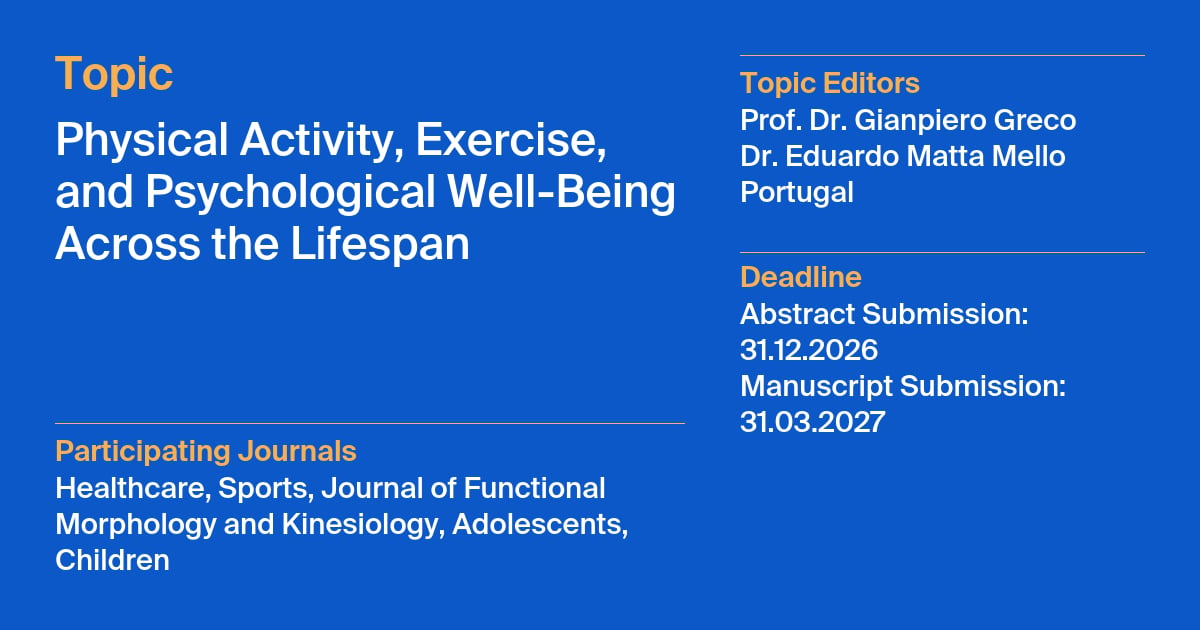
Physical Activity, Exercise, and Psychological Well-Being Across the Lifespan
Topic Information
Dear Colleagues,
Physical activity and exercise are widely recognized as key determinants of physical health, but their role in psychological well-being across the lifespan has gained increasing attention only in recent years. Accumulating evidence suggests that movement behaviors influence not only mental health outcomes such as anxiety, depression, and stress, but also broader dimensions of psychological functioning, including motivation, self-regulation, quality of life, emotional resilience, and social well-being. This Topic aims to bring together interdisciplinary research examining the relationships between physical activity, structured exercise, and psychological well-being from childhood and adolescence through adulthood and older age. By adopting a lifespan perspective, the Topic seeks to capture age-specific mechanisms, developmental trajectories, and contextual factors that shape the psychological responses to physical activity and exercise in diverse populations. Contributions may address both general and specific populations, including healthy individuals, athletes, students, older adults, and people living with chronic conditions or disabilities. Relevant themes include, but are not limited to, mental health promotion, psychological adaptation to exercise, motivation and adherence to active lifestyles, behavior change processes, psychosocial determinants of physical activity, and the role of physical activity in preventive and therapeutic contexts. Methodological approaches may include observational studies, experimental and intervention designs, longitudinal research, mixed-methods studies, and systematic or narrative reviews. The Topic is intentionally broad to encourage submissions from multiple disciplines—such as sport and exercise science, psychology, public health, education, and rehabilitation—and to support collaboration across journals participating in the combined Special Issue. By integrating psychological and behavioral perspectives with physical activity and exercise research, this Topic aims to advance understanding of how movement can support psychological well-being and mental health across the entire lifespan, while informing evidence-based practice and policy development.
Dr. Gianpiero Greco
Dr. Eduardo Matta Mello Portugal
Topic Editors
Keywords
- physical activity AND mental health
- exercise AND mental health
- physical activity AND well-being
- exercise adherence
- exercise motivation
- behavior change AND physical activity
- sport psychology
- exercise psychology
- physical activity AND quality of life
- sedentary behavior AND mental health
- motor competence AND psychological outcomes
Participating Journals


336 Articles
Launched in 2021
1.7Impact Factor
1.7CiteScore
42 DaysSubmission to First Decision
6 DaysAcceptance to Publication
Q3Highest JCR Category Ranking

10,679 Articles
Launched in 2014
2.6Impact Factor
4.5CiteScore
15 DaysSubmission to First Decision
3 DaysAcceptance to Publication
Q1Highest JCR Category Ranking

18,147 Articles
Launched in 2013
3.4Impact Factor
5.5CiteScore
21 DaysSubmission to First Decision
3 DaysAcceptance to Publication
Q1Highest JCR Category Ranking

1,900 Articles
Launched in 2016
2.5Impact Factor
3.2CiteScore
20 DaysSubmission to First Decision
3 DaysAcceptance to Publication
Q2Highest JCR Category Ranking

2,699 Articles
Launched in 2013
3.2Impact Factor
4.3CiteScore
19 DaysSubmission to First Decision
5 DaysAcceptance to Publication
Q1Highest JCR Category Ranking