
New Advances in Luminescent Materials
Topic Information
Dear Colleagues,
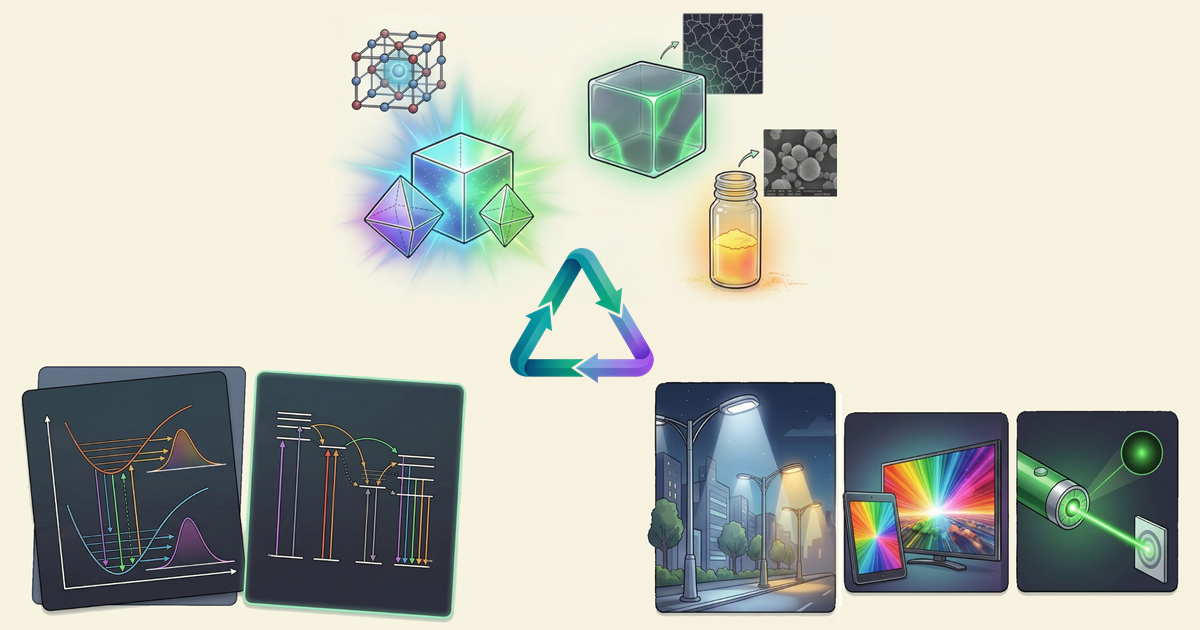
Luminescent materials form the cornerstone of human civilization, a reality underscored by the close correlation between the level of application of lighting materials and a country's economic development—a fact that can be verified by a nighttime satellite view of Earth. Consequently, advances in luminescent materials are essential to humanity's pursuit of a better quality of life. To date, thousands of luminescent materials have been reported, with a select few achieving commercialization and finding their way into countless households. Concurrently, on the theoretical front, topics such as rare-earth energy levels, energy transfer, empirical fitting formulas, and quantum theory-based predictions are frequently discussed in both the literature and conference presentations. While we benefit from and appreciate these achievements—the fruits of pioneering efforts—we must recognize that "the essence of luminescence lies in energy conversion". This concise statement still encompasses profound scientific questions, ranging from novel energy transfer mechanisms and advanced structural designs (such as host structures, local coordination environments of luminescent centers, and ground-state and excited-state configurations) to innovative fabrication techniques that push performance ever closer to theoretical limits. Moreover, emerging technologies from other fields, such as machine learning and artificial intelligence, introduce new challenges and opportunities. In this context, the timely reporting and synthesis of cutting-edge advances in these areas not only honors the legacy of past discoveries but also anchors our present efforts while charting a course for future innovation. Driven by this motivation, this Topic seeks to showcase recent breakthroughs in the field. We cordially invite contributions that address emerging luminescent materials, multiscale computational simulations, key strategies for enhancing luminescence performance, the integration of big data-driven approaches, and the critical transition from laboratory-scale research to pilot-scale production and industrialization. Subworks addressing related aspects are also welcome.
Prof. Dr. Daqin Chen
Dr. Jonathan Kitchen
Dr. Haohong Chen
Topic Editors
Keywords
- novel luminescent materials
- multiscale computational simulations
- new luminescent mechanisms
- new preparation processes
- emerging applications
- big data-driven research
- statistical analysis
- pilot-scale production and industrialization
Participating Journals


942 Articles
Launched in 2019
2.6Impact Factor
4.4CiteScore
13 DaysSubmission to First Decision
4 DaysAcceptance to Publication
Q3Highest JCR Category Ranking

2,459 Articles
Launched in 2013
3.4Impact Factor
5.3CiteScore
13 DaysSubmission to First Decision
3 DaysAcceptance to Publication
Q2Highest JCR Category Ranking

58,969 Articles
Launched in 2008
3.7Impact Factor
7.0CiteScore
14 DaysSubmission to First Decision
4 DaysAcceptance to Publication
Q2Highest JCR Category Ranking

66,630 Articles
Launched in 1996
5.1Impact Factor
10.3CiteScore
16 DaysSubmission to First Decision
3 DaysAcceptance to Publication
Q2Highest JCR Category Ranking

271 Articles
Launched in 2020
2.1Impact Factor
3.3CiteScore
18 DaysSubmission to First Decision
5 DaysAcceptance to Publication
Q4Highest JCR Category Ranking

Preprints.org is a multidisciplinary platform offering a preprint service designed to facilitate the early sharing of your research. It supports and empowers your research journey from the very beginning.
MDPI Topics is collaborating with Preprints.org and has established a direct connection between MDPI journals and the platform. Authors are encouraged to take advantage of this opportunity by posting their preprints at Preprints.org prior to publication:
i. Share your research immediately: disseminate your ideas prior to publication and establish priority for your work.
ii. Safeguard your intellectual contribution: Protect your ideas with a time-stamped preprint that serves as proof of your research timeline.
iii. Boost visibility and impact: Increase the reach and influence of your research by making it accessible to a global audience.
iv. Gain early feedback: Receive valuable input and insights from peers before submitting to a journal.
v. Ensure broad indexing: Web of Science (Preprint Citation Index), Google Scholar, Crossref, SHARE, PrePubMed, Scilit and Europe PMC.