

Enzyme Inhibition and Activation Beyond IC50: Mechanistic Interpretation in Modern Biomedical Science
Topic Information
Dear Colleagues,
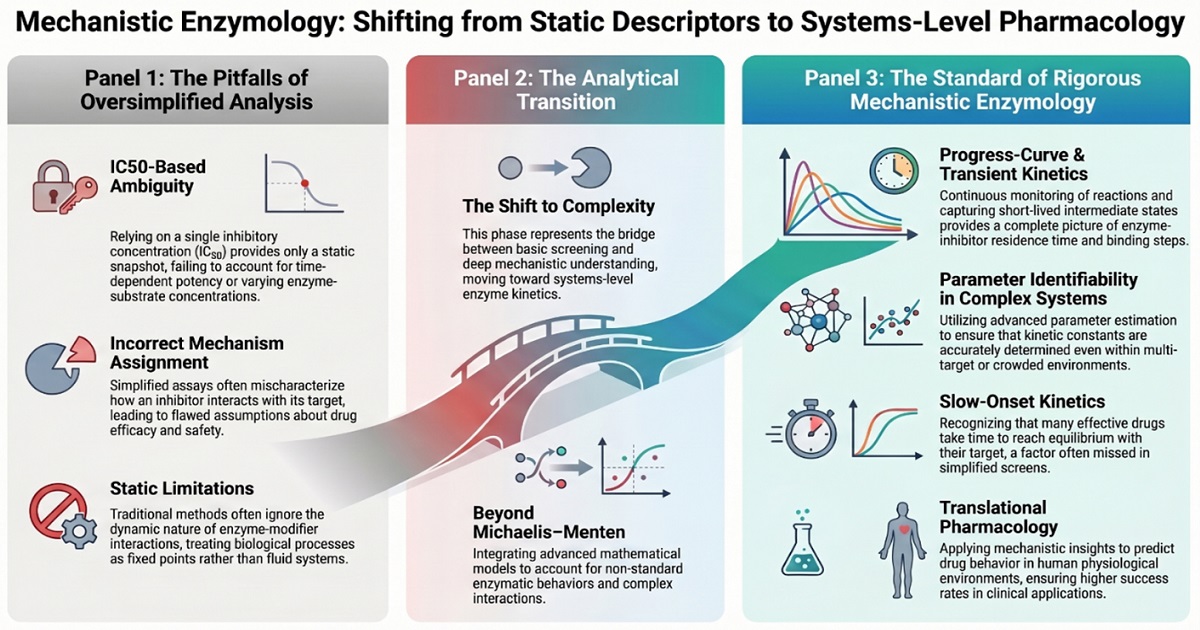
Enzyme kinetics remains a foundational discipline in biochemistry, pharmacology, and molecular medicine. However, despite major technological advances in drug discovery and systems biology, mechanistic interpretation of enzyme–modifier interactions is often overshadowed by simplified empirical descriptors and oversimplified analytical approaches. In many biomedical studies, inhibition mechanisms are assigned without rigorous kinetic demonstration, inhibition constants are derived from inappropriate assumptions, and mechanistic complexity is frequently reduced to isolated IC50 values with limited interpretative significance.
In this context, a modern, terminology-consistent mechanistic framework for enzyme–modifier interactions is essential. This Topic aims to promote a grounded perspective on modern enzymology, with particular emphasis on the systematic characterization of enzyme inhibition and activation mechanisms in biologically and pharmacologically relevant contexts.
We welcome contributions addressing the following:
- Mechanistic interpretation of enzyme–modifier interactions, using rigorously defined kinetic mechanisms rather than purely empirical descriptors.
- Distinction and classification of inhibition and activation mechanisms, following modern taxonomies and avoiding obsolete or ambiguous terminology, such as traditional “noncompetitive inhibition”.
- Allosteric, mixed, and hyperbolic modifier behavior, clarifying that hyperbolic mechanisms fall within the broader allosteric framework and should not be conflated with cooperativity.
- Slow-onset inhibition and activation, characterizing time-dependent mechanisms on the minutes’ scale, distinct from rapid transient events in enzyme–substrate kinetics.
- Progress-curve analysis, as a primary tool to analyze time-dependent slow-onset inhibition and activation beyond initial-rate approximations.
- Deviations from classical Michaelis–Menten assumptions, critically examining systems in which Michaelis–Menten/Briggs–Haldane approximations become quantitatively inadequate.
- Enzyme kinetics in crowded, heterogeneous, or cellular environments, addressing how crowding, compartmentalization, and condensates reshape apparent kinetic behavior.
- Kinetic identifiability, parameter estimation, and reproducibility, ensuring that kinetic parameters and mechanisms are demonstrably identifiable, robust, and transparently reported.
- Quantitative integration of kinetics into drug discovery and pharmacological research, embedding mechanistic enzyme kinetics into target validation, pharmacodynamics, and modulator design.
Particular interest will be given to studies that move beyond simplified initial-rate methodologies and incorporate rigorous experimental design, systematic kinetic analysis, and physiologically relevant interpretation. Contributions bridging mechanistic enzymology with medicinal chemistry, pharmacodynamics, target engagement, covalent modulation, and systems pharmacology are especially encouraged.
This Topic also seeks to stimulate critical discussion regarding obsolete analytical practices, conceptual ambiguities in the literature, and methodological limitations that continue to affect the interpretation of enzyme kinetics in contemporary biomedical science.
By integrating mechanistic rigor with biological complexity, this Topic aims to strengthen the conceptual foundations of enzyme kinetics and foster a more systematic understanding of enzyme–modifier interactions in modern molecular and translational research.
In alignment with the scope of the participating journals, this Topic adopts a unified mechanistic perspective on enzyme–modifier interactions and aims to move beyond single-parameter descriptors such as IC50 toward more mechanistically informative kinetic frameworks.
Dr. Paula Pinto
Prof. Dr. Antonio Baici
Topic Editors
Keywords
- enzyme kinetics
- enzyme–modifier interactions
- mechanistic enzymology
- enzyme inhibition
- enzyme activation
- allosteric regulation
- hyperbolic inhibition
- slow-onset inhibition
- progress-curve analysis
- parameter identifiability
Participating Journals


4,597 Articles
Launched in 1999
4.1Impact Factor
5.0CiteScore
37 DaysMedian Time to Publication
Q2Highest JCR Category Ranking

114,933 Articles
Launched in 2000
5.6Impact Factor
10.0CiteScore
42 DaysMedian Time to Publication
Q1Highest JCR Category Ranking

262 Articles
Launched in 2021
-Impact Factor
2.8CiteScore
54 DaysMedian Time to Publication
-Highest JCR Category Ranking

65,850 Articles
Launched in 1996
5.1Impact Factor
10.3CiteScore
41 DaysMedian Time to Publication
Q2Highest JCR Category Ranking

11,436 Articles
Launched in 2004
5.7Impact Factor
9.0CiteScore
40 DaysMedian Time to Publication
Q1Highest JCR Category Ranking