Skip Content
You are currently on the new version of our website. Access the old version .

Toxics

Toxics is an international, peer-reviewed, open access journal on all aspects of the toxic chemicals and materials, published monthly online by MDPI.

Indexed in PubMed | Quartile Ranking JCR - Q1 (Toxicology)

All Articles (4,766)

The ability of the atmosphere to convert primary pollutants into secondary pollutants through atmospheric oxidants is referred to as the atmospheric oxidizing capacity (AOC). This study systematically reviews the generation mechanisms, influencing factors, and quantitative characterization methods of major oxidants, along with advances in chemical mechanisms and modeling. We provide a comparative analysis of AOCs across diverse environments, including urban, suburban, and rural regions, highlighting the distinct impacts of anthropogenic and biogenic emissions on oxidation regimes. Despite advancements in chemical transport models and machine learning, limitations such as sparse observations, imperfect parameterizations, and unresolved chemical mechanisms lead to significant underestimations of the AOC. Future research must prioritize multi-scale observational networks and the elucidation of key chemical processes to refine model accuracy and improve the effectiveness of pollution control strategies.

8 February 2026
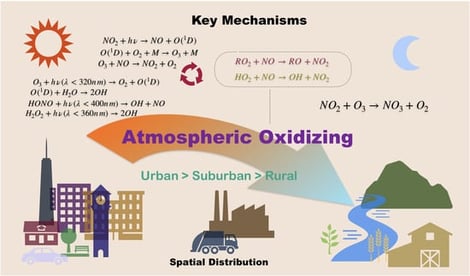
Schematic diagram of key reaction mechanisms governing atmospheric oxidizing capacity (the gray reaction numbers correspond to equations in text).

Background: Microplastics and nanoplastics, as pervasive and persistent environmental pollutants, are raising growing concerns regarding their potential risks to reproductive health, particularly pregnancy outcomes. Although the reproductive toxicity of polystyrene nanoplastics (PS-NPs) has been reported, the specific mechanisms underlying their effects on placental development and offspring health following gestational exposure remain unclear. Method: This study aimed to investigate the effects of gestational exposure to PS-NPs of different sizes (50 and 200 nm) and concentrations (1, 3, and 10 mg/mL) on placental function and embryonic development in ICR mice. An exposure model was established via tail vein injection, and samples were collected on embryonic Day 14.5 (E14.5). Results: the exposed groups tended towards increased embryo weight, embryo length, and embryo head circumference. Transcriptomic analysis revealed that PS-NP exposure significantly downregulated the expression of Ndufa5 (a subunit of mitochondrial respiratory chain complex I) and mt-CO1 (a core subunit of complex IV), but upregulated the expression of the genes Cldn1 (tight junction protein) and Erbb3 (receptor tyrosine kinase) in the placenta. Differentially expressed genes were enriched primarily in pathways related to oxidative phosphorylation, the tricarboxylic acid (TCA) cycle, and ErbB signalling. Conclusions: These changes collectively led to decreased mitochondrial ATP production, increased oxidative stress in the placenta, and potentially altered placental barrier function and trophoblast cell proliferation signalling. This study reveals a novel mechanism by which PS-NPs disrupt placental development and embryonic growth through impairment of placental energy metabolic homeostasis and key signalling pathways, thus providing crucial experimental evidence for assessing the reproductive and developmental toxicity of nanoplastics.

8 February 2026

  • Feature Paper
  • Article
  • Open Access

The pervasive toxicity of active aluminum (Al3+) in acidic red soils threatens agroecosystem sustainability, with conventional chemical stabilizers facing cost and secondary pollution constraints. This study evaluated rice husk/sawdust and their pyrolysis-derived biochar as stabilizers, focusing on microbial synergy. Results showed 3% rice husk biochar (RB) achieved 22.1 ± 1.1% stabilization efficiency within 180 days, outperforming sawdust biochar (12.1 ± 0.8%) and raw biomass. Biochar’s alkalinity and porosity created neutral niches, enriching denitrifiers (Thiobacillus, Arthrobacter, Thermomonas) that elevated pH, promoted Al(OH)3 precipitation, and enhanced oxygen-containing functional groups. This work valorizes agricultural waste for long-term Al3+ toxicity mitigation.

6 February 2026

Heavy metal pollution of farmland has emerged as a pressing global environmental challenge, which threatens food security, ecological integrity, and human health [...]

3 February 2026

News & Conferences

Issues

Open for Submission

Editor's Choice

Reprints of Collections

Cadmium and Trace Elements Toxicity
Reprint

Cadmium and Trace Elements Toxicity

Editors: Roberto Madeddu, Soisungwan Satarug, Peter Massányi

Get Alerted

Add your email address to receive forthcoming issues of this journal.

XFacebookLinkedIn
Toxics - ISSN 2305-6304