Environmental and Health Risk Assessments of Volatile Organic Compounds (VOCs) Based on Source Apportionment—A Case Study in Harbin, a Megacity in Northeastern China

 ,
, Highlights
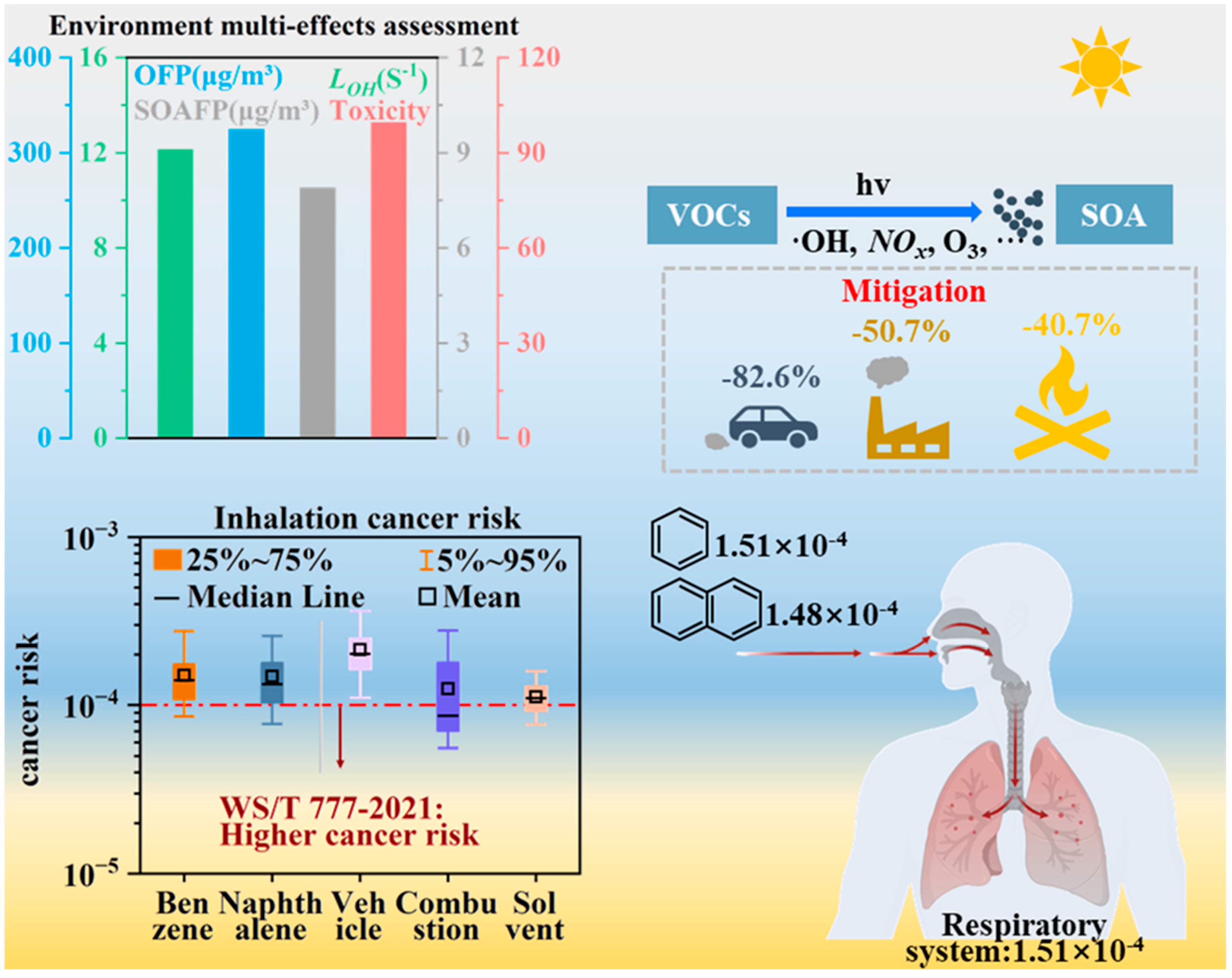
- TVOCs averaged 25.6 ± 8.2 ppb, with heating periods being 1.6 times higher than non-heating periods.
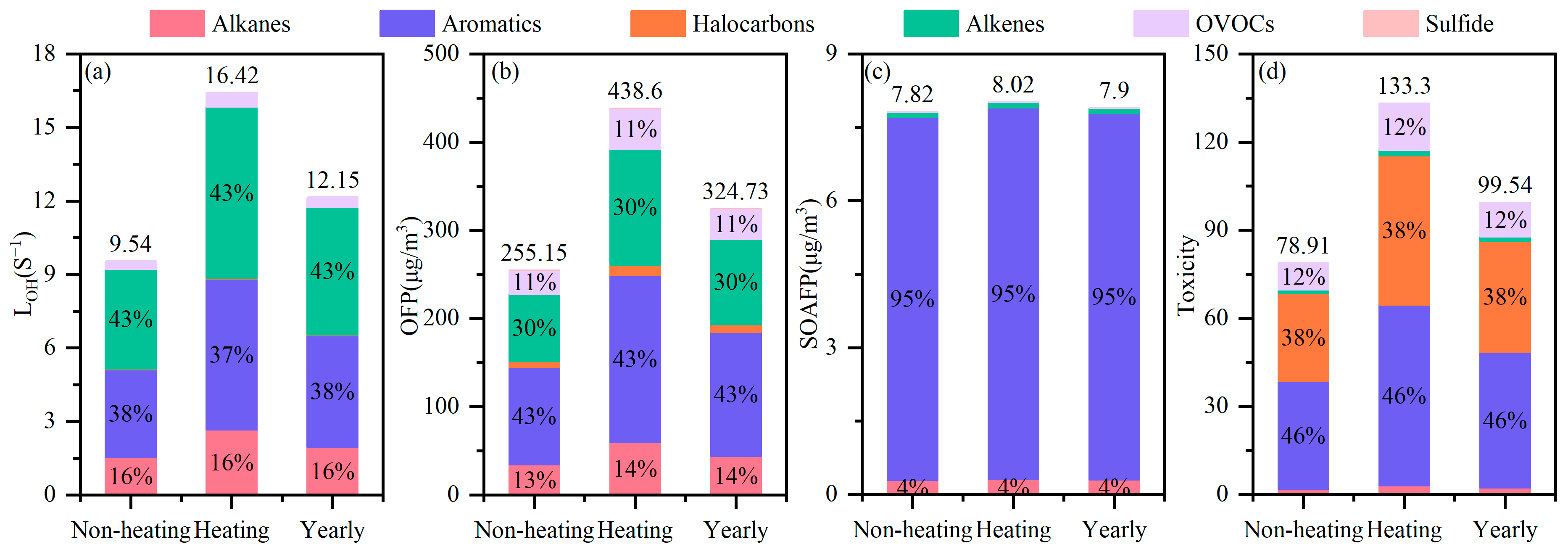
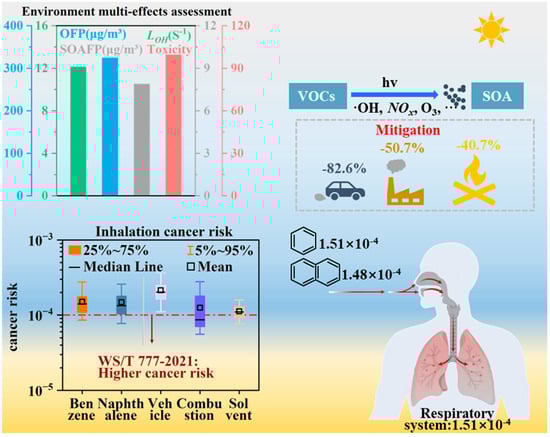
- Aromatics, alkenes, and halocarbons contributed 80.5 %, 74.5 %, 96.1 %, and 83.9 % to LOH, OFP, SOAFP, and toxicity.
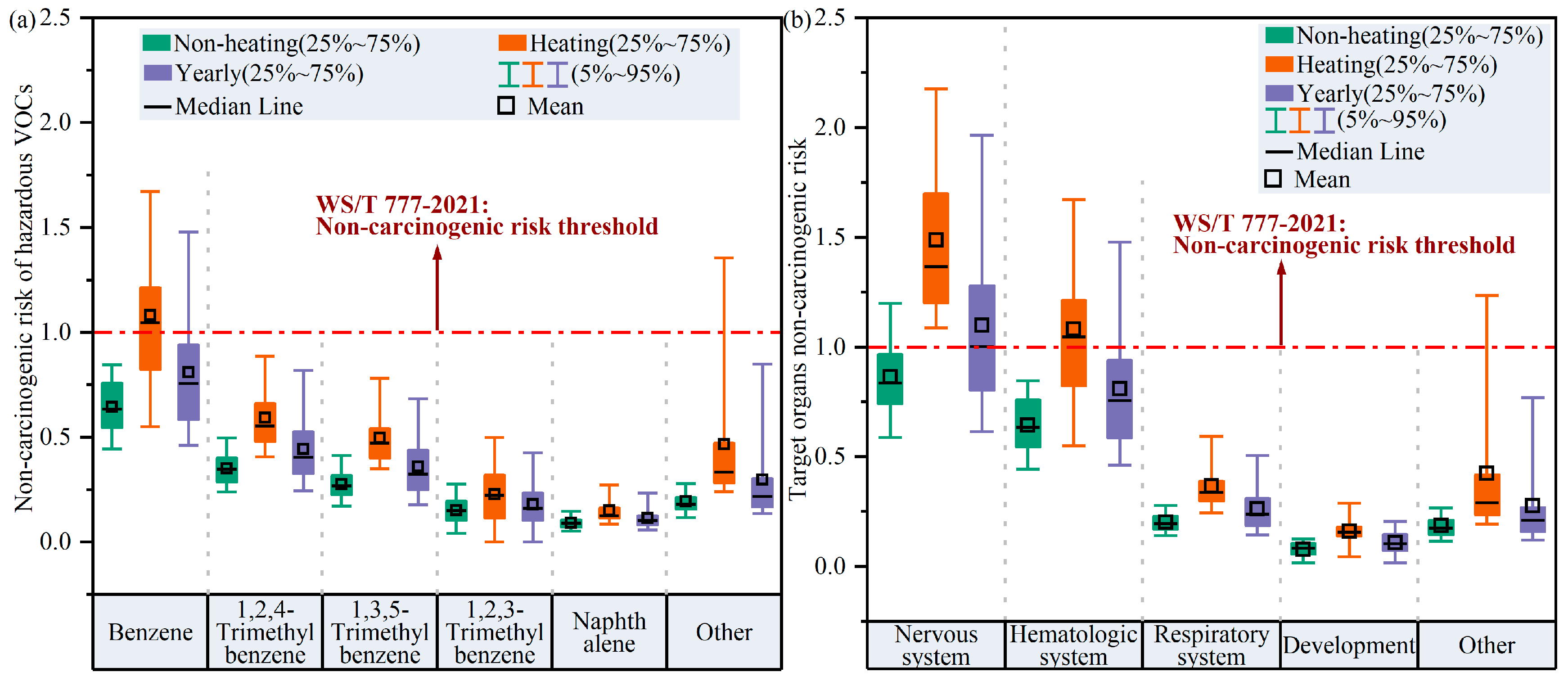
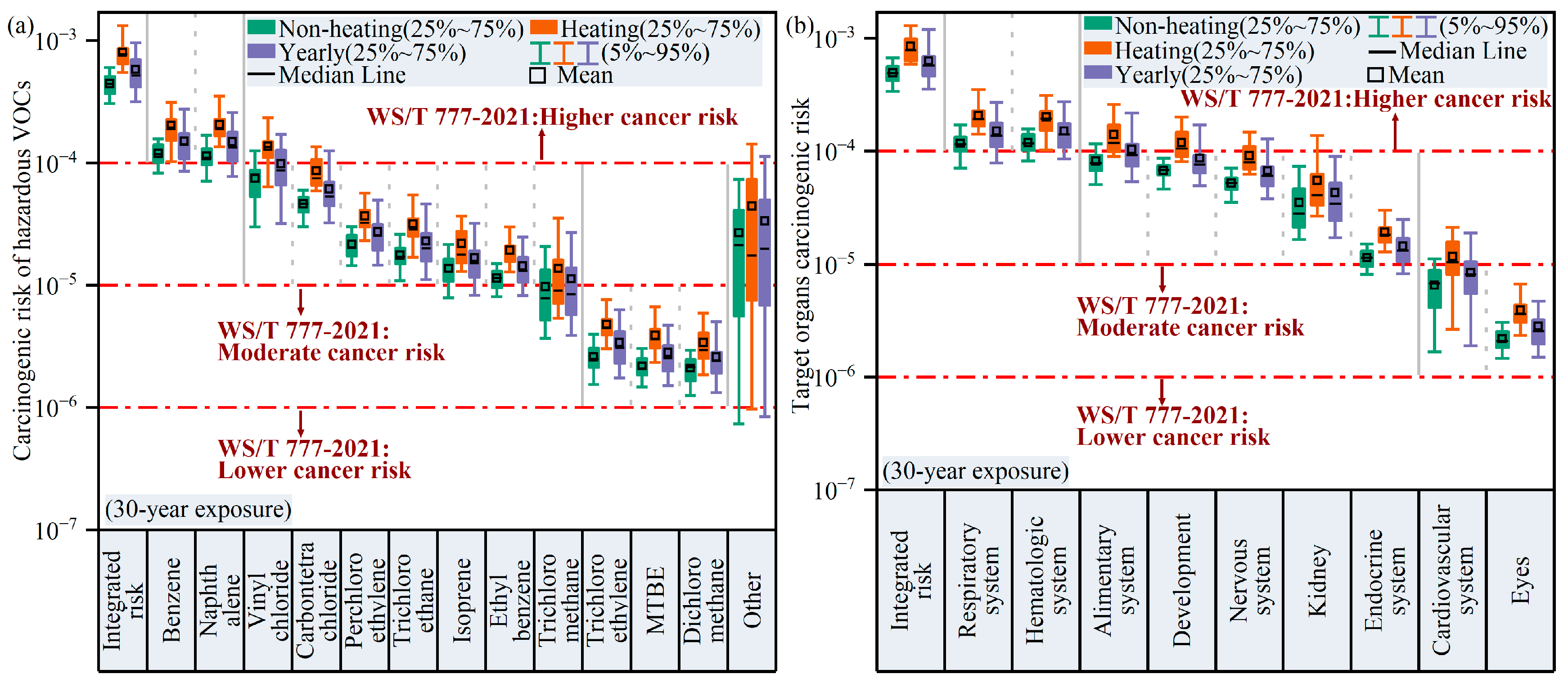
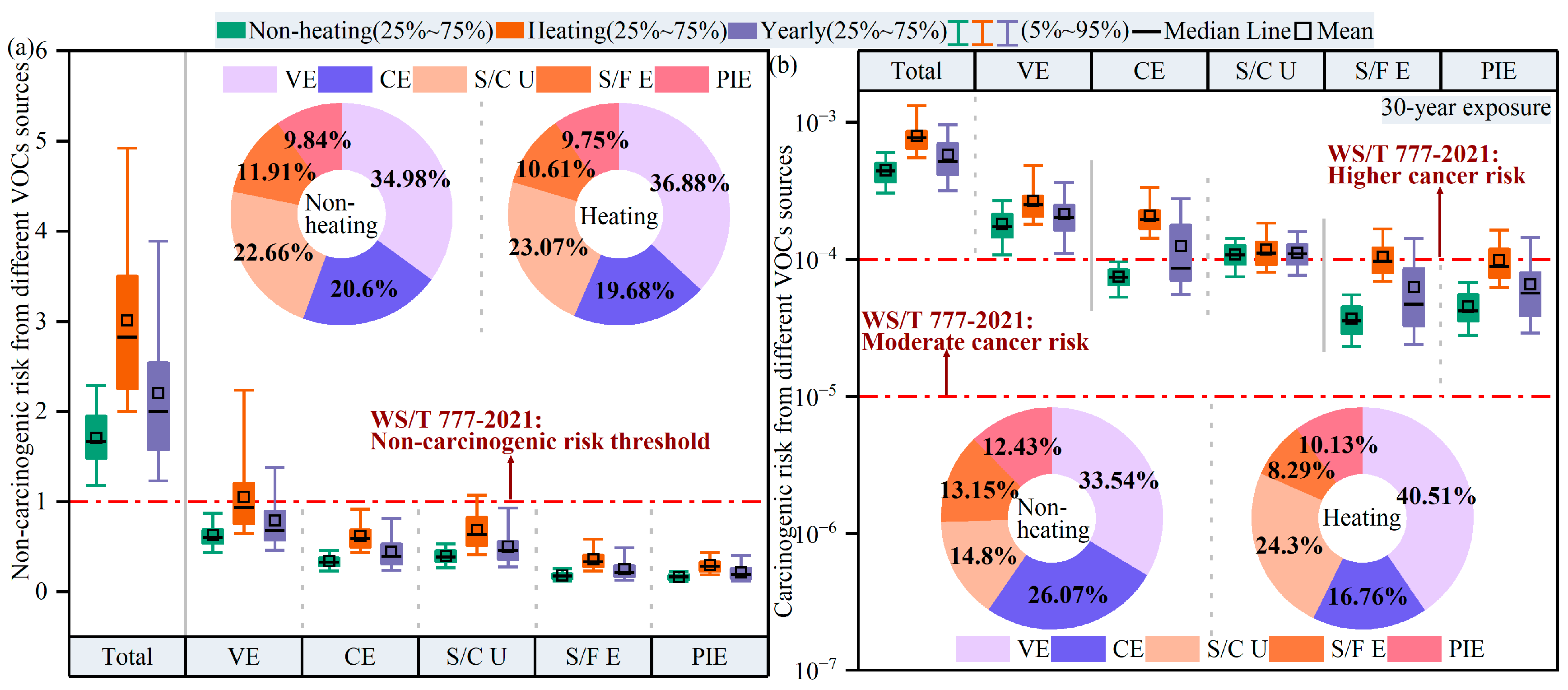
- The integrated cancer risk was 5.8 × 10⁻⁴, with vehicle exhaust contributing up to 40.5 % during heating periods.
- In heating periods, benzene and naphthalene are reduced by more than 50.0 %, and vehicle exhaust reduction is more than 80.0 %, achieving acceptable risk levels.
- The findings quantitatively emphasize the environmental and health risks of VOCs, which could be useful for local governments to help them better implement policies for managing VOC emissions.
Abstract
1. Introduction
2. Materials and Methods
2.1. Study Site Description
2.2. VOC Sampling and Analysis
2.3. Multi-Effect Assessment of Environmental Risks of VOCs
2.4. Health Risk-Oriented Source Apportionment
2.4.1. Source Apportionment
2.4.2. Health Risk Assessment
2.4.3. Preliminary Remediation Goals
3. Results
3.1. Characterization of VOCs
3.1.1. Characterization of VOC Compositions and Hazardous VOC Levels
3.1.2. Temporal Variations in VOCs
3.2. Source Apportionment
3.2.1. Specific VOC Ratio
3.2.2. PMF Method of Source Analysis
3.3. Environmental Multi-Effect Assessment
3.3.1. Contribution of Different VOCs’ Chemical Groups to Environmental Effects
3.3.2. Contributions of Different VOC Sources to Environmental Effects
3.4. Human Health Risk Assessment
3.4.1. Non-Carcinogenic Risk Exposure Assessment of Hazardous VOCs
3.4.2. Carcinogenic Risk Exposure Assessment of Hazardous VOCs
3.4.3. Contributions of Different VOC Sources to Health Risks
4. Conclusions
Supplementary Materials
Author Contributions
Funding
Institutional Review Board Statement
Informed Consent Statement
Data Availability Statement
Conflicts of Interest
References
- Atkinson, R. Atmospheric Chemistry of VOCs and NOx. Atmos. Environ. 2000, 34, 2063–2101. [Google Scholar] [CrossRef]
- FinlaysonPitts, B.J.; Pitts, J.N. Tropospheric Air Pollution: Ozone, Airborne Toxics, Polycyclic Aromatic Hydrocarbons, and Particles. Science 1997, 276, 1045–1052. [Google Scholar] [CrossRef]
- Feng, Z.; Xu, Y.; Kobayashi, K.; Dai, L.; Zhang, T.; Agathokleous, E.; Calatayud, V.; Paoletti, E.; Mukherjee, A.; Agrawal, M. Ozone Pollution Threatens the Production of Major Staple Crops in East Asia. Nat. Food 2022, 3, 47–56. [Google Scholar] [CrossRef]
- Fuhrer, J.; Val Martin, M.; Mills, G.; Heald, C.L.; Harmens, H.; Hayes, F.; Sharps, K.; Bender, J.; Ashmore, M.R. Current and Future Ozone Risks to Global Terrestrial Biodiversity and Ecosystem Processes. Ecol. Evol. 2016, 6, 8785–8799. [Google Scholar] [CrossRef]
- Ling, Z.; Wu, L.; Wang, Y.; Shao, M.; Wang, X.; Huang, W. Roles of Semivolatile and Intermediate-Volatility Organic Compounds in Secondary Organic Aerosol Formation and Its Implication: A review. J. Environ. Sci. 2022, 114, 259–285. [Google Scholar] [CrossRef]
- Srivastava, D.; Vu, T.V.; Tong, S.; Shi, Z.; Harrison, R.M. Formation of Secondary Organic Aerosols from Anthropogenic Precursors in Laboratory Studies. npj Clim. Atmos. Sci. 2022, 5, 22. [Google Scholar] [CrossRef]
- Yang, X.; Li, Y.; Ma, X.; Tan, Z.; Lu, K.; Zhang, Y. Unclassical Radical Generation Mechanisms in the Troposphere: A Review. Environ. Sci. Technol. 2024, 58, 15888–15909. [Google Scholar] [CrossRef] [PubMed]
- Hoyle, C.R.; Myhre, G.; Berntsen, T.K.; Isaksen, I.S.A. Anthropogenic Influence on Soa and the Resulting Radiative Forcing. Atmos. Chem. Phys. 2009, 9, 2715–2728. [Google Scholar] [CrossRef]
- Zhu, J.; Penner, J.E.; Yu, F.; Sillman, S.; Andreae, M.O.; Coe, H. Decrease in Radiative Forcing by Organic Aerosol Nucleation, Climate, and Land Use Change. Nat. Commun. 2019, 10, 423. [Google Scholar] [CrossRef] [PubMed]
- Shrivastava, M.; Cappa, C.D.; Fan, J.; Goldstein, A.H.; Guenther, A.B.; Jimenez, J.L.; Kuang, C.; Laskin, A.; Martin, S.T.; Ng, N.L. Recent Advances in Understanding Secondary Organic Aerosol: Implications for Global Climate Forcing. Reviers Geophys. 2017, 55, 509–559. [Google Scholar] [CrossRef]
- Xiao, Q.Y.; Geng, G.N.; Xue, T.; Liu, S.G.; Cai, C.L.; He, K.B.; Zhang, Q. Tracking PM2.5 and O3 Pollution and the Related Health Burden in China 2013–2020. Environ. Sci. Technol. 2022, 56, 6922–6932. [Google Scholar] [CrossRef]
- Gong, X.; Sun, F.X.; Wei, L.; Zhang, Y.; Xia, M.J.; Ge, M.; Xiong, L.L. Association of Ozone and Temperature with Ischemic Heart Disease Mortality Risk: Mediation and Interaction Analyses. Environ. Sci. Technol. 2024, 58, 20378–20388. [Google Scholar] [CrossRef] [PubMed]
- An, Z.; Huang, R.-J.; Zhang, R.; Tie, X.; Li, G.; Cao, J.; Zhou, W.; Shi, Z.; Han, Y.; Gu, Z. Severe Haze in Northern China: A Synergy of Anthropogenic Emissions and Atmospheric Processes. Proc. Natl. Acad. Sci. USA 2019, 116, 8657–8666. [Google Scholar] [CrossRef] [PubMed]
- Li, C.; Zhu, Q.; Jin, X.; Cohen, R.C. Elucidating Contributions of Anthropogenic Volatile Organic Compounds and Particulate Matter to Ozone Trends over China. Environ. Sci. Technol. 2022, 56, 12906–12916. [Google Scholar] [CrossRef] [PubMed]
- Yang, Y.; Liu, B.; Hua, J.; Yang, T.; Dai, Q.; Wu, J.; Feng, Y.; Hopke, P.K. Global Review of Source Apportionment of Volatile Organic Compounds Based on Highly Time-Resolved Data from 2015 to 2021. Environ. Int. 2022, 165, 107330. [Google Scholar] [CrossRef]
- Yang, S.; Li, X.; Song, M.; Liu, Y.; Yu, X.; Chen, S.; Lu, S.; Wang, W.; Yang, Y.; Zeng, L.; et al. Characteristics and Sources of Volatile Organic Compounds During Pollution Episodes and Clean Periods in the Beijing-Tianjin-Hebei Region. Sci. Total Environ. 2021, 799, 149491. [Google Scholar] [CrossRef]
- Li, J.; Xie, X.; Li, L.; Wang, X.; Wang, H.; Jing, S.A.; Ying, Q.; Qin, M.; Hu, J. Fate of Oxygenated Volatile Organic Compounds in the Yangtze River Delta Region: Source Contributions and Impacts on the Atmospheric Oxidation Capacity. Environ. Sci. Technol. 2022, 56, 11212–11224. [Google Scholar] [CrossRef]
- Pei, C.; Yang, W.; Zhang, Y.; Song, W.; Xiao, S.; Wang, J.; Zhang, J.; Zhang, T.; Chen, D.; Wang, Y.; et al. Decrease in Ambient Volatile Organic Compounds During the COVID-19 Lockdown Period in the Pearl River Delta Region, South China. Sci. Total Environ. 2022, 823, 153720. [Google Scholar] [CrossRef]
- Mellouki, A.; Wallington, T.; Chen, J.J. Atmospheric Chemistry of Oxygenated Volatile Organic Compounds: Impacts on Air Quality and Climate. Chem. Rev. 2015, 115, 3984–4014. [Google Scholar] [CrossRef]
- Zhao, Q.; Bi, J.; Liu, Q.; Ling, Z.; Shen, G.; Chen, F.; Qiao, Y.; Li, C.; Ma, Z. Sources of Volatile Organic Compounds and Policy Implications for Regional Ozone Pollution Control in an Urban Location of Nanjing, East China. Atmos. Chem. Phys. 2020, 20, 3905–3919. [Google Scholar] [CrossRef]
- Niu, H.; Mo, Z.; Shao, M.; Lu, S.; Xie, S. Screening the Emission Sources of Volatile Organic Compounds (Vocs) in China by Multi-Effects Evaluation. Front. Environ. Sci. Eng. 2016, 10, 1. [Google Scholar] [CrossRef]
- Xiong, Y.; Huang, Y.; Du, K. Health Risk-Oriented Source Apportionment of Hazardous Volatile Organic Compounds in Eight Canadian Cities and Implications for Prioritizing Mitigation Strategies. Environ. Sci. Technol. 2022, 56, 12077–12085. [Google Scholar] [CrossRef]
- Xuan, L.; Ma, Y.; Xing, Y.; Meng, Q.; Song, J.; Chen, T.; Wang, H.; Wang, P.; Zhang, Y.; Gao, P. Source, Temporal Variation and Health Risk of Volatile Organic Compounds (Vocs) from Urban Traffic in Harbin, China. Environ. Pollut. 2021, 270, 116074. [Google Scholar] [CrossRef]
- Lerner, J.C.; Sanchez, E.Y.; Sambeth, J.E.; Porta, A.A. Characterization and Health Risk Assessment of Vocs in Occupational Environments in Buenos Aires, Argentina. Atmos. Environ. 2012, 55, 440–447. [Google Scholar] [CrossRef]
- China, Ministry of Ecological Environment of the People’s Republic. Ambient Air-Determination of Volatile Organic Compounds—Collected by Specially-Prepared Canistersand Analyzed by Gas Chromatography/Mass Spectrometry. 2015. Available online: https://www.mee.gov.cn/ywgz/fgbz/bz/bzwb/jcffbz/201510/W020151030573530793420.pdf#page=11.59 (accessed on 2 November 2025).
- Atkinson, R.; Arey, J. Atmospheric Degradation of Volatile Organic Compounds. Chem. Rev. 2003, 103, 4605–4638. [Google Scholar] [CrossRef]
- Guo, Q.; Wang, Y.; Zheng, J.; Zhu, M.; Sha, Q.; Huang, Z. Temporal Evolution of Speciated Volatile Organic Compound (VOC) Emissions from Solvent Use Sources in the Pearl River Delta Region, China (2006–2019). Sci. Total Environ. 2024, 933, 172888. [Google Scholar] [CrossRef] [PubMed]
- Carter, W.P.L. SAPRC Atmospheric Chemical Mechanisms and VOC Reactivity Scales. 2024. Available online: https://intra.engr.ucr.edu/~carter/SAPRC/ (accessed on 2 November 2025).
- Derwent, R.G.; Jenkin, M.E.; Utembe, S.R.; Shallcross, D.E.; Murrells, T.P.; Passant, N.R. Secondary Organic Aerosol Formation from a Large Number of Reactive Man-Made Organic Compounds. Sci. Total Environ. 2010, 408, 3374–3381. [Google Scholar] [CrossRef]
- McDonald, B.C.; de Gouw, J.A.; Gilman, J.B.; Jathar, S.H.; Akherati, A.; Cappa, C.D.; Jimenez, J.L.; Lee-Taylor, J.; Hayes, P.L.; McKeen, S.A.; et al. Volatile Chemical Products Emerging as Largest Petrochemical Source of Urban Organic Emissions. Science 2018, 359, 760–764. [Google Scholar] [CrossRef]
- Ye, C.; Guo, S.; Lin, W.; Tian, F.; Wang, J.; Zhang, C.; Chi, S.; Chen, Y.; Zhang, Y.; Zeng, L.; et al. Measurement Report: Source Apportionment and Environmental Impacts of Volatile Organic Compounds (VOCs) in Lhasa, a Highland City in China. Atmos. Chem. Phys. 2023, 23, 10383–10397. [Google Scholar] [CrossRef]
- Wu, C.F.; Wu, S.Y.; Wu, Y.H.; Cullen, A.C.; Larson, T.V.; Williamson, J.; Liu, L.J.S. Cancer Risk Assessment of Selected Hazardous Air Pollutants in Seattle. Environ. Int. 2009, 35, 516–522. [Google Scholar] [CrossRef]
- Gary Norris, R.D.; Steve, B.; Song, B. EPA Positive Matrix Factorization (PMF) 5.0 Fundamentals and User Guide. 2014. Available online: https://www.epa.gov/sites/default/files/2015-02/documents/pmf_5.0_user_guide.pdf (accessed on 2 November 2025).
- OEHHA. Air Toxics Hot Spots Program Guidance Manual; OEHHA: Sacramento, CA, USA, 2015. Available online: https://oehha.ca.gov/media/downloads/crnr/2015guidancemanual.pdf (accessed on 2 November 2025).
- Rajasekhar, B.; Nambi, I.M.; Govindarajan, S.K. Human Health Risk Assessment for Exposure to Btexn in an Urban Aquifer Using Deterministic and Probabilistic Methods: A Case Study of Chennai City, India. Environ. Pollut. 2020, 265, 114814. [Google Scholar] [CrossRef] [PubMed]
- Shan, C.; Javandel, I. A Multilayered Box Model for Calculating Preliminary Remediation Goals in Soil Screening. Risk Anal. 2005, 25, 339–349. [Google Scholar] [CrossRef]
- China, National Health Commission of the People’s Republic. Technical Guide for Environmental Health Risk Assessment of Chemical Exposure. 2021. Available online: https://www.ndcpa.gov.cn/jbkzzx/c100201/common/content/content_1666339466776481792.html (accessed on 2 November 2025).
- China, Ministry of Ecology and Environment of the People’s Republic. Ambient Air Quality Standards. 2012. Available online: https://www.mee.gov.cn/ywgz/fgbz/bz/bzwb/dqhjbh/dqhjzlbz/201203/W020250407403788086276.pdf (accessed on 2 November 2025).
- Crutzen, P.J.; Heidt, L.E.; Krasnec, J.P.; Pollock, W.H.; Seiler, W. Biomass Burning as a Source of Atmospheric Gases CO, H2, N2O, NO, CH3Cl and COS. Nature 2016, 282, 117–124. [Google Scholar]
- Seinfeld, J.H.; Erdakos, G.B.; Asher, W.E.; Pankow, J.F. Modeling the Formation of Secondary Organic Aerosol (SOA). 2. The Predicted Effects of Relative Humidity on Aerosol Formation in the α-Pinene-, β-Pinene-, Sabinene-, Carene-, and Cyclohexene-Ozone Systems. Environ. Sci. Technol. 2001, 35, 3272. [Google Scholar] [CrossRef][Green Version]
- Yang, Y.R.; Liu, X.G.; Qu, Y.; An, J.L.; Jiang, R.; Zhang, Y.H.; Sun, Y.L.; Wu, Z.J.; Zhang, F.; Xu, W.Q.; et al. Characteristics and Formation Mechanism of Continuous Hazes in China: A Case Study During the Autumn of 2014 in the North China Plain. Atmos. Chem. Phys. 2015, 15, 8165–8178. [Google Scholar] [CrossRef]
- Sun, W.; Shao, M.; Granier, C.; Liu, Y.; Ye, C.; Zheng, J.Y. Long-Term Trends of Anthropogenic SO2, NOx, CO, and NMVOCs Emissions in China. Earths Future 2018, 6, 1112–1133. [Google Scholar] [CrossRef]
- Williams, M.L. The Impact of Motor Vehicles on Air Pollutant Emissions and Air Quality in the UK—An Overview. Sci. Total Environ. 1987, 59, 47–61. [Google Scholar] [CrossRef]
- Lu, H.; Lyu, X.; Cheng, H.; Ling, Z.; Guo, H. Overview on the Spatial–Temporal Characteristics of the Ozone Formation Regime in China. Environ. Sci. Process. Impacts 2019, 21, 916–929. [Google Scholar] [CrossRef]
- Li, B.W.; Ho, S.S.H.; Gong, S.L.; Ni, J.W.; Li, H.R.; Han, L.Y.; Yang, Y.; Qi, Y.J.; Zhao, D.X. Characterization of VOCs and Their Related Atmospheric Processes in a Central Chinese City During Severe Ozone Pollution Periods. Atmos. Chem. Phys. 2019, 19, 617–638. [Google Scholar] [CrossRef]
- Zhu, K.; Liu, L. Reactive Activity, Source Analysis and Health Risk Assessment of VOCs in Ambient Air of Shahekou District, Dalian. 2022. Available online: https://link.cnki.net/doi/10.27393/d.cnki.gxazu.2022.000411 (accessed on 2 November 2025).
- Zhang, Y.; You, B.; Shang, Y.; Bao, Q.; Zhang, Y.; Pang, X.; Guo, L.; Fu, J.; Chen, W. Characteristics and Ozone Formation Potentials of Volatile Organic Compounds in a Heavy Industrial Urban Agglomeration of Northeast China. Air Qual. Atmos. Health 2024, 17, 2235–2246. [Google Scholar] [CrossRef]
- Ma, Z.B.; Liu, C.T.; Zhang, C.L.; Liu, P.F.; Ye, C.; Xue, C.Y.; Zhao, D.; Sun, J.C.; Du, Y.M.; Chai, F.H.; et al. The Levels, Sources and Reactivity of Volatile Organic Compounds in a Typical Urban Area Of Northeast China. J. Environ. Sci. 2019, 79, 121–134. [Google Scholar] [CrossRef]
- Simpson, I.J.; Blake, N.J.; Barletta, B.; Diskin, G.S.; Fuelberg, H.E.; Gorham, K.; Huey, L.G.; Meinardi, S.; Rowland, F.S.; Vay, S.A.; et al. Characterization of Trace Gases Measured over Alberta Oil Sands Mining Operations: 76 Speciated PM2.5, PM10, Volatile Organic Compounds (VOCs), CO2, CH4, CO, NO, NO2, NOy, O3 and SO2. Atmos. Chem. Phys. 2010, 10, 11931–11954. [Google Scholar] [CrossRef]
- Turner, M.C.; Godderis, L.; Guenel, P.; Hopf, N.; Quintanilla-Vega, B.; Soares-Lima, S.C.; Chaiklieng, S.; Da Silva, J.; Fustinoni, S.; Gi, M.; et al. Carcinogenicity of Automotive Gasoline and Some Oxygenated Gasoline Additives. Lancet. Oncol. 2025. online ahead of print. [CrossRef]
- Schlosser, P.M.; Bale, A.S.; Gibbons, C.F.; Wilkins, A.; Cooper, G.S. Human Health Effects of Dichloromethane: Key Findings and Scientific Issues. Environ. Health Perspect. 2015, 123, 114–119. [Google Scholar] [CrossRef] [PubMed]
- Ceballos, D.M.; Fellows, K.M.; Evans, A.E.; Janulewicz, P.A.; Lee, E.G.; Whittaker, S.G. Perchloroethylene and Dry Cleaning: It’s Time to Move the Industry to Safer Alternatives. Front. Public Health 2021, 9, 638082. [Google Scholar] [CrossRef]
- Hatch, L.E.; Luo, W.; Pankow, J.F.; Yokelson, R.J.; Stockwell, C.E.; Barsanti, K.C. Identification and Quantification of Gaseous Organic Compounds Emitted from Biomass Burning Using Two-Dimensional Gas Chromatography–Time-of-Flight Mass Spectrometry. Atmos. Chem. Phys. 2015, 15, 1865–1899. [Google Scholar] [CrossRef]
- Yu, W.; Shen, X.; Yao, Z.; Cao, X.; Hao, X.; Li, X.; Wu, B.; Zhang, H.; Wang, S.; Zhou, Q. Database of Emission Factors of Volatile Organic Compound (VOC) Species in Motor Vehicle Exhaust in China. Sci. Total Environ. 2024, 914, 169844. [Google Scholar] [CrossRef]
- Han, Y.; Wang, T.; Li, R.; Fu, H.; Duan, Y.; Gao, S.; Zhang, L.; Chen, J. Measurement Report: Volatile organic Compound Characteristics of the Different Land-Use Types in Shanghai: Spatiotemporal Variation, Source Apportionment and Impact on Secondary Formations of Ozone and Aerosol. Atmos. Chem. Phys. 2023, 23, 2877–2900. [Google Scholar] [CrossRef]
- Murphy, J.G.; Day, D.A.; Cleary, P.A.; Wooldridge, P.J.; Millet, D.B.; Goldstein, A.H.; Cohen, R.C. The Weekend Effect Within and Downwind of Sacramento–Part 1: Observations of Ozone, Nitrogen Oxides, and VOC Reactivity. Atmos. Chem. Phys. 2007, 7, 5327–5339. [Google Scholar] [CrossRef]
- Nussbaumer, C.M.; Cohen, R. The Role of Temperature and NOx in Ozone Trends in the Los Angeles Basin. Environ. Sci. Technol. 2020, 54, 15652–15659. [Google Scholar] [CrossRef] [PubMed]
- Song, M.; Li, X.; Yang, S.; Yu, X.; Zhou, S.; Yang, Y.; Chen, S.; Dong, H.; Liao, K.; Chen, Q.; et al. Spatiotemporal Variation, Sources, and Secondary Transformation Potential of VOCs in Xi’an, China. Atmos. Chem. Phys. 2020, 21, 4939–4958. [Google Scholar] [CrossRef]
- Cui, L.; Wu, D.; Wang, S.; Xu, Q.; Hu, R.; Hao, J. Measurement Report: Ambient Volatile Organic Compounds (VOCs) Pollution at Urban Beijing: Characteristics, Sources, and Implications for Pollution Control. Atmos. Chem. Phys. Discuss. 2021, 22, 11931–11944. [Google Scholar] [CrossRef]
- Liu, Y.; Shao, M.; Fu, L.; Lu, S.; Zeng, L.; Tang, D. Source Profiles of Volatile Organic Compounds (VOCs) Measured in China: Part I. Atmos. Environ. 2008, 42, 6247–6260. [Google Scholar] [CrossRef]
- Statistics, Harbin Bureau. Number of Motor Vehicle: Private Owned: Heilongjiang: Harbin. 2021. Available online: https://www.ceicdata.com/zh-hans/china/no-of-motor-vehicle-private-owned-prefecture-level-city/cn-no-of-motor-vehicle-private-owned-heilongjiang-harbin (accessed on 2 November 2025).
- Chang, D.; Li, Q.; Wang, Z.; Dai, J.; Fu, X.; Guo, J.; Zhu, L.; Pu, D.; Cuevas, C.A.; Fernandez, R.P. Significant Chlorine Emissions from Biomass Burning Affect the Long-Term Atmospheric Chemistry in Asia. Natl. Sci. Rev. 2024, 11, nwae285. [Google Scholar] [CrossRef] [PubMed]
- Akherati, A.; He, Y.; Coggon, M.M.; Koss, A.R.; Hodshire, A.L.; Sekimoto, K.; Warneke, C.; De Gouw, J.; Yee, L.; Seinfeld, J.H.; et al. Oxygenated Aromatic Compounds Are Important Precursors of Secondary Organic Aerosol in Biomass-Burning Emissions. Environ. Sci. Technol. 2020, 54, 8568–8579. [Google Scholar] [CrossRef] [PubMed]
- Yu, S.; Wang, S.; Xu, R.; Zhang, D.; Zhang, M.; Su, F.; Lu, X.; Li, X.; Zhang, R.; Wang, L. Measurement Report: Intra- and Interannual Variability and Source Apportionment of Volatile Organic Compounds During 2018-2020 in Zhengzhou, Central China. Atmos. Chem. Phys. 2022, 22, 14859–14878. [Google Scholar] [CrossRef]
- Zhou, C.-W.; Farooq, A.; Yang, L.; Mebel, A.M. Combustion Chemistry of Alkenes and Alkadienes. Prog. Energy Combust. Sci. 2022, 90, 100983. [Google Scholar] [CrossRef]
- Cheng, J.; Zhang, Y.; Wang, T.; Xu, H.; Norris, P.; Pan, W.-P. Emission of Volatile Organic Compounds (VOCs) During Coal Combustion at Different Heating Rates. Fuel 2018, 225, 554–562. [Google Scholar] [CrossRef]
- Xie, M.; Wang, G.; Hu, S.; Han, Q.; Xu, Y.; Gao, Z. Aliphatic Alkanes and Polycyclic Aromatic Hydrocarbons in Atmospheric PM10 Aerosols from Baoji, China: Implications for Coal Burning. Atmos. Res. 2009, 93, 840–848. [Google Scholar] [CrossRef]
- Ayoko, G.; Singh, A.; Lim, M.; Ristosvski, Z.; Jayaratne, E.; Morawska, L.; King, G.; Christensen, E. Characterization of VOCs from LPG and Unleaded Petroleum Fuelled Passenger Cars. Fuel 2014, 115, 636–643. [Google Scholar] [CrossRef]
- Ou, J.; Zheng, J.; Li, R.; Huang, X.; Zhong, Z.; Zhong, L.; Lin, H. Speciated OVOC and VOC Emission Inventories and Their Implications for Reactivity-Based Ozone Control Strategy in the Pearl River Delta Region, China. Sci. Total Environ. 2015, 530, 393–402. [Google Scholar] [CrossRef]
- Yu, C.; Crump, D. A Review of the Emission of VOCs from Polymeric Materials Used in Buildings. Build. Environ. 1998, 33, 357–374. [Google Scholar] [CrossRef]
- Deshmukh, B.; Siddiqui, S.; Coetzee, J.F. Characterization of Tetrahydrofuran as a Solvent for Proton Transfer Reactions. J. Electrochem. Soc. 1991, 138, 124. [Google Scholar] [CrossRef]
- Gonçalves, A.P.R.; Ogliari, A.d.O.; Jardim, P.d.S.; Moraes, R.R.d. Chemical Cleaning Agents and Bonding to Glass-Fiber Posts. Braz. Oral Res. 2013, 27, 70–72. [Google Scholar] [CrossRef] [PubMed]
- Xu, Z.; Zou, Q.; Jin, L.; Shen, Y.; Shen, J.; Xu, B.; Qu, F.; Zhang, F.; Xu, J.; Pei, X. Characteristics and Sources of Ambient Volatile Organic Compounds (VOCs) at a Regional Background Site, YRD Region, China: Significant Influence of Solvent Evaporation During Hot Months. Sci. Total Environ. 2023, 857, 159674. [Google Scholar] [CrossRef]
- McCarthy, M.C.; Aklilu, Y.-A.; Brown, S.G.; Lyder, D.A. Source Apportionment of Volatile Organic Compounds Measured in Edmonton, Alberta. Atmos. Environ. 2013, 81, 504–516. [Google Scholar] [CrossRef]
- Song, C.; Liu, Y.; Sun, L.; Zhang, Q.; Mao, H. Emissions of Volatile Organic Compounds (VOCs) from Gasoline-and Liquified Natural Gas (LNG)-Fueled Vehicles in Tunnel Studies. Atmos. Environ. 2020, 234, 117626. [Google Scholar] [CrossRef]
- An, J.; Wang, J.; Zhang, Y.; Zhu, B. Source Apportionment of Volatile Organic Compounds in an Urban Environment at the Yangtze River Delta, China. Arch. Environ. Contam. Toxicol. 2017, 72, 335–348. [Google Scholar] [CrossRef]
- Mozaffar, A.; Zhang, Y.-L.; Lin, Y.-C.; Xie, F.; Fan, M.-Y.; Cao, F. Measurement Report: High Contributions of Halocarbon and Aromatic Compounds to Atmospheric Volatile Organic Compounds in an Industrial Area. Atmos. Chem. Phys. 2021, 21, 18087–18099. [Google Scholar] [CrossRef]
- Ma, Y.; Fu, S.; Gao, S.; Zhang, S.; Che, X.; Wang, Q.; Jiao, Z. Update on Volatile Organic Compound (VOC) Source Profiles and Ozone Formation Potential in Synthetic Resins Industry in China. Environ. Pollut. 2021, 291, 118253. [Google Scholar] [CrossRef]
- Li, Q.; Su, G.; Li, C.; Wang, M.; Tan, L.; Gao, L.; Mingge, W.; Wang, Q. Emission Profiles, Ozone Formation Potential and Health-risk Assessment of Volatile Organic Compounds in Rubber Footwear Industries in China. J. Hazard. Mater. 2019, 375, 52–60. [Google Scholar] [CrossRef]
- Zhang, Z.; Wang, H.; Chen, D.; Li, Q.; Thai, P.; Gong, D.; Li, Y.; Zhang, C.; Gu, Y.; Zhou, L. Emission Characteristics of Volatile Organic Compounds and Their Secondary Organic Aerosol Formation Potentials from a Petroleum Refinery in Pearl River Delta, China. Sci. Total Environ. 2017, 584, 1162–1174. [Google Scholar] [CrossRef] [PubMed]
- Brown, S.G.; Frankel, A.; Hafner, H.R. Source Apportionment of VOCs in the Los Angeles Area Using Positive Matrix Factorization. Atmos. Environ. 2007, 41, 227–237. [Google Scholar] [CrossRef]
- Wang, Y.; Huang, J.; Zhao, B.; Du, Y.; Huang, L.; Lai, D.; Su, Q.; Manomaiphiboon, K.; Li, L. Full-Volatility Reactive Organic Carbon Emissions from Volatile Chemical Products in Mainland China. ACS ES T Air 2024, 1, 1541–1553. [Google Scholar] [CrossRef]
- Li, J.; Zhou, Y.; Simayi, M.; Deng, Y.; Xie, S. Spatial-Temporal Variations and Reduction Potentials of Volatile Organic Compound Emissions from the Coking Industry in China. J. Clean. Prod. 2019, 214, 224–235. [Google Scholar] [CrossRef]
- Huang, Y.; Xiu, G.; Lu, Y.; Gao, S.; Li, L.; Chen, L.; Huang, Q.; Yang, Y.; Che, X.; Chen, X. Application of an Emission Profile-Based Method to Trace the Sources of Volatile Organic Compounds in a Chemical Industrial Park. Sci. Total Environ. 2021, 768, 144694. [Google Scholar] [CrossRef]
- Mozaffar, A.; Zhang, Y.-L.; Fan, M.; Cao, F.; Lin, Y.-C. Characteristics of Summertime Ambient Vocs and Their Contributions to O3 and SOA Formation in a Suburban Area of Nanjing, China. Atmos. Res. 2020, 240, 104923. [Google Scholar] [CrossRef]
- Cheng, Y.; Zhong, Y.-J.; Liu, J.-M.; Cao, X.-B.; Yu, Q.-Q.; Zhang, Q.; He, K.-B. Considerable Contribution of Secondary Aerosol to Wintertime Haze Pollution in New Target of the Latest Clean Air Actions in China. Environ. Pollut. 2023, 335, 122362. [Google Scholar] [CrossRef] [PubMed]
- Zhang, G.; Wang, N.; Jiang, X.; Zhao, Y. Characterization of Ambient Volatile Organic Compounds (VOCs) in the Area Adjacent to a Petroleum Refinery in Jinan, China. Aerosol Air Qual. Res. 2017, 17, 944–950. [Google Scholar] [CrossRef]
- EPA, U.S. Technical Note Guidance for Photochemical Assessment Monitoring Stations (Pams) Required Network Implementation Plans and Enhanced Monitoring Plans (Emps). 2016. Available online: https://www.epa.gov/amtic/photochemical-assessment-monitoring-stations-pams-network-and-enhanced-monitoring-plan-emp (accessed on 2 November 2025).
- Center for Environmental Research Information Office of Research and Development U.S. Environmental Protection Agency Cincinnati, OH 45268. Compendium Method to-15 Determination of Volatile Organic Compounds (Vocs) in Air Collected in Specially-Prepared Canisters and Analyzed by Gas Chromatography/Mass Spectrometry (Gc/Ms). 1999. Available online: https://www.epa.gov/sites/default/files/2019-11/documents/to-15r.pdf (accessed on 2 November 2025).
- Organization, World Health. International Agency for Research on Cancer. Agents Classified by the Iarc Monographs. 2013. Available online: https://monographs.iarc.who.int/agents-classified-by-the-iarc/ (accessed on 2 November 2025).



| Non-Heating | Heating | ||||||
|---|---|---|---|---|---|---|---|
| 1.0 × 10⁻⁶ | 1.0 × 10⁻⁵ | 1.0 × 10⁻⁴ | 1.0 × 10⁻⁶ | 1.0 × 10⁻⁵ | 1.0 × 10⁻⁴ | ||
| VOC species | MTBE | 54.36% | 74.45% | ||||
| 1,4-Dioxane | 77.34% | 87.63% | |||||
| Benzene | 99.16% | 91.65% | 16.45% | 99.50% | 95.04% | 50.35% | |
| Ethylbenzene | 91.25% | 12.45% | 94.82% | 48.23% | |||
| Chlorotoluene | 89.28% | 90.18% | 1.76% | ||||
| 1,4-Dichlorobenzene | 74.00% | 43.12% | |||||
| Naphthalene | 99.12% | 91.21% | 12.13% | 99.51% | 95.12% | 51.17% | |
| Vinyl chloride | 98.40% | 83.97% | 99.21% | 92.09% | 20.88% | ||
| Dichloromethane | 52.50% | 70.78% | |||||
| Trichloromethane | 89.77% | 92.74% | 27.43% | ||||
| Carbon tatrachloride | 97.84% | 78.38% | 98.84% | 88.40% | |||
| 1,1,2-Trichloroethylene | 61.55% | 79.05% | |||||
| 1,1,2-Trichloroethane | 94.33% | 43.29% | 96.84% | 68.43% | |||
| 1,2-Dibromoethane | 14.45% | 93.22% | 32.17% | ||||
| Perchloroethylene | 95.37% | 53.75% | 97.28% | 72.81% | |||
| 1,1,2,2-Tetrachloroethane | 73.24% | 87.67% | |||||
| Isoprene | 92.74% | 27.43% | 95.44% | 54.42% | |||
| VOC sources | Vehicle exhaust | 99.78% | 97.85% | 78.46% | 99.83% | 98.26% | 82.61% |
| Combustion source | 98.41% | 84.13% | 99.41% | 94.07% | 40.73% | ||
| Solvent and coating usage | 99.51% | 95.07% | 50.74% | 98.81% | 88.12% | ||
| Solvent and fuel evaporation | 96.07% | 60.67% | 99.13% | 91.29% | 12.88% | ||
| Petrochemical industry source | 97.58% | 75.84% | 99.23% | 92.30% | |||
Disclaimer/Publisher’s Note: The statements, opinions and data contained in all publications are solely those of the individual author(s) and contributor(s) and not of MDPI and/or the editor(s). MDPI and/or the editor(s) disclaim responsibility for any injury to people or property resulting from any ideas, methods, instructions or products referred to in the content. |
© 2025 by the authors. Licensee MDPI, Basel, Switzerland. This article is an open access article distributed under the terms and conditions of the Creative Commons Attribution (CC BY) license.
Share and Cite
Jiang, J.; Li, B.; Wang, B.; Lu, L.; Meng, F.; Tian, C.; Qi, H.; Lian, A.-L. Environmental and Health Risk Assessments of Volatile Organic Compounds (VOCs) Based on Source Apportionment—A Case Study in Harbin, a Megacity in Northeastern China. Toxics 2026, 14, 46. https://doi.org/10.3390/toxics14010046
Jiang J, Li B, Wang B, Lu L, Meng F, Tian C, Qi H, Lian A-L. Environmental and Health Risk Assessments of Volatile Organic Compounds (VOCs) Based on Source Apportionment—A Case Study in Harbin, a Megacity in Northeastern China. Toxics. 2026; 14(1):46. https://doi.org/10.3390/toxics14010046
Chicago/Turabian StyleJiang, Jinpan, Bo Li, Binyuan Wang, Lu Lu, Fan Meng, Chongguo Tian, Hong Qi, and Ai-Ling Lian. 2026. "Environmental and Health Risk Assessments of Volatile Organic Compounds (VOCs) Based on Source Apportionment—A Case Study in Harbin, a Megacity in Northeastern China" Toxics 14, no. 1: 46. https://doi.org/10.3390/toxics14010046
APA StyleJiang, J., Li, B., Wang, B., Lu, L., Meng, F., Tian, C., Qi, H., & Lian, A.-L. (2026). Environmental and Health Risk Assessments of Volatile Organic Compounds (VOCs) Based on Source Apportionment—A Case Study in Harbin, a Megacity in Northeastern China. Toxics, 14(1), 46. https://doi.org/10.3390/toxics14010046