Skip Content
You are currently on the new version of our website. Access the old version .

Processes

Processes is an international, peer-reviewed, open access journal on processes/systems in chemistry, biology, material, energy, environment, food, pharmaceutical, manufacturing, automation control, catalysis, separation, particle and allied engineering fields published semimonthly online by MDPI.
The Brazilian Association of Chemical Engineering (ABEQ) is affiliated with Processes and its members receive discounts on the article processing charges. Please visit Society Collaborations for more details.

All Articles (19,283)

Severe fluid loss in fractured, depleted reservoirs usually defeat conventional water-based drilling fluids (WBDFs), and rigid lost-circulation materials (LCMs) struggle to form durable, conformal seals. We report an eco-oriented colloidal gas aphron (CGA) fluid built from a nanostructured corn biopolymer (NCBP) and a biodegradable peanut-oil-derived surfactant, benchmarked against a reference fluid (RF) and aphron-only baselines (aphron based fluid, ABF). NCBP, produced by ball milling, was confirmed nanostructured by x-ray diffraction (XRD), Fourier transform infrared spectroscopy (FTIR), electron and atomic microscopies. Performance was evaluated from 25 to 90 °C for rheology, aphron stability and filtration at low temperature and low pressure (LTLP) of 100 psi and 25 °C, with post-test mud cake imaging. The optimized formulation, NCBP-2, showed stronger shear-thinning and higher gel strengths with heat, sustained stable and uniform aphrons for at least 120 min with foam persistence beyond 24 h, and delivered 3.0 mL filtrate with a 0.8 mm mud cake. These outcomes correspond to 60% less filtrate and approximately 73% thinner mud cakes than RF (7.5 mL; 3.0 mm), and about 14% and 33% improvements over the best ABF (3.5 mL; 1.2 mm). Micrographs revealed denser, finer-pored mud cakes, consistent with a mechanism in which deformable aphrons bridge micro-fractures while nano-scale polymeric fillers tighten the mud cake network. The results demonstrate decisive loss-control gains with temperature-tolerant rheology, supporting bio-based CGA fluids for depleted and fractured formations.

7 February 2026
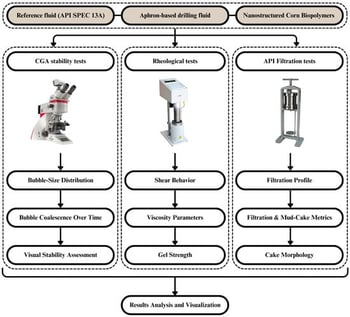
Flowchart of experimental procedure design and evaluation of CGA-based drilling fluids.

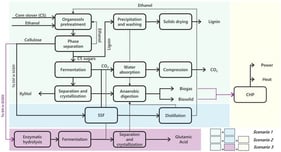
Colombia generates large volumes of lignocellulosic residues from agriculture, forestry, and agro-industrial activities. Much of this material is landfilled, openly burned, or left to decompose. These practices drive greenhouse-gas emissions (methane and CO2), particulate air pollution, water contamination, and pest proliferation. Therefore, this study focuses on the design, simulation, exergetic and economic analysis of lignocellulosic biorefinery schemes in Colombia using corn stover (CS) as feedstock. This approach thus turns an environmental liability into valuable resources. Mass and energy balances obtained from Aspen Plus V10® were used to calculate exergy efficiency. Economic indicators were provided by the Aspen Process Economic Analyzer (APEA) V10® software. The first scenario (SCE01) included xylitol, lignin, carbon dioxide, biogas, and biofertilizer production along with in situ ethanol co-production; for scenario 2 (SCE02), a cogeneration (CHP) stage using biogas and biofertilizer as fuel was added; in scenario 3 (SCE03), the ethanol production of scenarios 1 and 2 was replaced by glutamic acid production. The exergy efficiency results were as follows: SCE01 (60.1%), SCE02 (36.8%), SCE03 (37.5%). The largest exergy losses were found in the CHP system. In terms of economic viability, all scenarios showed favorable economic parameters. SCE03 showed better results with an Internal Rate of Return (IRR) of 28.01% and a Net Present Value (NPV) of USD 985.1 M compared to SCE01 (27.48%; USD 769.1 M) and SCE02 (27.13%; USD 643.1 M). In light of these results, the SCE03 approach represents the most attractive investment opportunity, with the potential to integrate the social and environmental pillars of sustainability by fostering rural economic development and CO2 capture. Optimization strategies can be readily adopted to enhance the overall efficiency of the proposed model, enabling it to serve as a benchmark for scaling and comparing alternative lignocellulosic waste valorization pathways at a national level.

7 February 2026

Schematic flowsheet of the three scenarios evaluated.

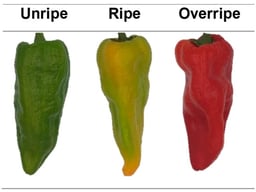
Drying chili peppers is a crucial technique for their preservation, as it extends shelf life while minimizing the degradation of high-value bioactive compounds. This study evaluated the impact of modulated solar irradiation on the drying kinetics and quality retention of “Chile de Agua” (Capsicum annuum L.) peppers across three maturity stages (unripe, ripe, and overripe). Two cylindrical solar dryers were employed: a conventional solar dryer (CSD) and a novel Solar Dryer with Dynamic Irradiance Control (SDIC) utilizing Polymer Dispersed Liquid Crystal (PDLC) technology. Drying behavior was analyzed through moisture ratio and drying rate, while quality attributes were assessed via color parameters, capsaicinoid content, and flavonoid profiling using UPLC-PDA-ESI-MS. Results demonstrated that the maturity stage significantly influences drying kinetics; unripe fruits exhibited the fastest dehydration rate, reducing drying time by approximately 14% compared to overripe fruits. Regarding quality, the CSD better preserved color (ΔE of 15.29 for ripe chilies). At the same time, the SDIC system significantly favored the retention of bioactive compounds, maintaining higher concentrations of total capsaicinoids (up to 1700 µg/g DW) and flavonoids such as luteolin (15.9 mg/100 g DW) and quercitrin (11.5 mg/100 g DW), especially in ripe fruits. The findings suggest that optimal processing requires selecting the drying method based on the targeted final use: CSD for color preservation in unripe chilies, or SDIC for maximizing bioactive retention in ripe fruits.

7 February 2026

Different ripening stages of “Chile de Agua” for experiments.

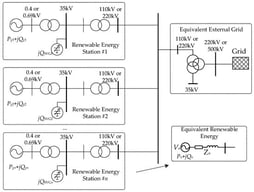
The rapid integration of renewable energy into power systems has made voltage oscillations caused by the intermittency of wind and solar power a critical operational challenge. To mitigate these issues, this paper proposes a multi-mode coordinated reactive power control strategy to enhance voltage stability in renewable energy clusters. The approach integrates two key indicators: voltage sensitivity for steady-state regulation and an improved multi-renewable energy station short circuit ratio (MRSCR) that accounts for dynamic power interactions. Validation is conducted using a hardware-in-the-loop (HIL) platform combining real-time RMS-based simulation with physical controllers. Case studies on an offshore wind cluster demonstrate that the proposed method reduces voltage fluctuation amplitude more effectively than conventional automatic voltage control (AVC), successfully suppressing oscillations. The results confirm that the strategy exhibits stronger adaptability to varying grid conditions and offers a scalable solution for oscillation mitigation in large-scale renewable energy integration.

6 February 2026

A typical renewable energy cluster. The cluster comprises aggregated wind farms, where the voltage is stepped up through transformers (35kV/110kV/220kV/500kV) for grid connection. Each station is represented by a Thévenin equivalent circuit: a voltage source (Vn) in series with an impedance (Zn).

News & Conferences

Issues

Open for Submission

Editor's Choice

Reprints of Collections

Phytochemicals
Reprint

Phytochemicals

Extraction, Optimization, Identification, Biological Activities, and Applications in the Food, Nutraceutical, and Pharmaceutical Industries
Editors: Ibrahim M. Abu-Reidah

Get Alerted

Add your email address to receive forthcoming issues of this journal.

XFacebookLinkedIn
Processes - ISSN 2227-9717