Alpha- and Beta-Coronaviruses in Humans and Animals: Taxonomy, Reservoirs, Hosts, and Interspecies Transmission

 ,
,  , ,
, ,  , , , , and
Abstract
1. Introduction
2. Methods
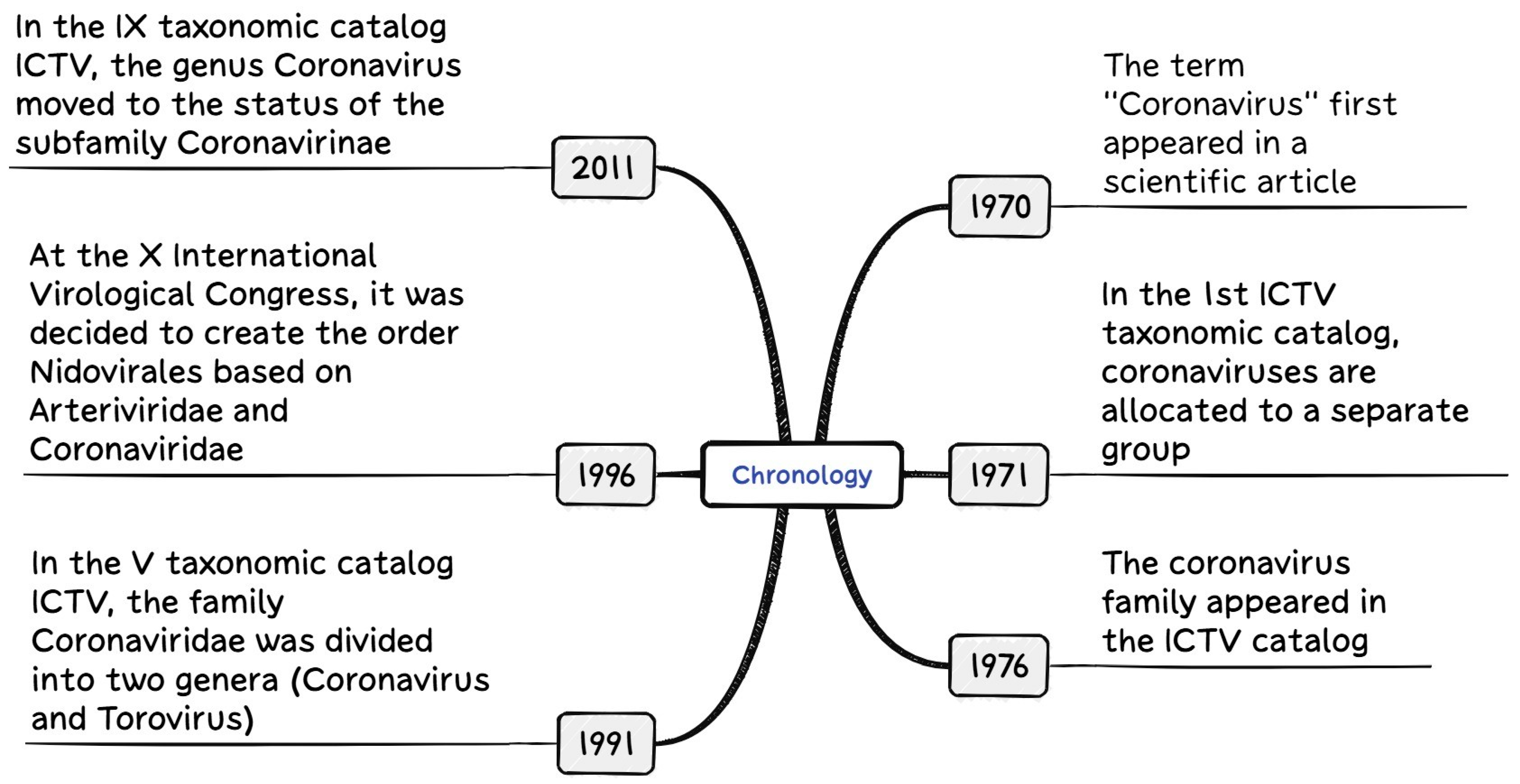
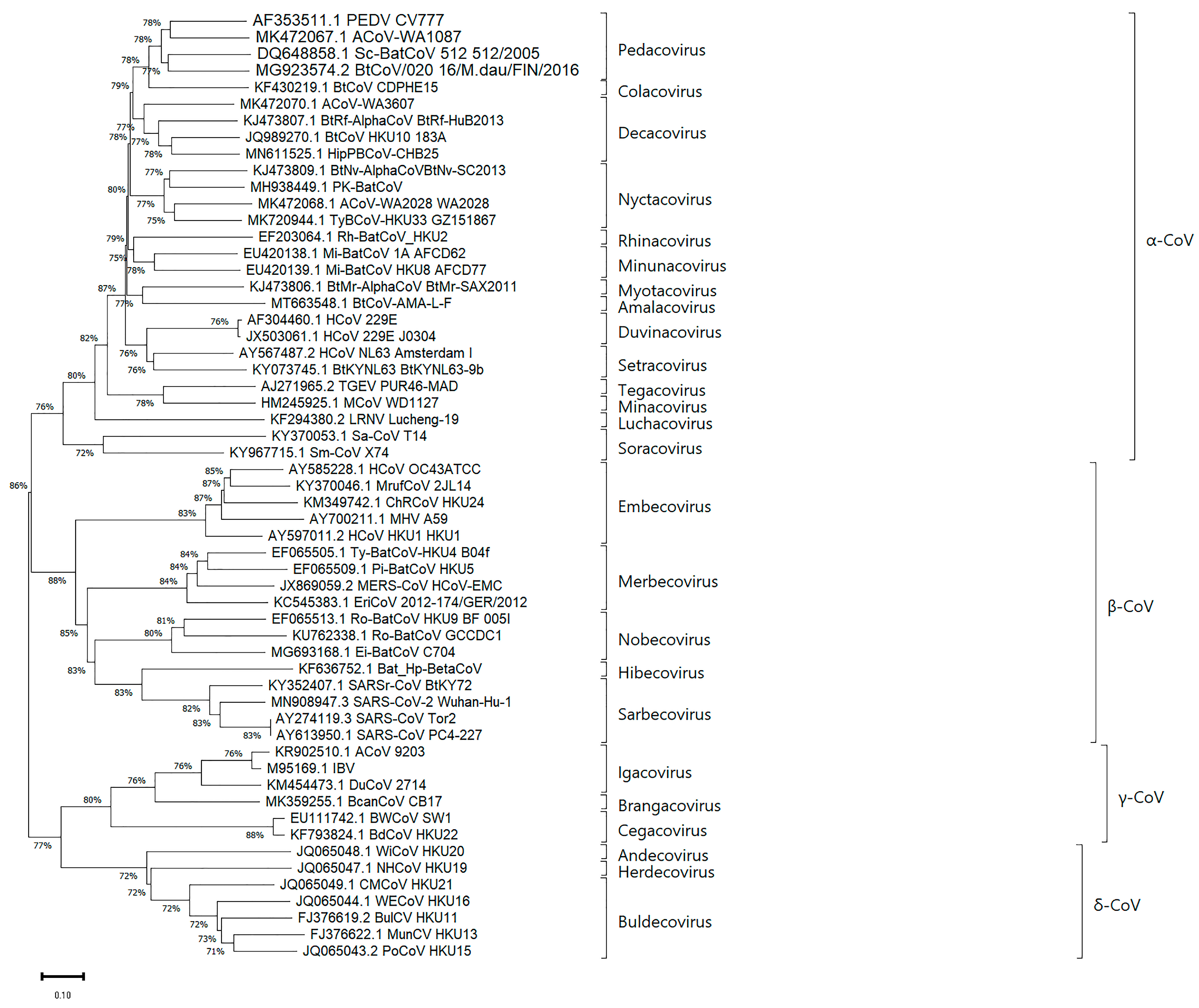
3. Taxonomy and Classification of Coronaviridae
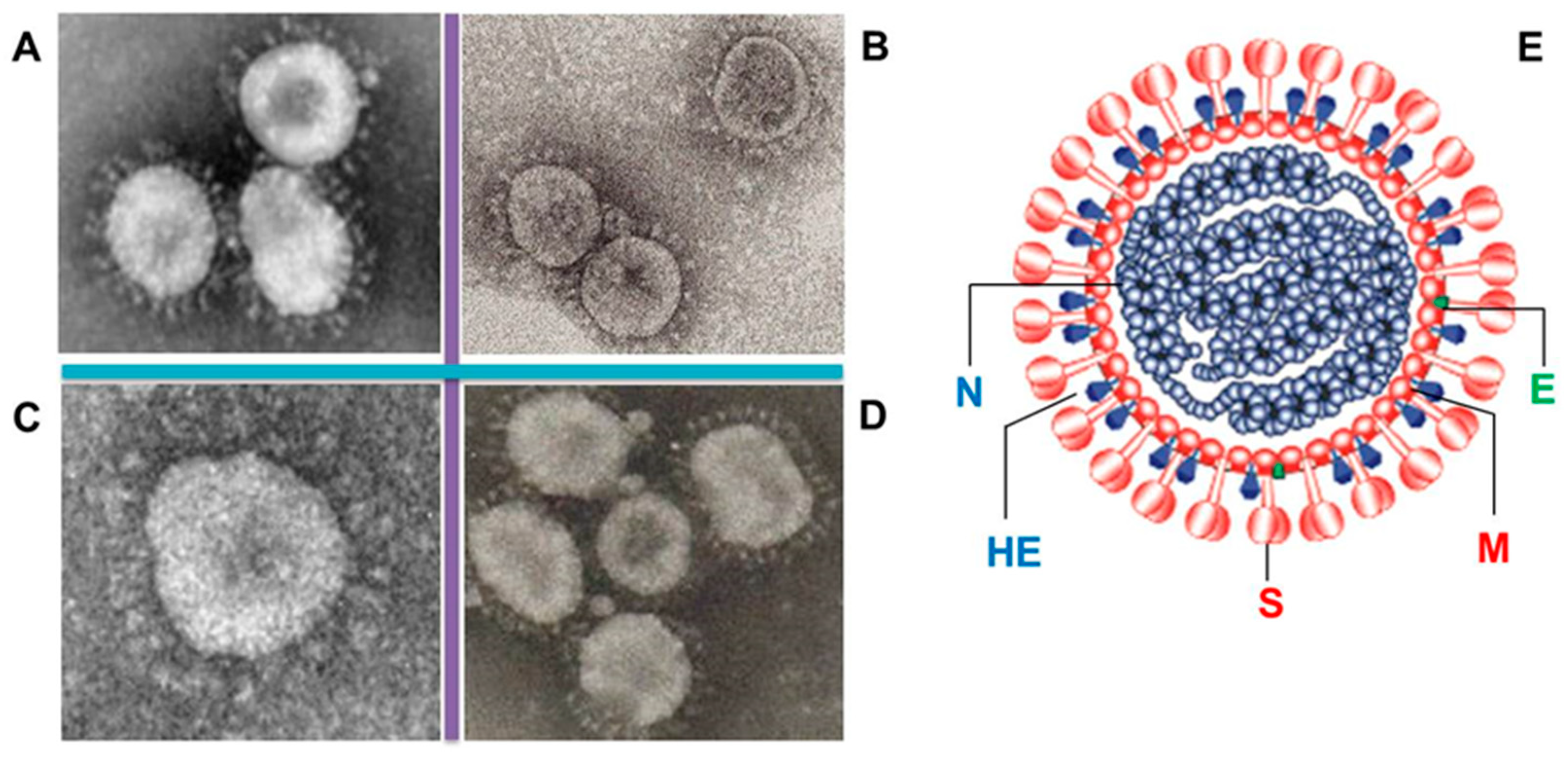
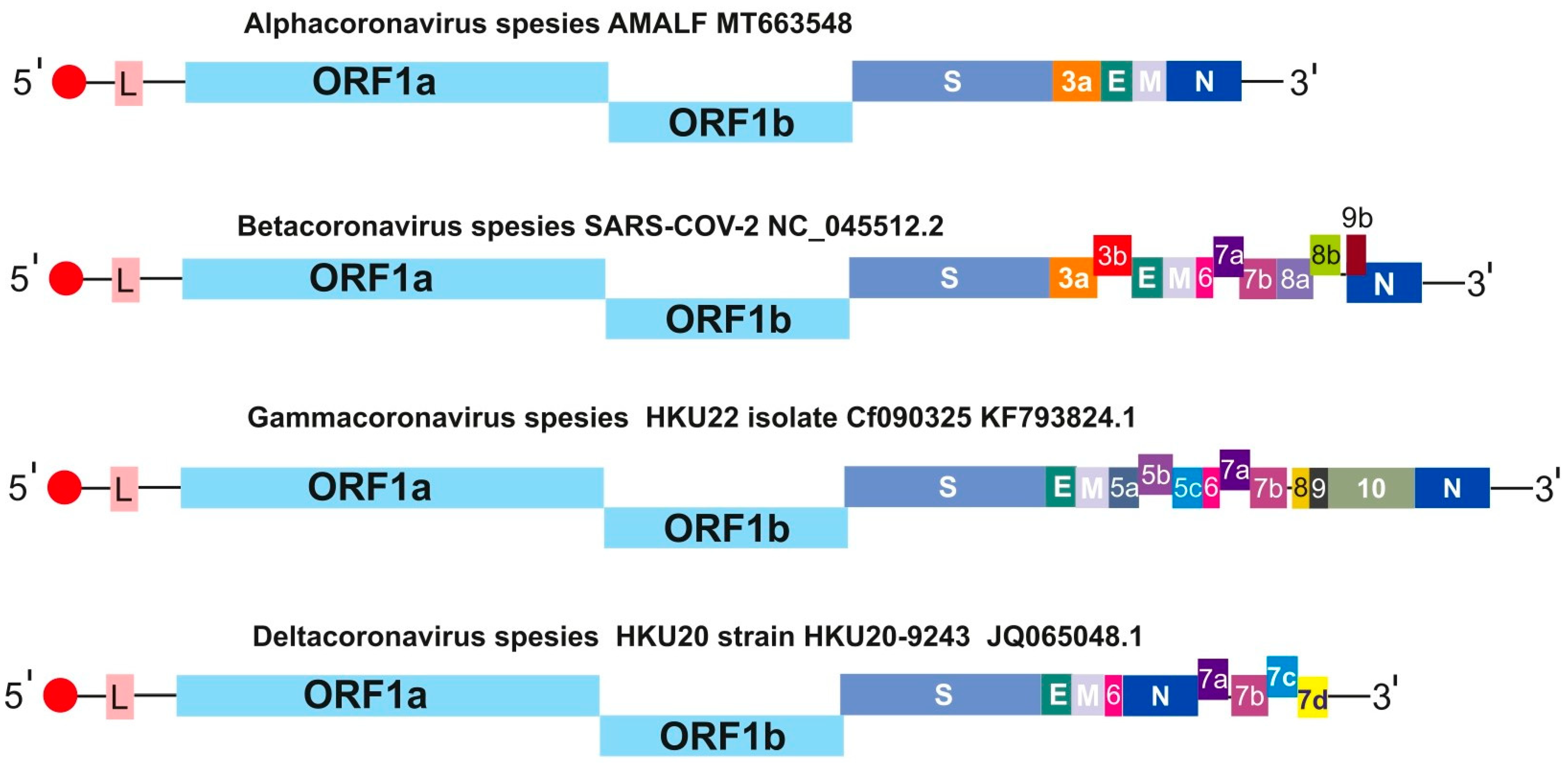
4. Genomic Organization and Structural Proteins
5. Alpha- and Beta-Coronaviruses of Animals
5.1. Porcine Coronaviruses
5.2. Feline Coronaviruses
5.3. Canine Coronaviruses (CCoVs)
5.4. Bovine Coronaviruses (BCoVs)
5.5. Mink Coronavirus (MCoV)
5.6. Ferret Coronaviruses (FRCoVs)
5.7. Equine Coronavirus (ECoV)
5.8. Beluga Whale Coronavirus SW1
5.9. Coronaviruses in Hedgehogs (Erinaceus spp.)
6. Human Alpha- and Beta-Coronaviruses
6.1. Human Coronavirus-229E (HCoV-229E)
6.2. Human Coronavirus—OC43 (HCoV-OC43)
6.3. Severe Acute Respiratory Syndrome Coronavirus (SARS-CoV)
6.4. Human Coronavirus-NL63 (HCoV-NL63)
6.5. Human Coronavirus-HKU1 (HCoV-HKU1)
6.6. Middle East Respiratory Syndrome (MERS-CoV)
6.7. SARS-CoV-2
7. Natural Reservoirs and Intermediate Hosts of CoV
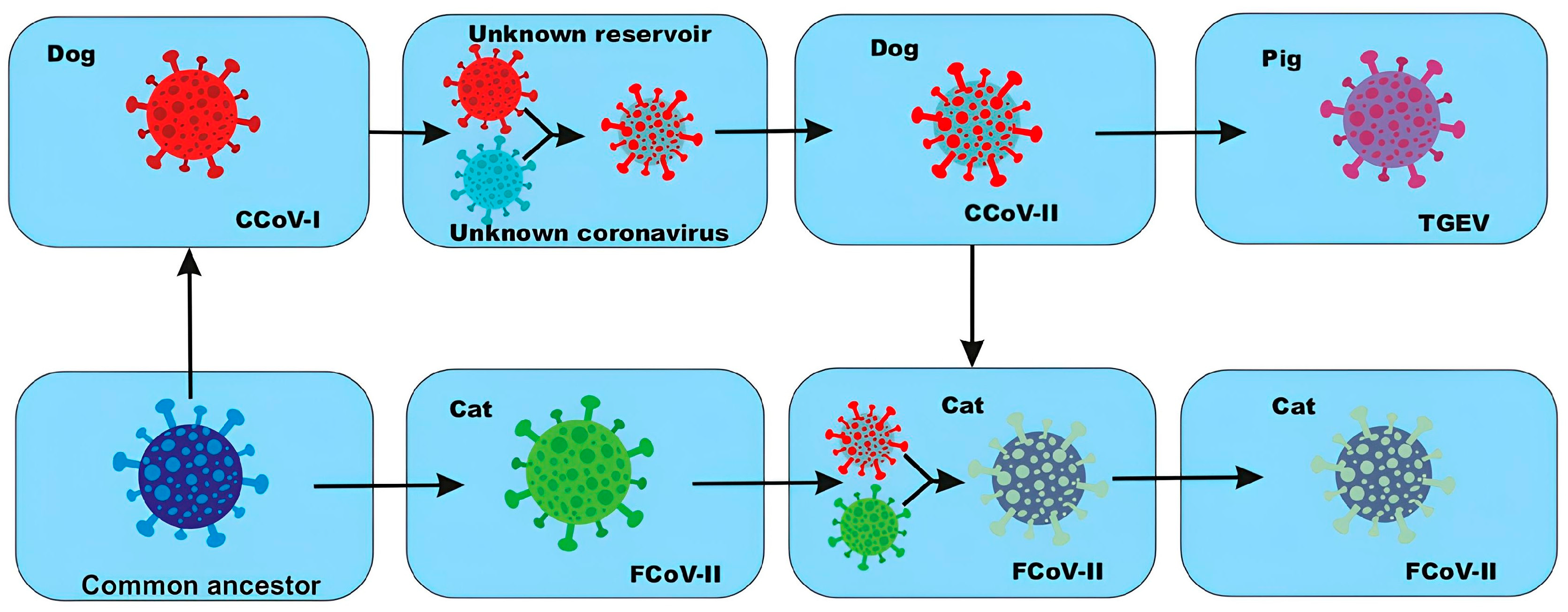
7.1. The Origin of Some Animal Coronaviruses
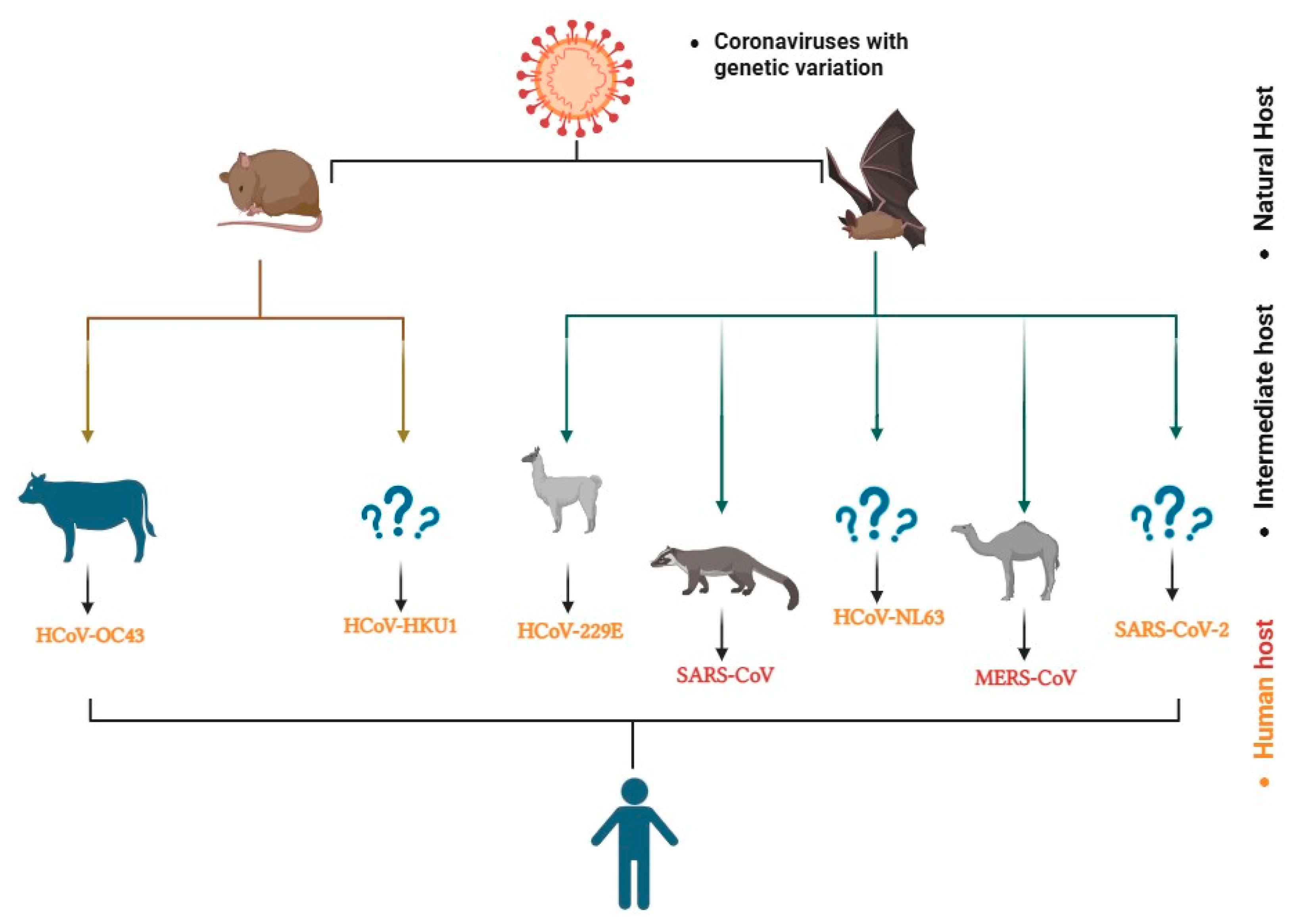
7.2. Origins of HCoVs
8. Receptor Usage and Molecular Determinants of Host Range
8.1. Receptor Diversity of Some Human and Animal Coronaviruses
8.1.1. Aminopeptidase N (APN)
8.1.2. Angiotensin-Converting Enzyme 2 (ACE2)
8.1.3. Sialic Acid
8.1.4. Dipeptidyl Peptidase 4 (DPP4)
8.2. Interspecies Transmission of CoV
9. One Health Aspects and Global Surveillance
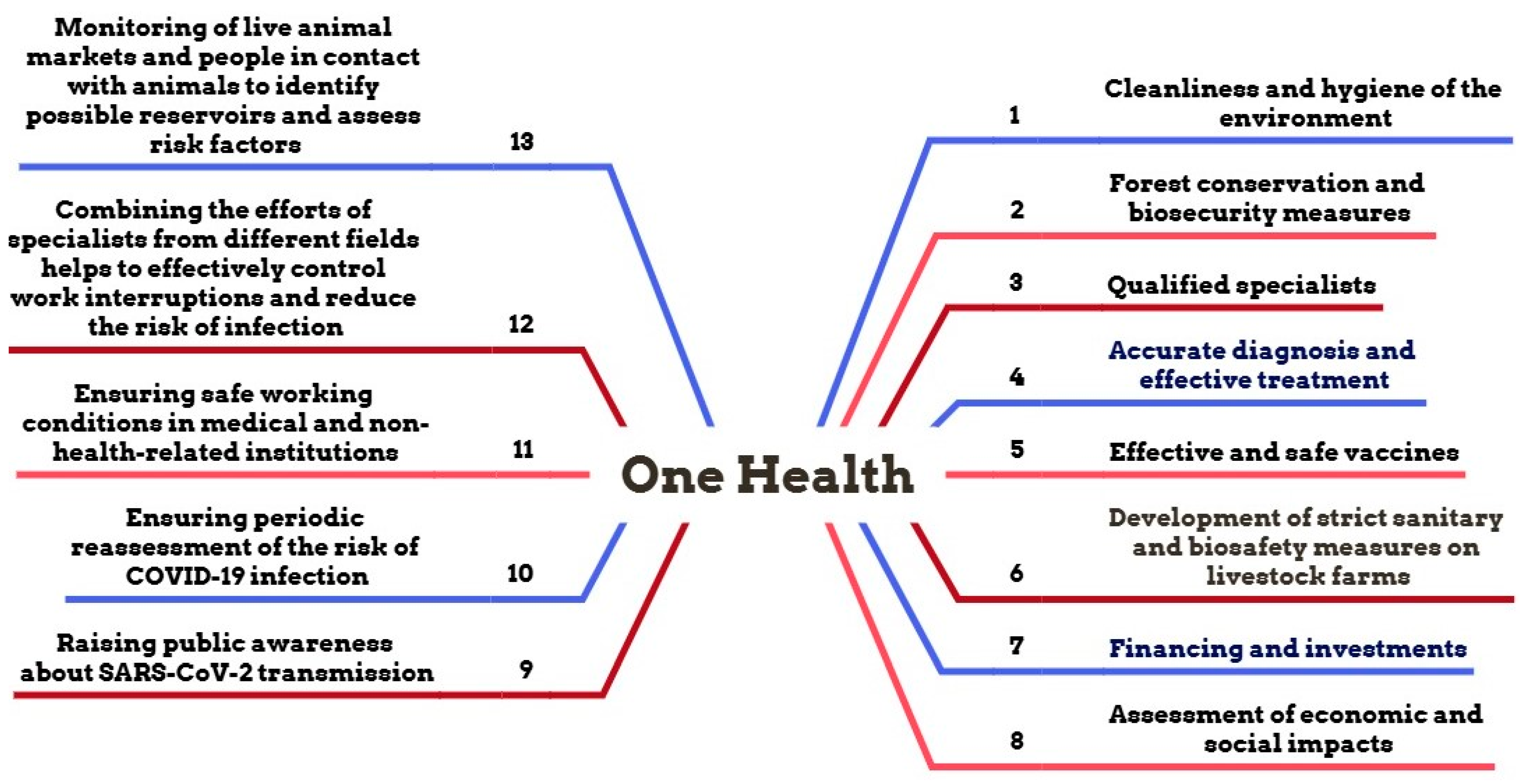
9.1. Future Perspectives on Coronavirus Infections in the Context of One Health
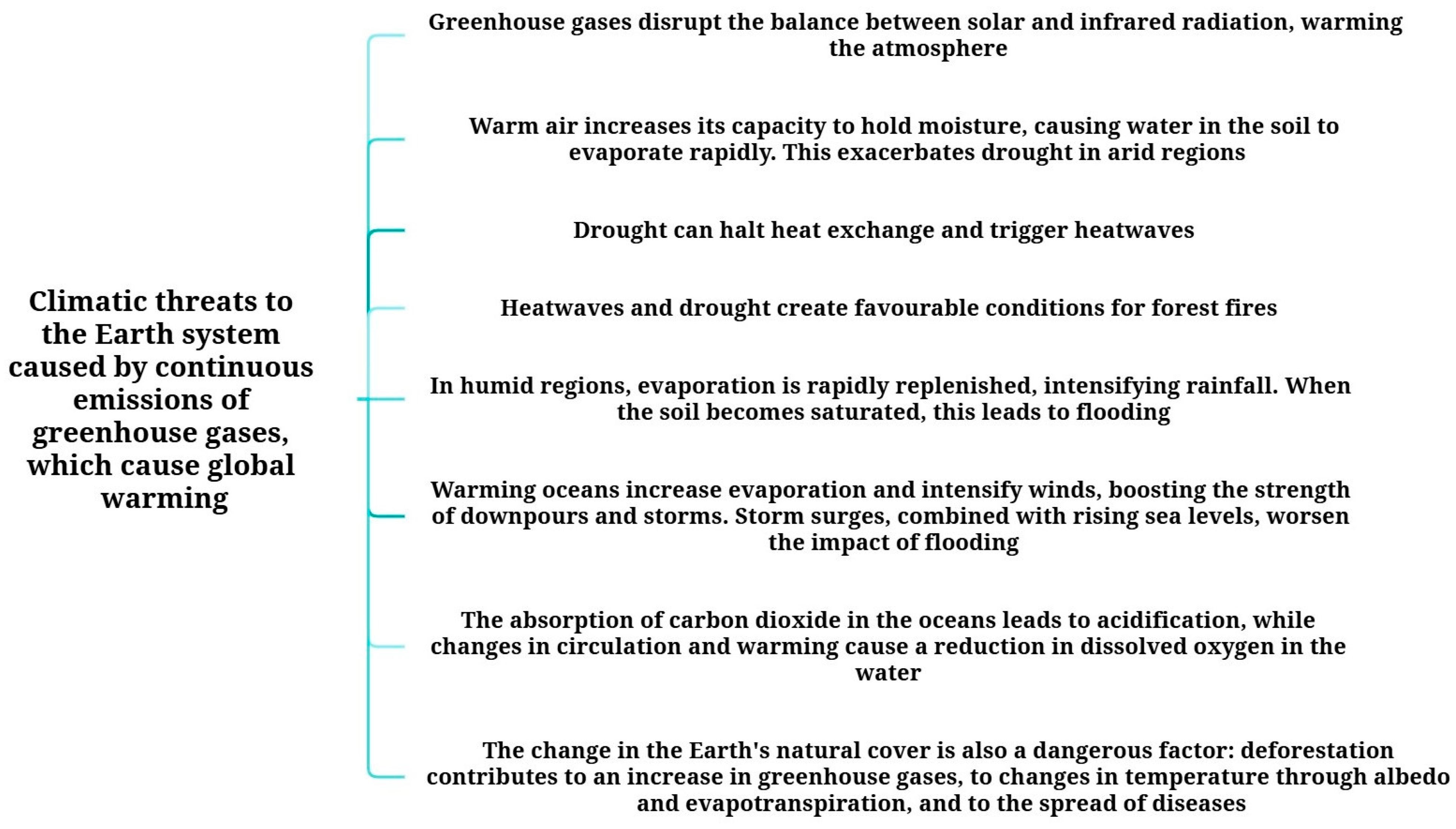
9.2. The Effect of Global Warming
9.3. SARS-CoV-2 in the Context of One Health: From Potential Emergence to Genomic Monitoring
10. Conclusions and Future Directions
Author Contributions
Funding
Institutional Review Board Statement
Informed Consent Statement
Data Availability Statement
Acknowledgments
Conflicts of Interest
Abbreviations
| CoV | Coronaviruses |
| ORF | Open reading frame |
| nm | nanometre |
| COVID-19 | Coronavirus Disease 2019 |
| WHO | World Health Organization |
References
- Shchelkanov, M.Y.; Popova, A.Y.; Dedkov, V.G.; Akimkin, V.G.; Maleev, V.V. History of investigation and current classification of coronaviruses (Nidovirales: Coronaviridae). Russ. J. Infect. Immun. 2020, 10, 221–246. [Google Scholar] [CrossRef]
- Shchelkanov, M.Y.; Kolobukhina, L.V.; Burgasova, O.A.; Kruzhkova, I.S.; Maleev, V.V. COVID-19: Etiology, clinical picture, treatment. Russ. J. Infect. Immun. 2020, 10, 421–445. [Google Scholar] [CrossRef]
- Fehr, A.R.; Perlman, S. Coronaviruses: An overview of their replication and pathogenesis. Methods Mol. Biol. 2015, 1282, 1–23. [Google Scholar]
- Li, F. Structure, Function, and Evolution of Coronavirus Spike Proteins. Annu. Rev. Virol. 2016, 3, 237–261. [Google Scholar] [CrossRef]
- Pringle, C.R. Virus taxonomy 1996—A bulletin from the Xth International Congress of Virology in Jerusalem. Arch. Virol. 1996, 141, 2251–2256. [Google Scholar] [CrossRef]
- King, A.M.Q.; Adams, M.J.; Carstens, E.B.; Lefkowitz, E.J. Virus Taxonomy: Classification and Nomenclature of Viruses. Ninth Report of the International Committee on Taxonomy of Viruses; Elsevier: Amsterdam, The Netherlands, 2011; Volume 1338, Available online: https://repository.rothamsted.ac.uk/id/eprint/18044/ (accessed on 30 October 2025).
- Coronaviridae Study Group of the International Committee on Taxonomy of Viruses. The species severe acute respiratory syndrome-related coronavirus: Classifying 2019-nCoV and naming it SARS-CoV-2. Nat. Microbiol. 2020, 5, 536–544. [Google Scholar] [CrossRef] [PubMed]
- Kiseleva, I.V.; Musaeva, T.D. From coronaviruses to coronaviruses. Russ. J. Infect. Immun. 2023, 13, 822–840. [Google Scholar] [CrossRef]
- ICTV. Virus Taxonomy: 2024 Release. ICTV Taxonomy Browser. 2024. Available online: https://ictv.global/ (accessed on 1 July 2025).
- Burrell, C.J.; Howard, C.R.; Murphy, F.A. Coronaviruses. In Fenner and White’s Medical Virology, 5th ed.; Elsevier: Amsterdam, The Netherlands, 2017; pp. 437–446. Available online: https://pmc.ncbi.nlm.nih.gov/articles/PMC7149368/ (accessed on 30 October 2025).
- Huang, Y.; Yang, C.; Xu, X.F.; Xu, W.; Liu, S.W. Structural and functional properties of SARS-CoV-2 spike protein: Potential antivirus drug development for COVID-19. Acta Pharmacol. Sin. 2020, 41, 1141–1149. [Google Scholar] [CrossRef]
- Neuman, B.W.; Kiss, G.; Kunding, A.H.; Bhella, D.; Baksh, M.F.; Connelly, S.; Droese, B.; Klaus, J.P.; Makino, S.; Sawicki, S.G.; et al. A structural analysis of M protein in coronavirus assembly and morphology. J. Struct. Biol. 2011, 174, 11–22. [Google Scholar] [CrossRef]
- Wu, W.; Cheng, Y.; Zhou, H.; Sun, C.; Zhang, S. The SARS-CoV-2 nucleocapsid protein: Its role in the viral life cycle, structure and functions, and use as a potential target in the development of vaccines and diagnostics. Virol. J. 2023, 20, 6. [Google Scholar] [CrossRef] [PubMed]
- Aldaais, E.A.; Yegnaswamy, S.; Albahrani, F.; Alsowaiket, F.; Alramadan, S. Sequence and structural analysis of COVID-19 E and M proteins with MERS virus E and M proteins—A comparative study. Biochem. Biophys. Rep. 2021, 26, 101023. [Google Scholar] [CrossRef] [PubMed]
- Harrison, C.M.; Doster, J.M.; Landwehr, E.H.; Kumar, N.P.; White, E.J.; Beachboard, D.C.; Stobart, C.C. Evaluating the Virology and Evolution of Seasonal Human Coronaviruses Associated with the Common Cold in the COVID-19 Era. Microorganisms 2023, 11, 445. [Google Scholar] [CrossRef]
- Stadler, K.; Masignani, V.; Eickmann, M.; Becker, S.; Abrignani, S.; Klenk, H.D.; Rappuoli, R. SARS—Beginning to understand a new virus. Nat. Rev. Microbiol. 2003, 1, 209–218. [Google Scholar] [CrossRef]
- Hu, H.; Jung, K.; Vlasova, A.N.; Chepngeno, J.; Lu, Z.; Wang, Q.; Saif, L.J. Isolation and characterization of porcine deltacoronavirus from pigs with diarrhea in the United States. J. Clin. Microbiol. 2015, 53, 1537–1548. [Google Scholar] [CrossRef]
- Microbiology—Infectious Bronchitis Virus (IBV). IBV Microbiol. Page 2025. Available online: https://www.infectious-bronchitis.com/infectious-bronchitis-disease/microbiology-virus/ (accessed on 1 July 2025).
- Woo, P.C.Y.; de Groot, R.J.; Haagmans, B.; Lau, S.K.P.; Neuman, B.W.; Perlman, S.; Sola, I.; van der Hoek, L.; Wong, A.C.P.; Yeh, S.H. ICTV Virus Taxonomy Profile: Coronaviridae. J. Gen. Virol. 2023, 104, 001843. [Google Scholar] [CrossRef]
- Hartenian, E.; Nandakumar, D.; Lari, A.; Ly, M.; Tucker, J.M.; Glaunsinger, B.A. The molecular virology of coronaviruses. J. Biol. Chem. 2020, 295, 12910–12934. [Google Scholar] [CrossRef]
- Ziebuhr, J.; Snijder, E.J.; Gorbalenya, A.E. Virus-encoded proteinases and proteolytic processing in the Nidovirales. J. Gen. Virol. 2000, 81, 853–879. [Google Scholar] [CrossRef]
- Yang, D.; Leibowitz, J.L. The structure and functions of coronavirus genomic 3′ and 5′ ends. Virus Res. 2015, 206, 120–133. [Google Scholar] [CrossRef] [PubMed]
- Brant, A.C.; Tian, W.; Majerciak, V.; Yang, W.; Zheng, Z.-M. SARS-CoV-2: From its discovery to genome structure, transcription, and replication. Cell Biosci. 2021, 11, 136. [Google Scholar] [CrossRef] [PubMed]
- Turlewicz-Podbielska, H.; Pomorska-Mól, M. Porcine Coronaviruses: Overview of the State of the Art. Virol. Sin. 2021, 36, 833–851. [Google Scholar] [CrossRef]
- Valkó, A.; Bálint, Á.; Bozsa, A.; Cságola, A. Prevalence of antibodies against transmissible gastroenteritis virus (TGEV) in Hungary. Vet. Anim. Sci. 2019, 7, 100042. [Google Scholar] [CrossRef]
- Piñeyro, P.E.; Lozada, M.I.; Alarcón, L.V.; Sanguinetti, R.; Cappuccio, J.A.; Pérez, E.M.; Vannucci, F.; Armocida, A.; Madson, D.M.; Perfumo, C.J.; et al. First retrospective studies with etiological confirmation of porcine transmissible gastroenteritis virus infection in Argentina. BMC Vet. Res. 2018, 14, 292. [Google Scholar] [CrossRef]
- Li, S.; Lu, Y.; Yang, S.; Wang, C.; Yang, J.; Huang, X.; Chen, G.; Shao, Y.; Li, M.; Yu, H.; et al. Porcine lung tissue slices: A culture model for PRCV infection and innate immune response investigations. AMB Express 2024, 14, 57. [Google Scholar] [CrossRef]
- Wesley, R.D.; Lager, K.M. Increased litter survival rates, reduced clinical illness and better lactogenic immunity against TGEV in gilts that were primed as neonates with porcine respiratory coronavirus (PRCV). Vet. Microbiol. 2003, 95, 175–186. [Google Scholar] [CrossRef] [PubMed]
- Mora-Díaz, J.C.; Piñeyro, P.E.; Rauh, R.; Nelson, W.; Sankoh, Z.; Gregg, E.; Carrillo-Ávila, J.A.; Shen, H.; Nelli, R.K.; Zimmerman, J.J.; et al. Porcine Hemagglutinating Encephalomyelitis Virus Infection In Vivo and Ex Vivo. J. Virol. 2021, 95, e02335-20. [Google Scholar] [CrossRef]
- Mora-Díaz, J.C.; Piñeyro, P.E.; Houston, E.; Zimmerman, J.; Giménez-Lirola, L.G. Porcine Hemagglutinating Encephalomyelitis Virus: A Review. Front. Vet. Sci. 2019, 6, 53. [Google Scholar] [CrossRef] [PubMed]
- Pensaert, M.B.; Martelli, P. Porcine epidemic diarrhea: A retrospect from Europe and matters of debate. Virus Res. 2016, 226, 1–6. [Google Scholar] [CrossRef] [PubMed]
- Wood, E.N. An apparently new syndrome of porcine epidemic diarrhoea. Vet. Rec. 1977, 100, 243–244. [Google Scholar] [CrossRef]
- Zhang, Y.; Han, L.; Xia, L.; Yuan, Y.; Hu, H. Assessment of hemagglutination activity of porcine deltacoronavirus. J. Vet. Sci. 2020, 21, e12. [Google Scholar] [CrossRef]
- Pedersen, N.C. A review of feline infectious peritonitis virus infection: 1963–2008. J. Feline Med. Surg. 2009, 11, 225–258. [Google Scholar] [CrossRef]
- Drechsler, Y.; Alcaraz, A.; Bossong, F.J.; Collisson, E.W.; Diniz, P.P.V. Feline coronavirus in multicat environments. Vet. Clin. N. Am. Small Anim. Pract. 2011, 41, 1133–1169. [Google Scholar] [CrossRef]
- Amman, B.R.; Cossaboom, C.M.; Wendling, N.M.; Harvey, R.R.; Rettler, H.; Taylor, D.; Kainulainen, M.H.; Ahmad, A.; Bunkley, P.; Godino, C.; et al. GPS Tracking of Free-Roaming Cats (Felis catus) on SARS-CoV-2-Infected Mink Farms in Utah. Viruses 2022, 14, 2131. [Google Scholar] [CrossRef]
- Tekes, G.; Thiel, H.J. Feline Coronaviruses: Pathogenesis of Feline Infectious Peritonitis. Adv. Virus Res. 2016, 96, 193–218. [Google Scholar] [PubMed]
- Feng, C.; Liu, Y.; Lyu, G.; Shang, S.; Xia, H.; Zhang, J.; Irwin, D.M.; Wang, Z.; Zhang, S. Adaptive Evolution of the Fox Coronavirus Based on Genome-Wide Sequence Analysis. Biomed. Res. Int. 2022, 2022, 9627961. [Google Scholar] [CrossRef]
- McClurkin, A.W.; Stark, S.L.; Norman, J.O. Transmissible gastroenteritis (TGE) of swine: The possible role of dogs in the epizootiology of TGE. Can. J. Comp. Med. 1970, 34, 347–349. [Google Scholar]
- Colina, S.E.; Serena, M.S.; Echeverría, M.G.; Metz, G.E. Clinical and molecular aspects of veterinary coronaviruses. Virus Res. 2021, 297, 198382. [Google Scholar] [CrossRef]
- Erles, K.; Brownlie, J. Canine respiratory coronavirus: An emerging pathogen in the canine infectious respiratory disease complex. Vet. Clin. N. Am. Small Anim. Pract. 2008, 38, 815–825. [Google Scholar] [CrossRef]
- Saif, L.J. Bovine respiratory coronavirus. Vet. Clin. N. Am. Food Anim. Pract. 2010, 26, 349–364. [Google Scholar] [CrossRef] [PubMed]
- Gozalo, A.S.; Clark, T.S.; Kurtz, D.M. Coronaviruses: Troubling Crown of the Animal Kingdom. Comp. Med. 2023, 73, 6–44. [Google Scholar] [CrossRef]
- Decaro, N.; Martella, V.; Elia, G.; Campolo, M.; Mari, V.; Desario, C.; Lucente, M.S.; Lorusso, A.; Greco, G.; Corrente, M.; et al. Biological and genetic analysis of a bovine-like coronavirus isolated from water buffalo (Bubalus bubalis) calves. Virology 2008, 370, 213–222. [Google Scholar] [CrossRef] [PubMed]
- Vlasova, A.N.; Halpin, R.; Wang, S.; Ghedin, E.; Spiro, D.J.; Saif, L.J. Molecular characterization of a new species in the genus Alphacoronavirus associated with mink epizootic catarrhal gastroenteritis. J. Gen. Virol. 2011, 92, 1369–1379. [Google Scholar] [CrossRef]
- Williams, B.H.; Kiupel, M.; West, K.H.; Raymond, J.T.; Grant, C.K.; Glickman, L.T. Coronavirus-associated epizootic catarrhal enteritis in ferrets. J. Am. Vet. Med. Assoc. 2000, 217, 526–530. [Google Scholar] [CrossRef]
- Murray, J.; Kiupel, M.; Maes, R.K. Ferret coronavirus-associated diseases. Vet. Clin. N. Am. Exot. Anim. Pract. 2010, 13, 543–560. [Google Scholar] [CrossRef]
- Xu, Y. Genetic diversity and potential recombination between ferret coronaviruses from European and American lineages. J. Infect. 2020, 80, 350–371. [Google Scholar] [CrossRef] [PubMed]
- Zhao, Y.; Wang, C.L.; Gao, Z.Y.; Qiao, H.X.; Wang, W.J.; Liu, X.Y.; Chuai, X. Ferrets: A powerful model of SARS-CoV-2. Zool. Res. 2023, 44, 323–330. [Google Scholar] [CrossRef] [PubMed]
- van de Ven, K.; van Dijken, H.; Wijsman, L.; Gomersbach, A.; Schouten, T.; Kool, J.; Lenz, S.; Roholl, P.; Meijer, A.; van Kasteren, P.B.; et al. Pathology and Immunity After SARS-CoV-2 Infection in Male Ferrets Is Affected by Age and Inoculation Route. Front. Immunol. 2021, 12, 750229. [Google Scholar] [CrossRef]
- Guy, J.S.; Breslin, J.J.; Breuhaus, B.; Vivrette, S.; Smith, L.G. Characterization of a coronavirus isolated from a diarrheic foal. J. Clin. Microbiol. 2000, 38, 4523–4526. [Google Scholar] [CrossRef]
- Mihindukulasuriya, K.A.; Wu, G.; St Leger, J.; Nordhausen, R.W.; Wang, D. Identification of a novel coronavirus from a beluga whale by using a panviral microarray. J. Virol. 2008, 82, 5084–5088. [Google Scholar] [CrossRef]
- Corman, V.M.; Kallies, R.; Philipps, H.; Göpner, G.; Müller, M.A.; Eckerle, I.; Brünink, S.; Drosten, C.; Drexler, J.F. Characterization of a novel betacoronavirus related to Middle East respiratory syndrome coronavirus in European hedgehogs. J. Virol. 2014, 88, 717–724. [Google Scholar] [CrossRef]
- Murtaza, G.; Sultana, R.; Abualait, T.; Fatima, M.; Bashir, S. Social isolation during the COVID-19 pandemic is associated with the decline in cognitive functioning in young adults. PeerJ 2023, 11, e16532. [Google Scholar] [CrossRef] [PubMed]
- Liu, D.X.; Liang, J.Q.; Fung, T.S. Human Coronavirus-229E, -OC43, -NL63, and -HKU1 (Coronaviridae). In Encyclopedia of Virology, 4th ed.; Elsevier: Amsterdam, The Netherlands, 2021; pp. 428–440. Available online: https://www.sciencedirect.com/science/chapter/referencework/abs/pii/B978012809633821501X?via%3Dihub (accessed on 30 October 2025).
- Vijgen, L.; Keyaerts, E.; Moës, E.; Thoelen, I.; Wollants, E.; Lemey, P.; Vandamme, A.-M.; Van Ranst, M. Complete genomic sequence of human coronavirus OC43: Molecular clock analysis suggests a relatively recent zoonotic coronavirus transmission event. J. Virol. 2005, 79, 1595–1604. [Google Scholar] [CrossRef]
- Poon, L.L.; Guan, Y.; Nicholls, J.M.; Yuen, K.Y.; Peiris, J.S. The aetiology, origins, and diagnosis of severe acute respiratory syndrome. Lancet Infect. Dis. 2004, 4, 663–671. [Google Scholar] [CrossRef]
- Ksiazek, T.G.; Erdman, D.; Goldsmith, C.S.; Zaki, S.R.; Peret, T.; Emery, S.; Tong, S.; Urbani, C.; Comer, J.A.; Lim, W.; et al. A novel coronavirus associated with severe acute respiratory syndrome. N. Engl. J. Med. 2003, 348, 1953–1966. [Google Scholar] [CrossRef]
- Tsang, K.W.; Ho, P.L.; Ooi, G.C.; Yee, W.K.; Wang, T.; Chan-Yeung, M.; Lam, W.K.; Seto, W.H.; Yam, L.Y.; Cheung, T.M.; et al. A cluster of cases of severe acute respiratory syndrome in Hong Kong. N. Engl. J. Med. 2003, 348, 1977–1985. [Google Scholar] [CrossRef] [PubMed]
- World Health Organization. Summary of Probable SARS Cases with Onset of Illness from 1 November 2002 to 31 July 2003. 2003. Available online: https://www.who.int/publications/m/item/summary-of-probable-sars-cases-with-onset-of-illness-from-1-november-2002-to-31-july-2003 (accessed on 1 July 2025).
- Dwosh, H.A.; Hong, H.H.; Austgarden, D.; Herman, S.; Schabas, R. Identification and containment of an outbreak of SARS in a community hospital. CMAJ 2003, 168, 1415–1420. [Google Scholar] [PubMed]
- Ng, S.K. Possible role of an animal vector in the SARS outbreak at Amoy Gardens. Lancet 2003, 362, 570–572. [Google Scholar] [CrossRef] [PubMed]
- Berger, A.; Drosten, C.; Doerr, H.W.; Stürmer, M.; Preiser, W. Severe acute respiratory syndrome (SARS)—Paradigm of an emerging viral infection. J. Clin. Virol. 2004, 29, 13–22. [Google Scholar] [CrossRef]
- WHO. Severe Acute Respiratory Syndrome (SARS). 2025. Available online: https://www.who.int/health-topics/severe-acute-respiratory-syndrome#tab=tab_1 (accessed on 1 July 2025).
- van der Hoek, L.; Pyrc, K.; Jebbink, M.F.; Vermeulen-Oost, W.; Berkhout, R.J.; Wolthers, K.C.; Wertheim-van Dillen, P.M.; Kaandorp, J.; Spaargaren, J.; Berkhout, B. Identification of a new human coronavirus. Nat. Med. 2004, 10, 368–373. [Google Scholar] [CrossRef]
- van der Hoek, L.; Pyrc, K.; Berkhout, B. Human coronavirus NL63, a new respiratory virus. FEMS Microbiol. Rev. 2006, 30, 760–773. [Google Scholar] [CrossRef]
- Castillo, G.; Mora-Díaz, J.C.; Breuer, M.; Singh, P.; Nelli, R.K.; Giménez-Lirola, L.G. Molecular mechanisms of human coronavirus NL63 infection and replication. Virus Res. 2023, 327, 199078. [Google Scholar] [CrossRef]
- Vabret, A.; Mourez, T.; Dina, J.; van der Hoek, L.; Gouarin, S.; Petitjean, J.; Brouard, J.; Freymuth, F. Human coronavirus NL63, France. Emerg. Infect. Dis. 2005, 11, 1225–1229. [Google Scholar] [CrossRef]
- Bastien, N.; Robinson, J.L.; Tse, A.; Lee, B.E.; Hart, L.; Li, Y. Human coronavirus NL-63 infections in children: A 1-year study. J. Clin. Microbiol. 2005, 43, 4567–4573. [Google Scholar] [CrossRef] [PubMed]
- Zaki, A.M.; van Boheemen, S.; Bestebroer, T.M.; Osterhaus, A.D.; Fouchier, R.A. Isolation of a novel coronavirus from a man with pneumonia in Saudi Arabia. N. Engl. J. Med. 2012, 367, 1814–1820, Erratum in 2013, 369, 394. [Google Scholar] [CrossRef]
- Reusken, C.B.; Haagmans, B.L.; Müller, M.A.; Gutierrez, C.; Godeke, G.J.; Meyer, B.; Muth, D.; Raj, V.S.; Smits-De Vries, L.; Corman, V.M.; et al. Middle East respiratory syndrome coronavirus neutralising serum antibodies in dromedary camels: A comparative serological study. Lancet Infect. Dis. 2013, 13, 859–866. [Google Scholar] [CrossRef]
- WHO. Middle East Respiratory Syndrome Coronavirus (MERS-CoV). 2025. Available online: https://www.who.int/news-room/fact-sheets/detail/middle-east-respiratory-syndrome-coronavirus-(mers-cov) (accessed on 1 July 2025).
- Baharoon, S.; Memish, Z.A. MERS-CoV as an emerging respiratory illness: A review of prevention methods. Travel Med. Infect. Dis. 2019, 32, 101520. [Google Scholar] [CrossRef]
- World Health Organization. Disease Outbreak News: Middle East Respiratory Syndrome Coronavirus—Saudi Arabia, 8 May 2024. 2024. Available online: https://www.who.int/emergencies/disease-outbreak-news/item/2025-DON560 (accessed on 1 July 2025).
- Kelly-Cirino, C.; Mazzola, L.T.; Chua, A.; Oxenford, C.J.; Van Kerkhove, M.D. An updated roadmap for MERS-CoV research and product development: Focus on diagnostics. BMJ Glob. Health 2019, 4, e001105. [Google Scholar] [CrossRef]
- Conzade, R.; Grant, R.; Malik, M.R.; Elkholy, A.; Elhakim, M.; Samhouri, D.; Ben Embarek, P.K.; Van Kerkhove, M.D. Reported Direct and Indirect Contact with Dromedary Camels among Laboratory-Confirmed MERS-CoV Cases. Viruses 2018, 10, 425. [Google Scholar] [CrossRef]
- Memish, Z.A.; Cotten, M.; Meyer, B.; Watson, S.J.; Alsahafi, A.J.; Al Rabeeah, A.A.; Corman, V.M.; Sieberg, A.; Makhdoom, H.Q.; Assiri, A.; et al. Human infection with MERS coronavirus after exposure to infected camels, Saudi Arabia, 2013. Emerg. Infect. Dis. 2014, 20, 1012–1015. [Google Scholar] [CrossRef]
- Mackay, I.M.; Arden, K.E. MERS coronavirus: Diagnostics, epidemiology and transmission. Virol. J. 2015, 12, 222. [Google Scholar] [CrossRef] [PubMed]
- Zhu, N.; Zhang, D.; Wang, W.; Li, X.; Yang, B.; Song, J.; Zhao, X.; Huang, B.; Shi, W.; Lu, R.; et al. A Novel Coronavirus from Patients with Pneumonia in China, 2019. N. Engl. J. Med. 2020, 382, 727–733. [Google Scholar] [CrossRef] [PubMed]
- Siddiqui, S.; Alhamdi, H.W.S.; Alghamdi, H.A. Recent Chronology of COVID-19 Pandemic. Front. Public Health 2022, 10, 778037. [Google Scholar] [CrossRef] [PubMed]
- WHO. Coronavirus Disease (COVID-19). 2025. Available online: https://www.who.int/publications/m/item/covid-19-epidemiological-update-edition-175 (accessed on 1 July 2025).
- Bak, A.; Mugglestone, M.A.; Ratnaraja, N.V.; Wilson, J.A.; Rivett, L.; Stoneham, S.M.; Bostock, J.; Moses, S.E.; Price, J.R.; Weinbren, M.; et al. SARS-CoV-2 routes of transmission and recommendations for preventing acquisition: Joint BIA, HIS, IPS and RCPath guidance. J. Hosp. Infect. 2021, 114, 79–103. [Google Scholar] [CrossRef]
- WHO. WHO Director-General’s Opening Remarks at the Media Briefing on COVID-19—11 March 2020. 2020. Available online: https://covid19.public-inquiry.uk (accessed on 1 July 2025).
- WHO. WHO COVID-19 Dashboard. 2025. Available online: https://data.who.int/dashboards/covid19/cases (accessed on 1 July 2025).
- Usserbayev, B.S.; Burashev, Y.D.; Kozhabergenov, N.S.; Melisbek, A.M.; Shirinbekov, M.Z.; Abduraimov, Y.O.; Zakarya, K.D. Dynamics of the spread of SARS-CoV-2 variants and clades. Eurasian J. Ecol. 2022, 71, 46–56. [Google Scholar] [CrossRef]
- Batyrshin, T.V. Kazahstane Zafiksirovany Pervye Dva Sluchaja Zabolevanija Koronavirusom. Sputnik Kazakhstan. 2020. Available online: https://ru.sputnik.kz/20200313/kazakhstan-pervyy-sluchay-koronavirus-13067637.html?ysclid=mipvlyaq8m439300296 (accessed on 1 July 2025).
- On the Introduction of a State of Emergency in the Republic of Kazakhstan. Akorda.kz. 2020. Available online: https://adilet.zan.kz/eng/docs/Z030000387_ (accessed on 1 July 2025).
- Bhatia, B.; Sonar, S.; Khan, S.; Bhattacharya, J. Pandemic-Proofing: Intercepting Zoonotic Spillover Events. Pathogens 2024, 13, 1067. [Google Scholar] [CrossRef]
- Ye, Z.W.; Yuan, S.; Yuen, K.S.; Fung, S.Y.; Chan, C.P.; Jin, D.Y. Zoonotic origins of human coronaviruses. Int. J. Biol. Sci. 2020, 16, 1686–1697. [Google Scholar] [CrossRef]
- Ruiz-Aravena, M.; McKee, C.; Gamble, A.; Lunn, T.; Morris, A.; Snedden, C.E.; Yinda, C.K.; Port, J.R.; Buchholz, D.W.; Yeo, Y.Y.; et al. Ecology, evolution and spillover of coronaviruses from bats. Nat. Rev. Microbiol. 2022, 20, 299–314, Erratum in 2022, 20, 315.. [Google Scholar] [CrossRef]
- Li, Q.; Shah, T.; Wang, B.; Qu, L.; Wang, R.; Hou, Y.; Baloch, Z.; Xia, X. Cross-species transmission, evolution and zoonotic potential of coronaviruses. Front. Cell. Infect. Microbiol. 2023, 12, 1081370. [Google Scholar] [CrossRef] [PubMed]
- Helmy, Y.A.; Fawzy, M.; Elaswad, A.; Sobieh, A.; Kenney, S.P.; Shehata, A.A. The COVID-19 Pandemic: A Comprehensive Review of Taxonomy, Genetics, Epidemiology, Diagnosis, Treatment, and Control. J. Clin. Med. 2020, 9, 1225. [Google Scholar] [CrossRef]
- Ghai, R.R.; Carpenter, A.; Liew, A.Y.; Martin, K.B.; Herring, M.K.; Gerber, S.I.; Hall, A.J.; Sleeman, J.M.; VonDobschuetz, S.; Behravesh, C.B. Animal Reservoirs and Hosts for Emerging Alphacoronaviruses and Betacoronaviruses. Emerg. Infect. Dis. 2021, 27, 1015–1022. [Google Scholar] [CrossRef]
- Jiang, S.; Zhang, S.; Kang, X.; Feng, Y.; Li, Y.; Nie, M.; Li, Y.; Chen, Y.; Zhao, S.; Jiang, T.; et al. Risk Assessment of the Possible Intermediate Host Role of Pigs for Coronaviruses with a Deep Learning Predictor. Viruses 2023, 15, 1556. [Google Scholar] [CrossRef]
- Lee, C. Porcine epidemic diarrhea virus: An emerging and re-emerging epizootic swine virus. Virol. J. 2015, 12, 193, Erratum in 2015, 22, 193. [Google Scholar] [CrossRef]
- Stout, A.E.; Guo, Q.; Millet, J.K.; de Matos, R.; Whittaker, G.R. Coronaviruses Associated with the Superfamily Musteloidea. mBio 2021, 12, e02873-20. [Google Scholar] [CrossRef]
- Wang, Q.; Vlasova, A.N.; Kenney, S.P.; Saif, L.J. Emerging and re-emerging coronaviruses in pigs. Curr. Opin. Virol. 2019, 34, 39–49. [Google Scholar] [CrossRef]
- Woo, P.C.Y.; Lau, S.K.P.; Lam, C.S.F.; Lau, C.C.Y.; Tsang, A.K.L.; Lau, J.H.C.; Bai, R.K.L.; Teng, J.L.L.; Tsang, C.C.C.; Wang, M.; et al. Discovery of seven novel mammalian and avian coronaviruses in the genus Deltacoronavirus supports bat coronaviruses as the gene source of Alphacoronavirus and Betacoronavirus and avian coronaviruses as the gene source of Gammacoronavirus and Deltacoronavirus. J. Virol. 2012, 86, 3995–4008. [Google Scholar] [CrossRef] [PubMed]
- Vlasova, A.N.; Saif, L.J. Bovine Coronavirus and the Associated Diseases. Front. Vet. Sci. 2021, 8, 643220. [Google Scholar] [CrossRef]
- Zhang, J.; Guy, J.S.; Snijder, E.J.; Denniston, D.A.; Timoney, P.J.; Balasuriya, U.B.R. Genomic characterization of equine coronavirus. Virology 2007, 369, 92–104. [Google Scholar] [CrossRef]
- Guan, Y.; Zheng, B.J.; He, Y.Q.; Liu, X.L.; Zhuang, Z.X.; Cheung, C.L.; Luo, S.W.; Li, P.H.; Zhang, L.J.; Guan, Y.J.; et al. Isolation and characterization of viruses related to the SARS coronavirus from animals in southern China. Science 2003, 302, 276–278. [Google Scholar] [CrossRef] [PubMed]
- De Sabato, L.; Di Bartolo, I.; De Marco, M.A.; Moreno, A.; Lelli, D.; Cotti, C.; Delogu, M.; Vaccari, G. Can Coronaviruses Steal Genes from the Host as Evidenced in Western European Hedgehogs by EriCoV Genetic Characterization? Viruses 2020, 12, 1471. [Google Scholar] [CrossRef] [PubMed]
- Lau, S.K.P.; Luk, H.K.H.; Wong, A.C.P.; Fan, R.Y.Y.; Lam, C.S.F.; Li, K.S.M.; Ahmed, S.S.; Chow, F.W.N.; Cai, J.P.; Zhu, X.; et al. Identification of a Novel Betacoronavirus (Merbecovirus) in Amur Hedgehogs from China. Viruses 2019, 11, 980. [Google Scholar] [CrossRef]
- De Sabato, L.; Ianiro, G.; Manzia, F.; Monini, M.; Chiappini, B.; Di Bartolo, I.; Vaccari, G. Erinaceus coronavirus persistence in hedgehogs (Erinaceus europaeus) in a non-invasive, in vivo, experimental setting. Front. Vet. Sci. 2023, 10, 1213990. [Google Scholar] [CrossRef]
- Shehata, A.A.; Attia, Y.A.; Rahman, M.T.; Basiouni, S.; El-Seedi, H.R.; Azhar, E.I.; Khafaga, A.F.; Hafez, H.M. Diversity of Coronaviruses with Particular Attention to the Interspecies Transmission of SARS-CoV-2. Animals 2022, 12, 378. [Google Scholar] [CrossRef]
- Gonzalez, J.P.; Macgregor-Skinner, G. Dangerous Viral Pathogens of Animal Origin: Risk and Biosecurity: Zoonotic Select Agents. In Zoonoses—Infections Affecting Humans and Animals; Elsevier: Amsterdam, The Netherlands, 2014; pp. 1015–1062. Available online: https://link.springer.com/chapter/10.1007/978-94-017-9457-2_41 (accessed on 30 October 2025).
- Cui, J.; Li, F.; Shi, Z.L. Origin and evolution of pathogenic coronaviruses. Nat. Rev. Microbiol. 2019, 17, 181–192. [Google Scholar] [CrossRef]
- Crits-Christoph, A.; Levy, J.I.; Pekar, J.E.; Goldstein, S.A.; Singh, R.; Hensel, Z.; Gangavarapu, K.; Rogers, M.B.; Moshiri, N.; Garry, R.F.; et al. Genetic tracing of market wildlife and viruses at the epicenter of the COVID-19 pandemic. Cell 2024, 187, 5468–5482.e11. [Google Scholar] [CrossRef] [PubMed]
- Pekar, J.E.; Lytras, S.; Ghafari, M.; Magee, A.F.; Parker, E.; Wang, Y.; Ji, X.; Havens, J.L.; Katzourakis, A.; Vasylyeva, T.I.; et al. The recency and geographical origins of the bat viruses ancestral to SARS-CoV and SARS-CoV-2. Cell 2025, 188, 3167–3183.e18. [Google Scholar] [CrossRef]
- Corman, V.M.; Baldwin, H.J.; Tateno, A.F.; Zerbinati, R.M.; Annan, A.; Owusu, M.; Nkrumah, E.E.; Maganga, G.D.; Oppong, S.; Adu-Sarkodie, Y.; et al. Evidence for an ancestral association of human coronavirus 229E with bats. J. Virol. 2015, 89, 11858–11870. [Google Scholar] [CrossRef] [PubMed]
- Tao, Y.; Shi, M.; Chommanard, C.; Queen, K.; Zhang, J.; Markotter, W.; Kuzmin, I.V.; Holmes, E.C.; Tong, S. Surveillance of bat coronaviruses in Kenya identifies relatives of human coronaviruses NL63 and 229E and their recombination history. J. Virol. 2017, 91, e01953-16. [Google Scholar] [CrossRef]
- Huynh, J.; Li, S.; Yount, B.; Smith, A.; Sturges, L.; Olsen, J.C.; Baric, R.S. Evidence supporting a zoonotic origin of human coronavirus strain NL63. J. Virol. 2012, 86, 12816–12825. [Google Scholar] [CrossRef] [PubMed]
- Corman, V.M.; Muth, D.; Niemeyer, D.; Drosten, C. Hosts and sources of endemic human coronaviruses. Adv. Virus Res. 2018, 100, 163–188. [Google Scholar]
- Crossley, B.M.; Mock, R.E.; Callison, S.A.; Hietala, S.K. Identification and characterization of a novel alpaca respiratory coronavirus most closely related to the human coronavirus 229E. Viruses 2012, 4, 3689–3700. [Google Scholar] [CrossRef]
- Lau, S.K.P.; Woo, P.C.Y.; Yip, C.C.Y.; Tse, H.; Tsoi, H.-W.; Cheng, V.C.C.; Lee, P.; Tang, B.S.F.; Cheung, C.H.Y.; Lee, R.A.; et al. Coronavirus HKU1 and other coronavirus infections in Hong Kong. J. Clin. Microbiol. 2006, 44, 2063–2071. [Google Scholar] [CrossRef]
- Wang, W.; Lin, X.D.; Guo, W.P.; Zhou, R.H.; Wang, M.R.; Wang, C.Q.; Ge, S.; Mei, S.H.; Li, M.H.; Shi, M.; et al. Discovery, diversity and evolution of novel coronaviruses sampled from rodents in China. Virology 2015, 474, 19–27. [Google Scholar] [CrossRef]
- Forni, D.; Cagliani, R.; Clerici, M.; Sironi, M. Molecular evolution of human coronavirus genomes. Trends Microbiol. 2017, 25, 35–48. [Google Scholar] [CrossRef] [PubMed]
- Akhtar, N.; Hayee, S.; Idnan, M.; Nawaz, F.; BiBi, S. Rodents human zoonotic pathogens transmission: Historical background and future prospects. In Rodents and Their Role in Ecology, Medicine and Agriculture; IntechOpen: Londen, UK, 2023; Available online: https://www.intechopen.com/chapters/1136612 (accessed on 30 October 2025).
- Li, W.; Shi, Z.; Yu, M.; Ren, W.; Smith, C.; Epstein, J.H.; Wang, H.; Crameri, G.; Hu, Z.; Zhang, H.; et al. Bats are natural reservoirs of SARS-like coronaviruses. Science 2005, 310, 676–679. [Google Scholar] [CrossRef]
- Mackenzie, J.S.; Childs, J.E.; Field, H.E.; Wang, L.F.; Breed, A.C. The role of bats as reservoir hosts of emerging neuroviruses. In Neurotropic Viral Infections; Elsevier: Amsterdam, The Netherlands, 2016; pp. 403–454. Available online: https://link.springer.com/chapter/10.1007/978-3-319-33189-8_12 (accessed on 30 October 2025).
- Omrani, A.S.; Al-Tawfiq, J.A.; Memish, Z.A. Middle East respiratory syndrome coronavirus (MERS-CoV): Animal to human interaction. Pathog. Glob. Health 2015, 109, 354–362. [Google Scholar] [CrossRef]
- Annan, A.; Baldwin, H.J.; Corman, V.M.; Klose, S.M.; Owusu, M.; Nkrumah, E.E.; Badu, E.K.; Anti, P.; Agbenyega, O.; Meyer, B.; et al. Human betacoronavirus 2c EMC/2012-related viruses in bats, Ghana and Europe. Emerg. Infect. Dis. 2013, 19, 456–459. [Google Scholar] [CrossRef]
- Zhang, Y.Z.; Holmes, E.C. A genomic perspective on the origin and emergence of SARS-CoV-2. Cell 2020, 181, 223–227. [Google Scholar] [CrossRef] [PubMed]
- Temmam, S.; Vongphayloth, K.; Salazar, E.B.; Munier, S.; Bonomi, M.; Régnault, B.; Douangboubpha, B.; Karami, Y.; Chretien, D.; Sanamxay, D.; et al. Coronaviruses with a SARS-CoV-2-like receptor-binding domain allowing ACE2-mediated entry into human cells isolated from bats of Indochinese peninsula. Res. Sq. 2022, 13, 1–15. [Google Scholar]
- Zhou, P.; Yang, X.L.; Wang, X.G.; Hu, B.; Zhang, L.; Zhang, W.; Si, H.R.; Zhu, Y.; Li, B.; Huang, C.L.; et al. A pneumonia outbreak associated with a new coronavirus of probable bat origin. Nature 2020, 579, 270–273. [Google Scholar] [CrossRef]
- Kan, B.; Wang, M.; Jing, H.; Xu, H.; Jiang, X.; Yan, M.; Liang, W.; Zheng, H.; Wan, K.; Liu, Q.; et al. Molecular evolution analysis and geographic investigation of severe acute respiratory syndrome coronavirus-like virus in palm civets at an animal market and on farms. J. Virol. 2005, 79, 11892–11900. [Google Scholar] [CrossRef]
- Azhar, E.I.; El-Kafrawy, S.A.; Farraj, S.A.; Hassan, A.M.; Al-Saeed, M.S.; Hashem, A.M.; Madani, T.A. Evidence for camel-to-human transmission of MERS coronavirus. N. Engl. J. Med. 2014, 370, 2499–2505. [Google Scholar] [CrossRef] [PubMed]
- Hemida, M.G.; Perera, R.A.; Wang, P.; Alhammadi, M.A.; Siu, L.Y.; Li, M.; Poon, L.L.; Saif, L.; Alnaeem, A.; Peiris, M. Middle East respiratory syndrome (MERS) coronavirus seroprevalence in domestic livestock in Saudi Arabia, 2010 to 2013. Euro Surveill 2013, 18, 20659. [Google Scholar] [CrossRef]
- Mallapaty, S. Animal source of the coronavirus continues to elude scientists. Nature 2020. [Google Scholar] [CrossRef]
- Lam, T.T.; Jia, N.; Zhang, Y.W.; Shum, M.M.H.; Jiang, J.F.; Zhu, H.C.; Tong, Y.G.; Shi, Y.X.; Ni, X.B.; Liao, Y.S.; et al. Identifying SARS-CoV-2-related coronaviruses in Malayan pangolins. Nature 2020, 583, 282–285. [Google Scholar] [CrossRef] [PubMed]
- Dimonaco, N.J.; Salavati, M.; Shih, B.B. Computational analysis of SARS-CoV-2 and SARS-like coronavirus diversity in human, bat and pangolin populations. Viruses 2020, 13, 49. [Google Scholar] [CrossRef] [PubMed]
- Sharun, K.; Dhama, K.; Pawde, A.M.; Gortázar, C.; Tiwari, R.; Bonilla-Aldana, D.K.; Rodriguez-Morales, A.J.; de la Fuente, J.; Michalak, I.; Attia, Y.A. SARS-CoV-2 in animals: Potential for unknown reservoir hosts and public health implications. Vet. Q. 2021, 41, 181–201. [Google Scholar] [CrossRef] [PubMed]
- Li, F. Receptor recognition mechanisms of coronaviruses: A decade of structural studies. J. Virol. 2015, 89, 1954–1964. [Google Scholar] [CrossRef]
- V’kovski, P.; Kratzel, A.; Steiner, S.; Stalder, H.; Thiel, V. Coronavirus biology and replication: Implications for SARS-CoV-2. Nat. Rev. Microbiol. 2021, 19, 155–170. [Google Scholar] [CrossRef]
- Li, F. Evidence for a common evolutionary origin of coronavirus spike protein receptor-binding subunits. J. Virol. 2012, 86, 2856–2858. [Google Scholar] [CrossRef]
- Thakur, S.; Sasi, S.; Pillai, S.G.; Nag, A.; Shukla, D.; Singhal, R.; Phalke, S.; Velu, G.S.K. SARS-CoV-2 Mutations and Their Impact on Diagnostics, Therapeutics and Vaccines. Front. Med. 2022, 9, 815389. [Google Scholar] [CrossRef]
- Kumar, R.; Srivastava, Y.; Muthuramalingam, P.; Singh, S.K.; Verma, G.; Tiwari, S.; Tandel, N.; Beura, S.K.; Panigrahi, A.R.; Maji, S.; et al. Understanding Mutations in Human SARS-CoV-2 Spike Glycoprotein: A Systematic Review & Meta-Analysis. Viruses 2023, 15, 856. [Google Scholar]
- Harvey, W.T.; Carabelli, A.M.; Jackson, B.; Gupta, R.K.; Thomson, E.C.; Harrison, E.M.; Ludden, C.; Reeve, R.; Rambaut, A.; Peacock, S.J.; et al. SARS-CoV-2 variants, spike mutations and immune escape. Nat. Rev. Microbiol. 2021, 19, 409–424. [Google Scholar] [CrossRef] [PubMed]
- Thomson, E.C.; Rosen, L.E.; Shepherd, J.G.; Spreafico, R.; da Silva Filipe, A.; Wojcechowskyj, J.A.; Davis, C.; Piccoli, L.; Pascall, D.J.; Dillen, J.; et al. Circulating SARS-CoV-2 spike N439K variants maintain fitness while evading antibody-mediated immunity. Cell 2021, 184, 1171–1187.e20. [Google Scholar] [CrossRef] [PubMed]
- Shah, M.; Woo, H.G. Omicron: A Heavily Mutated SARS-CoV-2 Variant Exhibits Stronger Binding to ACE2 and Potently Escapes Approved COVID-19 Therapeutic Antibodies. Front. Immunol. 2022, 12, 830527. [Google Scholar] [CrossRef]
- Mohammad, T.; Choudhury, A.; Habib, I.; Asrani, P.; Mathur, Y.; Umair, M.; Anjum, F.; Shafie, A.; Yadav, D.K.; Hassan, M.I. Genomic Variations in the Structural Proteins of SARS-CoV-2 and Their Deleterious Impact on Pathogenesis: A Comparative Genomics Approach. Front. Cell. Infect. Microbiol. 2021, 11, 765039. [Google Scholar] [CrossRef] [PubMed]
- Korber, B.; Fischer, W.M.; Gnanakaran, S.; Yoon, H.; Theiler, J.; Abfalterer, W.; Hengartner, N.; Giorgi, E.E.; Bhattacharya, T.; Foley, B.; et al. Tracking Changes in SARS-CoV-2 Spike: Evidence that D614G Increases Infectivity of the COVID-19 Virus. Cell 2020, 182, 812–827.e19. [Google Scholar] [CrossRef]
- Liu, Y.; Liu, J.; Johnson, B.A.; Xia, H.; Ku, Z.; Schindewolf, C.; Widen, S.G.; An, Z.; Weaver, S.C.; Menachery, V.D.; et al. Delta spike P681R mutation enhances SARS-CoV-2 fitness over Alpha variant. Cell Rep. 2022, 39, 110829. [Google Scholar] [CrossRef]
- Hodcroft, E.B.; Zuber, M.; Nadeau, S.; Vaughan, T.G.; Crawford, K.H.D.; Althaus, C.L.; Reichmuth, M.L.; Bowen, J.E.; Walls, A.C.; Corti, D.; et al. Spread of a SARS-CoV-2 variant through Europe in the summer of 2020. Nature 2021, 595, 707–712. [Google Scholar] [CrossRef]
- Majumdar, P.; Niyogi, S. SARS-CoV-2 mutations: The biological trackway towards viral fitness. Epidemiol. Infect. 2021, 149, e110. [Google Scholar] [CrossRef]
- Kolb, A.F.; Hegyi, A.; Siddell, S.G. Identification of residues critical for the human coronavirus 229E receptor function of human aminopeptidase. N. J. Gen. Virol. 1997, 78, 2795–2802. [Google Scholar] [CrossRef]
- Lendeckel, U.; Karimi, F.; Al Abdulla, R.; Wolke, C. The Role of the Ectopeptidase APN/CD13 in Cancer. Biomedicines 2023, 11, 724. [Google Scholar] [CrossRef]
- Chen, L.; Lin, Y.L.; Peng, G.; Li, F. Structural basis for multifunctional roles of mammalian aminopeptidase N. Proc. Natl. Acad. Sci. USA 2012, 109, 17966–17971. [Google Scholar] [CrossRef]
- Shirbhate, E.; Pandey, J.; Patel, V.K.; Kamal, M.; Jawaid, T.; Gorain, B.; Kesharwani, P.; Rajak, H. Understanding the role of ACE-2 receptor in pathogenesis of COVID-19 disease: A potential approach for therapeutic intervention. Pharmacol. Rep. 2021, 73, 1539–1550. [Google Scholar] [CrossRef] [PubMed]
- Scialo, F.; Daniele, A.; Amato, F.; Pastore, L.; Matera, M.G.; Cazzola, M.; Castaldo, G.; Bianco, A. ACE2: The Major Cell Entry Receptor for SARS-CoV-2. Lung 2020, 198, 867–877. [Google Scholar] [CrossRef]
- Neu, U.; Bauer, J.; Stehle, T. Viruses and sialic acids: Rules of engagement. Curr. Opin. Struct. Biol. 2011, 21, 610–618. [Google Scholar] [CrossRef] [PubMed]
- Sebastián-Martín, A.; Sánchez, B.G.; Mora-Rodríguez, J.M.; Bort, A.; Díaz-Laviada, I. Role of Dipeptidyl Peptidase-4 (DPP4) on COVID-19 Physiopathology. Biomedicines 2022, 10, 2026. [Google Scholar] [CrossRef]
- Raj, V.S.; Mou, H.; Smits, S.L.; Dekkers, D.H.; Müller, M.A.; Dijkman, R.; Muth, D.; Demmers, J.A.; Zaki, A.; Fouchier, R.A.; et al. Dipeptidyl peptidase 4 is a functional receptor for the emerging human coronavirus-EMC. Nature 2013, 495, 251–254. [Google Scholar] [CrossRef]
- Parkhe, P.; Verma, S. Evolution, Interspecies Transmission, and Zoonotic Significance of Animal Coronaviruses. Front. Vet. Sci. 2021, 8, 719834. [Google Scholar] [CrossRef]
- Mulabbi, E.N.; Tweyongyere, R.; Byarugaba, D.K. The history of the emergence and transmission of human coronaviruses. Onderstepoort J. Vet. Res. 2021, 88, e1–e8. [Google Scholar] [CrossRef]
- Amer, H.M. Bovine-like coronaviruses in domestic and wild ruminants. Anim. Health Res. Rev. 2018, 19, 113–124. [Google Scholar] [CrossRef]
- Ozmen, O.; Yukari, B.A.; Haligur, M.; Sahinduran, S. Observations and immunohistochemical detection of Coronavirus, Cryptosporidium parvum and Giardia intestinalis in neonatal diarrhoea in lambs and kids. Schweiz. Arch. Tierheilkd. 2006, 148, 357–364. [Google Scholar] [CrossRef] [PubMed]
- Yang, D.K.; Hwang, I.J.; Kim, B.H.; Kweon, C.H.; Lee, K.W.; Kang, M.I.; Lee, C.S.; Cho, K.O. Serosurveillance of viral diseases in Korean native goats (Capra hircus). J. Vet. Med. Sci. 2008, 70, 977–979. [Google Scholar] [CrossRef]
- Mao, L.; Cai, X.; Li, J.; Li, X.; Li, S.; Li, W.; Lu, H.; Dong, Y.; Zhai, J.; Xu, X.; et al. Discovery of a novel Betacoronavirus 1, cpCoV, in goats in China: The new risk of cross-species transmission. PLoS Pathog. 2025, 21, e1012974. [Google Scholar] [CrossRef] [PubMed]
- Khamassi Khbou, M.; Daaloul Jedidi, M.; Bouaicha Zaafouri, F.; Benzarti, M. Coronaviruses in farm animals: Epidemiology and public health implications. Vet. Med. Sci. 2021, 7, 322–347. [Google Scholar] [CrossRef]
- Alekseev, K.P.; Vlasova, A.N.; Jung, K.; Hasoksuz, M.; Zhang, X.; Halpin, R.; Wang, S.; Ghedin, E.; Spiro, D.; Saif, L.J. Bovine-like coronaviruses isolated from four species of captive wild ruminants are homologous to bovine coronaviruses, based on complete genomic sequences. J. Virol. 2008, 82, 12422–12431. [Google Scholar] [CrossRef]
- Majhdi, F.; Minocha, H.C.; Kapil, S. Isolation and characterization of a coronavirus from elk calves with diarrhea. J. Clin. Microbiol. 1997, 35, 2937–2942. [Google Scholar] [CrossRef]
- Kim, J.H.; Jang, J.H.; Yoon, S.W.; Noh, J.Y.; Ahn, M.J.; Kim, Y.; Jeong, D.G.; Kim, H.K. Detection of bovine coronavirus in nasal swab of non-captive wild water deer, Korea. Transbound. Emerg. Dis. 2018, 65, 627–631. [Google Scholar] [CrossRef]
- Kim, S.H.; Choi, H.; Yoon, J.; Woo, C.; Chung, H.M.; Kim, J.T.; Shin, J.H. Pathogens in water deer (Hydropotes inermis) in South Korea, 2010–2012. J. Wildl. Dis. 2014, 50, 478–483. [Google Scholar] [CrossRef] [PubMed]
- Chung, J.Y.; Kim, H.R.; Bae, Y.C.; Lee, O.S.; Oem, J.K. Detection and characterization of bovine-like coronaviruses from four species of zoo ruminants. Vet. Microbiol. 2011, 148, 396–401. [Google Scholar] [CrossRef]
- Hasoksuz, M.; Alekseev, K.; Vlasova, A.; Zhang, X.; Spiro, D.; Halpin, R.; Wang, S.; Ghedin, E.; Saif, L.J. Biologic, antigenic, and full-length genomic characterization of a bovine-like coronavirus isolated from a giraffe. J. Virol. 2007, 81, 4981–4990. [Google Scholar] [CrossRef] [PubMed]
- Kandeil, A.; Gomaa, M.; Shehata, M.; El-Taweel, A.; Kayed, A.E.; Abiadh, A.; Jrijer, J.; Moatasim, Y.; Kutkat, O.; Bagato, O.; et al. Middle East respiratory syndrome coronavirus infection in non-camelid domestic mammals. Emerg. Microbes Infect. 2019, 8, 103–108. [Google Scholar] [CrossRef]
- Wünschmann, A.; Frank, R.; Pomeroy, K.; Kapil, S. Enteric coronavirus infection in a juvenile dromedary (Camelus dromedarius). J. Vet. Diagn. Invest. 2002, 14, 441–444. [Google Scholar] [CrossRef]
- Woo, P.C.; Lau, S.K.; Wernery, U.; Wong, E.Y.; Tsang, A.K.; Johnson, B.; Yip, C.C.; Lau, C.C.; Sivakumar, S.; Cai, J.P.; et al. Novel betacoronavirus in dromedaries of the Middle East, 2013. Emerg. Infect. Dis. 2014, 20, 560–572. [Google Scholar] [CrossRef]
- Perlman, S.; Netland, J. Coronaviruses post-SARS: Update on replication and pathogenesis. Nat. Rev. Microbiol. 2009, 7, 439–450. [Google Scholar] [CrossRef] [PubMed]
- Aleebrahim-Dehkordi, E.; Soveyzi, F.; Deravi, N.; Rabbani, Z.; Saghazadeh, A.; Rezaei, N. Human Coronaviruses SARS-CoV, MERS-CoV, and SARS-CoV-2 in Children. J. Pediatr. Nurs. 2021, 56, 70–79. [Google Scholar] [CrossRef]
- Mackenzie, J.S.; Jeggo, M. The One Health Approach—Why Is It So Important? Trop. Med. Infect. Dis. 2019, 4, 88. [Google Scholar] [CrossRef] [PubMed]
- Horefti, E. The Importance of the One Health Concept in Combating Zoonoses. Pathogens 2023, 12, 977. [Google Scholar] [CrossRef]
- Salata, C.; Calistri, A.; Parolin, C.; Palù, G. Coronaviruses: A paradigm of new emerging zoonotic diseases. Pathog. Dis. 2019, 77, ftaa006. [Google Scholar] [CrossRef] [PubMed]
- Destoumieux-Garzón, D.; Mavingui, P.; Boetsch, G.; Boissier, J.; Darriet, F.; Duboz, P.; Fritsch, C.; Giraudoux, P.; Le Roux, F.; Morand, S.; et al. The One Health Concept: 10 Years Old and a Long Road Ahead. Front. Vet. Sci. 2018, 5, 14. [Google Scholar] [CrossRef]
- FAO. What is One Health? 2025. Available online: https://www.fao.org/one-health/overview/one-health-overview/en (accessed on 1 July 2025).
- Hameed, M.; Najafi, M.; Cheeti, S.; Sheokand, A.; Mago, A.; Desai, S. Factors influencing international collaboration on the prevention of COVID-19. Public Health 2022, 212, 95–101. [Google Scholar] [CrossRef]
- WHO. One Health. 2025. Available online: https://www.who.int/health-topics/one-health#tab=tab_3 (accessed on 1 July 2025).
- World Health Organization. Guidance on Conducting Vaccine Effectiveness Evaluations in the Setting of New SARS-CoV-2 Variants: Interim Guidance, 22 July 2021. 2021. Available online: https://www.who.int/ru/publications/i/item/WHO-2019-nCoV-vaccine_effectiveness-variants-2021.1 (accessed on 1 July 2025).
- Xu, Y.; Poosakkannu, A.; Suominen, K.M.; Laine, V.N.; Lilley, T.M.; Pulliainen, A.T.; Lehikoinen, A. Continental-scale climatic gradients of pathogenic microbial taxa in birds and bats. Ecography 2023, 12, e06783. [Google Scholar] [CrossRef]
- Mora, C.; McKenzie, T.; Gaw, I.M.; Dean, J.M.; von Hammerstein, H.; Knudson, T.A.; Setter, R.O.; Smith, C.Z.; Webster, K.M.; Patz, J.A.; et al. Over half of known human pathogenic diseases can be aggravated by climate change. Nat. Clim. Chang. 2022, 12, 869–875. [Google Scholar] [CrossRef] [PubMed]
- Environmental Changes Are Spreading Infectious Diseases—UN Study. Available online: https://news.un.org/ru/story/2005/02/1066161 (accessed on 1 December 2025).
- Tiwari, R.; Dhama, K.; Sharun, K.; Yatoo, M.I.; Malik, Y.S.; Singh, R.; Michalak, I.; Sah, R.; Bonilla-Aldana, D.K.; Rodriguez-Morales, A.J. COVID-19: Animals, veterinary and zoonotic links. Vet. Q. 2020, 40, 169–182. [Google Scholar] [CrossRef] [PubMed]
- Pangolinov Nazvali Nedostajushchim Zvenom v Peredache Koronovirusa Cheloveku. 2020. Available online: https://hightech.fm/2020/03/27/pangolin (accessed on 1 December 2025).
- World Health Organization. WHO Policy Brief: COVID-19 Surveillance. 10 December 2024. 2024. Available online: https://www.who.int/publications/m/item/who-policy-brief-covid-19-surveillance (accessed on 1 July 2025).
- Faraji, N.; Zeinali, T.; Joukar, F.; Aleali, M.S.; Eslami, N.; Shenagari, M.; Mansour-Ghanaei, F. Mutational dynamics of SARS-CoV-2: Impact on future COVID-19 vaccine strategies. Heliyon 2024, 10, e30208. [Google Scholar] [CrossRef] [PubMed]
- Genomic Epidemiology of SARS-CoV-2 with Subsampling Focused Globally Over the Past 6 Months. 2025. Available online: https://nextstrain.org/sars-cov-2 (accessed on 25 October 2025).
- WHO. Tracking SARS-CoV-2 Variants. 2025. Available online: https://www.who.int/activities/tracking-SARS-CoV-2-variants (accessed on 26 October 2025).



| Variety | Year of Emergence (Re-Emergence)/Distribution | Neonatal Piglet Mortality | Clinical Symptoms/Localization of Infection | Sources |
|---|---|---|---|---|
| TGEV (transmissible gastroenteritis coronavirus) | 1946 (USA, America)/America, Europe, Asia | High | Diarrhea, catarrhal-hemorrhagic gastroenteritis/Small intestine | [24,25,26] |
| PRCV (porcine respiratory coronavirus) | 1984 (Belgium)/Europe | Low | Dyspnea, tachypnea, anorexia, growth retardation/Respiratory tract | [27,28] |
| PHEV (porcine hemagglutinating encephalomyelitis virus) | 1958 (Ontario, Canada)/Canada, Belgium, China, Argentina, South Korea, USA, Japan | Not specified | Vomiting, emaciation, limb tremors/central nervous system, Respiratory tract | [3,29,30] |
| Porcine epidemic diarrhea (PED) | 1972 (England)/Belgium, Germany, England | High | Acute diarrhea (in fattening piglets, sows, piglets older than 10 weeks, and adult pigs)/Small intestine | [31] |
| Porcine epidemic diarrhea 2 | 1976 (England)/Netherlands, Germany, France, Bulgaria, Hungary and Switzerland | Acute diarrhea (in pigs of all ages)/Small intestine | [31,32] | |
| PEDV (porcine epidemic diarrhea virus) | 1978 (England and Belgium)/Europe | [31] | ||
| PDCoV (porcine deltacoronavirus) | 2012 (Hong Kong, China)/China, Canada, South Korea, Thailand, Laos, Vietnam | Not specified | Diarrhea/Small intestine | [33] |
| SADS-CoV (swine acute diarrhea syndrome coronavirus) | 2017 Guangdong, China | High | Anorexia, diarrhea, vomiting, dehydration, weight loss, lethargy/Small intestine | [24] |
| Variety | Year of Emergence | Incubation Period | Clinical Symptoms | Susceptible Animals | Notes | Sources |
|---|---|---|---|---|---|---|
| Feline infectious peritonitis (FIP) | 1963 USA | 2 days–2 weeks | Exudative (moist, non-parenchymatous) type and Granulomatous lesion. | Domestic and wild felids: African lion, cougar, leopard, cheetah, jaguar, lynx, serval, caracal, sand cat, Pallas’s cat, Europe | Naturally occurring infection; humans are not carriers. | [34,35]. |
| Feline enteric coronavirus (FECV) | Post-World War II | From ten days to several months | Mild gastrointestinal symptoms or asymptomatic carriage | Widespread, closely associated with FIP | Potential ancestor of FIPV; virulent form of FECV. | [34,35,37]. |
| Feline coronavirus (FCoV) | 1980s | Mild enteritis in cats, may exacerbate FIPV infection | Widespread among domestic cats | It is considered a virulent form of FECV; its epidemiology is closely linked to FIP | [34,35]. |
| Variety | Year of Emergence/Distribution | Clinical Symptoms | Tropism (Cellular/Organ-Specific) | Sources |
|---|---|---|---|---|
| Epizootic catarrhal enteritis virus (ECE) | 1993 (USA)/USA and Europe | Lethargy, hyporexia, anorexia, vomiting | Intestinal (epithelial cells of the intestinal mucosa/gastrointestinal tract) | [3,46,47] |
| Ferret enteric coronavirus (FRECV) | No data available/USA | Diarrhea, lethargy, anorexia, vomiting | Intestinal (epithelial cells of the intestines/gastrointestinal tract) | [47] |
| Ferret systemic coronavirus (FRSCV) | 2004 (Spain)/Netherlands, United Kingdom, Spain, USA, Peru, Japan | Diarrhea, weight loss, lethargy, hyporexia, anorexia, vomiting, sneezing, coughing, laboured breathing, nasal discharge, dehydration, bruxism, systolic heart murmur, jaundice, focal erythematous skin lesions, green urine, inflamed rectal mucosa, rectal prolapse | Intestinal, respiratory (epithelial cells of the respiratory tract/respiratory organs) | [47,48] |
| Genus | Subgenus | Virus (Abbreviation) | Host | Reservoir | Sources |
|---|---|---|---|---|---|
| α-CoV | Tegacovirus | TGEV | Pig | Unknown | [92] |
| α-CoV | Tegacovirus | CCoV | Dog | Domestic dog (Canis lupus familis) | [93] |
| α-CoV | Tegacovirus | FIPV | Cat | Domestic cat (Felis catus) | [93] |
| α-CoV | Pedacovirus | PEDV | Pig | Bats (Chiroptera) | [94,95] |
| α-CoV | Rhinacovirus | SADS-CoV | Pig | Bats (Chiroptera) | [93] |
| α-CoV | Minacovirus | FRSCV | Ferret | Ferret (Mustela putorius) | [93] |
| α-CoV | Minacovirus | MCoV | Mink | Mink (Mustela vison/Neovison vison) | [96] |
| β-CoV | Embecovirus | PHEV | Pig | Birds | [97,98] |
| β-CoV | Embecovirus | CRCoV | Dog | Rodents Family Muridae | [93] |
| β-CoV | Embecovirus | BCoV | Cow | Dog/wild ruminants | [99] |
| β-CoV | Embecovirus | ECoV | Horse | Unknown | [100] |
| β-CoV | Sarbecovirus | SARS-like CoV | Raccoon dog | Bats (Chiroptera) | [101] |
| β-CoV | Merbecovirus | EriCoV | Hedgehog | Hedgehog | [102,103,104] |
| No. | Mutation(s) | Spike Domain/Region | Impact on Viral Pathogenicity and Immune Evasion | Reference |
|---|---|---|---|---|
| 1 | K417N/T | RBD | Associated with immune escape; may reduce vaccine efficacy and contribute to reinfections | [136,137,138] |
| 2 | N439K | RBD | May facilitate immune evasion by reducing antibody neutralization efficacy | [137,139] |
| 3 | L452R | RBD | May disrupt interactions with residues I103 and V105, leading to reduced antibody neutralization | [136,137] |
| 4 | Y453F | RBD | Significantly enhances RBD binding affinity to hACE2, acting as a key determinant of viral pathogenesis | [137] |
| 5 | S477N | RBD | Enhances hACE2 binding and confers resistance to convalescent sera and neutralizing antibodies, increasing infectivity | [137] |
| 6 | T478K | RBD | Linked to immune escape and potential resistance to monoclonal antibody-based therapeutics | [136,137] |
| 7 | E484K/Q/A | RBD | Increases ACE2 binding affinity; promotes adaptive evolution and enhanced virulence | [136,137] |
| 8 | T478K, Q493K, Q498R | RBD | An increase in binding affinity between the RBD S protein and the ACE2 receptor is expected, which in turn may contribute to increased virus infectivity | [136,140] |
| 9 | N501Y | RBD | Contributes to immune escape and reduced antibody neutralization; plays a critical role in transmission and virulence | [137,138] |
| 10 | D614G | RBD | Increases spike density on virions and enhances ACE2 binding, leading to higher infectivity and transmissibility | [136,141,142] |
| 11 | Q677P/H | S1/S2 cleavage site proximity | May enhance cellular entry; however, increased transmissibility remains unconfirmed | [136] |
| 12 | P681R/H | S1/S2 cleavage site | Associated with improved viral entry into host cells | [143] |
| 13 | Δ69–70 | NTD | Linked to immune escape | [136,138] |
| 14 | A222V | NTD | No significant functional impact reported | [137,144] |
| Virus | Receptor | Reference | Virus | Receptor | Reference |
|---|---|---|---|---|---|
| Animal Coronaviruses | Human Coronavirus | ||||
| TGEV | APN | [1,91,105] | HCoV-229E | APN | [1,93] |
| PEDV | APN | [1,91] | HCoV-NL63 | ACE2 | [3,91,93,105] |
| PRCV | APN | [91,105] | HCoV-OC43 | SIALIC ACIDS | [91,93,105] |
| CCoV | APN | [1,91,93,105] | HCoV-HKU1 | SIALIC ACIDS | [91,93,105] |
| FIP | APN | [3,91,93] | SARS-CoV | ACE2 | [3,90,91,93,105] |
| FCOV | APN | [105] | MERS-CoV | DPP4 | [1,90,91,92,133] |
| FRSCV | Unknown | [93] | SARS-CoV-2 | ACE2 | [90,91,92,105,135] |
| SADS-CoV | Unknown | [93] | |||
| BCoV | SIALIC ACIDS | [1,91] | |||
| PHEV | SIALIC ACIDS | [105] | |||
| Animal/Virus Species | Status (Domestic/Wild) | Year of First Detection | Clinical Signs | Overall Nucleotide Identity with Other CoVs | Sources |
|---|---|---|---|---|---|
| Water buffalo (BCoV-like) | Domestic | 1985, Bulgaria | Diarrhea | 99% (BCoV) | [156] |
| Goats (CoV-like) | Domestic | 2006, Turkey | Neonatal diarrhea | 95% are identical to representatives of Embecovirus | [156,157,158,159] |
| Sheep (CoV-like) | Domestic | 1978, Australia | Diarrhea | 95% (BCoV) | [160,161] |
| Reindeer (Cervidae) | |||||
| Caribou/reindeer (Cervidae) | Wild | 1978, Canada | Diarrhea | Unknown | [156] |
| Moose/elk | Wild | 1991, Western North America | Diarrhea | 99% (BCoV) | [156,162] |
| Sambar and white-tailed deer | Wild | 1993–1994, USA | Severe diarrhea | 99.6% (BCoV) | [156,161] |
| Sika deer | Wild | 2006–2007, Japan | Diarrhea | Unknown | [156] |
| Water deer | Wild | 2010–2012, South Korea | Respiratory disease | 98% (BCoV) | [156,163,164] |
| Wild cattle | |||||
| Muskox (Ovibox moschatus) | Wild | 1979–1980, UK | Diarrhea | Unknown | [156] |
| European bison (Bison bonasus) | Wild | 2010, South Korea | Severe diarrhea | 99.5% (BCoV) | [156,165] |
| Antelopes | |||||
| Waterbuck | Wild | 1982, UK | Watery diarrhea | 99.6% (BCoV) | [156,161] |
| Sitatunga | Wild | 1979–1980, UK | Severe diarrhea | 99.9% (BCoV) | [156,165] |
| Nyala | Wild | 2010, South Korea | Diarrhea | 99.9% (BCoV) | [156,165] |
| Black antelope | Wild | 2003, USA | Diarrhea | 99.6% (BCoV) | [156,161] |
| Other animals | |||||
| Giraffe (Giraffa camelopardalis) | Wild | 2003, USA | Mild and severe diarrhea | 99% (BCoV) | [156,165,166] |
| Himalayan tar (Hemitragus jemlahicu) | Wild | 2010, South Korea | Weakness, depression, anorexia, bloody diarrhea, and dehydration | 99% (BCoV) | [156,165] |
| Animal/Virus Species | Status (Domestic/Wild) | Year of First Detection | Clinical Signs | Overall Nucleotide Identity with Other CoVs | Sources |
|---|---|---|---|---|---|
| Old World camels | |||||
| Dromedary calf | Domestic | 2002, USA | Diarrhea | Unknown | [156,168] |
| DcCoV UAE-HKU23 (dromedary) | Domestic | 2013, UAE | Diarrhea | 94.1% (BCoV) | [156,169] |
| New World camelids | |||||
| Alpaca CoV | Wild | 1998, USA | Severe diarrhea | 92.2% (HCoV-229E) and 99.5% (BCoV) | [114,156,160] |
| WHO Label | Pango Lineage | GISAID Clade/Lineage | Nextstrain Clade | Country of Origin |
|---|---|---|---|---|
| Alpha | B.1.1.7 | GRY (formerly GR/501Y.V1) | 20I | United Kingdom; Sep-2020 |
| Beta | B.1.351 | GH/501Y.V2 | 20H | South Africa; May-2020 |
| Gamma | P.1 | GR/501Y.V3 | 20J | Brazil; Nov-2020 |
| Delta | B.1.617.2 | G/478K.V1 | 21A/21I/21J | India; Oct-2020 |
| Epsilon | B.1.427/B.1.429 | GH/452R.V1 | 21C | United States of America; Mar-2020 |
| Zeta | P.2 | GR/484K.V2 | 20B | Brazil; Apr-2020 |
| Eta | B.1.525 | G/484K.V3 | 21D | Multiple countries; Dec-2020 |
| Theta | P.3 | GR/1092K.V1 | 21E | Philippines; Jan-2021 |
| Iota | B.1.526 | GH/253G.V1 | 21F | United States of America; Nov-2020 |
| Kappa | B.1.617.1 | G/452R.V3 | 21B | India; Oct-2020 |
| Lambda | C.37 | GR/452Q.V1 | 21G | Peru, Dec-2020 |
| Mu | B.1.621 | GH | 21H | Columbia; Jan-2021 |
| Omicron | B.1.1.529 | GRA | 21K, 21L, 21M, 22A–22F, 23A–23F, 24A–24I, 25A–25C | Southern African countries, Nov-2021 |
Disclaimer/Publisher’s Note: The statements, opinions and data contained in all publications are solely those of the individual author(s) and contributor(s) and not of MDPI and/or the editor(s). MDPI and/or the editor(s) disclaim responsibility for any injury to people or property resulting from any ideas, methods, instructions or products referred to in the content. |
© 2025 by the authors. Licensee MDPI, Basel, Switzerland. This article is an open access article distributed under the terms and conditions of the Creative Commons Attribution (CC BY) license.
Share and Cite
Usserbayev, B.; Zhugunissov, K.; Smekenov, I.; Akmyrzayev, N.; Abdykalyk, A.; Abeuov, K.; Zhumadil, B.; Melisbek, A.; Shirinbekov, M.; Zhaksylyk, S.; et al. Alpha- and Beta-Coronaviruses in Humans and Animals: Taxonomy, Reservoirs, Hosts, and Interspecies Transmission. Microorganisms 2026, 14, 43. https://doi.org/10.3390/microorganisms14010043
Usserbayev B, Zhugunissov K, Smekenov I, Akmyrzayev N, Abdykalyk A, Abeuov K, Zhumadil B, Melisbek A, Shirinbekov M, Zhaksylyk S, et al. Alpha- and Beta-Coronaviruses in Humans and Animals: Taxonomy, Reservoirs, Hosts, and Interspecies Transmission. Microorganisms. 2026; 14(1):43. https://doi.org/10.3390/microorganisms14010043
Chicago/Turabian StyleUsserbayev, Bekbolat, Kuandyk Zhugunissov, Izat Smekenov, Nurlan Akmyrzayev, Akbope Abdykalyk, Khayrulla Abeuov, Balnur Zhumadil, Aibarys Melisbek, Meirzhan Shirinbekov, Samat Zhaksylyk, and et al. 2026. "Alpha- and Beta-Coronaviruses in Humans and Animals: Taxonomy, Reservoirs, Hosts, and Interspecies Transmission" Microorganisms 14, no. 1: 43. https://doi.org/10.3390/microorganisms14010043
APA StyleUsserbayev, B., Zhugunissov, K., Smekenov, I., Akmyrzayev, N., Abdykalyk, A., Abeuov, K., Zhumadil, B., Melisbek, A., Shirinbekov, M., Zhaksylyk, S., Nagymzhanova, Z., Seidakhmetova, A., Beltramo, C., Peletto, S., Kerimbaev, A., Nurabaev, S., Chervyakova, O., & Kozhabergenov, N. (2026). Alpha- and Beta-Coronaviruses in Humans and Animals: Taxonomy, Reservoirs, Hosts, and Interspecies Transmission. Microorganisms, 14(1), 43. https://doi.org/10.3390/microorganisms14010043