Systematic Review

Efficacy and Safety of Probiotics in Children with Irritable Bowel Syndrome: A Systematic Review and Meta-Analysis

1
Department of Neurosciences, Mental Health and Sensory Organs (NESMOS), Faculty of Medicine and Psychology, Sapienza University of Rome, 00189 Rome, Italy
2
Pediatric Unit, Sant’Andrea University Hospital, 00189 Rome, Italy
3
Department of Public Health and Infectious Diseases, Sapienza University of Rome, 00185 Rome, Italy
4
Pediatric Gastroenterology and Endoscopy Unit, Department of Pediatric Specialties, Santobono Pausilipon Children’s Hospital, 80129 Naples, Italy
*
Author to whom correspondence should be addressed.
Microorganisms 2026, 14(1), 23; https://doi.org/10.3390/microorganisms14010023 (registering DOI)
Submission received: 19 November 2025 / Revised: 10 December 2025 / Accepted: 19 December 2025 / Published: 21 December 2025

Abstract

Irritable bowel syndrome (IBS) is a disorder of gut-brain interaction (DGBI), whose exact etiology remains unclear. The “brain–gut-microbiota axis” proved to be a key target in IBS management and there is strong evidence supporting the use of probiotics for improving overall symptoms both in adults and in children. We conducted a systematic review and meta-analysis of randomized controlled trials (RCTs) evaluating the effects of probiotic supplementation in pediatric patients diagnosed with IBS according to Rome III or IV criteria. Scopus, PubMed, and Cochrane Library were the available databases systematically searched up to February 2025. Six RCTs with 604 participants were included in the final systematic review. Three RCTs provided data from which the meta-analysis demonstrated that probiotic supplementation has a significant effect on reducing abdominal pain in patients with IBS (SMD −0.95, 95% CI −1.63 to −0.27). Other three RCTs reported data on the effects on stool consistency, and their meta-analysis proved that supplementation results in stool consistency normalization in patients with diarrhea or constipation (OR 2.17, 95% CI 1.18 to 4). The present meta-analysis demonstrated that probiotic supplementation can reduce abdominal pain in pediatric patients with IBS and provide significant bowel habit normalization in patients with diarrhea or constipation at baseline compared to placebo.

1. Introduction

Irritable bowel syndrome (IBS) is a disorder of gut–brain interaction (DGBI), defined according to the pediatric Rome IV criteria as recurrent abdominal pain associated with defecation or a change in stool frequency or appearance, occurring at least four times per month for a minimum of two months and not fully explained by another medical condition [1]. IBS is the most prevalent DGBI among children and adolescents [2], with prevalence ranging from 3.6 to 9.9%. The highest prevalence rates have been reported in China, Nigeria and Turkey (13.25%, 16% and 22.6%, respectively) [3,4,5]. In comparison, the lowest rates have been observed in the Mediterranean area and the United States (4% and from 2.8 to 5.1%, respectively) [2]. The considerable variation in reported prevalence may be partly attributed to cultural differences in the interpretation of the Rome criteria, particularly regarding perception of pain and bowel habits. Nevertheless, IBS is widely recognized as having a substantial impact on the daily activities, education, and health-related quality of life of affected children [5,6,7,8,9,10,11]. Furthermore, it is associated with a high rate of healthcare utilization, contributing significantly to increased annual healthcare costs [12,13,14]. The Rome IV criteria classify IBS into different subtypes based on the stool consistency on days with abnormal bowel movements. These subtypes include IBS-C (constipation-predominant), IBS-D (diarrhea-predominant), IBS-M (mixed type) and IBS-U (unsubtyped) [7,15]. Patients with IBS-C have more than 25% of bowel movements classified as Bristol Stool Form Scale (BSFS) types 1 or 2, while patients with IBS-D have more than 25% of bowel movements classified as BSFS types 6 or 7. Patients with IBS-M experience more than 25% of bowel movements as types 1 or 2 and more than 25% as types 6 or 7 [16]. To date, the exact etiology of IBS remains unclear. Several mechanisms have been proposed, including increased intestinal permeability and gut dysbiosis [17,18]. For instance, crosstalk between the gut microbiota and enteroendocrine and enterochromaffin cells seems to stimulate neurotransmission between the intestinal epithelium and the nervous system, thereby influencing visceral pain through synaptic-like connections with local neural fibers [19,20]. As a result, the bidirectional brain–gut interactions—the so-called ‘‘brain–gut axis’’ and the more recent concept of “brain–gut-microbiota axis”—are key targets when considering pharmacological interventions in IBS [21]. There is strong evidence supporting the use of probiotics for improving overall symptoms in adults with IBS [22,23], and two meta-analyses have shown similar benefits in children with IBS [24,25]. However, these pediatric meta-analyses included data from randomized controlled trials (RCTs) investigating probiotics in children with IBS, as diagnosed using the Rome II criteria, as well as in children with functional abdominal pain. To provide updated and clinically relevant evidence, we conducted a systematic review and meta-analysis of randomized controlled trials (RCTs) evaluating the effects of probiotic supplementation on symptom improvement, specifically pain intensity, in pediatric patients diagnosed with IBS according to Rome III or IV criteria.

2. Materials and Methods

This systematic review was performed according to the Cochrane Handbook for Systematic Reviews and the Preferred Reporting Items for Systematic Reviews and Meta-Analyses [26]. The review protocol was registered at PROSPERO (identifier RD42025626829). Since this study did not involve primary data collection, the protocol was not submitted for Institutional Review Board approval and did not require informed consent.

2.1. Search Strategy, Study Selection and Inclusion Criteria

A systematic search was conducted in the Scopus, PubMed, and Cochrane Library databases. The search strategy used Medical Subject Headings (MeSH) terms combined with the Boolean operators (“AND,” “OR”) as follows: ((pro-biotics) OR (probiotics) OR (probiotic)) AND ((irritable bowel syndrome) OR (IBS)) AND ((randomized controlled trial) OR (RCT)) AND (children). No restriction was applied. The search was supplemented by scanning the reference lists of the retrieved articles. Duplicate articles were removed, and the title and abstract of all retrieved records were screened. Studies that did not meet the inclusion criteria were excluded from the analysis. Two researchers and reasons examined the full texts of potentially relevant articles for exclusion, and these were recorded. Any disagreements were resolved through discussion with a third author. The search spanned the period from 1 January 2010, to 30 September 2024, to exclude RCTs that enrolled children diagnosed with IBS according to the Rome I or Rome II criteria. Studies meeting the following criteria were selected: (1) randomized controlled trial design; (2) probiotics supplementation as the intervention; (3) participants were children and adolescents (under or equal to 18 years of age) with IBS, according to Rome III or IV criteria; and (4) sufficient data reported on abdominal pain severity scores. Exclusion criteria included: studies without control groups, non-randomized trials, studies conducted exclusively in adults, animal studies, studies without available full text, and non-English publications. Studies that did not report sufficient data on the predefined outcomes or that enrolled healthy subjects were also excluded.

2.2. Review Question

The review question was formulated according to the PICO framework (P: Population, I: Intervention, C: Comparison, O: Outcomes) as follows: in children with Irritable Bowel Syndrome (P), does probiotic treatment (I), compared to placebo (C), demonstrate superior efficacy in reducing abdominal pain as primary outcome (O) and in improving stool consistency and quality of life (QoL) scores, while also evaluating trial-related adverse events as secondary outcomes?

2.3. Data Extraction

A detailed full-text review was independently performed by two authors (G.Ga. and G.Gia.). The following data were abstracted using standardized pre-piloted forms: first author’s name, year of publication, study location, sample size, RCT design, type of probiotic supplement dose and duration of intervention, participants’ characteristics (gender, mean age), and the means and standard deviations (SDs) of outcome measures in both the intervention and control groups.

2.4. Quality Assessment

The methodological quality of eligible RCTs was assessed with the revised Risk of Bias tool for randomized trials (RoB2 tool) [27]. Each study was independently rated by two authors as high, low, or unclear risk of bias based on the following domains: allocation concealment, blinding of outcome assessment, blinding of participants and personnel, incomplete outcome data, random sequence generation, selective reporting, and other biases. Any disagreements were resolved through consultation with a third reviewer (M.P.).

2.5. Statistical Analysis

The effect of probiotics on pain intensity was considered the primary outcome. Outcomes were reported in terms of median, mean, standard deviation (SD) and confidence intervals (CIs) when available. For this meta-analysis, the primary data extracted included the mean and SD of pain intensity scores at baseline (pre-treatment) and after intervention (post-treatment) for both probiotic and placebo groups. In addition, the change in pain intensity scores from baseline to post-treatment was calculated separately for each group. Given the variability in pain assessment instruments between studies, results were harmonized by calculating standardized mean differences (SMDs) with corresponding 95% confidence intervals (CIs). A random-effects meta-analysis was conducted using the restricted maximum likelihood (REML) method. Statistical heterogeneity between studies was assessed using the I2 statistic, with values below 50% indicating low heterogeneity, 50–75% indicating moderate heterogeneity, and values above 75% indicating high heterogeneity. All analyses were performed using STATA (StataCorp LLC, 4905 Lakeway Drive, College Station, TX, USA), version 18.0.

3. Results

3.1. Study Selection

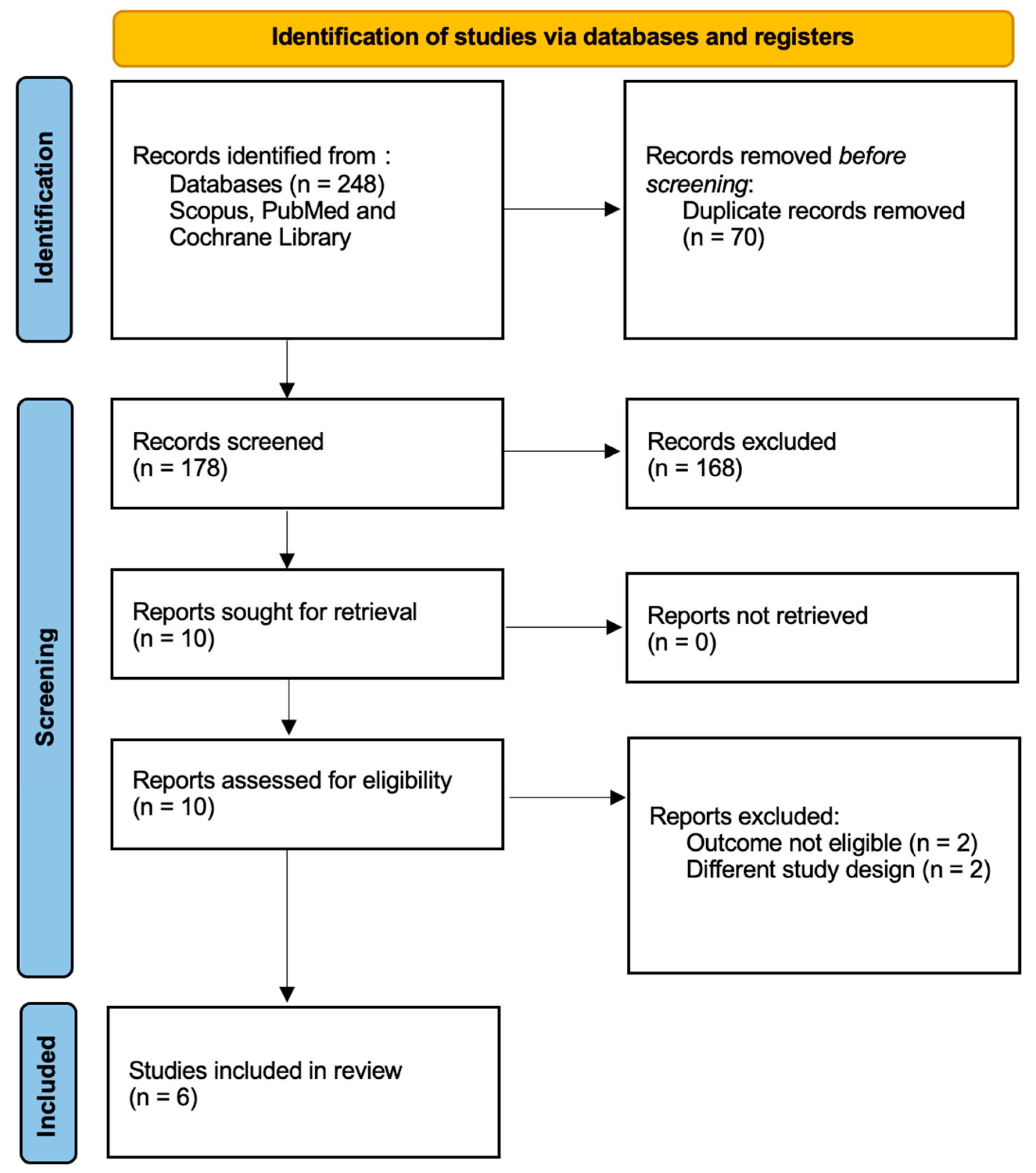
Using our search criteria, a comprehensive electronic database search using PubMed, Scopus, and the Cochrane Library yielded a total of 248 records. After removing 70 duplicates, 178 articles were screened based on their titles and abstracts. Of these, 168 were excluded primarily because they were review articles (n = 107), involved adult populations (n = 19), were meta-analyses (n = 10), or lacked full-text availability (n = 10). Additional exclusions included publication types that did not meet the inclusion criteria (e.g., conference proceedings, commentaries), irrelevant outcomes, or non-probiotic interventions. Full-text review of the remaining ten studies resulted in the exclusion of four studies due to unsuitable design or outcomes. Ultimately, six randomized controlled trials (RCTs) were included in the systematic review and meta-analysis [28,29,30,31,32,33]. The study selection process is detailed in the PRISMA flow diagram (Figure 1).

3.2. Studies and Patient Characteristics

The 6 included RCTs involved a total of 604 pediatric patients (aged 4–18 years) diagnosed with irritable bowel syndrome (IBS) according to the Rome III or IV criteria (Supplementary Table S1). Among participants with reported sex (n = 595), females comprised 51.3% (n = 305) and males 48.7% (n = 290). All studies employed placebo-controlled designs, with intervention durations ranging from 4 to 12 weeks. Probiotic regimens varied, including single strains such as Lactobacillus rhamnosus GG [28], Bacillus coagulans Unique IS2 [29], Bacillus clausii [30], Bifidobacterium adolescentis PRL2019 [31], Lactobacillus reuteri [32], as well as multi-strain formulations containing Bifidobacterium longum BB536, Bifidobacterium infantis M-63, Bifidobacterium breve M16V [33]. Primary outcomes assessed across studies included the frequency and intensity of abdominal pain. Secondary outcomes included global symptom relief, stool consistency, and quality of life (QoL).

3.2.1. Efficacy of Probiotics on Abdominal Pain Scores

All six RCTs evaluated probiotics’ effects on abdominal pain in pediatric IBS. Rahmani et al. found that 40% (6/15) of patients receiving probiotics experienced significant pain improvement versus none in placebo (p = 0.01) [32]. Kianifar et al. reported significant reductions in pain severity after four weeks of Lactobacillus GG (p < 0.01) [28]. Sudha et al. observed significant pain intensity decreases with B. coagulans Unique IS2 (p < 0.0001) [29]. Two studies documented higher rates of complete abdominal pain resolution in probiotic versus placebo groups (p = 0.003 and p = 0.006) [31,33]. Conversely, Vázquez-Frias et al. found no significant difference between B. clausii and placebo (p > 0.05) [30].

3.2.2. Efficacy on Abdominal Distension and Bloating

Several studies assessed probiotics’ impact on abdominal distension and bloating. Sudha et al. observed reductions in abdominal discomfort and bloating with B. coagulans (p < 0.05) [29]. No significant differences were noted in the B. clausii study by Vázquez-Frias et al. (p > 0.05) [30].

3.2.3. Effects on Bowel Habits

Probiotic-related improvements in bowel habits were reported by several trials. Sudha et al. reported better stool consistency, reduced incomplete evacuation, and urgency with B. coagulans (p < 0.05) [29]. Also Giorgio et al. reported better stool consistency in patients receiving B.adolescentis PRL2019 after treatment (p = 0.04) [31]. However, Kianifar et al. and Vázquez-Frias et al. found no significant differences compared to placebo [28,30].

3.2.4. Quality of Life Outcomes

Quality of life was assessed in a limited subset of studies. Two studies reported significantly greater QoL improvement with probiotics versus placebo [31,33]. Other studies, including Vázquez-Frias et al., observed no significant differences [30].

3.3. Meta-Analysis

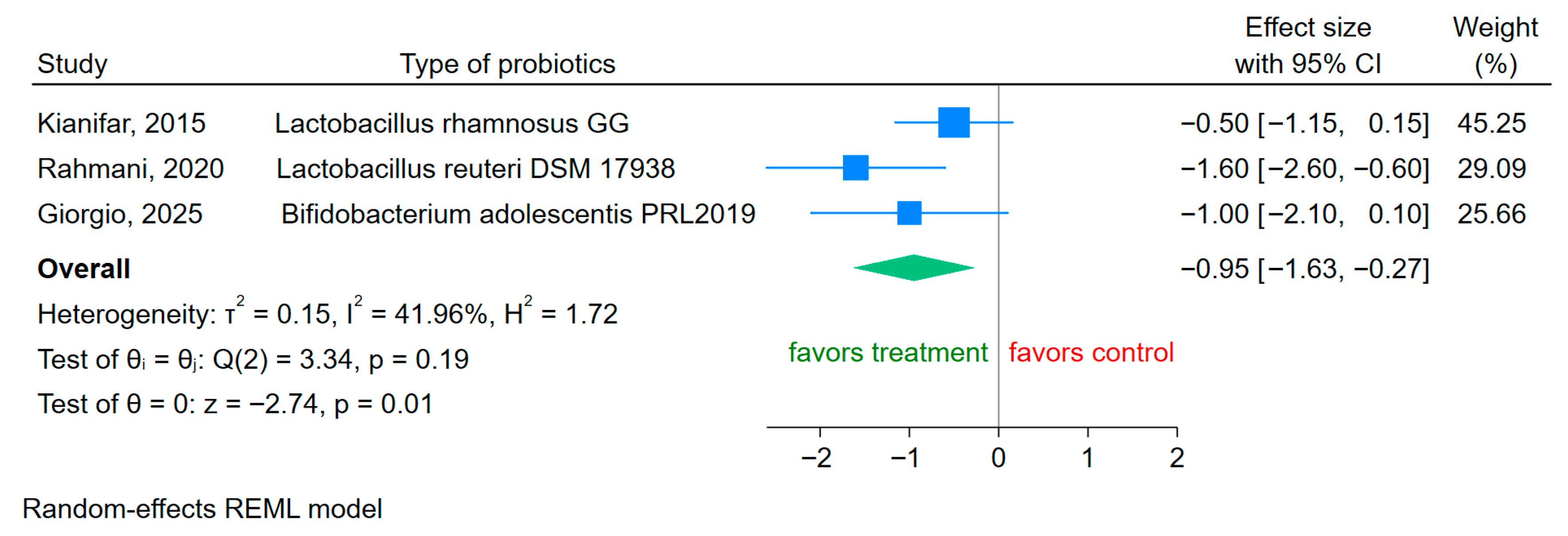
Data on the effect of probiotics on pain outcomes were reported in only three RCTs [28,31,32]. Probiotic supplementation resulted in a significant reduction in pain intensity compared to placebo (SMD −0.95, 95% CI −1.63 to −0.27; I2 = 41.96%) (Figure 2). Lower pain scores reflect symptom improvement, and therefore a negative effect size demonstrates the beneficial effect of probiotics.
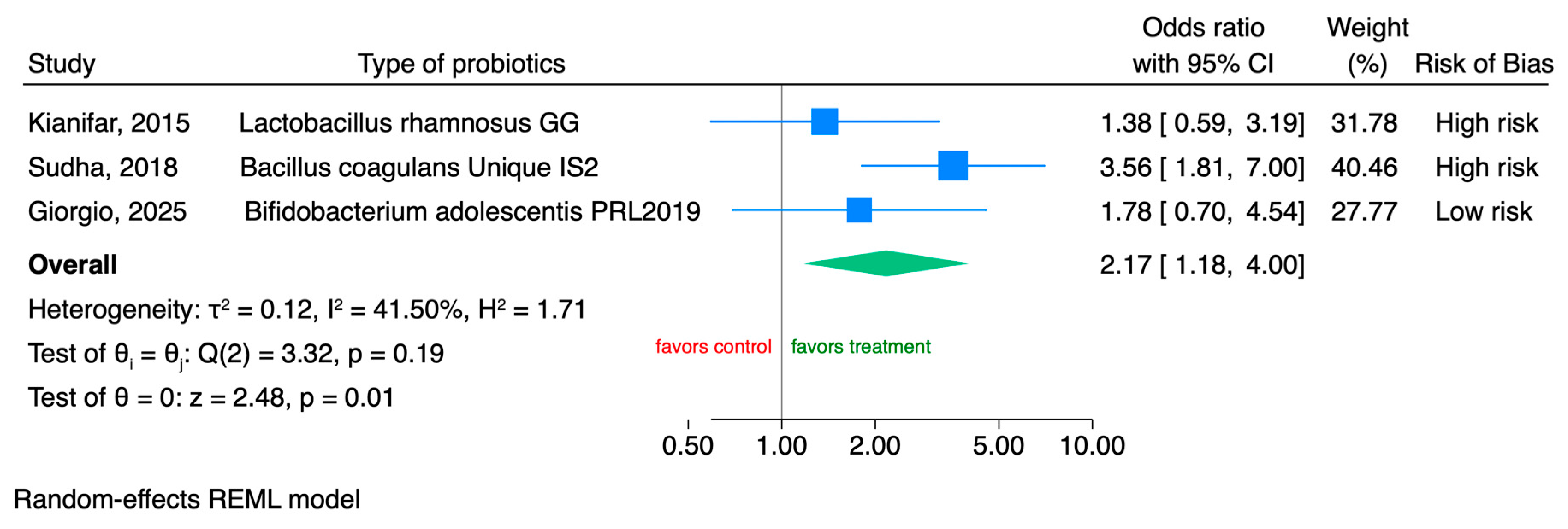
Only three RCTs [28,29,31] reported data on the effect of probiotics on stool consistency, according to the Bristol Stool Form Scale (BSFS). Probiotic supplementation resulted in significant normalization of bowel habits in IBS patients with diarrhea or constipation at baseline compared to placebo (OR 2.17, 95% CI 1.18 to 4, I2 = 41.50%) (Figure 3).

4. Discussion

This updated systematic review and meta-analysis provide compelling evidence for the beneficial effects of probiotics in treating IBS in pediatric patients.
Probiotics are live, nonpathogenic microorganisms known to exert several beneficial effects, including modulation of the host immune response within the gastrointestinal tract and suppression of pathogenic bacterial growth by promoting microbial balance [34]. Although IBS pathogenesis is multifaceted and not yet entirely understood, it is currently recognized as a brain–gut disorder. In IBS patients, a dysregulation between the enteric and central nervous systems occurs, resulting in altered sensations, motility, and potentially immune dysfunction [35]. In this scenario, gut microbiota plays a pivotal role, leading to the updated concept of the “brain–gut-microbiome axis,” which has replaced the earlier “brain–gut axis” model [36]. Probiotics can potentially modulate multiple components of this axis simultaneously, including restoring microbial balance, producing neuroactive compounds, reducing intestinal inflammation, and strengthening epithelial barrier function. Consequently, current guidelines support the use of probiotic supplementation in both adults and children with IBS [37,38]. Several studies have reported a positive correlation between IBS severity and low microbial diversity. In particular, reduced alpha and beta diversity of the gut have been associated with impaired intestinal motility and altered stool consistency [39,40]. Some adult studies have linked IBS severity to the absence of Methanobacteriales and the reduced presence of Bacteroides enterotypes [41]. Additionally, Pozuelo and colleagues observed a lower abundance of butyrate-producing and methane-producing bacteria in adult IBS-D and IBS-M patients [42]. In our analysis, probiotic supplementation led to a significant reduction in abdominal pain compared to the placebo. Similar to our findings, two previous meta-analyses have also demonstrated that probiotic supplementation reduces abdominal pain in children with IBS [24,25]. Experimental studies in germ-free animals have shown that dysbiosis can alter the perception of inflammatory visceral pain, highlighting the importance of the microbiota in regulating gut motility and sensory signaling [43]. Additionally, a disrupted gut barrier (“leaky gut”) can facilitate the translocation of luminal antigens, triggering immune responses and the release of pro-inflammatory mediators—such as histamine, tryptase, serotonin, and several polyunsaturated fatty acid derivatives (e.g., 12-HETE, 15-HETE, 5-HETE, 5-oxo-ETE, and LTB4)—all of which may contribute to sensory afferent hypersensitivity and abdominal pain [44,45,46]. Emerging evidence also supports the association between IBS and the reduced stability and biodiversity of the gut microbiota [18]. For instance, an Italian cross-sectional adult study revealed significant differences in Clostridiales abundance across IBS subtypes, which were correlated with fecal short-chain fatty acid (SCFA) levels and cytokine profiles [47]. Numerous studies suggested that probiotics may have an anti-inflammatory effect. For example, improvement in symptoms with Bifidobacteria supplementation has been demonstrated to be associated with an increased production of anti-inflammatory cytokines (IL-12) [48], and L. reuteri in an experimental rodent study reduced tumor necrosis factor-alpha (TNF-alpha)-induced production of IL-8 [49,50].
The present meta-analysis also demonstrated the beneficial effects of probiotic supplementation on stool consistency, helping to restore normal intestinal transit at the end of treatment in children with either constipation or diarrhea. Reduced ileal retention (and therefore increased colonic delivery) of bile acids has been suggested as a potential cause for symptoms in patients with functional diarrhea [51]. Lactobacilli and Bifidobacteria subspecies can deconjugate and absorb bile acids. Thus, one presumptive mechanism of probiotics may be rooted in their ability to reduce bile salt load to the colon, thereby avoiding potential colonic secretion and mucosal permeability changes induced by salt [50]. Gut microbiota commonly metabolize dietary substrates, producing gas and short-chain fatty acids. The latter may induce propulsive contractions, accelerate transit, or enhance fluid and sodium absorption in the colon. Methane-producing bacteria predominate in patients with IBS-C, and the amount of gas released is directly correlated with the severity of constipation [52]. In addition, in these patients, the presence of these bacteria is associated with slower passage through the intestine, reduced segmental contraction, and attenuated propulsion [53] Thus, probiotics supplementation may modify the colonic metabolism, influencing colonic transit and stool consistency [50].
Despite these promising findings, a key limitation must be acknowledged: the vast heterogeneity of probiotic strains, doses, and treatment durations included in the existing literature. While our meta-analysis shows a significant overall effect, the results cannot be generalized to all probiotic formulations. Emerging evidence highlights that the clinical efficacy of probiotics is highly strain-specific, emphasizing that our findings represent the general effect of probiotics rather than strain-specific recommendations, and that caution is warranted when generalizing results to specific probiotic products. A large meta-analysis by McFarland et al., which included both adult and pediatric IBS populations, demonstrated that certain individual strains—such as B. coagulans MTCC5260, Lactobacillus plantarum 299v, Saccharomyces boulardii CNCM I-745, and Saccharomyces cerevisiae CNCM I-3856—were significantly more effective than placebo in improving specific IBS symptoms, particularly abdominal pain [54]. However, even in that extensive analysis, the considerable variability in study design, outcome definitions, and probiotic formulations limited the ability to recommend a universal strain or formulation. Moreover, in our review, the six included RCTs tested six different strains or combinations, ranging from spore-forming probiotics (e.g., B. clausii) to traditional lactic acid bacteria (e.g., L. rhamnosus GG, B. adolescentis PRL2019). The diversity in formulation and strain characteristics—including their resistance to gastric acid, adhesion capacity, and immunomodulatory effects—likely contributes to the variability in clinical outcomes. Additionally, the gut microbiota profile in pediatric IBS patients lacks a clearly defined or characteristic signature and may have distinct microbiome characteristics compared to adult disease due to developmental maturation of the gut microbiota during childhood and adolescence, further complicating the identification of targeted probiotic interventions. Therefore, while probiotics appear to be a promising adjunctive treatment, personalized approaches based on strain functionality and patient microbiota profiling may be needed to optimize outcomes. Current guidelines, including the European Society for Paediatric Gastroenterology Hepatology and Nutrition (ESPGHAN) position paper [55], acknowledge these limitations and emphasize the need for caution when interpreting results from probiotic studies that use broad or heterogeneous definitions. They advocate for a more targeted approach—highlighting the importance of selecting specific strains, optimizing treatment duration and dosing, and designing trials that account for patient heterogeneity. Notably, ESPGHAN goes beyond a generic recommendation and, based on the currently available high-quality evidence, identifies two strains with sufficient efficacy and safety data in children with functional gastrointestinal disorders: L. reuteri DSM 17938 and L. rhamnosus GG. This point is particularly relevant, as it highlights how the field is shifting from the broad and non-specific use of probiotics toward evidence-based, strain-specific guidance. Nevertheless, even for these two strains, the recommendations are condition-specific (e.g., functional abdominal pain and colic), and their role in pediatric IBS still requires further validation [55].

5. Conclusions

In conclusion, this updated systematic review and meta-analysis suggest that probiotic supplementation may offer clinical benefits in alleviating symptoms of irritable bowel syndrome in children, particularly in reducing abdominal pain and improving stool consistency. Considering the complexity of the analyzed variables, the interpretation of these findings requires careful consideration and caution. The significant heterogeneity in probiotic strains and treatment protocols across included studies prevents the formulation of strain-specific clinical recommendations, nor can the results be generalized to a specific genus or species. As documented in prior literature, probiotic efficacy appears to be both strain-dependent and outcome-specific, and not all formulations yield the same benefits. Additionally, the limited number of high-quality pediatric trials and variability in outcome measures further restrict the generalizability of our findings.
Future research should aim to identify the most effective probiotic strains for each IBS subtype, using standardized diagnostic criteria and clinically meaningful endpoints. The integration of microbiota profiling and biomarkers may also support a move toward precision probiotic therapy in pediatric IBS.

Supplementary Materials

The following supporting information can be downloaded at: https://www.mdpi.com/article/10.3390/microorganisms14010023/s1, Table S1: Characteristics of Randomized Controlled Trials of Probiotics Versus Placebo in Children with Irritable Bowel Syndrome.

Author Contributions

Conceptualization, Investigation, Writing-Original Draft Preparation, M.P. and G.D.N.; Writing—Review & Editing, Supervision, Project Administration, G.D.N., M.P., M.M., G.G. (Giorgia Gallo) and G.G. (Giacomo Giarrusso); Methodology, Software, Formal Analysis, E.R. and C.D.V.; Resources F.C., M.G., G.Q., M.B., P.P. and A.F. All authors have read and agreed to the published version of the manuscript.

Funding

This research received no external funding.

Institutional Review Board Statement

Not applicable.

Informed Consent Statement

Not applicable.

Data Availability Statement

No new data were created or analyzed in this study. Data sharing is not applicable to this article.

Conflicts of Interest

The authors declare no conflicts of interest.

Abbreviations

The following abbreviations are used in this manuscript:
IBSIrritable Bowel Syndrome
DGBIDisorder of Gut–brain Interaction
IBS-CIrritable Bowel Syndrome constipation-predominant
IBS-DIrritable Bowel Syndrome diarrhea-predominant
IBS-MIrritable Bowel Syndrome mixed type
IBS-UIrritable Bowel Syndrome-unsubtyped
BSFSBristol Stool Form Scale
RCTRandomized Controlled Trial
MESHMedical Subject Headings
PICOPopulation, Intervention, Comparison, Outcomes
QoLQuality of Life
SDStandard Deviation
CIConfidence Interval
SMDStandardized Mean Difference
SEsStandard errors
REMLRestricted Maximum Likelihood
ESPGHANEuropean Society for Paediatric Gastroenterology Hepatology and Nutrition

References

  1. Hyams, J.S.; Di Lorenzo, C.; Saps, M.; Shulman, R.J.; Staiano, A.; van Tilburg, M. Functional Disorders: Children and Adolescents. Gastroenterology 2016. Epub ahead of printing. [Google Scholar] [CrossRef]
  2. Devanarayana, N.M.; Rajindrajith, S. Irritable bowel syndrome in children: Current knowledge, challenges and opportunities. World J. Gastroenterol. 2018, 24, 2211–2235. [Google Scholar] [CrossRef] [PubMed]
  3. Liu, D.; Li, D.; Xu, X.; Lu, H. An epidemiologic study of irritable bowel syndrome in adolescents and children in China: A school-based study. Pediatrics 2005, 116, e393–e396. [Google Scholar] [CrossRef]
  4. Karabulut, G.S.; Beşer, Ö.F.; Erginöz, E.; Kutlu, T.; Çokuğraş, F.Ç.; Erkan, T. The incidence of irritable bowel syndrome in children using the Rome III criteria and the effect of trimebutine treatment. J. Neurogastroenterol. Motil. 2013, 19, 90. [Google Scholar] [CrossRef]
  5. Adeniyi, O.F.; Adenike Lesi, O.; Olatona, F.A.; Esezobor, C.I.; Ikobah, J.M. Irritable bowel syndrome in adolescents in Lagos. Pan Afr. Med. J. 2017, 28, 93. [Google Scholar] [CrossRef]
  6. Rajindrajith, S.; Devanarayana, N.M. Subtypes and Symptomatology of Irritable Bowel Syndrome in Children and Adolescents: A School-based Survey Using Rome III Criteria. J. Neurogastroenterol. Motil. 2012, 18, 298–304. [Google Scholar] [CrossRef] [PubMed]
  7. Giannetti, E.; de’Angelis, G.; Turco, R.; Campanozzi, A.; Pensabene, L.; Salvatore, S.; de Seta, F.; Staiano, A. Subtypes of irritable bowel syndrome in children: Prevalence at diagnosis and at follow-up. J. Pediatr. 2014, 164, 1099–1103.e1. [Google Scholar] [CrossRef] [PubMed]
  8. Devanarayana, N.M.; Rajindrajith, S.; Benninga, M.A. Quality of life and health care consultation in 13 to 18 year olds with abdominal pain predominant functional gastrointestinal diseases. BMC Gastroenterol. 2014, 14, 150. [Google Scholar] [CrossRef]
  9. Ranasinghe, N.; Devanarayana, N.M.; Rajindrajith, S.; Perera, M.S.; Nishanthinie, S.; Warnakulasuriya, T.; de Zoysa, P.T. Functional gastrointestinal diseases and psychological maladjustment, personality traits and quality of life. BMC Gastroenterol. 2018, 18, 33. [Google Scholar] [CrossRef]
  10. Sagawa, T.; Okamura, S.; Kakizaki, S.; Zhang, Y.; Morita, K.; Mori, M. Functional gastrointestinal disorders in adolescents and quality of school life. J. Gastroenterol. Hepatol. 2013, 28, 285–290. [Google Scholar] [CrossRef]
  11. Varni, J.W.; Lane, M.M.; Burwinkle, T.M.; Fontaine, E.N.; Youssef, N.N.; Schwimmer, J.B.; Pardee, P.E.; Pohl, J.F.; Easley, D.J. Health-related quality of life in pediatric patients with irritable bowel syndrome: A comparative analysis. J. Dev. Behav. Pediatr. 2006, 27, 451–458. [Google Scholar] [CrossRef]
  12. Park, R.; Mikami, S.; LeClair, J.; Bollom, A.; Lembo, C.; Sethi, S.; Lembo, A.; Jones, M.; Cheng, V.; Friedlander, E.; et al. Inpatient burden of childhood functional GI disorders in the USA: An analysis of national trends in the USA from 1997 to 2009. Neurogastroenterol. Motil. 2015, 27, 684–692. [Google Scholar] [CrossRef]
  13. Hoekman, D.R.; Rutten, J.M.; Vlieger, A.M.; Benninga, M.A.; Dijkgraaf, M.G. Annual Costs of Care for Pediatric Irritable Bowel Syndrome, Functional Abdominal Pain, and Functional Abdominal Pain Syndrome. J. Pediatr. 2015, 167, 1103–1108.e2. [Google Scholar] [CrossRef] [PubMed]
  14. Lane, M.M.; Weidler, E.M.; Czyzewski, D.I.; Shulman, R.J. Pain symptoms and stooling patterns do not drive diagnostic costs for children with functional abdominal pain and irritable bowel syndrome in primary or tertiary care. Pediatrics 2009, 123, 758–764. [Google Scholar] [CrossRef] [PubMed]
  15. Self, M.M.; Czyzewski, D.I.; Chumpitazi, B.P.; Weidler, E.M.; Shulman, R.J. Subtypes of irritable bowel syndrome in children and adolescents. Clin. Gastroenterol. Hepatol. 2014, 12, 1468–1473. [Google Scholar] [CrossRef]
  16. Lacy, B.E.; Patel, N.K. Rome Criteria and a Diagnostic Approach to Irritable Bowel Syndrome. J. Clin. Med. 2017, 6, 99. [Google Scholar] [CrossRef] [PubMed]
  17. Ford, A.C.; Lacy, B.E.; Talley, N.J. Irritable Bowel Syndrome. N. Engl. J. Med. 2017, 376, 2566–2578. [Google Scholar] [CrossRef]
  18. Durbán, A.; Abellán, J.J.; Jiménez-Hernández, N.; Artacho, A.; Garrigues, V.; Ortiz, V.; Ponce, J.; Latorre, A.; Moya, A. Instability of the faecal microbiota in diarrhoea-predominant irritable bowel syndrome. FEMS Microbiol. Ecol. 2013, 86, 581–589. [Google Scholar] [CrossRef]
  19. Najjar, S.A.; Albers, K.M. Pain in Inflammatory Bowel Disease: Optogenetic Strategies for Study of Neural-Epithelial Signaling. Crohns Colitis 2021, 360, otab040. [Google Scholar] [CrossRef]
  20. El-Salhy, M.; Hausken, T.; Gilja, O.H.; Hatlebakk, J.G. The possible role of gastrointestinal endocrine cells in the pathophysiology of irritable bowel syndrome. Expert Rev. Gastroenterol. Hepatol. 2017, 11, 139–148. [Google Scholar] [CrossRef]
  21. Sandhu, B.K.; Paul, S.P. Irritable bowel syndrome in children: Pathogenesis, diagnosis and evidence-based treatment. World J. Gastroenterol. 2014, 20, 6013–6023. [Google Scholar] [CrossRef]
  22. Ding, L.; Ning, L.; Xu, G. Efficacy of different probiotic protocols in irritable bowel syndrome: A network meta-analysis. Medicine 2019, 98, e16068. [Google Scholar]
  23. Goodoory, V.C.; Khasawneh, M.; Black, C.J.; Quigley, E.M.M.; Moayyedi, P.; Ford, A.C. Efficacy of Probiotics in Irritable Bowel Syndrome: Systematic Review and Meta-analysis. Gastroenterology 2023, 165, 1206–1218, Erratum in Gastroenterology 2024, 167, 1248. [Google Scholar] [CrossRef] [PubMed]
  24. Xu, H.L.; Zou, L.L.; Chen, M.B.; Wang, H.; Shen, W.M.; Zheng, Q.H.; Cui, W.Y. Efficacy of probiotic adjuvant therapy for irritable bowel syndrome in children: A systematic review and meta-analysis. PLoS ONE 2021, 16, e0255160. [Google Scholar] [CrossRef] [PubMed]
  25. Fatahi, S.; Hosseini, A.; Sohouli, M.H.; Sayyari, A.; Khatami, K.; Farsani, Z.F.; Amiri, H.; Dara, N.; de Souza, I.G.O.; Santos, H.O. Effects of probiotic supplementation on abdominal pain severity in pediatric patients with irritable bowel syndrome: A systematic review and meta-analysis of randomized clinical trials. World J. Pediatr. 2022, 18, 320–332. [Google Scholar] [CrossRef]
  26. Higgins, J.P.T.; Thomas, J.; Chandler, J.; Cumpston, M.; Li, T.; Page, M.J. Cochrane Handbook for Systematic Reviews of Interventions Version 6.5; Cochrane: Oxford, UK, 2024. [Google Scholar]
  27. Sterne, J.A.C.; Savović, J.; Page, M.J.; Elbers, R.G.; Blencowe, N.S.; Boutron, I.; Cates, C.J.; Cheng, H.Y.; Corbett, M.S.; Eldridge, S.M.; et al. RoB 2: A revised tool for assessing risk of bias in randomised trials. BMJ 2019, 366, L4898. [Google Scholar] [CrossRef]
  28. Kianifar, H.; Jafari, S.A.; Kiani, M.; Ahanchian, H.; Ghasemi, S.V.; Grover, Z.; Mahmoodi, L.Z.; Bagherian, R.; Khalesi, M. Probiotic for irritable bowel syndrome in pediatric patients: A randomized controlled clinical trial. Electron. Physician 2015, 7, 1255–1260. [Google Scholar]
  29. Sudha, M.R.; Jayanthi, N.; Aasin, M.; Dhanashri, R.D.; Anirudh, T. Efficacy of Bacillus coagulans Unique IS2 in treatment of irritable bowel syndrome in children: A double blind, randomised placebo controlled study. Benef. Microbes 2018, 9, 563–572. [Google Scholar] [CrossRef]
  30. Vázquez-Frias, R.; Consuelo-Sánchez, A.; Acosta-Rodríguez-Bueno, C.P.; Blanco-Montero, A.; Robles, D.C.; Cohen, V.; Márquez, D.; Perez, M. Efficacy and Safety of the Adjuvant Use of Probiotic Bacillus clausii Strains in Pediatric Irritable Bowel Syndrome: A Randomized, Double-Blind, Placebo-Controlled Study. Paediatr. Drugs 2023, 25, 115–126. [Google Scholar] [CrossRef]
  31. Giorgio, V.; Quatrale, G.; Mennini, M.; Piccirillo, M.; Furio, S.; Stella, G.; Ferretti, A.; Parisi, P.; Evangelisti, M.; Felici, E.; et al. Bifidobacterium adolescentis PRL2019 in Pediatric Irritable Bowel Syndrome: A Multicentric, Randomized, Double-Blind, Placebo-Controlled Trial. Microorganisms 2025, 13, 627. [Google Scholar] [CrossRef]
  32. Rahmani, P.; Ghouran-Orimi, A.; Motamed, F.; Moradzadeh, A. Evaluating the effects of probiotics in pediatrics with recurrent abdominal pain. Clin. Exp. Pediatr. 2020, 63, 485–490. [Google Scholar] [CrossRef]
  33. Giannetti, E.; Maglione, M.; Alessandrella, A.; Strisciuglio, C.; De Giovanni, D.; Campanozzi, A.; Miele, E.; Staiano, A. A Mixture of 3 Bifidobacteria Decreases Abdominal Pain and Improves the Quality of Life in Children with Irritable Bowel Syndrome: A Multicenter, Randomized, Double-Blind, Placebo-Controlled, Crossover Trial. J. Clin. Gastroenterol. 2017, 51, e5–e10. [Google Scholar] [CrossRef] [PubMed]
  34. Williams, N. Probiotics. Am. J. Health-Syst. Pharm. 2010, 67, 449–458. [Google Scholar] [CrossRef] [PubMed]
  35. Camilleri, M. Peripheral mechanisms in irritable bowel syndrome. N. Engl. J. Med. 2012, 367, 1626–1635. [Google Scholar] [CrossRef]
  36. Martin, C.R.; Osadchiy, V.; Kalani, A.; Mayer, E.A. The Brain-Gut-Microbiome Axis. Cell. Mol. Gastroenterol. Hepatol. 2018, 6, 133–148. [Google Scholar] [CrossRef]
  37. Di Nardo, G.; Barbara, G.; Borrelli, O.; Cremon, C.; Giorgio, V.; Greco, L.; La Pietra, M.; Marasco, G.; Pensabene, L.; Piccirillo, M.; et al. Italian guidelines for the management of irritable bowel syndrome in children and adolescents: Joint Consensus from the Italian Societies of: Gastroenterology, Hepatology and Pediatric Nutrition (SIGENP), Pediatrics (SIP), Gastroenterology and Endoscopy (SIGE) and Neurogastroenterology and Motility (SINGEM). Ital. J. Pediatr. 2024, 50, 51. [Google Scholar] [PubMed]
  38. Barbara, G.; Cremon, C.; Bellini, M.; Corsetti, M.; Di Nardo, G.; Falangone, F.; Fuccio, L.; Galeazzi, F.; Iovino, P.; Sarnelli, G.; et al. Italian guidelines for the management of irritable bowel syndrome: Joint Consensus from the Italian Societies of: Gastroenterology and Endoscopy (SIGE), Neurogastroenterology and Motility (SINGEM), Hospital Gastroenterologists and Endoscopists (AIGO), Digestive Endoscopy (SIED), General Medicine (SIMG), Gastroenterology, Hepatology and Pediatric Nutrition (SIGENP) and Pediatrics (SIP). Dig. Liver Dis. 2023, 55, 187–207. [Google Scholar]
  39. Roager, H.M.; Hansen, L.B.; Bahl, M.I.; Frandsen, H.L.; Carvalho, V.; Gøbel, R.J.; Dalgaard, M.D.; Plichta, D.R.; Sparholt, M.H.; Vestergaard, H.; et al. Colonic transit time is related to bacterial metabolism and mucosal turnover in the gut. Nat. Microbiol. 2016, 1, 16093. [Google Scholar] [CrossRef]
  40. Benjak Horvat, I.; Gobin, I.; Kresović, A.; Hauser, G. How can probiotic improve irritable bowel syndrome symptoms? World J. Gastrointest. Surg. 2021, 13, 923–940. [Google Scholar] [CrossRef]
  41. Tap, J.; Derrien, M.; Törnblom, H.; Brazeilles, R.; Cools-Portier, S.; Doré, J.; Störsrud, S.; Le Nevé, B.; Öhman, L.; Simrén, M. Identification of an Intestinal Microbiota Signature Associated with Severity of Irritable Bowel Syndrome. Gastroenterology 2017, 152, 111–123.e8. [Google Scholar] [CrossRef]
  42. Pozuelo, M.; Panda, S.; Santiago, A.; Mendez, S.; Accarino, A.; Santos, J.; Guarner, F.; Azpiroz, F.; Manichanh, C. Reduction of butyrate- and methane-producing microorganisms in patients with Irritable Bowel Syndrome. Sci. Rep. 2015, 5, 12693. [Google Scholar] [CrossRef]
  43. Amaral, F.A.; Sachs, D.; Costa, V.V.; Fagundes, C.T.; Cisalpino, D.; Cunha, T.M.; Ferreira, S.H.; Cunha, F.Q.; Silva, T.A.; Nicoli, J.R.; et al. Commensal microbiota is fundamental for the development of inflammatory pain. Proc. Natl. Acad. Sci. USA 2008, 105, 2193–2197. [Google Scholar] [CrossRef] [PubMed]
  44. Cenac, N.; Bautzova, T.; Le Faouder, P.; Veldhuis, N.A.; Poole, D.P.; Rolland, C.; Bertrand, J.; Liedtke, W.; Dubourdeau, M.; Bertrand-Michel, J.; et al. Quantification and Potential Functions of Endogenous Agonists of Transient Receptor Potential Channels in Patients with Irritable Bowel Syndrome. Gastroenterology 2015, 149, 433–444.e7. [Google Scholar] [CrossRef]
  45. Bautzova, T.; Hockley, J.R.F.; Perez-Berezo, T.; Pujo, J.; Tranter, M.M.; Desormeaux, C.; Barbaro, M.R.; Basso, L.; Le Faouder, P.; Rolland, C.; et al. 5-oxoETE triggers nociception in constipation-predominant irritable bowel syndrome through MAS-related G protein-coupled receptor D. Sci. Signal. 2018, 11, eaal2171. [Google Scholar] [CrossRef]
  46. Barbara, G.; Wang, B.; Stanghellini, V.; de Giorgio, R.; Cremon, C.; Di Nardo, G.; Trevisani, M.; Campi, B.; Geppetti, P.; Tonini, M.; et al. Mast cell-dependent excitation of visceral-nociceptive sensory neurons in irritable bowel syndrome. Gastroenterology 2007, 132, 26–37. [Google Scholar] [CrossRef]
  47. Gargari, G.; Taverniti, V.; Gardana, C.; Cremon, C.; Canducci, F.; Pagano, I.; Barbaro, M.R.; Bellacosa, L.; Castellazzi, A.M.; Valsecchi, C.; et al. Fecal Clostridiales distribution and short-chain fatty acids reflect bowel habits in irritable bowel syndrome. Environ. Microbiol. 2018, 20, 3201–3213. [Google Scholar] [CrossRef]
  48. O’Mahony, L.; McCarthy, J.; Kelly, P.; Hurley, G.; Luo, F.; Chen, K.; O’Sullivan, G.C.; Kiely, B.; Collins, J.K.; Shanahan, F.; et al. Lactobacillus and bifidobacterium in irritable bowel syndrome: Symptom responses and relationship to cytokine profiles. Gastroenterology 2005, 128, 541–551. [Google Scholar] [CrossRef]
  49. Ma, D.; Forsythe, P.; Bienenstock, J. Live Lactobacillus rhamnosus [corrected] is essential for the inhibitory effect on tumor necrosis factor alpha-induced interleukin-8 expression. Infect. Immun. 2004, 72, 5308–5314. [Google Scholar] [CrossRef]
  50. Camilleri, M. Probiotics and irritable bowel syndrome: Rationale, putative mechanisms, and evidence of clinical efficacy. J. Clin. Gastroenterol. 2006, 40, 264–269. [Google Scholar] [CrossRef] [PubMed]
  51. Brydon, W.G.; Nyhlin, H.; Eastwood, M.A.; Merrick, M.V. Serum 7 alpha-hydroxy-4-cholesten-3-one and selenohomocholyltaurine (SeHCAT) whole body retention in the assessment of bile acid induced diarrhoea. Eur. J. Gastroenterol. Hepatol. 1996, 8, 117–123. [Google Scholar] [CrossRef] [PubMed]
  52. Chatterjee, S.; Park, S.; Low, K.; Kong, Y.; Pimentel, M. The degree of breath methane production in IBS correlates with the severity of constipation. Am. J. Gastroenterol. 2007, 102, 837–841. [Google Scholar] [CrossRef]
  53. Agrawal, A.; Houghton, L.A.; Morris, J.; Reilly, B.; Guyonnet, D.; Goupil Feuillerat, N.; Schlumberger, A.; Jakob, S.; Whorwell, P.J. Clinical trial: The effects of a fermented milk product containing Bifidobacterium lactis DN-173 010 on abdominal distension and gastrointestinal transit in irritable bowel syndrome with constipation. Aliment. Pharmacol. Ther. 2009, 29, 104–114. [Google Scholar] [CrossRef] [PubMed]
  54. McFarland, L.V.; Karakan, T.; Karatas, A. Strain-specific and outcome-specific efficacy of probiotics for the treatment of irritable bowel syndrome: A systematic review and meta-analysis. eClinicalMedicine 2021, 41, 101154. [Google Scholar] [CrossRef] [PubMed]
  55. Szajewska, H.; Canani, R.B.; Domellöf, M.; Guarino, A.; Hojsak, I.; Indrio, F.; Vecchio, A.L.; Mihatsch, W.A.; Mosca, A.; Salvatore, S. Probiotics for the management of pediatric gastrointestinal disorders: Position paper of the ESPGHAN Special Interest Group on Gut Microbiota and Modifications. J. Pediatr. Gastroenterol. Nutr. 2023, 76, 232–247. [Google Scholar] [CrossRef] [PubMed]
Figure 1. PRISMA flowchart of the study selection process.
Microorganisms 14 00023 g001
Figure 2. Forest plot of RCTs of the effects of probiotics (treatment) vs. placebo on abdominal pain in children with IBS [28,31,32]. Negative SMD values indicate a greater reduction in pain in the probiotic group (“favors treatment”). Effect sizes = standardized mean differences (SMDs) CI = 95% confidence intervals.
Microorganisms 14 00023 g002
Figure 3. Forest plot of RCTs of the effects of probiotics (treatment) vs. placebo on stool consistency in children with IBS [28,29,31].
Microorganisms 14 00023 g003
Disclaimer/Publisher’s Note: The statements, opinions and data contained in all publications are solely those of the individual author(s) and contributor(s) and not of MDPI and/or the editor(s). MDPI and/or the editor(s) disclaim responsibility for any injury to people or property resulting from any ideas, methods, instructions or products referred to in the content.