


Integrative Multi-Omics and Data‑Driven Biomarker Discovery in Human Diseases
Special Issue Information
Dear Colleagues,
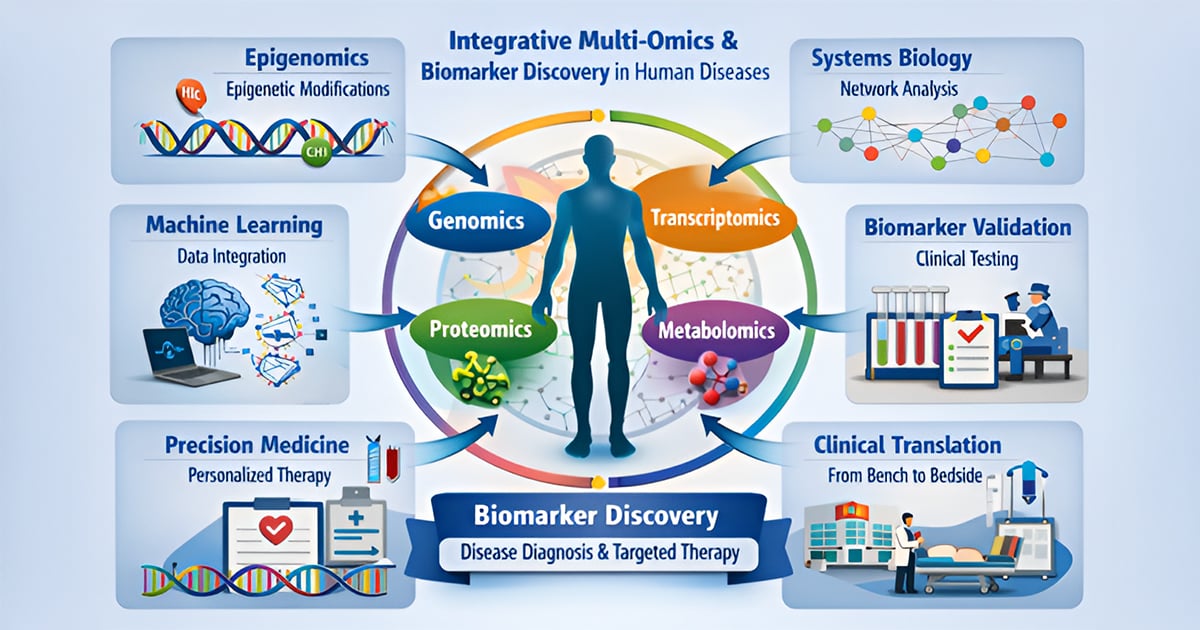
The accelerating convergence of multi‑omics technologies, genomics, transcriptomics, proteomics, metabolomics, and epigenomics, has transformed the landscape of biomedical research. By integrating these diverse molecular layers, researchers can move beyond reductionist approaches to capture the dynamic complexity of human disease. This integrative paradigm not only enhances mechanistic understanding but also enables the identification of robust, clinically relevant biomarkers. This collection focuses on:
- Single‑cell multi‑omics: Capturing heterogeneity at the cellular level to reveal rare populations and dynamic disease processes using scRNA‑seq or others and spatial mapping of gene expression within tissues.
- Next‑Generation Sequencing (NGS) analysis and genome‑wide association studies (GWAS): High‑throughput sequencing pipelines, RNA‑seq integration, and variant calling for clinical genomics.
- Data integration frameworks and algorithms: Developing computational pipelines that harmonize genomics, transcriptomics, proteomics, metabolomics, and epigenomics into unified models.
- Network biology and pathway analysis: Using systems biology approaches to map interactions across omics layers and identify key regulatory hubs.
- AI and machine learning: Leveraging deep learning, graph neural networks, and ensemble methods to identify hidden biomarker signatures and predict disease trajectories.
- Precision medicine and applications: Translating multi‑omics biomarkers into individualized diagnostics, prognostics, and therapeutic strategies.
- Population‑scale studies: Expanding biomarker discovery through large cohorts, longitudinal sampling, and integration with electronic health records.
- Clinical translation and validation: Ensuring reproducibility, regulatory compliance, and robust validation of biomarkers for real‑world clinical use.
- Integration with digital health: Combining omics data with wearable sensors, imaging, and clinical records for multimodal biomarker discovery.
- Real‑time clinical decision support: Embedding AI‑powered biomarker insights into hospital workflows to guide diagnostics and treatment choices.
- Global collaboration and data sharing: Building interoperable platforms and consortia to accelerate biomarker validation across diverse populations.
- Ethical and privacy considerations: Addressing challenges of patient data security, informed consent, and equitable access to AI‑powered biomarker technologies.
Dr. Holger Husi
Guest Editor
Manuscript Submission Information
Manuscripts should be submitted online at www.mdpi.com by registering and logging in to this website. Once you are registered, click here to go to the submission form. Manuscripts can be submitted until the deadline. All submissions that pass pre-check are peer-reviewed. Accepted papers will be published continuously in the journal (as soon as accepted) and will be listed together on the Special Issue website. Research articles, review articles as well as short communications are invited. For planned papers, a title and short abstract (about 250 words) can be sent to the Editorial Office for assessment.
Submitted manuscripts should not have been published previously, nor be under consideration for publication elsewhere (except conference proceedings papers). All manuscripts are thoroughly refereed through a single-anonymized peer-review process. A guide for authors and other relevant information for submission of manuscripts is available on the Instructions for Authors page. Medical Sciences is an international peer-reviewed open access monthly journal published by MDPI.
Please visit the Instructions for Authors page before submitting a manuscript. The Article Processing Charge (APC) for publication in this open access journal is 1600 CHF (Swiss Francs). Submitted papers should be well formatted and use good English. Authors may use MDPI's English editing service prior to publication or during author revisions.
Keywords
- omics technologies
- machine learning
- biomarkers
- systems biology
- precision medicine
- integrative analysis
- bioinformatics
- disease analytics
- molecular networks
- AI systems
Benefits of Publishing in a Special Issue
- Ease of navigation: Grouping papers by topic helps scholars navigate broad scope journals more efficiently.
- Greater discoverability: Special Issues support the reach and impact of scientific research. Articles in Special Issues are more discoverable and cited more frequently.
- Expansion of research network: Special Issues facilitate connections among authors, fostering scientific collaborations.
- External promotion: Articles in Special Issues are often promoted through the journal's social media, increasing their visibility.
- Reprint: MDPI Books provides the opportunity to republish successful Special Issues in book format, both online and in print.
Published Papers


Med. Sci. - ISSN 2076-3271