




Life 2024, 14(7), 863; https://doi.org/10.3390/life14070863 - 10 Jul 2024
Cited by 4 | Viewed by 2535
Abstract
►
Show Figures
Background: There is evidence that right ventricular (RV) contractile function, especially its coupling with the pulmonary circulation, has an important prognostic value in patients with left ventricular dysfunction. Aims: This study aimed to identify the best echocardiographic parameters of RV function and pulmonary
[...] Read more.
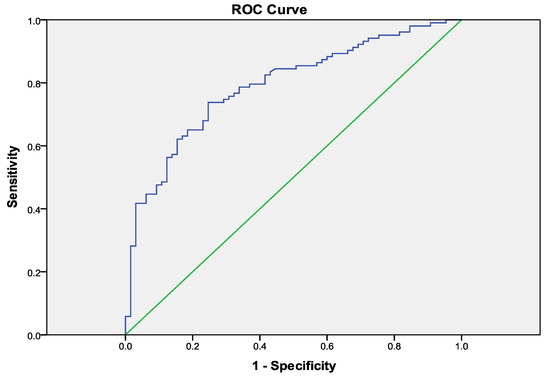
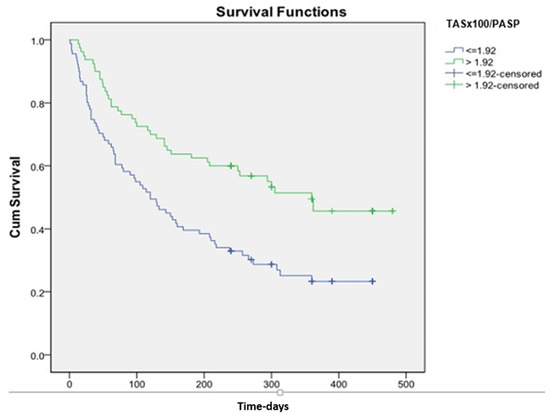
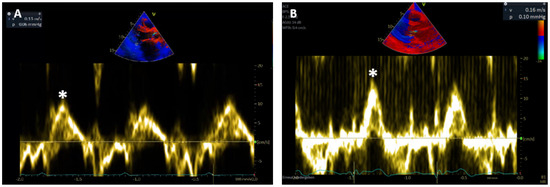
Background: There is evidence that right ventricular (RV) contractile function, especially its coupling with the pulmonary circulation, has an important prognostic value in patients with left ventricular dysfunction. Aims: This study aimed to identify the best echocardiographic parameters of RV function and pulmonary artery systolic pressure (PASP) alone or in the form of the index of right ventricular-pulmonary artery coupling (RV-PA coupling) to determine the best predictor of 1-year major adverse cardiovascular events (MACE), which were defined as cardiovascular death and cardiac decompensation in heart failure patients with reduced ejection fraction (HFrEF). Methods and results: The study enrolled 191 HFrEF patients (mean age 62.28 ± 12.79 years, 74% males, mean left ventricular ejection fraction (LVEF) 25.53 ± 6.87%). All patients underwent clinical, laboratory, and transthoracic echocardiographic (TTE) evaluation, focusing on assessing RV function and non-invasive parameters of RV-PA coupling. RV function was evaluated using fractional area change (FAC), tricuspid annular plane systolic excursion (TAPSE), and peak tricuspid annular systolic velocity (TAS’). PASP was estimated by peak tricuspid regurgitation velocity (TRVmax) and corrected by assumed right atrial pressure relative to the dimension and collapsibility of the inferior vena cava. The TAPSE/PASP and TAS’/PASP ratios were taken as an index of RV-PA coupling. During the follow-up (mean period of 340 ± 84 days), 58.1% of patients met the composite endpoint. The independent predictors of one-year outcome were shown to be advanced age, atrial fibrillation, indexed left atrial systolic volume (LAVI), LVEF, TAPSE/PASP, and TAS’/PASP. TAS’/PASP emerged as the strongest independent predictor of prognosis, with a hazard ratio (HR) of 0.67 (0.531–0.840), p < 0.001. Reconstructing the ROC curve 0.8 (0.723–0.859), p < 0.001, we obtained a threshold value of TAS’/PASP ≤ 0.19 (cm/s/mm Hg) (sensitivity 74.0, specificity 75.2). Patients with TAS’/RVSP ≤ 0.19 have a worse prognosis (Log Rank p < 0.001). Conclusions: This study confirmed previously known independent predictors of adverse outcomes in patients with HfrEF—advanced age, atrial fibrillation, LAVI, and LVEF—but non-invasive parameters of RV-PA coupling TAPSE/PASP and TAS’/PASP improved risk stratification in patients with HFrEF. Variable TAS’/PASP has been shown to be the most powerful, independent predictor of one-year outcome.
Full article
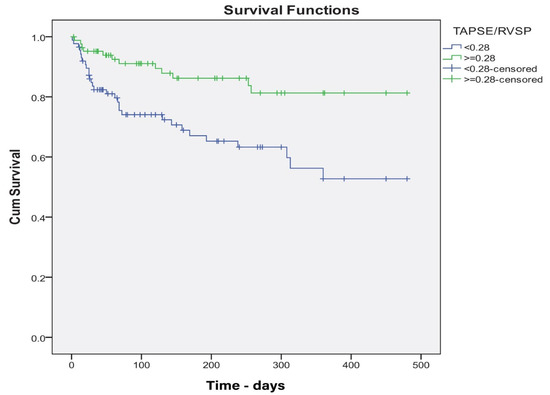
Figure 1