Skip to Content
You are currently on the new version of our website. Access the old version .

Journal of Innovation

Journal of Innovation is an international, peer-reviewed, open access journal on innovation published quarterly online by MDPI.

Get Alerted

Add your email address to receive forthcoming issues of this journal.

All Articles (5)

  • Article
  • Open Access

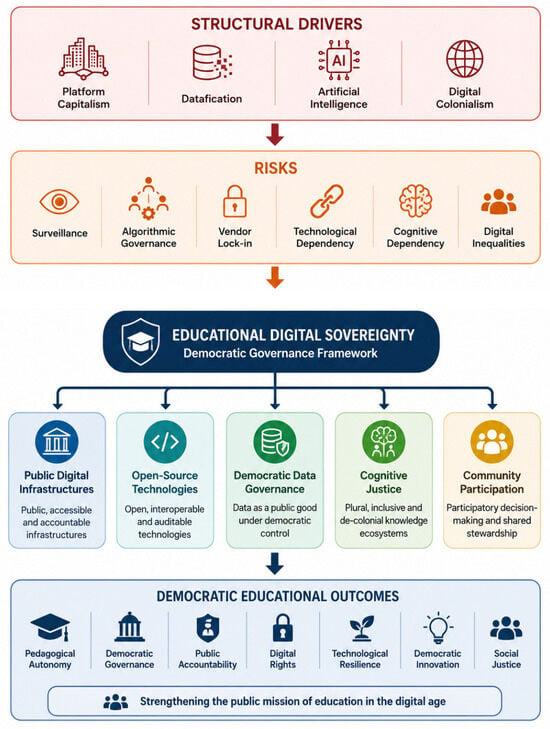
The rapid digitalization of education has intensified the presence of large technology corporations within educational infrastructures, platforms, and data ecosystems. While digital technologies have expanded access to educational resources and transformed teaching and learning, they have also generated new forms of technological dependency, data extraction, surveillance, and algorithmic governance. This article critically examines EdTech platform capitalism and develops Educational Digital Sovereignty as a framework for democratic governance of digital education. Drawing on a critical integrative review of recent literature indexed in Web of Science and Scopus, complemented by relevant theoretical and policy sources, the study analyzes the political, pedagogical, and socio-economic implications of educational platformization. The analysis identifies three interconnected risks: educational surveillance and data extraction, algorithmic governance and the erosion of pedagogical autonomy, and digital inequalities reinforced by technological colonialism and cognitive dependency. In response, the article proposes five dimensions of Educational Digital Sovereignty: public digital infrastructures, open-source technologies and technological autonomy, democratic data governance, cognitive justice and epistemic decolonization, and community participation. The article concludes that these dimensions provide a framework for aligning technological innovation with democratic governance, pedagogical autonomy, digital rights, and the public mission of education.

J. Innov.

21 September 2026

Integrated conceptual framework of Educational Digital Sovereignty proposed in this article.
  • Article
  • Open Access

Stochastic Optimal Harvesting of Renewable Resources

  • Paramahansa Pramanik and
  • Fatamatuj Johora

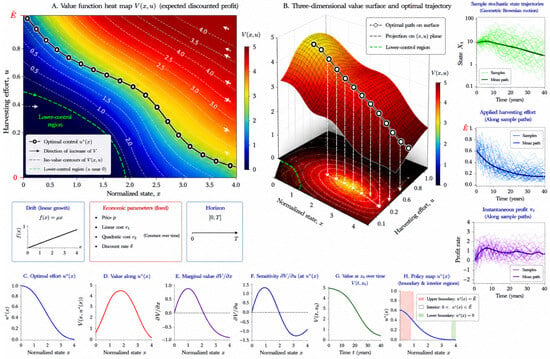
This paper develops a finite-horizon stochastic optimal harvesting model that links constrained Hamilton-Jacobi-Bellman (HJB) control with a nonlinear Feynman-Kac/BSDE representation. Harvesting effort is bounded, yielding a projected feedback policy with lower-bound, interior, and upper-saturation regimes. Under appropriate regularity conditions, the HJB and BSDE formulations characterize the same value function and optimal feedback through the Markovian relation . Numerically, the HJB equation is solved using a monotone implicit upwind Bellman scheme with policy iteration, while the associated BSDE is approximated independently by Monte Carlo conditional-expectation regression, permitting an ex post assessment of numerical consistency. The framework is illustrated using annual capture fisheries production data for the United States, Japan, China, and Indonesia. Country-specific drift and multiplicative volatility are estimated from normalized state-relative increments. The empirical state is interpreted as a normalized capture-production index rather than a biological stock, providing a data-informed illustration of constrained harvesting under stochastic dynamics and uncertainty.

J. Innov.

17 September 2026

Schematic visualization of the finite-horizon stochastic optimal harvesting model with linear state drift, multiplicative environmental uncertainty, bounded harvesting effort, and fixed economic parameters.
  • Article
  • Open Access

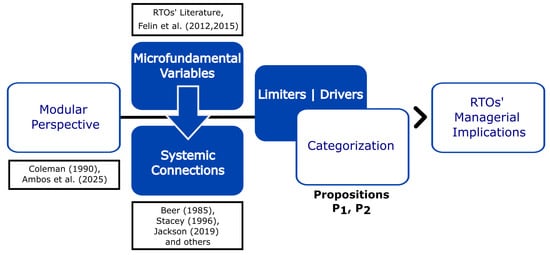
This study develops a modular framework for the diagnostic application of microfoundational theory to examine how individual-level actions aggregate into macro-level technological capabilities and operational performance in innovation intermediaries within emerging economies. Grounded in Coleman’s bathtub model and the Viable System Model, we dissect three interdependent modules to diagnose systemic issues within institutional voids. Methodologically, we conduct a qualitative critical case study of a centenary Brazilian Research and Technology Organization, utilizing semi-structured interviews across three distinct organizational levels—senior executives, unit heads, and research leads—triangulated with eleven institutional management documents (2019–2024) through categorical content analysis. Theoretically, this research aims to establish a conceptual taxonomy that synthesizes Coleman’s micro–macro link, potentially serving as an analytical baseline for future cross-context evaluations of innovation intermediaries while exploring how meso–micro actions co-evolve with ecosystem-level environments. Practically, this study seeks to offer actionable governance levers for managers and policymakers, illustrating how the strategic deployment of dedicated internationalization units to buffer external complexity and the targeted cultivation of soft competencies in senior research leads may help overcome collaborative network isolation within late-development settings.

J. Innov.

7 September 2026

Conceptual–theoretical constructs and corresponding references (Coleman, 1990; Felin et al., 2012, 2015; Beer, 1985; Jackson, 2019; Ambos et al., 2025; Stacey, 1996).
  • Article
  • Open Access

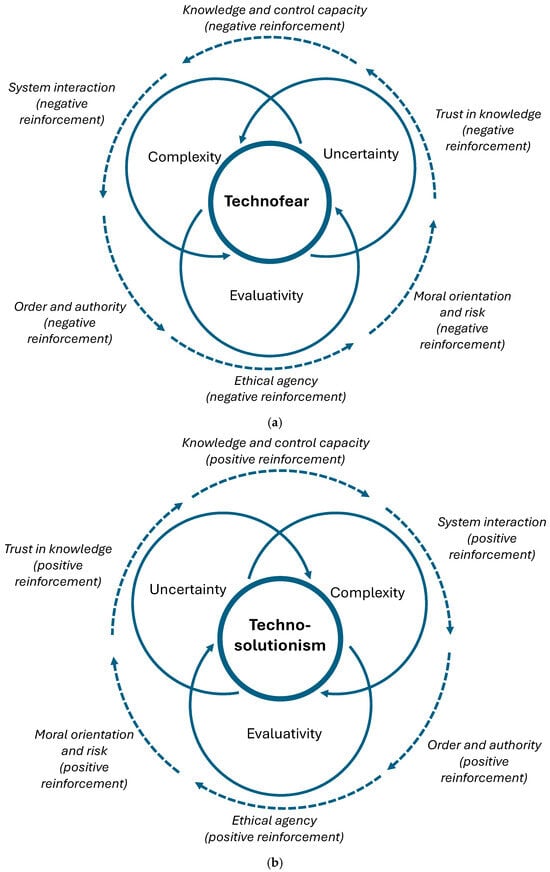
This article examines how Michael Crichton’s novels can help us understand how organizations and societies make sense of innovation and technological complexity, uncertainty, and conflicting values when confronting grand challenges. It presents technofear and technosolutionism as contrasting but interconnected ways of interpreting technological situations and justifying action. Based on a narrative analysis of The Andromeda Strain, The Terminal Man, Prey, and State of Fear, the study shows that these responses can coexist, alternate, and generate one another. Attempts to restore control can create new dependencies, reduce transparency, and blur responsibility, thereby generating technofear. Conversely, fear rarely leads to the abandonment of technology. Instead, it often encourages reliance on alternative experts and specific forms of knowledge. The article develops a dynamic framework for understanding this recursive relationship and presents fiction as a resource for innovation management, managerial reflection, foresight, and responsible innovation. Fiction is not treated as evidence of managerial behaviour or as validation of scientific claims. Rather, it provides material for examining how narratives construct and challenge claims about technological certainty, responsibility, control, and legitimacy.

J. Innov.

21 August 2026

(a,b): The constitutive dimensions of Technofear and Technosolutionism.

Highly Accessed Articles

News & Conferences

Latest Issues

Open for Submission

Journal Sections

XFacebookLinkedIn
J. Innov. - ISSN 3042-8629