



Journal Menu
► ▼ Journal Menu-
- IJMS Home
- Aims & Scope
- Editorial Board
- Reviewer Board
- Topical Advisory Panel
- Early Career Editorial Board
- Instructions for Authors
- Special Issues
- Topics
- Sections & Collections
- Article Processing Charge
- Indexing & Archiving
- Most Cited & Viewed
- Journal Statistics
- Journal History
- Journal Awards
- Society Collaborations
- Conferences
- Editorial Office
Journal Browser
► ▼ Journal Browser-
arrow_forward_ios
Forthcoming issue
arrow_forward_ios Current issue - Vol. 27 (2026)
- Vol. 26 (2025)
- Vol. 25 (2024)
- Vol. 24 (2023)
- Vol. 23 (2022)
- Vol. 22 (2021)
- Vol. 21 (2020)
- Vol. 20 (2019)
- Vol. 19 (2018)
- Vol. 18 (2017)
- Vol. 17 (2016)
- Vol. 16 (2015)
- Vol. 15 (2014)
- Vol. 14 (2013)
- Vol. 13 (2012)
- Vol. 12 (2011)
- Vol. 11 (2010)
- Vol. 10 (2009)
- Vol. 9 (2008)
- Vol. 8 (2007)
- Vol. 7 (2006)
- Vol. 6 (2005)
- Vol. 5 (2004)
- Vol. 4 (2003)
- Vol. 3 (2002)
- Vol. 2 (2001)
- Vol. 1 (2000)
Need Help?
Announcements
26 June 2026
International Journal of Molecular Sciences Webinar | New Trends in Research of Depression, 26 June 2026

Depression, often described as the “silent epidemic” of the 21st century, represents a complex and pervasive mental health challenge that affects millions of individuals worldwide. While its clinical manifestations are readily observable in the form of persistent sadness, hopelessness, and loss of interest in daily life, the true depths of this condition lie hidden within the intricate web of the human brain. Understanding the molecular basis of depression has become a crucial endeavor in contemporary neuroscience and psychology, as it holds the potential to unravel the mysteries behind this debilitating disorder and, ultimately, pave the way for more effective therapeutic interventions.
Date: 26 June 2026 at 9 a.m. CEST | 3 p.m. CST Asia
Webinar ID: 826 0267 4628
Website: https://sciforum.net/event/IJMS-10?subscribe
Register now for free!

Program:
|
Speaker/Presentation |
Time in CEST |
|
Jelena Romcevic |
9:00–9:10 a.m. |
|
Terézia Kisková-Šimková (Chair & Speaker) |
9:10–9:20 a.m. |
|
Terézia Kisková-Šimková |
9:20–9:40 a.m. |
|
Dominika Jarčušková |
9:40–10:00 a.m. |
|
Ali Saffet Gönül |
10:00–10:20 a.m. |
|
Q&A Session |
10:20–10:35 a.m. |
|
Terézia Kisková-Šimková |
10:35–10:40 a.m. |
After registering, you will receive a confirmation email containing information on how to join the webinar. Registrations with academic institutional email addresses will be prioritized.
Unable to attend? Register anyway, and we will let you know when the recording is available to watch.
Webinar Chair and Keynote Speakers:
- Dr. Terézia Kisková-Šimková, Pavol Jozef Safarik University in Kosice, Slovakia;
- Dr. Dominika Jarčušková, Pavol Jozef Safarik University in Kosice, Slovakia;
- Prof. Dr. Ali Saffet Gönül, Ege University, Türkiye.
Relevant Special Issues:
“Depression: From Molecular Basis to Therapy—3rd Edition”
Guest Editor: Terezia Kiskova-Simkova
Deadline for manuscript submissions: 31 August 2026
“Depression: From Molecular Basis to Therapy—2nd Edition”
Guest Editor: Terezia Kiskova-Simkova
Guest Editor: Terezia Kiskova-Simkova
25 June 2026
Empowering Academic Growth with MDPI Academic Publishing Workshop at Suranaree University of Technology, 3 July 2026

We are delighted to announce the MDPI Academic Publishing Workshop, organized in partnership with the Institute of Research and Development (IRD), Suranaree University of Technology (SUT). This event reflects a shared commitment to advancing academic research through open access publishing, cross-sector collaboration, and innovative scholarly communication.
As part of our ongoing dedication to researcher development, the workshop will improve academic writing skills, facilitate scholarly communication, and guide authors in selecting appropriate journals for submissions. Designed specifically for young researchers, PhD and master’s students, and potential researchers, the workshop will provide practical skills to enhance the visibility and impact of scholarly research while fostering meaningful connections with MDPI Journal Editors and publishing professionals.
Date: 3 July 2026
Time: 13:00–16:00
Location: Meeting Room C2-124, Academic Building 2, Suranaree University of Technology (SUT)
Language: Thai
Registration: https://www.surveymonkey.com/r/6R2WDF5
|
Speaker |
Program |
Time |
|
Assoc. Prof. Dr. Krajang Talabnin |
Opening Speech |
13:00–13:10 |
|
Dr. Maturin Natesungnoen |
MDPI and Journal Introduction |
13:10–13:30 |
|
Dr. Juthathip Poofery |
Writing Scientific Papers |
13:30–14:10 |
|
|
Q&A Session |
14:10–14:20 |
|
Ms. Hathaipat Kittirojana |
How to Respond to Peer Reviewers and Understanding Pre-Check Rejections |
14:20–15:00 |
|
|
Q&A Session |
15:00–15:10 |
|
Dr. Krit Inthajak |
Publication Ethics for Authors and Artificial Intelligence in Scientific Publication |
15:10–15:50 |
|
|
Q&A Session |
15:50–16:00 |
|
Chair: |
|
|
|
Assoc. Prof. Dr. Krajang Talabnin is the Deputy Director of the Institute of Research and Development at Suranaree University of Technology (SUT), Thailand, and an associate professor in the School of Pathology. He holds a PhD in medical biochemistry from Khon Kaen University and has built expertise in medical biochemistry, pathology, glycomics, and cancer biomarker research. His research covers glycosylation-related mechanisms in cancer progression, biomarker discovery, and translational biomedical research. He has published many scholarly publications, with more than 200 citations. |

|
MDPI Speakers: |
|
|
|
Dr. Maturin Natesungnoen obtained her PhD in biochemistry and molecular biology from Chulalongkorn University. She joined MDPI in October 2023 as an Assistant Editor for the International Journal of Molecular Sciences (IJMS). In June 2024, she was appointed as a Section Managing Editor. She currently serves as a Section Managing Editor for Current Issues in Molecular Biology (CIMB), as well as the Chief Section Managing Editor of the journal. She also began working for Crystals in the same year. She became a Section Managing Editor in 2021 and a Group Leader in 2022. She is currently one of MDPI’s Regional Engagement Editors for the Asia–Pacific region. |
|
|
Dr. Juthathip Poofery holds a PhD in biochemistry from the Faculty of Medicine, Chiang Mai University, Thailand. She began working at MDPI in 2021 as an Assistant Editor for Medicina and advanced to the position of Section Managing Editor in 2022. Since 2023, Dr. Poofery has been serving as the Group Leader of the Medical Science Section, where she oversees editorial operations and contributes to the advancement of research in the field. |
|
|
Ms. Hathaipat Kittirojana obtained her master’s degree in food science and biotechnology from Teesside University. She joined MDPI in December 2020 as an Assistant Editor for the Journal of Imaging. She was appointed as a Section Managing Editor in March 2023 and a Regional Engagement Editor for the Asia–Pacific region in July 2024. |
|
|
Dr. Krit Inthajak obtained his PhD in engineering and technology from Sirindhorn International Institute of Technology, Thammasat University. He joined MDPI in March 2020 as an Assistant Editor for Molecules. He was appointed as a Section Managing Editor in 2021 and worked as a Group Leader from 2021 to 2024. He is now one of MDPI’s Regional Engagement Editors for the Asia–Pa1cific region. |


24 June 2026
Summary of the MDPI Academic Publishing Workshop at Chiang Mai University Held on 5 June 2026

MDPI was pleased to partner with Chiang Mai University in Chiang Mai on 5 June 2026 for a highly productive Academic Publishing Workshop dedicated to advancing academic publishing and scholarly communication. The event was officially opened by Associate Professor Dr. Apichat Tantraworasin, Deputy Dean of the Faculty of Medicine, Chiang Mai University, who welcomed the MDPI speaker team and expressed his appreciation for their contribution in sharing valuable knowledge with faculty members, researchers, and students.

In his opening remarks, Dr. Apichat highlighted the challenges of publishing in international journals and emphasized the importance of developing practical skills throughout the publication process. He noted that the workshop addressed key researcher needs, including manuscript preparation, responding to peer reviewers, publication ethics, the responsible use of artificial intelligence, and effective figure and table design. The event brought together experts and members of the academic community to explore the latest trends and best practices across a range of scientific disciplines. Through insightful presentations and engaging discussions, participants gained valuable practical skills in scientific writing, data visualization and layout, responding to peer-reviewer comments, navigating the MDPI editorial process, understanding publication ethics, and engaging responsibly with artificial intelligence in scholarly publishing. The audience comprised participants from various academic levels—including professors, PhD students, master's students, and postgraduate researchers—with strong engagement maintained throughout the day.

During the first presentation, Mr. Pongsakorn Vithayanon, Editorial Team Leader and Deputy Managing Editor at MDPI Thailand, introduced the concept of open access publishing and MDPI’s role as a leading academic publisher. He highlighted several journals, including IJMS, Medicina, CIMB, Gastrointestinal Disorders, and Stress, and explained how these journals provide valuable publication opportunities for researchers in the medical and life sciences fields. The session also provided an overview of the publication process and the benefits of publishing in open access journals.

The session, “How to Write Scientific Papers”, was delivered by Dr. Juthathip Poofery, Editorial Team Leader and Regional Engagement Editor. The presentation provided practical guidance on preparing and structuring a scientific paper, covering essential components from the title and abstract to the discussion, conclusions, and back matter. Particular emphasis was placed on identifying research gaps, presenting methods with sufficient detail to ensure reproducibility, and clearly distinguishing between the reporting of results and their interpretation. The session also highlighted best practices for enhancing the visibility and impact of research through effective scientific writing, including the selection of appropriate keywords and the development of clear and informative manuscript elements. Ethical and transparency requirements, including authorship contributions, funding disclosure, data availability, informed consent, and conflicts of interest statements, were also discussed. Participants showed particular interest in practical approaches to improving manuscript quality, especially refining titles and keywords, strengthening scientific writing, and increasing the discoverability of their research.

The third session, titled “How to Respond to Peer Reviewers”, was presented by Ms. Hathaipat Kittirojana, a Regional Journal Relations Specialist. She discussed the peer-review process at MDPI and guided the audience through how to revise the manuscript professionally. This session also included the key tips of revision preparations and how we can organize a response in an effective way. In conclusion, she encouraged the audience to remain positive, open-minded, and professional when replying to reviewers.

For the next session of the event program, Ms. Ploy Assavajamroon, Regional Engagement Editor at MDPI's Bangkok Office, delivered a presentation entitled “Artificial Intelligence (AI) in Scientific Publishing”. The session explored the growing impact of artificial intelligence on scholarly communication and the evolving publishing landscape. The presentation provided an overview of AI technologies, with particular attention to Generative AI and Large Language Models (LLMs), which have become increasingly integrated into research and academic writing workflows. Participants gained insights into the capabilities of these tools, as well as their current limitations and potential risks. Emphasis was placed on the importance of human oversight, critical evaluation, and responsible use when incorporating AI-generated content into scholarly work. The session also addressed ethical considerations surrounding AI use in research and publishing. Drawing upon the recommendations of COPE and STM, the presentation outlined MDPI's policies and guidelines regarding the appropriate use of AI by authors, reviewers, and editors. The importance of transparency and proper disclosure of AI-assisted content was highlighted as a key aspect of maintaining research integrity. To conclude, participants were introduced to several AI-powered solutions developed by MDPI’s AI team. These tools are designed to support editorial processes, improve operational efficiency, and enhance the publishing experience for authors, reviewers, and editors.

The next session, titled “Publication Ethics for Authors”, was presented by Dr. Siriporn Tantiwatcharothai, Regional Engagement Editor at the MDPI Bangkok Office. She began by highlighting the importance of maintaining ethical standards throughout the research and publication process. The presentation then explored common ethical issues encountered in scholarly publishing, along with an overview of MDPI’s policies and guidelines for addressing them. The session also discussed the increasing use of artificial intelligence (AI) in research, emphasizing the associated ethical considerations and potential risks. In closing, Dr. Siriporn explained the procedures followed by MDPI when handling ethical concerns identified after publication, providing participants with a clearer understanding of how such cases are investigated and managed.

The sixth session, titled “How to Make Good Figures for Scientific Papers”, was presented by Ms. Pratthana Kruekantha, Production Editor at MDPI. She highlighted the importance of well-designed figures in enhancing the clarity, readability, and impact of scientific publications. The presentation covered different types of figures, the essential components of graphical abstracts and scientific figures, and best practices for figure preparation, including captions, image quality, and data presentation. The session also introduced practical graphic design principles, such as selecting appropriate chart types, using effective color schemes, improving accessibility, and maintaining visual consistency. It concluded with an overview of design tools that can help researchers create professional, publication-ready figures. The final session, titled “How to Design Tables in Scientific Papers”, was also presented by Ms. Pratthana Kruekantha. She introduced the essential components of scientific tables and shared practical guidelines for designing clear, accurate, and publication-ready tables. The session covered table structure, formatting standards, data organization, and common issues encountered during manuscript preparation. It concluded with recommendations for table-editing practices and an overview of MDPI’s figure and table editing services.

The workshop concluded with a closing session and a certificate awarding ceremony, recognizing the active participation of all attendees throughout the day. Participants remained attentive throughout the presentations, and while only a limited number of questions were raised during the Q&A sessions overall, the discussions that did arise were focused and substantive. This collaboration underscores the shared commitment of MDPI and Chiang Mai University to fostering interdisciplinary research and promoting global excellence in academic output. The event not only strengthened the partnership between MDPI and the university but also laid a solid foundation for continued collaboration and future academic advancement.
17 June 2026
2025 Impact Factors Released
Impact Factors measure how often articles in scientific journals are cited—specifically, the average number of citations received in a given year by articles published in that journal over the previous two years, as tracked in the Web of Science. For researchers, the number answers a practical question: how often is work published in this journal being picked up and built upon?
The metric is assigned to the journal as a whole, not to individual articles. A high Impact Factor tells you something useful about a journal's place in its field; it tells you less about any single paper within it.
For a complementary, article-level view, MDPI lists an Altmetric score on each article page. Where the Impact Factor tracks academic citations, the Altmetric score captures broader online attention: how an article is being shared, discussed, and referenced beyond the journal literature. Together, they offer two different ways of asking the same question: is this research reaching people?
With 2025 CiteScores from Scopus published a few weeks ago, Clarivate has now released this year's Journal Impact Factors in the Journal Citation Reports (JCR).
254 MDPI Journals Saw a Rise in Impact Factor
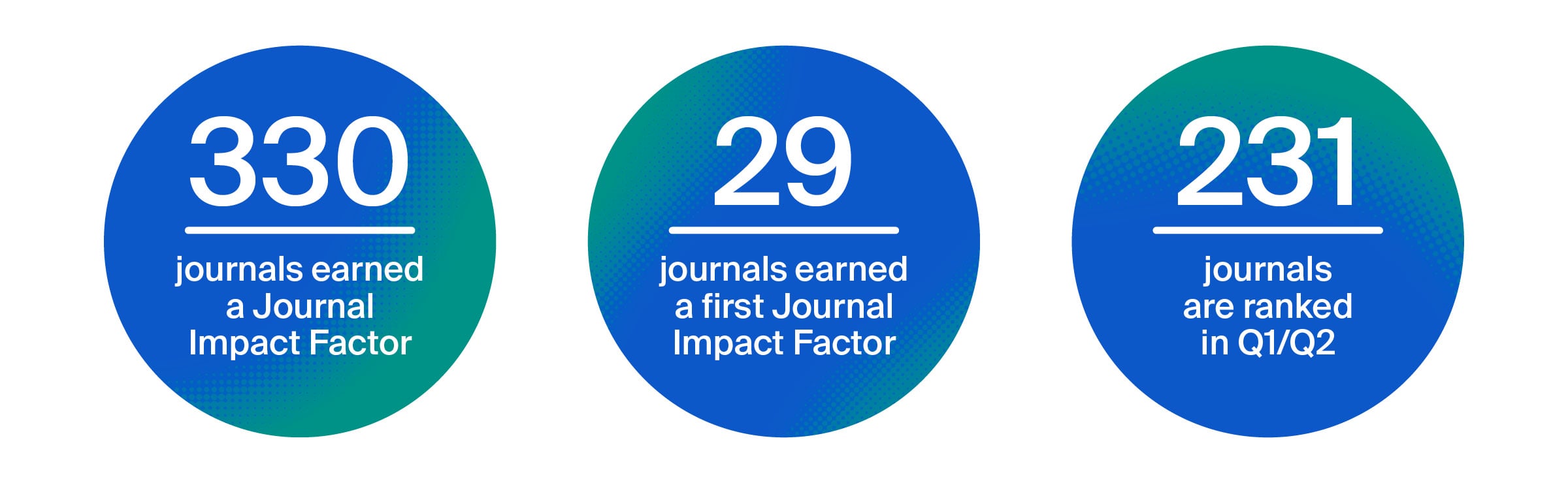
This year's JCR include 330 MDPI journals across a wide range of disciplines. Of these, 231 journals are placed in the top 50% (Q1 or Q2) of their respective subject categories, a result that spans fields as different as materials science, public health, environmental studies, and mathematics. 78 journals hold a top-quartile position (Q1), and 33 journals have a JIF of 5.0 or above.
- 330 journals earned a Journal Impact Factor (JIF)
- 29 journals earned a first JIF
- 254 journals had an increase in JIF
- 71% of ranked journals are in Q1 or Q2
For the full metrics on any MDPI journal, visit our Web of Science journals overview page or a journal's individual statistics page.
29 MDPI Journals Received Their First Journal Impact Factor
A first Impact Factor is a confirmation for an emerging journal. It marks the point at which a journal has been publishing long enough, and cited broadly enough, to enter the formal record of scientific influence. For the research communities those journals serve, it signals that the work being published is being read and built upon.
This year, 29 MDPI journals received a Journal Impact Factor for the first time, across a range of emerging and established research areas. Each represents years of editorial development and peer review—recognized in 2026 for the first time in the JCR.
This is also part of a longer shift in how science gets indexed. When the Emerging Sources Citation Index (ESCI) launched in 2016, 24 MDPI journals were included. By 2024 that number had grown to over 200, reflecting a broader change in the visibility of open access publishing within major citation tracking systems, not just at MDPI but across the sector.
Open Access with Impact
MDPI journals have received a total of 25.2 million citations in Web of Science. That figure matters less as a measure of MDPI's reach and more as a measure of what happens when research is freely available: it gets found, read, and used. Open access is only meaningful if the work actually travels and citations are one indicator that it does.
More than 4.6 million authors have published with MDPI. That breadth, across disciplines, institutions, and geographies, is what makes open access at this scale worth doing.
Thank You to the MDPI Scholarly Community
These results belong to the people who do the actual work: the Editors-in-Chief who set the standards, the Editorial Board Members and reviewers who hold them, and the authors who choose open access for their research. The numbers in the Journal Citation Reports are the downstream effect of decisions made at the desk, in the review, and at submission. Thank you for making them.
Data: 2025 Journal Impact Factors, Journal Citation Reports™ (Clarivate, 2026)
16 June 2026
Meet Us at the 34th Conference on Intelligent Systems for Molecular Biology (ISMB 2026), 12–16 July 2026, Washington, DC., USA

We are pleased to announce that MDPI will be participating in the 34th Conference on Intelligent Systems for Molecular Biology, organized by the International Society for Computational Biology, taking place from 12 to 16 July 2026 in Washington, DC.
The principal focus of the ISMB conference is the development and application of advanced computational methods to address biological problems, bringing together researchers from computer science, bioinformatics, computational biology, molecular biology, mathematics, statistics, and related fields. The conference provides a multidisciplinary platform for sharing the latest advancements in bioinformatics and computational biology, fostering new dialogues and perspectives to shape the future of the field.
Visit our booth to discover MDPI’s latest publications, Special Issues, and open access initiatives in molecular biology and related fields. Our editors will be on hand to discuss your research and answer any questions about publishing with MDPI.
The following MDPI journals will be represented at the conference:
- CIMB;
- Biology;
- Biophysica;
- BioMedInformatics;
- BioChem;
- IJMS;
- Epigenomes;
- JGBG.
If you are planning to attend the above conference, please feel free to reach out online and start a conversation with us. Our delegates look forward to meeting you in person at our booth and answering any questions you may have. For more information about this event, please visit the following website: https://www.iscb.org/ismb2026/home.
8 June 2026
Meet Us at the 2026 Human Proteome Organization World Congress, 27 September–1 October 2026, Singapore

Conference: 2026 Human Proteome Organization World Congress
Date: 27 September–1 October 2026
Location: Singapore
From 27 September to 1 October 2026, MDPI will be attending the 2026 Human Proteome Organization World Congress (HUPO 2026) in Singapore as an exhibitor, welcoming researchers from diverse backgrounds to visit and share their latest ideas.
This year, HUPO 2026 are embracing the theme “Proteomics Plus: Transforming Lives” and are excited to explore how proteomics is shaping the future of health and medicine in ways we could have only dreamed of a few years ago. Proteomics is no longer just a field of study; it is a catalyst for change. From cutting-edge breakthroughs to real-world solutions, the impact of proteomics is undeniable. At this Congress, we will come together to celebrate how our work is transforming lives—from advancing medical treatments to uncovering new ways to understand health on a global scale. It is an opportunity to see how the science is evolving and, most importantly, how it is making a real difference in people’s lives.
We look forward to meeting you in Singapore for an unforgettable experience at HUPO 2026!
The following MDPI journals will be represented:
If you attend this conference, please feel free to visit our booth. Our delegates look forward to meeting you in person and answering any questions that you may have. For more information about the conference, please visit the official website: https://2026.hupo.org/.
4 June 2026
International Journal of Molecular Sciences | 2025 Most Popular Cover Selection—Winners Announced

We are pleased to announce the winners of the IJMS 2025 Most Popular Cover Selection. Each winner will receive CHF 300 and a certificate. The winners are detailed below.

by Dea Chotzalli, Vasiliki Pardali, Holly M. Walden, Dimitrios Perivolaris, Dimitrios Moianos, Maria Makri, Antonios Drakopoulos, Erofili Giannakopoulou, Razia Tajwar, Molly E. Woodson et al.
Int. J. Mol. Sci. 2025, 26(20), 10239; https://doi.org/10.3390/ijms262010239
Available online: https://www.mdpi.com/1422-0067/26/20/10239

by Constantin Munteanu, Anca Irina Galaction, Gelu Onose, Marius Turnea and Mariana Rotariu
Int. J. Mol. Sci. 2025, 26(7), 3131; https://doi.org/10.3390/ijms26073131
Available online: https://www.mdpi.com/1422-0067/26/7/3131

by Michael John Klink
Int. J. Mol. Sci. 2025, 26(23), 11355; https://doi.org/10.3390/ijms262311355
Available online: https://www.mdpi.com/1422-0067/26/23/11355

by Xiaoxue Chai, Qian Tao and Lili Li
Int. J. Mol. Sci. 2025, 26(14), 6901; https://doi.org/10.3390/ijms26146901
Available online: https://www.mdpi.com/1422-0067/26/14/6901

by Rita Badagliacca, Manlio Fazio, Fabio Stagno, Giuseppe Mirabile, Demetrio Gerace and Alessandro Allegra
Int. J. Mol. Sci. 2025, 26(19), 9700; https://doi.org/10.3390/ijms26199700
Available online: https://www.mdpi.com/1422-0067/26/19/9700
We wish to congratulate the winners on their excellent research.
IJMS Editorial Office
4 June 2026
Open Access, Broadly Recognized: 363 MDPI Journals Receive CiteScores for 2025
The 2025 CiteScore metrics have been officially released by Scopus, and the results confirm what has become a consistent pattern for MDPI's journal portfolio: broad recognition across disciplines, steady improvement across the majority of ranked titles, and a growing presence at the top of subject category rankings.
CiteScore, published annually by Elsevier's Scopus database, measures the average citations received by articles published in a journal over a four-year window. As a complement to the Journal Impact Factor, which uses a two-year window based on the Web of Science database, CiteScore provides an alternative, long-term perspective on citation performance.
The 365 MDPI journals in Scopus (as of May 2026) are indexed across a wide range of subject categories, ensuring that open access research remains highly discoverable to a global readership through one of the most widely used platforms in academic publishing.
Data Summary (2025 CiteScores)
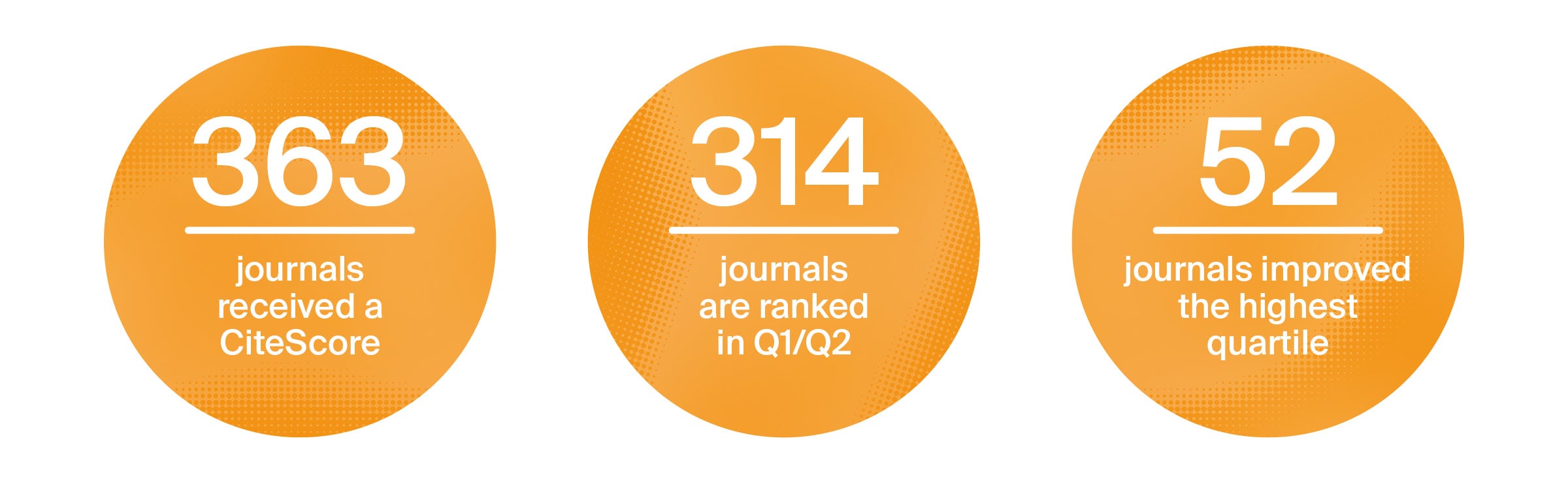
- New Additions: 41 MDPI journals received a CiteScore for the first time.
- Trending Upward: 234 of 322 previously ranked journals (73%) saw an increase in their CiteScore compared to last year.
- High Visibility: 314 journals (86%) rank in Q1 or Q2 in at least one subject category.
- Elite Performance: 42 journals rank in the top 10% of their subject categories.
Portfolio Performance
Among the 322 journals that held a CiteScore in 2024, 234 saw an increase this year. Quartile improvements outnumbered declines across the portfolio, with 52 journals moving to a higher quartile and only 20 seeing a decline. Furthermore, no previously ranked journals were removed. The 42 journals now ranked in the top 10% of their subject categories are drawn from a strong foundation of 178 journals holding a Q1 position.
With the large majority of our indexed portfolio ranked in the top half of research fields, researchers can confidently choose MDPI to meet funder mandates for high-quality, fully compliant Open Access publishing.
Exceptional Achievements for Foods and Life
Notably, both Foods and Life achieved a 99th percentile ranking in their respective subject categories for the 2025 CiteScores. This outstanding placement positions them as leading journals in their fields and highlights the high visibility and global impact of the open access research they publish.
Journal Metrics and Beyond
Journal-level metrics describe outlets, not individual articles. An increasing number of funders and institutions—including signatories of DORA and the Coalition for Advancing Research Assessment—now explicitly encourage evaluation at the article level rather than by the journal in which research appears. MDPI supports this direction: we report CiteScore alongside the Journal Impact Factor, Journal Citation Indicator, and article-level usage data because no single number captures the full reach and contribution of published research.
Thank You
These results reflect the sustained effort of thousands of editors-in-chief, editorial board members, reviewers, and authors across every field MDPI serves. The metrics are the outcome; the work is yours.
4 June 2026
International Journal of Molecular Sciences Webinar | Advances in Mass Spectrometry-Based Omics, 19 June 2026

Welcome message from the Chair:
It is my great pleasure to welcome you to the webinar entitled “Advances in Mass Spectrometry-Based Omics”, a scientific event dedicated to exploring recent developments and innovative applications of mass spectrometry in biomedical and life sciences research.
Mass spectrometry has become an indispensable analytical platform in modern omics sciences, enabling unparalleled insights into the molecular complexity of biological systems. Ranging from metabolomics and proteomics to glycomics, glycoproteomics and lipidomics, these technologies continue to improve our understanding of health and disease, opening new research directions in biomarker discovery, precision medicine, and translational research.
This webinar brings together distinguished researchers from Croatia, Romania, and the United States, who will present cutting-edge studies addressing diverse aspects of mass spectrometry-based omics. The program covers topics ranging from diet-induced metabolomic alterations and advanced proteomics methodologies to glycoproteomics of melanoma cells, lipid membrane remodeling, the structural analysis of proteoglycans, and glycolipid profiling in neurological diseases.
The diversity of the presentations reflects both the remarkable versatility of mass spectrometry and the interdisciplinary nature of contemporary omics. Beyond highlighting technological advances, this event aims to promote scientific dialog, collaboration, and the exchange of ideas among researchers, clinicians, and students interested in analytical and biomedical sciences.
I would like to express my sincere gratitude to all speakers for their valuable contributions and to all participants for joining us today. I hope this meeting will provide an inspiring and stimulating scientific experience for everyone involved.
I wish you a successful and enjoyable webinar.
Alina D. Zamfir
Webinar Chair
Date: 19 June 2026 3:00 p.m. CEST, 9:00 a.m. EDT, 9:00 p.m. CST Asia
Webinar ID: 879 9846 7215
Register now for free!

Program:
|
Speaker/Presentation |
Time in CEST |
|
Alina D. Zamfir |
3:00–3:05 p.m. |
|
Marija Heffer, University of Osijek, Croatia |
3:05–3:35 p.m. |
|
Costel C. Darie, Clarkson University, Potsdam, N.Y., USA |
3:35–4:05 p.m. |
|
Cristian Munteanu, Institute of Biochemistry of the Romanian Academy, Bucharest, Romania |
4:05–4:35 p.m. |
|
Break |
|
|
Svjetlana Kalanj-Bognar, University of Zagreb, Croatia |
4:50–5:20 p.m. |
|
Alina D. Zamfir, National Institute for Research and Development in Electrochemistry and Condensed Timisoara, Romania & ''Aurel Vlaicu'' University of Arad, Romania |
5:20–5:50 p.m. |
|
Mirela Sarbu, National Institute for Research and Development in Electrochemistry and Condensed Timisoara, Romania |
5:50–6:20 p.m. |
|
Q&A Session |
4:10–4:25 p.m. |
|
Alina D. Zamfir |
6:20–6:25 p.m. |
After registering, you will receive a confirmation email containing information on how to join the webinar. Registrations with email addresses from academic institutions will be prioritized.
Unable to attend? Register anyway and we will let you know when the recording is available to watch.
Webinar Chair and Keynote Speakers:
- Prof. Dr. Alina Diana Zamfir, 1 National Institute for Research and Development in Electrochemistry and Condensed Matter, Timisoara, Romania; 2 Department of Technical and Natural Sciences, “Aurel Vlaicu” University of Arad, Romania;
- Professor Marjia Heffer, Faculty of Medicine, University of Osijek, Croatia;
- Professor Costel Darie, Department of Chemistry and Biochemistry, Clarkson University, Potsdam, N.Y., USA;
- Dr. Cristian Munteanu, Institute of Biochemistry of the Romanian Academy, Bucharest, Romania;
- Professor Svjetlana Kalanj-Bognar, Department of Chemistry and Biochemistry, University of Zagreb Medical School, Zagreb, Croatia;
- Prof. Dr. Alina Diana Zamfir, 1 National Institute for Research and Development in Electrochemistry and Condensed Matter, Timisoara, Romania; 2 Department of Technical and Natural Sciences, “Aurel Vlaicu” University of Arad, Romania;
- Dr. Mirela Sârbu, National Institute for Research and Development in Electrochemistry and Condensed Timisoara, Romania.
3 June 2026
Empowering Academic Growth with MDPI Academic Publishing Workshop at Chulabhorn International College of Medicine, Thammasat University, 24 June 2026

We are delighted to announce the MDPI Academic Publishing Workshop, organized in partnership with Chulabhorn International College of Medicine, Thammasat University, Pathum Thani, in collaboration with the MAS Neuroscience Center, School of Anti-Aging and Regenerative Medicine, Mae Fah Luang University, Bangkok. This joint effort reflects a shared commitment to advancing interdisciplinary research that tackles global challenges through innovative methodologies, cross-sector cooperation, and transformative approaches.
As part of our ongoing dedication to researcher development, the workshop seeks to strengthen the research capacity of the academic community across both institutions. Participants will have the opportunity to explore emerging trends, gain insights into open access publishing practices, and engage directly with journal editors and publishing professionals. Designed especially for early-career researchers and innovators, the workshop will provide practical skills to help attendees enhance the visibility and impact of their work while fostering meaningful international collaborations.
Date: 24 June 2026
Time: 12:00 p.m.–4:00 p.m.
Location: Classroom AB-80, 5th Floor, Integrated Academic and Laboratory Building, Chulabhorn International College of Medicine, Rangsit Center, Thammasat University, Thailand
Language: Thai
Registration: https://www.surveymonkey.com/r/6R2WDF5
|
Speaker |
Program |
Time |
|
|
Registation |
12:00–1:00 p.m. |
|
Asst. Prof. Dr. Peerapong Kitupawong, Dean of Chulabhorn International College of Medicine, Thammasat University |
Opening Speech |
1:00–1:10 p.m. |
|
Dr. Siriporn Tantiwatcharothai |
MDPI and Journal Introduction |
1:10–1:30 p.m. |
|
Assoc. Prof. Sattrachai Prasopdee |
Behind the Submission: Real Experiences in Journal Selection |
1:30–1:45 p.m. |
|
Asst. Prof. Chuntida Kamalashiran |
Publishing Integrative Medicine Research |
1:45–2:00 p.m. |
|
Dr. Juthathip Poofery |
How to Write Scientific Papers |
2:00–2:30 p.m. |
|
|
Q&A Session and Coffee Break |
2:30–2:40 p.m. |
|
Dr. Krit Inthajak |
MDPI Editorial Process and Peer Review Process |
2:40–3:00 p.m. |
|
|
Q&A Session |
3:00–3:10 p.m. |
|
Ms. Hathaipat Kittirojana |
How to Respond to Peer Reviewers |
3:10–3:40 p.m. |
|
|
Q&A Session |
3:40–3:50 p.m. |
|
|
Closing & Certificate Awarding Ceremony |
3:50–4:00 p.m. |
| Chair: |
|
|
|
Asst. Prof. Dr. Peerapong Kitupawong, MD, is the Dean of Chulabhorn International College of Medicine, Thammasat University, Thailand. |
|
Guest Speakers: |
|
|
|
Assoc. Prof. Sattrachai Prasopdee is an Associate Professor of parasitology. He earned his bachelor’s degree in veterinary medicine from the Faculty of Veterinary Medicine, Khon Kaen University, and his doctoral degree from the Faculty of Medicine, Khon Kaen University. His research focuses on Opisthorchis viverrini infection and the control and diagnosis of cholangiocarcinoma. His current work emphasizes One Health research aimed at preventing and controlling parasitic diseases across human, animal, and environmental domains. |
|
|
Asst. Prof. Chuntida Kamalashiran is an Assistant Professor of integrtive of medicine. She graduated with her bachelor’s degree in Applied Thai Traditional Medicine from the Faculty of Pharmacy Medicine, Mahasarakham University, and with her doctoral degree in Integrative Medicine from Chulabhorn International College of Medicine, Thammasat University. The research focuses on clinical trial in Alternative, Thai Traditional and Integraive Medicine. Her current work focuses on eldery diseases, neuroscicene and integrative medicine. |


|
MDPI Speakers: |
|
|
|
Dr. Siriporn Tantiwatcharothai obtained her PhD in applied chemistry from the Faculty of Science, King Mongkut's Institute of Technology Ladkrabang. She joined MDPI in December 2022 as an Assistant Editor for Catalysts. In 2024, she was promoted to Section Managing Editor and served as a Chief Section Managing Editor in April 2025. Currently, she is one of MDPI's Regional Engagement Editors for the Asia–Pacific region. |
|
|
Dr. Juthathip Poofery holds a PhD in biochemistry from the Faculty of Medicine, Chiang Mai University, Thailand. She began working at MDPI in 2021 as an Assistant Editor for Medicina and advanced to the position of Section Managing Editor in 2022. Since 2023, Dr. Poofery has been serving as the Group Leader of the Medical Science Section, where she oversees editorial operations and contributes to the advancement of research in the field. She currently works as a Regional Engagement Editor for the Asia–Pacific region.
|
|
|
Dr. Krit Inthajak obtained his PhD in engineering and technology from Sirindhorn International Institute of Technology, Thammasat University. He joined MDPI in March 2020 as an Assistant Editor for Molecules. He was appointed as a Section Managing Editor in 2021 and worked as a Group Leader from 2021 to 2024. He is now one of MDPI's Regional Engagement Editors for the Asia–Pacific region. |
|
|
Ms. Hathaipat Kittirojana obtained her master’s degree in food science and biotechnology from Teesside University. She joined MDPI in December 2020 as an Assistant Editor for the Journal of Imaging. She was appointed as a Section Managing Editor in March 2023 and a Regional Engagement Editor for the Asia–Pacific region in July 2024. |


