
Skip Content
You are currently on the new version of our website. Access the old version .

Education Sciences

Education Sciences is an international, peer-reviewed, open access journal on education, published monthly online by MDPI.
The European Network of Sport Education (ENSE) is affiliated with Education Sciences and its members receive discounts on the article processing charges.
Quartile Ranking JCR - Q1 (Education and Educational Research)

All Articles (7,540)

A Narrative Review on Augmented Reality in Education

  • Federica Pallavicini and
  • Patrizia Anesa

Augmented Reality (AR) is transforming education by integrating digital and real-world elements to create immersive and practical learning experiences. AR offers unique benefits in education, such as enhancing student engagement, facilitating understanding of complex concepts through visualizations, and promoting collaborative learning. However, it also faces significant barriers, including high costs, technological limitations, and a lack of standardized evaluation frameworks. Drawing on examples across STEM (Science, Technology, Engineering, and Mathematics), humanities, and arts education, this article highlights how AR can effectively enhance learning outcomes. This narrative review synthesizes recent research on AR in education, drawing on empirical and conceptual studies across different educational levels and domains. Additionally, this paper examines the relationship between AR and major learning theories, presenting relevant case studies and the application of AR across various educational domains and target audiences. The review offers practical recommendations for educators, instructional designers, and researchers aiming to integrate AR into formal and informal learning environments, and introduces the ARCADE framework (Align–Rationale–Configure–Activate–Document–Evolve) as an actionable cycle to guide the design, implementation, and reporting of AR-based educational interventions.

6 February 2026
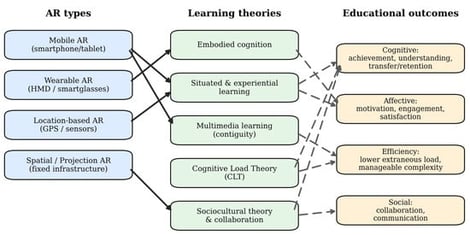
Conceptual mapping between AR types and technical choices, learning theories, and commonly reported educational outcomes. Solid arrows indicate the conceptual links between AR types and learning theories, while dashed arrows indicate commonly reported associations between learning theories and educational outcomes.

This study examines how international educators come to understand Lesson Study as a form of professional learning through participation in the Lesson Study Immersion Program in Japan (LSIP-JR). While prior research has documented the impact of Lesson Study on individual teachers’ knowledge and instructional practices, less attention has been paid to how teachers recognize the norms of learning communities and how they conceptualize curriculum and instructional tasks as objects of collective inquiry. Drawing on reflective journals produced by program participants, this study analyzes how these often-implicit dimensions of Lesson Study were interpreted through engagement with Japanese classroom practices and professional learning discourse. The findings suggest that participants did not view research lessons as polished demonstrations but rather as provisional inquiries shaped by uncertainty, shared responsibility, and openness to critique. Such interpretations brought into focus norms that are deeply embedded—and often taken for granted—within the Japanese educational context. In addition, participants came to recognize curriculum materials and instructional tasks not simply as tools for implementation but as shared research objects through which hypotheses about student learning are generated and examined, within both normative and institutional conditions. Rather than presenting Japanese Lesson Study as a model to be replicated, this study clarifies the conditions under which Lesson Study functions as collective inquiry. By making these typically unarticulated elements visible, the study offers a conceptual foundation for teachers and professional development leaders seeking to design and sustain meaningful Lesson Study across diverse educational contexts.

6 February 2026

Background: The rapid diffusion of generative Artificial Intelligence (AI) in higher education is reshaping students’ learning practices and raising concerns about unequal access and educational equity. In the Italian university context, where institutional guidelines on AI use are still developing, examining how students adopt and perceive tools such as ChatGPT is particularly relevant. Methods: This quantitative study investigated patterns of ChatGPT use and perceptions among Italian university students, with specific attention to its perceived support for learning and the development of transversal skills. Data were collected through an online survey. Differences across socio-demographic and academic characteristics were analysed using Mann–Whitney and Kruskal–Wallis tests, while associations between ChatGPT use, students’ perceptions, and study-related outcomes were examined using Spearman’s rho coefficients. Results: Students perceived ChatGPT as a useful tool, particularly in supporting the development of analytical, writing, and digital skills. Significant differences emerged across student groups. Higher levels of use and more positive perceptions were reported by freshmen, students studying in urban areas, and those with stronger economic resources. Conclusions: ChatGPT adoption and subjectively perceived institutional support and benefits vary by academic experience and socio-economic background. As the findings are based on self-reported perceptions, they reflect perceived rather than measured learning outcomes, highlighting the need for further research using objective indicators.

6 February 2026

To understand virtual leaders’ work at the intersection of equity and community, virtual school leadership (VSL) was examined with relevance to preparation and research. Research questions were: How is VSL described in extant literature? How is VSL applicable to leaders’ preparation and development? An integrative review approach was applied to online learning and virtual leadership linked to community and equity concepts. Document analysis was used to qualitatively code 34 (of 132) studies. Despite the demand for cyber schooling, some US preservice programs may lack training on leading equitably and collaboratively in virtual environments. Five findings address what virtual school leaders (aspire to) do in their jobs. Community and equity were leadership orientations as well as concerns discerned from perceptions of virtual schooling. Online public education is ensnared in global democratic backsliding for 82 countries, yet VSL remains underexplored in research. This literature review/conceptual work introduces Equity and Community in K–12 Online Leadership, an original conceptual framework informed by professional standards, virtual learning theories, and factors central to leadership. A critique of findings, along with recommendations for leadership preparation and practice, responds to the call for better preparing preservice leaders for the demands of K–12 online learning.

6 February 2026

News & Conferences

Issues

Open for Submission

Editor's Choice

Reprints of Collections

Teacher Professional Development and Teaching Practices in Early Childhood Education
Reprint

Teacher Professional Development and Teaching Practices in Early Childhood Education

An International Landscape
Editors: Shahid Karim, Xuanyi Eliza Wu, Alfredo Bautista
Technologies and Teacher Education
Reprint

Technologies and Teacher Education

Preparing Teachers for the Digital Age
Editors: Yu-Chun Kuo

Get Alerted

Add your email address to receive forthcoming issues of this journal.

XFacebookLinkedIn
Educ. Sci. - ISSN 2227-7102