


Cells 2026, 15(2), 152; https://doi.org/10.3390/cells15020152 - 14 Jan 2026
Cited by 1 | Viewed by 1215
Abstract
►
Show Figures
Analysis of pulmonary vascular dysfunction in various lung pathologies remains challenging due to the lack of functional ex vivo models. Paracrine signaling in the lung plays a critical role in regulating endothelial maturation and vascular homeostasis. Previously, we employed single-cell RNA-sequencing (scRNAseq) to
[...] Read more.
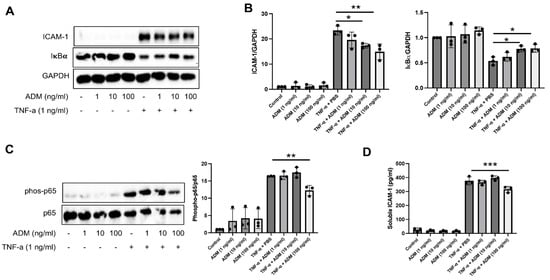
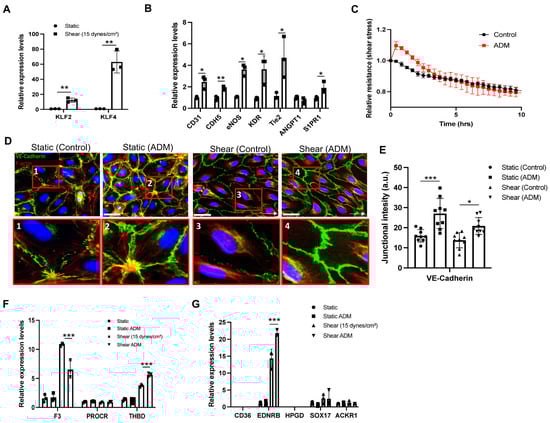
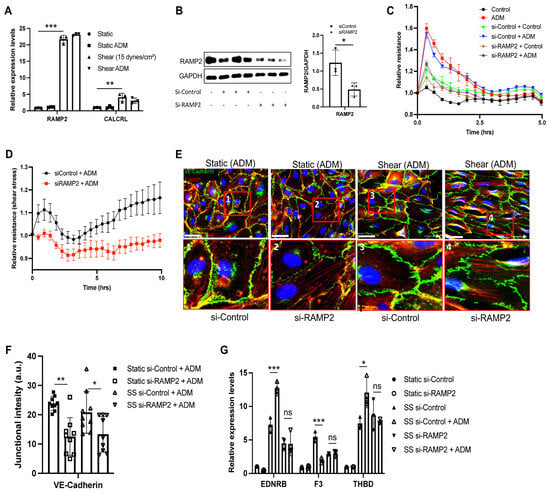
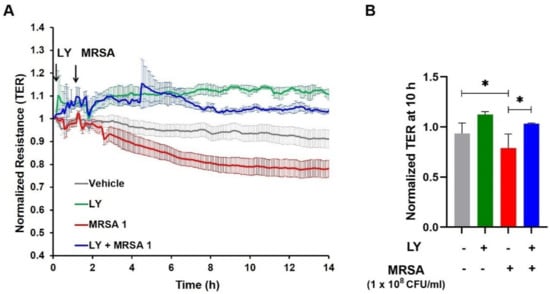
Analysis of pulmonary vascular dysfunction in various lung pathologies remains challenging due to the lack of functional ex vivo models. Paracrine signaling in the lung plays a critical role in regulating endothelial maturation and vascular homeostasis. Previously, we employed single-cell RNA-sequencing (scRNAseq) to systematically map ligand–receptor (L/R) interactions within the lung vascular niche. However, the functional impact of these ligands on endothelial biology remained unknown. Here, we systematically evaluated selected ligands in vitro to assess their effects on endothelial barrier integrity, anti-inflammatory responses, and phenotypic maturation. Among the top soluble ligands, we found that adrenomedulin (ADM) exhibited superior barrier enhancing effect on human pulmonary endothelial cell monolayers, as evidenced by electrical cell impedance sensing (ECIS) and XperT assays. ADM also exhibited anti-inflammatory properties, decreasing ICAM1 and increasing IkBa expression in a dose-dependent manner. Perfusion is commonly used in bioengineered vascular model systems. Shear stress (15 dynes/cm2) alone increased endothelial characteristics, including homeostatic markers such as CDH5, NOS3, TEK, and S1PR1. ADM treatment maintained the enhanced level of these markers under shear stress and further improved anti-coagulation by increasing THBD and decreasing F3 expression and synergistically enhanced the expression of the native lung aerocyte capillary endothelial marker EDNRB. This effect was completely attenuated by a blockade of ADM receptor, RAMP2. Together, these findings identify ADM/RAMP2 signaling as a key paracrine pathway that enhances vascular barrier integrity, anti-inflammatory phenotype, and endothelial homeostasis, providing a framework for improving the physiological relevance of engineered vascular models.
Full article
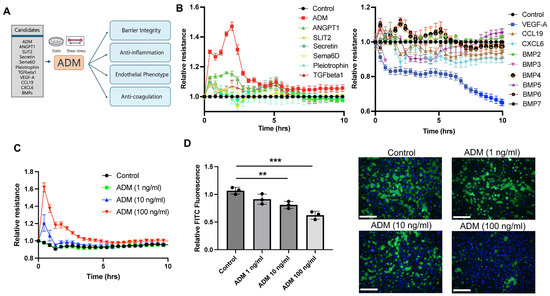
Figure 1