Skip Content
You are currently on the new version of our website. Access the old version .

Brain Sciences

Brain Sciences is an international, peer-reviewed, open access journal on neuroscience, published monthly online by MDPI.
The British Neuro-Oncology Society (BNOS) and Panhellenic Federation of Alzheimer's Disease and Related Disorders (PFADRD) are affiliated with Brain Sciences and their members receive a discount on article processing charges.

All Articles (10,011)

Cold-inducible RNA-binding protein (CIRP) is a critical molecule in the central nervous system (CNS) with functions that depend on its subcellular localization, exhibiting biphasic regulatory roles in both physiological and pathological processes. Under physiological conditions, intracellular cold-inducible RNA-binding protein (iCIRP) contributes to the maintenance of circadian rhythms by regulating the stability of core clock gene mRNAs and exerts neuroprotective effects during mild hypothermia by preserving the blood–brain barrier and inhibiting apoptosis. Pathologically, extracellular cold-inducible RNA-binding protein (eCIRP) functions as a damage-associated molecular pattern (DAMP) that drives neuroinflammation and brain injury. In ischemic stroke (IS), eCIRP promotes neutrophil extracellular trap (NET) formation and increases microglial activity via the Toll-like receptor 4 (TLR4) pathway. In cerebral ischemia–reperfusion (I/R) injury, eCIRP activates oxidative stress and the NOD-like receptor thermal protein domain associated protein 3 (NLRP3) inflammasome through the TLR4 axis, exacerbating mitochondrial damage. In intracerebral hemorrhage (ICH), eCIRP further amplifies inflammation via the interleukin-6 receptor (IL-6R)/signal transducer and activator of transcription 3 (STAT3) signaling pathway. In traumatic brain injury (TBI), eCIRP activates the endoplasmic reticulum stress pathway, intensifying apoptosis. In Alzheimer’s disease (AD), eCIRP regulates tau phosphorylation and β-amyloid (Aβ) metabolism and may mediate the link between alcohol exposure and AD pathology. Preclinical studies indicate that serum eCIRP levels correlate with IS and ICH severity, highlighting its potential as a biomarker. This systematic review elucidates the mechanisms of CIRP in CNS diseases, providing insights for understanding and preventing conditions such as IS, cerebral I/R injury, ICH, TBI, and AD.

9 February 2026
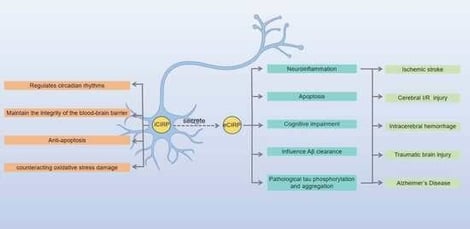
The intracellular protective role of CIRP in hypothermic brain protection. Intracellular CIRP expression is regulated by hypothermia, hypoxia, and oxidative stress. During CPB at 32 °C, hypothermia upregulates CIRP in brain tissue. CIRP downregulates TGF-β1 expression and maintains the integrity of the blood–brain barrier by inhibiting TGF-β1-mediated activation of MMP-9, thereby reducing pathologic deposition of extracellular matrix, which in turn decreases inflammatory cell infiltration and the release of TNF-α and MDA, ultimately attenuating neuronal injury. Furthermore, CIRP can mitigate brain injury by inhibiting neuronal apoptosis and counteracting oxidative stress damage through multiple pathways, thereby mitigating brain injury. TGF-β1: Transforming growth factor-β1; MMP-9: matrix metalloproteinase-9; TNF-α: tumor necrosis factor-α; MDA: malondialdehyde; HIF-1α: hypoxia-inducible factor-1α; MAM: mitochondria-associated endoplasmic reticulum membrane; IP3R: inositol 1,4,5-trisphosphate receptor; VDAC1: voltage-dependent anion channel 1; ROS: reactive oxygen species; ERK1/2: extracellular signal-regulated kinase; Akt: protein kinase B; TRX: thioredoxin.

Self-Perceptions of Aging in Older Adults: A Network Analysis of Clinical and Non-Clinical Samples

  • Lysiane Le Tirant,
  • Maxim Likhanov and
  • Isabelle Régner
  • + 5 authors

Background: Cognitive aging is highly heterogeneous, not only in performance but also in how individuals perceive their own aging. Such self-perceptions may shape emotional reactions and adaptation to memory difficulties, yet little is known about their organization in patients referred to a memory clinic for a first diagnostic consultation. The primary aim of this study was to identify the internal configuration of self-perceptions of aging in such patients. A secondary aim was to compare these patterns with those observed in older adults recruited in a research unit of experimental psychology, who reported subjective complaints but had no medical referral. Methods: In total, 130 memory clinic patients and 84 laboratory participants completed, prior to the same neuropsychological testing, a psychosocial questionnaire assessing four domains: self-perceptions of memory deficits, attitudes toward aging, aging stereotypes, and multiple facets of subjective age. Network analysis was applied to examine how these variables were interrelated and to determine their relative importance in each group. Results: Across both samples, network analyses revealed distinct organizational patterns. Patients showed a unified representational system characterized by more positive associations and centered on subjective age variables. By contrast, the laboratory group showed a two-cluster network with more negative connections, organized around negative aging stereotypes. Conclusions: These findings provide novel insights into the psychosocial profile of memory clinic patients, highlighting the added value of network approaches for capturing the interrelations among key self-representations of aging and memory, and for informing and contextualizing clinical evaluation.

9 February 2026

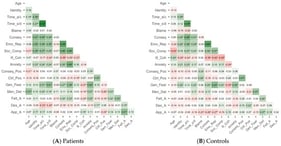
Correlations for all psychosocial variables for patients (Panel (A)) and controls (Panel (B)). Note. Correlation coefficients range from −1 (in red) to 1 (in green). * p < 0.05. Age: Chronological age; Identity: Identity; Time_a/c: Timeline acute/chronic; Time_s/d: Timeline stability/decline; Blame: Personal control (Blame); Conseq: Consequences; Emo_Rep: Emotional representation; Ill_Coh: Illness coherence; Soc_Comp: Social comparison; Anxiety: Personal anxiety towards aging; Conseq_Pos: Consequences positive; Ctrl_Pos: Control positive; Gen_Fear: General fear; Men_Det: Mental deterioration; Felt_A: Felt age; Des_A: Desired age; App_A: Apparent age.
  • Case Report
  • Open Access

Background/Objectives: It is widely recognized that malfunctions in the GABAergic system can be one of the underlying mechanisms in chronic pain. However, the use of GABAergic drugs to improve pain perception has strong and unwanted side effects, particularly in terms of sedation. Therefore, the present exploratory single-case study tested an alternative treatment using balance training to upregulate the GABAergic system in a 62-year-old patient with widespread chronic pain. Previously, balance training was shown to increase short-interval intracortical inhibition (SICI), a neurophysiological marker commonly associated with GABA-mediated intracortical inhibition, as assessed using paired-pulse transcranial magnetic stimulation (TMS), in healthy young and older adults. Therefore, we hypothesized that the balance-training-induced increase in GABAA-related intracortical inhibition would alleviate pain and increase quality of life. Methods: After two baseline measures, the patient participated in two balance training periods of 4 weeks each, followed by two detraining phases of 2 months each. At baseline and after each intervention and each detraining, intracortical inhibition (i.e., SICI) as well as pain and ‘well-being’ (questionnaires) was assessed. Results: Our results demonstrated enhanced and better modulated intracortical inhibition after 4 weeks of balance training, which was in line with analgesia and improved sleep and mood scores. However, after the first detraining, all parameters went back to baseline. In a subsequent second period of 4 weeks of balance training, intracortical inhibition was again increased, even above the values of the first training period. Pain, sleep, and mood scores were also further improved. After the second detraining period, all values dropped back close to their baseline values. Conclusions: The findings support the assumption that the GABAergic system is highly relevant in the processing and perception of pain. More importantly, our results suggest the possibility that balance training may be an effective way not only to upregulate intracortical inhibition but also to alleviate pain and improve well-being in patients with unspecific chronic pain.

9 February 2026

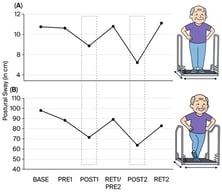
Changes in balance performance on the Posturomed. (A) indicates changes in postural sway measured in the bipedal stance on the free-swinging platform (i.e., Posturomed), whereas (B) displays the added sway path of the left and right single-leg stance on the Posturomed. It can be seen that after the balance learning interventions, the sway path was reduced (grey boxes). However, detraining always resulted in reduced performance, resulting in values close to baseline values for both (A) and (B).

Background: Motor imagery-based brain-computer interfaces (MI-BCIs) enable individuals who are unable to perform physical movements to interact with the external world by imagining movements. Users are typically classified as good performers or BCI-illiterate based on the classification accuracy of distinct EEG patterns (e.g., 60% or 70%). Yet, studies show that approximately 70% of users fall within intermediate accuracies between 60% and 80%, and although exceed the chance level, they often fail to achieve reliable MI-BCI control. Intermediate users often exhibit asymmetric motor imagery abilities between left and right hands, highlighting the need for refined early assessment and stratified training approaches. Methods: We employed ICA to decompose each participant’s EEG data and extract independent ERD/ERS components as indicators using a rule-based automated framework. This framework integrated dipole localization, ERD/ERS characteristics, and frequency-band power features of ICs. Importantly, we applied a power spectral parameterization approach to remove the 1/f-like background activity in power estimation and used statistical methods to precisely estimate the latency and duration of ERD. The extracted indicators were subsequently subjected to clustering analysis to categorize participants into four groups. Results: In addition to good performers (24.8%) and poor performers (35.8%), two groups were identified: LgoodRpoor (27.5%), who performed well in left-hand MI but poorly in right-hand MI, and LpoorRgood (11.9%), who showed the opposite pattern. Notably, these unilateral performers did not show significant differences in contralateral ERD but exhibited substantial differences in ipsilateral ERS. Conclusions: The proposed independent event-related brain dynamics model enables more refined stratification of MI-BCI users. Findings from this characterization study may inform the design of graded training protocols, especially for users demonstrating unilateral motor imagery proficiency.

9 February 2026

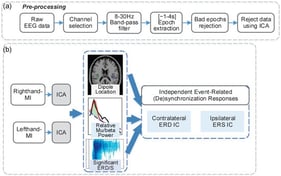
Flowchart illustrating the preprocessing, ICA decomposition, and selection of independent event-related (de)synchronization responses for motor imagery EEG data. (a) EEG preprocessing, (b) ICA decomposition pipeline and the selection rules for identifying contralateral ERD-related and ipsilateral ERS-related independent components based on dipole localization, relative mu/beta power, and statistically significant ERD/ERS patterns.

News & Conferences

Issues

Open for Submission

Editor's Choice

Reprints of Collections

Future Challenges for the Diagnosis and Management of Affective Disorders
Reprint

Future Challenges for the Diagnosis and Management of Affective Disorders

From Preclinical Evidence to Clinical Trials
Editors: Antonio Ventriglio, Mario Luciano, Andrea Fiorillo
Recent Advances in Assessment and Rehabilitation of Individuals with Communication and Language Disorders
Reprint

Recent Advances in Assessment and Rehabilitation of Individuals with Communication and Language Disorders

Editors: Dionysios Tafiadis, Nafsika Ziavra, Louiza Voniati, Angelos Papadopoulos

Get Alerted

Add your email address to receive forthcoming issues of this journal.

XFacebookLinkedIn
Brain Sci. - ISSN 2076-3425