A Neurophysiological Stratification Framework for Intermediate Motor Imagery-BCI Users Based on Independent Event-Related Brain Dynamics


Abstract
1. Introduction
- (1)
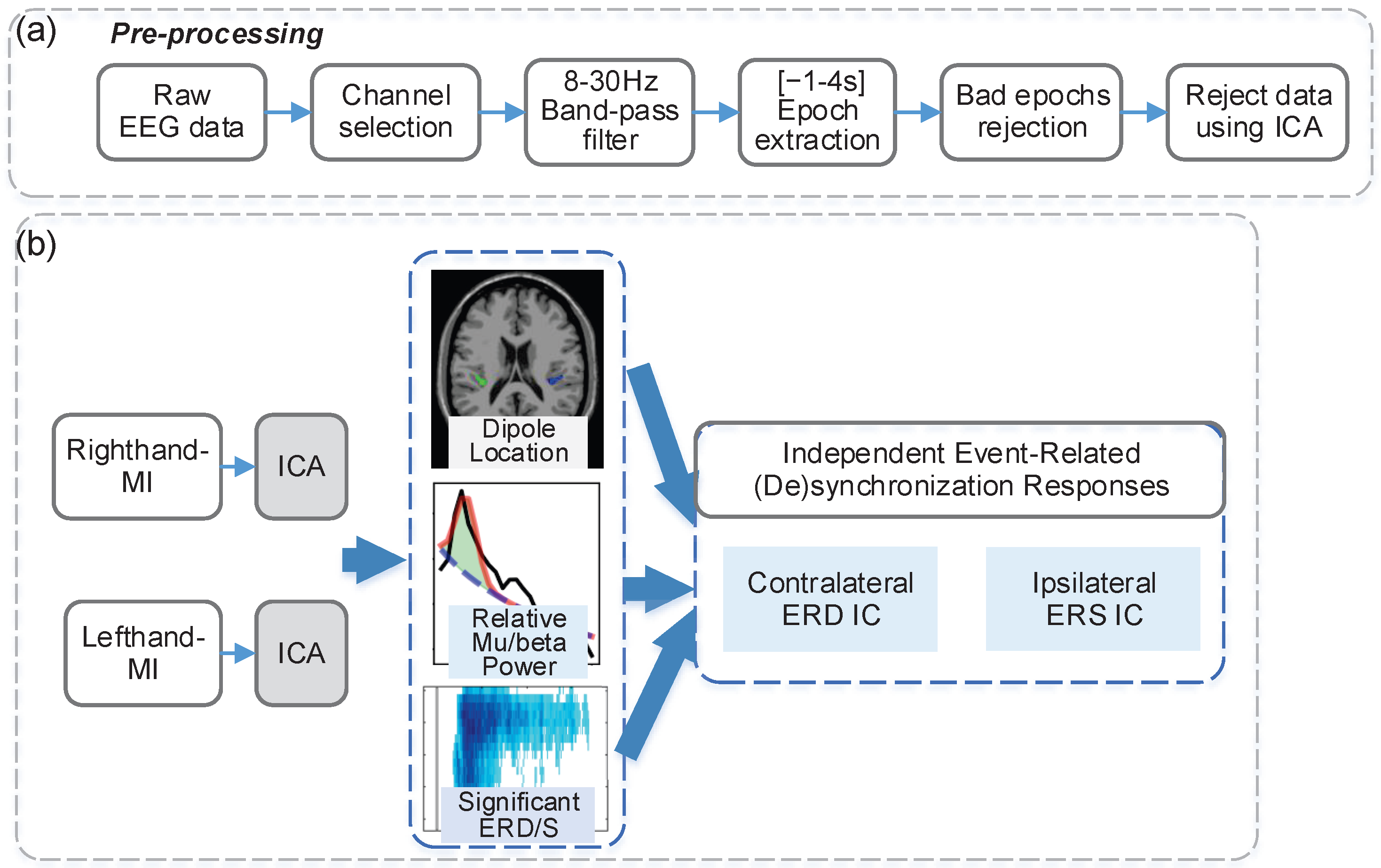
- We introduce a rule-based automated ICA pipeline that identifies contralateral ERD-related and ipsilateral ERS-related independent components by integrating dipole localization, ERD/ERS significance patterns, and oscillatory peak characterization.
- (2)
- We construct interpretable neurophysiological indices (e.g., contralateral ERD% and ipsilateral relative ERS power) to quantify individual MI proficiency beyond accuracy-based metrics.
- (3)
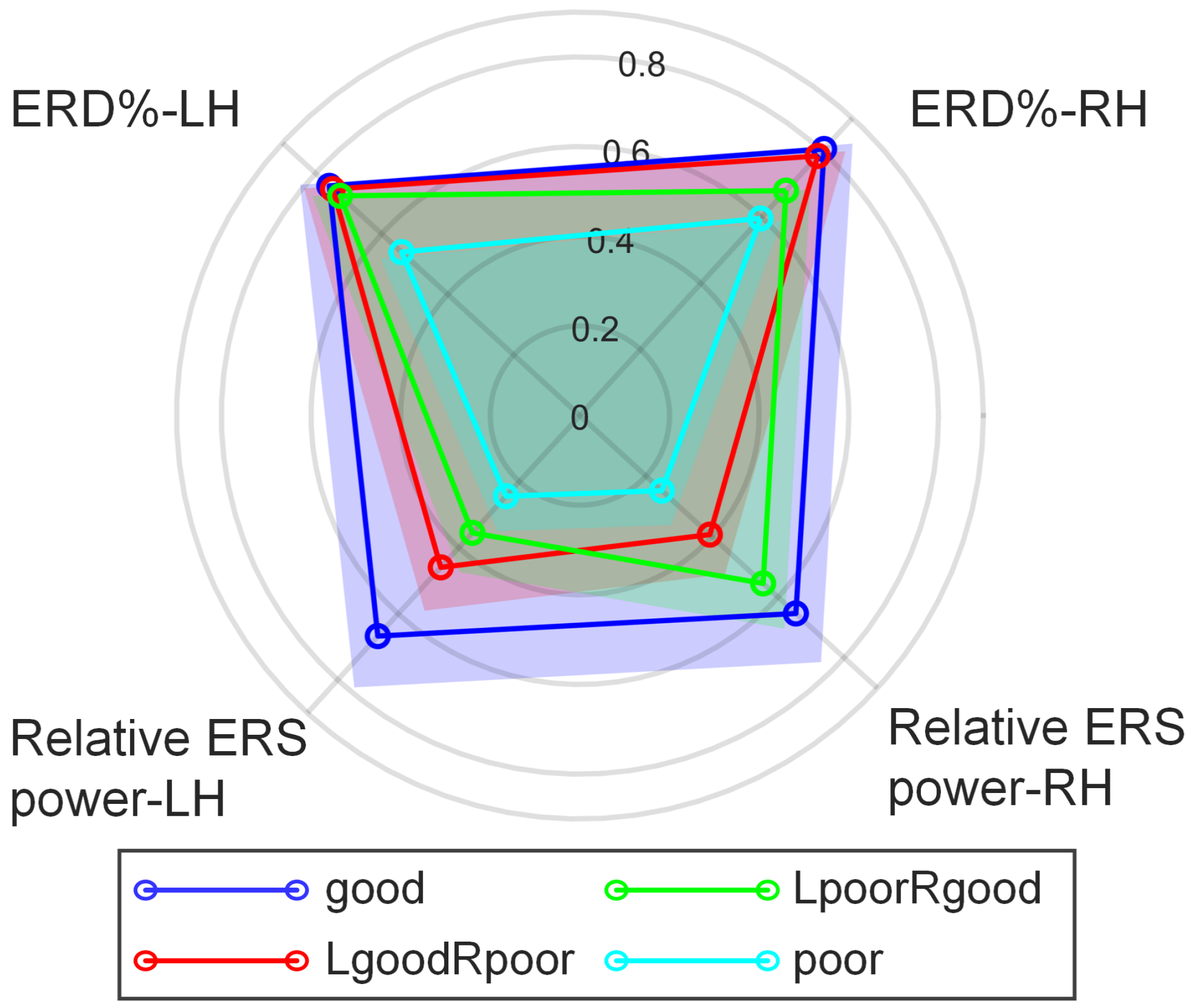
- We demonstrate a finer-grained stratification of MI-BCI users into four profiles, including two unilateral intermediate groups, which provides implications for graded training design.
2. Materials and Methods
2.1. EEG Data Description
2.2. An Event-Related Brain Dynamics Framework Based on Independent Component Analysis
2.2.1. EEG Preprocessing
2.2.2. ICA Decomposition
2.2.3. Relative mu/beta Power
2.2.4. Dynamic Power Changes and Significant ERD/ERS
2.2.5. Selection Rule of Independent Event-Related (De)Synchronization Components
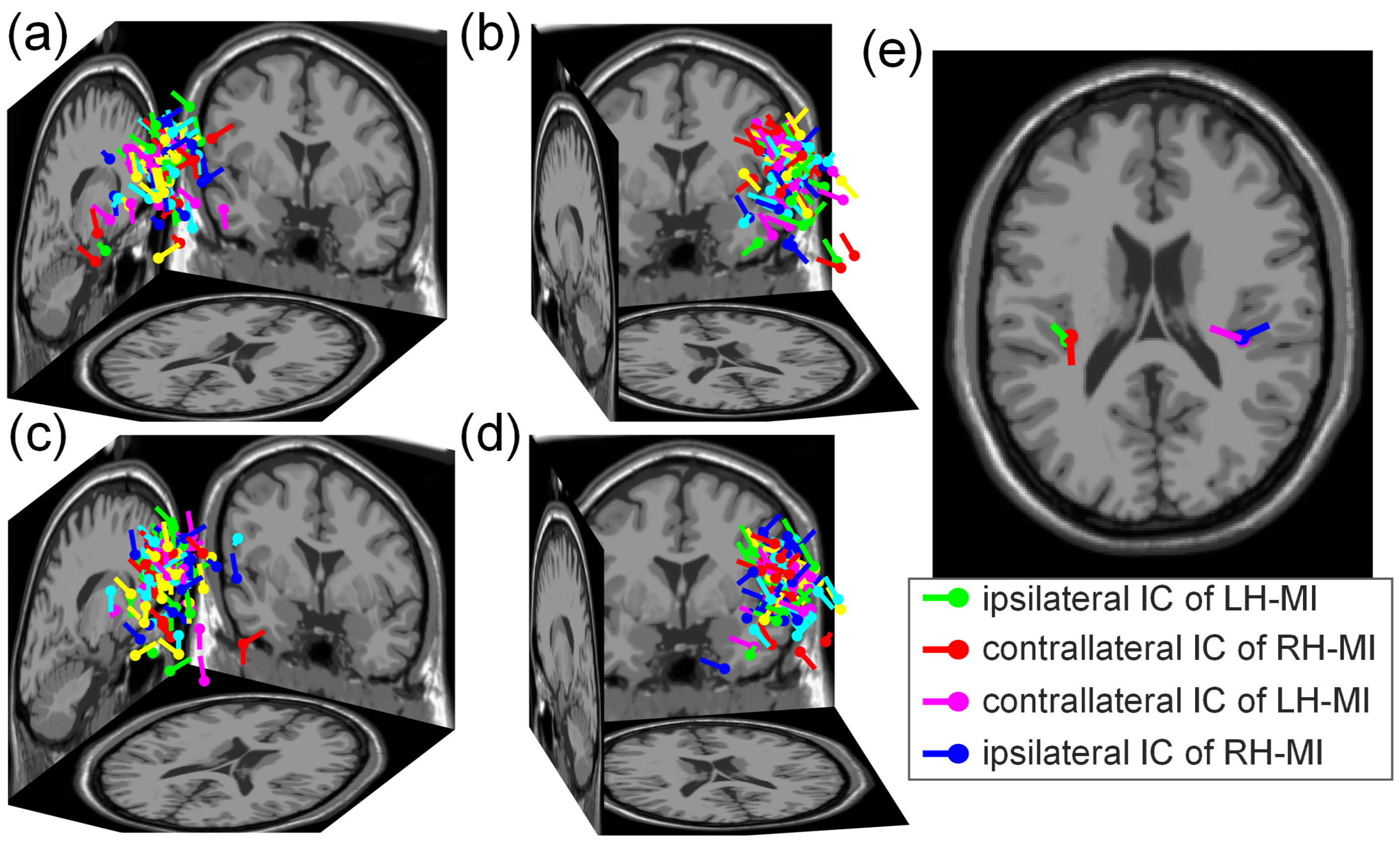
- The source location must fall within the contralateral motor imagery-related brain regions, including the contralateral somatosensory cortex (BA1–3), primary motor cortex (BA4), superior parietal lobule (BA5, BA7), premotor and supplementary motor areas (BA6), anterior cingulate cortex (BA24, BA32), fusiform gyrus body-selective area (BA37), inferior parietal lobule (BA40), opercular regions (BA44, BA45), and middle frontal gyrus (BA9, BA46) [40,41,42,43].
- Among IC candidates satisfying Rule 1, the top three components with the highest relative power were selected.
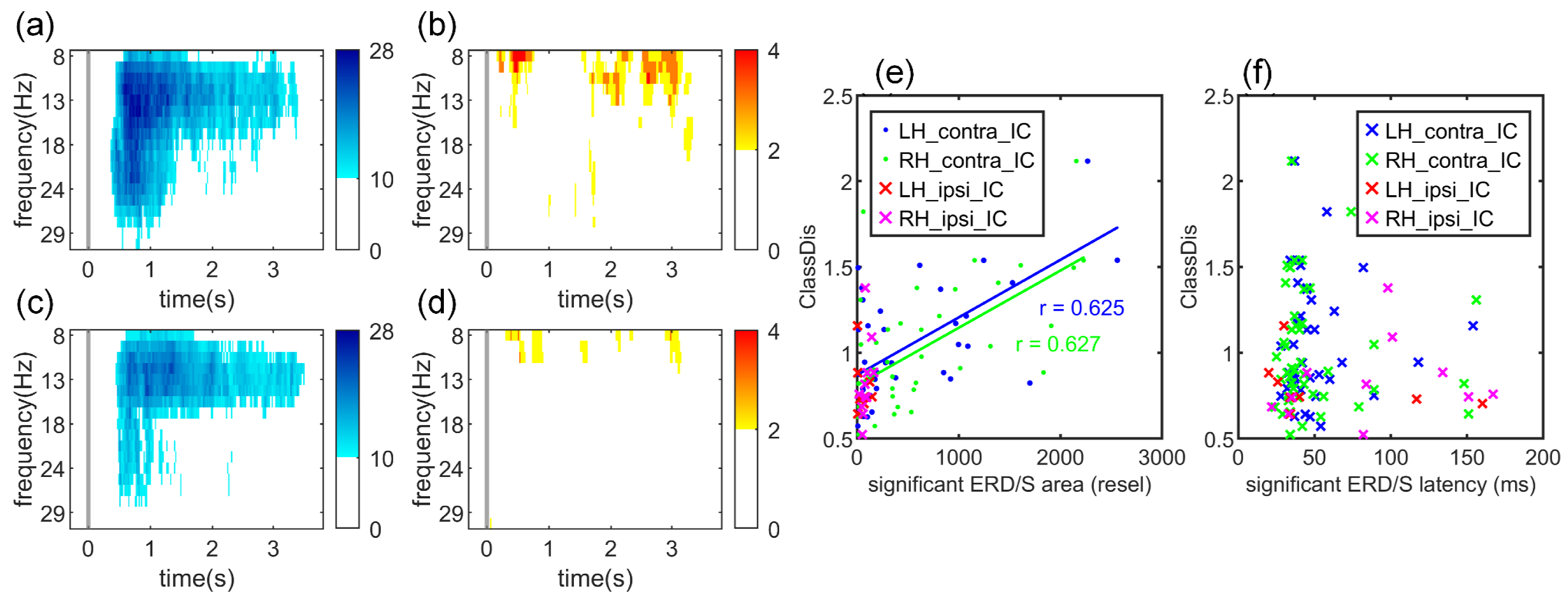
- From these candidates, the IC with the largest area of 4-connected regions in the significant ERD map was chosen. If none of the candidates exhibited significant ERD, the IC with the highest relative power was selected.
- The source location must be within ipsilateral motor imagery-related brain regions (same as Rule 1 for ERD ICs).
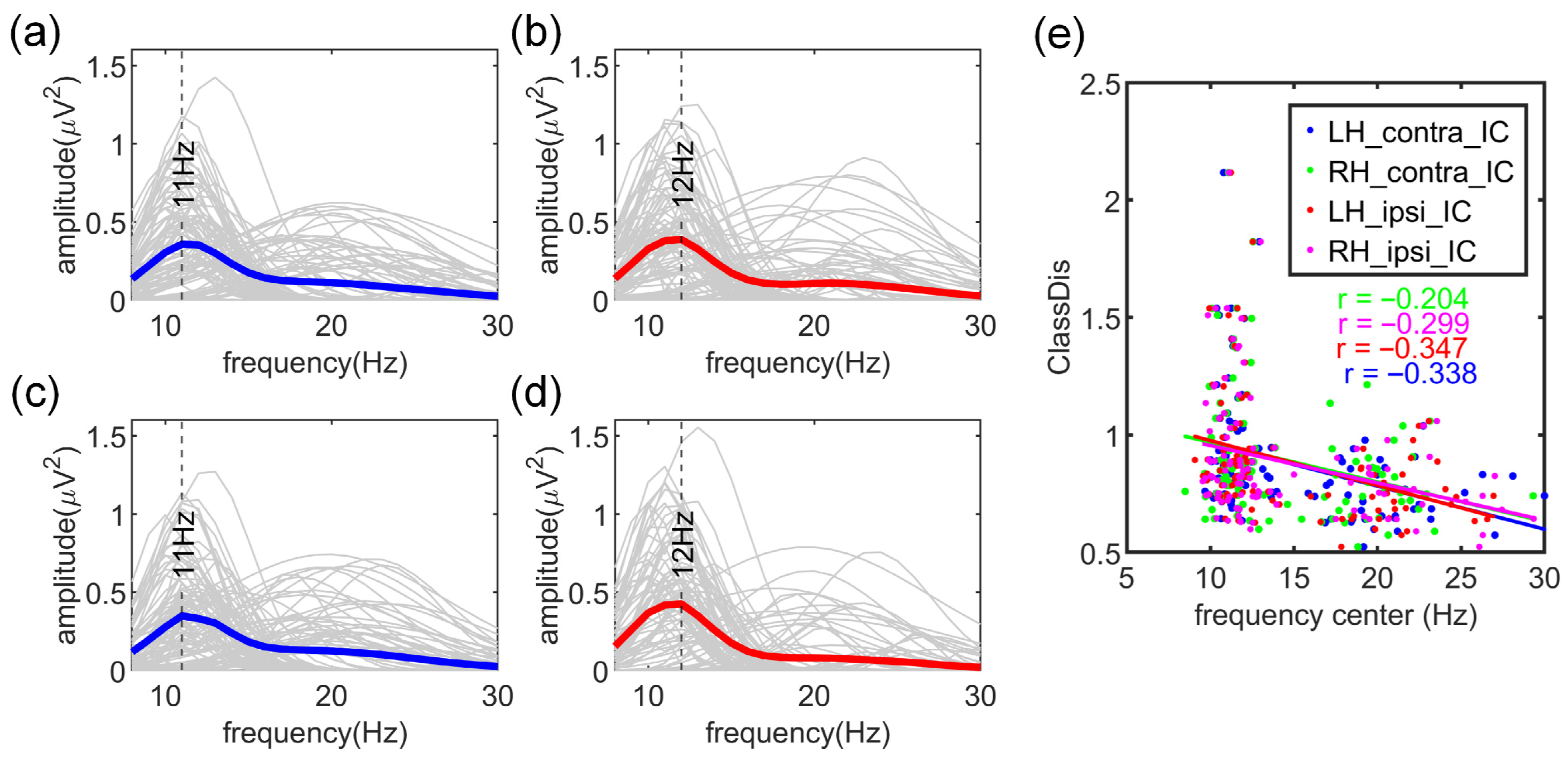
- The relative power spectrum must exhibit prominent oscillatory peaks within the mu/beta frequency range.
- The IC with the largest area of 4-connected regions in the significant ERS map was selected. If none of the candidates exhibited significant ERS, the IC with the highest relative mu/beta power was chosen.
2.3. Regression Model
2.4. Clustering Analysis
3. Results
3.1. Selection of Contralateral ERD and Ipsilateral ERS ICs
3.1.1. Dipole Source Localization of MI-Related ICs
3.1.2. Spectral Features of Contralateral and Ipsilateral ICs
3.1.3. Significant Time-Frequency Patterns of MI-Related ICs
3.2. Results of the Regression Model
3.3. User Performance Stratification
4. Discussion
- 1.
- Although the present study was conducted on a well-established and curated public dataset, our primary goal was not to address the full spectrum of challenges encountered in real-world MI-BCI scenarios, but rather to establish a clear and interpretable link between neurophysiological features and MI-BCI performance.
- 2.
- The present study intentionally focuses on event-related, component-level dynamics to achieve interpretable and performance-relevant characterization of MI-BCI users. We acknowledge that this component-level approach does not explicitly model network-level interactions or inter-regional connectivity, which may provide additional insight into distributed neural mechanisms underlying MI performance. Notably, independent components inherently integrate distributed neural sources, and event-related ERD/ERS has long been established as a gold-standard neural marker in MI-BCI studies. By comparison, connectivity-based measures are more difficult to translate into performance stratification and feedback-oriented applications Future work may extend the proposed framework by integrating connectivity-based measures or network-level modeling to further characterize distributed motor imagery networks under more challenging experimental conditions.
- 3.
- The present framework identifies neurophysiological heterogeneity among MI-BCI users, its ability to guide training requires prospective validation. A rigorous validation would involve a longitudinal, controlled study design in which participants are first stratified using the proposed IC-level ERD/ERS features, followed by group-specific training interventions. Baseline conditions could include non-stratified training, conventional accuracy-based grouping, or randomly assigned training protocols. Implementing such validation would require extending the current pipeline to support real-time feedback based on ipsilateral mu power. These components fall beyond the scope of the present study. Importantly, the current study does not claim superiority over existing training protocols, but rather provides a neurophysiological basis upon which baseline methods can be compared in future work.
5. Conclusions
Supplementary Materials
Author Contributions
Funding
Institutional Review Board Statement
Informed Consent Statement
Data Availability Statement
Conflicts of Interest
References
- Wolpaw, J.R.; Birbaumer, N.; Heetderks, W.J.; McFarland, D.J.; Peckham, P.H.; Schalk, G.; Donchin, E.; Quatrano, L.A.; Robinson, C.J.; Vaughan, T.M. Brain-computer interface technology: A review of the first international meeting. IEEE Trans. Rehabil. Eng. 2000, 8, 164–173. [Google Scholar] [CrossRef]
- Ramadan, R.A.; Vasilakos, A.V. Brain computer interface: Control signals review. Neurocomputing 2017, 223, 26–44. [Google Scholar] [CrossRef]
- Pfurtscheller, G.; Neuper, C. Motor imagery and direct brain-computer communication. Proc. IEEE 2001, 89, 1123–1134. [Google Scholar] [CrossRef]
- Leeb, R.; Perdikis, S.; Tonin, L.; Biasiucci, A.; Tavella, M.; Creatura, M.; Molina, A.; Al-Khodairy, A.; Carlson, T.; Millan, J.D. Transferring brain-computer interfaces beyond the laboratory: Successful application control for motor-disabled users. Artif. Intell. Med. 2013, 59, 121–132. [Google Scholar] [CrossRef] [PubMed]
- Lotte, F.; Jeunet, C. Defining and quantifying users’ mental imagery-based BCI skills: A first step. J. Neural Eng. 2018, 15, 046030. [Google Scholar] [CrossRef]
- Perdikis, S.; Millan, J.d.R. Brain-machine interfaces: A tale of two learners. IEEE Syst. Man Cybern. Mag. 2020, 6, 12–19. [Google Scholar] [CrossRef]
- Zhang, S.; Lu, Z.; Zhang, B.; Zhang, Y.; Liang, Z.; Zhang, L.; Li, L.; Huang, G.; Zhang, Z.; Li, Z. Graph-based feature learning methods for subject-dependent and subject-independent motor imagery EEG decoding. Cogn. Neurodyn. 2025, 19, 139. [Google Scholar] [CrossRef]
- Guger, C.; Edlinger, G.; Harkam, W.; Niedermayer, I.; Pfurtscheller, G. How many people are able to operate an EEG-based brain-computer interface (BCI)? IEEE Trans. Neural Syst. Rehabil. Eng. 2003, 11, 145–147. [Google Scholar] [CrossRef]
- Vidaurre, C.; Blankertz, B. Towards a cure for BCI illiteracy. Brain Topogr. 2010, 23, 194–198. [Google Scholar] [CrossRef]
- Blankertz, B.; Sannelli, C.; Halder, S.; Hammer, E.M.; Kubler, A.; Muller, K.R.; Curio, G.; Dickhaus, T. Neurophysiological predictor of SMR-based BCI performance. Neuroimage 2010, 51, 1303–1309. [Google Scholar] [CrossRef]
- Lee, M.H.; Kwon, O.Y.; Kim, Y.J.; Kim, H.K.; Lee, Y.E.; Williamson, J.; Fazli, S.; Lee, S.W. EEG dataset and OpenBMI toolbox for three BCI paradigms: An investigation into BCI illiteracy. Gigascience 2019, 8, giz002. [Google Scholar] [CrossRef] [PubMed]
- Saha, S.; Baumert, M. Intra- and Inter-subject Variability in EEG-Based Sensorimotor Brain Computer Interface: A Review. Front. Comput. Neurosci. 2019, 13, 87. [Google Scholar] [CrossRef] [PubMed]
- Ahn, M.; Jun, S.C. Performance variation in motor imagery brain-computer interface: A brief review. J. Neurosci. Methods 2015, 243, 103–110. [Google Scholar] [CrossRef] [PubMed]
- Lotte, F.; Congedo, M.; Lécuyer, A.; Lamarche, F.; Arnaldi, B. A review of classification algorithms for EEG-based brain–computer interfaces. J. Neural Eng. 2007, 4, R1. [Google Scholar] [CrossRef]
- Congedo, M.; Barachant, A.; Bhatia, R. Riemannian geometry for EEG-based brain-computer interfaces; a primer and a review. Brain-Comput. Interfaces 2017, 4, 155–174. [Google Scholar] [CrossRef]
- Rithwik, P.; Benzy, V.; Vinod, A. High accuracy decoding of motor imagery directions from EEG-based brain computer interface using filter bank spatially regularised common spatial pattern method. Biomed. Signal Process. Control 2022, 72, 103241. [Google Scholar] [CrossRef]
- Candelori, B.; Bardella, G.; Spinelli, I.; Ramawat, S.; Pani, P.; Ferraina, S.; Scardapane, S. Spatio-temporal transformers for decoding neural movement control. J. Neural Eng. 2025, 22, 016023. [Google Scholar] [CrossRef]
- Liu, F.; Meamardoost, S.; Gunawan, R.; Komiyama, T.; Mewes, C.; Zhang, Y.; Hwang, E.; Wang, L. Deep learning for neural decoding in motor cortex. J. Neural Eng. 2022, 19, 056021. [Google Scholar] [CrossRef]
- Saibene, A.; Ghaemi, H.; Dagdevir, E. Deep learning in motor imagery EEG signal decoding: A systematic review. Neurocomputing 2024, 610, 128577. [Google Scholar] [CrossRef]
- Han, Q.; Sun, Y.; Ye, H.; Song, Z.; Zhao, J.; Shi, L.; Kuang, Z. GAH-TNet: A Graph Attention-Based Hierarchical Temporal Network for EEG Motor Imagery Decoding. Brain Sci. 2025, 15, 883. [Google Scholar] [CrossRef]
- Tiwari, S.; Goel, S.; Bhardwaj, A. MIDNN—A classification approach for the EEG based motor imagery tasks using deep neural network. Appl. Intell. 2022, 52, 4824–4843. [Google Scholar] [CrossRef]
- Pfurtscheller, G.; Silva, F.L.d. Event-related EEG/MEG synchronization and desynchronization: Basic principles. Clin. Neurophysiol. 1999, 110, 1842–1857. [Google Scholar] [CrossRef] [PubMed]
- Pfurtscheller, G.; Brunner, C.; Schlogl, A.; Lopes da Silva, F.H. Mu rhythm (de)synchronization and EEG single-trial classification of different motor imagery tasks. Neuroimage 2006, 31, 153–159. [Google Scholar] [CrossRef] [PubMed]
- Graimann, B.; Huggins, J.; Levine, S.; Pfurtscheller, G. Visualization of significant ERD/ERS patterns in multichannel EEG and ECoG data. Clin. Neurophysiol. 2002, 113, 43–47. [Google Scholar] [CrossRef]
- Velasquez-Martinez, L.; Caicedo-Acosta, J.; Castellanos-Dominguez, G. Entropy-based estimation of event-related de/synchronization in motor imagery using vector-quantized patterns. Entropy 2020, 22, 703. [Google Scholar] [CrossRef]
- Jorajuria, T.; Nikulin, V.V.; Kapralov, N.; Gomez, M.; Vidaurre, C. MEAN(SP): How many channels are needed to predict the performance of a SMR-based BCI? IEEE Trans. Neural Syst. Rehabil. Eng. 2023, 31, 4931–4941. [Google Scholar] [CrossRef]
- Angulo-Sherman, I.N.; Leon-Dominguez, U.; Martinez-Torteya, A.; Fragoso-Gonzalez, G.A.; Martinez-Perez, M.V. Proficiency in motor imagery is linked to the lateralization of focused ERD patterns and beta PDC. J. Neuroeng. Rehabil. 2025, 22, 30. [Google Scholar] [CrossRef]
- Makeig, S.; Debener, S.; Onton, J.; Delorme, A. Mining event-related brain dynamics. Trends Cogn. Sci. 2004, 8, 204–210. [Google Scholar] [CrossRef]
- Naeem, M.; Brunner, C.; Leeb, R.; Graimann, B.; Pfurtscheller, G. Seperability of four-class motor imagery data using independent components analysis. J. Neural Eng. 2006, 3, 208–216. [Google Scholar] [CrossRef]
- Ontona, J.; Westerfieldb, M.; Townsendb, J.; Makeig, S. Imaging human EEG dynamics using independent component analysis. Neurosci. Biobehav. Rev. 2006, 30, 808–822. [Google Scholar] [CrossRef]
- Duann, J.R.; Chiou, J.C. A comparison of independent event-related desynchronization responses in motor-related brain areas to movement execution, movement imagery, and movement observation. PLoS ONE 2016, 11, e0162546. [Google Scholar] [CrossRef] [PubMed]
- Frolov, A.; Húsek, D.; Biryukova, E.; Bobrov, P.; Mokienko, O.; Alexandrov, A. Principles of motor recovery in post-stroke patients using hand exoskeleton controlled by the brain-computer interface based on motor imagery. Neural Netw. World 2017, 27, 107–137. [Google Scholar] [CrossRef][Green Version]
- Melnik, A.; Hairston, W.D.; Ferris, D.P.; König, P. EEG correlates of sensorimotor processing: Independent components involved in sensory and motor processing. Sci. Rep. 2017, 7, 4461. [Google Scholar] [CrossRef] [PubMed]
- Xu, K.; Huang, Y.Y.; Duann, J.R. The sensitivity of single-trial Mu-suppression detection for motor imagery performance as compared to motor execution and motor observation Pperformance. Front. Hum. Neurosci. 2019, 13, 302. [Google Scholar] [CrossRef]
- Goldberger, A.L.; Amaral, L.A.; Glass, L.; Hausdorff, J.M.; Ivanov, P.C.; Mark, R.G.; Mietus, J.E.; Moody, G.B.; Peng, C.K.; Stanley, H.E. PhysioBank, PhysioToolkit, and PhysioNet: Components of a new research resource for complex physiologic signals. Circulation 2000, 101, e215–e220. [Google Scholar] [CrossRef]
- Bell, A.J.; Sejnowski, T.J. An information-maximization approach to blind separation and blind deconvolution. Neural Comput. 1995, 7, 1129–1159. [Google Scholar] [CrossRef]
- Donoghue, T.; Haller, M.; Peterson, E.J.; Varma, P.; Sebastian, P.; Gao, R.; Noto, T.; Lara, A.H.; Wallis, J.D.; Knight, R.T.; et al. Parameterizing neural power spectra into periodic and aperiodic components. Nat. Neurosci. 2020, 23, 1655–1665. [Google Scholar] [CrossRef]
- Donoghue, T.; Watrous, A.J. How can we differentiate narrow-band oscillations from aperiodic activity? In Intracranial EEG: A Guide for Cognitive Neuroscientists; Axmacher, N., Ed.; Springer International Publishing: Cham, Switzerland, 2023; pp. 351–364. [Google Scholar] [CrossRef]
- Durka, P.J.; Zygierewicz, J.; Klekowicz, H.; Ginter, J.; Blinowska, K.J. On the statistical significance of event-related EEG desynchronization and synchronization in the time-frequency plane. IEEE Trans. Biomed. Eng. 2004, 51, 1167–1175. [Google Scholar] [CrossRef]
- Guillot, A.; Collet, C.; Nguyen, V.A.; Malouin, F.; Richards, C.; Doyon, J. Functional neuroanatomical networks associated with expertise in motor imagery. Neuroimage 2008, 41, 1471–1483. [Google Scholar] [CrossRef]
- Halder, S.; Agorastos, D.; Veit, R.; Hammer, E.M.; Lee, S.; Varkuti, B.; Bogdan, M.; Rosenstiel, W.; Birbaumer, N.; Kubler, A. Neural mechanisms of brain-computer interface control. Neuroimage 2011, 55, 1779–1790. [Google Scholar] [CrossRef]
- Youssofzadeh, V.; Roy, S.; Chowdhury, A.; Izadysadr, A.; Parkkonen, L.; Raghavan, M.; Prasad, G. Mapping and decoding cortical engagement during motor imagery, mental arithmetic, and silent word generation using MEG. Hum. Brain Mapp. 2023, 44, 3324–3342. [Google Scholar] [CrossRef] [PubMed]
- Furuta, T.; Morita, T.; Miura, G.; Naito, E. Structural and functional features characterizing the brains of individuals with higher controllability of motor imagery. bioRxiv 2023. [Google Scholar] [CrossRef] [PubMed]
- Orhan, U.; Hekim, M.; Ozer, M. EEG signals classification using the K-means clustering and a multilayer perceptron neural network model. Expert Syst. Appl. 2011, 38, 13475–13481. [Google Scholar] [CrossRef]
- Lotze, M.; Halsband, U. Motor imagery. J. Physiol. Paris 2006, 99, 386–395. [Google Scholar] [CrossRef]
- Jenkinson, N.; Brown, P. New insights into the relationship between dopamine, beta oscillations and motor function. Trends Neurosci. 2011, 34, 611–618. [Google Scholar] [CrossRef]
- Nguyen, M.T.D.; Pham, C.Q.; Nguyen, H.N.; Le, K.Q.; Huynh, L.Q. A statistical approach to evaluate beta response in motor imagery-based brain-computer interface. In Proceedings of the 8th International Conference on the Development of Biomedical Engineering in Vietnam, Ho Chi Minh City, Vietnam, 20–22 July 2020; Van Toi, V., Nguyen, T.H., Long, V.B., Huong, H.T.T., Eds.; Springer International Publishing: Cham, Switzerland, 2022; pp. 203–217. [Google Scholar]
- Tidare, J.; Leon, M.; Astrand, E. Time-resolved estimation of strength of motor imagery representation by multivariate EEG decoding. J. Neural Eng. 2021, 18, 016026. [Google Scholar] [CrossRef]
- Pfurtscheller, G.; Neuper, C. Motor imagery activates primary sensorimotor area in humans. Neurosci. Lett. 1997, 239, 65–68. [Google Scholar] [CrossRef]
- Jurkiewicz, M.T.; Gaetz, W.C.; Bostan, A.C.; Cheyne, D. Post-movement beta rebound is generated in motor cortex: Evidence from neuromagnetic recordings. NeuroImage 2006, 32, 1281–1289. [Google Scholar] [CrossRef]
- Pfurtscheller, G. Spatiotemporal ERD/ERS patterns during voluntary movement and motor imagery. Suppl. Clin. Neurophysiol. 2000, 53, 196–198. [Google Scholar] [CrossRef]
- Crotti, M.; Koschutnig, K.; Wriessnegger, S.C. Handedness impacts the neural correlates of kinesthetic motor imagery and execution: A FMRI study. J. Neurosci. Res. 2022, 100, 798–826. [Google Scholar] [CrossRef]
- Zapala, D.; Iwanowicz, P.; Francuz, P.; Augustynowicz, P. Handedness effects on motor imagery during kinesthetic and visual-motor conditions. Sci. Rep. 2021, 11, 13112. [Google Scholar] [CrossRef]
- Spezialetti, M.; Cinque, L.; Tavares, J.M.R.; Placidi, G. Toward EEG-based BCI driven by emotions for addressing BCI-Illiteracy: A meta-analytic review. Behav. Inf. Technol. 2018, 37, 855–871. [Google Scholar] [CrossRef]
- Zerafa, R.; Camilleri, T.; Falzon, O.; Camilleri, K.P. To train or not to train? A survey on training of feature extraction methods for SSVEP-based BCIs. J. Neural Eng. 2018, 15, 051001. [Google Scholar] [CrossRef]




| Predictor | LH-MI | RH-MI | ||
|---|---|---|---|---|
| p-Value | p-Value | |||
| ERD% | −0.307 ** | 0.002 | −0.248 * | 0.011 |
| ERS% | 0.161 | 0.165 | 0.153 | 0.135 |
| Relative ERD power | −0.035 | 0.750 | 0.133 | 0.128 |
| Relative ERS power | 0.186 * | 0.045 | 0.266 ** | 0.002 |
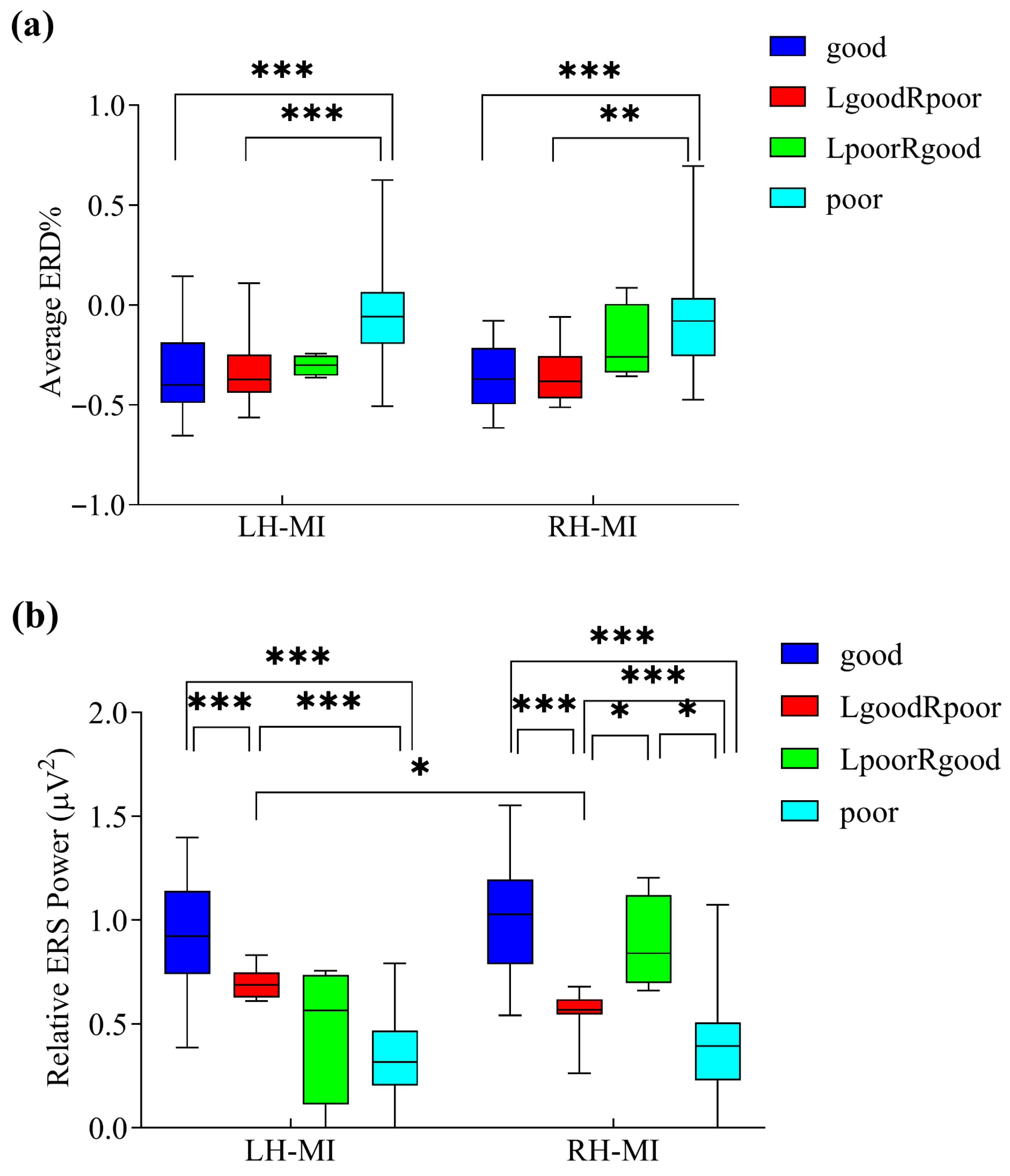
| Metric | MI Condition | Comparison | t-Value | p-Value |
|---|---|---|---|---|
| ERD% | LH-MI | good vs. poor | 6.162 *** | <0.001 |
| LgoodRpoor vs. poor | 4.358 *** | <0.001 | ||
| RH-MI | good vs. poor | 6.409 *** | <0.001 | |
| LgoodRpoor vs. poor | 4.629 ** | 0.002 | ||
| Relative ERS power | LH-MI | good vs. LgoodRpoor | 4.543 *** | <0.001 |
| good vs. poor | 11.284 *** | <0.001 | ||
| LgoodRpoor vs. poor | 12.329 *** | <0.001 | ||
| RH-MI | good vs. LgoodRpoor | 7.953 *** | <0.001 | |
| good vs. poor | 11.831 *** | <0.001 | ||
| LgoodRpoor vs. poor | 4.161 *** | <0.001 | ||
| LpoorRgood vs. LgoodRpoor | 4.261 *** | <0.001 | ||
| LpoorRgood vs. poor | 7.532 *** | <0.001 |
Disclaimer/Publisher’s Note: The statements, opinions and data contained in all publications are solely those of the individual author(s) and contributor(s) and not of MDPI and/or the editor(s). MDPI and/or the editor(s) disclaim responsibility for any injury to people or property resulting from any ideas, methods, instructions or products referred to in the content. |
© 2026 by the authors. Licensee MDPI, Basel, Switzerland. This article is an open access article distributed under the terms and conditions of the Creative Commons Attribution (CC BY) license.
Share and Cite
Duan, X.; Xie, S.; Cui, Y.; Ji, T.; Yan, H. A Neurophysiological Stratification Framework for Intermediate Motor Imagery-BCI Users Based on Independent Event-Related Brain Dynamics. Brain Sci. 2026, 16, 202. https://doi.org/10.3390/brainsci16020202
Duan X, Xie S, Cui Y, Ji T, Yan H. A Neurophysiological Stratification Framework for Intermediate Motor Imagery-BCI Users Based on Independent Event-Related Brain Dynamics. Brain Sciences. 2026; 16(2):202. https://doi.org/10.3390/brainsci16020202
Chicago/Turabian StyleDuan, Xu, Songyun Xie, Yujie Cui, Ting Ji, and Hao Yan. 2026. "A Neurophysiological Stratification Framework for Intermediate Motor Imagery-BCI Users Based on Independent Event-Related Brain Dynamics" Brain Sciences 16, no. 2: 202. https://doi.org/10.3390/brainsci16020202
APA StyleDuan, X., Xie, S., Cui, Y., Ji, T., & Yan, H. (2026). A Neurophysiological Stratification Framework for Intermediate Motor Imagery-BCI Users Based on Independent Event-Related Brain Dynamics. Brain Sciences, 16(2), 202. https://doi.org/10.3390/brainsci16020202