


Abstract
Turmeric is a curry spice that originated from India, which has attracted great interest in recent decades because it contains bioactive curcuminoids (curcumin, demethoxycurcumin, and bisdemethoxycurcumin). Curcumin (1,7-bis-(4-hydroxy-3-methoxyphenyl)-hepta-1,6-diene-3,5-dione), a lipophilic polyphenol may work as an anticancer, antibiotic, anti-inflammatory, and anti-aging agent as suggested by several in vitro, in vivo studies and clinical trials. However, poor aqueous solubility, bioavailability, and pharmacokinetic profiles limit curcumin’s therapeutic usage. To address these issues, several curcumin formulations have been developed. However, suboptimal sample preparation and analysis methodologies often hamper the accurate evaluation of bioactivities and their clinical efficacy. This review summarizes recent research on biological, pharmaceutical, and analytical aspects of the curcumin. Various formulation techniques and corresponding clinical trials and in vivo outcomes are discussed. A detailed comparison of different sample preparation (ultrasonic, pressurized liquid extraction, microwave, reflux) and analytical (FT-IR, FT-NIR, FT-Raman, UV, NMR, HPTLC, HPLC, and LC-MS/MS) methodologies used for the extraction and quantification of curcuminoids in different matrices, is presented. Application of optimal sample preparation, chromatographic separation, and detection methodologies will significantly improve the assessment of different formulations and biological activities of curcuminoids.
1. Introduction
The use of nutraceuticals, dietary supplements, and functional foods has gained significant popularity globally over the past few decades due to increased interest in natural products and their potential health benefits [1,2,3,4]. In addition, natural products are often perceived as less toxic compared to synthetically derived products [5]. Turmeric, a plant-derived curry spice, has been recognized for its medicinal properties [2]. Due to these advantages, several turmeric dietary supplements are available in the global market with varying formulations and health claims (supporting joint comfort, promoting mobility and flexibility, enhancing cognitive functioning, and providing cardiovascular health benefits) [1,2,3,4,5].
Turmeric (Curcuma longa) is a plant related to the ginger family (Zingiberaceae), which originated from India and is currently grown in several other parts of the world, including Southeast Asia, China, and Latin America [6,7]. Turmeric is a common spice used in the preparation of curries in India and other Asian countries because of its flavor and color [2,8]. India is the largest producer [9] and leading turmeric exporter. As per reports, the global market for turmeric was estimated at ~1.7 million metric tons and was expected to increase significantly by 2027 [10,11]. The curcumin global market was estimated to be around half a billion US dollars in 2016 and is projected to register a compound annual growth rate (CAGR) of 13% over the period of 2018–2025 [10].
Apart from its use as a curry spice, turmeric has been historically used as a natural coloring agent (food, cosmetics, and textiles), an insect repellent, and as an antimicrobial agent [12]. As per Ayurvedic medicine, turmeric has been used for various medical purposes such as wound healing, respiratory problems, liver, and dermatological disorders [5,8,13]. Curcumin (CUR), demethoxycurcumin (DMC), and bisdemethoxycurcumin (BMC) are bioactive polyphenolic compounds identified in turmeric [14,15], which have been collectively referred to as curcuminoids (CCMs). As per the United States Food and Drug Administration (FDA), curcuminoids are generally recognized as safe (GRAS) [15]. Clinical studies further supported that a high single oral dose (up to 12 g/day) of curcuminoids were very well tolerated [16,17].
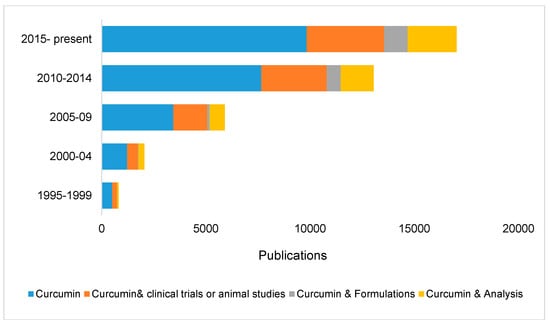
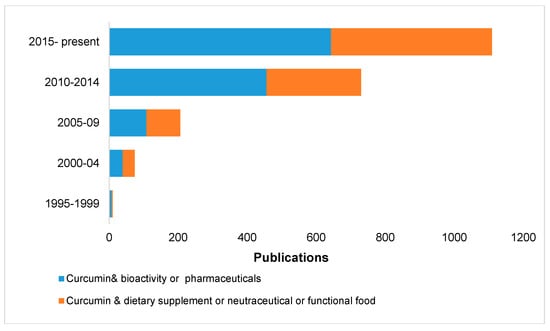
Curcumin has attracted a lot of attention in recent decades due to its therapeutic potential as anti-inflammatory, anti-diabetic, anti-cancer, and anti-aging agent [5,8,15,18], which is supported by several in vitro, in vivo and clinical trials [6,14,19,20,21]. In addition to these, curcumin has also shown promise in treating wound healing, arthritis, and Alzheimer’s. Figure 1 shows that significant increase in curcumin-based research. Based on Scopus research, almost 10,000 research articles have been published on curcuminoids in the past five years. However, curcumin therapeutic potential is limited by its low solubility in aqueous media, poor bioavailability, and pharmacokinetic profiles [17,18,22,23,24]. To address these issues, several different formulations (materials/ mixtures that combined curcumin with other elements, including polymers, lipids, and nanoparticles in appropriate proportions) have been produced and used in multiple studies [6,14,19,20,21].
Figure 1.
(Top) The number of publications published since 1995 on (i) curcumin, (ii) curcumin and clinical trials or animal studies, (iii) curcumin and formulations, and (iv) curcumin and analysis. (Bottom) (v) curcumin and bioactivity or pharmaceuticals, and (vi) curcumin and dietary supplement or nutraceutical or functional food.
Different sample preparation and analytical techniques have been developed to analyze CCMs [25,26], however, often detailed optimization information is not presented. It is essential to understand how different sample preparation and analysis techniques impact the quantification, bioavailability, pharmacokinetic profiles, and clinical efficacy of CCMs [25,26,27,28,29,30,31,32,33], which in turn will assist in increasing understanding of curcuminoids as a potential therapeutic agent [7,26,31,34]. This review presents current research updates in the areas of CCMs formulations, and their clinical outcomes [6,14,19,20,21], sample preparation [25,26,27,28,29,31,32,33,35,36,37,38,39], and various methodologies used to analyze CCMs [25,26,33,38,39,40,41,42,43,44,45,46,47,48,49]. Sample preparation techniques developed for extracting CCMs from plants, dietary supplements, and other biological matrices, have been described. Applications of different spectroscopy and chromatography methodologies used for detection of adulterants, identification, and quantification of CCMs from various matrices has also been discussed. Details of extraction conditions, efficiency, limits of quantification, and detection using liquid chromatography coupled with tandem mass spectrometry (LC-MS/MS) have been tabulated. Furthermore, we have discussed the advantages and limitations of different analytical techniques with the emphasis on sensitivity, accuracy, and robustness.
2. Curcumin
2.1. Chemistry
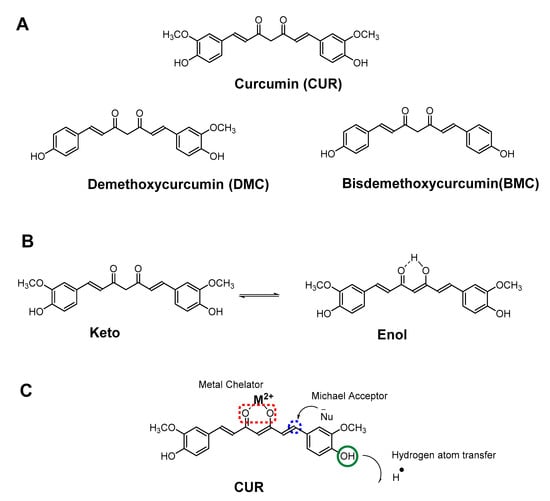
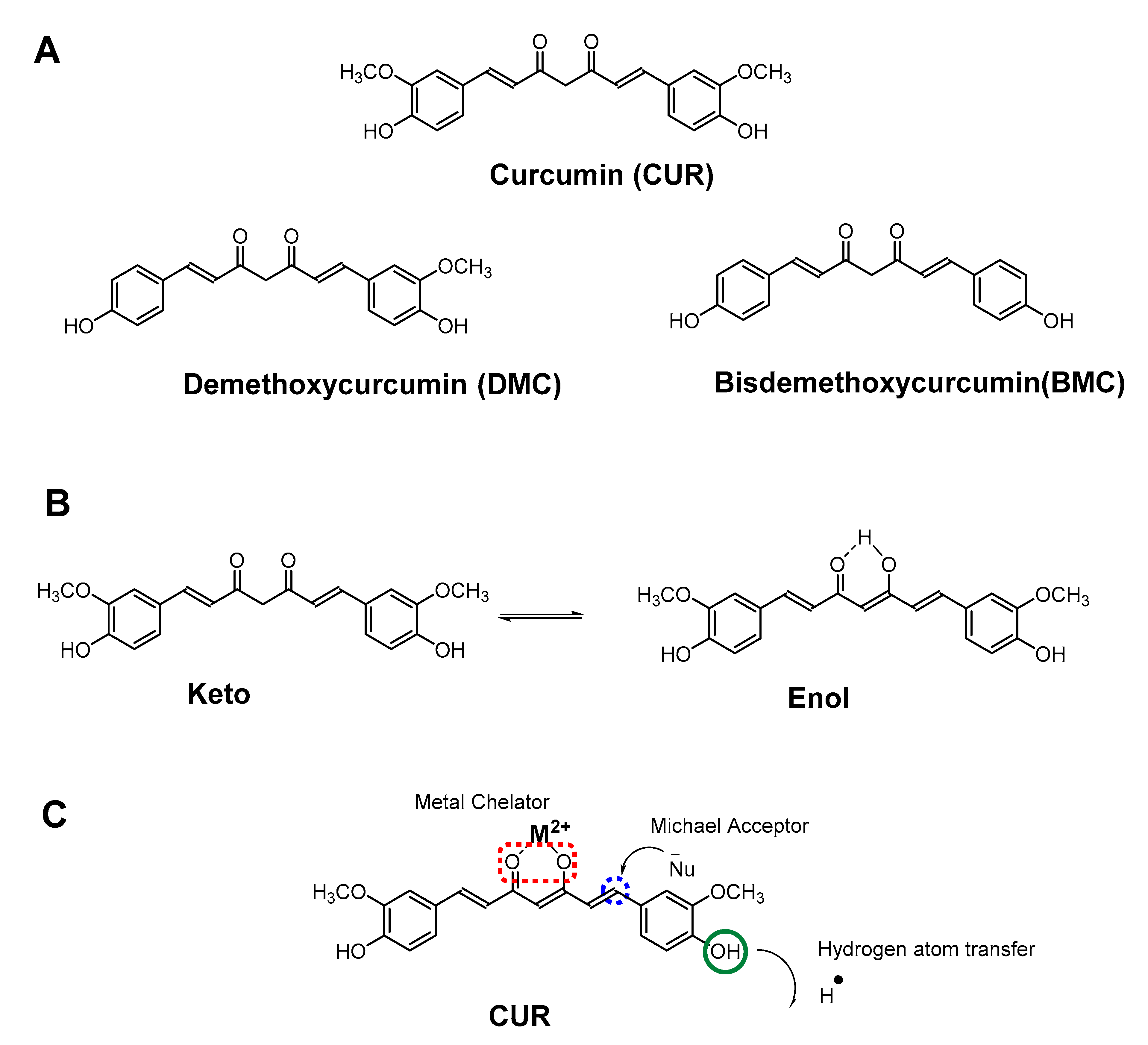
Chemical composition of turmeric consists of approximately 70% carbohydrates, 13% moisture, 6% protein, 6% essential oils (phellandrene, sabinene, cineol, borneol, zingiberene and sesquiterpenes), 5% fat, 3% mineral (potassium, calcium, phosphorus, iron, and sodium), 3–5% curcuminoids, and trace amounts of vitamins (B1, B2, C, and niacin) [5,17,24,50,51]. Among the curcuminoids (Figure 2A), approximately CUR accounts for 77%, DMC accounts for 17% and BMC accounts for 3–6% [17,18].
Figure 2.
(A). Chemical structures of curcuminoids, (B). Keto-enol tautomers of curcumin, and (C). Chemical reactivity sites in curcumin which contribute to its activity and bioavailability.
Curcumin was first isolated by Vogel and Pelletier in 1815 from the rhizomes of C. longa [17,52]. In 1842, Vogel Jr purified curcumin for the first time [17]. After several decades, in 1910, Melabedzka et al. reported the structure of curcumin as diferuloylmethane, or 1,6-heptadiene-3,5-dione-1,7-bis (4-hydroxy-3-methoxyphenyl)-(1E,6E) (Figure 2A) [17]. Three years later, in 1913, Lampe and Melobedzka reported a method for synthesizing curcumin [17,50,53]. In 1953, Srinivasan reported separation and quantification of curcumin components using chromatography [17,54].
Curcumin has two tautomeric forms, keto- and enol (Figure 2B). Curcumin is practically insoluble at room temperature in aqueous solutions at neutral and acidic pH. However, due to lipophilic nature with a log P value of ~3.0, it is soluble in organic solvents like methanol, ethanol, acetone, and dimethyl sulfoxide. Both at neutral and acidic pH, keto form is predominant, however, enol tautomer is exclusively present in alkaline conditions, which can be rationalized by the intramolecular hydrogen bonding in enol form [50,55,56]. The solubility of curcumin in aqueous solution increases under alkaline conditions, but CUR degrades rapidly under both neutral and alkaline conditions. Curcumin shows maximum absorption at 430 nm in methanol and 415–420 nm in acetone [5,57]. In alkaline conditions (pH > 10), CUR is fully deprotonated and shows maximum absorbance at 467 nm. Curcumin has pKa of 8.54 and possesses three labile protons at neutral pH of which one is enolic, and two are phenolic protons.
CUR primarily has three reactive sites, as illustrated in Figure 2C, hydrogen atom donor, Michael acceptor, and a metal chelator [23,24,50]. The α,β-unsaturated β-diketone portion of CUR is an excellent metal chelating agent and forms complexes with several known metal ions. The metal chelating ability of CUR has shown great promise as a therapeutic agent against diseases like Alzheimer’s, cancer, depression, and arthritis [50,58,59,60,61]. CUR forms complexes with all the metals such as Al3+, which are involved in Alzheimer’s, or direct binding to the small β-amyloid species to prevent aggregation and fibril formation [62,63,64,65,66]. Curcumin reduces heavy metal-induced toxicity (oxidative stress) by forming stable complexes with heavy metals like copper (Cu), chromium (Cr), arsenic (As), mercury (Hg), lead (Pb) and cadmium (Cd) [67,68,69,70,71,72]. The β-diketo moiety of curcumin not only reacts as a metal chelator but also involves as a Michael acceptor in nucleophilic addition reactions which occur between a nucleophile (like -OH, SH- and -SeH) and the α,β-unsaturated ketone moiety of curcumin (Figure 2C). In particular, thiol (-SH) groups in glutathiones and enzymes containing -SH and selenol (-SeH) groups, have been shown to react with α,β-unsaturated ketone moiety of curcumin [50,73,74,75,76,77].
2.2. Bioactivity
CUR has an ability to affect multiple biological targets and has been shown to exhibit activity against various diseases, including cancer, cardiovascular disease, neurological and autoimmune diseases) [17,18,19,54]. CUR can modulate several biological targets (including transcription factors, growth factors, inflammatory mediators, cytokines, cell cycle proteins, enzymes, protein kinases, and apoptotic proteins) and cellular pathways [7,17,78]. For instance, CUR modulates tumor growth via regulating multiple signaling pathways, including cell survival, tumor suppressor, caspase pathways, protein kinase, and death receptor pathways [5,7,19].
CUR can inhibit the activation of the transcription factor nuclear factor kappa B (NF-KB), which is responsible for cell survival, cytokine production, and other cellular functions. CUR downregulates the signal transducer and activation transcription (STAT) proteins, which are essential for cell growth, differentiation, and survival [5,19,23]. STAT proteins are also involved in immune system development, function, and clearance. Curcumin upregulates a leucine zipper protein NrF2, which regulates the expression of antioxidant properties that protect the cells from oxidative stress [5,19,23]. Curcuminoids therapeutic effect in treating some of the medical conditions/diseases and related mode of action have been discussed below.
Cancer: Garcea et al. reported that CUR administration resulted in the reduction of M(1)G protein levels, while COX-2 protein levels were unchanged in a malignant colorectal tissue [79]. He et al. reported curcumin treatment overexpressed P53 levels in tumor cells of colorectal cancer patients, which in turn promoted apoptosis [80]. Kim et al. studied the effect of curcumin as an anti-inflammatory agent in HNSCC (head and neck squamous cell carcinoma cancer) patients [81]. In this study, curcumin was found to suppress inflammatory cytokines such as TNF-α, IKKβ kinase, IL-6, and IL-8. CUR can also suppress the activity of protein kinases, including protein kinase (PK)A, phosphorylase kinase (PhK), the mammalian target of rapamycin (mTOR), and mitogen-activated protein kinases (MAPKs) [23] which play essential roles in various cellular responses, including regulation of cell growth, proliferation, division, survival and death.
Cardiovascular: Sahebkar reported that curcuminoids might reduce circulatory C-reactive protein levels, which is a predictor and independent risk factor of cardiovascular disease [82]. Curcumin has also shown to be effective against myocardial infarction and atherosclerosis [83]. CUR also has shown to decrease triglycerides levels, LDL (low-density lipoprotein), and total cholesterol [19]. In another study by Swamy et al. curcumin prevented doxorubicin-induced cardiomyopathy [84]. It increased the level of glutathione (GSH), superoxide dismutase (SOD), and catalase (CAT), while decreased the elevated malondialdehyde (MDA) levels.
Diabetes: CUR was found to be effective in treating diabetes in patients and animal models. Arun and Nalini reported that turmeric or curcumin administration to diabetic rats reduced sugar and hemoglobin levels in the blood [85]. Murugan and Pari in 2007 observed that decreased levels of plasma total protein, albumin, globulin, and albumin/globulin ratio in diabetic rats were brought back to near normal after CUR administration [86]. In diabetic rat models, oral administration of CUR resulted in a significant reduction in blood glucose and a significant increase in plasma insulin levels [86].
While a large number of in vivo experiments and clinical trials claim that CUR has great potential as a therapeutic agent, additional research is needed to confirm and validate the beneficial health claims of CCMs [24]. Pure CUR has been used in many in vitro studies, whereas most in vivo studies and clinical trials use CCMs mixture [24]. These terms (CUR and CCMs) have often been used as synonyms in literature [7,24]. Pagano et al. recently published an overview on the systemic reviews related to the efficacy of curcumin containing nutraceuticals for different health issues [87]. The authors established the search strategy using ’curcum’ or ‘turmeric’ and ‘systematic review’ or ‘meta-analysis’ or ‘clinical trials.’ The authors evaluated the methodological and reporting quality of previous studies using A measurement tool to assess systematic reviews (AMSTAR) and Overview quality assessment questionnaire (OQAQ). The results showed that only 22 systematic reviews (SR) met the authors’ inclusion criteria. Only four of the SRs scored high on the AMSTAR scale, and 12 SRs were high on OQAQ scores. The authors concluded that the efficacy of curcumin containing nutraceuticals was well demonstrated for several health conditions, including skin diseases, arthritis-related diseases, metabolic diseases, and depressive disorders. However, due to the poor quality of primary trials (i.e., number of trials for each systematic review, design, participants, and duration of the treatment) and the analysis methodology used, the uncertainty in bioefficacy of curcumin still exists [87].
2.3. Bioavailability
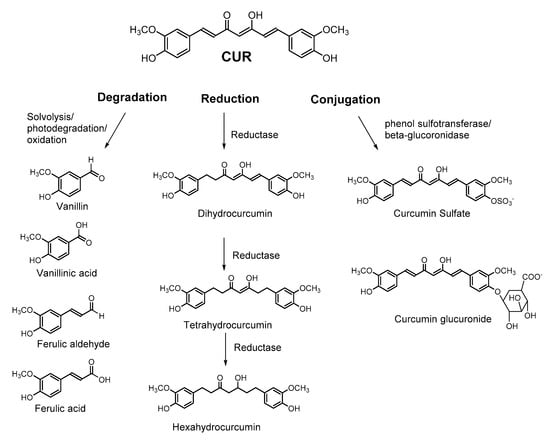
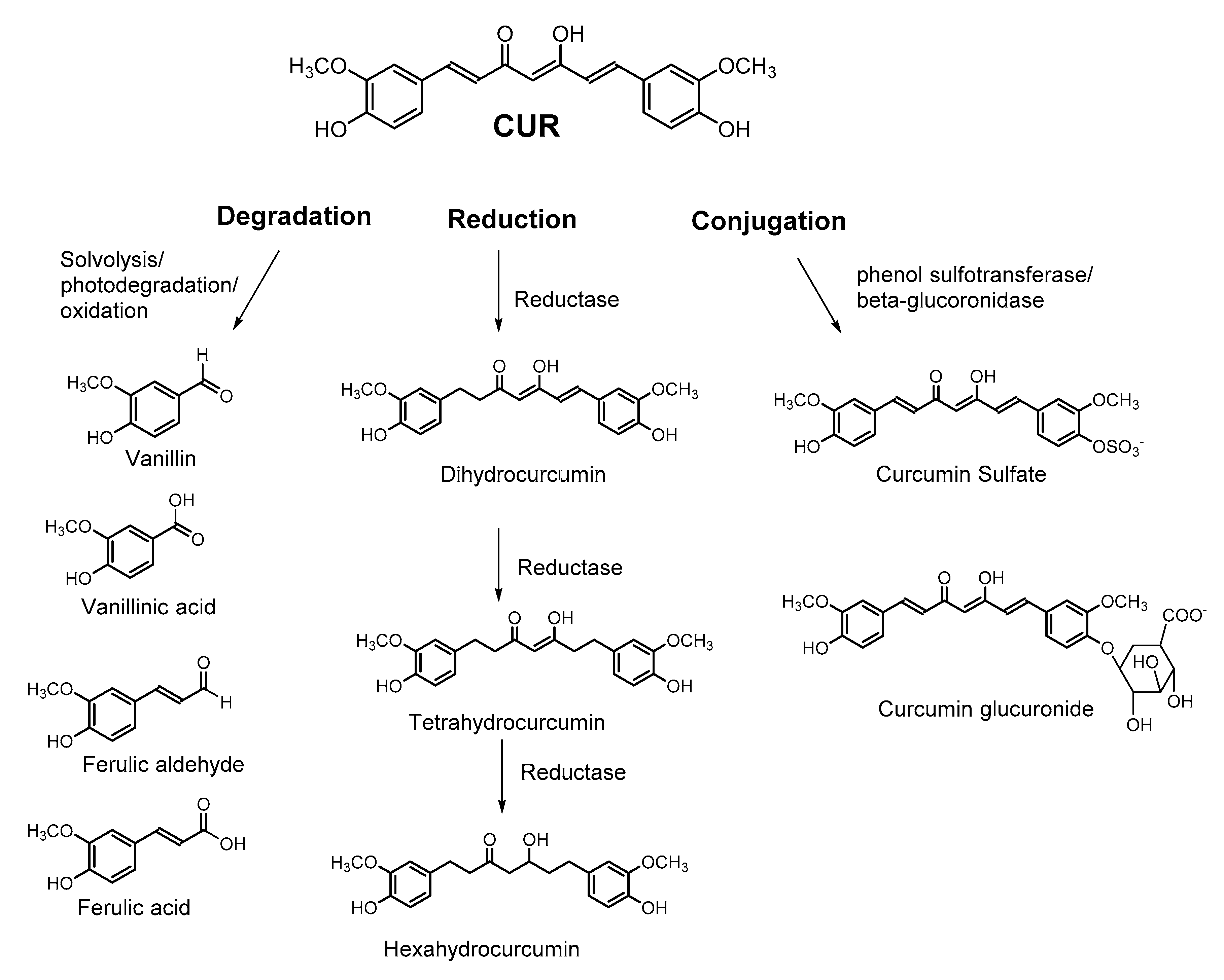
The therapeutic potential of CUR is mainly circumvented by its low bioavailability and poor pharmacokinetic profile (ADME; absorption, distribution, metabolism, and excretion) and short half-life time in the gastrointestinal (GI) tract [18,23]. Another challenge for CUR as a potential therapeutic agent is its poor stability under physiological conditions. For instance, at 37 °C and neutral pH (7.2), curcumin t1/2 was reported less than 10 min [24]. CUR degradation occurs in two pathways: solvolysis and photodegradation [24]. Solvolysis involves the nucleophilic substitution or elimination by solvent molecules. The nucleophile attack occurs on α,β-unsaturated ketone part of CUR (Michael addition). In aqueous alkaline buffer, solvolysis of heptadienone chain results in 90% of CUR degradation to generate vanillin, ferulic acid, ferulic aldehyde, and other products [18,24,50]. Autoxidation of CUR occurs via a radical chain reaction that leads to oxygen incorporation to yield a bicyclopentadione product [22,24]. Several reports suggested that CUR is sensitive to light both in solid and solution forms; hence, curcumin samples should be protected from light exposure. CUR degradation occurs upon exposure to sunlight [50,55] which is commonly observed by quick removal of turmeric stains when exposed to sunlight. Photochemical degradation of CUR occurs in solid as well as solubilized forms to ferulic acid, ferulic aldehyde, vanillin, and vanillic acid [24,50].
CUR metabolism mainly occurs via reduction and conjugation [17,18,22,50,88,89,90]. CUR degradation and metabolism products are shown in Figure 3 [17,18,22,50,88,89,90]. Reduction of CUR primarily occurs through the heptadienone chain double bonds to form di-, tetra-, and octahydrocurcumin, which is facilitated by several enzymes such as NADPH-dependent reductase, alcohol dehydrogenase and an unidentified microsomal enzyme [18,22,50]. Glucuronidation/sulfonation conjugation is the other primary metabolic pathway of CUR in the body. Conjugation primarily occurs at the phenolic oxygen of curcumin via enzymatic reactions [50]. For instance, O-sulfonation of CUR is catalyzed by human phenol sulfotransferase isoenzymes SULT1A1 and SULT1A3 [17,88]. Similarly, glucuronidation is catalyzed by UDP-glucuronosyltransferase [89].
Figure 3.
Curcumin degradation and metabolism products.
3. Formulations
Various types of chemical modifications of CUR (which include use of liposomes, nanoparticles, micelles, phospholipid complexes, polymers, adjuvants) have been developed to improve curcumin solubility, bioavailability, longer circulation time, targeted delivery and ADME profiles [6,18,19,20,21,90,91,92,93,94,95,96,97,98,99,100]. Nano-, micro-formulations have gained a great focus because of the advantages associated with them, including increased solubility, improved cellular uptake, target specificity), decreased degradation, increased bioavailability, circulation times, and ADME profiles [7,101]. Various types of CUR formulations and delivery systems have been reported in the literature, including liposomes, lipid-based nanoparticles, polymeric nanoparticles, micelles, microemulsions, metal-based nanoparticles [21]. Table 1 summarizes some of the CUR formulations used for animal studies and clinical trials along with their outcomes.
Table 1.
Several curcumin formulations and their clinical or in-vivo outcomes.
Among the multiple curcumin-formulations [15,21,102,103,104,105,106,107,108,109,110,111,112,113,114,115,116,117,118,119,120,121,122,123,124,125,126,127,128,129], the phytosomal formulation of CUR (Meriva), which is a complex of curcumin with phosphatidylcholine, is one of the well-studied curcumin-formulation (Table 1). Meriva is prepared by adding phospholipids to the hydroalcoholic extract of turmeric rhizomes under reflux conditions [21]. Meriva has shown improved bioavailability and pharmacokinetic profiles than the uncomplexed curcumin [21]. There have been several studies focusing on the efficacy of phytosomal curcumin in treating conditions such as cancer, inflammatory diseases, and diabetes. The data suggest that the phytosomal curcumin formulation has excellent properties as a delivery system [15,21].
Belcaro et al. reported a clinical study to assess a proprietary lecithin delivery system of CUR (Meriva) during chemo- and radiotherapy in 160 cancer patients [112]. The authors concluded that formulated CUR could potentially lower the pain side-effects caused during cancer therapy. In another study, a randomized, double-blind, placebo-controlled trial was carried out by Panahi et al. [103] on 80 subjects with solid tumors. This study supported the clinical efficacy of curcuminoids adjuvant therapy by improving the quality of life (QoL) of patients with solid tumors. In another study, an eight-week open, random, controlled clinical trial was conducted on 141 patients who were affected by neuropathic pain [113]. The purpose of the study was to evaluate the role of adjunctive therapy (a multi-ingredient formulation which consists of lipoic acid, CUR, and piperine) to dexibuprofen administration. This treatment indeed reduced neuropathic pain by more than 2/3. Moreover, this treatment reduced dexibuprofen usage by 40% [113].
Theracurmin, another CUR formulation consisting of dispersed curcumin with colloidal nanoparticles, was studied for improved bioavailability [114,115] and its efficacy in treating osteoarthritis compared to turmeric powder itself [116]. Theracurmin was shown to have greater bioavailability than turmeric powder by 40 fold in rats and 27 fold higher in humans [114]. A clinical study conducted by Nakagawa et al. concluded that Theracurmin was found to be effective in decreasing pain without causing any side effects [116].
Apart from Meriva and Theracurmin, several other CUR formulations have been reported in the literature [117,118,119,120,121,122,123,124,125,126,127,128,129]. Kakkar and Kaur reported a significant reduction in AlCl3 related neurotoxicity in male lacca mice [117] using a solid lipid nanoparticle CUR formulation [117]. Similarly, Nayak et al. reported curcuminoids loaded nanoparticles, which showed improved antimalarial activity in Albino mice [121]. In a clinical study on 60 periodontitis patients treated with CUR collagen sponge, Gottumukkala et al. found a significant reduction in the clinical (plaque and gingival index scores) and microbiological (BANA test and microbial colony count) parameters [129].
4. Sample Preparation for Analysis
Sample preparation plays a vital role in the accurate quantification of analytes from various matrices [7,34]. Often the concentration of the analyte of interest in samples is low and endogenous matrix components, and their degraded products (generated at elevated temperatures during the sample preparation) may interfere with the assay of the analyte of interest [27,28]. As a wide range of formulations for curcuminoids has emerged in the global market, there is a distinct need for developing robust, validated methods for their extraction and analysis [7]. This will also be important for the analysis of their biosafety, toxicity, bioactivities, and other health claims. Hence, an ideal sample preparation method should be simple, fast, and yielding maximum analyte recovery efficiently and minimum (or no) matrix interferences. Table 2 shows various sample preparation protocols used for extraction and analysis of curcuminoids from a wide array of matrices (biological-plasma and tissue, plant -rhizome and foods) as well as different formulations [13,25,26,27,28,29,31,32,33,35,36,37,38,39,130,131].
Table 2.
Several sample preparation techniques used for the extraction of curcuminoids.
CUR extraction from powdered rhizomes has been carried out using various extraction techniques, conditions, and solvents (Table 2). Among those methods, ultrasonication, reflux, pressurized liquid extraction, and microwave-assisted extractions are commonly used [13,29,32,36,38]. Liu et al. carried out CUR extraction from powdered rhizome using ultrasonication with acetonitrile: ethanol mixture (1:2, v/v) with 82% recovery efficiency [38]. In another case, Ashraf et al. reported CUR extraction using reflux in methanol for two hours at 70 °C with 99% recovery [29]. Similarly, Chao used pressurized liquid extraction technique (100 °C temperature and 1500 psi of pressure) with ethanol as a solvent to quantitatively (93–101%)recover curcumin [32]. Dandekar and Gaikar reported a microwave-assisted extraction (MAE) of curcuminoids from turmeric into various organic solvents such as acetone, ethyl alcohol, and isopropyl alcohol [132]. Using their optimized method, they extracted 60% of curcuminoids in acetone in 1 min. Later, Wakte et al. reported that water-soaked irradiated Curcuma powder in acetone solvent yielded 90% recovery of curcuminoids in 5 min [13].
Sample preparation techniques to extract CUR from different formulations and matrices are shown in Table 2. Kumar et al. used a simple sonication method using methanol solvent to extract ~99% of curcumin from a tablet form [33]. Similarly, Liang et al. used an extraction method with methanol and diluted HCl to extract CUR quantitatively (93–101%) from Tiantai No.1 pills [31]. Silva-Buzanello et al. reported curcumin extraction from poly (L-lactic acid) nanoparticles by adding dichloromethane to dried nanoparticles and precipitated polymer by adding methanol [39]. Using this method, authors reported ~86% of recovery of curcumin [39].
Protein precipitation and liquid-liquid extractions are commonly used to extract analytes (drugs and their metabolites) from biological samples (plasma and tissues). Kunati et al. reported CUR extraction from human plasma using protein precipitation in methanol with 0.1% formic acid [25]. After protein precipitation, the resulting solution was centrifuged, the supernatant was collected, dried under nitrogen and reconstituted in an appropriate solvent for analysis. Similarly, Li et al. used acetonitrile protein precipitation, followed by size-exclusion chromatography [26]. After the protein precipitation, the resulting mixture was centrifuged, and the supernatant was transferred to an OMEGA NANOSEP 10K nanosep size-exclusion tube. The resulting extract was used for the analysis. Jade et al. extracted curcumin from human plasma using ethyl acetate (liquid-liquid extraction) for three times. Ramalingam analyzed curcumin from mouse plasma and brain tissue by adding sodium hydroxide followed by ethyl acetate extraction [28].
From the literature summary presented in Table 2, Table 3 and Table 4, it is evident that the optimization of the sample preparation has not been the focus of peer-reviewed publications. This is evident as a wide range of solvents, solid-to-solvent ratio, extraction times, and techniques used for the analysis of the curcuminoids from different matrices. Recently, Yulianto et al. [130] and Chao et al. [32] used a pressurized liquid extractor for the extraction of curcuminoids from the powdered rhizome. Chao determined that the optimum conditions for the extraction of curcuminoids on the laboratory scale using accelerated solvent extractor was achieved with ethanol as extraction solvent at 100 °C, 1500 psi pressure, extraction time of 5 min, and a flush volume of 60% [32]. However, when water was used as an extraction solvent, the temperature was the critical factor that impacted the extraction efficiency [130]. Therefore, optimization of extraction and analysis protocols are needed to quantify curcuminoids content in different matrices accurately.
Table 3.
A summary of recent literature on simple spectroscopic and chromatographic methods used for the assay of turmeric samples.
Table 4.
A brief summary of recent literature on the LC-MS analytical methods used for the assay of turmeric samples.
5. Methods for Qualitative and Quantitative Analysis
Sensitive, accurate, and robust analytical methods are required for CUR quantification because a) CUR levels in plasma/serum/tissues are low due to poor bioavailability, rapid metabolism, and degradation, b) matrix interferences, and c) proper evaluation of bioefficacy and understanding mechanism/mode of action [7,26].
Each analytical technique has its advantages and limitations. For instance, thin layer chromatography (TLC) is an analytical technique classically used to separate analytes from mixtures/matrix interferences. This technique is relatively easy to operate; however, it provides poor resolution and is primarily useful for the qualitative/semi-quantitative analysis of analytes that occur in comparatively higher concentrations. On the other hand, LC-MS/MS is a powerful analytical tool for the sample analysis, both qualitatively and quantitively. Tandem mass spectrometry techniques provide not only accurate structural information of the analyte but also accurate measurements of the analytes even at very low concentrations (nano to picogram/mL) [7,26,133]. On the downside, LC-MS/MS instrumentation is expensive and requires a significant amount of technical expertise and maintenance. The techniques used for sample analysis are primarily dependent on the instrument availability and the research objective of the study. Table 3 [33,38,39,40,41,42,43,44,45,46,47,48,49,134,135] and Table 4 [14,25,26,27,28,29,30,31,35,36,37,93,96,133,136,137,138,139,140,141,142,143,144,145] summarize the various instrumentation and methods used to study and quantify curcumin in different matrices.
Spectroscopy techniques like Fourier transform (FT) infrared (IR), near-infrared (NIR), Raman, and ultraviolet/visible (UV-Vis) spectroscopic methods have been used for qualitative and quantitative analysis of curcuminoids and commonly found adulterants. Dhakal et al. used FT-IR and Raman for easy identification of the adulterant (metanil yellow and Sudan-I) from ground turmeric. The authors concluded that FT-Raman is more sensitive than FT-IR in detecting metanil yellow in turmeric [41]. Tanaka et al. used NIR coupled with multivariate analysis to quantify curcuminoids in Curcuma rhizome and compared results with HPLC quantification [43]. Authors observed that prediction by partial least-squares regression showed high correlation with HPLC quantification results. Curcuminoids show strong UV-Vis absorption at a λmax of 425 nm [24,50] and UV-Vis spectroscopy can easily be used for quantification of CCMs if sample matrix or other components present have no absorption in this range. The main advantages of spectroscopic based analysis are speed, ease, and cost-effectiveness. However, the above techniques are not as sensitive as mass spectrometry and often suffers from the matrix interferences that have components showing absorption at the same wavelength as the analyte. Spectroscopic methods (UV, IR, and NIR) can be used as a high throughput screening tools. All the spectroscopic techniques are influenced by matrix and often require confirmation using more specific detection techniques (HPLC or HPLC coupled with mass spectrometry) [7].
Chromatography is a powerful and robust technique for both qualitative and quantitative analysis of various types of analytes [7,34]. In particular, more than 2/3 of the analytical methodologies for CUR quantification are based on separation techniques with HPLC being the most dominant choice [7]. Chromatography is a separation technique, where analytes are separated based on their physical and chemical properties. Thin layer chromatography (TLC) and high-performance thin layer chromatography (HPTLC) are the separation techniques which address the issue of matrix interferences. While TLC primarily is used for qualitative analysis purpose, HPTLC can be used for both qualitative and quantitative purpose. The disadvantage of the HPTLC technique is a lack of sensitivity, resolution, and issues associated with the reproducibility. Table 3 summarizes the details of different non-LC-MS methods used in the literature for detecting adulteration and analysis of curcuminoids for different matrices.
HPLC techniques have been extensively used for the quantification of analytes in various fields. HPLC can be coupled to different detectors such as UV, fluorescence, and mass spectrometer (MS) (Table 3 and Table 4). While all detectors have their own advantages and limitations, MS has been proved to be a very useful, sensitive, accurate, and robust detector. For the separation of CUR using HPLC, mostly reverse-phase liquid chromatography, particularly C18 columns with different particle sizes have been used. While most of the reports are based on C18 columns, C8 and other columns have been used for CUR separation (Table 4). In recent years, due to the surge in animal studies and clinical trials on CUR efficacy as a therapeutic agent, there has been a high demand for rapid and sensitive analytical methods to quantify curcumin in trace quantities. As a result, a number of LC-MS/MS based methods have been developed and validated as MS detectors offer greater sensitivity and accuracy in quantification, as presented in Table 4 [14,25,26,27,28,29,30,31,35,36,37,93,96,133,136,137,138,139,140,141,142,143,144,145]. For instance, Huang et al. recently reported a validated LC-MS/MS method to quantify CUR and other compounds with an excellent low limit of quantification (LLOQ) of 0.01 ng/mL (10 pg/mL) and low limit of detection (LOD) of 0.004 ng/mL (4 pg/mL) [133]. Similarly, Ahmad et al. reported a validated LC-MS/MS method with LLOQ of 0.05 ng/mL and LOD of 0.02 ng/mL for curcumin quantification in rat brain homogenate and plasma [139].
6. Conclusions
The evidence for curcumin (CUR) as a potential therapeutic agent and nutraceutical has increased in recent decades. This is evident from the development of a large number of curcumin formulations. This increased interest has spurred the growth of in vivo, in vitro, clinical trials to evaluate the bioefficacy of CUR and curcuminoids. To support this research, there have been developments in sample preparation and analyses methodologies to screen, isolate, and quantify curcuminoids from different matrices and detect adulterants. Accurate analysis of curcuminoids in various plant matrices, formulations, and biological samples, has become an important aspect to evaluate CCMs efficacy, bioavailability, and pharmacokinetic profiles accurately.
Extraction of curcuminoids from plant, food and formulations matrices can be accomplished using an alcohol solvent (methanol or ethanol) with either ultrasonication, reflux or pressurized liquid extraction techniques. For extracting curcuminoids from in vitro, in vivo, and clinical samples, protein precipitation using acetonitrile/methanol and liquid-liquid extraction techniques are preferred. Spectroscopic methods can be used for rapid screening of curcuminoids and detection of adulterants in turmeric and related products. For accurate quantification and detection of trace amounts of curcuminoids and metabolites, chromatographic separation coupled to mass spectrometry detection (LC-MS/MS) methods should be used as they provide high accuracy, reproducibility, and high sensitivity with low LOD and LLOQ.
Funding
This work was supported by the Agricultural Research Service, US Department of Agriculture. Project # 1235-52000-066-00D and Office of Dietary Supplements, National Institute of Health grant AOD 19006-001-00000.
Conflicts of Interest
The authors declare no conflict of interest.
Abbreviations
The frequently used abbreviations:
| BMC | bisdemethoxycurcumin |
| CUR | Curcumin |
| CCMs | Curcuminoids |
| DMC | Demethoxycurcumin |
| FT | Fourier transform |
| HPLC | High Performance Liquid Chromatography |
| HPTLC | High Performance Thin Layer Chromatography |
| IR | Infrared |
| LC-MS/MS | Liquid chromatography coupled with tandem mass spectrometry |
| NIR | Near-infrared |
| TLC | Thin layer chromatography |
| uHPLC | Ultra-High Performance Liquid Chromatography |
| UV-Vis | Ultraviolet/visible |
References
- Kunnumakkara, A.B.; Sailo, B.L.; Banik, K.; Harsha, C.; Prasad, S.; Gupta, S.C.; Bharti, A.C.; Aggarwal, B.B. Chronic diseases, inflammation, and spices: How are they linked? J. Transl. Med. 2018, 16, 14. [Google Scholar] [CrossRef] [Scilit] [PubMed]
- Hewlings, S.; Kalman, D. Curcumin: A Review of Its’ Effects on Human Health. Foods 2017, 6, 92. [Google Scholar] [CrossRef] [Scilit] [PubMed]
- Das, L.; Bhaumik, E.; Raychaudhuri, U.; Chakraborty, R. Role of nutraceuticals in human health. J. Food Sci. Technol. 2012, 49, 173–183. [Google Scholar] [CrossRef] [Scilit] [PubMed]
- Santini, A.; Tenore, G.C.; Novellino, E. Nutraceuticals: A paradigm of proactive medicine. Eur. J. Pharm. Sci. 2017, 96, 53–61. [Google Scholar] [CrossRef] [Scilit] [PubMed]
- Goel, A.; Kunnumakkara, A.B.; Aggarwal, B.B. Curcumin as “Curecumin”: From kitchen to clinic. Biochem. Pharmacol. 2008, 75, 787–809. [Google Scholar] [CrossRef] [Scilit] [PubMed]
- Amalraj, A.; Pius, A.; Gopi, S.; Gopi, S. Biological activities of curcuminoids, other biomolecules from turmeric and their derivatives—A review. J. Tradit. Complement. Med. 2017, 7, 205–233. [Google Scholar] [CrossRef] [Scilit] [PubMed]
- Alves, R.C.; Fernandes, R.P.; Fonseca-Santos, B.; Victorelli, F.D.; Chorilli, M. A Critical Review of the Properties and Analytical Methods for the Determination of Curcumin in Biological and Pharmaceutical Matrices. Crit. Rev. Anal. Chem. 2019, 49, 138–149. [Google Scholar] [CrossRef] [Scilit]
- Araújo, C.; Leon, L. Biological activities of Curcuma longa L. Mem. Inst. Oswaldo Cruz 2001, 96, 723–728. [Google Scholar] [CrossRef] [Scilit]
- Prasad, S.; Aggarwal, B.B. Turmeric, the Golden Spice: From Traditional Medicine to Modern Medicine. In Herbal Medicine: Biomolecular and Clinical Aspects; Benzie, I.F.F., Wachtel-Galor, S., Eds.; CRC Press/Taylor & Francis: Boca Raton, FL, USA, 2011; ISBN 978-1-4398-0713-2. [Google Scholar]
- Herbal Supplements Market Size & Share | Industry Report, 2018–2025. Available online: https://www.grandviewresearch.com/industry-analysis/turmeric-extract-curcumin-market (accessed on 27 May 2019).
- Turmeric: Global Market Volume 2017–2027 | Statistic. Available online: https://www.statista.com/statistics/740259/global-turmeric-market-volume/ (accessed on 27 May 2019).
- Moghadamtousi, S.Z.; Kadir, H.A.; Hassandarvish, P.; Tajik, H.; Abubakar, S.; Zandi, K. A Review on Antibacterial, Antiviral, and Antifungal Activity of Curcumin. BioMed Res. Int. 2014, 2014, 186864. [Google Scholar]
- Wakte, P.S.; Sachin, B.S.; Patil, A.A.; Mohato, D.M.; Band, T.H.; Shinde, D.B. Optimization of microwave, ultra-sonic and supercritical carbon dioxide assisted extraction techniques for curcumin from Curcuma longa. Sep. Purif. Technol. 2011, 79, 50–55. [Google Scholar] [CrossRef] [Scilit]
- Gopi, S.; Jacob, J.; Varma, K.; Jude, S.; Amalraj, A.; Arundhathy, C.A.; George, R.; Sreeraj, T.R.; Divya, C.; Kunnumakkara, A.B.; et al. Comparative Oral Absorption of Curcumin in a Natural Turmeric Matrix with Two Other Curcumin Formulations: An Open-label Parallel-arm Study. Phytother. Res. 2017, 31, 1883–1891. [Google Scholar] [CrossRef] [Scilit] [PubMed]
- Gupta, S.C.; Patchva, S.; Aggarwal, B.B. Therapeutic Roles of Curcumin: Lessons Learned from Clinical Trials. AAPS J. 2013, 15, 195–218. [Google Scholar] [CrossRef] [Scilit] [PubMed]
- Lao, C.D.; Ruffin, M.T.; Normolle, D.; Heath, D.D.; Murray, S.I.; Bailey, J.M.; Boggs, M.E.; Crowell, J.; Rock, C.L.; Brenner, D.E. Dose escalation of a curcuminoid formulation. BMC Complement. Altern. Med. 2006, 6, 10. [Google Scholar] [CrossRef] [Scilit]
- Prasad, S.; Gupta, S.C.; Tyagi, A.K.; Aggarwal, B.B. Curcumin, a component of golden spice: From bedside to bench and back. Biotechnol. Adv. 2014, 32, 1053–1064. [Google Scholar] [CrossRef] [Scilit] [PubMed]
- Anand, P.; Kunnumakkara, A.B.; Newman, R.A.; Aggarwal, B.B. Bioavailability of Curcumin: Problems and Promises. Mol. Pharm. 2007, 4, 807–818. [Google Scholar] [CrossRef] [Scilit] [PubMed]
- Kunnumakkara, A.B.; Bordoloi, D.; Padmavathi, G.; Monisha, J.; Roy, N.K.; Prasad, S.; Aggarwal, B.B. Curcumin, the golden nutraceutical: Multitargeting for multiple chronic diseases. Br. J. Pharmacol. 2017, 174, 1325–1348. [Google Scholar] [CrossRef] [Scilit] [PubMed]
- Hussain, Z.; Thu, H.E.; Ng, S.-F.; Khan, S.; Katas, H. Nanoencapsulation, an efficient and promising approach to maximize wound healing efficacy of curcumin: A review of new trends and state-of-the-art. Colloids Surf. B Biointerfaces 2017, 150, 223–241. [Google Scholar] [CrossRef] [Scilit]
- Mirzaei, H.; Shakeri, A.; Rashidi, B.; Jalili, A.; Banikazemi, Z.; Sahebkar, A. Phytosomal curcumin: A review of pharmacokinetic, experimental and clinical studies. Biomed. Pharmacother. 2017, 85, 102–112. [Google Scholar] [CrossRef] [Scilit] [PubMed]
- Schneider, C.; Gordon, O.N.; Edwards, R.L.; Luis, P.B. Degradation of Curcumin: From Mechanism to Biological Implications. J. Agric. Food Chem. 2015, 63, 7606–7614. [Google Scholar] [CrossRef] [Scilit]
- Ghosh, S.; Banerjee, S.; Sil, P.C. The beneficial role of curcumin on inflammation, diabetes and neurodegenerative disease: A recent update. Food Chem. Toxicol. 2015, 83, 111–124. [Google Scholar] [CrossRef] [Scilit] [PubMed]
- Nelson, K.M.; Dahlin, J.L.; Bisson, J.; Graham, J.; Pauli, G.F.; Walters, M.A. The Essential Medicinal Chemistry of Curcumin: Miniperspective. J. Med. Chem. 2017, 60, 1620–1637. [Google Scholar] [CrossRef] [Scilit] [PubMed]
- Kunati, S.R.; Yang, S.; William, B.M.; Xu, Y. An LC-MS/MS method for simultaneous determination of curcumin, curcumin glucuronide and curcumin sulfate in a phase II clinical trial. J. Pharm. Biomed. Anal. 2018, 156, 189–198. [Google Scholar] [CrossRef] [Scilit] [PubMed]
- Li, W.; Yang, H.; Buckley, B.; Wang, L.; Kong, A.-N. A Novel Triple Stage Ion Trap MS method validated for curcumin pharmacokinetics application: A comparison summary of the latest validated curcumin LC/MS methods. J. Pharm. Biomed. Anal. 2018, 156, 116–124. [Google Scholar] [CrossRef] [Scilit] [PubMed]
- Chen, Z.; Sun, D.; Bi, X.; Zeng, X.; Luo, W.; Cai, D.; Zeng, Q.; Xu, A. Pharmacokinetic based study on “lagged stimulation” of Curcumae Longae Rhizoma—Piper nigrum couplet in their main active components’ metabolism using UPLC-MS-MS. Phytomedicine 2017, 27, 15–22. [Google Scholar] [CrossRef] [Scilit] [PubMed]
- Ramalingam, P.; Ko, Y.T. A validated LC-MS/MS method for quantitative analysis of curcumin in mouse plasma and brain tissue and its application in pharmacokinetic and brain distribution studies. J. Chromatogr. B 2014, 969, 101–108. [Google Scholar] [CrossRef] [Scilit] [PubMed]
- Ashraf, K.; Mujeeb, M.; Ahmad, A.; Ahmad, N.; Amir, M. Determination of Curcuminoids in Curcuma longa Linn. by UPLC/Q-TOF-MS: An Application in Turmeric Cultivation. J. Chromatogr. Sci. 2015, 53, 1346–1352. [Google Scholar] [CrossRef] [Scilit] [PubMed]
- Liu, Y.; Siard, M.; Adams, A.; Keowen, M.L.; Miller, T.K.; Garza, F., Jr.; Andrews, F.M.; Seeram, N.P. Simultaneous quantification of free curcuminoids and their metabolites in equine plasma by LC-ESI-MS/MS. J. Pharm. Biomed. Anal. 2018, 154, 31–39. [Google Scholar] [CrossRef] [Scilit]
- Liang, S.; Zeng, Y.; Wu, J.; Li, Z.; Luo, H.; Wu, Z. Development and Validation of a Rapid and Specific UHPLC–MS/MS Method for Simultaneous Determination of 21 Bioactive Components in Tiantai No. 1 Pill and Rat Plasma. Chromatographia 2018, 81, 447–456. [Google Scholar] [CrossRef] [Scilit]
- Chao, I.-C.; Wang, C.-M.; Li, S.-P.; Lin, L.-G.; Ye, W.-C.; Zhang, Q.-W. Simultaneous Quantification of Three Curcuminoids and Three Volatile Components of Curcuma longa Using Pressurized Liquid Extraction and High-Performance Liquid Chromatography. Molecules 2018, 23, 1568. [Google Scholar] [CrossRef] [Scilit]
- Kumar, G.; Ganguly, P.; Singh, R.; Katiyar, C. Simultaneous Determination of Salicin, Curcumin and Gallic Acid in Herbal Pain Relief Tablet by High Performance Thin Layer Chromatography. Int. J. Res. Pharm. Biosci. 2018, 5, 1–6. [Google Scholar]
- Rohman, A. Analysis of curcuminoids in food and pharmaceutical products. Int. Food Res. J. 2012, 19, 19–27. [Google Scholar]
- Jude, S.; Amalraj, A.; Kunnumakkara, A.; Divya, C.; Löffler, B.-M.; Gopi, S. Development of Validated Methods and Quantification of Curcuminoids and Curcumin Metabolites and Their Pharmacokinetic Study of Oral Administration of Complete Natural Turmeric Formulation (Cureit™) in Human Plasma via UPLC/ESI-Q-TOF-MS Spectrometry. Molecules 2018, 23, 2415. [Google Scholar] [CrossRef] [Scilit]
- Jia, S.; Du, Z.; Song, C.; Jin, S.; Zhang, Y.; Feng, Y.; Xiong, C.; Jiang, H. Identification and characterization of curcuminoids in turmeric using ultra-high performance liquid chromatography-quadrupole time of flight tandem mass spectrometry. J. Chromatogr. A 2017, 1521, 110–122. [Google Scholar] [CrossRef] [Scilit]
- Huang, Y.-S.; Hsieh, T.-J.; Lu, C.-Y. Simple analytical strategy for MALDI-TOF-MS and nanoUPLC–MS/MS: Quantitating curcumin in food condiments and dietary supplements and screening of acrylamide-induced ROS protein indicators reduced by curcumin. Food Chem. 2015, 174, 571–576. [Google Scholar] [CrossRef] [Scilit]
- Liu, X.; Zhu, L.; Gao, X.; Wang, Y.; Lu, H.; Tang, Y.; Li, J. Magnetic molecularly imprinted polymers for spectrophotometric quantification of curcumin in food. Food Chem. 2016, 202, 309–315. [Google Scholar] [CrossRef] [Scilit]
- Da Silva-Buzanello, R.A.; Ferro, A.C.; Bona, E.; Cardozo-Filho, L.; De Araújo, P.H.H.; Leimann, F.V.; Gonçalves, O.H. Validation of an Ultraviolet-visible (UV-Vis) technique for the quantitative determination of curcumin in poly(l-lactic acid) nanoparticles. Food Chem. 2015, 172, 99–104. [Google Scholar] [CrossRef] [Scilit]
- Jayaprakasha, G.K.; Rao, L.J.M.; Sakariah, K.K. Improved HPLC Method for the Determination of Curcumin, Demethoxycurcumin, and Bisdemethoxycurcumin. J. Agric. Food Chem. 2002, 50, 3668–3672. [Google Scholar] [CrossRef] [Scilit]
- Dhakal, S.; Chao, K.; Schmidt, W.; Qin, J.; Kim, M.; Chan, D. Evaluation of Turmeric Powder Adulterated with Metanil Yellow Using FT-Raman and FT-IR Spectroscopy. Foods 2016, 5, 36. [Google Scholar] [CrossRef] [Scilit]
- Dhakal, S.; Chao, K.; Schmidt, W.; Qin, J.; Kim, M.; Huang, Q. Detection of Azo Dyes in Curry Powder Using a 1064-nm Dispersive Point-Scan Raman System. Appl. Sci. 2018, 8, 564. [Google Scholar] [CrossRef] [Scilit]
- Tanaka, K.; Kuba, Y.; Sasaki, T.; Hiwatashi, F.; Komatsu, K. Quantitation of Curcuminoids in Curcuma Rhizome by Near-infrared Spectroscopic Analysis. J. Agric. Food Chem. 2008, 56, 8787–8792. [Google Scholar] [CrossRef] [Scilit]
- Kim, Y.-J.; Lee, H.J.; Shin, H.-S.; Shin, Y. Near-infrared Reflectance Spectroscopy as a Rapid and Non-destructive Analysis Tool for Curcuminoids in Turmeric. Phytochem. Anal. 2014, 25, 445–452. [Google Scholar] [CrossRef] [Scilit]
- Mangolim, C.S.; Moriwaki, C.; Nogueira, A.C.; Sato, F.; Baesso, M.L.; Neto, A.M.; Matioli, G. Curcumin–β-cyclodextrin inclusion complex: Stability, solubility, characterisation by FT-IR, FT-Raman, X-ray diffraction and photoacoustic spectroscopy, and food application. Food Chem. 2014, 153, 361–370. [Google Scholar] [CrossRef] [Scilit]
- Gören, A.C.; Çıkrıkçı, S.; Çergel, M.; Bilsel, G. Rapid quantitation of curcumin in turmeric via NMR and LC-tandem mass spectrometry. Food Chem. 2009, 113, 1239–1242. [Google Scholar] [CrossRef] [Scilit]
- Kharat, S.; Namdeo, A.; Mehta, P. Development and validation of HPTLC method for simultaneous estimation of curcumin and galangin in polyherbal capsule dosage form. J. Taibah Univ. Sci. 2017, 11, 775–781. [Google Scholar] [CrossRef] [Scilit]
- Gad, H.A.; Bouzabata, A. Application of chemometrics in quality control of Turmeric (Curcuma longa) based on Ultra-violet, Fourier transform-infrared and 1H NMR spectroscopy. Food Chem. 2017, 237, 857–864. [Google Scholar] [CrossRef] [Scilit]
- Mudge, E.; Chan, M.; Venkataraman, S.; Brown, P.N. Curcuminoids in Turmeric Roots and Supplements: Method Optimization and Validation. Food Anal. Methods 2016, 9, 1428–1435. [Google Scholar] [CrossRef] [Scilit]
- Priyadarsini, K. The Chemistry of Curcumin: From Extraction to Therapeutic Agent. Molecules 2014, 19, 20091–20112. [Google Scholar] [CrossRef] [Scilit]
- Strimpakos, A.S.; Sharma, R.A. Curcumin: Preventive and Therapeutic Properties in Laboratory Studies and Clinical Trials. Antioxid. Redox Signal. 2008, 10, 511–546. [Google Scholar] [CrossRef] [Scilit]
- Vogel, H.A.; Pelletier, J. Curcumin-biological and medicinal properties. J. Pharma 1815, 2, 50. [Google Scholar]
- Lampe, V.; Milobedzka, J. Studien uber Curcumin. Ber. Dtsch. Chem. Ges. 1913, 46, 2235–2240. [Google Scholar] [CrossRef] [Scilit]
- Gupta, S.C.; Patchva, S.; Koh, W.; Aggarwal, B.B. Discovery of Curcumin, a Component of the Golden Spice, and Its Miraculous Biological Activities. Clin. Exp. Pharmacol. Physiol. 2012, 39, 283–299. [Google Scholar] [CrossRef] [Scilit] [PubMed]
- Priyadarsini, K.I. Photophysics, photochemistry and photobiology of curcumin: Studies from organic solutions, bio-mimetics and living cells. J. Photochem. Photobiol. C Photochem. Rev. 2009, 10, 81–95. [Google Scholar] [CrossRef] [Scilit]
- Payton, F.; Sandusky, P.; Alworth, W.L. NMR Study of the Solution Structure of Curcumin. J. Nat. Prod. 2007, 70, 143–146. [Google Scholar] [CrossRef] [Scilit] [PubMed]
- Aggarwal, B.B.; Kumar, A.; Bharti, A.C. Anticancer potential of curcumin: Preclinical and clinical studies. Anticancer Res. 2003, 23, 363–398. [Google Scholar] [PubMed]
- Banerjee, S.; Chakravarty, A.R. Metal Complexes of Curcumin for Cellular Imaging, Targeting, and Photoinduced Anticancer Activity. Acc. Chem. Res. 2015, 48, 2075–2083. [Google Scholar] [CrossRef] [Scilit] [PubMed]
- Wanninger, S.; Lorenz, V.; Subhan, A.; Edelmann, F.T. Metal complexes of curcumin—Synthetic strategies, structures and medicinal applications. Chem. Soc. Rev. 2015, 44, 4986–5002. [Google Scholar] [CrossRef] [Scilit] [PubMed]
- Mei, X.; Xu, D.; Xu, S.; Zheng, Y.; Xu, S. Gastroprotective and antidepressant effects of a new zinc(II)-curcumin complex in rodent models of gastric ulcer and depression induced by stresses. Pharmacol. Biochem. Behav. 2011, 99, 66–74. [Google Scholar] [CrossRef] [Scilit] [PubMed]
- Pucci, D.; Bellini, T.; Crispini, A.; D’Agnano, I.; Liguori, P.F.; Garcia-Orduña, P.; Pirillo, S.; Valentini, A.; Zanchetta, G. DNA binding and cytotoxicity of fluorescent curcumin-based Zn(II) complexes. Med. Chem. Commun. 2012, 3, 462–468. [Google Scholar] [CrossRef] [Scilit]
- Baum, L.; Ng, A. Curcumin interaction with copper and iron suggests one possible mechanism of action in Alzheimer’s disease animal models. J. Alzheimers Dis. 2004, 6, 367–377. [Google Scholar] [CrossRef] [Scilit]
- Sood, P.K.; Nahar, U.; Nehru, B. Curcumin Attenuates Aluminum-Induced Oxidative Stress and Mitochondrial Dysfunction in Rat Brain. Neurotox. Res. 2011, 20, 351–361. [Google Scholar] [CrossRef] [Scilit]
- Abrahams, S.; Haylett, W.L.; Johnson, G.; Carr, J.A.; Bardien, S. Antioxidant effects of curcumin in models of neurodegeneration, aging, oxidative and nitrosative stress: A review. Neuroscience 2019, 406, 1–21. [Google Scholar] [CrossRef] [Scilit]
- Yang, F.; Lim, G.P.; Begum, A.N.; Ubeda, O.J.; Simmons, M.R.; Ambegaokar, S.S.; Chen, P.P.; Kayed, R.; Glabe, C.G.; Frautschy, S.A.; et al. Curcumin Inhibits Formation of Amyloid β Oligomers and Fibrils, Binds Plaques, and Reduces Amyloid in Vivo. J. Biol. Chem. 2005, 280, 5892–5901. [Google Scholar] [CrossRef] [Scilit]
- Nicolas, J.; Mura, S.; Brambilla, D.; Mackiewicz, N.; Couvreur, P. Design, functionalization strategies and biomedical applications of targeted biodegradable/biocompatible polymer-based nanocarriers for drug delivery. Chem. Soc. Rev. 2013, 42, 1147–1235. [Google Scholar] [CrossRef] [Scilit]
- García-Niño, W.R.; Pedraza-Chaverrí, J. Protective effect of curcumin against heavy metals-induced liver damage. Food Chem. Toxicol. 2014, 69, 182–201. [Google Scholar] [CrossRef] [Scilit]
- Yadav, A.; Lomash, V.; Samim, M.; Flora, S.J.S. Curcumin encapsulated in chitosan nanoparticles: A novel strategy for the treatment of arsenic toxicity. Chem Biol. Interact. 2012, 199, 49–61. [Google Scholar] [CrossRef] [Scilit]
- Shukla, P.K.; Khanna, V.K.; Khan, M.Y.; Srimal, R.C. Protective effect of curcumin against lead neurotoxicity in rat. Hum. Exp. Toxicol. 2003, 22, 653–658. [Google Scholar] [CrossRef] [Scilit]
- Agarwal, R.; Goel, S.K.; Behari, J.R. Detoxification and antioxidant effects of curcumin in rats experimentally exposed to mercury. J. Appl. Toxicol. 2010, 30, 457–468. [Google Scholar] [CrossRef] [Scilit]
- Flora, G.; Gupta, D.; Tiwari, A. Toxicity of lead: A review with recent updates. Interdiscip. Toxicol. 2012, 5, 47–58. [Google Scholar] [CrossRef] [Scilit]
- Oguzturk, H.; Ciftci, O.; Aydin, M.; Timurkaan, N.; Beytur, A.; Yilmaz, F. Ameliorative effects of curcumin against acute cadmium toxicity on male reproductive system in rats. Andrologia 2012, 44, 243–249. [Google Scholar] [CrossRef] [Scilit]
- Priyadarsini, K.I. Chemical and structural features influencing the biological activity of curcumin. Curr. Pharm. Des. 2013, 19, 2093–2100. [Google Scholar]
- Awasthi, S.; Pandya, U.; Singhal, S.S.; Lin, J.T.; Thiviyanathan, V.; Seifert, W.E., Jr.; Awasthi, Y.C.; Ansari, G.A.S. Curcumin-glutathione interactions and the role of human glutathione S-transferase P1-1. Chem Biol Interact 2000, 128, 19–38. [Google Scholar] [CrossRef] [Scilit]
- Jackson, P.A.; Widen, J.C.; Harki, D.A.; Brummond, K.M. Covalent Modifiers: A Chemical Perspective on the Reactivity of α,β-Unsaturated Carbonyls with Thiols via Hetero-Michael Addition Reactions. J. Med. Chem. 2017, 60, 839–885. [Google Scholar] [CrossRef] [Scilit]
- Fang, J.; Lu, J.; Holmgren, A. Thioredoxin Reductase Is Irreversibly Modified by Curcumin: A Novel Molecular Mechanism for its Anticancer Activity. J. Biol. Chem. 2005, 280, 25284–25290. [Google Scholar] [CrossRef] [Scilit]
- Lelli, D.; Sahebkar, A.; Johnston, T.P.; Pedone, C. Curcumin use in pulmonary diseases: State of the art and future perspectives. Pharmacol. Res. 2017, 115, 133–148. [Google Scholar] [CrossRef] [Scilit]
- Leiherer, A.; Mündlein, A.; Drexel, H. Phytochemicals and their impact on adipose tissue inflammation and diabetes. Vasc. Pharmacol. 2013, 58, 3–20. [Google Scholar] [CrossRef] [Scilit]
- Garcea, G.; Berry, D.P.; Jones, D.J.L.; Singh, R.; Dennison, A.R.; Farmer, P.B.; Sharma, R.A.; Steward, W.P.; Gescher, A.J. Consumption of the Putative Chemopreventive Agent Curcumin by Cancer Patients: Assessment of Curcumin Levels in the Colorectum and their Pharmacodynamic Consequences. Cancer Epidemiol. Biomark. Prev. 2005, 14, 120–125. [Google Scholar]
- He, Z.-Y.; Shi, C.-B.; Wen, H.; Li, F.-L.; Wang, B.-L.; Wang, J. Upregulation of p53 Expression in Patients with Colorectal Cancer by Administration of Curcumin. Cancer Investig. 2011, 29, 208–213. [Google Scholar] [CrossRef] [Scilit]
- Kim, S.G.; Veena, M.S.; Basak, S.K.; Han, E.; Tajima, T.; Gjertson, D.W.; Starr, J.; Eidelman, O.; Pollard, H.B.; Srivastava, M.; et al. Curcumin Treatment Suppresses IKKβ Kinase Activity of Salivary Cells of Patients with Head and Neck Cancer: A Pilot Study. Clin. Cancer Res. 2011, 17, 5953–5961. [Google Scholar] [CrossRef] [Scilit]
- Sahebkar, A. Are Curcuminoids Effective C-Reactive Protein-Lowering Agents in Clinical Practice? Evidence from a Meta-Analysis. Phytother. Res. 2014, 28, 633–642. [Google Scholar] [CrossRef] [Scilit]
- Aggarwal, B.B.; Shishodia, S. Suppression of the Nuclear Factor-kB Activation Pathway by Spice-Derived Phytochemicals: Reasoning for Seasoning. Ann. N. Y. Acad. Sci. 2004, 1030, 434–441. [Google Scholar] [CrossRef] [Scilit]
- Swamy, A.V.; Gulliaya, S.; Thippeswamy, A.; Koti, B.C.; Manjula, D.V. Cardioprotective effect of curcumin against doxorubicin-induced myocardial toxicity in albino rats. Indian J. Pharmacol. 2012, 44, 73–77. [Google Scholar] [CrossRef] [Scilit]
- Arun, N.; Nalini, N. Efficacy of turmeric on blood sugar and polyol pathway in diabetic albino rats. Plant Foods Hum. Nutr. 2002, 57, 41–52. [Google Scholar] [CrossRef] [Scilit]
- Murugan, P.; Pari, L. Influence of Tetrahydrocurcumin on Hepatic and Renal Functional Markers and Protein Levels in Experimental Type 2 Diabetic Rats. Basic Clin. Pharmacol. Toxicol. 2007, 101, 241–245. [Google Scholar] [CrossRef] [Scilit]
- Pagano, E.; Romano, B.; Izzo, A.A.; Borrelli, F. The clinical efficacy of curcumin-containing nutraceuticals: An overview of systematic reviews. Pharmacol. Res. 2018, 134, 79–91. [Google Scholar] [CrossRef] [Scilit]
- Ireson, C.R.; Jones, D.J.L.; Orr, S.; Coughtrie, M.W.H.; Boocock, D.J.; Williams, M.L.; Farmer, P.B.; Steward, W.P.; Gescher, A.J. Metabolism of the Cancer Chemopreventive Agent Curcumin in Human and Rat Intestine. Cancer Epidemiol. Biomark. Prev. 2002, 11, 105–111. [Google Scholar]
- Hoehle, S.I.; Pfeiffer, E.; Metzler, M. Glucuronidation of curcuminoids by human microsomal and recombinant UDP-glucuronosyltransferases. Mol. Nutr. Food Res. 2007, 51, 932–938. [Google Scholar] [CrossRef] [Scilit]
- Jäger, R.; Lowery, R.P.; Calvanese, A.V.; Joy, J.M.; Purpura, M.; Wilson, J.M. Comparative absorption of curcumin formulations. Nutr. J. 2014, 13, 11. [Google Scholar] [CrossRef] [Scilit]
- Prasad, S.; Tyagi, A.K.; Aggarwal, B.B. Recent Developments in Delivery, Bioavailability, Absorption and Metabolism of Curcumin: The Golden Pigment from Golden Spice. Cancer Res. Treat. 2014, 46, 2–18. [Google Scholar] [CrossRef] [Scilit]
- Naksuriya, O.; Okonogi, S.; Schiffelers, R.M.; Hennink, W.E. Curcumin nanoformulations: A review of pharmaceutical properties and preclinical studies and clinical data related to cancer treatment. Biomaterials 2014, 35, 3365–3383. [Google Scholar] [CrossRef] [Scilit]
- Purpura, M.; Lowery, R.P.; Wilson, J.M.; Mannan, H.; Münch, G.; Razmovski-Naumovski, V. Analysis of different innovative formulations of curcumin for improved relative oral bioavailability in human subjects. Eur. J. Nutr. 2018, 57, 929–938. [Google Scholar] [CrossRef] [Scilit]
- Yallapu, M.M.; Nagesh, P.K.B.; Jaggi, M.; Chauhan, S.C. Therapeutic Applications of Curcumin Nanoformulations. AAPS J. 2015, 17, 1341–1356. [Google Scholar] [CrossRef] [Scilit]
- Rahimi, H.R.; Nedaeinia, R.; Shamloo, A.S.; Nikdoust, S.; Oskuee, K. Novel delivery system for natural products: Nano-curcumin formulations. Avicenna J. Phytomed. 2016, 6, 383–398. [Google Scholar]
- Szymusiak, M.; Hu, X.; Leon Plata, P.A.; Ciupinski, P.; Wang, Z.J.; Liu, Y. Bioavailability of curcumin and curcumin glucuronide in the central nervous system of mice after oral delivery of nano-curcumin. Int. J. Pharm. 2016, 511, 415–423. [Google Scholar] [CrossRef] [Scilit]
- Lu, P.S.; Inbaraj, B.S.; Chen, B.H. Determination of oral bioavailability of curcuminoid dispersions and nanoemulsions prepared from Curcuma longa Linnaeus. J. Sci. Food Agric. 2018, 98, 51–63. [Google Scholar] [CrossRef] [Scilit]
- Desai, K. A novel Curcumin Complex with Superior Efficacy to Indomethacin and Native Curcumin in an Inflammatory Model. SF J. Orthop. Rheumatol. 2017, 1, 1. [Google Scholar]
- Stohs, S.J.; Ji, J.; Bucci, L.R.; Preuss, H.G. A Comparative Pharmacokinetic Assessment of a Novel Highly Bioavailable Curcumin Formulation with 95% Curcumin: A Randomized, Double-Blind, Crossover Study. J. Am. Coll. Nutr. 2018, 37, 51–59. [Google Scholar] [CrossRef] [Scilit]
- Sari, T.P.; Mann, B.; Kumar, R.; Singh, R.R.B.; Sharma, R.; Bhardwaj, M.; Athira, S. Preparation and characterization of nanoemulsion encapsulating curcumin. Food Hydrocoll. 2015, 43, 540–546. [Google Scholar] [CrossRef] [Scilit]
- Khan, S.; Imran, M.; Butt, T.T.; Ali Shah, S.W.; Sohail, M.; Malik, A.; Das, S.; Thu, H.E.; Adam, A.; Hussain, Z. Curcumin based nanomedicines as efficient nanoplatform for treatment of cancer: New developments in reversing cancer drug resistance, rapid internalization, and improved anticancer efficacy. Trends Food Sci. Technol. 2018, 80, 8–22. [Google Scholar] [CrossRef] [Scilit]
- Cuomo, J.; Appendino, G.; Dern, A.S.; Schneider, E.; McKinnon, T.P.; Brown, M.J.; Togni, S.; Dixon, B.M. Comparative Absorption of a Standardized Curcuminoid Mixture and Its Lecithin Formulation. J. Nat. Prod. 2011, 74, 664–669. [Google Scholar] [CrossRef] [Scilit]
- Panahi, Y.; Saadat, A.; Beiraghdar, F.; Sahebkar, A. Adjuvant Therapy with Bioavailability-Boosted Curcuminoids Suppresses Systemic Inflammation and Improves Quality of Life in Patients with Solid Tumors: A Randomized Double-Blind Placebo-Controlled Trial. Phytother. Res. 2014, 28, 1461–1467. [Google Scholar] [CrossRef] [Scilit]
- Sundar Dhilip Kumar, S.; Houreld, N.N.; Abrahamse, H. Therapeutic Potential and Recent Advances of Curcumin in the Treatment of Aging-Associated Diseases. Molecules 2018, 23, 835. [Google Scholar] [CrossRef] [Scilit]
- Steigerwalt, R.; Nebbioso, M.; Appendino, G.; Belcaro, G.; Ciammaichella, G.; Cornelli, U.; Luzzi, R.; Togni, S.; Dugall, M.; Cesarone, M.R.; et al. Meriva®, a lecithinized curcumin delivery system, in diabetic microangiopathy and retinopathy. Panminerva Med. 2012, 54, 11–16. [Google Scholar]
- Belcaro, G.; Cesarone, M.R.; Dugall, M.; Pellegrini, L.; Ledda, A.; Grossi, M.G.; Togni, S.; Appendino, G. Efficacy and Safety of Meriva®, a Curcumin-phosphatidylcholine Complex, during Extended Administration in Osteoarthritis Patients. Altern. Med. Rev. 2010, 15, 337–344. [Google Scholar]
- Mazzolani, F.; Togni, S. Oral administration of a curcumin-phospholipid delivery system for the treatment of central serous chorioretinopathy: A 12-month follow-up study. Clin. Ophthalmol. 2013, 7, 939–945. [Google Scholar]
- Cheng, K.K.; Yeung, C.F.; Ho, S.W.; Chow, S.F.; Chow, A.H.L.; Baum, L. Highly stabilized curcumin nanoparticles tested in an in vitro blood–brain barrier model and in Alzheimer’s disease Tg2576 Mice. AAPS J. 2013, 15, 324–336. [Google Scholar] [CrossRef] [Scilit]
- Mazzolani, F. Pilot study of oral administration of a curcumin-phospholipid formulation for treatment of central serous chorioretinopathy. Clin. Ophthalmol. 2012, 6, 801–806. [Google Scholar]
- Belcaro, G.; Cesarone, M.R.; Dugall, M.; Pellegrini, L.; Ledda, A.; Grossi, M.G.; Togni, S.; Appendino, G. Product-evaluation registry of Meriva®, a curcumin-phosphatidylcholine complex, for the complementary management of osteoarthritis. Panminerva Med. 2010, 52, 55–62. [Google Scholar]
- Appendino, G.; Belcaro, G.; Cornelli, U.; Luzzi, R.; Togni, S.; Dugall, M.; Cesarone, M.R.; Feragalli, B.; Ippolito, E.; Errichi, B.M.; et al. Potential role of curcumin phytosome (Meriva) in controlling the evolution of diabetic microangiopathy. A pilot study. Panminerva Med. 2011, 53, 43–49. [Google Scholar]
- Belcaro, G.; Hosoi, M.; Pellegrini, L.; Appendino, G.; Ippolito, E.; Ricci, A.; Ledda, A.; Dugall, M.; Cesarone, M.R.; Maione, C.; et al. A Controlled Study of a Lecithinized Delivery System of Curcumin (Meriva®) to Alleviate the Adverse Effects of Cancer Treatment. Phytother. Res. 2014, 28, 444–450. [Google Scholar] [CrossRef] [Scilit]
- Di Pierro, F.; Settembre, R. Safety and efficacy of an add-on therapy with curcumin phytosome and piperine and/or lipoic acid in subjects with a diagnosis of peripheral neuropathy treated with dexibuprofen. J. Pain Res. 2013, 6, 497–503. [Google Scholar] [CrossRef] [Scilit]
- Sasaki, H.; Sunagawa, Y.; Takahashi, K.; Imaizumi, A.; Fukuda, H.; Hashimoto, T.; Wada, H.; Katanasaka, Y.; Kakeya, H.; Fujita, M.; et al. Innovative Preparation of Curcumin for Improved Oral Bioavailability. Biol. Pharm. Bull. 2011, 34, 660–665. [Google Scholar] [CrossRef] [Scilit]
- Kanai, M.; Imaizumi, A.; Otsuka, Y.; Sasaki, H.; Hashiguchi, M.; Tsujiko, K.; Matsumoto, S.; Ishiguro, H.; Chiba, T. Dose-escalation and pharmacokinetic study of nanoparticle curcumin, a potential anticancer agent with improved bioavailability, in healthy human volunteers. Cancer Chemother. Pharmacol. 2012, 69, 65–70. [Google Scholar] [CrossRef] [Scilit]
- Nakagawa, Y.; Mukai, S.; Yamada, S.; Matsuoka, M.; Tarumi, E.; Hashimoto, T.; Tamura, C.; Imaizumi, A.; Nishihira, J.; Nakamura, T. Short-term effects of highly-bioavailable curcumin for treating knee osteoarthritis: A randomized, double-blind, placebo-controlled prospective study. J. Orthop. Sci. 2014, 19, 933–939. [Google Scholar] [CrossRef] [Scilit]
- Kakkar, V.; Kaur, I.P. Evaluating potential of curcumin loaded solid lipid nanoparticles in aluminium induced behavioural, biochemical and histopathological alterations in mice brain. Food Chem. Toxicol. 2011, 49, 2906–2913. [Google Scholar] [CrossRef] [Scilit]
- Kakkar, V.; Muppu, S.K.; Chopra, K.; Kaur, I.P. Curcumin loaded solid lipid nanoparticles: An efficient formulation approach for cerebral ischemic reperfusion injury in rats. Eur. J. Pharm. Biopharm. 2013, 85, 339–345. [Google Scholar] [CrossRef] [Scilit]
- Zanotto-Filho, A.; Coradini, K.; Braganhol, E.; Schröder, R.; de Oliveira, C.M.; Simões-Pires, A.; Battastini, A.M.O.; Pohlmann, A.R.; Guterres, S.S.; Forcelini, C.M.; et al. Curcumin-loaded lipid-core nanocapsules as a strategy to improve pharmacological efficacy of curcumin in glioma treatment. Eur. J. Pharm. Biopharm. 2013, 83, 156–167. [Google Scholar] [CrossRef] [Scilit]
- Hagl, S.; Kocher, A.; Schiborr, C.; Kolesova, N.; Frank, J.; Eckert, G.P. Curcumin micelles improve mitochondrial function in neuronal PC12 cells and brains of NMRI mice—Impact on bioavailability. Neurochem. Int. 2015, 89, 234–242. [Google Scholar] [CrossRef] [Scilit]
- Nayak, A.P.; Tiyaboonchai, W.; Patankar, S.; Madhusudhan, B.; Souto, E.B. Curcuminoids-loaded lipid nanoparticles: Novel approach towards malaria treatment. Colloids Surf. B Biointerfaces 2010, 81, 263–273. [Google Scholar] [CrossRef] [Scilit]
- Aditya, N.P.; Chimote, G.; Gunalan, K.; Banerjee, R.; Patankar, S.; Madhusudhan, B. Curcuminoids-loaded liposomes in combination with arteether protects against Plasmodium berghei infection in mice. Exp. Parasitol. 2012, 131, 292–299. [Google Scholar] [CrossRef] [Scilit]
- Bhatia, M.; Urolagin, S.S.; Pentyala, K.B.; Urolagin, S.B.; KB, M.; Bhoi, S. Novel Therapeutic Approach for the Treatment of Periodontitis by Curcumin. J. Clin. Diagn. Res. 2014, 8, ZC65–ZC69. [Google Scholar] [CrossRef] [Scilit]
- Manca, M.L.; Castangia, I.; Zaru, M.; Nácher, A.; Valenti, D.; Fernàndez-Busquets, X.; Fadda, A.M.; Manconi, M. Development of curcumin loaded sodium hyaluronate immobilized vesicles (hyalurosomes) and their potential on skin inflammation and wound restoring. Biomaterials 2015, 71, 100–109. [Google Scholar] [CrossRef] [Scilit]
- Karri, V.V.S.R.; Kuppusamy, G.; Talluri, S.V.; Mannemala, S.S.; Kollipara, R.; Wadhwani, A.D.; Mulukutla, S.; Raju, K.R.S.; Malayandi, R. Curcumin loaded chitosan nanoparticles impregnated into collagen-alginate scaffolds for diabetic wound healing. Int. J. Boil. Macromol. 2016, 93, 1519–1529. [Google Scholar] [CrossRef] [Scilit]
- Castangia, I.; Nácher, A.; Caddeo, C.; Valenti, D.; Fadda, A.M.; Díez-Sales, O.; Ruiz-Saurí, A.; Manconi, M. Fabrication of quercetin and curcumin bionanovesicles for the prevention and rapid regeneration of full-thickness skin defects on mice. Acta Biomater. 2014, 10, 1292–1300. [Google Scholar] [CrossRef] [Scilit]
- Gong, C.; Wu, Q.; Wang, Y.; Zhang, D.; Luo, F.; Zhao, X.; Wei, Y.; Qian, Z. A biodegradable hydrogel system containing curcumin encapsulated in micelles for cutaneous wound healing. Biomaterials 2013, 34, 6377–6387. [Google Scholar] [CrossRef] [Scilit]
- Ranjbar-Mohammadi, M.; Rabbani, S.; Bahrami, S.H.; Joghataei, M.T.; Moayer, F. Antibacterial performance and in vivo diabetic wound healing of curcumin loaded gum tragacanth/poly(ε-caprolactone) electrospun nanofibers. Mater. Sci. Eng. C 2016, 69, 1183–1191. [Google Scholar] [CrossRef] [Scilit]
- Gottumukkala, S.N.V.S.; Sudarshan, S.; Mantena, S.R. Comparative evaluation of the efficacy of two controlled release devices: Chlorhexidine chips and indigenous curcumin based collagen as local drug delivery systems. Contemp. Clin. Dent. 2014, 5, 175–181. [Google Scholar] [CrossRef] [Scilit]
- Yulianto, M.; Paramita, V.; Hartati, I.; Amalia, R. Response Surface Methodology of Pressurized Liquid Water Extraction of Curcumin From Curcuma Domestica Val. Rasayan J. Chem. 2018, 11, 1564–1571. [Google Scholar] [CrossRef] [Scilit]
- Pillai, G.K.G.; Bharate, S.S.; Awasthi, A.; Verma, R.; Mishra, G.; Singh, A.T.; Jaggi, M.; Mithal, A.; Vishwakarma, R.A. Antidiabetic potential of polyherbal formulation DB14201: Preclinical development, safety and efficacy studies. J. Ethnopharmacol. 2017, 197, 218–230. [Google Scholar] [CrossRef] [Scilit]
- Dandekar, D.V.; Gaikar, V.G. Microwave assisted extraction of curcuminoids from Curcuma longa. Sep. Sci. Technol. 2002, 37, 2669–2690. [Google Scholar] [CrossRef] [Scilit]
- Huang, Y.; Adeleye, A.S.; Zhao, L.; Minakova, A.S.; Anumol, T.; Keller, A.A. Antioxidant response of cucumber (Cucumis sativus) exposed to nano copper pesticide: Quantitative determination via LC-MS/MS. Food Chem. 2019, 270, 47–52. [Google Scholar] [CrossRef] [Scilit]
- Reolon, J.; Brustolin, M.; Haas, S.E.; Bender, E.A.; Malesuik, M.D.; Colomé, L.M. Development and validation of high-performance liquid chromatography method for simultaneous determination of acyclovir and curcumin in polymeric microparticles. J. Appl. Pharm. Sci. 2018, 8, 136–141. [Google Scholar]
- Peram, M.R.; Jalalpure, S.S.; Joshi, S.A.; Palkar, M.B.; Diwan, P.V. Single Robust RP-HPLC Analytical Method for Quantification of Curcuminoids in Commercial Turmeric Products, Ayurvedic Medicines, and Nanovesicular Systems. J. Liq. Chromatogr. Relat. Technol. 2017, 40, 487–498. [Google Scholar] [CrossRef] [Scilit]
- Ahmad, N.; Ahmad, R.; Naqvi, A.A.; Alam, M.A.; Ashafaq, M.; Iqbal, Z.; Ahmad, F.J. Isolation, Characterization and Quantification of Curcuminoids and Their Comparative Effects in Cerebral Ischemia. J. Liq. Chromatogr. Relat. Technol. 2017, 40, 133–146. [Google Scholar] [CrossRef] [Scilit]
- Mahale, J.; Singh, R.; Howells, L.M.; Britton, R.G.; Khan, S.M.; Brown, K. Detection of Plasma Curcuminoids from Dietary Intake of Turmeric-Containing Food in Human Volunteers. Mol. Nutr. Food Res. 2018, 62, 1800267. [Google Scholar] [CrossRef] [Scilit]
- Na Bhuket, P.R.; Niwattisaiwong, N.; Limpikirati, P.; Khemawoot, P.; Towiwat, P.; Ongpipattanakul, B.; Rojsitthisak, P. Simultaneous determination of curcumin diethyl disuccinate and its active metabolite curcumin in rat plasma by LC–MS/MS: Application of esterase inhibitors in the stabilization of an ester-containing prodrug. J. Chromatogr. B 2016, 1033, 301–310. [Google Scholar] [CrossRef] [Scilit]
- Ahmad, N.; Ahmad, R.; Ahmad, F.J. Stressed Kinetics and Pharmacokinetics of Curcumin Nanoemulsion Using Validated Ultrahigh-Performance Liquid Chromatography—Synapt Mass Spectrometry (UPLC—MS/MS-ESI-Q-TOF). Iran. J. Sci. Technol. Trans. A Sci. 2016, 40, 109–123. [Google Scholar] [CrossRef] [Scilit]
- Ma, W.; Wang, J.; Guo, Q.; Tu, P. Simultaneous determination of doxorubicin and curcumin in rat plasma by LC–MS/MS and its application to pharmacokinetic study. J. Pharm. Biomed. Anal. 2015, 111, 215–221. [Google Scholar] [CrossRef] [Scilit]
- Cao, Y.; Xu, R.X.; Liu, Z. A high-throughput quantification method of curcuminoids and curcumin metabolites in human plasma via high-performance liquid chromatography/tandem mass spectrometry. J. Chromatogr. B 2014, 949, 70–78. [Google Scholar] [CrossRef] [Scilit]
- Shen, Y.; Han, C.; Chen, X.; Hou, X.; Long, Z. Simultaneous determination of three Curcuminoids in Curcuma wenyujin Y.H.chen et C.Ling. by liquid chromatography–tandem mass spectrometry combined with pressurized liquid extraction. J. Pharm. Biomed. Anal. 2013, 81, 146–150. [Google Scholar] [CrossRef] [Scilit]
- Khalil, N.M.; Nascimento, T.C.F.D.; Casa, D.M.; Dalmolin, L.F.; De Mattos, A.C.; Hoss, I.; Romano, M.A.; Mainardes, R.M. Pharmacokinetics of curcumin-loaded PLGA and PLGA–PEG blend nanoparticles after oral administration in rats. Colloids Surfaces B Biointerfaces 2013, 101, 353–360. [Google Scholar] [CrossRef] [Scilit]
- Li, R.; Qiao, X.; Li, Q.; He, R.; Ye, M.; Xiang, C.; Lin, X.; Guo, D. Metabolic and pharmacokinetic studies of curcumin, demethoxycurcumin and bisdemethoxycurcumin in mice tumor after intragastric administration of nanoparticle formulations by liquid chromatography coupled with tandem mass spectrometry. J. Chromatogr. B 2011, 879, 2751–2758. [Google Scholar] [CrossRef] [Scilit]
- Liu, A.; Lou, H.; Zhao, L.; Fan, P. Validated LC/MS/MS assay for curcumin and tetrahydrocurcumin in rat plasma and application to pharmacokinetic study of phospholipid complex of curcumin. J. Pharm. Biomed. Anal. 2006, 40, 720–727. [Google Scholar] [CrossRef] [Scilit]

© 2019 by the authors. Licensee MDPI, Basel, Switzerland. This article is an open access article distributed under the terms and conditions of the Creative Commons Attribution (CC BY) license (http://creativecommons.org/licenses/by/4.0/).