


Abstract
Agro-industrial residues such as prickly pear peel represent an underutilized source of bioactive compounds. However, comparative evidence on green extraction versus biotransformation strategies remains limited. This study evaluated solid-state fermentation (SSF), ultrasound-assisted extraction (UAE), and microwave-assisted extraction (MAE) for tannin recovery from Opuntia ficus-indica peel. SSF using Aspergillus niger significantly enhanced condensed tannins (>50 mg/g) and hydrolyzable tannins (~7 mg/g), outperforming UAE and MAE. This improvement was associated with fungal-mediated cell wall degradation and metabolic transformation. SSF extracts also showed superior antioxidant activity (DPPH, ABTS, and FRAP) and exclusive antimicrobial activity against Escherichia coli (4.5 mm inhibition zone). HPLC analysis revealed increased phenolic diversity, with rhamnetin as the predominant metabolite. These findings demonstrate that SSF is not only an extraction method but also a biotransformation strategy that enhances both the yield and functionality of phenolic compounds. This approach supports the sustainable valorization of agro-industrial residues within a circular bioeconomy framework.
1. Introduction
Opuntia ficus-indica (prickly pear) is an economically important cactus widely cultivated in arid and semi-arid regions, generating considerable amounts of peel as an agro-industrial by-product [1,2]. Prickly pear peel represents approximately 30–50% of the fruit weight and remains an underutilized agro-industrial residue despite being rich in bioactive phytochemicals [3].
Previous studies have demonstrated that prickly pear peel contains abundant phenolic compounds, particularly tannins and flavonoids, which are associated with important biological activities [4]. Among these phytochemicals, tannins have attracted particular attention because of their antioxidant, anti-inflammatory, and antimicrobial properties [5,6].
Green extraction technologies such as ultrasound-assisted extraction (UAE) and microwave-assisted extraction (MAE) have been extensively investigated for recovering phenolic compounds from plant matrices because they reduce extraction time and solvent consumption. However, these approaches rely mainly on physical mechanisms [7,8,9,10,11].
In contrast, solid-state fermentation (SSF) employs microbial metabolism to disrupt plant cell walls and biotransform phenolic compounds, potentially improving both extraction yield and bioactivity. Despite these advantages, comparative studies evaluating extraction efficiency, phenolic diversity, and biological activity among these strategies remain scarce [12,13].
Opuntia ficus-indica peel represents an attractive model for the development of sustainable bioprocesses because it is generated in large quantities during fruit processing and contains considerable amounts of bound phenolic compounds that remain underutilized. Unlike conventional extraction technologies, microbial biotransformation has the potential to release and structurally modify these compounds, thereby increasing both their diversity and biological activity. Consequently, this biomass provides an excellent platform for evaluating whether biotransformation-based strategies can outperform purely physical extraction methods.
Despite the increasing interest in green extraction technologies, direct comparative studies evaluating physical extraction (UAE and MAE) against microbial biotransformation through SSF under the same experimental framework remain scarce. Moreover, little information is available regarding how these strategies influence not only tannin recovery but also phenolic diversity and the resulting biological activities. Addressing this gap is essential for identifying efficient approaches for the sustainable valorization of agro-industrial residues and for understanding the role of biotransformation in improving the functionality of plant-derived bioactive compounds. Therefore, this study hypothesizes that SSF not only improves tannin extraction but also modifies the phenolic profile, resulting in enhanced bioactivity compared to UAE and MAE. The main objective of this study was to evaluate and compare the efficacy of SSF, UAE, and MAE for the extraction of bioactive tannins from the prickly pear peel (Opuntia ficus-indica).
2. Materials and Methods
2.1. Preparation of Raw Material
Fresh fruits of Opuntia ficus-indica were obtained from a local commercial market in Saltillo, Coahuila, Mexico. The fruits originated from commercial orchards in Zacatecas, Mexico, one of the main producing regions in the country. The species was identified based on the commercial identity of the fruit and its characteristic morphological traits. Since the study was conducted using fruit peel generated as an agro-industrial residue rather than botanical specimens collected in the field, no voucher specimen was deposited in a herbarium. The peels were frozen until washed with sodium hypochlorite. Once washed, the material was cut into cubes of approximately 1 cm2 and dried in a convection oven at 60 °C for 48 h. The dried material was ground in a blender (T-Fal® Power Mix 500w, model LN2838MX, Mexico city, Mexico) to obtain a more homogeneous material and sieved to use only the material smaller than 800 µm [14].
2.2. Solid-State Fermentation Conditions
Solid-state fermentation was carried out under previously reported conditions [15], with slight modifications. Briefly, Aspergillus niger GH1 (DIA-UAdeC collection; MUM:23.16) was used as the inoculum. A spore suspension was prepared in sterile distilled water and adjusted to a concentration of 1 × 10⁷ spores/mL using a Neubauer chamber. The inoculum was applied using a spraying method to ensure uniform distribution over the substrate. The moisture content was adjusted to 70% (w/w) relative to the solid substrate by adding the spore suspension. Fermentation was conducted at 30 °C for 54 h. At the end of the fermentation period, the process was stopped by adding absolute ethanol, followed by manual agitation. The fermented material was then filtered by manual pressing, and the obtained extract was stored under refrigeration until further analysis.
2.3. Ultrasound-Assisted Extraction
Dried prickly pear peel powder was mixed with absolute ethanol in test tubes and subjected to UAE using an ultrasonic bath (BRANSON®, model 5510, Brookfield, CT, USA) operating at a power of 135 W and a frequency of 40 kHz. After treatment, the samples were centrifuged (Premiere® XC-2450, Benchtop, Manassas, VA, USA) at 4000 rpm for 10 min. The supernatant, containing the extracted compounds, was collected and stored under refrigeration until further use [9,16]. The solid residue (pellet) was also retained for analysis. The extraction conditions were optimized using a three-factor, three-level Box–Behnken experimental design. The independent variables were extraction time (10, 20, and 30 min), temperature (30, 40, and 50 °C), and solid-to-liquid ratio (1:25, 1:15, and 1:5, m/v). A total of nine experimental treatments were evaluated to determine the optimal extraction conditions.
2.4. Microwave-Assisted Extraction
MAE was performed using a microwave system (CEM® Discover-SP, model 909150, Stallings, NC, USA) operating at a power of 300 W and a frequency of 60 Hz. Dried samples were mixed with absolute ethanol in test tubes and subjected to microwave irradiation under controlled time and temperature conditions. No additional pressure was applied during the process. Following extraction, the samples were centrifuged at 4000 rpm for 10 min (Premiere® XC-2450, Shanghai, China), and the supernatant was collected and stored under refrigeration until analysis [17,18]. The solid residue was also retained. The extraction conditions were optimized using a three-factor, three-level Box–Behnken experimental design. The evaluated factors were extraction time (5, 10, and 15 min), temperature (30, 40, and 50 °C), and solid-to-liquid ratio (1:25, 1:15, and 1:5, m/v). A total of nine experimental treatments were performed to evaluate the effects of the process variables on extraction efficiency.
2.5. Tannin Quantification
Hydrolyzable tannins were determined using the Folin–Ciocalteu method and gallic acid as standard, whereas condensed tannins were quantified using the HCl–butanol assay with catechin as standard, following Palacios et al. [19]. Results are expressed as mg/g dry peel.
2.6. DPPH and ABTS Assays
Antioxidant activity was evaluated by the DPPH radical scavenging assay according to Martínez-Morales et al. [20]. IC50 values were calculated from inhibition curves generated at different extract concentrations. ABTS radical scavenging activity was determined following Rumpf et al. [21]. Results are expressed as IC50 values.
2.7. FRAP Assay
Ferric reducing antioxidant power (FRAP) was determined according to Sik et al. [22] and expressed as mg Fe2+ equivalents per gram of dry peel.
2.8. Antibacterial Activity Evaluation
Antibacterial activity against Escherichia coli ATCC 15922 was evaluated using the agar disk diffusion method according to Wang et al. [23], with slight modifications. Inhibition halos were measured after 24 h of incubation at 37 °C.
2.9. HPLC Conditions
Phenolic compounds were analyzed by HPLC–ESI–MS according to Cerda-Cejudo et al. [24] using a Varian HPLC system equipped with a PDA detector (Varian ProStar 330, Palo Alto, CA, USA) and an ion-trap mass spectrometer (Varian 500-MS IT Mass Spectometer, Palo Alto, CA, USA).
2.10. Statistical Analysis
All experiments were performed in triplicate, and results are expressed as mean ± standard deviation. Statistical analysis was conducted using Statistica software (version 7.0, StatSoft Inc., Tulsa, OK, USA). Differences among treatments were evaluated by one-way analysis of variance (ANOVA), followed by Tukey’s post hoc test for multiple comparisons. Statistical significance was considered at p < 0.05. For the Box–Behnken experimental design applied to UAE and MAE, response surface methodology was used to evaluate the effects of independent variables (time, temperature, and solid-to-liquid ratio) on tannin yield. The significance of model terms was assessed by ANOVA. Pareto charts of standardized effects were generated to identify the most influential factors and their interactions. Only statistically significant effects (p < 0.05) were considered in the interpretation of the results.
3. Results and Discussion
3.1. Comparative Assessment of Tannin Extraction Methods
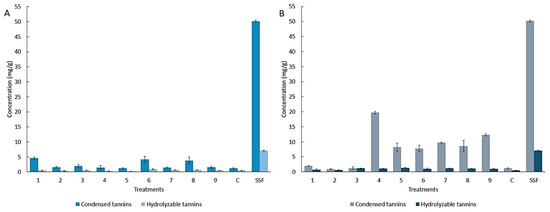
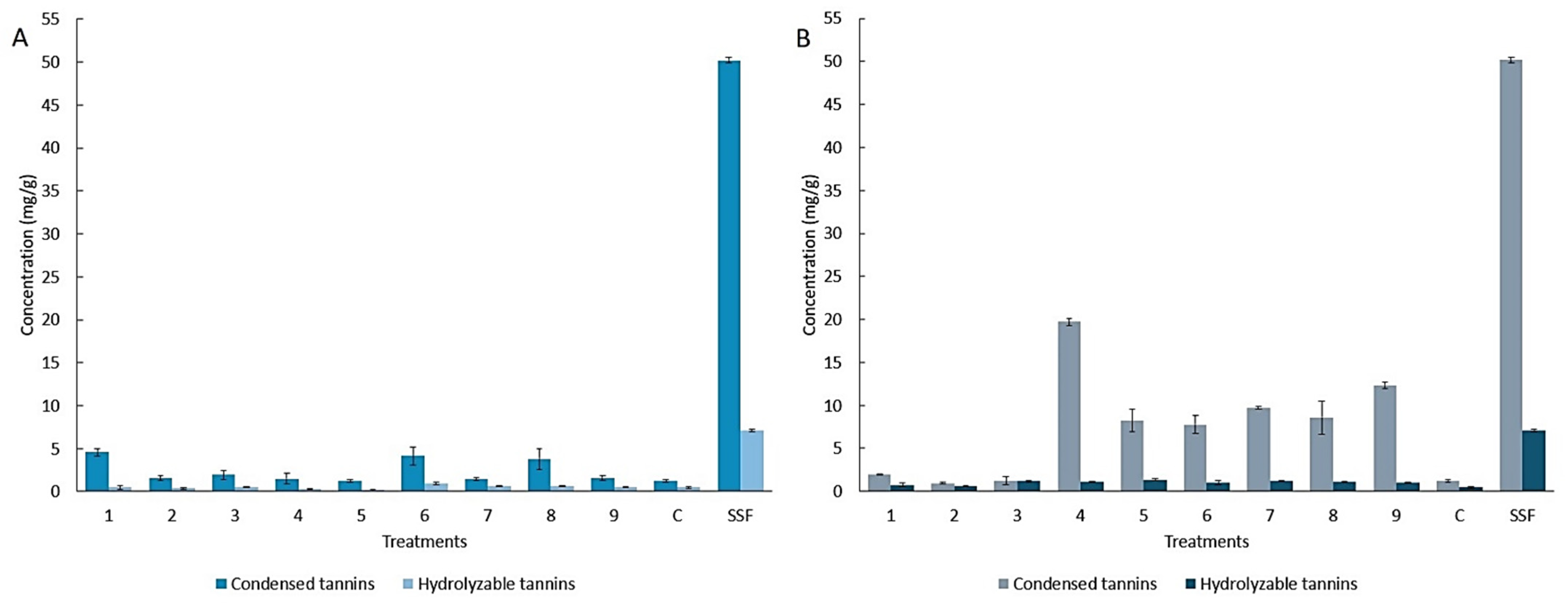
The extraction of condensed and hydrolyzable tannins varied significantly depending on the methodology applied (Figure 1). Among the evaluated techniques, SSF showed the highest efficiency, yielding more than 50 mg/g of condensed tannins and approximately 7 mg/g of hydrolyzable tannins. In contrast, UAE and MAE resulted in considerably lower yields across all experimental conditions.
Figure 1.
Concentrations of condensed and hydrolyzable tannins obtained using UAE and MAE were compared with those obtained using SSF: (A) the results obtained using the UAE method; (B) the results of the MAE method. C: control (without any treatment).
The superior performance of SSF can be attributed to the enzymatic activity of Aspergillus niger, which promotes the degradation of plant cell wall components such as cellulose and hemicellulose, facilitating the release of bound phenolic compounds. In addition, enzymes such as tannases and β-glucosidases may contribute to the biotransformation of complex polyphenols into more extractable and bioavailable forms. This dual mechanism—cell wall disruption and biochemical transformation—has been widely reported as a key advantage of SSF over conventional extraction techniques [12,13].
In contrast, UAE and MAE rely primarily on physical mechanisms, including cavitation and dielectric heating, respectively. Cavitation enhances mass transfer through microbubble collapse and cell disruption, while microwave irradiation increases solvent penetration and heating efficiency [17,25]. However, these processes do not promote the chemical transformation of phenolic compounds. Furthermore, prolonged exposure to ultrasound or microwave energy may lead to degradation of thermolabile polyphenols, which can negatively affect extraction yields [23,26].
Previous studies have reported improved recovery of phenolic compounds using UAE and MAE, although their efficiency strongly depends on process optimization and the physicochemical characteristics of the plant matrix [10,27]. In the present study, despite the application of a Box–Behnken design, both techniques showed limited performance compared to SSF, suggesting that extraction alone may be insufficient to maximize tannin recovery from prickly pear peel.
Overall, these results highlight that SSF acts not only as an extraction strategy but also as a biotransformation process capable of enhancing both the yield and accessibility of phenolic compounds. This distinction is particularly relevant for the valorization of agro-industrial residues, where a significant proportion of phenolics remains bound to structural components of the plant matrix [28].
3.2. Effects of the Process Variables Using UAE and MAE
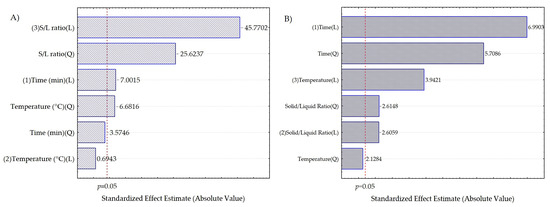
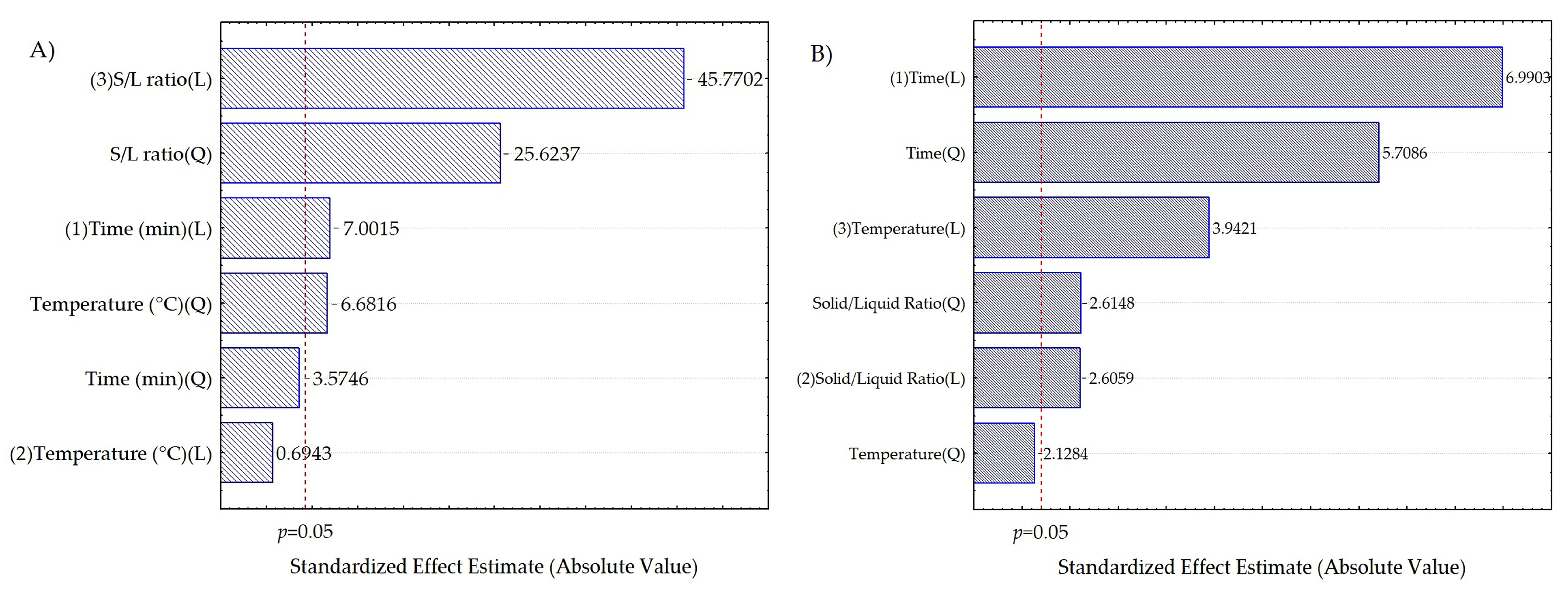
The effects of process variables and their interactions on condensed tannin accumulation were evaluated using Pareto charts derived from the Box–Behnken design (Figure 2). The standardized effects were ranked according to their magnitude, and statistically significant factors were identified at a confidence level of 95% (p < 0.05).
Figure 2.
Pareto charts illustrating the standardized effects on condensed tannin accumulation: (A) the standardized effect of the UAE; (B) the standardized effects of the MAE. The vertical dotted line represents a significance level of p = 0.05.
For UAE (Figure 2A), the most influential factor was the linear effect of the solid-to-liquid ratio, followed by its quadratic term. The negative coefficients observed for both effects indicate that increasing the solvent volume relative to the solid significantly reduced tannin concentration. This behavior suggests a dilution effect and possible reduction in mass transfer efficiency at higher solvent ratios, which has been previously reported in ultrasound-assisted extraction systems [29].
Additionally, extraction time exhibited both significant linear and quadratic effects, indicating a non-linear relationship with tannin recovery. Prolonged sonication may initially enhance extraction due to cavitation-induced cell disruption; however, excessive exposure can promote the degradation of phenolic compounds through sonochemical reactions involving free radical formation [23]. Temperature also showed a significant quadratic effect, suggesting that moderate temperatures favor extraction, whereas excessive heating may lead to compound instability.
In contrast, the linear effect of temperature was not statistically significant, indicating that within the evaluated range, temperature alone was not a limiting factor for tannin extraction. This finding highlights that cavitation intensity and solvent dynamics may play a more critical role than thermal effects in UAE processes [25].
For MAE (Figure 2B), extraction time was identified as the most influential variable, with both linear and quadratic effects being statistically significant. This indicates that extraction efficiency is highly dependent on exposure time, with an optimal range beyond which degradation of phenolic compounds may occur due to prolonged microwave irradiation [17].
Temperature also showed a significant linear effect in MAE, reflecting its role in enhancing dielectric heating and accelerating mass transfer. However, excessively high temperatures may lead to thermal degradation of sensitive compounds, reducing the overall yield [26]. In contrast, the solid-to-liquid ratio did not show a statistically significant effect, suggesting that, under microwave conditions, energy transfer and solvent heating are more dominant factors than solvent volume.
Overall, these results demonstrate that both UAE and MAE are governed by complex interactions between process variables, where optimal conditions are required to balance enhanced mass transfer and prevent compound degradation. The observed differences between the two techniques further highlight the distinct extraction mechanisms involved, reinforcing the limitations of purely physical methods compared to biotransformation-based approaches such as SSF.
3.3. Analysis by HPLC of the Best Treatments
The phenolic profiles of the best-performing extracts obtained by SSF, UAE, and MAE were characterized by HPLC analysis (Table 1). A total of 29 compounds were identified, including tyrosols, hydroxycinnamic acids, flavanones, flavones, methoxyflavonols, and catechins. Significant differences in both the diversity and distribution of compounds were observed depending on the extraction method.
Table 1.
Polyphenolic compounds identified in the extracts of prickly pear peels obtained by UAE, MAE, and SSF.
SSF extracts exhibited the highest chemical diversity, with 20 identified compounds, compared to 13 and 8 compounds detected in MAE and UAE extracts, respectively. This enhanced diversity is attributed to the metabolic activity of Aspergillus niger, which promotes not only the release of bound phenolics but also their biotransformation into structurally diverse derivatives. Enzymatic systems involved in SSF, such as esterases, tannases, and glycosidases, are known to modify phenolic structures, increasing their extractability and functional potential [13,28].
Among the identified compounds, rhamnetin was the predominant metabolite in SSF extracts. This flavonol has been widely reported for its antioxidant, anti-inflammatory, and antimicrobial properties and has been associated with the modulation of cellular oxidative stress and inhibition of microbial growth [30]. The higher abundance of rhamnetin in SSF extracts may therefore explain the superior bioactivity observed in subsequent antioxidant and antimicrobial assays.
In contrast, MAE extracts showed a predominance of p-coumaroyl tyrosine, while UAE extracts presented a simpler phenolic profile dominated by fewer compounds. This suggests that physical extraction methods primarily recover readily extractable phenolics, whereas SSF facilitates the release of bound compounds and the generation of new metabolites through enzymatic transformation. Similar trends have been reported in studies analyzing phenolic profiles of plant matrices, where fermentation processes significantly increased both compound diversity and bioactivity [31,32].
Previous reports have identified a wide range of phenolic compounds in prickly pear peel, including flavonols, hydroxybenzoic acids, and hydroxycinnamic acids, highlighting their potential as a source of functional ingredients [33]. However, the present results demonstrate that the extraction method plays a critical role not only in yield but also in defining the chemical composition of the extracts.
Overall, the results confirm that SSF is a powerful strategy to enhance both the diversity and functionality of phenolic compounds through biotransformation processes, generating extracts with improved potential for nutraceutical and pharmaceutical applications.
3.4. Antioxidant and Antimicrobial Activity
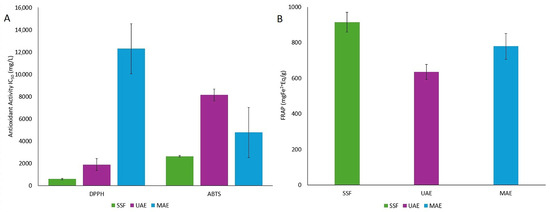
The antioxidant activity of the extracts obtained by SSF, UAE, and MAE was evaluated using DPPH, ABTS, and FRAP assays (Figure 3). In all cases, SSF extracts exhibited superior antioxidant capacity compared to UAE and MAE.
Figure 3.
Antioxidant activity of extracts obtained using different extraction methods (SSF, UAE, and MAE): (A) Antioxidant activity assessed using DPPH and ABTS free radical assays, expressed as IC50 values. (B) Ferric reduction capacity (FRAP method), expressed as mgFe2+ Eq/g. Data are presented as the mean ± standard deviation.
In the DPPH assay, SSF showed the lowest IC50 value (598 mg/L), indicating the highest radical scavenging activity, followed by UAE (1895 mg/L) and MAE (12,298 mg/L). A similar trend was observed for ABTS, where SSF extracts showed the strongest activity (IC50 = 2645 mg/L), while UAE and MAE exhibited significantly lower performance. These results indicate that SSF enhances the ability of extracts to neutralize free radicals through hydrogen atom transfer and electron donation mechanisms.
The FRAP assay further confirmed these findings, with SSF extracts showing the highest ferric reducing power (914 mg Fe2+ Eq/g), significantly exceeding that of MAE (779 mg Fe2+ Eq/g) and UAE (635 mg Fe2+ Eq/g). This suggests that SSF promotes the formation or release of compounds with strong reducing capacity, which are typically associated with phenolic hydroxyl groups.
The enhanced antioxidant activity observed in SSF extracts can be directly correlated with their higher phenolic diversity and abundance, as revealed by HPLC analysis. In particular, the presence of flavonols such as rhamnetin, along with other phenolic derivatives, likely contributes to the improved radical scavenging and reducing capacity. These compounds are known to stabilize free radicals through resonance and electron delocalization mechanisms [30].
Additionally, the fermentation process may lead to the breakdown of complex polyphenols into simpler and more bioactive forms, increasing their accessibility and reactivity. Similar improvements in antioxidant activity after solid-state fermentation have been reported in various plant matrices, including legumes and agro-industrial residues [32,34].
Regarding antimicrobial activity, only SSF extracts exhibited notable inhibition against Escherichia coli, with an inhibition zone of 4.5 mm, whereas UAE showed limited activity (2 mm) and MAE showed no inhibition. Although the observed inhibition zones were moderate, this result highlights the potential of SSF to enhance antimicrobial properties through the generation of bioactive metabolites.
The resistance observed in E. coli can be attributed to its Gram-negative cell wall structure, which contains a membrane rich in lipopolysaccharides that restricts the diffusion of antimicrobial compounds. Despite this barrier, the activity observed in SSF extracts suggests the presence of compounds capable of interacting with bacterial membranes or interfering with cellular processes.
Flavonoids, particularly flavonols such as rhamnetin and quercetin derivatives, have been reported to exert antimicrobial effects through multiple mechanisms, including membrane disruption, inhibition of efflux pumps, and interference with nucleic acid synthesis [35]. Therefore, the enhanced antimicrobial activity observed in SSF extracts is likely associated with their enriched and diversified phenolic profile.
Overall, these findings demonstrate that SSF not only improves the extraction yield of phenolic compounds but also enhances their functional properties, reinforcing its potential as a biotechnological strategy for producing high-value bioactive extracts from agro-industrial residues. Despite the promising results obtained under laboratory conditions, further studies should evaluate process economics, scale-up feasibility, and process integration to determine the industrial competitiveness of SSF relative to other green extraction technologies.
Despite the superior extraction yield and bioactivity obtained by SSF, some limitations should be considered for its industrial implementation. Compared with UAE and MAE, SSF requires longer processing times and may be more susceptible to batch-to-batch variability due to the biological nature of the process. In addition, appropriate control of fermentation conditions is essential to prevent contamination and ensure product safety, including monitoring for undesirable secondary metabolites. Downstream purification may also be more demanding than in physical extraction methods. Therefore, although SSF showed superior performance under the laboratory conditions evaluated, further studies should address process optimization, quality control, and scale-up to facilitate industrial implementation.
4. Conclusions
This study demonstrated that SSF is a more effective strategy than UAE and MAE for the valorization of Opuntia ficus-indica peel. SSF significantly increased the recovery of condensed and hydrolyzable tannins, enhanced phenolic diversity through microbial biotransformation, and improved the antioxidant and antimicrobial activities of the resulting extracts. These findings demonstrate that SSF represents a promising biotechnological approach for producing high-value bioactive extracts from agro-industrial residues within a circular bioeconomy framework. Although the present work was conducted at a laboratory scale, future studies should include techno-economic assessment and pilot-scale validation to confirm the industrial feasibility of this strategy.
Author Contributions
Conceptualization, A.C.-C. and L.S.; formal analysis, A.C.-C. and L.S.; methodology, A.C.-C., D.W.G.-M. and D.C.-R.; resources, R.R.-H., T.K.M.-M. and A.S.-G.; supervision, C.L.B.-M. and J.A.A.-V.; writing—original draft, A.C.-C. and L.S.; writing—review and editing, A.C.-C. and L.S. All authors have read and agreed to the published version of the manuscript.
Funding
This research received no external funding.
Data Availability Statement
All the data generated or analyzed during this study are included in the manuscript.
Acknowledgments
The authors thank the Faculty of Chemical Sciences and the Research Center for the Conservation of Biodiversity and Ecology of Coahuila at UAdeC for the facilities provided. Coronado-Contreras thanks SECIHTI for a postgraduate scholarship.
Conflicts of Interest
The authors declare no conflicts of interest.
References
- Carpena, M.; Cassani, L.; Gomez-Zavaglia, A.; Garcia-Perez, P.; Seyyedi-Mansour, S.; Cao, H.; Simal-Gandara, J.; Prieto, M.A. Application of Fermentation for the Valorization of Residues from Cactaceae Family. Food Chem. 2023, 410, 135369. [Google Scholar] [CrossRef] [Scilit] [PubMed]
- Ferreira, R.M.; Flórez-Fernández, N.; Silva, A.S.; Saraiva, J.A.; Figueroa, F.L.; Veiga, J.; Dolores Torres, M.; Cardoso, S.M.; Domínguez, H. Opuntia ficus-indica Seed Pomace Extracts with High UV-Screening Ability in a Circular Economy Approach for Body Lotions with Solar Protection. J. Ind. Eng. Chem. 2023, 130, 456–467. [Google Scholar] [CrossRef] [Scilit]
- Hernández-Becerra, E.; de los Angeles Aguilera-Barreiro, M.; Contreras-Padilla, M.; Pérez-Torrero, E.; Rodriguez-Garcia, M.E. Nopal Cladodes (Opuntia ficus-indica): Nutritional Properties and Functional Potential. J. Funct. Foods 2022, 95, 105183. [Google Scholar] [CrossRef] [Scilit]
- María Mérida, D.; Vitelli-Storelli, F.; Moreno-Franco, B.; Rodríguez-Ayala, M.; López-García, E.; Banegas, J.R.; Rodríguez-Artalejo, F.; Guallar-Castillón, P. Polyphenol Intake and Mortality: A Nationwide Cohort Study in the Adult Population of Spain. Clin. Nutr. 2023, 42, 1076–1085. [Google Scholar] [CrossRef] [Scilit] [PubMed]
- Zhang, L.; Guan, Q.; Jiang, J.; Khan, M.S. Tannin Complexation with Metal Ions and Its Implication on Human Health, Environment and Industry: An Overview. Int. J. Biol. Macromol. 2023, 253, 127485. [Google Scholar] [CrossRef] [Scilit] [PubMed]
- Molino, S.; Pilar Francino, M.; Ángel Rufián Henares, J. Why Is It Important to Understand the Nature and Chemistry of Tannins to Exploit Their Potential as Nutraceuticals? Food Res. Int. 2023, 173, 113329. [Google Scholar] [CrossRef] [Scilit] [PubMed]
- Yang, X.-Y.; Pritchard, H.W. Stimulatory and Inhibitory Effects of Light on Cereus repandus (Cactaceae) Seed Germination Are Strongly Dependent on Spectral Quality. Seed Sci. Res. 2022, 32, 166–174. [Google Scholar] [CrossRef] [Scilit]
- Singla, M.; Sit, N. Application of Ultrasound in Combination with Other Technologies in Food Processing: A Review. Ultrason. Sonochem. 2021, 73, 105506. [Google Scholar] [CrossRef] [Scilit] [PubMed]
- Yang, J.; Li, N.; Wang, C.; Chang, T.; Jiang, H. Ultrasound-Homogenization-Assisted Extraction of Polyphenols from Coconut Mesocarp: Optimization Study. Ultrason. Sonochem. 2021, 78, 105739. [Google Scholar] [CrossRef] [Scilit] [PubMed]
- Khadhraoui, B.; Ummat, V.; Tiwari, B.K.; Fabiano-Tixier, A.S.; Chemat, F. Review of Ultrasound Combinations with Hybrid and Innovative Techniques for Extraction and Processing of Food and Natural Products. Ultrason. Sonochem. 2021, 76, 105625. [Google Scholar] [CrossRef] [Scilit] [PubMed]
- Chew, S.K.; Teoh, W.H.; Hong, S.L.; Yusoff, R. Rutin Extraction from Female Carica Papaya Linn. Using Ultrasound and Microwave-Assisted Extractive Methods: Optimization and Extraction Efficiencies. Heliyon 2023, 9, e20260. [Google Scholar] [CrossRef] [Scilit] [PubMed]
- Olukomaiya, O.O.; Adiamo, O.Q.; Fernando, W.C.; Mereddy, R.; Li, X.; Sultanbawa, Y. Effect of Solid-State Fermentation on Proximate Composition, Anti-Nutritional Factor, Microbiological and Functional Properties of Lupin Flour. Food Chem. 2020, 315, 126238. [Google Scholar] [CrossRef] [Scilit] [PubMed]
- Yafetto, L. Application of Solid-State Fermentation by Microbial Biotechnology for Bioprocessing of Agro-Industrial Wastes from 1970 to 2020: A Review and Bibliometric Analysis. Heliyon 2022, 8, e09173. [Google Scholar] [CrossRef] [Scilit] [PubMed]
- Zamboi, A.; Fraterrigo Garofalo, S.; Tommasi, T.; Fino, D. Optimization of Ultrasounds Assisted Extraction of Polysaccharides from Cladodes of Opuntia ficus-indica Using Response Surface Methodology. Sustain. Chem. Pharm. 2024, 37, 101348. [Google Scholar] [CrossRef] [Scilit]
- Coronado-Contreras, A.; Ruelas-Chacón, X.; Reyes-Acosta, Y.K.; Dávila-Medina, M.D.; Ascacio-Valdés, J.A.; Sepúlveda, L. Valorization of Prickly Pear Peel Residues (Opuntia ficus-indica) Using Solid-State Fermentation. Foods 2023, 12, 4213. [Google Scholar] [CrossRef] [Scilit] [PubMed]
- de Albuquerque, J.G.; Escalona-Buendía, H.B.; de Magalhães Cordeiro, A.M.T.; dos Santos Lima, M.; de Souza Aquino, J.; da Silva Vasconcelos, M.A. Ultrasound Treatment for Improving the Bioactive Compounds and Quality Properties of a Brazilian Nopal (Opuntia ficus-indica) Beverage during Shelf-Life. LWT 2021, 149, 111814. [Google Scholar] [CrossRef] [Scilit]
- Xiaokang, W.; Lyng, J.G.; Brunton, N.P.; Cody, L.; Jacquier, J.C.; Harrison, S.M.; Papoutsis, K. Monitoring the Effect of Different Microwave Extraction Parameters on the Recovery of Polyphenols from Shiitake Mushrooms: Comparison with Hot-Water and Organic-Solvent Extractions. Biotechnol. Rep. 2020, 27, e00504. [Google Scholar] [CrossRef] [Scilit] [PubMed]
- Jesus, M.S.; Genisheva, Z.; Romaní, A.; Pereira, R.N.; Teixeira, J.A.; Domingues, L. Bioactive Compounds Recovery Optimization from Vine Pruning Residues Using Conventional Heating and Microwave-Assisted Extraction Methods. Ind. Crops Prod. 2019, 132, 99–110. [Google Scholar] [CrossRef] [Scilit]
- Palacios, C.E.; Nagai, A.; Torres, P.; Rodrigues, J.A.; Salatino, A. Contents of Tannins of Cultivars of Sorghum Cultivated in Brazil, as Determined by Four Quantification Methods. Food Chem. 2021, 337, 127970. [Google Scholar] [CrossRef] [Scilit] [PubMed]
- Martinez-Morales, F.; Alonso-Castro, A.J.; Zapata-Morales, J.R.; Carranza-Álvarez, C.; Aragon-Martinez, O.H. Use of Standardized Units for a Correct Interpretation of IC50 Values Obtained from the Inhibition of the DPPH Radical by Natural Antioxidants. Chem. Pap. 2020, 74, 3325–3334. [Google Scholar] [CrossRef] [Scilit]
- Rumpf, J.; Burger, R.; Schulze, M. Statistical Evaluation of DPPH, ABTS, FRAP, and Folin-Ciocalteu Assays to Assess the Antioxidant Capacity of Lignins. Int. J. Biol. Macromol. 2023, 233, 123470. [Google Scholar] [CrossRef] [Scilit] [PubMed]
- Sik, B.; Ajtony, Z.; Lakatos, E.; Székelyhidi, R. The Effects of Extraction Conditions on the Antioxidant Activities, Total Polyphenol and Monomer Anthocyanin Contents of Six Edible Fruits Growing Wild in Hungary. Heliyon 2022, 8, e12048. [Google Scholar] [CrossRef] [Scilit] [PubMed]
- Wang, Z.; Zhu, J.; Li, W.; Li, R.; Wang, X.; Qiao, H.; Sun, Q.; Zhang, H. Antibacterial Mechanism of the Polysaccharide Produced by Chaetomium Globosum CGMCC 6882 against Staphylococcus Aureus. Int. J. Biol. Macromol. 2020, 159, 231–235. [Google Scholar] [CrossRef] [Scilit] [PubMed]
- Cerda-Cejudo, N.D.; Buenrostro-Figueroa, J.J.; Sepúlveda, L.; Torres-Leon, C.; Chávez-González, M.L.; Ascacio-Valdés, J.A.; Aguilar, C.N. Recovery of Ellagic Acid from Mexican Rambutan Peel by Solid-State Fermentation-Assisted Extraction. Food Bioprod. Process. 2022, 134, 86–94. [Google Scholar] [CrossRef] [Scilit]
- Chemat, F.; Rombaut, N.; Sicaire, A.G.; Meullemiestre, A.; Fabiano-Tixier, A.S.; Abert-Vian, M. Ultrasound Assisted Extraction of Food and Natural Products. Mechanisms, Techniques, Combinations, Protocols and Applications. A Review. Ultrason. Sonochem. 2017, 34, 540–560. [Google Scholar] [CrossRef] [Scilit] [PubMed]
- Pettinato, M.; Casazza, A.A.; Perego, P. The Role of Heating Step in Microwave-Assisted Extraction of Polyphenols from Spent Coffee Grounds. Food Bioprod. Process. 2019, 114, 227–234. [Google Scholar] [CrossRef] [Scilit]
- Gómez-Salazar, J.A.; Patlán-González, J.; Sosa-Morales, M.E.; Segovia-Hernandez, J.G.; Sánchez-Ramírez, E.; Ramírez-Márquez, C. Multi-Objective Optimization of Sustainable Red Prickly Pear (Opuntia streptacantha) Peel Drying and Biocompounds Extraction Using a Hybrid Stochastic Algorithm. Food Bioprod. Process. 2022, 132, 155–166. [Google Scholar] [CrossRef] [Scilit]
- Frumuzachi, O.; Nicolescu, A.; Martău, G.A.; Odocheanu, R.; Ranga, F.; Mocan, A.; Vodnar, D.C. Enhancing the Phenolic Profile and Antioxidant Activity in Corn Silk via Solid-State Fermentation with Aspergillus niger. Innov. Food Sci. Emerg. Technol. 2025, 105, 104239. [Google Scholar] [CrossRef] [Scilit]
- Meullemiestre, A.; Petitcolas, E.; Maache-Rezzoug, Z.; Chemat, F.; Rezzoug, S.A. Impact of Ultrasound on Solid–Liquid Extraction of Phenolic Compounds from Maritime Pine Sawdust Waste. Kinetics, Optimization and Large Scale Experiments. Ultrason. Sonochem. 2016, 28, 230–239. [Google Scholar] [CrossRef] [Scilit] [PubMed]
- Medeiros, D.L.; Lima, E.T.G.; Silva, J.C.; Medeiros, M.A.; Pinheiro, E.B.F. Rhamnetin: A Review of Its Pharmacology and Toxicity. J. Pharm. Pharmacol. 2022, 74, 793–799. [Google Scholar] [CrossRef] [Scilit] [PubMed]
- Rodríguez-Daza, M.C.; Daoust, L.; Boutkrabt, L.; Pilon, G.; Varin, T.; Dudonné, S.; Levy, É.; Marette, A.; Roy, D.; Desjardins, Y. Wild Blueberry Proanthocyanidins Shape Distinct Gut Microbiota Profile and Influence Glucose Homeostasis and Intestinal Phenotypes in High-Fat High-Sucrose Fed Mice. Sci. Rep. 2020, 10, 2217. [Google Scholar] [CrossRef] [Scilit] [PubMed]
- Hur, S.J.; Lee, S.Y.; Kim, Y.C.; Choi, I.; Kim, G.B. Effect of Fermentation on the Antioxidant Activity in Plant-Based Foods. Food Chem. 2014, 160, 346–356. [Google Scholar] [CrossRef] [Scilit] [PubMed]
- Amaya-Cruz, D.M.; Pérez-Ramírez, I.F.; Delgado-García, J.; Mondragón-Jacobo, C.; Dector-Espinoza, A.; Reynoso-Camacho, R. An Integral Profile of Bioactive Compounds and Functional Properties of Prickly Pear (Opuntia ficus-indica L.) Peel with Different Tonalities. Food Chem. 2019, 278, 568–578. [Google Scholar] [CrossRef] [Scilit] [PubMed]
- Magro, A.E.A.; Silva, L.C.; Rasera, G.B.; de Castro, R.J.S. Solid-State Fermentation as an Efficient Strategy for the Biotransformation of Lentils: Enhancing Their Antioxidant and Antidiabetic Potentials. Bioresour. Bioprocess. 2019, 6, 38. [Google Scholar] [CrossRef] [Scilit]
- Do Socorro Chagas, M.S.; Behrens, M.D.; Moragas-Tellis, C.J.; Penedo, G.X.M.; Silva, A.R.; Gonçalves-De-Albuquerque, C.F. Flavonols and Flavones as Potential Anti-Inflammatory, Antioxidant, and Antibacterial Compounds. Oxidative Med. Cell. Longev. 2022, 2022, 9966750. [Google Scholar] [CrossRef] [Scilit] [PubMed]

Disclaimer/Publisher’s Note: The statements, opinions and data contained in all publications are solely those of the individual author(s) and contributor(s) and not of MDPI and/or the editor(s). MDPI and/or the editor(s) disclaim responsibility for any injury to people or property resulting from any ideas, methods, instructions or products referred to in the content. |
© 2026 by the authors. Licensee MDPI, Basel, Switzerland. This article is an open access article distributed under the terms and conditions of the Creative Commons Attribution (CC BY) license.