


Abstract
Environmental disturbances from hospital demolition and construction can aerosolise pathogenic fungal spores, particularly those of Aspergillus species, posing a serious threat to immunocompromised patients. This paper presents a structured narrative review of representative case studies to evaluate the relationship between demolition activities and airborne Aspergillus exposure, with a focus on clinical risk and environmental monitoring. Three exemplar studies were selected to illustrate high-intensity short-duration demolition, prolonged mechanical demolition, and meteorologically integrated risk assessment. By examining these cases, this review identifies gaps in current knowledge, methodological limitations, and challenges in causal attribution. The analysis supports the development of a novel conceptual framework for assessing and managing Aspergillus-related risks during hospital redevelopment, offering a structured approach to future infection prevention and control strategies. This framework is intended as a conceptual tool to support evidence-informed decision-making while acknowledging the limitations inherent in a targeted narrative review rather than a systematic synthesis.
1. Introduction—Pathogenicity and Clinical Risk of Environmental Fungal Spores in Vulnerable Patients
Environmental fungal pathogens are broadly classified into three morphological groups: obligately filamentous moulds, budding yeasts, and thermally dimorphic fungi. Obligate moulds include species such as Aspergillus, which grow as branching hyphae and reproduce through airborne conidia. Budding yeasts, such as Cryptococcus, exist predominantly as unicellular organisms, while thermally dimorphic fungi transition between a mould form in the environment and a yeast form in host tissues. In the UK clinical context, invasive fungal disease is predominantly driven by filamentous moulds, with Aspergillus species representing the primary cause of severe infections.
In susceptible hosts, Aspergillus can cause extensive tissue damage through hyphal invasion, secretion of proteolytic and elastolytic enzymes, and angioinvasion. Vascular invasion may result in thrombosis and haemorrhage, while inflammatory responses can contribute to severe pulmonary complications, including acute respiratory distress syndrome [1]. Aspergillus species, particularly Aspergillus fumigatus, are the leading cause of life-threatening invasive fungal infections worldwide [2], characterised by angioinvasion and rapid tissue necrosis. Epidemiological data suggest that invasive aspergillosis has been estimated to affect over two million people globally each year, primarily those with severe immunodeficiencies, chronic obstructive pulmonary disease, or patients in intensive care [3]. The disease is characterised by a strong tendency for angioinvasion and rapid tissue necrosis, with mortality often exceeding 50% in high-risk groups and, in some reported settings, approaching 90% [4,5]. Reflecting this burden, the World Health Organization [6] has classified Aspergillus fumigatus as a “Critical Priority” pathogen, responsible for substantial global mortality and exceeding other major fungal pathogens such as Candida and Cryptococcus.
Although exposure to Aspergillus spores is ubiquitous, invasive disease predominantly occurs in vulnerable populations, including neutropenic patients [7], transplant recipients [8], and individuals with chronic conditions such as chronic obstructive pulmonary disease (COPD) [9] or cystic fibrosis [10]. Its pathogenic potential is driven by an obligately filamentous growth habit and a pronounced capacity for angioinvasion, whereby hyphae physically penetrate the lung parenchyma and vascular walls [11]. Tissue destruction is mediated by the secretion of degradative enzymes, including proteases and elastases, which break down host elastin and collagen [12]. Successful survival within the host is further facilitated by sophisticated immune evasion strategies, such as the use of hydrophobin rodlets and melanin to mask stimulatory cell-wall patterns [13], the secretion of catalases to neutralise reactive oxygen species [14], and complement modulation via Aspf2 [15].
A key factor underlying Aspergillus pathogenicity is its ability to produce large numbers of small, highly respirable asexual spores, known as conidia. These conidia typically measure less than 5 μm in diameter, a size that promotes efficient aerosolisation from environmental reservoirs and enables evasion of upper respiratory clearance mechanisms during inhalation [1]. These spores can reach the terminal bronchioles and alveoli, where they germinate into invasive hyphae through cell wall remodelling [16]. Their respirable size (2–5 μm) allows for prolonged airborne suspension, underpinning the use of high-efficiency particulate air (HEPA) filtration in high-risk hospital environments such as haematology and transplant units [17].
Infection establishment depends not only on deposition but also on thermotolerance, with growth at approximately 37 °C being essential for infectivity [18]. While exposure is universal due to the widespread environmental distribution of Aspergillus [19], environmental disturbances such as construction and demolition can elevate airborne spore concentrations. In healthcare environments, this may increase exposure risk for immunocompromised patients, particularly when combined with impaired host defences [20].
In summary, Aspergillus spores pose a significant clinical risk due to their small size, airborne dispersal, thermotolerance, and invasive capacity. However, the extent to which environmental disturbance influences airborne fungal loads remains uncertain. This represents a key gap in infection prevention. This study examines potential pathways linking environmental disturbance to Aspergillus exposure and infection risk, synthesising evidence from case studies and highlighting methodological limitations to inform improved monitoring and mitigation strategies for high-risk clinical settings.
Literature Search and Selection Strategy
To provide a transparent basis for the narrative review, a structured literature search was undertaken to identify studies relevant to the relationship between hospital demolition and Aspergillus exposure. The aim was to conduct a targeted, critical evaluation of representative case studies, highlighting current knowledge gaps and supporting the development of a conceptual framework for environmental risk mitigation, rather than to perform a systematic or exhaustive meta-analysis.
The search was performed using PubMed Central and Web of Science, focusing on English-language peer-reviewed publications. Keywords included “hospital demolition,” “nosocomial aspergillosis,” and “environmental fungal monitoring.” More than fifty publications published between 1983 and 2026 were identified through this search process. Studies were screened for relevance based on three main criteria: the presence of documented hospital demolition or construction activities with sufficient temporal detail, the availability of quantitative or qualitative data on airborne Aspergillus spore levels, and the inclusion of relevant environmental or meteorological information affecting spore dispersion. These criteria were used to ensure that selected studies provided sufficient environmental and clinical context to support the selection of three exemplar case studies, chosen for their detailed reporting of nosocomial aspergillosis risk and associated environmental conditions. Bouza et al. [21] was chosen for its focus on high-intensity, short-duration demolition and the associated risk of fungal exposure. Hansen et al. [22] was included for its documentation of longer duration mechanical demolition, where outcomes were heterogeneous and sometimes conflicting, highlighting challenges in causal attribution. Pilmis et al. [20] was selected for its integration of meteorological data into environmental monitoring, demonstrating the influence of weather conditions on spore dispersal and risk assessment.
They were chosen to provide detailed examples of hospital demolition settings with documented or inferred nosocomial aspergillosis risk and associated environmental conditions, supporting evaluation of potential causal relationships between construction activity and Aspergillus exposure, and highlighting methodological limitations and knowledge gaps. These cases are intended to support conceptual synthesis rather than statistical generalisation. This may, however, introduce an inherent risk of selection bias, which is acknowledged as a limitation of the narrative review design.
2. Airborne Fungal Risk Assessment in Hospital Settings
Healthcare infrastructure activities, particularly major demolition and land excavation, represent a significant environmental hazard due to the large-scale aerosolization of thermotolerant fungal spores. Previous studies reported that outdoor Aspergillus spore concentrations could increase up to 105-fold during demolition compared with pre-demolition levels [23]. Given the high infection risk of Aspergillus for immunocompromised patients [4,5], rigorous air monitoring is considered essential to evaluate the effectiveness of hospital barrier measures. Two methodological approaches, non-cultivable sampling and cultivable sampling, are commonly employed to quantify environmental fungal loads.
2.1. Non-Cultivable Methods (Hirst-Type Spore Traps)
Non-cultivable methods use Hirst-type spore traps, such as the Lanzoni VPPS 2000, for continuous volumetric air sampling and monitoring [24,25]. These devices collect airborne particles by impacting them onto a silicone coated strip or adhesive tape mounted on a rotating drum, which moves at a constant speed to generate time sequenced data. Because this method captures both viable and non-viable spores, results are reported as particles per cubic metre rather than colony forming units. Identification is performed using optical microscopy, but is generally limited to the genus or family level, particularly the Aspergillaceae, which includes Aspergillus and Penicillium species, since their spores are morphologically indistinguishable under light microscopy [25]. The main advantage of the non-cultivable method is the rapid turnaround, providing results within 48 h by bypassing the need for fungal growth. This makes them a valuable tool for detecting spore bursts during active demolition [24,25].
2.2. Cultivable Methods (Viable Impaction Samplers)
Cultivable methods serve as a key clinical reference and use biocollectors, such as the Air IDEAL device, which actively draw a defined volume of air and impact airborne particles directly onto agar culture media [24]. The results are expressed as colony forming units per cubic metre (cfu/m3). A key scientific advantage of this approach is the ability to achieve species level identification. For example, Loeffert et al. [25] used incubation at 37 °C to selectively isolate thermotolerant Aspergillus fumigatus, the principal causative agent of invasive aspergillosis.
The principal limitation of this approach is the prolonged incubation period required for visible colony growth, which can extend up to seven days. This delay precludes real-time monitoring and limits the ability to implement timely protective measures for high-risk immunocompromised patients during demolition activities. Nevertheless, cultivation-based methods are more sensitive for detecting low concentrations of viable Aspergillus species. Dananché et al. [24] therefore concluded that culture-based analysis remains the most reliable method for quantifying infectious risk in hospital environments, as it measures viable, potentially pathogenic organisms rather than total fungal burden.
2.3. Evaluation of Fungal Monitoring Methods, Statistical Analysis, and Confounding Factors
To evaluate the mathematical relationship and clinical agreement between these two monitoring methodologies, researchers employed three primary statistical metrics. First, the correlation coefficient (Pearson’s or Spearman’s r-value) was used to determine the strength and direction of the linear relationship between daily fungal counts. The purpose was to justify whether the two sampling devices track the same environmental trends over time. Second, the p-value was used to assess the probability that any observed correlation occurred by chance, with a threshold of less than 0.05 defining statistical significance. Finally, the Kappa coefficient was calculated to measure concordance, representing the frequency with which both methods categorize a sample into the same risk level, for example low versus high fungal load. While correlation assesses the strength of association and similarity in trends between measurements, concordance is more relevant for clinical safety, as it determines whether both devices generate consistent signals that would prompt the same infection prevention and control actions [24,25]. Loeffert et al. [25] reported substantial discrepancies between results obtained using cultivable and non-cultivable methods, reflected in differences in correlation coefficients (r-values) and statistical significance (p-values). The authors suggested that these discrepancies could be influenced by meteorological variables, which act as confounding factors. Across different demolition stages, decreased wind speed and increased relative humidity were associated with elevated concentrations of Aspergillus spores, whereas higher temperatures increased the odds of fungal detection. Additionally, sampling location was found to significantly affect the results: spore concentrations decreased with height, likely due to stronger wind effects at elevated positions [25]. The results suggest that meteorological conditions, sampling height, and methodological sensitivity all influence measurement outcomes, and failure to account for these factors may lead to misleading comparisons.
In summary, both non-cultivable and cultivable methods can offer valuable insights into airborne fungal loads, each with distinct strengths and limitations. Non-cultivable sampling provides rapid, real-time detection of spore fluctuations, making it useful for monitoring immediate environmental changes, whereas cultivable sampling, despite higher costs and longer processing times, remains the most reliable approach for precise quantification and species-level identification. This accuracy is important for assessing potential relationships between demolition activities and environmental exposure, which may contribute to infection risk in susceptible patients, as well as informing effective mitigation strategies.
2.4. Clinical Significance and the Causality Gap
Airborne Aspergillus spores may pose a significant clinical risk during healthcare construction and demolition. A conventional dose–response approach, commonly used in medicine to quantify infectious risk, is challenging to apply in this context. Laboratory dose–response models, such as those reported by López-Malo et al. [26], primarily reflect fungal inhibition by antifungal agents and do not directly translate to human inhalation risks. More recent work by Lobo-Vega et al. [27] has characterised fungal phenotypes, including persistence and tolerance in both clinical and environmental isolates. However, these studies lack high-resolution molecular typing. As a result, they cannot reliably attribute infections to specific demolition events. This difficulty is compounded by patient heterogeneity: factors such as the depth and duration of neutropenia, underlying chronic respiratory conditions, and prior environmental exposures dominate susceptibility, preventing the definition of a universal minimum infectious dose. As a result, conventional dose–response methods cannot reliably capture the nuanced, context-specific risk of invasive aspergillosis in these highly vulnerable populations.
To address this challenge, this work adopts an alternative approach that examines associations between specific healthcare construction and demolition activities and airborne fungal concentrations. Section 3 analyses these relationships using primarily cultivable data, highlighting limitations in current monitoring methods and uncertainties in risk interpretation. By synthesising representative case studies, this study proposes a framework to identify high-risk activities and environmental conditions, supporting targeted, evidence-informed infection prevention for vulnerable patients.
3. Influence of Hospital Construction and Demolition on Aspergillus Exposure
This section examines the impact of hospital construction and demolition activities on airborne Aspergillus exposure by synthesizing evidence from three representative case study sites. These sites were selected for their proximity to active clinical wards and for providing contrasting contexts for qualitative comparison rather than representative sampling. A summary of the case studies is provided in Table 1. The first site describes a rapid, one-month demolition in Madrid [21]. The second site, the University Hospital Essen in Germany, is evaluated through two longitudinal studies: an initial investigation of mechanical dismantling [22] and a follow-up study conducted ten years later [28]. The third site involves a multi-zone hospital construction program in Paris, capturing diverse operational and environmental conditions relevant to airborne fungal exposure [20].
Table 1.
Overview of hospital demolition cases: fungal infection control, air sampling, and protected patient groups [20,21,22,28].
The aim of this comparative analysis is not to resolve these differing interpretations, but to explore potential relationships between specific demolition activities and Aspergillus infection risks which may inform hypotheses regarding causal factors.
3.1. Case 1: Rapid Hospital Demolition and Short-Term Airborne Fungal Exposure
This study, conducted at the Hospital General Universitario Gregorio Marañón in Madrid Spain, reported the impact of a controlled maternity building explosion on atmospheric fungal spore counts in the surrounding hospital complex [21]. The demolition and subsequent rubble removal were completed within one month. Air samples were collected in close proximity to the site using the cultivable fungal monitoring method, with plates incubated for five days at 37 °C. Although clinical outcomes were monitored, the incidence of invasive filamentous fungal infections remained very low, approximately three cases over three months (prior to the demolition), limiting the statistical power for detecting changes. From seven days before to seven days after the demolition, strict protective protocols were implemented, including the postponement of high-risk surgeries such as open heart, neurosurgical, and peripheral vascular procedures.
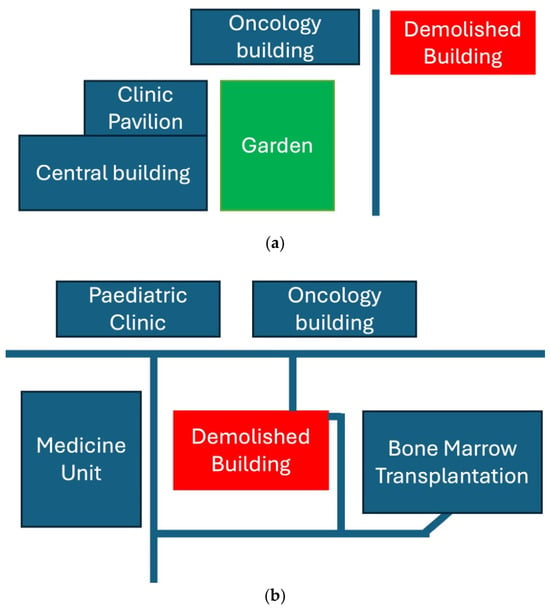
This study highlighted a critical correlation between structural sealing and indoor air quality by comparing “protected” areas, with HEPA filtration greater than 95% efficiency, with “unprotected” areas, with standard filtration less than 95% efficiency [21]. HEPA filtered rooms remained largely free of fungal contamination. In areas where window seals were removed prematurely, one and a half to three hours after the explosion (Central Building, Figure 1a), spore counts reached 52.0 cfu/m3. By contrast, areas that maintained continuous sealing (Clinic Pavilion, Figure 1a) remained significantly lower at 20.5 cfu/m3, with a p-value of less than 0.001 [21]. This may reflect that in buildings without high efficiency filtration, maintaining a continuous physical seal is critical to protect patients from the immediate surge of spores generated by nearby demolition activities.
Figure 1.
Comparative schematic of hospital demolition sites and airborne fungal monitoring in Case 1 and Case 2 (not to scale; redrawn from published sources [21,22]) (a) Case 1: Fast-track demolition of a maternity building within one month; (b) Case 2: Extended demolition of a three-storey hospital building over four months.
It is important to note that the demolition work in this study took place in May, a period during which climatic conditions in central Spain are generally conducive to fungal growth. According to AEMET (Agencia Estatal de Meteorología) [29], the mean monthly temperature in Madrid in May is 16.7 °C, with an average minimum daily temperature of 11.3 °C and an average maximum daily temperature of 22.2 °C. These conditions may provide a favourable thermal environment for spore germination and proliferation. May also falls within a season of moderate humidity, with an average relative humidity of 53% and conditions associated with increased airborne spore activity, with regional aerobiological records showing a marked increase in spore concentrations from spring into summer across much of Spain. Despite these conditions, actual meteorological parameters were not incorporated into this study [21]. Consequently, the potential influence of temperature fluctuations and humidity on airborne fungal dispersal was not formally assessed. This reflects this study’s primary focus on the immediate effects of rapid demolition, where the intensity and timing of structural disturbance were considered the principal drivers of spore release, and detailed meteorological monitoring was not prioritised.
3.2. Case 2: Typical Hospital Demolition with Extended Duration and Complex Environmental Influences
This study was conducted at the University Hospital Essen in Germany to assess the impact of demolishing a three-storey building located in close proximity to high-risk clinical areas [22]. A baseline control period was established through air sampling from April until two weeks prior to the onset of demolition in November, with the demolition phase extending from November 2006 to March of the following year. Fungal spores were monitored using two approaches: physical particulate matter monitoring and cultivable fungal air sampling.
Physical monitoring was performed using automated particle counters to quantify concentrations of ultrafine and larger airborne particles in the size range of 0.3 to 5.0 µm, based on light scattering or condensation principles. This physical approach is distinct from non-cultivable biological sampling methods, such as Hirst type spore traps discussed previously. Whereas Hirst type methods rely on microscopic identification of fungal taxa based on spore morphology, particulate matter monitoring provides only aggregate particle counts and does not distinguish between inorganic dust and biological particles such as fungal spores.
The results revealed a clear divergence between fungal indicators based on physical particulate matter monitoring and those obtained from cultivable fungal air sampling, reflecting differences between general aerosol levels and biologically active fungal spores. During the demolition period, particulate matter concentrations increased by factors ranging from 1.6 to 3.3, whereas changes in cultivable fungal loads were modest. In particular, the median concentration of moulds capable of growth at 37 °C, a temperature relevant to human pathogenicity, increased only marginally from 66 cfu/m3 to 80 cfu/m3 [22]. This finding is particularly significant given the immediate proximity of the demolition site to Oncology and Bone Marrow Transplantation wards (Figure 1b), where patients are highly susceptible to invasive aspergillosis. The limited response of viable fungal loads despite substantial increases in particulate matter underscores that rapid aerosol measurements, while useful for general air quality monitoring, do not reliably reflect the presence of viable pathogenic spores or directly translate to patient infection risk. Consequently, reliance solely on particulate matter data could lead to misinformed infection control decisions, emphasising the need for direct, cultivable monitoring to guide protective measures for vulnerable patient populations.
Clinical surveillance conducted identified a low incidence of invasive fungal infections, approximately 1.6 cases per month, a frequency that is insufficient to support robust statistical associations between demolition activity and patient outcomes. On this basis, the authors [22] concluded that no increase in fungal infection risk was observed under the specific conditions of this study, where comprehensive protective measures were implemented, including mechanical demolition using excavators, full enclosure of the structure with impermeable plastic sheeting, and continuous dust suppression using water jets.
Nevertheless, this interpretation may require careful consideration of seasonal influences on airborne fungal concentrations, as the authors explicitly acknowledged that environmental fungal loads in Germany are substantially lower during winter months, and relevant meteorological parameters were recorded but not incorporated into the analysis. Seasonal decline in background fungal levels was treated as peripheral confounding factor rather than as a potentially dominant explanatory factor. The exclusion of meteorological covariates such as temperature, relative humidity, and wind conditions from a multivariate framework limits the ability to distinguish demolition-related effects from expected seasonal reductions in spore abundance. The low infection risk observed during the study period may also be influenced by a combination of intervention strategies and naturally reduced winter fungal activity, underscoring the difficulty of isolating the impact of demolition from seasonal environmental influences.
About a decade later, a follow-up study at the same institution examined the demolition of a larger seven-storey building, the Medicine Unit shown in Figure 1b [28]. The demolition methodology and protective measures, including mechanical excavation, water jet dust suppression, and high efficiency filtration, were comparable to those used in the previous project [22]. But unlike the previous study, the later demolition work took place during the summer peak of fungal activity, between April and August. By incorporating meteorological variables into a multivariate analysis, the authors [28] reported no significant associations between Aspergillus spore concentrations and temperature, rainfall, or wind direction. This finding provided less support for the earlier hypothesis that weather acted as a major confounding factor, leading to the interpretation that, under standard hospital infection prevention and control protocols, neither demolition activity nor seasonal meteorological variability was a primary driver of pathogenic fungal loads.
However, a detailed evaluation of the data presented by the authors [28] raises significant methodological concerns regarding the reliance on mean spore concentrations for risk assessment. To evaluate infection risk, the authors reported mean Aspergillus concentrations of 17.5 cfu/m3 before demolition and 20.8 cfu/m3 during demolition, concluding that there was no significant increase in fungal load with a p-value of 0.26. However, the reported mean during the demolition phase was derived from measurements with high volatility, spanning a range from below 10 cfu/m3 to extreme outliers exceeding 120 cfu/m3. While the mean increased by only 19%, the median concentration rose more substantially from 7.5 cfu/m3 to 12.0 cfu/m3, indicating a 60% increase in the central tendency of the distribution that is not fully captured by longitudinal averages. As such, the mean value may not fully represent the short-lived but substantial increases in spore concentration that were directly observed during active demolition. While mean values characterize background conditions, they inherently smooth temporal variability and may obscure transient high intensity exposure events that are clinically relevant. Similar to how the integration of rainbow wavelengths produces white light, averaging sporadic fungal measurements may obscure transient but clinically important spikes. Given that invasive aspergillosis may be triggered by brief episodes of elevated exposure, reliance solely on mean values risks underestimating the true hazard, emphasising the need for high-resolution temporal monitoring to capture exposure events that are most relevant to patient safety.
3.3. Case 3: Is Hospital Demolition a Primary Driver of Aspergillus Exposure?
This study was conducted at the Necker Enfants Malades Hospital, a 650-bed teaching hospital in Paris, France, during a large-scale renovation and construction programme carried out between 2009 and 2010 [20]. The investigation encompassed four distinct work zones, labelled A to D, with surface areas ranging from approximately 400 m2 to 13,300 m2, where demolition and construction activities were performed either sequentially or concurrently. More than 200 outdoor air samples were collected over a two-year monitoring period, with sampling conducted three times per week at a height of 1.5 m above ground level. Although this study provides a detailed assessment of the influence of meteorological variables and construction activities on outdoor airborne fungal concentrations, it did not include indoor air sampling and did not report clinical data on patient infection rates during the study period.
The results suggest a divergence between the determinants of overall fungal burden and those governing Aspergillus species specifically. Total fungal cultures were positive in all outdoor air samples, where median concentrations reached 144 cfu/m3 during active demolition phases compared with 68 cfu/m3 during general building phases. Multivariate analysis suggested that both demolition activity and ambient temperature were associated with total fungal loads, with both factors showing strong statistical significance (p-value < 0.001). In contrast, the behaviour of Aspergillus spores, detected in 80.1% of samples, followed a different pattern. Although demolition was associated with increased levels of various environmental moulds, it was not a statistically significant predictor of elevated Aspergillus spore concentrations above 20 cfu/m3 in the fully adjusted model. Instead, temperature was the only variable that remained significantly associated with Aspergillus levels (p-value = 0.036). These findings may reflect that, in this setting, Aspergillus exposure could be more strongly influenced by seasonal climatic conditions than by demolition activity itself. Consequently, scheduling high-risk construction and demolition work during cooler months, such as autumn and winter, may be associated with lower exposure in some contexts, although this remains uncertain and context-dependent.
The findings are also subject to several other limitations, including the monocentric study design, a relatively small sample size of 201 samples, and the absence of adjustment for localised factors such as traffic density or hospital specific ventilation characteristics. More importantly, this study illustrates the difficulty of attributing changes in airborne Aspergillus spore concentrations to demolition alone when environmental monitoring is conducted at low temporal resolution. The observed influence of seasonal temperature may be influenced by broader climatic variability, which could mask short-term effects associated with demolition activities. To establish clearer causal relationships, future investigations should adopt higher frequency and longer-term environmental surveillance combined with advanced multivariate modelling. Such approaches could enable the separation of construction related effects from background seasonal cycles and support the development of more targeted, proactive infection prevention and control strategies in hospital settings.
3.4. Evaluating Evidence and Research Gaps in Monitoring Aspergillus Exposure
Taken together, the three case studies illustrate both consistent protective approaches and substantial uncertainty in attributing airborne Aspergillus exposure to hospital construction and demolition activities. A similar finding across Cases 1 [21] and 2 [22] is the effectiveness of engineering controls, particularly high-efficiency particulate air filtration and strict physical sealing, in suppressing indoor fungal spore concentrations. In both settings, HEPA-filtered areas remained largely free of fungal contamination despite substantial external disturbance, confirming their critical protective role. This convergence reinforces existing infection prevention and control guidance and provides robust empirical support for the continued prioritisation of physical barriers and high-efficiency ventilation in healthcare environments adjacent to demolition sites.
Beyond these common findings, the studies diverge in their proposed causal drivers. While Case 1 may reflect a possible relationship between demolition intensity and spore release, the stable levels observed in Case 2 could reflect either effective engineering controls or seasonal variability in measured concentrations. This divergence illustrates the interpretative ambiguity inherent in current monitoring protocols. Case 3 [20] further complicates interpretation by suggesting that, for Aspergillus specifically, climatic variables such as temperature may be stronger predictors of elevated concentrations than demolition activity itself. These divergent conclusions may be associated with methodological differences across the studies. The intensive high frequency monitoring in Case 1 contrasts with the lower frequency sampling in Case 2 and Case 3, typically conducted two to three times per week, which may have missed short-lived exposure peaks that could be clinically significant. In addition, Case 3 employed multivariate statistical models that incorporated meteorological variables, whereas other studies treated weather conditions primarily as peripheral confounding factors. Together, these differences in temporal resolution and variable integration illustrate the difficulty of capturing real world environmental complexity and help explain the conflicting causal interpretations reported across sites.
Collectively, these studies expose critical research gaps that limit to robustly infer casual relationships between specific construction activities and clinical risk. Current research lacks the ability to separate the short-term effects of demolition activities from broader seasonal fluctuations in fungal abundance. Previous studies often rely on infrequent, manual air sampling, which lacks the temporal resolution needed to capture transient spore peaks associated with specific construction events. In addition, infection risk is often inferred from indirect or non-specific indicators, such as the overall fungal counts, which may not reliably reflect exposure to viable, clinically relevant Aspergillus species. These limitations emphasise the need for improved monitoring strategies that can integrate frequent, high-resolution measurements of both indoor and outdoor fungal spore concentrations with robust multivariate statistical analyses, allowing researchers to identify more accurately the factors driving clinically relevant exposure. Addressing these gaps is crucial not only to reconcile the conflicting findings observed across current studies, but also to move from purely reactive mitigation strategies toward more informed, data-driven infection prevention and control approaches. The following section builds on this review and discusses how emerging monitoring technologies, advanced statistical modelling, and machine learning approaches could help to address these limitations and support a more precise assessment of the Aspergillus risk in hospital settings.
4. Future Directions: A Conceptual Framework for Integrated Risk Assessment and Causal Attribution
The case studies reviewed in Section 3 reveal unresolved methodological limitations that hinder the establishment of clear causal links between hospital demolition and Aspergillus exposure. In particular, infrequent and low temporal resolution sampling makes it difficult to detect short lived but potentially important increases in spore concentrations linked to specific construction events [20,21]. The reliance on surrogate measures such as total particulate matter rather than direct measurements of viable species often blurs the distinction between clinically relevant exposure and general dust generation [22]. These challenges are compounded by the asynchronous recording of environmental and operational variables, which limits the ability of traditional statistical models to capture complex, nonlinear relationships or interactions. Such constraints point to the potential value of advanced analytical approaches, including machine learning, which can integrate continuous, multimodal data streams and identify patterns that may be missed by conventional methods. Building on these insights, this section outlines a conceptual framework for integrated risk assessment, combining high-resolution environmental and operational monitoring with analytical approaches that help account for variability, interactions, and potential causal pathways in hospital settings.
4.1. Multimodal Data Acquisition: The Foundation of Causal Inference
The challenge of establishing causal attribution during hospital construction is characterized by the potential for deceptive patterns in environmental data. As described in the conceptual framework of The Tiger That Isn’t [30], striking visual patterns or stripes can be misleading if interpreted in isolation without confirming the presence of an actual causal tiger. Similarly, in hospital redevelopment studies, apparent spikes in airborne Aspergillus may be misleading, reflecting seasonal variability or meteorological fluctuations rather than a direct effect of construction activity.
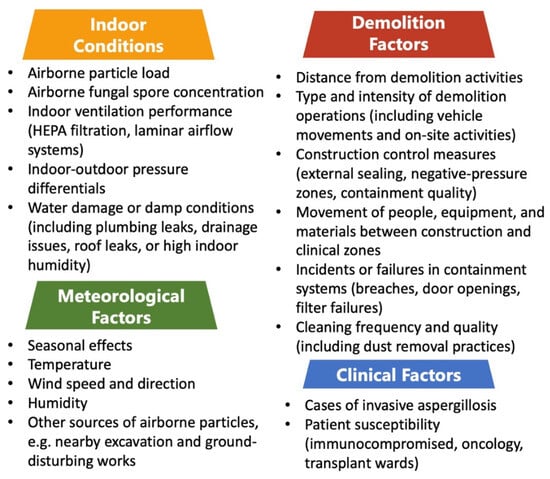
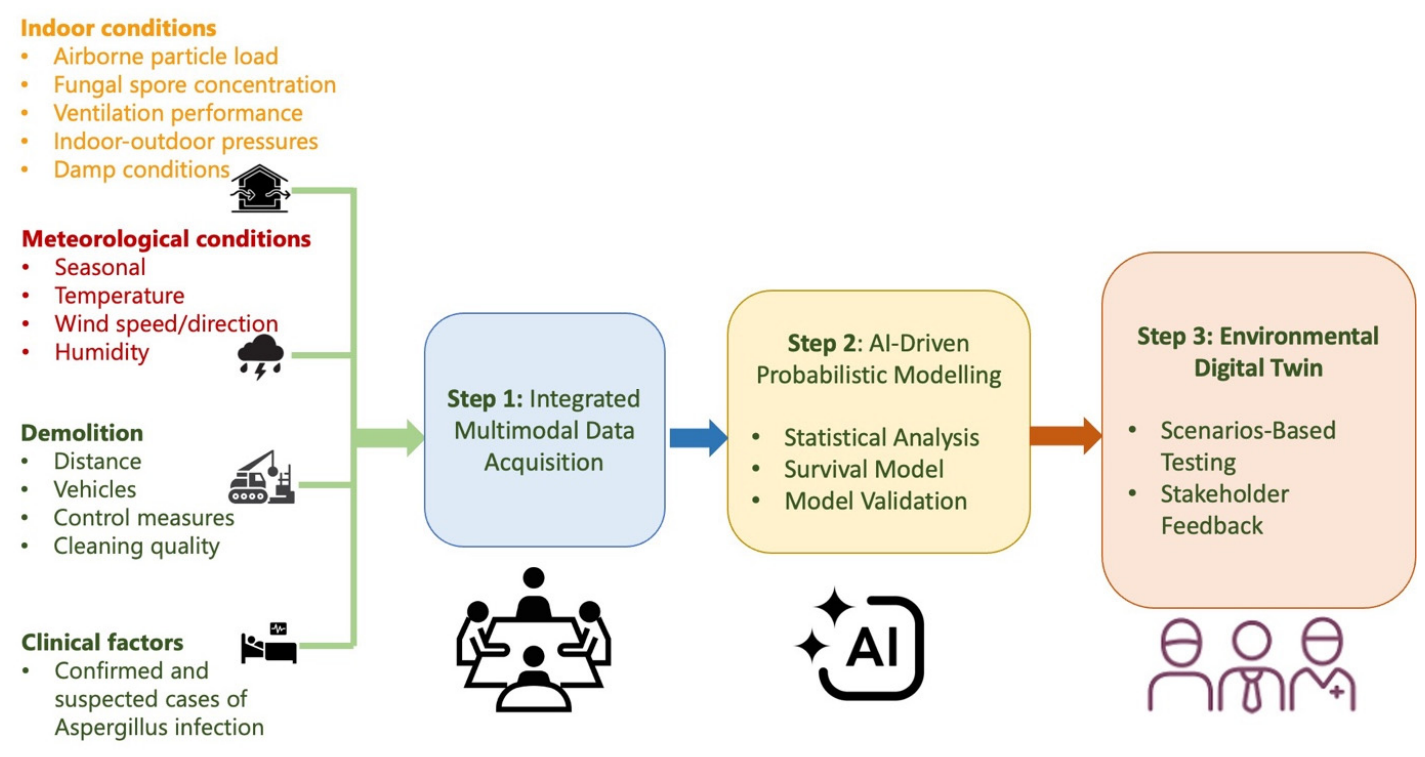
To distinguish meaningful signals from superficial patterns, a robust analytical framework could be founded on high-resolution datasets that capture the full pathway from sources of disturbance to environmental receptors. Complementary data streams could include detailed operational logs documenting demolition methods, work intensity, activity sequencing, and the use of dust suppression measures. These operational records primarily serve as input data for models and simulations that predict aerosol generation and dispersion. To evaluate the effectiveness of mitigation measures, independent observations such as continuous particulate measurements or fungal air sampling could be used to interpret trends and validate model predictions, ensuring that conclusions are not based solely on the operational inputs. Operational data could be collected alongside continuous meteorological measurements, such as temperature, relative humidity, and wind speed, to account for seasonal and environmental variability. While particulate matter measurements alone may not reliably represent viable fungal loads or infection risk, high-frequency monitoring across multiple particle sizes may provide essential information on aerosol transport and dispersion within hospital spaces. Integrating operational, meteorological, and particulate datasets into a unified multi-modal framework could potentially support the characterization of exposure pathways and exploration of causal relationships. This data architecture, illustrated in Figure 2, may address the primary limitations identified in previous studies, including low temporal resolution and the lack of meteorological integration [20,28].
Figure 2.
Overview of multimodal data streams required for assessing Aspergillus exposure in hospital environments.
4.2. Advanced Analytics for Signal Separation and Uncertainty Quantification
Clarifying the relative contributions of demolition activities and environmental conditions to Aspergillus exposure is challenging with conventional descriptive or correlational analyses. Causal inference approaches, such as Bayesian Structural Time Series and Granger causality methods [31], may provide a way to address this challenge by estimating a counterfactual scenario. A counterfactual represents the fungal concentrations that would be expected over time if demolition had not occurred, given the observed meteorological conditions, background fungal levels, and routine hospital activities. By comparing these predicted baseline levels with the actual measurements during demolition, researchers may be able to isolate the specific effects of demolition from natural fluctuations in fungal counts due to seasonal patterns, temperature-driven growth cycles, or other environmental factors. Unlike traditional correlational models, these causal frameworks are designed to operate on dense, high-frequency datasets, capturing temporal trends and short-term spikes that may be critical for clinical risk assessment. In this way, counterfactual modelling may allow the incremental impact of demolition activities on Aspergillus exposure to be explored and partially separated from broader environmental variability.
Building on the counterfactual analysis described above, high-resolution multimodal datasets could be analysed using deep probabilistic models to account for both the inherent variability in environmental measurements and the sparsity of clinical observations. These models are well suited to the high dimensionality of continuous sensor streams, including temperature, humidity, particulate matter, and operational logs, potentially providing a framework for distinguishing demolition-related effects from background environmental fluctuations. Architectures such as Deep Survival Machines and Neural Multitask Logistic Regression have been developed for safety-critical applications where uncertainty must be explicitly quantified [32]. Unlike conventional approaches that produce a single point estimate, such as a predicted Aspergillus concentration or a fixed infection probability, these models generate probability distributions over possible outcomes. This may allow for separate representation of variability arising from environmental fluctuations and fungal measurements, as well as uncertainty stemming from limited microbiological or clinical data, which reflects the confidence in model predictions given available information. By applying Multitask Learning principles, the models can jointly learn patterns across continuous environmental sensor data and sparse microbiological and clinical observations, potentially enabling predictions of Aspergillus concentrations and potential patient exposure to leverage multiple related data streams. This approach may help capture complex interactions between demolition activities, environmental conditions, and measured fungal loads, providing a probabilistic framework that could be used to assess exposure risk. Critically, it may allow infection control teams to identify periods of elevated risk, including short-term spikes that conventional averages might obscure, and to plan targeted interventions [33]. By linking high-frequency environmental data with probabilistic exposure estimates, this framework may support more responsive, evidence-informed infection control strategies during hospital construction and demolition.
4.3. The Environmental Digital Twin: A Proposed Operational Interface
While advanced analytics offer powerful tools for modelling fungal exposure, predictive accuracy alone is often insufficient for operational decision making. Abstract probabilities do not always easily translate into actionable guidance for clinicians or infection control teams, who must respond in real time to changing construction and environmental conditions. Moreover, conventional machine learning models are primarily retrospective, learning from historical patterns but providing limited insight for prospective evaluation of alternative control strategies. To overcome these limitations, this paper proposes the concept of the Environmental Digital Twin. Within this framework, the Environmental Digital Twin is conceptualised here as a dynamic virtual representation of a physical environment that integrates real time multimodal data streams to simulate complex aerosol pathways and explore the potential impact of interventions. This conceptual roadmap situates model outputs within the context of physical hospital structures, construction processes, and clinical workflows to support scenario-based assessment and more transparent decision making.
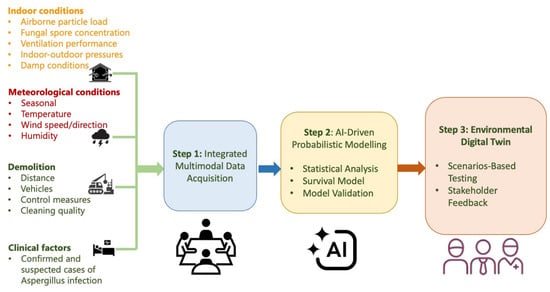
A potential advantage of the Environmental Digital Twin is its “what-if” simulation capability, which could allow staff to evaluate the impact of different interventions before implementation. For example, predicted risk spikes can be tested virtually by adjusting ventilation rates, pausing specific demolition activities, or modifying dust suppression strategies, thereby supporting the optimisation of mitigation measures. As illustrated in Figure 3, the digital twin may function as an operational interface that unifies the multimodal data acquisition described in Figure 2 with the probabilistic modelling frameworks. This may provide a potential approach for overcoming the interpretative ambiguity identified in Section 3.4 by moving beyond static averages toward dynamic, context-aware risk evaluation. It may provide clinicians, estates managers, and construction stakeholders with a shared, real-time evidence base, supporting informed judgment rather than opaque, black-box decision making. This transparency is particularly important given that invasive aspergillosis carries high mortality rates [4,5]. By enabling earlier recognition of elevated risk and facilitating comparative evaluation of mitigation strategies, the Environmental Digital Twin may offer a practical and adaptive tool for proactive infection control under uncertainty.
Figure 3.
Integrated workflow for developing an Environmental Digital Twin, from multimodal data acquisition through AI-driven probabilistic modelling to operational decision support.
While the case studies evaluated in this review are primarily based in European clinical settings, the proposed conceptual framework is intended to be applicable across diverse geographical and climatic contexts. The core principle of the roadmap, which involves integrating environmental and operational data to identify potential causal pathways, may remain relevant in settings with different backgrounds in healthcare infrastructure or access to advanced digital monitoring and high-efficiency particulate air filtration. In such contexts, the framework could serve as a strategic tool for prioritising interventions and guiding infection prevention and control efforts. By relying on accessible data surrogates and targeted environmental monitoring, healthcare facilities may be able to identify high risk phases of demolition and deploy mitigation measures in the areas where they are most needed to protect vulnerable patient populations.
5. Conclusions and Overview
Hospital construction and demolition pose a serious risk of Aspergillus exposure to highly vulnerable patients, with invasive aspergillosis carrying high mortality rates in high-risk individuals. Case studies suggest that HEPA filtration and strict physical sealing can effectively protect indoor environments, yet outdoor fungal concentrations remain strongly influenced by environmental variability. Existing research is constrained by low temporal resolution, reliance on surrogate metrics, and incomplete integration of indoor and outdoor monitoring, which limits the ability to establish clear causal links between demolition activities and clinically relevant exposure or to design evidence-based mitigation strategies. Apparent spikes in airborne Aspergillus during demolition may not directly indicate increased infection risk. Instead, they may reflect broader environmental variability rather than a direct effect of construction activity. Protective interventions can further modulate observed patterns, making superficial trends difficult to interpret without a robust analytical framework.
Building on these insights, this work highlights the importance of high-resolution multimodal monitoring and advanced analytical frameworks for clarifying exposure risks. By integrating continuous environmental and operational data, including demolition logs, dust suppression measures, and meteorological variables, with microbiological and clinical observations, it is possible to separate demolition-related effects from background variability. Probabilistic models and Multitask Learning can account for both measurement variability and sparse clinical data, generating a probabilistic mapping between demolition activities, airborne Aspergillus levels, and patient exposure. The Environmental Digital Twin concept further translates these outputs into a dynamic, operational interface, enabling real-time “what-if” simulations of mitigation strategies and scenario-based risk assessment. Together, this integrated framework is intended to address the methodological limitations identified in previous studies, could support adaptive and evidence-informed infection control, and may provide a scalable conceptual approach applicable to diverse healthcare settings. By linking data-driven predictions with actionable interventions, this approach could support hospital teams in identifying periods of elevated risk and informing measures to protect highly susceptible patients during construction and demolition activities.
Author Contributions
Conceptualization, K.T. and S.B.; methodology, K.T. and S.B.; investigation, K.T. and S.B.; writing (original draft preparation), K.T. and S.B.; writing (review and editing), K.T. and S.B. All authors have read and agreed to the published version of the manuscript.
Funding
This research did not receive any specific grant from funding agencies in the public, commercial, or not-for-profit sectors.
Data Availability Statement
This is a review paper and does not report new or original data. All information is derived from previously published studies, which are appropriately cited within the manuscript.
Conflicts of Interest
The authors declare that they have no conflicts of interest.
References
- Denham, S.T.; Wambaugh, M.A.; Brown, J.C.S. How Environmental Fungi Cause a Range of Clinical Outcomes in Susceptible Hosts. J. Mol. Biol. 2019, 431, 2982–3009. [Google Scholar] [CrossRef] [Scilit]
- Latgé, J.P. Aspergillus fumigatus and aspergillosis. Clin. Microbiol. Rev. 1999, 12, 310–350. [Google Scholar] [CrossRef] [Scilit] [PubMed]
- Denning, D.W. Global incidence and mortality of severe fungal disease. Lancet Infect. Dis. 2024, 24, e428–e438. [Google Scholar] [CrossRef] [Scilit] [PubMed]
- Garcia-Vidal, C.; Peghin, M.; Cervera, C.; Gudiol, C.; Ruiz-Camps, I.; Moreno, A.; Royo-Cebrecos, C.; Roselló, E.; de la Bellacasa, J.P.; Ayats, J.; et al. Causes of death in a contemporary cohort of patients with invasive aspergillosis. PLoS ONE 2015, 10, e0120370. [Google Scholar] [CrossRef] [Scilit] [PubMed]
- Brown, G.D.; Denning, D.W.; Gow, N.A.; Levitz, S.M.; Netea, M.G.; White, T.C. Hidden killers: Human fungal infections. Sci. Transl. Med. 2012, 4, 165rv113. [Google Scholar] [CrossRef] [Scilit]
- WHO. WHO Fungal Priority Pathogens List to Guide Research, Development and Public Health Action; WHO: Geneva, Switzerland, 2022. [Google Scholar]
- Gerson, S.L.; Talbot, G.H.; Hurwitz, S.; Strom, B.L.; Lusk, E.J.; Cassileth, P.A. Prolonged granulocytopenia: The major risk factor for invasive pulmonary aspergillosis in patients with acute leukemia. Ann. Intern. Med. 1984, 100, 345–351. [Google Scholar] [CrossRef] [Scilit]
- Kosmidis, C.; Denning, D.W. The clinical spectrum of pulmonary aspergillosis. Thorax 2015, 70, 270–277. [Google Scholar] [CrossRef] [Scilit]
- Shahi, M.; Ayatollahi Mousavi, S.A.; Nabili, M.; Aliyali, M.; Khodavaisy, S.; Badali, H. Aspergillus colonization in patients with chronic obstructive pulmonary disease. Curr. Med. Mycol. 2015, 1, 45–51. [Google Scholar] [CrossRef] [Scilit]
- Knutsen, A.P.; Slavin, R.G. Allergic bronchopulmonary aspergillosis in asthma and cystic fibrosis. Clin. Dev. Immunol. 2011, 2011, 843763. [Google Scholar] [CrossRef] [Scilit]
- Patterson, K.C.; Strek, M.E. Diagnosis and treatment of pulmonary aspergillosis syndromes. Chest 2014, 146, 1358–1368. [Google Scholar] [CrossRef] [Scilit]
- Blanco, J.L.; Hontecillas, R.; Bouza, E.; Blanco, I.; Pelaez, T.; Muñoz, P.; Perez Molina, J.; Garcia, M.E. Correlation between the elastase activity index and invasiveness of clinical isolates of Aspergillus fumigatus. J. Clin. Microbiol. 2002, 40, 1811–1813. [Google Scholar] [CrossRef] [Scilit] [PubMed]
- Erwig, L.P.; Gow, N.A. Interactions of fungal pathogens with phagocytes. Nat. Rev. Microbiol. 2016, 14, 163–176. [Google Scholar] [CrossRef] [Scilit] [PubMed]
- Dagenais, T.R.; Keller, N.P. Pathogenesis of Aspergillus fumigatus in Invasive Aspergillosis. Clin. Microbiol. Rev. 2009, 22, 447–465. [Google Scholar] [CrossRef] [Scilit] [PubMed]
- Dasari, P.; Shopova, I.A.; Stroe, M.; Wartenberg, D.; Martin-Dahse, H.; Beyersdorf, N.; Hortschansky, P.; Dietrich, S.; Cseresnyés, Z.; Figge, M.T.; et al. Aspf2 From Aspergillus fumigatus Recruits Human Immune Regulators for Immune Evasion and Cell Damage. Front. Immunol. 2018, 9, 1635. [Google Scholar] [CrossRef] [Scilit]
- Giles, S.S.; Dagenais, T.R.; Botts, M.R.; Keller, N.P.; Hull, C.M. Elucidating the pathogenesis of spores from the human fungal pathogen Cryptococcus neoformans. Infect. Immun. 2009, 77, 3491–3500. [Google Scholar] [CrossRef] [Scilit]
- Ruiz-Camps, I.; Aguado, J.M.; Almirante, B.; Bouza, E.; Ferrer-Barbera, C.F.; Len, O.; Lopez-Cerero, L.; Rodríguez-Tudela, J.L.; Ruiz, M.; Solé, A.; et al. Guidelines for the prevention of invasive mould diseases caused by filamentous fungi by the Spanish Society of Infectious Diseases and Clinical Microbiology (SEIMC). Clin. Microbiol. Infect. 2011, 17, 1–24. [Google Scholar] [CrossRef] [Scilit]
- Kowalski, C.H.; Beattie, S.R.; Fuller, K.K.; McGurk, E.A.; Tang, Y.W.; Hohl, T.M.; Obar, J.J.; Cramer, R.A., Jr. Heterogeneity among Isolates Reveals that Fitness in Low Oxygen Correlates with Aspergillus fumigatus Virulence. mBio 2016, 7, e01515-16. [Google Scholar] [CrossRef] [Scilit]
- Mousavi, B.; Hedayati, M.T.; Hedayati, N.; Ilkit, M.; Syedmousavi, S. Aspergillus species in indoor environments and their possible occupational and public health hazards. Curr. Med. Mycol. 2016, 2, 36–42. [Google Scholar] [CrossRef] [Scilit]
- Pilmis, B.; Thepot-Seegers, V.; Angebault, C.; Weiss, E.; Alaabouche, I.; Bougnoux, M.E.; Zahar, J.R. Could we predict airborne Aspergillus contamination during construction work? Am. J. Infect. Control 2017, 45, 39–41. [Google Scholar] [CrossRef] [Scilit]
- Bouza, E.; Peláez, T.; Pérez-Molina, J.; Marín, M.; Alcalá, L.; Padilla, B.; Muñoz, P. Demolition of a hospital building by controlled explosion: The impact on filamentous fungal load in internal and external air. J. Hosp. Infect. 2002, 52, 234–242. [Google Scholar] [CrossRef] [Scilit]
- Hansen, D.; Blahout, B.; Benner, D.; Popp, W. Environmental sampling of particulate matter and fungal spores during demolition of a building on a hospital area. J. Hosp. Infect. 2008, 70, 259–264. [Google Scholar] [CrossRef] [Scilit] [PubMed]
- Streifel, A.J.; Lauer, J.L.; Vesley, D.; Juni, B.; Rhame, F.S. Aspergillus fumigatus and other thermotolerant fungi generated by hospital building demolition. Appl. Environ. Microbiol. 1983, 46, 375–378. [Google Scholar] [CrossRef] [Scilit] [PubMed]
- Dananché, C.; Gustin, M.-P.; Cassier, P.; Loeffert, S.T.; Thibaudon, M.; Bénet, T.; Vanhems, P. Evaluation of hirst-type spore trap to monitor environmental fungal load in hospital. PLoS ONE 2017, 12, e0177263. [Google Scholar] [CrossRef] [Scilit] [PubMed]
- Loeffert, S.T.; Vanhems, P.; Tissot, E.; Dananché, C.; Cassier, P.; Bénet, T.; Perraud, M.; Thibaudon, M.; Gustin, M.-P. Evaluation of Hirst-type spore traps in outdoor Aspergillaceae monitoring during large demolition work in hospital. PLoS ONE 2018, 13, e0191135. [Google Scholar] [CrossRef] [Scilit]
- López-Malo, A.; Alzamora, S.M.; Palou, E. Aspergillus flavus dose–response curves to selected natural and synthetic antimicrobials. Int. J. Food Microbiol. 2002, 73, 213–218. [Google Scholar] [CrossRef] [Scilit]
- Lobo-Vega, R.; Megías, D.; Río-Ropero, A.; Mato-López, Á.; Ashraph, K.; Manosalva, J.; Alcázar Fuoli, L.; Alastruey-Izquierdo, A.; Mellado, E.; Amich, J. Establishing thresholds for azole tolerance and persistence in Aspergillus fumigatus to study their impact on voriconazole treatment in vivo. bioRxiv 2025. [Google Scholar] [CrossRef] [Scilit]
- Wirmann, L.; Ross, B.; Reimann, O.; Steinmann, J.; Rath, P.M. Airborne Aspergillus fumigatus spore concentration during demolition of a building on a hospital site, and patient risk determination for invasive aspergillosis including azole resistance. J. Hosp. Infect. 2018, 100, e91–e97. [Google Scholar] [CrossRef] [Scilit]
- AEMET. Standard Climate Values: Madrid, Retiro. Available online: https://www.aemet.es (accessed on 25 February 2026).
- Dilnot, A.; Blastland, M. The Tiger That Isn’t: Seeing Through a World of Numbers; Profile Books: London, UK, 2008. [Google Scholar]
- Gutiérrez, I.; Alvares, D.; Gutiérrez, L. A Bayesian flexible model for testing Granger causality. Econom. Stat. 2024. [Google Scholar] [CrossRef] [Scilit]
- Tran, N.Q.; Goel, G.; Pudota, N.; Suesserman, M.; Helms, J.; Lasaga, D.; Olson, D.; Bowen, E.; Bhattacharya, S. Leveraging deep survival models to predict quality of care risk in diverse hospital readmissions. Sci. Rep. 2023, 13, 10479. [Google Scholar] [CrossRef] [Scilit]
- Huang, G.; Liu, H.; Gong, S.; Ge, Y. Survival Prediction After Transarterial Chemoembolization for Hepatocellular Carcinoma: A Deep Multitask Survival Analysis Approach. J. Healthc. Inform. Res. 2023, 7, 332–358. [Google Scholar] [CrossRef] [Scilit]

Disclaimer/Publisher’s Note: The statements, opinions and data contained in all publications are solely those of the individual author(s) and contributor(s) and not of MDPI and/or the editor(s). MDPI and/or the editor(s) disclaim responsibility for any injury to people or property resulting from any ideas, methods, instructions or products referred to in the content. |
© 2026 by the authors. Licensee MDPI, Basel, Switzerland. This article is an open access article distributed under the terms and conditions of the Creative Commons Attribution (CC BY) license.