


Abstract
Cancer center infusion departments are often challenged with scheduling a large number of patients while having a limited number of nurses available to administer the infusions. Cancer patients have different acuity levels depending on many factors, such as treatment plans, drug side effects, and health status. Thus, several factors need to be considered when assigning patients to nurses, as unbalanced nurse-to-patient assignments affect patient flow and nurse workload. This study introduces a mixed-integer programming model for nurse–patient assignments that minimizes patient wait times while ensuring workload balance among oncology nurses, while addressing the limited attention in existing studies to jointly modeling patient acuity and nurse continuity. The model also explores the effects of maintaining nurse continuity for patients desiring the same nurse throughout their treatments. Because the mixed-integer programming model can become difficult to solve when there are many cancer patients, an alternative nurse–patient assignment heuristic is proposed and evaluated. Numerical examples based on data from a regional cancer center compare the effectiveness and performance of the exact and heuristic methods. The results show that patient wait time and workload variation among nurses increase when there is a stronger requirement to maintain nurse continuity, which could negatively affect both patient and nurse satisfaction. This study provides valuable insights into the nurse–patient assignment problem and helps cancer infusion centers determine the impacts of maintaining different levels of nurse continuity in their settings.
1. Introduction
Cancer patients receive various treatment types, such as surgery, chemotherapy, and radiotherapy, for extended periods to cure cancer. Chemotherapy, in particular, requires coordination among multiple providers, departments, and services throughout a patient’s treatment process.
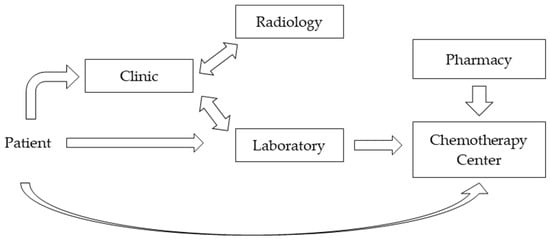
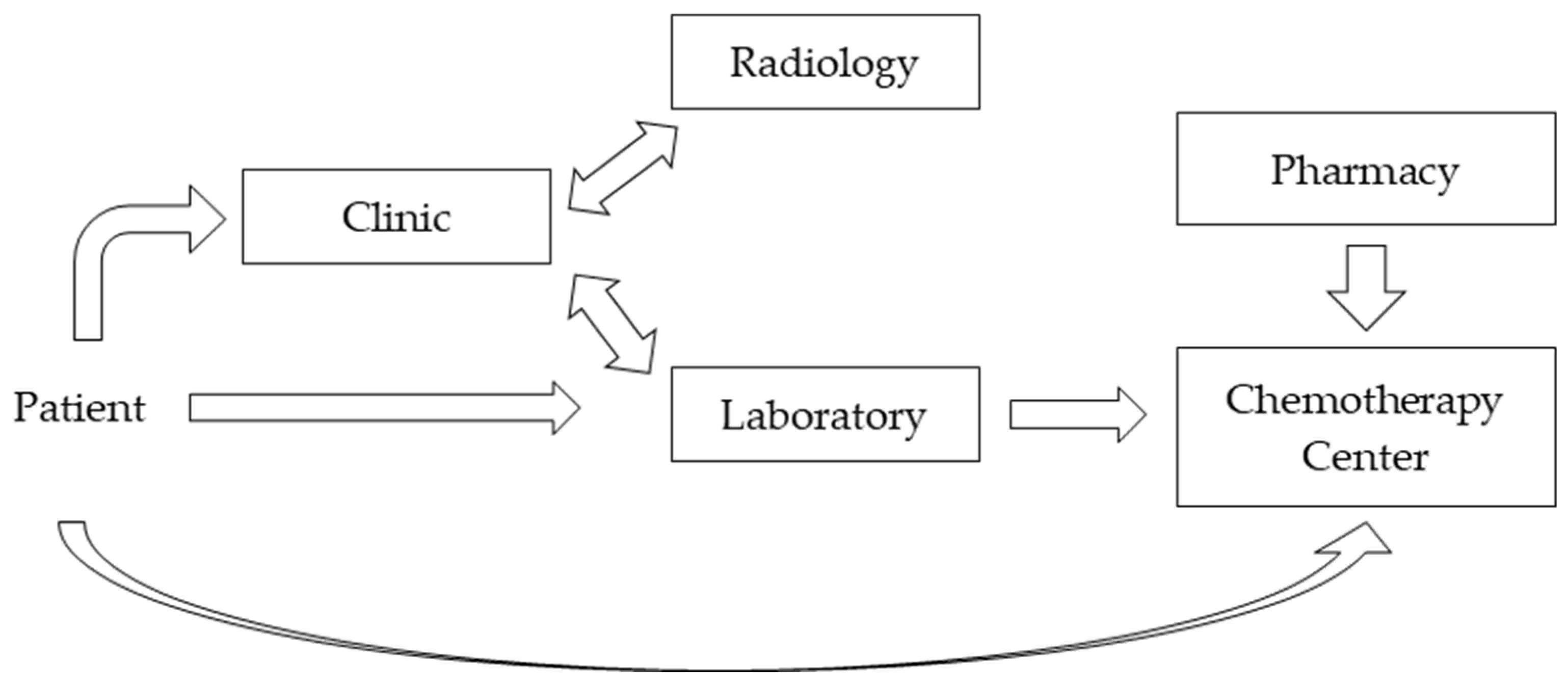
A typical cancer center is organized into five main departments: an oncology clinic, radiology, laboratory, pharmacy, and chemotherapy center (Figure 1). Patients see an oncologist or an advanced practice provider in the clinic. Imaging scans are performed in the radiology department. Lab tests, including blood tests, are done in the laboratory department and are reviewed by an oncologist before patients receive chemotherapy. Patients’ chemotherapy drugs are mixed in the pharmacy and sent to the chemotherapy center, where patients receive the treatment either as an infusion or an injection.
Figure 1.
Patient flow among departments in a typical cancer center.
This study focuses on the infusion department in cancer centers where chemotherapy is done in parallel or in sequence with radiotherapy and surgery.
Chemotherapy treatment is done in prescribed cycles of a treatment period followed by a rest period. To offer effective treatments, cancer centers must establish policies for efficient patient scheduling and resource allocation, including nurses and chairs. However, there is a significant variation in nursing requirements and chemotherapy lengths, which makes resource assignment and patient scheduling for chemotherapy a complex problem [1]. For example, an infusion center may use the number of chairs to determine the number of patients scheduled in a day. However, the number of nurses may not be sufficient to administer chemotherapy to all patients on time [2,3].
Cancer patients have different acuity levels depending on many factors, such as treatment plans, drug side effects, and health status. Thus, several factors need to be considered when assigning patients to nurses, including the number of patients and their acuity levels as well as additional tasks that nurses should perform (e.g., triaging, mixing drugs, and documenting the treatment on patient medical records). Unbalanced nurse to patient assignments affects patient flow and nurse workload; patients will experience long wait times to start their treatments, and some nurses will have to work overtime and may experience burnout [4,5].
In outpatient oncology practice, clinical acuity is used to describe how much nursing attention a patient is likely to require during treatment. It is influenced by several factors, including the complexity of the therapy, the severity of symptoms, the level of monitoring needed, and the risk of adverse reactions during infusion [6]. In day-to-day operations, acuity is often translated into a numerical measure that represents the amount of nursing effort required over the course of treatment, allowing infusion centers to better assess workload and guide nurse–patient assignments [7]. As a result, incorporating acuity into nurse–patient assignment decisions play an important role in balancing workload, maintaining patient safety, and supporting efficient patient flow in infusion centers [8].
Chemotherapy nurses are key resources that supervise chemotherapy treatments as ordered by oncologists. Chemotherapy nurses educate patients and family members about their treatments, document important information in patient charts, stabilize patients during an emergency, and help them better cope with drug side effects [9]. Since nurses handle multiple patients simultaneously, it is essential to balance their workload based on the acuity levels of patients to ensure patient safety, quality of care, and nurse satisfaction.
Oncology clinics apply different nursing care delivery models to schedule patients for chemotherapy treatments and to assign nurses to patients. There are two main delivery models used in cancer clinics: functional care and continuity-based (often referred to as “primary”) nursing care [1]. To avoid confusion with primary medical care, we use the term nurse continuity to describe this model throughout the remainder of the paper. According to the Oncology Nursing Society Survey [10], these two models are the two most commonly used models in infusion centers; 40% of chemotherapy centers use the functional care delivery model, and 39% use the continuity-based model. In the functional care delivery model, nurses’ working hours and skill levels are considered when assigning them to patients; thus, patients may be assigned to different nurses at every visit. In the continuity-based delivery model, a primary nurse is assigned to a patient, and care continuity is maintained through the chemotherapy sessions.
Nurse to patient assignment is an important decision in infusion centers as it affects patient flow and nurse workload [4,11]. Although there is high variability in chemotherapy patients’ care needs, few studies in the literature address chemotherapy nurse assignments based on acuity levels of patients [6,8]. In this study, we propose a mixed-integer mathematical programming model to assign nurses to patients considering the acuity levels of patients to minimize patient wait time to start their treatments. We also seek to balance the workload across oncology nurses to avoid safety issues and nurse burnout. The contribution of this study is that the proposed model allows infusion centers to have the flexibility to provide patients with nurse continuity while ensuring nurse workload does not exceed the maximum acuity level that nurses can handle at any given time during working hours. In other words, this study brings together two elements that are usually treated separately, acuity-based workload limits and nurse continuity, and shows how they interact in day-to-day infusion center operations. By modeling both within a single framework, we address a gap in the existing literature and offer a practical decision-support approach for infusion centers that operate under mixed care delivery models, a setting that has received relatively little attention in the literature. While prior studies in outpatient oncology have examined acuity-based assignment, workload balancing, or uncertainty in treatment durations, these elements are often studied in isolation. In particular, nurse–patient continuity is typically assumed to be fixed or handled outside the assignment decision. In this study, we explicitly model nurse continuity as part of an acuity-constrained nurse–patient assignment problem and examine how different levels of continuity affect both patient wait time and workload balance. By evaluating these trade-offs across multiple continuity scenarios, the proposed model provides insight into how continuity requirements interact with operational constraints in daily infusion center operations.
From a managerial perspective, this study provides a practical way to evaluate trade-offs that infusion center leaders face on a daily basis. Rather than assuming a single care delivery model, the proposed framework allows managers to explore how different levels of nurse continuity affect patient wait time and nurse workload under realistic acuity constraints. This is particularly relevant for infusion centers that operate under mixed care delivery models, where continuity may be offered selectively rather than universally. By making nurse continuity an adjustable decision variable, the model helps decision makers assess when continuity can be supported without compromising operational performance and when it may introduce unintended delays or workload imbalances.
This research is conducted in collaboration with a cancer center in West Texas to address challenges related to operational efficiency and nurse workload in infusion clinics. The collaboration offered insights into real-world scheduling and care delivery practices, which inform the design and evaluation of our proposed model.
The remainder of this paper is organized as follows. Section 2 provides a literature review of outpatient chemotherapy scheduling and positions our study within the existing literature. In Section 3, the problem is described in detail, and a mixed-integer linear programming model is formulated. The usefulness of the model is demonstrated by showing numerical results and evaluating the effect of changing different operational parameters in Section 4. Section 5 discusses the results in greater depth, highlighting their practical implications for infusion center operations as well as the limitations of the study. Conclusions and opportunities for future research are discussed in Section 6.
2. Literature Review
Outpatient chemotherapy scheduling is a crucial aspect of cancer care that aims to improve patient access to care. Over the last two decades, researchers have devoted significant attention to this area. They have used several approaches to improve chemotherapy patient scheduling such as mathematical programming ([3,6,12,13,14]), heuristic algorithms ([15,16]), and simulation ([4]). Bazrafshan and Lam [17] provide a comprehensive review of the studies in outpatient chemotherapy scheduling. Below we discuss the most recently published studies relevant to chemotherapy nurse assignment and patient scheduling in outpatient cancer centers.
Although nurse–patient assignment has been extensively studied in literature in inpatient clinics, few studies address nurse assignment in outpatient settings. Liang and Turkcan [8] are one of the very first researchers who address the nurse assignment problem in chemotherapy departments. They propose a multi-objective mixed integer model to minimize patient wait time and nurse overtime in oncology clinics. Heshmat et al. [18] propose a novel approach for scheduling chemotherapy patients that includes a clustering stage to find the optimum cluster members for any patient mix (based on infusion duration and acuity level) and a mathematical programming stage to assign nurses to the patient clusters. Hesaraki et al. [19] present a bicriterion model for scheduling chemotherapy appointments to maximize nurse utilization and minimize the deviation of the scheduled appointments from patients’ ready times. Demir et al. [20] formulate a two-stage stochastic mixed-integer programming model to assign chemotherapy appointments to a limited number of resources (nurses and chairs). They aim to minimize the expected weighted sum of nurse overtime, chair idle time, and patient wait time resulting in a balanced assignment of patients to nurses.
More recent optimization-based studies continue to address uncertainty and workload considerations in outpatient oncology operations. Benzaid et al. [3] propose a two-stage mathematical model for daily nurse–patient assignment. In the first stage, new patients are scheduled at the end of each day, the daily requirements for nurses are estimated, and a wait list is created. Later, in the second stage, patients are assigned to nurses such that the required number of nurses is minimized. Gul [13] develop a two-stage stochastic mixed-integer programming model for scheduling chemotherapy patients and assigning them to nurses and chairs such that the workload among nurses is balanced. The objective function is to minimize the expected weighted sum of patient wait time and nurse overtime. Karakaya [6] formulate a two-stage stochastic mixed integer programming model to account for uncertainty in infusion durations. The objective is to minimize the expected weighted sum of excess patient acuity, waiting time, and nurse overtime. Then, they develop a scenario bundling-based decomposition algorithm to find near-optimal solutions to the problem. Gul and Karsu [21] use real outpatient data to study variability in chemotherapy treatment durations and its impact on scheduling. They then develop two-stage stochastic optimization models that balance patient waiting time, nurse overtime, and workload considerations. Prior studies have examined key aspects of outpatient infusion operations, such as acuity-based assignment and scheduling (e.g., Refs. [8,21]), workload balance and nurse overtime (e.g., Refs. [13,20]), and uncertainty in treatment durations (e.g., Refs. [6,20,21]). However, nurse–patient continuity is often treated as fixed or left outside the assignment decision, and the operational impact of enforcing different levels of continuity is rarely examined. This study addresses that gap by explicitly modeling nurse continuity as a decision variable and by evaluating how increasing continuity requirements affect patient wait time and workload balance under acuity-based capacity constraints. In this study, we build upon the work of Liang and Turkcan [8] by proposing a functional care delivery model to reduce patient wait time. While our approach is aligned with their work, our contribution lies in incorporating nurse continuity for certain patients and ensuring a balanced workload distribution among nurses based on patient acuity.
3. Methodology
One of the main challenges in infusion departments is developing nurse–patient assignments that reduce patient wait times while maintaining a balanced workload among nurses to help prevent burnout. In this section, we formulate a mixed-integer linear programming (MILP) model to support these assignment decisions by explicitly accounting for patient acuity levels. The MILP framework is particularly appropriate in this setting because it enables key operational constraints—such as nurse availability, assignment feasibility, and acuity-based workload limits—to be represented directly within the optimization model. The proposed formulation therefore seeks not only to minimize patient wait time, but also to promote a more balanced distribution of workload across nurses. We consider a typical infusion center where a set number of nurses are employed and work fixed hours (e.g., 8 a.m. to 5 p.m.) each day. Each nurse’s work schedule is unique to account for any variations in their availability. Patient schedules are also provided, outlining the number of patients scheduled, appointment times, treatment duration, and acuity levels. The head nurse assigns nurses to patients at the start of each day based on the acuity level of the patients and the maximum acuity level each nurse can manage during their shift. Patient acuity is modeled as a fixed value over the course of a single treatment day. This reflects how infusion centers typically operate, where acuity is determined in advance based on the planned treatment, the patient’s condition, and expected monitoring needs. Although a patient’s acuity may change over longer time horizons or across visits, it is usually treated as stable for day-to-day operational decisions. Modeling acuity in this way allows the framework to account for meaningful differences in nursing workload while keeping the model practical and tractable.
We utilize a math programming-based approach which allows us to define an objective to be optimized subject to constraints related to patient care requirements and nursing availability and capability. The model can explore numerous schedule alternatives in order to find an optimal solution for the stated objective and constraints. The proposed model assists infusion centers with assigning nurses to patients such that the overall wait time for patients is minimized and the workload among nurses is distributed equitably. The sets, indices, parameters, and variables used in the proposed mathematical model are as follows:
- Sets
Set of patients
: Set of nurses
: Set of slots
- Indices
index for patients
index for nurses
index for time slots
- Parameters
: Appointment time of patient
: Treatment duration of patient
: Acuity level of patient , representing the intensity of nursing care required during treatment
: Skill level of nurse
: Total maximum acuity level that nurse can handle at each time slot
: Shift start and end times of nurse
: Binary input having value 1 if nurse can administer patient , and 0 otherwise
: Binary input having value 1 if nurse is the primary nurse for patient , and 0 otherwise
- Variables
: Binary variable having value 1 if patient is assigned to nurse in slot , and 0 otherwise
: Overtime of nurse
: Workload of nurse
: Workload difference between nurse and
: Wait time of patient
: Treatment start time of patient
Time in the infusion center is represented using fixed-length intervals, or slots. These slots align with how appointments and nurse availability are typically planned in practice and allow treatment start times to be modeled in a clear and manageable way. Although patient arrivals and treatment durations are continuous in reality, using discrete time intervals provides a reasonable and widely used approximation that makes it possible to model nurse–patient assignments across the day without unnecessary complexity. All time-dependent decisions in the model are indexed by discrete time slots .
The proposed MILP is formulated as follows:
subject to:
The objective function (1) minimizes the sum of patient wait times to start their infusions. Constraint (2) ensures that each patient is assigned to only one nurse. This constraint also guarantees that the treatment does not begin until the assigned nurse has started their work for the day and the patient has arrived, assuming that the patients are always on time for their appointments. Due to additional work and possible complications that may arise at the beginning of patient treatment, each nurse can start the treatment of only one patient at a time, which is guaranteed by constraint (3). Constraint (4) guarantees that every patient is allocated to a nurse with the necessary skills to attend to their needs. Additionally, this constraint can be utilized to ensure that patients are assigned to their preferred nurse, as in the continuity-based delivery model. In keeping with standard practice in infusion centers, nurses are assumed to supervise multiple patients concurrently during treatment. However, the number of patients a nurse can manage at any given time is constrained by the overall intensity of care required, rather than by patient count alone. Constraint (5) ensures that the total acuity level of the patients assigned to each nurse at each time slot does not exceed the maximum total acuity assigned to a nurse within each time slot, ensuring that workloads remain within manageable levels. Constraint (6) calculates the acuity-based utilization for each nurse, which is defined as the total acuity level of all the patients assigned to a nurse multiplied by the treatment duration of each patient divided by the total acuity level that a nurse can handle in a day. The utilization variable represents an acuity-weighted measure of nurse workload over the day, normalized by the maximum workload capacity of each nurse. This definition allows workload comparisons across nurses with different acuity limits. Constraint (7) balances the workload across nurses by setting the utilization variability among nurses to be less than a predefined value ε. The parameter ε reflects a managerial tolerance for workload imbalance and can be adjusted by infusion center leadership based on staffing policies and operational priorities. Constraint (8) defines patient wait time as the difference between the actual treatment start time and the scheduled appointment time. Constraints (9–11) are binary and non-negativity constraints.
The model relies on several simplifying assumptions to remain tractable and focused on daily assignment decisions. Patients are assumed to arrive on time, treatment durations are treated as deterministic, and patient acuity levels are fixed for the duration of a treatment day. These assumptions reflect common planning practices in infusion centers, where schedules and acuity assessments are determined in advance. Nevertheless, deviations from these assumptions may occur in practice and could affect assignment feasibility and performance.
4. Results
In this section, we demonstrate the efficacy of the proposed model by solving it for a specific numerical example. Additionally, we explore the effects of utilizing a combination of primary and functional care delivery models, where certain patients prefer to be assigned to the same nurse for each visit to the infusion center. Furthermore, we develop a heuristic algorithm and evaluate its performance relative to the exact method.
As mentioned, this study was conducted in collaboration with a cancer center. Due to restrictions on accessing patient-level data, the numerical example used in this study is synthetic. However, all model inputs including operating hours, staffing levels, treatment durations, and patient acuity distributions were derived from actual infusion department practices and validated by the cancer center manager to ensure they accurately reflected real operating conditions.
We assume that 40 patients are scheduled for the day. The number of working hours in a day is assumed to be 9 h (8 a.m. to 5 p.m.), divided into 27 slots (20 min slots). Table 1 provides a summary of the scheduled patient information, including their scheduled slot, treatment duration (measured in slots), and acuity level. The appointment duration includes the time a nurse spends with a patient or a family member before and/or after the treatment, the total time of treatment, and the time for any additional nursing requirements. Patients’ acuity levels are determined by various factors, such as treatment type, patient status (new or returning), and symptom management requirements, and range from 1 to 5. The acuity levels of 1 and 5 indicate the least and the highest nursing care required by a patient, respectively. The value of ε (maximum acuity-based workload variability among nurses) is set to 0.1.
Table 1.
Scheduled patients’ information.
We assume that the infusion center has 7 oncology nurses who work from 8 a.m. to 5 p.m. Table 2 illustrates the maximum total acuity level assigned to each nurse. This value denotes the highest total acuity level a nurse can handle during each time slot, which depends on their experience and ability to manage multiple patients simultaneously. For instance, if a nurse’s maximum total acuity level is 8, they must ensure that the sum of the acuity levels of all the patients under their supervision at a given time slot does not exceed 8.
Table 2.
Maximum acuity levels of nurses in a given slot.
4.1. Exact Method
This section presents the model results obtained by solving the mixed-integer linear programming model using a linear programming–based branch-and-bound algorithm implemented in Gurobi Optimizer, a commercial optimization solver widely used for solving linear and mixed-integer programming problems. Table 3 presents the model results, including the nurse assigned to each patient and the patient wait time (in slots). According to the results, nearly one-third of the patients (13 patients) had to wait before receiving treatment. Six patients had to wait 20 min, while the remaining seven had to wait between 2 and 4 slots (40 to 80 min). The primary cause of the patient’s wait time was due to the maximum acuity level limit of the nurses. By enabling the chemotherapy nurses to handle more patients, fewer patients would need to wait for their turn. This highlights the importance of offering training programs to chemotherapy nurses to help them enhance their nursing expertise.
Table 3.
Model results for nurse assignment and patient wait time.
Table 4 shows the utilization rates of each nurse. The findings indicate that the proposed model ensures an even workload distribution among the nurses, resulting in a balanced workload.
Table 4.
Model results for nurse utilization.
The findings presented above are based on a scenario where patients are assigned to nurses based on acuity levels without considering care continuity. Nevertheless, some cancer centers combine functional care with nurse continuity delivery models to satisfy patients who prefer to see the same nurse each time they receive chemotherapy. To account for this, we explore five scenarios in this section, enabling some patients to be assigned to their preferred nurse. Table 5 displays the five scenarios we investigate. We use the same input as the previous case example for each scenario but relax the constraint associated with workload balance (Constraint 7) to avoid infeasibility issues.
Table 5.
Scenarios investigated to account for nurse continuity delivery model.
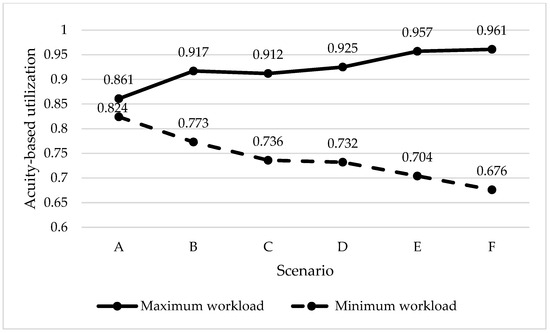
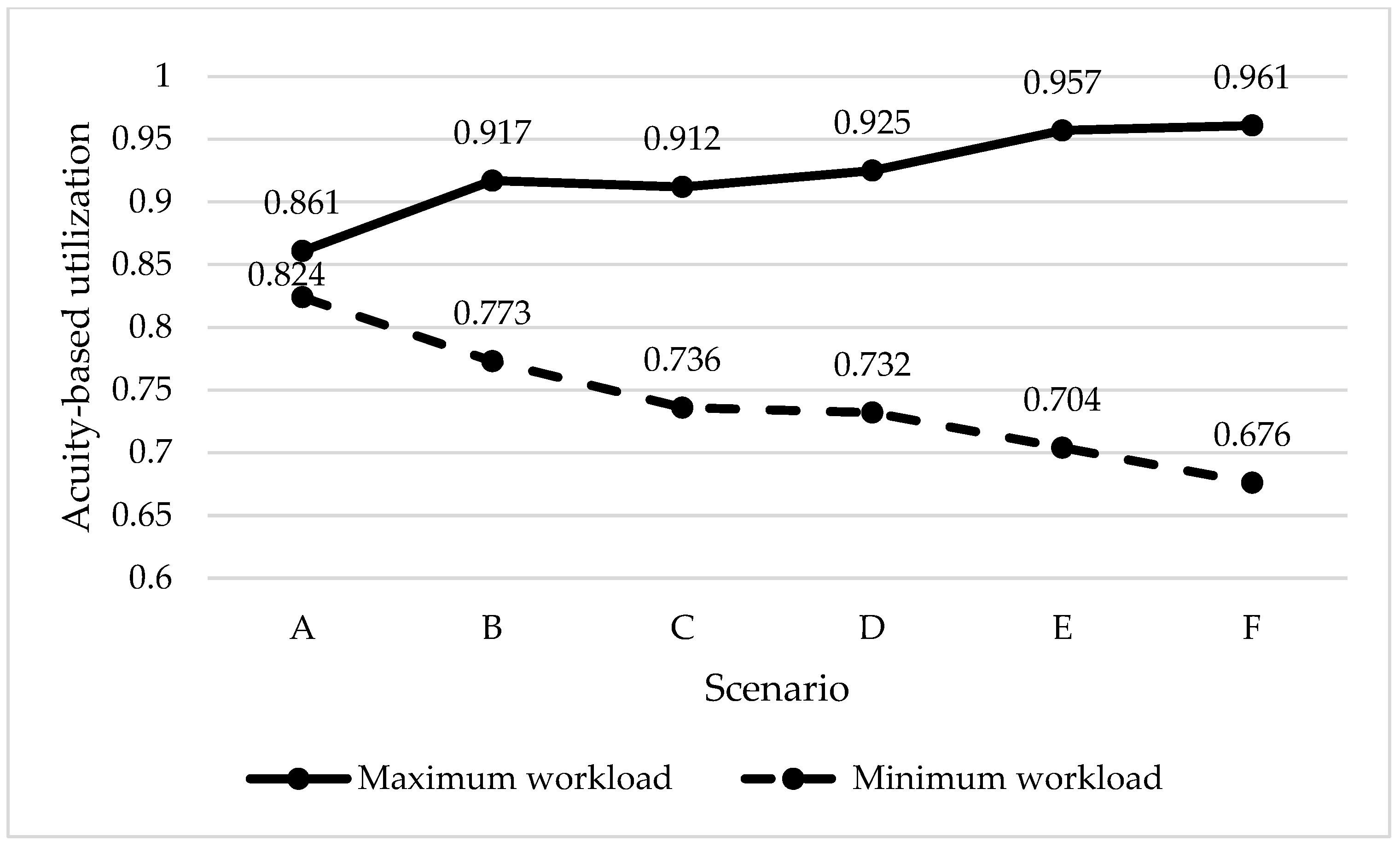
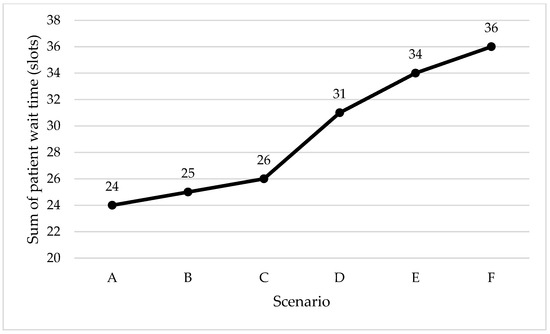
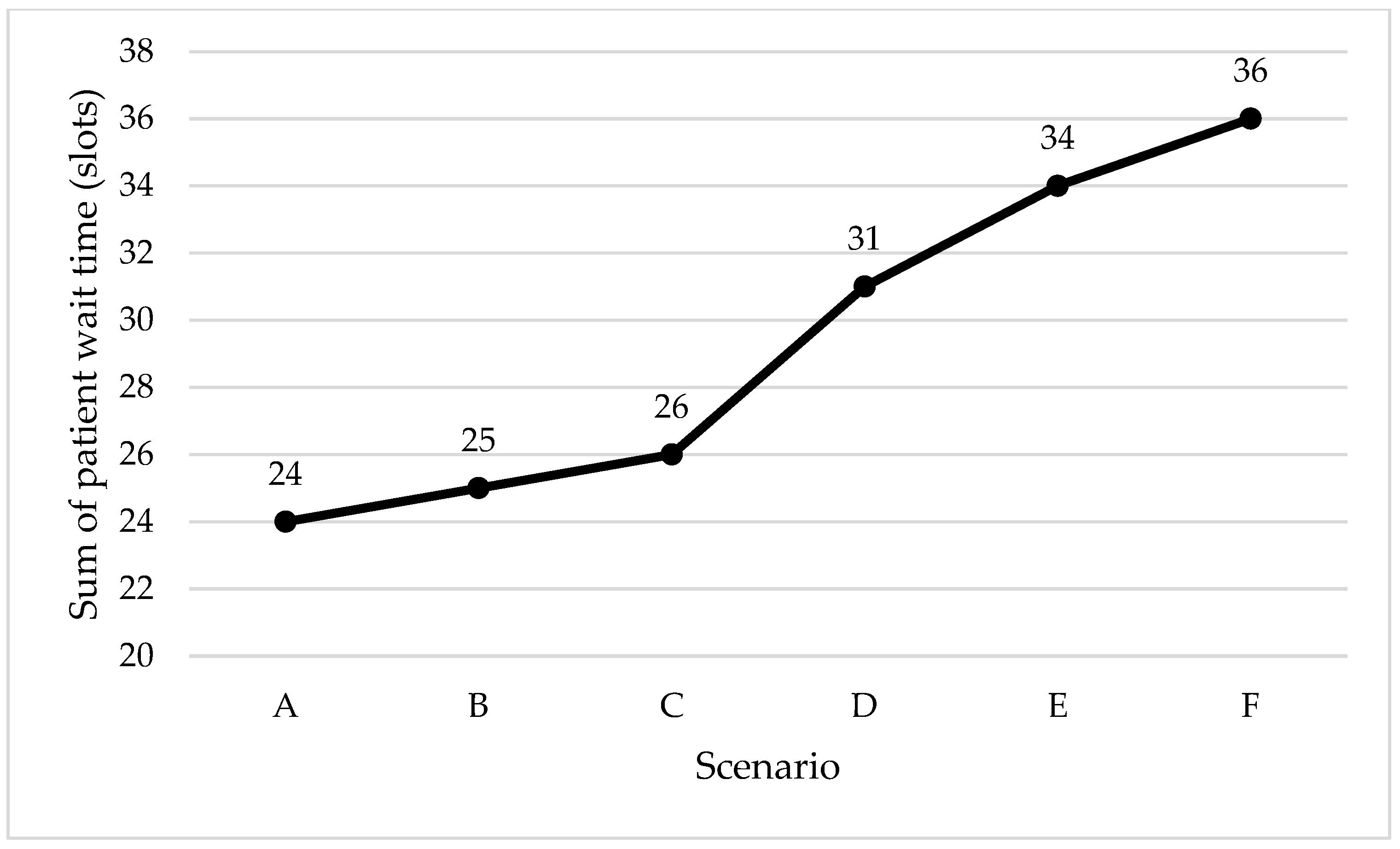
Figure 2 and Figure 3 illustrate the effect of each scenario on workload variation among nurses and patient wait time, respectively. As the proportion of patients requiring nurse continuity increases across scenarios A–F, workload variation among nurses generally increases. Overall, the maximum and minimum workload trends remain fairly consistent across scenarios; while they are not perfectly smooth, this behavior is expected given the discrete nature of nurse–patient assignments and the integer structure of the model. The transition from scenario B to C reflects an important shift. At this point, nurse continuity constraints begin to affect a larger share of daily assignments, reducing the model’s ability to redistribute patients evenly across nurses. Although the maximum workload decreases slightly between these two scenarios, the minimum workload declines more noticeably, resulting in an increase in overall workload variation. This indicates that some nurses become more constrained by preassigned patients, while others experience reduced utilization. As continuity requirements increase further in scenarios C–F, assignment flexibility continues to decrease, and workload variation grows in a more consistent manner. Furthermore, patients’ wait time increases as they have to wait for their preferred nurse to be available. However, one way to address this problem is to consider the care delivery type when scheduling and assigning patients to their desired nurses. This approach enables infusion centers to distribute patients more evenly throughout the day, leading to an improved patient flow on a daily basis. The increase in patient wait time is more pronounced between scenarios C and D, when the percentage of patients following the nurse continuity delivery model rises from 20% to 30%. At this point, continuity requirements start to affect a meaningful portion of daily nurse assignments, which makes it harder to adjust assignments during busier periods of the day. In scenarios B and C, there is still enough flexibility to accommodate variation in appointment times and treatment lengths. Once continuity requirements increase further in scenario D, however, more patients end up waiting for their assigned nurse to become available. After this point (scenarios D–F), most of the assignment flexibility has already been lost, so adding more continuity requirements has a smaller incremental effect, leading to a steadier increase in patient wait time.
Figure 2.
Workload variation across nurses under different levels of nurse continuity.
Figure 3.
Total patient wait time (in slots) across scenarios with increasing levels of nurse continuity.
Whether the observed increases in patient wait time and workload variation are operationally or clinically acceptable depends on local priorities, staffing levels, and patient expectations. In some settings, modest increases may be acceptable if they support care continuity and patient satisfaction, while in others they may signal the need for additional staffing or scheduling adjustments. The proposed model is intended to support these trade-off assessments rather than prescribe a single “optimal” level of nurse continuity.
4.2. Proposed Heuristic Algorithm
If there is a very large number of patients, the mixed-integer programming model can require significant computational resources in order to solve the problem. Therefore, this section introduces a heuristic or approximate algorithm designed to evaluate the effects of an alternative nurse–patient assignment method. The algorithm prioritizes the assignment of patients to nurses who can manage more patients simultaneously. The following section outlines the steps of the Algorithm 1.
| Algorithm 1 Proposed Heuristic |
| Step 1: Calculate the acuity index for each patient, which is defined as the patient acuity level multiplied by the patient treatment duration , for ) Step 2: Define as the remaining maximum total acuity level for nurse in slot ; set Step 3: Define set M as the set of nurses sorted from higher to lower maximum total acuity level Step 4: For each time slot , start from the patient with the highest acuity index and from the nurse with the highest maximum total acuity level. If there are multiple patients scheduled in a time slot, start with the patient with the highest acuity index. If , assign nurse to patient ; else proceed to the next nurse in set . If no nurse is selected, go to the next time slot ) and repeat step 4 until a nurse is selected Step 5:) Step 6: Repeat steps 4 and 5 until all patients are assigned to a nurse. |
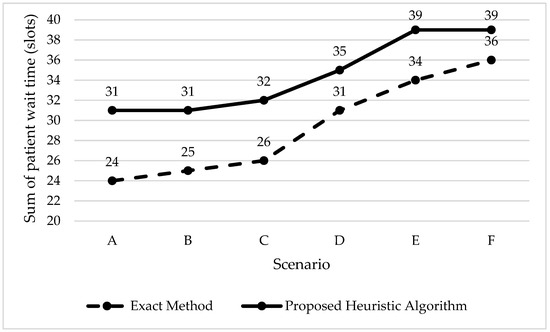
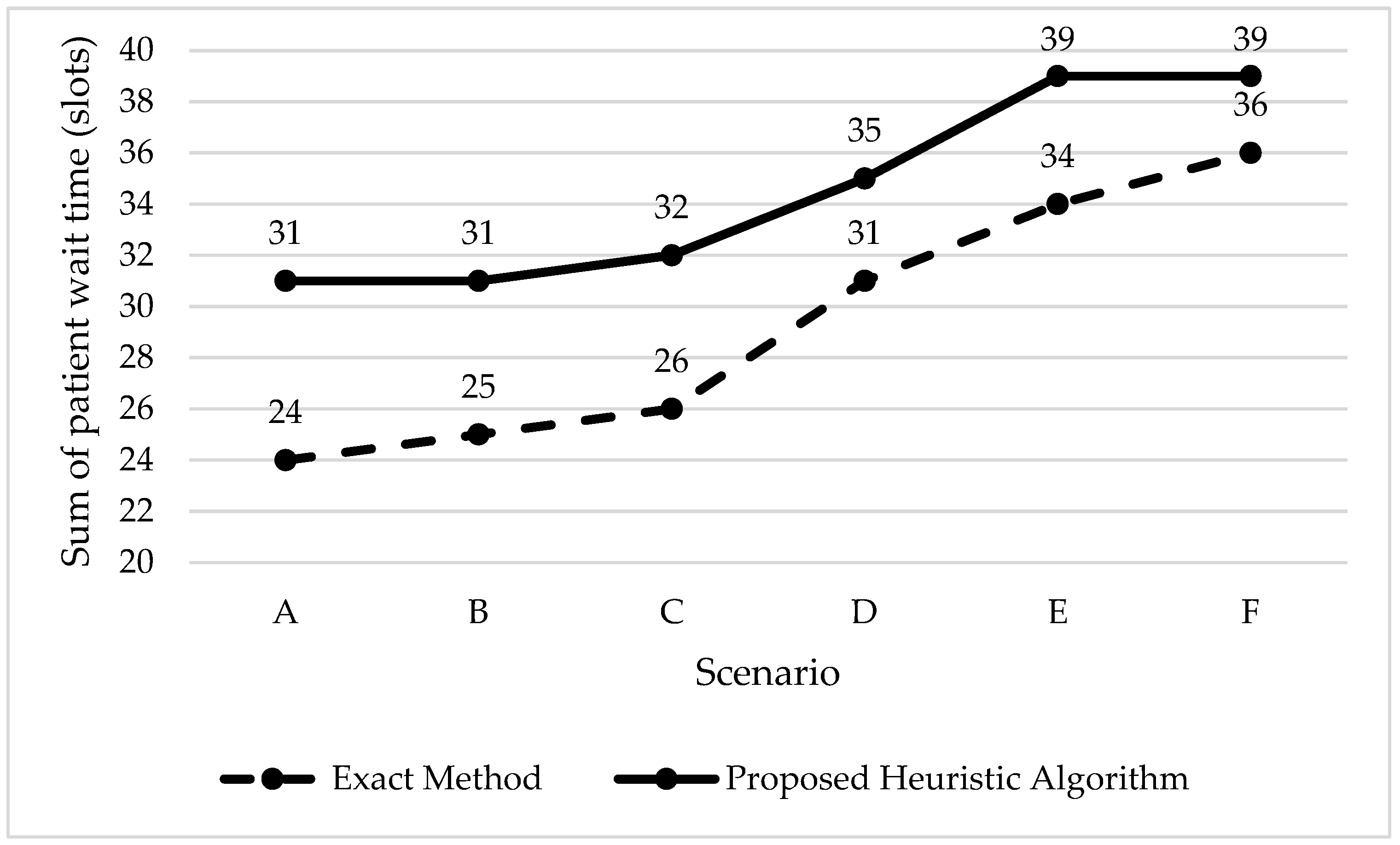
Figure 4 compares the outcomes of the exact method (presented in the preceding section) and the heuristic algorithm for total patient wait time. The results indicate that the exact algorithm outperforms the heuristic algorithm. The reason for this is that the exact algorithm takes a comprehensive approach across the entire time horizon and aims to allocate nurses to patients to minimize the total patient wait time. In contrast, the heuristic algorithm prioritizes nurses with higher maximum total acuity levels. Nonetheless, the two methods generate more similar results as patient continuity increases. This is due to the increase in the number of patients assigned to preassigned nurses, resulting in a more constrained problem solution space and fewer decisions for the heuristic algorithm.
Figure 4.
Patient wait time obtained from the exact and the heuristic methods.
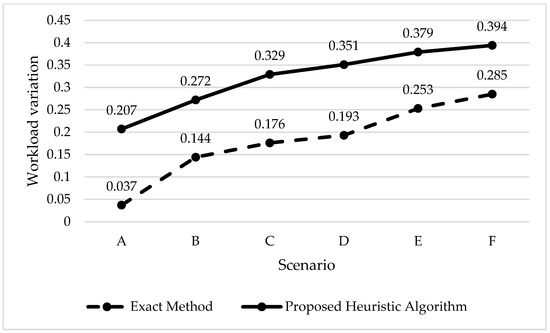
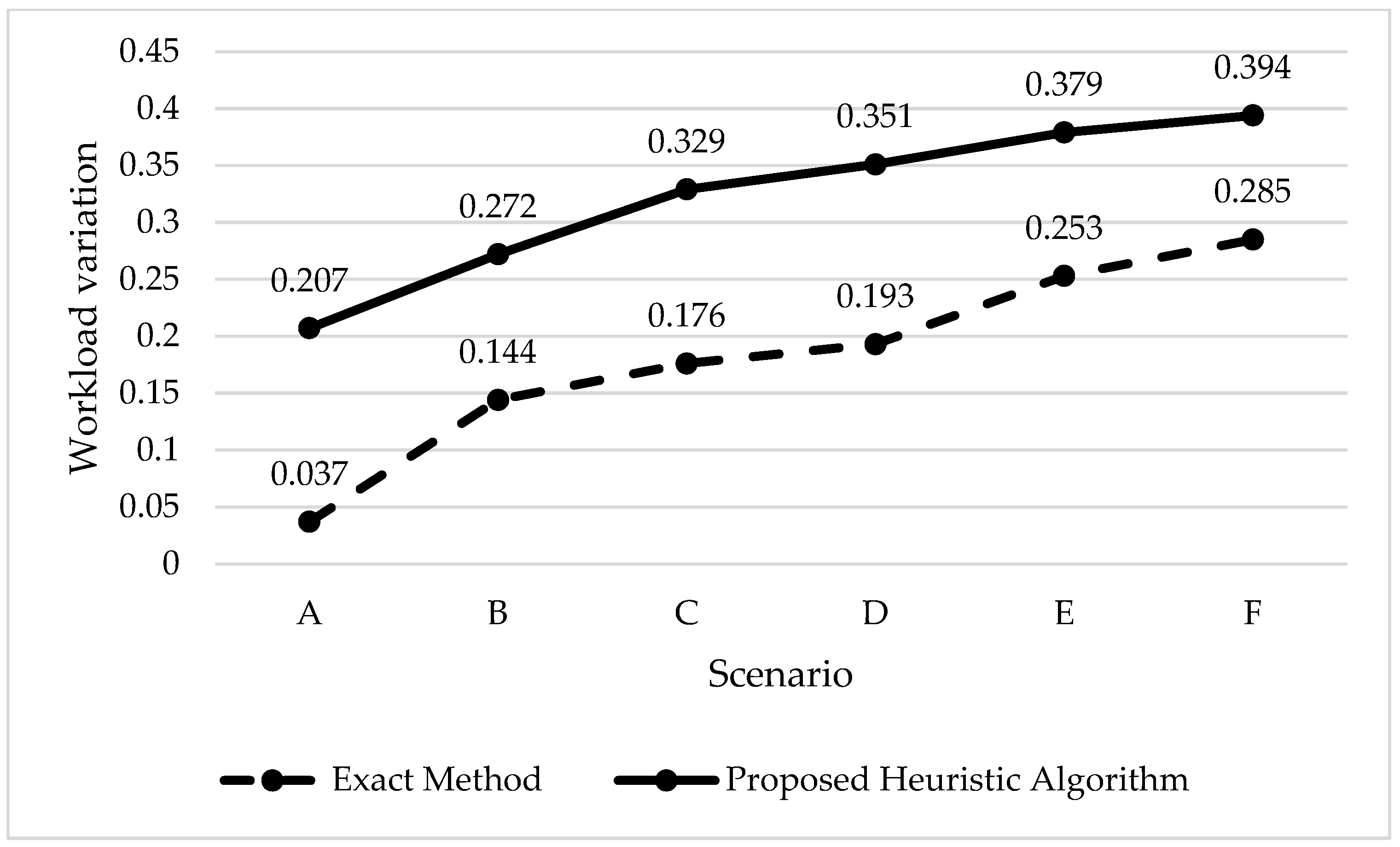
The acuity-based utilization variation among nurses for both the exact and the heuristic algorithms is presented in Figure 5. Utilization variation for each scenario is the difference between the minimum and maximum utilization among nurses. The results confirm that the utilization variation is more significant in the heuristic algorithm. Although balancing work utilization is not a determining factor in the current heuristic algorithm, an alternative approach could be devised to consider workload balance more effectively.
Figure 5.
Workload variation obtained from the exact and the heuristic methods.
The heuristic developed in this study was designed to provide an alternative assignment approach that is computationally efficient and easy to apply in practice. There are several natural extensions that could further enhance its performance. For instance, future versions could explicitly incorporate workload-balancing considerations into the assignment logic or allow for limited look-ahead across time slots to better anticipate capacity constraints. These enhancements were not explored in the present study in order to maintain a clear and focused comparison between the exact optimization approach and an approximate assignment method.
5. Discussion
The results highlight several operational trade-offs that infusion centers may face when assigning nurses to patients under different care delivery approaches. In the baseline scenario, where patients are assigned based only on acuity levels, the model produces fairly balanced workloads across nurses and relatively low patient wait times. This outcome largely reflects the flexibility available when assignments can be adjusted freely according to nurse capacity and patient acuity. With fewer restrictions on assignments, the system can distribute work more evenly throughout the day.
Once nurse continuity is introduced, however, that flexibility becomes more limited. As more patients are required to see the same nurse, the model has fewer opportunities to shift assignments across nurses. Some nurses become tied to specific patients, while others may have fewer chances to take on additional workload. As a result, both workload variation and patient wait time tend to increase. This pattern mirrors what many infusion centers experience in practice: nurse continuity can improve the patient experience and strengthen patient–nurse relationships, but it can also make daily scheduling decisions more constrained.
It is also important to interpret these results in light of the simplifying assumptions used in the model. The numerical example used in this study is simulated but was designed to reflect realistic operating conditions observed in infusion centers. Even so, the example represents a single-day scenario and does not capture the full range of variability that may occur in practice, such as changes in patient volume, staffing levels, or scheduling patterns over longer planning horizons. Future work could extend this analysis by examining additional operational scenarios and by incorporating real patient data to further evaluate the model’s performance and applicability in different clinical environments.
Moreover, this study focuses primarily on operational outcomes—specifically patient wait time and nurse workload balance. While these measures are closely related to broader concerns such as nurse well-being and patient safety, those outcomes are not modeled directly in the current framework. Still, the model can help identify assignment policies that reduce operational strain in infusion centers. Future research could extend this work by explicitly incorporating quality-of-care measures, patient outcomes, or indicators of nurse well-being into the modeling framework.
From a managerial perspective, these results highlight the importance of understanding how different care delivery policies influence day-to-day operations. The proposed model provides a structured way to examine the trade-offs between patient wait time, nurse workload, and nurse continuity. In many infusion centers, staffing decisions are often based primarily on physical resources, such as chair availability. However, the results suggest that nurse workload constraints—especially when patient acuity varies throughout the day—can play an equally important role in determining patient flow and overall system performance. The model can therefore serve as a decision-support tool for assessing whether existing staffing levels are sufficient to support desired care delivery practices or whether adjustments to staffing, scheduling, or care models may be needed.
For nurse leaders, the findings also highlight the operational consequences of nurse continuity policies. While maintaining nurse continuity may improve patient comfort and satisfaction, higher levels of nurse continuity can also lead to greater workload imbalance and longer patient wait times if they are not carefully managed. The proposed framework allows nurse leaders to explore these effects in advance and to identify situations where nurse continuity can be offered without exceeding safe workload limits.
6. Conclusions
Providing high-quality care for cancer patients is an ongoing operational challenge for infusion centers due to the increasing number of cancer patients and limited nursing resources. This study addresses the functional care delivery model in infusion centers, where nurses are assigned to patients based on their acuity levels and the maximum total acuity levels they can manage. We propose a mixed-integer linear programming model for the nurse–patient assignment problem to minimize the total patient wait time on a given day. Additionally, we aim to balance the workload across chemotherapy nurses by imposing a hard constraint on the workload variation among nurses. Furthermore, as some cancer patients prefer seeing the same nurse in each treatment session, we investigate the impact of providing infusion centers with the flexibility to use a combination of functional and nurse continuity delivery models. From a practical standpoint, the proposed model is intended as a decision-support tool rather than a fully automated scheduling system. The required inputs—such as patient appointment times, treatment durations, acuity levels, nurse availability, and continuity preferences—are already routinely collected in infusion centers, making the approach feasible for offline use in supporting daily nurse–patient assignment decisions.
According to the results, patient wait time and workload variation among nurses increase when nurse continuity of care increases, which could have implications for patient experience and nurse well-being, depending on local operational priorities and staffing conditions. The goal of this study is not to determine the best level of nurse continuity to employ, but rather to offer insights into the nurse–patient assignment problem and assist infusion centers in assessing the impacts of having different levels of nurse continuity of care. A more comprehensive study is required to compare the full effects of requiring nurse continuity, considering different factors such as patient satisfaction, patient safety, and resource costs.
Furthermore, we developed a heuristic algorithm as an alternative approach for nurse–patient assignment. The heuristic requires less computational resources than the exact model. The results indicate that the exact method outperforms the heuristic algorithm regarding total patient wait time and the heuristic algorithm leads to higher workload variation among nurses as it does not consider the balance of nurse workload. Future research can focus on developing a heuristic algorithm that considers workload balance when assigning nurses to patients.
This study only focuses on nurse–patient assignment. Future research should also take into account chair assignments, as chair utilization is a crucial factor in patient wait time and patient flow. Moreover, further research can be conducted to determine the benefits of assigning patients to chairs and nurses when scheduling patients for chemotherapy.
In summary, this study provides a structured optimization framework for evaluating nurse–patient assignment decisions in oncology infusion centers while accounting for patient acuity and nurse continuity preferences. By highlighting the operational trade-offs between patient wait time, nurse workload balance, and continuity of care, the proposed model offers infusion center managers a practical tool for assessing staffing and assignment policies. These insights may help healthcare organizations design more efficient and sustainable care delivery practices in outpatient oncology settings.
Author Contributions
Conceptualization, M.K. and B.A.N.; methodology, M.K.; software, M.K.; validation, M.K. and B.A.N.; formal analysis, M.K.; investigation, M.K.; resources, B.A.N.; data curation, M.K.; writing—original draft preparation, M.K.; writing—review and editing, M.K. and B.A.N.; visualization, M.K.; supervision, M.K. and B.A.N.; project administration, M.K.; funding acquisition, M.K. All authors have read and agreed to the published version of the manuscript.
Funding
This research received no external funding.
Data Availability Statement
This study does not rely on external datasets. The numerical example is based on synthetic data designed to reflect realistic operating conditions. The raw data supporting the conclusions of this article will be made available by the authors on request.
Conflicts of Interest
The authors declare no conflict of interest.
References
- Lamé, G.; Jouini, O.; Stal-Le Cardinal, J. Outpatient chemotherapy planning: A literature review with insights from a case study. IIE Trans. Healthc. Syst. Eng. 2016, 6, 127–139. [Google Scholar]
- Turkcan, A.; Zeng, B.; Lawley, M. Chemotherapy operations planning and scheduling. IIE Trans. Healthc. Syst. Eng. 2012, 2, 31–49. [Google Scholar] [CrossRef] [Scilit]
- Benzaid, M.; Lahrichi, N.; Rousseau, L.-M. Chemotherapy appointment scheduling and daily outpatient–nurse assignment. Health Care Manag. Sci. 2020, 23, 34–50. [Google Scholar] [CrossRef] [Scilit] [PubMed]
- Qureshi, S.M.; Purdy, N.; Mohani, A.; Neumann, W.P. Predicting the effect of nurse–patient ratio on nurse workload and care quality using discrete event simulation. J. Nurs. Manag. 2019, 27, 971–980. [Google Scholar] [CrossRef] [Scilit] [PubMed]
- MacPhee, M.; Dahinten, V.S.; Havaei, F. The impact of heavy perceived nurse workloads on patient and nurse outcomes. Adm. Sci. 2017, 7, 7. [Google Scholar] [CrossRef] [Scilit]
- Karakaya, S.; Gul, S.; Çelik, M. Stochastic scheduling of chemotherapy appointments considering patient acuity levels. Eur. J. Oper. Res. 2023, 305, 902–916. [Google Scholar] [CrossRef] [Scilit]
- Souza, C.A.; Jericó, M.C.; Perroca, M.G. Measurement of nurses’ workload in an oncology outpatient clinic. Rev. Esc. Enferm. USP 2014, 48, 97–103. [Google Scholar] [CrossRef] [Scilit] [PubMed]
- Liang, B.; Turkcan, A. Acuity-based nurse assignment and patient scheduling in oncology clinics. Health Care Manag. Sci. 2016, 19, 207–226. [Google Scholar] [CrossRef] [Scilit] [PubMed]
- Wiley, K.; LeFebvre, K.B.; Wall, L.; Baldwin-Medsker, A.; Nguyen, K.; Marsh, L.; Baniewicz, D. Immunotherapy administration: Oncology Nursing Society recommendations. Clin. J. Oncol. Nurs. 2017, 21, 5–7. [Google Scholar] [CrossRef] [Scilit] [PubMed]
- Oncology Nursing Society. Care Delivery Models Survey Results: Ambulatory Oncology Practices; Oncology Nursing Society: Pittsburgh, PA, USA, 2019. [Google Scholar]
- Sundaramoorthi, D.; Chen, V.C.; Rosenberger, J.M.; Kim, S.B.; Buckley-Behan, D.F. A data-integrated simulation-based optimization for assigning nurses to patient admissions. Health Care Manag. Sci. 2010, 13, 210–221. [Google Scholar] [CrossRef] [Scilit] [PubMed]
- Liang, B.; Turkcan, A.; Zeng, B.; Lawley, M. Improvement of chemotherapy patient flow and scheduling in an outpatient oncology clinic. Int. J. Prod. Res. 2015, 53, 7177–7190. [Google Scholar] [CrossRef] [Scilit]
- Gul, S. Chemotherapy appointment scheduling under uncertainty by considering workload balance among nurses. Pamukkale Univ. J. Eng. Sci. 2021, 27, 570–578. [Google Scholar] [CrossRef] [Scilit]
- Hesaraki, A.F.; Dellaert, N.P.; de Kok, T. Integrating nurse assignment in outpatient chemotherapy appointment scheduling. OR Spectr. 2020, 42, 935–963. [Google Scholar] [CrossRef] [Scilit]
- Huang, Y.-L.; Bach, S.M.; Looker, S.A.; Kuo, Y.-H. Alternative outpatient chemotherapy scheduling method to improve patient service quality and nurse satisfaction. J. Oncol. Pract. 2018, 14, e82–e91. [Google Scholar] [PubMed]
- Sevinc, S.; Sanli, U.A.; Goker, E. Algorithms for scheduling of chemotherapy plans. Comput. Biol. Med. 2013, 43, 2103–2109. [Google Scholar] [CrossRef] [Scilit] [PubMed]
- Bazrafshan, N.; Lam, S.S. Outpatient chemotherapy planning and decision making: A systematic review. Health Syst. 2025, 14, 1–34. [Google Scholar] [CrossRef] [Scilit]
- Heshmat, M.; Nakata, K.; Eltawil, A. Solving the patient appointment scheduling problem in outpatient chemotherapy clinics using clustering and mathematical programming. Comput. Ind. Eng. 2018, 124, 347–358. [Google Scholar] [CrossRef] [Scilit]
- Hesaraki, A.F.; Dellaert, N.P.; de Kok, T. Generating outpatient chemotherapy appointment templates with balanced flowtime and makespan. Eur. J. Oper. Res. 2019, 275, 304–318. [Google Scholar] [CrossRef] [Scilit]
- Demir, N.B.; Gul, S.; Çelik, M. A stochastic programming approach for chemotherapy appointment scheduling. Nav. Res. Logist. 2021, 68, 112–133. [Google Scholar] [CrossRef] [Scilit]
- Gul, S.; Karsu, Ö. Uncertainty in chemotherapy scheduling. In Chemotherapy Appointment Scheduling: Addressing Uncertainty and Fairness; Springer Nature: Cham, Switzerland, 2025; pp. 21–37. [Google Scholar]

Disclaimer/Publisher’s Note: The statements, opinions and data contained in all publications are solely those of the individual author(s) and contributor(s) and not of MDPI and/or the editor(s). MDPI and/or the editor(s) disclaim responsibility for any injury to people or property resulting from any ideas, methods, instructions or products referred to in the content. |
© 2026 by the authors. Licensee MDPI, Basel, Switzerland. This article is an open access article distributed under the terms and conditions of the Creative Commons Attribution (CC BY) license.