


Abstract
This study examines the effectiveness of a virtual reality (VR) application as a learning tool in higher hospitality education, focusing on declarative knowledge acquisition and test-based learning outcomes. Conducted as a classroom-based pilot study, it involved a census of undergraduate students enrolled in a restaurant management course (N = 28) and compared VR-supported learning with traditional instruction using printed materials. Declarative knowledge acquisition was assessed using identical multiple-choice pre- and post-tests. Results showed that scores improved across all students. A statistically significant time × group interaction indicated that the two groups improved at different rates over time. Students who learned using printed materials demonstrated greater improvement than those who used the VR application. The findings suggest that, in its implementation, the VR application did not demonstrate superior test-based knowledge outcomes compared to traditional learning. One possible explanation lies in the type of knowledge assessed: the test focused on declarative and recognition-based knowledge, whereas VR may be more effective for procedural and experience-based learning. The limited interactivity of the early-stage VR application (VR HOTEL v0.9.4) may have also constrained its instructional potential. Overall, the results highlight the importance of aligning VR-based learning activities with learning objectives, instructional design, and assessment methods.
1. Introduction
The rapid development of immersive technologies is increasingly influencing educational practices, particularly in applied fields such as tourism and hospitality. In these disciplines, learning extends beyond theoretical knowledge to include the development of practical, spatial, and situational skills directly linked to real service environments. From a pedagogical perspective, hospitality education is inherently experiential and requires teaching approaches that effectively connect knowledge with action and context.
In this context, virtual reality (VR) is a promising instructional tool that enables immersive, interactive, and context-rich learning environments [1]. In hospitality and tourism education, VR has been applied in various training scenarios, including front-desk communication, restaurant service and table setting, guestroom orientation, and service-related problem-solving tasks [2,3,4,5]. These applications allow students to engage in realistic simulations of professional situations and safely practice operational procedures in a controlled environment. However, the extent to which such environments translate into measurable learning outcomes remains unclear.
Recent systematic and meta-analytic studies in higher education further highlight the relevance of immersive technologies, indicating that VR can enhance engagement and learning. At the same time, evidence regarding its impact on learning outcomes remains mixed and strongly dependent on instructional design and the specific learning context [6,7,8,9,10]. While VR is consistently associated with higher engagement and presence, its contribution to knowledge acquisition is less consistent.
The pedagogical potential of VR is commonly explained through experiential and situated learning theories [11,12], which emphasise learning through active engagement in context-based tasks. Empirical studies in hospitality education suggest that VR may support experiential learning, increase engagement, and contribute to skill development, often producing outcomes comparable to real-world training while also improving learner confidence [13,14]. However, existing research also indicates that VR tends to produce small to moderate effects on learning outcomes, with effects often stronger in practice-oriented contexts involving procedural tasks and simulations [7,10,15].
Nevertheless, whether VR can effectively support declarative knowledge acquisition remains an important question, particularly in hospitality education, where students must first acquire knowledge of restaurant equipment, inventory, and service items before applying this knowledge in practical learning activities and simulation-based scenarios.
One explanation for these mixed findings can be considered in light of Cognitive Load Theory [16], which emphasises the limitations of working memory and the role of instructional design in managing cognitive demands. In VR environments, learners must process multiple sources of information simultaneously, such as navigation, visual elements, textual content, and interaction with virtual objects, which may increase cognitive load. Empirical evidence suggests that higher cognitive load is associated with lower learning performance, whereas instructional strategies such as guidance and signalling can help reduce cognitive demands and improve learning outcomes [17,18]. Although cognitive load was not directly measured in this study, it provides a relevant theoretical lens for interpreting potential differences in learning effectiveness.
Despite these insights, several important limitations remain in the existing literature. First, most studies in hospitality education focus on user experience, engagement, and technology acceptance, whereas learning outcomes are examined less frequently [3,5,13,14]. Second, many studies are conducted in controlled or short-term experimental settings, which limit ecological validity and raise questions about the applicability of their findings to real-world classroom contexts [10,19]. Third, the role of cognitive load is rarely systematically measured or operationalised in hospitality-related VR research [18,20]. Finally, there is fragmented evidence on how individual learner characteristics, such as interest or motivation, relate to learning outcomes in VR-based environments [8,21].
Consequently, there remains a lack of empirical evidence from real classroom settings directly examining the effectiveness of VR for knowledge acquisition, particularly regarding test-based learning outcomes. In addition, the role of instructional design and potential cognitive constraints in shaping these outcomes remains insufficiently explored.
This study addresses these gaps through a classroom-based pilot conducted in a real educational setting, involving students enrolled in the course Management of Food and Beverage (F&B) Operations, which focuses on restaurant operations and service processes. The study compares a VR-supported learning condition with a traditional instructional approach based on printed materials and focuses specifically on test-based knowledge acquisition.
By doing so, the study contributes to the literature in three ways. First, it provides empirical evidence from a real classroom setting, thereby increasing ecological validity. Second, it offers a direct comparison between VR-based and traditional instructional approaches. Third, it complements existing hospitality VR research by examining objectively measured acquisition of declarative knowledge in a real educational environment. This aspect has received comparatively less attention than learner engagement, perceptions, or technology acceptance. The study was designed as a pilot comparative classroom study; therefore, the findings should be interpreted as indicative rather than conclusive.
2. Theoretical Background
2.1. Experiential and Situated Learning in Hospitality Education
Hospitality and tourism education is inherently practice-oriented, as it requires students to integrate theoretical knowledge with procedural and situational skills. Students are expected not only to understand service processes but also to recognise inventory, navigate space, and perform tasks in dynamic service environments. From a pedagogical perspective, such learning is primarily grounded in experiential learning theory, which conceptualises learning as the construction of knowledge through experience and reflection [11]. Similarly, situated learning theory emphasises that knowledge is closely tied to the context in which it is acquired and applied [12]. From a learning perspective, a distinction can be made between declarative knowledge (knowing what) and procedural knowledge (knowing how), with immersive environments typically supporting the latter through active engagement in context-based tasks.
This distinction can be further understood through Bloom’s taxonomy of cognitive processes [22], which differentiates between lower-order cognitive processes, such as remembering and understanding, and higher-order processes, including applying, analysing, evaluating, and creating. In the context of hospitality education, lower-order processes are typically associated with recognising and recalling service-related elements. In contrast, higher-order processes involve applying knowledge in context, solving problems, and making decisions in dynamic service environments. Immersive technologies such as VR are often associated with higher-order learning, as they enable experiential and context-rich interaction [23]. However, when learning outcomes are assessed using recognition-based tasks, the potential advantages of VR may be less pronounced, as such outcomes primarily reflect lower-order cognitive processes.
VR technologies are particularly relevant in this context, as they enable immersive, context-rich environments that closely resemble real hospitality settings. In hospitality education, VR has been applied in various scenarios, including front-desk communication, restaurant service and table setting, guestroom orientation, and service-related problem-solving tasks [1,3,4,5].
These applications align with experiential learning principles by allowing students to actively engage in realistic situations, repeat tasks, and gradually develop context-dependent skills. Empirical studies suggest that VR environments enhance engagement, presence, and experiential immersion, while also supporting skill development and learner confidence in simulated service situations [13,14].
However, most of these studies primarily focus on user experience variables, such as satisfaction, immersion, or perceived usefulness, rather than on actual learning outcomes. As a result, the effectiveness of VR from a learning-outcome perspective remains insufficiently evaluated.
2.2. Effectiveness of VR for Learning Outcomes
The effectiveness of VR in education has been widely examined, particularly through systematic reviews and meta-analyses. Overall, evidence suggests that VR yields small-to-moderate improvements in learning outcomes compared with traditional or less immersive approaches [10,24]. Stronger effects are typically observed in practice-oriented contexts involving procedural skills and simulations.
For example, in fields such as nursing education, meta-analytical findings indicate substantial improvements in knowledge and moderate gains in skills, when VR is combined with structured instructional elements, such as guidance, pre-briefing, and debriefing [7]. Similarly, studies on safety training and gamified VR environments report moderate effects on both behaviour and knowledge, particularly when learners actively engage in realistic scenarios [7,25].
At the same time, VR appears to be more effective in influencing affective outcomes, such as engagement, motivation, and sense of presence, than purely cognitive outcomes. This pattern is consistent with broader research on educational technology, which highlights the role of digital tools in shaping both learning outcomes and learner perceptions, particularly in diverse learning contexts [26], as well as the importance of user preparedness in the effective integration of technology in educational settings [27]. In other words, while VR is valuable as an experiential and motivational tool, its contribution to knowledge acquisition is less consistent and depends strongly on instructional design and learning context [28,29].
2.3. Cognitive Load in Immersive Learning Environments
One explanation for the mixed effectiveness of VR can be considered in light of Cognitive Load Theory [16], which emphasises the limited capacity of working memory and the importance of instructional design in managing cognitive demands.
In VR environments, learners must process multiple sources of information simultaneously, including spatial navigation, visual elements, textual information, and interaction with virtual objects. This can increase extraneous cognitive load, particularly when the environment lacks structure or guidance.
Empirical research shows that higher cognitive load is associated with lower learning performance. In contrast, instructional strategies such as signalling, guidance, and structured task design can help reduce cognitive demands and improve learning outcomes [9,18,20]. This suggests that VR effectiveness depends not only on immersion but also on the design of the learning environment.
Taken together, experiential and situated learning theories highlight the value of immersive, context-rich environments, while Cognitive Load Theory emphasises the constraints of learners’ cognitive capacity. The effectiveness of VR, therefore, depends on balancing engagement with cognitive efficiency. While immersive environments may enhance motivation and experiential learning, they do not necessarily lead to improved knowledge outcomes, particularly when cognitive demands are high or instructional design is insufficiently structured.
2.4. Research Gaps in VR-Based Hospitality Education
Despite the growing body of research, several important gaps remain. First, although VR is frequently associated with increased engagement, presence, and user satisfaction, relatively few studies directly measure knowledge acquisition or learning outcomes. Instead, most research focuses on subjective indicators such as perceived usefulness or behavioural intention [3,5].
Second, many studies are conducted in controlled or short-term experimental settings, which may limit ecological validity and raise questions about the applicability of their findings to real educational contexts [10,19,30].
Third, although cognitive load is often discussed as an important factor, it is rarely systematically measured or operationalised in hospitality-related VR research, making it difficult to fully understand its role in the learning process [18,20].
Taken together, these limitations indicate a need for research conducted in real classroom settings that explicitly focuses on learning outcomes and considers the roles of instructional design and cognitive constraints. Accordingly, the study addresses the following research questions (RQs):
RQ1: What changes in test scores were observed after the learning activity?
RQ2: What differences in test score improvement were observed between the VR and traditional learning conditions?
3. Materials and Methods
3.1. Participants
The sample included full-time students enrolled in the course (N = 28), representing the entire available cohort (census sample). Students were assigned to the VR and control conditions according to the organisation of the class sessions. The final sample, therefore, included participants who completed both the pre-test and post-test.
Descriptive results suggest that the groups were comparable in terms of initial performance, as reflected in similar pre-test scores. Two supervising teachers were involved in the study’s implementation.
3.2. Instruments
Knowledge acquisition was assessed using a pre-test and a post-test administered via a Moodle-based platform. Each test consisted of 12 identical multiple-choice questions. The use of identical items enabled direct comparison of performance across time and groups.
The test primarily assessed declarative and recognition-based knowledge related to restaurant inventory and table setting. The items required students to identify and recognise elements of restaurant inventory and table-setting components (e.g., selecting the correct item or its function). Each correct answer contributed equally to the total score.
The use of identical test items may introduce a testing effect, as test-takers become familiar with the questions. However, students were not informed in advance about the specific items, and no feedback on correct answers was provided between the pre-test and post-test. This approach was adopted to ensure comparability between measurements. It is also important to note that the primary focus was on assessing between-group differences following the instructional intervention, rather than within-group changes over time.
To assess usability and perceived learning experience, students completed a structured reflection questionnaire comprising Likert-scale and open-ended items on usability, clarity, perceived learning value, and overall experience. The questionnaire was developed for this study and used for descriptive analysis (see Section 4.3). In addition, supervising teachers provided an evaluation report to offer an external perspective on the implementation and pedagogical value of the VR activity.
3.3. Research Design
The study was designed as a classroom-based pilot evaluation of a VR-supported learning activity in higher education in hospitality. It was implemented in the second year of the undergraduate study programme Tourism Enterprise Management, within the course Management of F&B Operations, using the Restaurant and Banquet Services module and the Table Settings scenario. Therefore, the study represents an evaluation of an instructional intervention in a real educational setting rather than a controlled experiment.
To enable the comparison of instructional approaches, the study included a VR-based learning condition and a control condition using traditional printed materials. The design is best described as a pilot comparative classroom study, as participants were not randomly assigned to conditions but were allocated based on the organisation of class sessions.
The sessions were conducted consecutively on the same day to ensure comparable instructional conditions in terms of timing and learning context. Given the quasi-experimental design, the findings should be interpreted as indicative rather than causal.
3.4. Instructional Conditions
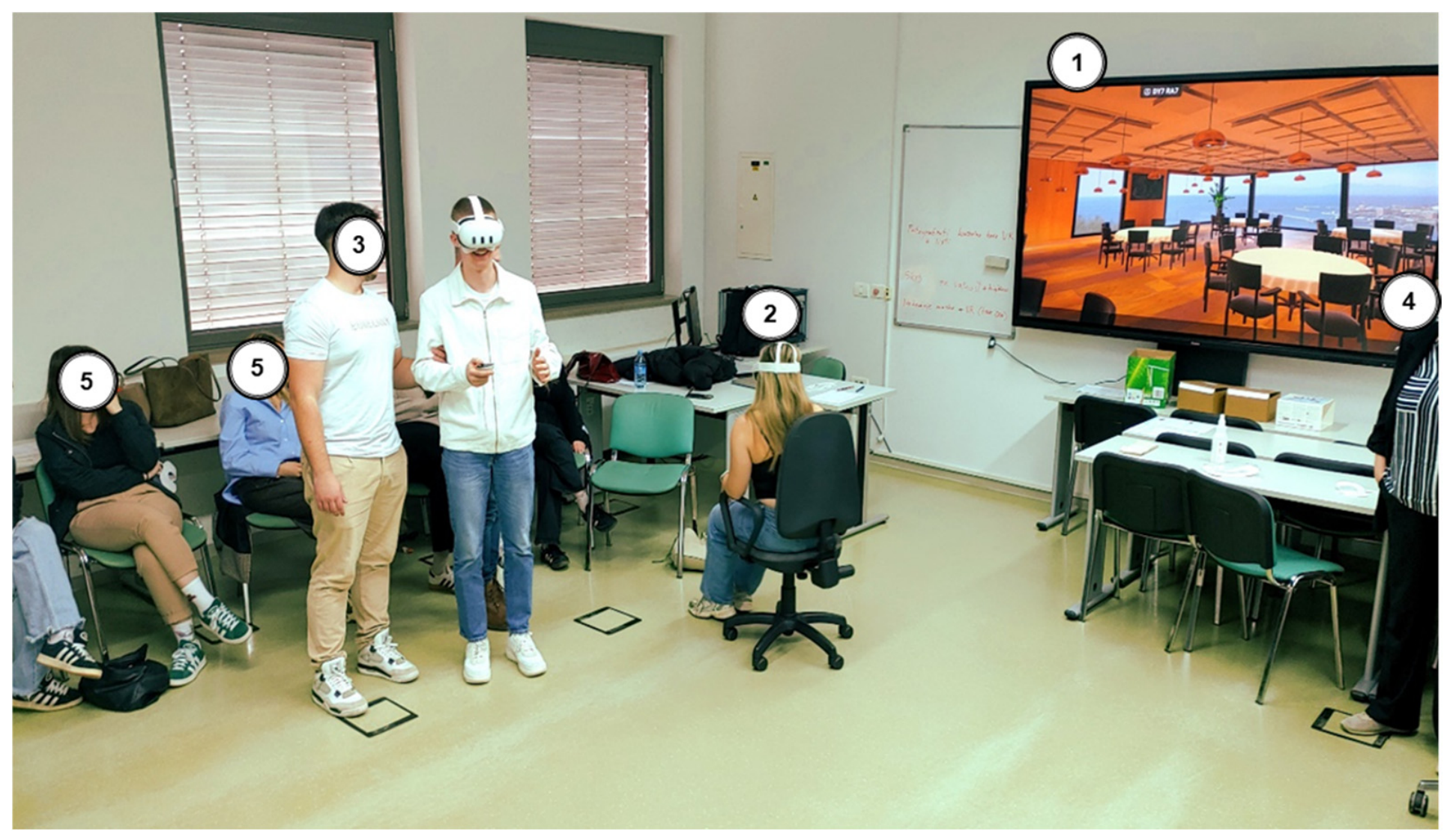
Students in the VR group used two head-mounted displays (HMDs) to explore a virtual restaurant environment. The VR application used in the study was developed within the Erasmus+ project VR EU Hoteliers, which focuses on creating immersive training environments for hospitality education. The VR activity was conducted using the Meta Quest 3 (Meta Platforms Technologies, LLC, Menlo Park, CA, USA). The headset’s visual output was streamed (cast) over a network to a computer, where it was displayed on an interactive classroom board, allowing other participants to observe the simulation. The application used in the study was VR HOTEL (v0.9.4).
The learning activity included inspecting restaurant inventory, reading object descriptions, interacting with selected items, and completing a short in-application quiz. The tasks were designed to support recognition and understanding of key restaurant inventory elements and table-setting components and were aligned with the knowledge test content.
The VR application represented a simplified virtual restaurant environment with basic interaction functionality, including object selection and information display. Due to its developmental stage, the application offered limited interactivity and lacked advanced feedback and adaptive instructional features.
Students in the control group studied the same content (including the quiz questions) using printed materials covering restaurant inventory and table setting. The materials were designed to closely match the content presented in the VR environment in terms of scope and level of detail. Both instructional conditions were implemented within comparable time frames and required a similar level of engagement.
The control group was exposed to the VR application only after completing the post-test, ensuring that this exposure did not influence their test performance. The classroom setup and testing procedure are shown in Figure 1.
Figure 1.
Classroom implementation of the VR learning activity, showing the use of head-mounted displays and the projection of the virtual environment onto an interactive board. Note: (1) the VR application displayed on the interactive whiteboard; (2) student testing a VR application while seated on a movable chair; (3) student testing a VR application while standing, accompanied by a peer; (4) supervising teacher; (5) waiting observers.
3.5. Procedure
At the beginning of the session, students received a brief introduction to the study, including the learning objectives, instructions, and safety guidelines for using VR equipment.
All participants first completed the pre-test individually (approx. 5 min), without access to learning materials or interaction with peers. Students then engaged in the assigned learning activity: the VR group participated in the VR-based simulation, while the control group studied the same content using printed materials. The learning activity for the control group lasted approximately 10 min. All students in this group completed the test simultaneously. For the VR group, students used the headset individually, one after another (approx. 7–10 min per student).
After completing the learning activity, all students completed the post-test (approx. 5 min) and the reflection questionnaire (approx. 10 min). Participation in the study was voluntary, and all data were collected anonymously. The overall procedure is summarised in Table 1.
Table 1.
Overview of the study design and procedure.
3.6. Data Analysis
Learning outcomes were analysed using repeated-measures ANOVA, with time (pre-test vs. post-test) and group (VR vs. control) as factors. All analyses were conducted using JASP (Version 0.18.3; JASP Team, University of Amsterdam, Amsterdam, The Netherlands).
Prior to analysis, the standard ANOVA assumptions (normality, homogeneity of variance, and absence of outliers) were examined, and no major violations were detected, given that the study included only two groups; the assumption of sphericity was not assessed. However, given the quasi-experimental design and the relatively small sample size, the results should be interpreted with caution.
Statistical results are reported using F-values, p-values, partial eta squared (η2p), and Cohen’s f as measures of effect size.
4. Results
4.1. Overall Learning Improvement (RQ1)
Across all participants, average performance improved from 34.5% (M = 4.143 out of 12) in the pre-test to 63.1% (M = 7.571) in the post-test, indicating higher scores following the learning activity. A repeated-measures ANOVA revealed a statistically significant main effect of time, F(1, 26) = 39.80, p < 0.001, η2p = 0.61, f = 1.24, indicating that post-test scores were significantly higher than pre-test scores across participants, regardless of instructional condition (see Table 2).
Table 2.
Repeated-measures ANOVA.
These results support RQ1, indicating that learning gains occurred following the instructional intervention.
4.2. Differences Between VR and Control Groups (RQ2)
Descriptive statistics are presented in Table 3. Both groups improved between the pre-test and post-test, with a larger increase observed in the control group.
Table 3.
Descriptive statistics.
The groups started from a comparable level of prior knowledge, as indicated by very similar pre-test mean scores (M in Table 3). The between-group main effect was not statistically significant, F(1, 26) = 3.14, p = 0.088, η2p = 0.11, f = 0.35.
A repeated-measures ANOVA revealed a statistically significant interaction between time and group, F(1, 26) = 5.04, p = 0.033, η2p = 0.16, f = 0.44, indicating that the two groups improved at different rates over time. Higher overall performance was observed in the control group.
Taken together, these results indicate that, although the groups did not differ significantly when considered independently of time, both improved over time, with the control group showing a greater increase.
4.3. Usability and Perceived Learning Experience
Students evaluated the learning experience using a post-activity reflection questionnaire. Table 4 presents results for the VR group only, as VR was implemented as a mandatory learning mode. The results indicate high ratings for usability and organisation, including ease of navigation (M = 4.308), comfort during use (M = 4.154), task structure (M = 4.154), and overall system stability (M = 4.077).
Table 4.
VR group post-test reflection.
In contrast, the lowest-rated items were related to problem-solving and critical thinking (M = 3.083), understanding of the subject matter (M = 3.250), and motivation and engagement (M = 3.250).
Additionally, open-ended responses highlighted key strengths, limitations, and suggestions for improvement in the VR learning experience (see Table 5). Students emphasised the value of visualisation and independent exploration, while also pointing to limitations related to interactivity, movement, and object manipulation.
Table 5.
Summary of open-ended responses (VR group).
5. Discussion
The findings of this study provide insight into the role of VR applications in hospitality education, particularly regarding test-based knowledge outcomes. Overall, students in both groups improved their performance, suggesting that learning occurred in both conditions. At the same time, the results showed that the control group had a larger increase in performance than the VR group.
The findings clearly address the research questions. Specifically, regarding RQ1, the findings show that test scores improved following the learning activity across both instructional conditions. Regarding RQ2, the results indicate that the control group showed greater improvement than the VR group, suggesting that VR did not yield superior test-based knowledge outcomes in this context.
These findings are consistent with previous research reporting mixed effects of VR on learning outcomes [6,10,15]. While VR is often associated with increased engagement, immersion, and learner motivation, its effects on knowledge acquisition are less consistent. Recent reviews have similarly suggested that the educational effectiveness of immersive technologies depends on contextual, pedagogical, and assessment-related factors rather than immersion alone [31]. Unlike many previous studies conducted in controlled settings, the present study provides evidence from a real classroom environment, highlighting the challenges of implementing VR in everyday teaching practice.
Beyond the specific findings, the study contributes to the ongoing discussion regarding the educational effectiveness of immersive technologies. The results suggest that the benefits of VR may depend less on immersion itself and more on the alignment between learning objectives, instructional design, and assessment methods.
One possible explanation for the observed pattern relates to the type of knowledge assessed in this study. The test primarily measured declarative and recognition-based knowledge, such as identifying restaurant inventory and its characteristics. Previous research suggests that immersive environments may be particularly effective in supporting procedural and context-based learning, whereas their advantages are less pronounced for tasks involving recognition and recall [7,10]. This may partly explain why the VR condition did not result in higher test-based performance in the present study. In addition, the printed materials may have been better suited to this type of assessment, as they allowed students to review the learning content more easily before completing the post-test.
This finding can also be interpreted through the lens of Bloom’s taxonomy, as the assessment focused primarily on lower-order cognitive processes (i.e., remembering and understanding). In contrast, VR environments are more likely to support higher-order processes, such as application and analysis [23]. This potential misalignment between the instructional approach and the level of cognitive processing assessed may partly explain the observed differences in learning outcomes.
Taken together, these findings suggest that the observed results may partly reflect a mismatch between the learning outcomes assessed and the pedagogical affordances typically associated with immersive VR environments.
Another possible explanation can be considered in light of Cognitive Load Theory [16]. VR environments require learners to process multiple sources of information simultaneously, including navigation, visual elements, textual content, and interaction with virtual objects. Given the limited instructional guidance and the early developmental stage of the VR application used in this study, these additional demands may have affected learning efficiency. However, cognitive load was not directly measured in this study; therefore, this explanation should be interpreted as a theoretical perspective rather than an empirical finding.
An additional consideration relates to the level of interactivity provided by the VR application used in this study. The application represented a relatively simplified environment with limited interaction possibilities, which may have constrained its instructional potential. It is therefore plausible that different results might be observed with more advanced VR applications offering higher levels of interactivity, feedback, and adaptive learning support. In this context, the effectiveness of VR is likely to depend not only on immersion but also on the extent to which the environment enables meaningful interaction and supports learning tasks that are difficult to achieve through traditional instructional methods. Similar conclusions have been reported in vocational education contexts, where the educational value of VR appears to depend less on the technology itself and more on its integration within coherent learning designs and authentic learning tasks [32]. In particular, VR may offer greater advantages when applied to procedural, spatial, and context-dependent learning, where experiential engagement plays a central role.
The results are further supported by the evaluation questionnaire (see Table 4), which indicated high levels of usability, clarity, and overall organisation of the VR experience, alongside more moderate ratings of perceived learning value, realism, and support for problem-solving. The lowest-rated aspects were related to problem-solving and critical thinking, understanding of the subject matter, and motivation and engagement. This suggests that the VR environment was perceived as usable and functionally acceptable, but its contribution to deeper learning processes may have been more limited. This pattern is consistent with previous findings suggesting that VR is often associated with stronger effects on affective outcomes (e.g., engagement, motivation, and social connectedness). In contrast, its effects on cognitive performance are less consistent [7,33,34].
Open-ended responses (see Table 5) further support this interpretation, highlighting the strengths of the VR module in visualisation, independent exploration, and experiential engagement, as well as its limitations, including restricted interactivity, difficulties with movement and object manipulation, and certain unrealistic elements. Students also emphasised the need for improvements, particularly increased interactivity, more complex tasks, the inclusion of human elements, and the expansion of the virtual environment.
Taken together, the findings indicate that, in its current implementation, VR-based learning did not demonstrate superior test-based knowledge outcomes compared to traditional instruction in this context. This does not necessarily imply that VR is ineffective as a learning tool, but rather that its effectiveness depends on how it is implemented and aligned with learning objectives and assessment methods.
From a practical perspective, these findings suggest that VR should be implemented as a structured, guided instructional tool rather than a standalone solution. These findings have practical implications for instructional design in higher education, particularly in applied disciplines such as hospitality and tourism. In particular, attention should be given to the design of learning tasks, the level of instructional support, and the alignment between the learning environment and the type of knowledge being assessed. Similar conclusions have been reported in recent higher education research, which emphasises that the educational value of VR depends on structured pedagogical frameworks and scaffolded learning activities rather than on immersion alone [35]. The results further suggest that educators should carefully align VR-based instructional activities with learning objectives and assessment methods, particularly when targeting different levels of cognitive processing.
Several limitations should be acknowledged. The study was conducted within a single course cohort, which limits generalisability beyond this context. However, the sample represented the entire cohort of students enrolled in the course, thereby providing insight into VR implementation under authentic classroom conditions. The use of identical pre- and post-test items may have introduced a testing effect. Future studies should minimise this limitation by using parallel test forms or more robust experimental designs, such as the Solomon four-group design. The VR application was in an early stage of development, which may have influenced both usability and learning outcomes. As this was a classroom-based pilot study, the findings should therefore be interpreted as indicative, exploratory, and context-specific rather than broadly generalisable.
Future research should address these limitations through larger samples, more controlled designs, and more developed VR learning environments. Replicating the present study across different institutions, hospitality courses, and student groups would help examine the robustness and generalisability of the findings. In addition, future studies should examine different types of learning outcomes, including procedural and situational knowledge, and explore the role of cognitive load in VR-based learning using direct measurement (e.g., the NASA Task Load Index (NASA-TLX)).
6. Conclusions
This study examined the effectiveness of a VR application as a learning tool in higher hospitality education, focusing on test-based knowledge outcomes. The findings indicate that learning occurred across both instructional conditions, as reflected in improved post-test scores. However, VR-based learning did not demonstrate superior test-based performance compared to traditional instruction, with the control group showing a greater improvement.
These results suggest that VR effectiveness depends on its alignment with learning objectives, assessment methods, and instructional design. In the present study, the focus on declarative and recognition-based knowledge, combined with the VR application’s limited interactivity, may have constrained its instructional potential. More broadly, the findings indicate that immersive technologies do not inherently lead to improved learning outcomes, but require careful pedagogical integration.
From a practical perspective, in the context of the present study, VR should be implemented as a structured and lecturer-guided instructional tool rather than a standalone solution. Its integration with traditional teaching approaches may provide the greatest educational benefit when aligned with appropriate learning objectives. When the primary learning objective is the acquisition of declarative knowledge, traditional or blended instructional approaches may remain more appropriate. In contrast, VR may offer greater potential for learning activities that emphasise practical, procedural, or context-dependent learning.
The findings should be interpreted in light of several limitations, including the single-course context, the use of identical test items, and the VR application’s early developmental stage. Future research should therefore examine more advanced and interactive VR environments, larger samples, and different types of learning outcomes, particularly those related to procedural and context-dependent knowledge.
Author Contributions
Conceptualisation, M.K. and S.P.; methodology, M.K. and S.P.; software, M.K. and S.P.; validation, M.K. and S.P.; formal analysis, M.K. and S.P.; investigation, M.K. and S.P.; resources, M.K. and S.P.; data curation, M.K. and S.P.; writing—original draft preparation, M.K. and S.P.; writing—review and editing, M.K. and S.P.; visualisation, M.K. and S.P.; supervision, M.K. and S.P.; project administration, M.K. and S.P.; funding acquisition, M.K. and S.P. All authors have read and agreed to the published version of the manuscript.
Funding
This research was funded by the European Union through the Erasmus+ Programme, grant number 2023-1-CZ01-KA220-HED-000157759, project “Application of Virtual Reality to the European Hospitality and Tourism Educational Programmes (VR EU Hoteliers)”.
Institutional Review Board Statement
The study was conducted in accordance with the ethical standards of the University of Primorska (UP), the Declaration of Helsinki, and the European Code of Conduct for Research Integrity issued by ALLEA—All European Academies. Specifically, in line with the rules for the processing of applications to the Commission for Ethics in Human Subjects Research at the University of Primorska (Document No. 002-25/24, 17 July 2024, Article 5a), formal ethics approval was not required due to the anonymous, low-risk, non-invasive nature of the study and the absence of sensitive personal data. Under these rules, non-interventional research involving adult participants may be conducted without prior ethics board approval when participation is voluntary, informed consent is obtained, no sensitive personal data are collected, and data protection is ensured. All of these conditions were fulfilled in the present study; therefore, formal ethics approval was not required.
Informed Consent Statement
Informed consent was obtained from all subjects involved in the study.
Data Availability Statement
The data presented in this study are available from the corresponding author upon reasonable request.
Conflicts of Interest
The authors declare no conflicts of interest.
Abbreviations
The following abbreviations are used in this manuscript:
| VR | Virtual Reality |
| F&B | Food and Beverage |
| HMD | Head-Mounted Display |
| UP | University of Primorska |
References
- Horng, J.-S.; Hsu, H. Optimizing Learning Outcomes in Aesthetic Education through Technological Integration: AR/VR Applications in Hospitality Aesthetics Course. Educ. Inf. Technol. 2024, 29, 20905–20924. [Google Scholar] [CrossRef] [Scilit]
- Cunha, C.R.; Martins, C.; Mendonça, V. Using Extended Reality in Experiential Learning for Hospitality Management Education. Procedia Comput. Sci. 2023, 219, 634–641. [Google Scholar] [CrossRef] [Scilit]
- Felicen, S.S.; Pulhin, J.C.B.; Borbon, N.M.D.; Apritado, J.M.M.; Ylagan, A.D. Integrating Virtual Reality Technology in Tourism and Hospitality Education: Student Learning Experiences and Implications. In Proceedings of the 11th International Conference on Frontiers of Educational Technologies 2025; Gokhale, A., Ed.; Lecture Notes in Educational Technology; Springer: Singapore, 2026; pp. 125–136. [Google Scholar]
- Gunawan, A.G.; Surahman, E.; Masyfa, F.H.; Joshua, Q.P. A Systematic Literature Review on VR Table Manner Innovation as an Emerging Learning Media in Culinary Education. J. Inov. Teknol. Pembelajaran 2025, 12, 72–84. [Google Scholar] [CrossRef] [Scilit]
- Van Der Meulen, F.J.; De Vries, M. A Literature Review of Implementing Virtual Reality in Hospitality Education. Res. Hosp. Manag. 2023, 13, 55–61. [Google Scholar] [CrossRef] [Scilit]
- Aldawsari, R.; Buhalis, D.; Roushan, G. Immersive Metaverse Technologies for Education and Training in Tourism and Hospitality. Int. J. Contemp. Hosp. Manag. 2025, 37, 2716–2736. [Google Scholar] [CrossRef] [Scilit]
- Choi, G.W.; Woo, M.; Ryu, A.; Kim, J. The Effectiveness of Nursing Education Using Immersive Virtual Reality or Augmented Reality: Systematic Review and Meta-Analysis. J. Korean Acad. Soc. Nurs. Educ. 2024, 30, 197–211. [Google Scholar] [CrossRef] [Scilit]
- Han, X.; Luo, H.; Wang, Z.; Zhang, D. Using Virtual Reality for Teacher Education: A Systematic Review and Meta-Analysis of Literature from 2014 to 2024. Front. Virtual Real. 2025, 6, 1620905. [Google Scholar] [CrossRef] [Scilit]
- Jian, Y.; Abu Bakar, J.A. Comparing Cognitive Load in Learning Spatial Ability: Immersive Learning Environment vs. Digital Learning Media. Discov. Sustain. 2024, 5, 111. [Google Scholar] [CrossRef] [Scilit]
- Wu, B.; Yu, X.; Gu, X. Effectiveness of Immersive Virtual Reality Using Head-Mounted Displays on Learning Performance: A Meta-Analysis. Br. J. Educ. Technol. 2020, 51, 1991–2005. [Google Scholar] [CrossRef] [Scilit]
- Kolb, D.A. Experiential Learning: Experience as the Source of Learning and Development; Prentice-Hall: Englewood Cliffs, NJ, USA, 1984. [Google Scholar]
- Lave, J.; Wenger, E. Situated Learning: Legitimate Peripheral Participation; Cambridge University Press: Cambridge, UK, 1991. [Google Scholar]
- Al Hakim, V.G.; Chen, Y.-E.; Lin, M.-H.; Chang, C.-Y.; Wang, J.-H.; Chang, C.-K.; Zhuang, Y.; Yang, S.-H.; Chen, G.-D. Marrying Physical and Virtual Realms: An Embodied, Multi-Modal Approach to Situational Learning in Digital Reality. In Proceedings of the 32nd International Conference on Computers in Education, Quezon City, Philippines, 25–29 November 2024. [Google Scholar] [CrossRef] [Scilit]
- Hawkinson, E. Immersive Simulations in Tourism Education: A Case Study. Ph.D. Thesis, Education in Educational Technology, Boise State University, Boise, Idaho, 2024. [Google Scholar]
- Otsuki, M.; Okuma, T. Development and Evaluation of a Restaurant Virtual Reality Training System for Enhancing Awareness and Priority-Setting Skills. Sci. Rep. 2025, 15, 18673. [Google Scholar] [CrossRef] [Scilit] [PubMed]
- Sweller, J. Cognitive Load During Problem Solving: Effects on Learning. Cogn. Sci. 1988, 12, 257–285. [Google Scholar] [CrossRef] [PubMed]
- Al-Said, K.; Berestova, A.; Ismailova, N.; Pronkin, N. The Impact of Video-Based Virtual Reality Training on Critical Thinking and Cognitive Load. Int. J. Eval. Res. Educ. 2024, 13, 3239. [Google Scholar] [CrossRef] [Scilit]
- Wen, P.; Lu, F.; Mohamad Ali, A.Z. Using Attentional Guidance Methods in Virtual Reality Laboratories Reduces Students’ Cognitive Load and Improves Their Academic Performance. Virtual Real. 2024, 28, 110. [Google Scholar] [CrossRef] [Scilit]
- Susanto, N.; Rifki, M.S.; Bahtra, R.; Komaini, A.; Pranoto, N.W. Current Trends Virtual Reality to Enhance Skill Acquisition in Physical Education in Higher Education in the Twenty-First Century: A Systematic Review. Open Educ. Stud. 2025, 7, 20250088. [Google Scholar] [CrossRef] [Scilit]
- Shen, Y.; Pan, Z. Evaluating the Impact of Immersive Virtual Reality Learning Environments with a Cognitive Load on Students in Various Interaction Modes. In Proceedings of the 2022 8th International Conference on Virtual Reality (ICVR); IEEE: Nanjing, China, 2022; pp. 210–215. [Google Scholar]
- Yu, N.; Shi, W.; Dong, W.; Kang, R. The Impact of Virtual Reality Immersion on Learning Outcomes: A Comparative Study of Declarative and Procedural Knowledge Acquisition. Behav. Sci. 2025, 15, 1322. [Google Scholar] [CrossRef] [Scilit] [PubMed]
- Anderson, L.W.; Krathwohl, D.R. (Eds.) A Taxonomy for Learning, Teaching, and Assessing: A Revision of Bloom’s Taxonomy of Educational Objectives; Longman: New York, NY, USA, 2009. [Google Scholar]
- Jensen, L.; Konradsen, F. A Review of the Use of Virtual Reality Head-Mounted Displays in Education and Training. Educ. Inf. Technol. 2018, 23, 1515–1529. [Google Scholar] [CrossRef] [Scilit]
- Lin, X.P.; Li, B.B.; Yao, Z.N.; Yang, Z.; Zhang, M. The Impact of Virtual Reality on Student Engagement in the Classroom–a Critical Review of the Literature. Front. Psychol. 2024, 15, 1360574. [Google Scholar] [CrossRef] [Scilit] [PubMed]
- Zhang, Y.; Yu, Z. Turning Play into Progress: Unveiling the Effect of Gamified VR on Learning Through Meta-Analysis. Int. J. Serious Games 2025, 12, 69–80. [Google Scholar] [CrossRef] [Scilit]
- Jiang, Y.; Wang, Q.; Weng, Z. The Influence of Technology in Educating English Language Learners At-Risk or with Disabilities: A Systematic Review. CEPS J. Cent. Educ. Policy Stud. J. 2022, 12, 53–74. [Google Scholar] [CrossRef] [Scilit]
- Chilla, S.; Doetjes, G.; Vogt, K.; Ibrahim, L.A.; Tsagari, D. Digital-Inclusive Transformation and Teacher Preparedness for Foreign Language Education—A Bilateral German-Norwegian Perspective. Cent. Educ. Policy Stud. J. 2025, 15, 83–124. [Google Scholar] [CrossRef] [Scilit]
- Dubach, J.; Anzeneder, S.; Tempelmann, S.; Cacchione, T. Effects of School-Based Immersive Virtual Reality Interventions on Learning in the K-6 Range: A Systematic Literature Review. Comput. Educ. X Real. 2025, 7, 100117. [Google Scholar] [CrossRef] [Scilit]
- Hoerler, R.; Christen, J.; Bättig-Frey, P.; Chow, N.; Duce, A.D.; Heeb, N.; Kaschlik, A.; Siegwart, M.; Zapata, J.; West, M. Shaping Cities in a Headset: Exploring the Role of Virtual Reality Immersion and Interactivity in Civic Education. Preprint 2026. [Google Scholar] [CrossRef] [Scilit] [PubMed]
- Radianti, J.; Majchrzak, T.A.; Fromm, J.; Wohlgenannt, I. A Systematic Review of Immersive Virtual Reality Applications for Higher Education: Design Elements, Lessons Learned, and Research Agenda. Comput. Educ. 2020, 147, 103778. [Google Scholar] [CrossRef] [Scilit]
- Balalle, H. Learning beyond Realities: Exploring Virtual Reality, Augmented Reality, and Mixed Reality in Higher Education—A Systematic Literature Review. Discov. Educ. 2025, 4, 151. [Google Scholar] [CrossRef] [Scilit]
- Crescenzo, N.; Arnaud, D.; Sichani, P.F.; Kristensen, J.W.; Partarakis, N.; Zabulis, X. Hybrid Craft Training in Vocational Education: Integrating E-Learning and VR in Glassblowing Apprenticeships. Virtual Worlds 2026, 5, 26. [Google Scholar] [CrossRef] [Scilit]
- Chen, B.; Wu, Z.; Zhao, R. From Fiction to Fact: The Growing Role of Generative AI in Business and Finance. J. Chin. Econ. Bus. Stud. 2023, 21, 471–496. [Google Scholar] [CrossRef] [Scilit]
- Košatka, D.; Šašinková, A.; Košatková, M.; Hunčík, T.; Šašinka, Č. Virtual Reality and the Sense of Belonging Among Distance Learners: A Study on Peer Relationships in Higher Education. Virtual Worlds 2026, 5, 17. [Google Scholar] [CrossRef] [Scilit]
- Donald, C.; Rustamova, S.; Hirsu, L.; Rodolico, G.; Latkovskis, I.; Mcdonnell, N.; Veitch, N. Virtual Reality Peer-to-Peer Learning: A Pilot Study Investigating Peer-to-Peer VR Supported Lessons in Higher Education. Front. Educ. 2026, 11, 1800038. [Google Scholar] [CrossRef] [Scilit]

Disclaimer/Publisher’s Note: The statements, opinions and data contained in all publications are solely those of the individual author(s) and contributor(s) and not of MDPI and/or the editor(s). MDPI and/or the editor(s) disclaim responsibility for any injury to people or property resulting from any ideas, methods, instructions or products referred to in the content. |
© 2026 by the authors. Licensee MDPI, Basel, Switzerland. This article is an open access article distributed under the terms and conditions of the Creative Commons Attribution (CC BY) license.