


Abstract
Rapid technological advancements are transforming educational practice and reshaping the traditional conception of learning. In particular, immersive technologies, such as augmented reality (AR) and virtual reality (VR), have shifted the focus from learning outcomes alone to the quality of the learning environment and the psychological processes involved in learning (e.g., motivation and cognitive processes). Against this background, the current perspective proposes a reconceptualization of immersive technologies (virtual reality, augmented reality, and mixed reality) as ecological learning environments. Specifically, by integrating the neo-ecological framework with the Cognitive-Affective Model of Immersive Learning (CAMIL), we argue that immersive technologies create hybrid physical–virtual microsystems in which embodied and experiential learning emerge as pedagogical processes through which knowledge is actively constructed. From this perspective, learning results from the interaction between ecological contexts, immersive psychological mechanisms, and learners’ active engagement with the environment. We further discuss the important limitations and ethical challenges associated with immersive technologies. Finally, we suggest that immersive technology should be integrated into blended educational approaches consisting of traditional learning combined with immersive technologies.
1. Introduction
Most recent technological advancements in the educational context have highlighted the need to rethink school dynamics, such as learning approaches and the learning environment. According to Teschers, Neuhaus, and Vogt [1], the school system approach should move from a static to a more flexible and responsive approach to curriculum and schooling, with a more experiential rather than theoretical curriculum. Indeed, the authors emphasize that traditional learning is based on an educational model developed in response to the 19th-century industrial age. Traditional learning methods, characterized by face-to-face interactions, predetermined curriculum, standardized evaluations, and a teacher-centered approach, should be adapted to new questions.
Immersive technologies have become pervasive in recent times, both in research and in educational practices. Based on the level of immersion, it is possible to distinguish among virtual reality (VR), augmented reality (AR), and mixed reality (MR). Virtual reality is a fully immersive experience that isolates users from the physical world and allows them to interact with a simulated environment through head-mounted displays and motion-tracking systems. Augmented reality overlays digital elements in the real-world environment, allowing users to perceive both physical and virtual information. Mixed reality combines characteristics of virtual and augmented reality, enabling digital objects to interact with the physical environment in real time.
The adoption of new technologies, combined with an adaptive and personalized learning environment, guarantees a more student-centered approach to learning, which seems to foster students’ motivation and improve the quality of educational outcomes [2,3]. Features such as adaptive feedback and personalization make their use particularly suitable in the educational context [4]. Despite the growing body of research on immersive technologies in education, existing theoretical perspectives remain largely fragmented and conceptualize immersive technologies as mere instructional tools designed to achieve specific educational outcomes. Within this perspective, virtual environments are simply considered as media that can deliver educational content on different platforms or instructional formats [5,6]. Less attention has been given to conceptualizing immersive technologies as educational environments in which contextual, psychological, and pedagogical processes dynamically interact. Consequently, there is still no integrative perspective explaining how immersive technologies reshape learning beyond their role as instructional tools.
For this reason, the current paper aims to propose a perspective on learning mechanisms through immersive technology, highlighting the importance of the virtual environment as an active developmental context rather than a mere technological instrument. Specifically, we argue that virtual environments function as hybrid microsystems where macrostructural context and micro-level cognitive processes converge during the learning experience. Within the technological space, according to Navarro and Tudge’s [7] neo-ecological framework, immersive affordances such as spatial presence and agency presented in the Cognitive Affective Model of Immersive Learning (CAMIL) facilitate the activation of embodied and experiential learning. In this sense, virtual environments represent dynamic zones characterized by the interaction among cognitive, affective, emotional, and social processes. Immersive and embodied interactions allow learners to actively construct knowledge through exploration, feedback, and engagement with the surrounding environment. Moreover, following CAMIL’s variables to adapt tasks and experiences according to individual characteristics, these technologies become highly suitable for supporting participation in different types of learners across the lifespan.
2. Toward AR/VR Ecological Learning: The Neo-Ecological Model
The rapidly evolving cultural environment in which young people are developing requires an adaptation of traditional frameworks. Concerning the developmental psychology tradition, Urie Bronfenbrenner [8,9] described the environmental interactions occurring in someone’s life and how these interactions shape individual development. This framework is also particularly relevant to educational psychology, as it can be considered a tool for understanding how the individual interacts across societal, organizational, and individual dimensions [10]. This framework has been selected as it provides a multilevel perspective for conceptualizing learning as a result of continuous interactions between the learner and the surrounding environment. According to his model, five nested types of contexts can be distinguished, namely: microsystem, which is the immediate direct environment consisting of family, peers, teachers, and classroom; mesosystem, which consists of interactions and connections occurring between two microsystems (e.g., parents interacting with teachers); exosystem, representing the external social settings that indirectly affect the individual, who does not actively participate in them (for instance, parents’ work time or broad school policies); macrosystem, which consists of the overarching cultural, societal, and economic values dictating norms and laws; chronosystem, consisting of the dimension of time, such as time transitions and historical and social circumstances over time. Navarro and Tudge [7] propose a neo-ecological theory, derived from Bronfenbrenner’s ecological theory, which comprises the virtual environments that were not forecasted in the traditional model. Concerning the microsystem, the neo-ecological model distinguishes between physical and virtual microsystems. While the physical microsystem is a pattern of activities, social roles, and interpersonal relations experienced by the developing person in a face-to-face setting, the virtual microsystem groups the experiences that the developing person has on digital platforms. In this sense, the developing individual may exist in more than one microsystem at once, such as the student who is connected in an online classroom (i.e., virtual microsystem) while being at home (i.e., physical microsystem). The virtual microsystems share several specific features that might also be applicable to physical microsystems. One of the features relates to synchronicity/asynchronicity, which is also typical of a physical microsystem (such as writing a letter), but this feature is more pronounced in the virtual environment, also depending on the type of platform used. Moreover, although availability is shared by both systems, individuals interacting through virtual connections can contact other people at great distances, thus people that otherwise would not be available to them. Another feature shared by virtual and physical environments is publicness, which is more pronounced in virtual microsystems, as group interactions can involve a wider audience than physical microsystems. Similarly, permanence (or persistence) is frequently observed in the virtual environment, as the virtual information provided by individuals does not disappear but permanently remains available [11]. The distinction between physical and virtual microsystems recognizes that developmental experiences increasingly occur in digital environments. This distinction is particularly relevant to immersive technologies because they create hybrid microsystems in which learners simultaneously interact with physical and virtual elements. However, Navarro and Tudge discuss digital environments such as online communication and social media, whereas little attention is devoted to immersive environments characterized by embodiment, spatial presence, and real-time interaction. Consequently, the application of the neo-ecological framework to AR/VR requires extending the concept of the virtual microsystem to also include immersive educational contexts.
Regarding the mesosystem, no adaptations were provided by the authors, who maintain that it is particularly important for adolescents, as it regards the way their social, physical and digital worlds are interconnected. Regarding the virtual environment, the mesosystemic level may concern whether skills learned in virtual microsystems can be translated into gains in physical contexts. This represents a useful basis for understanding transfer across educational contexts. However, the framework does not explicitly explain how learning experiences developed within immersive environments are translated into other educational settings.
Similarly to the mesosystem, the exosystem remains the same as the one conceptualized by Bronfenbrenner [12], defined as the processes taking place between two or more settings, in which the occurring events indirectly influence processes within the immediate setting in which the person lives. In recent times, the influence of the digital exosystem is more significant in the lives of youth than in previous generations, as deleterious exosystemic forces may impact youth participating in virtual microsystems more directly [7].
Regarding the macro-system, the ubiquity of digital technology and the large diffusion of smartphones worldwide has an impact upon the values, beliefs, and social structure of society. Less attention has been dedicated to understanding how changing cultural values may reshape conceptions of teaching, learning, and learner participation within immersive environments.
The chronosystem, in Bronfenbrenner’s original framework, consists of three types of time influencing the development of a person. Microtime refers to what is happening in the current moment. In light of the neo-ecological theory, digital technology facilitates media multitasking but also stresses users with digital interruptions (such as notifications, e-mails, messages, and events) that are termed technoference, which can lead to higher levels of inattention [13]. Concerning mesotime, conceptualized as the repetition of proximal processes over long periods, adherence to digital programs or the persistence of parallel technoference might be considered. Finally, macrotime relates to the changes observed in larger society within and across generations. For example, the advent of the Internet represents a cultural phenomenon as it shares norms that are adopted across generations [14].
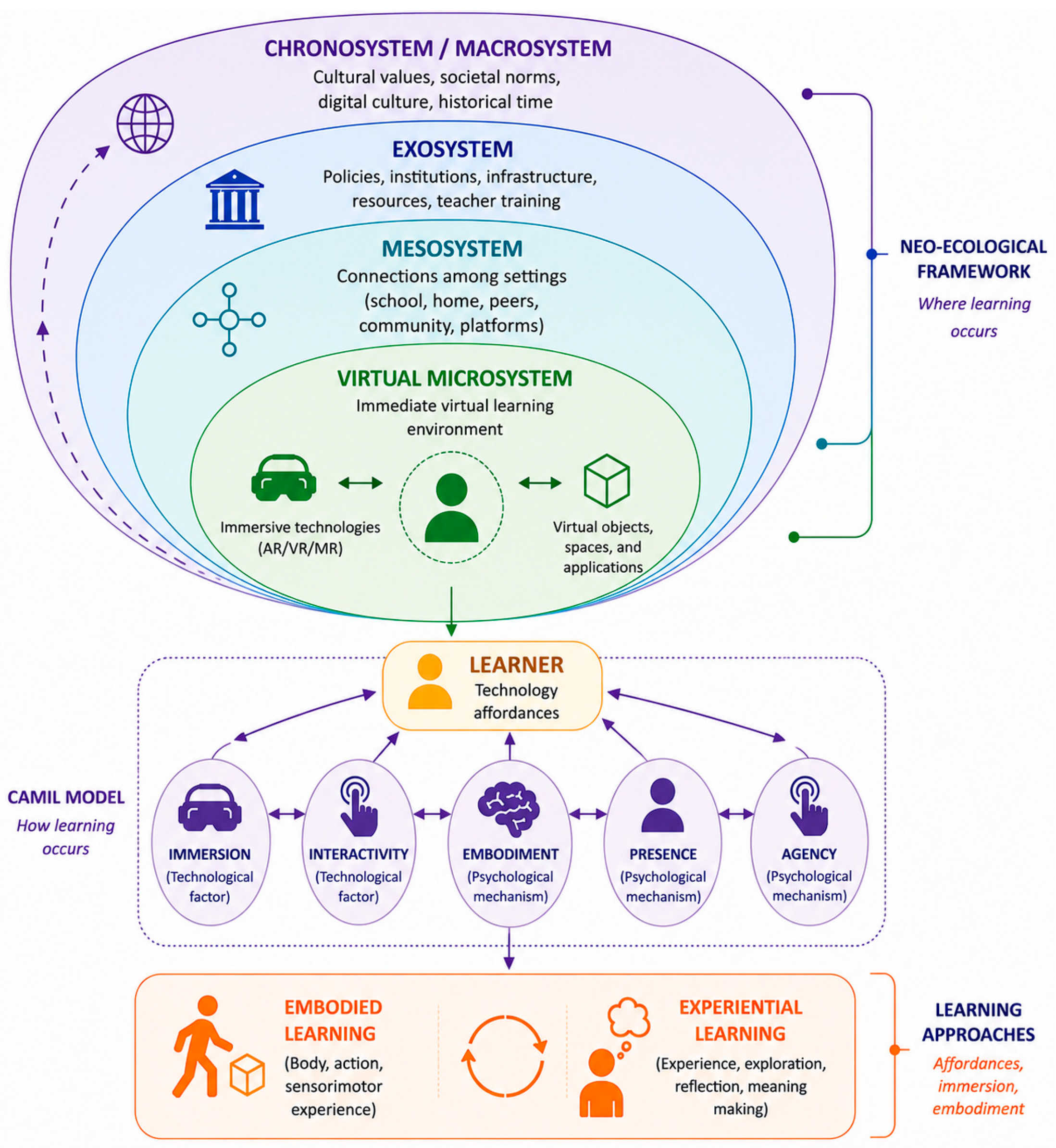
Following the neo-ecological model, AR/VR technology should not be merely considered instructional tools but rather learning environments that can reshape the interaction between learners and educational contexts (Figure 1). Indeed, immersive learning environments create hybrid microsystems where physical and virtual experiences co-exist at the same time. As a consequence, the educational experience consists of a continuous interaction between physical and virtual contexts instead of a single static setting. Concerning the mesosystem, immersive technology might facilitate stronger connections between educational environments (such as school, home, and digital learning platforms), resulting in a continuous and flexible experience. The exosystemic system includes technological infrastructure, educational policies, and institutional decisions that indirectly shape learners’ experiences. At the macrosystem level, immersive technologies reflect a cultural transformation derived from digitalization, interactivity, and integration of technology into everyday life. Finally, at the chronosystem level, it is possible to observe how educational environments are evolving in response to the rapid technological transformation in recent years. At the microtime level, the immersive environment may help reduce the phenomenon of technoference, and this may result in a more focused learning environment over longer periods (i.e., mesotime level). At the macrotime level, the e-learning approach may change in favor of a more digitalized and student-centered environment.
Figure 1.
Connection among the adaptation of the neo-ecological framework, CAMIL, and learning approaches proposed by the authors.
From this perspective, ecological learning, intended as a process resulting from the interaction between the individual and the proximal environment, is not merely characterized by the coexistence of physical and virtual environments, but by the active interaction between learners and their surroundings. In this sense, learning emerges through exploration, action, feedback, and adaptation within contextualized environments. Therefore, embodied and experiential learning may represent the pedagogical mechanisms through which AR/VR ecological learning is realized, as they place learners in direct interaction with the affordances of both physical and virtual contexts.
3. Embodied and Experiential Learning Through AR/VR
Regarding the practical applications of new technologies, immersive training seems to be effective for improving children’s cognitive functioning and learning [6]. According to Huang [15], this improvement results from the process of mental simulation of virtual scenery and objects that people immersed in an environment have to perform, leading to higher cognitive and mental engagement in the game, requiring a higher level of executive functioning.
The mechanism underlying this process can be identified through the Cognitive-Affect Theory of Learning with Media—CATLM [16,17], which assumes that the richness of stimuli and the level of interactivity provided by multimedia can foster intrinsic motivation, reducing, at the same time, the effort required to learn [18]. As humans have limited cognitive resources, learning is effective when learners avoid unnecessary mental effort, are motivated, and actively engage with information.
Among the theoretical models explaining the interactions between technology and learning, the Cognitive-Affective Theory of Learning with Media (CATLM) provides a particularly suitable framework because it integrates cognitive, motivational, and affective processes underlying learning through multimedia. Unlike traditional cognitive theories that primarily focus on information processing or cognitive load, CATLM recognizes that learning is also influenced by learners’ motivation, emotional engagement, and active participation. The CATLM framework can be adapted to virtual reality with the same positive relationship between motivation and cognitive engagement and the negative effect on cognitive load. According to the CATLM model applied to VR [16], additional variables, such as immersion, presence, and embodiment, may influence the experience of virtual learning. Specifically, more immersive VR systems can increase learners’ embodiment, which is the feeling that the virtual body is their own, and presence, which is the feeling of being inside the virtual world. Experiencing such sensations increases motivation and curiosity, which are connected to higher cognitive engagement, resulting in more active information processing.
Based on these premises, the Cognitive-Affective Model of Immersive Learning (CAMIL) was proposed by Makransky and Petersen [19] to explain the mechanisms underlying the learning processes within immersive environments. Similar to CATLM-VR, CAMIL assumes that learning depends on the balance between cognitive engagement and cognitive load. However, CAMIL puts greater emphasis on immersive-specific affordances, such as spatial presence, agency, embodiment, and self-location, and considers them central mechanisms through which virtual environments influence learning processes. Immersion is defined as the user’s experience of being engaged by a computer-generated environment. This experience produces a sense of “being there”, also called presence [20]. While immersion is an objective, measurable quality of a system or environment, presence is the cognitive acceptance of the virtual reality as the current reality. Embodiment is the sensation deriving from the brain accepting a digital avatar as one’s own physical body [21], which fosters the feeling of agency, intended as the perceived ability to control subsequent actions [22]. Finally, cognitive load refers to the amount of working memory required to process the virtual information and tasks [23].
While CATLM-VR mainly extends multimedia learning principles to immersive environments, CAMIL places immersive affordances themselves at the center of the learning process. According to this perspective, immersive technologies do not simply provide richer multimedia stimulation but create psychologically situated experiences where learners actively interact with contextualized environments. In other words, CAMIL provides an interpretation of the learning mechanisms occurring in VR learning environments.
Considering the neo-ecological framework proposed by Navarro and Tudge [7], the virtual microsystem is the immediate environment where learning occurs by conceptualizing immersive technologies as a hybrid physical–virtual context embedded in broader ecological systems. As posited by the authors, the virtual microsystem influences and is influenced by the other ecological levels. For instance, educational policies encouraging the use of immersive technologies in the classroom (i.e., exosystem) contribute to creating a virtual microsystem for learning purposes. While the neo-ecological framework describes the contextual structure of immersive learning, CAMIL explains how learning occurs within these environments. Specifically, CAMIL proposes that technological characteristics, such as immersion and interactivity, promote psychological mechanisms such as presence, agency, and embodiment, which interact with learners’ cognitive and affective characteristics in pursuing learning goals. Among these mechanisms, embodiment can be considered a conceptual bridge between immersive technologies and the embodied cognition paradigm. This paradigm affirms that cognition is shaped by abstract mental representations and bodily actions within contextualized experiences. Davis and Markman [24] maintain that cognitive processing is more reactive when sensory and motor systems actively contribute to cognitive processing rather than serving as peripheral input and output channels. The educational approaches that are directly connected to embodiment and presence are embodied learning and experiential learning. In this sense, embodied and experiential learning can be interpreted as pedagogical processes through which the context described by the neo-ecological framework and the psychological mechanisms presented by CAMIL are translated into educational practices. As immersive technologies allow learners to interact with the educational content through exploration and movement, learners become active participants in the learning process instead of being passive recipients (Figure 1). CAMIL represents one of the first attempts to explain immersive learning through a comprehensive cognitive-affective framework. Its major contribution lies in recognizing presence, embodiment, and agency as central psychological mechanisms of immersive learning. Nevertheless, CAMIL primarily explains how immersive affordances influence learning, while providing limited consideration of the broader ecological context in which these affordances are embedded. Consequently, CAMIL complements rather than replaces the neo-ecological framework.
3.1. Embodied Learning
Embodied learning is the learning approach deriving from the embodied cognition paradigm and assumes that cognition is more responsive when it is integrated into the sensorimotor system [25,26]. Following this approach, learning experiences are increasingly designed to promote multisensory processing by providing opportunities to interact with objects and digital representations, such as AR/VR technology.
According to the Instructional Embodiment Framework (IEF) by Black et al. [27], instructional embodiment consists of two main categories: physical and imagined embodiment. Physical embodiment can be direct, surrogate or augmented. The users achieve direct embodiment when they move in a certain way in physical space, while in the case of surrogate embodiment, they give instructions to a program or use objects that allow them to learn concepts from the object’s physical material. Regarding augmented embodiment, the users have a representational system (such as an avatar) together with an augmented feedback system. Embodiment can also be imagined through the mental simulation of physically embodied actions.
Studies regarding the application of embodied learning through virtual reality found improvements in several educational domains, such as learning STEM [28,29], children’s letter-sound knowledge [30], motor learning [31]. However, findings are not uniformly positive: for instance, Rudling et al. [32] found that immersive VR did not generally outperform computer-based training for vocabulary learning, although it may benefit learners with stronger sustained attention.
3.2. Experiential Learning
Experiential learning is a learning approach where knowledge is constructed through direct experience, active participation, and interaction with the environment [33]. Experiential learning derives from Kolb’s theory [34], which assumes that learning is a cyclic process involving four steps: concrete experience, reflective observation, abstract conceptualization, and active experimentation. Concrete experience and reflective observation are part of the first phase that captures the experience, where tangible experiences are transformed into abstract experience. In the second phase, learners transform abstract conceptualizations into actions in the concrete world through the processes of abstract conceptualization and active experimentation.
This framework conceives learners as active participants constructing meaning through continuous interactions with contextualized experiences. Virtual environments allow learners to interact with realistic situations that may offer opportunities to explore and experiment with situations that might be dangerous, expensive or impossible to reproduce in traditional settings. Within the virtual environment, users can experience a sense of presence, interactivity, and immersion that might facilitate their active involvement in complex situations.
Research on VR-based experiential learning reported positive effects across several educational domains. At school, immersive experiences can increase the effectiveness of history learning [35]. In healthcare education, immersive experiences have been used to simulate surgical training, rehabilitation, and anatomy learning within safe environments [36,37]. Furthermore, in engineering and architecture, virtual experiences allow enhanced spatial understanding, design skills, procedural learning, and creation of complex three-dimensional models and simulated construction environments [38,39]. Concerning language learning, VR experiences can facilitate role-playing, social interaction, and communication experiences [40]. Finally, VR-based serious games and immersive simulations have been applied to social and emergency learning contexts, improving engagement, memory retention, and survival-related decision-making skills through realistic and interactive scenarios [41].
3.3. Practical Considerations of Embodied and Experiential Approaches
Both approaches raise questions about the psychological and educational implications of their adoption in real classrooms.
First, each type of immersive technology can have different effects on learning processes. Although VR, AR, and MR are frequently treated as interchangeable, they differ in terms of the degree to which they integrate virtual and physical environments, as represented by Milgram and Kishino’s [42] continuum ranging from real environment to virtual environment. This difference has specific implications on the theoretical and practical level. The neo-ecological model applies to VR, AR, and MR, as these technologies can create virtual microsystems embedded within real microsystems. Conversely, in CAMIL, different immersive affordances activate different levels of presence and embodiment. Specifically, VR is likely to elicit the highest levels of presence and embodiment as it replaces the physical surroundings with a fully simulated environment. This aspect makes VR particularly suitable for educational activities that require exploration, perspective-taking, and simulation of otherwise inaccessible or risky situations [43]. Conversely, AR integrates virtual objects within the real world, preserving the interaction with the physical environment. Therefore, AR is appropriate for situated learning and procedural guidance [44]. Finally, MR represents an intermediate solution in which virtual and physical objects coexist and interact in real time. Different from AR, MR emphasizes agency and embodied interaction through the integration of physical and virtual objects. Therefore, virtual elements can dynamically respond to users’ actions, with richer embodied interactions and collaborative manipulation of virtual objects [45].
The second question relates to the possibility of transferring the virtual knowledge to real-world situations. Regarding embodied learning through VR, Klingenberg et al. [46] tested how different levels of immersion and interactivity affect procedural learning, embodiment, cognitive load, and transfer of knowledge from a virtual environment to a real-world task. The authors found that students’ performance during the virtual lesson positively predicted their performance on the real-world transfer task, suggesting that learning procedural skills in virtual environments can transfer successfully to physical contexts. Similarly, VR-based experiential learning is often used to acquire skills in delicate or dangerous contexts, as it can simulate risky, expensive, or difficult-to-reproduce environments [47]. This study may represent preliminary evidence that immersive environments can support the transfer to real-world contexts under specific instructional design and contextual factors.
The third issue relates to the cognitive overload generated by the exposure to virtual reality. According to the Cognitive Load Theory [48], the acquisition of new schemas can be hindered when cognitive resources are allocated to process irrelevant information. In VR environments, as previously shown by Huang, Roscoe, Craig, and Johnson-Glenberg [16], the level of immersion may also introduce additional cognitive demands that burden the learning process.
The fourth question concerns the use of virtual reality adapted to different developmental conditions. For instance, Moon [49] reviewed the training based on social embodiment for children with autism spectrum disorder (ASD) in a naturalistic environment, which allows children to simulate social components in the training through non-player characters. Furthermore, Julrode et al. [50] designed a gamified VR intervention based on experiential learning to enhance ASD children’s social skills, finding significant improvements in social communication and social motivation. Similar results were retrieved concerning studies applying virtual reality to inclusive learning of individuals with ASD, Attention Deficit–Hyperactivity Disorder (ADHD), and intellectual disabilities [51,52,53]. For instance, Alvarado, Guerrero, and Serón [54] tested an immersive program delivered through CAVE (i.e., Computer Automated Virtual Environment), which is an immersive room-sized virtual environment where the images are projected on the walls, floor, and ceiling, for children with autism spectrum disorder. Applying the semantic embodied conversational agent theory, the authors implemented the “Lore alphabet”, a visually enriched alphabet in which letters are represented with distinctive facial features. To facilitate the interactions, verbal communication was replaced by a keyboard with Lore letters, which were pronounced and projected on the screen. The intervention was effective in terms of emotional response and reported encouraging results regarding alphabet learning.
Indeed, the high degree of adaptivity of the virtual environments makes this tool particularly suitable for different developmental conditions. Adaptivity is defined as the degree to which a system can alter its actions in response to the needs and preferences of the user [55]. A system is adaptive when there is a performance measurement of the trainee, when the variable is adaptive, and when the logic is adaptive [56]. Performance outcomes should be collected before or during the training through different evaluation methods (such as monitoring the trainee’s movements, accuracy after each trial, etc.). An adaptive variable is a characteristic that can be adjusted on the basis of the trainee’s performance. Adaptive logic is the logic underlying the adaptive system, where all the system changes in respect to the trainee’s performance. Thanks to this flexible feature, adaptive immersive systems enhance the effectiveness of training in people with atypical development [57].
Taken together, these aspects define the possibilities (e.g., skill transfer and adaptability) and the limitations (e.g., cognitive load) that arise when implementing training through immersive technologies.
4. Discussion
The current perspective paper suggests redefining learning approaches considering the ecological validity, intended as the validity of the learning experiences in terms of congruency with real-life situations, provided by learning through immersive technologies. Indeed, the adoption of immersive reality may transform the conception of learning, intended as a process adhering to contextual demands transferable to the real world. The main contribution of this perspective is the shift from conceptualizing immersive technologies as instructional media designed to deliver educational content toward understanding them as ecological learning environments in which learning emerges through continuous interactions between learners, technology, and educational contexts.
The neo-ecological model by Navarro and Tudge [7] considers the virtual world as a parallel world that equally influences individuals’ lives and skills. According to this perspective, learning can also occur in virtual classes, suggesting that immersive technologies may represent a continuation of the physical class, creating hybrid educational spaces where students actively construct knowledge through embodied, situated, and socially mediated experiences. In this way, immersive technologies may create a bridge between theory and practice, promoting learning processes that are more closely connected to real-world contexts and everyday functioning. This interactive redefinition may be particularly relevant for embodied and experiential learning, where learners are no longer considered passive recipients but active constructors of their knowledge. Receiving real-time feedback, manipulating objects, and navigating virtual environments may increase engagement in learning activities [58]. Moreover, immersive technologies may facilitate the process of skill learning in situations that are difficult to reproduce, expensive, or dangerous. Similar to Simonian and Reggente [59], who proposed a neuropsychological assessment framework where virtual reality allows the simulation of realistic cognitive demands while maintaining experimental control, immersive educational environments may reproduce complex, dynamic, and multisensory situations similar to real-world learning contexts. In this sense, immersive learning can facilitate the integration of simultaneous cognitive processes, ensuring alignment with real-life situations. Moreover, the ability to manipulate environmental variables, feedback, and distractors in a controlled manner may enable educators to personalize learning experiences according to students’ developmental and cognitive characteristics. This aspect may be particularly relevant for inclusive educational settings, where adaptive immersive environments can support participation, engagement, and accessibility for learners with diverse needs.
While the neo-ecological model provides a macro-structural framework for understanding how virtual and physical worlds exist at the same time, the Cognitive-Affective Model of Immersive Learning (CAMIL) [19] provides insight into how a student experiences the virtual microsystem as an active developmental context instead of a technological distraction. In this way, the model demonstrates that technological affordances dynamically shape the learner’s cognitive functions and affective states within the virtual microsystem. Following this perspective, learning through embodiment or practical experiences becomes a process that shifts the instructional focus from standardized outcomes to student-centered interactions that can dynamically reshape environmental variables to meet the diverse sensory and cognitive needs of individual learners [60,61]. Learning in such environments may facilitate the transfer of procedural and contextual knowledge to real-life situations, as demonstrated by skill practice trainings, which enable students to acquire abilities related to dangerous or expensive situations, or contexts that are difficult to replicate [62]. Nevertheless, this does not necessarily imply that immersive learning outperforms traditional approaches. Moreover, transfer effects may depend on multiple contextual and person-related factors.
Regarding the adaptivity of virtual environments, the possibility to personalize and adapt learning by dynamically adjusting task difficulty may increase engagement and optimize the learning experience [56]. However, the possibility to adapt the task according to the learner’s level does not necessarily guarantee that an immersive environment can be adopted by learners with diverse sensory, cognitive, or physical characteristics. Inclusive instructional design requires broader considerations, including interface accessibility, alternative interaction modalities, compatibility with assistive technologies, and appropriate pedagogical support. Consequently, adaptive learning should be considered one component of inclusive educational design rather than a sufficient condition for inclusion.
However, despite these advantages, immersive environments also raise important issues. First, the high volume of information and continuous interaction with virtual elements may increase cognitive load, which can affect learning processes [23]. In this sense, overstimulation in the virtual environment might interfere with executive control and attention, resulting in poorer performance [63]. Moreover, learners may differ in their susceptibility to cybersickness, sensory overstimulation, and visual or motor limitations, which may influence their ability to actively participate in immersive learning experiences [64]. This aspect becomes particularly important when involving learners with neurodevelopmental conditions, as exposure to immersive environments may not always be appropriate. Another important issue concerns the ethical implications of adopting such technologies. Due to the high level of realism and emotional engagement, immersive environments may reduce learners’ critical distance from educational content, blurring the boundaries between virtual and physical reality, especially in children and adolescents whose cognitive, emotional, and visuomotor systems are still developing [65]. Additional concerns regard accessibility and equity, since immersive technologies may not be equally usable or beneficial for all learners, in particular for individuals with reduced technological access [66]. The availability of adequate technological infrastructures, dedicated physical learning spaces, financial resources, and sufficient technological literacy of teachers and students is essential for integrating immersive learning into educational practice. Regarding this aspect, the educational effectiveness of immersive technologies depends not only on their technological characteristics but also on their pedagogical integration within meaningful learning activities. Finally, immersive systems continuously collect behavioral, physiological, and biometric information. On the one hand, these data support adaptive learning and analytics. On the other hand, they also raise concerns concerning privacy and data ownership. These issues become particularly sensitive when immersive technologies are implemented in schools, involving children and adolescents, which requires that educational institutions adopt clear ethical guidelines and robust data protection procedures.
Therefore, future AR/VR applications should adopt rigorous ethical guidelines for protecting users’ well-being, in order to ensure a safe environment that promotes inclusivity and balances immersive experiences with psychological and cognitive safety. From an ecological perspective, the successful implementation of immersive technologies depends not only on the characteristics of the virtual learning environment but also on interactions among learners, teachers, technological resources, institutional support, and the broader educational context.
The present perspective contributes to the current literature in three main ways: first, it reconceptualizes immersive technologies as ecological learning environments rather than merely instructional tools for delivering educational content. Second, it integrates complementary theoretical frameworks—including the neo-ecological framework, CAMIL, embodied learning, and experiential learning—into a unified interpretation of immersive learning operating across environmental, psychological, and pedagogical levels. Third, it provides a conceptual basis for future research that investigates immersive learning as the outcome of dynamic interactions among learners, educational contexts, and immersive technologies, rather than as a direct consequence of technological immersion itself.
Considering both the opportunities and limitations of immersive environments, future research should not conceive them as a replacement for traditional learning. Instead, AR/VR could be successfully integrated into physical classrooms, where they can represent an opportunity to experience the practical side of the theories learned during traditional learning. Previous research highlighted that a blended learning approach may enhance students’ engagement and motivation by combining face-to-face instruction with immersive and flexible digital experiences [67]. According to Mitra [68], blended and hybrid educational approaches may combine the advantages of online learning flexibility with the psychological and relational dimensions of face-to-face instruction, creating more adaptive and inclusive learning experiences. For instance, teachers may organize a lecture that begins with a theoretical presentation. Once students identify the principal or structural characteristics of the topic, they are encouraged to explore it independently. The teacher should guide the reflection before, during, and after the immersive activity, directing students toward a connection to the virtual experience with classroom discussions. From an ecological perspective, learning should arise from the interaction between virtual and physical microsystems.
Therefore, future research should explore the effectiveness of a “blended reality” combining theoretical knowledge and virtual experiential and embodied practice with the aim of maximizing the outcomes of the learning process. Moreover, the virtual experience should follow ethical, sound procedures aimed at protecting students’ health and safety.
Author Contributions
Conceptualization: A.G. and M.A.; Methodology: A.G.; Visual Representation: A.G.; Supervision: M.A.; Writing—original draft: A.G. and M.A.; Writing—review and editing: M.A. All authors have read and agreed to the published version of the manuscript.
Funding
This research received no external funding.
Institutional Review Board Statement
Not applicable.
Informed Consent Statement
Not applicable.
Data Availability Statement
No new data were created or analyzed in this study. Data sharing is not applicable to this article.
Conflicts of Interest
The authors declare no conflicts of interest.
References
- Teschers, C.; Neuhaus, T.; Vogt, M. Troubling the boundaries of traditional schooling for a rapidly changing future–Looking back and looking forward. Educ. Philos. Theory 2024, 56, 873–884. [Google Scholar] [CrossRef] [Scilit]
- Wang, L. The impact of student-centered learning on academic motivation and achievement: A comparative research between traditional instruction and student-centered approach. J. Educ. Humanit. Soc. Sci. 2023, 22, 346–353. [Google Scholar] [CrossRef] [Scilit]
- McCombs, B.L.; Miller, L. Learner-Centered Classroom Practices and Assessments: Maximizing Student Motivation, Learning, and Achievement; Corwin Press: Thousand Oaks, CA, USA, 2007. [Google Scholar]
- Zhou, P.; Zhan, Z. A Systematic Review of Virtual Reality Applications for Adaptive Behavior Training in Individuals with Intellectual Disabilities. Educ. Sci. 2025, 15, 1014. [Google Scholar] [CrossRef] [Scilit]
- Lawson, A.P.; Martella, A.M.; LaBonte, K.; Delgado, C.Y.; Zhao, F.; Gluck, J.A.; Munns, M.E.; Wells LeRoy, A.; Mayer, R.E. Confounded or controlled? A systematic review of media comparison studies involving immersive virtual reality for STEM education. Educ. Psychol. Rev. 2024, 36, 69. [Google Scholar] [CrossRef] [Scilit]
- Gentile, A.; Alesi, M. Immersive training programs for schoolchildren: A systematic review. Acta Psychol. 2025, 260, 105657. [Google Scholar] [CrossRef] [Scilit]
- Navarro, J.L.; Tudge, J.R. Technologizing Bronfenbrenner: Neo-ecological theory. Curr. Psychol. 2023, 42, 19338–19354. [Google Scholar]
- Bronfenbrenner, U. The Ecology of Human Development: Experiments by Nature and Design; Harvard University Press: Cambridge, MA, USA, 1979. [Google Scholar]
- Bronfenbrenner, U. Ecological models of human development. Int. Encycl. Educ. 1994, 3, 37–43. [Google Scholar]
- Christensen, J. A critical reflection of Bronfenbrenner s development ecology model. Probl. Educ. 21st Cent. 2016, 69, 22–28. [Google Scholar] [CrossRef] [Scilit]
- Boyd, D. Why youth (heart) social network sites: The role of networked publics in teenage social life. In Youth, Identity, and Digital Media; Buckingham, D., Ed.; The John D. and Catherine T. MacArthur Foundation Series on Digital Media and Learning; MIT Press: Cambridge, MA, USA, 2008; pp. 2007–2016. [Google Scholar]
- Bronfenbrenner, U.; Ceci, S.J. Heredity, environment, and the question “How?”: A first approximation. In Nature, Nurture & Psychology; American Psychological Association: Washington, DC, USA, 1993. [Google Scholar]
- Kushlev, K.; Proulx, J.; Dunn, E.W. “Silence your phones” Smartphone notifications increase inattention and hyperactivity symptoms. In Proceedings of the 2016 CHI Conference on Human Factors In Computing Systems, San Jose, CA, USA, 7–12 May 2016; pp. 1011–1020. [Google Scholar]
- Yan, Z. What influences children’s and adolescents’ understanding of the complexity of the Internet? Dev. Psychol. 2006, 42, 418. [Google Scholar] [CrossRef] [Scilit] [PubMed]
- Huang, K.-T. Exergaming executive functions: An immersive virtual reality-based cognitive training for adults aged 50 and older. Cyberpsychol. Behav. Soc. Netw. 2020, 23, 143–149. [Google Scholar] [CrossRef] [Scilit] [PubMed]
- Huang, W.; Roscoe, R.D.; Craig, S.D.; Johnson-Glenberg, M.C. Extending the cognitive-affective theory of learning with media in virtual reality learning: A structural equation modeling approach. J. Educ. Comput. Res. 2022, 60, 807–842. [Google Scholar]
- Moreno, R. Learning in high-tech and multimedia environments. Curr. Dir. Psychol. Sci. 2006, 15, 63–67. [Google Scholar] [CrossRef] [Scilit]
- Poupard, M.; Larrue, F.; Sauzéon, H.; Tricot, A. A systematic review of immersive technologies for education: Learning performance, cognitive load and intrinsic motivation. Br. J. Educ. Technol. 2025, 56, 5–41. [Google Scholar]
- Makransky, G.; Petersen, G.B. The Cognitive Affective Model of Immersive Learning (CAMIL): A Theoretical Research-Based Model of Learning in Immersive Virtual Reality. Educ. Psychol. Rev. 2021, 33, 937–958. [Google Scholar] [CrossRef] [Scilit]
- Bowman, D.A.; McMahan, R.P. Virtual reality: How much immersion is enough? Computer 2007, 40, 36–43. [Google Scholar] [CrossRef] [Scilit]
- Kilteni, K.; Groten, R.; Slater, M. The sense of embodiment in virtual reality. Presence Teleoperators Virtual Environ. 2012, 21, 373–387. [Google Scholar] [CrossRef] [Scilit]
- McGivney, E. Interactivity and identity impact learners’ sense of agency in virtual reality field trips. Br. J. Educ. Technol. 2025, 56, 410–434. [Google Scholar]
- De Witte, B.; Reynaert, V.; Kieken, D.; Jabbour, J.; Demarey, C.; Dumoulin, A.; Possik, J. Immersive virtual reality learning and cognitive load: A multiple-day field study. Comput. Hum. Behav. 2026, 176, 108853. [Google Scholar] [CrossRef] [Scilit]
- Davis, J.I.; Markman, A.B. Embodied cognition as a practical paradigm: Introduction to the topic, the future of embodied cognition. Top. Cogn. Sci. 2012, 4, 685–691. [Google Scholar] [CrossRef] [Scilit] [PubMed]
- Barsalou, L.W. Grounded cognition. Annu. Rev. Psychol. 2008, 59, 617–645. [Google Scholar] [CrossRef] [Scilit] [PubMed]
- Ioannou, M.; Ioannou, A. Technology-enhanced embodied learning. Educ. Technol. Soc. 2020, 23, 81–94. [Google Scholar]
- Black, J.B.; Segal, A.; Vitale, J.; Fadjo, C.L. Embodied cognition and learning environment design. In Theoretical Foundations of Learning Environments; Routledge: Abingdon, UK, 2012; pp. 198–223. [Google Scholar]
- Johnson-Glenberg, M.C.; Bartolomea, H.; Kalina, E. Platform is not destiny: Embodied learning effects comparing 2D desktop to 3D virtual reality STEM experiences. J. Comput. Assist. Learn. 2021, 37, 1263–1284. [Google Scholar] [CrossRef] [Scilit]
- Acevedo, P.; Magana, A.J.; Walsh, Y.; Will, H.; Benes, B.; Mousas, C. Embodied immersive virtual reality to enhance the conceptual understanding of charged particles: A qualitative study. Comput. Educ. X Real. 2024, 5, 100075. [Google Scholar] [CrossRef] [Scilit]
- Henriksen, A.H.; Topor, M.; Petersen, G.B.; Rohde, R.A.; Damsgaard, L.; Nielsen, A.M.V.; Wulff-Abramsson, A.; Makransky, G.; Wienecke, J. Embodied Learning Using Virtual Reality and Mirrors Can Enhance Letter-Sound Knowledge in 6–7-Year-Old Children. J. Comput. Assist. Learn. 2025, 41, e70090. [Google Scholar] [CrossRef] [Scilit]
- Haar, S.; Sundar, G.; Faisal, A.A. Embodied virtual reality for the study of real-world motor learning. PLoS ONE 2021, 16, e0245717. [Google Scholar] [CrossRef] [Scilit] [PubMed]
- Rudling, M.; Rumetshofer, T.; Nirme, J.; Mårtensson, J. Embodied word learning in schools and sustained attention in virtual reality. npj Sci. Learn. 2026, 11, 9. [Google Scholar] [CrossRef] [Scilit] [PubMed]
- Asad, M.M.; Naz, A.; Churi, P.; Tahanzadeh, M.M. Virtual reality as pedagogical tool to enhance experiential learning: A systematic literature review. Educ. Res. Int. 2021, 2021, 7061623. [Google Scholar] [CrossRef] [Scilit]
- Kolb, D.A. Experiential Learning: Experience as the Source of Learning and Development; FT Press: Hoboken, NJ, USA, 2014. [Google Scholar]
- Merchán, M.J.; Merchán, P.; Pérez, E.; Salamanca, S.; Corrales-Serrano, M. Virtual reality as a didactic tool for teaching history to early childhood teachers in training. Interact. Technol. Smart Educ. 2025, 22, 389–409. [Google Scholar] [CrossRef] [Scilit]
- Izard, S.G.; Juanes, J.A.; García Peñalvo, F.J.; Estella, J.M.G.; Ledesma, M.J.S.; Ruisoto, P. Virtual reality as an educational and training tool for medicine. J. Med. Syst. 2018, 42, 50. [Google Scholar] [CrossRef] [Scilit] [PubMed]
- Mao, R.Q.; Lan, L.; Kay, J.; Lohre, R.; Ayeni, O.R.; Goel, D.P. Immersive virtual reality for surgical training: A systematic review. J. Surg. Res. 2021, 268, 40–58. [Google Scholar] [CrossRef] [Scilit] [PubMed]
- González, N.A.A. Development of spatial skills with virtual reality and augmented reality. Int. J. Interact. Des. Manuf. (IJIDeM) 2018, 12, 133–144. [Google Scholar]
- Wang, P.; Wu, P.; Wang, J.; Chi, H.-L.; Wang, X. A critical review of the use of virtual reality in construction engineering education and training. Int. J. Environ. Res. Public Health 2018, 15, 1204. [Google Scholar] [CrossRef] [Scilit] [PubMed]
- Rogers, S.L.; Hollett, R.; Li, Y.R.; Speelman, C.P. An evaluation of virtual reality role-play experiences for helping-profession courses. Teach. Psychol. 2022, 49, 78–84. [Google Scholar]
- Abbas, J.R.; Chu, M.M.; Jeyarajah, C.; Isba, R.; Payton, A.; McGrath, B.; Tolley, N.; Bruce, I. Virtual reality in simulation-based emergency skills training: A systematic review with a narrative synthesis. Resusc. Plus 2023, 16, 100484. [Google Scholar] [CrossRef] [Scilit] [PubMed]
- Milgram, P.; Kishino, F. A taxonomy of mixed reality visual displays. IEICE Trans. Inf. Syst. 1994, 77, 1321–1329. [Google Scholar]
- Crogman, H.T.; Cano, V.D.; Pacheco, E.; Sonawane, R.B.; Boroon, R. Virtual reality, augmented reality, and mixed reality in experiential learning: Transforming educational paradigms. Educ. Sci. 2025, 15, 303. [Google Scholar] [CrossRef] [Scilit]
- Yu, J.; Denham, A.R.; Searight, E. A systematic review of augmented reality game-based Learning in STEM education. Educ. Technol. Res. Dev. 2022, 70, 1169–1194. [Google Scholar] [CrossRef] [Scilit]
- Speicher, M.; Hall, B.D.; Nebeling, M. What is mixed reality? In Proceedings of the 2019 CHI Conference on Human Factors in Computing Systems, Glasgow, UK, 4–9 May 2019; pp. 1–15. [Google Scholar]
- Klingenberg, S.; Bosse, R.; Mayer, R.E.; Makransky, G. Does Embodiment in Virtual Reality Boost Learning Transfer? Testing an Immersion-Interactivity Framework. Educ. Psychol. Rev. 2024, 36, 116. [Google Scholar] [CrossRef] [Scilit]
- Riches, S.; Kaleva, I. Virtual reality training as enhanced experiential learning. J. Technol. Behav. Sci. 2025, 11, 10–14. [Google Scholar] [CrossRef] [Scilit]
- Sweller, J.; Chandler, P. Evidence for cognitive load theory. Cogn. Instr. 1991, 8, 351–362. [Google Scholar] [CrossRef] [Scilit]
- Moon, J. Reviews of social embodiment for design of non-player characters in virtual reality-based social skill training for autistic children. Multimodal Technol. Interact. 2018, 2, 53. [Google Scholar] [CrossRef] [Scilit]
- Julrode, P.; Worragin, P.; Ariya, P.; Puritat, K.; Intawong, K. Designing Gamified Virtual Reality Intervention Based on Experiential Learning to Enhance Social Reciprocity in Children with Autism Spectrum Disorder. Educ. Sci. 2025, 15, 1104. [Google Scholar] [CrossRef] [Scilit]
- de Oliveira Malaquias, F.F.; Malaquias, R.F. The role of virtual reality in the learning process of individuals with intellectual disabilities. Technol. Disabil. 2016, 28, 133–138. [Google Scholar]
- Nabors, L.; Monnin, J.; Jimenez, S. A scoping review of studies on virtual reality for individuals with intellectual disabilities. Adv. Neurodev. Disord. 2020, 4, 344–356. [Google Scholar] [CrossRef] [Scilit]
- Almuaqel, I.A. Virtual reality and inclusive learning of individuals with intellectual and developmental disabilities: A review of findings and the path ahead. IEEE Trans. Eng. Manag. 2023, 71, 13049–13065. [Google Scholar] [CrossRef] [Scilit]
- Alvarado, Y.; Guerrero, R.; Serón, F. Inclusive learning through immersive virtual reality and semantic embodied conversational agent: A case study in children with autism. J. Comput. Sci. Technol. 2023, 23, e09. [Google Scholar] [CrossRef] [Scilit]
- Vandewaetere, M.; Desmet, P.; Clarebout, G. The contribution of learner characteristics in the development of computer-based adaptive learning environments. Comput. Hum. Behav. 2011, 27, 118–130. [Google Scholar] [CrossRef] [Scilit]
- Zahabi, M.; Abdul Razak, A.M. Adaptive virtual reality-based training: A systematic literature review and framework. Virtual Real. 2020, 24, 725–752. [Google Scholar] [CrossRef] [Scilit]
- Maddalon, L.; Minissi, M.E.; Parsons, T.; Hervas, A.; Alcaniz, M. Exploring adaptive virtual reality systems used in interventions for children with autism spectrum disorder: Systematic review. J. Med. Internet Res. 2024, 26, e57093. [Google Scholar] [CrossRef] [Scilit] [PubMed]
- Lindgren, R.; Tscholl, M.; Wang, S.; Johnson, E. Enhancing learning and engagement through embodied interaction within a mixed reality simulation. Comput. Educ. 2016, 95, 174–187. [Google Scholar] [CrossRef] [Scilit]
- Simonian, N.; Reggente, N. Beyond the Testing Room: Virtual Reality as a Paradigmatic Solution to Ecological Validity Deficits in Neuropsychological Memory Assessment. Virtual Worlds 2026, 5, 7. [Google Scholar] [CrossRef] [Scilit]
- Steffen, J.H.; Gaskin, J.E.; Meservy, T.O.; Jenkins, J.L.; Wolman, I. Framework of affordances for virtual reality and augmented reality. J. Manag. Inf. Syst. 2019, 36, 683–729. [Google Scholar] [CrossRef] [Scilit]
- Shin, D.-H. The role of affordance in the experience of virtual reality learning: Technological and affective affordances in virtual reality. Telemat. Inform. 2017, 34, 1826–1836. [Google Scholar] [CrossRef] [Scilit]
- Xie, B.; Liu, H.; Alghofaili, R.; Zhang, Y.; Jiang, Y.; Lobo, F.D.; Li, C.; Li, W.; Huang, H.; Akdere, M. A review on virtual reality skill training applications. Front. Virtual Real. 2021, 2, 645153. [Google Scholar] [CrossRef] [Scilit]
- Lawson, A.P.; Mayer, R.E. Individual differences in executive function affect learning with immersive virtual reality. J. Comput. Assist. Learn. 2024, 40, 1068–1082. [Google Scholar] [CrossRef] [Scilit]
- Kaimara, P.; Oikonomou, A.; Deliyannis, I. Could virtual reality applications pose real risks to children and adolescents? A systematic review of ethical issues and concerns. Virtual Real. 2022, 26, 697–735. [Google Scholar] [CrossRef] [Scilit] [PubMed]
- Skulmowski, A. Ethical issues of educational virtual reality. Comput. Educ. X Real. 2023, 2, 100023. [Google Scholar] [CrossRef] [Scilit]
- Raja, U.S.; Al-Baghli, R. Ethical concerns in contemporary virtual reality and frameworks for pursuing responsible use. Front. Virtual Real. 2025, 6, 1451273. [Google Scholar] [CrossRef] [Scilit]
- Ahmad, M.; Hussain, S.; Qahar, A. Comparison between virtual reality and integrating blended learning flipped classroom model: An experiment on secondary school students. Int. Res. J. Manag. Soc. Sci. 2024, 5, 1–11. [Google Scholar]
- Mitra, S. Metaverse: A potential virtual-physical ecosystem for innovative blended education and training. J. Metaverse 2023, 3, 66–72. [Google Scholar] [CrossRef] [Scilit]
Disclaimer/Publisher’s Note: The statements, opinions and data contained in all publications are solely those of the individual author(s) and contributor(s) and not of MDPI and/or the editor(s). MDPI and/or the editor(s) disclaim responsibility for any injury to people or property resulting from any ideas, methods, instructions or products referred to in the content. |
© 2026 by the authors. Licensee MDPI, Basel, Switzerland. This article is an open access article distributed under the terms and conditions of the Creative Commons Attribution (CC BY) license.