


Abstract
Background: Generative artificial intelligence (GenAI) is diffusing among consumers at exceptional speed, yet little is known about how its adoption relates to households’ prior engagement with digital financial services, or about the barriers associated with non-adoption. Methods: Using individual microdata from the 2025 Spanish Survey on ICT Equipment and Use in Households (INE; 14,642 internet users aged 16 and older), we estimate survey-weighted logistic regressions of GenAI adoption on financial digital engagement, digital skills and sociodemographics, with autonomous community fixed effects and cluster-robust standard errors, complemented by average marginal effects, alternative variance estimators, and an analysis of all stated reasons for non-use. Results: GenAI adoption is 37.3% among internet users. Online banking users have 73% higher adjusted odds of adopting GenAI (OR = 1.73; 95% CI 1.53–1.97), and adoption rises monotonically from 18% to 79% across a 0–4 financial digital engagement index, although this gradient is driven mainly by the online banking (extensive) margin. A steep age gradient is present, but the financial digital advantage does not significantly widen with age. Among non-adopters, the most frequently stated reason for non-use is a lack of perceived need (67%); privacy or security concerns are also prominent (43%) and are cited disproportionately by online banking users, women, and older individuals. Conclusions: Prior financial digital engagement is a strong correlate, rather than a demonstrated cause, of consumer GenAI adoption, consistent with experience and facilitating condition constructs in UTAUT2. Among capable non-adopters, for whom access and skills are not the obstacle, privacy- and security-related concerns, rather than a broader deficit of trust in AI, emerge as the most salient barriers to adoption, underscoring these concerns as priorities for consumer-facing AI in financial services.
Keywords:
generative artificial intelligence; technology adoption; UTAUT2; digital financial services; online banking; digital divide; trust; privacy; consumer behaviour; Spain JEL Classification:
G51; O33; D12; G53
1. Introduction
Generative artificial intelligence (GenAI) has diffused among consumers faster than almost any previous digital technology. In 2025, the first year in which the European Union statistical system measured it, roughly one in three Europeans aged 16–74 reported having used a GenAI tool in the previous three months, and in Spain, the figure reached 37.9% [1,2]. This uptake coincides with the maturation of digital financial services: online banking is now used by the large majority of internet users, and an expanding set of household financial activities takes place online. Whether prior engagement with digital financial services shapes who adopts GenAI, and what holds non-adopters back, is a question of direct relevance to the future of consumer finance, yet it remains essentially unexamined with nationally representative data.
Consumer technology adoption has been theorised through a well-developed lineage of models. The Technology Acceptance Model [3,4] holds that perceived usefulness and ease of use drive adoption; its extensions—TAM2 [5], the Theory of Planned Behaviour [6], and the Unified Theory of Acceptance and Use of Technology, as well as its consumer-oriented version, UTAUT2 [7,8,9]—add social influence, facilitating conditions, hedonic motivation, habit and prior experience as determinants of intention and use. Rogers’ diffusion of innovations theory [10] situates a technology along an adopter distribution. Within this lineage, prior experience and facilitating conditions are repeatedly found to be among the strongest predictors of the adoption of a new digital technology, motivating our focus on households’ pre-existing financial digital engagement.
The digital divide literature provides a complementary lens. Beyond the first-level divide in physical access, scholars distinguish a second-level divide in skills and uses and a third-level divide in the tangible outcomes individuals extract from technology [11,12,13,14]. These inequalities are consequential because they map onto, and can reinforce, broader social and economic disparities [15]. If GenAI adoption is concentrated among the already digitally and financially capable, the technology may widen, rather than narrow, existing divides.
A third strand concerns trust and privacy. Trust and perceived risk are decisive antecedents of the adoption of information systems that handle sensitive data [16,17,18], and the privacy calculus framework shows that adoption decisions weigh perceived benefits against privacy concerns [19,20]. The related behavioural literature documents algorithm aversion—people’s reluctance to rely on algorithmic judgement, especially after observing errors—as well as conditional algorithm appreciation [21,22]. Because GenAI is probabilistic, opaque and data-hungry, trust and privacy concerns are plausibly central to consumer adoption, particularly in financial contexts.
The adoption of digital financial services is the natural setting in which these mechanisms intersect. The UTAUT lineage has been applied extensively to online and mobile banking, where performance expectancy, effort expectancy, habit and trust consistently predict adoption [23,24,25,26,27]. Digital finance and fintech are, in turn, widely studied as drivers of financial inclusion [28,29,30,31,32,33], with financial literacy shaping who benefits [34]. Engaging with digital financial services, therefore, signals both digital capability and a willingness to delegate consequential, sensitive tasks to algorithmic systems—precisely the dispositions that acceptance theory predicts should lower the barriers to adopting GenAI.
Yet the empirical evidence on consumer GenAI adoption is dominated by convenience samples of students and professionals [35], and broader accounts of GenAI emphasise capabilities and organisational use, rather than population-level consumer behaviour [36,37,38]. A recent UTAUT-based study of GenAI adoption among employees in Korean firms illustrates the same limitation in an organisational setting [39]. A near-concurrent, nationally representative Spanish survey documents an emerging generative AI divide by age, education, and gender [40], corroborating the digital divide pattern we find, but it does not examine financial digital engagement or the reasons non-adopters give for non-use, leaving open the questions this study addresses. Three gaps follow. First, population-representative evidence on consumer GenAI adoption is scarce. Second, the relationship between households’ financial digital engagement and GenAI adoption has not been quantified. Third, the barriers reported by non-adopters, and whether these reflect a lack of capability or a deficit of trust, are under-studied.
We test three hypotheses. H1: Prior financial digital engagement (online banking and online financial activities) is positively associated with GenAI adoption, conditional on digital skills and sociodemographics. Because the design is cross-sectional, we treat financial digital engagement as an observable marker of readiness that operationalises the prior experience and facilitating condition constructs of UTAUT2, while acknowledging that it may also index a broader dimension of digital maturity that the data cannot fully separate from a finance-specific mechanism. H2: The association between age and adoption is amplified among the financially digital, producing a steeper generational divide for engaged users. We state H2 against an explicit alternative—that financial digital engagement confers a similar advantage at all ages, such that age operates as an independent axis of the divide—so that either outcome is theoretically informative. H3: Among non-adopters, privacy and security concerns are salient barriers, disproportionately reported by individuals who are otherwise digitally and financially capable; we assess this against the full set of stated reasons for non-use, rather than in isolation. Using the individual microdata of the 2025 Spanish Survey on ICT Equipment and Use in Households [1], the contribution is threefold: the first nationally representative estimate of the financial digital gradient in consumer GenAI adoption; an explicit test of whether that gradient widens the age divide; and an analysis of the stated barriers among non-adopters. Section 2 describes the data and methods, Section 3 the results, Section 4 discusses them, and Section 5 concludes.
2. Materials and Methods
2.1. Data
The analysis draws on the microdata file of the 2025 Survey on ICT Equipment and Use in Households, conducted by the Spanish National Statistics Institute (INE) [1]. The survey is the Spanish component of the harmonised European Union survey on ICT use in households and by individuals [41,42] and is administered through a stratified sample with calibrated person-level elevation weights (FACTOR_P) that reproduce known population totals by sex, age, and region; all estimates apply this weight. The 2025 edition is the first to include a module on the use of GenAI tools, which was administered only to recent internet users; the analytical universe is, therefore, the population of internet users aged 16 and older. Of 14,727 internet users, 85 (0.58%) were excluded because their completed education level was not stated, yielding an estimation sample of 14,642 complete cases. Excluded respondents were on average slightly older and less digitally engaged than those retained (Supplementary Table S1); given their negligible share, complete-case analysis is unlikely to bias the estimates.
2.2. Variables
The dependent variable is a binary indicator of whether the individual used any GenAI tool in the previous three months (INE item IAG). Financial digital engagement was captured in two ways: a binary indicator of online (including mobile) banking use (OTROSERV_2) and a 0–4 financial digital engagement index summing online banking and three online financial activities: buying or selling securities (AFININT1), contracting or renewing insurance (AFININT2), and arranging a loan or credit (AFININT3). The four components are weighted equally for transparency and because they are conceptually co-equal expressions of delegating consequential financial tasks to digital channels; because online banking is far more prevalent (75.6%) than the advanced activities (3.9–12.3%), it necessarily dominates the index, a feature we probe directly in Section 3.5 by estimating the components separately and jointly. A digital skills index (0–8) counts eight computer- and device-related tasks, with the individual reports each performing (TMOR1-TMOR3 and TAREAINF1-TAREAINF5) an equally weighted binary item. Controls comprise age, sex, completed education (low, medium, high), net monthly household income (ING_HOG, with a separate category for non-response), degree of urbanisation (Eurostat DEG_URBA), internet use frequency (a high-frequency indicator for daily or more), and labour market status (SIT_LAB). The autonomous community of residence was entered as a fixed effect. Among non-adopters, five non-exclusive stated reasons for non-use were recorded—no perceived need (IAG_NO1), unawareness (IAG_NO2), not knowing how to use the tools (IAG_NO3), privacy/security/protection concerns (IAG_NO4), and other reasons (IAG_NO5)—allowing the privacy/security barrier to be assessed against the full set.
2.3. Empirical Strategy
We estimate survey-weighted logistic regressions of GenAI adoption. Model 1 includes the online banking indicator and the full set of controls with autonomous community fixed effects; Model 2 replaces the binary indicator with the 0–4 engagement index to assess a dose–response pattern; Model 3 adds an interaction between online banking and (mean-centred) age to test H2; and Model 4 restricts the sample to non-adopters and models the probability of citing privacy or security as a reason for non-use (H3). Because the data are cross-sectional and observational, all estimates are interpreted as associations, rather than causal effects or mechanisms. Results are reported as odds ratios, with 95% confidence intervals for every covariate (full tables in Supplementary Table S2); to aid interpretation, we also report average marginal effects and model-adjusted predicted probabilities. Standard errors are clustered by autonomous community (19 clusters); because this number of clusters is small, we verify the online banking result against heteroskedasticity-robust errors, a leave-one-community-out jackknife, and a wild cluster bootstrap, and complement the fixed-effects specification with a random-intercept multilevel model. Multicollinearity (variance inflation factors) and model fit are reported in Section 3.5.
3. Results
3.1. Descriptive Patterns
Among internet users aged 16 and older, weighted GenAI adoption is 37.3%, closely matching the official national estimate for the 16–74 population (37.9%). Online banking is used by 75.6% of the sample and at least one advanced online financial activity by 18.7%. The sample is 50.7% women, with a mean age of 47 years; 45.1% have higher education and 95.1% use the internet daily or more. Table 1 summarises the principal variables and the adoption rate within each group.
Table 1.
Sample composition and generative AI adoption by group (weighted, internet users aged 16 and older).
3.2. Financial Digital Engagement and Adoption (H1)
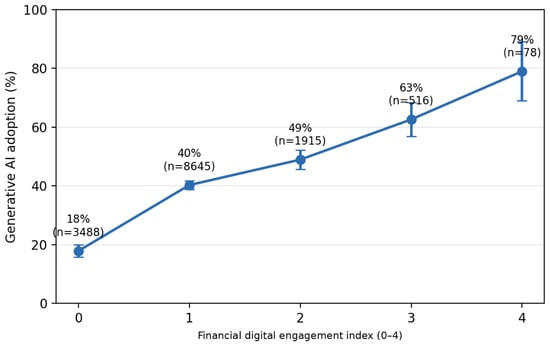
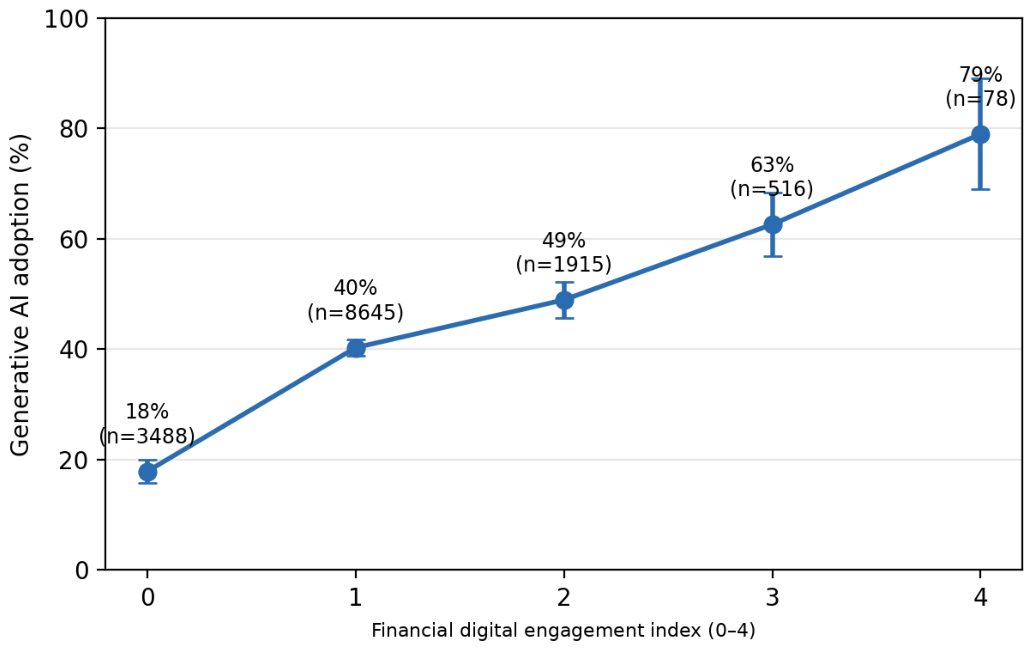
H1 is strongly supported. In Model 1, online banking users have 73% higher adjusted odds of using GenAI than non-users, holding constant digital skills, age, education, income, urbanisation, internet frequency, labour status and region (OR = 1.73; 95% CI 1.53–1.97; p < 0.001), an average marginal effect of about +7.9 percentage points. The relationship is monotonic in intensity: each additional point on the 0–4 financial digital engagement index raises the odds of adoption by 25% (Model 2; OR = 1.25; 95% CI 1.12–1.39), and model-adjusted predicted probabilities rise from 33.7% at index 0 to 46.8% at index 4, an adjusted gradient more modest than the raw descriptive rise from 18% to 79% (Figure 1), which is partly confounded with age and skills. Because online banking accounts for roughly three-quarters of the index mass, the gradient reflects mainly the extensive (online banking) margin: when online banking and the count of advanced activities enter jointly, online banking remains strong (OR = 1.71; 95% CI 1.51–1.95), whereas the advanced activity count is not significant (Section 3.5). Digital skills (OR = 1.43 per task) and daily internet use (OR = 2.88) are, as expected from acceptance theory [8,9], the strongest correlates, but the financial digital gradient is robust to their inclusion.
Figure 1.
Generative AI adoption by financial digital engagement index (0–4), weighted; internet users aged 16 and older, with 95% confidence intervals and unweighted category sizes (n). The highest category (index = 4) contains only 78 respondents, hence its wide interval. Source: author’s calculations based on INE 2025 microdata [1].
3.3. The Age Divide (H2)
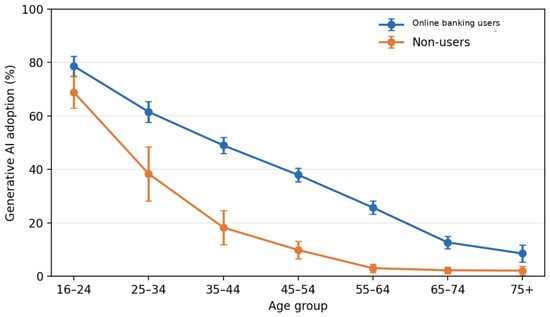
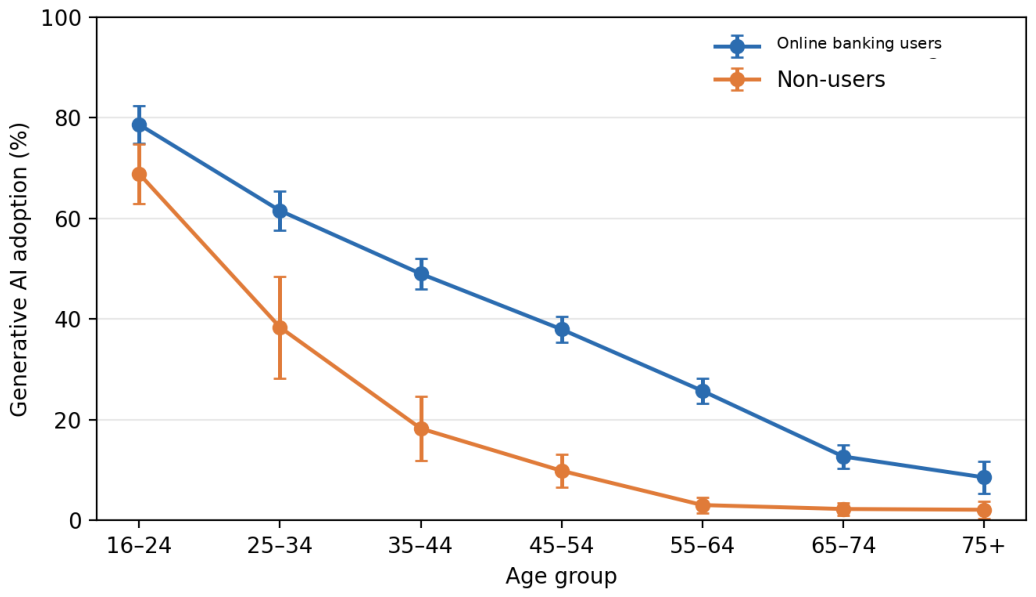
A pronounced generational divide is present: each additional year of age lowers the odds of adoption by roughly 4–5% (Model 1, OR = 0.96; p < 0.001), and raw adoption falls from 76% among those aged 16–24 to about 9% among those aged 65–74. H2 is not supported. The interaction between online banking and age (Model 3) is positive, but not statistically significant (OR = 1.01; 95% CI 0.998–1.024; p = 0.095); because it is borderline, we refrain from interpreting it substantively and conclude only that the financial digital advantage is approximately constant across the age range, rather than amplifying the generational gap. Figure 2 shows that online banking users adopt GenAI at higher rates within every age band, but the confidence intervals indicate that the spacing between the two curves does not widen materially with age, consistent with age operating as an independent axis of the second-level digital divide [12,14].
Figure 2.
Generative AI adoption by age group and online banking use, weighted, with 95% confidence intervals. Source: author’s calculations based on INE 2025 microdata [1].
3.4. Privacy and Security Concerns Among Non-Adopters (H3)
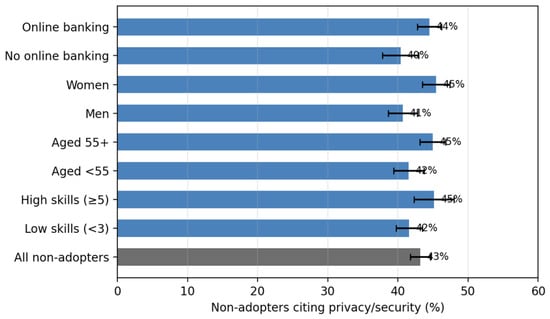
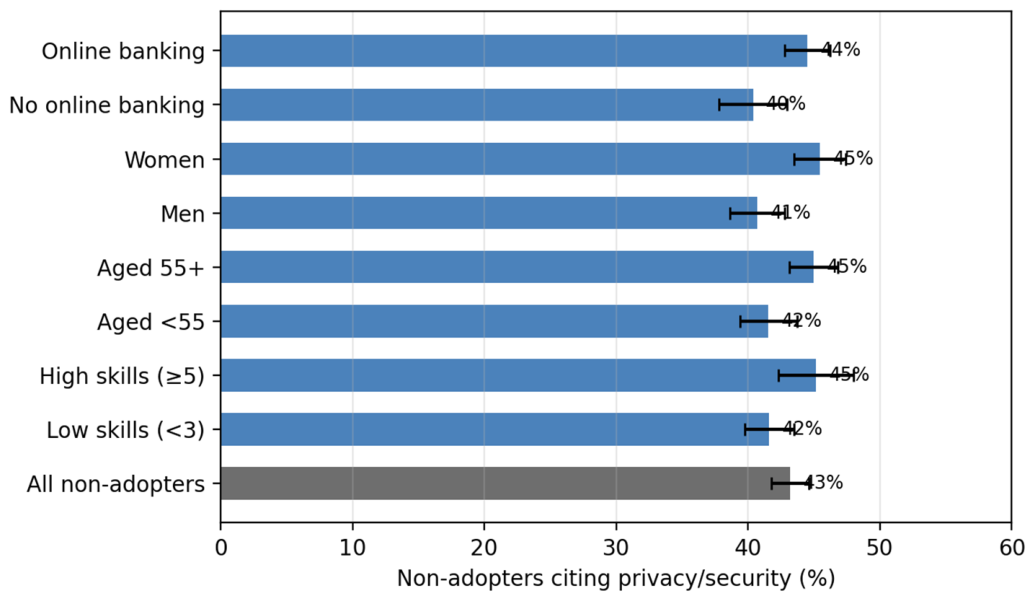
H3 receives qualified support. Among non-adopters, the stated reasons for non-use are, in order of prevalence, a lack of perceived need (66.8%), not knowing how to use the tools (44.9%), privacy or security concerns (43.2%), other reasons (27.7%) and unawareness (25.4%); the item permitted multiple responses. Privacy and security are therefore prominent, but are not the single dominant reason for non-use, which is a lack of perceived need. However, the privacy/security barrier is socially patterned: controlling for covariates (Model 4), it is significantly more likely among online banking users (OR = 1.18; 95% CI 1.07–1.31; p = 0.002), women (OR = 1.25; p < 0.001), older individuals (OR = 1.01 per year; p < 0.001), and the more digitally skilled (OR = 1.04; p = 0.001), whereas the count of advanced financial activities is not significant. The pattern supports a narrower interpretation than ‘trust’ in general: for non-adopters who are already digitally and financially capable—those for whom access and skill are not the obstacles—privacy- and security-related concerns are the most salient remaining barrier [16,19]. Figure 3 displays the prevalence of the privacy/security barrier across groups.
Figure 3.
Share of non-adopters citing privacy/security as a reason for not using generative AI, by group (weighted), with 95% confidence intervals. Source: author’s calculations based on INE 2025 microdata [1].
3.5. Robustness
The random-intercept multilevel specification indicates that the autonomous community of residence accounts for under 1% of the variance in adoption (intraclass correlation approximately 0.7%), confirming that individual-level characteristics dominate and that the autonomous community fixed effects adequately adjust for regional heterogeneity. Inference on the online banking effect is stable across estimators: the odds ratio is essentially unchanged under heteroskedasticity-robust errors, ranges only from 1.69 to 1.81 in a leave-one-community-out jackknife, and remains significant under a wild cluster bootstrap (p = 0.003), addressing the concern that 19 clusters may destabilise cluster-robust errors. Estimating the index components separately shows heterogeneity—online banking (OR = 1.73) and securities trading (OR = 1.62) are positive, insurance is not significant, and arranging credit is weakly negative—reinforcing that the index is driven by the online banking margin. Variance inflation factors for all predictors are below 1.5, indicating no multicollinearity, and McFadden’s pseudo-R-squared is 0.33 for the adoption models. Table 2 reports the odds ratios for the principal predictors across the four models; full coefficient tables with confidence intervals and reference categories are provided in Supplementary Table S2.
Table 2.
Odds ratios from survey-weighted logistic regressions of generative AI adoption (Models 1–3) and of citing privacy/security as a barrier among non-adopters (Model 4).
4. Discussion
The central result is a strong, dose-responsive association between households’ financial digital engagement and consumer adoption of GenAI. Interpreted associationally through UTAUT2 [8,9], online banking and online financial activities serve as observable markers of the prior experience and facilitating condition constructs: individuals who already conduct consequential financial tasks through digital channels face lower effort and uncertainty when adopting a further algorithmic technology [25,26]. Whether financial digital engagement is a finance-specific mechanism or, more broadly, a marker of digital maturity, cannot be settled with cross-sectional data; the robustness of the gradient to digital skills and internet frequency indicates it is not merely a restatement of general digital capability, but the two interpretations remain observationally close. That the gradient is carried largely by the online banking margin further suggests it reflects routine digital delegation, rather than sophisticated financial activity per se. To avoid any ambiguity, we underline that the dose–response pattern documented in Section 3.2 should be read primarily as an online banking effect: it is not evidence that progressively more sophisticated financial activities—securities trading, insurance, and credit—are associated with progressively greater GenAI adoption, since the advanced activity components are individually weak or non-significant once online banking is accounted for (Section 3.5).
The rejection of H2 is informative. The generational divide in GenAI adoption is large, but broadly uniform: being a financially digital user confers a similar advantage at all ages, rather than compounding the disadvantage of older cohorts. This tempers the concern that digital financial services act as an accelerant of an age-based GenAI divide and points instead to age as an independent axis of the second- and third-level digital divide [12,13,14].
The findings on stated barriers carry a policy implication, with an important qualification. A lack of perceived need is the most common reason for non-use; privacy and security concerns rank next and, unlike need, are reported more often by the digitally skilled and by online banking users. For these capable consumers, the salient obstacle is thus a privacy- and security-related concern, rather than an access or skills deficit, echoing the finding that trust and perceived privacy risk govern the adoption of information systems handling sensitive data [16,17,19], and resonating with the algorithm-aversion literature [21], as well as with experimental evidence that explainability shapes trust in algorithmic financial advice [43]. We deliberately frame this as privacy- and security-specific, rather than as ‘trust’ in general, since the survey does not measure trust in AI outputs, in institutions deploying AI, or in algorithmic decision making, which are conceptually distinct. As financial institutions embed GenAI in consumer-facing services [36,37,38], demonstrable privacy safeguards, transparency and security assurances may matter for diffusion among the already-engaged, alongside efforts to communicate concrete usefulness to the larger group who see no need. The gendered pattern, with women non-adopters citing privacy and security more often, warrants attention to the design of inclusive, trustworthy consumer AI [29,31,32].
Several limitations qualify these conclusions. The data are cross-sectional, so the associations cannot be given a causal interpretation; reverse causality (GenAI users becoming more financially digital) and omitted variables—openness to innovation, risk tolerance, occupation and workplace or educational exposure to AI, and the household technological environment—may all contribute, and the survey does not measure them. The financial digital index is dominated by online banking, so the dose–response outcome should be read as an extensive margin result. The evidence is for a single country in the first year the GenAI module was fielded, precluding a longitudinal view. The privacy/security item records whether a concern is a reason for non-use, not whether it is the principal reason, and it captures only one dimension of trust. Complete-case exclusion is minimal (0.58%) but non-random. Finally, the survey-weighted clustered standard errors are approximate; the robustness checks reported above indicate the substantive conclusions are nonetheless stable. On endogeneity specifically, individuals who adopt online banking and those who adopt GenAI plausibly share unobserved traits—openness to innovation, technological affinity, occupation, cognitive ability and workplace exposure to AI—that the survey cannot capture, so financial digital engagement may partly proxy a broader digital readiness, rather than an independent finance-specific mechanism; distinguishing between these accounts is beyond what a single cross-section can deliver. Future work should, therefore, pursue identification strategies better suited to isolating a causal effect, such as panel data that track individuals as they adopt online banking and GenAI over time; instrumental–variable designs, exploiting variation in local banking digitalisation; or quasi-experimental approaches around staggered branch closures or online banking rollouts. Finally, external validity is not established: Spain has comparatively high digital financial penetration and specific demographic and institutional characteristics, so the size, and possibly the direction, of the associations documented here may not generalise to countries with different levels of financial digitalisation, regulatory regimes or AI awareness; replication with comparable microdata from other countries, as further national AI-use modules become available alongside the emerging Spanish evidence on the generative AI divide [40], would help establish how much of the pattern is Spain-specific.
5. Conclusions
Using nationally representative Spanish microdata from 2025, this study provides the first population-level evidence that consumers’ prior engagement with digital financial services is strongly associated with generative AI adoption, rising with the intensity of that engagement, an association driven predominantly by the online banking margin, rather than by more sophisticated financial activities. The generational divide in adoption is pronounced, but is not widened by financial digital status, and among non-adopters, a lack of perceived need is the leading stated reason, while privacy and security constitute the most salient barriers among the digitally and financially capable. Two conclusions follow directly from the evidence: financial digital engagement is a robust correlate of adoption, and privacy/security concerns are concentrated among capable non-adopters. Beyond these, and more tentatively in light of the existing literature, broadening responsible consumer adoption of AI is likely to depend on communicating concrete usefulness to the unengaged, as well as on closing the privacy- and security-related trust gap through privacy protection, transparency, and security among the engaged, while attention to age- and gender-related divides remains essential. Because the evidence is drawn from a single, comparatively finance digitalised country, generalisation to other institutional and regulatory contexts should be made cautiously. Future research should pursue causal and longitudinal designs, including panel, instrumental–variable and quasi-experimental approaches to endogeneity, and cross-national comparisons as comparable microdata accumulate.
Supplementary Materials
The following supporting information can be downloaded at: https://www.mdpi.com/article/10.3390/fintech5030061/s1, Table S1: Comparison of included and excluded respondents; Table S2: Full coefficient tables with 95% confidence intervals for Models 1–4; Table S3: Average marginal effects and model-adjusted predicted probabilities; and Table S4: Index component and alternative inference robustness checks.
Funding
This research received no external funding.
Institutional Review Board Statement
Not applicable. This study used anonymised secondary microdata produced by an official statistical agency.
Informed Consent Statement
Not applicable.
Data Availability Statement
This study used the publicly available anonymised microdata of the 2025 Survey on ICT Equipment and Use in Households, distributed free of charge by the Spanish National Statistics Institute (INE) at https://www.ine.es (accessed on 10 June 2026). The raw data supporting the conclusions of this article will be made available by the authors on request.
Acknowledgments
The author thanks the INE and Eurostat for making the survey microdata and documentation publicly available. During the preparation of this manuscript, the author used Claude Sonnet 5 (Anthropic, San Francisco, CA, USA) to assist with bibliographic selection. The AI tool was not used to generate data or to produce substantive interpretation. The author reviewed and edited the output and takes full responsibility for the content of this publication.
Conflicts of Interest
The author declares no conflicts of interest.
References
- Instituto Nacional de Estadística (INE). Encuesta Sobre Equipamiento y Uso de Tecnologías de Información y Comunicación en los Hogares 2025: Ficheros de Microdatos; INE: Madrid, Spain, 2025; Available online: https://www.ine.es (accessed on 10 June 2026).
- Eurostat. Use of Artificial Intelligence by Individuals; Statistics Explained, dataset isoc_ai_iaiu; Eurostat: Luxembourg, 2025. [Google Scholar]
- Davis, F.D. Perceived usefulness, perceived ease of use, and user acceptance of information technology. MIS Q. 1989, 13, 319–340. [Google Scholar] [CrossRef] [Scilit]
- Davis, F.D.; Bagozzi, R.P.; Warshaw, P.R. User acceptance of computer technology: A comparison of two theoretical models. Manag. Sci. 1989, 35, 982–1003. [Google Scholar] [CrossRef] [Scilit]
- Venkatesh, V.; Davis, F.D. A theoretical extension of the technology acceptance model: Four longitudinal field studies. Manag. Sci. 2000, 46, 186–204. [Google Scholar] [CrossRef] [Scilit]
- Ajzen, I. The theory of planned behavior. Organ. Behav. Hum. Decis. Process. 1991, 50, 179–211. [Google Scholar] [CrossRef] [Scilit]
- Venkatesh, V.; Morris, M.G.; Davis, G.B.; Davis, F.D. User acceptance of information technology: Toward a unified view. MIS Q. 2003, 27, 425–478. [Google Scholar] [CrossRef] [Scilit]
- Venkatesh, V.; Thong, J.Y.L.; Xu, X. Consumer acceptance and use of information technology: Extending the unified theory of acceptance and use of technology. MIS Q. 2012, 36, 157–178. [Google Scholar] [CrossRef] [Scilit]
- Venkatesh, V.; Thong, J.Y.L.; Xu, X. Unified theory of acceptance and use of technology: A synthesis and the road ahead. J. Assoc. Inf. Syst. 2016, 17, 328–376. [Google Scholar] [CrossRef] [Scilit]
- Rogers, E.M. Diffusion of Innovations, 5th ed.; Free Press: New York, NY, USA, 2003. [Google Scholar]
- van Dijk, J.A.G.M. The Digital Divide; Polity Press: Cambridge, UK, 2020. [Google Scholar]
- Hargittai, E. Second-level digital divide: Differences in people’s online skills. First Monday 2002, 7. [Google Scholar] [CrossRef] [Scilit]
- van Deursen, A.J.A.M.; van Dijk, J.A.G.M. The first-level digital divide shifts from inequalities in physical access to inequalities in material access. New Media Soc. 2019, 21, 354–375. [Google Scholar] [CrossRef] [Scilit] [PubMed]
- Scheerder, A.; van Deursen, A.; van Dijk, J. Determinants of Internet skills, uses and outcomes: A systematic review of the second- and third-level digital divide. Telemat. Inform. 2017, 34, 1607–1624. [Google Scholar] [CrossRef] [Scilit]
- Robinson, L.; Cotten, S.R.; Ono, H.; Quan-Haase, A.; Mesch, G.; Chen, W.; Schulz, J.; Hale, T.M.; Stern, M.J. Digital inequalities and why they matter. Inf. Commun. Soc. 2015, 18, 569–582. [Google Scholar] [CrossRef] [Scilit]
- Gefen, D.; Karahanna, E.; Straub, D.W. Trust and TAM in online shopping: An integrated model. MIS Q. 2003, 27, 51–90. [Google Scholar] [CrossRef] [Scilit]
- McKnight, D.H.; Choudhury, V.; Kacmar, C. Developing and validating trust measures for e-commerce: An integrative typology. Inf. Syst. Res. 2002, 13, 334–359. [Google Scholar] [CrossRef] [Scilit]
- Pavlou, P.A. Consumer acceptance of electronic commerce: Integrating trust and risk with the technology acceptance model. Int. J. Electron. Commer. 2003, 7, 101–134. [Google Scholar] [CrossRef] [Scilit]
- Dinev, T.; Hart, P. An extended privacy calculus model for e-commerce transactions. Inf. Syst. Res. 2006, 17, 61–80. [Google Scholar] [CrossRef] [Scilit]
- Bélanger, F.; Crossler, R.E. Privacy in the digital age: A review of information privacy research in information systems. MIS Q. 2011, 35, 1017–1041. [Google Scholar] [CrossRef] [Scilit]
- Dietvorst, B.J.; Simmons, J.P.; Massey, C. Algorithm aversion: People erroneously avoid algorithms after seeing them err. J. Exp. Psychol. Gen. 2015, 144, 114–126. [Google Scholar] [CrossRef] [Scilit] [PubMed]
- Logg, J.M.; Minson, J.A.; Moore, D.A. Algorithm appreciation: People prefer algorithmic to human judgment. Organ. Behav. Hum. Decis. Process. 2019, 151, 90–103. [Google Scholar] [CrossRef] [Scilit]
- Luarn, P.; Lin, H.-H. Toward an understanding of the behavioral intention to use mobile banking. Comput. Hum. Behav. 2005, 21, 873–891. [Google Scholar] [CrossRef] [Scilit]
- Zhou, T.; Lu, Y.; Wang, B. Integrating TTF and UTAUT to explain mobile banking user adoption. Comput. Hum. Behav. 2010, 26, 760–767. [Google Scholar] [CrossRef] [Scilit]
- Baptista, G.; Oliveira, T. Understanding mobile banking: The unified theory of acceptance and use of technology combined with cultural moderators. Comput. Hum. Behav. 2015, 50, 418–430. [Google Scholar] [CrossRef] [Scilit]
- Alalwan, A.A.; Dwivedi, Y.K.; Rana, N.P. Factors influencing adoption of mobile banking by Jordanian bank customers: Extending UTAUT2 with trust. Int. J. Inf. Manag. 2017, 37, 99–110. [Google Scholar] [CrossRef] [Scilit]
- Tam, C.; Oliveira, T. Understanding mobile banking individual performance. Internet Res. 2017, 27, 538–562. [Google Scholar] [CrossRef] [Scilit]
- Gomber, P.; Kauffman, R.J.; Parker, C.; Weber, B.W. On the fintech revolution: Interpreting the forces of innovation, disruption, and transformation in financial services. J. Manag. Inf. Syst. 2018, 35, 220–265. [Google Scholar] [CrossRef] [Scilit]
- Ozili, P.K. Impact of digital finance on financial inclusion and stability. Borsa Istanb. Rev. 2018, 18, 329–340. [Google Scholar] [CrossRef] [Scilit]
- Demirgüç-Kunt, A.; Klapper, L.; Singer, D.; Ansar, S. The Global Findex Database 2021: Financial Inclusion, Digital Payments, and Resilience in the Age of COVID-19; World Bank: Washington, DC, USA, 2022. [Google Scholar]
- Tok, Y.W.; Heng, D. Fintech: Financial Inclusion or Exclusion? IMF Work. Pap., WP/22/80; IMF: Washington, DC, USA, 2022. [Google Scholar]
- Mhlanga, D. Industry 4.0 in finance: The impact of artificial intelligence (AI) on digital financial inclusion. Int. J. Financ. Stud. 2020, 8, 45. [Google Scholar] [CrossRef] [Scilit]
- Mhlanga, D.; Denhere, V.; Moloi, T. Financial inclusion and fintech: A state-of-the-art systematic literature review. Financ. Innov. 2025, 11, 69. [Google Scholar] [CrossRef] [Scilit]
- Lusardi, A.; Mitchell, O.S. The economic importance of financial literacy: Theory and evidence. J. Econ. Lit. 2014, 52, 5–44. [Google Scholar] [CrossRef] [Scilit] [PubMed]
- Strzelecki, A. To use or not to use ChatGPT in higher education? A study of students’ acceptance and use of technology. Interact. Learn. Environ. 2024, 32, 5142–5155. [Google Scholar]
- Feuerriegel, S.; Hartmann, J.; Janiesch, C.; Zschech, P. Generative AI. Bus. Inf. Syst. Eng. 2024, 66, 111–126. [Google Scholar]
- Königstorfer, F.; Thalmann, S. Applications of artificial intelligence in commercial banks—A research agenda for behavioral finance. J. Behav. Exp. Financ. 2020, 27, 100352. [Google Scholar] [CrossRef] [Scilit]
- Lui, A.; Lamb, G.W. Artificial intelligence and augmented intelligence collaboration: Regaining trust and confidence in the financial sector. Inf. Commun. Technol. Law 2018, 27, 267–283. [Google Scholar] [CrossRef] [Scilit]
- Kim, Y.; Blazquez, V.; Oh, T. Determinants of generative AI system adoption and usage behavior in Korean companies: Applying the UTAUT model. Behav. Sci. 2024, 14, 1035. [Google Scholar] [CrossRef] [Scilit] [PubMed]
- Suárez, D.; García-Mariñoso, B. On the verge of a digital divide in the use of generative AI? Telecommun. Policy 2025, 49, 102997. [Google Scholar] [CrossRef] [Scilit]
- Eurostat. European Compilers’ Manual for Statistics on the Use of ICT in Households and by Individuals—2024 Edition; Eurostat: Luxembourg, 2024. [Google Scholar]
- European Commission; Eurostat. Digitalisation in Europe—2025 Edition; Publications Office of the European Union: Luxembourg, 2025. [Google Scholar]
- Ben David, D.; Resheff, Y.S.; Tron, T. Explainable AI and adoption of financial algorithmic advisors: An experimental study. In Proceedings of the 2021 AAAI/ACM Conference on AI, Ethics, and Society (AIES ‘21), Virtual Event, 19–21 May 2021; pp. 1–13. [Google Scholar]

Disclaimer/Publisher’s Note: The statements, opinions and data contained in all publications are solely those of the individual author(s) and contributor(s) and not of MDPI and/or the editor(s). MDPI and/or the editor(s) disclaim responsibility for any injury to people or property resulting from any ideas, methods, instructions or products referred to in the content. |
© 2026 by the author. Licensee MDPI, Basel, Switzerland. This article is an open access article distributed under the terms and conditions of the Creative Commons Attribution (CC BY) license.