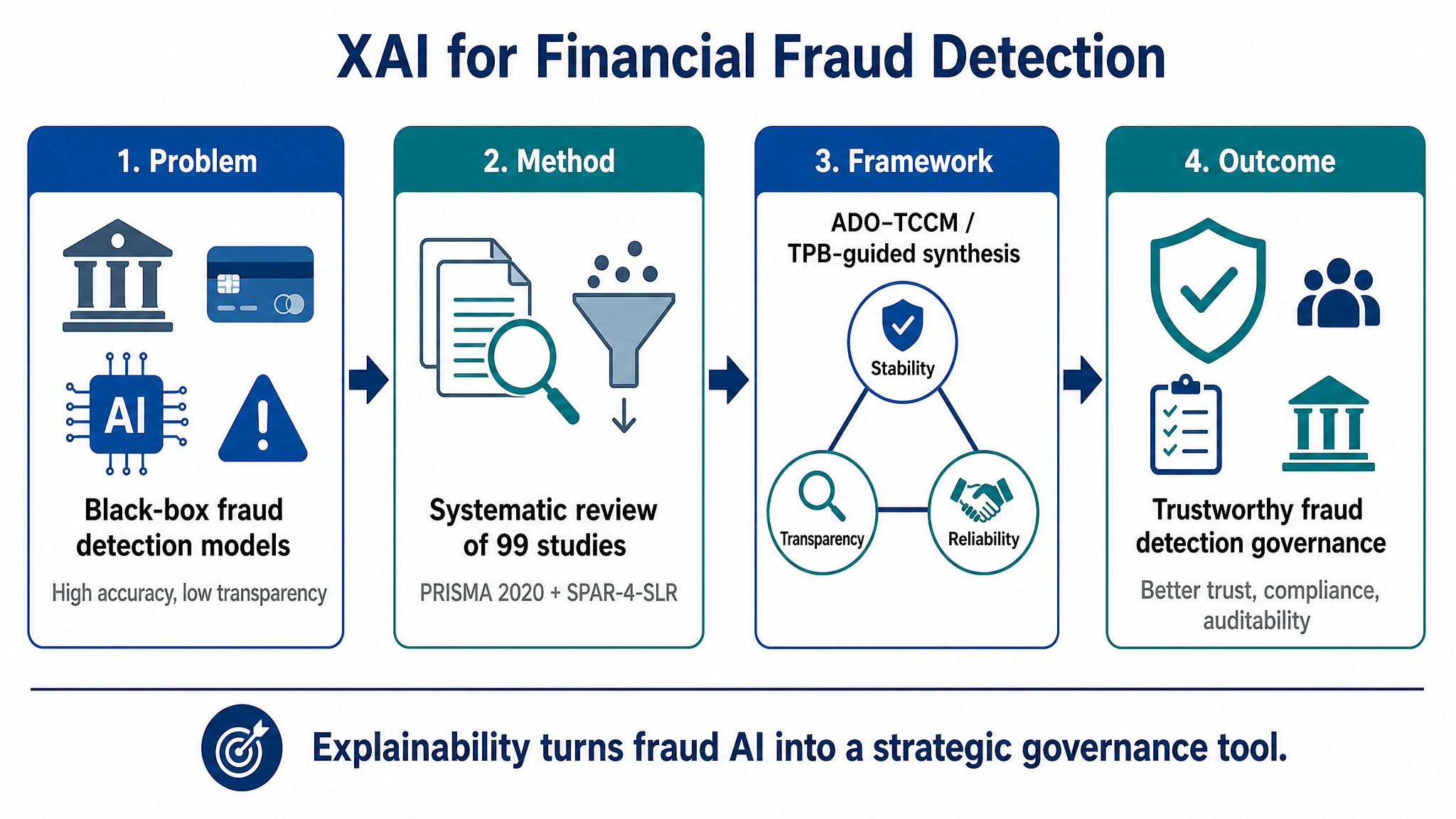

Explainable Artificial Intelligence in Financial Fraud Detection: A Systematic Review and FinTech-Oriented ADO–TCCM Meta-Framework for Trust, Governance, and Transparency




Abstract
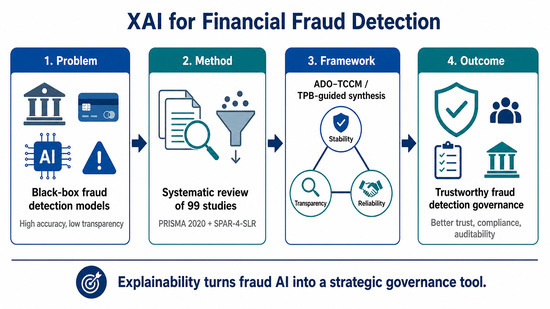
1. Introduction
- (i)
- The lack of an integrated framework linking behavioural, technical, and institutional drivers of explainable AI adoption;
- (ii)
- Limited exploration of explainability as a governance capability within financial systems;
- (iii)
- Insufficient attention to the governance and capability-development dimensions of explainability within FinTech environments.
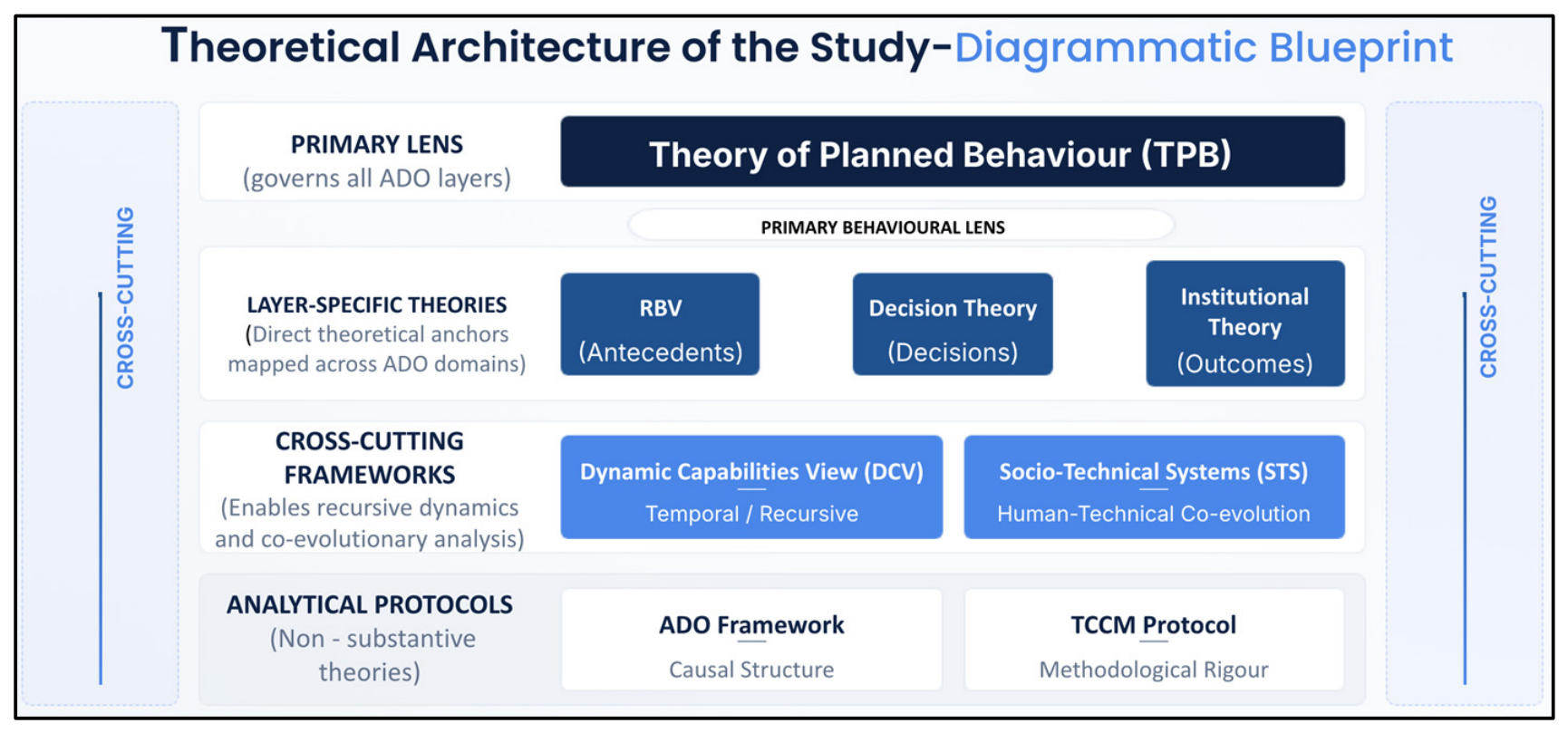
Theoretical Architecture: Hierarchy and Functional Role
- A FinTech-oriented framework is developed, integrating explainable AI into fraud detection and governance systems;
- The ADO framework is extended by incorporating behavioural theory (TPB) within AI-driven financial decision-making;
- The Stability–Transparency–Reliability (STR) model is introduced as a governance mechanism for explainability, operationalised through three named theoretical extensions: (a) Interpretative Agency, an extension of TPB’s Perceived Behavioural Control from resource availability into cognitive–forensic validation capacity; (b) Triadic STS Alignment, an extension of Socio-Technical Systems Theory incorporating a regulatory–ethical subsystem as a non-negotiable governance stabiliser; and (c) the Recursive Learning Loop, an extension of the Dynamic Capabilities View that formalises XAI as an active, self-reinforcing governance catalyst rather than a static compliance instrument, operationalised through the concept of Interpretative Agility. These extensions are developed in full in Section 6.1.
- A systematic synthesis of XAI applications in financial fraud detection is provided, with implications for regulatory governance, practitioner decision-making, and future research directions in FinTech.
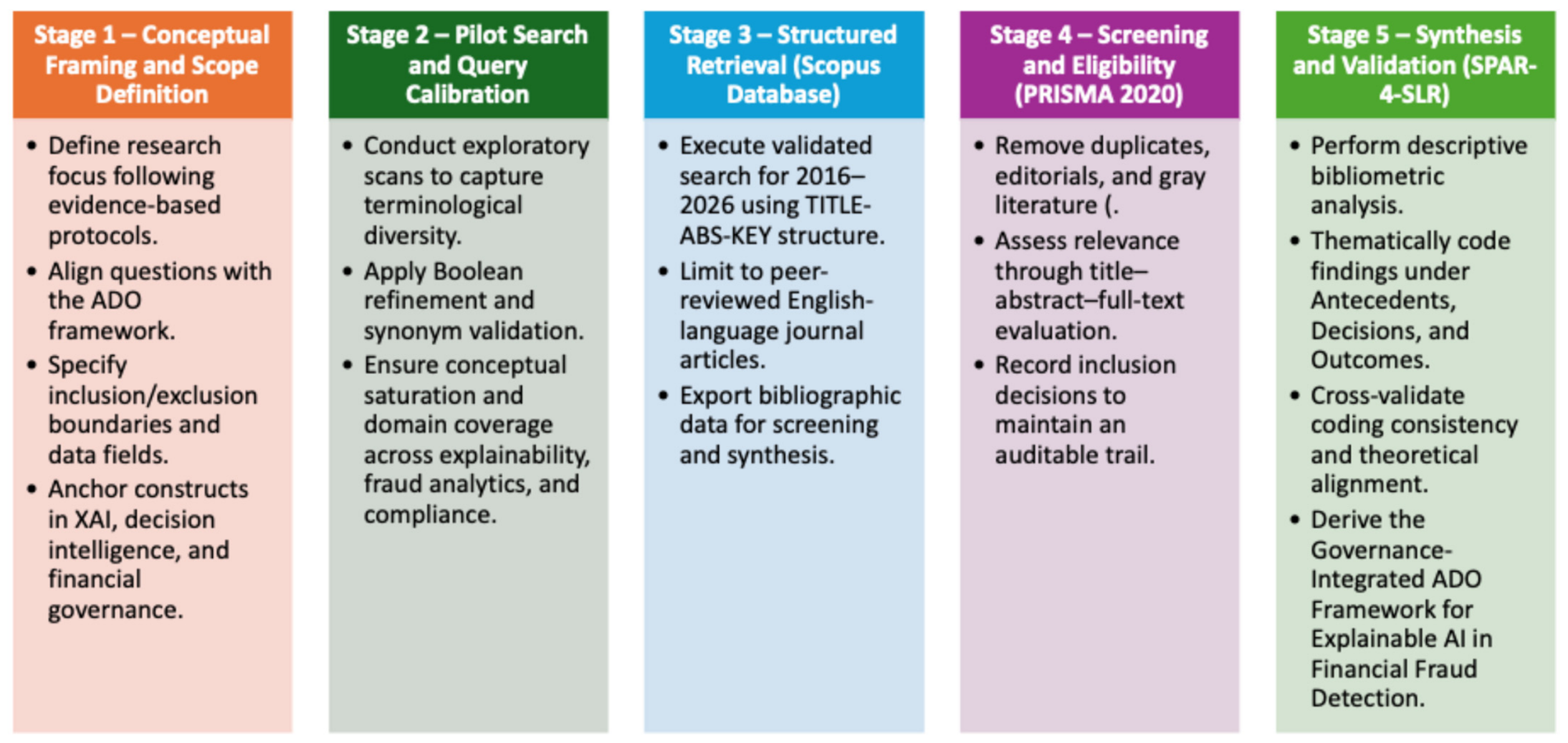
2. Research Methods
2.1. Review Design

2.2. Pilot Search and Query Calibration
2.3. Operational Search Strategy and Eligibility Criteria
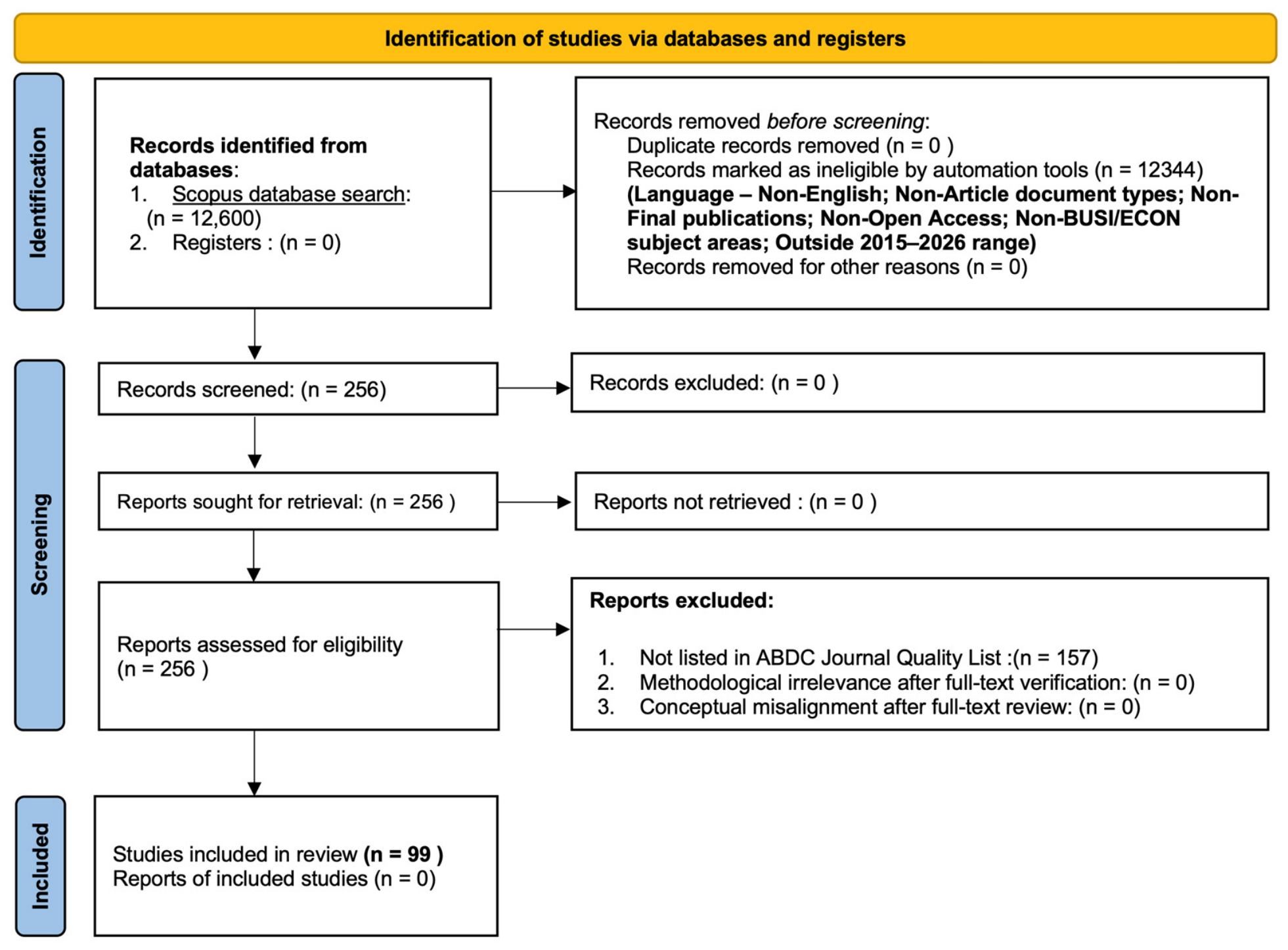
2.4. Study Selection Procedure (PRISMA 2020)
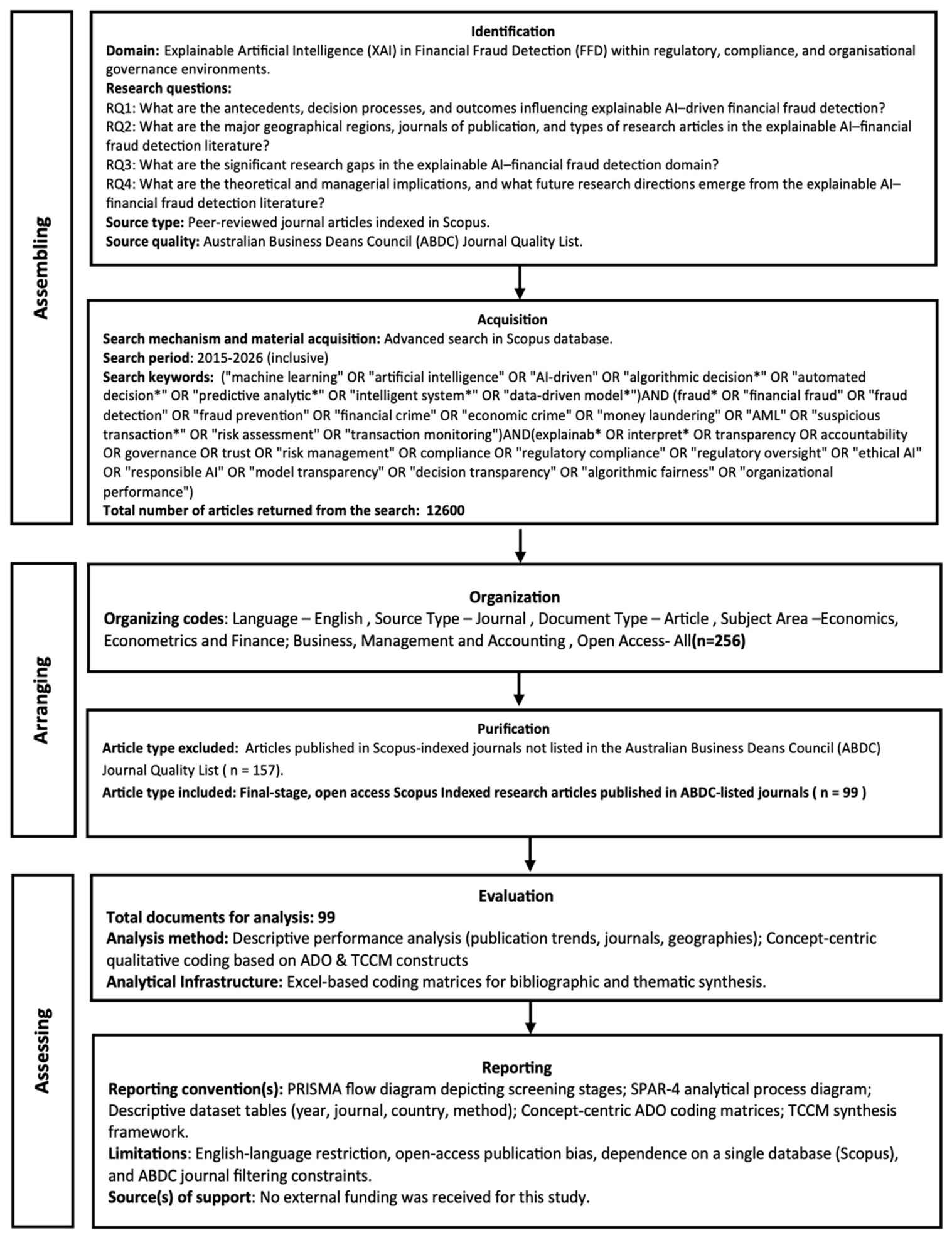
2.5. SPAR-4-SLR Protocol
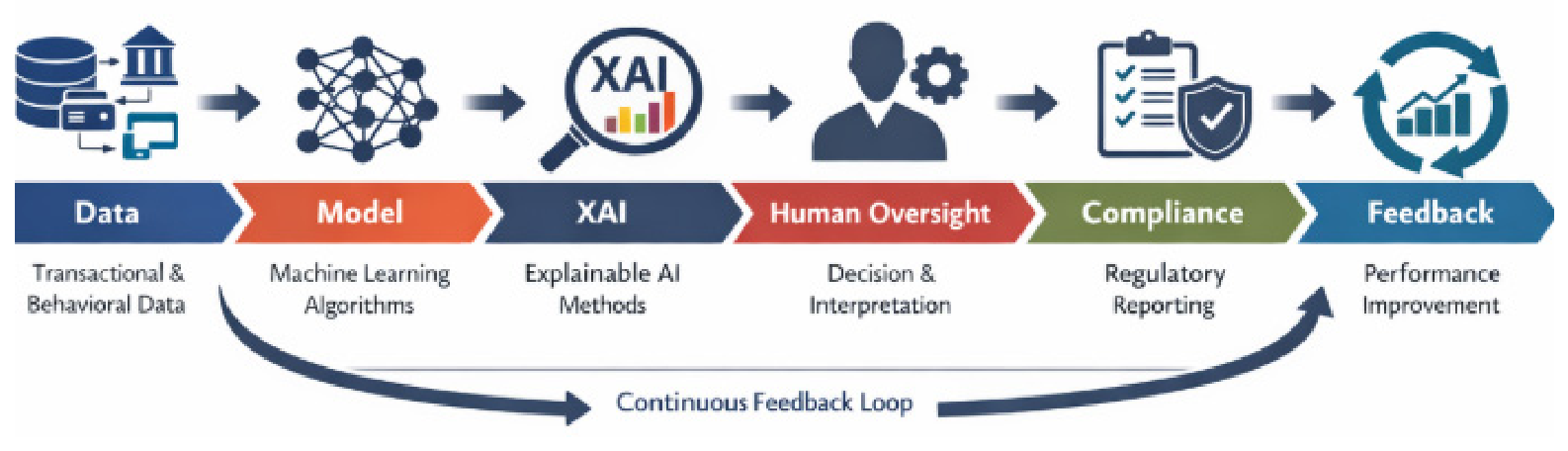
3. FinTech-Oriented XAI System Architecture
- (i)
- Data Layer: High-volume transactional, behavioural, and alternative data streams;
- (ii)
- Model Layer: Machine learning and deep learning algorithms (e.g., GNNs, ensemble models);
- (iii)
- Explainability Layer: Post hoc and intrinsic XAI methods (e.g., SHAP, LIME, counterfactual explanations);
- (iv)
- Decision and Governance Layer: Human-in-the-loop validation, regulatory reporting, and audit compliance mechanisms.
4. Analysis and Synthesis
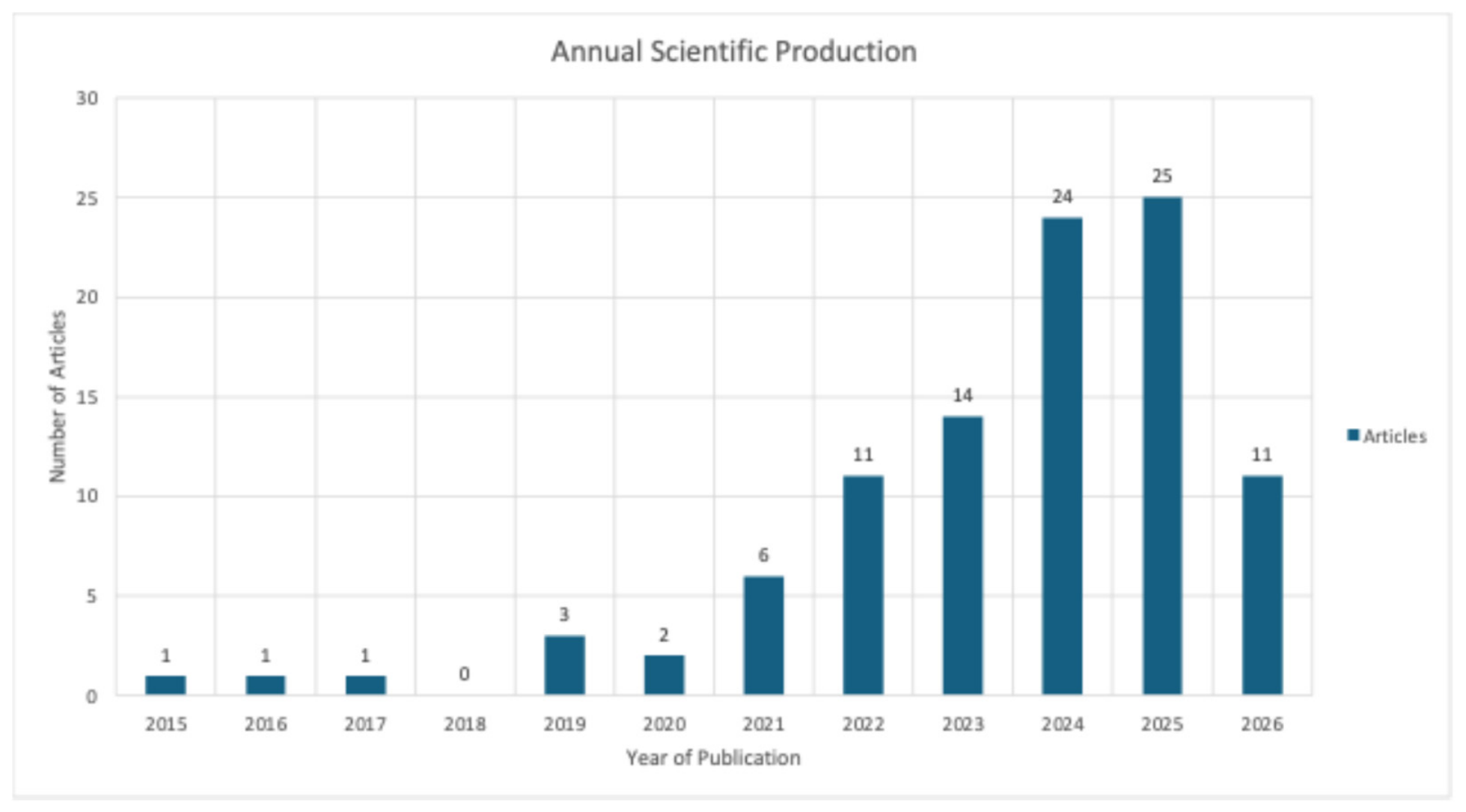
4.1. Annual Scientific Production

4.2. Source-Journal Distribution and Indexing Profile

| Journal | Indexing and ABDC Ranking | No. of Articles | % of Dataset |
|---|---|---|---|
| Decision Support Systems | Scopus, A* | 6 | 6.06% |
| Technological Forecasting and Social Change | Scopus, A | 4 | 4.04% |
| Journal of Forecasting | Scopus, A | 4 | 4.04% |
| Journal of Banking Regulation | Scopus, C | 3 | 3.03% |
| International Journal of Production Research | Scopus, A | 3 | 3.03% |
| Finance Research Letters | Scopus, A | 3 | 3.03% |
| Journal of Money Laundering Control | Scopus, C | 3 | 3.03% |
| Technology in Society | Scopus, C | 2 | 2.02% |
| Technovation | Scopus, A | 2 | 2.02% |
| Journal of Economic Surveys | Scopus, A | 2 | 2.02% |
| Information Resources Management Journal | Scopus, C | 2 | 2.02% |
| Journal of Organisational and End User Computing | Scopus, B | 2 | 2.02% |
| International Journal of Production Economics | Scopus, A | 2 | 2.02% |
| Journal of Behavioural and Experimental Finance | Scopus, A | 2 | 2.02% |
| International Review of Finance | Scopus, A | 2 | 2.02% |
| Economies | Scopus, C | 2 | 2.02% |
| Energy Economics | Scopus, A* | 2 | 2.02% |
| International Journal of Information Systems and Supply Chain Management | Scopus, C | 2 | 2.02% |
| Electronic Commerce Research and Applications | Scopus, B | 2 | 2.02% |
| Engineering, Construction and Architectural Management | Scopus, A | 2 | 2.02% |
| IEEE Transactions on Engineering Management | Scopus, A | 2 | 2.02% |
| Electronic Markets | Scopus, A | 2 | 2.02% |
| International Transactions in Operational Research | Scopus, B | 2 | 2.02% |
| Computational Management Science | Scopus, B | 1 | 1.01% |
| Sustainable Futures | Scopus, C | 1 | 1.01% |
| Systems Research and Behavioural Science | Scopus, A | 1 | 1.01% |
| Journal of Industrial Relations | Scopus, A | 1 | 1.01% |
| Transportation Research Part A: Policy and Practice | Scopus, A* | 1 | 1.01% |
| Journal of Applied Economic Sciences | Scopus, C | 1 | 1.01% |
| Journal of Construction Engineering and Management | Scopus, A* | 1 | 1.01% |
| Risk Management and Insurance Review | Scopus, C | 1 | 1.01% |
| Emerging Markets Review | Scopus, A | 1 | 1.01% |
| Administrative Sciences | Scopus, C | 1 | 1.01% |
| International Journal of Business Information Systems | Scopus, C | 1 | 1.01% |
| South African Journal of Business Management | Scopus, C | 1 | 1.01% |
| Business Strategy and the Environment | Scopus, A | 1 | 1.01% |
| Journal of Industrial and Management Optimisation | Scopus, B | 1 | 1.01% |
| Journal of Risk and Insurance | Scopus, A | 1 | 1.01% |
| International Journal of Economics and Financial Issues | Scopus, C | 1 | 1.01% |
| Current Issues in Auditing | Scopus, B | 1 | 1.01% |
| European Journal of Health Economics | Scopus, A | 1 | 1.01% |
| Transportation Research Part E: Logistics and Transportation Review | Scopus, A* | 1 | 1.01% |
| Managerial and Decision Economics | Scopus, B | 1 | 1.01% |
| Management Review Quarterly | Scopus, B | 1 | 1.01% |
| Marine Policy | Scopus, A | 1 | 1.01% |
| Borsa Istanbul Review | Scopus, B | 1 | 1.01% |
| Strategic Management Journal | Scopus, A* | 1 | 1.01% |
| Production Planning and Control | Scopus, A | 1 | 1.01% |
| Financial Innovation | Scopus, B | 1 | 1.01% |
| Journal of Business Economics | Scopus, B | 1 | 1.01% |
| Accounting Research Journal | Scopus, B | 1 | 1.01% |
| Indian Journal of Marketing | Scopus, C | 1 | 1.01% |
| Economic Modelling | Scopus, A | 1 | 1.01% |
| Public Administration Review | Scopus, A | 1 | 1.01% |
| Journal of Cases on Information Technology | Scopus, C | 1 | 1.01% |
| Management Science | Scopus, A* | 1 | 1.01% |
| Journal of Econometrics | Scopus, A* | 1 | 1.01% |
| Journal of the Operational Research Society | Scopus, A | 1 | 1.01% |
| Journal of Global Information Management | Scopus, A | 1 | 1.01% |
| European Business Organisation Law Review | Scopus, B | 1 | 1.01% |
| Oxford Review of Economic Policy | Scopus, A | 1 | 1.01% |
| Journal of Advanced Transportation | Scopus, B | 1 | 1.01% |
| Tourism Management | Scopus, A* | 1 | 1.01% |
| International Journal of Project Management | Scopus, A* | 1 | 1.01% |
| Total | 99 | 100.00% | |
4.3. Geographical Research Distribution
| Country | Number of Articles | Country | Number of Articles | Country | Number of Articles |
|---|---|---|---|---|---|
| China | 56 | Romania | 6 | Iran | 2 |
| UK | 45 | Ukraine | 6 | Ireland | 2 |
| Australia | 28 | Belgium | 5 | Malaysia | 2 |
| USA | 26 | Thailand | 5 | Serbia | 2 |
| Germany | 22 | Brazil | 4 | South Korea | 2 |
| Spain | 19 | South Africa | 4 | Austria | 1 |
| Italy | 18 | Sweden | 4 | Cyprus | 1 |
| India | 12 | Turkey | 4 | Morocco | 1 |
| France | 10 | Canada | 3 | Pakistan | 1 |
| Finland | 7 | Qatar | 3 | Singapore | 1 |
| Netherlands | 7 | Colombia | 2 | Slovenia | 1 |
| Switzerland | 7 | Greece | 2 | United Arab Emirates | 1 |
4.4. Theoretical Foundations
| Sr. NO | Theory/Framework | References | No. of Studies |
|---|---|---|---|
| 1 | Resource-Based View (RBV) | [8,10,36,46,47,48,71,74,81,82,83,84,85] | 13 |
| 2 | Institutional Theory | [4,7,9,20,21,29,49,50,51,86,87,88] | 12 |
| 3 | Decision Theory and DSS | [6,37,40,52,53,54,77,78,89,90,91] | 11 |
| 4 | Agency Theory | [18,20,26,55,92,93,94,95] | 9 |
| 5 | Socio-Technical Systems Theory | [7,8,12,18,77,96,97,98] | 8 |
| 6 | Technology Acceptance (TAM/UTAUT) | [37,38,47,99,100,101,102] | 7 |
| 7 | Signal Theory/Info Asymmetry | [103,104,105,106,107,108,109] | 7 |
| 8 | Fuzzy Set Theory and Logic | [81,83,95,110,111] | 5 |
| 9 | Algorithmic Fairness Theory | [11,60,79,112,113] | 5 |
| 10 | Risk Management/PIDE Theory | [24,80,85,114] | 4 |
| 11 | Theory of Planned Behaviour (TPB) | [47,50,59,115] | 4 |
| 12 | Fraud Diamond/Triangle Theory | [12,59,92,116] | 4 |
| 13 | Reliability Theory (XAI Stability) | [23,28,43] | 3 |
| 14 | Innovation Resistance Theory (IRT) | [37,38,39] | 3 |
| 15 | Modern Portfolio Theory (MPT) | [80] | 1 |
4.5. Methodological Orientation
| Sr. NO | Type of Study | No. of Studies | Methodological Sub-Types | References | |
|---|---|---|---|---|---|
| 1 | Quantitative | Quantitative: Algorithmic/Experimental | 41 | Deep learning, GBDT, ensemble methods, and simulation-based stress testing. | [5,11,12,22,23,24,26,28,34,35,36,42,45,59,81,83,84,85,95,96,104,106,107,108,109,112,114,116,117,118,119,120,121,122,123,124,125,126] |
| 2 | Quantitative: Survey/Econometric | 18 | Structural equation modelling (SEM), GMM, and cross-sectional regression. | [10,17,37,38,46,47,50,79,92,93,99,103,105,115,127,128,129,130] | |
| 3 | Qualitative | Qualitative: Case Study and Interviews | 12 | Multiple-case analysis, expert elicitation, and semi-structured interviews. | [3,4,7,9,29,39,49,60,86,88,97,100] |
| 4 | Others | Hybrid/Mixed-Methods | 15 | Combining human-expert benchmarking with AI performance scores (blind peer review). | [6,8,25,35,38,52,53,80,89,110,131,132,133,134,135] |
| 5 | Conceptual/Secondary (Meta-Analysis) | 13 | Systematic literature reviews (SLR) and PRISMA-based framework development. | [8,18,20,21,25,51,55,71,74,80,82,133,136] | |
4.6. Sectoral Distribution of Empirical Application
| Sr. NO | Industry Sector | No. of Studies | Decision Context | Technical Capability Focus | References |
|---|---|---|---|---|---|
| 1 | Banking and Credit | 37 | Credit scoring, loan default, and SME creditworthiness assessment. | Risk Sensitivity: Balancing predictive accuracy with semantic interpretability for auditors. | [8,17,20,21,22,24,25,28,34,35,40,45,48,51,54,55,58,74,77,78,79,81,82,90,91,94,95,98,102,106,107,109,117,123,125,136,137] |
| 2 | E-commerce and Payments | 12 | Real-time transaction fraud, fake review detection, and user behavioural embedding. | High-Velocity Triage: Processing high-frequency graphs and clickstreams in real-time. | [23,36,42,43,83,84,85,102,108,112,119,138,139] |
| 3 | RegTech and AML | 12 | AML forensics, suspicious activity reporting (SAR), and compliance monitoring. | Regulatory Auditability: Mapping Article-level law into traceable control criteria. | [4,5,7,12,29,86,87,88,96,99,100] |
| 4 | Investment and Portfolio | 9 | Asset allocation, crypto market risk, and pension fund optimisation. | Uncertainty Quantification: Modelling tail-risk spillovers and scenario trees. | [80,103,109,114,126,140,141,142,143] |
| 5 | Insurance and Claims | 4 | Underwriting fraud, high-cardinality claim management, and premium misrepresentation. | Complexity Handling: Managing high-dimensional categorical data and label-free detection. | [11,113,118,122] |
| 6 | Corporate and ESG | 7 | ESG disclosure accountability, CEO deception, and takeover market risk. | Linguistic Forensics: Using NLP/Sentiment Analysis to detect obfuscation and salience. | [9,46,50,93,104,105,116] |
| 7 | Supply Chain and Logistics | 6 | SCF payment risk, chemical supply chain fraud, and logistics disruptions. | Interdependence Modelling: Mapping nonlinear evolutionary trajectories across stakeholders. | [6,125,129,132,133,134] |
4.7. Data Typology and Complexity Landscape
| Sr. NO | Data Category | No. of Studies | Data Source and Type | Data Velocity and Complexity | References |
|---|---|---|---|---|---|
| 1 | Secondary: Structured Financial | 44 | Stock market indices, bank transaction logs, credit bureau reports, and IFRS/GAAP statements. | High Complexity: Multi-dimensional numerical data requiring feature engineering for non-linearity. | [5,11,22,24,26,28,35,36,42,45,58,81,83,84,95,96,106,107,108,109,114,116,117,118,119,120,121,122,123,124,125,126,141] |
| 2 | Primary: Behavioural and Perceptual | 22 | Semi-structured interviews, Likert-scale surveys, and expert Delphi panels. | Low Velocity: Static snapshots of human intent, trust levels, and organisational resistance. | [3,7,10,17,37,38,46,47,49,50,79,92,93,99,100,103,105,115,127,128,129,130] |
| 3 | Alternative: Unstructured and Synthetic | 18 | Sentiment from earnings calls, social media text, satellite sensor logs, and GAN-generated fraud samples. | Ultra-High Velocity: Requires real-time NLP or Graph embedding; high noise-to-signal ratio. | [6,12,23,39,55,60,85,86,89,96,104,111,112,132,134,137,144] |
| 4 | Secondary: Legal and Systematic | 15 | Regulatory texts (GDPR/EU AI Act), previously published literature, and policy White Papers. | High Complexity: Qualitative density; requires thematic synthesis and cross-reference mapping. | [4,8,9,20,21,25,29,51,74,80,82,88,97,133,136] |
4.8. Decision-Type Taxonomy
| Sr. NO | Decision Type | No. of Studies | Decision Context | Decision Autonomy Level | References |
|---|---|---|---|---|---|
| 1 | Risk-Predictive | 31 | Forecasting probability of default (PD), credit distress, and crash risks. | Semi-Autonomous: AI generates risk scores; humans set the institutional risk thresholds. | [8,22,24,26,28,58,80,81,95,106,107,108,109,117,121,124,125,126,133,141] |
| 2 | Operational-Triage | 22 | Real-time flagging of fraudulent transactions, clickstreams, and AML suspicious activities. | High-Autonomous: Automated blocking/triaging with human forensic override. | [5,7,12,23,35,36,42,43,59,88,96,118,119,122,144] |
| 3 | Diagnostic-Forensic | 16 | Root-cause analysis of fraud signatures, deceptive reviews, and CEO earnings call obfuscation. | Human-Centric: AI identifies salient patterns; humans provide the legal/contextual rationale. | [3,5,21,39,49,50,60,84,86,92,93,97,100,104,105,116] |
| 4 | Strategic-Governance | 15 | Corporate ESG accountability, public sector financial auditing, and Trustworthy AI policy. | Executive-Level: AI insights inform long-term institutional policy and risk posture. | [4,9,18,20,21,25,29,49,51,55,74,82] |
| 5 | Prescriptive-Tactical | 9 | Optimising staff planning, ambulance relocation, and cash management buffer adjustments. | Dynamic Support: AI prescribes specific mitigation tactics; humans approve/execute. | [6,85,89,114,129,132,134,135,145] |
| 6 | Fairness-Adjustive | 6 | Correcting bias in subprime lending and mis-calibration in alternative behavioural data. | Corrective: AI acts as a monitor to recalibrate human underwriting rules for equity. | [10,11,59,60,79,123] |
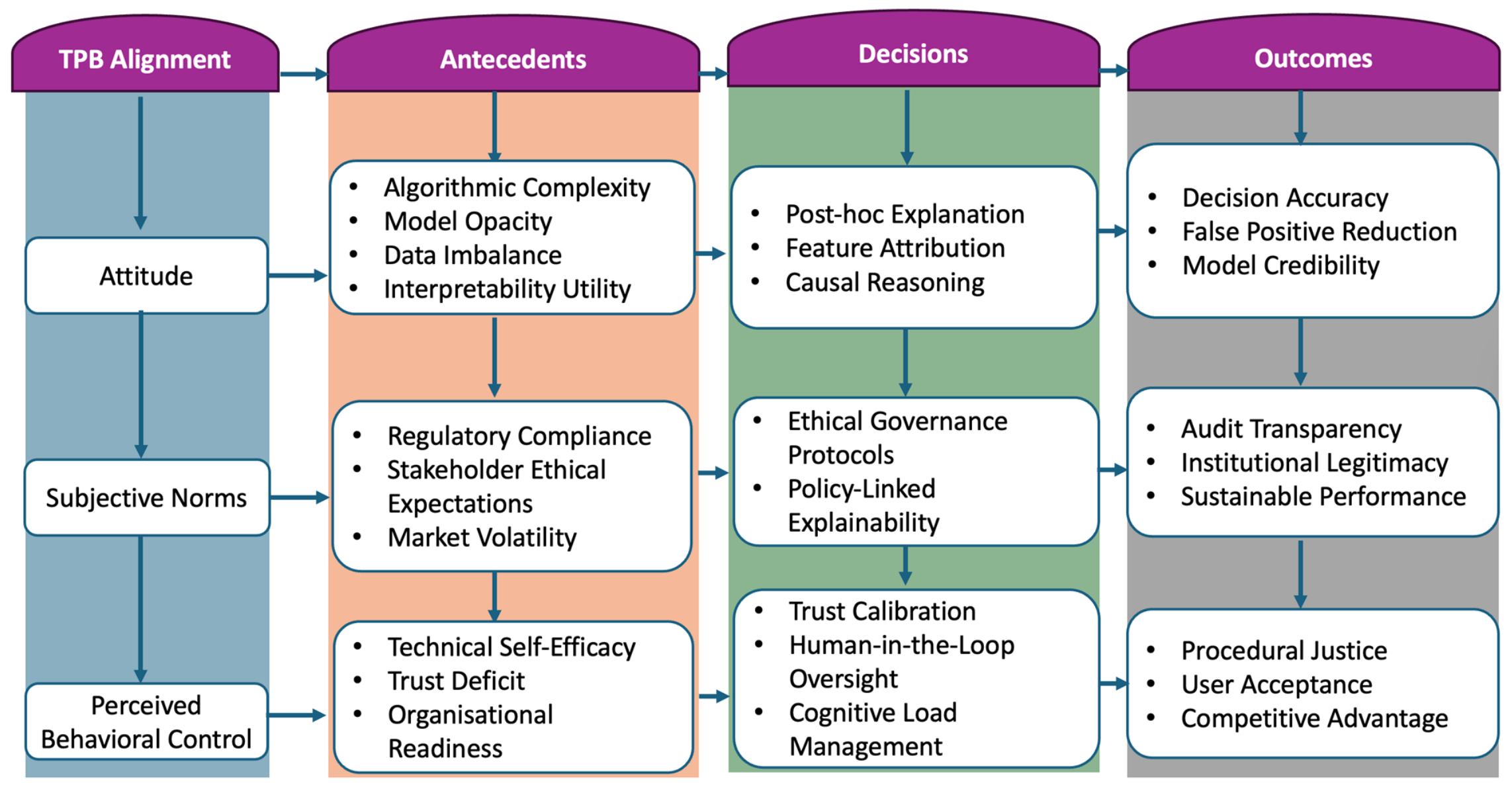
5. Content Analysis Using the ADO Framework
5.1. The Theory of Planned Behaviour (TPB)
5.2. Antecedents
5.2.1. Attitude Toward XAI Adoption
- Algorithmic Complexity—Expertise in designing and running highly conventional analytics, such as linear statistical models, has enabled the transition to using more cognitively complex, higher-dimensional architectures for predictive modelling. Examples include Deep Neural Networks (DNN), Graph Neural Networks (GNN), and Extreme Gradient Boosting (XGBoost). The increased complexity of these methodologies has exponentially increased the ability to predict potential fraud patterns [23,36]. Nonlinear logic is one of the structural impediments to tracing fraud alerts back to a specific person. [22]. The research indicates that as modelling complexity increases, forensic investigators have greater difficulty verifying hidden-layer interactions manually, suggesting that additional effort is necessary to leverage XAI to reconcile the model’s mathematical representations with their corresponding variables in the financial domain [35,117,121].
- Model Opacity—Due to their black box nature, AI algorithms create an epistemological distance between the output produced by the algorithm and the rationale/business case for the manager’s decision [32,164]. For example, in credit risk assessments and loan audits, this opacity makes it difficult for loan auditors to explain the basis for AI-generated discrepancies to internal review panels and regulatory bodies, leading to negative responses within an organisation to the use of automated systems. [20,137]. For these reasons, it is argued that XAI is a necessary corrective antecedent that enables logical validation of interventions when making decisions about high-stakes financial transactions [45,157].
- Data Imbalance—Many organisations are implementing XAI for various reasons, one of which is the imbalance present in fraud datasets. For instance, there might only be 1 fraud occurrence for every 1000 legitimate transactions [104]. The resulting heavily unbalanced distribution, therefore, leads to incorrect judgments of the relationships between the different classes of observations [158]. Organisations use XAI to determine whether their fraud detection notifications are based on evidence of actual fraud or are merely the result of statistical distributions driven by data imbalance [112]. If XAI provides local explanation(s), then investigators can ensure that any bias in the model’s “learning” did not occur due to over-sampling or noise [43,45].
- Interpretability Utility—According to Liu et al. (2024) [58], XAI’s value lies in its ability to transform abstract statistical probabilities into actionable business intelligence. As researchers view interpretability more as a practical utility than a high-end feature, they believe it can improve the speed and accuracy of triaging fraud alerts based on risk [117]. Recent research indicates that once XAI identifies the ‘causal drivers’ of a fraud alert, the perceived value of the AI system will substantially increase, thereby promoting the organisation’s favourable intention to scale its use [8,34,109].
5.2.2. Subjective Norms in the XAI Ecosystem
- Regulatory Compliance—Due to global regulatory mandates like GDPR (Article 22) and the European Union’s AI Act, ‘explainable artificial intelligence’ has moved from being a discretionary choice in the development of an AI system to a ‘losing’ legal need [4,29]. The ‘right to explanation’ has established a normative landscape requiring financial institutions to justify their automated decisions in Anti-Money Laundering (AML), forensic accounting, and suspicious activity report (SAR) filing. [12]. Failure to maintain a logic trail that can be audited introduces significant legal liability risk and drives the normatively significant adoption of XAI within organisations for regulatory compliance [7,21,61].
- Ethical Expectations—Firms are pressured by different stakeholders, including investors, civic advocacy groups, and others, to build fraud detection models that do not create systemic bias against certain protected groups [46]. In the context of fair lending and ESG, XAI is employed to meet these normative ethical expectations by providing evidence that racial and gender-related variables were not used as proxy inputs into the fraud prediction process [2,9]. This value alignment supports an organisation’s legitimacy as an institution and its continued operation [10,79].
- Market Volatility—Due to the changing nature of fraud schemes, there is a need for rationale to validate that models have not become obsolete or failed [159]. As defined by market norms, to avoid serious liquidity problems or customer losses caused by the cascading effect of false positives, trust-by-design is required in high-volatility scenarios [117]. Organisations have begun using XAI to provide rationales that can substantiate model performance when traditional statistical benchmarks are unstable [90,160].
5.2.3. Perceived Behavioural Control (PBC)
- Technical Self-Efficacy—According to an article by Kim & Kim (2026) [37], successful implementation depends on an organisation’s internal AI literacy and the expertise of data science employees. A firm with higher levels of technical self-efficacy than other firms is more successful in implementing complex interpretability pipeline techniques, such as SHAP or GNN Explainers, without significantly affecting its existing fraud detection processes [38]. Organisations determine how much control they have over recalibrating AI logic based on their capabilities [56,161,162].
- Trust Deficit—The persistent scepticism among upper management regarding automated ‘black-box’ alerts represents a major obstacle to perceived control [102]. This lack of trust creates a behavioural bottleneck: if (upper) managers do not feel they have control over how the machine has made its ‘decision’, they will be less likely to act on the output [90,163]. XAI builds a bridge to restore that behavioural control by providing contextually rich justifications that align the machine’s output with the manager’s domain knowledge [40,91].
- Organisational Readiness—A firm’s digital infrastructure and governance culture maturity level drives its ability to host computationally intensive XAI tools [56]. A ready organisation has the necessary hardware for processing complex explanations of the data driving those tools and a “learning culture” that prepares analysts to utilise the rationales for XAI each day in their triage work [162]. Research indicates that most FinTech firms are more ready to use XAI than traditional banks, as their back-end infrastructure is built with auditable-by-default data pipelines [57,98].
5.3. Decisions
5.3.1. Addressing Technological Antecedents (Attitude and Utility)
- Post hoc Explanation (SHAP/LIME)—Localised feature importance scores are used to provide real-time validation of high-stakes alerts by identifying key features within each transactional alert triage. Key features, such as high transaction velocity and geographic anomalies, can support analysts by providing real-time insight into the validity of alerts from transactionally detected or planned activity [23,28,43].
- Feature Attribution—By mapping the global weights of all variables across the model to determine overall data imbalances and maximise the value of interpretation and use, companies can reduce the risk of evaluating non-legitimate data artefacts. This is particularly important in the context of credit and HR analytics. To ensure that the model is not based solely on invalid variables, companies work to capture legitimate predictors that reinforce the overall value and usefulness of the entire model [117,166,167,168].
- Causal Reasoning—Causal reasoning is a method of “what if” counterfactual scenario analysis that can help investigators determine the reasons for an automated denial of a loan [11]. In these cases, investigators must show a causal relationship to justify an automated denial; they use counterfactual reasoning to determine the minimal change required to alter a person’s loan application outcome [45,60].
5.3.2. Addressing Environmental Antecedents (Subjective Norms and Legal Compliance)
- Ethical Governance Protocols—Organisations incorporate metrics for bias monitoring and demographic parity into their real-time auditing processes in response to social pressures and ethical expectations [79]. This eliminates discrimination against protected classes arising from the logic used to detect fraud and maintains institutional integrity [11,27,112].
- Policy-Linked Explainability—Organisations use policy-linked explainability to align their internal AI reporting requirements with international regulatory standards, such as Basel III/IV, and to comply with legal and regulatory requirements [61]. The formalisation of these standards ensures that the SAR (Suspicious Activity Report) and AML (Anti-Money Laundering) processes of all organisations are based on traceable and auditable evidence [7,21,164,170].
5.3.3. Addressing Organisational Antecedents (Perceived Behavioural Control and Readiness)
- Trust Calibration—To mitigate the issues caused by a Trust Deficit within an organisation, developing and consistently implementing an iterative Trust Calibration process through explainable AI (XAI) is a means of allowing managers to enhance or reduce their dependence upon AI, using the truthfulness and clarity of the logical rationale provided by the AI. By providing the “reliability” associated with an explanation, organisations will reduce automation bias [53,90,163].
- Human-in-the-Loop (HITL) Oversight—Organisations with high levels of Readiness will implement HITL oversight, thereby providing a means to retain Control by the human subject matter expert. With AI serving as a high-speed filtering mechanism, expert forensic investigators will add the final “interpretive layer” to confirm the flags before any can be disposed of. This requires algorithms to operate at high speed while still taking into account the intuitive judgement of an expert in their field [40,77,78,98].
- Cognitive Load Management—To enhance Ease of Use, organisations are developing user-centric visualisations that aid investigators in processing complex information from XAI systems, enabling quicker interpretation and decision-making [171]. As a result, investigators are more likely to experience higher levels of Technical Self-Efficacy. They are not negatively affected by the amount of data presented to them while conducting internal bank audit tasks under high pressure [40,57].
5.4. Outcome
5.4.1. Outcomes of Interpretative Mechanisms (Attitude and Precision)
- Decision Accuracy—Interpretative mechanisms improve decision accuracy by detecting and deleting false or fictitious data relationships, thereby increasing model accuracy. This is especially important in Banking and the Stock Market, where determining how to justify the cause of a “red flag” before acting on it is critical for financial integrity [23,36,172,182].
- False Positive Reduction—By leveraging XAI rationale to assess alerts raised by investigators rapidly, XAI enables substantial improvements in operational efficiency by preventing the waste of forensic resources, allowing Fraud Management teams to focus on investigating only the highest-probability fraudulent activities [85,111,114,117,175].
- Model Credibility—Explainability fosters reliability by providing verifiable and reproducible logic paths. In Credit and FinTech, the model’s technical credibility assures that it will produce high-quality results, not only through statistical analysis but also through a forensic perspective [176,183,184,185].
5.4.2. Outcomes of Institutional Mechanisms (Subjective Norms and Compliance)
- Audit Transparency—Provides an auditable trail that supports a verifiable, defensible rationale, as required by regulatory bodies for compliance [4]. Verification is essential for AI auditing, as black-box outputs do not provide a legally sufficient rationale for Compliance SARs or AML reporting [29,177,178].
- Institutional Legitimacy—By demonstrating compliance with environmental, social, and governance (ESG) parameters and the ethical standards of AI governance, companies establish legitimacy. Demonstrating fraud detection logic as unbiased and traceable through verifiable processes provides a social licence to operate, confirming that they are operating legitimately [9,46,170].
- Sustainable Performance—As long as organisations demonstrate ongoing compliance with regulatory framework(s), they remain sustainable and provide long-term organisational resilience. With respect to corporate governance, alignment with regulatory standards prevents legal risks and ensures the ongoing continuity of operations [30,81,180].
5.4.3. Outcomes of Cognitive Mechanisms (Perceived Behavioural Control and Fairness)
- Procedural Justice—Automated alerts accompanied by a clear, logical rationale allow users/employees to perceive greater fairness [78]. The importance of perceived Fairness is significant in both HR Management and Credit, as transparency in decision-making helps reduce negative perceptions of algorithmic bias [27,79].
- Competitive Advantage—Organisations that view explainability as a compliance obligation rather than as a dynamic strategy potentially gain a significant market advantage [55]. Companies engaged in FinTech Innovation, capable of quickly deploying auditable, trusted AI, can achieve a distinct competitive advantage in the marketplace [10,31,162].
6. Discussion
6.1. Antecedents of the Explainable-AI Financial-Decision Model
6.1.1. Attitudinal Antecedents
6.1.2. Subjective-Norm Antecedents
6.1.3. Perceived Behavioural Control Antecedents
6.2. Decision Aspect of the ADO Model
6.3. Outcomes of the ADO Model
6.4. Geographical Distribution, Journals, and Research Typologies
6.5. Tensions, Contradictions, and the Novelty of the STR Model
6.5.1. Tension 1: Accuracy Versus Interpretability:
6.5.2. Tension 2: Regulatory Mandate Versus Operational Feasibility:
6.5.3. Tension 3: Static Compliance Versus Recursive Governance:
7. Implications
7.1. Theoretical Implications
7.1.1. Advancing the Theory of Planned Behaviour: The STR Component of Reliability
7.1.2. The STR Model and Triadic Alignment in Socio-Technical Systems (STS)
7.1.3. Formalising the Recursive Learning Loop via Interpretative Agility
| Theoretical Foundation | Traditional Tenet | STR Model Refinement/Advancement | Proposed Mechanism (ADO-Linked) | Reference |
|---|---|---|---|---|
| Theory of Planned Behaviour (TPB) | PBC is a measure of resource availability and ease of use. | Reliability (Interpretative Agency): Redefines control as the cognitive ability to forensically validate automated logic. | Trust Calibration and Cognitive Load Management | [40,90,102,163] |
| Socio-Technical Systems (STS) | Optimisation depends on both the Social and Technical subsystems. | Transparency (Triadic Alignment): Proposes a “Regulatory/Ethical” pillar as a non-negotiable stabiliser. | Policy-Linked Explainability and Ethical Protocols | [4,29,61,79] |
| Dynamic Capabilities (DCV) | Firms integrate and reconfigure internal/external competences. | Stability (Recursive Learning): Positions XAI as a catalyst reconfiguring future adoption readiness. | Recursive Feedback Loop | [31,55,56,57] |
| Institutional Theory | Organisations achieve legitimacy through “Box-Ticking” mimicry. | Strategic Legitimacy: Transforms passive compliance into an active differentiator for innovation. | Audit Transparency and Governance Protocols | [10,17,61,162] |
| Decision Theory | Decisions maximise expected utility. | Justified Utility: Proposes that utility includes both the outcome and the traceability of the path. | Post hoc Explanation and Causal Reasoning | [11,23,36] |
7.2. Managerial and Policy Implications
8. Future Research Directions
9. Conclusions
Supplementary Materials
Author Contributions
Funding
Institutional Review Board Statement
Informed Consent Statement
Data Availability Statement
Conflicts of Interest
Abbreviations
| XAI | Explainable Artificial Intelligence |
| AI | Artificial Intelligence |
| FFD | Financial Fraud Detection |
| TPB | Theory of Planned Behaviour |
| PBC | Perceived Behavioural Control |
| ADO | Antecedents–Decisions–Outcomes |
| TCCM | Theory, Context, Characteristics, Methodology |
| STR | Stability–Transparency–Reliability |
| STS | Socio-Technical Systems |
| RBV | Resource-Based View |
| DCV | Dynamic Capabilities View |
| SLR | Systematic Literature Review |
| PRISMA | Preferred Reporting Items for Systematic Reviews and Meta-Analyses |
| SPAR-4-SLR | Structured Protocol for Reporting on Systematic Literature Reviews |
| ABDC | Australian Business Deans Council |
| GDPR | General Data Protection Regulation |
| AML | Anti-Money Laundering |
| SAR | Suspicious Activity Report |
| ESG | Environmental, Social, and Governance |
| HITL | Human-in-the-Loop |
| SHAP | SHapley Additive exPlanations |
| LIME | Local Interpretable Model-agnostic Explanations |
| GNN | Graph Neural Network |
| DNN | Deep Neural Network |
| RQ | Research Question |
| CRO | Chief Risk Officer |
| FinTech | Financial Technology |
References
- Buchanan, B.G.; Wright, D. The Impact of Machine Learning on UK Financial Services. Oxf. Rev. Econ. Policy 2021, 37, 537–563. [Google Scholar] [CrossRef] [Scilit] [PubMed]
- Galaz, V.; Centeno, M.A.; Callahan, P.W.; Causevic, A.; Patterson, T.; Brass, I.; Baum, S.; Farber, D.; Fischer, J.; Garcia, D.; et al. Artificial Intelligence, Systemic Risks, and Sustainability. Technol. Soc. 2021, 67, 101741. [Google Scholar] [CrossRef] [Scilit]
- Ozturk, O. The Impact of AI on International Trade: Opportunities and Challenges. Economies 2024, 12, 298. [Google Scholar] [CrossRef] [Scilit]
- Bui, L.V. Legal and Regulatory Challenges in Addressing High-Tech Crimes in the Banking Sector: Developing a Cybersecurity Risk Assessment Framework for Vietnam. J. Bank. Regul. 2026, 27, 4. [Google Scholar] [CrossRef] [Scilit]
- Lokanan, M.E. Data Mining for Statistical Analysis of Money Laundering Transactions. J. Money Laund. Control 2019, 22, 753–763. [Google Scholar] [CrossRef] [Scilit]
- Mogre, R.; Talluri, S.S.; DAmico, F. A Decision Framework to Mitigate Supply Chain Risks: An Application in the Offshore-Wind Industry. IEEE Trans. Eng. Manag. 2016, 63, 316–325. [Google Scholar] [CrossRef] [Scilit]
- Turksen, U.; Benson, V.; Adamyk, B. Legal Implications of Automated Suspicious Transaction Monitoring: Enhancing Integrity of AI. J. Bank. Regul. 2024, 25, 359–377. [Google Scholar] [CrossRef] [Scilit]
- Ali, H.; Zafar, M.B.; Aysan, A.F. Generative AI in Finance: Replicability, Methodological Contingencies, and Future Research Directions. Financ. Res. Lett. 2025, 86, 108797. [Google Scholar] [CrossRef] [Scilit]
- Cordeiro, C.M.; Adomaitis, L.; Huang, L. The AI-Policy-Governance Nexus: How Regulation and AI Shift Corporate Governance toward Stakeholders. Technol. Soc. 2026, 84, 103117. [Google Scholar] [CrossRef] [Scilit]
- Mokoena, P.B. Harnessing Artificial Intelligence by Embedding Advanced Analytics and Modelling Techniques into Risk Management Processes. Risk Manag. Insur. Rev. 2025, 28, 207–231. [Google Scholar] [CrossRef] [Scilit]
- Farbmacher, H.; Löw, L.; Spindler, M. An Explainable Attention Network for Fraud Detection in Claims Management. J. Econom. 2022, 228, 244–258. [Google Scholar] [CrossRef] [Scilit]
- Shpachuk, V.; Markova, O.; Adamyk, B. AI-Driven Financial Fraud: Key Risks and Legal Protections for Financial Institutions. J. Bank. Regul. 2026, 27, 6. [Google Scholar] [CrossRef] [Scilit]
- Gomber, P.; Koch, J.-A.; Siering, M. Digital Finance and FinTech: Current Research and Future Research Directions. J. Bus. Econ. 2017, 87, 537–580. [Google Scholar] [CrossRef] [Scilit]
- United Nations Department of Economic and Social Affairs. World Social Report 2023: Leaving No One Behind in an Ageing World; World Social Report; United Nations: New York, NY, USA, 2023. [Google Scholar]
- IBM. What Is Fintech? Available online: https://www.ibm.com/think/topics/fintech (accessed on 25 May 2026).
- Arner, D.W. FinTech, RegTech, and the Reconceptualization of Financial Regulation. Int. Law 2017, 37, 371. [Google Scholar]
- Rodgers, W.; Hudson, R.; Economou, F. Modelling Credit and Investment Decisions Based on AI Algorithmic Behavioral Pathways. Technol. Forecast. Soc. Change 2023, 191, 122471. [Google Scholar] [CrossRef] [Scilit]
- Arnaboldi, M.; De Bruijn, H.; Steccolini, I.; Van Der Voort, H. On Humans, Algorithms and Data. Qual. Res. Account. Manag. 2022, 19, 241–254. [Google Scholar] [CrossRef] [Scilit]
- Long, P.; Solaimani, S. Beyond the Black Box: Operationalising Explicability in Artificial Intelligence for Financial Institutions. Int. J. Bus. Inf. Syst. 2025, 49, 10071822. [Google Scholar] [CrossRef] [Scilit]
- Hilb, M. Toward Artificial Governance? The Role of Artificial Intelligence in Shaping the Future of Corporate Governance. J. Manag. Gov. 2020, 24, 851–870. [Google Scholar] [CrossRef] [Scilit]
- Sætra, H.S. A Shallow Defence of a Technocracy of Artificial Intelligence: Examining the Political Harms of Algorithmic Governance in the Domain of Government. Technol. Soc. 2020, 62, 101283. [Google Scholar] [CrossRef] [Scilit] [PubMed]
- Cui, B.; Ge, L.; Grecov, P. Bond Defaults in China: Using Machine Learning to Make Predictions. Int. Rev. Financ. 2025, 25, e70010. [Google Scholar] [CrossRef] [Scilit]
- Rao, S.X.; Han, Z.; Yin, H.; Jiang, J.; Zhang, Z.; Zhao, Y.; Shan, Y. Fraud Detection at eBay. Emerg. Mark. Rev. 2025, 66, 101277. [Google Scholar] [CrossRef] [Scilit]
- Georgiou, K.; Yannacopoulos, A.N. Deep Neural Networks for Probability of Default Modelling. J. Ind. Manag. Optim. 2024, 20, 3647–3677. [Google Scholar] [CrossRef] [Scilit]
- Weber, P.; Carl, K.V.; Hinz, O. Applications of Explainable Artificial Intelligence in Finance—A Systematic Review of Finance, Information Systems, and Computer Science Literature. Manag. Rev. Q. 2024, 74, 867–907. [Google Scholar] [CrossRef] [Scilit]
- Schneider, M.; Brühl, R. Disentangling the Black Box around CEO and Financial Information-Based Accounting Fraud Detection: Machine Learning-Based Evidence from Publicly Listed U.S. Firms. J. Bus. Econ. 2023, 93, 1591–1628. [Google Scholar] [CrossRef] [Scilit]
- Akter, S.; Dwivedi, Y.K.; Biswas, K.; Michael, K.; Bandara, R.J.; Sajib, S. Addressing Algorithmic Bias in AI-Driven Customer Management. J. Glob. Inf. Manag. 2021, 29, 1–27. [Google Scholar] [CrossRef] [Scilit]
- Visani, G.; Bagli, E.; Chesani, F.; Poluzzi, A.; Capuzzo, D. Statistical Stability Indices for LIME: Obtaining Reliable Explanations for Machine Learning Models. J. Oper. Res. Soc. 2022, 73, 91–101. [Google Scholar] [CrossRef] [Scilit]
- Hickman, E.; Petrin, M. Trustworthy AI and Corporate Governance: The EU’s Ethics Guidelines for Trustworthy Artificial Intelligence from a Company Law Perspective. Eur. Bus. Organ. Law Rev. 2021, 22, 593–625. [Google Scholar] [CrossRef] [Scilit]
- Guo, T.; Liu, P.; Wang, C.; Xie, J.; Du, J.; Lim, M.K. Toward Sustainable Port-Hinterland Transportation: A Holistic Approach to Design Modal Shift Policy Mixes. Transp. Res. Part Policy Pract. 2023, 174, 103746. [Google Scholar] [CrossRef] [Scilit]
- Rana, N.P.; Chatterjee, S.; Dwivedi, Y.K.; Akter, S. Understanding Dark Side of Artificial Intelligence (AI) Integrated Business Analytics: Assessing Firm’s Operational Inefficiency and Competitiveness. Eur. J. Inf. Syst. 2022, 31, 364–387. [Google Scholar] [CrossRef] [Scilit]
- Abedin, B. Managing the Tension between Opposing Effects of Explainability of Artificial Intelligence: A Contingency Theory Perspective. Internet Res. 2022, 32, 425–453. [Google Scholar] [CrossRef] [Scilit]
- Chatti, H.; Argoubi, M. Artificial Intelligence in Knowledge Management: Identifying Intellectual Milestones and Emerging Domains. Electron. J. Knowl. Manag. 2025, 23, 122–148. [Google Scholar] [CrossRef] [Scilit]
- Detthamrong, U.; Chansanam, W.; Boongoen, T.; Iam-On, N. Enhancing Fraud Detection in Banking Using Advanced Machine Learning Techniques. Int. J. Econ. Financ. Issues 2024, 14, 177–184. [Google Scholar] [CrossRef] [Scilit]
- Ariza-Garzón, M.-J.; Arroyo, J.; Segovia-Vargas, M.-J.; Caparrini, A. Profit-Sensitive Machine Learning Classification with Explanations in Credit Risk: The Case of Small Businesses in Peer-to-Peer Lending. Electron. Commer. Res. Appl. 2024, 67, 101428. [Google Scholar] [CrossRef] [Scilit]
- Zhao, Y. The Data Analysis of Enterprise Operational Risk Prediction Under Machine Learning: Innovations and Improvements in Corporate Law Risk Management Strategies. J. Organ. End User Comput. 2024, 36, 1–24. [Google Scholar] [CrossRef] [Scilit]
- Kim, S.; Kim, C. Addressing Perceived Resistance to Biometric Security Systems in Airports: Exploration With a General Bayesian Network-Based Decision Support System. J. Organ. End User Comput. 2026, 38, 1–31. [Google Scholar] [CrossRef] [Scilit]
- Brauner, P.; Glawe, F.; Liehner, G.L.; Vervier, L.; Ziefle, M. Mapping Public Perception of Artificial Intelligence: Expectations, Risk–Benefit Tradeoffs, and Value as Determinants for Societal Acceptance. Technol. Forecast. Soc. Change 2025, 220, 124304. [Google Scholar] [CrossRef] [Scilit]
- Grimmelikhuijsen, S. Explaining Why the Computer Says No: Algorithmic Transparency Affects the Perceived Trustworthiness of Automated Decision-Making. Public Adm. Rev. 2023, 83, 241–262. [Google Scholar] [CrossRef] [Scilit]
- Riedl, R. Is Trust in Artificial Intelligence Systems Related to User Personality? Review of Empirical Evidence and Future Research Directions. Electron. Mark. 2022, 32, 2021–2051. [Google Scholar] [CrossRef] [Scilit]
- Kim, T.W.; Routledge, B.R. Why a Right to an Explanation of Algorithmic Decision-Making Should Exist: A Trust-Based Approach. Bus. Ethics Q. 2022, 32, 75–102. [Google Scholar] [CrossRef] [Scilit]
- Gupta, A.; Dwivedi, D.N.; Shah, J.; Jain, A. Data Quality Issues Leading to Sub Optimal Machine Learning for Money Laundering Models. J. Money Laund. Control 2022, 25, 551–555. [Google Scholar] [CrossRef] [Scilit]
- Baesens, B.; Höppner, S.; Verdonck, T. Data Engineering for Fraud Detection. Decis. Support Syst. 2021, 150, 113492. [Google Scholar] [CrossRef] [Scilit]
- Gerlach, J.; Hoppe, P.; Jagels, S.; Licker, L.; Breitner, M.H. Decision Support for Efficient XAI Services—A Morphological Analysis, Business Model Archetypes, and a Decision Tree. Electron. Mark. 2022, 32, 2139–2158. [Google Scholar] [CrossRef] [Scilit]
- Shen, F.; Zhao, X.; Kou, G. Three-Stage Reject Inference Learning Framework for Credit Scoring Using Unsupervised Transfer Learning and Three-Way Decision Theory. Decis. Support Syst. 2020, 137, 113366. [Google Scholar] [CrossRef] [Scilit]
- Nadeem, W.; Ashraf, A.R.; Khan, H.; Kumar, V. Impact of AI Strategies on Climate-Change Performance: Responsible AI and Crisis Management Perspectives. Technovation 2026, 150, 103390. [Google Scholar] [CrossRef] [Scilit]
- Rodríguez-Espíndola, O.; Chowdhury, S.; Dey, P.K.; Albores, P.; Emrouznejad, A. Analysis of the Adoption of Emergent Technologies for Risk Management in the Era of Digital Manufacturing. Technol. Forecast. Soc. Change 2022, 178, 121562. [Google Scholar] [CrossRef] [Scilit]
- Berman, A.; De Fine Licht, K.; Carlsson, V. Trustworthy AI in the Public Sector: An Empirical Analysis of a Swedish Labor Market Decision-Support System. Technol. Soc. 2024, 76, 102471. [Google Scholar] [CrossRef] [Scilit]
- Aldemir, C.; Uçma Uysal, T. Artificial Intelligence for Financial Accountability and Governance in the Public Sector: Strategic Opportunities and Challenges. Adm. Sci. 2025, 15, 58. [Google Scholar] [CrossRef] [Scilit]
- Coita, I.-F.; Belbe, S.Ș.; Mare, C.C.; Osterrieder, J.; Hopp, C. Modelling Taxpayers’ Behaviour Based on Prediction of Trust Using Sentiment Analysis. Financ. Res. Lett. 2023, 58, 104549. [Google Scholar] [CrossRef] [Scilit]
- Tenzer, M. Social Landscape Characterisation: A People-Centred, Place-Based Approach to Inclusive and Transparent Heritage and Landscape Management. Int. J. Herit. Stud. 2024, 30, 269–284. [Google Scholar] [CrossRef] [Scilit]
- Hor, T.S.C.; Fong, L.; Wynne, K.; Verhoeven, B. Easing the Cognitive Load of General Practitioners: AI Design Principles for Future-Ready Healthcare. Technovation 2025, 142, 103208. [Google Scholar] [CrossRef] [Scilit]
- Nyqvist, R.; Peltokorpi, A.; Seppänen, O. Can ChatGPT Exceed Humans in Construction Project Risk Management? Eng. Constr. Archit. Manag. 2024, 31, 223–243. [Google Scholar] [CrossRef] [Scilit]
- Poszler, F.; Lange, B. The Impact of Intelligent Decision-Support Systems on Humans’ Ethical Decision-Making: A Systematic Literature Review and an Integrated Framework. Technol. Forecast. Soc. Change 2024, 204, 123403. [Google Scholar] [CrossRef] [Scilit]
- Glaser, V.L.; Sloan, J.; Gehman, J. Organizations as Algorithms: A New Metaphor for Advancing Management Theory. J. Manag. Stud. 2024, 61, 2748–2769. [Google Scholar] [CrossRef] [Scilit]
- Hülter, S.M.; Ertel, C.; Heidemann, A. Exploring the Individual Adoption of Human Resource Analytics: Behavioural Beliefs and the Role of Machine Learning Characteristics. Technol. Forecast. Soc. Change 2024, 208, 123709. [Google Scholar] [CrossRef] [Scilit]
- Pande, D.; Taeihagh, A. A Governance Perspective on User Acceptance of Autonomous Systems in Singapore. Technol. Soc. 2024, 77, 102580. [Google Scholar] [CrossRef] [Scilit]
- Liu, J.; Zhang, X.; Xiong, H. Credit Risk Prediction Based on Causal Machine Learning: Bayesian Network Learning, Default Inference, and Interpretation. J. Forecast. 2024, 43, 1625–1660. [Google Scholar] [CrossRef] [Scilit]
- Liu, X.; Lu, J.; Cheng, Z.; Ma, X. A Dynamic Bayesian Network-Based Real-Time Crash Prediction Model for Urban Elevated Expressway. J. Adv. Transp. 2021, 2021, 5569143. [Google Scholar] [CrossRef] [Scilit]
- Zacharias, J.; Von Zahn, M.; Chen, J.; Hinz, O. Designing a Feature Selection Method Based on Explainable Artificial Intelligence. Electron. Mark. 2022, 32, 2159–2184. [Google Scholar] [CrossRef] [Scilit]
- Peeters, B. AI-Based Profiling by Tax Authorities: Exploring GDPR Constraints and Explainability. EC Tax Rev. 2025, 34, 182–185. [Google Scholar] [CrossRef] [Scilit]
- Tranfield, D.; Denyer, D.; Smart, P. Towards a Methodology for Developing Evidence-Informed Management Knowledge by Means of Systematic Review. Br. J. Manag. 2003, 14, 207–222. [Google Scholar] [CrossRef] [Scilit]
- Snyder, H. Literature Review as a Research Methodology: An Overview and Guidelines. J. Bus. Res. 2019, 104, 333–339. [Google Scholar] [CrossRef] [Scilit]
- Webster, J.; Watson, R. Analyzing the Past to Prepare for the Future: Writing a Literature Review. MIS Q. 2002, 26, xiii–xxiii. [Google Scholar] [CrossRef] [Scilit]
- Page, M.; Mckenzie, J.; Bossuyt, P.; Boutron, I.; Hoffmann, T.; Mulrow, C.; Shamseer, L.; Tetzlaff, J.; Akl, E.; Brennan, S.; et al. The PRISMA 2020 Statement: An Updated Guideline for Reporting Systematic Reviews. BMJ 2021, 372, n71. [Google Scholar] [CrossRef] [Scilit] [PubMed]
- Paul, J.; Lim, W.M.; O’Cass, A.; Hao, A.W.; Bresciani, S. Scientific Procedures and Rationales for Systematic Literature Reviews (SPAR-4-SLR). Int. J. Consum. Stud. 2021, 45, O1–O16. [Google Scholar] [CrossRef] [Scilit]
- Okoli, C.; Schabram, K. A Guide to Conducting a Systematic Literature Review of Information Systems Research. SSRN Electron. J. 2010, 10. [Google Scholar] [CrossRef] [Scilit]
- Kitchenham, B.; Charters, S. Guidelines for Performing Systematic Literature Reviews in Software Engineering; Keele University: Keele, UK; University of Durham: Durham, UK, 2007. [Google Scholar]
- Denyer, D.; Tranfield, D. Producing a Systematic Review. In The SAGE Handbook of Organizational Research Methods; SAGE Publications Ltd.: London, UK, 2009; pp. 671–689. [Google Scholar]
- Barredo Arrieta, A.; Díaz-Rodríguez, N.; Del Ser, J.; Bennetot, A.; Tabik, S.; Barbado, A.; Garcia, S.; Gil-Lopez, S.; Molina, D.; Benjamins, R.; et al. Explainable Artificial Intelligence (XAI): Concepts, Taxonomies, Opportunities and Challenges toward Responsible AI. Inf. Fusion 2020, 58, 82–115. [Google Scholar] [CrossRef] [Scilit]
- Ali, S.; Abuhmed, T.; El-Sappagh, S.; Muhammad, K.; Alonso-Moral, J.M.; Confalonieri, R.; Guidotti, R.; Del Ser, J.; Díaz-Rodríguez, N.; Herrera, F. Explainable Artificial Intelligence (XAI): What We Know and What Is Left to Attain Trustworthy Artificial Intelligence. Inf. Fusion 2023, 99, 101805. [Google Scholar] [CrossRef] [Scilit]
- Bennani, M.H.; Driss, H. Rethinking Systematic Literature Reviews: A Critical and Evolving Perspective on the SPAR-4-SLR Protocol. Rev. Int. Des Sci. De Gest. 2025, 8, 519–539. [Google Scholar]
- Sauer, P.C.; Seuring, S. How to Conduct Systematic Literature Reviews in Management Research: A Guide in 6 Steps and 14 Decisions. Rev. Manag. Sci. 2023, 17, 1899–1933. [Google Scholar] [CrossRef] [Scilit]
- Olan, F.; Spanaki, K.; Ahmed, W.; Zhao, G. Enabling Explainable Artificial Intelligence Capabilities in Supply Chain Decision Support Making. Prod. Plan. Control 2025, 36, 808–819. [Google Scholar] [CrossRef] [Scilit]
- Hidalgo, P.; Rodriguez, D. An Explainable Multi-Task Similarity Measure: Integrating Accumulated Local Effects and Weighted Fréchet Distance. Knowl.-Based Syst. 2025, 329, 114384. [Google Scholar] [CrossRef] [Scilit]
- Mongeon, P.; Paul-Hus, A. The Journal Coverage of Web of Science and Scopus: A Comparative Analysis. Scientometrics 2016, 106, 213–228. [Google Scholar] [CrossRef] [Scilit]
- Wilson, C.; Van Der Velden, M. Sustainable AI: An Integrated Model to Guide Public Sector Decision-Making. Technol. Soc. 2022, 68, 101926. [Google Scholar] [CrossRef] [Scilit]
- Feldkamp, T.; Langer, M.; Wies, L.; König, C.J. Justice, Trust, and Moral Judgements When Personnel Selection Is Supported by Algorithms. Eur. J. Work Organ. Psychol. 2024, 33, 130–145. [Google Scholar] [CrossRef] [Scilit]
- Liu, Z.; Liang, H. Are Credit Scores Gender-Neutral? Evidence of Mis-Calibration from Alternative and Traditional Borrowing Data. J. Behav. Exp. Financ. 2025, 47, 101081. [Google Scholar] [CrossRef] [Scilit]
- Moreira, L.; Santos, I.L.D.; Gonzalez, P.H. Portfolio Optimization for Pension Purposes: Literature Review. J. Econ. Surv. 2026, 40, 45–72. [Google Scholar] [CrossRef] [Scilit]
- Yang, S.; Wu, H. The Global Organizational Behavior Analysis for Financial Risk Management Utilizing Artificial Intelligence. J. Glob. Inf. Manag. 2021, 30, 1–24. [Google Scholar] [CrossRef] [Scilit]
- Ghobakhloo, M.; Fathi, M.; Iranmanesh, M.; Vilkas, M.; Grybauskas, A.; Amran, A. Generative Artificial Intelligence in Manufacturing: Opportunities for Actualizing Industry 5.0 Sustainability Goals. J. Manuf. Technol. Manag. 2024, 35, 94–121. [Google Scholar] [CrossRef] [Scilit]
- Zhu, J. Application of Artificial Intelligence Data Mining Algorithm in Enterprise Management Risk Assessment. Int. J. Inf. Syst. Supply Chain Manag. 2024, 17, 1–19. [Google Scholar] [CrossRef] [Scilit]
- Martinez-Torres, M.R.; Toral, S.L. A Machine Learning Approach for the Identification of the Deceptive Reviews in the Hospitality Sector Using Unique Attributes and Sentiment Orientation. Tour. Manag. 2019, 75, 393–403. [Google Scholar] [CrossRef] [Scilit]
- Wruck, S.; Vis, I.F.A.; Boter, J. Risk Control for Staff Planning in E-Commerce Warehouses. Int. J. Prod. Res. 2017, 55, 6453–6469. [Google Scholar] [CrossRef] [Scilit]
- De Blasio, G.; D’Ignazio, A.; Letta, M. Gotham City. Predicting ‘Corrupted’ Municipalities with Machine Learning. Technol. Forecast. Soc. Change 2022, 184, 122016. [Google Scholar] [CrossRef] [Scilit]
- Aldboush, H.H.H.; Ferdous, M. Building Trust in Fintech: An Analysis of Ethical and Privacy Considerations in the Intersection of Big Data, AI, and Customer Trust. Int. J. Financ. Stud. 2023, 11, 90. [Google Scholar] [CrossRef] [Scilit]
- Singh, C.; Lin, W. Can Artificial Intelligence, RegTech and CharityTech Provide Effective Solutions for Anti-Money Laundering and Counter-Terror Financing Initiatives in Charitable Fundraising. J. Money Laund. Control 2021, 24, 464–482. [Google Scholar] [CrossRef] [Scilit]
- Hajiali, M.; Teimoury, E.; Rabiee, M.; Delen, D. An Interactive Decision Support System for Real-Time Ambulance Relocation with Priority Guidelines. Decis. Support Syst. 2022, 155, 113712. [Google Scholar] [CrossRef] [Scilit]
- Selten, F.; Robeer, M.; Grimmelikhuijsen, S. ‘Just like I Thought’: Street-level Bureaucrats Trust AI Recommendations If They Confirm Their Professional Judgment. Public Adm. Rev. 2023, 83, 263–278. [Google Scholar] [CrossRef] [Scilit]
- Jeremiah, F. The Human-AI Dyad: Navigating the New Frontier of Entrepreneurial Discourse. Futures 2025, 166, 103529. [Google Scholar] [CrossRef] [Scilit]
- Zeng, S.; Dai, S. Synergizing Domain Knowledge and Machine Learning: Intelligent Early Fraud Detection Enhanced by Earnings Management Analysis. Int. Rev. Financ. 2025, 25, e70021. [Google Scholar] [CrossRef] [Scilit]
- Chindasombatcharoen, P.; Chatjuthamard, P.; Jiraporn, P.; Wongsinhirun, N. Climate Change Exposure and the Takeover Market: A Text-Based Analysis. Bus. Strategy Environ. 2024, 33, 8587–8592. [Google Scholar] [CrossRef] [Scilit]
- Eroğlu, M.; Karatepe Kaya, M. Impact of Artificial Intelligence on Corporate Board Diversity Policies and Regulations. Eur. Bus. Organ. Law Rev. 2022, 23, 541–572. [Google Scholar] [CrossRef] [Scilit]
- Chamochumbi Diaz, G.D.; Palazzi, F.; Sorini, L. Creditworthiness of Small and Medium Enterprises: A Fuzzy Decision-Making Approach. Comput. Manag. Sci. 2026, 23, 2. [Google Scholar] [CrossRef] [Scilit]
- Pocher, N.; Zichichi, M.; Merizzi, F.; Shafiq, M.Z.; Ferretti, S. Detecting Anomalous Cryptocurrency Transactions: An AML/CFT Application of Machine Learning-Based Forensics. Electron. Mark. 2023, 33, 37. [Google Scholar] [CrossRef] [Scilit]
- Matthews, J.; Love, P.E.D.; Porter, S.; Fang, W. Curating a Domain Ontology for Rework in Construction: Challenges and Learnings from Practice. Prod. Plan. Control 2024, 35, 2068–2083. [Google Scholar] [CrossRef] [Scilit]
- Rožanec, J.M.; Novalija, I.; Zajec, P.; Kenda, K.; Tavakoli Ghinani, H.; Suh, S.; Bian, S.; Veliou, E.; Papamartzivanos, D.; Giannetsos, T.; et al. Human-Centric Artificial Intelligence Architecture for Industry 5.0 Applications. Int. J. Prod. Res. 2023, 61, 6847–6872. [Google Scholar] [CrossRef] [Scilit]
- Osei-Assibey Bonsu, M.; Wang, Y.; Guo, Y. Does Fintech Lead to Better Accounting Practices? Empirical Evidence. Account. Res. J. 2023, 36, 129–147. [Google Scholar] [CrossRef] [Scilit]
- Pahari, S.; Polisetty, A.; Sharma, S.; Jha, R.; Chakraborty, D. Adoption of AI in the Banking Industry: A Case Study on Indian Banks. Indian J. Mark. 2023, 53, 26. [Google Scholar] [CrossRef] [Scilit]
- Kim, D.H.; Vanheusden, F.J.; Kim, A. Forecasting Cryptocurrency Markets Using Recurrence and Time-Frequency Analysis-Based Machine Learning Algorithms. Financ. Res. Lett. 2025, 85, 108268. [Google Scholar] [CrossRef] [Scilit]
- Yu, X.; Chen, Y.; Zhao, Q.; Li, H. Research and Analysis of Trust and Control in Human-AI Interaction for Decision-Making Systems in Optimizing Public Health Service. J. Organ. End User Comput. 2025, 37, 1–15. [Google Scholar] [CrossRef] [Scilit]
- Hasan, M.M.; Taylor, G.; Richardson, G. Brand Capital and Stock Price Crash Risk. Manag. Sci. 2022, 68, 7221–7247. [Google Scholar] [CrossRef] [Scilit]
- Hyde, S.J.; Bachura, E.; Bundy, J.; Gretz, R.T.; Sanders, W.G. The Tangled Webs We Weave: Examining the Effects of CEO Deception on Analyst Recommendations. Strateg. Manag. J. 2024, 45, 66–112. [Google Scholar] [CrossRef] [Scilit]
- Düsterhöft, M.; Schiemann, F.; Walther, T. Let’s Talk about Risk! Stock Market Effects of Risk Disclosure for European Energy Utilities. Energy Econ. 2023, 125, 106794. [Google Scholar] [CrossRef] [Scilit]
- Li, W.; Liu, X.; Su, J.; Cui, T. Advancing Financial Risk Management: A Transparent Framework for Effective Fraud Detection. Financ. Res. Lett. 2025, 75, 106865. [Google Scholar] [CrossRef] [Scilit]
- Chen, S. Credit Scoring Prediction for Small and Medium-Sized Enterprises Based on Alternative Data and Gradient Boosting Algorithms. Inf. Resour. Manag. J. 2026, 39, 1–19. [Google Scholar] [CrossRef] [Scilit]
- Wen, W.; Han, X. An Introduction of Transaction Session-induced Security Scheme Using Blockchain Technology: Understanding the Features of Internet of Things–Based Financial Security Systems. Manag. Decis. Econ. 2024, 45, 1817–1834. [Google Scholar] [CrossRef] [Scilit]
- Chen, M.; Wei, Y.; Wang, S. Past and Future of Cryptocurrencies: A Survey Using Bibliometric Methods. J. Econ. Surv. 2026, 40, 20–44. [Google Scholar] [CrossRef] [Scilit]
- Rafi-Ul-Shan, P.M.; Bashiri, M.; Kamal, M.M.; Mangla, S.K.; Tjahjono, B. An Analysis of Fuzzy Group Decision Making to Adopt Emerging Technologies for Fashion Supply Chain Risk Management. IEEE Trans. Eng. Manag. 2024, 71, 8469–8487. [Google Scholar] [CrossRef] [Scilit]
- Castañé, G.; Dolgui, A.; Kousi, N.; Meyers, B.; Thevenin, S.; Vyhmeister, E.; Östberg, P.-O. The ASSISTANT Project: AI for High Level Decisions in Manufacturing. Int. J. Prod. Res. 2023, 61, 2288–2306. [Google Scholar] [CrossRef] [Scilit]
- Liu, C.; Ryan, D.; Lin, G.; Xu, C. No Rose without a Thorn: Corporate Teamwork Culture and Financial Statement Misconduct. J. Behav. Exp. Financ. 2023, 37, 100786. [Google Scholar] [CrossRef] [Scilit]
- Pessach, D.; Singer, G.; Avrahami, D.; Chalutz Ben-Gal, H.; Shmueli, E.; Ben-Gal, I. Employees Recruitment: A Prescriptive Analytics Approach via Machine Learning and Mathematical Programming. Decis. Support Syst. 2020, 134, 113290. [Google Scholar] [CrossRef] [Scilit] [PubMed]
- Salas-Molina, F. Selecting the Best Risk Measure in Multiobjective Cash Management. Int. Trans. Oper. Res. 2019, 26, 929–945. [Google Scholar] [CrossRef] [Scilit]
- Oyenubi, A.; Kollamparambil, U. Does Noncompliance with COVID-19 Regulations Impact the Depressive Symptoms of Others? Econ. Model. 2023, 120, 106191. [Google Scholar] [CrossRef] [Scilit] [PubMed]
- Nguyen Thanh, C.; Phan Huy, T. Predicting Financial Reports Fraud by Machine Learning: The Proxy of Auditor Opinions. Cogent Bus. Manag. 2025, 12, 2510556. [Google Scholar] [CrossRef] [Scilit]
- Wang, L.; Yu, Z.; Ma, J.; Chen, X.; Wu, C. A Two-Stage Interpretable Model to Explain Classifier in Credit Risk Prediction. J. Forecast. 2025, 44, 2132–2150. [Google Scholar] [CrossRef] [Scilit]
- Banulescu-Radu, D.; Yankol-Schalck, M. Practical Guideline to Efficiently Detect Insurance Fraud in the Era of Machine Learning: A Household Insurance Case. J. Risk Insur. 2024, 91, 867–913. [Google Scholar] [CrossRef] [Scilit]
- Vanini, P.; Rossi, S.; Zvizdic, E.; Domenig, T. Online Payment Fraud: From Anomaly Detection to Risk Management. Financ. Innov. 2023, 9, 66. [Google Scholar] [CrossRef] [Scilit]
- Feng, T.; Xu, J.; Zhou, Z.; Luo, Y. How Green Credit Policy Affects Commercial Banks’ Credit Risk?: Evidence and Federated Learning-Based Modeling From 26 Listed Commercial Banks in China. J. Cases Inf. Technol. 2023, 26, 1–21. [Google Scholar] [CrossRef] [Scilit]
- Niu, S.; Yin, Q.; Ma, J.; Song, Y.; Xu, Y.; Bai, L.; Pan, W.; Yang, X. Enhancing Healthcare Decision Support through Explainable AI Models for Risk Prediction. Decis. Support Syst. 2024, 181, 114228. [Google Scholar] [CrossRef] [Scilit]
- Vandervorst, F.; Verbeke, W.; Verdonck, T. Data Misrepresentation Detection for Insurance Underwriting Fraud Prevention. Decis. Support Syst. 2022, 159, 113798. [Google Scholar] [CrossRef] [Scilit]
- Lu, Z.; Li, H.; Wu, J. Exploring the Impact of Financial Literacy on Predicting Credit Default among Farmers: An Analysis Using a Hybrid Machine Learning Model. Borsa Istanb. Rev. 2024, 24, 352–362. [Google Scholar] [CrossRef] [Scilit]
- Biswas, B.; Mukhopadhyay, A.; Kumar, A.; Delen, D. A Hybrid Framework Using Explainable AI (XAI) in Cyber-Risk Management for Defence and Recovery against Phishing Attacks. Decis. Support Syst. 2024, 177, 114102. [Google Scholar] [CrossRef] [Scilit]
- Kong, L.; Brintrup, A. A Hierarchical Bayesian Model for Payment Delay Prediction in Supply Chain Financing. Int. J. Prod. Res. 2026, 64, 168–191. [Google Scholar] [CrossRef] [Scilit]
- Luna, M.; Pérez-Mon, O.; Becker, J.L. Forecasting and Managing Price Volatility in Salmon Production: A Hybrid System Using Conformal Prediction and Dynamic Hedging. Int. J. Prod. Econ. 2026, 291, 109726. [Google Scholar] [CrossRef] [Scilit]
- Sadeh, H.; Mirarchi, C.; Shahbodaghlou, F.; Pavan, A. Predicting the Trends and Cost Impact of COVID-19 OSHA Citations on US Construction Contractors Using Machine Learning and Simulation. Eng. Constr. Archit. Manag. 2023, 30, 3461–3479. [Google Scholar] [CrossRef] [Scilit]
- Feng, Y.; Wang, X.; Chen, Q.; Yang, Z.; Wang, J.; Li, H.; Xia, G.; Liu, Z. Prediction of the Severity of Marine Accidents Using Improved Machine Learning. Transp. Res. Part E Logist. Transp. Rev. 2024, 188, 103647. [Google Scholar] [CrossRef] [Scilit]
- Hosseini Shekarabi, S.A.; Kiani Mavi, R.; Kiani Mavi, N.; Macau, F.R.; Arisian, S. (Sean) A Novel Robust Optimization Approach for Supply Chain Resilience: The Role of Flexibility and Collaboration. Int. J. Prod. Econ. 2025, 287, 109686. [Google Scholar] [CrossRef] [Scilit]
- Dai, S.; Zhang, J.; Huang, Z.; Zeng, S. Fire Prediction and Risk Identification With Interpretable Machine Learning. J. Forecast. 2025, 44, 1699–1715. [Google Scholar] [CrossRef] [Scilit]
- Martin, H.; James, J.; Chadee, A. Exploring Large Language Model AI Tools in Construction Project Risk Assessment: Chat GPT Limitations in Risk Identification, Mitigation Strategies, and User Experience. J. Constr. Eng. Manag. 2025, 151, 04025119. [Google Scholar] [CrossRef] [Scilit]
- Popa, C.; Stefanov, O.; Goia, I. Multimodal Livestock Operations Analysis Using Business Process Modeling: A Case Study of Romanian Black Sea Ports. Economies 2025, 13, 69. [Google Scholar] [CrossRef] [Scilit]
- Ghamarimajd, Z.; Ghanbaripour, A.; Tumpa, R.J.; Watanabe, T.; Mbachu, J.; Skitmore, M. Application of Systems Thinking and System Dynamics in Managing Risks and Stakeholders in Construction Projects: A Systematic Literature Review. Syst. Res. Behav. Sci. 2025, 42, 1465–1479. [Google Scholar] [CrossRef] [Scilit]
- Mohamed, O.Y.; Binti Jamaludin, N.F. Development of an Integrated ESG and Climate Risk Assessment Framework for Semiconductors Industries in Malaysia. Sustain. Futur. 2025, 10, 101052. [Google Scholar] [CrossRef] [Scilit]
- Pietersen, L.-A.; Rudman, R. Data-Related Risks for the Use of Machine Learning in Retail Customer Demand Forecasting. S. Afr. J. Bus. Manag. 2025, 56, 13. [Google Scholar] [CrossRef] [Scilit]
- Ariza-Garzón, M.-J.; Camacho-Miñano, M.-D.-M.; Segovia-Vargas, M.-J.; Arroyo, J. Risk-Return Modelling in the P2p Lending Market: Trends, Gaps, Recommendations and Future Directions. Electron. Commer. Res. Appl. 2021, 49, 101079. [Google Scholar] [CrossRef] [Scilit]
- West, J.; Bhattacharya, M. Intelligent Financial Fraud Detection: A Comprehensive Review. Comput. Secur. 2016, 57, 47–66. [Google Scholar] [CrossRef] [Scilit]
- Boiko, R.; Butenko, D.; Frolov, A.; Moisiiakha, A.; Rudevska, V. Evaluating Modern Quantitative Methods for Investment Portfolio Management under Market Uncertainty. J. Appl. Econ. Sci. JAES 2025, 20, 427. [Google Scholar] [CrossRef] [Scilit] [PubMed]
- Ben Jabeur, S.; Bakkar, Y.; Cepni, O. Do Global COVOL and Geopolitical Risks Affect Clean Energy Prices? Evidence from Explainable Artificial Intelligence Models. Energy Econ. 2025, 141, 108112. [Google Scholar] [CrossRef] [Scilit]
- Zhang, C.; Wang, Y.; Zhang, J. Risk Assessment of Live-Streaming Marketing Based on Hesitant Fuzzy Multi-Attribute Group Decision-Making Method. J. Theor. Appl. Electron. Commer. Res. 2025, 20, 120. [Google Scholar] [CrossRef] [Scilit]
- Zhang, Q.; Ma, Z.; Wu, Y.; Liu, Y.; Qu, X. Quantifying Variable Contributions to Bus Operation Delays Considering Causal Relationships. Transp. Res. Part E Logist. Transp. Rev. 2025, 194, 103881. [Google Scholar] [CrossRef] [Scilit]
- Manimuthu, A.; Venkatesh, V.G.; Shi, Y.; Sreedharan, V.R.; Koh, S.C.L. Design and Development of Automobile Assembly Model Using Federated Artificial Intelligence with Smart Contract. Int. J. Prod. Res. 2022, 60, 111–135. [Google Scholar] [CrossRef] [Scilit]
- Lopez-Martinez-Carrasco, A.; Juarez, J.M.; Campos, M.; Canovas-Segura, B. A Methodology Based on Trace-Based Clustering for Patient Phenotyping. Knowl.-Based Syst. 2021, 232, 107469. [Google Scholar] [CrossRef] [Scilit]
- Paul, J.; Benito, G. A Review of Research on Outward Foreign Direct Investment from Emerging Countries, Including China: What Do We Know, How Do We Know and Where Should We Be Heading? Asia Pac. Bus. Rev. 2017, 24, 90–115. [Google Scholar] [CrossRef] [Scilit]
- Paul, J.; Rosado-Serrano, A. Gradual Internationalization vs Born-Global/International New Venture Models: A Review and Research Agenda. Int. Mark. Rev. 2019, 36, 830–858. [Google Scholar] [CrossRef] [Scilit]
- Ambika, A.; Shin, H.; Jain, V. Immersive Technologies and Consumer Behavior: A Systematic Review of Two Decades of Research. Aust. J. Manag. 2025, 50, 55–79. [Google Scholar] [CrossRef] [Scilit]
- Thomas, A.; Gupta, V. Tacit Knowledge in Organizations: Bibliometrics and a Framework-Based Systematic Review of Antecedents, Outcomes, Theories, Methods and Future Directions. J. Knowl. Manag. 2022, 26, 1014–1041. [Google Scholar] [CrossRef] [Scilit]
- Ajzen, I. From Intentions to Actions: A Theory of Planned Behavior. In Action Control: From Cognition to Behavior; Kuhl, J., Beckmann, J., Eds.; Springer: Berlin/Heidelberg, Germany, 1985; pp. 11–39. [Google Scholar]
- Ajzen, I. The Theory of Planned Behavior. Theor. Cogn. Self-Regul. 1991, 50, 179–211. [Google Scholar] [CrossRef] [Scilit]
- Ajzen, I. The Theory of Planned Behaviour: Reactions and Reflections. Psychol. Health 2011, 26, 1113–1127. [Google Scholar] [CrossRef] [Scilit] [PubMed]
- Dwivedi, Y.; Hughes, L.; Ismagilova, E.; Aarts, G.; Coombs, C.; Crick, T.; Duan, Y.; Dwivedi, R.; Edwards, J.; Eirug, A.; et al. Artificial Intelligence (AI): Multidisciplinary Perspectives on Emerging Challenges, Opportunities, and Agenda for Research, Practice and Policy. Int. J. Inf. Manag. 2019, 57, 101994. [Google Scholar] [CrossRef] [Scilit]
- Al-Emran, M.; Mezhuyev, V.; Kamaludin, A. Technology Acceptance Model in M-Learning Context: A Systematic Review. Comput. Educ. 2018, 125, 389–412. [Google Scholar] [CrossRef] [Scilit]
- De Oliveira, J.A.P.; Wanke, P.; Antunes, J.; Tan, Y. Unveiling the Impact of Information Vagueness on Carbon Emission Inventories Using Fuzzy Sets. Energy Econ. 2025, 148, 108672. [Google Scholar] [CrossRef] [Scilit]
- Gangwar, H.; Date, H.; Ramaswamy, R. Understanding Determinants of Cloud Computing Adoption Using an Integrated TAM-TOE Model. J. Enterp. Inf. Manag. 2015, 28, 107–130. [Google Scholar] [CrossRef] [Scilit]
- Xie, Z.; He, T.; Tian, S.; Fu, Y.; Zhou, J.; Chen, D. Joint Gaussian Mixture Model for Versatile Deep Visual Model Explanation. Knowl.-Based Syst. 2023, 280, 110989. [Google Scholar] [CrossRef] [Scilit]
- Aljunaid, S.K.; Almheiri, S.J.; Dawood, H.; Khan, M.A. Secure and Transparent Banking: Explainable AI-Driven Federated Learning Model for Financial Fraud Detection. J. Risk Financ. Manag. 2025, 18, 179. [Google Scholar] [CrossRef] [Scilit]
- Ghosh, I.; Alfaro-Cortés, E.; Gámez, M.; García-Rubio, N. Prediction and Interpretation of Daily NFT and DeFi Prices Dynamics: Inspection through Ensemble Machine Learning & XAI. Int. Rev. Financ. Anal. 2023, 87, 102558. [Google Scholar] [CrossRef] [Scilit]
- Oprea, S.-V.; Bâra, A. Customer-Centric Decision-Making with XAI and Counterfactual Explanations for Churn Mitigation. J. Theor. Appl. Electron. Commer. Res. 2025, 20, 129. [Google Scholar] [CrossRef] [Scilit]
- Almaqtari, F.A. The Role of IT Governance in the Integration of AI in Accounting and Auditing Operations. Economies 2024, 12, 199. [Google Scholar] [CrossRef] [Scilit]
- Zebec, A.; Indihar Štemberger, M. Creating AI Business Value through BPM Capabilities. Bus. Process Manag. J. 2024, 30, 1–26. [Google Scholar] [CrossRef] [Scilit]
- Boob-Engel, K. Is AI as Trustworthy as Human Experts? The Role of Advice Source, Technology Knowledge, and Perceptions of AI’s Impact in Organizational Decision-Making. J. Decis. Syst. 2025, 34, 2594620. [Google Scholar] [CrossRef] [Scilit]
- Rodgers, W.; Murray, J.M.; Stefanidis, A.; Degbey, W.Y.; Tarba, S.Y. An Artificial Intelligence Algorithmic Approach to Ethical Decision-Making in Human Resource Management Processes. Hum. Resour. Manag. Rev. 2023, 33, 100925. [Google Scholar] [CrossRef] [Scilit]
- Loecher, M. Debiasing SHAP Scores in Random Forests. AStA Adv. Stat. Anal. 2024, 108, 427–440. [Google Scholar] [CrossRef] [Scilit]
- Xie, S. Improving Explainability of Major Risk Factors in Artificial Neural Networks for Auto Insurance Rate Regulation. Risks 2021, 9, 126. [Google Scholar] [CrossRef] [Scilit]
- Gosiewska, A.; Kozak, A.; Biecek, P. Simpler Is Better: Lifting Interpretability-Performance Trade-off via Automated Feature Engineering. Decis. Support Syst. 2021, 150, 113556. [Google Scholar] [CrossRef] [Scilit]
- Lorenz, F.; Willwersch, J.; Cajias, M.; Fuerst, F. Interpretable Machine Learning for Real Estate Market Analysis. Real Estate Econ. 2023, 51, 1178–1208. [Google Scholar] [CrossRef] [Scilit]
- Peukert, C.; Bechtold, S.; Batikas, M.; Kretschmer, T. Regulatory Spillovers and Data Governance: Evidence from the GDPR. Mark. Sci. 2022, 41, 746–768. [Google Scholar] [CrossRef] [Scilit]
- Brotcke, L. Time to Assess Bias in Machine Learning Models for Credit Decisions. J. Risk Financ. Manag. 2022, 15, 165. [Google Scholar] [CrossRef] [Scilit]
- Zimmermann, R.; Mora, D.; Cirqueira, D.; Helfert, M.; Bezbradica, M.; Werth, D.; Weitzl, W.J.; Riedl, R.; Auinger, A. Enhancing Brick-and-Mortar Store Shopping Experience with an Augmented Reality Shopping Assistant Application Using Personalized Recommendations and Explainable Artificial Intelligence. J. Res. Interact. Mark. 2023, 17, 273–298. [Google Scholar] [CrossRef] [Scilit]
- Tiukhova, E.; Vemuri, P.; Flores, N.L.; Islind, A.S.; Óskarsdóttir, M.; Poelmans, S.; Baesens, B.; Snoeck, M. Explainable Learning Analytics: Assessing the Stability of Student Success Prediction Models by Means of Explainable AI. Decis. Support Syst. 2024, 182, 114229. [Google Scholar] [CrossRef] [Scilit]
- Senoner, J.; Netland, T.; Feuerriegel, S. Using Explainable Artificial Intelligence to Improve Process Quality: Evidence from Semiconductor Manufacturing. Manag. Sci. 2022, 68, 5704–5723. [Google Scholar] [CrossRef] [Scilit]
- Nimmy, S.F.; Hussain, O.K.; Chakrabortty, R.K.; Hussain, F.K.; Saberi, M. An Optimized Belief-Rule-Based (BRB) Approach to Ensure the Trustworthiness of Interpreted Time-Series Decisions. Knowl.-Based Syst. 2023, 271, 110552. [Google Scholar] [CrossRef] [Scilit]
- Zhong, C.; Goel, S. Transparent AI in Auditing through Explainable AI. Curr. Issues Audit. 2024, 18, A1–A14. [Google Scholar] [CrossRef] [Scilit]
- Agbabiaka, O.; Ojo, A.; Connolly, N. Requirements for Trustworthy AI-Enabled Automated Decision-Making in the Public Sector: A Systematic Review. Technol. Forecast. Soc. Change 2025, 215, 124076. [Google Scholar] [CrossRef] [Scilit]
- Zhu, L.; Chen, P.; Dong, D.; Wang, Z. Can Artificial Intelligence Enable the Government to Respond More Effectively to Major Public Health Emergencies?—Taking the Prevention and Control of Covid-19 in China as an Example. Socio-Econ. Plan. Sci. 2022, 80, 101029. [Google Scholar] [CrossRef] [Scilit] [PubMed]
- Heidemann, A.; Hülter, S.M.; Tekieli, M. Machine Learning with Real-World HR Data: Mitigating the Trade-off between Predictive Performance and Transparency. Int. J. Hum. Resour. Manag. 2024, 35, 2343–2366. [Google Scholar] [CrossRef] [Scilit]
- Lera-Leri, R.X.; Liscio, E.; Bistaffa, F.; Jonker, C.M.; Lopez-Sanchez, M.; Murukannaiah, P.K.; Rodriguez-Aguilar, J.A.; Salas-Molina, F. Aggregating Value Systems for Decision Support. Knowl.-Based Syst. 2024, 287, 111453. [Google Scholar] [CrossRef] [Scilit]
- Şentürk, Ö. AI-Driven Climate Adaptation: Technical Applications, Ethical Governance, and Social Inclusion. Acadlore Trans. Mach. Learn. 2026, 5, 20–31. [Google Scholar] [CrossRef] [Scilit]
- Tuyen, V.V. Human Behavioral Dynamics in AI-Assisted Decision Making: An Integrated SWOT–AHP–TOPSIS Analysis. J. Intell. Manag. Decis. 2026, 5, 64–76. [Google Scholar] [CrossRef] [Scilit]
- Dong, X.H.; Zhu, X.Q.; Li, L.P. Digital Finance and Industrial Chain Resilience in China: A Spatial Network Perspective. J. Intell. Manag. Decis. 2026, 5, 47–63. [Google Scholar] [CrossRef] [Scilit]
- Inder, S.; Sood, K.; Grima, S. Antecedents of Behavioural Intention to Adopt Internet Banking Using Structural Equation Modelling. J. Risk Financ. Manag. 2022, 15, 157. [Google Scholar] [CrossRef] [Scilit]
- Awuraris, A.K.; Daniel, R.; Muthukumar, P. Empowering Accessibility to Digital Space Through Generative AI to Support People with Disabilities. Acadlore Trans. Mach. Learn. 2026, 5, 44–57. [Google Scholar] [CrossRef] [Scilit]
- Oppong-Fosu, K.; Obagbuwa, O. Financial Inclusion Driven by Digital Financial Platforms: Impact on Economic Growth in Ghana. J. Account. Financ. Audit. Stud. 2025, 11, 244–258. [Google Scholar] [CrossRef] [Scilit]
- Akbulut, O.Y. Assessing the Environmental Sustainability Performance of the Banking Sector: A Novel Integrated Grey Multi-Criteria Decision-Making (MCDM) Approach. Int. J. Knowl. Innov. Stud. 2024, 2, 239–258. [Google Scholar] [CrossRef] [Scilit]
- Varma, P.; Nijjer, S.; Sood, K.; Grima, S.; Rupeika-Apoga, R. Thematic Analysis of Financial Technology (Fintech) Influence on the Banking Industry. Risks 2022, 10, 186. [Google Scholar] [CrossRef] [Scilit]

| Dimension | Inclusion Criteria | Exclusion Criteria | Operationalisation in Scopus Query | |
|---|---|---|---|---|
| KEYWORD SEARCH STRING | Article Fields Searched | Studies where relevant concepts appear in the title, abstract, or author keywords to ensure thematic centrality | Studies where search terms appear only in full text, references, or Supplementary Material | TITLE-ABS-KEY |
| Core Technological Focus: AI-Based Systems | Research explicitly applying artificial intelligence, machine learning, AI-driven systems, algorithmic or automated decision-making, predictive analytics, intelligent systems, or data-driven models. | Studies addressing fraud or risk without AI-based computational or algorithmic approaches | TITLE-ABS-KEY (“machine learning” OR “artificial intelligence” OR “AI-driven” OR “algorithmic decision*” OR “automated decision*” OR “predictive analytics” OR “intelligent system*” OR “data-driven model*”) | |
| Application Domain: Financial Fraud and Economic Crime | Studies examining financial fraud detection/prevention, financial crime, economic crime, money laundering, AML, suspicious transactions, transaction monitoring, or financial risk assessment | AI studies unrelated to fraud, economic crime, or financial compliance contexts | AND (fraud* OR “financial fraud” OR “fraud detection” OR “fraud prevention” OR “financial crime” OR “economic crime” OR “money laundering” OR “AML” OR “suspicious transaction*” OR “risk assessment” OR “transaction monitoring”) | |
| Governance, Transparency and Regulatory Orientation | Research incorporating explainability, interpretability, transparency, accountability, governance, ethical AI, responsible AI, compliance, regulatory oversight, trust, fairness, risk management, or organisational performance. | Purely technical fraud-detection studies lack governance, ethical, compliance, and transparency considerations. | AND (explainab* OR interpret* OR transparency OR accountability OR governance OR trust OR “risk management” OR compliance OR “regulatory compliance” OR “regulatory oversight” OR “ethical AI” OR “responsible AI” OR “model transparency” OR “decision transparency” OR “algorithmic fairness” OR “organisational performance”) | |
| ELIGIBILITY FILTERS | Publication Period | Articles published between 2015 and 2026 (inclusive), reflecting the modern evolution of AI-driven fraud governance | Articles published before 2015 or after 2026 | AND PUBYEAR > 2014 AND PUBYEAR < 2027 |
| Subject Area Scope | Studies indexed under Business, Management and Accounting and Economics, Econometrics and Finance. | Studies classified exclusively under engineering, computer science, medicine, or unrelated disciplines. | AND (LIMIT-TO (SUBJAREA, “BUSI”) OR LIMIT-TO (SUBJAREA, “ECON”)) | |
| Document Type | Peer-reviewed journal research articles | Conference papers, book chapters, editorials, reviews, notes, letters, or errata | AND (LIMIT-TO (DOCTYPE, “ar”)) | |
| Source Type | Journal publications to ensure scholarly rigour and standardised indexing | Non-journal sources, such as conference proceedings or trade publications | AND (LIMIT-TO (SRCTYPE, “j”)) | |
| Access Type | Open Access articles to ensure transparency, reproducibility, and accessibility | Closed-access or subscription-restricted publications | AND (LIMIT-TO (OA, “all”)) | |
| Publication Stage | Final, fully published articles | Articles in press, early access, or pre-publication stages | AND (LIMIT-TO (PUBSTAGE, “final”)) | |
| Language | Publications written in English to maintain analytical consistency | Publications in languages other than English | AND (LIMIT-TO (LANGUAGE, “English”)) | |
| Journal Quality Filter | Articles published in journals recognised in the Australian Business Deans Council (ABDC) Journal Quality List to ensure established scholarly credibility and ranking standards | Articles published in journals recognised in the Australian Business Deans Council (ABDC) Journal Quality List to ensure established scholarly credibility and ranking standards | Articles published in journals recognised in the Australian Business Deans Council (ABDC) Journal Quality List to ensure established scholarly credibility and ranking standards | |
| Method | Type | Strength | Limitation | Use in FinTech |
|---|---|---|---|---|
| SHAP | Post hoc (global and local) | Consistent, theoretically grounded | Computationally expensive | Credit scoring, fraud explanation |
| LIME | Post hoc (local) | Model-agnostic, simple | Instability across runs | Transaction-level fraud analysis |
| Decision Trees | Intrinsic | Highly interpretable | Lower accuracy vs complex models | Rule-based fraud detection |
| Rule-based Models | Intrinsic | Transparent and auditable | Limited scalability | AML compliance systems |
| Counterfactual Explanations | Post hoc | Actionable insights | Complex to generate | Loan approval explanations |
| Theory of Planned Behaviour (TPB) Dimension | Antecedent Construct | Conceptual Description and Empirical Findings (N = 99) | Representative Financial Fraud Detection Contexts | References |
|---|---|---|---|---|
| Attitude | Algorithmic Complexity | The use of high-dimensional architectures (DNN, GNN, XGBoost) creates nonlinear logic that prevents direct human tracing. | Transactional fraud alerts | [22,23,35,36,117] |
| Model Opacity | The inherent ‘black-box’ nature of neural logic erodes the user’s ability to justify interventions, creating an epistemic gap. | Credit risk and loan audits | [17,18,20,32,156,157] | |
| Data Imbalance | Highly skewed fraud datasets (1:1000 ratio) lead to biassed boundaries, requiring XAI to validate minority class logic. | SME loan default prediction | [43,45,104,158] | |
| Interpretability Utility | Perceived value of XAI in converting statistical probabilities into actionable intelligence for forensic investigators. | Risk assessment strategy | [8,34,58,107,117] | |
| Subjective Norms | Regulatory Compliance | Global mandates (GDPR, EU AI Act) transition XAI from a technical elective to a mandatory legal “Right to Explanation.” | AML forensics and SAR | [4,7,12,21,29] |
| Ethical Expectations | Pressure from stakeholders to ensure fraud models do not introduce systemic bias against protected demographic groups. | ESG and fair lending | [2,9,10,46,79] | |
| Market Volatility | Dynamic shifts in fraud patterns demand a sound rationale to ensure models have not drifted or failed during market stress. | Capital market analytics | [90,91,159,160] | |
| Perceived Behavioural Control | Technical Self-Efficacy | The organisation’s internal literacy and specialised skillsets are required to deploy and maintain auditable XAI pipelines. | AI literacy and HR capital | [37,38,56,161,162] |
| Trust Deficit | Managerial scepticism toward automated results limits adoption unless the AI provides context-rich justifications. | Bank wire forensics | [40,90,91,102,163] | |
| Organisational Readiness | The firm’s digital maturity, learning culture, and available infrastructure support computationally intensive XAI tools. | FinTech vs Legacy Banks | [56,57,162] |
| Theoretical Alignment | Key Antecedent | Mechanism/Mediator | Functional Role in Decision Making | Illustrative Contexts | References | |
|---|---|---|---|---|---|---|
| Attitude | Utility | Algorithmic Complexity; Model Opacity | Post-hoc Explanation | Translating deep math into local importance scores (SHAP/LIME) for individual transactional alert triage. | Card Fraud Triage | [23,28,43,165] |
| Utility | Data Imbalance; Interpretability Utility | Feature Attribution | Global weight mapping of variables (e.g., transaction velocity) to validate the core model logic. | Credit/HR Analytics | [117,121,166,167,168] | |
| Logic | Data Imbalance | Causal Reasoning | Generating counterfactual “what-if” scenarios to clarify the causal path behind automated denials or flags. | Loan Recourse and Appeals | [11,45,60,123,169] | |
| Subjective Norms | Social | Ethical Expectations | Ethical Governance Protocols | Embedding bias-monitoring and demographic parity metrics directly into the real-time auditing lifecycle. | Corporate Audits | [11,27,61,79,112] |
| Legal | Regulatory Compliance | Policy-Linked Explainability | Aligning internal AI reporting standards with international regulatory benchmarks (e.g., Basel III/IV). | SAR/AML Compliance | [7,21,61,164,170] | |
| Perceived Behavioural Control | Control | Trust Deficit | Trust Calibration | The iterative process of adjusting managerial reliance on AI based on the veracity of the provided logic. | High-stakes Trading | [52,53,90,102,163] |
| Control | Organisational Readiness | Human-in-the-Loop (HITL) | Establishing forensic oversight where experts validate AI flags before final disposition. | AML Investigation | [40,77,78,89,98] | |
| Ease of Use | Technical Self-Efficacy; Organisational Readiness | Cognitive Load Management | Designing XAI interfaces that present complex data in digestible, user-centric visualisations. | Internal Bank Audits | [40,57,171] | |
| Theoretical Alignment | Decision Construct | Outcome Construct | Description of Impact and Empirical Results | Predominant Domains | References | ||
|---|---|---|---|---|---|---|---|
| Attitude | Precision | Interpretative | Post hoc Explanation Feature Attribution Causal Reasoning | Decision Accuracy | Improved precision by identifying and eliminating spurious or ‘hallucinated’ data correlations. | Banking and Stock Markets | [172,173,174] |
| Efficiency | False Positive Reduction | Significant improvement in triage efficiency, reducing resource waste in manual reviews. | Fraud Management | [85,111,114,117,175] | |||
| Reliability | Model Credibility | Enhanced technical reliability through verifiable and reproducible logic paths. | Credit and FinTech | [2,32,121,176] | |||
| Subjective Norms | Compliance | Institutional | Ethical Governance Protocols Policy-Linked Explainability | Audit Transparency | Traceable, defensible justifications for AI decisions provided to regulatory authorities. | AI Auditing | [4,29,177,178] |
| Legitimacy | Institutional Legitimacy | Strengthened social licence to operate through demonstrated adherence to ESG standards. | ESG and Public Policy | [9,46,61,179] | |||
| Sustainability | Sustainable Performance | Long-term organisational resilience through ongoing adherence to compliance frameworks. | Corporate Governance | [30,81,180,181] | |||
| Perceived Behavioural Control | Fairness | Cognitive | Trust Calibration Human-in-the-Loop (HITL) Cognitive Load Management | Procedural Justice | Heightened perception of fairness and trust when automated flags are rationalised. | HR Management and Credit | [27,78,79,181] |
| Usage | User Acceptance | Reduction in “innovation anxiety” and increased willingness to depend on AI tools. | Retail and Public Admin | [40,57,171] | |||
| Strategy | Competitive Advantage | Transforming explainability from a compliance burden into a dynamic asset for innovation. | FinTech Innovation | [10,31,55,162] | |||
| Focus Area | Implication Type | Primary Actors/Stakeholders | Strategic Recommendations | Research-Driven Insights | Practice-Based Implementation Ideas |
|---|---|---|---|---|---|
| Algorithmic Accountability | Policy | Regulatory Bodies (GDPR, EU AI Act), CROs | Shift from “Passive Compliance” to “Accountability-by-Design” to meet the legal Right to Explanation. | Regulatory mandates are transitioning XAI from a technical elective to a legal requisite [4,21]. | Develop standardised “Model Cards” that provide post hoc SHAP rationales for every SAR submission. |
| Operational Precision | Managerial | Data Scientists, Fraud Analysts | Utilise Interpretative Mechanisms to eliminate spurious correlations in highly imbalanced fraud datasets. | XAI identifies “hallucinated” correlations that lead to costly false positives [23,36]. | Integrate SHAP/LIME dashboards directly into the real-time transaction triage workflow. |
| Socio-Technical Trust | Managerial | Chief Information Officers (CIOs), Investigators | Institutionalise Human-in-the-Loop (HITL) oversight to calibrate human reliance and prevent automation bias. | Trust is not binary; it requires constant calibration through transparent logic [102,163]. | Implement “Co-Piloting” sessions where analysts forensically validate AI flags using counterfactual reasoning. |
| Ethical Governance | Policy and Social | ESG Committees, Ethics Boards | Embed Ethical Protocols to monitor demographic parity and mitigate systemic bias in automated lending. | Stakeholder expectations demand that fraud models remain free from proxy-variable discrimination [79]. | Perform “Fairness Audits” quarterly using XAI to identify disparate impacts on protected groups. |
| Resource Efficiency | Managerial | Operations Managers, Forensic Leads | Leverage XAI-driven triage to optimise the allocation of expensive forensic expertise. | XAI significantly reduces the time spent on manual review of low-probability alerts [111,117]. | Create a tiered alert system: “Automated Clear,” “XAI-Explained Triage,” and “Complex Forensic Review.” |
| Innovation Strategy | Managerial | Chief Strategy Officers, FinTech Leads | Transform explainability from a “Compliance Burden” into a “Dynamic Strategic Asset” for market differentiation. | Firms with auditable AI achieve higher institutional trust and faster product approvals [31,55]. | Market “Transparent AI” as a core brand value to enhance user acceptance and customer loyalty. |
| Cognitive Readiness | Policy | HR Directors, Learning and Development | Prioritise XAI Literacy training to bridge the gap between technical self-efficacy and managerial control. | Organisational readiness is the ultimate bottleneck for effective XAI implementation [37,40]. | Launch an “AI-Forensics Certification” for staff to master interpretability tools and cognitive load management. |
| Research Frontier | Identified Gap | Proposed Research Questions | Suggested Methodological Approach | Target Theoretical Contribution | References |
|---|---|---|---|---|---|
| Technical Frontier | Real-time XAI for high-velocity transaction streams. | How can local explanation fidelity be maintained in millisecond-latency streaming architectures without degrading detection speed? | Experimental Design; Simulation of Streaming Architectures | Technical Utility and Efficiency | [23,36] |
| Technical Frontier | Standardised forensic-grade fidelity metrics. | What objective metrics best quantify the “ground truth” alignment between a post hoc explanation and the underlying non-linear logic? | Quantitative Benchmarking; Mathematical Validation | Model Credibility and Reliability | [35,165,184] |
| Institutional Frontier | Legal admissibility and evidential weight of XAI. | To what extent do XAI rationales (e.g., SHAP plots) meet the “Daubert Standard” or equivalent legal criteria for evidence in SAR disputes? | Legal Hermeneutics: Qualitative Case Study Analysis | Regulatory Compliance and Audit Transparency | [4,12,61] |
| Institutional Frontier | The Fairness-Accuracy-Interpretability “Trilemma.” | How does the enforcement of demographic parity protocols specifically alter the causal pathways revealed by counterfactual reasoning? | Multi-Objective Optimisation; Algorithmic Auditing | Ethical Norms and Procedural Justice | [27,61,79] |
| Behavioural Frontier | Optimal trust calibration vs automation over-reliance. | What is the threshold of information density where XAI shifts from empowering an analyst to causing cognitive “over-reliance”? | Lab Experiments; Eye-Tracking; Behavioural Triage Tasks | PBC and User Acceptance | [40,90,102,163] |
| Behavioural Frontier | Cognitive load and UX design for auditors. | Which visualisation archetypes most effectively minimise information fatigue for forensic investigators during high-pressure triage? | User Experience (UX) Research; Longitudinal Field Studies | Technical Self-Efficacy and Ease of Use | [57,171] |
| Strategic Frontier | Long-term ROI and competitive advantage. | Does the adoption of auditable AI lead to a quantifiable reduction in fraud-loss ratios and an increase in institutional market value? | Longitudinal Financial Analysis; Event Study Methodology | Dynamic Capabilities (DCV) and Strategy | [10,31,55] |
| Recursive Frontier | Verification of the Organisational Learning Loop. | How does the successful realisation of XAI outcomes over time reconfigure a firm’s future readiness for disruptive AI innovations? | Qualitative In-Depth Interviews; Longitudinal Surveys | Recursive Learning and Organisational Readiness | [56,57,162] |
Disclaimer/Publisher’s Note: The statements, opinions and data contained in all publications are solely those of the individual author(s) and contributor(s) and not of MDPI and/or the editor(s). MDPI and/or the editor(s) disclaim responsibility for any injury to people or property resulting from any ideas, methods, instructions or products referred to in the content. |
© 2026 by the authors. Licensee MDPI, Basel, Switzerland. This article is an open access article distributed under the terms and conditions of the Creative Commons Attribution (CC BY) license.
Share and Cite
Gupta, D.; Chugh, P.; Sood, K.; Grima, S. Explainable Artificial Intelligence in Financial Fraud Detection: A Systematic Review and FinTech-Oriented ADO–TCCM Meta-Framework for Trust, Governance, and Transparency. FinTech 2026, 5, 60. https://doi.org/10.3390/fintech5030060
Gupta D, Chugh P, Sood K, Grima S. Explainable Artificial Intelligence in Financial Fraud Detection: A Systematic Review and FinTech-Oriented ADO–TCCM Meta-Framework for Trust, Governance, and Transparency. FinTech. 2026; 5(3):60. https://doi.org/10.3390/fintech5030060
Chicago/Turabian StyleGupta, Devansh, Priyanka Chugh, Kiran Sood, and Simon Grima. 2026. "Explainable Artificial Intelligence in Financial Fraud Detection: A Systematic Review and FinTech-Oriented ADO–TCCM Meta-Framework for Trust, Governance, and Transparency" FinTech 5, no. 3: 60. https://doi.org/10.3390/fintech5030060
APA StyleGupta, D., Chugh, P., Sood, K., & Grima, S. (2026). Explainable Artificial Intelligence in Financial Fraud Detection: A Systematic Review and FinTech-Oriented ADO–TCCM Meta-Framework for Trust, Governance, and Transparency. FinTech, 5(3), 60. https://doi.org/10.3390/fintech5030060