


Abstract
Armed conflicts are at the epicentre of an information war, amplified by false claims about the motivations of the conflicts and refugees. The spread of narratives, especially in digital media, challenges the European Union to implement effective strategies to combat misinformation and to adopt measures to scrutinise and hold the main communication channels accountable, in order to prevent hostile narratives from influencing public opinion and political decision-makers. In this context, this article seeks to analyse the implications of media discourses and misinformation in the development of social representations about the Russian–Ukrainian war and refugees, as well as the use of social networks by individuals to share this type of content. The research is based on an exploratory study as part of the R&D Project MeInWar—Study on the media and social representations of the Russian-Ukrainian conflict, funded by Europeia University. The study employed a survey method and an online questionnaire applied to a non-probabilistic convenience sample of 222 individuals aged between 18 and 38. The results revealed that media narratives influence attitudes towards refugees and migration policies, and it is clear that factors such as age and gender have an impact on content-sharing practices and the motivations behind them.
1. Introduction
In his approach to the idea of invisible society, Innerarity (2009) reflects on a chaotic and unstructured society, which is the result of individualism, uncertainty and the distance between individuals and their essence. The author refers to a climate of social disconcertion and an uprooted society, largely due to mass culture and the communication revolution. In this complex and uncertain environment, the media operate not merely as channels of information but as structuring agents of symbolic meaning, offering interpretative frames that actively participate in the social construction of reality and in the development of shared representations of the world. In contexts marked by geopolitical instability and humanitarian crises, this structuring function becomes even more significant, as media discourses contribute to shaping collective understandings of conflict, refugees, and political responsibility. Within this framework, this article examines how media narratives and misinformation intersect in the construction of social representations of the Russian–Ukrainian war and its humanitarian consequences, while also analysing how these representations are reproduced, negotiated, and circulated through individuals’ practices on social networks.
2. The Media, Its Ecosystem and Young Audiences
When reflecting on what defines contemporary societies and their dynamics, we are transported to the prominent significance that the media have in everyday life and in structuring routines. Even considering the obvious sociodemographic imbalances, the different political, economic, social and cultural contexts and circumstances, and the many war scenarios—which can lead to situations of inequality and information and digital divide—it is possible to see that citizens have infinite possibilities for communication and access to information (Hasebrink & Paus-Hasebrink, 2013).
It would not be unreasonable to say that the hybridity of the media ecosystem has helped to create more democratic ways of communicating and has provided a more immediate view of the world, particularly in info-inclusive societies. However, when we critically reflect on this multimedia context, we see an exponential increase in false content instigated by the development of communication and information platforms, which is also compounded by the challenges currently facing journalism (Voinea, 2025) and its interlocutors, such as: (i) a shortage of professionals in newsrooms; (ii) job insecurity; (iii) acceleration of information and consequent lack of rigorous review of contents and sources; (iv) lack of regulation online; (v) competitive struggle; (vi) fragmentation of audiences; (vii) burnout; (viii) online harassment and hostility; (ix) automation in news production; (x) segmentation of news content, among others. The combination of these factors contributes, to a large extent, to the weakening of the organisational structure and the instrumentalisation of the journalistic profession, which is exposed to a set of circumstances that challenge its usual operating models and make them more complex (Voinea, 2025; Yeste-Piquer et al., 2025).
This is a dynamic that today forms part of media consumption and, as a consequence, public and political debates, so it is crucial that citizens learn how to ethically and critically frame the contents they receive. Investing in digital literacy strategies is a real investment in encouraging greater awareness of the media industry and its motivations, while at the same time enabling citizens to acquire a more effective understanding of aspects of the world and to act in a more participatory way in their society. The media are important catalysts for conscious debates on the world’s impacting issues, so it is a necessary condition that information-consuming audiences are able to frame and discern the structuring of the media system and the public and political conjuncture in which it operates.
It should also be noted that the multi-channel media environment provides a platform for diverse forms of use and consumption. This is particularly evident among younger generations, who engage actively with new communication and information tools, as well as digital media. This relationship offers numerous possibilities for news consumption, activism, and civic participation. However, it also presents significant challenges and risks. These networks are increasingly used for the spread of misleading and false information, hate speech, and algorithmic manipulation. Such practices fuel distorted perceptions of reality, reinforce prejudice, and contribute to growing distrust in the media and democratic institutions. As a result, they intensify social divisions, exacerbate crises, and trigger other dynamics that threaten social cohesion and democratic stability.
Recent studies (Bădescu & Sum, 2024; Lybeck et al., 2024; Zanoschi et al., 2024; Sanusi et al., 2025) show that the Internet is integrated into mediatised societies, constituting a socialisation mechanism in the context of learning important aspects about the world, helping to create interpretations about that same world, while at the same time serving as a vehicle for intervention in debates about impactful issues. As far as the younger generations are concerned, this tool is mainly used for entertainment purposes on social networks, with Portugal, according to European Union data (Eurostat, 2023), at the top of the countries in which the most intensive use is consumption. Nevertheless, in a study (Bădescu & Sum, 2024) that sought to analyse the relationship between the media and political participation among young people and adults aged between 14 and 29 in south-eastern Europe, the authors concluded that, unlike television, digital media have a strong influence on interest in political issues and active participation, especially among the older audiences in the sample. In the same vein, the quantitative research by Zanoschi et al. (2024) emphasises that there is a relationship between social media and interest in political topics, although it admits that digital media coexist with conventional media, which remain, for the respondents, ways of accessing world events. Digital media arouse curiosity about civic–political topics and news in general, but political intervention through these formats does not feature prominently in the results obtained, showing that these media are preferably vehicles for accessing the news and are not effective platforms for active civic–political intervention, with young people continuing to prefer conventional political participation.
3. The News in Times of Conflict
Today, the circulation of misinformation and disinformation constitutes an undeniable problem and poses a clear challenge to the clarification of public perception on issues that impact society and the world. Within the scope of this study, misinformation refers to inaccurate or misleading information circulating across media platforms, whereas disinformation designates content that is intentionally produced and disseminated to deceive or manipulate audiences (Wardle & Derakhshan, 2017). Both forms of informational distortion are embedded in the contemporary communication landscape and play a significant role in influencing public debate, shaping narratives, and constructing social representations, particularly in contexts marked by political instability and armed conflict.
Communication of these issues unfolds in a chaotic and multifaceted manner, largely due to the growing use of digital platforms and social media, which increasingly blur the boundaries between true and false information. Such content emerges within an information environment characterised by structural weaknesses, particularly concerning verification and validation mechanisms (Kucharski, 2016). In this context of deregulation, fake news—which often aligns with ideological and economic interests—finds favourable conditions to spread, producing significant social and political consequences (Allcott & Gentzkow, 2017). These dynamics reflect broader challenges within contemporary media architecture and its relationship with audiences. In mediatised societies, daily information consumption practices rely not only on access to news through conventional or digital platforms, but also on the establishment of trust relationships, which shape perceptions of credibility according to socioeconomic, educational, and contextual variables (Sousa & Pinto-Martinho, 2022). As Sousa and Pinto-Martinho (2022, p. 165) observe, “in exceptional social circumstances, such as catastrophes, actors are more likely to trust digital media,” a tendency possibly linked to the portability of technological devices and the speed with which digital platforms are updated.
The Russian–Ukrainian geopolitical conflict, which began on 24 February 2022, is therefore at the epicentre of an information war triggered by false claims. The spread of narratives fuelled mainly in the online context, particularly about the causes of the war and the role of instrumentalisation of refugees, within this context, challenges the European Union to define counter strategies and adopt scrutiny and accountability measures on the main channels of disinformation, in order to prevent hostile narratives from shaping public opinion and influencing political decision-makers.
The media’s role in shaping public opinion during times of conflict is well-documented, and the Russian invasion of Ukraine has reignited scholarly interest in the relationship between media narratives and societal perceptions (Chouliaraki & Stolic, 2017; Gugushvili, 2025; Ajana et al., 2024; Scardigno et al., 2024; Capati, 2025). In particular, Western media outlets have been scrutinised for their framing strategies, selective representation, and the ensuing effects on public attitudes towards the war and its broader geopolitical context. The narrative of the crisis and the rising cost of living, particularly in the context of European countries, tends to sow division, uncertainty and resentment towards refugees. This can also have a highly problematic impact on institutions’ decisions on migration policies, legitimising more restrictive policies and jeopardising the protection of vulnerable and life-threatening victims of conflict.
Several studies have highlighted the ideological underpinnings of media coverage related to Ukraine (Chouliaraki & Stolic, 2017; Gugushvili, 2025; Capati, 2025). To deepen this understanding, it is essential to consider how European opinion leaders have framed the conflict and its protagonists. As analysed in the study A Scathing Indictment: How European Opinion Leaders Framed Putin’s Aggression Against Ukraine (Franch et al., 2025), the construction of meaning is not limited to newsrooms but is also shaped by influential discourse that dictates how the European public perceives the war’s aggressors and victims. This is particularly relevant when we consider that Chouliaraki and Stolic (2017), although their work predates the 2022 conflict, provide a foundational analysis of “hierarchies of suffering” in Western reporting on Eastern European crises, which remains highly relevant. Their argument that certain lives are rendered more ‘grievable’ than others has been echoed in recent analyses of the Ukraine war, where Western audiences were perceived to show stronger empathy due to cultural proximity and racial familiarity. Another research, entitled The discursive framing of European integration in EU-wide media: actors, narratives and policies following the Russian invasion of Ukraine (Capati, 2025), examines how major pan-European media outlets framed the European Union’s role in response to the war in Ukraine during the first year of the conflict. Through a qualitative analysis of six transnational media sources, the study identifies dominant discursive patterns that portray the war as both a geopolitical crisis and a catalyst for deeper EU integration. Narratives commonly emphasised the EU’s leadership in areas such as energy security, defence coordination, and humanitarian aid, reinforcing a sense of institutional unity and purpose. The framing centred around three core functions: diagnosing the problem, attributing responsibility, and proposing solutions, thereby shaping public perception of the EU as a legitimate and capable geopolitical actor. The study concludes that media narratives played a key role in constructing a shared European identity during a moment of crisis.
Also, Ajana et al. (2024) concluded, in their study, entitled “It Could Have Been Us”: media frames and the coverage of Ukrainian, Afghan and Syrian refugee crises, that media coverage of the refugee crisis in Ukraine, Syria and Afghanistan by two of the UK’s most influential media outlets, with international projection, The Sun and the BBC, reveals a clear discrepancy in the frameworks used, oscillating between humanitarian, moral and security perspectives. The media’s selection and emphasis of certain elements, such as images, emotive vocabulary, and historical connections, profoundly shapes public perception, influencing both empathy and fear. This structural bias in media narratives reflects and reinforces existing racial and geopolitical inequalities, acting as a catalyst for misinformation by normalising partial and politicised views of reality. These considerations are shared by Scardigno et al. (2024), who analysed 235 articles from three Italian newspapers in order to reveal how media framing of migration reproduces shared ideologies and polarised emotions. The authors also identified three main types of framing, humanitarian, security, and political, which vary according to editorial orientation. Examples of how the media shape public perception include the dehumanisation of migrants, the appeal to fear or empathy, and the strategic use of language. These factors reinforce inequalities and facilitate the dissemination of polarised and biased narratives about migration.
But the impact of media narratives is not confined to Western audiences. The article Russian public perceptions of the war in Ukraine: a paradox of optimism amid crisis (Gugushvili, 2025) explores the complex and often contradictory attitudes of the Russian public towards the war in Ukraine. Drawing on survey data and qualitative analysis, the article centres on how state-controlled media in Russia have constructed and maintained a dominant narrative of the war in Ukraine, shaping public perceptions in a way that fosters optimism and national cohesion, even amid mounting crisis. One of the primary findings is that the Kremlin’s near-total control over mainstream media has enabled the dissemination of a highly curated interpretation of the conflict—portrayed not as an aggressive war, but as a defensive operation against Western encroachment and Ukrainian extremism. Through the use of emotionally charged language, selective framing, and repetition of official talking points, the media have reinforced the idea that Russia is acting morally and necessarily. This narrative often invokes historical memory, including references to the Second World War and the defence of Russian-speaking populations, to legitimise military action and delegitimize dissenting views. This informational environment, marked by state dominance and restricted pluralism, contributes to a public mood that appears paradoxically positive. According to the authors, many Russians express confidence in the country’s future and belief in the justness of its actions, even as external observers point out isolation and hardship. This optimism is not entirely spontaneous but is instead strategically produced through media manipulation and symbolic appeals to patriotism and victimhood (Gugushvili, 2025).
These studies lead us to the theoretical reflection of Fenton (2022), who says that the media and communication gain their real democratic meaning in times of crisis, as they can be active agents in social change and in balancing power relations. The unstable and complex characteristics of the social order of our times bring out structures of inequality and discrimination that can, at the same time as corresponding to the interests of political and ideological groups, feed these same structures through the concentration of power and lobbying. This represents a challenge for us to rethink organisational structures and work towards equality and pluralism, undoing injustices and bringing hope for change in favour of democracy and human and social rights.
The construction of representations about the world, as well as about societal and humanitarian dynamics, finds in the media a privileged arena for symbolic mediation. Media institutions do not merely relay information but play a central role in shaping how social reality is organised, interpreted, and made meaningful. This perspective is closely aligned with framing theory, whose foundations can be traced to the work of Goffman (1974), who conceptualised frames as interpretative schemata that allow individuals to locate, perceive and make sense of events. Building on this foundational perspective, Entman (1993) advances framing theory by conceptualising it as a process through which certain aspects of reality are selectively emphasised in communicative texts, thereby structuring how problems are defined, causes are attributed, moral judgements are articulated, and possible solutions are legitimised. This perspective highlights the power of media narratives not only to describe reality but to structure meaning and guide public interpretation.
Building on this approach, communication scholars have demonstrated that news frames structure the presentation of issues and guide the interpretation of complex social phenomena (Tuchman, 1978; Semetko & Valkenburg, 2000; De Vreese, 2005). By narrating and framing events, the media actively participate in the production and stabilisation of shared meanings. Through selective emphasis, language choices, and narrative structuring, media discourses highlight particular aspects of reality while downplaying others, thereby consolidating specific interpretative frameworks that shape public opinion and collective understandings of conflict and migration. As emphasised in contemporary framing scholarship (D’Angelo, 2002; Chong & Druckman, 2007), framing operates not only at the level of media production but also within broader political and communicative processes that influence how audiences evaluate and interpret public issues.
Hence, it is important to emphasise that the world that reaches audiences through the media is mediated by multiple platforms, agendas, institutional logics and actors. As Pinto et al. (2015) point out,
“it is unquestionable that the information that reaches us comes overwhelmingly from agencies and media that see the world from certain angles: from their geographical location, which, as we know, conditions the relevance of the stories chosen; from the sources to which the media have easier access or from those that organise themselves to make certain points of view and interpretations of reality known to the media; and, of course, from the strategies and interests of the large media groups that own and control the media.”
It is therefore in a context of war and crisis that we need to take a critical and prudent look at the media and information, particularly against a backdrop of great technological transformation and accelerated circulation of information. Vulnerable groups who are victims of war are particularly affected, as they are the target of untruths and manipulative discourses that substantially weaken not only the very difficult circumstances in which they find themselves, but also the social perceptions of communities and peoples, directly or indirectly affected by conflicts, about refugees and migration policies.
In a scenario of conflict, geopolitical movements and humanitarian crises, the media can be agents for verifying and listening to the truth, becoming very useful tools in the fight against fake news. Although this phenomenon is not exclusive of these troubled times, they are favourable to a great risk of manipulation, propaganda and an increase in the circulation of incorrect or false information. This is a highly demanding scenario for the media and journalism which, alongside prosuming audiences, must assume a role of public and political scrutiny, questioning, filtering and promoting the sharing of information in a rigorous, contextualised and prudent manner. This relationship appears crucial nowadays, in order to create representations of the world that respect democracy, human and social rights, and conscious, participatory citizenship.
Thus, learning to use and interpret the media makes sense in the world we live in. Understanding the risks and potential of these tools, not only in terms of technique, but also in terms of the social, cultural and moral content they carry, becomes an asset (Baccega, 2011). Therefore, it seems reasonable to consider that the world portrayed by the media requires [critical] attention that involves sharing information and deepening the reading of media content (Baccega, 2011). At the same time, against a backdrop of technological transformation, there are many challenges facing the news production industry. The acceleration in the circulation of information, particularly in the online context, has brought demands regarding the need to promote media and digital literacy strategies, with a view to the development and consolidation of critical competencies and analysis of the media and their messages.
In the context of conflict, developing critical competencies is essential not only for public opinion to be civically aware of the various framings of events, but also for antibodies to be created to cope with the emotional impact of permanent contact with shocking and disturbing news. Studies show that prolonged exposure to this type of news has negative effects on potentially vulnerable audiences and can cause them stress, anxiety and depression (Molen & Konijn, 2007; Wilson, 2008). Digital literacy and, in particular, news literacy are particularly important in this sense, as they aim to empower citizens to deal critically, healthily and consciously with contents that reach them in multiple formats and from multiple sources. By acting as agents of socialisation and providing images of the world, the media have a very important impact on social representations of that world. To ignore the importance of the impact of the media and information on issues as important as war and refugees is to neglect the necessary balance between the mediated experience and the acquisition of a more critical, evaluative and supportive attitude and preparation for a changing world.
While the consulted literature provides a robust foundation on the ideological framing of the war (Gugushvili, 2025) and the ‘hierarchies of suffering’ in refugee coverage (Chouliaraki & Stolic, 2017; Ajana et al., 2024), there remains a gap regarding how these narratives are actively consumed, interpreted, and recirculated by young audiences in specific geographical contexts, such as Portugal. The present research contributes to filling this gap by shifting the focus from message production to individuals’ sharing practices and social representations. By analysing how young audiences negotiate the meaning of the war within their personal networks, this study expands the understanding of the misinformation ecosystem, revealing not only what the media project but how these representations are transformed into tools for digital participation (or alienation). Therefore, we emphasise the relevance of this research, with a special focus on social representations of the theme of war and conflict, and its media coverage, as well as the way in which this theme is shared on individuals’ personal social networks.
4. Materials and Methods
Based on the theoretical framework previously presented, this article aims to analyse the implications of media discourses and misinformation in the development of social representations about the Russian–Ukrainian war, as well as the way this topic is shared on individuals’ personal social networks. More specifically, it focuses on the opinions and perspectives of citizens aged between 18 and 38 living in Portugal on this conflict and its consequences, particularly with regard to refugees. The study seeks to understand how the narratives and representations propagated by official media and unofficial sources, with an emphasis on online channels, influence the construction of perceptions about the world, geopolitical dynamics, war refugees and migration policies.
To achieve this, three main objectives were defined: the first consists of exploring audiences’ news consumption habits, identifying the main forms of access, the most used sources and the patterns of interaction in the context of media reception, with an emphasis on news about the war; the second objective is to investigate audiences’ knowledge and perceptions of the conflict, analysing their understanding of the nature of the information, both for the direct actors and for the refugees; and finally, the third objective aims to assess the uses that the actors make of their networks in order to share contents on the subject addressed.
In order to operationalise these objectives and provide a clear framework for the empirical analysis, this study addresses the following Research Questions (RQ): RQ1: What are the predominant news consumption habits and primary sources used by young adults in Portugal to follow the Russian–Ukrainian war?; RQ2: How do these audiences perceive the nature of media coverage and its evolution throughout the conflict?; RQ3: How do individual practices and sociodemographic factors, such as age and gender, influence the sharing of war-related content on personal social networks?; RQ4: To what extent do media representations and interpersonal discussions correlate with public perceptions of refugees and the role of international institutions? Given the exploratory nature of this research and the use of a non-probabilistic sample, the study focuses on addressing these questions to map social representations, rather than testing formal predictive hypotheses.
Methodologically, we opted for an online questionnaire survey consisting of 33 questions, completed anonymously and applied to a non-probabilistic convenience sample of 222 individuals aged between 18 and 38 in the first quarter of 2023. Although the sample size does not allow for statistical generalisations to the entire Portuguese population, this research provides a robust exploratory case study focused on a digital native generation within a specific crisis context. This approach aligns with the exploratory nature of the MeInWar Project, a Research & Development Project funded by Europeia University (2022–2025) that investigates media coverage, digital communication practices, misinformation and their influence on social representations of the Russian–Ukrainian conflict, refugees and associated migration policies in a Portuguese context.
The questionnaire was designed and distributed using the Google Forms platform and disseminated via email, direct contact with participants, and through in-class administration using electronic devices. Responses were automatically collected and stored by the platform itself, allowing for secure and efficient data management. This instrument was designed on the basis of an exploratory questionnaire, aimed at collecting data on citizens’ perceptions of the conflict and refugees, as well as analysing the media representations associated with these issues and their use of the media to share content on the subject. Below is the analysis framework used to conduct the study (see Table 1):
Table 1.
Analysis framework.
The results were analysed using descriptive and inferential statistical methods. Pearson’s correlation coefficient was used to investigate correlations between participants’ age and variables related to sharing content about the war on social networks. The correlations measured the strength of the relationships between the continuous variables, interpreted as indicators of participants’ engagement with media consumption and the sharing of content about the conflict. The correlations identified showed moderate values in some dimensions, with a significance level set at p < 0.05.
In addition, the Chi-Square test was used to explore categorical associations, namely between the gender of the participants and issues such as support for refugees and sharing content about the war. This method made it possible to assess significant differences in the distribution of responses between genders, highlighting some statistically relevant associations and others that were marginally significant.
Cluster analysis (K-Means) was also carried out in order to identify the main profiles among the respondents, based on their habits and perceptions.
All the analyses were carried out using SPSS software (version 29), following strict criteria for interpreting the results. The associations and trends identified were discussed, taking into account the socio-political context of the study and the patterns observed in the data.
Based on the methods described, the data obtained allowed for an in-depth analysis of the participants’ perceptions and media practices in relation to the Russian–Ukrainian war and refugees. The statistical techniques used, such as descriptive analysis, Pearson correlations and the Chi-Square test, made it possible to identify significant patterns and trends that respond to the objectives outlined. The main results are presented below, highlighting the relationships observed between sociodemographic variables and media consumption and sharing practices.
5. Results
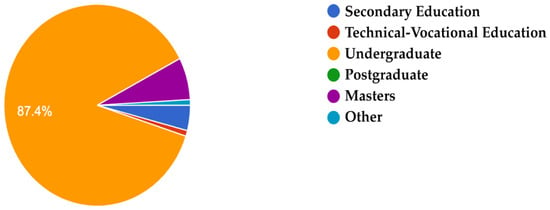
Analysing the data collected from 222 surveys made it possible to understand the perceptions and practices of citizens living in Portugal with regard to the Russian–Ukrainian war and refugees. The sample revealed a predominance of young people, with an average age of 20, and the majority (61%) in the 18–20 age bracket. In terms of gender, 68% of respondents identified themselves as female, while 32% were male. Portuguese nationality is predominant (70%), with a higher concentration of residents in the districts of Braga (39%), Porto (16%) and Lisbon (14%). The majority of respondents (90%) live with family members, and 87% are studying for or have completed an academic degree, with a particular emphasis on years in the fields of Communication and Management (Figure 1).
Figure 1.
Levels of schooling.
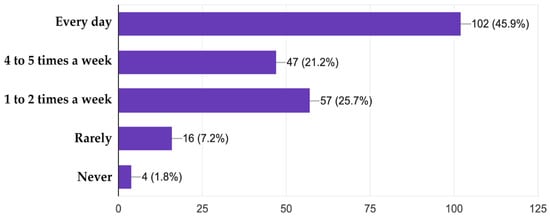
Regarding media consumption habits, respondents spend an average of 1 to 2 h a day on television, although 50% report spending more than 3 h on digital media. Despite this, 93% of respondents say that their family members follow the news frequently (between 4 and 7 days a week), and 67% of respondents themselves maintain a similar habit (Figure 2). However, 207 of the respondents spend less than half an hour a day reading the news. The predominant activity on the Internet is the use of social networks (90%), with Instagram being the most popular network (98%), followed by TikTok (83%).
Figure 2.
Frequency of following the news.
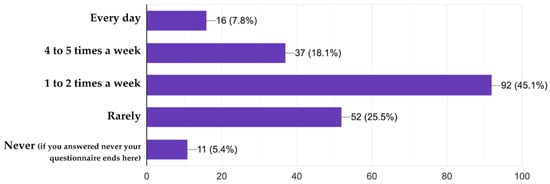
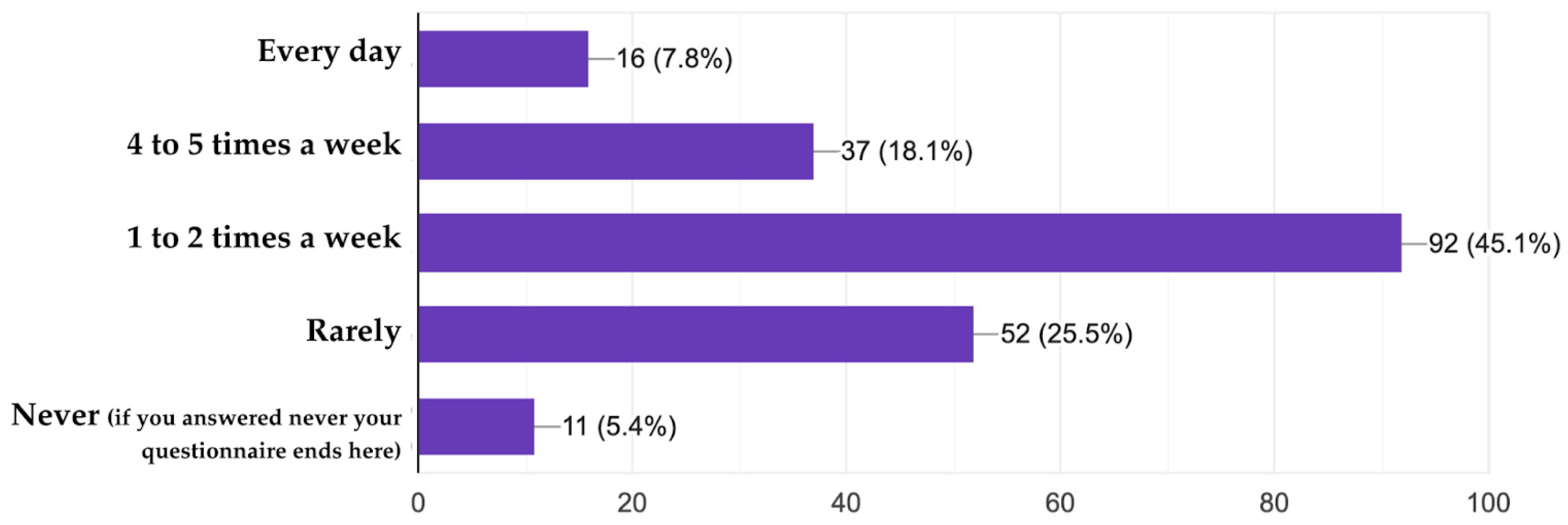
When it comes to following news on war-related topics, 83% of respondents say they follow events, although almost half (45%) do so only once or twice a week (Figure 3). Among the reasons given for not following the news as much as they do are the content of the news, which is often described as “sad”, “frightening” or “worrying”. Television (83%) and social networks (55%) are the preferred means of getting informed, followed by digital newspapers (41%), confirming a national trend, already evidenced by recent studies (Cardoso et al., 2025). As for specific channels, the most mentioned include RTP, SIC, TVI, Instagram and the X platform. This finding addresses RQ1, confirming that despite the digital age, television remains a dominant source for following the war, albeit complemented by social networks.
Figure 3.
Frequency of following the news about the war.
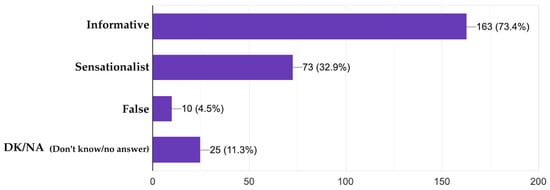
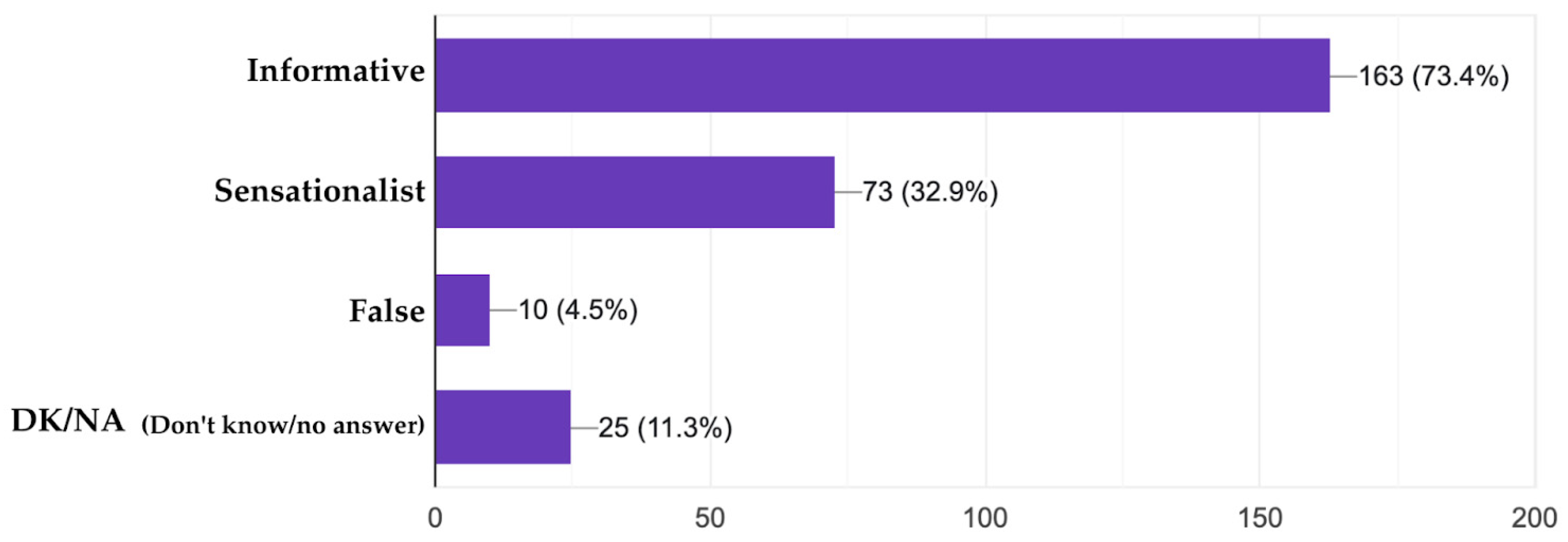
With regard to media representations, 71% of the participants believe that the media has progressively given the conflict less prominence. As for the content of the news, 73% consider it informative, while 33% classify it as sensationalist (Figure 4, p. 10). These results provide an answer to RQ2, indicating a duality in audience perception: the information is seen as useful but is simultaneously criticised for its sensationalist nature.
Figure 4.
Opinions on media coverage of the war.
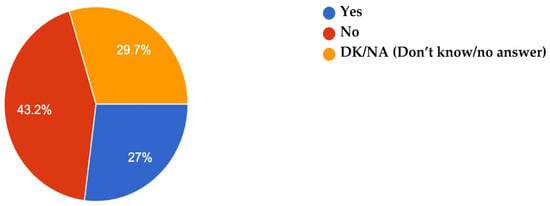
In what concerns refugees, opinions are diverse. The majority of respondents recognise the potential positive contribution of refugees to host countries, but 43% feel that the support given by countries to these populations is insufficient (Figure 5, p. 11). The European Union’s intervention is viewed favourably, but there is still widespread concern about the economic impact of the conflict.
Figure 5.
Sufficiency of host countries’ support for refugee entry.
The statistical analysis reinforces some important trends: age shows a moderate positive correlation with sharing content about the war on social networks (r = 0.18, p < 0.05) and with the types of content shared (r = 0.19, p < 0.05). These results indicate that older participants are more likely to share content related to the conflict, as well as being more specific in the topics covered. On the other hand, the reasons for sharing content show a slightly negative correlation with age (r = −0.15, p < 0.05), suggesting that younger people have marginally higher motivations for sharing information, especially to raise awareness or inform their contacts.
As for gender, the Chi-squared test reveals a statistically significant association with perceptions of support for refugees (p = 0.024), with 58% of women considering support to be insufficient, compared to 42% of men. This result should be interpreted in light of the gender imbalance in the sample, in which women represent 68% of respondents. Consequently, the observed difference may be partially influenced by the sample composition rather than reflecting a generalisable gender-based perception. Sharing content on social media also shows a marginally significant association with gender (p = 0.05), being more common among women (62%) than men (48%).
Regarding RQ3, the statistical evidence confirms that age and gender shape both sharing practices and the critical evaluation of institutional support. For other variables, such as the perception of the impact of the war on the economic crisis or media consumption, no statistically significant associations were observed (p > 0.05).
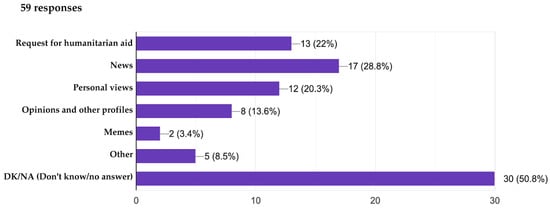
Finally, 88% of respondents say they do not share war-related content on social media. Among those who do share, topics about armed conflicts, rights violations and migratory movements stand out. However, 56% of respondents do not know exactly why they share such content, while 26% say they do so to raise awareness and 13% mention concern about combating misinformation (Figure 6, p. 12).
Figure 6.
Type of content shared on social networks.
Cluster analysis (K-Means) allowed us to identify three main profiles among the respondents, based on their habits and perceptions: Cluster 1, which represents 35% of the sample, is mostly made up of respondents who use social networks as their main source of news, although they follow the news less frequently and have more neutral perceptions of the war. Cluster 2, comprising 42% of respondents, is characterised by predominantly television and digital newspaper users, who express more informative and critical perceptions of the conflict. Cluster 3, with 23% of participants, includes individuals who follow the news more intermittently but who show a greater propensity to share content online.
The patterns observed among respondents who consider news about the war to be sensationalist show a specific profile. This group has a diversified media consumption, using a wide variety of media to follow the news. Despite this, only a minority share war-related content on social networks (r = 0.39, p < 0.05), while those who do tend to specify the types of content, often associated with objectives such as awareness-raising or mobilisation. A positive link was also identified between the perception of the war as a main cause of the economic crisis and a critical view of media coverage (r = 0.16, p < 0.05), suggesting that media dissatisfaction may be associated with broader concerns about the impacts of the conflict.
With regard to academic profile, this group is mostly made up of university students. Bachelor’s Degree students stand out in discussions on the subject with friends and family (r = 0.20, p < 0.05), while students on advanced programmes, such as Master’s Degrees, show a greater propensity to share content online and adopt a more critical view of the war.
Respondents who follow the news exclusively via social networks are highly likely to share war-related content (p < 0.01), but the data do not reveal a significant correlation between this behaviour and critical perceptions of the media.
Among those showing an interest in political news, a significant propensity to share war-related content was also observed (p < 0.01). However, as in the case of social networks, no statistically significant association was identified between interest in politics and a critical view of the media.
Those interested in entertainment news share similar characteristics, with a high probability of sharing content about war (p < 0.01). However, there was also no evidence of an association between interest in entertainment and critical perceptions of media coverage.
Additionally, it was identified that favourable perceptions of the European Union’s role in the war are moderately associated with the way the media represents the refugee issue (r = 0.39, p < 0.05). These data suggest that opinions on the role of the European Union can be influenced by media representations, as well as by interpersonal interactions, given that individuals who frequently discuss the war with family members also have more favourable perceptions of the European Union (r = 0.20, p < 0.05). Addressing RQ4, the data suggests that interpersonal dialogue can serve as a crucial mediator in constructing positive social representations of international institutions.
To summarise, it can be said that the results presented highlight relevant patterns in the participants’ perceptions and media practices, as well as their implications in the wider context of the Russian–Ukrainian war and misinformation. The analysis reveals not only trends in information consumption and sharing but also the sociodemographic dynamics that influence these practices, such as age and gender. This data reinforces the relevance of the theoretical framework that emphasises the role of the media as social constructors of reality (Innerarity, 2009; Hasebrink & Paus-Hasebrink, 2013; Pinto et al., 2015), but also exposes weaknesses in the contemporary media ecosystem, such as the predominance of sensationalist contents and the perceived inadequacy of the conflict coverage. By linking individual motivations for sharing with media narratives and misinformation, the results emphasise the complexity of the interaction between audiences and the media, offering important insights for academic and practical reflection on the subject. These findings underpin the study’s conclusions, pointing to the need for more robust media literacy strategies and future research that expands the sample diversity and deepens the relationships observed.
6. Discussion
This study sought to understand the implications of media discourses and misinformation in shaping social representations of the Russian–Ukrainian war and refugees, as well as to explore how individuals use social networks to engage with and share related content. The results align closely with the theoretical framework, particularly the idea that the media act as key constructors of social reality (Innerarity, 2009; Hasebrink & Paus-Hasebrink, 2013), providing interpretative frameworks that influence public perception and social action (Pinto et al., 2015).
By acting as intermediaries between global events and local audiences, the media offer frameworks that shape the way people understand the world and social issues (Pinto et al., 2015). This role, however, is challenged by the complexity of the current news ecosystem, characterised by the acceleration of news, the fragmentation of audiences and the deregulation of digital platforms (Voinea, 2025). The results of this research highlight these dynamics, showing that participants perceive the media as relevant sources of information, in line with research by Zanoschi et al. (2024), but at the same time are critical of their ability to offer complete and accurate coverage of the Russian–Ukrainian conflict. This perception is particularly visible in the classification of news as sensationalist or insufficient by a significant proportion of respondents.
Despite the centrality of media in everyday information practices, the findings reveal a tension between reliance and scepticism. While participants continue to use both conventional and digital platforms as primary sources of information, a significant proportion perceive the coverage as losing prominence or adopting a sensationalist tone. These perceptions reflect broader concerns regarding the credibility and normative function of the media in times of crisis (Pinto et al., 2015), suggesting that media discourses may shift from predominantly informative frameworks to more emotionally intensified narratives (Scardigno et al., 2024). Research on the emotional dynamics of journalism highlights that news narratives increasingly incorporate affective elements that shape how events are communicated and interpreted. As argued by Wahl-Jorgensen (2019), emotions are not merely incidental to news reporting but constitute a central dimension of contemporary journalistic storytelling, influencing both the framing of events and audience engagement. Similarly, Pantti (2010) has shown that emotional expressions in news coverage can function as interpretative cues that guide public responses to crises and humanitarian events. In this sense, the growing presence of emotionally charged narratives may contribute to intensifying audience engagement while simultaneously shaping how conflicts are perceived and morally evaluated. Such dynamics illustrate how fluctuations in media framing can contribute to ambivalent or fragmented social representations of conflict.
This perception of sensationalism and declining prominence can also be interpreted in light of existing research on media framing of crises. Studies analysing the representation of refugees and conflicts have demonstrated that journalistic narratives frequently oscillate between humanitarian and security frames, often emphasising dramatic or emotionally charged elements (Ajana et al., 2024; Scardigno et al., 2024). In this sense, the participants’ critical perception of media coverage may reflect an awareness—conscious or implicit—of these framing strategies. Rather than merely consuming information, audiences appear capable of identifying narrative patterns that shape the representation of conflict and migration, reinforcing the idea that media audiences actively interpret and evaluate the discourses circulating within the information ecosystem.
The study further highlights the role of social media in participatory communication. Although 88% of respondents do not share war-related content, among those who do, themes such as human rights violations and forced migration prevail. This behaviour reflects the growing relevance of participatory cultures in digital environments, where users increasingly assume hybrid roles as both consumers and producers of information. The concept of the “prosumer”, originally introduced by Toffler (1980) to describe the convergence between production and consumption in late modern societies, has been further developed within digital communication studies by scholars such as Ritzer (2014), Jurgenson (2012), and Bruns (2008), who emphasise the active involvement of audiences in the creation, circulation, and reinterpretation of content in networked publics. In this context, users may act as selective mediators of information within the public sphere. The findings illustrate this dynamic through the figure of the “citizen-prosumer” (Fenton, 2022), who selectively produces and disseminates information, even though 56% of these users report being unaware of their motivations for sharing. Among those who do identify motivations, 26% report doing so to raise awareness and 13% to counter misinformation.
A significant disconnect emerges between the theoretical emphasis on ‘information disorder’ (Wardle & Derakhshan, 2017) and the empirical behaviour of the digital natives surveyed. Although the literature extensively warns of the democratic threat posed by misinformation in the Russian–Ukrainian conflict, the results show that only 13% of those who share content do so with the intent to combat fake news. This gap suggests that, while young adults may be cognitively aware of fake news, they do not perceive themselves as active ‘gatekeepers’ or digital vigilantes (Voinea, 2025). This lack of practical agency might be attributed to a ‘diffusion of responsibility’ in the digital sphere, where users assume that platforms or institutional fact-checkers are the sole parties responsible for sanitising the information ecosystem (Jun et al., 2017). Furthermore, as digital spaces function primarily as ‘affective publics’ where sentiment drives engagement (Papacharissi, 2015), the objective threat of disinformation is often sidelined by the immediate urge for emotional expression. This prioritisation of ‘feeling’ over ‘fact-checking’ (Pennycook & Rand, 2021) creates a structural vulnerability that weakens collective resistance to orchestrated hostile narratives.
Also, a striking paradox emerges from the data: while the respondents exhibit near-ubiquitous consumption of visual-centric platforms—specifically Instagram (98%) and TikTok (83%)—an overwhelming 88% refrain from sharing content related to the conflict. This discrepancy suggests that high digital reach does not inherently translate into active civic engagement or ‘prosumerism’ (Toffler, 1980) in the context of war. Rather than simple passivity, this silence may point toward the phenomenon of ‘news avoidance’ (Skovsgaard & Andersen, 2020) or ‘compassion fatigue’ (Kinickie & Figley, 2017), where the continuous exposure to ‘sad’ and ‘frightening’ imagery triggers a psychological defence mechanism. As conceptualised in media psychology, the affective weight of war narratives can lead to emotional exhaustion, prompting users to adopt a ‘spectator’ role to preserve their mental well-being (McNaughton-Cassill, 2001). This finding challenges the idealised notion of digital natives as constant catalysts for information flow, suggesting instead that in times of geopolitical trauma, the digital space functions more as a sphere for consumption than for active dissemination or mobilisation (Vromen et al., 2016).
This pattern offers an important contribution to the understanding of youth communication practices in digital environments. Although younger generations are frequently described as highly participatory within networked media systems, the findings suggest that participation does not necessarily translate into the active circulation of information related to geopolitical crises. Instead, engagement appears selective and mediated by emotional responses, perceived relevance, and the personal meaning attributed to the topic. In line with studies on mediated socialisation processes (Hasebrink & Paus-Hasebrink, 2013), this behaviour indicates that young users negotiate their role in the information ecosystem not only through technological access but also through subjective evaluations of the content they encounter.
The results indicate that motivations to share content vary according to age and gender, with younger people showing a greater predisposition to raise awareness, often driven by a desire to inform or mobilise others. This dynamic reinforces the role of media narratives as not only sources of information but also as tools for social positioning and identity construction (Hasebrink & Paus-Hasebrink, 2013). Women showed greater overall involvement in sharing. This relationship between sociodemographic characteristics and media practices reinforces the need for media literacy strategies adapted to the specificities of audiences.
In the light of the results, it can be seen that participants’ perceptions of the inadequacy of support for refugees, the sensationalist tone of the media and their motivations for sharing content illustrate how the media ecosystem, especially in digital environments, contributes to the construction of representations that influence attitudes towards conflict victims and migration policies. These narratives do not act uniformly: they are filtered by sociodemographic factors and patterns of digital engagement.
Consistent with the theoretical framework (Innerarity, 2009; Hasebrink & Paus-Hasebrink, 2013; Pinto et al., 2015), the results illustrate how the media not only inform but actively co-construct public understanding, while also exposing vulnerabilities in the ecosystem of information circulation, particularly in relation to misinformation, emotional saturation, and narrative simplification.
From a broader media studies perspective, these findings reinforce the importance of examining not only the production of media narratives but also the processes through which these narratives are interpreted, negotiated and circulated by audiences. As suggested by framing theory (Goffman, 1974; Chong & Druckman, 2007), media discourses provide interpretative structures that shape how social issues are understood. However, the present results indicate that these frameworks are not passively absorbed by audiences. Instead, they are filtered through everyday communication practices, interpersonal discussions and individual experiences, demonstrating that the construction of social representations of conflict emerges from the interaction between media narratives and audience interpretation.
Despite the significant contributions of this research, it should be stressed that the study has limitations that restrict its ability to be generalised. The sample, made up of 222 individuals recruited through a non-probabilistic convenience strategy, is representative only of a specific segment of the Portuguese population, predominantly young, university-educated, and female. This fact affects the external validity of the results, making it necessary to expand and diversify the sample in future research in order to explore the replicability of the trends observed. Furthermore, the absence of validated scales in the questionnaire used limits comparability with other studies and may restrict the accuracy of the measures analysed. Although this instrument is suitable for the exploratory nature of the research, it could benefit from a future methodological review that includes tested and consolidated instruments, ensuring that the conclusions are more robust. Finally, the study focused on perceptions stated by the respondents, which does not allow us to gauge real behaviour or directly measure the impact of media narratives. These limitations emphasise the need for complementary research using mixed methods and representative samples to delve deeper into the relationships between media practices, misinformation and social perceptions in conflict contexts.
Nevertheless, the data presented offers relevant information on how the media and digital platforms influence social perceptions in conflict contexts. Narratives centred on the economic crisis, the rising cost of living, uncontrolled immigration and security concerns demonstrate a tangible impact on attitudes towards refugees, corroborating theories that indicate that media framings not only reflect but also shape public opinion, especially in situations of socio-political uncertainty (Kucharski, 2016; Allcott & Gentzkow, 2017; Gugushvili, 2025; Ajana et al., 2024; Scardigno et al., 2024).
On a practical level, this study emphasises the need for a broader approach to media literacy, which is not limited to critical news consumption, but also enables citizens to interpret, evaluate and share information ethically and responsibly. In an information ecosystem characterised by overload and misinformation, this training becomes essential to preserve democratic values and promote active citizenship.
Also, this research offers a starting point for future debates, with implications not only for the academic field but also for policymakers and media actors. Reflection on the role of the media and social networks in times of conflict should be deepened, considering the ethical and structural challenges associated with communicating global crises and their impact on public policies, social attitudes and strengthening democratic cohesion.
7. Conclusions
This study contributes to the understanding of how media narratives, within hybrid and digitally mediated ecosystems, operate not only as informational devices but as symbolic mechanisms that structure collective meaning in times of geopolitical crisis. It reinforces the central role of the media and social networks in the construction of social representations in conflict contexts, and sought to explore the implications of media discourses and misinformation in shaping social representations of the Russian–Ukrainian war and refugees, with a focus on the perceptions and media practices of university-based convenience sample of young adults.
Regarding the first research objective—exploring audiences’ news consumption habits—the results show that digital platforms and social networks play a central role, particularly among younger participants, although television remains a significant source. Social networks are the preferred channel for accessing and sharing content, but participants maintain a critical view of the media’s sensationalist tone.
Concerning the second objective—investigating audiences’ knowledge and perceptions of the conflict—the findings indicate that participants perceive the media coverage as losing relevance over time and as partially sensationalist. The support provided to refugees is widely viewed as insufficient, particularly among female respondents, reflecting a critical stance toward the response of host countries and the EU.
Finally, in relation to the third objective—evaluating the use of social networks for sharing content—the data reveal that most participants do not actively share content about the war, although those who do are motivated by awareness-raising and concern about misinformation. Age and gender were found to influence sharing practices and perceptions of the conflict, albeit within the limitations of the sample.
Overall, the findings demonstrate that media narratives function as structuring mechanisms in the construction of social representations of humanitarian crises, contributing to the emergence of fragmented and, at times, polarised interpretations of conflict and migration. By evidencing the interplay between media consumption habits, sociodemographic variables, and sharing practices, this study underscores the embeddedness of meaning-making processes within hybrid communication environments. These insights reinforce the need for media and news literacy strategies capable not only of fostering critical consumption, but also of strengthening citizens’ capacity to interpret, contextualise, and responsibly circulate information in times of geopolitical instability.
Despite the significant contributions of this research, it should be stressed that the study has limitations that restrict the generalizability of its results. The sample, composed of 222 individuals recruited through a non-probabilistic convenience strategy, represents only a specific segment of the Portuguese population, predominantly young, university-educated, and female. As a result, the patterns identified in this study should be interpreted as indicative tendencies rather than conclusions that can be extended to the Portuguese population as a whole. The overrepresentation of certain demographic groups may have influenced the perceptions observed, particularly in relation to media use and attitudes toward humanitarian crises. Consequently, the findings should be understood primarily as an exploratory contribution that highlights possible relationships between media consumption, perceptions of conflict, and content-sharing practices among young and digitally engaged audiences.
Also, the study focused on self-reported perceptions, which does not allow the direct observation of actual behaviour or the measurement of the real impact of media narratives. These limitations highlight the need for complementary research using mixed methods and more representative samples in order to further explore the relationships between media practices, misinformation and disinformation and social perceptions in contexts of geopolitical conflict.
Future research should therefore explore these dynamics using more representative samples and complementary methodological approaches, in order to further examine how media narratives about geopolitical conflicts are interpreted, negotiated and circulated across different audience groups.
Author Contributions
Conceptualization, P.S. and S.P.; methodology, C.P. and P.S.; software, C.P.; validation, P.S., C.P. and S.P.; formal analysis, P.S.; investigation, C.P. and P.S.; resources, P.S.; data curation, C.P. and P.S.; writing—original draft preparation, P.S. and S.P.; writing—review and editing, P.S. and S.P.; visualization, S.P.; supervision, P.S.; project administration, P.S.; funding acquisition, P.S. All authors have read and agreed to the published version of the manuscript.
Funding
This research was funded by Europeia University (PI23PS).
Institutional Review Board Statement
The study was conducted in accordance with the Declaration of Helsinki, and approved by the Ethics Committee of Europeia University (4 July 2025).
Informed Consent Statement
Informed consent was obtained from all subjects involved in the study.
Data Availability Statement
The original contributions presented in this study are included in the article. Further inquiries can be directed to the corresponding author.
Conflicts of Interest
The authors declare no conflicts of interest.
References
- Ajana, B., Connell, H., & Liddle, T. (2024). “It could have been us”: Media frames and the coverage of Ukrainian, Afghan and Syrian refugee crises. SN Social Sciences, 4(135), 135. [Google Scholar] [CrossRef] [Scilit]
- Allcott, H., & Gentzkow, M. (2017). Social media and fake news in the 2016 election. Journal of Economic Perspectives, 31(2), 211–236. [Google Scholar] [CrossRef] [Scilit]
- Baccega, M. (2011). Cultural challenges: From communication to educommunication. In A. Citelli, & O. Costa (Eds.), Educommunication: Building a new area of knowledge (pp. 123–135). Paulinas. [Google Scholar]
- Bădescu, G., & Sum, P. E. (2024). Civic engagement landscape: Romania 2024. Center for the Study of Democracy; Friedrich-Ebert-Stiftung. [Google Scholar]
- Bruns, A. (2008). Blogs, Wikipedia, second life, and beyond: From production to produsage. Peter Lang. [Google Scholar]
- Capati, A. (2025). The discursive framing of European integration in EU-wide media: Actors, narratives and policies following the Russian invasion of Ukraine. Comparative European Politics, 23, 271–299. [Google Scholar] [CrossRef] [Scilit]
- Cardoso, G., Paisana, M., & Pinto-Martinho, A. (2025). Digital news report Portugal 2025. Publicações OberCom. OberCom—Observatório da Comunicação. [Google Scholar]
- Chong, D., & Druckman, J. N. (2007). Framing theory. Annual Review of Political Science, 10, 103–126. [Google Scholar] [CrossRef] [Scilit]
- Chouliaraki, L., & Stolic, T. (2017). Rethinking media responsibility in the refugee ‘crisis’. Television & New Media, 18(2), 118–135. [Google Scholar] [CrossRef] [Scilit]
- D’Angelo, P. (2002). News framing as a multiparadigmatic research program: A response to Entman. Journal of Communication, 52(4), 870–888. [Google Scholar] [CrossRef]
- De Vreese, C. H. (2005). News framing: Theory and typology. Information Design Journal + Document Design, 13(1), 51–62. [Google Scholar] [CrossRef] [Scilit]
- Entman, R. M. (1993). Framing: Toward clarification of a fractured paradigm. Journal of Communication, 43(4), 51–58. [Google Scholar] [CrossRef] [Scilit]
- Eurostat. (2023, July 14). 96% of young people in the EU uses the internet daily. European Commission. Available online: https://ec.europa.eu/eurostat/web/products-eurostat-news/w/ddn-20230714-1 (accessed on 16 March 2026).
- Fenton, N. (2022). Comunicação, democracia e mudança social em tempos de crise—Desestabilizar os poderes, desmontar injustiças. Media & Journalism Journal, 22(41), 21–39. [Google Scholar] [CrossRef] [Scilit]
- Franch, P., Sintes-Olivella, M., Zilles, K., Laferrara, V., & Yeste-Piquer, E. (2025). A scathing indictment: How European opinion leaders framed Putin’s aggression against Ukraine. Journalism and Media, 6(3), 99. [Google Scholar] [CrossRef] [Scilit]
- Goffman, E. (1974). Frame analysis: An essay on the organization of experience. Harvard University Press. [Google Scholar]
- Gugushvili, A. (2025). Russian public perceptions of the war in Ukraine: A paradox of optimism amid crisis. Journal of Contemporary European Studies, 33(3), 950–974. [Google Scholar] [CrossRef] [Scilit]
- Hasebrink, U., & Paus-Hasebrink, I. (2013). Trends in children’s consumptions of media. In D. Lemish (Ed.), The Routledge international handbook of children (pp. 31–39). Routledge. [Google Scholar]
- Innerarity, D. (2009). A sociedade invisível. Teorema. [Google Scholar]
- Jun, Y., Meng, R., & Johar, G. V. (2017). Perceived social presence reduces fact-checking. Proceedings of the National Academy of Sciences (PNAS), 114(23), 5976–5981. [Google Scholar] [CrossRef] [Scilit] [PubMed]
- Jurgenson, N. (2012). When atoms meet bits: Social media, the mobile web and augmented revolution. Future Internet, 4(1), 83–91. [Google Scholar] [CrossRef] [Scilit]
- Kinickie, A. J., & Figley, C. R. (2017). Compassion fatigue and news consumption: The emotional impact of witnessing global suffering. Media Psychology Review, 11(2), 1–10. [Google Scholar]
- Kucharski, A. (2016). Post-truth: Study epidemiology of fake news. Nature, 540(7634), 525. [Google Scholar] [CrossRef] [Scilit]
- Lybeck, R., Koiranen, I., & Koivula, A. (2024). From digital divide to digital capital: The role of education and digital skills in social media participation. Universal Access in the Information Society, 23, 1657–1669. [Google Scholar] [CrossRef] [Scilit]
- McNaughton-Cassill, M. E. (2001). The news media and psychological distress: Anxiety, individual differences, and transversality. Anxiety, Stress, and Coping, 14(2), 193–211. [Google Scholar] [CrossRef] [Scilit]
- Molen, J., & Konijn, E. (2007). Dutch children’s emotional reactions to news about the war in Iraq: Influence of media exposure, identification and empathy. In D. Lemish, & M. Götz (Eds.), Children and media in times of war and conflict (pp. 75–98). Hampton Press. [Google Scholar]
- Pantti, M. (2010). The value of emotion: An examination of television journalists’ notions on emotionality. European Journal of Communication, 25(2), 168–181. [Google Scholar] [CrossRef] [Scilit]
- Papacharissi, Z. (2015). Affective publics: Sentiment, activism, and digital networks. Oxford University Press. [Google Scholar]
- Pennycook, G., & Rand, D. G. (2021). The psychology of fake news. Trends in Cognitive Sciences, 25(5), 388–402. [Google Scholar] [CrossRef] [Scilit]
- Pinto, M., Pereira, S., & Brites, M. J. (Orgs.). (2015). Os media e os refugiados: Agenda de atividades. University of Minho—Communication and Society Research Centre. [Google Scholar]
- Ritzer, G. (2014). Prosumption: Evolution, revolution, or eternal return of the same? Journal of Consumer Culture, 14(1), 3–24. [Google Scholar] [CrossRef] [Scilit]
- Sanusi, O. B., Ifedolapo, S. A., & Ayinde, L. O. (2025). The role of social media in development communication: Opportunities and challenges. Lead City International Journal of Library, Information & Communication Sciences, 2(1), 217–231. [Google Scholar]
- Scardigno, R., Guagnano, G. D., & Pagliarulo, F. (2024). Framing news and framing migrants: A qualitative study. World Futures, 80(3), 245–268. [Google Scholar] [CrossRef] [Scilit]
- Semetko, H. A., & Valkenburg, P. M. (2000). Framing European politics: A content analysis of press and television news. Journal of Communication, 50(2), 93–109. [Google Scholar] [CrossRef]
- Skovsgaard, M., & Andersen, K. (2020). Conceptualizing news avoidance: Towards a shared understanding of different causes and types. Journalism Studies, 21(4), 459–476. [Google Scholar] [CrossRef] [Scilit]
- Sousa, J., & Pinto-Martinho, A. (2022). Confiança e uso dos media na União Europeia. Revista Media & Jornalismo, 22(41), 161–178. [Google Scholar] [CrossRef] [Scilit]
- Toffler, A. (1980). The third wave. William Morrow & Co. [Google Scholar]
- Tuchman, G. (1978). Making news: A study in the construction of reality. Free Press. [Google Scholar]
- Voinea, D. V. (2025). Reconceptualizing gatekeeping in the age of artificial intelligence: A theoretical exploration of artificial intelligence-driven news curation and automated journalism. Journalism and Media, 6, 68. [Google Scholar] [CrossRef] [Scilit]
- Vromen, A., Loader, B. D., Xenos, M. A., & Bailo, F. (2016). Everyday making through Facebook engagement: Young citizens’ political interactions in Australia, the United Kingdom and the United States. Political Studies, 64(3), 513–533. [Google Scholar] [CrossRef] [Scilit]
- Wahl-Jorgensen, K. (2019). Emotions, media and politics. Polity Press. [Google Scholar]
- Wardle, C., & Derakhshan, H. (2017). Information disorder: Toward an interdisciplinary framework for research and policy making. Council of Europe. [Google Scholar]
- Wilson, B. J. (2008). Media and children’s aggression, fear and altruism. Spring, 18(1), 87–118. [Google Scholar] [CrossRef] [Scilit]
- Yeste-Piquer, E., Suau-Martínez, J., Sintes-Olivella, M., & Xicoy-Comas, E. (2025). What if I prefer robot journalists? Trust and objectivity in the AI news ecosystem. Journalism and Media, 6(2), 51. [Google Scholar] [CrossRef] [Scilit]
- Zanoschi, E., Poleac, G., & Toescu, A. (2024). Beyond “likes” and “shares”: Exploring the complexities of social media and youth political engagement. Journal of Științe Politice. Revue des Sciences Politiques, (83), 22–31. Available online: https://cis01.ucv.ro/revistadestiintepolitice/files/numarul83_2024/RSP_83.pdf (accessed on 16 March 2026).

Disclaimer/Publisher’s Note: The statements, opinions and data contained in all publications are solely those of the individual author(s) and contributor(s) and not of MDPI and/or the editor(s). MDPI and/or the editor(s) disclaim responsibility for any injury to people or property resulting from any ideas, methods, instructions or products referred to in the content. |
© 2026 by the authors. Licensee MDPI, Basel, Switzerland. This article is an open access article distributed under the terms and conditions of the Creative Commons Attribution (CC BY) license.