


Abstract
Phycological knowledge in Mexico has primarily focused on intertidal zones, coral reefs, and, to a much lesser extent, mangroves. In mangroves, there are isolated studies on various areas of the country, and in many cases, references are made to the macroalgae that grow in association with them, incidentally as part of floristic inventories for a given area. Therefore, the present study aimed to compile existing information on macroalgae associated with mangrove roots in seven ecoregions throughout Mexico. The search was integrative using Google Scholar, Scopus, and Web of Science with different keywords; only records of algae growing on mangrove roots were considered. The literature review includes information on the composition, species richness, their distribution across Mexican marine ecoregions, and their morphofunctional groups. A systematic literature review from 1972 to 2024 identified 40 studies with data on macroalgae found on mangrove roots. The final phycofloristic inventory recorded 155 taxa, distributed among 67 genera, 39 families, 19 orders, and three phyla. The most representative orders were Ceramiales and Cladophorales, and the families with the greatest number of taxa were Rhodomelaceae and Cladophoraceae. This checklist provides a baseline for future taxonomic and biogeographic studies of mangrove-associated macroalgae.
1. Introduction
Macroalgae are among the most important photosynthetic components of mangrove ecosystems and grow attached or close to the roots, seedlings, trunks, and pneumatophores of mangrove species, either directly or on epibiontic invertebrates, such as barnacles, mussels, and oysters, attached to soft sediments or forming floating masses [1,2]. These organisms are primary producers, playing a fundamental role in nutrient cycles, and providing refuge and feeding areas for other living beings, such as invertebrates and fish. They also contribute to calcareous formation and deposition [3]. Mangrove trees create a suitable environment for the growth of highly adapted, typical algal flora that are resistant to fluctuations in factors, such as salinity, light, and nutrients [3,4,5].
Studies have been conducted on macroalgal species associated with mangroves and their seasonal distribution throughout the world, including India, Malaysia, Kenya, and Egypt [6,7,8,9]. In the Americas, studies have been conducted in Brazil, Cuba, Colombia, El Salvador, Panama, Puerto Rico, and Venezuela, where mangroves have been explored at the floristic level, and the value of these organisms for mangrove ecosystems has been emphasized [10,11,12,13,14,15,16,17,18,19].
In Mexico, knowledge of the richness of macroalgae associated with mangroves is incipient. Most data have been obtained from general phycological studies in which they have been identified as mangrove epiphytes, with few studies focusing on the knowledge of them. Among studies focusing on macroalgae in mangroves, Inclán-Rivadeneira [20], who studied animal and photosynthetic epibionts growing on Rhizophora mangle L. in the Mexican Caribbean [21,22], and Pedroche et al. [23], who recorded algae such as Bostrychia, Caloglossa, and Catenella associated with mangrove roots in the Pacific and proposed the new species Caloglossa apomeiotica J.A.West & Zuccarello in the Mexican Pacific, stand out. Paul-Chávez and Riosmena-Rodríguez [1] recorded macrophyte species associated with mangroves, considering all species regardless of the substrate, and they included species directly associated with the roots and those found on rocks and sand, in rhodolith mats, and floating. Perez-Estrada [24] and Riosmena-Rodriguez et al. [2], who recorded mangrove-associated algal species in arid mangroves of Baja California Sur, have contributed significantly to knowledge on this topic. Lucas and De la Cruz-Francisco [25] evaluated the community of invertebrates and macroalgae on Rhizophora mangle roots in Laguna Tampamachoco, Veracruz. Quiroz-González et al. [26] reported epiphytic macroalgal species in Mexico; although this study mentioned mangroves, they were not discussed in depth as a substrate.
This study aimed to integrate all data on macroalgae associated with mangrove roots in Mexico to provide an updated overview and contribute to future taxonomic, ecological, and biogeographical studies at the national level.
2. Materials and Methods
A search of the specialized phycological literature was conducted, considering only books, book chapters, and articles. The search was integrative (Guirao-Goris, 2015) [27].
To compile the taxonomic catalog, a systematic literature search was conducted across the Web of Science, Scopus, and Google Scholar databases, covering the period from 1972 to 2024. The search strategy was based on a standardized Boolean query using the following search terms in English and Spanish (TS): TS = (“macroalgae” OR “seaweed” OR “benthic algae”) AND TS = (“epiphyt” OR “epibiont”) AND TS = (“mangrove” OR “Rhizophora” OR “Avicennia”) AND TS = (“Mexico” OR “Mexican Caribbean” OR “Gulf of Mexico” OR “Mexican Pacific”). The resulting records were manually filtered to ensure that the data corresponded exclusively to macroalgae associated with mangrove roots within Mexican territory. Based on this information, studies presenting data on macroalgae exclusively growing on mangrove roots were selected. The studies that were excluded were based on several criteria: (A) Studies focusing exclusively on phytoplankton or non-macroscopic benthic microalgae. (B) Records of macroalgae associated with soft sediments (muddy intertidal zones) or artificial substrates within the mangrove. (C) General floristic lists of coastal lagoons that did not specify the collection substrate. (D) Reports of drifting or floating macroalgae.
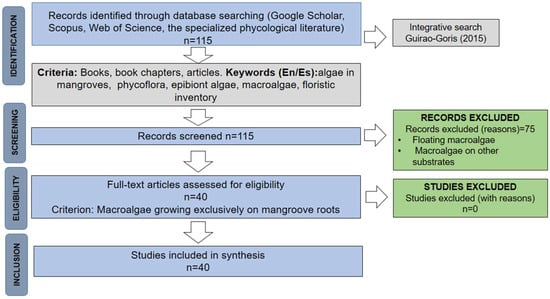
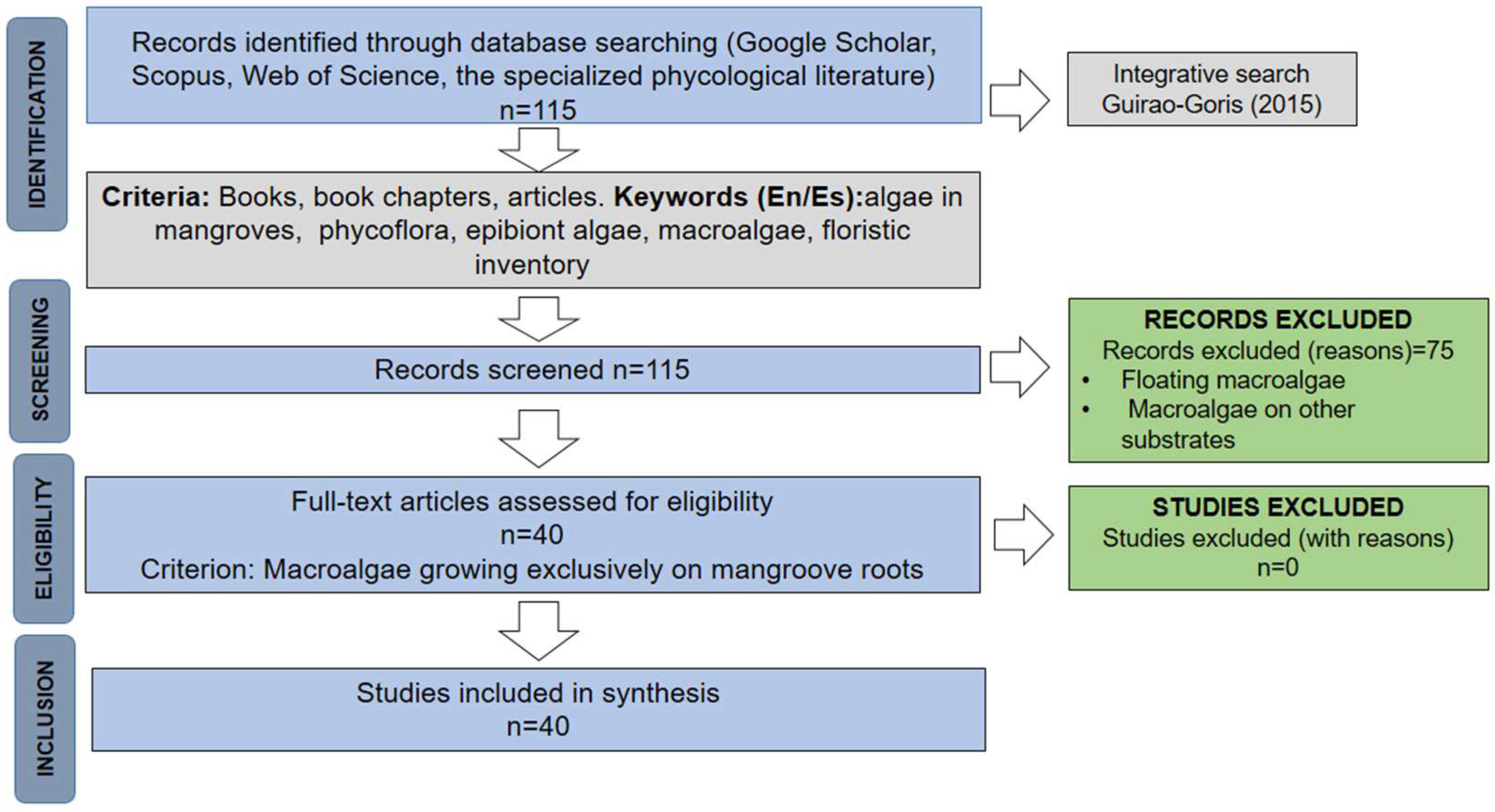
A total of 115 studies were consulted, of which 40 presented information on macroalgae on mangrove roots [1,2,16,20,22,23,24,25,28,29,30,31,32,33,34,35,36,37,38,39,40,41,42,43,44,45,46,47,48,49,50,51,52,53,54,55,56,57,58,59]. Scientific names were updated using AlgaeBase [60]. The morphofunctional groups to which each taxon belonged were included based on Steneck and Dethier’s classification [61] (microscopic, filamentous, foliose, corticate foliose, corticated macrophytes, leathery macrophytes, calcareous articulated, and crusts). In addition, each species was recorded and associated with the marine ecoregion classification of Spalding et al. [62] (Figure 1).
Figure 1.
PRISMA flow diagram for study selection [27].
3. Results
Of the total number of articles and books reviewed, 40 contained data on macroalgae growing on mangrove roots, with studies dating from 1972 to 2024. A total of 155 macroalgae taxa associated with mangrove roots have been reported in Mexico. Of these, 97 are Rhodophyta, 49 are Chlorophyta, and nine are Heterokontophyta–Phaeophyceae (Table 1). These taxa are distributed across 67 genera, 39 families, 19 orders, and three phyla (Table 1). Table 1 presents an inventory of the orders, families, genera, and species of macroalgae growing on mangroves in each algal division.
Table 1.
Inventory of orders, families, genera, and species by algal division. The number of species is presented in parentheses.
In terms of representativeness, the orders with the highest number of taxa were Ceramiales (72), Cladophorales (22), and Bryopsidales (13). Considering the families, Rhodomelaceae contains the highest number (49 species), followed by Cladophoraceae (16) and Ceramiaceae (12). The genera with the highest number of species were Chondria (10), Polysiphonia (eight), Bostrychia, Cladophora (eight), and Ulva (seven). The species more frequently recorded as mangrove epiphytes were Caloglossa leprieurii (Montagne) G. Martens (eight studies), Spyridia filamentosa (Wulfen) Harvey (nine), Bostrychia radicans (Montagne) Montagne (eight), and Chaetomorpha linum (O. F. Müller) Kützing (seven).
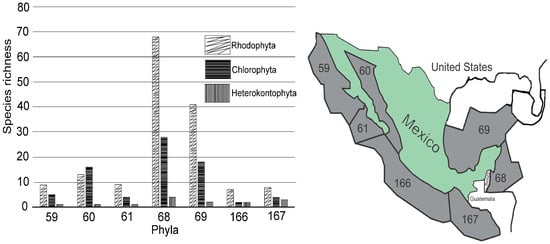
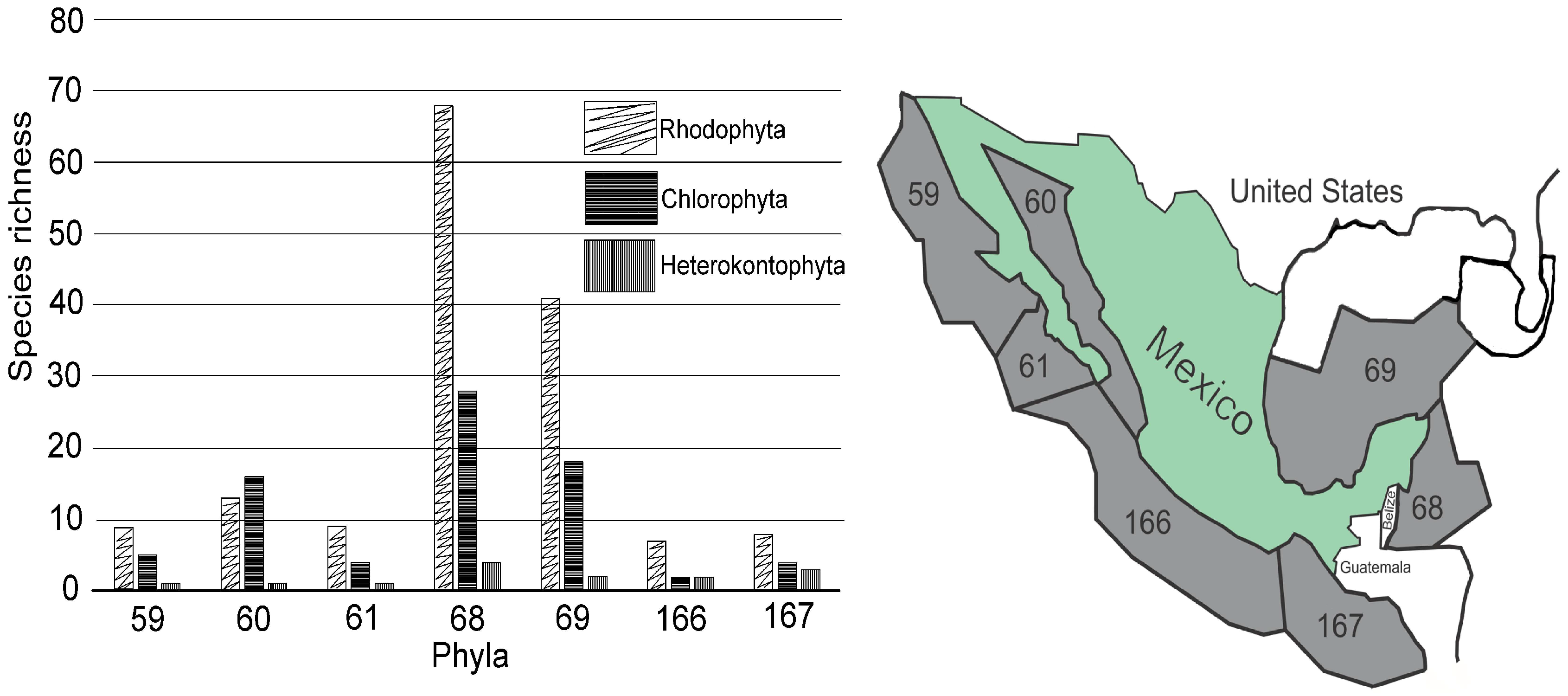
In terms of morphofunctional groups, filaments predominated with 97 taxa, followed by corticated macrophytes (38), foliose algae (16), calcareous articulated algae (four), and crusts (one) (Supplementary Table S1). In terms of geographical distribution, the species reported in a higher number of ecoregions was Bostrychia radicans (seven ecoregions), Caloglossa apomeiotica, C. leprieurii, and Polysiphonia mollis Hooker f. & Harvey (five ecoregions each). The western Caribbean ecoregion (code 68) harbored the highest richness (100 species), followed by the southern Gulf of Mexico (code 69) with 61 species and the Cortezian ecoregion (code 60) with 30 species (Figure 2). The remaining ecoregions had a similar number of records, with 11–16 taxa (Supplementary Table S1, Figure 1). The majority of studies do not present data on mangrove species that served as a substrate, but those that did mainly indicated Rhizophora mangle (Supplementary Table S1 [1,2,16,20,22,23,24,25,28,29,30,31,32,33,34,35,36,37,38,39,40,41,42,43,44,45,46,47,48,49,50,51,52,53,54,55,56,57,58,59]).
Figure 2.
Number of species per phylum for each Spalding ecoregion: 59. Southern California Bight; 60. Cortezian; 61. Magdalena Transition; 68. Western Caribbean; 69. Southern Gulf of Mexico; 166. Mexican Tropical Pacific; 167. Chiapas–Nicaragua.
4. Discussion
Of the 115 studies reviewed, 35% presented data on macroalgae associated with mangrove roots. The majority of these were floristic, and only eight focused on this particular topic. This contribution represents the first effort to compile all data on macroalgae associated with mangroves in Mexico, as has been done in other countries, such as Brazil, Colombia, Panama, and El Salvador [5,14,17,63].
According to Pedroche and Sentíes [64], the macroalgal species richness in Mexico includes 1698 taxa, and algae associated with mangrove roots represent 8.6% of the species recorded for the country. Other authors have indicated a low species richness for mangrove macroalgae, despite their important ecological and biological roles. A total of 109, 33, 168, 14, and 22 species have been recorded in mangroves in the Caribbean [3], Gazi Bay, Kenya [6], Cuba [65], Boca del Toro, Panamá [17], and Brazil [5], which is attributed to the complex environmental conditions of this ecosystem, where there are significant fluctuations in humidity, salinity, light, temperature, and nutrient concentrations [3,5]. Additionally, this could be due to the scarcity of macroalgal studies on mangroves at different geographical scales, as there are not many studies at either the national or regional level.
Regarding the representativeness of the phyla, the data in this study coincide with those presented in other studies. Both phycofloristic and direct associations with mangroves have shown that most species are those of Rhodophyta, followed by Chlorophyta and Heterokontophyta–Phaeophyceae; this represents a pattern characteristic of regions with tropical phycophytes [5,59,66]. Considering orders and families, Ceramiales accounted for 48% of the species in this study, and the Rhodomelaceae family accounted for 34%. These taxa have been identified in other studies as the most representative, showing higher percentages. For example, in Panama [17], the values for both groups range from 43 to 64%. In the study by Yokoya et al. [5] in Brazil, Ceramiales and Rhodomelaceae represented 64 and 41% of the total species, respectively.
Although the literature indicates that the genus Chondria is rarely found in mangrove ecosystems [67,68], it contained the highest number of species in the present study, with 10. This may be related to some of the characteristics of the genus, such as the cylindrical and fleshy thallus structure, which reduces the surface-to-volume ratio, conserving internal moisture [69], and its ability to produce the amino acid mycosporine, enabling it to retain water within its cells and maintain protein stability [70].
Polysiphonia and Bostrychia also included several species frequently recorded in this ecosystem. They form part of what is known as the Bostrychietum complex [5,6,63,71], which includes other genera, such as Caloglossa and Catenella. This group includes algal species that are highly adapted to mangrove conditions and exhibit the greatest diversification and abundance at these sites, making them an important subject due to the complexity of their taxonomic determination and multiple adaptations [16,23,51]. In this study, only two species of the genus Caloglossa were recorded, which are the only ones registered in Mexico (C. leprieurii and C. apomeiotica). However, they appeared in the largest number of studies, and their high frequency of occurrence may be related to their tolerance to fluctuating environments.
Yokoya et al. [5] recorded eight Bostrychia species in Brazil, the same number observed in this study. The morphology of the Bostrychia thallus enables it to retain water via capillarity when the tide is low, preventing the algae from drying out completely. This has been observed in B. moritziana (Sonder ex Kützing) J. Agardh and B. radicans (Montagne) Montagne, which are found in the upper part of the pneumatophores [72], suggesting that Bostrychia species are adapted to places in which significant desiccation can occur [6,73]. Furthermore, the genera Bostrychia and Polysiphonia are euryhaline [73], enabling them to balance their internal pressure when the water is very salty or nearly freshwater due to rainfall. They also form specialized rhizoids that firmly anchor them to different substrates [74], such as the rough bark of aerial roots, making them common species on Rhizophora mangle roots.
The genus Cladophora also contained a significant number of species associated with mangrove roots. This could be linked to the characteristics of the filamentous thallus, where the shape of its cells and the resistance of its cell walls provide flexibility and structural support against tidal currents, salinity, and desiccation changes [75,76,77]. The presence of Ulva can be explained by the photosynthetic efficiency of its thalli, a result of its rapid absorption of nutrients [78], which are abundant in mangrove sediments. Cladophora and Ulva are specialists that utilize the nitrogen and phosphorus [77,79] filtered from mangroves, enabling them to grow faster than other genera in areas with high organic matter [76].
The number of macroalgal species associated with mangrove roots in the western Caribbean may be due to more stable ocean conditions than those in the Gulf of Mexico and the Mexican Pacific, as well as differences in mangrove coverage between sites. Until 2020, CONABIO reported 247,017 ha of mangroves for this ecoregion, the largest area in Mexico [80]. In addition, the western Caribbean has clear, oligotrophic waters [81], which receive large river discharges compared to the Gulf of Mexico [82]. Light penetration promotes greater growth of algae associated with mangrove roots, enabling more diverse vertical zoning [83]. In addition, the connectivity of mangroves and reef habitats makes the western Caribbean a very important area [84,85]. It is here that the world’s second-largest reef formation is located, and many algal species that normally live on reefs have an ideal alternative substrate in the roots of Rhizophora mangle [86]. The proximity of reef systems acts as a constant ”source” of spores from different species [84,85]. Muddy and sandy bottoms (high sedimentation) predominate in the Gulf of Mexico due to the presence of rivers, such as the Mississippi [87] and Grijalva–Usumacinta [88], which limit diversity to species that are highly resistant to turbidity when the habitat is altered [89]. There are also differences in the salinity and temperature gradients in the Gulf of Mexico, as it experiences greater seasonal fluctuations in temperature and salinity due to the north winds and river discharges [88,89]. This acts as an ecological filter; only species with a high tolerance (euryhaline and eurythermic) survive, as is the case with the genera Bostrychia, Caloglossa, and Catenella [90]. The western Caribbean is a more thermally stable area, enabling more specialized species that are less tolerant to sudden changes to become successfully established [81]. Another factor to consider is habitat complexity. In the western Caribbean, mangroves are often associated with seagrasses (Thalassia testudinum K.D. Koenig). This mangrove–seagrass–reef complex creates a continuum of habitats that favor cross-biodiversity [91]. In other ecoregions, mangroves may be more isolated or only surrounded by mud, as they actively create their own ecosystems by trapping sediments [92], reducing the variety of available niches.
In arid mangroves that develop in the Cortezian (60) ecoregion, the mangrove trees grow under suboptimal conditions. The assemblages are far less extensive and contain shorter trees than in most tropical locations, and the water salinity (from 38 to 43 psu) and air humidity are related to rain scarcity. This limited vegetation structure likely affects the diversity of microconditions in which macroalgae can grow [93].
Of the studies presenting information on the host mangrove species, the most cited is Rhizophora mangle, whose root arrangement constitutes a heterogeneous mixture of trapped material and micro-epibiont communities [53]. This provides a suitable substrate for other organisms [86] due to its firmness and availability of colonizable surface area, which is mostly submerged and close to the coastal zone. The lack of data on mangrove species that serve as substrates and their logical attribution to R. mangle is likely related to the species habitat and distribution since the typical habitat of R. mangle is the intertidal zone, which is protected from the sea on tropical and subtropical coasts, where it is the dominant species [94]. Furthermore, Rhizophora is the most common mangrove genus worldwide and is one of only three genera that span global regions [95].
The human factor in knowledge generation cannot be ignored. For ecoregions with fewer records of macroalgal species associated with mangrove roots, the figures obtained in this study only reflect “how much has been searched for”. Therefore, the collection of taxonomic information on macroalgal species associated with mangroves and database creation thereof is important for analyzing the state of knowledge of these taxa and identifying areas that require more detailed studies [96].
The remarkable species richness recorded in the western Caribbean ecoregion, which accounts for 64.51% of national diversity with 100 identified taxa, must be analyzed from a critical perspective. This marked geographical disparity suggests the presence of a Wallacean bias, where the gap between known and actual biodiversity is accentuated by a heterogeneous distribution of sampling effort [97]. In this study, the high species richness values in the Caribbean coincide with a concentration of 75% of the references analyzed in the catalog (30 out of 40 works), which highlights a marked ”collector’s dilemma”. As analyzed in the context of Mexican marine flora by Pedroche and Sentíes (2020), this differential research intensity tends to generate”artificial hotspots” in historically more explored areas [98]. Therefore, whilst the western Caribbean is confirmed as a key area for epiphytic macroalgae associated with Rhizophora mangle, its apparent dominance over other ecoregions should be considered a trend subject to revision, pending more robust and standardized inventories in the less-documented areas of the Pacific and the Gulf of Mexico. This will expand our understanding of local biological diversity and foster research that employs diverse approaches, thereby supporting the development of ecological, biogeographical, and environmental impact and conservation studies [99], particularly those focused on mangrove–macroalgae associations.
Supplementary Materials
The following supporting information can be downloaded at: https://www.mdpi.com/article/10.3390/phycology6020036/s1. Table S1: Taxonomic list of algal species associated with mangrove roots, containing the full occurrence-by-ecoregion dataset [1,2,16,20,22,23,24,25,28,29,30,31,32,33,34,35,36,37,38,39,40,41,42,43,44,45,46,47,48,49,50,51,52,53,54,55,56,57,58,59].
Author Contributions
Conceptualization, N.Q.-G.; Methodology, N.Q.-G., M.G.R.-A., H.A.P.-Á., O.O.-R., and L.G.A.-E.; Validation, N.Q.-G., L.G.A.-E., M.G.R.-A., L.E.M.-C., C.M.-G., and H.P.L.-T.; Formal Analysis, N.Q.-G. and L.G.A.-E.; Investigation, N.Q.-G., L.G.A.-E., and M.G.R.-A.; Resources, N.Q.-G., L.G.A.-E., and H.P.L.-T.; Data Curation, N.Q.-G., L.G.A.-E., and L.E.M.-C.; Writing—Original Draft Preparation, N.Q.-G., L.G.A.-E., M.G.R.-A., L.E.M.-C., C.M.-G., and H.P.L.-T.; Writing—Review and Editing, N.Q.-G., L.G.A.-E., M.G.R.-A., L.E.M.-C., and C.M.-G.; Visualization, Supervision, and Project Administration, N.Q.-G., L.G.A.-E., M.G.R.-A., L.E.M.-C., C.M.-G., and H.P.L.-T.; Funding Acquisition, N.Q.-G. and L.G.A.-E. All authors have read and agreed to the published version of the manuscript.
Funding
This research received no external funding.
Institutional Review Board Statement
Not applicable.
Informed Consent Statement
Not applicable.
Data Availability Statement
The raw data supporting the conclusions of this article will be made available by the authors upon request.
Acknowledgments
To the Ficologia Marina laboratory for the loan of the facilities.
Conflicts of Interest
The authors declare no conflicts of interest.
References
- Paul-Chávez, L.; Rodríguez, R.R. Macroalgas asociadas a manglares en Bahía de La Paz, Baja California Sur, México. Rev. Inv. Mar. 2006, 27, 165–168. [Google Scholar]
- Riosmena-Rodríguez, R.; Paul-Chávez, L.; Mazariegos-Villareal, A.; Serviere-Zaragoza, E.; Pacheco-Ruíz, I.; Hernández-Carmona, G.; Hinojosa-Arango, G. Flora ficológica asociada a manglares de la Península de Baja California. In Los Manglares de la Península de Baja California, 1st ed.; Riosmena-Rodríguez, R., Ed.; CICIMAR-CIBNOR-UABCS: La Paz, Mexico, 2011; pp. 183–200. [Google Scholar]
- Cordeiro-Marino, M.; Braga, M.; Eston, V.R.; Fujii, M.T.; Yokoya, N. Mangrove macroalgal communities of Latin America: The state of art and perspectives. In Coastal Plant Communities of Latin America, 1st ed.; Seeliger, U., Ed.; Academic Press: New York, NY, USA, 1992; Volume 3, pp. 51–64. [Google Scholar]
- Taylor, W.R. Association algales des mangroves d’Amerique. Colloq. Int. Cent. Natl. Rech. Sci. 1959, 81, 143–152. [Google Scholar]
- Yokoya, N.S.; Pellizzari, F.; Felicio, R.; Armstrong, L.; Debonsi, H.; Guimaraes, S.M.; Fujii, M. Mangrove Macroalgal Communities. In Brazilian Mangroves and Salt Marshes, 1st ed.; Schaeffer-Novelli, Y., Abuchahla, G.M.O., Cintrón-Molero, G., Eds.; Springer: Cham, Switzerland, 2023; Volume 1, pp. 209–246. [Google Scholar] [CrossRef] [Scilit]
- Coppejans, E.; Gallin, E. Macroalgae associated with the mangrove vegetation of Gazi Bay (Kenya). Bull. Soc. R. Bot. Belg. 1989, 122, 47–60. [Google Scholar]
- King, R.J.; Puttock, C.F. Macroalgae Associated with Mangroves in Australia: Rhodophyta. Bot. Mar. 1994, 37, 181–192. [Google Scholar] [CrossRef] [Scilit]
- El-Sharouny, H.M.; El-Tayeb, M.A.; Ismail, M.S. Macroalgae associated with mangroves at Hurghada and Safaga of the Egyptian Red Sea coast. J. King Abdulaziz Univ. Mar. Sci. 2001, 12, 241–251. [Google Scholar] [CrossRef] [Scilit]
- Nedumaran, T.; Perumal, P. Temporal and spatial variations in the structure of macroalgal communities associated with mangroves of Pichavaram (South India). Bot. Res. Int. 2009, 2, 198–205. [Google Scholar]
- Suárez, A.M. Algas asociadas a las raíces de Rhizophora mangle L. en cayos al este de la Isla de la Juventud, Cuba. Rev. Inv. Mar. 1989, 10, 117–123. [Google Scholar]
- Rodríguez, C.; Stoner, A.W. The epiphyte community of mangrove roots in a tropical estuary: Distribution and biomass. Aquat. Bot. 1990, 36, 117–126. [Google Scholar] [CrossRef] [Scilit]
- Barrios, J.; Márquez, B.; Jiménez, M. Macroalgas asociadas a Rhizophora mangle L. en el golfo de Santa Fe, Estado Sucre, Venezuela. Bol. Inst. Oceanogr. Venez. 2003, 42, 37–45. [Google Scholar]
- Peña-Salamanca, E. Dinámica espacial y temporal de la biomasa algal asociada a las raíces de mangle en la Bahía de Buenaventura, costa Pacífica de Colombia. Bol. Investig. Mar. Coster. 2008, 37, 55–70. [Google Scholar] [CrossRef] [Scilit]
- Tejada, O.L. Notas preliminares de la flora algal asociada a los bosques de manglar de El Salvador. Rev. Mesoam. 2008, 12, 1–193. [Google Scholar]
- López, B.; Vera, B.; Conde, J.E. Macroalgas asociadas a las raíces de Rhizophora mangle L. en la península de Paraguaná, Estado Falcón, Venezuela. Bol. Inst. Oceanogr. Venez. 2009, 48, 101–111. [Google Scholar]
- Zucarello, G.C.; Kamiya, M.; Ootsuki, R.; Loiseaux de Goër, S.; Pedroche, F.F.; West, J.A. New records of red algae from mangroves in El Salvador and Pacific Mexico, combining culture and molecular observations. Bot. Mar. 2012, 55, 101–111. [Google Scholar] [CrossRef] [Scilit]
- Ríos, R.; Tejada, O.L.; Fonseca, D.M.; Miranda, E.; Cerrud, A. Comunidad de algas del manglar de playa Estrella, isla Colón, Bocas del Toro, Panamá. Rev. Cienc. Mar. Costera 2019, 11, 9–29. [Google Scholar] [CrossRef] [Scilit]
- Betancourt, R.; Barrios-Montilla, J. Macroalgas asociadas a Rhizophora mangle en la ensenada de Carenero, estado Sucre, Venezuela. Acta Biol. Venez. 2021, 41, 17–31. [Google Scholar]
- Acosta-Balbás, V.; Gotera, B.; Barrios-Montilla, J.; Jiménez-Ramos, E. Floristic composition of macroalgae associated with Rhizophora mangle (Rhizophoraceae) in two inlets of the Venezuelan Caribbean. Bol. Investig. Mar. Coster. 2023, 52, 159–174. [Google Scholar] [CrossRef] [Scilit]
- Inclán-Rivadeneira, R. Ecología de la epibiosis en las raíces inmersas de Rhizophora mangle en Bahía de la Ascensión, Quintana Roo, México. Cienc. Mar. 1989, 15, 1–20. [Google Scholar] [CrossRef] [Scilit]
- West, J.A.; Zuccarello, G.; Karsten, U.; Calumpong, H.P. Biology of Bostrychia, Stictosiphonia, and Caloglossa (Rhodophyta, Ceramiales). In Proceedings of the Second RP-USA Phycology Symposium, Cebu and Dumaguete, Philippines, 6–19 January 1992; Abbott, I.A., Ed.; Philippine Council for Marine and Ocean Research and Development: Los Baños, Philippines, 1992; pp. 11–31. [Google Scholar]
- West, J.A.; Zuccarello, G.C.; Pedroche, F.F.; Karsten, U. Caloglossa apomeiotica sp. nov. (Ceramiales, Rhodophyta) from Pacific México. Bot. Mar. 1994, 37, 381–390. [Google Scholar] [CrossRef] [Scilit]
- Pedroche, F.F.; West, J.A.; Zuccarello, G.C.; Sentíes, A.; Karsten, U. Marine red algae of the mangroves in south Pacific México and Pacific Guatemala. Bot. Mar. 1995, 38, 111–119. [Google Scholar] [CrossRef] [Scilit]
- Pérez-Estrada, C.J.; León-Tejera, H.; Serviere-Zaragoza, E. Cyanobacteria and macroalgae from an arid environment mangrove on the east coast of the Baja California Peninsula. Bot. Mar. 2012, 55, 187–196. [Google Scholar] [CrossRef] [Scilit]
- Lucas, E.; De la Cruz-Francisco, V. Macroflora y macrofauna asociada a las raíces sumergidas de Rhizophora mangle (Rhizophoraceae), en la laguna Tampamachoco, Veracruz, México. Rev. Colomb. Cienc. Anim. RECIA 2018, 10, 31–42. [Google Scholar] [CrossRef] [Scilit]
- Quiroz-González, N.; Aguilar-Estrada, L.G.; Acosta-Calderón, J.A.; Álvarez-Castillo, L.; Arriola-Álvarez, F. Biodiversity of epiphytic marine macroalgae in Mexico: Composition and current status. Bot. Mar. 2023, 66, 181–189. [Google Scholar] [CrossRef] [Scilit]
- Guirao-Goris, S.J. Utilidad y tipos de revisión de literatura. Rev. Enf. 2015, 9, 495. [Google Scholar] [CrossRef] [Scilit]
- Huerta, L.; Tirado, J. Estudio florístico ecológico de las algas marinas de la costa del Gulfo de Tehuantepec, México. Bol. Soc. Bot. México 1970, 31, 113–137. [Google Scholar]
- Huerta, L.; Garza-Barrientos, M.A. Contibución al conocimiento de la flora de las islas Socorro y San Benedicto del Archipiélago Revillagigedo, Colima, México. Bol. Inform. Inst. Bot. Univ. Guadalaj. Supp. Agric. 1975, 2, 4–16. [Google Scholar]
- Mendoza-González, A.C.; Mateo-Cid, L.E. Contribución al conocimiento de la flora marina bentónica de las islas Sacrificios y Santiaguillo, Veracruz, México. Phytologia 1985, 59, 9–16. [Google Scholar]
- Mendoza-González, A.C.; Mateo-Cid, L.E. Contribución al estudio florístico de la costa occidental de Baja California, México. Phytologia 1985, 59, 17–33. [Google Scholar]
- Huerta, L.; Mendoza-González, A.C.; Mateo-Cid, L.E. Avance sobre un estudio de las algas marinas de la Península de Yucatán. Phytologia 1987, 62, 23–53. [Google Scholar]
- Mateo-Cid, L.E.; Mendoza-González, A.C. Algas marinas bénticas de la isla Cozumel, Quintana Roo, México. Acta Bot. Mex. 1991, 16, 57–87. [Google Scholar] [CrossRef] [Scilit]
- Serviere-Zaragoza, E.; Collado-Vides, L.; González-González, J. Caracterización ficológica de la laguna de Bojórquez, Quintana Roo, México. Caribb. J. Sci. 1992, 28, 126–133. [Google Scholar]
- Collado-Vides, L.; González-González, J. Macroalgas del Sistema lagunar de Nichupté, Quintana Roo. In Biodiversidad Marina y Costera de México, 1st ed.; Salazar-Vallejo, S.I., González, N.E., Eds.; CONABIO-CIQROO: México, México, 1993; pp. 752–761. [Google Scholar]
- Mateo-Cid, L.E.; Sánchez-Rodríguez, I.; Rodríguez-Montesinos, Y.E.; Casas-Valdez, M.M. Floristic study on benthic marine algae of Bahia Concepcion, BCS, Mexico. Cienc. Mar. 1993, 19, 41–60. [Google Scholar] [CrossRef] [Scilit]
- Dreckmann, K.M.; Pérez-Hernández, M.A. Macroalgas bentónicas de la laguna de Tampamachoco, Veracruz, México. Rev. Biol. Trop. 1994, 42, 715–717. [Google Scholar]
- Collado-Vides, L.; Gonzalez-Gonzalez, J.; Ezcurra, E. Patrones de distribución ficoflorística en el sistema lagunar de Nichupté, Quintana Roo, México. Acta Bot. Mex. 1995, 31, 19–32. [Google Scholar] [CrossRef] [Scilit]
- Ortega, M.M. Observaciones del fitobentos de la Laguna de Términos, Campeche, México. An. Inst. Biol. Univ. Nac. Autón. Méx. Ser. Bot. 1995, 66, 1–36. [Google Scholar]
- Orozco-Vega, H.; Dreckmann, K. Macroalgas estuarinas del litoral del Golfo de México. Cryptogam. Algol. 1995, 16, 189–198. [Google Scholar]
- Sentíes, A. The genus Polysiphonia (Ceramiales, Rhodomelaceae) in the tropical Pacific of Mexico. Rev. Biol. Trop. 1995, 43, 39–54. [Google Scholar]
- Collado-Vides, L.; West, J.A. Bostrychia calliptera (Montagne) Montagne (Rhodomelaceae, Rhodophyta), a new record for the central Gulf of Mexico. Cienc. Mar. 1996, 22, 47–55. [Google Scholar]
- Mendoza-González, A.C.; Mateo-Cid, L.E. Contribución al estudio de la ficoflora marina de la costa del estado de Chiapas, México (parte a). Polibotánica 1996, 2, 61–118. [Google Scholar]
- Mendoza-González, A.C.; Mateo-Cid, L.E. Avance de un estudio sobre las macroalgas marinas de Guerrero y Oaxaca. Cienc. Mar. 1998, 4, 15–29. [Google Scholar]
- De la Lanza-Espino, G.; Pulido, S.H. Organismos Indicadores de la Calidad del Agua y de la Contaminación (Bioindicadores); Plaza y Valdés Editores: Mexico City, Mexico, 2000; pp. 1–633. [Google Scholar]
- Ortega, M.M.; Godínez, J.L.; Garduño-Solórzano, G. Catálogo de Algas Bénticas de las Costas Mexicanas del Golfo de México y Mar Caribe; CONABIO-UNAM: Mexico City, México, 2001; pp. 1–594. [Google Scholar]
- Ortegón-Aznar, I.; González-González, J.; Sentíes-Granados, A. Estudio ficoflorístico de la laguna de Río Lagartos, Yucatán, México. Hidrobiológica 2001, 11, 97–104. [Google Scholar]
- Fujii, M.T.; Sentíes, A. Taxonomia do complexo Laurencia (Rhodomelaceae, Rhodophyta) do Brasil, com ênfase nas espécies dos estados de São Paulo e do Espírito Santo. Monogr. Ficol. 2005, 2, 69–135. [Google Scholar]
- Mendoza-González, A.C.; Mateo-Cid, L.E. Cinco nuevos registros de algas rojas (Rhodophyta) para el Caribe Mexicano. Polibotánica 2007, 23, 101–119. [Google Scholar]
- Ortegón-Aznar, I.; Sánchez-Molina, I.; Cetz, R.C. The distribution of marine algae in a coastal lagoon, northern Yucatan Peninsula, Mexico. Neotrop. Biol. Conserv. 2009, 4, 99–105. [Google Scholar] [CrossRef] [Scilit]
- Norris, J.N. Marine algae of the Northern Gulf of California: Chlorophyta and Phaeophyceae. Smithson. Contrib. Bot. 2010, 94, 1–276. [Google Scholar] [CrossRef] [Scilit]
- Zuccarello, G.C.; Buchanan, J.; West, J.A.; Pedroche, F.F. Genetic diversity of the mangrove-associated alga Bostrychia radicans/Bostrychia moritziana (Ceramiales, Rhodophyta) from southern Central America. Phycol. Res. 2011, 59, 98–104. [Google Scholar] [CrossRef] [Scilit]
- Mateo-Cid, L.E.; Mendoza-González, A.C. Algas marinas bentónicas de la costa noroccidental de Guerrero, México. Rev. Mex. Biodivers. 2012, 83, 905–928. [Google Scholar] [CrossRef] [Scilit]
- Norris, J.N. Marine algae of the northern Gulf of California, II: Rhodophyta. Smithson. Contrib. Bot. 2014, 96, 1–555. [Google Scholar] [CrossRef] [Scilit]
- Acosta-Calderón, J.A.; Mateo-Cid, L.E.; Mendoza-González, A.C. An updated list of marine green algae (Chlorophyta, Ulvophyceae) from the Biosphere Reserve of Sian Ka’an, Quintana Roo, Mexico. Check List 2016, 12, 1–15. [Google Scholar] [CrossRef] [Scilit]
- Mendoza-González, A.C.; Mateo-Cid, L.E.; Acosta-Calderón, J.A.; Vázquez-Rodríguez, A.; Hernández-Casas, C.M.; Garduño-Acosta, G.A. Marine seaweeds of the Yucatan Peninsula: Diversity, economic importance and conservation. In Marine Benthos: Biology, Ecosystem Functions and Environmental Impact; Hauppauge: New York, NY, USA, 2016; pp. 39–81. [Google Scholar]
- Norris, J.N.; Aguilar-Rosas, L.E.; Pedroche, F.F. Conspectus of the Benthic Marine Algae of the Gulf of California: Rhodophyta, Phaeophyceae, and Chlorophyta; Smithsonian Institution Scholarly Press: Washington, DC, USA, 2019; pp. 1–126. [Google Scholar]
- Pérez-Jiménez, G.M.; Rivas-Acuña, M.G.; León-Álvarez, D.; Campos-Campos, B.; Quiroz-González, N. Macroalgas de la laguna "El Carmen", Tabasco, México. Acta Bot. Mex. 2020, 127, e1606. [Google Scholar] [CrossRef] [Scilit]
- Mateo-Cid, L.E.; Mendoza-González, A.C.; García-López, D.Y.; Hernández-Casas, C.M.; Méndez-Guzmán, I. Diversidad de algas marinas bentónicas del litoral de Veracruz, México. Acta Bot. Mex. 2024, 131, e2316. [Google Scholar] [CrossRef] [Scilit]
- Guiry, M.D.; Guiry, G.M. AlgaeBase. World-Wide Electronic Publication. Available online: http://www.algaebase.org (accessed on 1 November 2025).
- Steneck, R.S.; Dethier, M.N. A functional group approach to the structure of algal-dominated communities. Oikos 1994, 69, 476–498. [Google Scholar] [CrossRef] [Scilit]
- Spalding, M.D.; Fox, H.E.; Allen, G.R.; Davidson, N.; Ferdaña, Z.A.; Finlayson, M.; Halperin, B.S.; Jorge, M.A.; Lombana, A.; Lourie, S.A.; et al. Marine ecoregions of the world: A bioregionalization of coastal and shelf areas. BioScience 2007, 57, 573–583. [Google Scholar] [CrossRef] [Scilit]
- Peña-Salamanca, E. El complejo Bostrychietum: La flora de algas asociadas a las raíces del manglar en la costa pacífica colombiana. Rev. Acad. Colomb. Cienc. Exactas Fis. Nat. 2017, 41, 338–348. [Google Scholar] [CrossRef] [Scilit]
- Pedroche, F.; Sentíes, A. Diversidad de macroalgas en México. Una actualización florística y nomenclatural. Cymbella 2020, 6, 4–55. [Google Scholar]
- Martínez-Daranas, B. Macroalgas y fanerógamas marinas asociadas a los manglares cubanos. In Ecosistemas de Manglar en el Archipiélago Cubano, 1st ed.; Menéndez, L., Guzmán, J., Eds.; Editorial Academia: La Habana, Cuba, 2005; pp. 254–265. [Google Scholar]
- Hernández-Casas, C.M.; Mendoza-González, A.C.; García-López, D.Y.; Mateo-Cid, L.E. Spatio-temporal structure of two seaweeds communities in Campeche, Mexico. Diversity 2024, 16, 344. [Google Scholar] [CrossRef] [Scilit]
- Tani, M.; Masuda, M.A. Taxonomic study of two minute species of Chondria (Ceramiales, Rhodophyta) from the north-western Pacific, with the description of Chondria econstricta sp. nov. Phycologia 2003, 42, 220–231. [Google Scholar] [CrossRef] [Scilit]
- Islam, M.A.; Mauya, M.Z.; Rafiquzzaman, S.M.; Islam, M.R.; Liao, L.M. First report of the red algal genus Chondria C. Agardh (Rhodomelaceae, Rhodophyta) for the marine flora of Bangladesh. Diversity 2019, 11, 95. [Google Scholar] [CrossRef] [Scilit]
- Gazhali, M.; Rahmawati, R.; Astuti, S.P.; Sukiman, S. Diversity of red algae (Rhodophyta) on mangrove ecosystem in Ekas Villages, East Lombok District. Fish Sci. 2018, 8, 1–13. [Google Scholar] [CrossRef] [Scilit]
- Klisch, M.; Häder, D.P. Mycosporine-like amino acids and marine toxins—The common and the different. Mar. Drugs 2008, 6, 147–163. [Google Scholar] [CrossRef] [Scilit]
- Post, E. Zur Verbreitungs-Ökologie des Bostrychietum. Hydrobiologia 1968, 31, 241–316. [Google Scholar] [CrossRef] [Scilit]
- Wilcox, L.V.; Yocom, T.G.; Goodrich, R.C.; Forbes, A.M. Ecology of mangroves in the Jewfish Chain, Exuma, Bahamas. In Proceedings of the International Symposium on Biology and Management of Mangroves, 1st ed.; Walsh, G.E., Snedaker, S.C., Teas, H.J., Eds.; University of Florida: Gainesville, FL, USA, 1975; Volume 1, pp. 305–342. [Google Scholar]
- Phillips, A.; Lambert, G.; Granger, J.; Steinke, T. Vertical zonation of epiphytic algae associated with Avicennia marina (Forssk.) Vierh. pneumatophores at Beachwood Mangroves Nature Reserve, Durban, South Africa. Bot. Mar. 1996, 39, 167–176. [Google Scholar] [CrossRef] [Scilit]
- Rawlence, D.J.; Taylor, A.R.A. The rhizoids of Polysiphonia lanosa. Can. J. Bot. 1970, 48, 607–611. [Google Scholar] [CrossRef] [Scilit]
- Astbury, W.T.; Preston, R.D. The structure of the cell wall in some species of the filamentous green alga Cladophora. Proc. R. Soc. Lond. B Biol. Sci. 1940, 129, 54–76. [Google Scholar] [CrossRef] [Scilit]
- Dodds, W.K.; Gudder, D.A. The ecology of Cladophora. J. Phycol. 1992, 28, 415–427. [Google Scholar] [CrossRef] [Scilit]
- Michalak, I.; Messyasz, B. Concise review of Cladophora spp.: Macroalgae of commercial interest. J. Appl. Phycol. 2021, 33, 133–166. [Google Scholar] [CrossRef] [Scilit]
- Beer, S. Photosynthetic traits of the ubiquitous and prolific macroalga Ulva (Chlorophyta): A review. Eur. J. Phycol. 2023, 58, 390–398. [Google Scholar] [CrossRef] [Scilit]
- Teichberg, M.; Fox, S.E.; Olsen, Y.S.; Valiela, I.; Martinetto, P.; Iribarne, O.; Tagliapietra, D. Eutrophication and macroalgal blooms in temperate and tropical coastal waters: Nutrient enrichment experiments with Ulva spp. Glob. Change Biol. 2010, 16, 2624–2637. [Google Scholar] [CrossRef] [Scilit]
- CONABIO. Biodiversidad Mexicana. Available online: https://www.biodiversidad.gob.mx/monitoreo/smmm/extensionDist (accessed on 1 February 2026).
- Aguirre-Gómez, R.; Salmerón-García, O. Evaluación de los efectos de un huracán en la capa superior de mezcla en el Pacífico mexicano sudoccidental durante ENOS 1997-1998: Observaciones in situ y satelitales. Lat. Am. J. Aquat. Res. 2015, 43, 222–233. [Google Scholar]
- Turner, R.E.; Rabalais, N.N.; Alexander, R.B.; McIsaac, G.; Howarth, R.W. Characterization of nutrient, organic carbon, and sediment loads and concentrations from the Mississippi River into the northern Gulf of Mexico. Estuaries Coasts 2007, 30, 773–790. [Google Scholar] [CrossRef] [Scilit]
- Hader, D.P.; Figueroa, F.L. Invited review. Photoecophysiology of marine macroalgae. Photochem. Photobiol. 1997, 66, 1–14. [Google Scholar] [CrossRef] [Scilit]
- Mumby, P.J.; Hastings, A. The impact of ecosystem connectivity on coral reef resilience. J. Appl. Ecol. 2008, 45, 854–862. [Google Scholar] [CrossRef] [Scilit]
- Yabsley, N.A.; Olds, A.D.; Connolly, R.M.; Martin, T.S.; Gilby, B.L.; Maxwell, P.S.; Schlacher, T.A. Resource type influences the effects of reserves and connectivity on ecological functions. J. Anim. Ecol. 2016, 85, 437–444. [Google Scholar] [CrossRef] [Scilit]
- Chithra, P.; Sunil Kumar, R. Preliminary studies on epibiotic protista in the mangrove ecosystem of Ayiramthengu, Kerala coast. J. Mar. Biol. Assoc. India 2015, 57, 90–94. [Google Scholar]
- Davis, R.A. Sediments of the Gulf of Mexico. In Habitats and Biota of the Gulf of Mexico: Before the Deepwater Horizon Oil Spill, 1st ed.; Ward, C.H., Ed.; Springer: New York, NY, USA, 2017; Volume 1, pp. 37–103. [Google Scholar] [CrossRef] [Scilit]
- Day, J.W.; Díaz de León, A.; González Sansón, G.; Moreno-Casasola, P.; Yáñez-Arancibia, A. Diagnóstico ambiental del Golfo de México (Resumen ejecutivo). In Diagnóstico Ambiental del Golfo de México, 1st ed.; Caso, M., Pisanty, I., Ezcurra, E., Eds.; SEMARNAT-INE: México, D.F., Mexico, 2005; Volume 1, pp. 15–22. [Google Scholar]
- Yáñez-Arancibia, A.; Lara-Domínguez, A.L.; Sánchez-Gil, P.; Day, J.W. Interacciones ecológicas estuario-mar: Marco conceptual para el manejo ambiental costero. In Diagnóstico Ambiental del Golfo de México, 1st ed.; Caso, M., Pisanty, I., Ezcurra, E., Eds.; Instituto Nacional de Ecología (INE-SEMARNAT): Mexico City, Mexico, 2004; Volume 2, pp. 431–490. [Google Scholar]
- West, J.A.; Zuccarello, G.C.; Pedroche, F.F.; Karsten, U. Marine red algae of the mangroves in Pacific Mexico and their polyol content. Bot. Mar. 1992, 35, 567–572. [Google Scholar] [CrossRef] [Scilit]
- Dorenbosch, M.; Verberk, W.C.E.P.; Nagelkerken, I.; Van der Velde, G. Influence of habitat configuration on connectivity between fish assemblages of Caribbean seagrass beds, mangroves and coral reefs. Mar. Ecol. Prog. Ser. 2007, 334, 103–116. [Google Scholar] [CrossRef] [Scilit]
- Furukawa, K.; Wolanski, E. Sedimentation in mangrove forests. Mangroves Salt Marshes 1996, 1, 3–10. [Google Scholar] [CrossRef] [Scilit]
- Chithra, P.; Sunil Kumar, R. Distribution and diversity ciliate epibionts on the prop root of Rhizophora apiculata. In Frontiers in Benthic Science; Bijoy Nandan, S., Priyaja, P., Jayachandran, P.R., Eds.; Directorate of Public Relations and Publications, CUSAT: Kochi, India, 2020; pp. 275–286. [Google Scholar]
- DeYoe, H.; Lonard, R.I.; Judd, F.W.; Stalter, R.; Feller, I. Biological flora of the tropical and subtropical intertidal zone: Literature review for Rhizophora mangle L. J. Coast. Res. 2020, 36, 857–884. [Google Scholar] [CrossRef] [Scilit]
- Duke, N.C.; Ball, M.C.; Ellison, J.C. Factors influencing biodiversity and distributional gradients in mangroves. Glob. Ecol. Biogeogr. Lett. 1998, 7, 27–47. [Google Scholar] [CrossRef] [Scilit]
- Escalante, E.T. Las bases de datos curatoriales y el estudio espacial de la biodiversidad: Un ejemplo con los mamíferos terrestres de México. In Regionalización Biogeográfica en Iberoamérica y Tópicos Afines, 1st ed.; Llorente, J., Morrone, J.J., Eds.; Ediciones de la UNAM: Mexico City, Mexico, 2005; pp. 493–502. [Google Scholar]
- Hortal, J.; de Bello, F.; Diniz-Filho, J.A.; Lewinsohn, T.; Lobo, J.; Ladle, R. Seven Shortfalls that Beset Large-Scale Knowledge of Biodiversity. Annu. Rev. Ecol. Evol. Syst. 2015, 46, 523–549. [Google Scholar] [CrossRef] [Scilit]
- Myers, N.; Mittermeier, R.A.; Mittermeier, C.G.; Da Fonseca, G.A.; Kent, J. Biodiversity hotspots for conservation priorities. Nature 2000, 403, 853–858. [Google Scholar] [CrossRef] [Scilit] [PubMed]
- Alamilla, L.E. Desarrollo de Una Base de Datos Taxonómica-Biogeográfica. Bachelor’s Thesis, Universidad Nacional Autónoma de México, Mexico City, Mexico, 1994. [Google Scholar]

Disclaimer/Publisher’s Note: The statements, opinions and data contained in all publications are solely those of the individual author(s) and contributor(s) and not of MDPI and/or the editor(s). MDPI and/or the editor(s) disclaim responsibility for any injury to people or property resulting from any ideas, methods, instructions or products referred to in the content. |
© 2026 by the authors. Licensee MDPI, Basel, Switzerland. This article is an open access article distributed under the terms and conditions of the Creative Commons Attribution (CC BY) license.