Article

DoE-Guided Multi-Response Optimization of Harvesting and Drying for Maximized Macromolecule Recovery in Chlorella sp.


by
Andrés F. Barajas-Solano
1,*,
Antonio Zuorro
2,*,
Roberto Lavecchia
2,
Janet B. García-Martínez
1,
Jefferson E. Contreras-Ropero
1,
Nestor A. Urbina-Suarez
1 and
German L. Lopez-Barrera
1
1
Department of Environmental Sciences, Universidad Francisco de Paula Santander, Av. Gran Colombia No. 12E-96, Cúcuta 540003, Colombia
2
Department of Chemical Engineering, Materials, and Environment, Sapienza University, Via Eudossiana 18, 00184 Roma, Italy
*
Authors to whom correspondence should be addressed.
Phycology 2026, 6(2), 35; https://doi.org/10.3390/phycology6020035

Submission received: 18 February 2026 / Revised: 19 March 2026 / Accepted: 25 March 2026 / Published: 27 March 2026

Abstract

Harvesting and drying are critical post-harvest operations in microalgal biomass processing because they strongly influence biomass conditioning and the subsequent recoverability of major macromolecular fractions. Accordingly, this study evaluated and optimized harvesting and drying conditions to identify processing windows associated with carbohydrate, protein, and lipid responses in Chlorella sp. (UFPS012). An I-optimal design was applied to assess drying temperature (40–60 °C), drying time (18–30 h), equipment (oven vs. food-grade dehydrator), and harvesting method (chemical flocculation vs. electroflotation). Subsequently, temperature and time were optimized using a central composite design while keeping electroflotation and the food-grade dehydrator fixed. The harvesting method was consistently significant across responses, whereas drying factors showed metabolite-dependent effects. During the screening stage, carbohydrates were mainly influenced by drying time and harvesting method, proteins by drying time and equipment, and lipids by drying temperature, equipment, and harvesting method. In the optimization stage, the fitted quadratic models showed high goodness of fit (R2 = 0.9778–0.9959), and the desirability function identified a compromise condition at 56.78 °C and 41.28 h. Under these conditions, the model predicted approximately 155.0 mg/L of total carbohydrates, 368.4 mg/L of total proteins, and 15.2 mg/L of total lipids. Process validation showed no significant difference between predicted and observed values for proteins, whereas carbohydrates and lipids differed significantly. In parallel, the moisture ratio approached zero at approximately 2460 min, consistent with the late stage of drying. Overall, electroflotation, coupled with food-grade dehydration, defined a laboratory-scale post-harvest configuration for the simultaneous conditioning of Chlorella biomass for multi-metabolite recovery. Future studies should evaluate specific energy demand, techno-economic feasibility, alternative drying technologies, and other Chlorella-relevant high-value compounds such as carotenoids.

1. Introduction

Microalgae have become relevant biotechnological platforms to produce metabolites of industrial interest, with applications in food systems, cosmetics, pharmaceuticals, and nutraceuticals. Their value is associated not only with the diversity of biochemical profiles observed across strains, but also with the ability to modulate biomass composition through cultivation strategy and post-harvest processing [1]. Under this perspective, the valorization of microalgal biomass cannot be understood solely as a function of culture productivity, because downstream operations determine whether the harvested biomass remains suitable for the subsequent recovery of carbohydrates, proteins, and lipids under reproducible conditions [2]. In this sense, the quality of the biomass entering the extraction or formulation stages is strongly influenced by how water is removed and by the extent to which post-harvest operations preserve the recoverability of intracellular compounds [3].
Despite significant progress in cultivation systems, downstream processing remains a major bottleneck in scaling microalgal schemes from laboratory to larger operational scales. This limitation arises from the need to process large culture volumes with low solids concentration while minimizing physicochemical deterioration, contamination, and compositional instability during concentration and conditioning [4]. Consequently, harvesting, dewatering, and drying should not be regarded as merely auxiliary steps, but as operations that directly affect process feasibility, operating costs, and the suitability of the biomass for subsequent valorization [5,6]. Although energy demand is widely recognized as an important consideration in scale-up and sustainability analyses of microalgal processes [7,8], the central challenge addressed in this study is not the direct quantification of specific energy consumption, but the identification of post-harvest conditions that preserve macromolecule recoverability in a technically consistent manner.
Among post-harvest operations, harvesting is particularly important because it affects final biomass composition not only through recovery efficiency, but also through its influence on cell integrity, residual inorganic or organic matter, and the suitability of the concentrated biomass for downstream applications sensitive to contaminants [9]. This aspect becomes especially relevant when the same biomass is intended for fractionation, extraction, or formulation, because the chosen concentration method may alter the material’s physicochemical state before drying. Several studies have shown that flocculation-based strategies can vary markedly in both separation performance and quality effects depending on species, physiological state, and medium composition [9]. Likewise, pH-induced flocculation has been associated with changes in aggregate structure, interactions with extracellular polymeric substances, and species-dependent alterations in cell-wall condition and metabolic profile, indicating that harvesting should be assessed through quality-related criteria rather than recovery yield alone [10].
Electrochemical harvesting routes have therefore attracted increasing attention as alternatives for biomass concentration, particularly because they can reduce the need for direct coagulant addition and enable process control through electrical parameters, electrode configuration, and broth characteristics [11]. Reviews of electroflocculation, electroflotation, and hybrid electrochemical systems indicate that these approaches can achieve high separation efficiencies, although their performance remains dependent on current density, electrode material, passivation behavior, and microbubble generation, all of which can affect reproducibility and the condition of the recovered biomass [12]. In addition, culture state and system complexity may further influence process response, reinforcing the need to evaluate the compatibility between harvesting technology and the intended end use of the biomass [13]. This broader perspective is increasingly emphasized in recent analyses of microalgal biorefineries, where harvesting is treated as a stage that conditions the quality and usability of biomass rather than as an isolated separation step [14].
Once biomass has been concentrated, drying becomes a second decisive stage because moisture content governs storage stability and the preservation of extractable compounds. The aqueous phase promotes enzymatic activity, microbial growth, and oxidative reactions, all of which reduce shelf life and alter the subsequent recovery of target biomolecules [3]. Comparative studies on algal drying have shown that the selected technique can either preserve or impair quality attributes, while drying kinetics and heat- and mass-transfer conditions can modify both the cellular matrix and the subsequent recovery of macromolecules [15]. Freeze-drying is often associated with high preservation capacity, but its scalability decreases with scale due to capital and operational demands. By contrast, convective and other thermal methods are more accessible, although they may induce degradation if temperature, time, and bed geometry are not adequately controlled [6]. Moreover, multivariate studies indicate that factor interactions may dominate the response of recovery-oriented processes, meaning that evaluating harvesting and drying independently can lead to conclusions that are operationally incomplete from a product-quality perspective [15,16,17].
For Chlorella biomass, this issue is especially relevant because the recovery of intracellular compounds depends not only on biomass concentration, but also on the resistance of the cell envelope and on the mechanical, chemical, and thermal history imposed during downstream processing. Recent work on Chlorella vulgaris has shown that cell-wall recalcitrance can directly limit the release of proteins and carbohydrates, thereby conditioning the effectiveness of downstream recovery strategies [18]. In the same direction, recent studies on sequential fractionation of Chlorella biomass indicate that the order and severity of processing steps can substantially modify overall product recovery, reinforcing the importance of integrated process design rather than isolated operation-by-operation comparisons [19]. Therefore, the practical performance of the post-harvest train cannot be inferred exclusively from harvesting efficiency or drying speed, since biomass condition after concentration and thermal conditioning jointly determines the subsequent recoverability of carbohydrates, proteins, and lipids [2].
Despite partial studies on harvesting technologies, drying behavior, and individual extraction routes, a gap remains in integrated evaluations that couple harvesting-route selection with drying strategy and compositional responses under laboratory-relevant conditions using accessible equipment [4]. This gap is especially important when the objective is not merely to concentrate biomass, but to obtain a post-harvest material suitable for the subsequent recovery of multiple macromolecular fractions. Within the scope of this study, biomass quality is understood as the preservation of the post-harvest recoverability of carbohydrate, protein, and lipid fractions under comparable processing conditions, rather than as a direct characterization of cell damage at the ultrastructural or molecular level. In response to this need, the present study evaluates a laboratory-scale microalgal biomass processing strategy through a coupled assessment of harvesting and drying, comparing an electrochemical harvesting route with chemical flocculation and applying experimental design and response surface methodology to identify the factors and interactions that define consistent operating conditions for maximizing macromolecule recoverability in Chlorella sp. (UFPS012).

2. Materials and Methods

2.1. Algal Strain

Chlorella sp. (UFPS012) was sourced from the INValgae Collection at Universidad Francisco de Paula Santander (Colombia). The strain was maintained on solidified Bold Basal’s medium (3% w/v agar) [20] under conditions of 80 µmol photons m−2 s−1 illumination, a temperature of 25 ± 1 °C, and a light/dark photoperiod of 12/12 h.

2.2. Biomass Production

The strain was cultivated under axenic conditions in a 500 mL glass bottle (GL45) containing 250 mL of Bold Basal medium for 15 days. The cultivation conditions included a light intensity of 120 µmol photons m−2 s−1, a temperature of 25 ± 1 °C, and a 12/12 h light/dark photoperiod. The culture received filtered air (0.6 vvm) supplemented with 1% (v/v) CO2. Following the 15-day cultivation period, the culture was progressively scaled up and used as inoculum until a working volume of 20 L was reached. In each scale-up step, the inoculum volume represented less than 20% (v/v) of the receiving culture volume, and transfer to the final growth stage was performed when the biomass concentration reached 1.2 g L−1.
During the final growth stage, the alga was cultivated in a 30 L tubular reactor (Syn-oxis algae, Le Cellier, France). The reactor was supplied with filtered air (0.6 vvm) enriched with 1% (v/v) CO2, maintaining a light intensity of 120 µmol photons m−2 s−1, a temperature of 25 ± 1 °C, and a light/dark photoperiod of 12/12 h for a duration of 30 days. Under these operating conditions, the culture reached a final biomass concentration of 1.36 g L−1, and 5 L aliquots were subsequently withdrawn for the harvesting and drying experiments.

2.3. Effect of Harvesting and Drying Methods on Biomass Quality

To assess the impact of harvesting and drying on the concentrations of total carbohydrates, proteins, and lipids in Chlorella sp., an I-optimal design with four factors (two numeric and two categorical) was applied as the screening stage of the experimental approach. This design was complemented by response surface methodology, facilitated by Design-Expert® software (version 22.0.2; Stat-Ease, Inc., Minneapolis, MN, USA). The investigated factors and their respective ranges are detailed in Table 1. Two distinct harvesting methods (electroflotation and chemical flocculation) along with two drying techniques (oven-drying and dehydrator drying) were tested.
In each experiment, 5 L of algal culture was harvested and dried according to the design conditions. Harvesting involved the use of a low-cost electroflotation device operated at a working volume of 2 L [11,21], equipped with 11 aluminum electrodes (12 cm × 20 cm × 1 mm; 6 anodes, 5 cathodes), each providing an exposed surface area of 240 cm2 and a total submerged contact area of 2640 cm2. The electrodes were spaced 0.5 cm apart and operated at 10 V × 5 A (50 W). The culture suspension was treated under constant agitation (150 rpm) for 20 min, after which the concentrated biomass accumulated in the upper section of the reactor was collected and transferred to non-stick, food-grade silicone molds for the subsequent drying step [22]. These operating conditions were selected based on the previously validated range reported for this type of electroflotation system, for which harvesting efficiencies above 95% and close to 100% were obtained under comparable operating conditions in less than 20 min [11].
For chemical flocculation, the pH of the liquid biomass was adjusted to 11, and a concentrated AlCl3 solution (16% w/v) was added to the media until the final concentration reached 200 mg L−1; the suspension was maintained under constant mixing (150 rpm) for 5 min during pH adjustment and flocculant addition. After a 20 min period without mixing, the concentrated biomass settled in the lower section of the vessel, was extracted and further concentrated by centrifugation at 4200 rpm (20 °C, 20 min). Before drying, the recovered biomass was subjected to a postwashing/desorption step to reduce residual aluminum and minimize its potential interference with metabolite quantification, following the conditioning strategy reported for electroflocculated algal biomass [23].
Biomass drying was carried out in a 50 L laboratory-grade oven (BINDER, Tuttlingen, Germany), while dehydration experiments used a locally produced 120 L food-grade dehydrator (110 V). All harvesting and drying treatments defined by the experimental design were performed in triplicate

2.4. Process Optimization

The optimization of process variables for total carbohydrate, protein, and lipid recovery was performed using a central composite design (CCD). Following the screening stage, the CCD was applied to optimize drying temperature and drying time, while the harvesting and drying methods selected in the previous stage were kept constant. The optimal processing conditions were defined according to the desirability criteria obtained from the fitted model. Confirmation of the optimized results was performed using a two-tailed one-sample t-test with GraphPad Prism® software (version 10.6.1; GraphPad Software, Inc., San Diego, CA, USA). For this purpose, the experimental validation of the optimum condition consisted of the original run and five additional replicates, and the values obtained under these optimized conditions were compared with those predicted by the model. Statistical significance was assessed at the α = 0.05 level.

2.5. Metabolite Quantification

Metabolite concentrations were determined from calibration curves prepared with method-specific reference standards. D-glucose, bovine serum albumin (BSA), and canola oil were used as calibration standards for total carbohydrates, proteins, and lipids, respectively, and the concentrations of each metabolite were calculated from the corresponding calibration equations (Equations (1)–(3)).

2.5.1. Total Carbohydrates

Total carbohydrates were determined according to Moheimani et al. [24]. A 5 mg portion of dried biomass was transferred into 15 mL test tubes, mixed with 5 mL of 1 M H2SO4, and vortexed (Multi Reax, Heidolph, Schwabach, Germany) at 1500 rpm for 10 min. The mixture was incubated at 100 °C for 60 min, cooled to room temperature, and centrifuged at 2876× g for 20 min. Then, 2 mL of supernatant was mixed with 1 mL of phenol solution (5% w/v) and 5 mL of concentrated H2SO4; after cooling, absorbance was measured at 485 nm.
A glucose calibration curve was constructed from replicate standards (0 to 10 mg/L), and the final regression was determined based on the experimentally observed linear range. Low-concentration points outside this interval were excluded from the final fit to avoid bias in slope estimation and sample quantification (R2 = 0.9999). The concentration of carbohydrates was determined using Equation (1).
T o t a l   c a r b o h y d r a t e s   mg L = A b s 485   nm 0.05883   0.08377

2.5.2. Total Proteins

Total protein was determined according to Slocombe et al. [25]. An amount of 20 mg of dried biomass (equivalent to 40 mg of fresh biomass) was combined with 0.8 mL of 24% (w/v) trichloroacetic acid (TCA) in an acid-resistant test tube. The sample was heated in a water bath at 95 °C for 15 min. Following this step, 2.4 mL of ultrapure water was added, and the mixture was then subjected to centrifugation (5000 rpm, 20 min, 4 °C). The resulting pellet was resuspended in 0.5 mL of Lowry D reagent and heated in a water bath at 55 °C for 60 min. The tube was centrifuged twice (5000 rpm, 15 min, 4 °C). Subsequently, 0.15 mL of the obtained supernatant was combined with 2.85 mL of Lowry D solution. The mixture was incubated at room temperature (25 ± 1 °C) for 10 min. Next, the sample was mixed with 0.3 mL of Folin–Ciocalteu reagent and incubated at room temperature (25 ± 1 °C) for 30 min. The resulting sample was then measured at 600 nm.
A BSA calibration curve was constructed from replicate standards (0 to 35 mg/L), and the final regression was determined based on the experimentally observed linear range. Low-concentration points outside this interval were excluded from the final fit to avoid bias in slope estimation and sample quantification (R2 = 0.9992). The concentration of total proteins was determined using Equation (2).
T o t a l   p r o t e i n s   mg L = A b s 600   nm 0.08047   0.02499

2.5.3. Total Lipids

Total lipids were quantified using the method described by Mishra et al. [26]. A 5 mg portion of dried biomass was mixed with 2 mL of concentrated H2SO4 and vortexed at 1500 rpm for 5 min. The mixture was incubated at 100 °C for 10 min and cooled in an ice bath for 5 min. Next, 5 mL of fresh phospho-vanillin was mixed with 2 mL of concentrated H2SO4 and vortexed at 1500 rpm for 5 min. The mixture was incubated at 100 °C for 10 min and cooled in an ice bath for 5 min. Next, 5 mL of fresh phospho-vanillin reagent was added, and the mixture was incubated at 37 °C for 15 min. The mixture was centrifuged at 2876× g for 20 min, and the absorbance of the supernatant was measured at 530 nm.
Total lipid concentration was expressed as mg/L (Equation (3)) using the phospho-vanillin calibration equation adjusted to the final reaction volume (7 mL), according to Mishra et al. [26] (R2 = 0.9942).
T o t a l   l i p i d s   mg L = A b s 530   nm + 0.0236   0.0742

2.6. Moisture Content and Drying Rate

Samples from the harvested biomass were removed from the drying equipment to determine the optimized moisture ratio and drying rate for the process. The moisture content of the algal biomass at time t, X t (g water g dry matter−1), can be defined according to Equation (4).
X t = m t m d m d
The moisture content can be expressed as the dimensionless moisture ratio (MR) according to Equation (5):
M R = X t X e X i X e
where Xi and Xe are the initial and equilibrium moisture contents, respectively. At longer drying times, Xe can be neglected compared to Xi and Xt; therefore, Equation (5) can be simplified into Equation (6):
M R = X t X i
The drying rate (DR) of the algal biomass can be calculated from the moisture content of the microalgae according to Equation (7):
D R = X t + t X t t  
where DR is the drying rate (g water g dry matter −1 min −1), X t + t is the moisture content at time t + d t (g water g dry matter−1), and ∆ t is the time increment (min) [27].

3. Results

3.1. Effect of Harvesting and Drying Methods on Biomass Quality

The I-optimal design was used as a screening stage to evaluate the effects of harvesting and drying conditions on the recovery of total carbohydrate, protein, and lipid from post-harvest biomass. The corresponding ANOVA results and model statistics are summarized in Table 2, whereas the experimental matrix, the observed responses for each run, and the corresponding mean values are provided in Supplementary Table S1. ANOVA confirmed that the fitted models were statistically significant for the three responses. For total carbohydrates, drying time (B) and harvesting method (D) were significant factors, whereas drying temperature (A) and drying equipment (C) were not significant within the evaluated range. For total proteins, drying time (B), drying equipment (C), and harvesting method (D) significantly affected the response, while drying temperature (A) was not significant. For total lipids, drying temperature (A), drying equipment (C), and harvesting method (D) were significant, whereas drying time (B) did not show a significant effect under the evaluated conditions.
The fitted models showed adequate goodness of fit for the three responses, with R2 values of 0.9701, 0.8470, and 0.9796 for total carbohydrates, proteins, and lipids, respectively. Likewise, the adjusted R2 values were 0.9401 for carbohydrates, 0.7814 for proteins, and 0.9593 for lipids, whereas the predicted R2 values reached 0.8451, 0.6083, and 0.8787, respectively. In all three cases, the difference between adjusted R2 and predicted R2 was lower than 0.2. In addition, the lack-of-fit test was not significant for total carbohydrates, total proteins, or total lipids. According to the response surface plots, electroflotation was associated with higher recovery of carbohydrates, proteins, and lipids than chemical flocculation. Likewise, compared with the convective drying oven, the dehydrator showed higher responses for the three metabolites toward the upper range of the evaluated drying conditions.

3.2. Optimization of Drying Time and Temperature for the Extraction of Metabolites

Following the screening stage, a central composite design (CCD) comprising 14 runs arranged in two blocks was applied to optimize drying temperature and drying time under the previously selected electroflotation and dehydrator drying conditions. The corresponding ANOVA results and model statistics are summarized in Table 3, whereas the experimental matrix, the observed responses for each run, and the corresponding mean values are provided in Supplementary Table S2. The block term was retained in the ANOVA structure for total carbohydrates, proteins, and lipids, and the associated sums of squares are presented in Table 3. ANOVA confirmed that the fitted quadratic models were statistically significant for the three responses. For total carbohydrates, drying temperature (A), drying time (B), the interaction term (AB), and the quadratic term A2 were significant, whereas B2 was not significant. For total proteins, drying temperature (A), drying time (B), the interaction term (AB), and both quadratic terms (A2 and B2) significantly affected the response. For total lipids, drying time (B), the interaction term (AB), and both quadratic terms (A2 and B2) were significant, whereas drying temperature (A) did not show a significant effect within the evaluated range.
The fitted CCD models showed high goodness of fit for the three responses, with R2 values of 0.9778, 0.9933, and 0.9959 for total carbohydrates, proteins, and lipids, respectively. Likewise, the adjusted R2 values were 0.9620 for carbohydrates, 0.9885 for proteins, and 0.9930 for lipids, whereas the predicted R2 values reached 0.9159, 0.9840, and 0.9905, respectively. In all three cases, the difference between adjusted R2 and predicted R2 was lower than 0.2. In addition, the lack-of-fit test was not significant for total carbohydrates, total proteins, or total lipids. These results indicate that the quadratic models adequately described the behavior of the three responses within the evaluated experimental domain.
Based on the final model output generated by Design-Expert®, the fitted quadratic equations in terms of actual factors were obtained for the three responses. These equations describe the predicted behavior of total carbohydrates, proteins, and lipids as a function of drying temperature and drying time within the evaluated domain. The corresponding predictive models are presented below as Equations (8)–(10).
YTotal carbohydrates (mg/L) = 133.39321 + 0.600459(Drying temperature) − 0.401207(Drying time) + 0.014623(Drying temperature) (Drying time) − 0.008103(Drying temperature)2 − 0.002382(Drying time)2
YTotal proteins (mg/L) = −315.71996 + 21.16407(Drying temperature) + 10.19203(Drying time) − 0.078736(Drying temperature) (Drying time) − 0.204620(Drying temperature)2 − 0.055229(Drying time)2
YTotal lipids (mg/L) = −42.58684 + 1.49160(Drying temperature) + 0.938933(Drying time) − 0.002307(Drying temperature) (Drying time) − 0.012289(Drying temperature)2 − 0.012138(Drying time)2
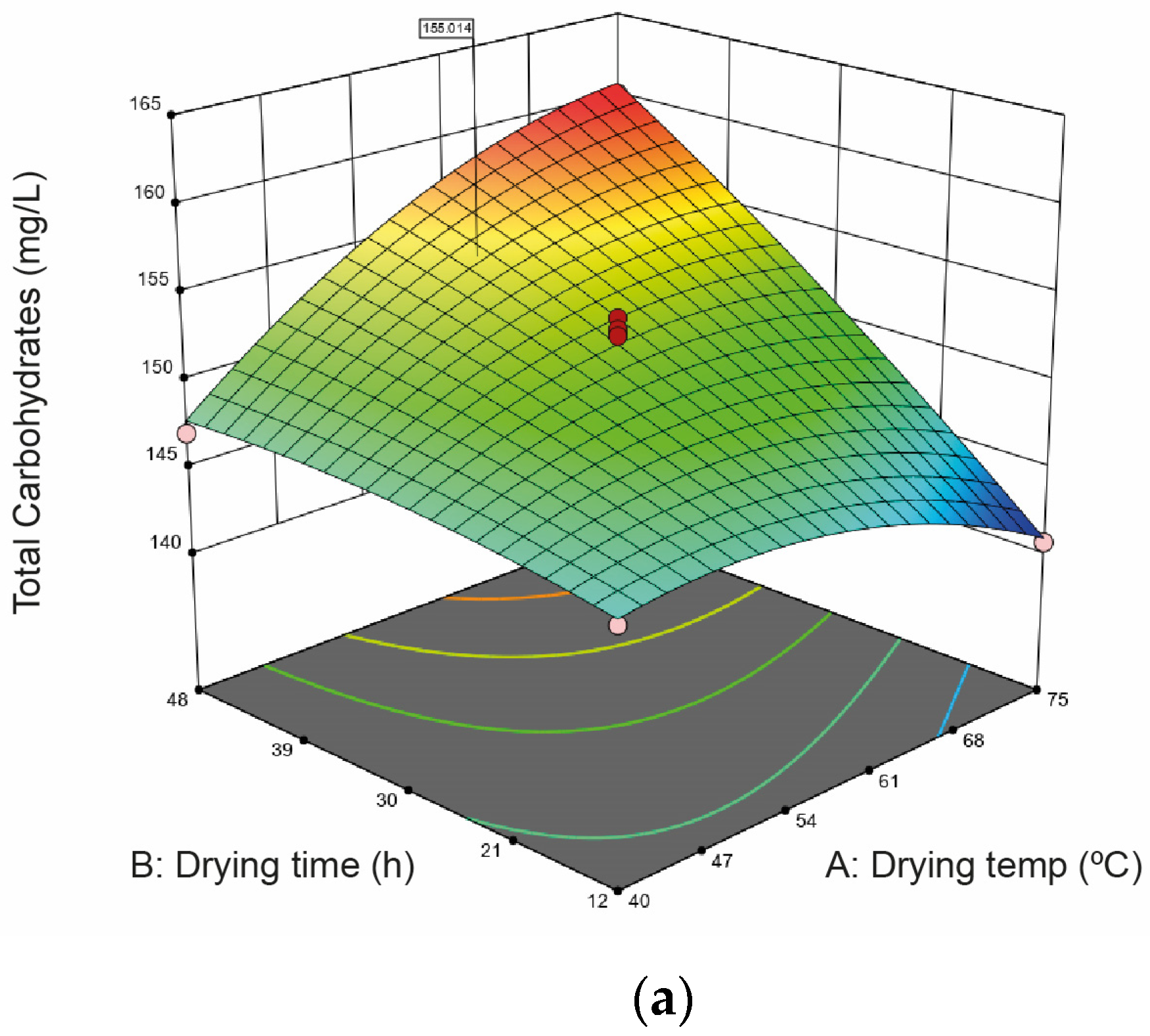
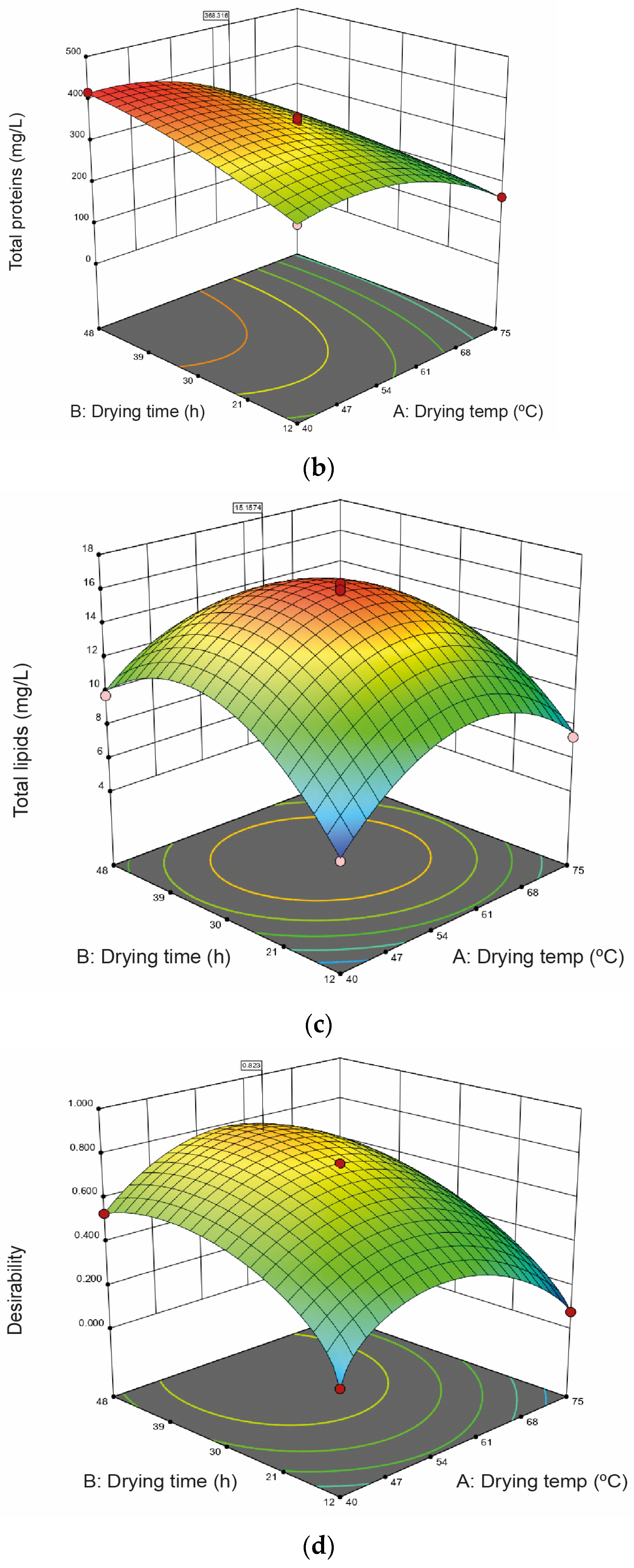
Figure 1 presents the response surfaces obtained from the central composite design for total carbohydrates (a), total proteins (b), total lipids (c), and the overall desirability function (d). For total carbohydrates (Figure 1a), the surface showed a progressive increase in the predicted response across the evaluated domain, with the highest values located at extended drying times and toward the upper temperature range of the model. Likewise, for total proteins (Figure 1b), higher predicted values were observed at prolonged drying times; however, in this case, the region of maximum response was displaced toward lower temperature values than for carbohydrates. Thus, within the studied interval, the carbohydrate response increased from the lower region of the design space, close to 40 °C and 12 h, toward drying times of approximately 39–48 h and temperatures above 60 °C, whereas the protein response reached its highest values at approximately 39–48 h and around 40–50 °C, decreasing progressively as temperature increased toward 68–75 °C.
In contrast, the response surface for total lipids (Figure 1c) displayed an internal maximum rather than a monotonic increase across the domain. Specifically, the highest predicted lipid values were concentrated around 30–39 h and approximately 54–61 °C, with a central maximum near 35 h and 60 °C, whereas the response decreased toward both lower and higher drying time and temperature values. Furthermore, the desirability surface (Figure 1d), which integrates the three fitted responses within the same experimental domain, showed its highest predicted values at intermediate-to-high temperatures combined with extended drying times, particularly around 54–61 °C and approximately 30–45 h; in turn, lower desirability values were observed toward the edges of the design space, especially at combinations corresponding to low drying times and the extreme values of the evaluated temperature interval.

3.3. Process Validation

Numerical optimization using a desirability function was used to identify drying conditions that simultaneously maximize the three fitted responses. The desirability surface indicated an optimum at 56.78 °C and 41.28 h, corresponding to the maximum predicted desirability within the evaluated domain. These optimized conditions, obtained from the CCD model, were subsequently applied to freshly harvested biomass during drying, and the expected and observed concentrations of total carbohydrates, total proteins, and total lipids were compared using a two-tailed one-sample t-test.
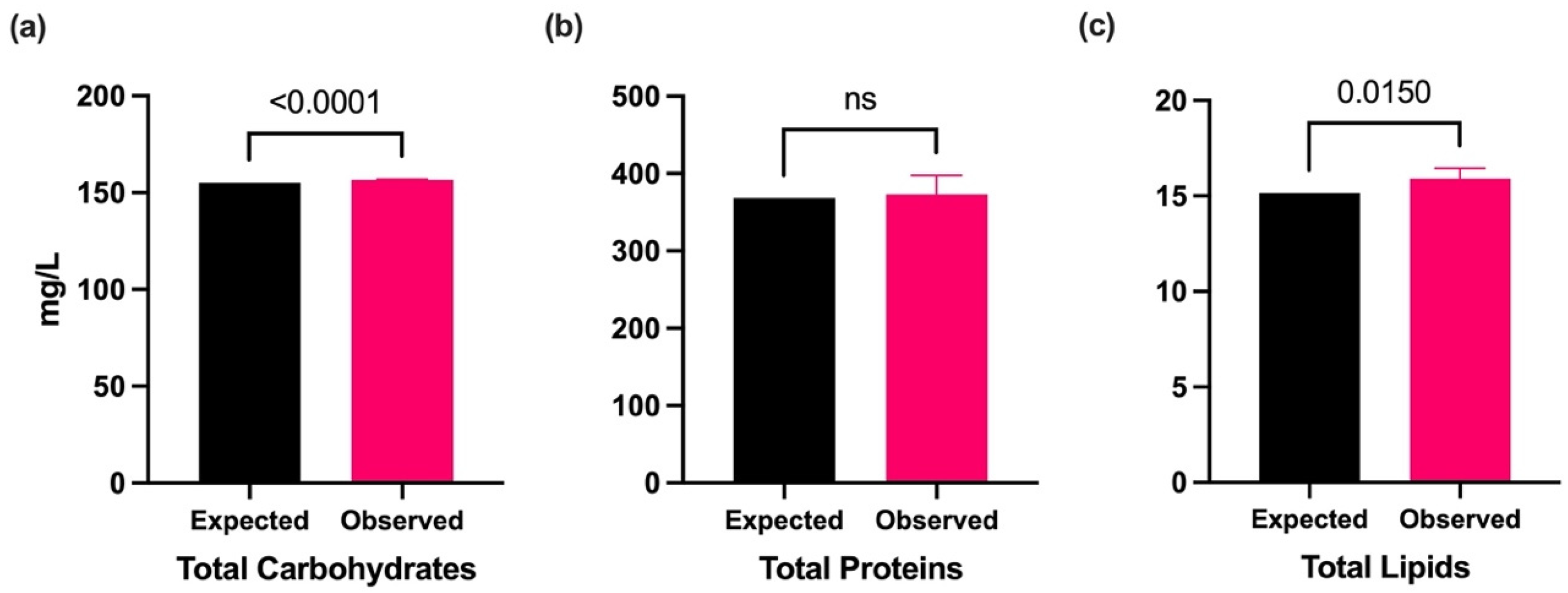
Figure 2 shows the expected and observed values obtained under the optimized drying conditions. For total carbohydrates (Figure 2a), the observed concentration differed significantly from the predicted value (p < 0.0001). In contrast, for total proteins (Figure 2b), no significant difference was detected between the expected and observed values (ns). For total lipids (Figure 2c), the observed concentration also differed significantly from the predicted value (p = 0.0150).

3.4. Moisture Content and Drying Rate of Harvested Biomass

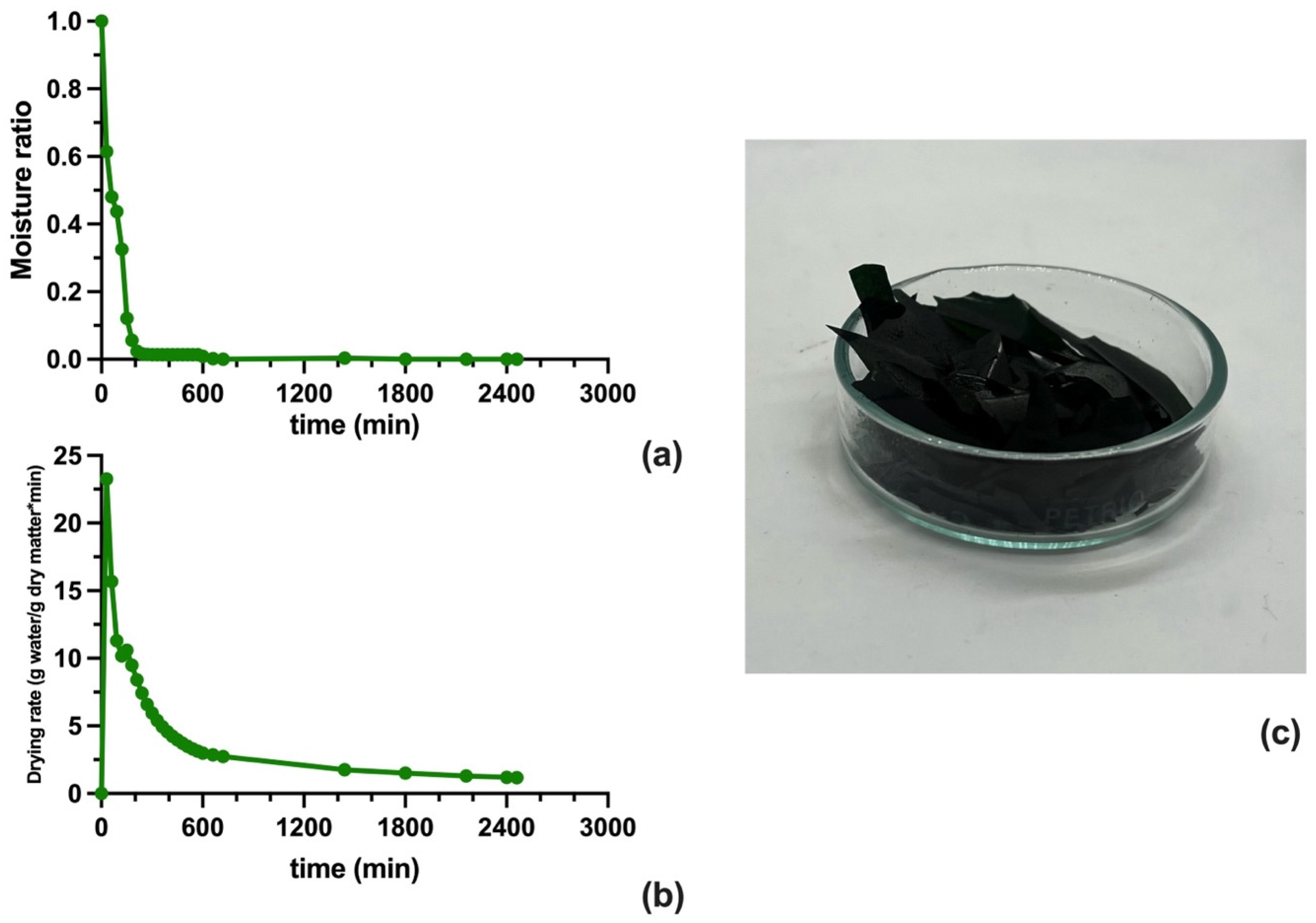
Figure 3a,b show the moisture ratio and drying rate profiles of the harvested biomass under the optimized harvesting and drying conditions. In this regard, the moisture ratio decreased markedly during the initial stage of the process, from 1.0 to values close to zero within the early drying period; subsequently, it remained near zero during the following intervals, and at approximately 2460 min (41 h) it was already close to zero. Likewise, the drying rate profile showed its maximum value at the initial measurement interval and then decreased continuously throughout the process. Moreover, the greatest variation was observed during the early stage, whereas at later times the curve exhibited a progressively lower slope and reached low values toward the final drying period. In addition, Figure 3c shows the dried algal biomass flakes obtained under the optimized conditions.

4. Discussion

4.1. Harvesting Route as a Determinant of Post-Harvest Biomass Conditioning

Across the screening stage, harvesting emerged as the only factor that significantly affected the three metabolite responses, which indicates that the post-harvest condition of the biomass was strongly influenced by the separation route applied before drying. Rather than acting only as a concentration step, harvesting appears to have conditioned the subsequent recovery behavior of carbohydrates, proteins, and lipids by modifying the physical and chemical state of the recovered solid. In this context, the different significance patterns observed for the three metabolites suggest that the response did not depend exclusively on biomass retention, but also on the characteristics of the material delivered to the drying stage. This interpretation is in line with previous studies indicating that harvesting configuration can alter the inorganic fraction associated with the biomass, aggregate compactness, and the practical accessibility of intracellular or structurally bound fractions during downstream processing [10,13]. Recent reviews on microalgal harvesting further emphasize that the effects of flocculation-based and electrochemical routes are not necessarily equivalent in terms of biomass quality, even when the biomass originates from the same cultivation batch [28].
Within that framework, the higher responses associated with electroflotation relative to chemical flocculation can be discussed in terms of differences in the condition of the biomass after recovery rather than as a simple contrast in separation efficiency. Under chemical flocculation, the addition of aluminum-based coagulants may increase the mineral fraction associated with the harvested biomass or modify the ionic environment carried into downstream processing [29]. This aspect becomes especially relevant when several fractions are assessed from the same post-harvest substrate, because residual salts or metals can affect the material’s downstream behavior and analytical response. In contrast, electrochemical harvesting reduces the need for direct addition of external coagulants, although its performance remains dependent on electrical parameters, electrode materials, and medium chemistry [30,31]. Recent work has shown that, when aluminum electrodes are used, residual aluminum can remain associated with the recovered biomass and may require a selective postwash step to minimize carryover into subsequent analyses [23]. In parallel, recent electrochemical harvesting studies have reported recovery efficiencies above 95% under optimized operating conditions, which reinforces the relevance of harvesting design as a determinant of downstream biomass conditioning [31]. Within the scope of the present study, these antecedents provide a consistent basis to interpret why the harvesting route remained significant across the three metabolite responses and why its effect did not behave uniformly among carbohydrates, proteins, and lipids

4.2. Drying Severity and Differential Behavior of Carbohydrate, Protein, and Lipid Fractions

The combined results from the screening stage, the CCD, and the response surfaces indicate that drying severity did not affect the three metabolite fractions in the same way. For carbohydrates, the response shifted toward longer drying times and the upper temperature range of the evaluated domain, placing this fraction in the region of greater thermal and temporal severity within the experimental space. In practical terms, this pattern indicates that carbohydrate recovery was favored under conditions associated with greater water removal, rather than by a single variable acting independently. Previous studies on microalgal drying kinetics have shown that longer drying periods are directly reflected in lower residual moisture and in changes in the accessibility of solid-associated fractions during subsequent analytical recovery, especially when the biomass is processed under convective regimes dominated by progressive moisture loss [13,32]. Recent analyses of Chlorella drying behavior also support that the evolution of moisture removal is strongly dependent on the applied thermal regime and that the behavior of the solid changes markedly across the drying trajectory, even within relatively narrow temperature intervals [33]. Within the scope of the present study, these antecedents provide a consistent basis for interpreting why the carbohydrate maximum was displaced toward longer drying times and higher temperatures, without requiring direct evidence of a specific structural mechanism.
A different distribution was observed for proteins and lipids, indicating that the optimal region for these fractions did not coincide with that of carbohydrates. For proteins, the highest response was observed at prolonged drying times and moderate-to-low temperatures, placing the protein-rich region in a sector of the factor space less severe than that associated with the carbohydrate maximum. This separation is compatible with the thermal sensitivity widely described for microalgal proteins during post-harvest processing, particularly when temperature becomes a stronger determinant than moisture removal alone [34,35,36]. Recent reviews of microalgal drying also note that, as severity increases, thermal treatments can more readily compromise protein quality than carbohydrate-rich fractions, although the extent of the effect depends on biomass composition and drying configuration [3]. For lipids, the response surface did not show a monotonic increase across the evaluated domain; instead, the highest values were concentrated in an internal region around intermediate temperature and drying time, which indicates a narrower operating window than those observed for carbohydrates or proteins. Similar internal maxima have been reported in drying studies, where lipid-associated responses were not favored at the highest thermal or temporal levels, but rather at intermediate conditions that balance dehydration and thermal exposure [32,36]. Taken together, these patterns indicate that drying acted as a conditioning stage with metabolite-specific operational windows, in which the response of each fraction was displaced to a different region of the factor space.

4.3. Quadratic Behavior, Interaction Effects, and Compromise Region of the Multivariable Model

The central composite design refined the trends identified during the screening stage by revealing nonlinear responses and significant interaction effects between drying temperature and drying time for the three metabolites. For carbohydrates, the predominance of drying time, together with the significance of the interaction term and the quadratic contribution of temperature, indicates that the response did not increase linearly across the evaluated domain, but shifted toward a region where the effect of prolonged drying depended on the applied temperature level [32]. For proteins, the simultaneous significance of temperature, time, interaction, and both quadratic terms indicates a more pronounced response to the combined variation in drying temperature and drying time, reflected in a narrower response region than that observed for carbohydrates [34,35,36]. For lipids, the relevance of both quadratic terms and the interaction term, together with the absence of significance of the linear temperature term, places the lipid response in a clearly non-monotonic domain, where the response is concentrated around an internal optimum rather than at the extreme values of the experimental space [32,36]. In this sense, the CCD did not simply confirm the screening trends but captured the curvature and interaction patterns observed for the three metabolite responses within the selected processing window.
Although the block term was retained in the ANOVA structure of the central composite design, its contribution was minor relative to the fitted model terms for the three responses. In Table 3, the sums of squares associated with the block term were 0.0223 for carbohydrates, 23.95 for proteins, and 1.12 for lipids, whereas the corresponding model sums of squares were 389.26, 1.019 × 10⁵, and 221.29, respectively. This contrast indicates that the variability captured by blocking was small compared with the systematic effects of drying temperature, drying time, and their interaction. In practical terms, retaining the block term preserved the experimental structure of the CCD without altering the overall interpretation that response curvature and compromise-region formation were governed primarily by the process variables rather than by between-block variability.
This interpretation is further supported by the fitted predictive equations obtained for the three responses (Equations (8)–(10)). In the three models, the negative quadratic coefficients indicate downward curvature within the evaluated domain, which is compatible with bounded response surfaces rather than unrestricted linear increases. For total carbohydrates, the positive interaction coefficient, together with the negative quadratic terms, indicates that the combined increase in drying temperature and drying time favored the response within the studied region, although this tendency was progressively limited as both factors moved away from the central domain. For total proteins, the positive linear coefficients of both factors, combined with the negative quadratic terms, describe a response that initially increased with temperature and time but became progressively restricted at higher levels of both variables. In contrast, the lipid equation showed negative quadratic coefficients for both factors, together with a negative interaction term, which is consistent with the internal optimum identified in the response surface and with the concentration of the highest predicted values at intermediate drying conditions rather than at the boundaries of the experimental space. Similar behavior has been reported in response-surface studies in which quadratic models define bounded optima and the signs of the second-order terms are directly associated with the locations of edge or internal stationary regions within the experimental domain [23,37].
This differential curvature across responses is also reflected in the response surfaces and in the desirability function. The regions of highest predicted carbohydrate and protein recovery were displaced toward different sectors of the factor space, whereas the lipid response was centered around an internal maximum at intermediate drying conditions. As a result, the overall desirability maximum did not coincide with the individual optimum of any single metabolite, but with a compromise region located at 56.78 °C and 41.28 h, where the three fitted responses reached the highest simultaneous agreement within the evaluated domain. Because the desirability function integrates the fitted behavior of the three responses simultaneously, the final compromise point was not constrained to the region initially identified during the screening stage, but to the CCD region where the best joint agreement among carbohydrate, protein, and lipid responses was obtained. In this sense, the location of the optimum at 56.78 °C and 41.28 h reflects the refinement introduced by the quadratic model and the interaction structure resolved during the CCD stage, rather than the isolated effect of any single factor considered in isolation.
This type of displacement between individual and global optima has been widely reported in multivariable optimization using desirability functions, where the final solution corresponds to the best joint satisfaction of partially divergent response surfaces rather than to the isolated maximization of a single variable [32]. Within the scope of the present study, the location of that region indicates that the post-harvest optimization space was shaped by metabolite-specific response windows and by the interaction between time and temperature within the drying stage, rather than by a single factor acting uniformly on the three fractions.

4.4. Predictive Consistency, Process Scope, and Study Limitations

Validation under the optimized conditions provided a useful basis to assess the predictive consistency of the fitted model. In the expected–observed comparison, protein recovery did not show significant differences, whereas carbohydrates and lipids did, indicating that the agreement between model prediction and experimental validation was not equivalent across the three responses [16,32]. In parallel, the moisture-ratio and drying-rate profiles located the optimized condition within the final section of the drying trajectory, since the biomass approached values close to zero moisture ratio at approximately 2460 min (41 h), while the drying-rate curve reached its highest value at the initial stage and then progressively decreased over time [32,38]. Under these conditions, the optimized point can be interpreted as a compromise region derived from the combined behavior of the three fitted responses, rather than as the individual maximum of a single metabolite [16,32].
At the same time, the present findings should be interpreted within the limits of the variables directly measured. The study demonstrates differential behavior of carbohydrate, protein, and lipid recovery as a function of harvesting route and drying conditions; however, it does not provide direct evidence of changes in water state, porosity, aggregate compactness, cell-wall disruption, residual mineral load, lipid oxidation, or protein denaturation. In microalgal downstream processing, these descriptors are commonly used to strengthen the interpretation of drying and dewatering responses, particularly when compositional and structural effects are discussed together [6]. Accordingly, the interpretation proposed here is supported by consistency with previous literature rather than by direct structural or physicochemical characterization of the processed biomass. This consideration is especially relevant for the lipid response, whose absolute values depend on the analytical basis of the sulfo-phospho-vanillin assay, and for the comparison between harvesting routes, where the contribution of residual inorganic matter was not independently quantified [29].
Furthermore, the optimized condition identified in this work is better understood as a laboratory-scale processing region for the simultaneous recovery of three metabolite fractions from the same post-harvest biomass. Recent reviews indicate that drying and dewatering remain among the most energy-intensive and scale-sensitive stages of the microalgal process chain, which means that the relevance of a laboratory optimum must eventually be examined together with specific energy demand, equipment configuration, and techno-economic performance [6,39]. In that context, additional evaluation of alternative drying technologies, residual mineral fraction, and structural attributes of the dried biomass would broaden the interpretation of the metabolite-specific response windows identified in the present study.

5. Conclusions

Harvesting and drying were confirmed as decisive post-harvest operations for defining the subsequent recoverability of carbohydrate, protein, and lipid fractions from Chlorella sp. (UFPS012). The screening stage showed that the harvesting method was the only factor consistently significant across the three responses, highlighting that biomass conditioning after concentration plays a determining role in downstream performance. In contrast, drying factors showed metabolite-dependent effects: carbohydrates were mainly influenced by drying time and harvesting method, proteins by drying time, equipment, and harvesting method, and lipids by drying temperature, equipment, and harvesting method. Within the evaluated domain, electroflotation coupled with a food-grade dehydrator provided the most favorable post-harvest configuration for the simultaneous conditioning of biomass intended for multimetabolite recovery.
Optimization through central composite design and response surface methodology identified a compromise condition at 56.78 °C and 41.28 h, at which the fitted models showed high goodness of fit (R2 = 0.9778–0.9959). Under these conditions, the predicted responses were approximately 155.0 mg/L for total carbohydrates, 368.4 mg/L for total proteins, and 15.2 mg/L for total lipids. Experimental validation showed no significant difference between predicted and observed values for proteins, whereas carbohydrates and lipids differed significantly, indicating that predictive consistency was response-dependent. In parallel, the moisture ratio approached zero at approximately 2460 min, while the drying rate decreased progressively throughout the process, placing the selected condition in the late-stage drying regime. Overall, the study defines a laboratory-scale post-harvest processing region for Chlorella biomass and provides a basis for future studies addressing specific energy demand, techno-economic feasibility, alternative drying technologies, residual mineral fraction, and the recovery of other Chlorella-relevant high-value compounds such as carotenoids.

Supplementary Materials

The following supporting information can be downloaded at: https://www.mdpi.com/article/10.3390/phycology6020035/s1.

Author Contributions

Conceptualization, A.Z., A.F.B.-S. and J.E.C.-R.; methodology, A.Z., J.B.G.-M. and J.E.C.-R.; software, R.L., A.Z. and N.A.U.-S.; validation, N.A.U.-S. and A.F.B.-S.; formal analysis, A.Z. and G.L.L.-B.; investigation, J.B.G.-M., J.E.C.-R. and G.L.L.-B.; resources, A.Z. and A.F.B.-S.; data curation, A.Z. and R.L.; writing—original draft preparation, A.Z. and J.E.C.-R.; writing—review and editing, J.B.G.-M. and A.F.B.-S.; visualization, A.F.B.-S., A.Z. and G.L.L.-B.; supervision, A.Z. and A.F.B.-S.; project administration, R.L. and A.F.B.-S.; funding acquisition, A.Z. and A.F.B.-S. All authors have read and agreed to the published version of the manuscript.

Funding

This study received financial support from Sapienza University through the Academic Mid Projects 2021 (Grant No. RM12117A8B58023A). Also, the NeWater project received funding through the WATER4ALL Partnership. Additionally, funding was provided by Universidad Francisco de Paula Santander (Colombia) (FINU 001-2025), the Ministry of Science and Technology of Colombia, and the Colombian Institute of Educational Credit and Technical Studies Abroad (MINCIENCIAS-ICETEX) under the project titled “FOTOLIX” with the ID 2023-0686.

Institutional Review Board Statement

Not applicable.

Informed Consent Statement

Not applicable.

Data Availability Statement

The original contributions presented in this study are included in the article. Further inquiries can be directed to the corresponding author.

Acknowledgments

We would like to express our sincere gratitude to Sapienza University of Rome and Universidad Francisco de Paula Santander (Colombia) for providing the equipment for this research. We also thank the Colombian Ministry of Science, Technology, and Innovation, MINCIENCIAS for supporting national Ph.D. Doctorates through the Francisco José de Caldas scholarship program.

Conflicts of Interest

The authors declare no conflicts of interest.

References

  1. Lafarga, T. Cultured Microalgae and Compounds Derived Thereof for Food Applications: Strain Selection and Cultivation, Drying, and Processing Strategies. Food Rev. Int. 2020, 36, 559–583. [Google Scholar] [CrossRef]
  2. Nitsos, C.; Filali, R.; Taidi, B.; Lemaire, J. Current and Novel Approaches to Downstream Processing of Microalgae: A Review. Biotechnol. Adv. 2020, 45, 107650. [Google Scholar] [CrossRef] [PubMed]
  3. Hernández, A.; González-Moya, M.; Márquez, A.; Acevedo, L. Review Microalgae Drying: A Comprehensive Exploration from Conventional Air Drying to Microwave Drying Methods. Future Foods 2024, 10, 100420. [Google Scholar] [CrossRef]
  4. Deconinck, N.; Muylaert, K.; Ivens, W.; Vandamme, D. Innovative Harvesting Processes for Microalgae Biomass Production: A Perspective from Patent Literature. Algal Res. 2018, 31, 469–477. [Google Scholar] [CrossRef]
  5. Gurreri, L.; Calanni Rindina, M.; Luciano, A.; Lima, S.; Scargiali, F.; Fino, D.; Mancini, G. Environmental Sustainability of Microalgae-Based Production Systems: Roadmap and Challenges towards the Industrial Implementation. Sustain. Chem. Pharm. 2023, 35, 101191. [Google Scholar] [CrossRef]
  6. Kendler, S.; Magnanelli, E.; Bless, M.; Nordtvedt, T.S. A Review of Dewatering and Drying Energy Requirements in Microalgae Production: Pathways towards Industrial Uptake and Bioeconomy Integration. Clean. Circ. Bioecon. 2025, 12, 100184. [Google Scholar] [CrossRef]
  7. Ubando, A.T.; Anderson, S.; Ng, E.; Chen, W.-H.; Culaba, A.B.; Kwon, E.E. Life Cycle Assessment of Microalgal Biorefinery: A State-of-the-Art Review. Bioresour. Technol. 2022, 360, 127615. [Google Scholar] [CrossRef] [PubMed]
  8. Chen, M.; Chen, Y.; Zhang, Q. A Review of Energy Consumption in the Acquisition of Bio-Feedstock for Microalgae Biofuel Production. Sustainability 2021, 13, 8873. [Google Scholar] [CrossRef]
  9. Deepa, P.; Sowndhararajan, K.; Kim, S. A Review of the Harvesting Techniques of Microalgae. Water 2023, 15, 3074. [Google Scholar] [CrossRef]
  10. Kuzhiumparambil, U.; Labeeuw, L.; Commault, A.; Vu, H.P.; Nguyen, L.N.; Ralph, P.J.; Nghiem, L.D. Effects of Harvesting on Morphological and Biochemical Characteristics of Microalgal Biomass Harvested by Polyacrylamide Addition, PH-Induced Flocculation, and Centrifugation. Bioresour. Technol. 2022, 359, 127433. [Google Scholar] [CrossRef]
  11. Sanchez-Galvis, E.M.; Cardenas-Gutierrez, I.Y.; Contreras-Ropero, J.E.; García-Martínez, J.B.; Barajas-Solano, A.F.; Zuorro, A. An Innovative Low-Cost Equipment for Electro-Concentration of Microalgal Biomass. Appl. Sci. 2020, 10, 4841. [Google Scholar] [CrossRef]
  12. Krishnamoorthy, N.; Unpaprom, Y.; Ramaraj, R.; Maniam, G.P.; Govindan, N.; Arunachalam, T.; Paramasivan, B. Recent Advances and Future Prospects of Electrochemical Processes for Microalgae Harvesting. J. Environ. Chem. Eng. 2021, 9, 105875. [Google Scholar] [CrossRef]
  13. de Morais, E.G.; Sampaio, I.C.F.; Gonzalez-Flo, E.; Ferrer, I.; Uggetti, E.; García, J. Microalgae Harvesting for Wastewater Treatment and Resources Recovery: A Review. New Biotechnol. 2023, 78, 84–94. [Google Scholar] [CrossRef]
  14. Shitanaka, T.; Fujioka, H.; Khan, M.; Kaur, M.; Du, Z.-Y.; Khanal, S.K. Recent Advances in Microalgal Production, Harvesting, Prediction, Optimization, and Control Strategies. Bioresour. Technol. 2024, 391, 129924. [Google Scholar] [CrossRef] [PubMed]
  15. Stramarkou, M.; Papadaki, S.; Kyriakopoulou, K.; Tzovenis, I.; Chronis, M.; Krokida, M. Comparative Analysis of Different Drying Techniques Based on the Qualitative Characteristics of Spirulina platensis Biomass. J. Aquat. Food Prod. Technol. 2021, 30, 498–516. [Google Scholar] [CrossRef]
  16. Aljabri, H.; Cherif, M.; Siddiqui, S.A.; Bounnit, T.; Saadaoui, I. Evidence of the Drying Technique’s Impact on the Biomass Quality of Tetraselmis subcordiformis (Chlorophyceae). Biotechnol. Biofuels Bioprod. 2023, 16, 85. [Google Scholar] [CrossRef]
  17. Ansari, F.A.; Gupta, S.K.; Nasr, M.; Rawat, I.; Bux, F. Evaluation of Various Cell Drying and Disruption Techniques for Sustainable Metabolite Extractions from Microalgae Grown in Wastewater: A Multivariate Approach. J. Clean. Prod. 2018, 182, 634–643. [Google Scholar] [CrossRef]
  18. Weber, S.; Grande, P.M.; Blank, L.M.; Klose, H. Insights into Cell Wall Disintegration of Chlorella vulgaris. PLoS ONE 2022, 17, e0262500. [Google Scholar] [CrossRef]
  19. Hammann, W.; Ross, A.; Seames, W. Sequential Extraction of Carbohydrates and Lipids from Chlorella vulgaris Using Combined Physical and Chemical Pre-Treatments. ChemEngineering 2024, 8, 11. [Google Scholar] [CrossRef]
  20. Andersen, R.; Berges, J.; Harrison, P.; Watanabe, M. Recipes for Freshwater and Seawater Media. In Algal Culture Techniques; Elsevier Academic Press: Amsterdam, The Netherlands, 2005. [Google Scholar]
  21. Castellanos-Estupinan, M.; Sanchez-Galvis, M.; Garcia-Martinez, J.B.; Barajas-Ferreira, C.; Zuorro, A.; Barajas-Solano, A.F. Design of an Electroflotation System for the Concentration and Harvesting of Freshwater Microalgae. Chem. Eng. Trans. 2018, 64, 1–6. [Google Scholar] [CrossRef]
  22. Barajas-Solano, A.F. Optimization of Phycobiliprotein Solubilization from a Thermotolerant oscillatoria Sp. Processes 2022, 10, 836. [Google Scholar] [CrossRef]
  23. Cabrera-Casadiego, L.B.; García-Martínez, J.B.; Contreras-Ropero, J.E.; Zuorro, A.; Barajas-Solano, A.F. Response Surface Methodology for Optimizing Aluminum Desorption from Electroflocculated Algal Biomass. Phycology 2025, 5, 73. [Google Scholar] [CrossRef]
  24. Moheimani, N.R.; Borowitzka, M.A.; Isdepsky, A.; Sing, S.F. Standard Methods for Measuring Growth of Algae and Their Composition. In Algae for Biofuels and Energy; Springer: Dordrecht, The Netherlands, 2013; pp. 265–284. [Google Scholar]
  25. Slocombe, S.P.; Ross, M.; Thomas, N.; McNeill, S.; Stanley, M.S. A Rapid and General Method for Measurement of Protein in Micro-Algal Biomass. Bioresour. Technol. 2013, 129, 51–57. [Google Scholar] [CrossRef]
  26. Mishra, S.K.; Suh, W.I.; Farooq, W.; Moon, M.; Shrivastav, A.; Park, M.S.; Yang, J.-W. Rapid Quantification of Microalgal Lipids in Aqueous Medium by a Simple Colorimetric Method. Bioresour. Technol. 2014, 155, 330–333. [Google Scholar] [CrossRef]
  27. Agbede, O.O.; Oke, E.O.; Akinfenwa, S.I.; Wahab, K.T.; Ogundipe, S.; Aworanti, O.A.; Arinkoola, A.O.; Agarry, S.E.; Ogunleye, O.O.; Osuolale, F.N.; et al. Thin Layer Drying of Green Microalgae (Chlorella Sp.) Paste Biomass: Drying Characteristics, Energy Requirement and Mathematical Modeling. Bioresour. Technol. Rep. 2020, 11, 100467. [Google Scholar] [CrossRef]
  28. Li, S.; Hu, T.; Xu, Y.; Wang, J.; Chu, R.; Yin, Z.; Mo, F.; Zhu, L. A Review on Flocculation as an Efficient Method to Harvest Energy Microalgae: Mechanisms, Performances, Influencing Factors and Perspectives. Renew. Sustain. Energy Rev. 2020, 131, 110005. [Google Scholar] [CrossRef]
  29. Rossi, S.; Visigalli, S.; Castillo Cascino, F.; Mantovani, M.; Mezzanotte, V.; Parati, K.; Canziani, R.; Turolla, A.; Ficara, E. Metal-Based Flocculation to Harvest Microalgae: A Look beyond Separation Efficiency. Sci. Total Environ. 2021, 799, 149395. [Google Scholar] [CrossRef]
  30. Castro-Muñoz, R.; García-Depraect, O. Membrane-Based Harvesting Processes for Microalgae and Their Valuable-Related Molecules: A Review. Membranes 2021, 11, 585. [Google Scholar] [CrossRef] [PubMed]
  31. Pratama, W.D.; Hadiyanto, H.; Aziz, M.; Widiasa, I.N.; Saputra, A.R.; Azhar, R.F. Low-Energy Microalgae Harvesting Using Electrocoagulation and Its Process Optimization. Results Eng. 2026, 29, 108576. [Google Scholar] [CrossRef]
  32. Behera, B.; Balasubramanian, P. Experimental and Modelling Studies of Convective and Microwave Drying Kinetics for Microalgae. Bioresour. Technol. 2021, 340, 125721. [Google Scholar] [CrossRef]
  33. Karmakar, D.; Tasnim, N.; Hasan, M.R.; Hossain, M.S.; Arefin, P.; Bhowmik, D.; Nibir, Y.M.; Kabir, K.B.; Karim, R. Kinetic Study and Modelling of Drying of Chlorella vulgaris. Heliyon 2024, 10, e38441. [Google Scholar] [CrossRef]
  34. Van De Walle, S.; Gifuni, I.; Coleman, B.; Baune, M.-C.; Rodrigues, A.; Cardoso, H.; Fanari, F.; Muylaert, K.; Van Royen, G. Innovative vs Classical Methods for Drying Heterotrophic Chlorella vulgaris: Impact on Protein Quality and Sensory Properties. Food Res. Int. 2024, 182, 114142. [Google Scholar] [CrossRef]
  35. Van De Walle, S.; Broucke, K.; Baune, M.-C.; Terjung, N.; Van Royen, G.; Boukid, F. Microalgae Protein Digestibility: How to Crack Open the Black Box? Crit. Rev. Food Sci. Nutr. 2024, 64, 7149–7171. [Google Scholar] [CrossRef] [PubMed]
  36. Schmid, B.; Navalho, S.; Schulze, P.S.C.; Van De Walle, S.; Van Royen, G.; Schüler, L.M.; Maia, I.B.; Bastos, C.R.V.; Baune, M.-C.; Januschewski, E.; et al. Drying Microalgae Using an Industrial Solar Dryer: A Biomass Quality Assessment. Foods 2022, 11, 1873. [Google Scholar] [CrossRef] [PubMed]
  37. Konar, N.; Durmaz, Y.; Genc Polat, D.; Mert, B. Optimization of Spray Drying for Chlorella vulgaris by Using RSM Methodology and Maltodextrin. J. Food Process. Preserv. 2022, 46, e16594. [Google Scholar] [CrossRef]
  38. Anyanwu, R.C.; Rodriguez, C.; Durrant, A.; Olabi, A.G. Optimisation of Tray Drier Microalgae Dewatering Techniques Using Response Surface Methodology. Energies 2018, 11, 2327. [Google Scholar] [CrossRef]
  39. Baldelli, A.; Weng, Y.; Prakash, S.; Bhandari, B. Optimizing Microalgae Bioprocessing and Digestibility: Spraying Techniques for Drying and Encapsulation. Food Biosci. 2025, 68, 106288. [Google Scholar] [CrossRef]
Figure 1. Surface responses obtained from the Central Composite Design for total carbohydrates (a), total proteins (b), total lipids (c), and desirability of the model (d).
Phycology 06 00035 g001aPhycology 06 00035 g001b
Figure 2. Expected vs. observed concentrations of total carbohydrates (a), total proteins (b), and total lipids (c) under optimized drying conditions.
Phycology 06 00035 g002
Figure 3. Moisture ratio (a) and drying rate (b) of the algal biomass under optimal conditions of harvesting and drying. Dried flakes of algal biomass (c).
Phycology 06 00035 g003
Table 1. Main variables (categorical and numerical) studied for harvesting and drying the produced biomass.
FactorNameUnitsTypeMinimumMaximum
ADrying temperature°CNumeric4060
BDrying timeh1830
CDrying methodn/aCategoricOvenDehydrator
DHarvesting methodFlocculationElectroflotation
Table 2. ANOVA of the results obtained from the I-optimal design for the selection of the most relevant variables.
MetaboliteSourceSum of SquaresdfMean SquareF Valuep Value
Total
Carbohydrates
Model234.021023.4032.41<0.0001 *
A-Drying temperature0.004010.00400.00550.9423 **
B-Drying time6.0116.018.320.0163 *
C-Drying equipment0.033610.03360.04650.8336 **
D-Harvesting method146.821146.82203.32<0.0001 *
Residual7.22100.7221
Lack of Fit4.2250.84421.410.3585 **
Pure Error3.0050.6000
Cor Total241.2420
Total
Proteins
Model1.183 × 105619,718.1012.91<0.0001 *
A-Drying temperature833.301833.300.54570.4723 **
B-Drying time46,590.86146,590.8630.51<0.0001 *
C-Drying equipment16,428.39116,428.3910.760.0055 *
D-Harvesting method27,576.62127,576.6218.060.0008 *
Residual21,378.46141527.03
Lack of Fit18,600.7192066.753.720.0809 **
Pure Error2777.755555.55
Cor Total1.397 × 10520
Total
lipids
Model263.701026.3748.14<0.0001 *
A-Drying temperature67.71167.71123.60<0.0001 *
B-Drying time0.003810.00380.00700.9349 **
C-Drying equipment7.9417.9414.500.0034 *
D-Harvesting method149.971149.97273.76<0.0001 *
Residual5.48100.5478
Lack of Fit4.4750.89404.440.0639
Pure Error1.0150.2016
Cor Total269.1720
R2Adj R2Pred R2Std. Dev.Adeq PrecisionMeanC.V. %
Total
Carbohydrates
0.97010.94010.84510.849816.2528151.480.5610
Total
Proteins
0.84700.78140.608339.0811.7411240.1416.27
Total
Lipids
0.97960.95930.87875.1818.514148.0710.78
* Significant; ** Not significant.
Table 3. ANOVA of the results obtained from the central composite design.
MetaboliteSourceSum of SquaresdfMean SquareF Valuep Value
Total
Carbohydrates
Block0.022310.0223
Model389.26577.8561.75<0.0001 *
A-Drying temperature28.19128.1922.360.0021 *
B-Drying time228.211228.21181.02<0.0001 *
AB84.87184.8767.32<0.0001 *
A245.48145.4836.080.0005 *
B24.4014.403.490.1040 **
Residual8.8271.26
Lack of Fit4.1831.391.200.4165 **
Pure Error4.6441.16
Cor Total398.1013
Total
Proteins
Block23.95123.95
Model1.019 × 105520,370.35207.68<0.0001 *
A-Drying temperature54,796.60154,796.60558.67<0.0001 *
B-Drying time14,326.48114,326.48146.06<0.0001 *
AB2460.5112460.5125.090.0016 *
A228,998.46128,998.46295.65<0.0001 *
B22364.5612364.5624.110.0017 *
Residual686.59798.08
Lack of Fit53.58317.860.11280.9481 **
Pure Error633.024158.25
Cor Total1.026 × 10513
Total
lipids
Block1.1211.12
Model221.29544.26341.94<0.0001 *
A-Drying temperature0.204610.20461.580.2489 **
B-Drying time15.77115.77121.83<0.0001 *
AB2.1112.1116.320.0049 *
A2104.601104.60808.15<0.0001 *
B2114.221114.22882.47<0.0001 *
Residual0.906070.1294
Lack of Fit0.059730.01990.09410.9594 **
Pure Error0.846340.2116
Cor Total223.3213
R2Adj R2Pred R2Std. Dev.Adeq PrecisionMeanC.V. %
Total
Carbohydrates
0.97780.96200.91590.561425.058075.160.7470
Total
Proteins
0.99330.98850.98409.9044.8823298.893.31
Total
Lipids
0.99590.99300.99050.359841.485011.423.15
* Significant; ** Not significant.
Disclaimer/Publisher’s Note: The statements, opinions and data contained in all publications are solely those of the individual author(s) and contributor(s) and not of MDPI and/or the editor(s). MDPI and/or the editor(s) disclaim responsibility for any injury to people or property resulting from any ideas, methods, instructions or products referred to in the content.