


Abstract
Background: Activity trackers support physical activity, yet evidence on their effectiveness among older adults and care partners is limited. This study assesses the relationship between activity-tracking frequency and engagement in consistent physical activity among older adults and care partners. Methods: For this cross-sectional study, 615 older adults and care partners completed online surveys assessing the frequency of activity tracking (predictor) and the regularity in physical activity engagement (outcome). Using multivariable logistic regression, we assessed the association between the predictors and the outcome across the entire population and separately among older adults (n = 310) and care partners (n = 305), adjusting for sociodemographic, mobility, and health-related covariates. We reported the adjusted odds ratio (aOR) and 95% confidence intervals (CI). Results: Older adult (OA) and care partner (CP) respondents were predominantly female (OA: 57%, CP: 53%) and non-Hispanic White (OA: 51%, CP: 43%). Across the entire population, frequent tracking of physical activity was associated with a 2.4-fold increase in the odds of engaging in consistent physical activity (aOR: 2.40; 95% CI: 1.45–3.96). Older adults who frequently track their physical activity were 2.5 times more likely to engage in consistent physical activity (aOR: 2.47; 95% CI: 1.08–5.64). Care partners who occasionally tracked their physical activity were 3.5 times more likely to engage in consistent physical activity (aOR: 3.54; 95% CI: 1.54–8.11). Conclusions: Physical activity tracking is associated with greater physical activity engagement among older adults and care partners. These findings contribute to understanding factors associated with physical activity behavior in this population.
1. Introduction
Physical activity is a critical determinant of healthy aging [1,2], promoting mobility [3,4], cardiovascular function [5,6], cognitive health [7,8], and overall quality of life in older adults [9,10,11,12]. Despite these substantial benefits [13,14,15], fewer than one in four older adults in the United States [16] meet recommended physical activity guidelines, with participation declining further in the presence of chronic disease, mobility limitations, or advancing age [17,18]. Lack of physical activity often extends to care partners, defined as family members or friends who provide physical, emotional, or logistical support to an older adult [19], who may face similar or even heightened barriers to maintaining regular activity [20,21,22]. Time constraints, caregiving responsibilities, stress, and competing daily demands can limit opportunities for both older adults and their care partners to engage in consistent physical activity [20,21,22,23,24]. In addition, health- and mobility-related factors such as prior falls, functional limitations, frailty, and comorbid conditions can shape the ability to be active [25,26,27,28,29,30], influencing how older adults and care partners engage with physical activity and tracking technologies.
As interest grows in practical approaches to increase physical activity, digital activity trackers, including smartphones, pedometers, and wearable devices, have emerged as widely accessible tools that encourage self-monitoring and behavior change [31,32]. These devices provide real-time feedback, reinforce progress, promote awareness of daily movement, and facilitate long-term adherence to physical activity [32]. For older adults and care partners, who often navigate fluctuating schedules and complex health-related demands, activity tracking may offer a simple and adaptable strategy to support consistent engagement in physical activity [33,34].
Existing research indicates that older adults adopt wearable activity trackers at lower rates than younger populations [35,36,37]. Also, randomized trials have demonstrated short-term increases in daily step counts and moderate-to-vigorous physical activity among older adults using activity trackers [38,39,40,41,42,43,44,45,46]. While some observational studies have examined associations between wearable use and activity levels among older adults [47,48,49], the evidence base characterizing the naturally occurring frequency of wearable use and its relationship to consistent physical activity behavior in real-world settings remains limited. Care partners are rarely examined as a distinct group in experimental and observational studies [50]. A recent scoping review of technology use among female caregivers identified only two studies specifically examining activity tracking in this population [50], both of which reported benefits of tracking for physical activity behavior [51,52]. Despite these potential benefits, little is known about how wearable activity trackers may affect caregiving burden or influence downstream health and physical activity outcomes among care partners. In addition, examining care partners and older adult care recipients in parallel allows determination of whether the association between activity tracking frequency and physical activity engagement differs by caregiving role, informing whether interventions should be tailored separately or applied broadly across caregiving roles.
The aim of this study, therefore, is to evaluate the association between the frequency of activity tracking and consistent physical activity engagement among older adults and care partners. We hypothesized that more frequent tracking would be associated with higher odds of engaging in regular physical activity, with potentially distinct patterns between older adults and care partners. Understanding how tracking behaviors relate to physical activity engagement can inform low-cost, scalable strategies to promote health and mobility in aging populations and their support networks.
2. Materials and Methods
2.1. Study Design and Setting
We conducted a cross-sectional online survey to examine the relationship between activity-tracking behaviors and consistent physical activity among older adults and their care partners. The survey was administered as part of the pilot and survey validation of the Activity Tracking, Care Partner Co-Participation, Text Reminders, Instructional Education, Virtual Physical Therapy, and Exercise (ACTIVE) project (IRB: i25-01158; ClinicalTrials.gov registration: NCT07321587) [53,54].
2.2. Participant Recruitment
Participants were recruited nationwide through ResearchMatch, a National Institutes of Health-supported volunteer registry that connects researchers with individuals interested in participating in health studies [55]. Recruitment messages were distributed to eligible platform members, and individuals who responded were directed to an electronic consent form and the study survey. Data were collected and stored using Research Electronic Data Capture (REDCap), a secure, web-based platform for research data management [56].
2.3. Eligibility Criteria
Two groups were eligible for participation: older adults and care partners. Older adults were eligible if they were aged 65 years or older, could read English, and had internet access to complete the online survey. Care partners were eligible if they were aged 18 years or older, provided ongoing unpaid support to an older adult, and met the same language and internet-access requirements. Individuals providing paid or formal caregiving services and respondents who indicated substantial difficulty completing an online survey due to cognitive limitations were excluded.
2.4. Outcome Measure
The primary outcome was engagement in consistent physical activity. Respondents were asked, “In the past week, how many days did you engage in physical activity, such as walking or light exercise?” Response was measured on an ordinal scale: 0 days, 1–2 days, 3–4 days, 5 or more days. We defined consistent physical activity as engagement in physical activity for 3 or more days per week.
2.5. Primary Predictor Variable
The main predictor, frequency of activity tracking, was measured using a single item from a previously validated survey—Physical Activity Practice Scale [57]. The specific item selected was: “I track my physical activity levels using a device or app.” While the full scale includes six additional items assessing physical activity practices, we selected only this item to specifically capture tracking behavior rather than physical activity itself. The original scale has excellent content validity (CVI = 0.95) and reliability (α) = 0.91, supporting the validity of using this item as a focused measure of tracking frequency. Response to this survey item was measured using a five-item ordinal scale: never, rarely, sometimes, often, always. We defined frequency of activity tracking as either rarely (“never” or “rarely”), occasionally (“sometimes”), or frequently (“often” or “always”).
2.6. Potential Confounders
We selected sociodemographic, mobility, and health characteristics as potential confounders of the association between frequency of activity tracking and consistent physical activity, based on prior literature [15,52,58,59,60,61]. Sociodemographic characteristics included age, sex, race and ethnicity, educational attainment, marital status, and living situation (living alone versus with others). Mobility-related factors included a history of a fall in the past year and functional limitations. For the mobility characteristic, respondents were asked whether they had fallen in the past 12 months (yes or no) and whether they had any health conditions that limit their ability to be physically active (yes or no). Health characteristics included the Charlson Comorbidity Index and the Clinical Frailty Scale score. The Charlson comorbidity index is a measure of the comorbidities and a predictor of 10-year mortality, computed from 16 chronic diseases [62,63]. The score is a weighted sum of the 16 chronic diseases and age, ranging from 0 to 24 [64,65]. We measured the Charlson comorbidity index as a continuous variable, excluding age. The Clinical Frailty Scale, a measure of frailty, is a 9-item scale (Cronbach alpha: 0.76–0.91) that assesses an individual’s vulnerability to stressors [66,67,68]. We defined the Clinical Frailty Scale score as a three-level categorical variable—fit (scores 1–3), vulnerable (score of 4), and frail (score of 5–9), consistent with prior studies [69,70].
2.7. Missing Data
A total of 698 eligible persons consented to participate in the survey. However, 83 of them did not complete any survey questions and were excluded. We received complete survey responses from the remaining 615 (88.1%) respondents.
2.8. Statistical Analysis
We reported the frequency distributions of all categorical variables. Continuous variables were summarized using means and standard deviations or medians and interquartile ranges, depending on their distribution. Bivariate associations between participant characteristics and consistent physical activity were examined using chi-square tests, independent-samples t-tests, and Mann–Whitney U tests, as appropriate. To evaluate the association between activity-tracking behavior and consistent physical activity, we first assessed variance inflation factors and correlation coefficients among the covariates, ensuring that no covariate exhibited a correlation greater than 0.3 and that the model’s variance inflation factor did not exceed 3.0 [71]. All the variables in the model met these criteria. Next, we performed a multivariable logistic regression for three analytic groups: the combined sample of older adults and care partners (n = 615), older adults only (n = 310), and care partners only (n = 305). We reported the adjusted odds ratios (aORs) with corresponding 95% confidence intervals. As a sensitivity analysis, we conducted multivariable ordinal logistic regression treating physical activity engagement as a four-level ordinal outcome (0, 1–2, 3–4, and 5 or more days per week). Predicted probabilities were estimated for each activity-tracking category to estimate the likelihood of engaging in each physical activity category.
Model fit was evaluated using multiple complementary statistics. The likelihood ratio (LR) chi-square test compares the full model to an intercept-only model; a p-value < 0.05 indicates that the predictors jointly improve model fit over the null model [72]. Pseudo R2 was reported as an index of explanatory strength, with values of 0.10 and higher generally acceptable in behavioral and epidemiologic research [73]. Goodness-of-fit statistics (Hosmer–Lemeshow test) were used to assess calibration by comparing observed and predicted outcome frequencies [72]. A non-significant p-value (p > 0.05) suggests no evidence of lack of fit [72]. Akaike information criteria (AIC) and Bayesian information criteria (BIC) were reported to allow comparison of relative model fit and parsimony between logistic and ordinal logistic regression models, with lower values indicating better fit [74]. All analyses were performed using Stata version 16 [75].
2.9. Ethical Considerations
This study was approved by the New York University Langone Health Institutional Review Board (IRB# i25-00450). All study participants provided electronic informed consent before access to the survey. Study procedures adhered to institutional and federal ethical guidelines for research involving human participants.
3. Results
The mean age was 52.8 years (SD 19.0) for the overall sample, 70.1 years (SD 4.3) for older adults, and 35.3 years (SD 10.1) for care partners (Table 1). Overall, 55.0% of participants were female (older adults 57.1%, care partners 52.8%). By race and ethnicity, 42.9% were non-Hispanic White (older adults 50.7%, care partners 35.1%), 30.6% non-Hispanic Black (older adults 31.6%, care partners 29.5%), 20.7% Hispanic (older adults 11.3%, care partners 30.2%), and 5.8% other races (older adults 6.5%, care partners 5.3%). Regarding mobility and health characteristics, 22.1% of participants reported a fall in the prior year (older adults 24.5%, care partners 19.7%), and functional limitations were more common among older adults (13.5%) than care partners (3.0%). Most participants had no comorbidity (79.3%) and were categorized as fit on the clinical frailty scale (90.9%), though frailty was more prevalent among older adults (7.1% vs. 5.2%). Also, 59.2% of participants reported frequent activity tracking (older adults 61.9%, care partners 56.4%). Overall, 70.1% engaged in consistent physical activity, with higher participation among older adults (78.4%) compared with care partners (61.6%).
Table 1.
Sociodemographic, mobility, and health characteristics of the study population (n = 615), including older adults (n = 310) and care partners (n = 305).
Consistent physical activity was associated with several sociodemographic characteristics (Table 2). Older adults were more likely to report consistent physical activity engagement than care partners (OR 0.44; 95% CI: 0.31–0.63). Across the overall sample, increasing age was associated with consistent physical activity engagement (OR 1.02; 95% CI: 1.01–1.03). Males had lower odds of consistent physical activity engagement than females (OR 0.60; 95% CI: 0.43–0.86). Compared with Non-Hispanic White participants, non-Hispanic Black (OR 0.31; 95% CI: 0.20–0.48), Hispanic (OR 0.37; 95% CI: 0.23–0.61), and other racial groups (OR 0.18; 95% CI: 0.09–0.38) had lower odds of consistent physical activity engagement. Participants living alone were less likely to be active than those living with others (OR 0.59; 95% CI: 0.42–0.84). Mobility and health characteristics, including prior falls, functional limitations, comorbidity burden, and frailty, were not significantly associated with consistent physical activity engagement.
Table 2.
Bivariate association and unadjusted odds ratio between engagement in physical activity and activity tracking behavior, sociodemographic, mobility, and health characteristics among the study population (n = 615).
In the unadjusted analysis, activity-tracking behavior was not significantly associated with consistent physical activity (Table 2). After adjusting for demographic, social, mobility, and health characteristics, activity-tracking behavior was associated with consistent activity (Table 3). In the overall population, both occasional (aOR 2.18, 95% CI 1.19–4.01) and frequent tracking (aOR 2.40, 95% CI 1.45–3.96) were associated with higher odds of consistent physical activity. Among older adults, frequent tracking, but not occasional tracking, was associated with consistent physical activity (aOR 2.47, 95% CI 1.08–5.64). In contrast, among care partners, occasional tracking, but not frequent tracking, was associated with consistent physical activity (aOR 3.54, 95% CI 1.54–8.11).
Table 3.
Multivariable logistic regression result of the association between engagement in physical activity and activity tracking behavior among the study population and separately among older adults and care partners.
For the sensitivity analysis, all odds ratios were relative to the lowest activity category (1–2 days, 3–4 days, and 5 or more days per week vs. 0 days per week), and we similarly adjusted for demographic, social, mobility, and health characteristics (Table 4). In the overall population, both occasional (aOR 2.53; 95% CI 1.51–4.25) and frequent activity tracking (aOR 2.49; 95% CI 1.64–3.76) were associated with higher odds of engaging in more days of physical activity. Among older adults, frequent activity tracking, but not occasional activity tracking, was associated with higher odds of engaging in more days of physical activity (aOR 1.91; 95% CI 1.03–3.54). In contrast, among care partners, both occasional (aOR 3.44; 95% CI 1.73–6.86) and frequent activity tracking (aOR 3.29, 95% CI 1.79–6.05) were associated with higher odds of engaging in more days of physical activity.
Table 4.
Multivariable ordinal logistic regression result of the association between engagement in physical activity and activity tracking behavior among the study population and separately among older adults and care partners.
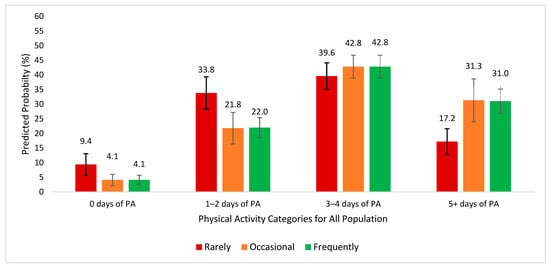
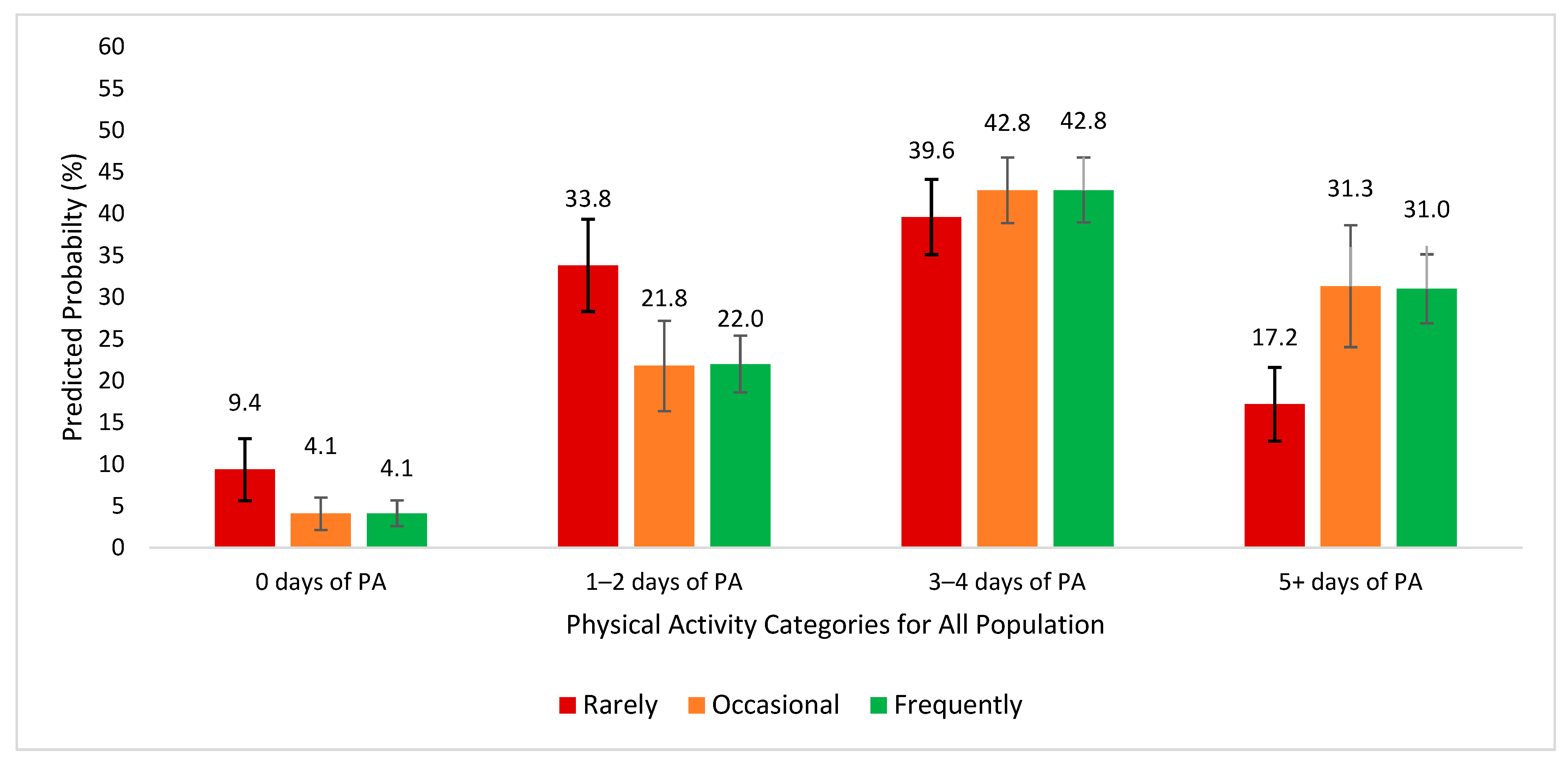
We computed the predicted probabilities from the ordinal logistic regression models. In the overall population, those with occasional (predicted odds: 31.3%; 95% CI: 26.9–35.2%) and frequent activity tracking behavior (predicted odds: 31.0%; 95% CI: 17.6–34.1%) had higher probabilities of engaging in five or more days of physical activity per week compared to rare activity trackers (predicted odds: 17.2%; 95% CI: 12.8–21.6%) (Figure 1). Those with rare activity tracking behavior were more likely to engage in 1–2 days of physical activity per week (predicted odds: 33.8%; 95% CI: 28.3–39.4%) compared to those with occasional (predicted odds: 21.8%; 95% CI: 16.4–27.2%) and frequent activity tracking behavior (predicted odds: 22.0%; 95% CI: 18.6–25.4%). Due to sparse cell counts in some activity tracking–physical activity categories, predicted probabilities were not calculated for subgroups of older adults and care partners.
Figure 1.
Predicted probabilities of physical activities across the entire study population. PA: Physical Activity. Vertical lines represent 95% confidence intervals. Predicted estimates generated from adjusted ordinal logistic regression models after accounting for age, sex, race/ethnicity, education, marital status, living situation, fall history, functional limitation, Charlson comorbidity index, and frailty status.
4. Discussion
In this cross-sectional study of 615 older adults and care partners, we found that more frequent activity tracking was associated with significantly greater engagement in consistent physical activity. Specifically, older adults who frequently tracked their activity were more likely to engage in consistent physical activity, whereas those who tracked occasionally did not show a similar effect. Among care partners, occasional tracking—rather than frequent tracking—was significantly associated with consistent physical activity.
Activity tracking has been consistently linked to higher physical activity levels through mechanisms rooted in self-regulation and behavior-change theories [76,77,78,79]. Self-monitoring increases awareness of daily movement, strengthens accountability, and enables individuals to set and evaluate progress toward personalized goals [80]. Prior studies have shown that tracking reinforces positive feedback loops that motivate continued activity and can reduce sedentary time [78,81]. For older adults in particular, tracking may provide a compensatory structure that supports habit formation and offers real-time validation of effort [33,82]. Among care partners, activity tracking may also serve as a self-care tool, providing a structured way to maintain health behaviors amid caregiving responsibilities [22,52].
We report that older adults who frequently tracked their activity had substantially higher odds of engaging in consistent physical activity, consistent with earlier studies [31,83]. A plausible explanation may be that older adults who track frequently may have integrated activity tracking into their daily routines, using feedback to maintain accountability and motivation [33,84,85]. However, older adults’ adoption and continued use of physical activity trackers may be influenced by personal and social factors, as well as smartphone quality. Jin et al. [84] reported factors that inform activity self-tracking behavior, including self-efficacy, technology affinity, device quality and design, perceived ease of use, perceived usefulness, perceived device value, social influence, and financial incentive. Hence, interventions aimed at improving physical activity through the use of physical activity trackers should be designed to minimize user burden, leverage intuitive and reliable technologies, and incorporate behavioral and social supports, such as goal setting, feedback, and caregiver or peer involvement, to promote sustained engagement and maximize potential benefits among older adults.
In contrast to older adults, care partners who occasionally tracked their physical activity had higher odds of engaging in consistent physical activity. One possible explanation is that caregiving responsibilities impose substantial cognitive and time demands, limiting capacity for sustained daily self-monitoring. Care partners often balance multiple responsibilities, including work, caregiving, and household tasks [86,87,88], leaving less time for structured self-monitoring. Occasional tracking, therefore, may represent a strategic and goal-oriented use of the device, deployed selectively when physical activity is feasible and when feedback is most likely to reinforce behavior. In contrast, frequent tracking may reflect routine monitoring behavior that becomes cognitively burdensome or normalized within competing caregiving demands. When monitoring becomes habitual without sufficient opportunity to act on feedback, tracking frequency may not translate into increased physical activity. Thus, among care partners, the effectiveness of tracking may depend less on frequency and more on whether feedback can be meaningfully processed and translated into action amid competing caregiving responsibilities [88,89].
This study also presents a classic case of negative confounding, defined as a true observed effect that is underestimated and biased toward the null [90]. Notably, the association between tracking behavior and physical activity engagement was not significant in bivariate analysis but emerged after multivariable adjustment. This suggests negative confounding, which, in our study, age and race/ethnicity suppressed the underlying relationship between tracking behavior and physical activity engagement. The adjusted models show that tracking frequency is independently associated with physical activity, even after accounting for these demographic and health factors. This methodological finding underscores epidemiological principles and observational research guidelines that emphasize evaluating observed associations in the context of potential confounders when examining behavioral patterns in heterogeneous populations [91,92]. Our results highlight why carefully selecting confounders based on prior evidence, guided by the existing literature and confirmed through multicollinearity diagnostics, is critical. Our methodological steps enabled us to account for complex demographic and health-related confounding structures that would otherwise obscure the true association between activity-tracking behavior and physical activity engagement.
Our findings have several implications for practice, program development, and future research. Activity tracking is a low-cost, accessible tool that may support consistent physical activity among both older adults and care partners [33,83,85]. Our findings suggest that interventions aimed at increasing physical activity could consider using activity tracking as a supportive tool, recognizing that older adults and care partners may differ in how frequently or consistently they track their activity. Prior studies indicate that the effectiveness of wearables is enhanced when devices are paired with structured goal-setting, actionable feedback, prompts, and periodic performance summaries, rather than passive data collection alone [93,94]. For older adults, encouraging consistent daily wear, simple progress visualization, and reinforcement of goal attainment may maximize benefit by supporting behavioral awareness and habit formation. For care partners, periodic check-ins, adjustable reminders, and achievable weekly activity targets rather than strict daily tracking expectations may more align with their competing caregiving responsibilities [95,96]. In addition, providers may consider encouraging coordinated, mutually reinforcing physical activity-tracking behaviors among older adults and their care partners to strengthen motivation and promote shared participation. At the community and organizational levels, senior centers, caregiving programs, and health-promotion initiatives could explore the feasibility of integrating easy-to-use physical activity-tracking devices into existing wellness activities and chronic disease management. Policy initiatives that expand access to digital activity-tracking devices through insurance coverage, community-based aging services, or fall-prevention programs may support broader device adoption and reduce sedentary behavior. Finally, these results underscore the need for further research examining longitudinal patterns of activity tracking, dyadic influences on health behaviors, and the mechanisms underlying the association between tracking frequency and physical activity among older adults and care partners.
This study has several limitations. First, its cross-sectional design precludes causal inference. Second, the observed association between physical activity tracking and engagement in consistent physical activity may be bidirectional, as individuals who are already more active may be more likely to track their activity. Third, although individuals who did not respond to any survey items were excluded from the analysis, non-response bias cannot be ruled out, as these individuals may systematically differ from respondents, potentially affecting the representativeness of the study sample. Fourth, physical activity and tracking behaviors were self-reported, which may introduce recall or social desirability bias [97,98]. Future studies that incorporate objective device data could validate self-reported tracking patterns and provide a more granular assessment of activity-tracking behavior and physical activity engagement. Fifth, our study participants were recruited online, which may have overrepresented individuals with higher digital literacy or greater interest in health research, potentially limiting generalizability to the broader population of older adults and care partners. Sixth, our definition of consistent physical activity was based solely on frequency (3 or more days per week) and did not account for activity duration or intensity. This differs from WHO guidelines, which emphasize duration and intensity [99], limiting comparability with studies using WHO-aligned measures. We did not measure caregiver burden, which precluded us from examining its potential role in the relationship between tracking frequency and physical activity engagement among care partners. Finally, although we controlled for sociodemographic and health characteristics, unmeasured factors may influence engagement in physical activity or activity-tracking behaviors. These may include baseline motivation, habitual energy expenditure, dietary patterns, mental health status (e.g., depression or anxiety), work schedules and time constraints, strength of social networks, environmental supports, access to caregiving resources, availability of activity-tracking devices, and digital literacy. Future studies incorporating these behavioral and psychosocial factors would provide a more comprehensive understanding of determinants of physical activity in this population. Despite these limitations, this study is among the few to examine both US older adults’ and care partners’ activity tracking and physical activity behaviors, providing insights into how tracking frequency relates to engagement in physical activities within this population. Our findings highlight practical, low-cost strategies that promote physical activity and provide information to inform interventions, programs, and policies aimed at improving physical activity among older adults and care partners.
5. Conclusions
Activity tracking is a low-cost, accessible tool that is associated with consistent physical activity among both older adults and their care partners. Our study shows that tracking frequency is associated with higher physical activity engagement, though patterns differ between the two groups. These results generate testable hypotheses for future longitudinal and intervention research examining whether activity-tracking devices can promote physical activity in both populations and whether, in particular, care partners may benefit from interventions emphasizing weekly targets rather than strict daily adherence.
Author Contributions
Conceptualization, O.A.; Methodology, O.A.; Software, O.A. and J.C.; Formal Analysis, O.A.; Data Curation, O.A.; Writing—Original Draft Preparation, O.A.; Writing—Review & Editing, O.A., D.B. and J.C.; Visualization, O.A.; Supervision, J.C. and D.B. All authors have read and agreed to the published version of the manuscript.
Funding
This research received no external funding.
Institutional Review Board Statement
All study procedures were conducted in accordance with ethical standards for human subjects research and the principles of the Declaration of Helsinki. This study was reviewed and approved by the NYU Langone Health Institutional Review Board (IRB#: i25-00450); 21 August 2025.
Informed Consent Statement
Informed consent was obtained from all subjects involved in the study.
Data Availability Statement
The original data presented in the study are openly available in FigShare at https://doi.org/10.6084/m9.figshare.30929594.
Conflicts of Interest
The authors declare no conflicts of interest.
Abbreviations
The following abbreviations are used in this manuscript:
| ACTIVE | Activity Tracking, Care Partner Co-Participation, Text Reminders, Instructional Education, Virtual Physical Therapy, and Exercise |
| REDCap | Research Electronic Data Capture |
References
- Szychowska, A.; Drygas, W. Physical activity as a determinant of successful aging: A narrative review article. Aging Clin. Exp. Res. 2022, 34, 1209–1214. [Google Scholar] [CrossRef] [Scilit]
- WHO. Physical Activity. Available online: https://www.who.int/news-room/fact-sheets/detail/physical-activity (accessed on 23 February 2026).
- CDC. Benefits of Physical Activity. Available online: https://www.cdc.gov/physical-activity-basics/benefits/index.html (accessed on 23 February 2026).
- Ungvari, Z.; Fazekas-Pongor, V.; Csiszar, A.; Kunutsor, S.K. The multifaceted benefits of walking for healthy aging: From Blue Zones to molecular mechanisms. GeroScience 2023, 45, 3211–3239. [Google Scholar] [CrossRef] [Scilit] [PubMed]
- Nystoriak, M.A.; Bhatnagar, A. Cardiovascular Effects and Benefits of Exercise. Front. Cardiovasc. Med. 2018, 5, 135. [Google Scholar] [CrossRef] [Scilit]
- Drakopoulou, M.; Vlachakis, P.K.; Apostolos, A.; Tsioufis, K.; Toutouzas, K. How does regular exercise improve cardiovascular function: Congenital heart disease and beyond. Int. J. Cardiol. Congenit. Heart Dis. 2025, 19, 100542. [Google Scholar] [CrossRef] [Scilit]
- Mandolesi, L.; Polverino, A.; Montuori, S.; Foti, F.; Ferraioli, G.; Sorrentino, P.; Sorrentino, G. Effects of Physical Exercise on Cognitive Functioning and Wellbeing: Biological and Psychological Benefits. Front. Psychol. 2018, 9, 509. [Google Scholar] [CrossRef] [Scilit]
- Cui, L.; Xing, Y.; Zhou, H.; Qian, J.; Li, J.; Shen, F.; Bu, Y. Physical activity promotes the development of cognitive ability in adolescents: The chain mediating role based on self-education expectations and learning behaviors. Front. Psychol. 2024, 15, 1383384. [Google Scholar] [CrossRef] [Scilit]
- Langhammer, B.; Bergland, A.; Rydwik, E. The Importance of Physical Activity Exercise among Older People. Biomed. Res. Int. 2018, 2018, 7856823. [Google Scholar] [CrossRef] [Scilit]
- Marquez, D.X.; Aguiñaga, S.; Vásquez, P.M.; Conroy, D.E.; Erickson, K.I.; Hillman, C.; Stillman, C.M.; Ballard, R.M.; Sheppard, B.B.; Petruzzello, S.J.; et al. A systematic review of physical activity and quality of life and well-being. Transl. Behav. Med. 2020, 10, 1098–1109. [Google Scholar] [CrossRef] [Scilit] [PubMed]
- Barcelos, A.; Lopes, D.G.; Mazeda, C.; Canhão, H.; da Cunha Branco, J.; Rodrigues, A.M. Regular physical activity improves physical function and health-related quality of life among middle-aged and older women who suffered a fragility fracture-a population-based cohort. Osteoporos. Int. 2024, 35, 2203–2213. [Google Scholar] [CrossRef] [Scilit] [PubMed]
- Ruegsegger, G.N.; Booth, F.W. Health Benefits of Exercise. Cold Spring Harb. Perspect. Med. 2018, 8, a029694. [Google Scholar] [CrossRef] [Scilit]
- Blackwell, D.; Clarke, T. State Variation in Meeting the 2008 Federal Guidelines for Both Aerobic and Muscle-Strengthening Activities Through Leisure-Time Physical Activity Among Adults Aged 18–64: United States, 2010–2015. In National Health Statistics Reports; National Center for Health Statistics: Hyattsville, MD, USA, 2018. Available online: https://www.cdc.gov/nchs/data/nhsr/nhsr112.pdf (accessed on 23 February 2026).
- Elgaddal, N.K.E. Characteristics of Older Adults Who Met Federal Physical Activity Guidelines for Americans: United States, 2022; National Health Statistics Reports; National Center for Health Statistics: Hyattsville, MD, USA, 2024. [Google Scholar] [CrossRef] [Scilit]
- Adeyemi, O.; Chippendale, T.; Ogedegbe, O.; Boatright, D.; Chodosh, J. Activity Intensity and All-Cause Mortality Following Fall Injury Among Older Adults: Results from a 12-Year National Survey. Healthcare 2025, 13, 2530. [Google Scholar] [CrossRef] [Scilit]
- U.S. Census Bureau. 2010 US Census Summary File 1: Single Years of Age and Sex 2010. Available online: https://www.census.gov/content/dam/Census/library/publications/2011/dec/c2010br-03.pdf (accessed on 18 March 2026).
- Meredith, S.J.; Cox, N.J.; Ibrahim, K.; Higson, J.; McNiff, J.; Mitchell, S.; Rutherford, M.; Wijayendran, A.; Shenkin, S.D.; Kilgour, A.H.M.; et al. Factors that influence older adults’ participation in physical activity: A systematic review of qualitative studies. Age Ageing 2023, 52, afad145. [Google Scholar] [CrossRef] [Scilit]
- CDC. Report: Adults 50 and Older Need More Physical Activity. Available online: https://www.cdc.gov/physical-activity/php/reports/adults-50-and-older.html (accessed on 23 February 2026).
- Schulz, R.; Beach, S.R.; Czaja, S.J.; Martire, L.M.; Monin, J.K. Family Caregiving for Older Adults. Annu. Rev. Psychol. 2020, 71, 635–659. [Google Scholar] [CrossRef] [Scilit]
- Committee on Family Caregiving for Older Adults; Board on Health Care Services; Health and Medicine Division; National Academies of Sciences, Engineering, and Medicine. Families Caring for an Aging America. Available online: https://www.ncbi.nlm.nih.gov/books/NBK396398/ (accessed on 23 February 2026).
- Stanfors, M.; Jacobs, J. Unpaid caregiving and stress among older working-age men and women in Sweden. SSM-Popul. Health 2023, 23, 101458. [Google Scholar] [CrossRef] [Scilit] [PubMed]
- Boon, J.T.; Maxwell, C.A.; Layne, D.M. Caring While Moving: Case Studies on Physical Activity and Dementia Caregiver Well-Being. Healthcare 2025, 13, 2205. [Google Scholar] [CrossRef] [Scilit] [PubMed]
- Kim, E.; Ullrich-French, S.; Bolkan, C.; Hill, L.G. The Role of Caregivers in Physical Activity for Older Adults With Alzheimer’s Disease. Am. J. Alzheimer’s Dis. Other Dement. 2018, 33, 122–130. [Google Scholar] [CrossRef] [Scilit]
- Bethancourt, H.J.; Rosenberg, D.E.; Beatty, T.; Arterburn, D.E. Barriers to and facilitators of physical activity program use among older adults. Clin. Med. Res. 2014, 12, 10–20. [Google Scholar] [CrossRef] [Scilit]
- Adeyemi, O.; Chippendale, T.; Ogedegbe, G.; Boatright, D.; Chodosh, J. The Relationship Between Functional Limitation and Fall Injury Among Older Adults: A 12-Year National Survey Analysis. Preprints 2026. [Google Scholar] [CrossRef] [Scilit]
- Adeyemi, O.; Grudzen, C.; DiMaggio, C.; Wittman, I.; Velez-Rosborough, A.; Arcila-Mesa, M.; Cuthel, A.; Poracky, H.; Meyman, P.; Chodosh, J. Pre-injury frailty and clinical care trajectory of older adults with trauma injuries: A retrospective cohort analysis of A large level I US trauma center. PLoS ONE 2025, 20, e0317305. [Google Scholar] [CrossRef] [Scilit]
- Adam, C.E.; Fitzpatrick, A.L.; Leary, C.S.; Ilango, S.D.; Phelan, E.A.; Semmens, E.O. The impact of falls on activities of daily living in older adults: A retrospective cohort analysis. PLoS ONE 2024, 19, e0294017. [Google Scholar] [CrossRef] [Scilit]
- Ellmers, T.J.; Delbaere, K.; Kal, E.C. Frailty, falls and poor functional mobility predict new onset of activity restriction due to concerns about falling in older adults: A prospective 12-month cohort study. Eur. Geriatr. Med. 2023, 14, 345–351. [Google Scholar] [CrossRef] [Scilit]
- Li, Q.; Guan, J.; Wang, R. Association of physical activity levels with frailty index in elderly Chinese: Evidence from the China health and retirement longitudinal study (CHARLS). BMC Geriatr. 2025, 25, 762. [Google Scholar] [CrossRef] [Scilit] [PubMed]
- Liu, S.; Si, Y.; Peng, Y.; Wang, D.; Yuan, X.; Peng, Y. Incidence and risk factors of falls in older people with chronic comorbidities in community: A cross-sectional study. Front. Public Health 2025, 13, 1643699. [Google Scholar] [CrossRef] [Scilit] [PubMed]
- Wu, S.; Li, G.; Du, L.; Chen, S.; Zhang, X.; He, Q. The effectiveness of wearable activity trackers for increasing physical activity and reducing sedentary time in older adults: A systematic review and meta-analysis. Digit. Health 2023, 9, 20552076231176705. [Google Scholar] [CrossRef] [Scilit]
- Laffi, A.; Persiani, M.; Piras, A.; Meoni, A.; Raffi, M. Effectiveness of Wearable Technologies in Supporting Physical Activity and Metabolic Health in Adults with Type 2 Diabetes: A Systematic-Narrative Hybrid Review. Healthcare 2025, 13, 2422. [Google Scholar] [CrossRef] [Scilit]
- Kononova, A.; Li, L.; Kamp, K.; Bowen, M.; Rikard, R.V.; Cotten, S.; Peng, W. The Use of Wearable Activity Trackers Among Older Adults: Focus Group Study of Tracker Perceptions, Motivators, and Barriers in the Maintenance Stage of Behavior Change. JMIR mHealth uHealth 2019, 7, e9832. [Google Scholar] [CrossRef] [Scilit]
- Canali, S.; Ferretti, A.; Schiaffonati, V.; Blasimme, A. Wearable Technologies for Healthy Ageing: Prospects, Challenges, and Ethical Considerations. J. Frailty Aging 2024, 13, 149–156. [Google Scholar] [CrossRef] [Scilit]
- Friemel, T.N. The digital divide has grown old: Determinants of a digital divide among seniors. New Media Soc. 2016, 18, 313–331. [Google Scholar] [CrossRef] [Scilit]
- Kim, S.; Choudhury, A. Comparison of Older and Younger Adults’ Attitudes Toward the Adoption and Use of Activity Trackers. JMIR mHealth uHealth 2020, 8, e18312. [Google Scholar] [CrossRef] [Scilit] [PubMed]
- Kekade, S.; Hseieh, C.H.; Islam, M.M.; Atique, S.; Mohammed Khalfan, A.; Li, Y.C.; Abdul, S.S. The usefulness and actual use of wearable devices among the elderly population. Comput. Methods Programs Biomed. 2018, 153, 137–159. [Google Scholar] [CrossRef] [Scilit]
- Brickwood, K.J.; Ahuja, K.D.K.; Watson, G.; O’Brien, J.A.; Williams, A.D. Effects of Activity Tracker Use With Health Professional Support or Telephone Counseling on Maintenance of Physical Activity and Health Outcomes in Older Adults: Randomized Controlled Trial. JMIR mHealth uHealth 2021, 9, e18686. [Google Scholar] [CrossRef] [Scilit]
- Croteau, K.A.; Richeson, N.E.; Farmer, B.C.; Jones, D.B. Effect of a pedometer-based intervention on daily step counts of community-dwelling older adults. Res. Q. Exerc. Sport. 2007, 78, 401–406. [Google Scholar] [CrossRef] [PubMed]
- Kenfield, S.A.; Van Blarigan, E.L.; Ameli, N.; Lavaki, E.; Cedars, B.; Paciorek, A.T.; Monroy, C.; Tantum, L.K.; Newton, R.U.; Signorell, C.; et al. Feasibility, Acceptability, and Behavioral Outcomes from a Technology-enhanced Behavioral Change Intervention (Prostate 8): A Pilot Randomized Controlled Trial in Men with Prostate Cancer. Eur. Urol. 2019, 75, 950–958. [Google Scholar] [CrossRef] [Scilit]
- Kim, B.H.; Glanz, K. Text messaging to motivate walking in older African Americans: A randomized controlled trial. Am. J. Prev. Med. 2013, 44, 71–75. [Google Scholar] [CrossRef] [Scilit]
- Lewis, Z.H.; Ottenbacher, K.J.; Fisher, S.R.; Jennings, K.; Brown, A.F.; Swartz, M.C.; Martinez, E.; Lyons, E.J. Effect of Electronic Activity Monitors and Pedometers on Health: Results from the TAME Health Pilot Randomized Pragmatic Trial. Int. J. Environ. Res. Public Health 2020, 17, 6800. [Google Scholar] [CrossRef] [Scilit]
- Lyons, E.J.; Swartz, M.C.; Lewis, Z.H.; Martinez, E.; Jennings, K. Feasibility and Acceptability of a Wearable Technology Physical Activity Intervention With Telephone Counseling for Mid-Aged and Older Adults: A Randomized Controlled Pilot Trial. JMIR mHealth uHealth 2017, 5, e28. [Google Scholar] [CrossRef] [Scilit]
- Rowley, T.W.; Lenz, E.K.; Swartz, A.M.; Miller, N.E.; Maeda, H.; Strath, S.J. Efficacy of an Individually Tailored, Internet-Mediated Physical Activity Intervention in Older Adults: A Randomized Controlled Trial. J. Appl. Gerontol. 2019, 38, 1011–1022. [Google Scholar] [CrossRef] [Scilit]
- Suboc, T.B.; Strath, S.J.; Dharmashankar, K.; Coulliard, A.; Miller, N.; Wang, J.; Tanner, M.J.; Widlansky, M.E. Relative importance of step count, intensity, and duration on physical activity’s impact on vascular structure and function in previously sedentary older adults. J. Am. Heart Assoc. 2014, 3, e000702. [Google Scholar] [CrossRef] [Scilit] [PubMed]
- Talbot, L.A.; Gaines, J.M.; Huynh, T.N.; Metter, E.J. A home-based pedometer-driven walking program to increase physical activity in older adults with osteoarthritis of the knee: A preliminary study. J. Am. Geriatr. Soc. 2003, 51, 387–392. [Google Scholar] [CrossRef] [Scilit]
- Jiang, Y.; Zeng, K.; Yang, R. Wearable device use in older adults associated with physical activity guideline recommendations: Empirical research quantitative. J. Clin. Nurs. 2023, 32, 6374–6383. [Google Scholar] [CrossRef] [Scilit] [PubMed]
- Dhingra, L.S.; Aminorroaya, A.; Oikonomou, E.K.; Nargesi, A.A.; Wilson, F.P.; Krumholz, H.M.; Khera, R. Use of Wearable Devices in Individuals With or at Risk for Cardiovascular Disease in the US, 2019 to 2020. JAMA Netw. Open 2023, 6, e2316634. [Google Scholar] [CrossRef] [Scilit]
- Chandrasekaran, R.; Katthula, V.; Moustakas, E. Patterns of Use and Key Predictors for the Use of Wearable Health Care Devices by US Adults: Insights from a National Survey. J. Med. Internet Res. 2020, 22, e22443. [Google Scholar] [CrossRef] [Scilit]
- Aparicio, A.; Inostroza-Correa, M.A.; Miranda, P.; Salinas, C.; Herskovic, V.; Chackiel, C.; Alarcón, C. The impact of technology use for care by informal female caregivers on their well-being: A scoping review. Syst. Rev. 2025, 14, 89. [Google Scholar] [CrossRef] [Scilit]
- Flanagan, J.; Post, K.; Hill, R.; DiPalazzo, J. Feasibility of a Nurse Coached Walking Intervention for Informal Dementia Caregivers. West. J. Nurs. Res. 2022, 44, 466–476. [Google Scholar] [CrossRef] [Scilit] [PubMed]
- Mahmood, A.; Kim, H.; Kedia, S.; Dillon, P. Wearable Activity Tracker Use and Physical Activity Among Informal Caregivers in the United States: Quantitative Study. JMIR mHealth uHealth 2022, 10, e40391. [Google Scholar] [CrossRef] [Scilit]
- Adeyemi, O.; Chippendale, T.; Chodosh, J.; Boatright, D. Protocol for a Pilot Two-Arm Crossover Randomized Controlled Trial of the ACTIVE Intervention for Older Adults With and Without Mild Dementia and Their Care Partners. J. Clin. Med. 2026, 15, 1341. [Google Scholar] [CrossRef] [Scilit] [PubMed]
- Boatright, D.; Adeyemi, O. Activity Tracking, Care Partner Co-Participation, Text Reminders, Instructional Education, Virtual Physical Therapy and Exercise (ACTIVE). Available online: https://clinicaltrials.gov/study/NCT07321587#study-record-dates (accessed on 13 January 2026).
- ResearchMatch. What Is ResearchMatch? Available online: https://www.researchmatch.org/ (accessed on 18 March 2026).
- Harris, P. Research Electronic Data Capture (REDCap). J. Med. Libr. Assoc. 2018, 106, 142–144. [Google Scholar] [CrossRef] [Scilit]
- Adeyemi, O.; Boatright, D.; Chodosh, J. Development and Validation of a Perception, Attitude, and Practice of Physical Activity to Support Personalized Physical Activity Promotion Among U.S. Older Adults. Sports 2026, 14, 81. [Google Scholar] [CrossRef] [Scilit]
- Chippendale, T.; Albert, S.M.; Mahmood, A. Efficacy of the Stroll Safe Outdoor Fall Prevention Program: A Randomized Controlled Trial. Gerontologist 2023, 63, 1556–1565. [Google Scholar] [CrossRef] [Scilit]
- Rotenberg, S.; Fritz, H.; Chippendale, T.; Lysack, C.; Cutchin, M. Out-of-Home Activities and Health in Older Adults: A Scoping Review. OTJR Occup. Ther. J. Res. 2021, 41, 285–298. [Google Scholar] [CrossRef] [Scilit] [PubMed]
- Ferguson, T.; Olds, T.; Curtis, R.; Blake, H.; Crozier, A.J.; Dankiw, K.; Dumuid, D.; Kasai, D.; O’Connor, E.; Virgara, R.; et al. Effectiveness of wearable activity trackers to increase physical activity and improve health: A systematic review of systematic reviews and meta-analyses. Lancet Digit. Health 2022, 4, e615–e626. [Google Scholar] [CrossRef] [Scilit]
- Zahrt, O.H.; Evans, K.; Murnane, E.; Santoro, E.; Baiocchi, M.; Landay, J.; Delp, S.; Crum, A. Effects of Wearable Fitness Trackers and Activity Adequacy Mindsets on Affect, Behavior, and Health: Longitudinal Randomized Controlled Trial. J. Med. Internet Res. 2023, 25, e40529. [Google Scholar] [CrossRef] [Scilit]
- Charlson, M.; Szatrowski, T.P.; Peterson, J.; Gold, J. Validation of a combined comorbidity index. J. Clin. Epidemiol. 1994, 47, 1245–1251. [Google Scholar] [CrossRef] [Scilit]
- Charlson, M.E.; Carrozzino, D.; Guidi, J.; Patierno, C. Charlson Comorbidity Index: A Critical Review of Clinimetric Properties. Psychother. Psychosom. 2022, 91, 8–35. [Google Scholar] [CrossRef] [Scilit] [PubMed]
- Adeyemi, O.J.; Meltzer-Bruhn, A.; Esper, G.; DiMaggio, C.; Grudzen, C.; Chodosh, J.; Konda, S. Crosswalk between Charlson Comorbidity Index and the American Society of Anesthesiologists Physical Status Score for Geriatric Trauma Assessment. Healthcare 2023, 11, 1137. [Google Scholar] [CrossRef] [Scilit] [PubMed]
- Konda, S.R.; Dedhia, N.; Ranson, R.A.; Tong, Y.; Ganta, A.; Egol, K.A. Loss of Ambulatory Level and Activities of Daily Living at 1 Year Following Hip Fracture: Can We Identify Patients at Risk? Geriatr. Orthop. Surg. Rehabil. 2021, 12, 21514593211002158. [Google Scholar] [CrossRef] [Scilit] [PubMed]
- Pulok, M.H.; Theou, O.; van der Valk, A.M.; Rockwood, K. The role of illness acuity on the association between frailty and mortality in emergency department patients referred to internal medicine. Age Ageing 2020, 49, 1071–1079. [Google Scholar] [CrossRef] [Scilit]
- Rockwood, K.; Song, X.; MacKnight, C.; Bergman, H.; Hogan, D.B.; McDowell, I.; Mitnitski, A. A global clinical measure of fitness and frailty in elderly people. Cmaj 2005, 173, 489–495. [Google Scholar] [CrossRef] [Scilit]
- Leshabari, K.M. Reliability and Validity of Clinicopathological Features Associated with Frailty Syndrome in Elderly Population. In Frailty in the Elderly-Understanding and Managing Complexity; IntechOpen: London, UK, 2021. [Google Scholar] [CrossRef] [Scilit]
- Ekerstad, N.; Javadzadeh, D.; Alexander, K.P.; Bergström, O.; Eurenius, L.; Fredrikson, M.; Gudnadottir, G.; Held, C.; Ängerud, K.H.; Jahjah, R.; et al. Clinical Frailty Scale classes are independently associated with 6-month mortality for patients after acute myocardial infarction. Eur. Heart J. Acute Cardiovasc. Care 2022, 11, 89–98. [Google Scholar] [CrossRef] [Scilit]
- Zhou, Q.; Deng, W.; Zhao, M.; Zhou, W.; Chen, D.; Wang, H.; Wang, S.; Yang, H.; Yin, Y. The clinical frailty scale is associated with an increased risk of postoperative complications and the development of post-traumatic osteoarthritis in elderly patients with trimalleolar ankle fractures—A retrospective study. J. Orthop. Surg. Res. 2025, 20, 120. [Google Scholar] [CrossRef] [Scilit]
- Zuur, A.F.; Ieno, E.N.; Elphick, C.S. A protocol for data exploration to avoid common statistical problems. Methods Ecol. Evol. 2010, 1, 3–14. [Google Scholar] [CrossRef] [Scilit]
- Hosmer, D.W.; Lemeshow, S.; Sturdivant, R.X. Assessing the Fit of the Model. In Applied Logistic Regression; Wiley: Hoboken, NJ, USA, 2013; pp. 153–225. [Google Scholar] [CrossRef] [Scilit]
- Ozili, P. The Acceptable R-Square in Empirical Modelling for Social Science Research. SSRN Electron. J. 2022. [Google Scholar] [CrossRef] [Scilit]
- Burnham, K.P.; Anderson, D.R. Multimodel Inference: Understanding AIC and BIC in Model Selection. Sociol. Methods Res. 2004, 33, 261–304. [Google Scholar] [CrossRef] [Scilit]
- StataCorp. Stata Statistical Software: Release 16; StataCorp LLC.: College Station, TX, USA, 2017. [Google Scholar]
- Lin, S.; Ling, R. Motivating Physical Activity with Fitness Tracking and the Interpersonal Context. Int. J. Hum.-Comput. Interact. 2023, 40, 7720–7730. [Google Scholar] [CrossRef] [Scilit]
- Hoj, T.H.; Covey, E.L.; Jones, A.C.; Haines, A.C.; Hall, P.C.; Crookston, B.T.; West, J.H. How Do Apps Work? An Analysis of Physical Activity App Users’ Perceptions of Behavior Change Mechanisms. JMIR mHealth uHealth 2017, 5, e114. [Google Scholar] [CrossRef] [Scilit]
- Asimakopoulos, S.; Asimakopoulos, G.; Spillers, F. Motivation and User Engagement in Fitness Tracking: Heuristics for Mobile Healthcare Wearables. Informatics 2017, 4, 5. [Google Scholar] [CrossRef] [Scilit]
- Chia, G.L.C.; Anderson, A.; McLean, L.A. Behavior Change Techniques Incorporated in Fitness Trackers: Content Analysis. JMIR mHealth uHealth 2019, 7, e12768. [Google Scholar] [CrossRef] [Scilit]
- Page, E.J.; Massey, A.S.; Prado-Romero, P.N.; Albadawi, S. The Use of Self-Monitoring and Technology to Increase Physical Activity: A Review of the Literature. Perspect. Behav. Sci. 2020, 43, 501–514. [Google Scholar] [CrossRef] [Scilit]
- Sullivan, A.N.; Lachman, M.E. Behavior Change with Fitness Technology in Sedentary Adults: A Review of the Evidence for Increasing Physical Activity. Front. Public Health 2016, 4, 289. [Google Scholar] [CrossRef] [Scilit] [PubMed]
- Peng, W.; Li, L.; Kononova, A.; Cotten, S.; Kamp, K.; Bowen, M. Habit Formation in Wearable Activity Tracker Use Among Older Adults: Qualitative Study. JMIR mHealth uHealth 2021, 9, e22488. [Google Scholar] [CrossRef] [Scilit]
- Li, R.; Li, Y.; Wang, L.; Li, L.; Fu, C.; Hu, D.; Wei, Q. Wearable Activity Tracker–Based Interventions for Physical Activity, Body Composition, and Physical Function Among Community-Dwelling Older Adults: Systematic Review and Meta-Analysis of Randomized Controlled Trials. J. Med. Internet Res. 2025, 27, e59507. [Google Scholar] [CrossRef] [Scilit]
- Jin, D.; Halvari, H.; Maehle, N.; Olafsen, A.H. Self-tracking behaviour in physical activity: A systematic review of drivers and outcomes of fitness tracking. Behav. Inf. Technol. 2022, 41, 242–261. [Google Scholar] [CrossRef] [Scilit]
- Hvalič-Touzery, S.; Šetinc, M.; Dolničar, V. Benefits of a Wearable Activity Tracker with Safety Features for Older Adults: An Intervention Study. Int. J. Environ. Res. Public Health 2022, 19, 15723. [Google Scholar] [CrossRef] [Scilit] [PubMed]
- Honda, A.; Ono, M.; Nishida, T.; Honda, S. Balancing and Conflict Between Work and Family Life of Sandwiched Caregivers: A Scoping Review. Saf. Health Work 2025, 16, 156–163. [Google Scholar] [CrossRef] [Scilit] [PubMed]
- Kokorelias, K.M.; Nadesar, N.; Bak, K.; Boger, J.; Nygård, L.; Mäki-Petäjä-Leinonen, A.; Nedlund, A.-C.; Astell, A. The impact on employment and education of caregiving for a family member with young onset dementia: A scoping review. Dementia 2024, 23, 850–881. [Google Scholar] [CrossRef] [Scilit]
- Queen, T.L.; Butner, J.; Berg, C.A.; Smith, J. Activity Engagement Among Older Adult Spousal Caregivers. J. Gerontol. B Psychol. Sci. Soc. Sci. 2019, 74, 1278–1282. [Google Scholar] [CrossRef] [Scilit]
- Kuzmik, A.; Rodriguez, M.; Hannan, J.; Boltz, M. Designing a mobile application to promote physical activity in spousal care partners of persons living with dementia and their care-recipient. Dementia 2025, 24, 408–423. [Google Scholar] [CrossRef] [Scilit]
- Mehio-Sibai, A.; Feinleib, M.; Sibai, T.A.; Armenian, H.K. A Positive or a Negative Confounding Variable? A Simple Teaching Aid for Clinicians and Students. Ann. Epidemiol. 2005, 15, 421–423. [Google Scholar] [CrossRef] [Scilit]
- Rothman, K.J.; Huybrechts, K.F.; Murray, E.J. An Introduction to Some Advanced Topics. In Epidemiology: An Introduction; Oxford Academic: New York, NY, USA, 2025; pp. 281–300. [Google Scholar] [CrossRef] [Scilit]
- von Elm, E.; Altman, D.G.; Egger, M.; Pocock, S.J.; Gøtzsche, P.C.; Vandenbroucke, J.P. The Strengthening the Reporting of Observational Studies in Epidemiology (STROBE) statement: Guidelines for reporting observational studies. Ann. Intern. Med. 2007, 147, 573–577. [Google Scholar] [CrossRef] [Scilit]
- Chua, R.E.C.; Lau, Y.; Ang, W.W.; Boey, A.; Lau, S.T. Effectiveness of wearable technology-based physical activity interventions for adults with type 2 diabetes mellitus: A systematic review and meta-regression. J. Diabetes 2024, 16, e70002. [Google Scholar] [CrossRef] [Scilit]
- Kang, H.S.; Exworthy, M. Wearing the Future-Wearables to Empower Users to Take Greater Responsibility for Their Health and Care: Scoping Review. JMIR mHealth uHealth 2022, 10, e35684. [Google Scholar] [CrossRef] [Scilit] [PubMed]
- Department of Health and Human Services. Physical Activity Guidelines for Americans. Available online: https://odphp.health.gov/sites/default/files/2019-10/PAG_ExecutiveSummary.pdf (accessed on 23 February 2026).
- American Heart Association. American Heart Association Recommendations for Physical Activity in Adults and Kids. Available online: https://www.heart.org/en/healthy-living/fitness/fitness-basics/aha-recs-for-physical-activity-in-adults (accessed on 23 February 2026).
- Rojas-Saunero, L.P.; Glymour, M.M.; Mayeda, E.R. Selection Bias in Health Research: Quantifying, Eliminating, or Exacerbating Health Disparities? Curr. Epidemiol. Rep. 2024, 11, 63–72. [Google Scholar] [CrossRef] [Scilit] [PubMed]
- Van de Mortel, T.F. Faking It: Social Desirability Response Bias in Self-Report Research. Aust. J. Adv. Nurs. 2008, 25, 40–48. [Google Scholar]
- WHO. Guidelines on Physical Activity and Sedentary Behaviour. Available online: https://www.ncbi.nlm.nih.gov/books/NBK566046/ (accessed on 23 February 2026).

Disclaimer/Publisher’s Note: The statements, opinions and data contained in all publications are solely those of the individual author(s) and contributor(s) and not of MDPI and/or the editor(s). MDPI and/or the editor(s) disclaim responsibility for any injury to people or property resulting from any ideas, methods, instructions or products referred to in the content. |
© 2026 by the authors. Licensee MDPI, Basel, Switzerland. This article is an open access article distributed under the terms and conditions of the Creative Commons Attribution (CC BY) license.