


Abstract
The growing demand for multifunctional textile materials has stimulated extensive research into the development of antimicrobial finishing agents capable of providing long-term protection against pathogenic microorganisms while preserving the performance characteristics of fabrics. In this study, cotton fabrics were functionalized using a nitrogen- and sulfur-containing antiseptic composition based on sulfosalicylic acid, copper acetate treated fabrics were characterized by Fourier-transform infrared spectroscopy (FTIR), scanning electron microscopy (SEM), and thermogravimetric analysis (TGA/DTG) to investigate their structural, morphological, and thermal properties. The antimicrobial activity of the modified fabrics was evaluated against representative microorganisms. In addition, the influence of the antiseptic treatment on the functional properties of the cotton fabrics, including tensile strength, elongation at break, wrinkle resistance, abrasion resistance, hygroscopicity, air permeability, color fastness, and water permeability, was assessed. The results demonstrated successful incorporation of the antiseptic composition onto the fiber surface, improved thermal stability, and pronounced antimicrobial activity. Furthermore, the treated fabrics retained satisfactory mechanical and hygienic properties, indicating the suitability of the developed composition for the production of protective and hygienic textile materials. The proposed approach offers a promising route for the fabrication of multifunctional cellulose-based textiles with enhanced performance and biological protection.
1. Introduction
The rapid development of healthcare, protective clothing, and hygienic textile products has significantly increased the demand for antimicrobial textile materials. Cotton fabrics are among the most widely used textile materials due to their excellent comfort, biodegradability, moisture absorption capacity, and biocompatibility [1]. However, the hydrophilic nature of cotton fibers creates favorable conditions for the growth and proliferation of bacteria and fungi, which may lead to unpleasant odors, deterioration of fabric properties, and transmission of infectious diseases. Therefore, the development of effective antimicrobial treatments for cotton textiles remains an important research direction in textile science and engineering [2,3].
Various antimicrobial agents have been applied to cotton fabrics, including silver nanoparticles, copper-containing compounds, zinc oxide nanoparticles, quaternary ammonium salts, and organic biocides. Among these materials, metal-containing systems have attracted considerable attention because of their broad-spectrum antimicrobial activity and long-term effectiveness. Nevertheless, some antimicrobial treatments suffer from poor washing durability, high production costs, environmental concerns, or adverse effects on textile performance, necessitating the development of alternative functionalization strategies [4,5].
Nitrogen-containing organic compounds are known to exhibit significant antimicrobial properties owing to their ability to interfere with microbial metabolism and cellular processes. However, some nitrogen-containing compounds may show limited long-term durability, reduced activity after repeated washing or prolonged exposure to environmental conditions, and in some cases may raise toxicity concerns depending on their chemical structure and concentration. Similarly, sulfur-containing compounds possess strong biocidal activity and have been widely employed in the formulation of disinfectants, fungicides, and antimicrobial coatings. Nevertheless, certain sulfur-containing compounds may suffer from instability under oxidative conditions, unpleasant odor, or environmental concerns when used at high concentrations. Recent studies have demonstrated that the combination of nitrogen and sulfur functionalities within a single system may enhance antimicrobial efficiency through synergistic effects and improve the stability of antimicrobial materials. Despite these advantages, further optimization of composition, durability, and environmental safety is still required before widespread practical application [6,7,8].
The success of the treatment depends on the chemical compatibility of the selected compounds and processing parameters. In particular, pH affects the stability of the active components and their interaction with textile fibers, while the concentration determines the amount of antimicrobial agent deposited on the fabric. Processing temperature and the fixation method further influence the binding efficiency, durability, and washing resistance of the antimicrobial finish. Therefore, optimization of these parameters is essential to achieve maximum antimicrobial performance and long-term stability [9,10].
Copper ions represent another important class of antimicrobial agents due to their ability to generate reactive oxygen species, disrupt cell membranes, and inhibit essential enzymatic activities in microorganisms. The incorporation of copper-containing compounds into textile substrates has been reported to provide effective antibacterial protection against both Gram-positive and Gram-negative bacteria. Moreover, copper-based systems are generally more economical than silver-based alternatives and demonstrate good compatibility with textile finishing technologies. However, copper-containing antimicrobial systems may undergo oxidation during use, resulting in gradual Cu2+ ion leaching, reduced antimicrobial durability after repeated laundering, possible discoloration of treated textiles, and environmental concerns associated with excessive copper release. Therefore, appropriate fixation strategies are required to improve the long-term stability and safety of copper-based textile finishes. Among various textile substrates, cotton fabrics are particularly attractive for antimicrobial functionalization because of their comfort, biodegradability, and excellent moisture management properties. Nevertheless, their hydrophilic cellulose structure facilitates microbial colonization, which may lead to fabric deterioration, unpleasant odors, and an increased risk of infection transmission. Consequently, the development of durable copper-based antimicrobial finishes for cotton textiles has become an important research focus in recent years [11,12,13,14].
Various approaches have been proposed for imparting antimicrobial functionality to cotton fabrics, including the use of metal nanoparticles, metal oxides, quaternary ammonium compounds, and bioactive organic molecules. Among them, copper-containing systems have attracted particular interest because of their broad-spectrum antimicrobial activity, relatively low cost, and environmental compatibility compared with silver-based materials [15,16].
Although copper ions are widely recognized for their broad-spectrum antimicrobial activity, their direct application in textile materials intended for prolonged skin contact requires careful consideration. Excessive release of Cu(II) ions may cause skin irritation, cytotoxic effects, or allergic reactions in sensitive individuals. Therefore, current research focuses on immobilizing copper ions within stable carrier systems or coordination complexes to control their release while maintaining antimicrobial efficacy. In the present study, sulfosalicylic acid, thiourea, and kaolin were employed to stabilize the Cu(II)-based composition and improve its fixation on cotton fibers, which may contribute to controlled copper ion release while preserving antimicrobial activity [17,18].
Sulfosalicylic acid and its metal complexes have received increasing attention owing to their coordination ability, thermal stability, and biological activity. Complexes formed between sulfosalicylic acid and transition metal ions have demonstrated promising antimicrobial properties and potential applications in functional materials and protective coatings [19,20].
Despite significant progress in antimicrobial textile finishing, limited information is available regarding cotton fabrics modified with compositions simultaneously containing sulfur-, nitrogen-, and copper-based active centers. Furthermore, the influence of such treatments on the structural characteristics and thermal stability of cotton fabrics remains insufficiently studied, creating a need for further investigation [21,22].
Despite substantial progress in antimicrobial textile finishing, limited information is available regarding cotton fabrics functionalized with antiseptic compositions simultaneously containing nitrogen, sulfur, and copper-based active centers. Furthermore, the relationship between structural modifications, thermal stability, and antimicrobial performance of such systems remains insufficiently investigated. Therefore, the development of multifunctional textile materials exhibiting enhanced biological activity and improved thermal characteristics continues to be of significant scientific and practical interest [23,24].
In addition to metal-based antimicrobial agents, conducting polymers have attracted considerable attention for the functionalization of cotton textiles. Among them, polyaniline (PANi) has been extensively investigated because of its excellent environmental stability, electrical conductivity, and intrinsic antimicrobial activity. PANi-coated cotton fabrics have demonstrated effective inhibition against both Gram-positive and Gram-negative bacteria while simultaneously imparting electrical conductivity and multifunctionality to textile materials. Consequently, PANi-based coatings have been considered promising candidates for medical textiles, wearable electronics, and protective fabrics [25].
Despite these advantages, the preparation of PANi coatings generally requires oxidative polymerization under acidic conditions, which may increase the complexity of the finishing process. Therefore, alternative antimicrobial systems based on transition-metal coordination compounds have also attracted increasing interest because of their simple preparation, high antimicrobial efficiency, and compatibility with conventional textile finishing techniques. In this context, Cu(II)-containing systems represent a promising approach for developing multifunctional antimicrobial cotton fabrics [26].
In the present study, cotton fabrics were functionalized using a nitrogen- and sulfur-containing antiseptic composition based on thiourea, sulfosalicylic acid, and copper acetate. The structural characteristics, thermal behavior, and antimicrobial properties of the modified fabrics were comprehensively investigated using spectroscopic, microscopic, thermal, and microbiological analysis methods.
2. Materials and Methods
2.1. Materials
4-Sulfosalicylic acid dihydrate (ACS reagent, ≥99%, C7H6O6S·2H2O), copper(II) acetate monohydrate (ACS reagent, ≥98%, Cu(CH3COO)2·H2O), thiourea (ACS reagent, ≥99%, CH4N2S), and kaolin were purchased from Sigma-Aldrich (St. Louis, MO, USA) and used as received without further purification. Distilled water was used as the solvent throughout all experiments. A plain-woven 100% cotton fabric was used as the textile substrate in this study. The fabric was commercially obtained from a local textile supplier (Uzbekistan) and used without any additional chemical pretreatment unless otherwise stated. Prior to functionalization, the fabric was washed with distilled water to remove surface impurities and dried at room temperature.
2.2. Preparation of Nitrogen- and Sulfur-Containing Antimicrobial Composition
The antiseptic composite was synthesized via a stepwise aqueous coordination process. Initially, 0.01 mol of 4-sulfosalicylic acid dihydrate was dissolved in 30 mL of distilled water at 45 °C under continuous magnetic stirring to obtain a clear homogeneous solution. The reaction mixture was stirred at approximately 500 rpm using a magnetic stirrer.
Subsequently, 0.005 mol of copper(II) acetate monohydrate was slowly added to the solution and stirred for 15 min to allow the formation of a copper–sulfosalicylic acid coordination complex.
Afterward, 0.01 mol of thiourea was added dropwise to the reaction mixture under constant stirring. The solution gradually turned into a stable colloidal suspension, indicating the interaction of copper ions with nitrogen and sulfur donor atoms of thiourea. The mixture was further stirred for 60 min at 50 °C to ensure complete complexation.
Finally, 0.2 g of finely powdered kaolin was introduced into the suspension as an inorganic supporting matrix to enhance structural stability and dispersion of the active components. The resulting mixture was stirred for an additional 30 min and then aged at room temperature for 24 h. Unless otherwise stated, all stirring steps were carried out using a magnetic stirrer at approximately 500 rpm.
The obtained composite was separated by filtration, washed several times with distilled water to remove unreacted species, and dried in an oven at 60 °C for 4 h to obtain the final powdered antiseptic material.
2.3. Functionalization of Cotton Fabric
Cotton fabric samples were functionalized using a dip-coating (impregnation) method. The dried antiseptic composite was dispersed in distilled water under ultrasonication for 15 min to obtain a uniform suspension. Cotton fabric samples were functionalized using a dip-coating (impregnation) method. The dried antiseptic composite was dispersed in distilled water under ultrasonication for 15 min to obtain a uniform suspension. The resulting suspension was then stirred at approximately 500 rpm to ensure complete homogenization before the impregnation process.
Pre-cleaned cotton fabric samples were immersed in the suspension and maintained under stirring for 45 min at room temperature to ensure uniform adsorption of the active components onto the fiber surface. Pre-cleaned cotton fabric samples were immersed in the suspension and maintained under stirring at approximately 500 rpm for 45 min at room temperature to ensure uniform adsorption of the active components onto the fiber surface.
After impregnation, the samples were squeezed to remove excess solution and dried at 80 °C for 1 h. Subsequently, thermal curing was performed at 120 °C for 2 h to improve the fixation of the antiseptic coating onto the cotton fibers.
Cotton fabric samples with dimensions of 8 × 18 cm2 and a mass of 1.74 g were used for the impregnation experiments. The impregnation was carried out using a liquor ratio of 1:20 (w/v), corresponding to approximately 35 mL of suspension per fabric sample, ensuring complete immersion throughout the treatment. The suspension was mildly acidic due to the presence of sulfosalicylic acid (pH 6). Continuous magnetic stirring was applied during the impregnation process to maintain a homogeneous suspension and to promote uniform deposition of the antimicrobial composite onto the cotton fibers. After squeezing, the samples were dried and thermally cured as described above.
2.4. Characterization Techniques
2.4.1. FTIR Analysis
Fourier transform infrared (FTIR) spectroscopy was performed using a Shimadzu IRTracer-100 spectrometer (Shimadzu Corporation, Kyoto, Japan). Spectra were recorded in the range of 4000–400 cm−1 with a resolution of 4 cm−1 to identify functional groups and confirm coordination interactions within the composite and modified cotton fabric.
Fourier-transform infrared (FTIR) spectra were recorded using an IRAffinity-1S FTIR spectrometer (Shimadzu Corporation, Kyoto, Japan) in the range of 4000–600 cm−1.
2.4.2. SEM Analysis
The surface morphology of the untreated and treated cotton fabrics was examined using a scanning electron microscope (Shimadzu Corporation, Kyoto, Japan). Prior to analysis, samples were coated with a thin gold layer to enhance conductivity. Images were obtained at different magnifications to evaluate surface coverage and morphological changes after functionalization.
The surface morphology and elemental composition of the samples were examined using an SNE Alpha scanning electron microscope equipped with a Bruker XFlash 6 energy-dispersive X-ray spectroscopy (EDS) detector (Bruker Nano GmbH, Berlin, Germany).
2.4.3. Thermal Analysis (TGA–DTA)
Thermal stability of the synthesized composite was investigated using thermogravimetric and differential thermal analysis (DTG-60, Shimadzu, Japan). Measurements were carried out under an argon atmosphere with a flow rate of 80 mL/min. The heating rate was set at 10 °C/min over a temperature range of 25–800 °C.
Thermogravimetric analysis (TGA) and differential thermal analysis (DTA) were performed using a DTG-60 thermal analyzer (Shimadzu Corporation, Kyoto, Japan).
2.5. Antimicrobial Activity
The antibacterial activity of the untreated and functionalized cotton fabrics was evaluated using the agar diffusion method. Gram-positive Staphylococcus aureus and Gram-negative Escherichia coli were used as test microorganisms.
Fabric samples were placed on inoculated agar plates and incubated at 37 °C for 24 h. The antibacterial performance was assessed by measuring the inhibition zone diameter around each sample.
The antimicrobial activity of the untreated and treated cotton fabrics was evaluated according to ISO 20645:2004 (Textile fabrics—Determination of antibacterial activity—Agar diffusion plate test) [27]. The antibacterial performance was tested against Staphylococcus aureus, Escherichia coli, Pseudomonas aeruginosa, and the antifungal activity against Candida albicans. The microbial suspensions were uniformly spread onto the surface of sterile agar plates. Fabric specimens of identical dimensions were placed directly onto the inoculated agar surface, while untreated cotton fabric served as the negative control.
The inoculated plates containing bacterial strains were incubated at 37 ± 1 °C for 24 h, whereas the plates inoculated with C. albicans were incubated at 28 ± 1 °C for 48 h. After incubation, the antimicrobial efficacy was assessed by measuring the diameter of the inhibition zone (mm) surrounding each fabric specimen. All experiments were carried out in triplicate, and the results are reported as the mean ± standard deviation.
3. Results and Discussion
3.1. FTIR Analysis of the Synthesized Antiseptic
The FTIR spectrum of the final composite was compared with the characteristic functional groups of the starting components. Sulfosalicylic acid exhibited characteristic O–H, C=O, and S=O vibrations, while thiourea contributed C–N and C=S absorption bands. After composite formation, slight shifts and changes in the intensity of these characteristic bands were observed, indicating intermolecular interactions and possible coordination between Cu(II) ions and the sulfur- and oxygen-containing functional groups. In addition, the low-frequency region (998–559 cm−1) was assigned to Cu–O and/or Cu–N vibrations, supporting the formation of a copper-containing coordination structure within the composite. These spectral changes suggest successful incorporation of the individual components into a unified multifunctional system.
FTIR was employed to identify the functional groups and coordination interactions present in the synthesized antiseptic composition. A strong absorption band observed at 1686.49 cm−1 corresponds to the stretching vibration of the carbonyl group, confirming the presence of the sulfosalicylic acid moiety within the complex.
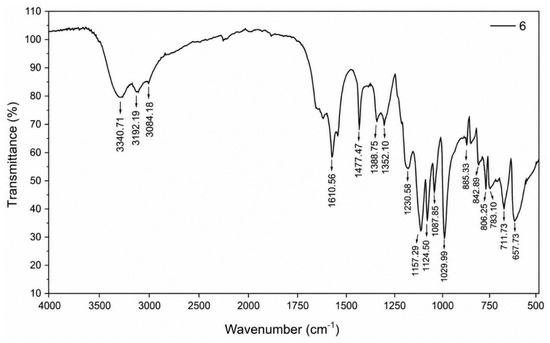
The FTIR spectrum of the synthesized composition shows several characteristic absorption bands, confirming the presence of hydroxyl, amino, aromatic, sulfonic and metal–ligand coordination groups. A broad absorption band at 3340.71 cm−1, together with bands at 3192.19 and 3084.18 cm−1, can be assigned to O–H and N–H stretching vibrations, indicating the presence of hydroxyl groups from sulfosalicylic acid and amino groups from thiourea. The absorption band at 1610.56 cm−1 is attributed to C=C stretching vibrations of the aromatic ring, confirming the retention of aromatic fragments derived from sulfosalicylic acid.
The bands observed at 1477.47 and 1388.75 cm−1 may be related to aromatic ring vibrations and C–N stretching. In addition, the absorption bands in the region of 1230.58–1029.99 cm−1 are associated with C–N, S=O and C=S stretching vibrations, suggesting the involvement of thiourea and sulfonic groups in the formation of the complex structure. The bands at 885.33, 842.89, 806.25, 783.10, 711.73 and 657.73 cm−1 correspond to out-of-plane aromatic C–H vibrations and low-frequency metal–ligand interactions. These changes indicate that Cu(II) ions participate in complex formation through coordination with oxygen- and nitrogen-donor atoms (Figure 1).
Figure 1.
IR image of the synthesized antiseptic.
3.2. Surface Morphology and Elemental Composition
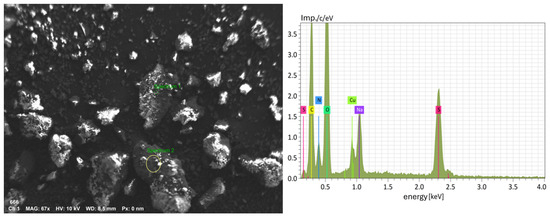
SEM analysis revealed a heterogeneous surface with porous, granular microstructures. Kaolin particles were observed to act as a support material, providing structural stability to the complex. EDX spectra confirmed the presence of key elements such as carbon (44.02%), oxygen (38.82%), sulfur (9.00%), sodium (6.33%), nitrogen (1.59%), and trace amounts of aluminum (0.24%). The presence of sulfur and nitrogen validated the successful coordination of thiourea and sulfosalicylic acid with the copper(II) center. Oxygen-rich signals indicated the involvement of SSA’s hydroxyl and sulfonic groups in metal-ligand bonding.
Scanning electron microscopy was employed to investigate the surface morphology and microstructural characteristics of the synthesized antiseptic material. The SEM micrograph (Figure 2) reveals a highly heterogeneous surface composed of irregularly shaped agglomerates distributed over the substrate. The particles exhibit a non-uniform size distribution, ranging from micron-scale clusters to smaller dispersed fragments. Such morphology indicates the formation of a composite structure rather than a single-phase material.
Figure 2.
SEM–EDX Analysis of the Synthesized Antiseptic Material.
The observed bright regions in the SEM image correspond to denser inorganic components, while the darker background is associated with the organic matrix. This contrast suggests successful incorporation of metal-containing species into the organic framework. The agglomeration behavior may be attributed to intermolecular interactions such as hydrogen bonding, coordination bonding, and van der Waals forces occurring during the synthesis process.
Energy-dispersive X-ray spectroscopy (EDX) analysis (Figure 2) confirms the elemental composition of the material. The spectrum shows the presence of key elements including carbon (C), nitrogen (N), oxygen (O), sulfur (S), copper (Cu), and sodium (Na). The detection of nitrogen and sulfur indicates the successful incorporation of thiourea-derived functional groups, which are responsible for the antimicrobial activity of the material. The presence of copper further enhances the biocidal properties due to its well-known antimicrobial behavior.
The sulfur peak observed at approximately 2.3 keV corresponds to the characteristic emission of sulfur-containing functional groups, confirming their structural integrity after synthesis. The copper signal detected around 0.9–1.0 keV further validates the formation of a coordination system between the metal ion and organic ligands. Sodium traces may originate from precursor salts or residual synthesis medium.
3.3. Thermal Stability
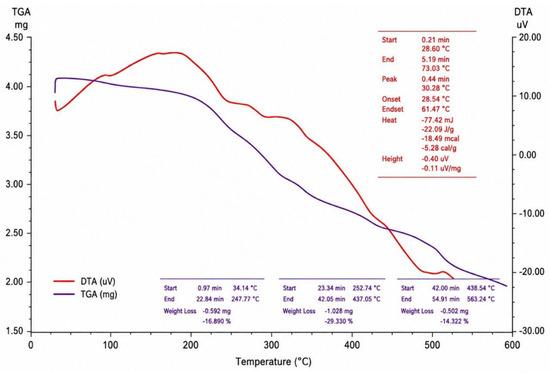
TGA results showed that the synthesized complex remained thermally stable up to 260 °C, with initial weight loss corresponding to surface-bound water. Major decomposition began at 270–360 °C, confirming the enhanced stability of the kaolin-supported complex compared to the free organic ligands.
The DTG curve was used to better interpret the thermal degradation behaviour of the composite. The initial weight loss below approximately 250 °C was mainly attributed to the removal of physically adsorbed moisture together with the decomposition of low-molecular-weight volatile species. The second degradation stage observed at higher temperatures was associated with the thermal decomposition of the organic ligand framework containing sulfosalicylic acid and thiourea. At elevated temperatures, the remaining residue was mainly related to the thermally stable inorganic fraction consisting of copper-containing species and kaolin. Since TGA/DTG analysis alone cannot unequivocally identify individual bond cleavage events, these assignments are based on the thermal behaviour of the constituent materials and are presented as probable degradation processes.
The combination of Cu(II), sulfosalicylic acid (SSA), thiourea, and kaolin resulted in a multifunctional composition. The antimicrobial tests demonstrated that the treated cotton fabrics inhibited the growth of the tested microorganisms under the experimental conditions. These findings indicate the potential of the synthesized composition as an antimicrobial textile finishing agent. However, further studies are required to evaluate its long-term performance and suitability for practical applications.
The thermogravimetric (TGA) curve of the synthesized antiseptic sample (blue line) reveals three main stages of mass loss, each corresponding to distinct thermal decomposition processes occurring within the material.
The first stage begins at 34.14 °C and continues up to 247.77 °C, during which a mass loss of 0.592 mg (16.890%) is observed. This initial weight loss can be attributed to the removal of adsorbed moisture, evaporation of low-molecular-weight volatile components, or the release of weakly bound functional groups.
The second stage occurs in the temperature range of 252.74 °C to 437.05 °C, with a mass loss of 1.028 mg (29.330%). This stage corresponds to the decomposition of the main organic constituents, likely including active components such as sulfosalicylic acid and thiourea.
The third stage, extending from 436.53 °C to 563.24 °C, is associated with a further mass loss of 0.502 mg (14.322%). This phase reflects the degradation of more thermally stable organic fragments, including coordinated complex structures that decompose at elevated temperatures.
Overall, the total mass loss of the sample reaches 60.542%, while the remaining 39.458% corresponds to inorganic residues, such as kaolin, copper oxide (CuO), or other mineralized components present in the composition (Figure 3).
Figure 3.
Thermal properties of the synthesized antiseptic material (based on TGA/DTA).
The TGA results indicate that the antiseptic treatment modified the thermal degradation behavior of the cotton fabric. Although the overall thermal stability was not markedly improved, the treated sample exhibited changes in the degradation profile and residual char yield, suggesting the formation of a thermally stable protective layer on the fiber surface.
According to the differential thermal analysis (DTA) curve (red line), an endothermic effect associated with heat absorption is observed in the temperature range from 28.60 °C to 73.03 °C, with a maximum peak at 30.28 °C.
During this process, a total heat absorption of −77.42 mJ was recorded, corresponding to −22.09 J/g or −5.28 cal/g. This endothermic event is attributed to physical processes such as the evaporation of moisture and the removal of water molecules from hydrated components.
3.4. Antimicrobial Activity of the Synthesized Antiseptic Material
The antimicrobial activity of the synthesized antiseptic material was evaluated using the agar disk diffusion method against representative microorganisms including Gram-positive bacteria (Staphylococcus aureus), Gram-negative bacteria (Escherichia coli, Pseudomonas aeruginosa), and fungus (Candida albicans).
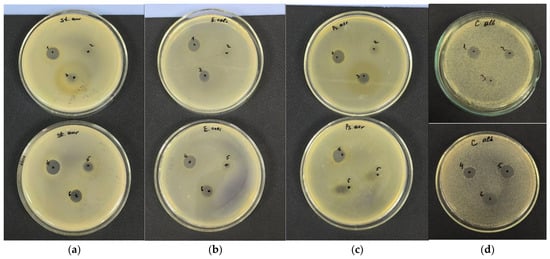
The obtained results indicate that the synthesized material exhibits broad-spectrum antimicrobial activity against all tested microorganisms. The inhibition zones are clearly visible in all Petri dishes, confirming the effective suppression of microbial growth.
Among the tested strains, the strongest antibacterial activity was observed against Staphylococcus aureus, which can be attributed to the simpler cell wall structure of Gram-positive bacteria, allowing easier penetration of active components. In contrast, slightly lower activity was observed against Gram-negative bacteria (E. coli and P. aeruginosa), likely due to the presence of an outer membrane that limits the diffusion of antimicrobial agents (Figure 4b,c).
Figure 4.
Antimicrobial activity of the synthesized antiseptic material against selected microorganisms using the disk diffusion method: (a) Staphylococcus aureus; (b) Escherichia coli; (c) Pseudomonas aeruginosa; (d) Candida albicans.
The presented results demonstrate the formation of clear inhibition zones around the tested samples, indicating significant antimicrobial activity of the synthesized material. The largest inhibition zones were observed against Staphylococcus aureus, suggesting higher susceptibility of Gram-positive bacteria. Moderate activity was detected against Escherichia coli and Pseudomonas aeruginosa, which can be explained by the presence of an outer membrane in Gram-negative bacteria that limits the penetration of active compounds. In addition, noticeable antifungal activity against Candida albicans confirms the broad-spectrum effectiveness of the material (Figure 4a,d).
The antibacterial activity of the developed composite can be mainly attributed to the presence of Cu(II) species, which are known to interact with bacterial cell envelopes, disrupt membrane integrity, interfere with essential cellular proteins and enzymes, and promote oxidative stress, ultimately resulting in microbial cell death. The sulfur- and oxygen-containing ligands present in the composite may stabilize the copper species through coordination interactions, while kaolin provides a supporting matrix that promotes a more uniform distribution of the active components on the cotton fiber surface. Consequently, the combined action of Cu(II), the coordinating ligands, and the inorganic carrier contributes to the observed broad-spectrum antimicrobial performance.
The results clearly demonstrate the formation of inhibition zones around the applied samples, confirming the pronounced antimicrobial activity of the synthesized material.
The results presented in Table 1 demonstrate that the synthesized antiseptic material exhibits pronounced antimicrobial activity against all tested microorganisms. The formation of inhibition zones of varying diameters confirms the effective suppression of microbial growth.
Table 1.
Inhibition zone diameters (mm) of the synthesized antiseptic material against selected microorganisms determined by the disk diffusion method.
According to ISO 20645:2004, the antibacterial activity was evaluated using a qualitative agar diffusion plate method, and the antimicrobial efficacy was assessed by measuring the inhibition zones around the treated fabric specimens.
The agar diffusion method was selected as an initial screening approach because the antimicrobial agent was immobilized on the cotton substrate rather than tested as a freely soluble compound. This method enables direct evaluation of growth inhibition at the textile–microorganism interface. However, it provides mainly qualitative or semi-quantitative information and does not determine the minimum bactericidal concentration. Therefore, future studies should include quantitative viable-cell reduction tests and determination of the bactericidal activity of released antimicrobial species.
Among the tested strains, the highest antibacterial activity was observed against Staphylococcus aureus, which can be attributed to the relatively simple structure of Gram-positive bacterial cell walls. In contrast, slightly lower inhibition was recorded for Gram-negative bacteria (Escherichia coli and Pseudomonas aeruginosa), likely due to the presence of an additional outer membrane that restricts the penetration of active compounds. Nevertheless, the material still showed considerable activity against these strains, indicating its broad-spectrum effectiveness.
The antimicrobial performance observed in the present study is consistent with previous reports on PANi-functionalized cotton fabrics, which also exhibited effective inhibition of Gram-positive and Gram-negative microorganisms. However, unlike PANi-based coatings, where antimicrobial activity is mainly associated with the conducting polymer matrix, the present antiseptic system derives its antimicrobial effect primarily from Cu(II)-based coordination interactions and the synergistic action of sulfur-containing ligands. These findings demonstrate that the developed Cu(II)-containing antiseptic composition represents a promising alternative to conducting polymer-based antimicrobial textile finishes while maintaining a relatively simple preparation procedure.
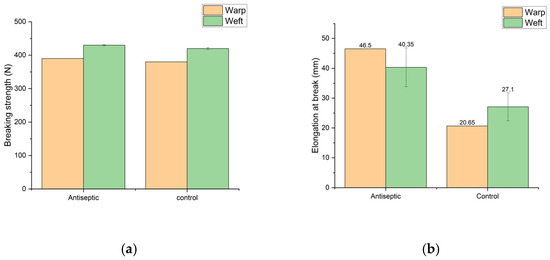
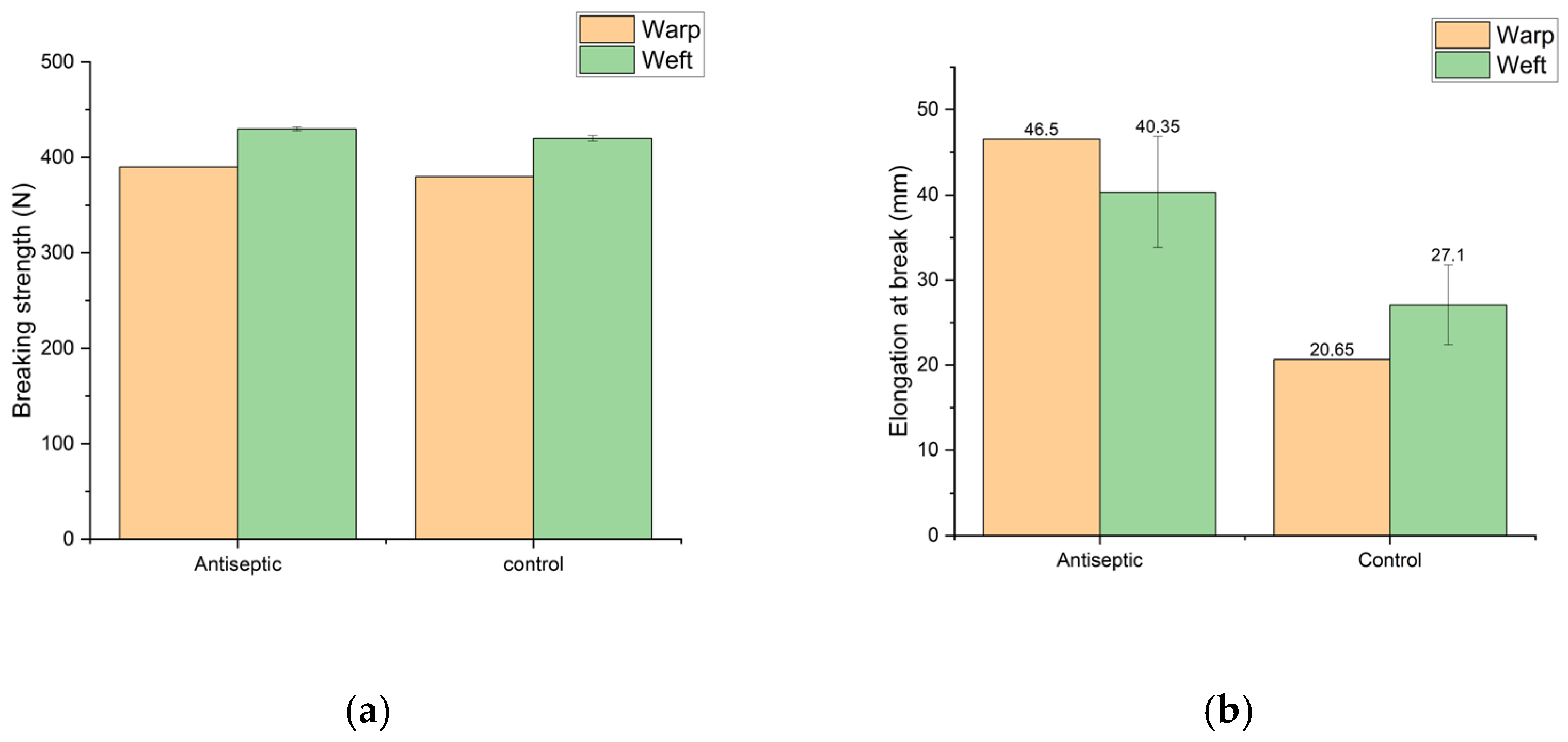
The mechanical properties of untreated and antiseptic-treated cotton fabrics are presented in Figure 5. As shown in Figure 5a, the antiseptic treatment preserved the tensile strength of the fabric, with only minor differences observed between the treated and untreated samples in both the warp and weft directions. This indicates that the functional finishing process did not adversely affect the structural integrity of the cotton fibers.
Figure 5.
Comparison of the mechanical performance of untreated (Control) and antiseptic-treated cotton fabrics: (a) breaking strength, (b) elongation at break.
Figure 5b demonstrates the elongation at break of the fabrics. The treated specimens exhibited comparable elongation behavior to the untreated control, suggesting that the antiseptic composition maintained the flexibility and deformation capacity of the textile without causing excessive stiffening or fiber degradation.
The wrinkle recovery results shown reveal that the finishing treatment caused only slight variations in crease recovery compared with the untreated fabric. The obtained values indicate that the applied antiseptic formulation preserved the elastic recovery characteristics of the cotton fabric while maintaining its dimensional stability. Overall, the mechanical performance of the treated samples remained comparable to that of the untreated control, confirming that the developed nitrogen- and sulfur-containing antiseptic composition effectively functionalized the cotton fabric without compromising its essential physical and mechanical properties.
In addition to the mechanical characteristics discussed above, several other performance parameters were evaluated to assess the influence of the antiseptic finishing treatment on the functional properties of the cotton fabric. The abrasion resistance of the treated fabric increased from 14.600 cycles for the untreated sample to 16.500 cycles after treatment, indicating that the deposited nitrogen- and sulfur-containing antiseptic composition did not impair the wear resistance of the textile. On the contrary, the slight improvement in abrasion resistance suggests that the functional coating contributed to better surface stability during repeated friction.
The air permeability of the treated fabric was 13.77 cm3/cm2·s, compared with 10.71 cm3/cm2·s for the untreated fabric, demonstrating that the antiseptic treatment did not block the pore structure of the cotton fabric or significantly restrict air circulation. Maintaining adequate air permeability is particularly important for healthcare textiles, where wearer comfort and moisture exchange are essential requirements.
Furthermore, the color fastness ratings of the treated fabric remained comparable to those of the untreated sample (4/5/4 and 5/4/4, respectively), confirming that the finishing process preserved the visual appearance and color stability of the textile. Overall, these results demonstrate that the developed antiseptic finishing not only imparted antimicrobial functionality but also maintained the key physical performance characteristics required for practical textile applications.
4. Conclusions
In this study, a novel antiseptic composition based on sulfosalicylic acid, copper(II) acetate, thiourea, and kaolin was successfully synthesized and applied to textile materials. The structural and physicochemical characteristics of the synthesized composition were comprehensively investigated using FTIR, SEM analysis, and thermal analysis techniques. FTIR results confirmed the formation of coordination interactions between the active components, while SEM micrographs revealed a relatively uniform distribution of the antiseptic composition on the fiber surface. Thermal analysis demonstrated that the obtained material possesses satisfactory thermal stability, indicating its suitability for practical textile applications.
The biological activity studies showed that the treated textile samples exhibited significant antimicrobial performance against test microorganisms, confirming the effectiveness of the synthesized composition as an antimicrobial finishing agent. The presence of copper-containing active centers and sulfur-containing functional groups is believed to contribute substantially to the observed antimicrobial activity through synergistic mechanisms.
Evaluation of the physical and hygienic properties of the treated fabrics demonstrated that the antiseptic treatment did not adversely affect the essential performance characteristics of the textile substrate. On the contrary, improvements in tensile strength, hygroscopicity, color fastness, and water resistance were observed. Although a slight decrease in air permeability and abrasion resistance was detected, the obtained values remained within acceptable limits for functional textile materials. These findings indicate that the developed antiseptic composition provides biological protection while preserving the operational properties required for practical use.
Future studies will focus on evaluating the wash durability and long-term antimicrobial performance of the treated cotton fabrics to assess their suitability for practical textile applications.
Overall, the results confirm that the synthesized sulfur- and nitrogen-containing copper-based antiseptic composition is a promising multifunctional finishing agent for textile materials. The developed treatment combines antimicrobial effectiveness, thermal stability, and satisfactory mechanical performance, making it a potential candidate for application in medical, household, and protective textile products. Further studies focused on washing durability, long-term antimicrobial stability, and large-scale application processes may contribute to the industrial implementation of the proposed antiseptic system.
Author Contributions
Conceptualization, D.Y.; Methodology, D.Y. and Z.J.; Validation, R.A.; Formal analysis, K.T. and A.S.; Investigation, K.T. and G.M.; Resources, D.Y., K.T. and G.M.; Data curation, D.Y., G.M., S.E., M.X. and B.R.; Writing—original draft, D.Y.; Writing—review & editing, G.M. and K.R.; Visualization, A.S.; Supervision, D.Y. and R.A.; Project administration, D.Y. All authors have read and agreed to the published version of the manuscript.
Funding
This research received no external funding.
Data Availability Statement
The data presented in this study are available from the corresponding author upon reasonable request.
Acknowledgments
Many thanks to Termez State University and Tashkent Scientific Research Institute of Chemical Technology, which closely support this research.
Conflicts of Interest
The authors declare no conflict of interest.
References
- Dilfuza, Y.; Khayit, T.; Rustam, A.; Gulvar, M.; Fayzulla, N.; Aziza, K.; Behzod, A. Antiseptic Functionalization of Healthcare Textile Materials: Comparative Analysis of Antimicrobial Agents, Methods, and Performance—A Review. Fibers 2026, 14, 54. [Google Scholar] [CrossRef] [Scilit]
- Salat, M.; Petkova, P.; Hoyo, J.; Perelshtein, I.; Gedanken, A.; Tzanov, T. Durable antimicrobial cotton textiles coated sonochemically with ZnO nanoparticles embedded in an in-situ enzymatically generated bioadhesive. Carbohydr. Polym. 2018, 189, 198–203. [Google Scholar] [CrossRef] [Scilit] [PubMed]
- Gedanken, A.; Perkas, N.; Perelshtein, I.; Lipovsky, A. Imparting pharmaceutical applications to the surface of fabrics for wound and skin care by ultrasonic waves. Curr. Med. Chem. 2018, 25, 5739–5754. [Google Scholar] [CrossRef] [Scilit] [PubMed]
- Ibrahim, M.; Davies, M.J.; Ahmad, E.; Annabi, F.A.; Eckel, R.H.; Ba-Essa, E.M.; El Sayed, N.A.; Fischl, A.H.; Houeiss, P.; Iraqi, H.; et al. Recommendations for management of diabetes during Ramadan: Update 2020, applying the principles of the ADA/EASD consensus. BMJ Open Diabetes Res. Care 2020, 8, e001248. [Google Scholar] [CrossRef] [Scilit] [PubMed]
- El-Naggar, N.E.-A.; Saber, W.I.A.; Zweil, A.M.; Bashir, S.I. An innovative green synthesis approach of chitosan nanoparticles and their inhibitory activity against phytopathogenic Botrytis cinerea on strawberry leaves. Sci. Rep. 2022, 12, 3515. [Google Scholar] [CrossRef] [Scilit] [PubMed]
- Minisy, I.M.; Salahuddin, N.A.; Ayad, M.M. Adsorption of methylene blue onto chitosan–montmorillonite/polyaniline nanocomposite. Appl. Clay Sci. 2021, 203, 105993. [Google Scholar] [CrossRef] [Scilit]
- Wang, Q.; Guo, Y.; Iketani, S.; Nair, M.S.; Li, Z.; Mohri, X.; Wang, M.; Yu, J.; Bouen, E.D.; Chang, J.Y.; et al. Antibody evasion by SARS-CoV-2 Omicron subvariants BA.2.12.1, BA.4 and BA.5. Nature 2022, 608, 603–608. [Google Scholar] [CrossRef] [Scilit] [PubMed]
- Alghamdi, B.A.; Al-Johani, I.; Al-Shamrani, J.M.; Alshamrani, H.M.; Al-Otaibi, B.G.; Almazmomi, K.; Yusof, N.Y. Antimicrobial resistance in methicillin-resistant Staphylococcus aureus. Saudi J. Biol. Sci. 2023, 30, 103604. [Google Scholar] [CrossRef] [Scilit] [PubMed]
- Gao, Y.; Cranston, R. Recent advances in antimicrobial treatments of textiles. Text. Res. J. 2008, 78, 60–72. [Google Scholar] [CrossRef] [Scilit]
- Hashem, M.; Ibrahim, N.A.; El-Sayed, W.A.; El-Husseiny, S.; El-Enany, E. Enhancing antimicrobial properties of dyed and finished cotton fabrics. Carbohydr. Polym. 2009, 78, 502–510. [Google Scholar] [CrossRef] [Scilit]
- Bhandari, V.; Jose, S.; Badanayak, P.; Sankaran, A.; Anandan, V. Antimicrobial finishing of metals, metal oxides, and metal composites on textiles: A systematic review. Ind. Eng. Chem. Res. 2022, 61, 86–101. [Google Scholar] [CrossRef] [Scilit]
- Ghayempour, S.; Montazer, M. Herbal products on cellulosic fabric with controlled release: Comparison of in situ encapsulation and UV curing of the prepared nanocapsules. Cellulose 2017, 24, 4033–4043. [Google Scholar] [CrossRef] [Scilit]
- Wang, S.; Zhang, Y.; Shi, Y.; He, Q.; Tan, Q.; Peng, Z.; Liu, Y.; Li, D.; Li, X.; Ke, D.; et al. Rhubarb charcoal-crosslinked chitosan/silk fibroin sponge scaffold with efficient hemostasis, inflammation, and angiogenesis for promoting diabetic wound healing. Int. J. Biol. Macromol. 2023, 253, 126796. [Google Scholar] [CrossRef] [Scilit] [PubMed]
- Svirinovskiy, A.; Perelshtein, I.; Natan, M.; Banin, E.; Gedanken, A. Imparting superhydrophobic and biocidal functionalities to a polymeric substrate by the sonochemical method. Ultrason. Sonochem. 2018, 44, 398–403. [Google Scholar] [CrossRef] [Scilit] [PubMed]
- Borkow, G.; Lara, H.H.; Covington, C.Y.; Nyamathi, A.; Gabbay, J. Deactivation of human immunodeficiency virus type 1 in medium by copper oxide-containing filters. Antimicrob. Agents Chemother. 2008, 52, 518–525. [Google Scholar] [CrossRef] [Scilit] [PubMed]
- Yakubova, D.; Turaev, H.; Alikulov, R.; Kholboeva, A.; Umarova, S. Комплексные соединения на основе солей меди (II) и их антибактериальные свойства. Univers. Технические Науки 2025, 12, 54–57. [Google Scholar] [CrossRef] [Scilit]
- Hostynek, J.J.; Maibach, H.I. Copper hypersensitivity: Dermatologic aspects. Contact Dermat. 2004, 17, 328–333. [Google Scholar] [CrossRef] [Scilit] [PubMed]
- Arendsen, L.P.; Thakar, R.; Sultan, A.H. The Use of Copper as an Antimicrobial Agent in Health Care, Including Obstetrics and Gynecology. Clin. Microbiol. Rev. 2019, 32, e00125-18. [Google Scholar] [CrossRef] [Scilit] [PubMed]
- Nazarov, Y.E.; Turaev, K.K.; Suyunov, J.R.; Alimnazarov, B.K.; Rasulov, A.A.; Ibragimov, B.T.; Ashurov, J.M. 8-Hydroxyquinolinium trichlorido(pyridine-2,6-dicarboxylic acid-κ3O,N,O′)copper(II) dihydrate. Acta Crystallogr. Sect. E Crystallogr. Commun. 2024, 80, 1049–1053. [Google Scholar] [CrossRef] [Scilit] [PubMed]
- Rasulov, A.; Torambetov, B.; Alimnazarov, B.; Kadirova, S.; Suyunov, J.; Nazarov, Y.; Ashurov, J. Norfloxacinium nitrate. IUCrData 2024, 9, x240813. [Google Scholar] [CrossRef] [Scilit] [PubMed]
- Liu, Y.-F.; Hsu, Y.-C.; Chen, P.-L.; Chuang, H.-J.; Tu, T.-Y.; Chang, C.-J.; Hsiao, Y.-M.; Lin, C.-L. Does intraoperative antiseptic solution soaking reduce microbial contamination in spine surgery? A randomized controlled trial. Spine J. 2025, 25, 1857–1865. [Google Scholar] [CrossRef] [Scilit] [PubMed]
- Dashtizadeh, D.N.; Amiri, F.; Hannani, S.; Oshaghi, M.; Azadi, N. Comparison of the effect of surgical site skin preparation with povidone-iodine antiseptic at two different temperatures on the microbial load and surgical site infection in laparotomy patients: A randomised controlled trial. J. Perioper. Nurs. 2024, 37, 39–48. [Google Scholar] [CrossRef] [Scilit]
- Kh, T.; Kholboeva, A.; Norkulov, F.; Normurodov, B.; Yakubova, D.; Shukurov, D. Research of the physico-chemical properties of antipyrene-antiseptics, which contain nitrogen. Int. J. Eng. Trends Technol. 2023, 71, 348–355. [Google Scholar] [CrossRef] [Scilit]
- Yuldashova, S.G.; Muzaffarova, N.S.; Nomozov, A.K.; Shaymardanova, M.A.; Durmanova, S.S.; Esanov, A.M.; Sharipov, E.I.; Uralov, N.B.; Bozorov, Y.S.; Todjiev, J.N.; et al. Nanocoatings and anti-corrosion strategies: Anti-corrosion solutions in medical devices. Int. J. Corros. Scale Inhib. 2026, 15, 58–88. [Google Scholar]
- Rafi, A.S.; Sheikh, A.A.; Chaion, M.H.; Chakrovarty, T.; Islam, M.T.; Kundu, C.K. A multi-functional coating on cotton fabric to incorporate electro-conductive, anti-bacterial, and flame-retardant properties. Heliyon 2024, 10, e37120. [Google Scholar] [CrossRef] [Scilit] [PubMed]
- Kudzin, M.H.; Chruściel, J.J. Antibacterial functionalization of cellulose and cotton: A comprehensive review of cellulose-based strategies. Carbohydr. Polym. 2025, 379, 124826. [Google Scholar] [CrossRef] [Scilit] [PubMed]
- ISO 20645:2004; Textile Fabrics—Determination of Antibacterial Activity—Agar Diffusion Plate Test. International Organization for Standardization: Geneva, Switzerland, 2004.

Disclaimer/Publisher’s Note: The statements, opinions and data contained in all publications are solely those of the individual author(s) and contributor(s) and not of MDPI and/or the editor(s). MDPI and/or the editor(s) disclaim responsibility for any injury to people or property resulting from any ideas, methods, instructions or products referred to in the content. |
© 2026 by the authors. Licensee MDPI, Basel, Switzerland. This article is an open access article distributed under the terms and conditions of the Creative Commons Attribution (CC BY) license.