


Abstract
Two new species of the subfamily Lecithocerinae (Gelechioidea, Lecithoceridae); Notioseus liberianus Park & Karisch, sp. nov. and Lecithocera maruana Park & Karisch, sp. nov., are described from the Nimba Mountains, bordering Guinea and Liberia. At the same time, Dragmatucha flavoaurea Park & Karisch, 2022, is transferred to Notioseus Park, 2018, resulting in a new combination Notioseus flavoaurea (Park & Karisch, 2022), comb. nov. This species is reported for the first time from Liberia and Guinea, and the male is described and illustrated for the first time, including details of the male genitalia. In addition, Pectinimura paraliberalis Park, 2023, P. bongoensis Park, 2023, and Homaloxestis rawlinsi Park, 2018, are reported from Liberia for the first time. The female genitalia of P. paraliberalis are also newly described and illustrated.
Keywords:
taxonomy; torodorinae; lecithoceridae; Corymbus; Homaloxestis; Lecithocera; Pectinimura; Africa 1. Introduction
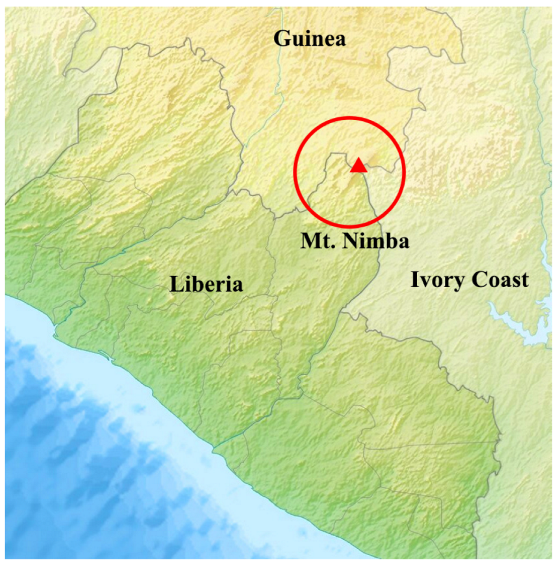
As previously noted for the subfamily Torodorinae of Lecithoceridae (Lepidoptera: Gelechioidea) from Nimba Mountains in Part I [1], this mountain range, bordering Liberia and Guinea, forms a chain extending from Liberia in the southwest to Guinea in the northeast. Compared with more than 600 species in 48 genera of the subfamily Torodorinae known worldwide [2,3], only 116 species in 10 genera have been recorded from the Afrotropical Region [4,5,6,7,8,9]. In western Africa, including the Nimba Mountains, the fauna is even less well known: only 27 species belonging to four genera of Torodorinae-Dragmatucha Meyrick, Ptilothyris Walsingham, Thubdora Park, and Torodora Meyrick have been recorded to date [1]. Likewise, the fauna of the subfamily Lecithocerinae in West Africa also remains poorly explored, with only 20 species recorded so far (Table 1 [4,5,6,7,8,9,10,11,12]).
Table 1.
List of the known species of the subfamily Lecithocerinae in West Africa (Ivory Coast, Cameroon, Ghana, and Equatorial Guinea).
In the present paper, two new species of Lecithocerinae, Notioseus liberianus Park & Karisch, sp. nov. and Lecithocera maruana Park & Karisch, sp. nov., are described. In addition, two species of Pectinimura Park, 2018, P. paraliberalis Park, 2023 (originally described from Ivory Coast) and P. bongoensis Park, 2023 (from Ghana), are newly recorded from Liberia and/or Guinea. The female of P. paraliberalis is reported for the first time from Liberia, along with a description and illustration of its genitalia.
Furthermore, Dragmatucha flavoaurea Park &b Karish, 2022, is transferred to the genus Notioseus, resulting in the new combination Notioseus flavoaurea (Park &b Karish, 2022), comb. nov. This species is recorded from Liberia for the first time, as is Homaloxestis rawlinsi Park, 2018, originally described from Cameroon [4].
2. Material and Methods
The material examined is based primarily on specimens collected from the southern slopes of the Nimba Mountains in Liberia by T. Karisch and A.-J. Dutton in August 2022. These specimens are preserved in the Museum für Naturkunde und Vorgeschichte, Dessau-Roßlau, Germany (MNVD). Additional material was collected from the northern slope of the Nimba Mountains in Guinea (Ziela Forest, Prov. Nzérékoré, 7°07′ N, 8°36′ W) in November 2009 by local collectors, and is preserved in the Zoologische Staatssammlung München, München, Germany (ZSM). The genitalia of the specimens were dissected following the procedures described in Robinson (1976) [13], stained using Eosin Y, and embedded in Euparal. The colour standard of adults mainly follows Kornerup & Wanscher (1978) [14]. All type specimens are deposited in MNVD.
3. Results and Discussion
3.1. Genus Notioseus Park, 2018
Type species: Notioseus cupripennis Park, 2018: 571. TL: Cameroon, Efulen.
The genus Notioseus Park, 2018 is an Afrotropical genus currently comprising only two known species from Cameroon: N. cupripennis Park, 2018 and N. acidodes Park, 2018) [4]. The genus is closely related to Corymbus Park, 2019, sharing several morphological characters, including the ochreous ground colour of the wings, the labial palpus bearing long, hair-like scales dorsally, and similarities in the male genitalia without specific diagnostic characters. The female of Notioseus remains unknown.
Park et al. (2019) established Corymbus Park, separating it from Notioseus Park primarily on the basis of the hindwing venation: in Corymbus, M2 is absent and M3 and CuA1 are stalked, whereas in Notioseus, M3 and CuA1 are clearly coalescent in the type species or M3 is closely approximated to CuA1 in N. acidodes [5]. However, in Lecithoceridae, both fore- and hindwing venation may show intraspecific variation and therefore cannot be regarded as reliable diagnostic character for defining genera.
Moreover, Park et al. (2019) did not mention one of the principal diagnostic features of Corymbus in the original generic description, namely the absence of a ventral scale-tuft at the apex of the antennal scape [5]. In contrast, Notioseus possesses a well-developed blackish scale-tuft at this position. To clarify the relationship between the two genera, further studies incorporating molecular data are required. In the present study, an additional new species of Notioseus is described from Liberia and two unassociated females are documented.
3.1.1. Notioseus liberianus Park & Karisch, sp. nov.
LSID urn:lsid:zoobank.org:act:AEFBED38-AD3A-44E4-93C6-FBCF5AE233A9
Type specimens. Holotype: male, Liberia, Nimba Mountains, alt. 1050 m, 4.2 km SE Yekepa, camp secondary forest on SE slope, 7°32′35.6″ N 8°31′20.3″ W, 27 viii 2022 LF, leg. T. Karisch, gen. slide no. 4150/Karisch, in SEDI.
Paratype: male, same data as the holotype, in SDEI.
Diagnosis. The new species is superficially similar to Notioseus acidodes Park, 2018, described from Cameroon, sharing a comparative forewing pattern and colouration. However, it can be distinguished by its larger size (wingspan 11 mm in N. acidodes) and by the male genitalia, characterized by a digitate cucullus and a stouter aedeagus.
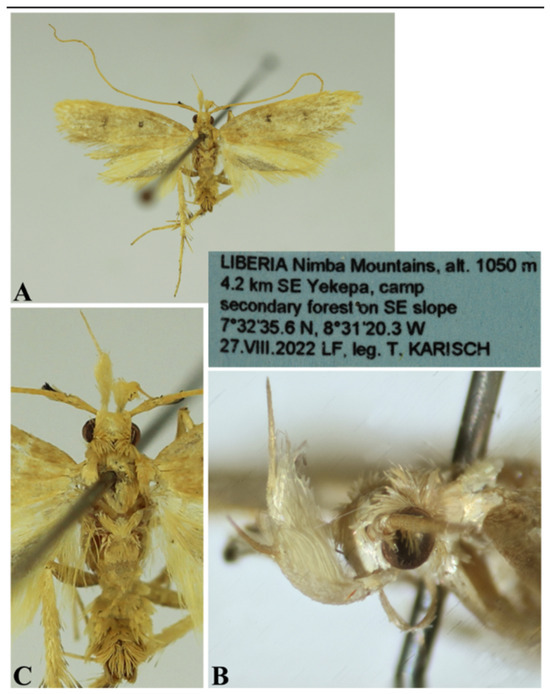
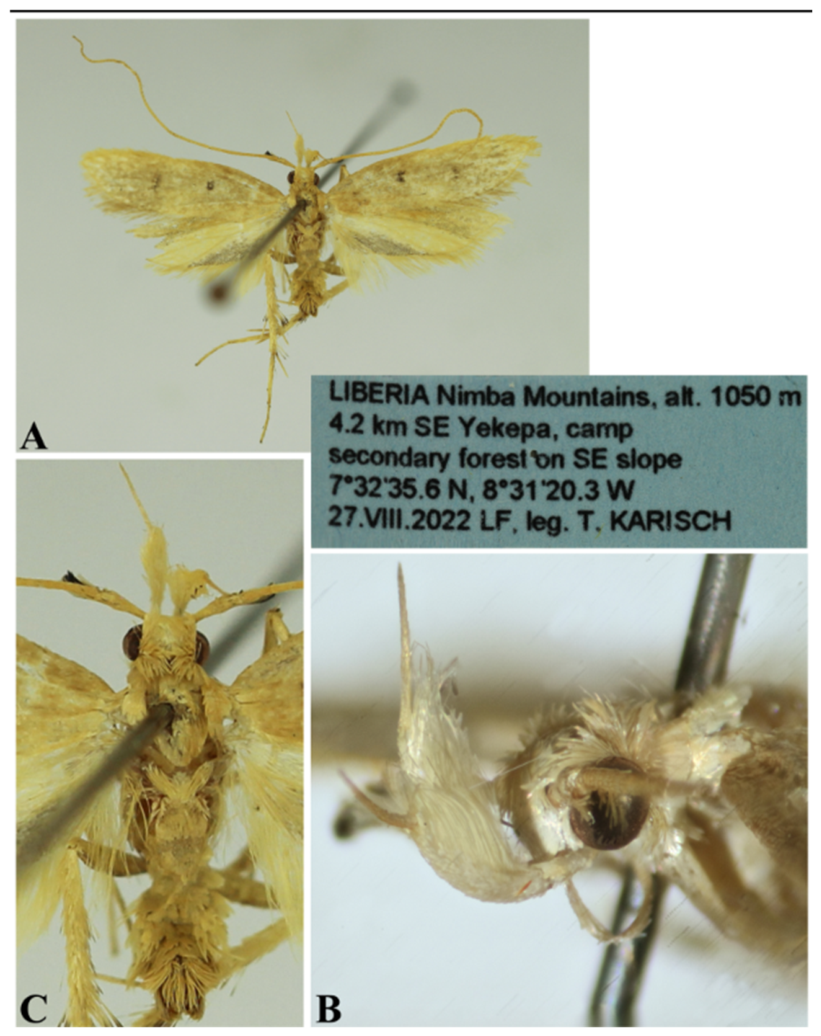
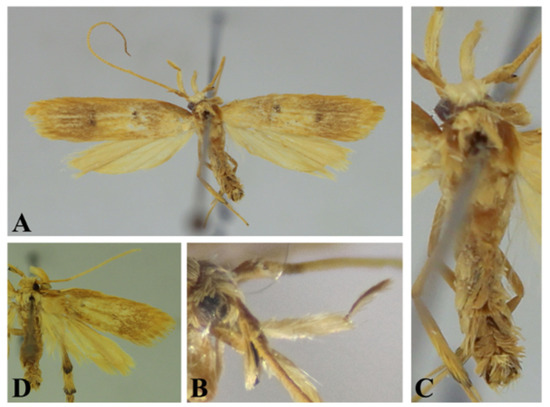
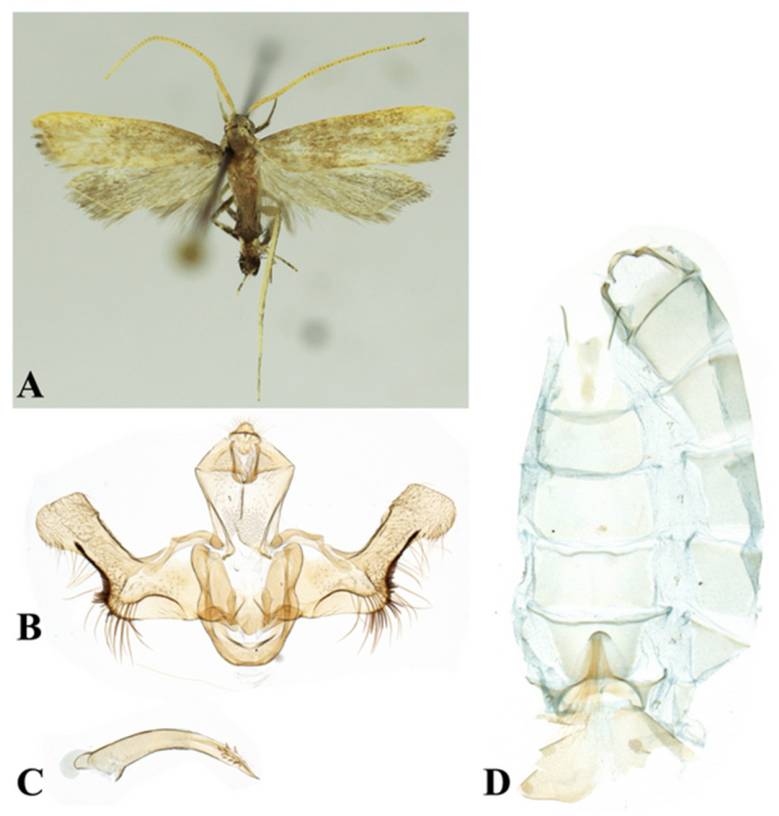
Description. Male Figure 1A,B. Wingspan 16.0 mm.
Figure 1.
Notioseus liberianus Park & Karisch, sp. nov.: (A) holotype (Liberia), with its label; (B) dorsal view of body; (C) head with labial palpus.
Head: pale yellow dorsally, with yellowish-white erect scales laterally. Antenna slightly longer than forewing; scape elongated, slightly dilated distally, pale yellow mixed with brownish scales, with a black scale-tuft at apex ventrally; flagellum pale yellow, filiform. Labial palpus with second segment thickened and arched, bearing long, yellowish-white hair-like scales dorsally, extending to middle of 3rd segment; 3rd segment slender, as long as 2nd segment, strongly upturned, pale yellow, sharply pointed apically.
Thorax: pale yellow dorsally; tegula concolourous. Hind tibia densely covered with pale yellow scales dorsally; apical spur blackish medially.
Forewing: ground colour pale yellow, irregularly scattered with brownish scales, bearing a distinct blackish discal stigma; reniform spot comma-shaped; costa slightly arched before middle; apex more or less acute; termen oblique; fringe concolourous with ground colour.
Hindwing: ground colour pale yellow, covered with dark greyish scales in lower 1/4.
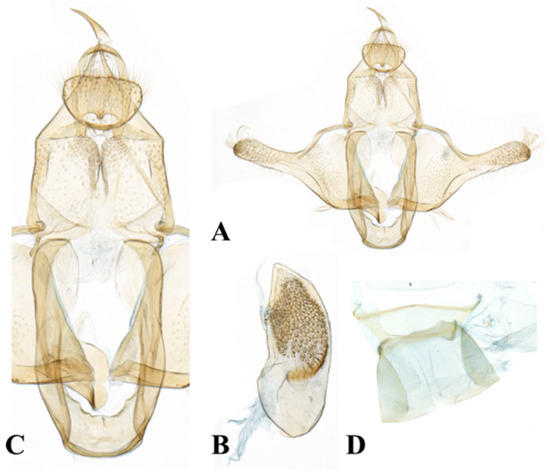
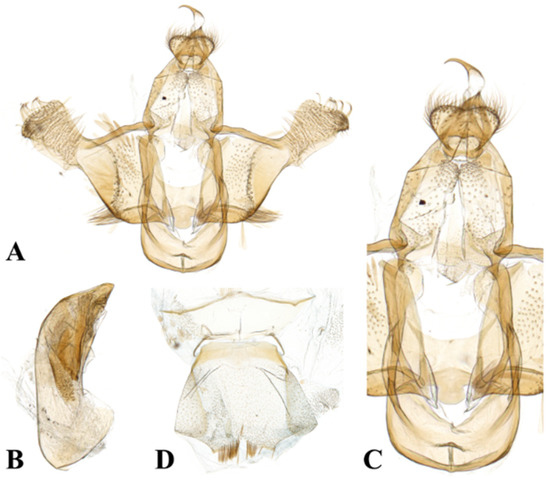
Abdomen Figure 1B and Figure 2D: greyish yellow dorsally; tergites lack spinose zones; segment VII heavily sclerotized along anterior margin; sternite VIII slightly concave medially on posterior margin.
Figure 2.
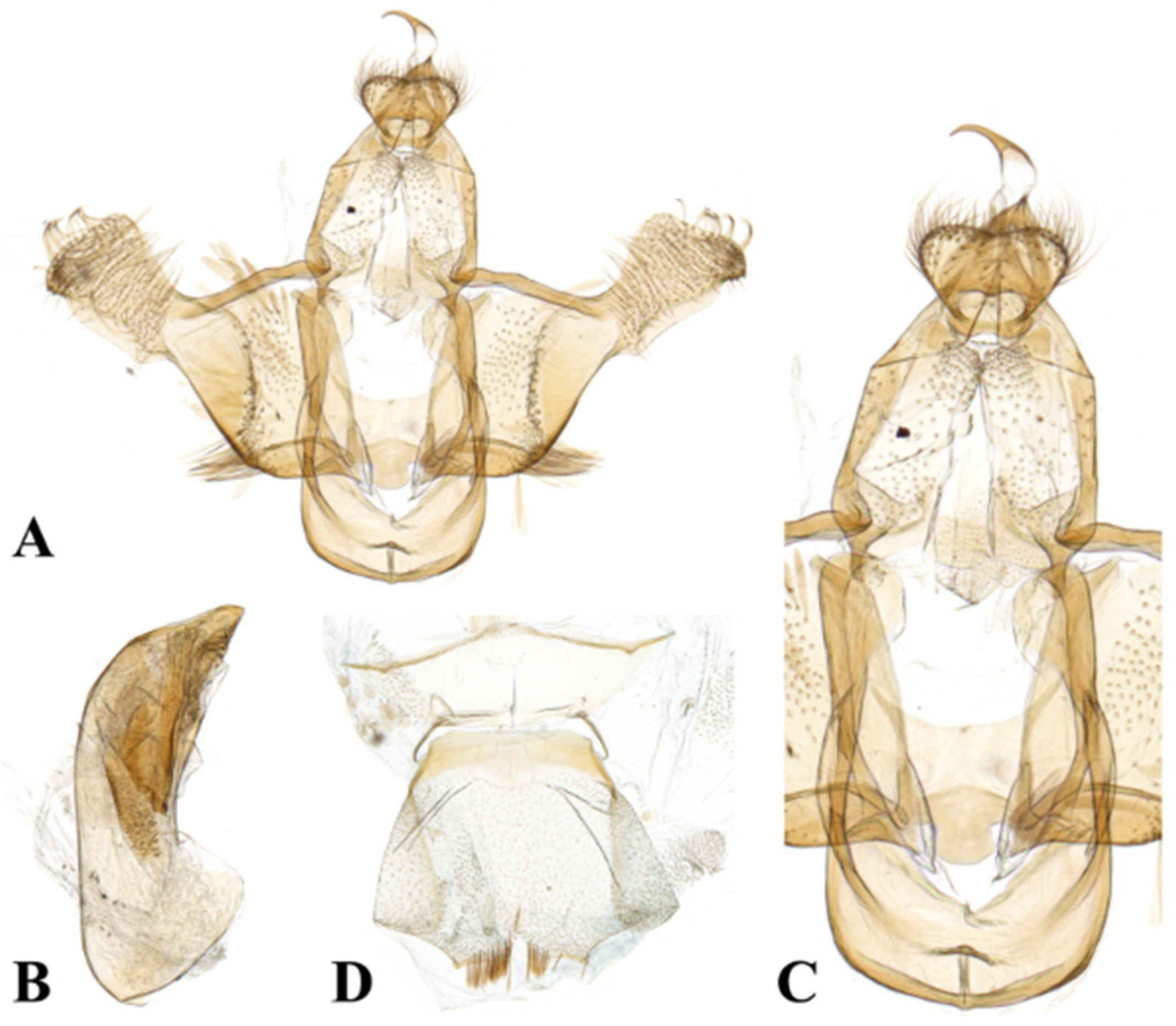
Male genitalia of Notioseus liberianus Park & Karisch, sp. nov.: (A) genitalia (holotype, gen. slide no. 4150/Karisch); (B) aedeagus; (C) central part; (D) pregenital segments.
Male genitalia Figure 2A–C: uncus basal plate large, fan-shaped, densely setose, with peanut-shaped basal concavity deeply emarginated medially on caudal margin; outer margin heavily sclerotized; caudal margin slightly sinuate. Gnathos basal plate weakly sclerotized, inverted U-shaped, with convex caudal margin. Tegumen nearly pentagonal, deeply incised medially. Costal bar banded, narrow, slightly angled medially. Valva extremely broad basally, with a crescent-shaped sclerotized plate extending to near lower corner of cucullus; cucullus elongate, more or less digitate with round apex, densely setose, bearing long hair-like scales apically; sacculus well-developed. Juxta weakly sclerotized, semi-ovate, lacking processes. Vinculum broad, banded, with outer margin sclerotized. Aedeagus very thick and robust, longer than valva; cornuti consisting of an oval patch bearing numerous minute conical spines.
Female unknown.
Distribution. Liberia (Nimba Mountains)
Etymology. The species name is derived from Liberia, the country in which the type locality is situated.
3.1.2. Notioseus flavoaurea (Park & Karisch, 2022)
Dragmatucha flavoaurea Park & Karisch, 2022: 373. TL: Ivory Coast, Gouédié.
Notioseus flavoaurea Park & Karisch, 2022, comb. nov.
Material examined. 1♂, Liberia, Nimba Mountains, alt. 1060 m, 4.4 km SE Yekepa, 0.2 km SSW camp secondary forest near Parinari forest 7°32′27.3″ N 8°31′24.3″ W, 28 viii 2022 LF (125 W HOL), leg. T. Karisch & A.J. Dutton, gen. slide no. 4303/Karisch, in MNVD; 4♂, same locality, alt. 1050 m & 1055 m, 22–23 viii 2022, leg. T. Karisch in SDEI, MNVD; 3♂, Guinea, Mt. Nimba area, xi 2009, coll. ZSM, gen.-slide 4273/Karisch, in ZSM.
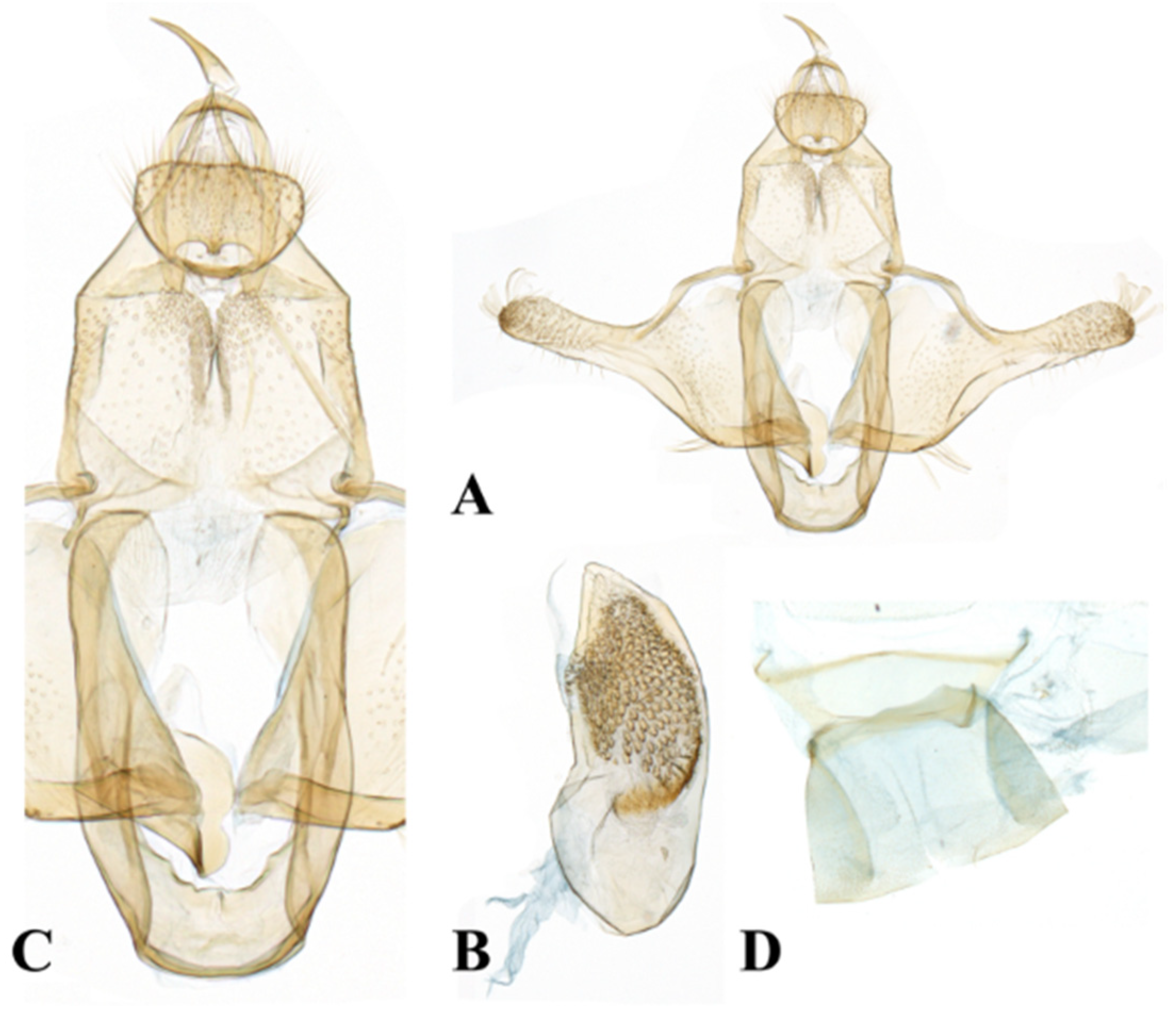
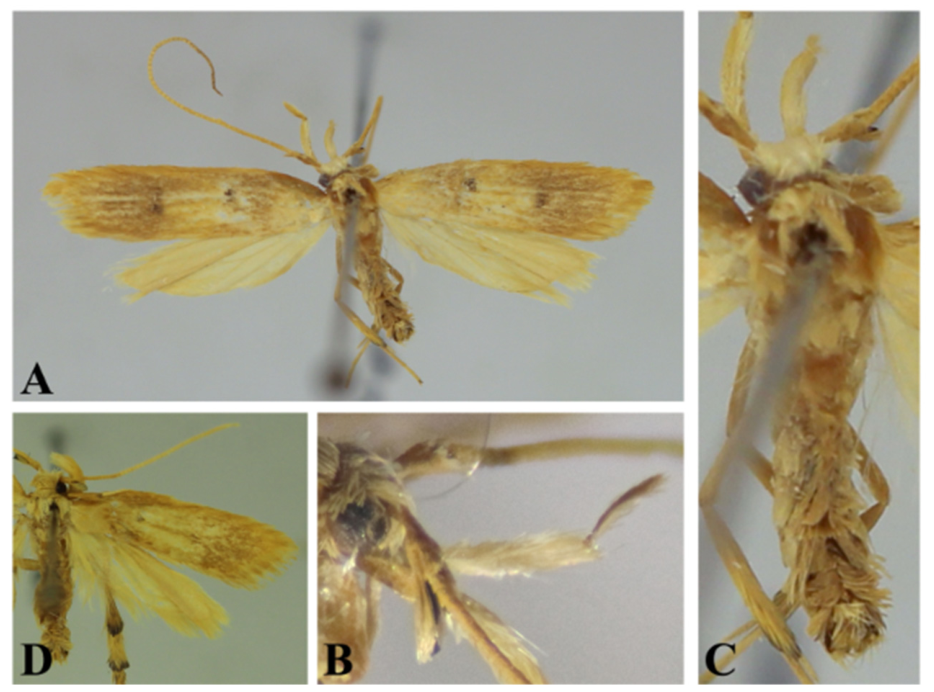
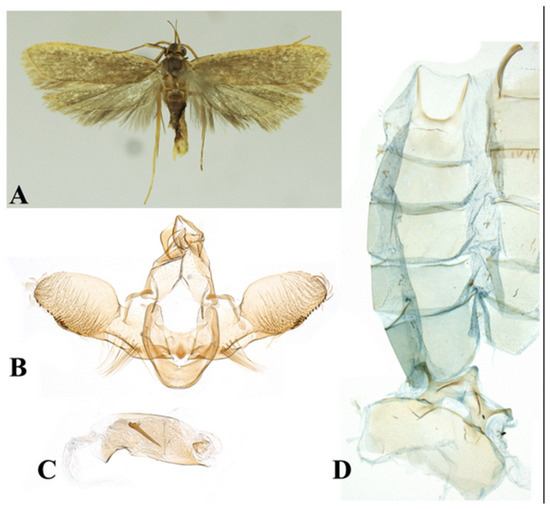
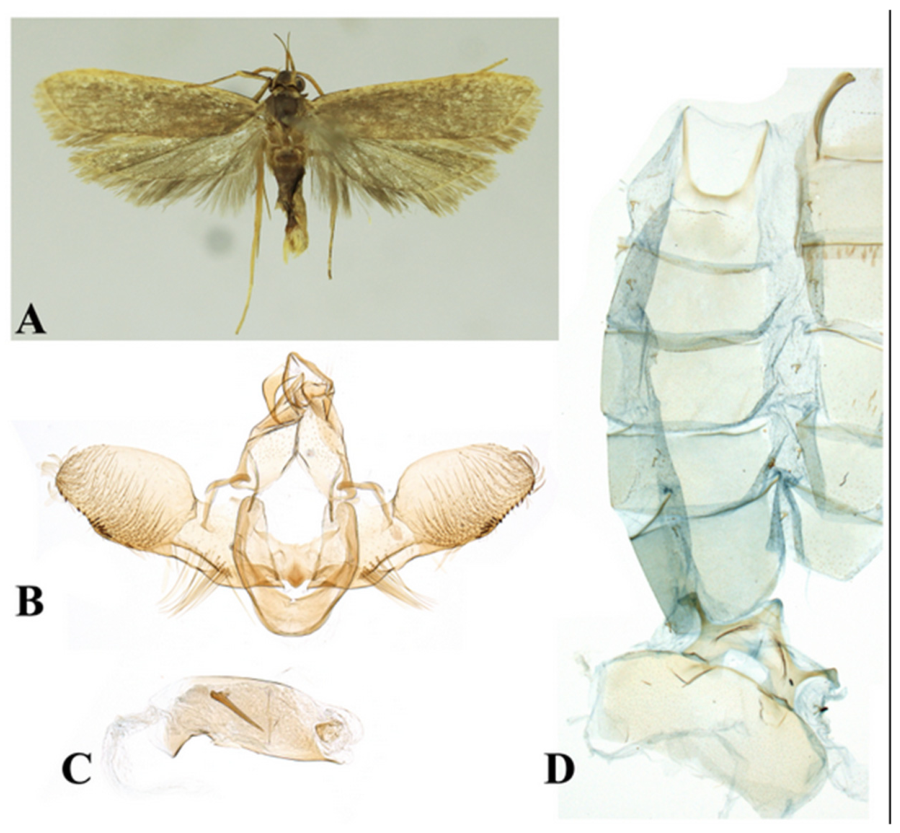
Diagnosis. Male Figure 3A–D, Wingspan 14.0 mm. The species was originally described from Ivory Coast based on a single female. Park et al. (2022) erroneously placed it in Dragmatucha Meyrick, 1908 [7]. It is herein transferred to Notioseus Park, 2018 based on morphological characters, particularly the absence of spinous zones on the abdominal tergites.
Figure 3.
Notioseus flavoaurea (Park & Karisch, 2022), comb.nov.: (A) male from Liberia (gen. slide no. 4303/Karisch), (B) head with labial palpus; (C) central part; (D) male from Guinea (gen. slide no. 4273/Karisch).
Although externally similar to the preceding new species, N. liberianus sp. nov., it can be readily distinguished by the male genitalia: the basal plate of the uncus is somewhat triangular, the costal bar is gently curved, the crescent-shaped sclerotized plate in the valva extends from the costa to near the distal end of sacculus; the cucullus is broadly expanded anteriorly along the dorsal margin, and the aedeagus is less stout.
Male genitalia Figure 4A–C: uncus basal plate large, somewhat triangular, densely setose along latero-caudal margin, with peanut-shaped basal concavity. Gnathos basal plate triangular, weakly sclerotized, sharply terminated apically. Tegumen triangular in distal 2/5. Costal bar banded, slightly bent before middle. Valva extremely broad basally; crescent linear plate arising from costa and extending to end of sacculus; cucullus broadly expanded along dorsal margin, densely setose; sacculus well-developed, narrowly terminated. Juxta weakly sclerotized, concave on caudal margin, with thumb-like process anteriorly, without additional processes. Vinculum broad, with outer margin heavily sclerotized. Aedeagus stout, slightly longer than valva, strongly arched beyond middle and strongly bent in basal 1/3; cornuti consisting of a triangular plate and an oval patch composed of numerous minute conical spines.
Figure 4.
Male genitalia of Notioseus flavoaurea Park & Karisch, 2022: (A) genitalia (gen. slide no. 4303/Karisch); (B) aedeagus; (C) central part; (D) abdomen, pregenital segments.
Female genitalia: See Park & Karisch (2022, Fig. 12B).
Distribution. Ivory Coast, Guinea, and Liberia (Nimba Mountains: new record).
Remark. The male is reported for the first time, describing and illustrating the genitalia.
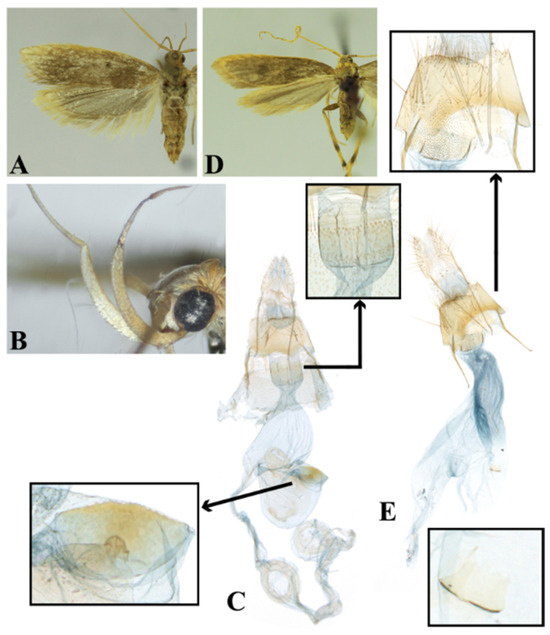
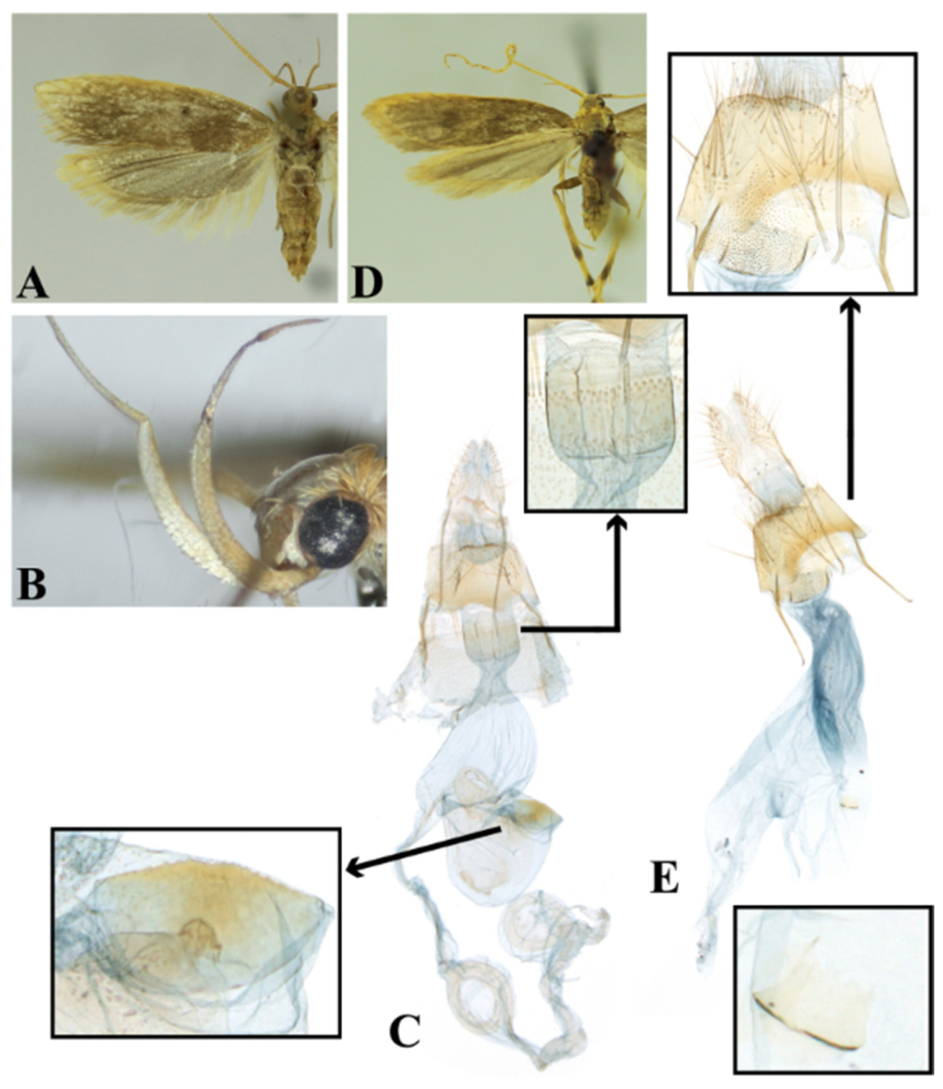
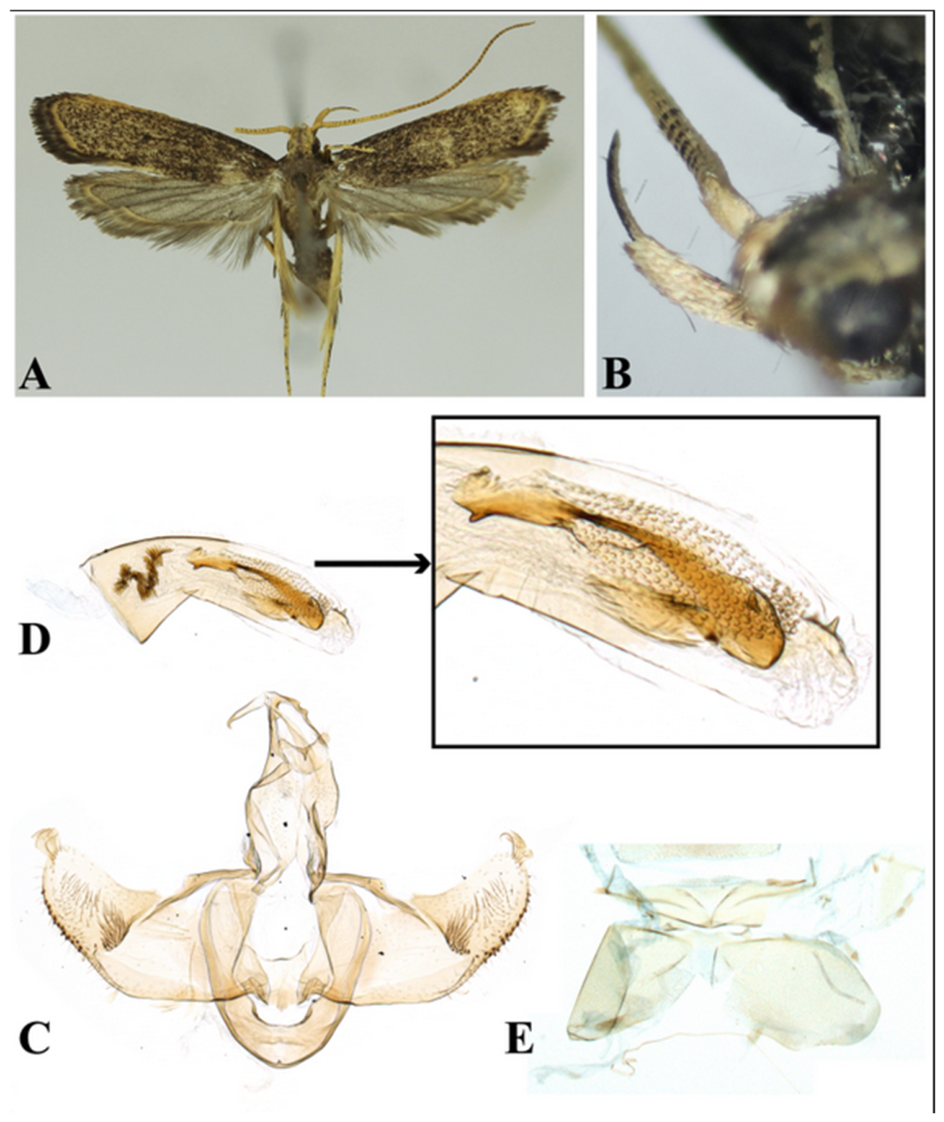
Female specimens of Notioseus collected from the Nimba Mountains, Liberia (1 female: alt. 1050 m, 4.2 km SE Yekepa, camp secondary forest on SE slope, 7°32′35.6″ N 8°31′20.3″ W, 27 viii 2022 LF, leg. T. Karisch & A.-J. Dutton, gen. slide no. 4199/Karisch (Figure 5D,E); and 1 female: alt. 1060 m, 4.5 km SE Yekepa, 0.3 km SSW camp secondary forest near Parinari forest, 7°32′27.3″ N 8°31′24.3″ W, 24 viii 2022 LF, leg. T. Karisch & A.-J. Dutton, gen. slide no. 4173/Karisch) (Figure 5A–C) remain unidentified, as a species-level identification cannot be made with confidence in the absence of associated males or molecular data. For future reference, the morphology of these females, including adult characteristics and genitalia, is illustrated Figure 5.
Figure 5.
Females of two unidentified species of Notioseus: (A) female (gen. slide no. 4173/Karisch); (B) head with labial palpus; (C) female genitalia (gen. slide no. 4173/Karisch); (D) the other unidentified female; (E) ditto, female genitalia (gen. slide no. 4199/Karisch).
3.2. Genus Lecithocera Herrich-Schäffer, 1853
The genus Lecithocera Herrich-Schäffer, 1853, one of the most speciose genera within Lecithocerinae, comprises 46 species in the Afrotropical Region out of more than 310 species worldwide. In West Africa in particular, only four species (L. cyclisca Park, 2018, L. dysmica Park, 2018, L. eucharis Meyrick, 1933, and L. protoma Meyrick, 1914) have been documented.
Lecithocera maruana Park & Karisch, sp. nov.
LSID urn:lsid:zoobank.org:act:DA4DDDA2-8D2F-4BB9-9372-58B3DD29AC52
Type specimen. Holotype: male, Liberia, Nimba Mountains, alt. 1050 m, 4.2 km SE Yekepa, camp secondary forest on SE slope 7°32′35.6″ N 8°31′20.3″ W, 27 viii 2022, LF, leg. T. Karisch & A.J. Dutton, gen. slide no. 4194/Karisch, in SDEI.
Diagnosis. The male genitalia of the new species are very similar to those of an Oriental species, L. pelomorpha Meyrick, 1931, described from China, but the adult can be distinguished by the smaller size (compared with 18–21 mm wingspan of L. pelomorpha) and by the more elongated forewing.
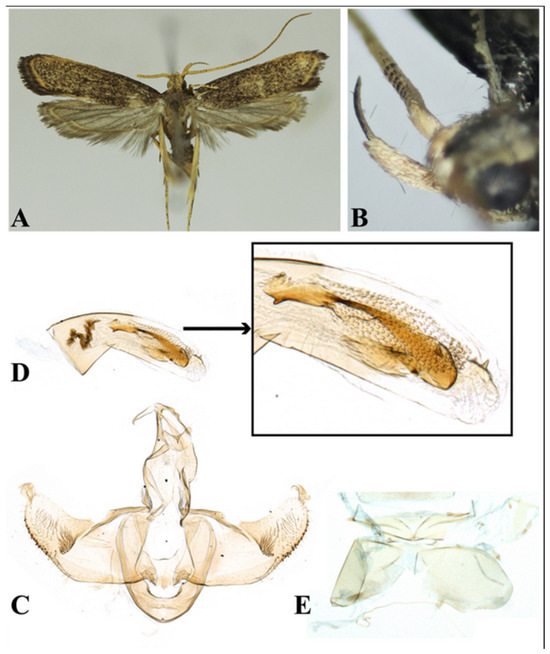
Description. Male Figure 6A. Wingspan 14.5 mm.
Figure 6.
Lecithocera maruana Park & Karisch, sp. nov.: (A) adult (holotype); (B) head with labial palpus; (C) male genitalia (gen. slide no.4194/Karisch); (D) aedeagus; (E) abdomen.
Head: pale greyish orange dorsally. Antenna slightly longer than forewing; scape elongated, nearly parallel-sided, pale yellowish grey all around; flagellum pale greyish orange, with dark-brown annulation, especially more blackish in several basal segments. Labial palpus with second segment thickened, yellowish white, speckled with yellowish brown scales; 3rd segment more or less stout, shorter than 2nd segment slender, slightly upturned, blackish ventrally.
Thorax: yellow brown dorsally. Hind tibia greyish brown, with long hairs dorsally; median spurs with inner one about two times as long as outer; apical spurs greyish brown, with inner one 1.5 times longer than outer.
Forewing: elongate; ground colour orange white, evenly scattered with dark-brown scales; discal stigma very small, blackish; reniform spot rounded; apex obtuse; termen oblique; fringe dark brown, with narrow yellowish-white basal line.
Hindwing: ground colour greyish, broader than forewing; apex obtuse; fringe concolourous, with narrow yellowish-white basal line.
Abdomen Figure 6E: dark grey dorsally; tergites lacking spinose zones; sternite VIII concave medially along posterior margin.
Male genitalia Figure 6C,D basal lobes of uncus semi-ovate, directed outward. Gnathos basal plate triangular, lateral margins heavily sclerotized, bearing two small triangular lobes pre-apically; median process slender, strongly angled subapically. Tegumen weakly sclerotized. Costal bar banded, medially angled. Valva extremely broad basally; ventral margin medially expanded; cucullus short, broadened, densely setose, with minute spines along outer margin; apex rounded; sacculus short, narrowed. Juxta small, shield-shaped, dorsal margin concave, with short, triangular latero-caudal processes; anterior margin with short median projection. Vinculum broadened medially, taenioid apically. Aedeagus as long as valva, with dorsal margin arched, strongly bent at basal one-third, with a small apical dorsal spine; cornuti consisting of a zigzag-shaped lamina with short spines, a sclerotized plate narrowed beyond one-third and gradually broadened apically, and a large sac bearing numerous minute spinules.
Female unknown.
Distribution. Liberia (Nimba Mountains)
Etymology. The species name is derived from the archaic Korean term, -maru (= mountain ridge), combined with the Latin suffix, -ana.
3.3. Genus Pectinimura Park, 2018
Type species: Pectinimura montiatilis Park & Byun, 2018: 111. TL: the Philippines, Palawan.
The genus Pectinimura Park, 2018, was established based on P. montiatilis Park, 2008, from the Philippines. The genus currently comprises 14 known species: eight species from the Oriental Region, four from the Oceanian Region, and two from Africa (Ivory Coast and Ghana) Table 1. The genus is morphologically related to Lecithocera but can be defined by the presence of a specialized pectinate comb on the valva of the male genitalia. This modified character is shared with Neopectinimura Park, 2010, Onnuria Park, 2011, and Hamatina Park, 2011; however, Pectinimura can be separated from these genera by differences in the shape of the labial palpus and wing venation. The following two species of the genus are recorded from Liberia for the first time.
3.3.1. Pectinimura paraliberalis Park & Karisch, 2022
Pectinimura paraliberalis Park, 2022: 375. TL: Ivory Coast.
Material examined. 7♂, 1♀, Liberia, Nimba Mountains, alt. 1060 m, 4.4 km SE Yekepa, 0.2 km SSW camp secondary forest near Parinari forest 7°32′27.3″ N 8°31′24.3″ W, 28 viii 2022, LF (125 W HOL), leg. T. Karisch & A.J. Dutton, gen. slide no. 4176/Karisch (♂), 4178/Karisch (♂), and 4177/Karisch (♀); 6♂, 1♀, Liberia, Nimba Mountains, alt. 1320 m, 7.9 km SSE Yekepa, 1 km SW Celcom tower edge of Parinari forest on SSE slope 7°30′55.5″ N 8°31′24.6″ W, 30 viii 2022, LF (125 W HOL), leg. T. Karisch & A.J. Dutton, gen. slide no. 4159/Karisch (♀) and 4160/Karisch (♂).
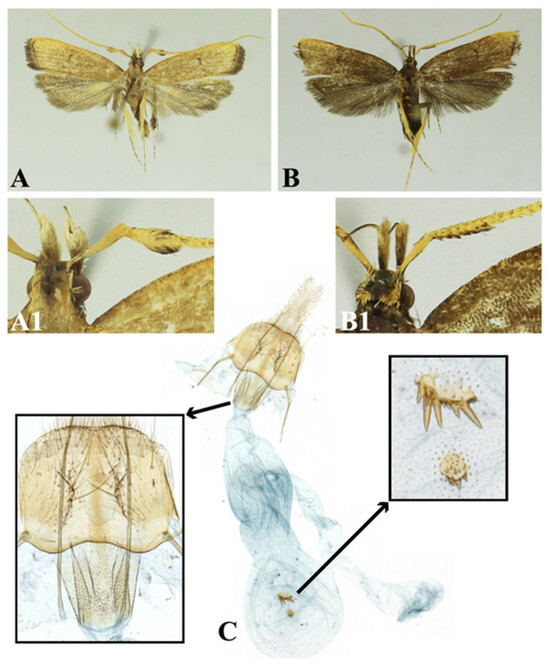
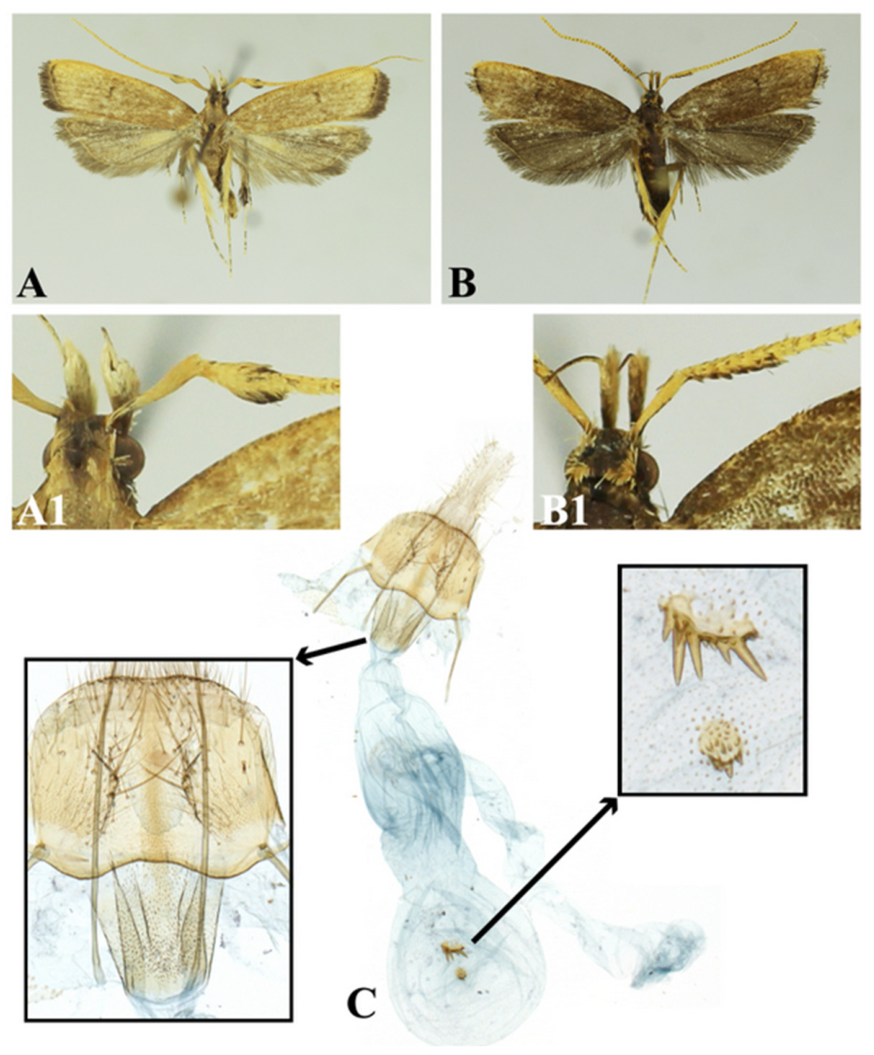
Diagnosis. Male Figure 7A,A1, female Figure 7B,B1. Wingspan 12.0–16.5 mm. The species was described from Ivory Coast based on a male. The species can be distinguished from its allies by the swollen basal segments of the flagellum bearing scale-tuft at base. The female is reported for the first time, and its genitalia are described and illustrated.
Figure 7.
Pectinimura paraliberalis Park & Karisch, 2022; (A) male adult; (A1) close-up head with antenna; (B) female adult; (B1) close-up head with antenna; (C) female genitalia (gen, slide no. 4159/Karisch).
Male genitalia: See also Park et al. (2022, Fig. 13B,B1)
Female genitalia Figure 7C: Abdominal sternite VIII slightly concave medially on caudal margin; deeply concave on anterior margin. Antrum membranous, funnel-shaped, as long as the length of sternite VIII. Ductus bursae broadened medially, about 1.5 times the length of corpus bursae; ductus seminalis arising from near middle of ductus bursae. Corpus bursae ovate, with two different shaped signa: distal with 7–8 strong spines along lower margin, anterior more rounded bearing shorter spines.
Distribution. Ivory Coast (Montagne), Liberia (Nimba Mountains: new record)
3.3.2. Pectinimura bongoensis Park, 2023
Pectinimura bongoensis Park, 2023: 7. TL: Ghana, Bia National Park.
Material examined. 1♂, Liberia, Nimba Mountains, alt. 1060 m, 4.4 km SE Yekepa, 0.2 km SSW camp secondary forest near Parinari forest 7°32′27.3″ N 8°31′24.3″ W, 28 viii 2022, LF (125 W HOL), leg. T. Karisch & A.J. Dutton, gen. slide no. 4190/Karisch.
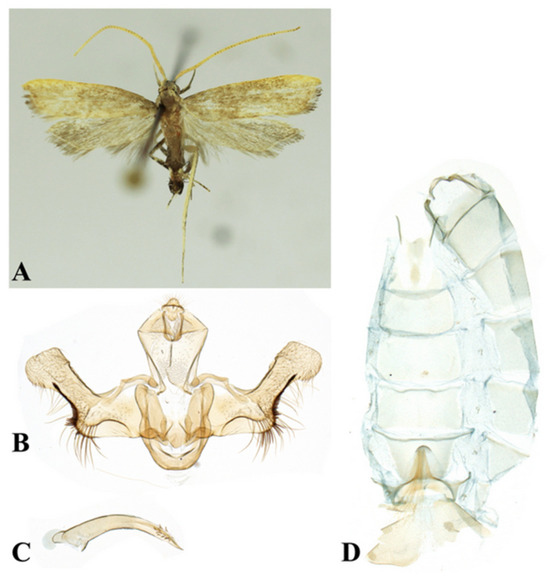
Diagnosis. Wingspan 12.0 mm. The species was described from Ghana based on a male. It can be distinguished from P. paraliberalis, described from Ivory Coast, by the antenna lacking a swollen basal portion of the flagellum, the second segment of labial palpus without ventral rough scale-tufts, and by the male genitalia, which have an extremely broadened distal part of the cucullus and a slender aedeagus. The species is reported from Liberia for the first time.
Male genitalia Figure 8B,C: See also Park et al. (2023, Fig. 6E–G).
Figure 8.
Pectinimura bongoensis Park, 2023; (A) adult; (B) male genitalia (gen. slide no. 4190/Karisch); (C) aedeagus; (D) abdomen.
Female unknown.
Distribution. Ghana, Liberia (Nimba Mountains: new record).
3.4. Genus Homaloxestis Meyrick, 1910
The genus is cosmopolitan and comprises 62 species worldwide. In the Afrotropical Region, only seven species are known. Of these, two species of the genus (H. rawlinsi Park, 2018 and H. subpallida Meyrick, 1931) have been reported from West Africa, only in Cameroon (Park 2008).
Homaloxestis rawlinsi Park, 2018
Homaloxestis rawlinsi Park, 2018: 563. TL: Cameroon, Efulen.
Material examined. 1♂, Liberia, Nimba Mountains, alt. 1050 m, 4.2 km SE Yekepa, camp secondary forest on SE slope, 7°32′35.6″ N 8°31′20.3″ W, 27 viii 2022 LF, leg. T. Karisch, gen. slide no. 4191/Karisch, 2♂, Liberia, Nimba Mountains, alt. 1060 m, 4.2 km SE Yekepa, 0.2 km SSW camp, secondary forest near Parinari forest, 7°32′27.3″ N 8°31′24.3″ W, 28 viii 2022 LF, leg. T. Karisch & A.-J. Dutton.
Diagnosis. The species is similar to the other Afrotropical species known from Cameroon, H. subpallida Meyrick, 1937, but can be distinguished by the male genitalia, as noted by Park (2018).
Male genitalia Figure 9B,C. See also Park (2018, Fig. 7A,B).
Figure 9.
Homaloxestis rawlinsi Park, 2018; (A) male; (B) male genitalia (gen, slide no. 4191/Karisch; (C) aedeagus; (D) abdomen.
Female unknown.
Distribution. Cameroon, Liberia (Nimba Mts.).
Map of Guinea and Liberia in western Africa (Mt. Nimba bordering Guinea and Liberia (modified from Wikipedia, 2010)).
4. Conclusions
Following Part I, which treated the subfamily Torodorinae of Lecithoceridae (Lepidoptera: Gelechioidea) in Liberia, Part II deals with the subfamily Lecithocerinae. Two new species, Notioseus liberianus Park & Karisch, sp. nov. and Lecithocera maruana Park & Karisch, sp. nov., are described and illustrated. In addition, Pectinimura paraliberalis Park, 2023, P. bongoensis Park, 2023, and Homaloxestis rawlinsi Park, 2018, are recorded from Liberia for the first time. The female genitalia of P. paraliberalis are described and illustrated for the first time.
Author Contributions
Conceptualization, T.K. and K.-T.P.; Methodology, T.K. and A.-J.D.; Validation, A.-J.D.; Formal analysis, A.-J.D.; Data curation, T.-U.Y.; Writing—original draft, T.K. and K.-T.P.; Writing—review & editing, T.-U.Y. and K.-T.P.; Supervision, K.-T.P. All authors have read and agreed to the published version of the manuscript.
Funding
This research received no external funding.
Informed Consent Statement
Not applicable.
Data Availability Statement
The original contributions presented in this study are included in the article. Further inquiries can be directed to the corresponding author.
Acknowledgments
The authors thank the Liberian Forestry Development Authority (FDA) for granting permission to conduct the research and to export the material for further analysis. In addition, they are grateful to the Society for the Conservation of Nature of Liberia for the support provided. We are indebted to the anonymous reviewers for their careful reading with helpful comments that can greatly improve the quality of the manuscript.
Conflicts of Interest
The authors declare no conflict of interest.
Abbreviations
| MNVD | Museum für Naturkunde und Vorgeschichte Dessau, Germany |
| SDEI | Senckenberg Deutsches Entomologisches Institut, Müncheberg, Germany |
| ZSM | Zoologische Staatssammlung München, Germany |
| TL | Type locality |
| sp. nov. | New species |
References
- Karisch, T.; Dutton, A.J.; Yu, T.-U.; Park, K.-T. Lecithoceridae (Lepidoptera: Gelechioidea) from Nimba Mts. bordering Liberia and Guinea, Part I: The subfamily Torodorinae, with descriptions of 15 new species. Zootaxa 2025, 5728, 247–286. [Google Scholar]
- De Prins, J.; De Prins, W. Afromoths, Online Database of Afrotropical Moth Species (Lepidoptera). 2025. Available online: http://www.afromoths.net (accessed on 22 April 2025).
- Park, K.-T.; Cho, S.; Koo, J.M. The subfamily Torodorinae of the world (Lepidoptera: Lecithoceridae). Nat. Inst. Biol. Res. 2022, 5, 584. [Google Scholar]
- Park, K.-T. Three new genera and ten new species of the subfamily Lecithocerinae (Lepidoptera, Lecithoceridae) from Cameroon, Africa, based on material collected in 1913–18. Zootaxa 2018, 4415, 561–579. [Google Scholar] [PubMed]
- Park, K.-T.; Koo, J.M.; Aarvik, L. Description of Corymbus Park, gen. n. with six new species from the Afrotropical Region (Lepidoptera: Lecithoceridae). SHILAP Revt. Lipid. 2019, 47, 657–672. [Google Scholar] [CrossRef] [Scilit]
- Park, K.-T.; Kim, S.R. Four new species of Paniculata Park, 2018 (Lepidoptera: Lecithoceridae) from the Afrotropical Region. J. Nat. Hist. 2021, 54, 2897–2908. [Google Scholar]
- Park, K.-T.; Yu, T.U.; Karisch, T. The family Lecithoceridae (Lepidoptera: Gelechioidea) from Ivory Coast (Republic of Côte d’Ivoire), with descriptions of nine new species. Zootaxa 2022, 5162, 357–377. [Google Scholar] [CrossRef] [Scilit] [PubMed]
- Park, K.-T.; Koo, J.M.; De Prins, W. Six New Species of the Family Lecithoceridae (Lepidoptera) from Ghana. Int. J. Zool. Anim. Biol. 2023, 6, 438. [Google Scholar] [CrossRef] [Scilit]
- Meyrick, E. Exotic Microlepidoptera; Taylor and Francis: Abingdon, UK, 1914; Volume 1, pp. 161–288. [Google Scholar]
- Meyrick, E. Exotic Microlepidoptera; Taylor and Francis: Abingdon, UK, 1931; Volume 4, pp. 72–82. [Google Scholar]
- Meyrick, E. Exotic Microlepidoptera; Taylor and Francis: Abingdon, UK, 1932; Volume 4, pp. 203–206. [Google Scholar]
- Meyrick, E. Exotic Microlepidoptera; Taylor and Francis: Abingdon, UK, 1933; Volume 4, pp. 356–359. [Google Scholar]
- Robinson, G.S. The preparation of slides of Lepidoptera genitalia with special reference to the Microlepidoptera. Entomol. Gaz. 1976, 27, 127–132. [Google Scholar]
- Kornerup, A.; Wanscher, J.H. Methuen Handbook of Colour, 3rd ed.; Eyer Methuen: London, UK, 1978; p. 252. [Google Scholar]

Disclaimer/Publisher’s Note: The statements, opinions and data contained in all publications are solely those of the individual author(s) and contributor(s) and not of MDPI and/or the editor(s). MDPI and/or the editor(s) disclaim responsibility for any injury to people or property resulting from any ideas, methods, instructions or products referred to in the content. |
© 2026 by the authors. Licensee MDPI, Basel, Switzerland. This article is an open access article distributed under the terms and conditions of the Creative Commons Attribution (CC BY) license.