


Abstract
Identification keys are important aspects of taxonomic research, but their quality varies substantially. I surveyed all the keys associated with the description of new non-insect animal genera that were available to me (through online and library resources or emailed pdfs received upon request from authors) published in 2021 and 2022. I found 50 keys in 45 papers that permitted the identification of 441 genera, of which 82 were newly described. I assessed the same variables as treated in an earlier paper that dealt only with insects over the same time period. Of the 17 variables evaluated as to whether the key was as useful as possible or whether it was suboptimal, an average of 5.6 were found wanting, very similar to the average for insects (5.7). Important differences between insect and non-insect datasets are: (i) the relatively lower frequency of identification keys associated with the description of new genera in non-insects, (ii) the relatively higher level in the taxonomic hierarchy to which the keys applied in non-insects and (iii) the higher proportion of keys that were to the global fauna in non-insect papers. The frequencies of occurrence of suboptimality among the 17 variables were also similar between the two datasets. Evaluation of non-insect papers suggested several additional recommendations for authors to bear in mind when constructing a key above those resulting from a similar survey of insects.
1. Introduction
Keys are important aspects of the description of new taxa [1,2,3,4] and there are repeated recommendations for making them more readily available, the most recent of which is Gonzalez et al. [5]. Recently, I assessed a range of parameters associated with the description of new insect genera [3] and found that less than 40% of the new genera were made identifiable by a key and that keys averaged suboptimal for approximately one third of 17 binary assessment variables that related to how easy the keys would be for a novice to use. Given that taxonomic practices and standards vary among taxa [6,7], similar assessment of the prevalence of and nature of ways in which identification keys for non-insects might be unnecessarily difficult to use seemed potentially useful. In this paper I provide the results of the assessment of 308 papers describing 424 new non-insect animal genera published in 2021 and 2022 which in combination with the earlier insect data provides a simultaneous snapshot of the nature of those keys written in English for all animal genera.
2. Materials and Methods
Scopus searches that combined the terms associated with the names of animal phyla (or for Arthopoda and Chordata, classes) with “gen* n*” or “n* gen*” were conducted from January 2025 to January 2026. As data for Insecta have already been treated [3] but did not include non-insect Hexapoda (here taken to be Collembola, Diplura and Protura) separate searches were conducted for those three orders. Searches were limited to papers published in 2021 and 2022 for consistency with similar data obtained for insects [3] to make comparisons somewhat more controlled and combinations more appropriate. Only extant taxa were surveyed given the differences in approaches required for assessment of fossils, and replacement names (e.g., Huntinema, Nematoda: Hystrignathidae [8]) were also not included as the original descriptions were published elsewhere at a different time period. All papers freely available to me online through google scholar and the library resources at York University (a system referred to as Omni) were downloaded for study. More details are provided elsewhere [3]. Emails requesting pdfs were sent to the corresponding author of all remaining papers when email addresses could be readily discovered. Not all requests were successful. It is possible that the search terms employed would have precluded discovery of new genus descriptions and associated keys published in languages other than English. Thus, while not exhaustive, the sample is likely representative of the state of keys for newly described non-insect animal genera, at least those presented in English, over the two years sampled and the data comparable to those presented previously for just insects [3].
For each paper I assessed whether one or more keys to adults were provided. If a paper included more than one key (such as separate ones for males and females, or different geographic areas, e.g., Haitlinger [9]) each was treated as a separate entry for assessment of keys, although the proportion of papers that were accessible was analysed on a per-paper basis.
Following earlier work [10,11], I call the group to which the key directly applies the reference group. Thus, a key to South American genera within a superfamily would have the superfamily from that continent as the reference group. This term was previously used in relation to diagnoses [10] but applies equally to keys. The recognition group is the most expansive grouping to which the reference group belongs for which information on how to identify it is not given in the paper, i.e., that taxon which a user has to be able to identify to decide whether the information presented might be useful for a task at hand. For example, if the reference group is freshwater isopods from Australia but no information is given on how to identify Isopoda from other Crustacea, the reference group is Australian Isopoda and the recognition group Isopoda as a whole. If the key is titled: “key to the world genera of Areneidae” and how to identify araneids from other spiders is provided in the paper, the recognition group is all spiders. The higher the taxonomic level of the recognition group, the more useful the paper might be. At least it would make is easier for potential users to tell whether they should read further.
The information outlined below was extracted from each paper with a key. The first set, in Arabic numerals, deals with basic background information. Those in the second set, using Roman numerals, were chosen largely based on ([3], see also Walter and Winterton [4]).
In addition to the standard journal citation data:
- (1)
- Classification of the taxa treated in the key (phylum, class, family).
- (2)
- The title of the key.
- (3)
- Taxonomic level for which the key applied, i.e., the reference group.
- (4)
- Whether the key related to a morphological or geographical subset of the taxon. For the latter the categories were global, continental, national or subnational; when several adjacent small nations were treated, they were included in the national category, and coastal geographies were treated depending upon their extent—e.g., Pacific and Atlantic for North America or just Mexico, were considered continental and national respectively.
- (5)
- Whether the group keyed was overtly named.
- (6)
- The number of new genera described in the paper and treated in the key.
- (7)
- The total number of genera included in the key.
- (8)
- Whether each new genus was known from one or both sexes.
- (9)
- The number of couplets in the key. Assuming each genus is keyed out just once, the number of couplets should be the number of genera minus one; exceptions to this and the reasons for the difference were noted (see item vii below). When other levels in the taxonomic hierarchy were included in the key, (e.g., key to tribes of a subfamily plus to genera of one tribe) only those couplets ultimately leading to a generic level identification were counted.
Keys were evaluated based upon the following criteria using the same numbering as in Packer [3].
- (i)
- The availability of the key—was it freely available or through library or online resources, was it obtained from the emailed request to authors or perhaps not available at all? Those in the latter category could not be assessed for any other variables and were not included in the remaining data.
- (ii)
- Whether the presence of a key would be detectable from standard searches (i.e., was the word “key” found in the title, abstract or keywords).
- (iii)
- Whether authors explained how to identify the taxonomic group treated in the key (also where that information was provided and how many features needed to be studied to make the decision). The taxonomic level from which the taxon is discriminated is the recognition group, i.e., that which a potential user has to be able to recognise before deciding to use the key. Taxa identified at the family level or above were considered not applicable for being scored as suboptimal as it was assumed that those interested in the taxa might be able to make family-level identifications relatively easily.
- (iv)
- Was the key, or parts of it, restricted to one sex when the other sex was also known? This required looking for sex-specific couplets. Some keys were overtly stated to be for one sex and were coded as not applicable for this variable.
- (v)
- Were there errors in key formatting, such as unattainable couplets due to numbering errors?
- (vi)
- Were there leapfrog couplets—i.e., those in which the first lead (i.e., the first half of a couplet) led to a subsequent couplet that was further down the key than that resulting from the second lead? This was considered to be potentially confusing because having the two leads take the user to other couplets in sequence is the most common practice. Keys of less than three couplets were considered not applicable for this variable because leapfrogging is not possible.
- (vii)
- Was the key of the standard dichotomous structure and if not, in what way did it differ?
- (viii)
- Did the key facilitate retracing (indicated by including the couplet number from which the current one was attained)? Retracing was considered unnecessary in keys of less than three couplets.
- (ix)
- Was the mean number of steps taken to get to the genera in the key as small as possible (i.e., was the as key fan-shaped as possible—see below)? This is a measure of average effort required of a user to perform an identification.
- (x)
- Were there any monothetic couplets (i.e., those that included only a single feature), and if so, what proportion did they make up?
- (xi)
- Were any of the features in one lead of a couplet not contrasted in the other lead? Were any couplets made up entirely of features that were not contrasted?
- (xii)
- Were any couplets indecisive for one or both sexes, through inclusion of only qualified statements (e.g., “usually”), ambiguous (e.g., long versus short with neither measurements nor figures cited to demonstrate the difference) or through having overlapping feature states (e.g., number of setae on a particular structure 10–20, versus 18–24)?
- (xiii)
- Did all leads cite at least one figure to illustrate them?
- (xiv)
- Were the figures conveniently placed close to the key—on the same or adjacent page or as close to the key as possible given the number of figures, versus scattered throughout the text or all being placed several pages away or all at the end? Keys lacking figure citations were treated as not applicable for this variable.
- (xv)
- Were all genera in the key diagnosed, not just the new ones (all of which were diagnosed, although this was not the case for all insect new genera [3])?
- (xvi)
- Were habitus images of the new genus provided, or at least all parts of it relevant to its identification (for example, not all body segments of a millipede might be required to give a reader an idea of its overall appearance, an issue that generally does not arise with insects)?
- (xvii)
- Lastly, was the key an emendation of an earlier one without the full key being presented? This was not found in any of the papers assessed here: complete keys were provided ubiquitously (this issue arose only among the insect keys treated earlier).
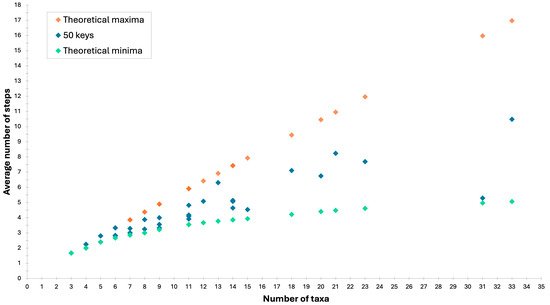
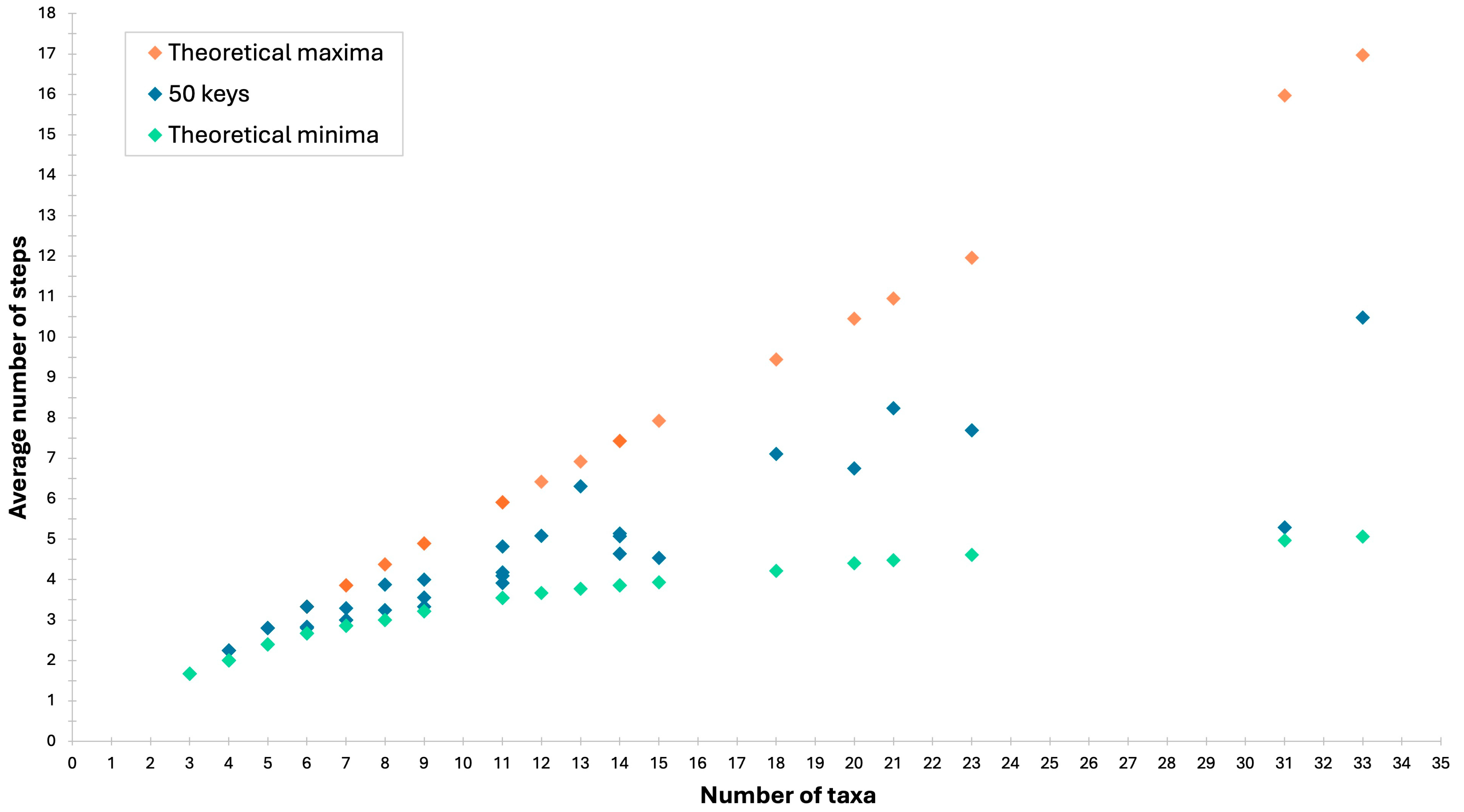
The meaning and method of acquisition for all above variables should be self-evident except for the treatment of number of couplets required to get to an identification. As has been noted elsewhere [3,4,12] keys that are more fan-shaped require study of fewer couplets, on average, to effect an identification than do those that are comb-shaped. Furthermore, the difference increases very steeply as the number of taxa in the key increases. For example, a key for 128 taxa will require, on average (assuming all terminals are included once), almost ten times as many couplets to be evaluated (64.5) if it is comb-shaped than if it were perfectly fan shaped (7), see also Figure 1.
Figure 1.
Plot showing the average number of steps to get to each of the terminals in a key once for the 50 keys assessed in comparison to the smallest possible number (i.e., if the key were as fan-shaped as possible) and to the largest (if the key were comb-shaped).
For a perfectly comb-shaped key, the average number of steps to obtain an identification is given by the equation:
where n is the number of taxa in the key.
Smax = ((n + 1)/2) − 1/n
The equation to estimate the average number of steps in a perfectly fan-shaped key is much more complicated:
where n is the number of taxa, Q = Ꙇlog2(n)ꓙ and x = n − 2Q. Note that surrounding an expression by “Ꙇ” and “ꓙ” indicates that the numerical value must be rounded down to the next lowest integer.
Smin = (Q × (2Q − x) + (Q + 1) × 2x)/n
In comparing the number of steps required to the minimum and maximum possible, keys of only three taxa were considered inapplicable as in them Smin = Smax = 1.67 (there were no keys to only two taxa but obviously Smin is the same as Smax in that instance also).
Because the sample size for number of keys was small for higher-level groupings (with a maximum of 13, for Acari), statistical analyses contrasting different subgroups are unwarranted.
From the above, a composite index of key quality was calculated with variables i–xvii coded as binary with suboptimality scored as 1 for each of them and then summed across all variables. As some of the criteria are inapplicable for particular keys (see above), a more reasonable index is the percentage of applicable variables that were suboptimal, i.e., ignoring entries in the table where a key was scored as inapplicable. This was also calculated.
The data from insects from Packer [3] are compared to that presented here for each of the 17 criteria and also in summaries of the total number of components that were suboptimal.
Statistical tests were undertaken using the online Social Science Statistics website: www.socscistatistics.com.
It should be reiterated that the following assessments concern only keys to genera. Papers in which new genera were described that included a key that dealt with species identifications are not included in the sample unless they also keyed different genera (e.g., Borges et al. [13]). In the latter case, the data collected related only to those parts of the key that permitted genus-level identification. Similarly, keys (such as in Prendini et al. [14]) that permitted the identification of higher-level taxonomic groups were evaluated only for those couplets that ultimately led to genus-level identifications.
3. Results
3.1. Background Data
A total of 325 papers described a total of 446 new genera although 17 papers for 22 new genera were not available (see methods) and not treated further. Table 1 shows the number of papers and new genera described for each animal phylum, with those with the largest sample sizes, Arthropoda and Chordata, also divided into classes. Table 1 also shows the number and percentage of papers that included keys and the number and percentage of new genera described in papers with keys to permit identification. It should be noted that, as with the insect survey [3], none of the keys found in the literature search were matrix-based keys.
Table 1.
Taxonomic breakdown of the number of papers describing new genera, number of new genera described and the inclusion of keys to permit the identification of the genera.
In the following, “Column letter” refers to columns in Table 2 where all raw data are presented.
Forty-five of the papers included keys to genera (14.6% of the total). More than one key in a paper was found as follows (indicated by a number after the dash in Column A): Haitlinger [9] had four keys for genera of castriniid mites, one each for the two sexes in each of two geographic regions. In Gomes Almeida et al. [15] there were separate keys for males and females of macronyssid mites and Kim and Boxshall [16] had separate keys for copepods in different families. Thus, there was a total of 50 keys in the dataset. Overall, 82 new genera and 441 genera in total were each made potentially identifiable through one or more keys. Thus 19.3% of the 424 new genera were included in keys. For papers with keys, 19 different journals were included with Zootaxa being most heavily represented with 14 papers (31.1% of the total) and Zookeys a distant second with four (Column B).
There is marked heterogeneity in the proportion of new genera that are described furnished with a key among higher-level taxa. For the major groupings with ten or more new genera, Bryozoa, Mollusca, Platyhelminthes and Porifera (and also Mammalia) lacked any identification keys and there was one key among the ten papers (10.0%) that described new nematode genera. Among the rest, Arachnida had the smallest proportion of papers that included an identification key (7.9%), and Myriapoda had the most (47.1%). The pattern for proportion of new genera made identifiable with a key was similar, with 7.7% of new nematode genera and 46.2% of myriapods being the outlying non-zero values (Table 1). Variation among arthropod classes in the prevalence of identification keys is significant when analysed on a per-paper or per-new genus basis (non-insect hexapods removed due to small sample sizes, χ2 = 15.93, p = 0.0012 and χ2 = 22.83, p < 0.00005 respectively). In the following, “Column” refers to columns in Table 2 where all raw data are presented.
Fifty-two new genera were known from both sexes and an additional three were likely also known for both sexes in somewhat sexually monomorphic taxa (one polychaete annelid and two bony fish, Column F) with long series of specimens but no statements provided about their sex. Fourteen new genera were known only as females, one only as males and one only as males and neuters [17]. Eleven newly described genera with smaller sample sizes lacked statements as to whether one or both sexes had been studied (none were in taxa where hermaphroditism would be an issue).
Key titles almost always accurately explained what followed: i.e., they mentioned the taxonomic level(s) that the key identified (usually genera) as well as the reference group to which it pertained. Three exceptions were as follows: in Slavenko et al. [18] the key was simply titled “key to the genera” and two keys related only to vaguely described groups of genera: key to genera A, B and C [19] or key to genus D and related taxa [20]. Keys also identified whether they dealt with geographic subdivisions, morphological or ecological subsets or just one sex (or in the case of Gellert et al. [17]—only to neuters of a crustacean group). However, there was one key only to females when both sexes were known [21], six where the key applied only to males when both sexes were known (Table 2, column F) and in Gellert et al. [17] males of the new genus were also known in addition to neuters but the key was only for the latter.
Table 2.
Raw data extracted for this paper. i–xvii indicate variables assessed for key criteria.
Column G shows the level of the taxonomic hierarchy included in the keys, i.e., the reference group. Most keys treated the family level or above (31, 62%). Thirteen of the keys treated a geographically restricted subset of the taxonomic level (c, n or s added in Column G indicating continents, national and subnational respectively), two a morphologically defined subset (m added in Column G; [17,44]), three were both geographically and morphologically prescribed [19,51,52] and one was both ecologically (e added in Column G) and geographically restricted [23]. Overall, global level treatments were most common (32, 65.3%).
The keys permitted the identification of three to 33 genera (column I) in total with an average of 10.12, but high variance (S.D. = 7.31, median = 7). From one to five new genera could be identified with the keys (column C) with an average of 1.82 (S.D. = 1.12, median = 1). The number of couplets was usually as expected (i.e., n-1 where n is the number of genera treated, column J); exceptions are noted in the footnotes to the column and also under variable vii below.
Table 2 also shows the results of key evaluation for each of the criteria; column numbers are given for the relevant data.
3.2. Key Evaluation
(i) Availability: I could not access the data in 17 papers which were neither available through library and online sources nor through contact with an author. Thus, 5.2% of papers describing 22 new genera (4.9% of the total) could not be analysed further. Without access to the entire paper, it was usually impossible to determine whether or not keys were provided.
Eleven papers that included a total of 12 keys that permitted the identification of 20 new genera were not freely available but were obtained upon request (column K). All of these had been published in Zootaxa.
(ii) Searchable: Ten keys incorporating 25 new genera were in papers that did not have the presence of a key detectable through standard keyword searches before downloading the pdf (Column L). These represent 20% and 30.5% of papers and new genera respectively.
(iii) Reference group identification explained: One key was to genera within an order, two were for superfamilies and 28 were to families. These taxonomic levels were considered not to require explanation on how to identify them. This left thirty-seven new genera in 19 keys that were in papers where information on how to identify the taxonomic level to which the key applied would have been useful. This information was not given for seven keys relevant to 16 new genera (36.8% of the keys and 43.2% of the new genera, column M). When provided, the information was immediately above the key or at the beginning of the taxonomic section in seven of the instances, but far away in the introduction in the others and thus usefully positioned in 58.3% of cases where it was deemed needed. The number of features requiring evaluation by a user to check whether the key might be useful to identify a specimen in these instances ranged from two to 33 with an average of 9.2 (column N).
(iv) Sex-specific couplets (Column O): Three keys had sex-specific couplets despite the key ostensibly being to both sexes. Thus, specimens of the sex not treated in those couplets could not be identified with the key when passing that couplet was required. This issue applied to 8.6% of the keys where the problem could arise, although in two of these [41,49] it was clearly stated that this was an issue in the key heading or subheading (i.e., wording such as “this key requires a specific sex to be available for some couplets to be applicable”).
(v) Formatting errors (Column P): Three keys contained errors in couplet numbering (6%): in two cases [33,42] there was a single error which should be easily accounted for by users. But in Jesus et al. [32] there were multiple errors (couplets with only one lead, different leads of a couplet numbered as if they were different couplets) and the fact that this key also included trichotomies suggests that those using it frequently would likely wish to edit the pdf for clarity.
(vi) Leapfrogging (column Q): A single key [31] (2%) had leapfrog couplets.
(vii) Non-dichotomous couplets (Column R): Three keys included one or more trichotomous couplets and one was of the yoked style (i.e., all the taxa agreeing with the first lead of a couplet were treated before the second lead was reached [42]). Thus 8% of keys had a non-standard structure.
(viii) Retracing (Column S): Only four keys facilitated retracing although three more had only two couplets and so would not have needed it. Thus only 8.5% of keys for which retracing might have been sensible permitted it. This related to seven new genera (9% of the total for which retracing would have been useful).
(ix) Number of steps: Figure 1 shows the mean number of steps required to identify the genera in the keys along with the minimum and maximum possible number of steps (for fan- and comb-shaped keys respectively). Six keys (Column T), for a total of 11 new genera, were as short as possible—i.e., they were maximally fan-shaped. Thus, 14.3% of strictly dichotomous keys of more than two couplets (where minimum and maximum number of steps are equal) were as efficient to use as possible and the percentage of new genera that they aided the identification of was 16.2%. Not surprisingly, these were all in the relatively shorter keys: no keys of more than five couplets were as fan-shaped as possible, but even for such short keys only a minority were optimal for this criterion (6/17 or 35.3%) and fan-shaped keys were to significantly fewer taxa than the others (Mann–Whitney U-test, z = 2.2, p = 0.028).
(x) Monothetic couplets (Column U): All but seven keys included one or more monothetic couplets (86%); three were made up entirely of such couplets while a fourth was monothetic for females; thus 8% of all keys included entirely single-feature couplets. Seventy new genera were in the keys containing monothetic couplets (85.4% of the total). The average proportion of couplets that were monothetic across all keys was 45.5%.
(xi) Not contrasted (Column V): Eleven keys (22%) included features in one or more leads that were not contrasted in the alternate lead of the couplet and there were 22 new genera in these keys (26.8%). Uncontrasted features made up all parts of one or more couplets in four cases (8% of all keys) relevant to six new genera (7.3%).
(xii) Eleven keys (22%) had one or more couplets that were entirely indecisive (Column W), affecting 24 new genera (29.3%).
(xiii) Imaged features (Columns X): Only four keys (8%), for six new genera (7.3%), had at least one image cited for each lead, 34 (68%) entirely lacked them and the remaining 12 illustrated one or more leads, but not all of them (these are the keys with “1” as the entry in column X but also with an entry in column Y). On average 19.4% of leads cited at least one image.
(xiv) Image placement (Column Y): Four keys (25% of keys with any images) had all the images provided near the key, while the remaining 12 had them less conveniently placed.
(xv) Diagnoses (Column Z): Thirteen keys (26%) were in papers where all genera that were made identifiable from a key were also identifiable through a formal diagnosis and one more had diagnostic information presented for all genera in sections with the subheading “remarks”. All the new genera were diagnosed.
(xvi) Habitus images (Column AA): Ten keys in seven papers did not have complete habitus images of the new genera with the result that 18 new genera lacked habitus images. However, seven of these genera had substantial proportions of their entire bodies illustrated, four of which were millipedes for which an image incorporating all repetitively structured segments might not need habitus images.
(xvii) Emendation of an earlier key with only the changes included, rather than the whole key, was not found in any of the papers assessed here.
An issue not found among insect keys was contradiction between how many genera were stated to be treated in the key and the number actually in it. This was found in one instance [30] where the number in the key was less than expected from the text. This does not affect key quality itself other than making users wonder how to identify the missing taxa, unless the first number was a typographic error.
For the fifty non-insect keys assessed for the above 17 criteria, the number of variables that were found to be suboptimal varied from two to nine (Column AC), with an average of 5.6 (S.D. = 1.75). This represents 12.5 to 69.2% (Column AD) of the assessable variables (Column AB; recall, some variables are inapplicable for some keys) and an average of 36.9% (S.D. = 11.6).
3.3. Comparison of Entomological to Other Animal Data
Table 3 compares the data discussed above for the sum of non-insect and insect keys.
Table 3.
Data for the variables for which the non-insect data were significantly different from the insect data.
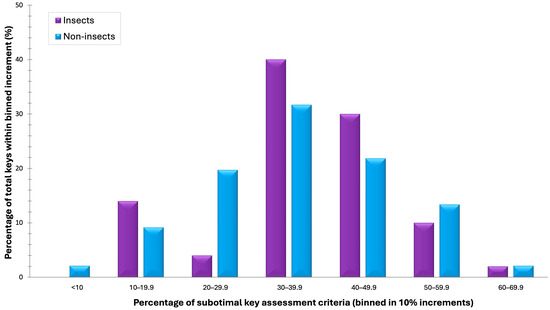
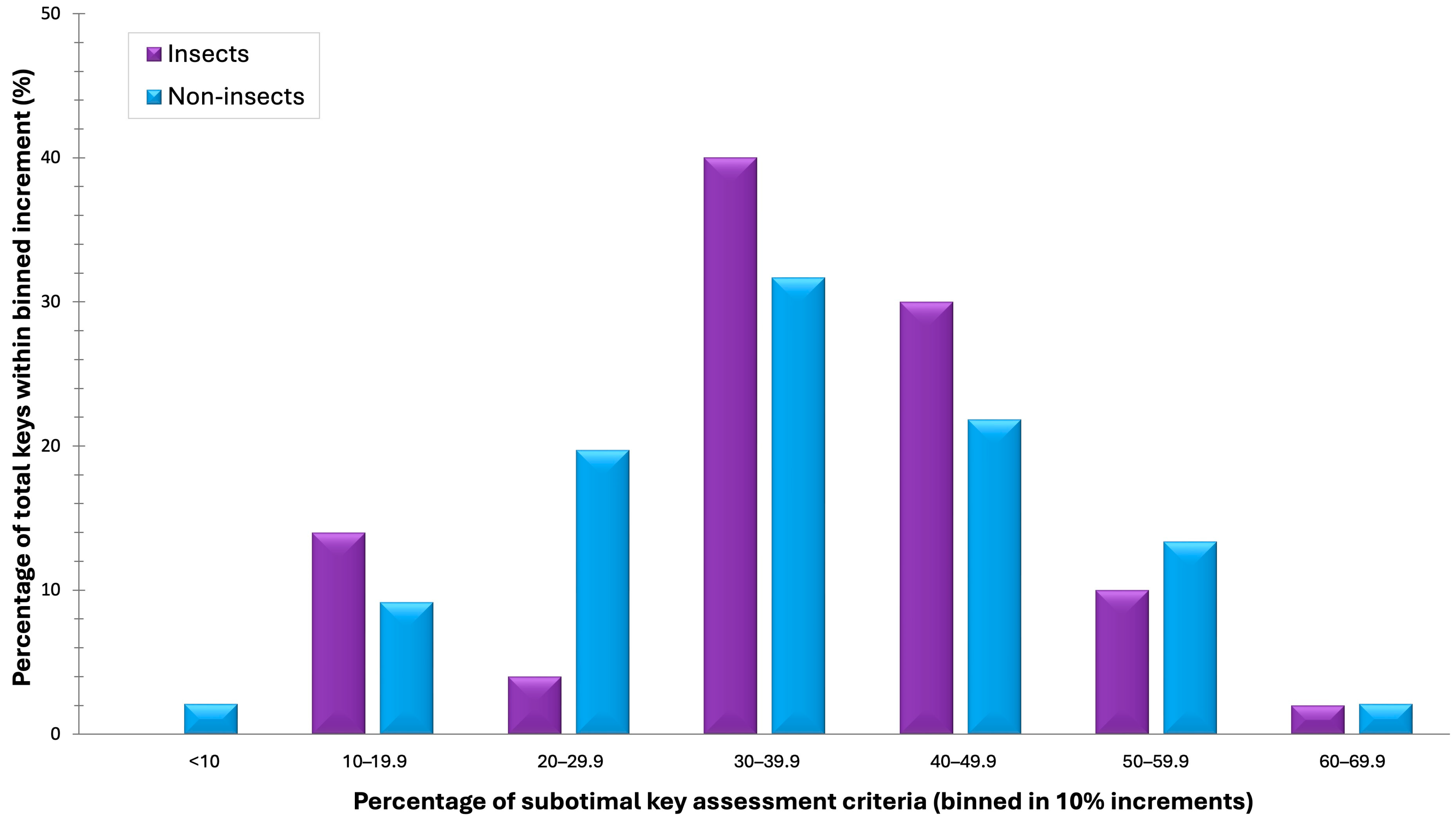
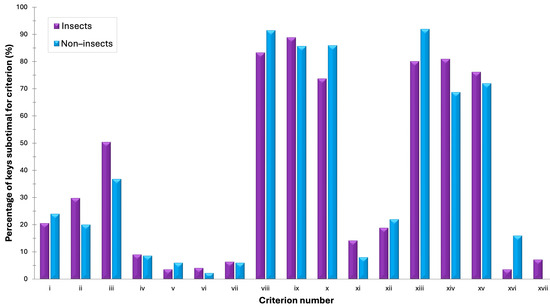
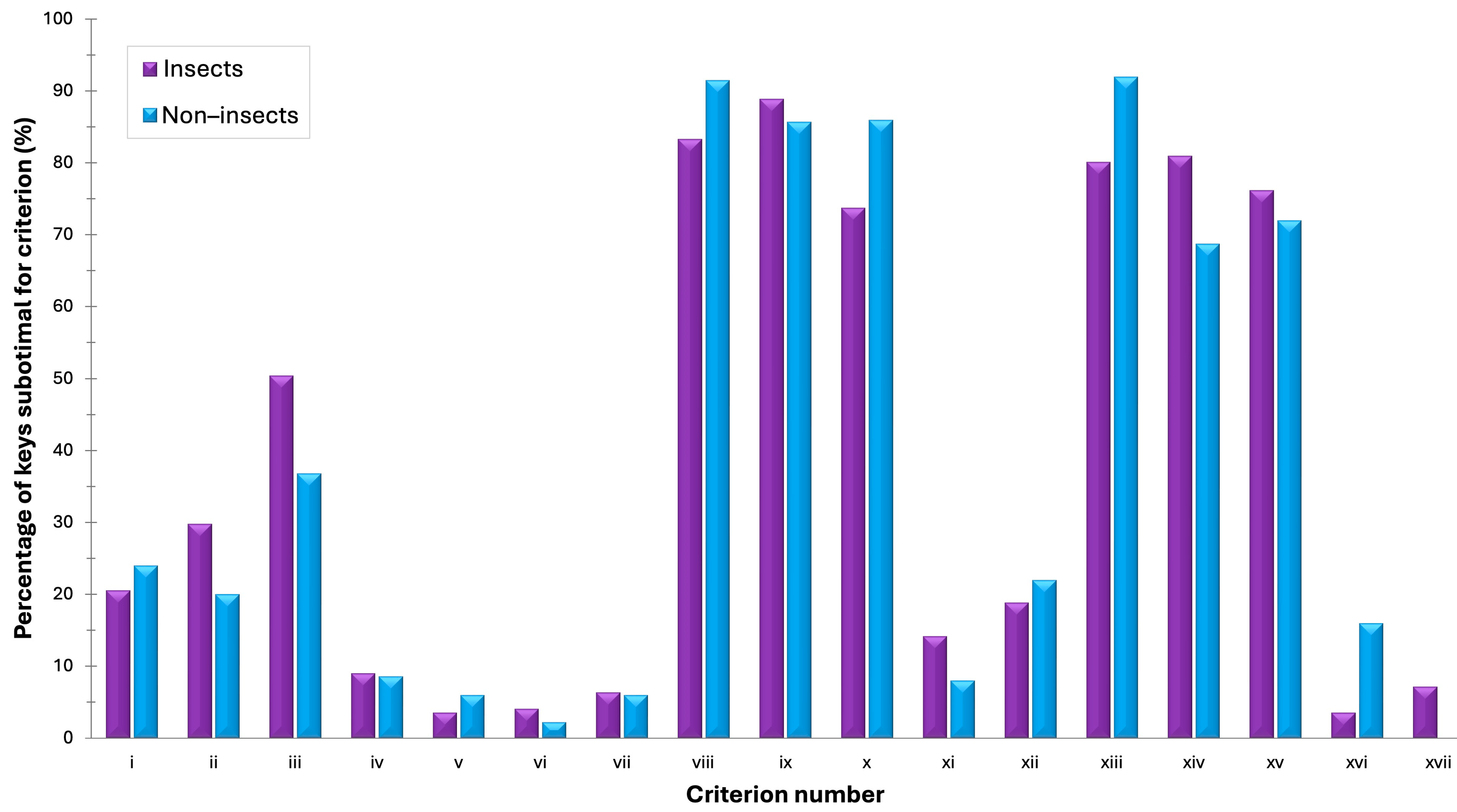
Figure 2 shows the percentage of assessable variables that were suboptimal for non-insects and for the earlier insect data and Figure 3 shows the proportion of keys that were subject to each of the 17 different issues separately for insects and non-insects. In both cases, the patterns are similar. None of the key assessment criteria differed significantly between the insect and non-insect keys, although illustration of all leads was almost significantly less frequent in the non-insect keys (χ2 = 3.72, p = 0.054) and the proportion of keys with entirely monothetic couplets was higher in insects (χ2 = 3.72, p = 0.08) (all other p values were greater than 0.1). However, there were significant differences among some of the other assessed variables as follows. Both the proportion of papers with keys and new genera made identifiable with keys were higher in the insect sample (χ2 = 34.85 and 56.27, respectively, p << 0.00001 in both cases). Keys were given to genera within groups at the family level or above more often in non-insects (χ2 = 41.34, p <<< 0.00001) and were more often to the global fauna (χ2 = 5.9, p = 0.015).
Figure 2.
Percentage occurrence of different proportions of variables for which the keys were suboptimal, grouped in 10% increments.
Figure 3.
Percentage of occurrences where keys were suboptimal for each of the 17 criteria.
4. Discussion
4.1. General
It is becoming increasingly important to assess biodiversity as efficiently as possible and this requires accurate and easy-to-use identification tools. Anyone other than the taxonomic experts on a particular group wishing to identify specimens morphologically will likely need to use one or more identification keys as the first step in identifying a specimen [3,57]: but how easy are these keys to use? I chose to assess new genus-level taxa as the focus of study so the results might be broadly applicable while being tractable. Based upon an earlier survey of keys to insect genera [3], I evaluated 17 key optimality criteria, and, on average, insect and non-insect keys alike were suboptimal for an average of over 5.5 variables but with substantial variation among keys in the overall scores.
The earlier paper made 23 recommendations on how to make keys optimal for users. I do not repeat that list here as most of the factors noted above (1–16) were among them. It is generally not possible to verify several more such as whether (relatively) naïve subjects tested the key or whether the key was proofread carefully. Others are difficult for non-specialists of the included taxa to address such as whether the most common taxa are treated earlier in the key or if couplets requiring the most difficult practical procedures arise later. The use of terminology that would be unknown to anyone not already well-acquainted with the taxonomic group treated seemed ubiquitous. While it is important to use terms that are precise and internationally understood by people using a key, beginners will often be at a loss when faced with a paper that does not explain what a large number of taxon-specific morphological terms might refer to. This would be most easily accomplished through labelled illustrations that point out both the structure and the particular feature state that a specimen must possess for it to agree with a statement in a key. Alas, this was rarely done. The best example I have found of such user-friendly approaches remains [58], a study of ponerine ants, although several papers on Crustacea (e.g., Conlan [28]) approached this. But there seems no good reason to use terms that require consultation of a dictionary when those in common usage would suffice. Take for example, a couplet in Baker [59] where a structure is stated to be either mucronate or mutic. Mucronate means having a mucro, which means it has an abrupt sharp point. Mutic means unarmed. Why not simply say “with one or more spines” (and perhaps help further by saying how many; in this case there are two and they are neither short nor “abruptly sharp”) versus “without spines”. Why are most—even English-speaking users—forced to consult a dictionary to understand a couplet? I have yet to hear a taxonomist, or anyone that uses the results of taxonomic research, complain that they do not have enough to do and so making keys mor rapidly understood should benefit everyone and should be considered during key construction.
In addition to the lack of keys that were partial emendations of earlier ones among the non-insect data (as noted above), another issue that a few insect keys suffered from which was not found in any of the examples examined here was the placement of keys in supplementary materials where, experience shows, less rigorous examination occurs during the review process [3].
Conversely, two issues were found among the current sample of keys that did not occur among the insect papers. One arose in Haitlinger [9], where separate keys were provided for males and females of canestriniid mites for each of two different geographic areas. The second pair of those keys (for Asian and Oceanian genera) would, at best, be unnecessarily time-consuming to use because “[g]enera which are already in the keys for Europe are not included in these keys.” Thus, a specimen from Asia or Oceania would have to be run through a key to European genera before using the one for the geographic area from which the sample was obtained: it seems probable that false positive identifications might be obtained in using the key to European taxa for an Asian specimen.
The other issue concerns inclusion of taxa that the authors have not seen. For example, Drumm and Heard [30] included one new genus in their key based upon the original diagnosis and illustrations. Because this issue could only be confidently recognised if the authors stated it themselves, it seems probable that it arose more often than I detected it and it may have occurred unnoticed within the insect dataset.
Some additional insights gleaned from the non-insect samples are as follows: One key (in Kohler et al. [37]) provided letters for the different leads within a couplet but did so inconsistently, potentially causing confusion. In contrast, Drumm and Heard [30] included trichotomies in their key but made it sufficiently obvious, through adding letters at the beginning of each lead, that users would notice the inclusion of this non-standard approach. The keys in Sharkey et al. [60] in the insect dataset, also made it obvious when non-dichotomous couplets arose. In Núñez et al. [45] the authors incorporated a useful approach by avoiding, wherever possible, couplets that relied on body parts that are frequently broken off (their focal organisms being polynoid polychaetes). While many marine organisms are fragile, difficult to extract as intact specimens or both, many arthropods have body parts that are often broken off whether specimens are stored in fluids or as is the case with most insects, on a pin. It would be useful for authors of new taxa to minimise reliance on those body parts most likely to be lost (this was treated previously [3] only in passing—monothetic couplets using fragile parts being discouraged). It is useful for authors of taxonomic papers to explain how to differentiate the taxa treated in the context of both keys [3] and diagnoses [10] and to do so at as high a level as possible. This will enable more potential users to know whether the paper is of practical use to their tasks at hand. This might be more important for taxa for which there is broader interest. However, this is something of a circular argument given that taxa with a literature permitting easy identification will receive broader attention. Authors are sometimes inconsistent in their treatment of this issue. For example, ref. Drumm and Heard [30] provide a key to genera of Parapseudinae (Crustacea) and elsewhere explain how to identify the family Parapseudidae from among taxa of the suborder Apseudomorpha. They also state what features differ between the subfamilies—without mentioning which states are present in which subfamily. Thus, they allow identification of the relevant family, but the user has to know which subfamily has which feature states before they can embark on the key.
4.2. Recommendations
1. Provide information that makes it clear what taxa can be identified with the key. This should be done in the key’s title or immediately beneath it. This would include the taxonomic group encompassed by the key, the geographic range it occupies, what sexes or life stages the key works for and whether it is to an ecologically or morphologically defined subset of the larger group. The key title should also state the taxonomic level the key identifies. If there is more than one—for example if the key is to genera within a family overall, but some subfamilies are identified only to that level whereas others are keyed to genus, it should be stated overtly, perhaps optimally just below the title. If the key is to a morphological subset of the higher-level taxon treated explain clearly how to identify it. “Key to the taxa with modified hind legs” is not useful unless a potential user can easily understand what those modifications look like. In this example, images should be provided not only of the least modified of the taxa included but also in the most similar appearing legs that are considered unmodified—for example, by stating “key to the taxa with hind legs at least as modified as in Fig. A, taxa without modifications will look at most like those in Fig. B.”
2. Whenever possible, include features based on body parts that are relatively unlikely to be obscured or damaged. Certainly, it is disadvantageous to have any couplets entirely made up of parts that are likely to be lost, although in some cases there might be no alternatives. It is perhaps notable that diagnoses of new genera in the groups for which no identification keys were provided often required time-consuming dissection and/or serial sectioning for study (e.g., Mendoza-Franco et al. [61], Platyhelminthes): a potential reason as to why producing keys is not part of the taxonomic culture among researchers of these groups.
3. When there are multiple keys dealing with the same taxa but from different ecological or geographic regions, make them exhaustively applicable in each case (see fourth paragraph in discussion for the example that prompted this recommendation).
Funding
This paper was supported by funding from the Natural Sciences and Engineering Research Council of Canada through Discovery Grant number RGPIN-2020-06991.
Data Availability Statement
All data presented here are shown in the tables provided except for the comparative data for insects which were published in Packer [3] and the supplementary information associated with that paper which are freely available.
Acknowledgments
I am grateful to all authors who replied to a request for pdfs of their papers and to Czarina Ortega for helping me obtain references and amalgamating the list of citations. I am grateful to Clement Kent for providing the equation to calculate the minimum number of steps required to obtain an identification. I thank Aishwarya Subramanian for editing the figures. AI was not used in the preparation of this paper; some may suspect that no I whatsoever was involved.
Conflicts of Interest
The author declares no conflicts of interest.
References
- Favret, C. The 5 Ds of taxonomy: A users guide. Quart. Rev. Biol. 2024, 99, 131–156. [Google Scholar]
- Krell, F.T. Why impact factors don’t work for taxonomy. Nature 2002, 415, 957. [Google Scholar] [PubMed]
- Packer, L. A survey of keys for the identification of newly described insect genera: Recommendations for authors, reviewers, editors, and publishers. ZooKeys 2024, 1215, 65. [Google Scholar] [CrossRef] [Scilit] [PubMed]
- Walter, D.E.; Winterton, S. Keys and the crisis in taxonomy: Extinction or reinvention? Annu. Rev. Entomol. 2007, 52, 193–208. [Google Scholar] [CrossRef] [Scilit] [PubMed]
- Gonzalez, V.H.; Rasmussen, C.; Lucia, M.; Zabinski, W.J. Announcing a new section: Provisional identification keys. J. Melittol. 2026, 147, 1–6. [Google Scholar]
- Rheindt, F.E.; Bouchard, P.; Pyle, R.L.; Welter-Schultes, F.; Aescht, E.; Ahyong, S.T.; Ballerio, A.; Bourgoin, T.; Ceríaco, L.M.; Dmitriev, D.; et al. Tightening the requirements for species diagnoses would help integrate DNA-based descriptions in taxonomic practice. PLoS Biol. 2023, 21, e3002251. [Google Scholar] [CrossRef] [Scilit] [PubMed]
- Braby, M.F.; Hsu, Y.F.; Lamas, G. How to describe a new species in zoology and avoid mistakes. Zool. J. Linn. Soc. 2024, 202, zlae043. [Google Scholar] [CrossRef] [Scilit]
- Zhang, N.; Zhang, L. Three new genera, two new species and one new combination of family Hystrignathidae (Nematoda: Thelastomatoidea) from Ceracupes fronticornis (Westwood) (Insecta: Passalidae) in China. Syst. Parasitol. 2022, 99, 689–698. [Google Scholar] [CrossRef] [Scilit] [PubMed]
- Haitlinger, R. A review of host-commensal associations between canestriniid mites (Astigmata: Canestriniidae) with keys and descriptions of the new genera. Eur. Zool. J. 2022, 89, 22–93. [Google Scholar] [CrossRef] [Scilit]
- Packer, L. Two simple ways to make taxonomic diagnoses more useful. Taxonomy 2025, 5, 43. [Google Scholar] [CrossRef] [Scilit]
- Packer, L. On the importance of contrasts in taxonomic diagnoses: A survey of 405 newly described insect genera. Insects 2025, 16, 1224. [Google Scholar] [CrossRef] [Scilit] [PubMed]
- Packer, L.; Ali, E.; Dumesh, S.; Walker, K. The identification of pollinators: Where are we and where should we go? In Pollination Services to Agriculture; Routledge: Oxfordshire, UK, 2016; pp. 57–73. [Google Scholar]
- Borges, C.; Farias, A.; Mácola, R.; Neves, E.G.; Johnsson, R. A new Entomolepididae genus and a new species of Spongiopsyllus Johnsson, 2000 (Copepoda, Siphonostomatoida) and their association with Aplysina Nardo, 1834 (Porifera, Demospongiae) in Todos-os-Santos Bay, Bahia, Brazil. Zootaxa 2021, 4981, 301–316. [Google Scholar] [CrossRef] [Scilit] [PubMed]
- Prendini, L.; Ehrenthal, V.L.; Loria, S.F. Systematics of the relictual Asian scorpion family Pseudochactidae Gromov, 1998, with a review of cavernicolous, troglobitic, and troglomorphic scorpions. Bull. Am. Mus. Nat. Hist. 2021, 453, 1–149. [Google Scholar] [CrossRef] [Scilit]
- Gomes-Almeida, B.K.; Pepato, A.R. A new genus and new species of macronyssid mite (Mesostigmata: Gamasina: Macronyssidae) from Brazilian caves including molecular data and key for genera occurring in Brazil. Acarologia 2021, 61, 501–526. [Google Scholar] [CrossRef] [Scilit]
- Kim, I.-H.; Boxshall, G.A. Copepods (Cyclopoida) associated with ascidian hosts: Ascidicolidae, Buproridae, Botryllophilidae, and Enteropsidae, with descriptions of 84 new species. Zootaxa 2021, 4978, 1–286. [Google Scholar] [CrossRef] [Scilit] [PubMed]
- Gellert, M.; Palero, F.; Błażewicz, M. Mislabeling and nomenclatorial confusion of Typhlotanais sandersi Kudinova-Pasternak, 1985 (Crustacea: Tanaidacea) and establishment of a new genus. PeerJ 2022, 10, e14272. [Google Scholar] [CrossRef] [Scilit] [PubMed]
- Slavenko, A.; Tamar, K.; Tallowin, O.J.; Kraus, F.; Allison, A.; Carranza, S.; Meiri, S. Revision of the montane New Guinean skink genus Lobulia (Squamata: Scincidae), with the description of four new genera and nine new species. Zool. J. Linn. Soc. 2022, 195, 220–278. [Google Scholar] [CrossRef] [Scilit]
- Turan, D.; Kaya, C.; Aksu, İ.; Bektaş, Y. Paracapoeta, a new genus of the Cyprinidae from Mesopotamia, Cilicia and Levant (Teleostei, Cypriniformes). Zoosystematics Evol. 2022, 98, 201–212. [Google Scholar] [CrossRef] [Scilit]
- Villalobos-Guerrero, T.F.; Conde-Vela, V.M.; Sato, M. Review of Composetia Hartmann-Schröder, 1985 (Annelida: Nereididae), with the establishment of two new similar genera. J. Nat. Hist. 2021, 55, 2313–2397. [Google Scholar] [CrossRef] [Scilit]
- Beard, J.J.; Ueckermann, E.A.; Seeman, O.D. A new tribe Obuloidini Beard, Ueckermann; Seeman (Acari: Tenuipalpidae): A review of the genera Krugeria and Obuloides, with descriptions of two new genera and nine new species. Syst. Appl. Acarol. 2022, 27, 269–346. [Google Scholar] [CrossRef] [Scilit]
- Amin, O.M.; Heckmann, R.A.; Sist, B.; Basso, W.U. A review of the parasite fauna of the black-bellied pangolin, Phataginus tetradactyla Lin. (Manidae), from Central Africa with the description of Intraproboscis sanghae n. gen. n. sp. (Acanthocephala: Gigantorhynchidae). J. Parasitol. 2021, 107, 222–238. [Google Scholar] [CrossRef] [Scilit] [PubMed]
- Antić, D.; Vagalinski, B.; Stoev, P.; Akkari, N. A review of the cavernicolous Trichopolydesmidae (Diplopoda, Polydesmida) from the Carpathian-Balkan arch and the Rhodope Mountains, with descriptions of two new genera and three new species. ZooKeys 2022, 1097, 1–46. [Google Scholar] [CrossRef] [Scilit] [PubMed]
- Antić, D.; Spelda, J. Maurieseuma, a new genus to accommodate Hylebainosoma nontronense Mauriès; Kime, 1999, and the revalidation of the genus Romanosoma Mauriès, 2015 (Diplopoda: Chordeumatida: Haaseidae). Zootaxa 2022, 5219, 193–200. [Google Scholar] [CrossRef] [Scilit] [PubMed]
- Bayartogtokh, B.; Ermilov, S.G. A new genus of Cepheidae and reassessment of the family (Acari: Oribatida). Syst. Appl. Acarol. 2021, 26, 1198–1212. [Google Scholar] [CrossRef] [Scilit]
- Benedetti, A.R.; Pinto-da-Rocha, R. Systematic revision and total evidence phylogenetic analysis of the Andean family Metasarcidae Kury, 1994 (Opiliones: Laniatores), with description of two new genera and twenty new species. Arthropod Syst. Phylogeny 2022, 80, 309–388. [Google Scholar] [CrossRef] [Scilit]
- Bouzan, R.S.; Iniesta, L.F.M.; Brescovit, A.D. Cladistic analysis and taxonomic review of the millipede tribe Arthrosolaenomeridini Hoffman, 1976 (Polydesmida: Chelodesmidae). Zootaxa 2021, 4970, 201–256. [Google Scholar] [CrossRef] [Scilit] [PubMed]
- Conlan, K.E. New genera for species of Jassa Leach (Crustacea: Amphipoda) and their relationship to a revised Ischyrocerini. Zootaxa 2021, 4921, 1–72. [Google Scholar] [CrossRef] [Scilit] [PubMed]
- de Souza, P.G.C.; Medeiros, G.D.S.; Ferreira, R.L.; Souza-Silva, M.; Bellini, B.C. A highly troglomorphic new genus of Sminthuridae (Collembola, Symphypleona) from the Brazilian semiarid region. Insects 2022, 13, 650. [Google Scholar] [CrossRef] [Scilit] [PubMed]
- Drumm, D.T.; Heard, R.W. Mexctenapseudes boeschi, a new tanaidacean genus and species (Crustacea: Peracarida: Apseudomorpha: Parapseudidae) from the Mexican coast of Campeche with the designation of a new related Australian genus to receive Longiflagrum caeruleus (Boesch, 1973). Zootaxa 2022, 5116, 200–222. [Google Scholar] [CrossRef] [Scilit] [PubMed]
- Jarquín-Martínez, U.; García-Madrigal, M.D.S. New genus and four new species of anthuroid isopods (Crustacea: Peracarida) from southern Mexican Pacific. Zootaxa 2021, 5048, 31–57. [Google Scholar] [CrossRef] [Scilit] [PubMed]
- Jesus, R.F.; dos Santos, A.N.; Nandyara, B.; dos Santos, J.N.; Melo, F.T.V. Vogtnema asymmetrica n. gen. n. sp. (Nematoda: Cosmocercoidea: Atractidae) parasite of Rhinoclemmys punctularia (Daudin) (Testudines: Geoemydidae) from eastern Amazon, Brazil. Syst. Parasitol. 2022, 99, 761–769. [Google Scholar] [CrossRef] [Scilit] [PubMed]
- Józwiak, P.; Błażewicz, M. Muvi schmallenbergi gen. nov. sp. nov. (Crustacea, Tanaidacea) from the southeast Australian coast, with comments on the distribution and habitat preferences of Chondropodinae. PeerJ 2021, 9, e11607. [Google Scholar] [CrossRef] [Scilit] [PubMed]
- Just, J. Tirons of the world: A review of “tironid” amphipods, description of new genera and species, and establishment of a new subfamily Tironinae Stebbing, 1906 stat. nov. (Crustacea, Synopiidae). Zootaxa 2022, 5139, 1–89. [Google Scholar] [CrossRef] [Scilit] [PubMed]
- Khaustov, A.A.; Frolov, A.V. New taxa of Athyreacaridae (Acari: Heterostigmata) from Neotropical and Afrotropical realms. Zootaxa 2022, 5188, 501–520. [Google Scholar] [CrossRef] [Scilit] [PubMed]
- Kimura, S.; Takeuchi, S.; Yadome, T. Generic revision of the species formerly belonging to the genus Carangoides and its related genera (Carangiformes: Carangidae). Ichthyol. Res. 2022, 69, 433–487. [Google Scholar] [CrossRef] [Scilit]
- Köhler, G.; Khaing, K.P.P.; Than, N.L.; Baranski, D.; Schell, T.; Greve, C.; Janke, A.; Pauls, S.U. A new genus and species of mud snake from Myanmar (Reptilia, Squamata, Homalopsidae). Zootaxa 2021, 4915, 301–325. [Google Scholar] [CrossRef] [Scilit] [PubMed]
- Li, H.T.; Jin, D.C.; Yi, T.C.; Guo, J.J. Contributions to the knowledge of Eylaoidea (Acari: Hydrachnidiae) from China. Eur. J. Taxon. 2021, 787, 53–70. [Google Scholar] [CrossRef] [Scilit]
- Lorenz, M.; Loria, S.F.; Harvey, M.S.; Harms, D. The Hercules pseudoscorpions from Madagascar: A systematic study of Feaellidae (Pseudoscorpiones: Feaelloidea) highlights regional endemism and diversity in one of the “hottest” biodiversity hotspots. Arth. Syst. Phylogeny 2022, 80, 649–691. [Google Scholar] [CrossRef] [Scilit]
- Lowry, J.; Myers, A. Platorchestiinae subfam. nov. (Amphipoda, Senticaudata, Talitridae) with the description of three new genera and four new species. Zootaxa 2022, 5100, 1–53. [Google Scholar] [CrossRef] [Scilit] [PubMed]
- Medeiros, G.D.S.; Nunes, R.C.; Zhang, F.; Godeiro, N.N.; Bellini, B.C. A new genus of Sminthurididae (Collembola, Symphypleona) from Brazil, with notes on the systematics of the family. Diversity 2022, 14, 960. [Google Scholar] [CrossRef] [Scilit]
- Mikhaljova, E.V. The millipede family Diplomaragnidae Attems, 1907 in the Asian part of Russia, with the descriptions of two new genera and seven new species (Diplopoda, Chordeumatida). Zootaxa 2021, 5060, 1–44. [Google Scholar] [CrossRef] [Scilit] [PubMed]
- Miko, L. Taxonomy of European Damaeidae IX. Contribution to the revision of the genus Belba von Heyden, 1826 (Acari, Oribatida). Syst. Appl. Acarol. 2021, 26, 1575–1613. [Google Scholar] [CrossRef] [Scilit]
- Morales-Núñez, A.G.; Chigbu, P. Carinacuma umesi, a new genus and species of bodotriid cumacean (Crustacea: Malacostraca: Peracarida) from shallow waters of the Maryland Coastal Bays, Mid-Atlantic region, USA. PeerJ 2021, 9, e11740. [Google Scholar] [CrossRef] [Scilit] [PubMed]
- Núñez, J.; Barnich, R.; Monterroso, Ó. A new genus and species of Polynoidae (Annelida: Polychaeta) from the Canary Islands, and update on taxa present in the Northeast Atlantic. Eur. J. Taxon. 2022, 846, 55–74. [Google Scholar] [CrossRef] [Scilit]
- Pimvichai, P.; Enghoff, H.; Panha, S.; Backeljau, T. A new genus of Pseudospirobolellidae (Diplopoda, Spirobolida) from limestone karst areas in Thailand, with descriptions of three new species. Zoosyst. Evol. 2022, 98, 313–326. [Google Scholar] [CrossRef] [Scilit]
- Shear, W.A.; Marek, P.E. The millipede family Striariidae Bollman, 1893. V. Stegostriaria dulcidormus, n. gen. n. sp. Kentrostriaria ohara, n. gen. n. sp. and the convergent evolution of exaggerated metazonital crests (Diplopoda, Chordeumatida, Striarioidea). Zootaxa 2022, 5094, 461–472. [Google Scholar] [CrossRef] [Scilit] [PubMed]
- Shear, W.A. Additions to the millipede family Caseyidae. II. Martenseya, a new genus of miniature, blind millipedes from California (Diplopoda, Chordeumatida, Striariidea, Striarioidea, Caseyidae). Zootaxa 2021, 4984, 108–113. [Google Scholar] [CrossRef] [Scilit] [PubMed]
- Sun, J.L.; Zhang, X.F.; Yi, T.C.; Guo, J.J.; Jin, D.C. Alloeuzercon seemani gen. nov. and sp. nov. of Euzerconidae (Acari: Mesostigmata) associated with passalid beetles from China. Int. J. Acarol. 2021, 47, 185–198. [Google Scholar] [CrossRef] [Scilit]
- Suzuki, Y.; Hiramatsu, T.; Tatsuta, H. Two new species and a new genus of ray spiders (Araneae, Theridiosomatidae) from the Ryukyu Islands, southwest Japan, with notes on their natural history. ZooKeys 2022, 1109, 67. [Google Scholar] [CrossRef] [Scilit] [PubMed]
- Turan, D.; Küçük, F.; Güçlü, S.S.; Aksu, İ. Turcichondrostoma, a new genus for the Leuciscidae (Teleostei: Cypriniformes) from southwestern Anatolia. J. Fish Biol. 2021, 99, 1968–1977. [Google Scholar] [CrossRef] [Scilit] [PubMed]
- Vagalinski, B.; Golovatch, S.I. The millipede tribe Brachyiulini in the Caucasus (Diplopoda, Julida, Julidae). ZooKeys 2021, 1058, 1–127. [Google Scholar] [CrossRef] [Scilit] [PubMed]
- Vereshchaka, A.; Kulagin, D.; Lunina, A. A new shrimp genus (Crustacea: Decapoda) from the deep Atlantic and an unusual cleaning mechanism of pelagic decapods. Diversity 2021, 13, 536. [Google Scholar] [CrossRef] [Scilit]
- Wurlitzer, W.B.; Franklin, E.; Ferla, N.J.; da Silva, G.L.; dos Santos Rocha, M. Pseudoscirus gen. nov. of Coleoscirinae (Acari: Prostigmata: Cunaxidae) from the Amazon rainforest, Brazil, with a key to the genera of adult female Coleoscirinae. J. Nat. Hist. 2021, 55, 1639–1647. [Google Scholar] [CrossRef] [Scilit]
- Zamani, A.; Marusik, Y.M. A new genus of Zodariidae (Arachnida: Araneae) from Tajikistan. J. Nat. Hist. 2022, 56, 1187–1198. [Google Scholar] [CrossRef] [Scilit]
- Zhang, J.; Yu, H.; Li, S. On the clubionid spiders (Araneae, Clubionidae) from Xishuangbanna, China, with descriptions of two new genera and seven new species. ZooKeys 2021, 1062, 73. [Google Scholar] [CrossRef] [Scilit] [PubMed]
- Borkent, A. Diagnosing diagnoses-can we improve our taxonomy? Zookeys 2021, 1071, 43–48. [Google Scholar] [PubMed]
- Esteves, F.A.; Fisher, B.L. Corrieopone nouragues gen. nov, sp. nov, a new Ponerinae from French Guiana (Hymenoptera, Formicidae). ZooKeys 2021, 1074, 83–173. [Google Scholar] [CrossRef] [Scilit] [PubMed]
- Baker, D.B. On Palaearctic and Oriental species of the genera Pseudapis WF Kirby, 1900, and Nomiapis Cockerell, 1919 (Hymenoptera, Halictidae, Nomiinae). Beiträge Entomol. 2002, 52, 1–83. [Google Scholar] [CrossRef] [Scilit]
- Sharkey, M.J.; Janzen, D.H.; Hallwachs, W.; Chapman, E.G.; Smith, M.A.; Dapkey, T.; Brown, A.; Ratnasingham, S.; Naik, S.; Manjunath, R.; et al. Minimalist revision and description of 403 new species in 11 subfamilies of Costa Rican braconid parasitoid wasps, including host records for 219 species. ZooKeys 2021, 1013, 1–665. [Google Scholar] [CrossRef] [Scilit] [PubMed]
- Mendoza-Franco, E.F.; Simões, N.; Vidal-Martínez, V.M.; Aguirre-Macedo, M.L. Rediscovering monogenoids (Platyhelminthes) parasitizing pomacentrid and chaetodontid fishes from Cayo Arcas Reef, Gulf of Mexico. Diversity 2022, 14, 985. [Google Scholar] [CrossRef] [Scilit]

Disclaimer/Publisher’s Note: The statements, opinions and data contained in all publications are solely those of the individual author(s) and contributor(s) and not of MDPI and/or the editor(s). MDPI and/or the editor(s) disclaim responsibility for any injury to people or property resulting from any ideas, methods, instructions or products referred to in the content. |
© 2026 by the author. Licensee MDPI, Basel, Switzerland. This article is an open access article distributed under the terms and conditions of the Creative Commons Attribution (CC BY) license.