


Simple Summary
Wild birds are an essential part of healthy ecosystems. Still, many are injured or die because of human activities such as collisions with buildings and cars, illegal captivity, power lines, and attacks by domestic animals. Wildlife rehabilitation centers care for these birds, work to return them safely to the wild, and provide valuable information about the main threats they face. In this study, we reviewed 18 years of records from a wildlife recovery center in northern Portugal, including more than 5000 wild birds from 135 species. We found that admissions increased over time, although the trend was not statistically significant, especially for birds of prey such as the Tawny Owl (Strix aluco) and the Common Buzzard (Buteo buteo). The most common reasons for admission were orphaned birds, birds of unknown origin, and birds rescued from illegal captivity. Overall, fewer than half of the birds were successfully released back into the wild. Birds injured by electrocution had the lowest chances of survival, while gunshot wounds were associated with variable outcomes. These results demonstrate the extent to which human activities affect wild birds and underscore the importance of wildlife rehabilitation centers for conservation, public education, and the development of measures to reduce preventable injuries.
Abstract
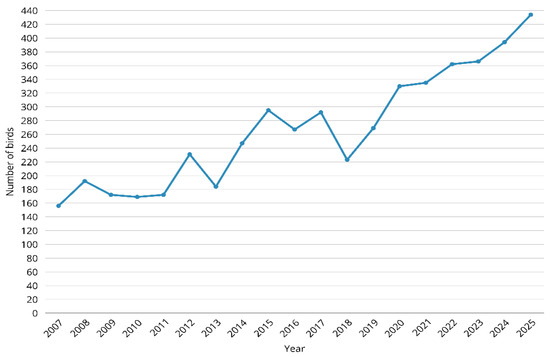
Wild birds are increasingly exposed to anthropogenic threats that compromise population viability. Wildlife rehabilitation centers provide valuable data to monitor these pressures and their conservation implications. This retrospective study analyzed wild bird admissions to the Wildlife Recovery Center of the University of Trás-os-Montes and Alto Douro (CRAS-UTAD) in northern Portugal between January 2007 and October 2025. A total of 5090 birds from 135 species and 44 families were admitted. Causes of admission were grouped into 11 categories, and outcomes into 7. Admissions increased over time, rising from approximately 160 birds in 2007 to more than 430 in 2025, although the overall temporal trend was not statistically significant. Birds of prey were the most frequently admitted group, particularly Strix aluco (9.16%) and Buteo buteo (8.00%). The most common causes of admission were orphaned birds (26.2%), followed by seizures from illegal captivity (12.2%) and collisions (5.0%). Overall, 43.2% of birds were released, while 29.4% died and 18.3% were euthanized. Admission cause was strongly associated with outcome, with electrocution showing the poorest prognosis and seizure from illegal captivity the highest probability of release. These findings highlight the major impact of human activities on wild bird morbidity and mortality and reinforce the importance of rehabilitation centers as sentinels for conservation and mitigation strategies.
1. Introduction
In recent decades, wildlife populations have declined significantly, placing many species at high risk of extinction and reducing global biodiversity [1,2]. These trends underscore the urgent need for effective wildlife conservation strategies, as interactions among humans, ecosystems, and animals directly affect environmental stability, human health, and quality of life [3].
Wild birds perform key ecological functions, including scavenging, pest control, pollination, seed dispersal, and nutrient cycling [4]. Despite their ecological importance, they are increasingly threatened by anthropogenic pressures, including habitat loss, collisions, and poisoning, which compromise population viability and biodiversity conservation [5,6].
Wildlife rehabilitation centers (WRCs) play a dual role in this context. While their primary function is to provide medical care and rehabilitation to individual animals, they also generate valuable data on environmental pressures and emerging threats. Systematic recording of admissions, causes, and outcomes enables the identification of hazards and the assessment of ecological and anthropogenic stressors at regional scales [7,8,9,10].
The ultimate goal of these centers is to release animals back into the wild under conditions that maximize survival and successful reintegration, without posing risks to existing populations [11]. Across several countries, numerous centers operate with diverse species and adopt varying management protocols, logistical capacities, and resources [12].
Given their role in conservation and epidemiological surveillance, this study presents a retrospective analysis of wild bird admissions to the Wildlife Rehabilitation Centre of the University of Trás-os-Montes and Alto Douro (CRAS-UTAD), Portugal. We analyzed species composition, causes of admission, geographic origin, and clinical outcomes to characterize long-term patterns, identify factors associated with rehabilitation success, and determine predictors of release and adverse outcomes.
2. Materials and Methods
2.1. Study Area and Data Collection
This study was conducted at the Wildlife Rehabilitation Centre of the University of Trás-os-Montes and Alto Douro (CRAS-UTAD), located in Vila Real, Northern Portugal (41°17′23.6″ N; 7°44′23.9″ W). The center serves a broad geographical area, primarily covering northern and central districts of Portugal, encompassing a wide range of habitats, including mountainous, urban, and agricultural landscapes.
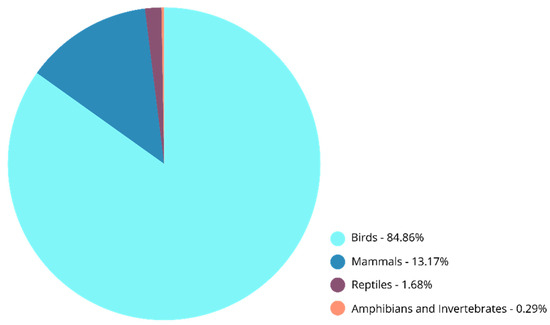
A retrospective analysis was performed using clinical records of all wild animals admitted to the center over 18 years, from January 2007 to October 2025. Admissions were distributed across taxonomic classes (birds, reptiles, mammals, amphibians, and invertebrates); however, amphibians and invertebrates were grouped into a single category due to their low frequency. Although CRAS-UTAD admits multiple taxonomic classes, birds (class Aves) accounted for the majority of admissions (84.86%) and were therefore selected for further analysis.
For each animal of class Aves, the following parameters were recorded: common and scientific name, taxonomic order and family (according to the IOC World Bird List [13], date of admission (year), age (categorized as juvenile/chick or adult, when available), the entity or individual responsible for transportation, geographical origin, cause of admission, and final clinical outcome. Sex and age were excluded from statistical analyses due to the high proportion of missing data.
2.2. Categorization of Admission Causes
Admission causes were classified into eleven distinct categories: (1) orphaned (healthy chicks or fledglings found displaced from the nest); (2) collision (strikes involving vehicles, glass windows, or other anthropogenic structures); (3) illegal captivity (wild birds unlawfully kept by private individuals and handed over without enforcement action); (4) seizures (confiscations by environmental authorities); (5) gunshot (radiographic detection of projectiles causing injury or flight incapacity); (6) electrocution (clinical signs consistent with electrical injury); (7) predation (by domestic or wild animals); (8) unknown (undetermined causes); (9) transferred (from other wildlife recovery centers); (10) birth at CRAS-UTAD (eggs incubated and hatched in captivity) and (11) capture (victims of traps, nets, or confinement in anthropogenic structures such as chimneys or buildings).
2.3. Categorization of Clinical Outcomes
The outcome was classified into seven categories: (1) released (successfully rehabilitated and released into the wild); (2) death (natural or confirmed by necropsy); (3) euthanized (cases with non-releasable conditions or infectious risks); (4) escaped; (5) in treatment (still under rehabilitation at the end of the study period); (6) transferred (to other centers for continued recovery or release); and (7) nest replacement (chicks returned to their original nest by staff).
2.4. Statistical Analysis
Descriptive statistics were used to summarize the data. For the total sample description, amphibians and invertebrates were grouped into a single category due to their low frequency.
Temporal trends in admissions were explored using generalized linear models (GLMs) with a negative binomial distribution and a log link function to account for overdispersion in count data. Year was included as a continuous predictor of the annual number of admitted birds, and regression coefficients (β) were used as the average annual rate of change in the number of admissions, with statistical significance assessed using a Wald test [14,15].
To further evaluate temporal trends by cause of admission, additional Generalized linear models (GLMs) with a negative binomial distribution were fitted. The annual number of admitted individuals per cause was used as the dependent variable, with year as a continuous covariate and cause of admission as a categorical predictor. An interaction term (cause × year) was included to evaluate whether trends differed among causes. Model fit was assessed using deviance, Pearson chi-square statistics, and the Akaike Information Criterion (AIC). The significance of effects was assessed using Type III Wald chi-square tests [14,16].
Associations between taxonomic order and cause of admission, taxonomic order and outcome, and cause of admission and outcome were analyzed using Pearson’s chi-square tests. Standardized and adjusted residuals were used to identify cell-specific associations, and effect size was estimated using Cramér’s V [14,17]. Taxonomic orders with fewer than 50 individuals were grouped into a single category (“Others”) to reduce sparsity and improve robustness.
To estimate predictors of release and poor outcome, two multivariable binary logistic regression models were fitted. Odds ratios (ORs) and 95% confidence intervals (95% CIs) were calculated for release (released vs. not released) and for poor outcome (death or euthanasia vs. all other outcomes). Admission cause and taxonomic order were included simultaneously in both models to assess their independent effects. For the release model, outcomes were coded as 1 = released and 0 = not released; for the poor-outcome model, outcomes were coded as 1 = death or euthanasia and 0 = all other outcomes. Reference categories were defined as “Unknown” for admission cause and “Passeriformes” for the taxonomic order, as these were the most frequent categories, ensuring stable estimates and facilitating interpretation. Model performance was evaluated using the omnibus likelihood ratio test, Nagelkerke’s R2, overall classification accuracy, and the area under the receiver operating characteristic curve (AUC) [18,19]. This approach was selected a priori based on the binary nature of both outcomes and the study’s inferential objectives, as odds ratios and 95% confidence intervals are directly interpretable, clinically meaningful, and allow direct comparison with the published rehabilitation literature.
Statistical significance was set at p < 0.05.
3. Results
3.1. Admission Patterns and Temporal Trends
Over the 18-year study period, from 10 January 2007 to 17 October 2025, a total of 5998 animals were admitted. Of these, 5090 were birds, 790 were mammals, 101 were reptiles, and 17 belonged to the amphibians and invertebrates (Figure 1).
Figure 1.
Pie chart illustrating the class of animals admitted over eighteen years.
Regarding birds, admissions increased over time, rising from approximately 160 birds in 2007 to more than 430 in 2025, although fluctuations were evident throughout the period (Figure 2). Between 2008 and 2011, admissions remained relatively stable. In 2012, a marked increase was observed, followed by a slight decline in 2013. From 2014 to 2017, admissions showed moderate variation, and from 2018 onward, a consistent upward trend emerged, culminating in a peak in 2025. The coefficient for year was positive (β = 0.053), corresponding to an estimated 5.5% annual increase in total admissions (IRR = 1.055; p < 0.001).
Figure 2.
Graph illustrating the number of birds admitted by study year.
3.2. Taxonomic Composition (Order, Families, and Species)
Admissions included 135 bird species, identified and classified into 44 families, across 21 orders.
Admissions were dominated by orders Passeriformes (31.0%), Accipitriformes (21.9%), and Strigiformes (19.0%), which together accounted for more than 70% of all cases. Columbiformes and Apodiformes were the next most represented orders, while all remaining orders contributed less than 5% each.
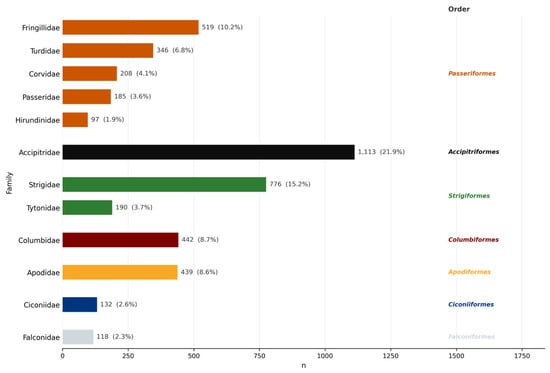
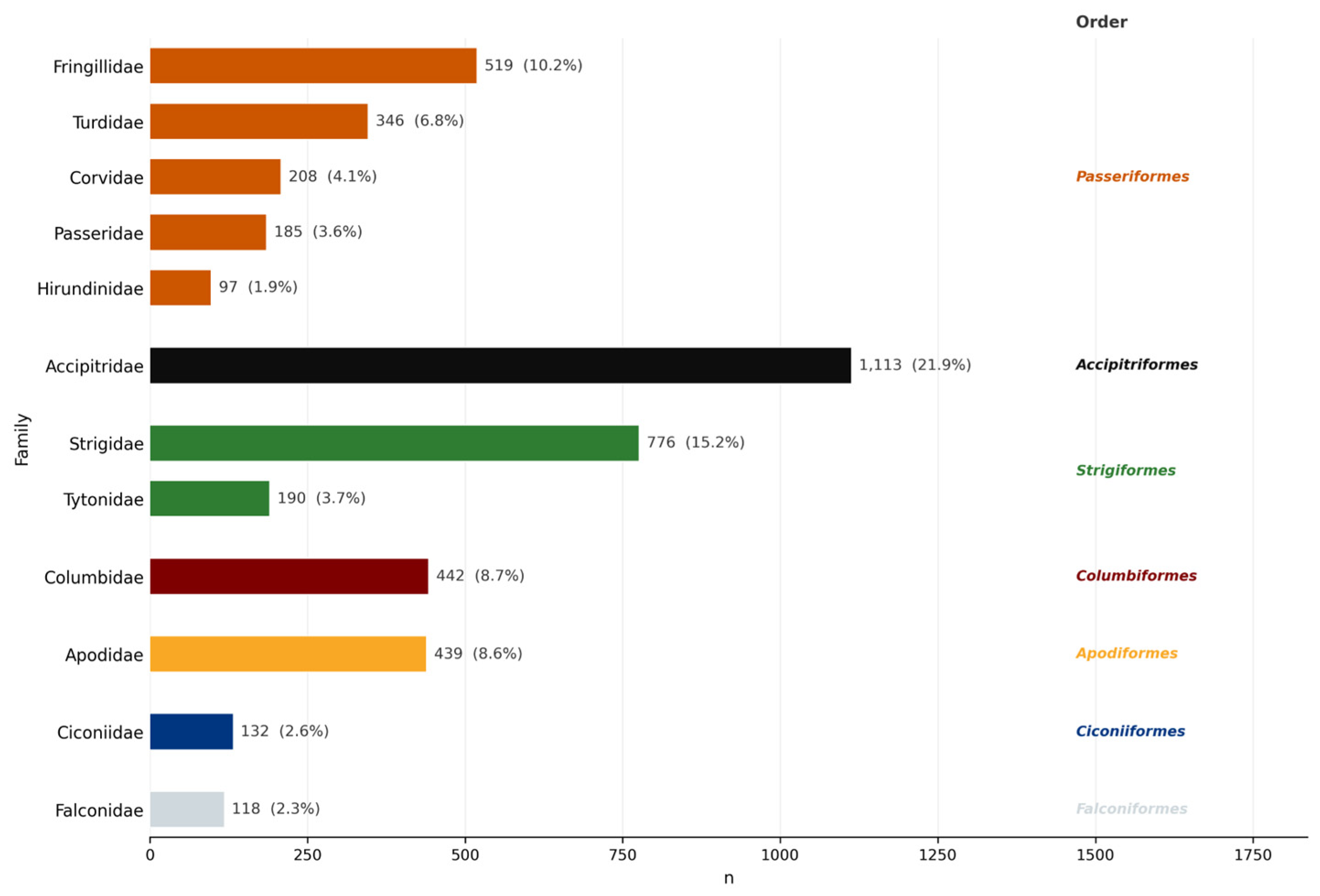
At the family level, approximately 70% of all admissions belonged to six families: Accipitridae (21.9%), Strigidae (15.3%), Fringillidae (10.2%), Columbidae (8.7%), Apodidae (8.6%), and Turdidae (6.8%) (Figure 3). In addition, a high diversity of less frequently represented families was observed, with 30 families each accounting for less than 1% of total admissions. Some of these, such as Anatidae, Laridae, and Ardeidae, accounted for approximately 0.7%, whereas only a few individuals represented several others.
Figure 3.
Families with the highest number of admissions (n) and corresponding percentage of total admissions. Bars are color-coded by taxonomic order, as indicated on the right. Families belonging to the same order are grouped together.
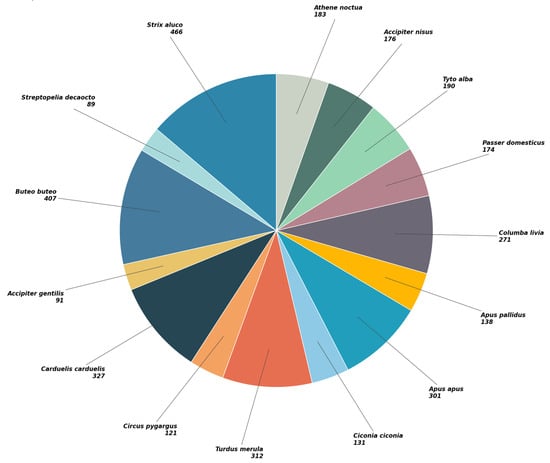
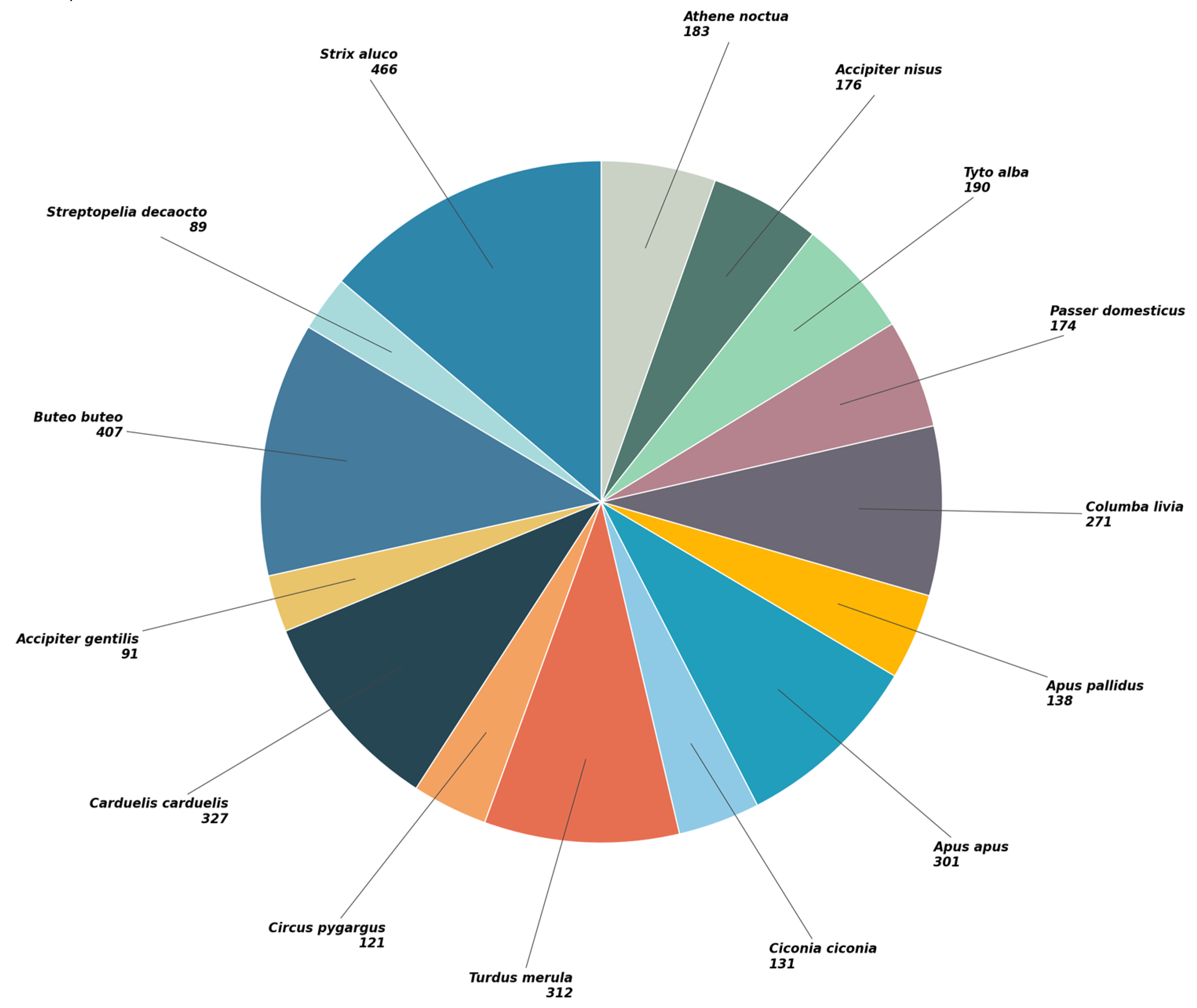
Regarding species, the most frequent were Strix aluco (9.2%) and Buteo buteo (8.0%), followed by Carduelis carduelis (6.4%), Turdus merula (6.1%), Apus apus (5.9%), and Columba livia (5.3%). Together, these species accounted for approximately 41% of all admissions (Figure 4).
Figure 4.
Species with the highest number of entries.
3.3. Delivery Source and Geographic Distribution
Most animals admitted to CRAS-UTAD were delivered by the Nature and Environment Protection Service (SEPNA) (44.24%) and private citizens (32.89%), followed by transfers from other wildlife rehabilitation centers (10.26%) and the Institute for Nature Conservation and Forests (ICNF) (8.37%). Other sources contributed marginally, including the police (0.92%), unknown transporters (3.08%), forest rangers (0.1%), firefighters (0.08%), and highway concessionaires (0.06%) (Figure S1).
Most admitted animals originated from regions close to the rehabilitation center, particularly the municipality of Vila Real 1759 (34.56%), followed by nearby municipalities such as Peso da Régua 380 (7.47%), Chaves and Alijó 205 each (4.03% each), and Lamego 217 (4.26%). Other municipalities showed intermediate proportions, including Terras de Bouro 145 (2.85%), Vila Pouca de Aguiar 155 (3.05%), Bragança 173 (3.4%), Mirandela 141 (2.77%), Torre de Moncorvo 152 (2.99%), and Vila Nova de Gaia 118 (2.32%). The remaining locations accounted for very low frequencies (less than 1% each), including major urban centers such as Lisbon 37 (0.73%) and Porto 12 (0.24%). The results are presented in Figure S2.
3.4. Admission Causes
The most frequent causes of admission were orphaned birds (26.2%) and seizures from illegal captivity (12.2%). Traumatic causes, including collisions (5.0%), gunshot (3.1%), predation (2.3%), and electrocution (1.75%), were less common. Other causes included capture (4.3%), transfers (7.6%), and birth at the center (2.0%). Cases with incomplete or imprecise information (classified as “unknown”) accounted for 33.2% of admissions.
Temporal trends differed significantly among admission causes, as indicated by the inclusion of an interaction term (cause × year) in the model (likelihood ratio test: χ2(10) = 756.74, p < 0.001; ΔAIC = 736.7). All admission causes increased significantly over time, except for birds born at the center, namely orphaned birds (β = 0.053, p < 0.001), capture in anthropogenic structures (β = 0.055, p < 0.001), transfers (β = 0.050, p = 0.002), unknown origin (β = 0.054, p < 0.001), including seizures from illegal captivity (β = 0.053, p = 0.003), collisions (β = 0.052, p < 0.001), gunshot (β = 0.055, p < 0.001), and electrocution (β = 0.050, p = 0.014).
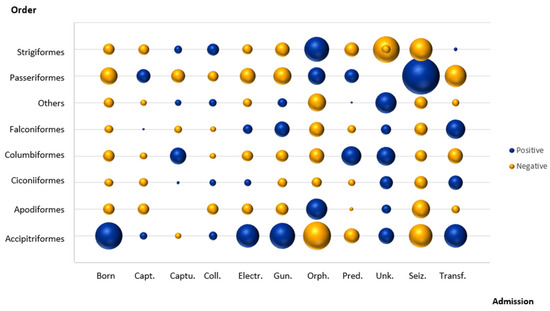
Admission causes differed significantly among taxonomic orders (p < 0.001; Figure 5). Analysis of adjusted residuals showed that Passeriformes had a strong positive association with seizure (adjusted residual = 34.5), as well as with orphaned (7.4) and predation (4.8), and a negative association with unknown causes (−17.6) and transfer (−11.6). Accipitriformes were positively associated with gunshot (16.0), electrocution (12.8), birth at the center (17.8), and transfer (13.2), and negatively associated with seizure (−13.4) and orphaned (−19.1). Strigiformes were strongly associated with orphaned (15.2) and negatively associated with seizure (−12.8). Columbiformes showed positive associations with capture (6.7), unknown causes (8.4), and predation (9.4).
Figure 5.
Bubble plot of adjusted residuals from Pearson’s chi-square test between bird orders and causes of admission (Birth = birth at the center; Capt. = capture; Captu. = captivity; Coll. = collision; Electr. = electrocution; Gun. = gunshot; Orph. = orphaned; Pred. = predation; Unk. = unknown; Seiz. = seizure, Transf. = transfer). Blue bubbles indicate positive associations and red bubbles indicate negative associations. Bubble size is proportional to the absolute value of the adjusted residuals.
3.5. Clinical Outcomes
Overall, 43.2% of birds were successfully released, while 29.4% died and 18.3% were euthanized. Less frequent outcomes included transfer (3.3%), ongoing treatment (4.3%), escape (1.4%), and nest replacement (<0.1%) (Figure S3).
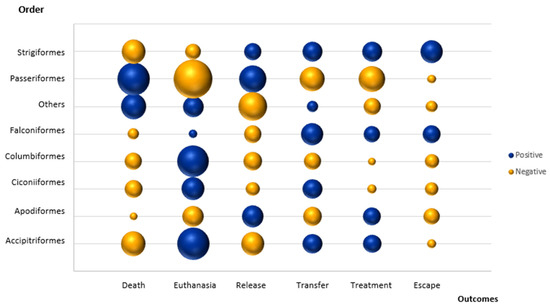
The association between animal order and outcome was statistically significant (p < 0.001) (Figure 6). Analysis of adjusted residuals revealed that Passeriformes showed a strong positive association with return to the wild (adjusted residual = 6.3) and death (9.0), and a strong negative association with euthanasia (−12.8) and transfer (−5.3). Accipitriformes were positively associated with euthanasia (9.0) and transfer (3.2), and negatively with return to the wild (−4.5) and death (−5.1). Columbiformes and Ciconiiformes also showed positive associations with euthanasia (8.6 and 4.5, respectively). Strigiformes were positively associated with escape (4.3), treatment (3.3), and transfer (3.2), and negatively associated with death (−4.9).
Figure 6.
Bubble plot of adjusted residuals from Pearson’s chi-square test between bird orders and clinical outcomes. Blue bubbles indicate positive associations and red bubbles indicate negative associations. Bubble size is proportional to the absolute value of the adjusted residuals.
Clinical outcome was strongly associated with the cause of admission (p < 0.001). High release rates were observed for seizures (83.8%), capture (71.6%), and births at the center (83.7%). In contrast, electrocution was associated with an extremely poor prognosis, with only one successful release and a predominance of euthanasia cases (n = 83). Traumatic causes, such as collisions and gunshot, were linked to intermediate outcomes, with release rates of 37.8% and 29.3%, respectively, alongside considerable mortality and euthanasia. Predation cases also showed high mortality. In contrast, cases classified as orphaned and unknown displayed high variability across outcomes, accounting simultaneously for the highest numbers of releases, deaths, and euthanasia. Detailed distributions are provided in Table S1.
To better illustrate the relationships among admission cause, taxonomic order, and clinical outcome, a Sankey diagram was constructed (Figure S4).
3.6. Predictors of Release and Poor Outcome
Both multivariable logistic regression models for predictors of release and poor outcomes were statistically significant (p < 0.001).
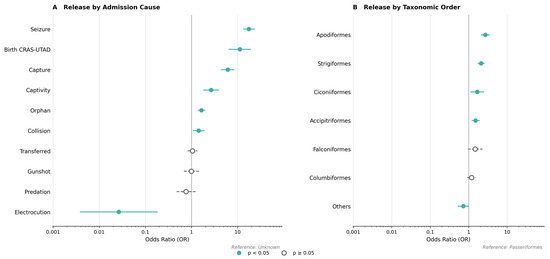
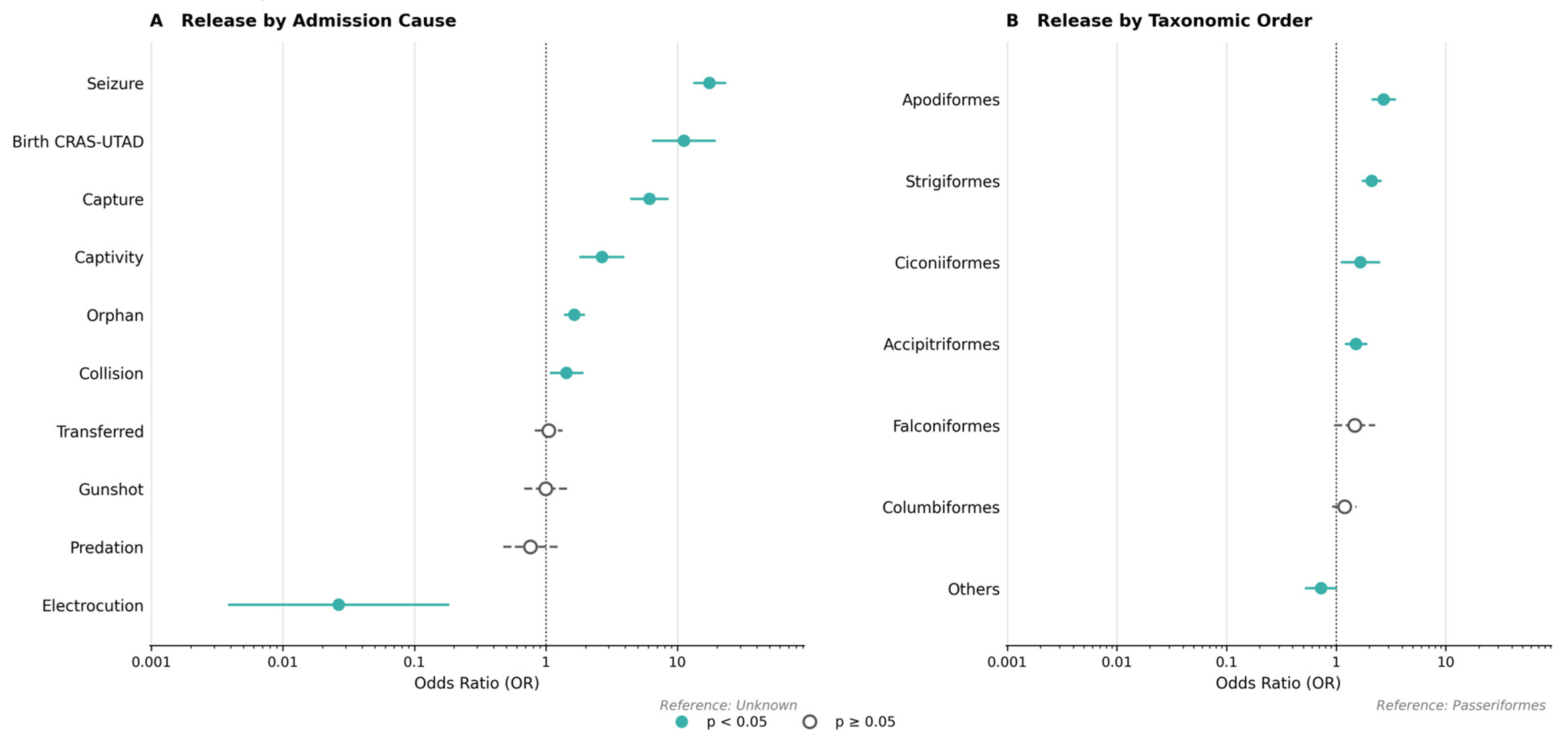
Considering release, admission cause was a strong predictor (p < 0.001). Compared with birds admitted for unknown causes, the highest odds of release were observed for seizures (OR = 17.49, p < 0.001) and birth at the center (OR = 11.27, p < 0.001), followed by capture (OR = 6.09, p < 0.001), captivity (OR = 2.67, p < 0.001), and collision (OR = 1.43, p = 0.013). Orphaned was also associated with an increased probability of release (OR = 1.64, p < 0.001). In contrast, electrocution was associated with a markedly reduced likelihood of release (OR = 0.025, p < 0.001). Gunshot, predation, and transfer were not significant predictors (Figure 7A).
Figure 7.
Odds ratios (ORs) and 95% confidence intervals from the multivariable logistic regression model predicting release. (A) Admission cause (reference category: unknown). (B) Taxonomic order (reference category: Passeriformes). The vertical dashed line indicates OR = 1 (no effect). Values above 1 indicate higher odds of release compared to the reference category, whereas values below 1 indicate lower odds. Green filled circles and solid lines indicate statistically significant associations (p < 0.05); gray open circles and dashed lines indicate non-significant associations.
Taxonomic order was also significantly associated with release (p < 0.001). Compared with Passeriformes, higher odds of release were observed in Accipitriformes (OR = 1.52, p < 0.001), Apodiformes (OR = 2.70, p < 0.001), Ciconiiformes (OR = 1.66, p = 0.012), and Strigiformes (OR = 2.10, p < 0.001). No significant differences were found for Columbiformes (p = 0.179), Falconiformes (p = 0.075), or other orders (p = 0.051) (Figure 7B).
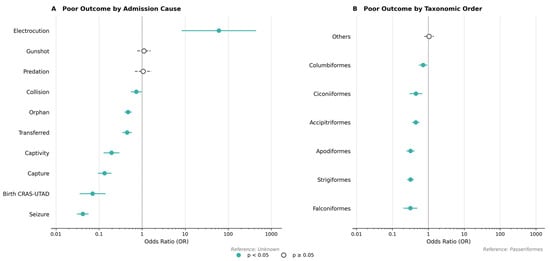
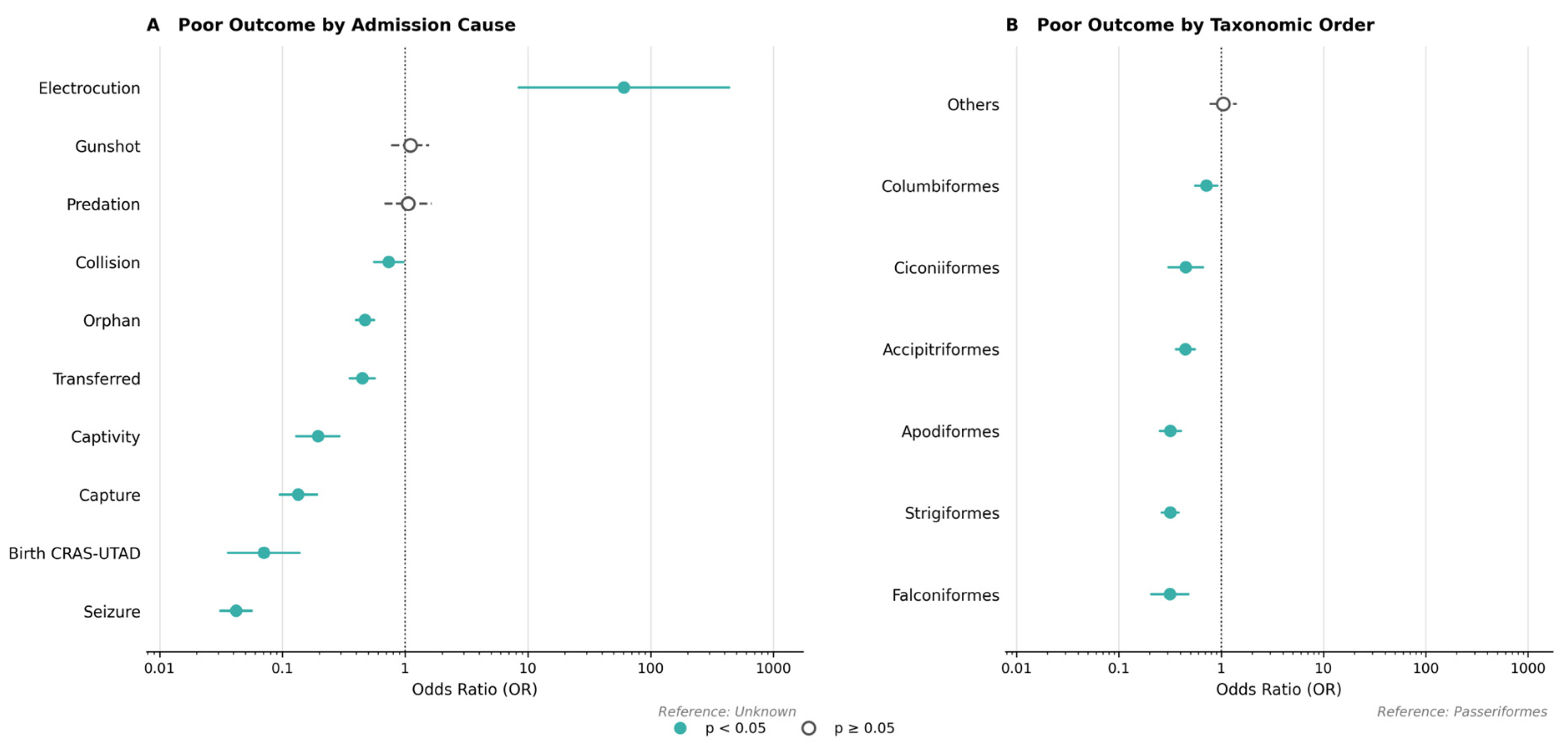
For poor outcome predictions, admission cause was a strong predictor (p < 0.001). Relative to unknown causes, electrocution was associated with a markedly increased likelihood of poor outcome (OR = 60.47, p < 0.001). In contrast, seizures (OR = 0.04, p < 0.001), birth at the center (OR = 0.07, p < 0.001), capture (OR = 0.13, p < 0.001), captivity (OR = 0.19, p < 0.001), orphaned (OR = 0.47, p < 0.001), transfer (OR = 0.45, p < 0.001) and collision (OR = 0.74, p = 0.030), were associated with significantly reduced odds of poor outcome, indicating more favorable prognoses. Gunshot and predation were not significant predictors (Figure 8A).
Figure 8.
Odds ratios (ORs) and 95% confidence intervals from the multivariate logistic regression model predicting poor outcome. (A) Admission cause (reference category: unknown). (B) Taxonomic order (reference category: Passeriformes). The vertical dashed line indicates OR = 1 (no effect). Values above 1 indicate higher odds of a poor outcome, whereas values below 1 indicate lower odds. Green filled circles and solid lines indicate statistically significant associations (p < 0.05); gray open circles and dashed lines indicate non-significant associations.
Taxonomic order was also significantly associated with poor outcome (p < 0.001). Compared with Passeriformes, the odds of poor outcome were significantly lower in several orders, particularly Apodiformes (OR = 0.32, p < 0.001) and Strigiformes (OR = 0.32, p < 0.001), which exhibited the lowest odds among all groups. Lower odds were also observed for Accipitriformes (OR = 0.45, p < 0.001), Ciconiiformes (OR = 0.45, p < 0.001), Columbiformes (OR = 0.71, p = 0.008), and Falconiformes (OR = 0.31, p < 0.001). No significant differences were observed for other orders (Figure 8B).
4. Discussion
This study aimed to characterize long-term patterns of wild bird admissions and identify predictors of rehabilitation outcomes at a wildlife rehabilitation center in northern Portugal. Birds accounted for the majority of admissions, with orphaned birds as the most frequent category. Admission cause emerged as the main predictor of outcome, with electrocution strongly associated with poor prognosis, while seizure and birth at the centre were associated with higher probabilities of release.
4.1. Rising Admissions Are Dominated by Urban-Adapted Birds
Birds accounted for the majority of admissions, consistent with patterns reported at other wildlife rehabilitation centers [20,21], likely reflecting their greater susceptibility to anthropogenic trauma, particularly collisions and fractures associated with flight and increasing human infrastructures [5,22,23,24], as well as higher detectability following injury compared to other vertebrates [25,26].
Admissions showed an upward trend, consistent with reports from other European rehabilitation centers [27], possibly associated with greater public awareness and improved rescue protocols rather than a true increase in injury rates [28]. Most animals were delivered by environmental authorities and private citizens, highlighting the importance of public engagement in wildlife conservation, though citizen involvement may also result in unnecessary admissions, particularly of juveniles during the breeding season [29,30]. Geographic distribution of admissions largely reflected proximity to the center, but may still inform targeted mitigation strategies when combined with land-use data [31,32,33].
Overall, the predominance of ecologically flexible species among admitted birds likely reflects their greater exposure and detectability in human-modified landscapes. These trends may serve as indirect indicators of broader environmental and urbanization impacts on bird communities [34].
The high number of Strix aluco admissions may be associated with its increasing adaptation to urban environments [35,36], where greater food availability and milder climatic conditions may promote earlier breeding. Consequently, chicks are increasingly admitted earlier in the season, likely reflecting nesting in urban areas where fledglings frequently reach the ground during initial flight attempts and are subsequently collected by the public [37].
Similarly, the high admission rate of Buteo buteo may be related to its opportunistic foraging behavior near roads and highways, where prey availability is increased [38,39,40,41,42]. Road-killed animals represent an abundant and predictable food source, attracting individuals to roadside environments and increasing their exposure to vehicle collisions [43,44].
4.2. Orphaned Birds Are the Predominant Admission Cause, with Variation Across Taxonomic Orders
Admission causes were broadly similar to those reported elsewhere [20,45], with orphaned birds as the most frequent category, likely associated with human interference during the breeding season, when fledglings are often mistakenly collected [46,47,48].
Cases with unknown origin accounted for a high proportion of records, a common limitation in retrospective analyses due to incomplete information at the time of admission [23].
Electrocution, despite its well-documented impact on storks, raptors, owls, corvids, and passerines [49,50], including endangered species such as the Iberian imperial eagle (Aquila adalberti) and Bonelli's eagle (Aquila fasciata) [51,52], accounted for a small proportion of admissions, likely reflecting high on-site mortality and underreporting [53,54,55].
Admission causes also differed significantly among avian orders, reflecting differences in ecology, behavior, and interactions with human environments. Passeriformes were more frequently associated with illegal captivity and orphaning, likely due to their popularity as cage birds and their presence in urban and peri-urban areas [56,57]. In contrast, Accipitriformes were more commonly associated with gunshot injuries and electrocution, reflecting both exposure to electrical infrastructure and ongoing persecution in rural landscapes [58,59,60,61,62]. Strigiformes showed a strong association with orphaned admissions, consistent with their nesting behavior in cavities or buildings where fledglings are often found on the ground [63,64]. Columbiformes were more often associated with predation and capture events, likely reflecting their abundance in urban environments and their frequent interactions with domestic predators [65,66,67].
4.3. Outcome Varies with Taxonomic Order and Admission Cause
Rehabilitation success in wildlife centers is generally defined as the release of individuals back into the wild, with minimal human interference during recovery [65]. In cases where animals are unlikely to survive or recover functional capacity, euthanasia may be considered to ensure animal welfare and prevent prolonged suffering [66,67,68].
The overall release rate observed in this study was 43.18%, consistent with values reported in other rehabilitation centers, including those in Costa Rica (41.8%) and the United Kingdom (~42.6%) [66,69]. These findings suggest comparable levels of rehabilitation effectiveness across regions.
Clinical outcomes varied significantly among avian orders, likely reflecting differences in causes of admission and injury severity. Passeriformes showed a higher probability of release but were also associated with natural death, possibly due to the high number of individuals admitted in debilitated condition. Accipitriformes were more frequently associated with euthanasia and transfer, suggesting more severe trauma at admission. Columbiformes and Ciconiiformes were also associated with euthanasia, indicating advanced clinical deterioration. In contrast, Strigiformes showed higher associations with treatment and escape, which may reflect longer rehabilitation periods and behavioral characteristics that complicate handling in captivity.
The association between the cause of admission and outcome observed in our study has also been described in other studies [27]. Electrocution was closely linked to euthanasia, reflecting the severity of electrical injuries. In contrast, birds admitted due to illegal captivity often showed higher probabilities of release, as many individuals did not present severe trauma. Although predation accounted for a relatively small proportion of admissions, it was associated with high mortality and euthanasia rates, indicating high clinical severity. Injuries caused by bites and scratches frequently result in severe trauma, secondary infections, and septicemia, even when external lesions appear minimal. Predation was primarily associated with domestic animals, particularly cats, highlighting the significant impact of these animals on wildlife [60,61,62,63,64,65,66,67,68,69,70,71,72,73].
4.4. Admission Cause Is the Strongest Predictor of Outcome, with Electrocution Carrying the Poorest Prognosis
Multivariable models identified the cause of admission as the strongest independent predictor of rehabilitation outcome, influencing both the probability of release and the likelihood of a poor outcome. Among all causes, electrocution emerged as a particularly critical factor, consistently associated with lower release probabilities and higher likelihood of poor outcomes, even after accounting for taxonomic differences. This finding is consistent with previous studies and reflects the severe and often irreversible damage caused by electrical injuries, including extensive tissue damage and neurological impairment [74]. From a conservation perspective, these findings further underscore the urgent need for mitigation measures on power lines, such as insulation and redesign of hazardous pylons, as prevention is far more effective than post-injury rehabilitation [75,76,77].
In contrast, birds admitted for seizures resulting from illegal captivity and birth at the center had a more favorable prognosis. Although these categories encompass a range of clinical conditions, their association with a higher release probability suggests that many individuals are not severely injured but rather displaced by human activity [78].
An interesting finding of this study concerns the survival of birds admitted with gunshot injuries. Although some of the birds admitted due to gunshot wounds were successfully released, this cause was not independently associated with prognosis in multivariate models. Nevertheless, this result highlights the importance of timely veterinary care, advanced diagnostic imaging, and surgical treatment in wildlife rehabilitation. In many cases, survival may depend on the precise location and removal of projectiles, stabilization of fractures, and appropriate postoperative treatment [79].
Taxonomic order also retained an independent association with outcome, although this effect should be interpreted cautiously. Differences among orders likely reflect variation in anatomy, behavior, stress tolerance, and adaptability to captivity rather than intrinsic susceptibility [10,80]. These findings support the adoption of rehabilitation protocols tailored to functional and ecological groups rather than to species identity alone.
From a practical standpoint, identifying independent predictors of release and poor outcome has important implications for the management of wildlife rehabilitation centers. Early recognition of cases with a low probability of successful release can support timely and ethically sound decision-making, reduce unnecessary suffering, and optimize the allocation of limited resources. Conversely, recognizing admission categories with higher recovery potential allows prioritization of treatment and rehabilitation efforts, ultimately improving overall effectiveness and animal welfare outcomes [28,47,81].
Overall, integrating predictive modeling into rehabilitation studies enhances these centers’ role as sources of conservation-relevant data. By identifying factors that independently influence survival and release, these analyses can inform targeted mitigation strategies and public awareness measures to reduce preventable injuries in wild bird populations [22,78,82].
4.5. Limitations of the Study and Future Perspectives
This study has inherent limitations due to its retrospective design, including reliance on third-party admission reports, which contributes to the high proportion of unknown cases, and the unavailability of consistent age and sex data [23]. Geographic distribution of admissions may reflect detection bias rather than true spatial patterns of injury. Furthermore, release was used as a proxy for rehabilitation success, though it does not guarantee long-term survival or successful reintegration [65,83].
Additional limitations relate to the predictive models. Odds ratios should be interpreted as relative effects rather than absolute measures of prognosis, as the reference categories do not represent biological baselines. Moreover, the high proportion of unknown cases may have diluted associations with specific causes, as this category likely includes heterogeneous and unrecognized conditions.
Future studies should incorporate post-release monitoring and spatial environmental data to better assess long-term outcomes and identify high-risk areas.
5. Conclusions
This study provides insights into wild bird admissions and rehabilitation outcomes in northern Portugal. Birds accounted for the majority of admissions, many of which were associated with anthropogenic factors, although a substantial proportion remained classified as unknown.
Admission cause emerged as the main predictor of outcome, highlighting the importance of prevention, early clinical intervention, and targeted mitigation strategies. Overall, these findings reinforce the value of wildlife rehabilitation centers as key sources of conservation-relevant data and tools for guiding evidence-based management strategies.
Supplementary Materials
The following supporting information can be downloaded at: https://www.mdpi.com/article/10.3390/birds7020028/s1, Figure S1: Distribution of birds by delivery source; Figure S2: The number of individuals recorded at each location is represented simultaneously by circle size and color. Circle size is proportional to the number of individuals, ranging from 1 to 1759. The color scale follows a continuous gradient, with lighter shades indicating lower values and darker shades indicating higher values. For visualization purposes, the data were grouped into classes (1–50; 51–200; 201–500; 501–1000; 1001–1759), as shown in the legend; Figure S3: Distribution of outcomes for birds admitted to CRAS-UTAD; Table S1: Distribution of clinical outcomes by cause of admission for birds admitted to CRAS-UTAD; Figure S4: Sankey diagrams illustrating the relationships between admission cause, taxonomic order, and clinical outcome. Clinical outcomes were grouped into three categories (release/escape, death, and other outcomes) for visualization purposes. Flows represent the number of individuals moving between categories.
Author Contributions
Conceptualization, C.A.C. and I.P.; methodology, C.A.C.; software, C.A.C., R.S., L.S. and F.S.; validation, C.A.C., R.S., L.S. and F.S.; formal analysis, C.A.C. and I.P.; investigation, C.A.C.; resources, C.A.C., R.S., L.S. and F.S.; data curation, C.A.C.; writing—original draft preparation, C.A.C.; writing—review and editing, C.A.C., R.S., L.S., F.S. and I.P.; visualization, C.A.C., R.S., L.S., F.S. and I.P.; supervision, I.P., F.S. and R.S.; project administration, F.S.; funding acquisition, I.P. All authors have read and agreed to the published version of the manuscript.
Funding
This work was supported by the projects UIDB/00772/2020 funded by the Portuguese Foundation for Science and Technology (FCT).
Institutional Review Board Statement
Not applicable.
Informed Consent Statement
Not applicable.
Data Availability Statement
The raw data supporting the conclusions of this article will be made available by the authors on request.
Conflicts of Interest
The authors declare no conflicts of interest.
References
- Ceballos, G.; Ehrlich, P.R. Mammal Population Losses and the Extinction Crisis. Science 2002, 296, 904–907. [Google Scholar] [CrossRef] [Scilit] [PubMed]
- Ceballos, G.; Garcia, A.; Ehrlich, P. The Sixth Extinction Crisis. J. Cosmol. 2010, 8, 180–185. [Google Scholar]
- Gross, M. Human Population at the Crossroads. Curr. Biol. 2023, 33, R1–R3. [Google Scholar] [CrossRef] [Scilit]
- Sekercioglu, C.H. Increasing Awareness of Avian Ecological Function. Trends Ecol. Evol. 2006, 21, 464–471. [Google Scholar] [CrossRef] [Scilit] [PubMed]
- Şekercioğlu, Ç.H.; Daily, G.C.; Ehrlich, P.R. Ecosystem Consequences of Bird Declines. Proc. Natl. Acad. Sci. USA 2004, 101, 18042–18047. [Google Scholar] [CrossRef] [Scilit]
- Loss, S.R.; Will, T.; Marra, P.P. Direct Mortality of Birds from Anthropogenic Causes. Annu. Rev. Ecol. Evol. Syst. 2015, 46, 99–120. [Google Scholar] [CrossRef] [Scilit]
- Griffith, J.E.; Dhand, N.K.; Krockenberger, M.B.; Higgins, D.P. A Retrospective Study of Admission Trends of Koalas to a Rehabilitation Facility Over 30 Years. J. Wildl. Dis. 2013, 49, 18–28. [Google Scholar] [CrossRef] [Scilit]
- Schlagloth, R.; Santamaria, F.; Melzer, A.; Keatley, M.R.; Houston, W. Vehicle Collisions and Dog Attacks on Victorian Koalas as Evidenced by a Retrospective Analysis of Sightings and Admission Records 1997–2011. Aust. Zool. 2021, 42, 655–666. [Google Scholar] [CrossRef] [Scilit]
- Taylor-Brown, A.; Booth, R.; Gillett, A.; Mealy, E.; Ogbourne, S.M.; Polkinghorne, A.; Conroy, G.C. The Impact of Human Activities on Australian Wildlife. PLoS ONE 2019, 14, e0206958. [Google Scholar] [CrossRef] [Scilit]
- Mason, G.J. Species Differences in Responses to Captivity: Stress, Welfare and the Comparative Method. Trends Ecol. Evol. 2010, 25, 713–721. [Google Scholar] [CrossRef] [Scilit] [PubMed]
- Kock, R.A.; Woodford, M.H.; Rossiter, P.B. Disease Risks Associated with the Translocation of Wildlife: -EN- -FR- Risques Sanitaires Associés Aux Transferts de Faune Sauvage -ES- Riesgos Sanitarios Ligados a La Traslocación de Animales Salvajes. Rev. Sci. Tech. Off. Int. Epiz. 2010, 29, 329–350. [Google Scholar] [CrossRef] [Scilit] [PubMed]
- Gourlay, P.; Decors, A.; Moinet, M.; Lambert, O.; Lawson, B.; Beaudeau, F.; Assié, S. The Potential Capacity of French Wildlife Rescue Centres for Wild Bird Disease Surveillance. Eur. J. Wildl. Res. 2014, 60, 865–873. [Google Scholar] [CrossRef] [Scilit]
- BOW (Birds of the World)–IOC World Bird List. Available online: https://www.worldbirdnames.org/new/bow/ (accessed on 11 April 2026).
- Stoklosa, J.; Blakey, R.V.; Hui, F.K.C. An Overview of Modern Applications of Negative Binomial Modelling in Ecology and Biodiversity. Diversity 2022, 14, 320. [Google Scholar] [CrossRef] [Scilit]
- McCullagh, P. Generalized Linear Models, 2nd ed.; Routledge: Boca Raton, FL, USA, 2019; ISBN 978-0-203-75373-6. [Google Scholar]
- Mazerolle, M.J. Improving Data Analysis in Herpetology: Using Akaike’s Information Criterion (AIC) to Assess the Strength of Biological Hypotheses. Amphibia-Reptilia 2006, 27, 169–180. [Google Scholar] [CrossRef] [Scilit]
- Alencar-Silva, T.P.; Adania, C.H.; Paulino, J.S.; Silva, J.C.R.; Hilário, R.R.; Mustin, K.; Rosalino, L.M.; Carvalho, W.D. Outcomes of Wildlife Rehabilitation Vary by Causes of Admission for Birds and Mammals Affected by Human-Wildlife Impacts in Southeastern Brazil. J. Nat. Conserv. 2026, 89, 127134. [Google Scholar] [CrossRef] [Scilit]
- Abrego, N.; Ovaskainen, O. Evaluating the Predictive Performance of Presence–Absence Models: Why Can the Same Model Appear Excellent or Poor? Ecol. Evol. 2023, 13, e10784. [Google Scholar] [CrossRef] [Scilit]
- Kontsiotis, V.J.; Triantafyllidis, A.; Telidis, S.; Eleftheriadou, I.; Liordos, V. The Predictive Ability of Wildlife Value Orientations for Mammal Management Varies with Species Conservation Status and Provenance. Sustainability 2021, 13, 11335. [Google Scholar] [CrossRef] [Scilit]
- Molina-López, R.A.; Mañosa, S.; Torres-Riera, A.; Pomarol, M.; Darwich, L. Morbidity, Outcomes and Cost-Benefit Analysis of Wildlife Rehabilitation in Catalonia (Spain). PLoS ONE 2017, 12, e0181331. [Google Scholar] [CrossRef] [Scilit]
- Dessalvi, G.; Borgo, E.; Galli, L. The Contribution to Wildlife Conservation of an Italian Recovery Centre. Nat. Conserv. 2021, 44, 1–20. [Google Scholar] [CrossRef] [Scilit]
- IUCN Red List and the Value of Integrating Genetics|Conservation Genetics. Available online: https://link.springer.com/article/10.1007/s10592-020-01301-6 (accessed on 4 January 2026).
- Lazarova, I.A.; Balieva, G.N.; Klisurov, I. Causes of Admissions and Mortality in Patients of a Wildlife Rehabilitation Centre in Bulgaria. Biodivers. Data J. 2024, 12, e123681. [Google Scholar] [CrossRef] [Scilit]
- Panter, C.T.; Allen, S.; Backhouse, N.; Mullineaux, E.; Rose, C.; Amar, A. Causes, Temporal Trends, and the Effects of Urbanization on Admissions of Wild Raptors to Rehabilitation Centers in England and Wales. Ecol. Evol. 2022, 12, e8856. [Google Scholar] [CrossRef] [Scilit]
- Kornreich, A.; Partridge, D.; Youngblood, M.; Parkins, K. Rehabilitation Outcomes of Bird-Building Collision Victims in the Northeastern United States. PLoS ONE 2024, 19, e0306362. [Google Scholar] [CrossRef] [Scilit] [PubMed]
- Pyne, T.; Haering, R.; Sriram, A.; Lorigan, S.; Shine, R.; Jolly, C.J. Interactions between Reptiles and People: A Perspective from Wildlife Rehabilitation Records. R. Soc. Open Sci. 2024, 11, 240512. [Google Scholar] [CrossRef] [Scilit]
- Böhm, C.; Wilberger, M.; Landmann, A. Survival Prospects of Wild Birds Depending on the Type of Injury and Other Stressors Leading to Hospitalisation: A Long-Term (1988–2020) Retrospective Study from an Urbanised Area of the Alps. Animals 2026, 16, 221. [Google Scholar] [CrossRef] [Scilit]
- Molony, S.; Baker, P.; Garland, L.; Cuthill, I.; Harris, S. Factors That Can Be Used to Predict Release Rates for Wildlife Casualties. Anim. Welf. 2007, 16, 361–367. [Google Scholar] [CrossRef] [Scilit]
- Hanson, M.; Hollingshead, N.; Schuler, K.; Siemer, W.F.; Martin, P.; Bunting, E.M. Species, Causes, and Outcomes of Wildlife Rehabilitation in New York State. PLoS ONE 2021, 16, e0257675. [Google Scholar] [CrossRef] [Scilit] [PubMed]
- Mullineaux, E. Veterinary Treatment and Rehabilitation of Indigenous Wildlife. J. Small Anim. Pract. 2014, 55, 293–300. [Google Scholar] [CrossRef] [Scilit] [PubMed]
- Ameca, E.I.; Nie, Y.; Wu, R.; Mittermeier, R.A.; Foden, W.; Wei, F. Identifying Protected Areas in Biodiversity Hotspots at Risk from Climate and Human-Induced Compound Events for Conserving Threatened Species. Sci. Total Environ. 2024, 938, 173192. [Google Scholar] [CrossRef] [Scilit] [PubMed]
- Sharma, P.; Chettri, N.; Uddin, K.; Wangchuk, K.; Joshi, R.; Tandin, T.; Pandey, A.; Gaira, K.S.; Basnet, K.; Wangdi, S.; et al. Mapping Human-wildlife Conflict Hotspots in a Transboundary Landscape, Eastern Himalaya. Glob. Ecol. Conserv. 2020, 24, e01284. [Google Scholar] [CrossRef] [Scilit]
- Rodríguez, J.P.; Rojas-Suárez, F. Guidelines for the Design of Conservation Strategies for the Animals of Venezuela. Conserv. Biol. 1996, 10, 1245–1252. [Google Scholar] [CrossRef] [Scilit]
- Weeks, T.L.; Walkden, P.A.; Edwards, D.P.; Lees, A.C.; Pigot, A.L.; Purvis, A.; Tobias, J.A. Land-Use Change Undermines the Stability of Avian Functional Diversity. Nature 2026, 649, 381–387. [Google Scholar] [CrossRef] [Scilit]
- Vrezec, A.; Tome, D. Habitat Selection and Patterns of Distribution in a Hierarchic Forest Owl Guild. Ornis Fenn. 2004, 81, 109–118. [Google Scholar]
- König, C.; Weick, F.; Becking, J.-H. Owls: A Guide to the Owls of the World; Pica: Robertsbridge, UK, 1999. [Google Scholar]
- Kaplan, G. Human-Caused High Direct Mortality in Birds: Unsustainable Trends and Ameliorative Actions. Animals 2025, 15, 73. [Google Scholar] [CrossRef] [Scilit]
- Borkovcová, M.; Mrtka, J.; Winkler, J. Factors Affecting Mortality of Vertebrates on the Roads in the Czech Republic. Transp. Res. Part Transp. Environ. 2012, 17, 66–72. [Google Scholar] [CrossRef] [Scilit]
- Deem, S.L.; Karesh, W.B.; Weisman, W. Putting Theory into Practice: Wildlife Health in Conservation. Conserv. Biol. 2001, 15, 1224–1233. [Google Scholar] [CrossRef] [Scilit]
- Lambertucci, S.A.; Speziale, K.L.; Rogers, T.E.; Morales, J.M. How Do Roads Affect the Habitat Use of an Assemblage of Scavenging Raptors? Biodivers. Conserv. 2009, 18, 2063–2074. [Google Scholar] [CrossRef] [Scilit]
- Orłowski, G.; Nowak, L. Factors Influencing Mammal Roadkills in the Agricultural Landscape of South-Western Poland. Pol. J. Ecol. 2006, 54, 283–294. [Google Scholar]
- Rotherham, I.D. The Life of Buzzards. Arboric. J. 2016, 38, 57–58. [Google Scholar] [CrossRef] [Scilit]
- Connor, P.; Allen, S.; Backhouse, N.; Mullineaux, E.; Ann Rose, C.; Amar, A. Causes, Temporal Trends, and the Effects of Urbanization on Admissions of Wild Raptors to Rehabilitation Centers in England and Wales. Ecol. Evol. 2022, 12, e8856. [Google Scholar]
- Maphalala, M.; Monadjem, A.; Bildstein, K.; Hoffman, B.; Colleen, D. Causes of Admission to a Raptor Rehabilitation Centre and Factors That Can Be Used to Predict the Likelihood of Release. Afr. J. Ecol. 2026, 59, 510–517. [Google Scholar] [CrossRef] [Scilit]
- Dutton-Regester, K.J. Hospital Admissions to a Major Wildlife Hospital in South-East Queensland, Australia, over a 10-Year Period, 2012–2022. Aust. J. Zool. 2025, 73, ZO24036. [Google Scholar] [CrossRef] [Scilit]
- Jiménez, J.; Crespo, J.; Martínez-Abraín, A. Long-Term Shifts in Admissions of Birds to Wildlife Recovery Centres Reflect Changes in Societal Attitudes towards Wildlife in Spain. Ardeola 2022, 69, 291–302. [Google Scholar] [CrossRef] [Scilit]
- Kwok, A.B.C.; Haering, R.; Travers, S.K.; Stathis, P. Trends in Wildlife Rehabilitation Rescues and Animal Fate across a Six-Year Period in New South Wales, Australia. PLoS ONE 2021, 16, e0257209. [Google Scholar] [CrossRef] [Scilit]
- Soulsbury, C.D.; White, P.C.L. Human–Wildlife Interactions in Urban Areas: A Review of Conflicts, Benefits and Opportunities. Wildl. Res. 2016, 42, 541–553. [Google Scholar] [CrossRef] [Scilit]
- Bevanger, K.B. Biological and Conservation Aspects of Bird Mortality Caused by Electricity Power Lines: A Review. Biol. Conserv. 1998, 86, 67–76. [Google Scholar] [CrossRef] [Scilit]
- Janss, G.F.E. Avian Mortality from Power Lines: A Morphologic Approach of a Species-Specific Mortality. Biol. Conserv. 2000, 95, 353–359. [Google Scholar] [CrossRef] [Scilit]
- Ferrer, M.; de la Riva, M.; Castroviejo, J. Electrocution of Raptors on Power Lines in Southwestern Spain (Electrocución de Rapaces En Tendidos Eléctricos Del Suroeste de España). J. Field Ornithol. 1991, 62, 181–190. [Google Scholar]
- González, L.M.; Margalida, A.; Mañosa, S.; Sánchez, R.; Oria, J.; Molina, J.I.; Caldera, J.; Aranda, A.; Prada, L. Causes and Spatio-Temporal Variations of Non-Natural Mortality in the Vulnerable Spanish Imperial Eagle Aquila Adalberti during a Recovery Period. Oryx 2007, 41, 495–502. [Google Scholar] [CrossRef] [Scilit]
- Guil, F.; Pérez-García, J.M. Bird Electrocution on Power Lines: Spatial Gaps and Identification of Driving Factors at Global Scales. J. Environ. Manag. 2022, 301, 113890. [Google Scholar] [CrossRef] [Scilit]
- Biasotto, L.D.; Moreira, F.; Bencke, G.A.; D’Amico, M.; Kindel, A.; Ascensão, F. Risk of Bird Electrocution in Power Lines: A Framework for Prioritizing Species and Areas for Conservation and Impact Mitigation. Anim. Conserv. 2022, 25, 285–296. [Google Scholar] [CrossRef] [Scilit]
- Gómez-Catasús, J.; Carrascal, L.M.; Moraleda, V.; Colsa, J.; Garcés, F.; Schuster, C. Factors Affecting Differential Underestimates of Bird Collision Fatalities at Electric Lines: A Case Study in the Canary Islands. Ardeola 2020, 68, 71. [Google Scholar] [CrossRef] [Scilit]
- Godoy, S.N.; Matushima, E.R. A Survey of Diseases in Passeriform Birds Obtained from Illegal Wildlife Trade in São Paulo City, Brazil. J. Avian Med. Surg. 2010, 24, 199–209. [Google Scholar] [CrossRef] [Scilit]
- Souto, W.M.S.; Torres, M.A.R.; Sousa, B.F.C.F.; Lima, K.G.G.C.; Vieira, L.T.S.; Pereira, G.A.; Guzzi, A.; Silva, M.V.; Pralon, B.G.N. Singing for Cages: The Use and Trade of Passeriformes as Wild Pets in an Economic Center of the Amazon—NE Brazil Route. Trop. Conserv. Sci. 2017, 10, 1940082917689898. [Google Scholar] [CrossRef] [Scilit]
- Cococcetta, C.; Coutant, T.; Collarile, T.; Vetere, A.; Di Ianni, F.; Huynh, M. Causes of Raptor Admission to the Wildlife Rehabilitation Centre in Abruzzo (Central Italy) from 2005–2016. Animals 2022, 12, 1916. [Google Scholar] [CrossRef] [Scilit] [PubMed]
- Wendell, M.D.; Sleeman, J.M.; Kratz, G. Retrospective Study of Morbidity and Mortality of Raptors Admitted to Colorado State University Veterinary Teaching Hospital during 1995 to 1998. J. Wildl. Dis. 2002, 38, 101–106. [Google Scholar] [CrossRef] [Scilit]
- Panter, C.T.; Bullock, H.E.; Brown, M.; Mori, D.; Thompson, L.J. Taking the Pulse of the World’s Raptors—A Systematic Quantitative Review of Wildlife Rehabilitation Centre Admissions. Biol. Conserv. 2026, 316, 111746. [Google Scholar] [CrossRef] [Scilit]
- Newton, I. Killing of Raptors on Grouse Moors: Evidence and Effects. Ibis 2021, 163, 1–19. [Google Scholar] [CrossRef] [Scilit]
- Thompson, L.J.; Hoffman, B.; Brown, M. Causes of Admissions to a Raptor Rehabilitation Centre in KwaZulu-Natal, South Africa. Afr. Zool. 2013, 48, 359–366. [Google Scholar] [CrossRef]
- Gao, F.; Shi, Y.; Li, J.; Lun, M.; Liu, Z.; Wang, Y.; Zhang, P.; Ge, X.; Jiang, P. Causes of Owls Admission to the Wildlife Rescue Centre in Beijing (China) from 2006–2022. Pak. J. Zool. 2026, 58, 557–568. [Google Scholar] [CrossRef] [Scilit]
- Schneider, Z.; Móczár, B.; Klein, Á.; Laczi, M.; Mátics, R. Fatal Traps in Western Barn Owls’ (Tyto Alba) Nesting Sites: The Consequence of Improper Building Modification. Ecol. Evol. 2025, 15, e71409. [Google Scholar] [CrossRef] [Scilit]
- Willette, M.; Rosenhagen, N.; Buhl, G.; Innis, C.; Boehm, J. Interrupted Lives: Welfare Considerations in Wildlife Rehabilitation. Animals 2023, 13, 1836. [Google Scholar] [CrossRef] [Scilit]
- Mullineaux, E.; Pawson, C.; Mullineaux, E.; Pawson, C. Trends in Admissions and Outcomes at a British Wildlife Rehabilitation Centre over a Ten-Year Period (2012–2022). Animals 2023, 14, 86. [Google Scholar] [CrossRef] [Scilit]
- White, K.; Hänninen, L.; Valros, A. Euthanasia and the Rehabilitation of Wildlife Casualties in Finland: Decision-Making Varies Depending on the Background Education of the Caregivers. Front. Vet. Sci. 2023, 10, 1207930. [Google Scholar] [CrossRef] [Scilit]
- Von Dietze, E.; Gardner, D. Euthanizing Wildlife: Experiences and Coping Strategies among People Who Conduct Euthanasia. Pac. Conserv. Biol. 2014, 20, 28–36. [Google Scholar] [CrossRef] [Scilit]
- Grogan, A.; Kelly, A. A Review of RSPCA Research into Wildlife Rehabilitation. Vet. Rec. 2013, 172, 211. [Google Scholar] [CrossRef] [Scilit] [PubMed]
- Garcês, A.; Soeiro, V.; Lóio, S.; Prada, J.; Silva, F.; Pires, I. Necropsy Findings and Causes of Mortality in Wild Birds in a Center for Rehabilitation of Wild Animals in the North of Portugal. Rev. Electron. Vet. 2018, 19, 041802. [Google Scholar]
- Rebolo-Ifrán, N.; Zamora-Nasca, L.; Lambertucci, S.A. Cat and Dog Predation on Birds: The Importance of Indirect Predation after Bird-Window Collisions. Perspect. Ecol. Conserv. 2021, 19, 293–299. [Google Scholar] [CrossRef] [Scilit]
- Turner, D.C. Outdoor Domestic Cats and Wildlife: How to Overrate and Misinterpret Field Data. Front. Vet. Sci. 2022, 9, 1087907. [Google Scholar] [CrossRef] [Scilit]
- Beauchamp, G. Susceptibility to Predation Varies with Body Mass, Foraging Niche, and Anti-Predator Responses among Bird Species. Birds 2023, 4, 73–84. [Google Scholar] [CrossRef] [Scilit]
- Rebolo-Ifrán, N.; Plaza, P.; Pérez-García, J.M.; Gamarra-Toledo, V.; Santander, F.; Lambertucci, S.A. Power Lines and Birds: An Overlooked Threat in South America. Perspect. Ecol. Conserv. 2023, 21, 71–84. [Google Scholar] [CrossRef] [Scilit]
- Bernardino, J.; Bevanger, K.; Barrientos, R.; Dwyer, J.F.; Marques, A.T.; Martins, R.C.; Shaw, J.M.; Silva, J.P.; Moreira, F. Bird Collisions with Power Lines: State of the Art and Priority Areas for Research. Biol. Conserv. 2018, 222, 1–13. [Google Scholar] [CrossRef] [Scilit]
- Durgapersad, K.; Beutel, A.; Mahatho, N. Literature Review on Mitigation Measures for Bird Electrocutions Occurring Due to Streamers on Transmission Power Lines. Birds 2025, 6, 5. [Google Scholar] [CrossRef] [Scilit]
- Guil, F.; Fernández-Olalla, M.; Moreno-Opo, R.; Mosqueda, I.; Gómez, M.E.; Aranda, A.; Arredondo, Á.; Guzmán, J.; Oria, J.; González, L.M.; et al. Minimising Mortality in Endangered Raptors Due to Power Lines: The Importance of Spatial Aggregation to Optimize the Application of Mitigation Measures. PLoS ONE 2011, 6, e28212. [Google Scholar] [CrossRef] [Scilit]
- Vezyrakis, A.; Bontzorlos, V.; Rallis, G.; Ganoti, M. Two Decades of Wildlife Rehabilitation in Greece: Major Threats, Admission Trends and Treatment Outcomes from a Prominent Rehabilitation Centre. J. Nat. Conserv. 2023, 73, 126372. [Google Scholar] [CrossRef] [Scilit]
- Desmarchelier, M.; Santamaria-Bouvier, A.; Fitzgérald, G.; Lair, S. Mortality and Morbidity Associated with Gunshot in Raptorial Birds from the Province of Quebec: 1986 to 2007. Can. Vet. J. 2010, 51, 70–74. [Google Scholar]
- Wyles, J.S.; Kunkel, J.G.; Wilson, A.C. Birds, Behavior, and Anatomical Evolution. Proc. Natl. Acad. Sci. USA 1983, 80, 4394–4397. [Google Scholar] [CrossRef] [Scilit]
- Costa, M.M.; Pinto da Cunha, N.; Hagnauer, I.; Venegas, M. A Retrospective Analysis of Admission Trends and Outcomes in a Wildlife Rescue and Rehabilitation Center in Costa Rica. Animals 2024, 14, 51. [Google Scholar] [CrossRef] [Scilit]
- Miller, T.K.; Pierce, K.; Clark, E.E.; Primack, R.B. Wildlife Rehabilitation Records Reveal Impacts of Anthropogenic Activities on Wildlife Health. Biol. Conserv. 2023, 286, 110295. [Google Scholar] [CrossRef] [Scilit]
- Engler, M.; Sens, R.; Lundberg, M.; Delor, A.; Stelter, M.; Tschertner, M.; Feyer, S.; Zein, S.; Halter-Gölkel, L.; Altenkamp, R.; et al. Worth the Effort? Rehabilitation Causes and Outcomes and the Assessment of Post-Release Survival for Urban Wild Bird Admissions in a European Metropolis. Animals 2025, 15, 1746. [Google Scholar] [CrossRef] [Scilit]
Disclaimer/Publisher’s Note: The statements, opinions and data contained in all publications are solely those of the individual author(s) and contributor(s) and not of MDPI and/or the editor(s). MDPI and/or the editor(s) disclaim responsibility for any injury to people or property resulting from any ideas, methods, instructions or products referred to in the content. |
© 2026 by the authors. Licensee MDPI, Basel, Switzerland. This article is an open access article distributed under the terms and conditions of the Creative Commons Attribution (CC BY) license.