
Article

New Avian Records Along the Elevation Gradient of the Cyclops Mountains, New Guinea, Revealed by Camera Trapping

by
James Alexander Kempton
1,2,*,
Attila Balázs
3,
Yoel Bessoran
4,
Yohanna Dalimunthe
5,
Anik Budhi Dharmayanthi
5,
Jared Diamond
6,
David Bishop
7,
Yolanda Duwiri
8,
Amir Hamidy
5,
Tri Haryoko
5,
Charlie Danny Heatubun
2,9,10,
Edward Glorious Excelsa Heatubun
11,
Melias Heluka
8,
John Imbenai Gustiar
4,
Nurul Inayah
5,
Mohammad Irham
5,
Georgios Karris
12,
Henderina Keiluhu
13,
Iain Kobak
8,
Malcolm Kobak
8,
Gison Morib
8,
Pascal Norotouw
14,
Ruben Penggu
8,
Dewi Prawiradilaga
5,
Mochtar Tanassy
4,
Heron Yando
8,
John Yalak
8,
Sili Yalak
8 and
Leonidas-Romanos Davranoglou
15,*
add Show full author list remove Hide full author list
1
Department of Biology, University of Oxford, South Parks Road, Oxford OX1 3EL, UK
2
Royal Botanic Gardens, Kew, Richmond TW9 3AE, UK
3
Department of Zoology, Fisheries, Hydrobiology and Apiculture, Mendel University in Brno, Zemědělská 1, 613 00 Brno, Czech Republic
4
Nature Conservation Agency of Papua (BBKSDAPapua), Ministry of Environment and Forestry, Kantor BBKSDA Papua, Jl. Raya Abepura, Kotaraja, Kec. Abepura, Kota Jayapura 99357, Papua, Indonesia
5
Research Center for Biosystematics and Evolution, National Research and Innovation Agency, KST Soekarno Jl. Raya Jakarta-Bogor KM 46, Cibinong 16911, West Java, Indonesia
6
Geography Department, University of California, Los Angeles, CA 90095-1524, USA
7
Semioptera Pty. Ltd., P.O. Box 1234, Armidale, NSW 2350, Australia
8
Yappenda, Stakin Gedung GOR STT-GIDI Lantai 1, Kelurahan Hinekombe, Sentani, Kota Jayapura 99352, Papua, Indonesia
9
Regional Research and Innovation Agency (BRIDA) of West Papua Province, Arfai, Manokwari 98315, Papua Barat, Indonesia
10
Faculty of Forestry, Universitas Papua, Jl. Gunung Salju, Amban, Manokwari 98314, Papua Barat, Indonesia
11
EcoNusa Foundation, Sorong City 98412, Southwest Papua, Indonesia
12
Department of Environment, Faculty of Environment, Ionian University, Μinotou-Giannopoulou Str., Panagoula, 29100 Zakynthos, Greece
13
Department of Biology, FMIPA Cenderawasih University, Jayapura 99224, Papua, Indonesia
14
Numbay Research Centre, Jalan Raya Waena Sentani No. 4, Jayapura 99332, Papua, Indonesia
15
Oxford University Museum of Natural History, University of Oxford, Oxford OX1 3PW, UK
*
Authors to whom correspondence should be addressed.
Birds 2026, 7(2), 27; https://doi.org/10.3390/birds7020027
Submission received: 7 March 2026 / Revised: 12 April 2026 / Accepted: 20 April 2026 / Published: 23 April 2026

Simple Summary

New Guinea is home to the richest birdlife of any island on Earth, yet many of its mountains remain poorly surveyed. In this study, we used motion-triggered camera traps placed along an elevation gradient from lowland forest to mountain summit to document bird species in the Cyclops Mountains, some of which are difficult to observe using traditional survey methods. We recorded 22 species over 11,869 camera-trap nights, including the first record of Masked Bowerbird from the range and the ‘rediscovery’ of Mayr’s Rail from the mountains after almost 100 years. We also detected several species at altitudes higher than previously reported, including Northern Cassowary over 1000 m above its previously recorded elevation ceiling. Although camera traps detected fewer species than traditional surveys, they were effective in detecting elusive ground-dwelling birds. Our results highlight the value of camera trapping as a complementary tool for biodiversity surveys in remote and challenging terrain, such as some of New Guinea’s mountain ranges.

Abstract

New Guinea, the world’s largest tropical island, supports the planet’s richest insular avifauna. Large areas of New Guinea remain poorly surveyed, however, in part due to the island’s challenging terrain. In hard-to-access areas, like many mountainous parts of New Guinea, automated surveying tools, like camera traps, may be especially helpful to address the survey deficit. Here we present the results of a camera-trap survey of the avifauna of the Cyclops Mountains, a range in New Guinea’s western, Indonesian provinces (Indonesian Papua). To our knowledge, our results represent only the second published camera-trap survey of birds from Indonesian Papua. We deployed 73 camera traps along an elevation gradient (143–1963 m) of the Cyclops Mountains for 11,869 camera-trap nights, recording 22 bird species from 1696 independent detections. Our species list is, to our knowledge, the first to include observations from the upper northern slopes of the Cyclops Mountains. It documents the first record of Masked Bowerbird (Sericulus aureus) in the range and provides photographic rediscoveries of two ‘lost’ species: Mayr’s Honeyeater (Ptiloprora mayri) and Mayr’s Forest Rail (Rallicula mayri). We also report substantial elevation range extensions for several species, including numerous records of Northern Cassowary (Casuarius unappendiculatus) over 1000 m above its historically known elevation ceiling. These findings provide new insights into species distributions and ecological flexibility in New Guinea’s montane systems, highlighting the potential for previously undocumented biodiversity in under-surveyed regions. Although camera traps detected fewer species than traditional ornithological methods, they were effective in documenting several elusive, ground-dwelling bird species, highlighting their value as a complementary tool for ornithological research in challenging terrain like New Guinea. Finally, we use our data to publish an updated bird species checklist for the Cyclops Mountains.

1. Introduction

New Guinea, the world’s largest tropical island, harbours one of the richest and least-documented biodiversity assemblages on Earth [1]. The island is recognised as foremost among the world’s plant ‘biodiversity darkspots’ [2] and among regions most likely to yield the discovery of new vertebrate species [3]. New Guinea also boasts the planet’s richest insular avifauna [4], and, in common with the rest of the world, the birds of New Guinea are better known than any other taxon occurring on the island. However, even among birds, new species discoveries and range extensions are made at a globally high rate [5,6,7].
New Guinea is a biodiversity darkspot with a reputation for challenging fieldwork conditions. Automated monitoring techniques, such as camera traps and passive acoustic monitoring, offer solutions for cost-effective, long-term monitoring in surveying hard-to-access areas. Recently, a new species of jewel-babbler (genus Ptilorrhoa) was described from New Guinea based on camera-trap evidence alone; no ornithologists observed the bird in-person [8]. However, published studies using automated monitoring techniques in New Guinea remain scarce. This is particularly the case in the island’s western, Indonesian provinces (hereafter referred to as Indonesian Papua). Our literature searches found only eight peer-reviewed articles using data collected by camera traps in Indonesian Papua [9,10,11,12,13,14], only two of which studied birds [15,16].
In 2023, our team conducted, to our knowledge, the first camera-trap deployment along a complete elevation gradient in Indonesian Papua. The location was the Cyclops Mountains, Papua Province, which rise from sea-level to approximately 1970 metres (m) above sea-level (asl) in elevation (note, all elevation measurements henceforth are asl). Biogeographically, the Cyclops Mountains belong to one of New Guinea’s fifteen outlying mountain ranges [17], separated from the island’s dominant Central Range by intervening lowland. In particular, found on the north coast, the Cyclops Mountains are among the Pacific terranes that collided with and accreted onto New Guinea’s Australian Craton in the past 10 million years [18]. Together with the Foja Mountains, the North Coastal Range, the Adelbert Mountains, and the Finisterre Mountains, the Cyclops Mountains represent a series of ‘sky-islands’—isolated mountain ranges possessing endemic faunal assemblages [19]—to the north of the Central Range.
It was not until 1903 that collections of Cyclops Mountain birds began to be made, though it was only in 1928, when Ernst Mayr came to the range, that substantial collections were made [20,21,22]. To date, 181 bird species have been recorded in the Cyclops Mountains [22,23,24,25], and until now, all bird survey efforts in the Cyclops Mountains have been undertaken using conventional ornithological methods. Furthermore, except for a Conservation International Rapid Assessment Programme (RAP) survey [24] that did not exceed 70 m in elevation, there have been no published bird surveys of the northern slopes; all historical surveys have been of the southern slopes (for a thorough review of historical surveys of the Cyclops Mountains, see Diamond and Bishop (2025) [25]). Thus, although the Cyclops Mountains have received relatively high sampling effort compared to much of Indonesian Papua [25], there remain opportunities to contribute to our knowledge of the avifauna of the range.
The focus of our 2023 camera-trap deployment along an elevation gradient in the Cyclops Mountains was to assess how the community of ground-dwelling mammal fauna in the mountain range varies with elevation. We were also seeking to establish whether Attenborough’s Long-beaked Echidna still persisted in the mountains, and we presented our echidna results in Morib et al. (2025) [14]. Though we did not target birds specifically, our deployment detected many occurrences of birds, mainly of ground-dwelling species, some of which are secretive species. Thus, our survey allows us to make some inferences about the avifauna of the Cyclops Mountains, and to make some assessment of the utility of camera traps as an ornithological survey method in New Guinea.
To our knowledge, this study represents the second published survey of birds from Indonesian Papua using camera traps, and the first published survey of birds from the slopes of the northern Cyclops Mountains above 100 m. With our data, we have identified range extensions, elevation limit extensions, and ‘rediscoveries’ of so-called ‘lost’ species (in the sense that there has been no recorded photographic, audio, or genetic evidence of them within ten years [26]). We also report on other interesting observations made on the avifauna of the Cyclops Mountains, highlighting the strengths and weaknesses of using camera traps for bird population monitoring in New Guinea. Finally, we provide a species checklist of the birds of the Cyclops Mountains based on our new data and records cited in Hartert [20], Rand [23], Setio et al. [24], and Diamond and Bishop [25] (Supplementary Table S1).

2. Materials and Methods

2.1. Study Area

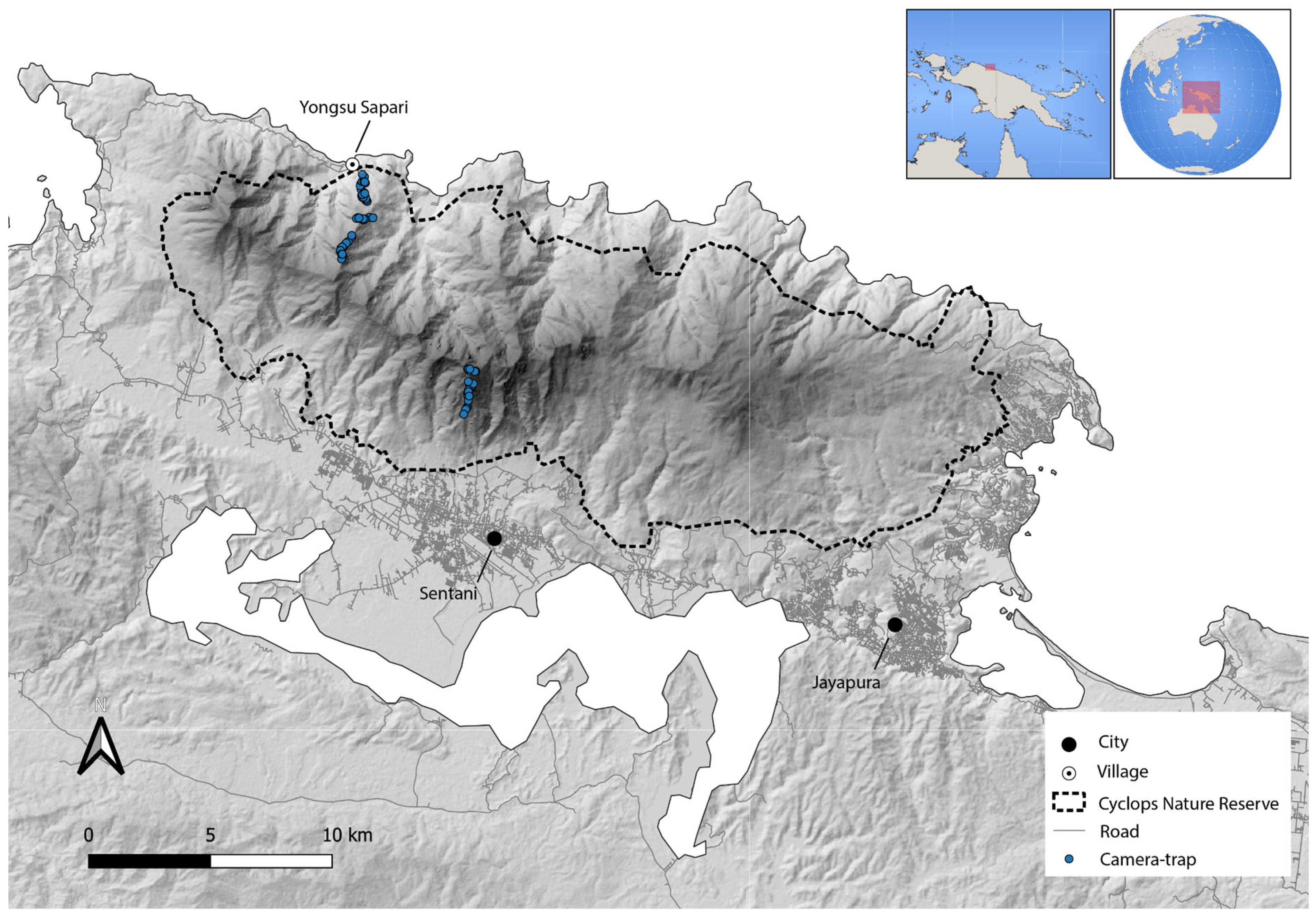
The Cyclops Mountains are a small, isolated mountain range, approximately 250 km2 in area, located on the northern coast of New Guinea in Indonesian Papua (see Figure 1). The range is sandwiched between the Pacific Ocean to its north and Lake Sentani and the cityscapes of Sentani, Abepura, and Jayapura to its south. It rises steeply on both sides, up to a maximum elevation of approximately 1970 m at its highest peak, Rafeni-Rara. Two other notable peaks are (1) Dafonsoro (c. 1580 m) to the west of Rafeni-Rara and (2) a peak of c. 1560 m to the east of the summit. The region is characterised by tropical lowland and montane rainforest, and the tree line is not reached. The climate is humid and tropical, with high annual rainfall and limited accessibility due to rugged terrain and, in parts, a lack of infrastructure. These characteristics have historically limited biological surveys, particularly on the northern slopes.

2.2. Methods

We deployed 73 Reconyx HyperFire 2 Professional Covert IR camera (Reconyx, Holmen, WI, USA) traps along an elevation gradient in the Cyclops Mountains between 143 m and 1963 m (see Figure 1). We accessed the north slopes of the Cyclops Mountains from the village of Yongsu Spari, and on the northern side, we deployed cameras (between 143 m and 1265 m) at 49 unique locations (which we henceforth call ‘stations’), one per station. On the south side of the Cyclops Mountains, we deployed cameras at 24 stations (between 1222 m and 1963 m), one per station. We first deployed cameras on 23 June 2023, and we last retrieved them on 16 March 2024. The guiding purpose of our deployment was to document the ground-dwelling mammal fauna of the Cyclops Mountains and to photograph Attenborough’s Long-beaked Echidna (Zaglossus attenboroughi), an elusive species for which, by 2023, there had been no genetic, audio, or photographic evidence collected in 62 years [14]. As such, we placed cameras opportunistically to maximise the likelihood of mammal and echidna detection, placing them near signs of mammal activity (for example, scat, animal trails, and putative echidna ‘nose-pokes’) and along ridgelines. We did not bait cameras, and we set them approximately 60 centimetres above ground, parallel to the floor, and at a minimum of 50 metres from a neighbouring camera. When triggered, cameras were programmed to take three-image bursts, with images taken one second apart, and we set the delay between bursts to 10 s. In total, cameras recorded for 11,869 camera-trap nights (mean ± SD: 163 ± 98 days), capturing 38,658 images. We classified images manually and identified 27,732 images containing animals. We could not identify the species present in 719 (1.9%) images. In the R package camtrapR [27], we applied a temporal independence threshold, filtering images of the same species taken by the same camera trap within 60 min of each other. After temporal filtering, we retained 5230 images, 1696 of which were birds (captured by 71 camera traps). Some of these images contained multiple individuals of the same species (for example, pairs of megapode or cassowary with chicks), but we did not distinguish between images containing single individuals or multiple individuals.
We recorded camera-trap elevation using a Garmin inReach Explorer+ GPS device (Garmin, Olathe, KS, USA) calibrated to the elevation of known surrounding waypoints. We also recorded the summit elevation of the Cyclops Mountains, which we found to be 1970 metres. The historically reported summit elevation for the Cyclops Mountains is 2158 m, which Diamond and Bishop [25] showed is erroneous—they report 1906 (±9) m as the summit elevation, based on the average of six calibrated Thommen 2000 altimeter readings taken at the summit.
To determine significant records from the Cyclops Mountains, we use Beehler and Pratt (2016) [4] as our primary reference for species distributions and elevation limits, which we supplement with other sources as necessary. For species taxonomy and nomenclature, we follow eBird/Clements. As we do not have elevation data for two of the 71 camera traps that detected birds, we exclude observations from these camera traps (27 images of Northern Cassowary (Casuarius unappendiculatus) and Wattled Brush-turkey (Aepypodius arfakianus)), retaining 1669 images from 69 camera traps as our independent species incidence records for further analysis.
We analyse the accumulation of bird species using the speciesAccum function from the camtrapR R package [27] (R version 4.5.1). The function computes the rarefaction and extrapolation curve for species accumulation using the iNEXT R package [28] (R version 4.5.1). We use camera-trap survey days as our unit of sample effort and independent species incidence records, defined above, as our response variable (1669 images).

3. Results

3.1. Overview of Bird Occurrence Records, Range Extensions, ‘Rediscoveries’, and Elevation Limits

We identify 22 species of bird from our image dataset, which we list in Section 3.2. Detailed Species Accounts. Species occurrence data follows a log-normal distribution with a few species recorded at high frequency (notably, Wattled Brush-turkey, Red-legged Brush-turkey (Talegalla jobiensis), and Northern Cassowary) and most species recorded at low frequency (Supplementary Figure S1).
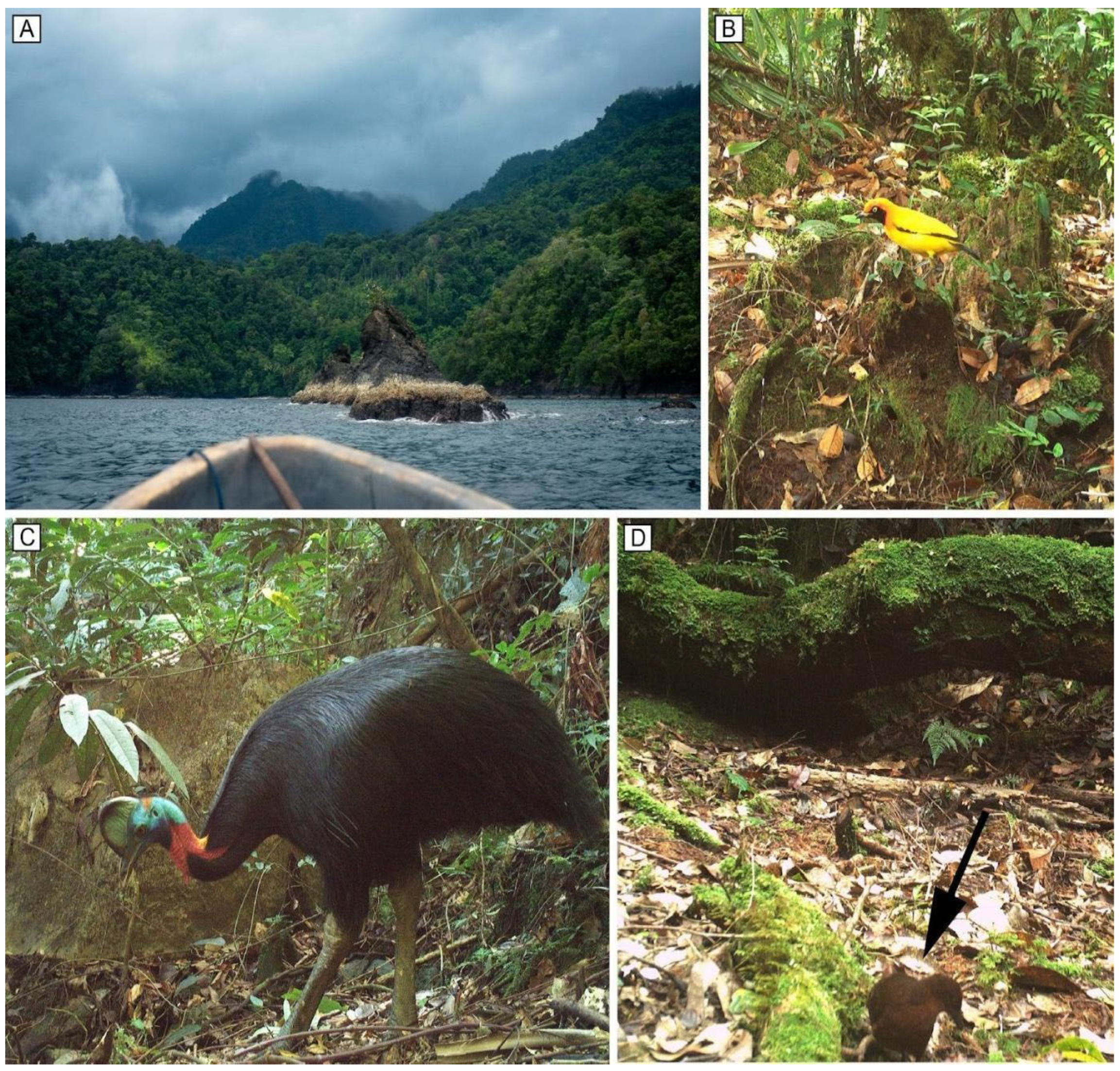
Among the data are images of Masked Bowerbird (Sericulus aureus) (Figure 2B), which is the first time this species has been recorded in the Cyclops Mountains and represents a range extension that fills the gap in its distribution between the outlying Foja Mountains and North Coastal Range (see Supplementary Figure S2). To our knowledge, we also report here the first published record of Cinnamon Ground-dove (Gallicolumba rufigula) in the Cyclops Mountains.
Also among the dataset are Mayr’s Forest Rail (Rallicula mayri mayri) (Figure 2D) and Mayr’s Honeyeater (Ptiloprora mayri mayri) (Supplementary Figure S3), so-called ‘lost’ species [26] in the sense that they were both last recorded by photographic, audio, or genetic means more than ten years ago (both 18 years ago in the Foja Mountains [29]). The images of Mayr’s Forest Rail are particularly significant, as the species had not been recorded by science in the Cyclops Mountains since Ernst Mayr in 1928 [20].
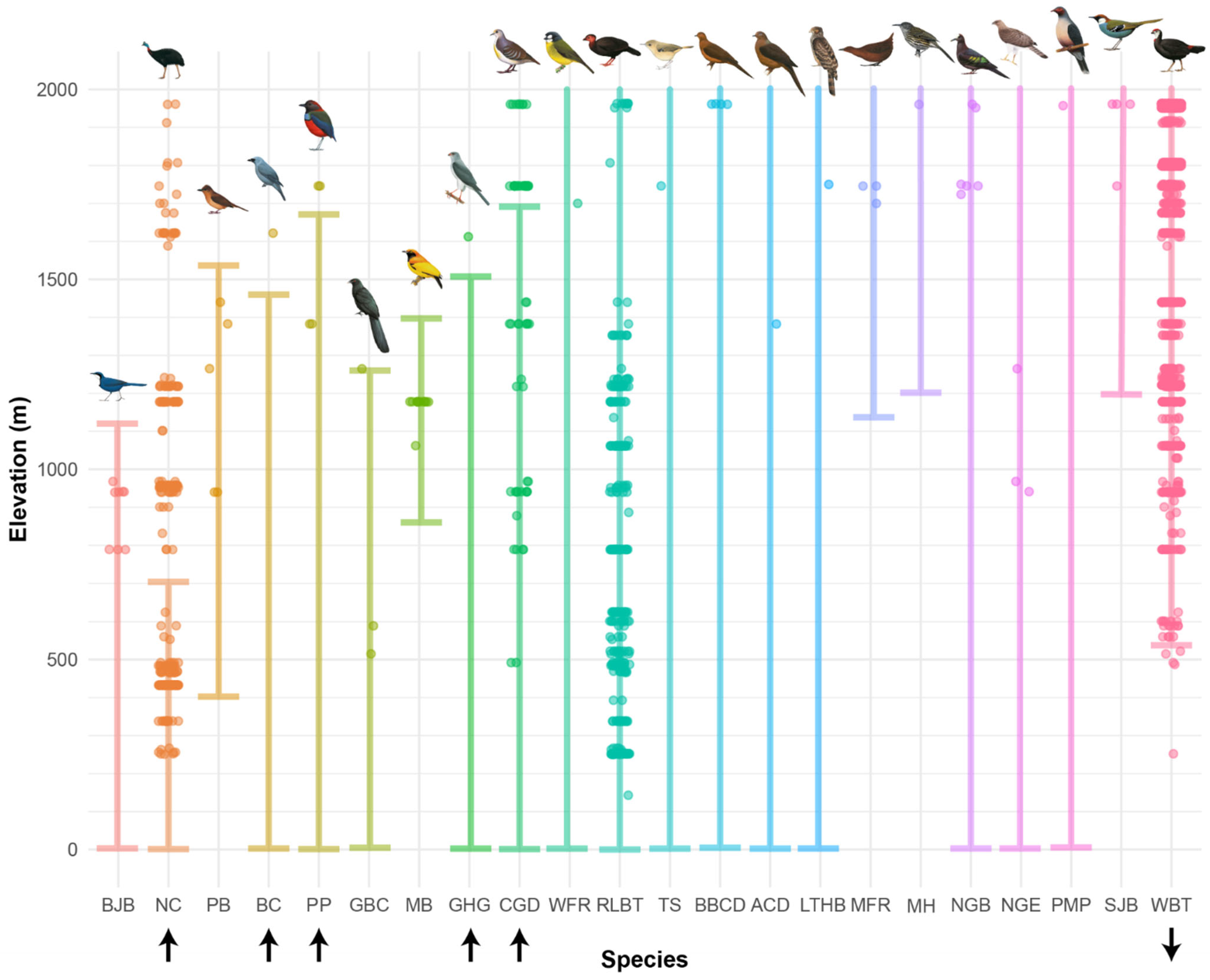
Following a literature search, with Beehler and Pratt (2016) [4] as our primary reference, we find elevation records outside previously recorded limits for six species, with five above their cited elevation ceilings, and one below its cited elevation floor (Figure 3).
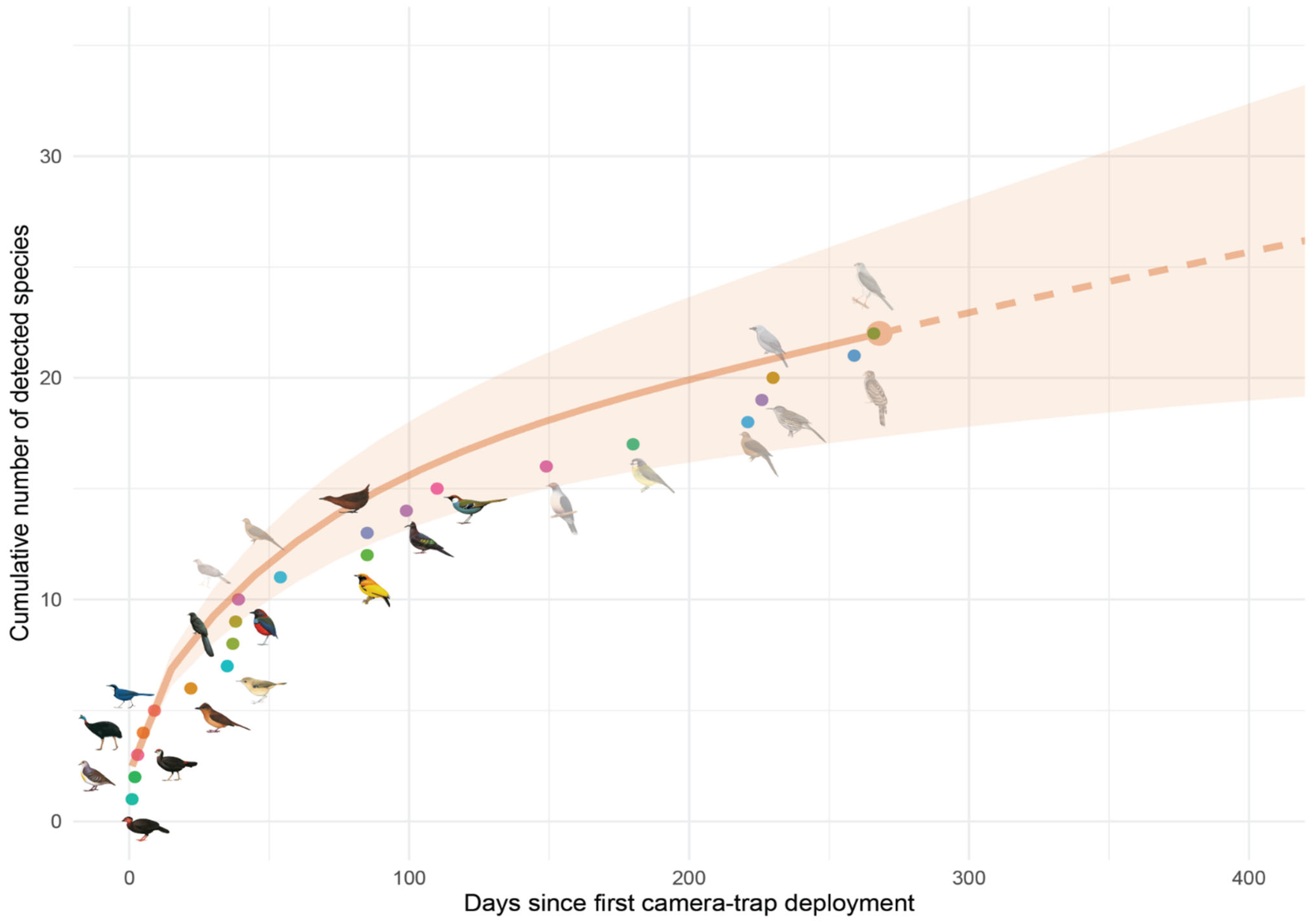
The 22 species that we recorded by camera trap represent 12% of the 182 bird species known to occur in the Cyclops Mountains. Photographs are predominantly of ground-dwelling bird species (1655 independent records from 13 species). We do, however, capture occasional images of arboreal species (14 independent records from nine species) that have come to ground. The species accumulation curve (in Figure 4), which is the cumulative number of species detected against sampling effort (camera-trap sampling duration), does not reach an asymptote. This may suggest that the camera-trap bird species inventory is incomplete [28]. However, if incidental arboreal species records are excluded, the species accumulation curve does asymptote (Supplementary Figure S4), suggesting we capture the detectable ground-dwelling bird fauna at our sample stations.

3.2. Species Accounts

We provide a complete list of the bird species that we photographed by camera trap along our elevation transect of the Cyclops Mountains. For each species, we provide the elevation range within which we recorded it, the number of independent photographs (ni) captured, and the number of camera traps that recorded the species (ns). We provide extended notes for those species where we present new distributional records in this paper.

3.2.1. Northern Cassowary (NC) Casuarius unappendiculatus (242–1961 m; ni = 242; ns = 41)

There are three cassowary species in New Guinea: the Dwarf Cassowary (Casuarius bennetti), the Southern Cassowary (Casuarius casuarius), and the Northern Cassowary (Casuarius unappendiculatus). The Southern and Northern are considered lowland species whose distributions are divided by the Central Range, and the Dwarf Cassowary replaces them at higher elevations. We record a substantial upslope elevation extension for the Northern Cassowary in the Cyclops Mountains, as we observe it extensively above its reported elevation ceiling (700 m) [4], as high as 1962 metres (see Supplementary Figure S5 for voucher photos). In the absence of the Dwarf Cassowary, it appears to occupy a similar ecological niche at higher elevations, suggesting both ecological release and previously unrecognised behavioural or habitat plasticity in this species. Our records suggest that, in the Cyclops Mountains, it occupies the niche of the Dwarf Cassowary (which has not been recorded in the Cyclops Mountains). We record it on 242 independent occasions in total, across 41 different stations (making it, alongside the Red-legged Brush-turkey, joint second for the greatest number of stations recorded at), on both the northern and southern slopes of the range.

3.2.2. Wattled Brushturkey (WBT) Aepypodius arfakianus (252–1963 m; ni = 1020; ns = 252)

A regular inhabitant of high-altitude habitats in Papua. Our study records this species below the 540 m elevation floor reported for mainland populations in Beehler and Pratt (2016) [4].

3.2.3. Red-Legged Brushturkey (RLBT) Talegalla jobiensis (143–1963 m; ni = 293; ns = 41)

A common species that is found almost across the entire north coast of New Guinea (excepting the Bird’s Head). Found just above the altitudinal range (0–1950 m) reported in Beehler and Pratt (2016) [4].

3.2.4. Grey-Headed Goshawk (GHG) Tachyspiza poliocephala (1612 m; ni = 1; ns = 1)

An uncommon yet broadly distributed species that is found across Papua [30]. Photographed at 1612 m, we recorded the species above the elevation ceiling (1500 m) reported in Beehler and Pratt (2016) [4].

3.2.5. New Guinea Eagle (NGE) Harpyopsis novaeguineae (941–1265 m; ni = 1; ns = 3)

A broadly distributed, yet rarely observed, species across Papua [4]. Previously observed with camera traps in the Torricelli [31]. Beehler and Pratt (2016) report records from sea-level to above 3200 m [4].

3.2.6. Long-Tailed Honey-Buzzard (LTHB) Henicopernis longicauda (1750 m; ni = 1; ns = 1)

A widespread New Guinea endemic, recorded between sea-level and 3000 m in elevation [4].

3.2.7. Mayr’s Forest Rail (MFR) Rallicula mayri mayri (1700–1746 m; ni = 3; ns = 2)

This elusive species is endemic to the Foja Mountains, the Cyclops Mountains, and the North Coastal Ranges. Before our study, it was only recorded in the Cyclops Mountains by Mayr in 1928 [20]. We photographed the species on three independent occasions, twice at 1746 m and once at 1700 m. As far as we are aware, these are the first photos of this species. Our observations represent a ‘rediscovery’ of a ‘lost’ species [26], as the last known recording of the species was over ten years ago, in 2007, in the Foja Mountains [5]. We photographed the species within its known elevation range (1160–2070 m) [4].

3.2.8. Black-Billed Cuckoo-Dove (BBCD) Macropygia nigrirostris (1961–1962 m; ni = 4; ns = 2)

Common species across most of northern Papua, ranging from sea-level to 2600 m [4]. Diamond and Bishop (2025) [25] recorded Black-billed Cuckoo-dove on the Cyclops Mountains at ca. 420 m.

3.2.9. Amboyna Cuckoo-Dove (ACD) Macropygia amboinensis (1383 m; ni = 1; ns = 1)

Primarily found in the western half of New Guinea, where it ranges from sea-level to 2300 m [4]. Diamond and Bishop (2025) [25] recorded the species at ca. 1370 m on the Cyclops Mountains.

3.2.10. Cinnamon Ground-Dove (CGD) Gallicolumba rufigula (492–1961 m; ni = 55; ns = 11)

With the exception of high peaks in the Central Cordillera, it is found across Indonesian Papua. However, to our knowledge, we present here the first published observations of the species from the Cyclops Mountains. Photographed up to 1961 m, we report this species over 250 m above its previously reported elevation ceiling (1700 m) [4].

3.2.11. New Guinea Bronzewing (NGB) Henicophaps albifrons (1724–1961 m; ni = 6; ns = 5)

A candidate species for camera-trap detection, as it forages on the forest floor. We observe the species within its elevation range, which is 0–2150 m [4].

3.2.12. Papuan Mountain Pigeon (PMP) Gymnophaps albertisii albertisii (1957 m; ni = 1; ns = 1)

A widespread New Guinea species. On the Cyclops Mountains, we recorded this species within its reported elevation range (0–3700 m) [4].

3.2.13. Greater Black Coucal (GBC) Centropus menbeki (515–1265 m; ni = 3; ns = 3)

A species found on the forest floor and in the lower canopy, it tends to live between sea-level and 800 m in elevation, though it has been seen, rarely, up to 1275 m [4]. We record the species near its reported limit, at 1265 m.

3.2.14. Papuan Pitta (PP) Erythropitta macklotii (1383–1746 m; ni = 4; ns = 2)

With the exception of high peaks in the Central Cordillera, it is found across New Guinea. We record Papuan Pitta up to 1746 m, a small increase to the species’ elevation ceiling (previously reported as 1680 m) [4].

3.2.15. Spotted Jewel-Babbler (SJB) Ptilorrhoa leucosticta sibilans (1746–1961 m; ni = 4; ns = 2)

Found in high-altitude areas of New Guinea. Recorded between 1200 and 2700 m [4].

3.2.16. Blue Jewel-Babbler (BJB) Ptilorrhoa caerulescens (789–968 m; ni = 8; ns = 4)

Ptilorrhoa is an exemplar genus of altitudinal segregation in birds in New Guinea [32]. Diamond (1972) notes that, in the Eastern Highlands, the three species present—P. caerulescens, P. castanonota, and P. leucosticta—show discrete elevation ranges. P. caerulescens is generally regarded as a lowland rainforest taxon, replaced by congeners at higher elevations [32]. Its recorded elevation range in Beehler and Pratt (2016) is 0–850 m [4], but it has previously been recorded up to 1128 in the Cyclops Mountains [25], and we record it up to 968 m.

3.2.17. Masked Bowerbird (MB) Sericulus aureus (1062–1178 m; ni = 11; ns = 2)

We photographed this species at two stations, on a total of 11 independent occasions. Despite multiple previous ornithological surveys of the range [25], our observations of Masked Bowerbird are the first in the Cyclops Mountains. The stations at which we photographed the species are within previously unsurveyed areas on the northern slopes of the range—this may have contributed to the absence, until now, of observations, and we second the recommendation of Diamond and Bishop (2025) that the northern slopes merit further surveying [25]. Our discovery of Masked Bowerbird adds another upland species (defined in Diamond and Bishop (2015) [33]) to the Cyclops Mountains’ upland birds, but it is not one of the 22 missing species identified by Diamond and Bishop (2025) [25]. The elevations of the two stations (1062 m and 1178 m) are within the known elevation range of the species (850–1400 m) [4]. We observed at least one male and at least two females in our photographs.
Our discovery strengthens understanding of the remarkable distribution of this species, synthesised previously on pages 91–93 of Diamond and Bishop (2021) [34]. The Sericulus superspecies that includes S. aureus and its close relative and sister species Fire-maned Bowerbird (S. bakeri), is widely distributed on the outlying mountain ranges of New Guinea’s north coast. Of those seven ranges, we can now say that Sericulus is present on at least six: S. aureus on the Bird’s Head, Wandamen, Foja, Cyclops, and North Coastal Range, and S. bakeri on the Adelberts. The Adelberts represent the eastern limit of Sericulus’s distribution on the north coast: Sericulus is unrecorded from the frequently surveyed Huon Mountains east of the Adelberts. The only outlying range from the Bird’s Head to the Adelberts where Sericulus has not been found is the Van Rees Mountains, which may be too low for Sericulus. See Supplementary Figure S2 for a map of the distribution of S. aureus and S. bakeri.
The outlying ranges from the Wandamen to the Adelberts are separated from the high mountains of New Guinea’s Central Range by the lowlands of the Rouffaer, Idenburg, and Sepik river basins. The only two documented records of Sericulus from the north slopes of the Central Range south of those basins are from Bernhard Camp and the Weyland Mountains in the westernmost part of the Central Range. Five extensive surveys of the Central Range’s northern watershed in Papua New Guinea did not find Sericulus. There is one report of S. aureus from the northern watershed of the Central Range in Papua New Guinea (from the Jimi River), but it is undocumented and likely improbable [34]. Thus, we think the range maps in Pratt and Beehler (2015, p. 172) [35] and Frith and Frith (2004, p. 334) [36], which show S. aureus distributed continuously along the northern slopes of the Central Range for 500 km east of Bernhard Camp, may be erroneous. Although S. aureus is likely distributed more widely than documented records suggest, we feel that current evidence does not robustly support a continuous distribution from Bernhard Camp to the Jimi River. Our understanding of the distribution of this elusive bird along the Central Range may be aided by more camera trapping in these mountains; S. aureus was found by our team on the Cyclops Mountains after nine traditional ornithological surveys there, highlighting the difficulty in detecting the species without camera traps.
It is interesting that Sericulus extends so far along the north coast from the Bird’s Head to the Adelberts, but that it has not been reported from across the narrower gap from the north coast ranges to the Central Range east of Bernhard Camp. At least two other species have similar distributions. Barred Cuckooshrike (Coracina lineata) is recorded on all of the north coast ranges, but it is infrequently recorded on the north slopes of the Central Range. The Grizzled Tree-kangaroo (Dendrolagus inustus) is widely distributed on the north coast ranges but is unknown from the Central Range [37].

3.2.18. Mayr’s Honeyeater (MH) Ptiloprora mayri mayri (1961 m; ni = 1; ns = 1)

We photographed the species once, at the summit, and saw it several times in the summit region, within its recorded elevation range (1200–2170 m) [4]. This species is known to be locally common in the Cyclops Mountains, with Diamond and Bishop (2025) noting that it is “the most abundant species in forest from 1567 m to the summit” [25]. The pair made this observation in 1990, and the species was also seen in the Foja Mountains in expeditions between 2005 and 2007 [29]. Despite its apparent local abundance, our observations still represent a ‘rediscovery’ of this ‘lost species’ under the lost species framework [26], as they are the first photographic evidence of the species in over a decade (see Supplementary Figure S3 for photographs). Rather than a conservation finding of importance, we feel this ‘rediscovery’ reflects some shortfalls of the ‘lost species’ concept: (1) the 10-year time horizon is too short relative to the sampling frequency of remote locations, such as the montane forest of the Foja Mountains, Cyclops Mountains, and North Coastal Ranges where Mayr’s Honeyeater is found, and (2) it excludes genuine observations made without photographic, audio, or genetic evidence, which are the predominant type of observation made by local stakeholders in a place like the Cyclops Mountains [14].

3.2.19. Tropical Scrubwren (TS) Sericornis beccarii cyclopum (1746 m; ni = 1; ns = 1)

The taxonomy of the species complex containing Sericornis beccarii, Sericornis nouhuysi, and Sericornis virgatus is unsettled. Some authors only consider S. beccarii and S. nouhuysi as valid species, and they treat some populations assigned to S. virgatus as intermediate S. beccarii × S. nouhuysi hybrids [4]. Other authors treat S. virgatus as a valid species, distinct from populations of S. beccarii found in the mouth of the Fly River, the Aru Islands, and northern Cape York [25], and excluded at higher elevations by S. nouhuysi. Here, as elsewhere in the text, we follow the eBird/Clements taxonomy, treating the population in the Cyclops Mountains as the cyclopum subspecies of S. beccarii. We photographed this species once, at 1746 m, within the maximum elevation ceiling we found reported for S. beccarii or S. virgatus [4].

3.2.20. Boyer’s Cuckooshrike (BC) Coracina boyeri (1622 m; ni = 1; ns = 1)

A common species found across New Guinea. Beehler and Pratt (2016) report an elevation ceiling of 1450 m for this species [4], but we record the species above this ceiling. However, we only have a single observation, so it is not possible to confirm whether this species regularly occupies higher-altitude habitats on the Cyclops Mountains.

3.2.21. Piping Bellbird (PB) Ornorectes cristatus (940–1440 m; ni = 5; ns = 4)

Beehler and Pratt (2016) report an elevation range for this species of 400–1300 m [4]. Diamond and Bishop (2025) found the species up to 1524 m, so our records are within the observed range for the species [25].

3.2.22. White-Faced Robin (WFR) Eopsaltria leucops melanogenys (1700 m; ni = 1; ns = 1)

A widespread species found between sea-level and 2200 m [4]. Recorded within its expected elevation range.

4. Discussion

Situated next to the metropolitan areas of Jayapura and Sentani (see Figure 1), the Cyclops Mountains are more accessible than most montane environments in Indonesian Papua. This may explain why, relative to other mountain regions in the provinces, the avifauna of the Cyclops Mountains has received more attention. Diamond and Bishop (2025) [25] provide a thorough history of bird surveys undertaken in the Cyclops Mountains, describing eight surveys, so that, including our present study, there are nine surveys of the Cyclops Mountains’ avifauna in the published record. Nonetheless, the first record of Masked Bowerbird that we describe here indicates the inventory of the Cyclops Mountains’ birds may remain incomplete. Indigenous accounts of a long-tailed Parotia in the Cyclops Mountains also suggest new records, or even new species, may be recorded in the future [29]. One possible explanation for new records from the Cyclops Mountains, despite higher-than-average survey effort [25], is that most inventories have been conducted on the southern slopes of the mountains on a single transect that leads to the summit of Gunung Rafeni-Rara. Our present study represents the first published survey that has taken place above 70 metres (a Conservation International RAP survey in 2000 took place below this elevation [24]) on the northern slopes of the Cyclops Mountains. It may not be a coincidence that we discovered Masked Bowerbird on the northern slopes, and we support Diamond and Bishop’s suggestion that further surveys of the northern Cyclops Mountains, as well as previously unsurveyed peaks (like Mount Dafonsoro), are meritworthy [25]. See Supplementary Figure S5 for a comparison of our north-side and south-side camera-trap observations.
The discovery of S. aureus on the northern slopes supports Diamond and Bishop’s suggestion that incomplete spatial coverage, rather than insufficient sampling effort per se, may underlie remaining gaps in the Cyclops Mountains’ bird inventory [25]. This pattern mirrors findings from other north coastal ranges of New Guinea, where geographically restricted survey effort has delayed the detection of both range-restricted and locally uncommon species [38]. Our results therefore reinforce the importance of expanding survey coverage into underexplored portions of even “well-known” mountain systems, particularly in regions characterised by steep environmental gradients and high habitat heterogeneity.
We recorded 22 species by camera trap during this study, far fewer than the total number of bird species recorded in the Cyclops Mountains (182—see Supplementary Table S1 for the full species checklist) and fewer than the number recorded during the traditional ornithological surveys (visual observation, mist-netting, and acoustic identification) by Mayr in 1928 [22], Rand in 1938–1939 [23], Beehler in 1980 [25], Diamond and Bishop in 1990 [25], and the Conservation International RAP in 2000 [24]. It is important to note that the composition of species detected in our survey likely reflects our study’s methodology. The primary purpose of our camera-trap deployment was to survey ground-dwelling mammal fauna along an elevation gradient of the Cyclops Mountains and to establish whether Attenborough’s Long-beaked Echidna persisted in the range [14]. We therefore placed cameras to maximise mammal, especially echidna, detection. As we placed them on the ground, unbaited, and not at locations preferred by birds (such as fruit-fall, nesting, or display sites), we missed the many canopy-dwelling, arboreal, and vocal species that are present in previous surveys.
The species most likely to be captured by our study design were ground-dwelling birds, including those that are secretive and typically elude more intrusive survey methods. Some of the most significant findings of this study may not have been possible using traditional survey methods. The new record of Masked Bowerbird, which is a rare and cryptic species [33], adds important information for understanding the biogeography of New Guinea’s outlying mountain ranges. Similarly, we obtained many records of Northern Cassowary (Casuarius unappendiculatus), which is typically difficult to record by traditional bird surveys, including records that increase its elevation ceiling by over 1000 m. This finding could have important conservation implications, as the species’ typical lowland habitat is increasingly threatened. However, this depends on whether Northern Cassowary occupies similarly high elevations elsewhere (which needs to be established—something for which camera trapping would be well-suited).
Our species accumulation curve of ground-dwelling species (Supplementary Figure S4) asymptotes, one interpretation of which is that we detected all ground-dwelling bird species that could have been detected at our camera-trap stations. As such, we can tentatively infer some ground-dwelling species that are absent from the Cyclops Mountains; we did not detect Pheasant Pigeon (Otidiphaps nobilis)—a species that camera traps are generally effective at detecting—for example, supporting suggestions by Diamond and Bishop (2025) [25] that the species may be absent from the Cyclops Mountains. However, some ground-dwelling species are missing from our dataset, such as Bronze Ground -dove (Gallicolumba beccarii) and Mountain Mouse-warbler (Crateroscelis robusta), which have previously been recorded in the Cyclops Mountains. Also, of recorded ground-dwelling birds, some small-to-mid-sized species (e.g., Erythropitta, Ornorectes, Ptilorrhoa, and Rallicula) are detected at a relatively low frequency compared to some other New Guinea camera-trap studies. These absences and lower-than-typical detection rates may reflect our study design (which used suboptimal camera placement for detecting birds) and limited spatial coverage, so we suggest some caution should be taken in interpreting the species composition of our results.
Overall, the new records presented here highlight the value of camera trapping in New Guinea, where logistical challenges, rugged terrain, and limited repeat survey effort constrain traditional ornithological fieldwork [30]. Camera traps operate continuously, require relatively little observer presence, and are less dependent on taxonomic or acoustic expertise in the field. As a result, they are particularly well-suited to documenting ground-dwelling birds—including elusive species—and hard-to-access areas.
Our results demonstrate the role of camera trapping as a complementary tool that fills critical detection gaps. In the Cyclops Mountains, camera trapping reveals aspects of avian community composition, elevation ecology, and species persistence that are poorly captured by traditional methods alone. Integrating camera traps with visual, acoustic, and mist-netting surveys is therefore likely to provide the most complete understanding of avifaunal diversity in New Guinea’s complex montane landscapes.

5. Conclusions

By completing, to our knowledge, the first published camera-trap survey along an elevation gradient in Indonesian Papua, we made three discoveries of particular interest: (1) we extended the range of Masked bowerbird to the Cyclops Mountains; (2) we made photographic rediscoveries of two ‘lost’ species, Mayr’s Forest Rail and Mayr’s Honeyeater (the first documented record of the former for nearly 100 years in the Cyclops); and (3) we extended the elevation ceiling of Northern Cassowary by over 1000 m.
Like most ground camera-trap deployments, we detected fewer bird species than traditional survey methods. In total, we recorded 22 species, 13 of which were ground-dwelling species and nine of which represent incidental species records of arboreal species. Our results show that, while ground deployment of camera traps may not be effective for assessing the complete bird fauna of a given location, they are useful for detecting elusive ground-dwelling species. Future studies in the Cyclops Mountains should integrate camera trapping with acoustic monitoring and direct observation to provide as complete an assessment of avian diversity in this mountain range as possible. Indeed, undertaking such survey methods across other mountain ranges in Indonesian Papua will surely be fruitful for improving the understanding of species distributions and ecological patterns of New Guinea’s bird species, and we encourage such surveys.

Supplementary Materials

The following supporting information can be downloaded at: https://www.mdpi.com/article/10.3390/birds7020027/s1; Figure S1: Species incidence bar chart; Figure S2: Presence and absence of Sericulus bowerbirds on New Guinea’s northern watershed (text and map modified, with permission, from Diamond and Bishop (2025) [25]); Figure S3: Image sequence of Mayr’s honeyeater (Ptiloprora mayri mayri); Figure S4: Species accumulation curve over time for ground-dwelling bird species; Figure S5: Voucher images for the increased elevation ceiling of Northern Cassowary (Casuarius unappendiculatus); Figure S6: North-side and south-side comparison; Table S1: List of all bird species observed in the Cyclops Mountains in the published record [20,23,24,25], including this publication; Table S2: Individual species account links and illustrator credits for the Cornell Lab of Ornithology Birds of the World (https://birdsoftheworld.org/bow/home (accessed on 26 January 2026)) illustrations used in Figure 3, Figure 4, and Figure S3.

Author Contributions

Conceptualization, J.A.K., L.-R.D., M.I., and M.K.; methodology, J.A.K. and G.M.; investigation, all authors; software, J.A.K. and L.-R.D.; validation, J.A.K. and L.-R.D.; formal analysis, J.A.K. and L.-R.D.; data curation, all authors; writing—original draft preparation, J.A.K., L.-R.D., J.D., and M.I.; writing—review and editing, all authors; visualisation, J.A.K. and L.-R.D.; supervision, J.A.K., L.-R.D., I.K., and M.K.; project administration, J.A.K., A.H., N.I., H.K., I.K., and J.I.G.; funding acquisition, J.A.K. and L.-R.D. All authors have read and agreed to the published version of the manuscript.

Funding

This research was funded by Merton College, University of Oxford, the Gilchrist Educational Trust (grant GILC 06.22, administered by the Royal Geographical Society), the Scientific Exploration Society, Biome Conservation, Re:wild, the University of Oxford Expeditions Council, Derek Williams, Chris Peri, and Petr Hlaváč. We are grateful to Reconyx for their support. Leonidas-Romanos Davranoglou acknowledges the Leverhulme Trust Early Career Fellowship grant (ECF-2021-199) for funding him during this research.

Institutional Review Board Statement

The study involved non-invasive camera trapping of wild animals and did not involve animal handling or experimental manipulation. Research was conducted under Indonesian research permits 465/SIP/IV/FR/8/2023 and 466/SIP/IV/FR/8/2023 and Papua BBKSDA permit SIMAKSI No. SI.29/K.4/BIDTEK/KSA.03.01/B/02/2026. Ethical approval was granted by Badan Riset dan Inovasi Nasional (BRIN).

Informed Consent Statement

Not applicable.

Data Availability Statement

The camera-trap images used in this study are available, on request, by contacting the corresponding authors.

Acknowledgments

We acknowledge and thank the community of Yongsu Sapari for their assistance in every stage of our research. We are particularly grateful to the following members of the community: M. Ormuseray, L. Nusa, I. Nusa, B. Abisay, S. Tablaseray, A. Ormuseray, M. Norotouw, S. M. Yomilena, A. Sorondanya, F. H. Apaserai, T. Sorondanya, J. A. Norotouw, G. Sorondanya, S. Norotouw, and Z. Sorondanya. We thank A. Tilker, Y. Wilson, and Y. Ulunggi for their assistance in fieldwork. We thank the Indonesian Ministry of Environment and Forestry (KLHK), the Indonesian National Research and Innovation Agency (BRIN), and Papua BBKSDA for their research support.

Conflicts of Interest

David Bishop is employed by Semioptera Pty. Ltd. The authors declare no conflicts of interest. The funders had no role in the design of the study; in the collection, analyses, or interpretation of data; in the writing of the manuscript; or in the decision to publish the results.

References

  1. Frodin, D.G. Biological exploration of New Guinea. In The Ecology of Papua, 1st ed.; Ecology of Indonesia series; Periplus Editions: Jakarta, Indonesia, 2007; Volume 6. [Google Scholar]
  2. Ondo, I.; Dhanjal-Adams, K.L.; Pironon, S.; Silvestro, D.; Colli-Silva, M.; Deklerck, V.; Grace, O.M.; Monro, A.K.; Nicolson, N.; Walker, B.; et al. Plant diversity darkspots for global collection priorities. New Phytol. 2024, 244, 719–733. [Google Scholar] [CrossRef]
  3. Moura, M.R.; Jetz, W. Shortfalls and opportunities in terrestrial vertebrate species discovery. Nat. Ecol. Evol. 2021, 5, 631–639. [Google Scholar] [CrossRef] [PubMed]
  4. Beehler, B.M.; Pratt, T.K. Birds of New Guinea: Distribution, Taxonomy, and Systematics. 2016. Available online: https://oxford.primo.exlibrisgroup.com (accessed on 1 April 2026).
  5. Beehler, B.M.; Diamond, J.M.; Kemp, N.; Iii, E.S.; Milensky, C.; Laman, T.G. Avifauna of the Foja Mountains of Western New Guinea. Bull. Br. Ornithol. Club 2012, 132, 84–101. [Google Scholar]
  6. Scholes, E.; Laman, T.G. Distinctive courtship phenotype of the Vogelkop Superb Bird-of-Paradise Lophorina niedda Mayr, 1930 confirms new species status. PeerJ 2018, 6, e4621. [Google Scholar] [CrossRef] [PubMed]
  7. Milá, B.; Bruxaux, J.; Friis, G.; Sam, K.; Ashari, H.; Thébaud, C. A new, undescribed species of Melanocharis berrypecker from western New Guinea and the evolutionary history of the family Melanocharitidae. Ibis 2021, 163, 1310–1329. [Google Scholar] [CrossRef]
  8. Woxvold, I.A.; Gamui, B.G.; Legra, L.; Yama, S.; Koane, B.; Tulai, S. A new species of jewel-babbler (Cinclosomatidae: Ptilorrhoa) from the Southern Fold Mountains of Papua New Guinea. Ibis 2025, 168, 431–450. [Google Scholar] [CrossRef]
  9. McIntyre, J.K.; Wolf, L.L.; Sacks, B.N.; Koibur, J.; Brisbin, I.L. A population of free-living highland wild dogs in Indonesian Papua. Aust. Mammal. 2020, 42, 160–166. [Google Scholar] [CrossRef]
  10. McIntyre, J.K.; Curry, C.J.; Wolf, L.L.; Maury, H.K.; Numberi, L.A.; Surbakti, S.; Davis, B.W. Investigation of free-living highland wild dogs near Grasberg Gold Mine, Papua Province, Indonesia. Aust. Mammal. 2025, 47, AM23047. [Google Scholar] [CrossRef]
  11. Pangau-Adam, M.; Flassy, M.; Trei, J.; Waltert, M.; Soofi, M. The role of the introduced rusa deer Cervus timorensis for wildlife hunting in West Papua, Indonesia. Ecol. Solut. Evid. 2022, 3, e12118. [Google Scholar] [CrossRef]
  12. Brodie, J.F.; Helmy, O.; Pangau-Adam, M.; Ugiek, G.; Froese, G.; Granados, A.; Mohd-Azlan, J.; Bernard, H.; Giordano, A.J.; Agil, M.; et al. Crossing the (Wallace) line: Local abundance and distribution of mammals across biogeographic barriers. Biotropica 2018, 50, 116–124. [Google Scholar] [CrossRef]
  13. Felayati, N.R.; Santoso, N.; Rahman, D.A. The Estimation of Cuscus Population and Distribution in Teluk Wondama District, West Papua Province, Indonesia. Media Konserv. 2024, 29, 37–48. [Google Scholar] [CrossRef]
  14. Morib, G.; Tilker, A.; Davranoglou, L.R.; Anasari, S.D.; Balázs, A.; A Barnes, P.; Foote, M.J.; Hamidy, A.; Heatubun, C.D.; Helgen, K.M.; et al. Attenborough’s echidna rediscovered by combining Indigenous knowledge with camera-trapping. npj Biodivers. 2025, 4, 19. [Google Scholar] [CrossRef]
  15. Brodie, J.F.; Pangau-Adam, M. Human impacts on two endemic cassowary species in Indonesian New Guinea. Oryx 2017, 51, 354–360. [Google Scholar] [CrossRef]
  16. Pangau-Adam, M.Z.; Brodie, J.F. Threats to the populations of two endemic brushturkey species in Indonesian New Guinea. J. Asia-Pac. Biodivers. 2019, 12, 488–492. [Google Scholar] [CrossRef]
  17. Diamond, J.M. New Distributional Records and Taxa from the Outlying Mountain Ranges of New Guinea. Emu Austral Ornithol. 1985, 85, 65–91. [Google Scholar] [CrossRef]
  18. Pigram, C.J.; Davies, H.L. Terranes and the accretion history of the New Guinea orogen. BMR J. Aust. Geol. Geophys. 1987, 10, 193–211. [Google Scholar]
  19. Heald, W.F. Sky Island; Van Nostrand: New York, NY, USA, 1967. [Google Scholar]
  20. Hartert, E. List of the Birds Collected by Ernst Mayr. Novit. Zool. 1930, 34, 27–128. [Google Scholar]
  21. Hartert, E. On a Collection of Birds Made by Dr. Ernst Mayr in Northern Dutch New Guinea. Novit. Zool. 1930, 34, 18–19. [Google Scholar]
  22. Mayr, E. My Dutch New Guinea Expedition, 1928. Novit. Zool. 1930, 34, 20–26. [Google Scholar]
  23. Rand, A.S. Results of the Archbold Expedition. No 43: Birds of the 1938-39 New Guinea Expedition. Bull. Am. Mus. Nat. Hist. 1942, 79, 425–516. [Google Scholar]
  24. Setio, P.; Kawatu, P.J.; Kalo, D.; Womsiwor Beehler, B.M. Birds of the Yongsu Area, northern Cyclops Mountains, Papua, Indonesia. In A Biodiversity Assessment of Yongsu—Cyclops Mountains and the Southern Mamberamo Basin, Papua, Indonesia; Richards, S., Suryadi, S., Eds.; RAP bulletin of biological assessment; Conservation International: Arlington, VA, USA, 2002. [Google Scholar]
  25. Diamond, J.; Bishop, K.D. Why are New Guinea’s Cyclops Mountains poor in upland bird species? Bull. Br. Ornithol. Club 2025, 145, 60–90. [Google Scholar] [CrossRef]
  26. Long, B.; Rodríguez, J.P. Lost but not forgotten: A new nomenclature to support a call to rediscover and conserve lost species. Oryx 2022, 56, 481–482. [Google Scholar] [CrossRef]
  27. Niedballa, J.; Sollmann, R.; Courtiol, A.; Wilting, A. camtrapR: An R package for efficient camera trap data management. Methods Ecol. Evol. 2016, 7, 1457–1462. [Google Scholar] [CrossRef]
  28. Hsieh, T.C.; Ma, K.H.; Chao, A. iNEXT: An R package for rarefaction and extrapolation of species diversity (Hill numbers). Methods Ecol. Evol. 2016, 7, 1451–1456. [Google Scholar] [CrossRef]
  29. Beehler, B.M.; Prawiradilaga, D.M. New taxa and new records of birds from the north coastal ranges of New Guinea. Bull. Br. Ornithol. Club 2010, 130, 277–285. [Google Scholar]
  30. Marki, P.Z.; Sam, K.; Koane, B.; Kristensen, J.B.; Kennedy, J.D.; Jønsson, K.A. New and noteworthy bird records from the Mt. Wilhelm elevational gradient, Papua New Guinea. Bull. Br. Ornithol. Club 2016, 136, 263–271. [Google Scholar]
  31. Thomas, J. Faunal survey by camera trapping in the Torricelli Mountain Range, Papua New Guinea. In Camera Trapping: Wildlife Management and Research; Meek, P., Fleming, P., Eds.; CSIRO Publishing: Clayton, Australia, 2014; pp. 69–76. [Google Scholar]
  32. Diamond, J.M. Avifauna of the Eastern Highlands of New Guinea; Nuttall Ornithological Club: Cambridge, MA, USA, 1972. [Google Scholar]
  33. Diamond, J.; Bishop, K.D. Avifaunas of the Kumawa and Fakfak Mountains, Indonesian New Guinea. Bull. Br. Ornithol. Club 2015, 135, 292–336. [Google Scholar]
  34. Diamond, J.; Bishop, K.D. Avifauna of the Adelbert Mountains, New Guinea: Why is Fire-maned Bowerbird Sericulus bakeri the mountains’ only endemic bird species? Bull. Br. Ornithol. Club 2021, 141, 75–108. [Google Scholar] [CrossRef]
  35. Pratt, T.K.; Beehler, B.M. Birds of New Guine, 2nd ed.; Princeton University Press: Princeton, NJ, USA, 2015. [Google Scholar] [CrossRef]
  36. Frith, C.; Frith, D. The Bowerbirds: Ptilonorhynchidae; Oxford University Press: Oxford, UK, 2004. [Google Scholar]
  37. Flannery, T. Mammals of New Guinea; Robert Brown & Associates: Carina, Australia, 1990. [Google Scholar]
  38. Sam, K.; Koane, B. New avian records along the elevational gradient of Mt. Wilhelm, Papua New Guinea. Bull. Br. Ornithol. Club 2014, 134, 116–133. [Google Scholar]
Figure 1. Study area and camera-trap locations in the Cyclops Mountains, Indonesian Papua. The Cyclops Mountains, approximately 250 km2 in area, are situated on the north coast of the island of New Guinea, near the border between the Indonesian provinces of the island (Indonesian Papua) and the country of Papua New Guinea. We recorded that the mountains reach an altitude of 1970 m at the summit of the range’s tallest peak, Rafeni-Rara. Blue dots on the map indicate individual camera traps deployed along the elevation gradient. On the south side of the range, we deployed cameras to the summit of Rafeni-Rara. On the north side, we worked with the community of Yongsu Spari to deploy camera traps up to 1265 m in elevation. The dashed line delineates the boundary of the Cyclops Mountains Protected Area.
Birds 07 00027 g001
Figure 2. Camera trap discoveries in the Cyclops Mountains, Papua. (A) North coast of the Cyclops Mountains, as viewed when approaching Yongsu Spari village; this side of the range has received only one previously published ornithological survey [24] and none above 100 m; (B) first record of Masked Bowerbird from the Cyclops Mountains; (C) Northern Cassowary, which we consistently record in the Cyclops Mountains above its reported 700 m elevation ceiling [4], representing an ecological niche expansion not documented elsewhere in Papua; (D) Mayr’s Forest Rail (indicated by black arrow), a ‘lost’ species not documented for 18 years prior to this study [5].
Birds 07 00027 g002
Figure 3. Species elevation data. Coloured dots represent independent observations of bird species, recorded by camera trap. Coloured bars illustrate the elevation ranges of species found by a search through the literature (with Beehler and Pratt (2016) [4] as the primary reference); bar whiskers represent the elevation floor or ceiling. We observe six species outside their cited elevation limits (five above and one below), and we indicate such upward extensions by up-arrows and such downward extensions by down-arrows. We display species name acronyms on the x-axis—for full species names, see Section 3.2. Detailed Species Accounts section. Illustrations are from Birds of the World (https://birdsoftheworld.org/bow/home (accessed on 26 January 2026)) by permission of the Cornell Lab of Ornithology. We provide individual species account links and illustrator credits in Supplementary Table S2.
Birds 07 00027 g003
Figure 4. Species accumulation curve over time for the birds of the Cyclops Mountains. The cumulative number of bird species detected by camera trap is plotted against the number of camera-trap days since deployment. Dots represent individual species, showing the number of days elapsed before each species was first recorded (species dot colours are the respective species bar and whisker colours in Figure 3). Next to dots, we place the respective species illustrations; translucent illustrations are incidental, arboreal species captured by camera traps. The dashed line is the extrapolation curve that indicates the estimated additional sampling effort required to detect a given number of species. The filled area is the 95% confidence interval. Illustrations are from Birds of the World (https://birdsoftheworld.org/bow/home (accessed on 26 January 2026)) by permission of the Cornell Lab of Ornithology. We provide individual species account links and illustrator credits in Supplementary Table S2.
Birds 07 00027 g004
Disclaimer/Publisher’s Note: The statements, opinions and data contained in all publications are solely those of the individual author(s) and contributor(s) and not of MDPI and/or the editor(s). MDPI and/or the editor(s) disclaim responsibility for any injury to people or property resulting from any ideas, methods, instructions or products referred to in the content.