Article

Individual Specialization of Frugivorous Birds Within a Plant–Frugivore Community: A Network Approach


by
Aarón González-Castro
* and
Carla Luis-Sánchez
Departamento de Biología Animal, Edafología y Geología, Universidad de La Laguna, Avenida Astrofísico Francisco Sánchez, 38206 La Laguna, Spain
*
Author to whom correspondence should be addressed.
Birds 2026, 7(2), 29; https://doi.org/10.3390/birds7020029
Submission received: 15 December 2025 / Revised: 11 May 2026 / Accepted: 15 May 2026 / Published: 19 May 2026

Simple Summary

Plant–animal mutualisms, like seed dispersal by fruit-eating birds, are crucial for biodiversity maintenance. But birds, fruiting plants and their interactions overlap each other through space and time, shaping networks of interactions. Hence, the use of the network approach has served to understand how mutualistic interactions could affect species and the communities they are embedded in. However, most studies using the network approach aggregate data from individuals belonging to the same species to draw ecological conclusions at the species level, despite interactions occurring between individuals. Here, we explore fruit use by individuals of four fruit-eating bird species to estimate levels of individual specialization and how it relates to mutualistic networks built at species level. We found no evidence for variation in fruit use by individuals and their specialization level was more related to their recapture than to the birds’ age, sex or beak size. Also, interactions of individuals were driven by their coincidence with the fruiting phenology of plant species. We also found individuals with similar diets to those of other heterospecific individuals rather than conspecific individuals. This could have implications for the ecological conclusions we draw from networks when we aggregate individuals’ data at the species level.

Abstract

Network approaches are commonly used to study mutualistic interactions between frugivorous birds and plants at the community level. However, most fruit–bird networks aggregate individual data and rely on species-level traits, often overlooking intraspecific variation. Here, we downscale a fruit–bird network to the individual level to evaluate intraspecific diet variation and individual specialization in the four main frugivorous passerine species of an island community. Fruit consumption was identified from fecal samples collected from mist-netted birds and individuals’ diets were modeled with a Bayesian approach. Intraspecific diet variation was quantified using the E and NODF indices, individual specialization using the Psi index, and clustering of individuals sharing fruit resources using the Cws index. We detected low intraspecific diet variation and individuals’ diets were not nested. Individual specialization was mainly related to recapture of individuals and weakly related to phenotypic traits. Clustering mainly involved heterospecific individuals whose diets matched plant fruiting phenology during the capture period. Accordingly, future community-level studies addressing the role of mutualistic interactions in biodiversity maintenance may benefit from integrating network approaches with complementary information on interindividual and interspecific competition.

1. Introduction

Mutualistic interactions, like frugivory and seed dispersal by animals (i.e., endozoochory) have been proposed as crucial ecological processes to maintain biodiversity worldwide [1]. Among fruit-eating animals, vertebrates constitute one of the most important groups as seed dispersers, with birds playing a prominent role (e.g., [2]). Since the beginning of the 21st century, the use of a network approach has become a very popular tool to understand ecological and evolutionary mechanisms underlying mutualistic interactions at the community level (e.g., [3,4]). Nevertheless, the use of this network approach has been subject to several criticisms (see, for example, [4]).
One of the criticized points is that data on interactions are aggregated at the species level to build up networks, despite ecological interactions occurring between individuals (e.g., [5,6]). Based on a network approach to understanding how individual animals use food resources [7,8], a species’ generalist diet can be interpreted in two distinct ways. It may arise from generalist individuals whose diets are broadly similar to one another and to the overall diet of the population. Alternatively, it may result from specialized individuals whose distinct diets collectively sum to the population’s niche breadth.
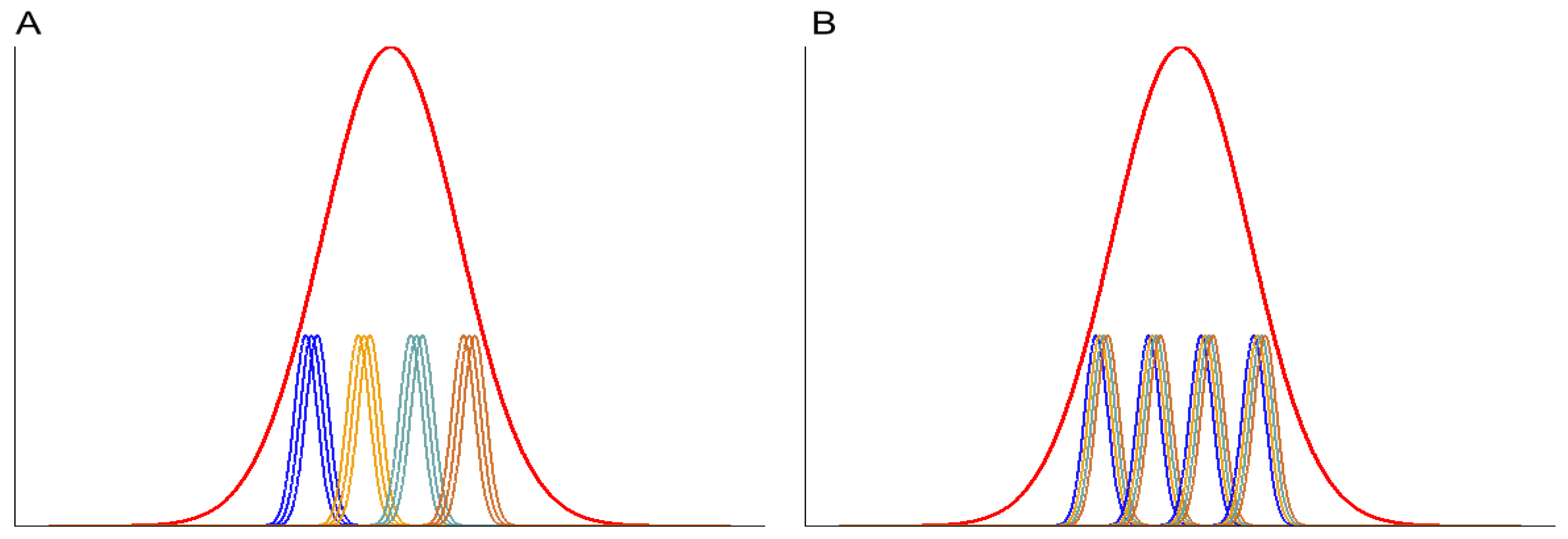
Additionally, Araújo et al. [7,8] proposed that within a population, there may be groups of individuals (i.e., clusters) consuming the same specific subsets of resources out of all resources consumed by the entire population. Looking at the entire community of frugivorous birds, we could consider pooling all species as the ‘frugivorous population’ covering all of the frugivore niche in that community. Also, if individuals’ diets mirrored the species diet, all conspecific individuals would be within the same cluster and differentiated from heterospecific individuals, which would form their own clusters (Figure 1A). Otherwise, the niches of individual birds could form clusters regardless of the species they belong to (Figure 1B).
Some studies have tried to downscale mutualistic networks to an individual-based focus (e.g., [9,10,11,12]). To our knowledge, however, most of them scale interactions to individual level for plants, amphibians, reptiles, marsupials and mammals, whereas studies focusing on birds with a network approach are still lacking. In this study we try to use the network approach proposed by Araújo et al. [7] to assess whether there is interindividual variation in fruit use by passerine birds in a small frugivorous community and, if so, to deepen our knowledge about potential drivers of such variation.
Ecological interactions may be driven by factors related to both the neutrality [13] and the functional traits [14] hypotheses. The ‘neutrality’ hypothesis states that species’ individuals interact at random, so that mutualistic interactions between pairwise species are proportional to their probability of encounter (i.e., species abundance or spatiotemporal overlap) (e.g., [15]). On the other hand, according to the ‘traits’ hypothesis, mutualistic interactions may be enhanced or constrained by individuals’ traits (e.g., morphology, physiology, etc.) (e.g., [12,16]).
This study has three specific goals: (1) to evaluate the interindividual diet variation for different fruit-eating bird species within a community; (2) to evaluate if individuals’ specialization level may be affected by factors related to the ‘neutrality’ or ‘traits’ hypotheses; and (3) to assess if individuals’ diets in the frugivore community form clusters composed of conspecific or heterospecific individuals.

2. Materials and Methods

2.1. Study Area

The study was conducted between March 2024 and February 2025 in Los Adernos, a stronghold of Macaronesian thermo-sclerophyllous shrubland located in northwestern Tenerife Island (Canary Islands, UTM: 28R 317523 E/3138253 N, 220m a.s.l.). The climate is Mediterranean, influenced by oceanic conditions. Accordingly, two main seasons can be distinguished at the study site: a dry season (from March to August) and a wet season (from September to February). The community of fleshy-fruited plants includes native species such as Asparagus scoparius, Rubia fruticosa, Rhamnus crenulata, Heberdenia excelsa and Jasminum odoratissimum. In addition, the introduced species Ficus carica, Opuntia maxima and O. tomentosa are present in the study site and their fruits are consumed by birds. Fruits are available year-round, but the temporal dynamics of fruiting phenology depend on the species. Some species fruit over relatively short periods (i.e., two to four months), whereas others produce fruits throughout the year.
Birds and lizards are considered the main seed dispersers in the community. The assemblage of native fruit-eating birds that can disperse seeds is mainly composed of four small passerine species: Sylvia atricapilla, Curruca melanocephala, Turdus merula, and Erithacus superbus. All of them are year-round residents in the Canary Islands. The insectivorous bird Cyanistes teneriffae is also abundant at the study site but is not a regular seed disperser, as it only occasionally consumes fruits and very rarely disperses small seeds. Therefore, this species was excluded from further analysis. Despite Columba junoniae being detected in the study site, individuals of this species were not captured, and their frugivorous diet was excluded from the study. Although the presence of migrant and wintering frugivorous species, like Turdus philomelos, Turdus torquatus, Phoenicurus ochruros, Curruca iberiae, etc., has been reported in the Canary Islands [17], there is no documented evidence supporting a significant presence of such frugivores within the thermo-sclerophyllous shrubland.

2.2. Fecal Sampling and Fruit–Bird Interaction Recording

Diet analyses were focused on feces of the most important avian seed dispersers in the habitat: Curruca melanocephala, Erithacus superbus, Sylvia atricapilla, and Turdus merula. To characterize the set of interactions between fleshy-fruited plants and frugivorous birds, we focused on the counts of seeds and pericarpic tissues recovered from the feces of birds captured with mist-nets. Mist-nets (21 m in length) were opened from dawn until dusk 2–3 days per month and were checked every 10 min for captured birds to prevent long bird-retention times in the mist-nets. Mist-netting sessions were carried out in days with favorable weather conditions to avoid extreme temperatures and rainy days. Mist-nets were closed in the middle of sunny days with high temperatures. Additionally, nets were closed during bird banding and handling when more than two specimens belonging to the studied species were captured at the same time on days that there was only one bird bander at the study site. Therefore, the number of hours that mist-nets were operative was variable across days. Captured birds were maintained in cloth bags for 10–15 min until defecation or regurgitation. Following similar studies on frugivory by birds [18], fecal samples were analyzed with a dissecting scope for seed identification, which were counted and identified at species level, except for Opuntia spp. (O. maxima and O. tomentosa), which were identified at genus level because their fruit remains and seeds were hardly distinguishable. To identify pericarpic tissues, remains of fruits were analyzed with a microscope. Both seeds and pericarps were compared to reference collections of seeds and fruits directly collected in the study site. Then, for each individual bird, we noted the estimated number of fruits consumed of each plant species. In the case of plant species with multi-seeded fruits, we divided the number of seeds found in feces by the mean number of seeds per fruit. To do so, we used data from fruits collected in the same study site, whose sample size varied between eight and 70 fruits, depending on their availability in the study site. Captured birds were banded with a coded metal band, after which we recorded trait data, such as gape width using a Traceable® (Control Company, Webster, TX, USA) digital caliper (±0.01 mm), body mass with a Pesola® (Präzisionswaagen AG, Chur, Switzerland) digital balance (±0.05 g), age and sex, whenever possible. To differentiate between male/female and adult/juvenile individuals we used a field guide to passerine identification in the hand [19]. Age was categorized as juvenile (born within the calendar year), adult (born before the calendar year) or undetermined, whereas sex was categorized as male, female or undetermined. Bird feces collection and handling time (including time inside the cloth bag) was no longer than 20–25 min for each individual bird.
The four fruit-eating bird species included in the study were captured and banded according to standard protocols of the Sociedad Española de Ornitología (SEO/BirdLIfe). For this purpose, A.G.C. held a license issued by the Centro de Migración de Aves (CMA) in Spain. We also had administrative authorizations issued by The Cabildo of Tenerife (references: E2024004091 and E2025002550) for fecal sampling by mist-netting. No other ethical approval was necessary for mist-netting as birds were not subject to any additional procedures that could harm them or produce extra anxiety beyond netting and leg-banding.

2.3. Statistical Analysis

2.3.1. Interindividual Diet Variation

Coblentz et al. [20] demonstrated that diet specialization may be overestimated when the number of prey observations per individual is low or varies among individuals, as in our case. Therefore, we used their proposed Bayesian hierarchical model to estimate individual diet specialization. This model assumes a multinomial distribution of resource use which is ultimately determined by the concentration parameter w, or its logarithm (ln(w)) for interpretability, which reflects the degree of diet variation across individuals within the population. A ln(w) = 0 represents a uniform distribution of individuals’ diets around the population mean, whereas a ln(w) > 0 represents individuals’ diets being strongly aggregated around the population mean diet. Lastly, ln(w) < 0 represents a highly dispersed distribution of individuals’ diets (see [20] for details).
For each of the four frugivorous species, the Bayesian model was fitted with ‘rjags’ [21] and ‘R2jags’ [22] packages for R (version 4.4.3) [23] and was initialized with weakly informative priors. We ran three independent Markov Chain Monte Carlo (MCMC) algorithms with 4000 iterations each, discarding the first 1000 iterations as burn-in. To reduce autocorrelation, we applied a thinning interval of 5, resulting in 1800 posterior samples used for inference. From each posterior draw, we simulated resource use matrices and computed the corresponding E index for interindividual diet variation and NODF index to assess the nestedness of individuals’ diets [7,8], and estimated their 95% Credibility Interval (95% CI). E index ranges between 0 when there is no interindividual diet variation (diet is the same across individuals), and 1 when the diet variation across individuals is the highest [7,8]. On the other hand, NODF ranges from 0 when individuals’ diets are not nested to 100 when individuals’ diets are perfectly nested [24]. Although the w concentration parameter is informative about interindividual diet variation, it is more recent than the E index. Therefore, we used the E index to make our results directly comparable to the widest possible range of previous studies.
Observed posterior distribution of E and NODF from the hierarchical model might arise due to random differences across sampled individuals. Therefore, we defined a null scenario where individuals’ diets were not excessively aggregated or dispersed around the population mean. To do so, we conditioned the posterior on the central 20% of the ln(w) distribution (i.e., between quantiles 0.4 and 0.6 of the posterior ln(w)), corresponding to intermediate values of the concentration parameter for each species. Then, we inferred the E and NODF values conditioned to this null scenario and quantified the posterior probability that each of the observed indices (E or NODF) exceeded values expected under the null scenario as the proportion of posterior draws where the inferred index value was larger than those expected for the null scenario of no interindividual diet variation.

2.3.2. Drivers of Individual Specialization

From each draw of the modeled diet, we calculated the PSi for each individual bird. This is an individual-level specialization index that measures the overlap between an individual’s diet and the species population’s diet. It ranges between 0 for specialist individuals and 1 for generalist individuals [25]. Because individual specialization indices (PSi) were estimated from a hierarchical Bayesian model, each individual bird was associated with a posterior distribution of PSi rather than a single value. To incorporate these estimates into subsequent analyses, we summarized the posterior distribution of PSi using the posterior median. Using a single summary statistic per individual also allowed us to link specialization to individual traits while avoiding pseudoreplication that would arise from treating posterior draws as independent observations. The posterior median was chosen because it provides a robust summary of the central tendency of skewed posterior distributions and is less sensitive to extreme draws than the posterior mean. Moreover, PSi values are bounded between 0 and 1, and posterior distributions can be asymmetric near these boundaries. Therefore, the median offers a stable and interpretable estimate of individual specialization.
We modeled individual PSi values using a Bayesian Generalized Linear Model implemented in the ‘brms’ package [26]. PSi was modeled using a Beta distribution with logit link and predictors of sex (except for Erithacus superbus), age class, gape size and recapture status (single capture or recaptured). For Curruca melanocephala, Sylvia atricapilla and Turdus merula, we constructed two candidate models: one with age class nested within sex and a model where age class was not nested within sex. Models were fitted with four chains of 4000 iterations each, with 1000 warm-up iterations. Model convergence was assessed via Rhat (≤1.005) and effective sample sizes (>2000) criteria. Model comparison was performed using leave-one-out cross-validation (LOO) and we used the LOO Information Criterion (looic) to select the best model (i.e., the one with the lowest looic). In the selected model, posterior probabilities of directional effects were used to interpret effect sizes of categorical variables (sex, age class, and recapture status). To evaluate the directional effect of gape size on PSi, we tested the posterior probability that the regression coefficient associated with gape ( β G a p e ) was greater than zero. Tests of posterior probabilities associated with each predictor were implemented using the ‘hypothesis()’ function in brms.

2.3.3. Clustering of Individual Birds’ Diets at the Community Level

To achieve the third goal of the study we pooled data of all individual birds’ diets in the community, irrespective of the species they belonged to. Then, to measure the level of clustering the ‘Eindex()’ function of the ‘RInSp’ package [27] for R was used to calculate the clustering index Cws, as proposed by Araújo et al. [7]. This index ranges from −1 to +1. When individuals’ diets are clustered, Cws is positive and tends towards +1 when clustering of individuals’ diets is the highest. On the other hand, Cws is negative and tends to −1 when diet variation is continuous and individuals’ diets do not form clusters [7]. To test the significance of the observed Cws index we used a randomization test. To do so, we randomized the diet of individual birds by assuming the null hypothesis that all fruit species could be consumed with the same probability by any individual bird in the study site. This procedure was repeated 9999 times, so that we obtained a null distribution of 9999 simulated Cws values (Cws-sim). Then, we calculated the Monte Carlo p-value as
P = K + 1 R + 1
where K is the number of randomizations leading to a simulated Cws-sim value equal to or more extreme than the observed Cws in the original data, and R is the total number of randomizations.
As clustered diet variation means that individual birds form groups (i.e., modules) sharing fruit resources, we used the functions ‘plotModuleWeb’ and ‘printoutModuleInformation’ of the ‘bipartite’ package [28] to visualize modules (i.e., clusters) of individual birds sharing fruit resources and to know the species identity of each individual within modules. It has been shown that frugivory interactions may be driven by seasonality of fruit availability [2], so individual birds consuming fruits available in the same time span could appear within the same cluster. To test if clustering was associated with seasonality of fruit availability and bird captures, we recorded the seasons (i.e., wet, dry or both) when each individual bird was captured (or recaptured) and the module (i.e., cluster) it was included in. Hence, we performed a G test [29] to test for significant association between the season that a bird was captured in and the module it was included in. To enable pairwise comparison between modules we applied Bonferroni’s correction factor to set the new signification level as α = 0.003.

3. Results

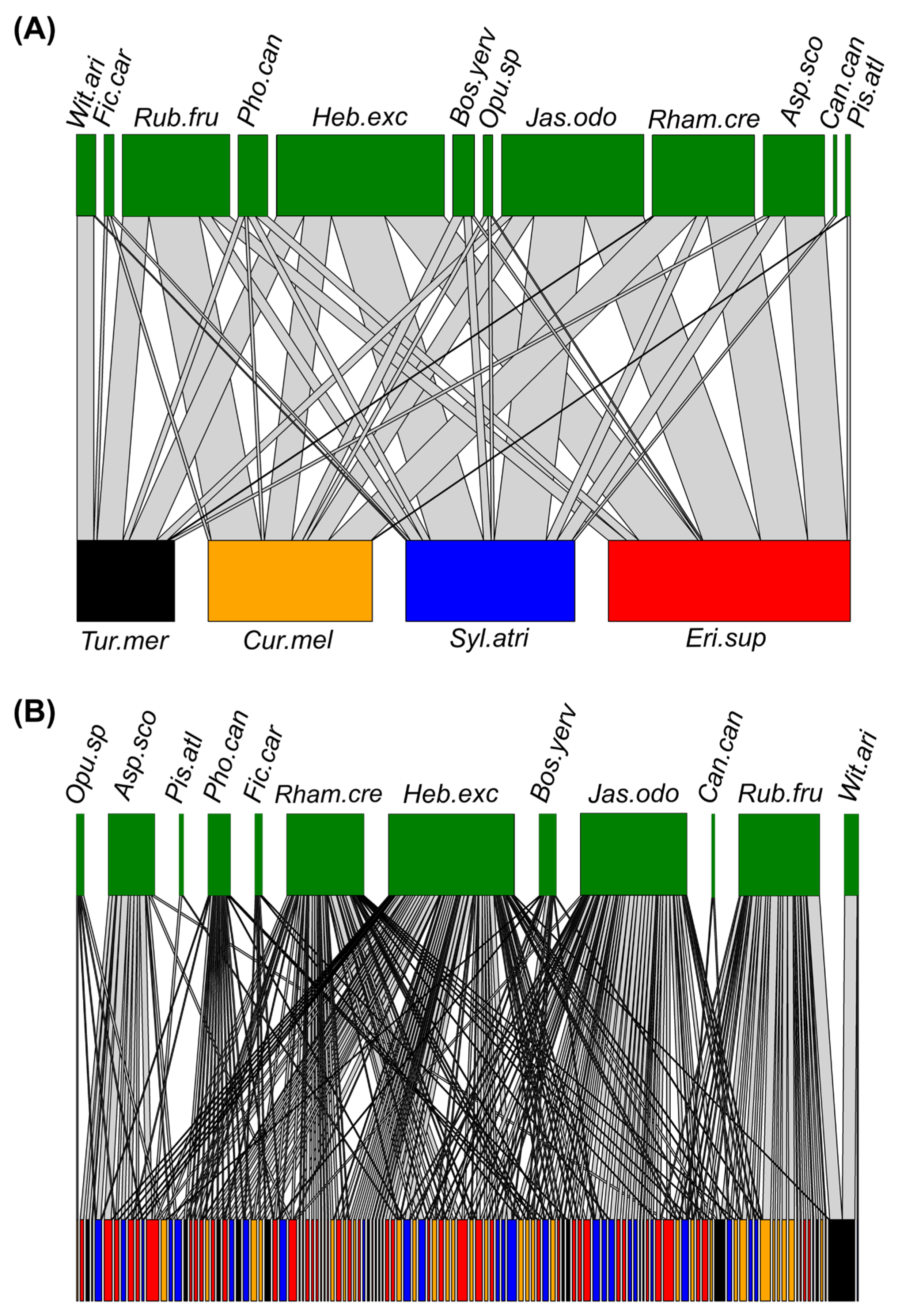
We recorded plant–frugivore interactions between 12 plant species and four bird species (Figure 2A). When downscaling bird species to the individual level, interactions were recorded for 123 individual birds (Figure 2B): 36 Curruca melanocephala, 43 Erithacus superbus, 28 Sylvia atricapilla, and 16 Turdus merula. Recapture level was variable across species. We recaptured three individuals (8.3% of individuals) of C. melanocephala (all of them recaptured only once), eight individuals (18.6%) of E. superbus (recaptured between one and three times), two individuals (7.1%) of S. atricapilla (both recaptured only once), and one individual (6.3%) of T. merula (recaptured once).

3.1. Interindividual Diet Variation

According to the E index (Table 1), observed interindividual diet variation for all of the four species was lower than expected under the null scenario of weak or absent interindividual variation, as the posterior probability that the observed E exceeded the null expectation of no interindividual diet variation was very low (p < 0.1 in all cases; Table 1). Accordingly, the posterior probability that the observed NODF exceeded the null expectation ranged between 0.49 and 0.53 for Sylvia atricapilla and Erithacus superbus, respectively (Table 1). Therefore, we found no evidence of either interindividual variation or nested pattern of individuals’ diets.

3.2. Drivers of Individual Specialization

Median values of PSi were moderate (from 0.54 for Sylvia atricapilla to 0.74 for Curruca melanocephala). For Curruca melanocephala and Sylvia atricapilla the best model to explain individual specialization (PSi) was that containing only the main effects of ‘sex’, ‘age’, ‘gape size’, and ‘capture status’ (Table 2). In the case of Turdus merula, the best model was that containing the effect of ‘age’ nested within ‘sex’. However, the difference between models was negligible and, furthermore, we could not identify any female individual. Therefore, we used the simplest model to facilitate interpretation and make inferences. As it was not possible to distinguish between sexes for Erithacus superbus, the only possible model to make inferences was that containing just the main effects of predictors (Table 2).
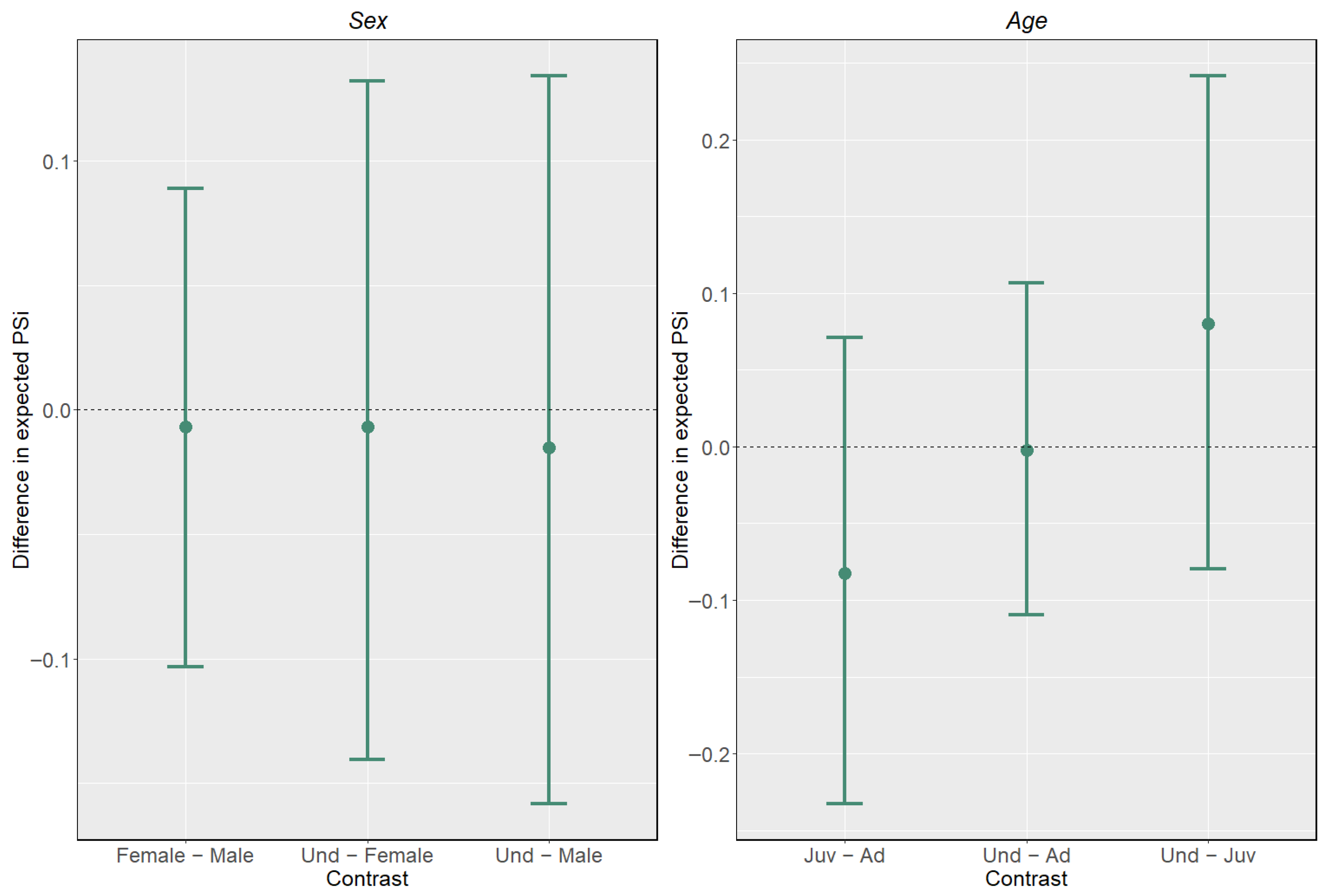
For Curruca melanocephala (Figure 3), there was no evidence that males were more generalist (higher PSi) than females (posterior difference PD = 0.01, 95%CI = −0.07–0.09, posterior probability PP = 0.56, evidence ratio ER = 1.26), nor females more than undetermined individuals (PD = 0.01, 95%CI = −0.11–0.12, PP = 0.54, ER = 1.18) or males more than undetermined individuals (PD = 0.01, 95%CI = −0.11–0.13, PP = 0.58, ER = 1.4). In the case of age, there was moderate evidence that adults were more generalist than juveniles (PD = 0.08, 95%CI = −0.04–0.21, PP = 0.86, ER = 6.31) and that undetermined were more than juvenile individuals (PD = 0.08, 95%CI = −0.05–0.21, PP = 0.84, ER = 5.32). However, there was no evidence that adults were more generalist than undetermined individuals (PD = 0.00, 95%CI = −0.09–0.09, PP = 0.52, ER = 1.07). Regarding gape size, evidence of relationship between this variable and generalization level was weak (β = 0.00, 95%CI = −0.03–0.04, PP = 0.59, ER = 1.42). Lastly, recaptured individuals showed slightly higher values of PSi than single-captured individuals, but with low support by posterior probability (PD = 0.04, 95%CI = −0.14–0.18, PP = 0.67, ER = 1.99).
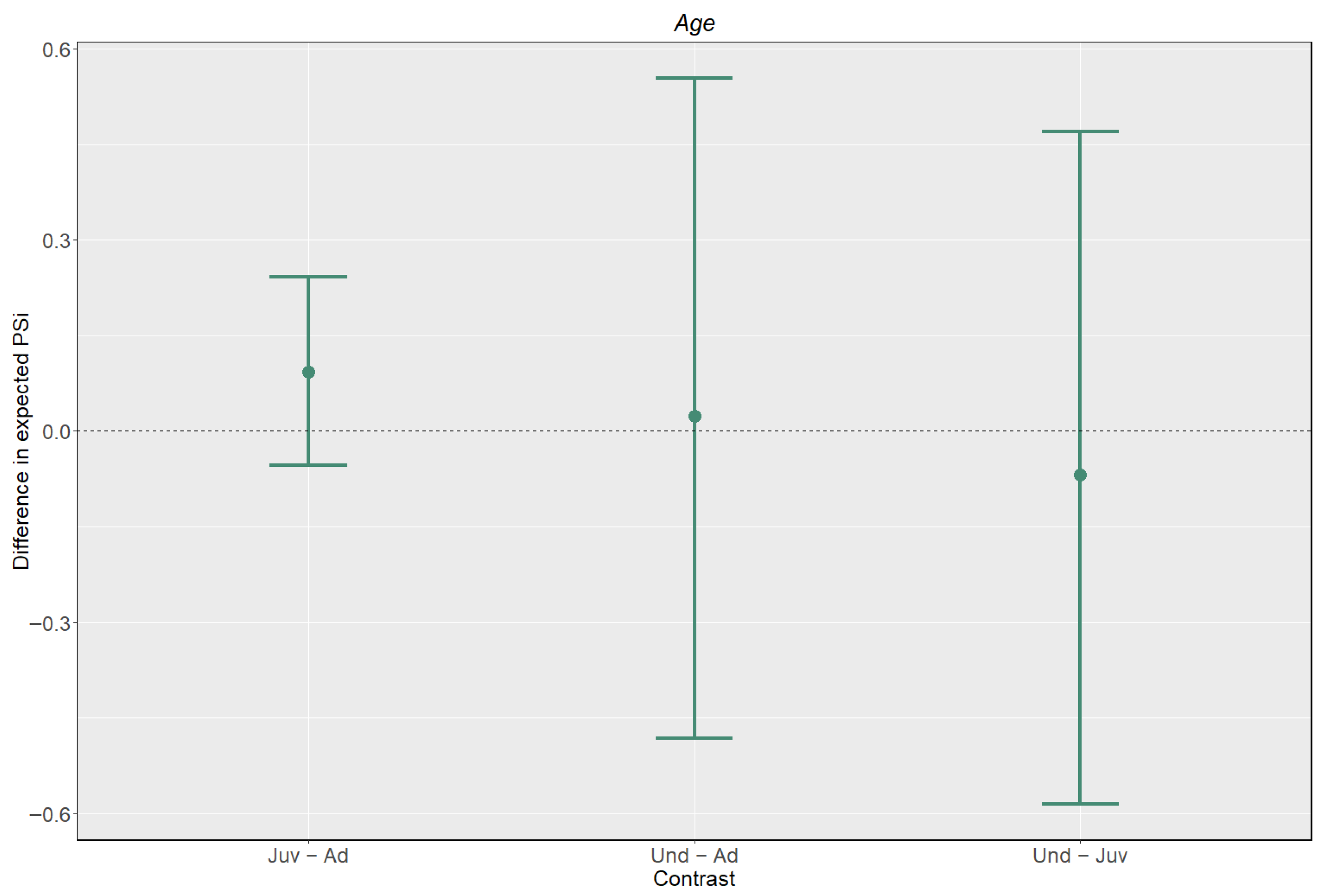
In the case of Erithacus superbus (Figure 4), juveniles were more generalist than adults (PD = 0.09, 95% CI = −0.03–0.22, PP = 0.9, ER = 8.69), whereas there was no strong evidence that juveniles were more generalist than undetermined (PD = 0.07, 95% CI = −0.38–0.5, PP = 0.61, ER = 1.53), or adults more generalist than undetermined (PD = 0.07, 95% CI = −0.4–0.46, PP = 0.46, ER = 0.46). We also found no evidence that individuals with larger gapes were more generalist (β = 0.00, 95% CI = −0.07–0.07, PP = 0.51, ER = 1.06). Regarding capture status, there was relatively strong evidence that recaptured individuals showed more generalist diets than individuals captured just once (PD = 0.12, 95% CI = −0.03–0.27, PP = 0.9, ER = 9.28).
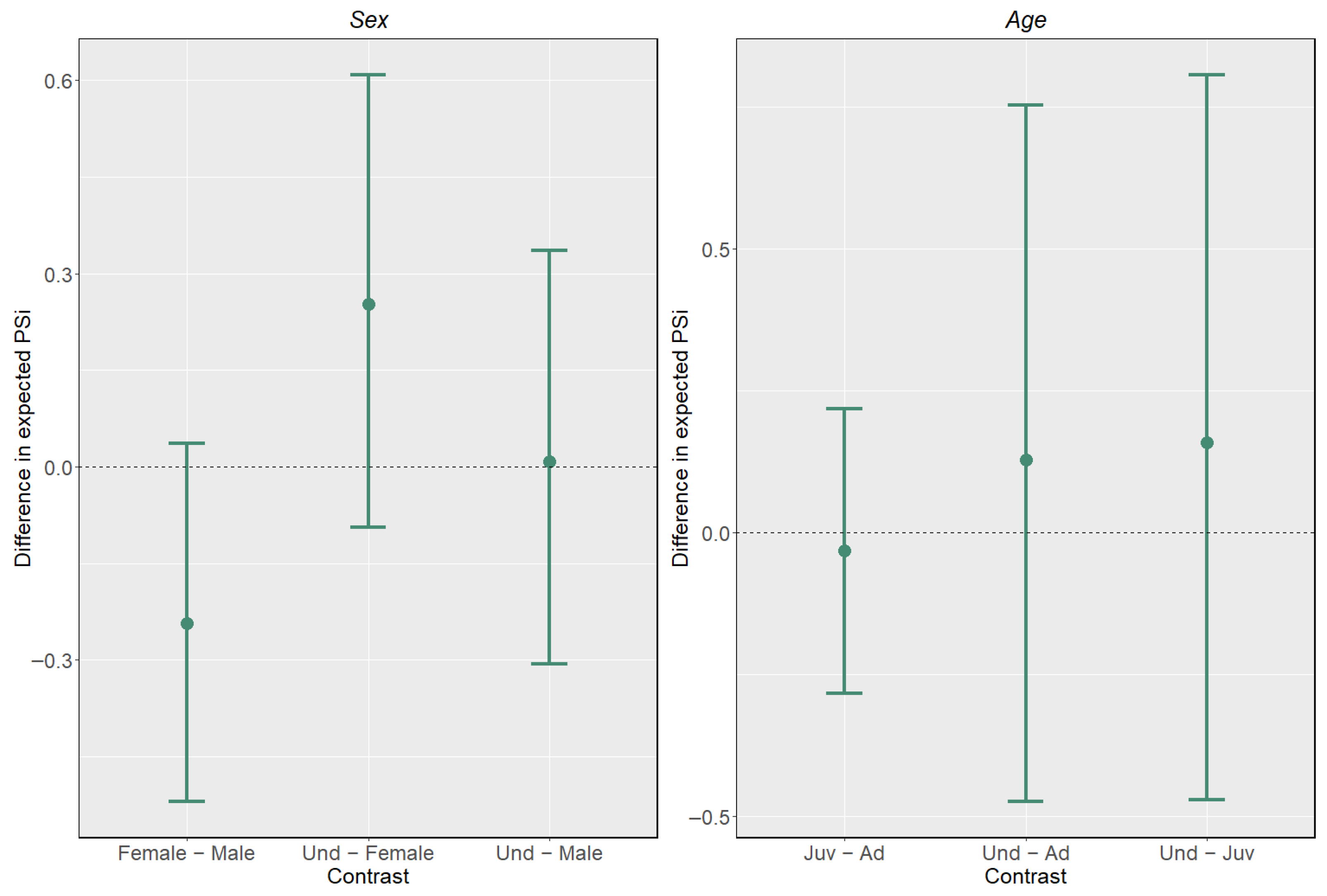
For Sylvia atricapilla (Figure 5), we found strong evidence that males were more generalist than females (PD = 0.24, 95% CI = 0.01–0.47, PP = 0.96, ER =21.6), and likewise that undetermined individuals were more generalist than females (PD = 0.25, 95% CI = −0.04–0.55, PP = 0.92, ER = 12.25). No evidence was found to assert that males were more generalist than undetermined individuals (PD = −0.01, 95% CI = −0.28–0.25, PP = 0.48, ER = 0.92). In the case of age, we found no evidence to support a difference between adults and juveniles (PD = 0.03, 95% CI = −0.18–0.24, PP = 0.6, ER = 1.5), nor between adult and undetermined individuals (PD = −0.13, 95% CI = −0.64–0.37, PP = 0.33, ER = 0.49) or between juvenile and undetermined individuals (PD = −0.16, 95% CI = −0.68–0.36, PP = 0.3, ER = 0.43). Additionally, we found no evidence to support the idea that individuals with larger gapes were more generalist (β = −0.01, 95% CI = −0.11–0.09, PP = 0.41, ER = 0.71). On the other hand, recaptured individuals showed more generalist diets than individuals captured just once (PD = 0.46, 95% CI = 0.08–0.84, PP = 0.97, ER = 37.34).
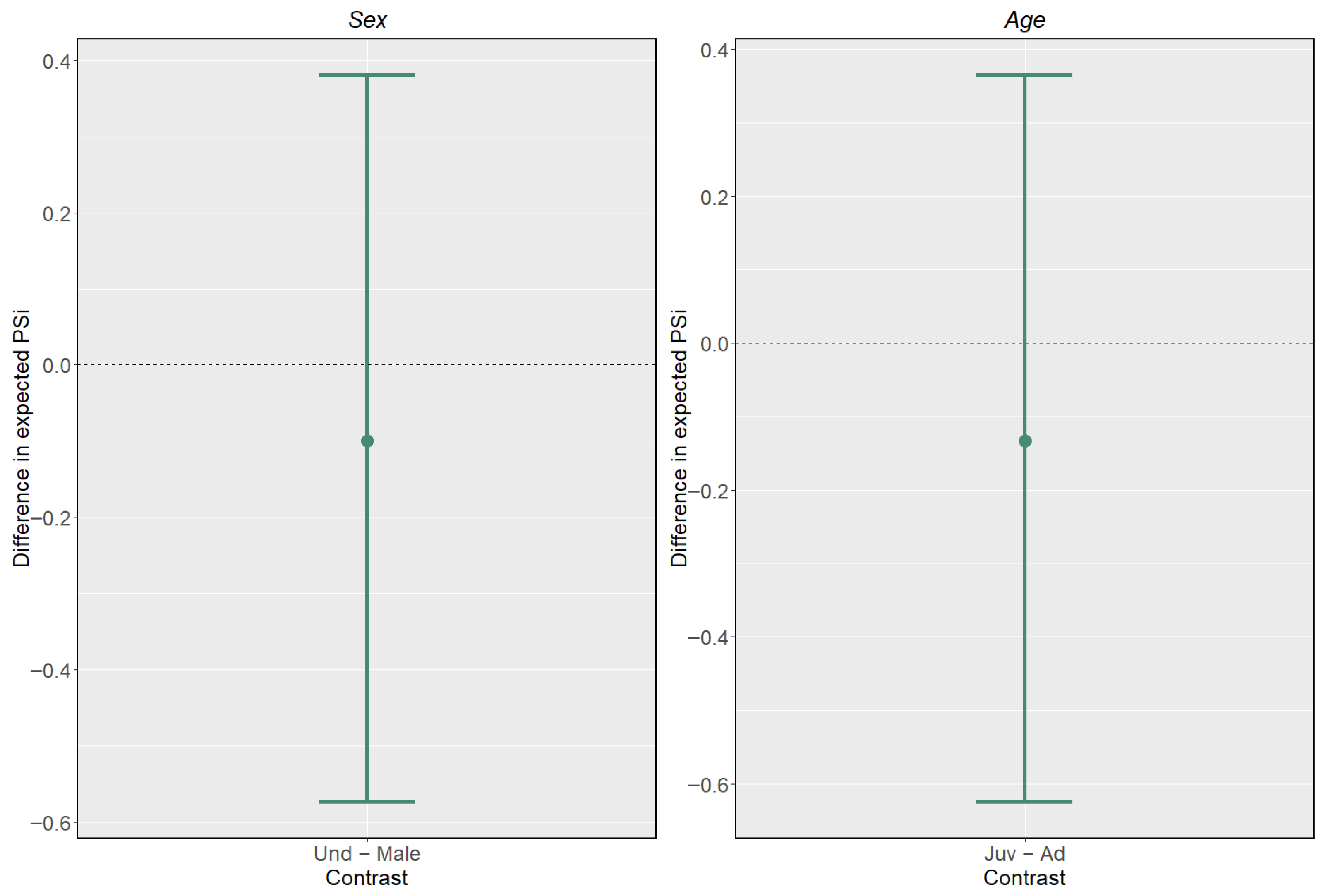
In Turdus merula (Figure 6), we found no strong support to assert that males were more generalist than undetermined individuals (PD = 0.1, 95% CI = −0.29–0.49, PP = 0.68, ER = 2.09), nor that adults were more generalist than juveniles (PD = 0.13, 95% CI = −0.27–0.53, PP = 0.72, ER = 2.52) or that larger gapes were related to more generalist diets (β = −0.04, 95% CI = −0.21–0.12, PP = 0.34, ER = 0.52). In the case of capture status, the evidence that recaptured individuals showed more generalist diets than individuals captured once was moderate (PD = 0.33, 95% CI = −0.27–0.95, PP = 0.82, ER = 4.54).

3.3. Clustering of Individual Bird Diets at the Community Level

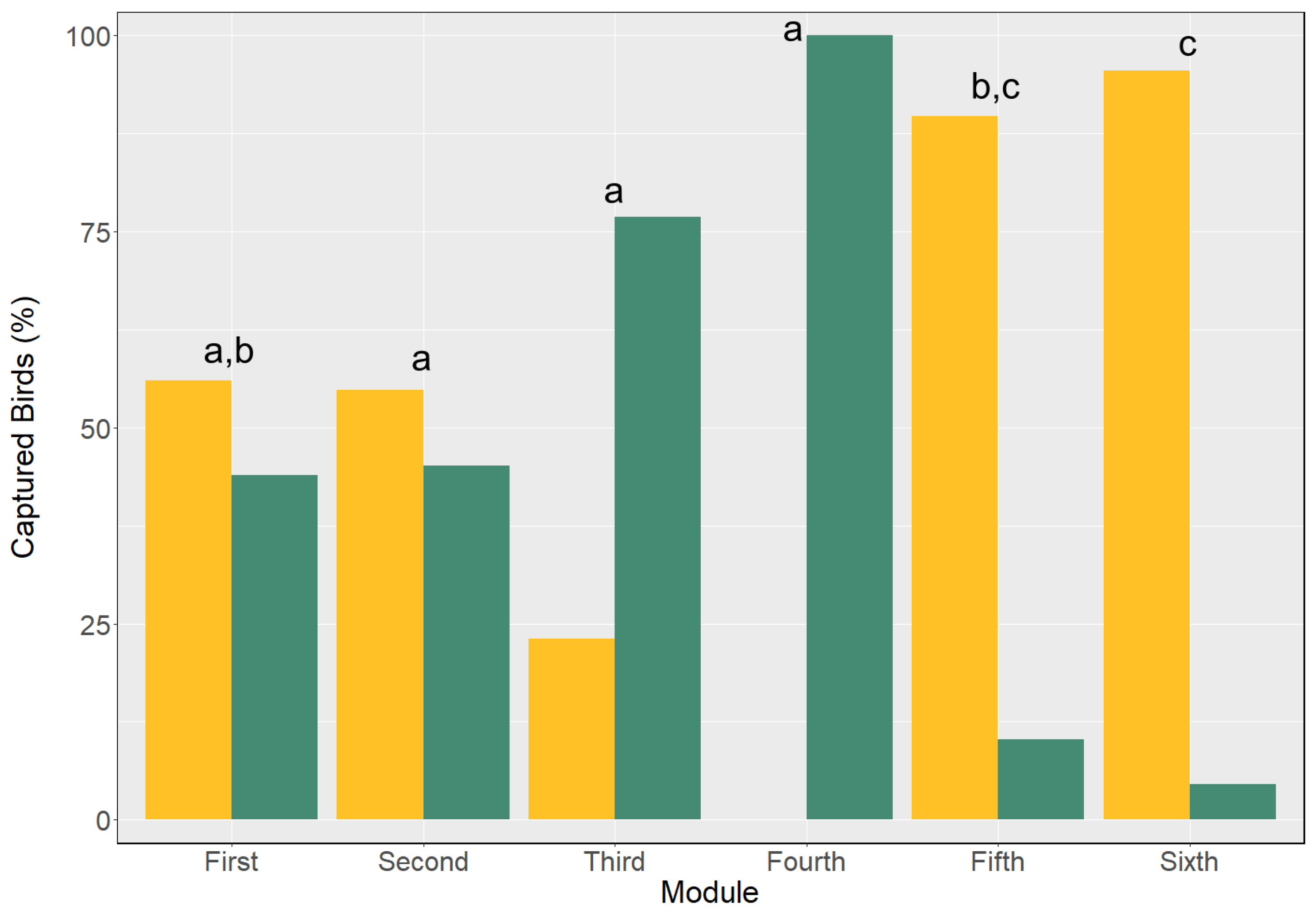
When considering the four frugivorous species together, pooled as the ‘frugivorous bird population’ in the community, individuals’ diets tended to group in clusters (Cws = 0.24) at rates significantly higher than the clustering predicted by the null model (Cws-sim = 0.07 ± 0.0001; Monte Carlo p-value < 0.001). We could identify six modules (i.e., clusters) of individual birds sharing fruit resources, and all of them were constituted by individuals belonging to different species (see Figure S1 in Supplementary Materials). Additionally, we found that clustering of individuals within modules was significantly associated with the seasons in which individuals were captured (G5 = 37.25; p < 0.001; Figure 7).

4. Discussion

In this work we have explored fruit consumption by a frugivorous bird community at an individual level, beyond the network built by aggregating interactions at the species level. Identification of individual passerines has been previously used to investigate individual food resource use (e.g., [30]). However, to the best of our knowledge, although mist-netting has been widely used to study frugivory and seed dispersal in bird communities (e.g., [16,18,30,31,32]), no study has yet applied a mutualistic network approach at the level of individual passerines.

4.1. Frugivorous Diet by Individual Birds

In this study, we found low to moderate levels of interindividual diet variation (i.e., E index), and they were not higher than expected under the null assumption of no interindividual diet variation. This finding was against our expectation that apparently generalist frugivorous species would be composed of relatively specialist individuals whose diets summed up to their respective population’s frugivorous niche. Therefore, although it has been shown that individuals within a population may not be ecologically equivalent [33], our results suggest that different individuals might have similar roles as frugivores and seed dispersers in a given community. Also, although previous studies have documented a nested pattern of interaction networks when they are downscaled to the individual level [8,9], we found no evidence for individual nested diets within this population. This lack of evidence for nestedness agrees with a previous study [12] and is consistent with the low interindividual diet variation we have observed in this study.
We found that individual specialization (measured using PSi) was relatively influence by individuals’ sex (Sylvia atricapilla) and age (for Curruca melanocephala and Erithacus superbus). Regarding the effect of sex, males of Sy atricapilla were more generalist than females. This finding agrees with previous studies, not only for birds (e.g., [34,35]), but also other types of vertebrates (e.g., [36,37]). In the case of age, our findings agree with previous studies showing differences in niche breadth linked to individuals’ ontogeny (e.g., [38,39,40]), as adults of Curruca melanocephala were more generalist than juveniles, whereas individuals of Erithacus superbus showed the opposite pattern, with juveniles being more generalist than adults.
Although an extensive literature exists showing that differences between sexes and age classes, or simply among individuals, regardless their sex or age, may be linked to differences in size (e.g., [12,33,35,36,37,38,39,40]), we found no support to assert that generalization level was positively related to gape size, despite this being a biological trait that influences frugivory and seed dispersal interactions of birds (e.g., [2,41]). Perhaps, the weak effect of gape size reported in this study is related to the fact that we focused on frugivory (searching for both seeds and pericarpic remains in birds’ feces) rather than exclusively on seed dispersal. Pericarpic remains in feces can appear as a consequence of fruit plucking, even by small birds, whereas for seed dispersal it is necessary that birds swallow the entire seed, whose size constrains effective seed dispersal by birds [2,41]. Other plausible explanations of the differences that we found in diet specialization across sexes or age classes might be related to differences in spatial patterns of movement during foraging [34], different digestive physiologies [35], or even hierarchical behavior in the use of food resources influenced by predation risk and resource abundance [42]. However, with the current dataset we cannot test these hypotheses.
Although we found significant clustering of fruit use, individual birds were not grouped by phenotypic traits. Instead, clusters were made of individuals belonging to different species, which differ in both phenotypic traits and degree of frugivory [43]. We found significant association between seasons (i.e., dry or wet) when birds were captured or recaptured and the module (i.e., cluster) they belonged to (Figure 7). For instance, the sixth module (at the bottom left corner in Figure S1) encompassed plant species whose fruit phenology peaks early in spring, when most individual birds of that module were captured. On the other hand, the fourth module (with Pistacia atlantica and Asparagus scoparius) could be associated with birds mostly captured in autumn, coinciding with these plants’ peaks of relative abundance. Indeed, degree of frugivory and individual specialization have been shown to change seasonally in birds [43] and other vertebrate species, e.g., [44,45]. These seasonal changes may be driven by both variation in resource abundance [43,44,45] and individuals’ intrinsic factors like cognition of spatiotemporal resource availability [46]. Nonetheless, according to the neutrality hypothesis, interactions among individuals would occur randomly and interaction frequency would be higher as the higher is the probability of encounters between individuals and resources (i.e., fruits) [15,16]. Hence, clustering of individuals sharing fruit species according to the fruiting phenology could be seen as an influence of neutrality-related factors, as probability of encounters depends on both spatial and temporal overlap [15,16].
Likewise, for individual specialization, we could not support the hypothesis that gape size influenced the clustering of individual birds. For instance, in this study we found plant species with very different fruit diameters (e.g., Phoenix canariensis, Ficus carica, and Heberdenia excelsa) within the same module (Figure S1) sharing interactions with individual birds belonging to species which, in turn, differ in their gape width [16]. If matching between fruit size and gape width were determinant of fruit–bird interactions, these fruit species would be expected to appear in different modules. However, Phoenix canariensis and Heberdenia excelsa fruit all year round, also matching with Ficus carica fruits in late summer, when almost no fruits from other plant species are available. Additionally, with the only exception of Curruca melanocephala, all bird species showed moderate to high evidence that being recaptured increased the generalization level of individuals. These effects of recapture on individual specialization (i.e., recaptured individuals being more generalist than individuals captured once), and seasonality of fruit abundance on the clustering of individuals, suggest that individual birds forage randomly and that frugivory interactions occur by chance, as previously reported (e.g., [47]).
Different individuals’ ability to digest fruit compounds might condition birds’ willingness or reluctance to consume some fruit species and to avoid others (e.g., [16,48]). However, looking at different modules of the network (Figure S1), we could find fruit species with similar nutrient compounds (i.e., Asparagus scoparius, Rhamnus crenulata, and Rubia fruticosa) in different modules, whereas fruit species with quite different nutrient compounds (for example, Canarina canariensis, R. fruticosa, and Withania aristata [16,49]) appeared in the same module, suggesting that interindividual variation in digestive ability does not seem to be related to interindividual diet variation or individual clustering observed in this study. Unfortunately, with the current data at hand, it is not possible to make deeper interpretations of other birds’ intrinsic factors.
As mentioned above, fruit resource use by individual birds may be driven by extrinsic factors, like spatiotemporal availability of resources [43,44,45]. Therefore, a plausible explanation for our results of individual clustering is that different individuals might forage in areas where fruit availability is spatially patchy. Then, analyses of fecal samples could reflect a patchy distribution of fruits. Although in the study area there is spatial heterogeneity in fruit availability, with some degree of mixture between species-rich and species-poor patches, we had no spatially explicit data about fruit availability to test for this possibility. Nonetheless, fruiting phenology in the study site differs between plant species, with groups of species fruiting at different time spans [16]. Hence, fruit availability may also be considered as temporally patchy. This interpretation is supported by our findings of a significant association between the season in which birds were captured and their corresponding network module.

4.2. Consequences for the Fruit–Frugivore Community

In contrast to previous results in the same study system [16], we did not find strong support for the effect of traits (i.e., sex, age, and gape width) on interindividual variation in fruit use by birds. This discrepancy might make it tempting to argue that studies of frugivory and seed dispersal using a network approach are invalid when individual-level data are aggregated to the species level. However, rather than adopting this potentially premature conclusion, several considerations must be addressed with caution.
First, we have to recall that in this study, we focused not only on seed dispersal, but on both frugivory and seed dispersal, which can determine the lack of effect of gape size (see above). Second, according to Bolnick et al. [33], temporal shifts in individual fruit preferences characterize short-term specialists, which are expected to exert weaker or more transient ecological effects on interacting partners. Conversely, individuals that consistently exploit the same fruit species can be considered long-term specialists, potentially exerting stronger ecological effects. For all species in this study, we found intermediate to moderate levels of individual generalization, with some individuals being relatively specialist and other individuals being more generalist. However, most individuals were captured only once, and fecal samples likely reflect the individual’s diet during the hour preceding capture [50]. This is an important factor to consider, because it has been demonstrated that timescales can affect inferences made about intraspecific diet specialization [51]. Indeed, this, in conjunction with the low recapture rates, could help to explain why we did not find strong evidence that age or sex affected the diet specialization of Turdus merula, despite other studies having shown such effects, at least for individuals of different ages [40].
This may be particularly relevant for Erithacus superbus and Sylvia atricapilla, as we found strong evidence that individuals’ Psi increased for recaptured birds of these species, whose diet breadth increased toward the population-level diet breadth. In addition, the low recapture rate we found in this study would suggest that these bird populations are subject to a high turnover of individuals. This, combined with the apparent long-term generalist feeding strategy and the low interindividual diet variation reported in this study, might imply a transient ecological effect of individuals on fruiting plants.
Regarding using ecological networks to understand plant–frugivore interactions and making inferences about their ecological and evolutionary implications, it has been argued that aggregating data of individuals’ interactions at the species level could lead to misleading interpretations [4]. In our study, we show that interindividual variation in frugivorous diet was low. Also, the effect of recaptures on diet generalization suggests that individuals might appear to be short-term specialists, but in the long-term they could have a generalist diet that matches with the population’s diet. Furthermore, although clustering of individuals was significant, clusters were composed of a mixture of conspecific and heterospecific individuals. Therefore, if our findings are right, aggregating data of individuals at the species level would not be misleading—it would allow us to know the suite of interactions and ecological effects of these species in the community. Nonetheless, this practice should be reinforced with analyses about completeness and reliability of individual-based interaction sampling [32].
Beyond their potential implications for data aggregation, our results also inform how mutualistic interactions are structured and potentially affected by interspecific competition at the community level. Although mutualistic interactions are often assumed to promote biodiversity maintenance [1], this effect has been suggested to occur primarily under conditions of low interspecific competition [52]. We detected significant clustering among heterospecific individuals, suggesting temporally overlapping interspecific competition among individuals consuming the same fruiting species within a given season. Accordingly, future community-level studies addressing the role of mutualistic interactions in biodiversity maintenance may benefit from integrating network approaches with complementary information on interindividual and interspecific competition. Such context dependence underscores the need for approaches capable of capturing both interaction network structure and individual-level variability within ecological communities.
In light of our results, it is important to highlight that combining interaction data obtained with different methodological approaches may improve our understanding of community-level interaction patterns [32]. Plant-centered methods (e.g., frugivory censuses at focal plants) is the most common type of methods used to record fruit–animal interactions [53], but they limit the ability to identify individual consumers. Our results highlight the value of mist-netting as a complementary, albeit labor-intensive, approach, as it allows the incorporation of individual-level dietary information that cannot be readily obtained using plant-centered methodologies.

5. Conclusions

  • Interindividual diet variation was consistently low, and individuals’ generalization level tended to increase as they were recaptured. Therefore, aggregating individual-based data at the species level for network characterization and interpretation of species’ role in the community would be reliable, at least in our study system.
  • Neutrality processes (individual persistence in the study site and temporal overlap with fruit availability) were generally stronger than individual-related traits as determinants of frugivorous diet and individuals’ diet clustering.
  • Clusters were formed by heterospecific individuals, increasing the interspecific competition, which in turn might affect the role of mutualistic interactions in biodiversity maintenance.
  • Future community-level studies aiming to understand the role of mutualistic interactions on biodiversity maintenance would benefit from integrating the network approach with information about intraspecific and interspecific fruit use by individual birds.

Supplementary Materials

The following supporting information can be downloaded at: https://www.mdpi.com/article/10.3390/birds7020029/s1. Figure S1: Modules of plant–individual bird interactions recorded in the study site.

Author Contributions

Conceptualization, A.G.-C.; methodology, A.G.-C. and C.L.-S.; formal analysis, A.G.-C. and C.L.-S.; investigation, A.G.-C.; resources, A.G.-C.; writing—original draft preparation, A.G.-C. and C.L.-S.; writing—review and editing, A.G.-C. and C.L.-S. All authors have read and agreed to the published version of the manuscript.

Funding

This research received no external funding.

Institutional Review Board Statement

Ethical review and approval were waived for this study according to Spanish laws (Real Decreto 53/2013 and Orden ECC/566/2015). This kind of review and approval are aimed at procedures that may cause animals a level of pain, suffering, distress or lasting damage equivalent to or greater than that caused by insertion of a needle. According to Spanish law, for bird banding with scientific purposes, it is necessary to have a license issued by authorized entities, like The Centro de Migración de Aves (CMA), which intrinsically cares about animal welfare and ethical aspects when issued licenses to bird banders. In the case of A.G.C., he held a specific license (number of license 800032) for banding a few species (those included in the study) with ecological or phylogenetic relationships.

Informed Consent Statement

Not applicable.

Data Availability Statement

The raw data supporting the conclusions of this article will be made available by the authors on request.

Acknowledgments

We are especially grateful to David Lugo, Aina Anyó, Aitor López, Alicia Arbelo, and Yurena Gavilán, who helped during the fieldwork and fecal analyses. We also thank Manuel Nogales for lending us part of the materials for mist-netting. The Cabildo of Tenerife gave authorization for fecal sampling by mist-netting (references: E2024004091 and E2025002550) and the landowner (Teobaldo Méndez) gave permission to access the study site through their private property.

Conflicts of Interest

The authors declare no conflicts of interest.

References

  1. Bronstein, J.L. Mutualism; Oxford University Press: Oxford, UK, 2015; p. 312. [Google Scholar]
  2. Jordano, P. Fruits and frugivory. In Seeds: The Ecology of Regeneration in Plant Communities, 3rd ed.; Gallagher, R.S., Ed.; CABI Publishing: Wallingford, UK, 2014; pp. 18–61. [Google Scholar]
  3. Bascompte, J.; Jordano, P. Mutualistic Networks; Princeton University Press: Princeton, NJ, USA, 2014; p. 224. [Google Scholar]
  4. Dormann, C.F. The rise, and possible fall, of network ecology. In Defning Agroecology—A Festschrift for Teja Tscharntke; Dormann, C.F., Batáry, P., Grass, I., Klein, A.M., Loos, J., Scherber, C., Steffan-Dewenter, I., Wanger, T.C., Eds.; Tredition: Hamburg, Germany, 2023; pp. 143–159. [Google Scholar]
  5. Thompson, J.N. Variation in interspecific interactions. Annu. Rev. Ecol. Syst. 1988, 19, 65–87. [Google Scholar] [CrossRef]
  6. Bolnick, D.I.; Amarasekare, P.; Araújo, M.S.; Bürger, R.; Levine, J.M.; Novak, M.; Rudolf, V.H.W.; Schreiber, S.J.; Urban, M.C.; Vasseur, D.A. Why intraspecific trait variation matters in community ecology. Trends Ecol. Evol. 2011, 26, 183–192. [Google Scholar] [CrossRef] [PubMed]
  7. Araújo, M.S.; Guimarães, P.R., Jr.; Svanbäck, R.; Pinheiro, A.; Guimarães, P.; dos Reis, S.F.; Bolnick, D.I. Network analysis reveals contrasting effects of intraspecific competition on individual vs. population diets. Ecology 2008, 89, 1981–1993. [Google Scholar] [CrossRef] [PubMed]
  8. Araújo, M.S.; Martins, E.G.; Cruz, L.D.; Fernandes, F.R.; Linhares, A.X.; dos Reis, S.F.; Guimarães, P.R., Jr. Nested diets: A novel pattern of individual-level resource use. Oikos 2010, 119, 81–88. [Google Scholar] [CrossRef]
  9. Pires, M.M.; Guimarães, P.R., Jr.; Araújo, M.S.; Giaretta, A.A.; Costa, J.C.L.; dos Reis, S.F. The nestedness assembly of individual-resource networks. J. Anim. Ecol. 2011, 80, 896–903. [Google Scholar] [CrossRef]
  10. Li, N.; Yang, X.; Ren, Y.; Wang, Z. Importance of species traits on individual based seed dispersal networks and dispersal distance for endangered trees in a fragmented forest. Front. Plant Sci. 2022, 13, 1010352. [Google Scholar] [CrossRef]
  11. Quintero, E.; Arroyo-Correa, B.; Isla, J.; Rodríguez-Sánchez, F.; Jordano, P. Downscaling mutualistic networks from species to individuals reveals consistent interaction niches and roles within plant populations. Proc. Natl. Acad. Sci. USA 2025, 122, e2402342122. [Google Scholar] [CrossRef]
  12. Figueroa, A.; Vizentin-Bugoni, J.; Herrera, A.; Cuni, L.; Villate, J.; Liu, H.; Whitfield, S. Seasonality and morphological variation shape intraspecific seed dispersal networks in gopher tortoises. Oikos 2025, 2025, e11487. [Google Scholar] [CrossRef]
  13. Hubbell, S.P. The Unified Neutral Theory of Biodiversity and Biogeography, 1st ed.; Princeton University Press: Princeton, NJ, USA, 2001; p. 392. [Google Scholar]
  14. McGill, B.J.; Enquist, B.J.; Weiher, E.; Westoby, M. Rebuilding community ecology from functional traits. Trends Ecol. Evol. 2006, 21, 178–185. [Google Scholar] [CrossRef]
  15. Vázquez, D.P.; Chacoff, N.P.; Cagnolo, L. Evaluating multiple determinants of the structure of plant-animal mutualistic networks. Ecology 2009, 90, 2039–2046. [Google Scholar] [CrossRef]
  16. González-Castro, A.; Yang, S.; Nogales, M.; Carlo, T.A. Relative importance of phenotypic trait matching and species’ abundance in determining plant-avian seed dispersal interactions in a small insular community. AoB Plants 2015, 7, plv07. [Google Scholar] [CrossRef]
  17. Martín, A.; Bacallado, J.J.; Lorenzo, J.A.; Quilis, V. Avifauna de Canarias, 1st ed.; Turquesa: Santa Cruz de Tenerife, Spain, 2025; p. 1023. [Google Scholar]
  18. González-Castro, A.; Traveset, A.; Nogales, M. Seed dispersal interactions in the Mediterranean Region: Contrasting patterns between islands and mainland. J. Biogeogr. 2012, 39, 1938–1947. [Google Scholar] [CrossRef]
  19. Demongin, L. Identification Guide to Birds in the Hand; Laurent Demongin: Beauregard-Vendon, France, 2016; p. 392. [Google Scholar]
  20. Coblentz, K.E.; Rosenblatt, A.E.; Novak, M. The application of Bayesian hierarchical models to quantify individual diet specialization. Ecology 2017, 98, 1535–1547. [Google Scholar] [CrossRef] [PubMed]
  21. Plummer, M. rjags: Bayesian Graphical Models Using MCMC, R package version 4-17; CRAN: Vienna, Austria, 2025. [Google Scholar] [CrossRef]
  22. Su, Y.; Yajima, M. R2jags: Using R to Run ‘JAGS’, R package version 0.8-9; CRAN: Vienna, Austria, 2024. [Google Scholar] [CrossRef]
  23. R Core Team. R: A Language and Environment for Statistical Computing; R Foundation for Statistical Computing: Vienna, Austria, 2024; Available online: https://www.R-project.org/ (accessed on 18 May 2020).
  24. Almeida-Neto, M.; Guimarães, P.; Guimarães, P.R.; Loyola, R.D.; Ulrich, W. A consistent metric for nestedness analysis in ecological systems: Reconciling concept and measurement. Oikos 2008, 117, 1227–1239. [Google Scholar] [CrossRef]
  25. Bolnick, D.I.; Yang, L.H.; Fordyce, J.A.; Davis, J.M.; Svanbäck, R. Measuring individual-level resource specialization. Ecology 2002, 83, 2936–2941. [Google Scholar] [CrossRef]
  26. Bürkner, P.C. brms: An R package for Bayesian Multilevel Models using Stan. J. Stat. softw. 2017, 80, 1–28. [Google Scholar] [CrossRef]
  27. Zaccarelli, N.; Mancinelli, G.; Bolnick, D.I. RInSp: An R package for the analysis of individual specialisation in resource use. Methods Ecol. Evol. 2013, 4, 1018–1023. [Google Scholar] [CrossRef]
  28. Dormann, C.F.; Gruber, B.; Fruend, J. Introducing the bipartite Package: Analysing Ecological Networks. R News 2008, 8/2, 8–11. [Google Scholar]
  29. Sokal, R.R.; Rohlf, F.J. Biometry, 3rd ed.; Freeman: New York, NY, USA, 1995; p. 887. [Google Scholar]
  30. Grant, P.R.; Grant, B.R.; Smith, J.N.M.; Abbott, I.J.; Abbott, L.K. Darwin’s finches: Population variation and natural selection. Proc. Natl. Acad. Sci. USA 1976, 73, 257–261. [Google Scholar] [CrossRef]
  31. Herrera, C.M. A study of avian frugivores, bird-dispersed plants and their interaction in Mediterranean scrublands. Ecol. Monogr. 1984, 54, 1–23. [Google Scholar] [CrossRef]
  32. Quintero, E.; Isla, J.; Jordano, P. Methodological overview and data-merging approaches in the study of plant-frugivore interactions. Oikos 2022, 2022, e08379. [Google Scholar] [CrossRef]
  33. Bolnick, D.I.; Svanbäck, R.; Fordyce, J.A.; Yang, L.H.; Davis, J.M.; Hulsey, C.D.; Forister, M.L. The ecology of individuals: Incidence and implications of individual specialization. Am. Nat. 2003, 161, 1–28. [Google Scholar] [CrossRef]
  34. Holmes, R.T. Foraging patterns of forest birds: Male-female differences. Wilson Bull. 1986, 98, 196–213. [Google Scholar]
  35. Bravo, C.; Bautista-Sopelana, L.M.; Alonso, J.C. Revisiting niche divergence hypothesis in sexually dimorphic birds: Is diet overlap correlated with sexual size dimorphism? J. Anim. Ecol. 2024, 93, 460–474. [Google Scholar] [CrossRef] [PubMed]
  36. Laliberté, J.; Rioux, E.; Lesmerises, R.; St-Laurent, M.H. Linking sexual size dimorphism to trophic niche partitioning in a generalist predator. Can. J. Zool. 2022, 100, 700–709. [Google Scholar] [CrossRef]
  37. Kernaléguen, L.; Cherel, Y.; Knox, T.C.; Baylis, A.M.M.; Arnould, J.P.Y. Sexual niche segregation and gender-specific individual specialization in a highly dimorphic marine mammal. PLoS ONE 2015, 10, e0133018. [Google Scholar] [CrossRef] [PubMed]
  38. Marchetti, K.; Price, T. Differences in the foraging of juvenile and adult birds: The importance of developmental constraints. Biol. Rev. 1989, 64, 51–70. [Google Scholar] [CrossRef]
  39. Bouchard, S.S.; Bjorndal, K.A. Ontogenetic diet shifts and digestive constraints in the omnivorous freshwater turtle Trachemys scripta. Physiol. Biochem. Zool. 2006, 79, 150–158. [Google Scholar] [CrossRef]
  40. Desrochers, A. Age and foraging success in European blackbirds: Variation between and with individuals. Anim. Behav. 1992, 43, 885–894. [Google Scholar] [CrossRef]
  41. Wheelwright, N.T. Fruit-Size, Gape Width, and the Diets of Fruit-Eating Birds. Ecology 1985, 66, 808–818. [Google Scholar] [CrossRef]
  42. Naman, S.M.; Ueda, R.; Sato, T. Predation risk and resource abundance mediate foraging behaviour and intraspecific resource partitioning among consumers in dominance hierarchies. Oikos 2019, 128, 1005–1014. [Google Scholar] [CrossRef]
  43. Carnicer, J.; Jordano, P.; Melián, C.J. The temporal dynamics of resource use by frugivorous birds: A network approach. Ecology 2009, 90, 1958–1970. [Google Scholar] [CrossRef]
  44. Figueroa, A.; Coblentz, K.; Herrera, A.; Cuni, L.; Villate, J.; Liu, H.; Araújo, M.S.; Withfield, S.M. Seasonal frugivory drives both diet inconsistency and individual specialization in the generalist herbivore gopher tortoise. Food Webs 2024, 40, e00356. [Google Scholar] [CrossRef]
  45. Herrera, M.L.G.; Korine, C.; Fleming, T.H.; Arad, Z. Dietary implications of intrapopulation variation in nitrogen isotope composition of an old world fruit bat. J. Mammal. 2008, 89, 1184–1190. [Google Scholar] [CrossRef]
  46. Robira, B.; Benhamou, S.; Fuh, T.N.; Masi, S. Do seasonal frugivory and cognition shape foraging movements in wild western gorillas? In Movement Ecology of Afrotropical Forest Mammals, 1st ed.; Reyna-Hurtado, R., Chapman, C.A., Melletti, M., Eds.; Springer: Cham, Switzerland, 2023; pp. 151–170. [Google Scholar] [CrossRef]
  47. Burns, K.C. What causes size coupling in fruit-frugivore interaction webs? Ecology 2013, 94, 295–300. [Google Scholar] [CrossRef]
  48. Afik, D.; Karasov, W.H. The trade-offs between digestion rate and efficiency in warblers and their ecological implications. Ecology 1995, 76, 2247–2257. [Google Scholar] [CrossRef]
  49. González-Castro, A.; Morán-López, T.; Nogales, M.; Traveset, A. Changes in the structure of seed dispersal networks when including interaction outcomes from both plant and animal perspectives. Oikos 2022, 2022, e08315. [Google Scholar] [CrossRef]
  50. Herrera, C.M. Adaptation to frugivory of Mediterranean avian seed dispersers. Ecology 1984, 65, 609–617. [Google Scholar] [CrossRef]
  51. Novak, M.; Tinker, M.T. Timescales alter the inferred strength and temporal consistency of intraspecific diet specialization. Oecologia 2015, 178, 61–74. [Google Scholar] [CrossRef] [PubMed]
  52. Pascual-García, A.; Bastolla, U. Mutualism supports biodiversity when the direct competition is weak. Nat. Commun. 2017, 8, 14326. [Google Scholar] [CrossRef] [PubMed]
  53. Jordano, P. Sampling networks of ecological interactions. Funct. Ecol. 2016, 30, 1883–1893. [Google Scholar] [CrossRef]
Figure 1. Hypothetical trophic niches of frugivorous birds. The community-level frugivorous niche constituted by all fruit-eating bird species in a community (red line) may be decomposed into frugivorous niches of individual birds belonging to different species (blue, orange, green, and brown lines). These frugivorous niches of individual birds may form clusters with niches of conspecific individuals (A) or with niches of heterospecific individuals (B). Modified from Araújo et al. [8].
Birds 07 00029 g001
Figure 2. Frugivory and seed dispersal network recorded in Los Adernos. (A) Interaction network recorded between 12 plant species (green boxes) and four fruit-eating bird species. (B) The same network with bird species scaled to the individual level (individuals as nodes). Plant scientific name abbreviations: Asp.sco = Asparagus scoparius, Bos.yer = Bosea yervamora, Can.can = Canarina canariensis, Fic.car = Ficus carica, Heb.exc = Heberdenia excelsa, Jas.odo = Jasminum odoratissimum, Opu.sp = Opuntia spp., Pho.can = Phoenix canariensis, Pis.atl = Pistacia atlantica, Rha.cre = Rhamnus crenulata, Rub.fru = Rubia fruticosa, and Wit.ari = Withania aristata. Animal name abbreviations (and code of colors): Cur.mel = Curruca melanocephala (orange), Eri.sup = Erithacus superbus (red), Syl.atri = Sylvia atricapilla (blue), and Tur.mer = Turdus merula (black). Individual birds’ identities have been omitted in (B) for clarity.
Birds 07 00029 g002
Figure 3. Effect of sex (left panel) and age class (right panel) on Curruca melanocephala individual specialization level (PSi). Dots and error bars represent medians and 95% Credibility Intervals for differences in expected PSi between paired categories of sex and age. Abbreviations: Ad: adult; Juv: juvenile; and Und: undetermined.
Birds 07 00029 g003
Figure 4. Effect of age class on Erithacus superbus individual specialization level (PSi). Dots and error bars represent medians and 95% Credibility Intervals for differences in expected PSi between paired categories of age. Abbreviations: Ad: adult; Juv: juvenile; and Und: undetermined.
Birds 07 00029 g004
Figure 5. Effect of sex (left panel) and age class (right panel) on Sylvia atricapilla individual specialization level (PSi). Dots and error bars represent medians and 95% Credibility Intervals for differences in expected PSi between paired categories of sex and age. Abbreviations: Ad: adult; Juv: juvenile; and Und: undetermined.
Birds 07 00029 g005
Figure 6. Effect of sex (left panel) and age class (right panel) on Turdus merula individual specialization level (PSi). Dots and error bars represent medians and 95% Credibility Intervals for differences in expected PSi between paired categories of sex and age. Abbreviations: Ad: adult; Juv: juvenile; and Und: undetermined.
Birds 07 00029 g006
Figure 7. Percentage of captured birds in dry (yellow) and wet (green) seasons and the network module they belonged to. Different letters at the tops of bars refer to significant differences for pairwise comparison between modules with the new significance level (α = 0.003) set after applying Bonferroni’s correction factor.
Birds 07 00029 g007
Table 1. Interindividual diet variation (E) and nested pattern (NODF) of fruit use by individuals of the four bird species included in the study. The table shows the 95% Credibility Interval for indices calculated from the posterior draws of the Bayesian hierarchical model (1800 iterations) and from posterior draws compatible with the null scenario of no interindividual diet variation (i.e., the central 20% of the ln(w) distribution; see main text for details).
Curruca melanocephala
ParameterObserved 95% CINull 95% CIP *
E0.26–0.5460.61–0.760.0005
NODF23.90–41.9424.17–41.160.52
Erithacus superbus
ParameterObserved 95% CINull 95% CIP *
E0.43–0.630.67–0.770
NODF26.15–42.6426.50–41.460.53
Sylvia atricapilla
ParameterObserved 95% CINull 95% CIP *
E0.50–0.680.64–0.0.790.02
NODF22.76–42.4823.62–42.250.49
Turdus merula
ParameterObserved 95% CINull 95% CIP *
E0.41–0.700.64–0.840.02
NODF14.36–37.1414.46–35.930.52
* P was calculated as the posterior probability for the observed index to be higher than expected under the null scenario of no interindividual diet variation.
Table 2. Comparison of different candidate models explaining individual specialization index (PSi).
Curruca melanocephala
Modelelpd *looic **
PSi ~ Sex/Age + Gape + Capture82.5−151.6
PSi ~ Sex + Age + Gape + Capture75.5−164.9
Sylvia atricapilla
Modelelpd *looic **
PSi ~ Sex/Age + Gape + Capture25.7−51.4
PSi ~ Sex + Age + Gape + Capture28.1−56.3
Turdus merula
Modelelpd *looic **
PSi ~ Sex/Age + Gape + Capture14.3−28.7
PSi ~ Sex + Age + Gape + Capture14.1−28.2
* Expected log predictive density (elpd) measures the model’s ability to predict new data. ** LOO Information Criterion calculated as L O O I C   =   2 × e l p d . For Erithacus superbus, model selection was not applied due to the impossibility of differentiating between males and females, so the only model used for this species did not contain the variable ‘sex’ nor an age class nested within ‘sex’.
Disclaimer/Publisher’s Note: The statements, opinions and data contained in all publications are solely those of the individual author(s) and contributor(s) and not of MDPI and/or the editor(s). MDPI and/or the editor(s) disclaim responsibility for any injury to people or property resulting from any ideas, methods, instructions or products referred to in the content.