


Highlights
What are the main findings?
- Perceived performance was significantly lower than importance across all 15 DSR attributes, with environmental responsibility showing the largest average performance–importance gap.
- Three of the four attributes in the “Concentrate Here” quadrant concerned environmental responsibility, revealing differentiated priorities even within the same DSR dimension.
What are the implications of the main findings?
- Attribute-level assessment of DSR helps identify which specific responsibilities require the greatest managerial attention beyond the overall shortfalls revealed at the dimension level.
- The findings suggest that DSR priority structures may be context sensitive, highlighting environmental responsibility as a central priority in a biosphere reserve.
Abstract
Destination social responsibility (DSR) has received growing attention in tourism research, yet limited knowledge exists about how tourists prioritize specific destination responsibilities and where perceived performance falls short of the importance they assign to them. This study evaluates DSR in a biosphere reserve by integrating performance–importance gap analysis with importance–performance analysis (IPA). Data were collected from 221 tourists visiting the Mui Ca Mau Biosphere Reserve, Vietnam, who evaluated the importance and performance of 15 attributes representing economic, environmental, legal, and ethical responsibilities. Paired-samples t-tests showed that perceived performance was significantly lower than importance for all 15 attributes. Environmental responsibility had the largest average performance–importance gap, with its four attributes exhibiting the largest attribute-level gaps. IPA identified four attributes in the “Concentrate Here” quadrant, three related to environmental responsibility and one to legal responsibility concerning product and service quality. Attributes within the same DSR dimension occupied different IPA quadrants, while larger performance–importance gaps did not necessarily correspond to higher IPA priorities. These findings contribute to DSR research by showing that responsibilities within the same dimension may differ in priority and that larger performance–importance gaps do not necessarily indicate higher IPA priorities, highlighting the value of combining gap analysis with attribute-level IPA across destination contexts.
1. Introduction
Tourism development can generate employment, income, and business opportunities for destinations, but it can also place pressure on natural resources and host communities when its impacts are inadequately managed. Destination management therefore involves more than attracting visitors and delivering satisfactory experiences. It also entails maximizing benefits for local communities, protecting environmental resources, and minimizing adverse social and cultural impacts (Nguyen et al., 2026; Panagiotopoulou & Skoultsos, 2025). These responsibilities are particularly important in environmentally sensitive destinations such as biosphere reserves. Intended to reconcile biodiversity conservation with sustainable development, biosphere reserves face the continuing challenge of generating benefits from tourism without undermining the natural and social resources on which tourism and local livelihoods depend.
Destination social responsibility (DSR) provides a useful perspective for examining these responsibilities at the destination level. Extending the notion of social responsibility beyond individual firms, DSR broadly refers to the collective responsibility efforts of destination stakeholders and their effects on the economic, social, cultural, and environmental interests of the destination and its stakeholders (Agapito et al., 2023; Su et al., 2017). This perspective is particularly relevant to tourism because destination development involves interconnected public agencies, businesses, communities, and other actors whose activities collectively shape its economic, social, and environmental outcomes. Accordingly, responsible destination management requires attention to local economic benefits, community involvement, environmental protection, and stakeholder cooperation (Panagiotopoulou & Skoultsos, 2025). DSR therefore provides an integrative framework for considering these responsibilities collectively.
Research on DSR has expanded considerably over the past decade (Agapito et al., 2023; Y. Lee et al., 2025), reflecting growing recognition of its role in addressing the broader impacts of tourism development and supporting sustainable destination management. Previous research has linked DSR to a wide range of favorable tourist responses. DSR can enhance tourist satisfaction through positive emotional responses (H. A. T. Tran et al., 2018), strengthen loyalty through a positive destination image (Yu & Hwang, 2019), and promote environmentally responsible behavior through consumption emotions and tourist–destination identification (Su & Swanson, 2017). It also contributes to destination trust and relationship continuity (Han et al., 2022), as well as destination reputation, destination identification, and tourists’ feedback and advocacy behaviors (Zhang et al., 2022). Su and Huang (2019) further demonstrated that DSR enhances destination preference and tourist satisfaction and, through destination preference, satisfaction, and tourist–destination identification, promotes revisit intentions. More recently, P. K. T. Tran et al. (2023) found that DSR strengthens tourist–destination identification and both cognitive and affective destination images, thereby enhancing tourist satisfaction and ultimately destination brand loyalty. Recent studies have also extended DSR research to nature-based and environmentally sensitive tourism settings. At an ecotourism wetland, C.-K. Lee et al. (2021) demonstrated the relevance of DSR to visitors’ pro-environmental behavior, while Pourhossein et al. (2023) found that DSR strengthened the relationship between environmental engagement and pro-environmental behavior among visitors to a nature-based public park. These findings underscore the relevance of DSR in destinations where tourism activities are closely intertwined with environmental conservation. Beyond tourists, research from the resident perspective suggests that DSR enhances perceived positive tourism impacts, support for tourism development, and quality of life (Su et al., 2018), while strengthening place dependence, place identity, and pro-tourism behaviors (B. Hu et al., 2019). Taken together, these studies provide substantial evidence of the favorable consequences of DSR but offer comparatively less insight into DSR as a managerial diagnostic issue. Furthermore, a systematic review by Agapito et al. (2023) shows that DSR research remains fragmented, is dominated by quantitative approaches, and has largely focused on tourist and resident perspectives. More importantly for destination management, much of this literature has examined the consequences of DSR (Agapito et al., 2023; Su & Swanson, 2017; Su et al., 2018) rather than identifying which specific responsibilities matter most, where performance falls short, and where limited managerial resources should be directed.
Importance–performance analysis (IPA) provides a practical means of addressing this problem. Introduced by Martilla and James (1977), IPA evaluates attributes simultaneously in terms of their perceived importance and performance and positions them within a matrix to identify different managerial priorities, including areas requiring improvement and those where current performance should be maintained. This diagnostic function is particularly valuable for destination management, where resources are limited and improvements cannot be pursued equally across all attributes (Lai & Hitchcock, 2015). Since its introduction, IPA has been extended and methodologically refined in tourism and hospitality research, with subsequent studies addressing issues such as the measurement of importance and performance, the positioning of crosshairs, attribute classification, and the reliability and validity of IPA (Lai & Hitchcock, 2015; Oh, 2001; Sever, 2015). More recent methodological developments have moved beyond traditional IPA. For example, asymmetric IPA has been used to classify destination attributes into basic, performance, and excitement factors according to their asymmetric effects on tourist satisfaction (Dueñas et al., 2021), while Chen et al. (2022) developed a data-driven IPA approach using social-media text, sentiment analysis, and association-rule mining to derive performance and importance indirectly. Despite these methodological developments, a central appeal of IPA remains its ability to translate attribute-level evaluations into readily interpretable managerial priorities (Oh, 2001; Sever, 2015). However, this apparent simplicity entails important methodological considerations, as the resulting priorities can be sensitive to how importance and performance are measured and how crosshairs are positioned (Lai & Hitchcock, 2015; Oh, 2001; Sever, 2015). Such sensitivity may affect the reliability and validity of attribute classifications and, consequently, the managerial priorities derived from the analysis (Lai & Hitchcock, 2015; Sever, 2015).
IPA has consequently been applied across diverse areas of tourism and hospitality research. In accommodation, it has been used to evaluate hotel selection factors and service attributes from the guest perspective (Chu & Choi, 2000), while in transportation settings it has been applied to assess passenger experiences and identify service improvement priorities at international airports (Wattanakamolchai & Choibamroong, 2025). At tourism attractions, IPA has helped identify visitor-experience and management priorities (Taplin, 2012). Its application has also extended to destination-level assessment, where importance and performance evaluations can reveal strengths, weaknesses, and priorities for resource allocation and strategic improvement (Dwyer et al., 2016). IPA is particularly relevant in nature-based and environmentally sensitive settings, where management priorities encompass both visitor experiences and sustainability considerations. For example, Coghlan (2012) applied a modified IPA to Great Barrier Reef tourism and showed that addressing some attributes important to visitor satisfaction required cooperation between tourism operators and protected-area managers. IPA has also been used to evaluate sustainable tourism initiatives by identifying discrepancies between their perceived importance and performance (Boley et al., 2017). Collectively, these applications demonstrate the versatility of IPA across tourism contexts. However, existing applications have primarily used IPA to diagnose service, visitor-experience, or sustainability-related attributes, leaving its potential for evaluating specific destination social responsibilities comparatively underexplored. This distinction is important because DSR encompasses multiple responsibilities that may differ in both their perceived importance and performance, making attribute-level prioritization particularly relevant to destination management.
Despite its broad application in tourism, the potential of IPA as a diagnostic tool for assessing destination social responsibility remains underexplored. One notable exception is Sin and Han (2021), who applied IPA to tourists’ evaluations of DSR at six modern historical and cultural heritage destinations in Republic of Korea. Their results showed that the perceived performance of DSR activities was generally lower than their importance and that individual responsibilities required varying levels of managerial attention. Their study illustrates how IPA can complement conventional DSR assessment by identifying specific responsibility-related areas where improvement should be prioritized. However, empirical research integrating DSR and IPA remains scarce, particularly in conservation-oriented destinations where tourism development is closely intertwined with environmental protection, resource use, and local livelihoods.
The present study examines DSR in the Mui Ca Mau Biosphere Reserve, Vietnam, by comparing visitors’ perceptions of the importance and performance of economic, environmental, legal, and ethical responsibilities. It also assesses importance–performance gaps and identifies DSR attributes requiring greater managerial attention. Accordingly, the study addresses three research questions: (RQ1) How do tourists evaluate the importance and performance of DSR attributes in a biosphere reserve? (RQ2) Are there significant gaps between the perceived performance and importance of these DSR attributes? (RQ3) Which DSR attributes should be prioritized based on importance–performance analysis?
The study makes two main contributions to DSR research. First, it extends the empirical context of DSR research to a biosphere reserve, where tourism development is closely intertwined with conservation and local interests. This context provides an opportunity to examine how tourists evaluate multiple destination responsibilities in a setting where tourism development and environmental protection must be pursued concurrently. Second, it advances the assessment of DSR by integrating performance–importance gap analysis with attribute-level IPA, showing how responsibilities within the same DSR dimension may differ in managerial priority and how larger performance–importance gaps do not necessarily correspond to higher IPA priorities. In particular, the combined analysis distinguishes between the magnitude of perceived DSR shortfalls and the relative priority assigned to individual responsibilities, demonstrating that these two forms of assessment provide complementary rather than interchangeable information. Together, these contributions provide a more differentiated understanding of DSR priorities in environmentally sensitive destinations and clarify how tourist evaluations of DSR can be interpreted when translating perceived responsibility performance into destination management priorities.
2. Literature Review
2.1. Destination Social Responsibility
Destination social responsibility (DSR) extends the principle of corporate social responsibility (CSR) to the destination context. CSR recognizes that organizational responsibilities extend beyond economic objectives to encompass broader legal, ethical, social, and environmental concerns (Carroll, 1979; Dahlsrud, 2008). Building on this conception, tourism scholars have shifted attention from the socially responsible practices of individual organizations to the collective responsibilities associated with destination development and management (Su & Swanson, 2017; Su et al., 2018). This shift reflects the multi-stakeholder nature of tourism destinations, where development and tourist experiences are shaped by interconnected actors, including governments, tourism businesses, residents, tourists, employees, investors, and suppliers (Han et al., 2022; Su & Swanson, 2017). Accordingly, DSR encompasses the collective obligations and socially responsible activities of destination stakeholders aimed at minimizing the adverse impacts of tourism, enhancing its benefits, and contributing to sustainable destination development and stakeholder well-being (Azinuddin et al., 2023; H. A. T. Tran et al., 2018). This collective orientation is particularly relevant because tourists experience and evaluate a destination as a whole, even though its products, services, infrastructure, environmental resources, and interactions are shaped by multiple actors. DSR therefore provides an appropriate conceptual lens for examining socially responsible practices at the destination level.
Despite this general understanding, there is no universally accepted dimensional structure of DSR. Previous studies have operationalized the construct differently across stakeholder perspectives and destination contexts (Azinuddin et al., 2023; Han et al., 2022). For example, H. A. T. Tran et al. (2018) conceptualized tourists’ perceived DSR in terms of economic, environmental, legal–ethical, and philanthropic responsibilities, whereas Yu and Hwang (2019) distinguished economic, environmental, legal, ethical, and philanthropic responsibilities. Other formulations have incorporated social, voluntary, and stakeholder responsibilities alongside economic and environmental dimensions (Han et al., 2022). These variations suggest that the dimensional configuration of DSR is context-dependent rather than governed by a single invariant structure.
Building on this multidimensional perspective, the present study conceptualizes DSR through four domains: economic, environmental, legal, and ethical responsibilities. These domains are well established in the social responsibility literature and have been incorporated into previous multidimensional DSR frameworks (Azinuddin et al., 2023; Carroll, 1979; H. A. T. Tran et al., 2018; Yu & Hwang, 2019). Together, they capture complementary responsibilities concerning economic well-being, environmental stewardship, legal compliance, and ethical conduct, all of which are relevant to tourism management in an environmentally sensitive destination. Rather than representing an exhaustive taxonomy of DSR, these domains provide a theoretically grounded and contextually relevant framework for assessing distinct areas of destination responsibility and identifying their respective management priorities.
Economic responsibility concerns the destination’s contribution to economically viable tourism development and the well-being of local communities. Environmental responsibility reflects efforts to conserve natural resources, minimize adverse environmental impacts, and promote environmentally sustainable tourism development. Legal responsibility concerns compliance with applicable laws and regulations and the fulfillment of formal obligations toward relevant stakeholders, whereas ethical responsibility encompasses fair, honest, transparent, and responsible conduct beyond formal legal requirements. Distinguishing these responsibility domains allows their perceived importance and performance to be assessed separately at the attribute level.
2.2. Importance–Performance Analysis for Evaluating Destination Social Responsibility
Importance–Performance Analysis (IPA), introduced by Martilla and James (1977), is a diagnostic framework that evaluates attributes according to their perceived importance and performance. The resulting matrix classifies attributes into four quadrants representing different managerial priorities: “Concentrate Here” (high importance, low performance), “Keep Up the Good Work” (high importance, high performance), “Low Priority” (low importance, low performance), and “Possible Overkill” (low importance, high performance) (Martilla & James, 1977; Oh, 2001). By considering importance and performance jointly, IPA helps managers identify attributes that require priority improvement and those whose current performance should be maintained, thereby enabling more effective allocation of limited resources (Lai & Hitchcock, 2015; Sever, 2015). IPA has consequently been applied across diverse tourism contexts to diagnose destination strengths and weaknesses and establish priorities for improvement (Caber et al., 2012; Griffin & Edwards, 2012; Jeng et al., 2019). Its managerial value lies in translating visitors’ evaluations into actionable priorities, particularly when limited resources require destination managers to prioritize improvements rather than address all attributes simultaneously (Sever, 2015).
Integrating DSR with IPA provides a diagnostic perspective that complements the predominantly outcome-oriented approach in previous DSR research. Existing studies have largely examined how DSR contributes to favorable perceptual, attitudinal, relational, and behavioral outcomes among tourists, as well as positive tourism-related perceptions and responses among residents (Han et al., 2022; B. Hu et al., 2019; Su & Swanson, 2017; Su et al., 2017; H. A. T. Tran et al., 2018; P. K. T. Tran et al., 2023; Zhang et al., 2022). While this body of research demonstrates the beneficial consequences of DSR, it provides comparatively less insight into which specific destination responsibilities are considered most important, how effectively destinations perform those responsibilities, and where the most consequential performance shortfalls occur. Jointly assessing importance and performance can address this managerial gap by distinguishing areas of strength from responsibilities requiring greater attention and resource allocation. Such a diagnostic perspective is particularly relevant to biosphere reserves, where tourism development must be balanced with environmental conservation and the socioeconomic interests of local communities. Applying IPA across the economic, environmental, legal, and ethical dimensions of DSR therefore provides a systematic basis for identifying responsibility-specific strengths, deficiencies, and priorities for more responsible destination management.
3. Materials and Methods
3.1. Study Context
The study was conducted in the Mui Ca Mau World Biosphere Reserve, located in Ca Mau Province at the southernmost part of Vietnam. Recognized by UNESCO in 2009 under the Man and the Biosphere Programme, the reserve covers 371,506 ha, comprising a core zone of 17,353 ha, a buffer zone of 43,527 ha, and a transition zone of 310,626 ha. The core zone includes protected areas within Mui Ca Mau National Park and U Minh Ha National Park, together with the western coastal protection forest (Ca Mau Provincial People’s Committee, 2026). The reserve contains diverse coastal and wetland environments, with mangrove and Melaleuca forests representing its two major forest ecosystems. These ecosystems support substantial biodiversity and important ecological functions while providing a distinctive setting for nature-based tourism and ecotourism development. Tourism has increasingly developed around these natural and community resources, particularly in Mui Ca Mau and U Minh Ha National Parks, with major activities including forest and waterway excursions, community-based tourism, homestays, wildlife observation, and experiences associated with local livelihoods and cuisine (Management Board of the Mui Ca Mau Biosphere Reserve, 2019). Recent administrative data illustrate the scale and economic significance of tourism in these areas. In the first nine months of 2025, the Mui Ca Mau Tourism Area received 389,934 visitors, including 22,729 forest-tour participants and 95,175 visitors to community-based tourism sites, generating more than VND 35.5 billion in revenue. U Minh Ha National Park received 5888 visitors in 2025, generating approximately VND 221.9 million from tourism services (Management Board of the Mui Ca Mau World Biosphere Reserve, 2025). Current management orientations promote environmentally responsible tourism in conjunction with natural-resource conservation, cultural values, and local livelihoods (Ca Mau Provincial People’s Committee, 2026; Management Board of the Mui Ca Mau Biosphere Reserve, 2019).
The reserve also illustrates the conservation–development challenges characteristic of biosphere reserves. Local communities depend substantially on agriculture, forestry, fisheries, and natural resources, and the management of these activities requires attention to their potential pressures on forests and other ecosystems (Management Board of the Mui Ca Mau Biosphere Reserve, 2019). Management therefore involves balancing biodiversity conservation and environmental protection with sustainable livelihoods, community participation, and tourism development (Ca Mau Provincial People’s Committee, 2026; Management Board of the Mui Ca Mau Biosphere Reserve, 2019). These characteristics make the Mui Ca Mau World Biosphere Reserve a relevant setting for examining DSR, as tourism development entails generating local economic benefits while protecting sensitive ecosystems, complying with conservation and environmental regulations, and addressing stakeholder interests. The coexistence of conservation objectives, livelihood needs, and tourism development provides an appropriate context for assessing visitors’ perceptions of the importance and performance of economic, environmental, legal, and ethical responsibilities.
3.2. Measurement Instrument
The measurement instrument was developed through a multi-stage adaptation and refinement process. Relevant DSR measures were identified from previous studies, with economic responsibility items informed by Yu and Hwang (2019), environmental responsibility items by Han et al. (2022), legal responsibility items by H. A. T. Tran et al. (2018), and ethical responsibility items by Azinuddin et al. (2023) and H. A. T. Tran et al. (2018). Items were selected and adapted to reflect destination-level responsibilities and ensure their relevance and clarity for visitors. The preliminary instrument was reviewed by 19 experts, comprising four bachelor’s, 13 master’s, and two doctoral degree holders, who assessed item relevance and suggested modifications where appropriate. The experts were selected based on their established experience in teaching and conducting research in tourism, which was considered relevant to evaluating the content and wording of the measurement items. Agreement on item relevance ranged from 78.9% to 100%. Based on their feedback, several items were refined for clarity and contextual relevance. The final instrument comprised 15 DSR attributes across four dimensions: economic responsibility (3 items), environmental responsibility (4 items), legal responsibility (4 items), and ethical responsibility (4 items) (Table 1). For the IPA, respondents evaluated each of the 15 attributes in terms of both importance and performance, indicating how important each responsibility was and how well they perceived the destination to perform on it. Both evaluations used five-point Likert-type scales, with higher scores indicating greater perceived importance or performance. Using identical attributes for both evaluations provided paired measures for direct importance–performance comparison and subsequent IPA.
Table 1.
Development and refinement of the DSR measurement attributes.
3.3. Sampling and Data Collection
Prior to the main survey, the questionnaire was pilot-tested with eight tourists to assess the clarity of its content and format. Based on their feedback, the instructions were refined to clearly distinguish between the importance and performance sections. Respondents were informed that the two sections contained the same attributes but served different purposes: the former assessed how important each attribute was for a destination, whereas the latter assessed how well each attribute was perceived to be performed at the destination. They were also informed that their ratings of the same attribute could be either similar or different across the two sections. The target population comprised tourists visiting the Mui Ca Mau Biosphere Reserve during the data collection period (July–August 2026). Eligible participants were tourists aged 18 years or older who were visiting the biosphere reserve for tourism purposes.
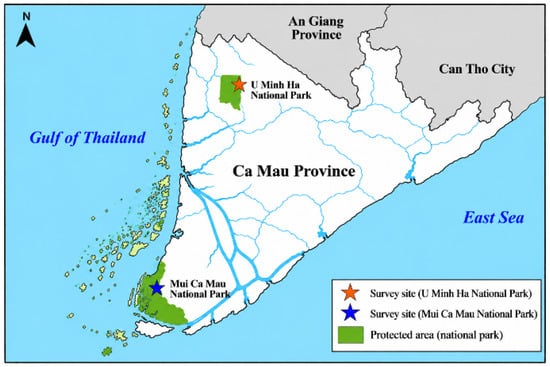
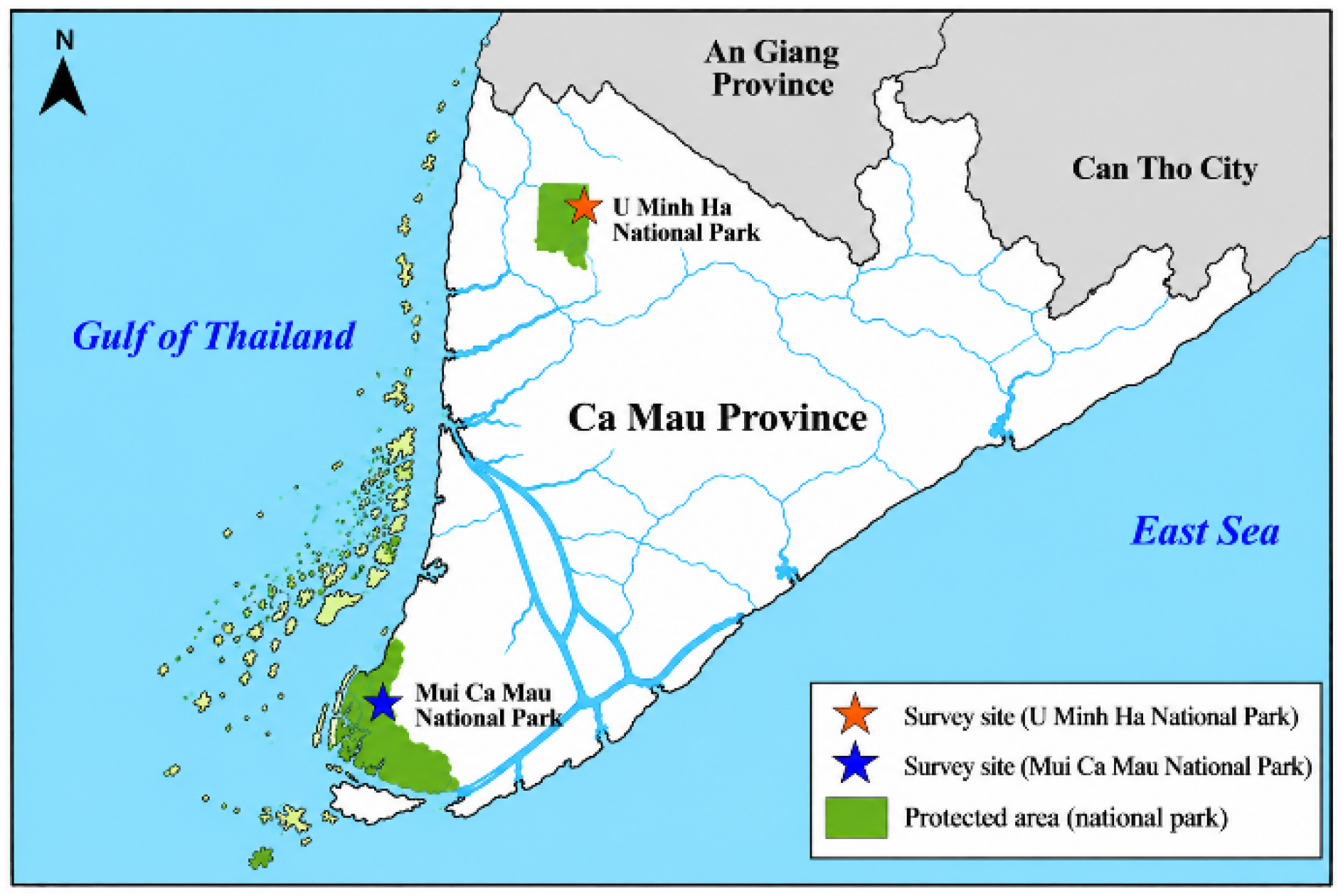
Following the pilot test, the main survey was conducted at two major tourism sites within the Mui Ca Mau Biosphere Reserve: Mui Ca Mau National Park and U Minh Ha National Park (Figure 1). Given the absence of a comprehensive sampling frame for visitors to the study area, convenience sampling was employed. Potential respondents were approached in person at tourism sites within the biosphere reserve, and questionnaires were administered only to those who voluntarily agreed to participate. Respondents were informed that participation was voluntary and that they could withdraw from the survey at any time without penalty or adverse consequences. The survey was administered face-to-face. A total of 230 questionnaires were collected and subsequently screened for response quality. Nine questionnaires were excluded because respondents selected the same response category throughout the questionnaire, indicating invariant response patterns and raising concerns about response quality. This screening resulted in a final sample of 221 usable responses, representing 96.1% of the questionnaires collected. Sample-size adequacy was assessed in relation to the analytical procedures employed in this study. For CFA, the sample size was evaluated using Westland’s (2010) lower-bound criterion based on the ratio of observed indicators to latent variables. With 15 observed indicators and four latent constructs, the indicator-to-latent-variable ratio was 3.75, corresponding to a lower-bound sample size of approximately 116 cases. The final sample of 221 therefore exceeded this lower bound. It also exceeded the sample size of 200 participants considered adequate for IPA surveys (Simpson et al., 2020). Accordingly, the final sample was considered sufficient for both measurement-model assessment and the subsequent importance–performance analyses.
Figure 1.
Location of the Mui Ca Mau World Biosphere Reserve and survey sites. Source: Authors’ elaboration using OpenStreetMap data (© OpenStreetMap contributors).
3.4. Data Analysis
Data analysis was conducted in several stages. First, the reliability of the measurement scales was assessed using Cronbach’s alpha (Hair et al., 2019). Confirmatory factor analysis (CFA) was then conducted on the performance measures to assess the measurement structure of DSR by examining overall model fit, standardized factor loadings, convergent validity, and discriminant validity (Hair et al., 2019; Kline, 2016). CFA was limited to the performance measures because the measurement model in this study was specified for perceived DSR performance across the four dimensions, whereas the corresponding importance ratings were treated as attribute-level judgments for the subsequent gap analysis and IPA rather than as indicators of a separate latent measurement model. Model fit was assessed using multiple goodness-of-fit indices, including the chi-square to degrees-of-freedom ratio (χ2/df), comparative fit index (CFI), Tucker–Lewis index (TLI), goodness-of-fit index (GFI), and root mean square error of approximation (RMSEA) (L. Hu & Bentler, 1999; Schermelleh-Engel et al., 2003). Next, descriptive statistics were calculated to determine the mean importance and performance scores for each DSR attribute. Differences between perceived importance and performance were examined by calculating the performance–importance gap (P − I) for each attribute. Paired-samples t-tests were subsequently conducted to determine whether these differences were statistically significant. Finally, importance–performance analysis (IPA) was employed to identify managerial priorities across the DSR attributes. Following the conventional IPA framework (Martilla & James, 1977; Lai & Hitchcock, 2015), importance scores were plotted on the vertical axis and performance scores on the horizontal axis. The grand means of importance and performance across all attributes were used as the crosshair values dividing the IPA matrix into four quadrants (Lai & Hitchcock, 2015; Sever, 2015). The quadrant positions, together with the magnitude and statistical significance of the P − I gaps, were used to identify areas requiring priority managerial attention.
4. Results
4.1. Respondent Profile
The final sample comprised 221 respondents and was relatively balanced by gender, with males accounting for 53.8% and females for 46.2%. In terms of age, respondents were predominantly younger and middle-aged adults. Those aged 18–28 constituted the largest group (37.1%), followed by respondents aged 29–39 (31.2%) and 40–50 (19%), while those over 50 accounted for 12.7%. Regarding educational attainment, more than half of the respondents (54.8%) had a university or postgraduate education. Respondents with upper-secondary education represented 29% of the sample, followed by those with vocational or college qualifications (14.9%), while only 1.4% had an educational level below upper secondary school. The respondents also represented a range of occupational backgrounds. Office employees formed the largest occupational group (28.1%), followed by public-sector employees (19.5%), respondents in other occupations (16.7%), those engaged in small business or trading (14%), workers (12.7%), and farmers (9%). Overall, the sample reflected diversity in gender, age, educational attainment, and occupational background.
4.2. Reliability Assessment
The internal consistency of the DSR measures was assessed separately for the importance and performance ratings using Cronbach’s alpha and corrected item–total correlations. As shown in Table 2, Cronbach’s alpha coefficients for the importance measures ranged from 0.726 to 0.821, while those for the performance measures ranged from 0.801 to 0.894. All coefficients exceeded the commonly accepted threshold of 0.70, indicating satisfactory internal consistency across the eight scales (Hair et al., 2019). Corrected item–total correlations ranged from 0.449 to 0.757 for the importance measures and from 0.583 to 0.792 for the performance measures, with all items exceeding the recommended minimum criterion of 0.3 (Nunnally & Bernstein, 1994). Accordingly, all 15 items were retained for subsequent analysis.
Table 2.
Reliability assessment of the DSR measures.
4.3. Confirmatory Factor Analysis
Confirmatory factor analysis (CFA) was conducted to assess the adequacy of the measurement model. Model fit was evaluated using multiple goodness-of-fit indices, as reliance on a single index may provide an incomplete assessment of model adequacy (L. Hu & Bentler, 1999; Schermelleh-Engel et al., 2003). The results indicated an acceptable fit to the data, with χ2 = 175.497 (df = 84, p < 0.001) and a normed chi-square (χ2/df) of 2.089. The comparative fit index (CFI = 0.953) and Tucker–Lewis index (TLI = 0.941) exceeded the commonly accepted threshold of 0.90, while the root mean square error of approximation (RMSEA = 0.070, 90% CI [0.056, 0.085]) was within the conventional range for acceptable fit (≤0.08) (L. Hu & Bentler, 1999; Schermelleh-Engel et al., 2003). The goodness-of-fit index (GFI = 0.907) also exceeded the conventional 0.90 criterion (Schermelleh-Engel et al., 2003). Taken together, these indices supported the adequacy of the four-factor measurement model.
The measurement model also demonstrated satisfactory reliability and construct validity. Standardized factor loadings ranged from 0.667 to 0.871. Composite reliability (CR) and average variance extracted (AVE) values were 0.896 and 0.682 for economic responsibility, 0.865 and 0.619 for environmental responsibility, 0.866 and 0.620 for legal responsibility, and 0.809 and 0.588 for ethical responsibility, respectively. All CR values exceeded the recommended threshold of 0.70, and all AVE values were above the 0.50 criterion, supporting convergent validity (Fornell & Larcker, 1981). Discriminant validity was assessed using complementary criteria. AVE values (0.588–0.682) exceeded their corresponding MSV values (0.259–0.543), and the square root of AVE (0.767–0.826) was greater than the corresponding inter-construct correlations, supporting discriminant validity under the Fornell–Larcker criterion (Fornell & Larcker, 1981). Discriminant validity was further examined using the heterotrait–monotrait ratio (HTMT), which provides a more sensitive assessment of construct distinctiveness (Henseler et al., 2015). HTMT values ranged from 0.475 to 0.749, all below the conservative threshold of 0.85 (Henseler et al., 2015). Collectively, these results provide evidence of satisfactory composite reliability, convergent validity, and discriminant validity for the four-factor measurement model.
4.4. Descriptive Analysis of Importance and Performance
Table 3 presents respondents’ evaluations of the importance and performance of the 15 DSR attributes. Importance ratings were consistently high, ranging from 4.18 to 4.65. At the dimension level, legal responsibility received the highest average importance rating (M = 4.58), followed by environmental (M = 4.53), ethical (M = 4.50), and economic responsibility (M = 4.39). At the attribute level, Le4 received the highest importance rating (M = 4.65), followed by En1 (M = 4.63), whereas Ec3 received the lowest rating (M = 4.18).
Table 3.
Descriptive statistics for Importance and Performance.
Performance ratings ranged from 3.95 to 4.42 and showed greater variation across DSR attributes. Legal responsibility recorded the highest average performance rating (M = 4.26), followed by economic (M = 4.20), ethical (M = 4.16), and environmental responsibility (M = 4.03). At the attribute level, Le4 received the highest performance rating (M = 4.42), followed by Ec2 (M = 4.30) and Ec1 (M = 4.27), whereas En4 received the lowest rating (M = 3.95). Overall, importance ratings were consistently high, whereas perceived performance varied more across dimensions and attributes.
4.5. Importance–Performance Gap Analysis
The gap analysis revealed systematic differences between tourists’ evaluations of importance and performance. As shown in Table 4, all 15 DSR attributes exhibited negative performance–importance gaps (P − I), indicating that perceived performance was consistently lower than the importance assigned to the corresponding attributes. Paired-samples t-tests confirmed that all differences were statistically significant (p < 0.05), although the magnitude of the gaps varied across DSR dimensions and attributes.
Table 4.
Importance–Performance gaps and Paired-Samples t-Test results.
Environmental responsibility exhibited the largest descriptive average gap (P − I = −0.51), and its four attributes recorded the four largest gaps among all 15 attributes: En1 (−0.570), En4 (−0.511), En2 (−0.489), and En3 (−0.457). Ethical and legal responsibility showed smaller descriptive average gaps of −0.34 and −0.32, respectively. Ethical attribute-level gaps were relatively consistent, ranging from −0.335 to −0.348, whereas legal gaps ranged from −0.226 to −0.430, with Le2 showing the largest discrepancy within this dimension (P − I = −0.430).
Economic responsibility exhibited the smallest descriptive average gap (P − I = −0.19), with attribute-level gaps ranging from −0.145 to −0.253. Ec3 recorded the smallest gap among all 15 attributes (P − I = −0.145), indicating the closest alignment between perceived importance and performance. Overall, the extent of performance shortfalls varied across DSR attributes and dimensions, with the largest discrepancies concentrated in environmental responsibility. These findings provide the basis for the subsequent IPA matrix, which evaluates the relative positions of the attributes on importance and performance simultaneously.
4.6. Importance–Performance Matrix of Destination Social Responsibility
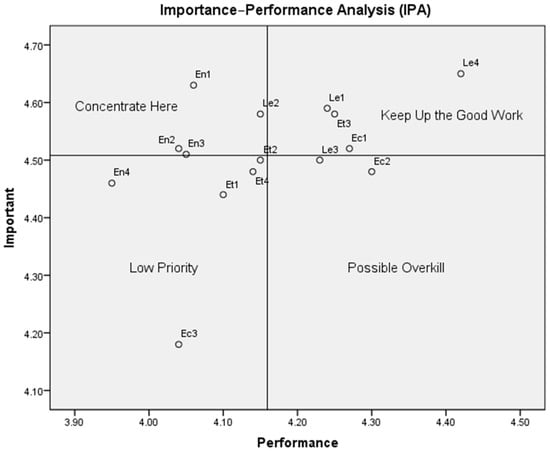
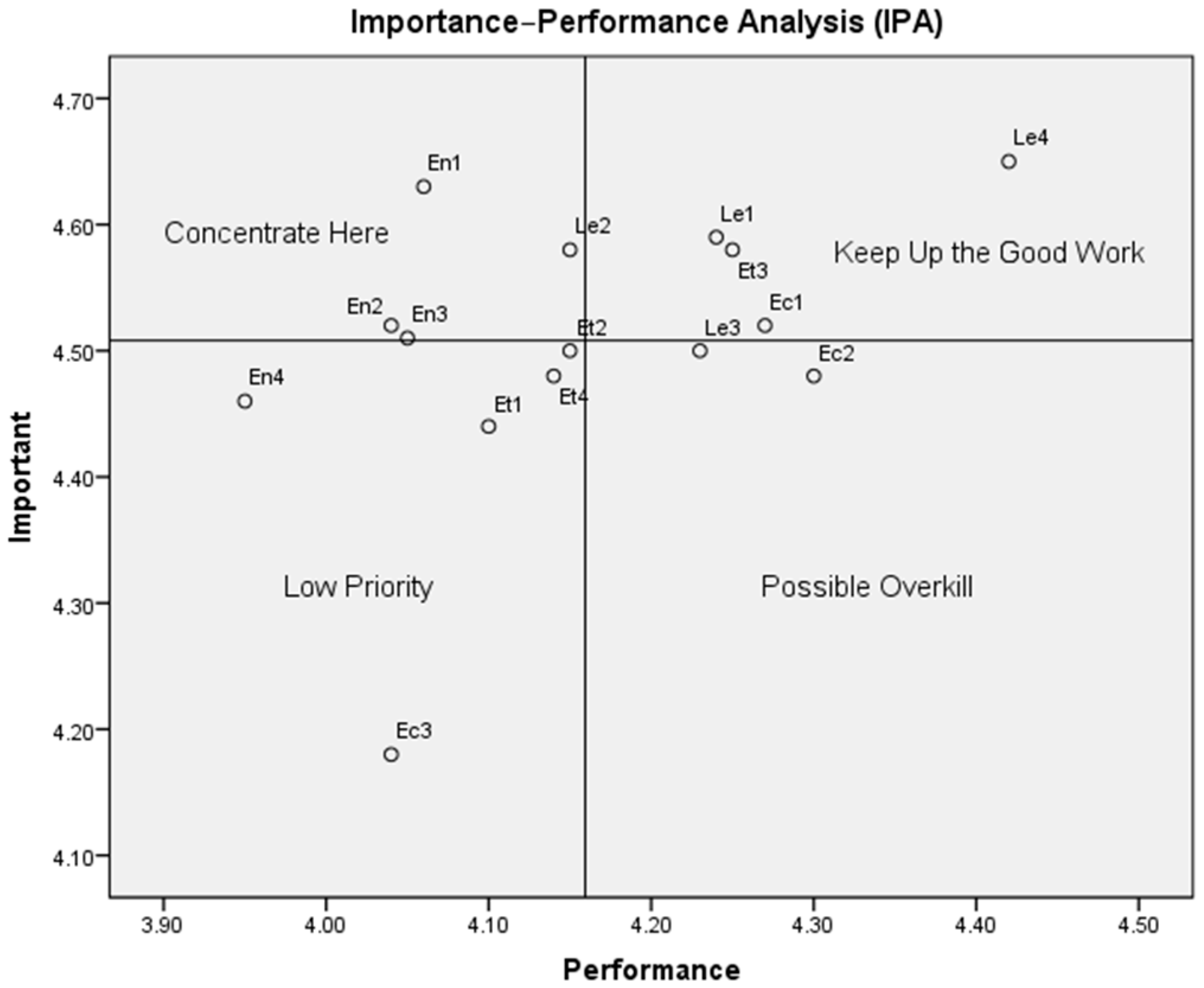
The importance–performance matrix provides a complementary assessment of the 15 DSR attributes by simultaneously considering their relative importance and perceived performance. The grand mean scores for importance (4.51) and performance (4.16) were used as crosshairs to divide the matrix into four quadrants (Figure 2). Quadrant classification was based on the unrounded grand means (4.508 and 4.159), although values are reported to two decimal places in the text. Accordingly, the position of each attribute reflects its importance and performance relative to the other DSR attributes rather than its absolute score on the five-point scale.
Figure 2.
Importance–Performance matrix of destination social responsibility attributes.
The “Concentrate Here” quadrant, characterized by above-average importance and below-average performance, contained En1, En2, En3, and Le2. Three of these four attributes belonged to environmental responsibility. En1 recorded an importance score of 4.63 and a performance score of 4.06, while the corresponding scores for En2 were 4.52 and 4.04. En3 (I = 4.51; P = 4.05) was positioned very close to, but slightly above, the importance crosshair when the unrounded grand mean was applied. Le2, the only legal responsibility attribute in this quadrant, recorded an importance score of 4.58 and a performance score of 4.15. The concentration of environmental attributes in this quadrant identifies environmental responsibility as the most prominent area requiring attention within the IPA framework.
The “Keep Up the Good Work” quadrant comprised Ec1, Le1, Le4, and Et3. These attributes had both importance and performance scores above their respective grand means. Le4 occupied the strongest position in this quadrant, with importance (M = 4.65) and performance (M = 4.42) both well above the corresponding crosshairs. A similar pattern was observed for Ec1 (I = 4.52; P = 4.27), Le1 (I = 4.59; P = 4.24), and Et3 (I = 4.58; P = 4.25). Within the IPA framework, these attributes represent areas in which comparatively strong performance is aligned with comparatively high importance and should therefore be maintained.
The “Low Priority” quadrant contained Ec3, En4, Et1, Et2, and Et4, all of which were positioned below both grand-mean crosshairs. Their classification indicates lower relative priority within the IPA matrix and should not be interpreted as suggesting that these responsibilities are unimportant in absolute terms. En4 is particularly noteworthy: despite recording one of the largest negative performance–importance gaps (I = 4.46; P = 3.95), it remained in the “Low Priority” quadrant because its importance score was below the overall importance crosshair. This illustrates the distinction between gap analysis and IPA: gap magnitude captures the extent of perceived underperformance, whereas IPA classification depends on the simultaneous relative positions of importance and performance.
Finally, Ec2 and Le3 were located in the “Possible Overkill” quadrant, with performance above the performance grand mean but importance below the importance grand mean. Ec2 recorded scores of 4.48 for importance and 4.30 for performance, while Le3 recorded 4.50 and 4.23, respectively. Within the conventional IPA framework, these attributes represent areas of comparatively strong performance but lower relative importance and therefore warrant less additional attention than attributes located in the “Concentrate Here” quadrant. As with the “Low Priority” quadrant, this classification reflects relative rather than absolute importance.
Overall, the IPA matrix reveals a differentiated pattern of priorities across the four DSR dimensions. Most notably, three environmental attributes (En1, En2, and En3) were located in the “Concentrate Here” quadrant, together with Le2, whereas En4 was classified as “Low Priority.” In contrast, the economic, legal, and ethical attributes were distributed across multiple quadrants. These results complement the preceding performance–importance gap analysis by demonstrating that the magnitude of a negative gap does not, by itself, determine an attribute’s position within the IPA matrix. Taken together, the concentration of En1, En2, and En3 in the “Concentrate Here” quadrant identifies environmental responsibility as the clearest area for prioritized improvement.
5. Discussion
This study reveals a consistent mismatch between the importance tourists attach to DSR and their perceptions of destination performance. Performance was significantly lower than importance for all 15 attributes, indicating a systematic shortfall in perceived performance relative to the importance assigned to these responsibilities. This overall pattern is consistent with Sin and Han (2021), who similarly reported lower performance than importance across DSR activities in modern historical and cultural heritage destinations in Republic of Korea. However, the present findings show that these shortfalls are not evenly distributed across DSR dimensions. Environmental responsibility had the largest average performance–importance gap, and the four largest attribute-level gaps were all environmental. Their concentration within a single dimension suggests a systematic mismatch between the importance attached to environmental responsibility and its perceived implementation rather than isolated deficiencies in individual practices.
Importantly, the concentration of the largest gaps within environmental responsibility needs to be understood in relation to the biosphere-reserve context. In a biosphere reserve, where tourism is closely tied to natural resources and conservation is central to destination sustainability, tourists may place particularly high expectations on environmental responsibility and be more attentive to its implementation. This interpretation is consistent with emerging DSR research in nature-based tourism settings, where environmental considerations have been closely linked to the role of destination responsibility. At an ecotourism wetland, C.-K. Lee et al. (2021) found that DSR significantly influenced visitors’ pro-environmental behavior, while Pourhossein et al. (2023) showed that DSR strengthened the relationship between environmental engagement and pro-environmental behavior among visitors to a nature-based public park. At the same time, translating environmental responsibility into consistently implemented practices can be challenging. Recent evidence from a developing destination in Vietnam shows uneven implementation of practices closely related to several environmental attributes examined here: while some environmental protection and resource-conservation measures were widely adopted, practices such as waste separation, renewable energy use, and the use of biodegradable products remained comparatively limited (Nguyen et al., 2026).
The IPA results sharpen this environmental pattern. Three environmental attributes were located in “Concentrate Here”: implementing measures to protect the natural environment (En1), using resources efficiently to minimize negative environmental impacts (En2), and prioritizing environmentally friendly products and services (En3). Their concentration in the priority quadrant is particularly meaningful in a biosphere reserve, where environmental conservation is integral to both the protected-area function and the natural resource base on which tourism depends. The relative positioning of these attributes indicates that environmental responsibility is not evaluated uniformly across its specific practices. En4, encouraging visitors to participate in environmental protection activities, provides an important contrast. Despite having the second-largest negative gap, it was located in “Low Priority.” Unlike En1–En3, which primarily concern environmental practices implemented at the destination level, En4 depends more directly on visitor engagement. This distinction may help explain why different forms of environmental responsibility carry different relative priorities even within the same DSR dimension.
Comparison with Sin and Han (2021) further highlights the context-dependent nature of these priorities. Their DSR–IPA study of six modern historical and cultural heritage destinations in Republic of Korea identified a different priority structure, with local employment creation positioned in “Concentrate Here,” while environmental activities did not dominate the priority quadrant. Rather than representing inconsistent findings, this contrast suggests that the relative salience of DSR dimensions may vary across destination settings. Rather than representing inconsistent findings, this contrast supports the view that DSR priorities may be context-dependent rather than uniform across destinations (Su & Swanson, 2017). Cultural heritage destinations and biosphere reserves differ in their defining resources, functions, stakeholder relationships, and sustainability challenges; tourists may therefore evaluate destination responsibilities in relation to the characteristics of the places they visit. The present study extends Sin and Han’s (2021) work by showing that the DSR priority structure observed in heritage destinations should not necessarily be assumed to apply in a biosphere-reserve context.
The findings also demonstrate the analytical value of combining performance–importance gap analysis with IPA. The two approaches converged in identifying environmental responsibility as a major area of concern but yielded different attribute-level priorities. En4 provides the clearest example: despite having the second-largest negative gap, it was not classified as “Concentrate Here.” Gap analysis captures the magnitude of the discrepancy between importance and performance, whereas IPA considers an attribute’s relative position on both dimensions simultaneously. Combining the two therefore provides a more differentiated diagnosis of DSR and, importantly, shows that the magnitude of an importance–performance gap should not automatically be equated with managerial priority.
Finally, the results reveal the limitations of relying solely on dimension-level assessments. Legal responsibility had the highest average importance and performance ratings, yet Le2, taking responsibility for the quality of products and services provided, was located in “Concentrate Here,” while the remaining legal attributes occupied other quadrants. Similarly, economic responsibility showed the smallest average gap, but its three attributes were distributed across three IPA quadrants. DSR dimensions are therefore not internally uniform from the tourist perspective. By extending DSR–IPA analysis from cultural heritage destinations to a biosphere-reserve context and integrating dimension-level gaps with attribute-level priorities, this study supports a more differentiated and context-sensitive understanding of DSR: its practical priority structure may vary across destination contexts, while aggregate dimension-level assessments may obscure which specific responsibilities require greater managerial attention.
6. Implications
6.1. Theoretical Implications
This study makes three main contributions to DSR research. First, it advances a diagnostic and priority-oriented application of DSR alongside the predominantly explanatory approaches in the literature. While much previous research has examined how perceived DSR influences tourist attitudes and behaviors, this study examines the alignment between the importance tourists assign to specific destination responsibilities and their perceptions of how well those responsibilities are performed. By integrating importance and performance assessments, gap analysis, and IPA, the study demonstrates how DSR can be used not only to understand tourist responses but also to diagnose where perceived destination performance is least aligned with tourist priorities.
Second, the study provides evidence that the priority structure of DSR may be context sensitive. In contrast to previous DSR–IPA evidence from modern historical and cultural heritage destinations in Republic of Korea (Sin & Han, 2021), the present study identifies environmental responsibility as the dominant priority in a biosphere reserve. This contrast suggests that DSR dimensions may not carry the same relative priority across destination settings; rather, their salience may reflect differences in destinations’ defining resources, functions, and sustainability challenges. The study thus extends understanding of DSR by highlighting destination context as an important consideration when interpreting the relative salience of different responsibilities.
Third, the study demonstrates the analytical value of examining DSR at the attribute level and combining gap analysis with IPA. Attributes within the same DSR dimension did not necessarily occupy the same priority category, while the attributes with the largest performance–importance gaps were not always those identified as the highest priorities by IPA. These findings show that aggregate dimension-level assessments can conceal meaningful variation among specific responsibilities and that performance shortfalls and relative priorities capture distinct aspects of DSR evaluation. An attribute-level approach, combined with complementary gap and IPA analyses, therefore provides a more differentiated understanding of how tourists evaluate destination responsibilities.
6.2. Practical Implications
The findings provide a practical basis for translating DSR assessment into priority setting at the destination level. By distinguishing between attributes that require immediate attention, those whose current performance should be maintained, and those for which additional improvement is comparatively less urgent, the IPA framework enables destination stakeholders to move beyond general commitments to responsible tourism toward more differentiated priorities. This is particularly relevant in a biosphere reserve, where environmental protection, tourism development, service quality, and local interests must be addressed within limited managerial and financial resources.
The results also demonstrate the practical importance of considering both absolute evaluations and relative IPA positions. Although all 15 DSR attributes received high absolute importance ratings, their positions in the IPA matrix indicate different levels of relative priority. Accordingly, lower-priority classifications should not be interpreted as indicating that particular responsibilities are unimportant or can be neglected. Rather, the findings provide a basis for sequencing improvement efforts while maintaining attention to the broader economic, environmental, legal, and ethical responsibilities of the destination.
The IPA priorities can also be incorporated into broader destination planning and decision-making. Destination managers can use the identified priorities to determine which areas require greater attention, allocate resources accordingly, and develop appropriate improvement actions. Periodic reassessment can then be used to examine changes in performance and adjust these priorities when necessary. In this way, IPA can support ongoing destination planning while allowing managers to consider the interests of different stakeholder groups and the specific conditions of the destination.
6.3. Managerial Implications
The most immediate managerial attention should be directed toward the four attributes in the “Concentrate Here” quadrant: implementing measures to protect the natural environment (En1), using resources efficiently to minimize negative environmental impacts (En2), prioritizing environmentally friendly products and services (En3), and taking responsibility for the quality of products and services provided (Le2). The concentration of three environmental attributes in this quadrant indicates that improving perceived environmental performance should be a central priority for DSR management in the biosphere reserve.
For En1 and En2, destination managers and tourism businesses should strengthen measures to protect environmentally sensitive areas, control tourism-related waste and pollution, and improve the efficiency of water, energy, and other resource use. For En3, environmental responsibility should be embedded more systematically in tourism operations and supply chains through environmentally responsible procurement, greater use of reusable or lower-impact materials, and the development of products and services that minimize ecological impacts. Destination-level environmental guidelines for tourism providers could help promote greater consistency in these practices. For Le2, destination stakeholders should strengthen accountability for tourism product and service quality through clear service standards, quality monitoring, and effective mechanisms for addressing service problems.
The remaining quadrants provide guidance for maintaining and sequencing DSR efforts. Existing performance should be sustained for the “Keep Up the Good Work” attributes: contributing positively to local economic development (Ec1), protecting visitors’ legitimate rights (Le1), complying with tourism regulations (Le4), and treating visitors fairly and transparently (Et3). The “Low Priority” attributes, encouraging the use of local products and services (Ec3), encouraging visitor participation in environmental protection (En4), avoiding false or exaggerated advertising (Et1), providing accurate information (Et2), and ensuring a healthy and safe working environment (Et4), should not be neglected, but additional improvement is comparatively less urgent than for attributes in “Concentrate Here.” Similarly, improving local livelihoods and community income (Ec2) and providing mechanisms to support visitors and promptly resolve incidents (Le3), classified as “Possible Overkill,” should not be interpreted as areas where existing efforts should be reduced. Rather, their position indicates that further investment is comparatively less urgent.
Overall, destination managers should prioritize environmental protection, resource efficiency, environmentally responsible tourism provision, and accountability for service quality; sustain areas where performance is already comparatively strong; and sequence further improvements in lower-priority areas according to available resources. This differentiated approach can support more strategic resource allocation while maintaining attention to the broader responsibilities of the biosphere reserve.
7. Conclusions, Limitations and Future Research
7.1. Conclusions
This study provides a priority-based assessment of DSR in a biosphere reserve. Although tourists attached high importance to DSR overall, perceived performance was consistently lower than the importance assigned to all 15 responsibilities. This mismatch was most pronounced for environmental responsibility, which showed the largest average performance–importance gap and accounted for three of the four attributes in the “Concentrate Here” quadrant. Importantly, the findings also revealed substantial variation among individual responsibilities within the same DSR dimension. DSR should therefore be understood not only as a multidimensional concept but also as a set of specific responsibilities whose relative salience and perceived performance may vary across destination contexts.
Overall, this study shows that assessing DSR involves more than determining the overall level of perceived responsible performance. A more informative question is which responsibilities carry the greatest relative priority within a particular destination context and where perceived performance is least aligned with that priority. Addressing this question provides a more differentiated basis for understanding and managing DSR in destinations where tourism development and environmental protection must coexist.
7.2. Limitations
These conclusions are bounded by the study setting and perspective. Because the analysis focused on a single biosphere reserve, the prominence of environmental responsibility cannot yet be generalized to other biosphere reserves or destination types. The study was also limited to the tourist perspective, which may differ from those of residents, tourism businesses, destination managers, and other stakeholder groups. In addition, the use of convenience sampling may have introduced selection bias because tourists who were accessible and willing to participate may differ from the broader tourist population visiting the biosphere reserve. Consequently, the sample may not fully represent all tourists to the destination, limiting the generalizability of the findings.
The IPA results should also be interpreted with caution because several attributes were located very close to the grand-mean crosshairs. In particular, En3, Le2, Le3, and Et2 were positioned near one of the dividing lines, making their quadrant assignments sensitive to small changes in the crosshair values. This sensitivity reflects a recognized methodological limitation of IPA, whereby quadrant classifications may depend on the positioning of the crosshairs (Lai & Hitchcock, 2015; Oh, 2001; Sever, 2015).
A further limitation concerns tourists’ ability to assess some DSR attributes. Certain aspects, such as regulatory compliance, resource efficiency, and employee working conditions, may not be directly observable to visitors. The corresponding ratings should therefore be interpreted as tourists’ perceptions based on their observations and experiences at the destination rather than as objective assessments of actual organizational practices or regulatory compliance.
7.3. Directions for Future Research
Future research could extend the present study in several directions. First, comparative research across protected, cultural, urban, and other destination settings could determine whether different contexts produce distinct DSR priority structures. Second, DSR could be examined from the perspective of other relevant stakeholder groups, such as local residents, tourism businesses, or tourism employees. As these groups experience and engage with destination responsibilities differently from tourists, studying them could reveal priorities and concerns that are less visible from the tourist perspective and broaden understanding of how DSR is perceived across the destination. Such evidence would also provide reserve managers with a broader basis for identifying responsibilities that warrant attention. Third, future studies could adopt a mixed methods design that combines quantitative DSR assessment and IPA with qualitative inquiry. While the quantitative component can identify the relative importance, performance gaps, and priority areas of DSR, interviews or focus groups could examine selected priority areas in greater depth, revealing how these responsibilities are manifested in the specific context of a biosphere reserve and identifying practical issues that quantitative ratings alone cannot capture. This integration would preserve the clear prioritization provided by IPA while adding the contextual depth needed to interpret and respond to its findings. Finally, because gap analysis and IPA capture different aspects of DSR evaluation, future research could compare alternative prioritization approaches and examine whether they identify similar or different critical responsibilities.
Author Contributions
Conceptualization, T.N.N. and V.D.H.; methodology, T.N.N.; software, T.N.N.; validation, T.N.N., V.D.H., M.T.L. and V.D.P.; formal analysis, T.N.N.; investigation, T.N.N., V.D.H., M.T.L. and V.D.P.; resources, T.N.N.; data curation, T.N.N.; writing—original draft preparation, T.N.N.; writing—review and editing, T.N.N. and V.D.P.; visualization, T.N.N. and V.D.P.; supervision, T.N.N. and V.D.H.; project administration, T.N.N.; funding acquisition, T.N.N. All authors have read and agreed to the published version of the manuscript.
Funding
This study is funded by the Can Tho University, Code: T2026-09.
Institutional Review Board Statement
Ethical review and approval were waived for this study due to get an exemption from the Can Tho University Research Ethics Committee for Social Sciences and Humanities (CTU-RECSH).
Informed Consent Statement
Informed consent was obtained from all subjects involved in the study.
Data Availability Statement
The datasets generated and/or analyzed during the current study are not publicly available due to ethical and confidentiality constraints but are available from the corresponding author upon reasonable request, subject to institutional approval.
Conflicts of Interest
The authors declare no conflicts of interest.
References
- Agapito, D., Kronenburg, R., & Pinto, P. (2023). A review on destination social responsibility: Towards a research agenda. Current Issues in Tourism, 26(4), 554–572. [Google Scholar] [CrossRef] [Scilit]
- Azinuddin, M., Hanafiah, M. H., Mior Shariffuddin, N. S., Kamarudin, M. K. A., & Mat Som, A. P. (2023). An exploration of perceived ecotourism design affordance and destination social responsibility linkages to tourists’ pro-environmental behaviour and destination loyalty. Journal of Ecotourism, 22(4), 518–541. [Google Scholar] [CrossRef] [Scilit]
- Boley, B. B., McGehee, N. G., & Hammett, A. L. T. (2017). Importance-performance analysis (IPA) of sustainable tourism initiatives: The resident perspective. Tourism Management, 58, 66–77. [Google Scholar] [CrossRef] [Scilit]
- Caber, M., Albayrak, T., & Matzler, K. (2012). Classification of the destination attributes in the content of competitiveness (by revised importance-performance analysis). Journal of Vacation Marketing, 18(1), 43–56. [Google Scholar] [CrossRef] [Scilit]
- Ca Mau Provincial People’s Committee. (2026). Quy chế quản lý và bảo vệ môi trường Khu dự trữ sinh quyển thế giới Mũi Cà Mau [Regulations on the management and environmental protection of the Mui Ca Mau World Biosphere Reserve]. Ca Mau Provincial People’s Committee. [Google Scholar]
- Carroll, A. B. (1979). A three-dimensional conceptual model of corporate performance. Academy of Management Review, 4(4), 497–505. [Google Scholar] [CrossRef] [Scilit]
- Chen, J., Becken, S., & Stantic, B. (2022). Assessing destination satisfaction by social media: An innovative approach using Importance-Performance Analysis. Annals of Tourism Research, 93, 103371. [Google Scholar] [CrossRef] [Scilit]
- Chu, R. K. S., & Choi, T. (2000). An importance-performance analysis of hotel selection factors in the Hong Kong hotel industry: A comparison of business and leisure travellers. Tourism Management, 21(4), 363–377. [Google Scholar] [CrossRef] [Scilit]
- Coghlan, A. (2012). Facilitating reef tourism management through an innovative importance-performance analysis method. Tourism Management, 33(4), 767–775. [Google Scholar] [CrossRef] [Scilit]
- Dahlsrud, A. (2008). How corporate social responsibility is defined: An analysis of 37 definitions. Corporate Social Responsibility and Environmental Management, 15(1), 1–13. [Google Scholar] [CrossRef] [Scilit]
- Dueñas, X., Rodríguez, M., & Pérez, L. M. (2021). Asymmetric importance-performance analysis: Measuring classification changes of destination attributes into basic, performance and excitement factors according to the segmentation criterion. Tourism and Hospitality Research, 21(4), 418–425. [Google Scholar] [CrossRef] [Scilit]
- Dwyer, L., Armenski, T., Cvelbar, L. K., Dragićević, V., & Mihalic, T. (2016). Modified importance–performance analysis for evaluating tourism businesses strategies: Comparison of Slovenia and Serbia. International Journal of Tourism Research, 18(4), 327–340. [Google Scholar] [CrossRef] [Scilit]
- Fornell, C., & Larcker, D. F. (1981). Evaluating structural equation models with unobservable variables and measurement error. Journal of Marketing Research, 18(1), 39–50. [Google Scholar] [CrossRef] [Scilit]
- Griffin, T., & Edwards, D. (2012). Importance–performance analysis as a diagnostic tool for urban destination managers. Anatolia, 23(1), 32–48. [Google Scholar] [CrossRef] [Scilit]
- Hair, J. F., Black, W. C., Babin, B. J., & Anderson, R. E. (2019). Multivariate data analysis (8th ed.). Cengage Learning. [Google Scholar]
- Han, J. H., Kim, Y., & Jung, M. (2022). Exploring the roles of multidimensional versus unidimensional construct of destination social responsibility in explaining destination trust and relationship continuity. Global Business & Finance Review (GBFR), 27(5), 83–99. [Google Scholar] [CrossRef] [Scilit]
- Henseler, J., Ringle, C. M., & Sarstedt, M. (2015). A new criterion for assessing discriminant validity in variance-based structural equation modeling. Journal of the Academy of Marketing Science, 43, 115–135. [Google Scholar] [CrossRef] [Scilit]
- Hu, B., Tuou, Y., & Liu, J. (2019). How does destination social responsibility impact residents’ pro-tourism behaviors? The mediating role of place attachment. Sustainability, 11(12), 3373. [Google Scholar] [CrossRef] [Scilit]
- Hu, L., & Bentler, P. M. (1999). Cutoff criteria for fit indexes in covariance structure analysis: Conventional criteria versus new alternatives. Structural Equation Modeling: A Multidisciplinary Journal, 6(1), 1–55. [Google Scholar] [CrossRef] [Scilit]
- Jeng, C.-R., Snyder, A. T., & Chen, C.-F. (2019). Importance–performance analysis as a strategic tool for tourism marketers: The case of Taiwan’s Destination Image. Tourism and Hospitality Research, 19(1), 112–125. [Google Scholar] [CrossRef] [Scilit]
- Kline, R. B. (2016). Principles and practice of structural equation modeling. Guilford Press. [Google Scholar]
- Lai, I. K. W., & Hitchcock, M. (2015). Importance–performance analysis in tourism: A framework for researchers. Tourism Management, 48, 242–267. [Google Scholar] [CrossRef] [Scilit]
- Lee, C.-K., Olya, H., Ahmad, M. S., Kim, K. H., & Oh, M.-J. (2021). Sustainable intelligence, destination social responsibility, and pro-environmental behaviour of visitors: Evidence from an eco-tourism site. Journal of Hospitality and Tourism Management, 47, 365–376. [Google Scholar] [CrossRef] [Scilit]
- Lee, Y., Sharma, B., & Tham, A. (2025). A scale to measure destination social responsibility perceived by residents and government. International Journal of Tourism Research, 27(4), e70084. [Google Scholar] [CrossRef] [Scilit]
- Management Board of the Mui Ca Mau Biosphere Reserve. (2019). Báo cáo đánh giá định kỳ 10 năm Khu Dự trữ sinh quyển Mũi Cà Mau, tỉnh Cà Mau, Việt Nam [Ten-year periodic review report of the Mui Ca Mau Biosphere Reserve, Ca Mau Province, Vietnam]. Management Board of the Mui Ca Mau Biosphere Reserve. [Google Scholar]
- Management Board of the Mui Ca Mau World Biosphere Reserve. (2025). Báo cáo Tổng kết công tác năm 2025 và định hướng hoạt động năm 2026 [Report on the 2025 annual review and orientations for 2026]. Management Board of the Mui Ca Mau World Biosphere Reserve. [Google Scholar]
- Martilla, J. A., & James, J. C. (1977). Importance-performance analysis. Journal of Marketing, 41(1), 77–79. [Google Scholar] [CrossRef] [Scilit]
- Nguyen, T. N., Huynh, V. D., & Ly, M. T. (2026). Responsible tourism practices among tourism enterprises in a developing destination. Tourism and Hospitality, 7(8), 258. [Google Scholar] [CrossRef] [Scilit]
- Nunnally, J. C., & Bernstein, I. H. (1994). Psychometric theory (3rd ed.). McGraw-Hill. [Google Scholar]
- Oh, H. (2001). Revisiting importance–performance analysis. Tourism Management, 22(6), 617–627. [Google Scholar] [CrossRef] [Scilit]
- Panagiotopoulou, P., & Skoultsos, S. (2025). Stakeholders’ involvement in sustainable destination management: A systematic literature review of existing multi-stakeholder frameworks and approaches. Tourism and Hospitality, 6(5), 250. [Google Scholar] [CrossRef] [Scilit]
- Pourhossein, M., Baker, B. J., Dousti, M., Behnam, M., & Tabesh, S. (2023). Embarking on the trail of sustainable harmony: Exploring the nexus of visitor environmental engagement, awareness, and destination social responsibility in natural parks. Journal of Destination Marketing & Management, 30, 100821. [Google Scholar] [CrossRef] [Scilit]
- Schermelleh-Engel, K., Moosbrugger, H., & Müller, H. (2003). Evaluating the fit of structural equation models: Tests of significance and descriptive goodness-of-fit measures. Methods of Psychological Research Online, 8(2), 23–74. [Google Scholar]
- Sever, I. (2015). Importance-performance analysis: A valid management tool? Tourism Management, 48, 43–53. [Google Scholar] [CrossRef] [Scilit]
- Simpson, G. D., Patroni, J., Teo, A. C. K., Chan, J. K. L., & Newsome, D. (2020). Importance-performance analysis to inform visitor management at marine wildlife tourism destinations. Journal of Tourism Futures, 6(2), 165–180. [Google Scholar] [CrossRef] [Scilit]
- Sin, B. M., & Han, J. H. (2021). A study on the destination social responsibility (DSR) in a context of modern historical and cultural heritage sites: Using IPA analysis. Northeast Asia Tourism Research, 17(1), 151–170. [Google Scholar] [CrossRef] [Scilit]
- Su, L., Huang, S., & Huang, J. (2018). Effects of destination social responsibility and tourism impacts on residents’ support for tourism and perceived quality of life. Journal of Hospitality & Tourism Research, 42(7), 1039–1057. [Google Scholar] [CrossRef] [Scilit]
- Su, L., & Huang, Y. (2019). How does perceived destination social responsibility impact revisit intentions: The mediating roles of destination preference and relationship quality. Sustainability, 11(1), 133. [Google Scholar] [CrossRef] [Scilit]
- Su, L., & Swanson, S. R. (2017). The effect of destination social responsibility on tourist environmentally responsible behavior: Compared analysis of first-time and repeat tourists. Tourism Management, 60, 308–321. [Google Scholar] [CrossRef] [Scilit]
- Su, L., Wang, L., Law, R., Chen, X., & Fong, D. (2017). Influences of destination social responsibility on the relationship quality with residents and destination economic performance. Journal of Travel & Tourism Marketing, 34(4), 488–502. [Google Scholar] [CrossRef] [Scilit]
- Taplin, R. H. (2012). Competitive importance-performance analysis of an Australian wildlife park. Tourism Management, 33(1), 29–37. [Google Scholar] [CrossRef] [Scilit]
- Tran, H. A. T., Hwang, Y. S., Yu, C., & Yoo, S. J. (2018). The effect of destination social responsibility on tourists’ satisfaction: The mediating role of emotions. Sustainability, 10(9), 3044. [Google Scholar] [CrossRef] [Scilit]
- Tran, P. K. T., Nguyen, H. K. T., Nguyen, L. T., Nguyen, H. T., Truong, T. B., & Tran, V. T. (2023). Destination social responsibility drives destination brand loyalty: A case study of domestic tourists in Danang city, Vietnam. International Journal of Tourism Cities, 9(1), 302–322. [Google Scholar] [CrossRef] [Scilit]
- Wattanakamolchai, S., & Choibamroong, T. (2025). Passenger experience management strategies for Bangkok suvarnabhumi airport. Tourism and Hospitality, 6(4), 175. [Google Scholar] [CrossRef] [Scilit]
- Westland, J. C. (2010). Lower bounds on sample size in structural equation modeling. Electronic Commerce Research and Applications, 9(6), 476–487. [Google Scholar] [CrossRef] [Scilit]
- Yu, C., & Hwang, Y. S. (2019). Do the social responsibility efforts of the destination affect the loyalty of tourists? Sustainability, 11(7), 1998. [Google Scholar] [CrossRef] [Scilit]
- Zhang, H., Cheng, Z., & Chen, X. (2022). How destination social responsibility affects tourist citizenship behavior at cultural heritage sites? Mediating roles of destination reputation and destination identification. Sustainability, 14(11), 6772. [Google Scholar] [CrossRef] [Scilit]

Disclaimer/Publisher’s Note: The statements, opinions and data contained in all publications are solely those of the individual author(s) and contributor(s) and not of MDPI and/or the editor(s). MDPI and/or the editor(s) disclaim responsibility for any injury to people or property resulting from any ideas, methods, instructions or products referred to in the content. |
© 2026 by the authors. Licensee MDPI, Basel, Switzerland. This article is an open access article distributed under the terms and conditions of the Creative Commons Attribution (CC BY) license.