


Abstract
With contemporary advancements in additive manufacturing (AM), it has become possible to obtain hull structures for spacecraft made of relatively cheap materials. The possibility of substituting super-austenitic stainless steel Avesta SMO 254 X1NiCrMoCuN20-18-7 (EN 10088) for that already used in the Starship SpaceX 304 L-Modified is focused on achieving better thermal stability and durability in extreme conditions. The Directed Energy Deposition Arc (DED-Arc) method for AM has enabled the production of high-strength-to-weight ratios. The aim is to engage low-cost material with treatment optimization to provide greater corrosion resistance and high yield and tensile strength. For the DED-Arc, a filler wire was selected for the welding source, Fronius TPS 400i. A simulation via the RoboDK Robot Development Kit for the FANUC ARC Mate 100ID10L is provided. Additional shot pining/vibration treatment is proposed for the finished structure, which can be a substitute for the cold-worked initial metal. A comparison is made for stainless steel that has already been tested for space travel. Regimes for the manufacturing process are proposed, with representative samples of Avesta SMO 254 obtained and tested using microhardness measurements, microcracking detection, porosity measurements, interface zone assessment, and microstructural analysis. The DED-Arc process can be applied to large-space shell manufacturing. A comparison is made with a focus on the mechanical and corrosion advantages. For Avesta SMO 254, microhardness measurements ranged from 235 to 246 HV1 and increased after treatment. The controlled parameters provided a maximum heat input of 0.7 KJ/mm, no defects, and a fine microstructure. The successful use of stainless steel with AM increases the potential for multiple space missions. The advanced method shows high quality, allows cost savings and provides extended service life.
1. Introduction
Additive manufacturing (AM) is increasingly becoming a desirable approach for space exploration, primarily due to its capability to fabricate complex structures layer-by-layer using diverse materials [1,2,3,4]. This study proposes the fabrication of hull structure for spacecraft using the commercially available super-austenitic stainless steel Avesta SMO 254 (X1NiCrMoCuN20-18-7, EN 10088) [5] as a substitute for the 304 L-Modified steel specifically designed for the Starship SpaceX [6,7]. This substitution is motivated by the superior thermal stability and durability of Avesta SMO 254 under extreme conditions. Notably, this material exhibits lower average thermal conductivity compared to standard austenitic steels [8,9]. The selected AM method for application is Directed Energy Deposition Arc (DED-Arc) which enables the production of shells with high-strength-to-weight ratios [10,11]. By operating the source in Cold Metal Transfer (CMT) mode [12,13,14] the buildup of thin-walled spacecraft enclosures can be achieved. This method is proposed based on preliminary micro-volume trials involving laser welding which demonstrated favorable mechanical characteristics, minimal defects and high thermal hardness. The primary aim is to expand the application of conventional materials in space missions through process optimization for enhancing corrosion resistance and yield/tensile strength while maintaining the cost-effectiveness for large-scale structural components. However, due to the tendency of Avesta SMO 254 to undergo molybdenum segregation, mechanical post-treatments—such as ultrasonic shot peening, shot peening or ultrasonic impact treatment—are proposed immediately after fabrication [15]. The main research objective of this study is to explicitly evaluate the feasibility of fabricating spacecraft hull structures from super-austenitic Avesta SMO 254 steel using the DED-Arc process, by optimizing the manufacturing and post-treatment parameters in order to mitigate elemental segregation, thereby delivering favorable material characteristics for aerospace applications compared to conventional manufacturing routes. The effectiveness of the immediate mechanical surface treatments is systematically verified to serve as a viable alternative effectively replacing conventional post-weld heat treatment.
2. Method
For the DED-Arc process, a Fronius TPS 400i (Fronius International GmbH, Wels, Austria) welding power source is suggested. The filler material, Avesta 254 SMO (Outokumpu, Helsinki, Finland), has a chemical composition conforming to the specification [5]. The material’s authenticity was verified through delivery certificate and on-site positive material identification testing. To evaluate the suitability of this material for space applications, its chemical composition and properties were compared against stainless steel previously tested for space travel. Specifically, the collected data for Avesta 254 SMO, along with the patented variants [16,17], were compared with publicly available information on the SpaceX 304L-Modified [18,19,20]. A summary of this comparison is presented in Table 1.
Table 1.
Comparison table between the Avesta SMO 254 and SpaceX 304L-Modified, showing the chemical contents inside the alloy and the main influence of the chemical element on the properties.
To ensure a stable deposition process and minimize the need for expensive trial-and-error iterations, a methodology combining empirical data from prior experimental and numerical simulation is implemented for the DED-Arc process. Physical execution of the current spacecraft hull fabrication is preceded by a comprehensive virtual testing phase in specialized simulation software. The process parameters in the simulation environment—such as arc power, travel speed, and wire feed rate—are not selected arbitrarily. Instead, they are strictly calibrated using data from previously conducted, step-by-step physical experiments. These prior empirical trials provided critical baseline data regarding melt pool geometry, thermal behavior, and deposition efficiency. By integrating these real-world benchmarks into the software, the simulation can accurately predict the thermal history, cooling rates and potential geometric distortions specific to the Avesta SMO 254 layer-by-layer buildup. Through this virtual optimization phase, the ideal processing window is established prior to any physical manufacturing. This sequential approach ensures that once the physical DED-Arc deposition is initiated, the process parameters will already be optimized to mitigate elemental segregation and reduce the risk of structural defects in the final thin-walled enclosures.
Statistical reliability in the micro-volume trials is achieved by fabrication of a total of 10 representative samples of Avesta SMO 254 with dimensions 180 × 100 × 1 (with the DED-achieved volume being only 3 × 100 × 1). The manufacturing runs were repeated for each one under identical environmental and operational conditions (continuous mode, fixed voltage, Pw = 5 ms, E = 15.2 J, PWM = 100%, s = 900 µ, f = 3 Hz) to verify the consistency of the microstructural and mechanical properties. For each specific destructive and non-destructive test (including microhardness, porosity, and microstructural analysis), 6 identical specimens were prepared and evaluated. Experimental repeatability was maintained by strictly controlling the process. Measurement uncertainty was accounted for across all characterization techniques. For the microhardness testing, indentations were performed at 10 different locations per sample. Porosity and microcracking measurements were subjected to image analysis software calibration to minimize systematic errors, resulting in an estimated relative uncertainty of ±2%.
Process simulation for AM of Avesta 254 SMO was conducted using the RoboDK Robot Development Kit (RoboDK, Montreal, QC, Canada) [21,22]. Additional shot pining/vibration treatment is proposed for the finished structure, which can be a substitute for the cold-worked initial metal [15,16,17] that is specified for the SpaceX 304L-Modified. The software includes a dedicated module for Robot Additive Manufacturing/Wire Arc Additive Manufacturing (WAAM). A CAD/CAM model with the desired geometry was imported into the system to generate the G-code required for precise robot movement. A kinematic simulation of the welding trajectory was performed using the “Material Addition” function. The simulation accounted for the control of the Fronius TPS 400i power source, including the switching on/off of the welding arc and the regulation of wire feed speed in synchronization with the robotic trajectory.
3. Results
3.1. Simulation for the Additive Manufacturing Process
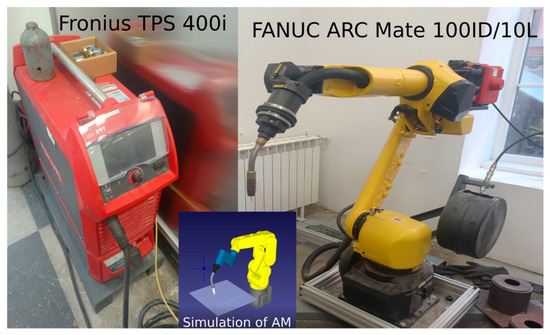
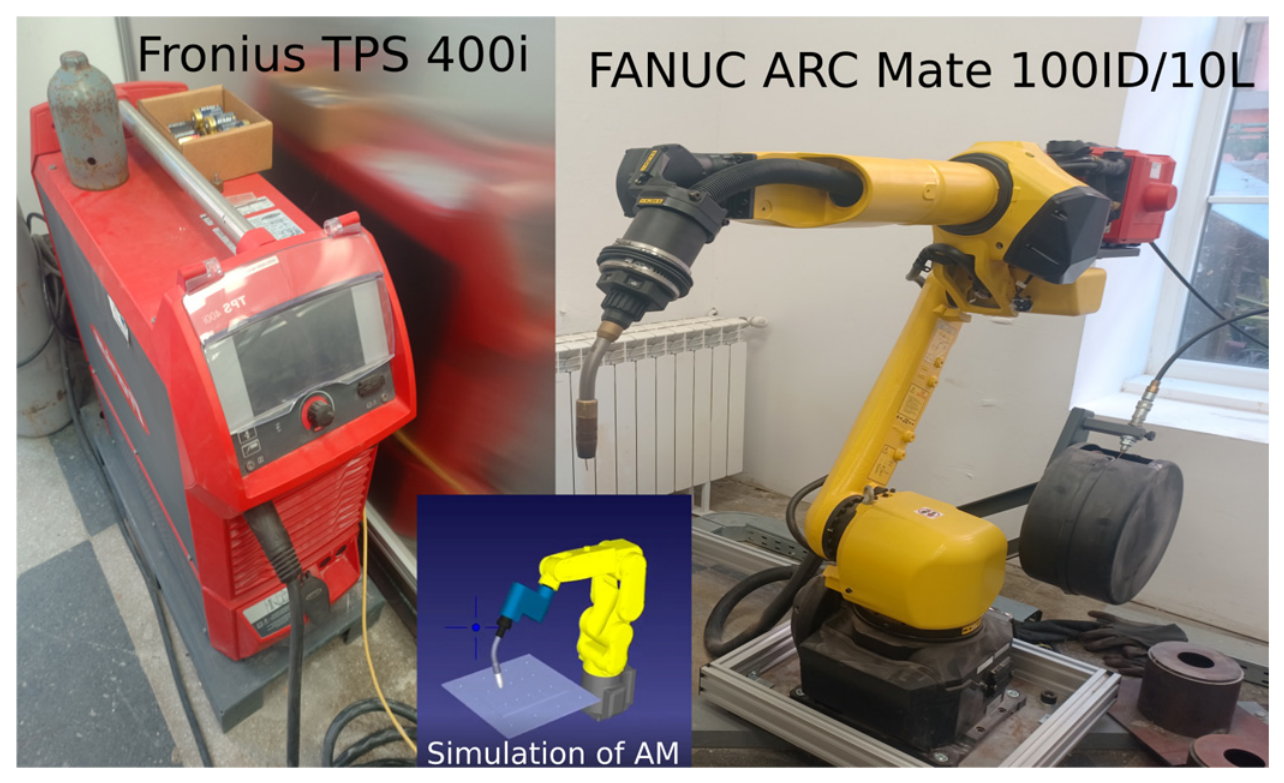
A simulation of the DED-Arc process was performed using the RoboDK Robot Development Kit for Standard Qualification Builds (SQB). The simulation adhered to the governing standards: AWS D2.0/D2.0M (Specification for Additive Manufacturing of Metal Components) and ISO/ASTM 52943-1 (aerospace requirements for DED-Arc) [23]. Due to the targeted thin-walled or single-pass procedure qualification [24,25], a minimum of 5 to 6 layers was required. The final height of the simulated build block was set to be at least 25 mm. Figure 1 presents the simulation results for the SQB fabrication, which were utilized to optimize process parameters and achieve the desired structural integrity.
Figure 1.
DED-Arc system with RoboDK Robot Development Kit simulation for AM aerospace structure build-up—general view.
Specific process parameters for the manufacturing were proposed and evaluated. The maximum heat input during the DED-Arc process is calculated to be below 0.7 kJ/mm (700 J/mm), in accordance with ISO 15614-1 standard [26]. The calculation was based on a welding voltage of approximately 15.6 V, a welding current of approximately 140 A and a torch travel speed of 250 mm/min. The thermal efficiency factor for the Cold Metal Transfer (CMT) process [27,28] using the Fronius TPS 400i power source was set to 0.8. Following the selection of the synergy parameters, strict control measurements were implemented to ensure that the total heat input did not exceed the 0.7 kJ/mm threshold, thereby preventing overheating of the austenitic stainless steel matrix.
3.2. Comparison of Corrosion Resistance Properties
The pitting resistance equivalent number (PREN) Avesta SMO 254 was calculated via the standard empirical formula (PREN = %Cr + 3.3 × %Mo + 16 × %N). Based on the metallurgical specification [5], the resulting PREN value is 42. In contrast, the leaner chemical composition of the 304L matrix commonly utilized in aerospace structures exhibits a significantly lower PREN rating from approximately 18–20, as defined by the limits in ASTM A240. This substantial difference highlights the superior resistance of Avesta SMO 254 to localized corrosion, particularly in aggressive environments. Superior chemical stability ensures the structural durability required for multi-mission spacecraft components, validating its potential for extensive reusability.
3.3. Mechanical Evaluation and Comparative Analysis
The mechanical integrity and quality of the Avesta SMO 254 deposits were evaluated though a comprehensive series of tests, including microhardness measurements, microcracking detection, porosity measurements, interface zone assessment and microstructural analysis. The process parameters were strictly controlled to maintain a maximum heat input of 0.7 KJ/mm, resulting in defect-free builds with a refined microstructure. These findings highlight the suitability of the DED-Arc process for manufacturing large-scale shell structures, offering significant mechanical advantages. Each representative sample underwent a rigorous sequence of non-destructive evaluation followed by destructive testing.
- Non-destructive testing (Visual Inspection)
Visual Inspection was conducted to assess surface quality, especially checking for layer sagging, excessive surface roughness and visible surface cracks. The inspection revealed no surface-breaking cracks or pores. The deposit exhibited a uniform, wavy bead pattern and no impermissible defects were observed, indicating high surface integrity.
- 2.
- Destructive Testing (Metallographic Examination)
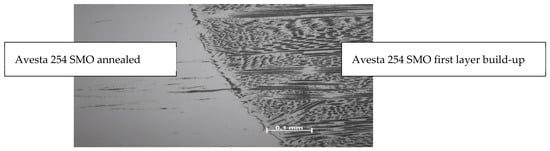
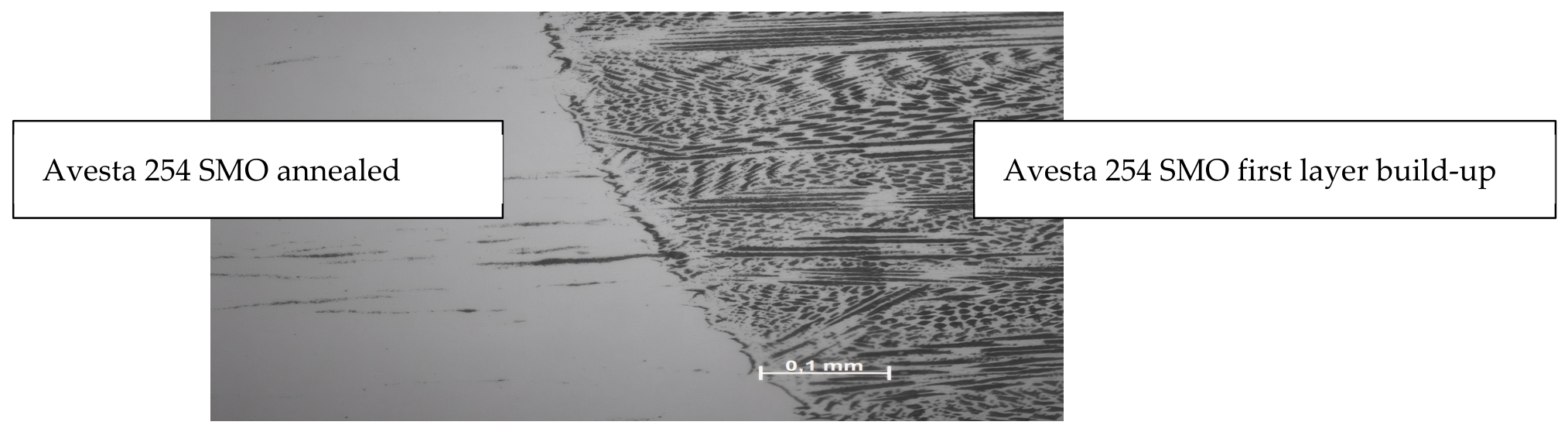
Metallographic analysis was performed to evaluate the internal structure. Cross-sections were prepared by cutting, polishing and chemically etching the samples to analyze the heat-affected zone, layer boundaries, grain growth and dilution zones. Figure 2 presents the microstructure of the substrate and the first deposited layer. The resulting microstructure is characterized by fine grains with some local molybdenum (Mo) segregation observed.
Figure 2.
Microstructure of Avesta SMO 254 in two zones—annealed and deposited first layer as viewed during metallographic analysis.
- 3.
- Destructive Testing (Hardness Mapping)
A vertical microhardness profile was measured from the base substrate through the center of the deposited layers to the top surface to assess hardness variations resulting from uneven cooling rates. For Avesta SMO 254 [29,30], the ambient temperature microhardness values ranged from 235 to 246 HV1. A critical advantage of this alloy is its ability to maintain structural integrity under high-temperature exposures typical of atmospheric re-entry conditions. To evaluate thermal stability, the AM sample was subjected to heat treatment at 1200 °C for 20 min. Under these conditions, Avesta SMO 254 retained a hardness of 168 ± 2 HV1. Although a reduction in hardness is noted, it is significantly less pronounced than that typically seen in standard austenitic stainless steels. For comparative purposes, the SpaceX 304L-Modified stainless steel exhibits hardness values ranging from 150 to 195 HV (equivalent to 80–92 HRB, as per ASTM E140) [18,19,20]. While the specific composition of SpaceX modifications remains proprietary, the academic literature confirms that heavily deformed or cold-rolled 304L stainless steel maintains baseline hardness and high energy absorption capabilities under ambient and cryogenic loads.
Research [31,32,33,34,35] indicates that combining DED with mechanical post-treatments like ultrasonic impact treatment or shot peening is superior to post-weld heat treatment for super-austenitic steels. Mechanical post-treatments avoid the risk associated with σ-phase precipitation and reheat cracking, while simultaneously strengthening the surface through grain refinement and introduction of beneficial compressive residual stresses. A comprehensive comparison of the mechanical properties of Avesta SMO 254 [36,37] and SpaceX 304L-Modified reveals distinct behaviors governed by their respective alloy chemistries and metallurgical processing histories. The comparative results are summarized in Table 2.
Table 2.
Mechanical properties comparison table between the Avesta SMO 254 and SpaceX 304L-Modified—as-built and post-processed.
In the as-built condition following additive manufacturing, the highly alloyed super-austenitic Avesta SMO 254 exhibits a microstructure characterized by cellular-dendritic growth. Rapid solidification induces significant micro-segregation of molybdenum at cell boundaries, which promotes the nucleation of secondary phases. Despite this chemical heterogeneity, as-built Avesta SMO 254 demonstrates robust mechanical properties, with a yield strength (σ0.2 >= 300 MPa) and a tensile strength (σm) ranging between 650 and 850 MPa [31]. This elevated baseline performance is primarily attributed to solid-solution strengthening driven by interstitial nitrogen and chromium within the face-centered cubic austenitic matrix. In contrast, the leaner composition of the 304L matrix typically used in aerospace structures exhibits lower baseline mechanical properties, with a yield strength (σ0.2 >= 210 MPa) and a tensile strength ranging from 520 to 620 MPa in its standard condition [33]. However, both materials exhibit exceptional capacity for plastic deformation and mechanical work hardening. When subjected to post-printing mechanical surface treatments—such as shot peening, ultrasonic shot peening or ultrasonic impact treatment—the surface mechanical properties of both alloys improve drastically. Cold-worked and surface-deformed Avesta SMO 254 experiences a profound increase in yield strength, reaching 600 to 850 MPa, while its ultimate tensile strength scales up to 850 to 1100 MPa, accompanied by a reduction in elongation (A5) to 10–20% and an increase in hardness to 325–380 HV [32]. Similarly, the SpaceX 304L-Modified grade relies heavily on severe cold-rolling and cryogenic strain-hardening strategies during fabrication. These processes enable the material to exceed a yield strength of 700 MPa and achieve a tensile strength above 900 MPa, with surface hardness reaching approximately 290–330 HV [34,35]. The potential for substituting these two alloys hinges on their distinct microstructural hardening mechanisms under deformation. The metastable SpaceX 304L-Modified hardens primarily through deformation-induced transformation of the austenite into hard martensite (γ to α’) [35]. Conversely, the highly alloyed Avesta SMO 254 remains in a stable face-centered cubic austenitic phase. Its hardening is achieved purely through intensive dislocation proliferation, cell wall refinement and planar slip [32]. Consequently, the application of hardening treatments immediately after AM [36,37] serves as an effective post-processing step. It introduces deep compressive residual stresses and mechanically homogenizes the segregated as-built surface layer without requiring conventional post-weld heat treatment.
4. Conclusions
The successful integration of stainless steel into AM processes significantly enhances the feasibility of multiple space missions. The advanced methodology not only ensures high-quality component fabrication but also enables the use of cost-effective metallic substitutes while extending service life.
Specifically, the combination of DED-arc with Avesta SMO 254, followed by ultrasonic impact treatment or shot peening, offers distinct advantages. Precise control of heat input during printing prevents dendrite coarsening, resulting in a hardness profile comparable to that of SpaceX 304L-Modified grade. This balance allows for the preservation of critical ductility, which is essential for withstanding cryogenic loading conditions. Further investigation is necessary to validate the scalability of this approach for larger-scale applications.
In conclusion, localized structural degradation can be effectively mitigated through post-processing via shot peening. This mechanical surface treatment induces beneficial compressive residual stresses and homogenizes the surface hardness, aligning it with the base metal hull. By preventing microcracking, this strategy ensures the structural integrity of pressure vessels operating under internal pressures exceeding 6 bar.
Funding
This research was funded by the European Regional Development Fund under the Operational Program “Scientific Research, Innovation and Digitization for Smart Transformation 2021–2027”, Project CoC “Smart Mechatronics, Eco- and Energy Saving Systems and Technologies”, BG16RFPR002-1.014-0005.
Institutional Review Board Statement
Not applicable.
Informed Consent Statement
Not applicable.
Data Availability Statement
The data is contained within the article.
Acknowledgments
The author would like to express gratitude to University “Prof. Dr. Assen Zlatarov” Burgas, Bulgaria, Technischen Universität Chemnitz, Germany and Open Laboratory on Experimental Micro and Nano Mechanics (OLEM), Bulgaria.
Conflicts of Interest
The author declares no conflicts of interest.
References
- Prisăcariu, E.G.; Dumitrescu, O.; Roșu, R.A. Additive Manufacturing in Space: Technologies, Flight Heritage, and Materials. Technologies 2026, 14, 165. [Google Scholar] [CrossRef] [Scilit]
- Su, X.; Zhang, P.; Huang, Y. Research Progress of Metal Additive Manufacturing Technology and Application in Space: A Review. Metals 2024, 14, 1373. [Google Scholar] [CrossRef] [Scilit]
- Dumitrescu, O.; Prisăcariu, E.G.; Roșu, R.A.; Cozzoni, E. Additive Manufacturing in Space: Process Physics, Qualification, and Future Directions. Technologies 2026, 14, 121. [Google Scholar] [CrossRef] [Scilit]
- Hoffmann, M.; Elwany, A. In-Space Additive Manufacturing: A Review. J. Manuf. Sci. Eng. 2023, 145, 020801. [Google Scholar]
- Liljas, M.; Wallen, B. Austenitic Stainless Steel Alloy with High Resistance to Pitting and Crevice Corrosion. U.S. Patent US4078921A, 14 March 1978. [Google Scholar]
- Kuehmann, C.J.; Cape, T.; Chevalier, J.; Judson, T.; McInerney, E. High Strength Austenitic Stainless Steel Alloys with Cryogenic Ductility. U.S. Patent US11753709B2, 12 September 2023. [Google Scholar]
- Kuehmann, C.J.; Cape, T.; Chevalier, J.; Judson, T.; McInerney, E. Austenitic Stainless Steel Alloys with High Cryogenic Strength and Toughness. U.S. Patent US20210087658A1, 25 March 2021. [Google Scholar]
- Malandruccolo, A.; Menapace, C.; Giroletti, I. Metallurgy, Properties and Applications of Superaustenitic Stainless Steels—SASSs. Metals 2025, 15, 241. [Google Scholar]
- Li, Y.; Zou, D.; Li, M.; Zhang, W.; Liang, J. Effect of cooling rate on segregation characteristics of 254SMO super austenitic stainless steel and pitting corrosion resistance under simulated flue gas desulfurization environment. J. Mater. Sci. 2023, 58, 4137–4149. [Google Scholar] [CrossRef] [Scilit]
- Graf, M.; Hälsig, A.; Höfer, K.; Awiszus, B.; Mayr, P. Thermo-Mechanical Modelling of Wire-Arc Additive Manufacturing (WAAM) of Semi-Finished Products. Metals 2018, 8, 1009. [Google Scholar] [CrossRef] [Scilit]
- Kloft, H.; Schmitz, L.P.; Müller, C.; Laghi, V.; Babovic, N.; Baghdadi, A. Experimental Application of Robotic Wire-and-Arc Additive Manufacturing Technique for Strengthening the I-Beam Profiles. Buildings 2023, 13, 366. [Google Scholar] [CrossRef] [Scilit]
- Feng, Y.; Fan, D. Investigating the Forming Characteristics of 316 Stainless Steel Fabricated through Cold Metal Transfer (CMT) Wire and Arc Additive Manufacturing. Materials 2024, 17, 2184. [Google Scholar] [CrossRef] [Scilit] [PubMed]
- Kumar Jain, S.; Murtaza, Q.; Singh, P. CMT Assisted Wire Arc Additive Manufacturing of SS 316L: Fabrication, Characterization, and Fractography. Arch. Metall. Mater. 2025, 70, 147–153. [Google Scholar] [CrossRef] [Scilit]
- Rahimi, A.; Yazdizadeh, M.; Pouranvari, M. CMT Wire-Arc Additive Manufacturing of High-Alloy Austenitic Stainless Steel: Microstructure-Properties Relationships. J. Mater. Res. Technol. 2025, 35, 881–891. [Google Scholar] [CrossRef] [Scilit]
- Cho, H.; Yoo, Y.-R.; Kim, Y.-S. Effect of Ultrasonic Shot Peening on Microstructure and Corrosion Properties of GTA-Welded 304L Stainless Steel. Crystals 2024, 14, 531. [Google Scholar] [CrossRef] [Scilit]
- Ma, G.; Zhao, G.; Li, Z.; Xiao, W. A path planning method for robotic wire and arc additive manufacturing of thin-walled structures with varying thickness. IOP Conf. Ser. Mater. Sci. Eng. 2019, 470, 012018. [Google Scholar] [CrossRef] [Scilit]
- Slavíček, J.; Franke, J.; Jaroš, J.; Koutný, D. Strategies for wire arc additive manufacturing of thin walls and overhangs. J. Mech. Sci. Technol. 2023, 37, 5529–5534. [Google Scholar] [CrossRef] [Scilit]
- Kumar, S.; Shahi, A.S. Effect of heat input on the microstructure and mechanical properties of gas tungsten arc welded AISI 304 stainless steel joints. Mater. Des. 2011, 32, 3617–3623. [Google Scholar] [CrossRef] [Scilit]
- Kim, J.-H.; Park, S.-B.; Kim, D.-H. Investigation of Impact Behavior of STS304L Steel Plate Under Cryogenic Conditions. Appl. Sci. 2025, 15, 3767. [Google Scholar] [CrossRef] [Scilit]
- Li, J.; Cheng, W.; Qin, W.; Chen, M.; Zhao, Y.; Li, Y.; Sun, Y.; Mao, Q. Cryogenic impact property of a high-strength-ductility 304L stainless steel with heterogeneous lamella structure. J. Mater. Res. Technol. 2023, 24, 1401–1409. [Google Scholar] [CrossRef] [Scilit]
- RoboDK Inc. RoboDK: Simulator for Robot Arms and Offline Programming. Available online: https://robodk.com/ (accessed on 22 May 2026).
- RoboDK Documentation. Robot Simulation and Offline Programming Application Examples: Welding and Additive Manufacturing. Available online: https://robodk.com/simulation (accessed on 22 May 2026).
- ISO/ASTM AWI 52943-1; Additive Manufacturing for Aerospace—Process Characteristics and Performance—Part 1: Standard Specification for Directed Energy Deposition Using Wire and Beam in Aerospace Applications. ISO: Geneva, Switzerland, 2023.
- Marcotte, J.; Mishra, S.; Wen, J.T. Robotic Wire Arc Additive Manufacturing With Variable Height Layers. IEEE/ASME Trans. Mechatron. 2025, 30, 2991–2998. [Google Scholar] [CrossRef] [Scilit]
- Raspall, F.; Araya, S.; Pazols, M.; Valenzuela, E.; Castillo, M.; Benavides, P. Wire Arc Additive Manufacturing for Widespread Architectural Application: A Review Informed by Large-Scale Prototypes. Buildings 2025, 15, 906. [Google Scholar] [CrossRef] [Scilit]
- ISO 15614-1; Specification and Qualification of Welding Procedures for Metallic Materials—Welding Procedure Test—Part 1: Arc and Gas Welding of Steels and Arc Welding of Nickel and Nickel Alloys. ISO: Geneva, Switzerland, 2017.
- Zeng, J.; Nie, W.; Li, X. The Influence of Heat Input on the Surface Quality of Wire and Arc Additive Manufacturing. Appl. Sci. 2021, 11, 10201. [Google Scholar] [CrossRef] [Scilit]
- Lee, S.H. CMT-Based Wire Arc Additive Manufacturing Using 316L Stainless Steel: Effect of Heat Accumulation on the Multi-Layer Deposits. Metals 2020, 10, 278. [Google Scholar] [CrossRef] [Scilit]
- Pu, E.; Zheng, W.; Xiang, J.; Song, Z.; Feng, H.; Zhu, Y. Hot Working Characteristic of Superaustenitic Stainless Steel 254SMO. Acta Metall. Sin. 2014, 27, 313–323. [Google Scholar] [CrossRef] [Scilit]
- Marin, R.; Combeau, H.; Zollinger, J.; Dehmas, M.; Rouat, B.; Lamontagne, A.; Cardinaux, D.; Lhenry-Robert, L. Solidification Path and Phase Transformation in Super-Austenitic Stainless Steel UNS S31254. IOP Conf. Ser. Mater. Sci. Eng. 2019, 529, 012008. [Google Scholar] [CrossRef] [Scilit]
- EN 10088-2; Stainless Steels—Part 2: Technical Delivery Conditions for Sheet/Plate and Strip of Corrosion Resisting Steels for General Purposes. CEN: Brussels, Belgium, 2014.
- Outokumpu Stainless AB. Handbook of Stainless Steels. Available online: https://www.outokumpu.com/en/expertise/2021/handbook-of-stainless-steel (accessed on 29 May 2026).
- ASTM A240/A240M; Standard Specification for Chromium and Chromium-Nickel Stainless Steel Plate, Sheet, and Strip for Pressure Vessels and for General Applications. ASTM International: West Conshohocken, PA, USA, 2020.
- World Steel Association. SpaceX Relies on Stainless Steel for Starship Mars Rocket: Cryogenic and Work-Hardening Modifications of 300-Series. Steel Stories. 2020. Available online: https://worldsteel.org/media/steel-stories/innovation/spacex-relies-on-stainless-steel-for-starship-mars-rocket/ (accessed on 29 May 2026).
- British Stainless Steel Association (BSSA). SpaceX Starship Material Selection: Cold-Rolling and Cryogenic Hardening of Modified 304L. Technical Report. 2021. Available online: https://bssa.org.uk/spacex-starship-is-made-of-stainless-steel/ (accessed on 29 May 2026).
- Matias, J.V.S.; Lourenço, M.J.C.; Jorge, J.C.F.; de Souza, L.F.G.; Farneze, H.N.; Mendes, M.C.; da Silva, C.L.A.; Araújo, L.S. Behavior of a superaustenitic stainless steel weld cladding deposited by the gas metal arc welding process. Mater. Today Commun. 2023, 34, 104978. [Google Scholar] [CrossRef] [Scilit]
- Fan, G.; Liu, J.; Zhang, G.; Li, Y.; Luo, G.; Lian, X.; Li, G. Multiple welding simulated microstructure and corrosion resistance of super austenitic stainless steel 254SMo welding heat affected zone. Int. J. Comput. Mater. Sci. Surf. Eng. 2020, 9, 51–64. [Google Scholar] [CrossRef] [Scilit]

Disclaimer/Publisher’s Note: The statements, opinions and data contained in all publications are solely those of the individual author(s) and contributor(s) and not of MDPI and/or the editor(s). MDPI and/or the editor(s) disclaim responsibility for any injury to people or property resulting from any ideas, methods, instructions or products referred to in the content. |
© 2026 by the author. Licensee MDPI, Basel, Switzerland. This article is an open access article distributed under the terms and conditions of the Creative Commons Attribution (CC BY) license.