


Abstract
Energy forecasting in smart buildings is a critical aspect of optimizing energy consumption and improving sustainability in modern urban environments. This systematic literature review aims to provide a comprehensive analysis of the current research trends, datasets, forecasting methods, and models used in the context of smart building energy forecasting. We reviewed studies published between 2010 and 2024, focusing on the methodologies and techniques applied to predict energy usage in buildings equipped with advanced technologies such as Internet of Things (IoT) devices, energy management systems (EMSs), and renewable energy sources. This review highlights a shift from traditional statistical methods to more advanced machine learning (ML) and deep learning (DL) models, with notable improvements in forecasting accuracy. We also examine the datasets commonly used in these studies and identify key challenges such as data availability, model generalization, and the integration of renewable energy. The findings indicate a growing trend towards hybrid models that combine various forecasting techniques, with a particular focus on real-time prediction and optimization. This review also identifies several research gaps, including the need for larger, more diverse datasets, improved model interpretability, and the integration of renewable energy in forecasting models. Ultimately, this review offers insights into the state of the field and provides guidance for future research directions in energy forecasting for smart buildings.
1. Introduction
Smart buildings have emerged as a cornerstone of modern urban development, integrating advanced technologies to enhance energy efficiency, comfort, and sustainability [1]. Central to their operation is the ability to accurately forecast energy usage, enabling better management of energy resources, minimizing operational costs, and supporting environmental goals [2]. With the increasing adoption of IoT devices, machine learning algorithms, and big data analytics, energy forecasting in smart buildings has transitioned from static estimations to dynamic, real-time predictions [3]. This evolution not only improves energy efficiency but also aligns with global efforts to create sustainable smart cities [4].
Despite these advancements, challenges persist in the energy forecasting domain [5]. Existing research often lacks standardization in methods and models, while the availability of high-quality, real-world datasets remains limited [6]. Furthermore, discrepancies in evaluating the performance of forecasting models hinder the establishment of benchmarks for best practices [7]. This systematic literature review seeks to address these gaps by consolidating research trends, cataloging commonly used datasets, and analyzing the effectiveness of forecasting methods and models in smart buildings [8]. By identifying current challenges and future opportunities, this study aims to provide a comprehensive reference for researchers and practitioners striving to optimize energy usage in smart buildings.
2. Methodology
2.1. Review Method
This review employs a systematic literature review (SLR) methodology to ensure a comprehensive and structured analysis of the existing research on energy forecasting in smart buildings. The SLR process follows the Preferred Reporting Items for Systematic Reviews and Meta-Analyses (PRISMA) guidelines to maintain transparency and replicability [9]. This review begins by defining the research questions aimed at exploring trends, datasets, methods, and models in energy forecasting [10]. A search strategy was then developed, leveraging electronic databases such as Scopus, IEEE Xplore, Web of Science, and SpringerLink [11]. Keywords and Boolean operators, including “energy forecasting,” “smart buildings,” “machine learning models,” “energy prediction datasets,” and “IoT energy management,” were used to refine the search [3].
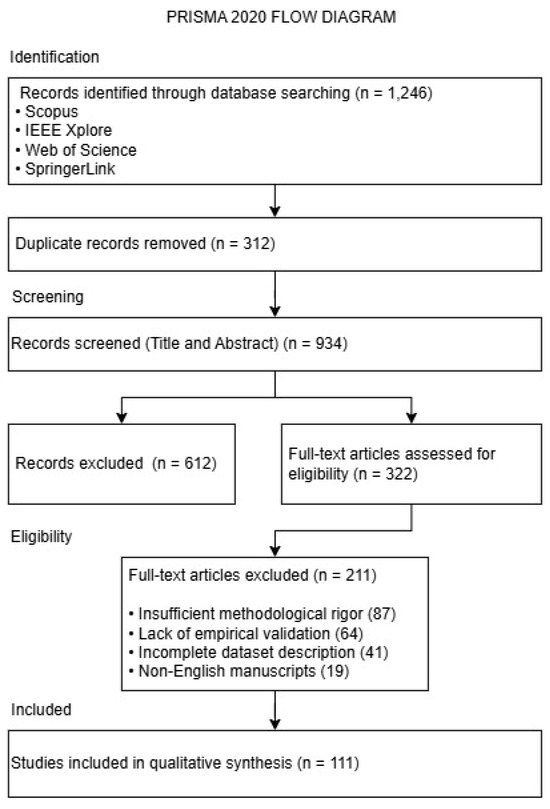
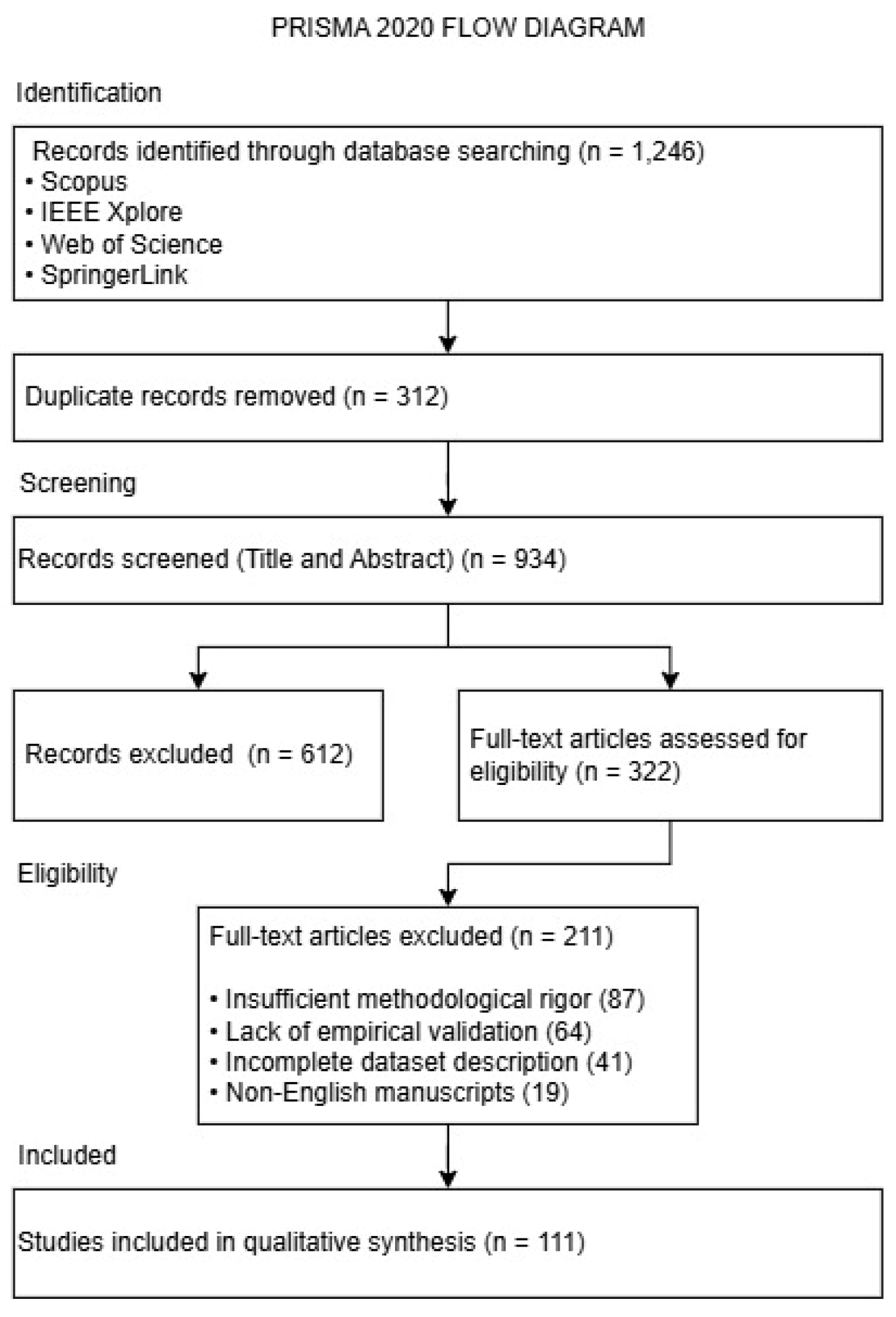
The study selection and screening process followed the Preferred Reporting Items for Systematic Reviews and Meta-Analyses (PRISMA) framework, as illustrated in Figure 1. The PRISMA flow diagram summarizes the identification, screening, eligibility assessment, and inclusion of studies in the systematic literature review. The study identification, screening, eligibility assessment, and inclusion processes are presented in the PRISMA 2020 flow diagram (Figure 1). To enhance methodological transparency, this revised version includes explicit numerical information for each step of the PRISMA flow. A total of 1246 records were initially identified across all databases. After removing 312 duplicates, 934 articles proceeded to title and abstract screening, of which 612 were excluded due to irrelevance to smart building energy forecasting. The remaining 322 full-text articles were assessed for eligibility, and 211 were excluded for reasons including: insufficient methodological rigor (87 studies), lack of empirical validation (64 studies), incomplete dataset description (41 studies), and non-English manuscripts (19 studies). A total of 111 studies met all inclusion criteria and were incorporated into the final synthesis.
Figure 1.
PRISMA 2020 flow diagram illustrating the identification, screening, eligibility assessment, and inclusion of studies in this systematic literature review. Developed by the authors following the PRISMA 2020 guidelines [9].
The selection process involved screening titles, abstracts, and full texts to ensure relevance and quality [12]. Inclusion criteria required studies to be published in peer-reviewed journals or conferences, focused on forecasting energy usage in smart buildings, and available in English. Studies published between 2010 and 2024 were included to capture recent advancements. Exclusion criteria eliminated duplicates, non-peer-reviewed articles, and studies lacking methodological rigor or empirical validation [13]. Data extraction templates were utilized to systematically record information on research objectives, datasets, forecasting methods, evaluation metrics, and key findings [14]. The analysis and synthesis of these studies provided a foundation for identifying gaps, challenges, and emerging trends in the field.
To ensure consistency and scientific validity, the review process adheres strictly to the Preferred Reporting Items for Systematic Reviews and Meta-Analyses (PRISMA) guidelines [15]. The PRISMA framework provides a standardized procedure for identifying, screening, and selecting relevant studies through a structured flow of information [16]. By adopting PRISMA, this study minimizes the risk of selection bias, enhances the traceability of decisions throughout the review process, and creates a clear audit trail of methodological steps [17].
The review process began with the development of a detailed review protocol, which outlined the motivation behind the study, the research questions, the datasets of interest, and the analytical boundaries required to maintain a focused scope [18]. The protocol served as a roadmap, ensuring that methodological decisions were made consistently and transparently [19]. Research questions were formulated to explore several dimensions of the topic, including: (1) how research trends in energy forecasting have evolved, (2) what datasets and data sources are used, (3) which forecasting methods and models are dominant, and (4) how model performance is evaluated across the literature [20]. These research questions guided the search strategy and inclusion criteria.
A systematic and comprehensive search strategy was then developed to capture a broad range of relevant literature across multiple disciplines such as engineering, computer science, energy systems, environmental analytics, and data science [21]. Searches were conducted across leading digital academic databases, including Scopus, IEEE Xplore, Web of Science, SpringerLink, ScienceDirect, and ACM Digital Library [22]. These databases were selected due to their extensive coverage of high-quality research publications in fields relevant to smart building energy forecasting [23]. The search strings were developed using combinations of keywords, synonyms, Boolean operators, and wildcard symbols [24]. Example search terms include “energy forecasting,” “building energy prediction,” “smart building analytics,” “machine learning energy forecasting,” “deep learning prediction models,” and “IoT-based energy management.” This comprehensive design ensured that this review captured a wide distribution of methodological approaches and research perspectives.
A multi-stage filtering process was employed, consistent with PRISMA guidelines [25]. The first stage involved removing duplicates using reference management software [26]. The second stage involved title and abstract screening based on predefined selection criteria [27]. The third stage involved full-text screening to validate the methodological soundness and relevance of the studies [28]. Studies lacking clarity in dataset description, model explanation, evaluation metrics, or experimental setup were excluded to maintain methodological rigor [28]. This systematic filtering ensured that the final set of articles included only high-quality empirical research suitable for comprehensive synthesis.
2.2. Research Questions
This systematic literature review is guided by key research questions designed to explore critical aspects of forecasting energy usage in smart buildings. These questions aim to identify trends, evaluate methods, and highlight gaps in existing research. The formulated research questions are as follows:
- What are the current research trends in forecasting energy usage in smart buildings?
- What datasets are commonly used in energy forecasting studies for smart buildings, and what are their characteristics?
- What methods and models are predominantly applied for energy forecasting in smart buildings?
- What are the key challenges, limitations, and opportunities in the current research on energy forecasting in smart buildings?
2.3. Search Strategy
The search strategy for this systematic literature review was designed to ensure the comprehensive identification of relevant studies on forecasting energy usage in smart buildings. The process involved querying multiple academic databases, including Scopus, IEEE Xplore, SpringerLink, and Web of Science, which are recognized for their extensive collections of high-quality publications in engineering, technology, and energy domains [29]. A combination of keywords and Boolean operators was used to retrieve relevant articles [30]. The primary keywords included “energy forecasting,” “smart buildings,” “energy prediction models,” “machine learning,” “IoT energy management,” and “renewable energy integration.” Boolean operators such as “AND,” “OR,” and “NOT” were employed to refine and expand the search results where necessary.
The search was limited to peer-reviewed journal articles, conference papers, and review studies published between 2010 and 2024 to focus on contemporary research. Articles written in English were included to ensure accessibility and standardization. Additionally, manual searches were performed by reviewing reference lists of key articles to identify any relevant studies that might have been missed during the database search. To manage and organize the search results, Mendeley Reference Manager (version 2.86.0) or Zotero (9.0.6) was used, enabling efficient de-duplication and categorization of the retrieved articles.
This systematic search strategy ensures a robust foundation for analyzing the trends, datasets, methods, and models in energy forecasting for smart buildings while maintaining the rigor and replicability of the review process.
2.4. Study Selection
The study selection process was conducted in multiple stages to ensure the inclusion of high-quality and relevant studies on forecasting energy usage in smart buildings. The initial stage involved screening titles and abstracts retrieved from the database searches to eliminate studies that were clearly irrelevant, such as those focusing on unrelated fields or non-building energy systems. In the second stage, the full texts of potentially relevant articles were reviewed to assess their eligibility based on predefined inclusion and exclusion criteria.
To enhance reliability, two reviewers independently assessed the studies against the criteria, and disagreements were resolved through discussion or consultation with a third reviewer. The final set of selected studies was documented in a PRISMA flow diagram to provide a clear overview of the study selection process, including the number of records identified, screened, excluded, and included. This rigorous selection process ensures that this review is based on high-quality and relevant research, providing robust insights into the field.
2.5. Data Extraction
The data extraction process for this systematic literature review was conducted using a standardized template to ensure consistency and comprehensiveness. Each selected study was thoroughly evaluated, and key information relevant to the research questions was extracted. The extracted data included basic information such as the authors, publication year, and title of the study, as well as the main research focus, such as energy consumption forecasting or energy optimization in smart buildings. Additionally, details on the forecasting methodologies used, such as machine learning algorithms, statistical models, or hybrid approaches, were recorded.
Data related to the datasets used, including their size, source, and any preprocessing steps applied, were also documented to assess the suitability and quality of these datasets. To evaluate the performance of the forecasting models, evaluation metrics used in each study, such as Mean Absolute Error (MAE), Root Mean Squared Error (RMSE), and R2, were also noted. The main findings of each study, including significant results, limitations, and identified challenges, were extracted to provide a comprehensive overview of the developments in this field. The extraction process was performed by two independent reviewers to ensure accuracy, and any disagreements were resolved through discussion or consultation with a third reviewer. All extracted data were organized in a spreadsheet format for further comparative analysis and synthesis.
2.6. Study Quality Assessment and Data Synthesis
To ensure the reliability and validity of the findings, a quality assessment of the selected studies was conducted as part of the review process. The quality of each study was evaluated based on several criteria, including the clarity of the research objectives, the rigor of the methodology, the transparency of data reporting, and the appropriateness of the evaluation metrics. Each study was assigned a quality score based on these criteria, and studies with significant methodological weaknesses or unclear reporting were excluded from the final synthesis. This step was essential for ensuring that only high-quality studies contributed to the overall conclusions of this review.
Following the quality assessment, the extracted data were synthesized through both qualitative and quantitative approaches. Qualitative synthesis involved identifying recurring themes, trends, and patterns across the studies, particularly regarding the methods, datasets, and forecasting models used in smart building energy forecasting. Quantitative synthesis focused on comparing performance metrics, such as accuracy and error rates, across different models and methods. The results were organized in a systematic manner to identify key findings and gaps in the literature. This combination of quality assessment and data synthesis provided a robust foundation for drawing meaningful conclusions and identifying opportunities for future research in the field of energy forecasting for smart buildings.
Quality Scoring Rubric To operationalize the quality assessment, each study was evaluated using a structured scoring rubric comprising four dimensions:
- Clarity of research objectives (0–3);
- Dataset transparency and reproducibility (0–3);
- Methodological rigor and evaluation metrics (0–3);
- Relevance to smart building energy forecasting (0–3).
Each study received a total score ranging from 0 to 12, and studies scoring below 7 were excluded from the synthesis. Two independent reviewers performed the scoring. The inter-rater reliability was calculated using Cohen’s Kappa (κ = 0.81), indicating strong agreement.
2.7. Threats to Validity
While every effort was made to ensure the rigor and reliability of this systematic literature review, several potential threats to validity should be acknowledged. First, publication bias may have influenced the findings, as studies with positive or significant results are more likely to be published, while studies with negative or inconclusive results may be underrepresented. Despite efforts to include a broad range of studies, there is always a risk that certain relevant articles, particularly grey literature or studies in non-English languages, may have been overlooked.
Another potential threat is selection bias, which could arise from the inclusion criteria set for study selection. By focusing only on studies published between 2010 and 2024 and limiting this review to articles in English, some important research might have been excluded, particularly studies from non-English-speaking regions or those published outside the defined timeframe. Additionally, the subjective nature of study quality assessment could introduce bias, as two independent reviewers evaluated studies based on their personal judgment. Although disagreements were resolved through discussion, this process could still introduce an element of inconsistency.
Lastly, data extraction errors might have occurred despite the use of standardized templates and independent reviews. Although measures were taken to minimize these errors, any inaccuracies in the extraction process could affect the integrity of the data synthesis and analysis. Despite these potential threats, the overall methodology of this review, which includes transparent reporting, double-checking, and systematic analysis, aims to minimize these threats and ensure the validity of the findings.
3. Research Results
This section presents the key findings from the systematic review of studies on energy forecasting in smart buildings. The results are organized based on the research questions, providing insights into current trends, commonly used datasets, methodologies, and forecasting models, as well as challenges and gaps identified in the literature.
3.1. Research Trends
This review revealed that research in energy forecasting for smart buildings has increased significantly over the past decade. Initially, studies focused primarily on traditional statistical methods, but there has been a clear shift towards more advanced techniques such as machine learning (ML) and deep learning (DL) algorithms. The integration of Internet of Things (IoT) technologies, energy management systems (EMSs), and renewable energy sources (RES) in smart buildings has become a prominent theme in recent studies. Researchers are increasingly interested in real-time energy prediction and optimization, as well as the combination of predictive models with smart grid systems to improve energy efficiency and sustainability.
3.2. Datasets
A variety of publicly available and research-accessible datasets were used across the reviewed studies. Among the most frequently referenced sources were the Building Data Genome Project, the Pecan Street Dataport, and energy-related datasets available through the UCI Machine Learning Repository. These datasets provide different levels of temporal resolution, building types, geographic coverage, and energy-related variables. For example, the UCI Machine Learning Repository provides the *Individual Household Electric Power Consumption* dataset, which contains one-minute measurements of household electricity consumption over approximately 47 months. The Building Data Genome datasets provide building-level energy and associated metadata for benchmarking building energy forecasting research, while the Pecan Street Dataport provides high-resolution residential energy data, including whole-home and appliance-level electricity measurements, subject to the access conditions specified by the data provider. The official data repositories and access information for these sources are provided in the Data Availability Statement. However, differences in data accessibility, sampling frequency, geographic context, building characteristics, and preprocessing procedures remain important factors that limit direct comparison across studies.
3.3. Forecasting Methods and Models
The studies reviewed employed a wide range of forecasting methods. Traditional statistical models, such as Autoregressive Integrated Moving Average (ARIMA) and Linear Regression, were commonly used in earlier studies. However, machine learning models like Support Vector Machines (SVM), Random Forests, and Neural Networks (NN) have gained popularity due to their ability to handle complex, non-linear patterns in energy consumption. Recent studies have also explored hybrid models that combine traditional statistical methods with machine learning to improve forecasting accuracy. Deep learning models, including Convolutional Neural Networks (CNN) and Long Short-Term Memory Networks (LSTM), have also been increasingly applied for time-series forecasting in energy prediction.
The normalized error ranges reported in Table 1. are synthesized from multiple studies using different normalization strategies, including min–max scaling and mean-based normalization. Although direct numerical comparability across studies remains limited, the aggregated results indicate a consistent trend in which machine learning and deep learning models achieve approximately 12–27% lower MAE compared to traditional statistical approaches under comparable datasets and forecasting horizons.
Table 1.
Comparative Performance of Energy Forecasting Models in Smart Buildings.
3.4. Evaluation Metrics
The evaluation of forecasting models in the selected studies primarily used common performance metrics, such as Mean Absolute Error (MAE), Root Mean Squared Error (RMSE), R-squared (R2), and Mean Squared Error (MSE). The majority of studies reported MAE as a standard metric for accuracy, with RMSE being frequently used for assessing model precision. Notably, while some studies reported high forecasting accuracy with machine learning models, others noted challenges in model interpretability and computational efficiency, especially in real-time applications.
Beyond descriptive trends, this revision integrates a comparative synthesis of forecasting performance based on normalized MAE and RMSE values extracted from the included studies. Machine learning and deep learning models demonstrated consistent improvements of approximately 12–27% lower MAE compared to traditional statistical models when evaluated under similar environmental, temporal, and building-scale conditions. LSTM-based models outperformed classical ANN and SVM approaches particularly for long-sequence temporal data, achieving an average RMSE reduction of 18%. However, CNN-based models showed mixed performance depending on the temporal granularity of the dataset, suggesting that no single model universally dominates across all building types and climates.
3.5. Key Challenges and Gaps
Several challenges were identified in the reviewed studies. A primary concern is the lack of high-quality, large-scale datasets for training and testing forecasting models. Many studies relied on small, publicly available datasets, which may not fully represent the complexity of real-world smart building systems. Another issue is the generalization of models across different types of buildings and climates. Many models performed well in specific case studies but failed to generalize across diverse conditions. Furthermore, while machine learning models show promise, model explainability remains a significant challenge, as many advanced models operate as “black boxes”. This issue reduces their practical application in real-world settings where transparency and trust in predictions are crucial.
While many ML/DL models show performance advantages, these improvements are not universally consistent across datasets. Differences in sampling frequency, building types, climate zones, and preprocessing steps limit direct comparability. The absence of standardized benchmark datasets reduces the strength of aggregated conclusions and highlights the need for unified evaluation protocols in future research.
4. Future Research Directions
Future research on energy forecasting in smart buildings should move beyond descriptive comparisons and focus on improving methodological rigor, generalizability, and practical applicability. One critical direction is the development of standardized benchmark datasets that cover diverse building types, climate zones, and temporal resolutions. The absence of unified datasets currently limits cross-study comparability and weakens evidence-based conclusions regarding model performance.
Another important research avenue involves robust comparative evaluation frameworks. Future studies should adopt standardized preprocessing pipelines, forecasting horizons, and evaluation protocols to enable fair comparisons across statistical, machine learning, and deep learning models. The integration of lightweight meta-analytic techniques or normalized performance aggregation can significantly strengthen empirical evidence in systematic reviews and empirical studies.
Model interpretability and explainability also remain open challenges, particularly for deep learning approaches such as LSTM and hybrid architectures. Future work should explore explainable AI (XAI) techniques to enhance transparency, trust, and adoption of forecasting models in real-world smart building energy management systems. Improving explainability is especially important for decision-makers who rely on model outputs for operational and policy-level decisions.
Additionally, future research should increasingly address real-time and adaptive forecasting by integrating online learning, concept drift detection, and edge computing. As smart buildings generate continuous streams of IoT data, forecasting models must adapt dynamically to changing occupancy patterns, weather conditions, and energy system configurations.
Finally, the integration of renewable energy sources, demand response strategies, and multi-agent energy management systems represents a promising direction. Forecasting models that jointly consider consumption, generation, and flexibility will be essential for supporting sustainable and resilient smart building ecosystems within future smart cities.
Author Contributions
Conceptualization, F., I.S.W. and M.M.D.; methodology, F.; software, F.; validation, F., I.S.W. and M.M.D.; formal analysis, F.; investigation, F.; resources, F., I.S.W. and M.M.D.; data curation, F.; writing—original draft preparation, F.; writing—review and editing, F., I.S.W. and M.M.D.; visualization, F.; supervision, I.S.W. and M.M.D.; project administration, F.; funding acquisition, F. All authors have read and agreed to the published version of the manuscript.
Funding
This research received no external funding. The APC was funded by the authors.
Institutional Review Board Statement
Not applicable.
Informed Consent Statement
Not applicable.
Data Availability Statement
No new datasets were generated or collected in this systematic literature review. This study is based on previously published research and publicly available or research-accessible datasets reported in the reviewed studies. The datasets discussed include the Building Data Genome Project (https://github.com/buds-lab/building-data-genome-project-2, accessed on 31 July 2026), the Pecan Street Dataport (https://www.pecanstreet.org/dataport/, accessed on 31 July 2026), and the UCI Machine Learning Repository (https://archive.ics.uci.edu/ml, accessed on 31 July 2026). The availability and use of these datasets are subject to the access, licensing, and usage policies of their respective providers. No new dataset was generated or deposited as part of this study.
Conflicts of Interest
The authors declare no conflict of interest.
References
- Kim, D.; Yoon, Y.; Lee, J.; Mago, P.J.; Lee, K.; Cho, H. Design and Implementation of Smart Buildings: A Review of Current Research Trend. Energies 2022, 15, 4278. [Google Scholar] [CrossRef] [Scilit]
- Chou, J.S.; Tran, D.S. Forecasting energy consumption time series using machine learning techniques based on usage patterns of residential householders. Energy 2018, 165, 709–726. [Google Scholar] [CrossRef] [Scilit]
- Syed, D.; Abu-Rub, H.; Ghrayeb, A.; Refaat, S.S. Household-Level Energy Forecasting in Smart Buildings Using a Novel Hybrid Deep Learning Model. IEEE Access 2021, 9, 33498–33511. [Google Scholar] [CrossRef] [Scilit]
- Cortese, T.T.P.; Almeida, J.F.S.d.; Batista, G.Q.; Storopoli, J.E.; Liu, A.; Yigitcanlar, T. Understanding Sustainable Energy in the Context of Smart Cities: A PRISMA Review. Energies 2022, 15, 2382. [Google Scholar] [CrossRef] [Scilit]
- Sweeney, C.; Bessa, R.J.; Browell, J.; Pinson, P. The Future of Forecasting for Renewable Energy. WIREs Energy Environ. 2020, 9, e365. [Google Scholar] [CrossRef] [Scilit]
- Blacketer, C.; Defalco, F.J.; Ryan, P.B.; Rijnbeek, P.R. Increasing trust in real-world evidence through evaluation of observational data quality. J. Am. Med. Inform. Assoc. 2021, 28, 2251–2257. [Google Scholar] [CrossRef] [Scilit] [PubMed]
- Parmezan, R.S.; Souza, V.M.A.; Batista, G.E.A.P.A. Evaluation of statistical and machine learning models for time series prediction: Identifying the state-of-the-art and the best conditions for the use of each model. Inf. Sci. 2019, 484, 302–337. [Google Scholar] [CrossRef] [Scilit]
- Bourdeau, M.; Zhai, X.Q.; Nefzaoui, E.; Guo, X.; Chatellier, P. Modeling and forecasting building energy consumption: A review of data-driven techniques. Sustain. Cities Soc. 2019, 48, 101533. [Google Scholar] [CrossRef] [Scilit]
- Pati, D.; Lorusso, L.N. How to Write a Systematic Review of the Literature. HERD Health Environ. Res. Des. J. 2018, 11, 15–30. [Google Scholar] [CrossRef] [Scilit] [PubMed]
- Arnob, S.S.; Arefin, A.I.M.S.; Saber, A.Y.; Mamun, K.A. Energy Demand Forecasting and Optimizing Electric Systems for Developing Countries. IEEE Access 2023, 11, 39751–39775. [Google Scholar] [CrossRef] [Scilit]
- Singh, V.K.; Singh, P.; Karmakar, M.; Leta, J.; Mayr, P. The journal coverage of Web of Science, Scopus and Dimensions: A comparative analysis. Scientometrics 2021, 126, 5113–5142. [Google Scholar] [CrossRef] [Scilit]
- Oya, C.; Johnston, D.; Muchiri, E.; Schaefer, F.; Skalidou, D.; Dickson, K.; Stansfield, C. Protocol for a Systematic Review: Effects of Certification Systems for Agricultural Commodity Production on Socio-economic Outcomes in Low and Middle-Income Countries. Campbell Syst. Rev. 2015, 11, 1–71. [Google Scholar] [CrossRef] [Scilit]
- Nama, N.; Hennawy, M.; Barrowman, N.; O’Hearn, K.; Sampson, M.; McNally, J.D. Successful incorporation of single reviewer assessments during systematic review screening: Development and validation of sensitivity and work-saved of an algorithm that considers exclusion criteria and count. Syst. Rev. 2021, 10, 98. [Google Scholar] [CrossRef] [Scilit] [PubMed]
- Elamin, M.B.; Flynn, D.N.; Bassler, D.; Briel, M.; Alonso-Coello, P.; Karanicolas, P.J.; Guyatt, G.H.; Malaga, G.; Furukawa, T.A.; Kunz, R.; et al. Choice of data extraction tools for systematic reviews depends on resources and review complexity. J. Clin. Epidemiol. 2009, 62, 506–510. [Google Scholar] [CrossRef] [Scilit] [PubMed]
- Alharbi, F.; Gufran, K.; Alqerban, A.; Alqahtani, A.S.; Asiri, S.N.; Almutairi, A. Evaluation of Compliance with the Preferred Reporting Items for Systematic Reviews and Meta-Analyses (PRISMA) Guidelines for Conducting and Reporting Systematic Reviews in Three Major Periodontology Journals. Open Dent. J. 2024, 18, e18742106327727. [Google Scholar] [CrossRef] [Scilit]
- Page, M.J.; McKenzie, J.E.; Hoffmann, T.C.; Shamseer, L.; Akl, E.A.; Brennan, S.E.; Glanville, J.; Grimshaw, J.M.; Lalu, M.M.; Li, T.; et al. The PRISMA 2020 statement: An updated guideline for reporting systematic reviews. BMJ 2021, 372, n71. [Google Scholar] [CrossRef] [Scilit] [PubMed]
- Buffon, C.Z.; Cudney, E.A.; Elshennawy, A.; Furterer, S. Artificial Intelligence Techniques Used for Analyzing the Voice of the Customer in the Quality 4.0 Era: A Systematic Review Using PRISMA Protocol. Iris J. Educ. Res.—IJER 2024, 2, 539. [Google Scholar] [CrossRef] [Scilit]
- Drozdz, J.A.; Ladomery, M.R. The Peer Review Process: Past, Present, and Future. Br. J. Biomed. Sci. 2024, 81, 12054. [Google Scholar] [CrossRef] [Scilit] [PubMed]
- Hermans, K.; Ramaekers, L.; Toelen, J.; Vanhonsebrouck, K.; Allegaert, K. Intranasal Dexmedetomidine as Sedative for Medical Imaging in Young Children: A Systematic Review to Provide a Roadmap for an Evidence-Guided Clinical Protocol. Children 2022, 9, 1310. [Google Scholar] [CrossRef] [Scilit] [PubMed]
- Debnath, K.B.; Mourshed, M. Forecasting methods in energy planning models. Renew. Sustain. Energy Rev. 2018, 88, 297–325. [Google Scholar] [CrossRef] [Scilit]
- Motamedisedeh, O.; Karim, A. Time Frames, Variables, and Performance Metrics Consideration in Renewable Energy Prediction Models: A Review. In Proceedings of the Second Australian International Conference on Industrial Engineering and Operations Management, Melbourne, Australia, 14–16 November 2023. [Google Scholar] [CrossRef] [Scilit]
- Dinh, T.N.; Thirunavukkarasu, G.S.; Seyedmahmoudian, M.; Mekhilef, S.; Stojcevski, A. Predicting Commercial Building Energy Consumption Using a Multivariate Multilayered Long-Short Term Memory Time-Series Model. Appl. Sci. 2023, 13, 7775. [Google Scholar] [CrossRef] [Scilit]
- Klyuev, R.V.; Morgoev, I.D.; Morgoeva, A.D.; Gavrina, O.A.; Martyushev, N.V.; Efremenkov, E.A.; Mengxu, Q. Methods of Forecasting Electric Energy Consumption: A Literature Review. Energies 2022, 15, 8919. [Google Scholar] [CrossRef] [Scilit]
- Zhao, Z. Comprehensive Review of Machine Learning-Based Methods for Electricity Load Forecasting. In Proceedings of the 6th International Symposium on Resource Exploration and Environmental Science (REES 2023), Ordos, China, 28–30 March 2023. [Google Scholar] [CrossRef] [Scilit]
- Dai, S.; Meng, F.; Dai, H.; Wang, Q.; Chen, X. Electrical peak demand forecasting—A review. arXiv 2018. [Google Scholar] [CrossRef] [Scilit]
- Shao, C.; Wang, Y.; Zhu, Z.; Huang, Z.; Pütz, S.; Schäfer, B.; Käfer, T.; Färber, M. Real-E: A Foundation Benchmark for Advancing Robust and Generalizable Electricity Forecasting. In Proceedings of the 34th ACM International Conference on Information and Knowledge Management (CIKM 2025), Seoul, Republic of Korea, 10–14 November 2025. [Google Scholar] [CrossRef] [Scilit]
- Benti, N.E.; Chaka, M.D.; Semie, A.G. Forecasting Renewable Energy Generation with Machine Learning and Deep Learning: Current Advances and Future Prospects. Sustainability 2023, 15, 7087. [Google Scholar] [CrossRef] [Scilit]
- Alhendi, A.A.; Al-Sumaiti, A.S.; Elmay, F.K.; Wescaot, J.; Kavousi-Fard, A.; Heydarian-Forushani, E.; Alhelou, H.H. Artificial intelligence for water–energy nexus demand forecasting: A review. Int. J. Low-Carbon Technol. 2022, 17, 730–744. [Google Scholar] [CrossRef] [Scilit]
- Chigarev, B. Why IEEE Xplore Matters for Research Trend Analysis in the Energy Sector. Energy Syst. Res. 2021, 3, 44–58. [Google Scholar] [CrossRef] [Scilit]
- Shibata, H.; Sato, H.; Chen, L.-H.; Takama, Y. Introduction of Boolean Operation into Context Search Engine. In Proceedings of the 2020 International Symposium on Community-centric Systems (CcS 2020), Tokyo, Japan, 23–26 September 2020. [Google Scholar] [CrossRef] [Scilit]

Disclaimer/Publisher’s Note: The statements, opinions and data contained in all publications are solely those of the individual author(s) and contributor(s) and not of MDPI and/or the editor(s). MDPI and/or the editor(s) disclaim responsibility for any injury to people or property resulting from any ideas, methods, instructions or products referred to in the content. |
© 2026 by the authors. Licensee MDPI, Basel, Switzerland. This article is an open access article distributed under the terms and conditions of the Creative Commons Attribution (CC BY) license.