


Abstract
This study compares the environmental impacts of traditional and biodegradable PCB substrate materials using Life Cycle Assessment (LCA) in GaBi (version number 9.2.1.68). It presents the first cradle-to-grave model of FR4-based rigid PCBs. Results show that conventional substrates (FR4, PI) have high global warming potential (~20 kg CO2-eq/kg) and energy use, with poor recyclability. Biodegradable alternatives (PLA, PBAT) show much lower impacts (~4 kg CO2-eq/kg) and better end-of-life performance. PET offers moderate recyclable performance, while paper (~6 kg CO2-eq/kg) is fully biodegradable and recyclable. Overall, biodegradable substrates, especially PLA, PBAT, and paper, provide clear sustainability advantages, with PET as a practical transitional option.
1. Introduction
As electronic waste continues to rise globally, the demand for sustainable alternatives to traditional printed circuit board (PCB) materials has become more demanding [1,2]. Although FR4 remains the dominant rigid PCB substrate due to its excellent mechanical and thermal properties, it poses significant environmental challenges, particularly at end-of-life [1,3]. Despite numerous studies on material use in PCB production [3,4,5,6], none have fully reported and analyzed the cradle-to-grave life cycle model of FR4-based PCBs using GaBi software. This study addresses that gap by presenting a GaBi-based LCA of FR4 substrates and comparative LCA analysis of PI, PET, paper, PLA, and PBAT using a functional unit of 1 m2, from raw material extraction to disposal or recycling.
2. Materials and Methods
2.1. Life Cycle Modeling of FR4 PCBs
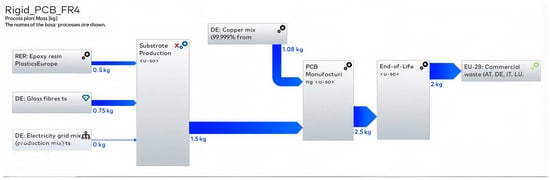
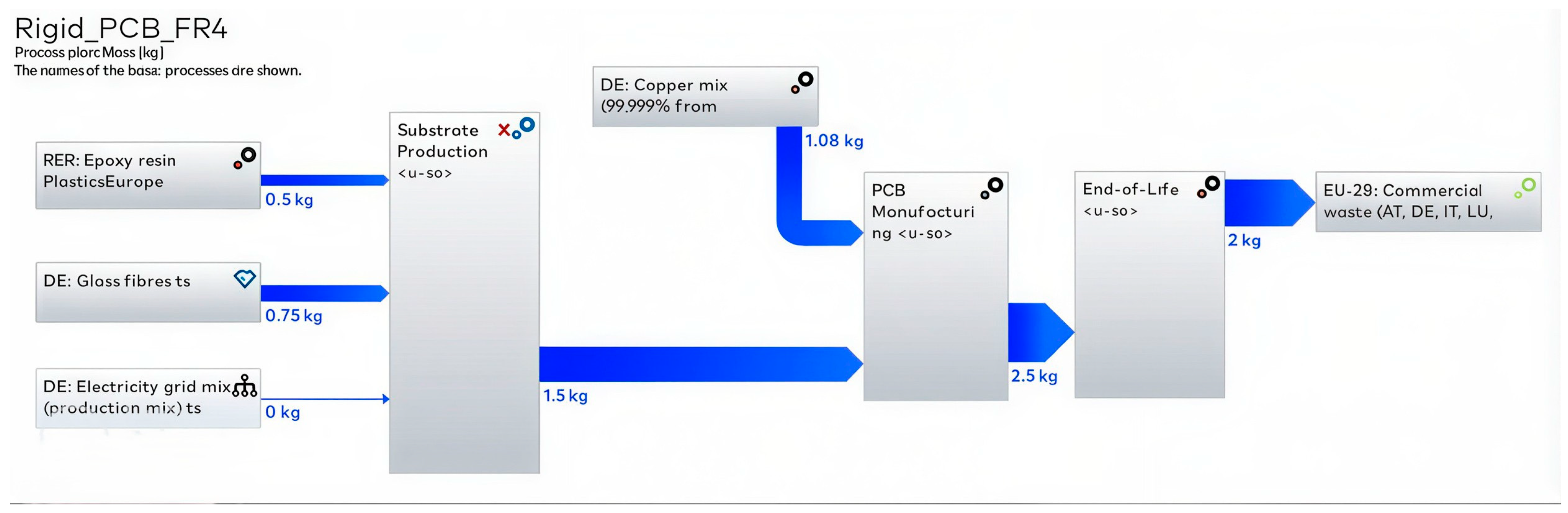
The life cycle of a rigid FR-4 printed circuit board (PCB) can be categorized into three primary stages: substrate production, PCB manufacturing, and end-of-life treatment. The material flow diagram in Figure 1 shows that in the substrate production phase, 0.5 kg of epoxy resin (sourced from Plastics Europe), 0.75 kg of glass fibers (from Germany), and electricity from the German grid mix are used to produce 1.5 kg of FR-4 substrate material. During PCB manufacturing, 1.08 kg of high-purity (99.999%) copper is added, likely for copper cladding, resulting in a final board mass of 2.5 kg. At the end of its life, 2 kg of the PCB enters commercial waste streams regulated under EU-28 waste management policies (e.g., Austria, Germany, Italy, Luxembourg). Approximately 0.5 kg of material is lost or degraded during this phase, likely due to inefficiencies or degradation during disposal. This material flow model underscores the significant role of copper and substrate materials in the overall environmental profile of the PCB and highlights the urgent need for improved recycling and recovery strategies to reduce environmental impact. Copper losses during etching and drilling are accounted for within the manufacturing phase, while recycling credits for recovered metals are applied at the end-of-life stage using the avoided burden method. Electricity and process energy are also considered at each relevant stage to ensure completeness of the assessment (Videos S1 and S2).
Figure 1.
Life cycle modeling of FR-4 PCB.
2.2. Key Data Gap and Mitigation
Life Cycle Assessment (LCA) of PCB manufacturing is complex due to the involvement of multiple materials, intricate fabrication steps, and limited industrial data caused by confidentiality and restricted disclosure [7]. Comparative LCA for electronic substrates faces major challenges from data gaps, especially for biodegradable materials. Assessing FR4, PI, PET, paper, PLA, and PBAT substrates required the use of proxy data from GaBi and Ecoinvent, with compositions derived from patents, datasheets, and the literature, and supplemented by European Bioplastics studies [8].
3. Results
3.1. Key Environmental Indicators for FR4-Based PCB
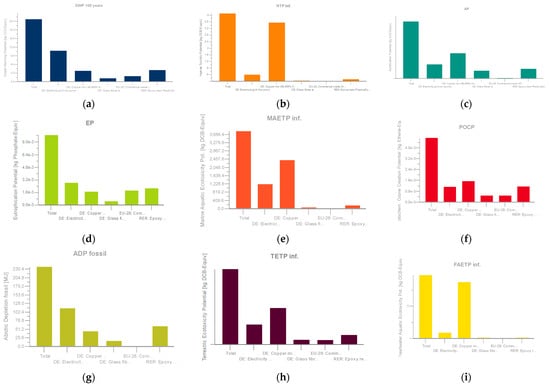
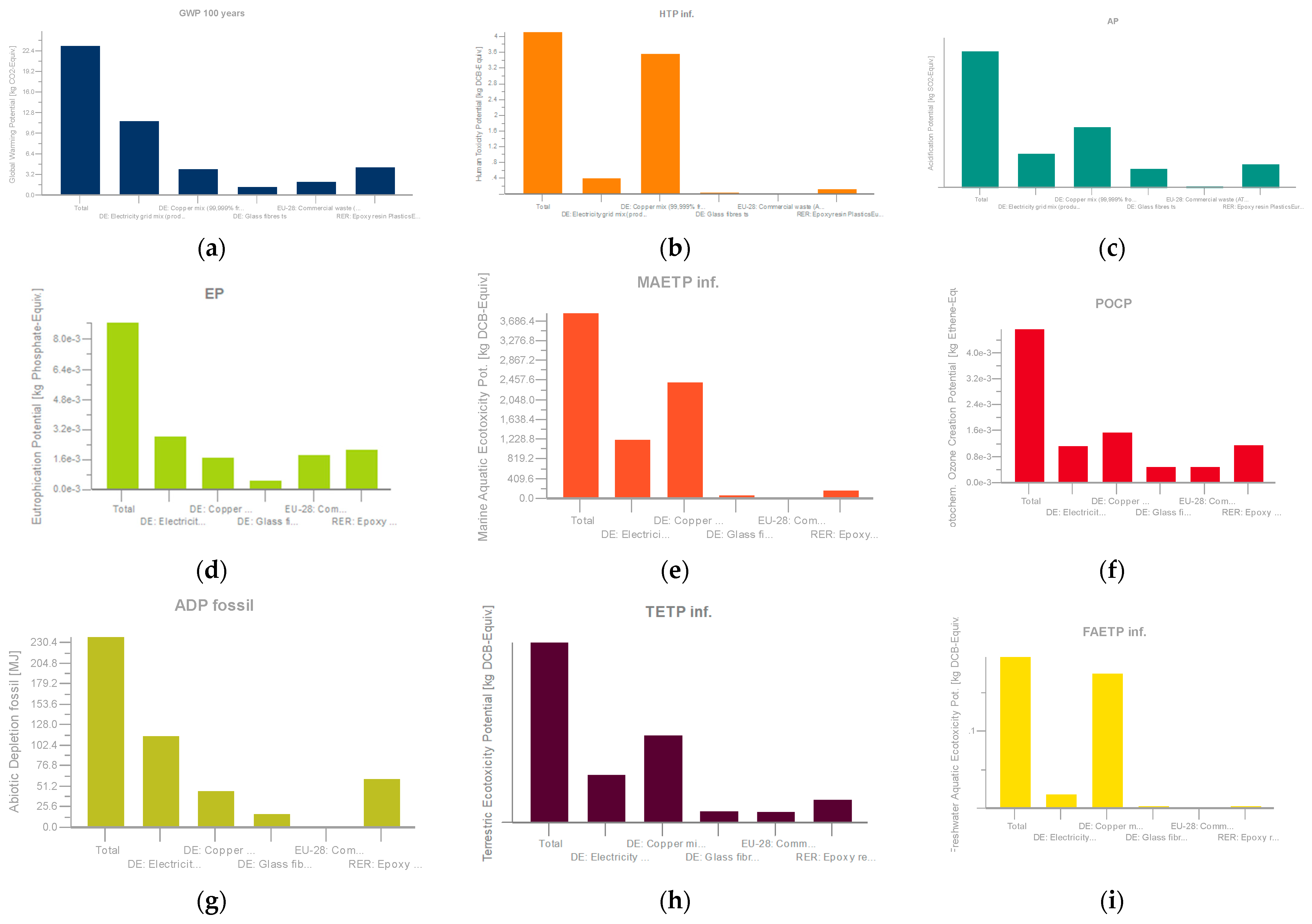
Figure 2a–i present the environmental performance of the FR4-based PCB across multiple impact categories. In Figure 2a, the Global Warming Potential (GWP, 100 years) is approximately 22.4 kg CO2-eq, dominated by electricity use from the German grid (~10 kg CO2-eq), followed by copper (3.5–4 kg CO2-eq) and epoxy resin (~3 kg CO2-eq). Glass fibers and waste disposal contribute little, indicating that energy consumption, metal use, and resin formulation are key contributors to the carbon footprint. Figure 2b shows the Human Toxicity Potential (HTP), with a total impact of about 4 kg 1,4-dichlorobenzene equivalents (DCB-eq), where over 87% arises from high-purity copper production. Electricity and epoxy resin contribute marginally, yet resin manufacturing still involves hazardous intermediates such as bisphenol-A and epichlorohydrin. These substances can elevate toxicity and limit recyclability, emphasizing the environmental burden of petrochemical-based polymers.
Figure 2.
Environmental performance of FR4-based PCB across multiple life cycle impact categories. (a) GWP, (b) HTP, (c) AP, (d) EP, (e) MAETP, (f) POCP, (g) ADP fossil, (h) TETP, and (i) and FAETP.
In Figure 2c,d, the Acidification (AP) and Eutrophication Potentials (EPs) are largely driven by copper and electricity use, with epoxy resin contributing moderately through fossil-based energy inputs during polymerization. Similarly, Figure 2e,h,i represent aquatic and terrestrial ecotoxicity potentials, which show copper and electricity as major stressors, though resin and glass fibers also add minor but cumulative effects. The Photochemical Ozone Creation Potential (POCP) in Figure 2f and the Abiotic Depletion Potential (ADP-fossil) in Figure 2g (>230 MJ) highlight epoxy resin and electricity as key sources of smog formation and fossil resource depletion. Given its petrochemical base, epoxy resin represents both a significant energy demand and a barrier to recyclability. Reducing the epoxy resin or substituting it with bio-based or recyclable alternatives offers a promising pathway to improve sustainability. Overall, Figure 2a–i consistently identify electricity, copper, and epoxy resin as the main environmental hotspots.
3.2. Comparative LCA of Substrates
Table 1 compares conventional and emerging eco-friendly PCB substrates in terms of environmental impact and cost. FR-4 and polyimide (PI) have the highest Global Warming Potentials (22.5 and 17.8 kg CO2-eq/kg) due to energy-intensive, non-biodegradable production. PET, though recyclable, remains moderately impactful (14.2 kg CO2-eq/kg). Biodegradable options paper (6.3), PLA (4.1), and PBAT (3.7 kg CO2-eq/kg) show lower impacts, with composting potential for PLA and PBAT. FR-4 is the most cost-effective, while PI is costlier (cost calculated from published UK-specific readily available data). This LCA highlights trade-offs between performance, cost, and sustainability.
Table 1.
LCA of FR4 and biodegradable PCB substrates using GaBi.
4. Conclusions
This study presents the complete cradle-to-grave GaBi simulation of an FR-4 based rigid PCB, filling a key gap in LCA modeling. By comparing FR-4 with alternative substrates like PI, PET, paper, PLA, and PBAT, the research highlights the significant environmental impacts of conventional materials. Biodegradable options such as PLA, PBAT, and paper offer clear environmental advantages, especially in end-of-life scenarios. These findings support the transition toward greener electronics and provide a framework for future research aiming to evaluate and improve the sustainability of PCB substrates.
Supplementary Materials
The following supporting information can be downloaded at: https://www.mdpi.com/article/10.3390/engproc2026127007/s1, Video S1: FR4_PCB_1, Video S2: FR4_PCB_2.
Funding
This work was conducted as part of the Women in STEM Hub (WISH) 2025 grant, and the conference presentation was funded by the Faculty of Engineering, Computing and the Environment (ECE) Faculty Fund Award, Kingston University London.
Institutional Review Board Statement
Not applicable.
Informed Consent Statement
Not applicable.
Data Availability Statement
Data is contained within the article and supplementary materials.
Acknowledgments
The author gratefully acknowledges Kingston University London for providing administrative, technical, and financial assistance for research and conference participation.
Conflicts of Interest
The author declares no conflict of interest.
References
- Chakraborty, M.; Kettle, J.; Dahiya, R. Electronic waste reduction through devices and printed circuit boards designed for circularity. IEEE J. Flex. Electron. 2022, 1, 4–23. [Google Scholar] [CrossRef] [Scilit]
- Liu, J.; Yang, C.; Wu, H.; Lin, Z.; Zhang, Z.; Wang, R.; Li, B.; Kang, F.; Shi, L.; Wong, C.P. Future paper based printed circuit boards for green electronics: Fabrication and life cycle assessment. Energy Environ. Sci. 2014, 7, 3674–3682. [Google Scholar] [CrossRef] [Scilit]
- Ozkan, E.; Elginoz, N.; Germirli Babuna, F. Life cycle assessment of a printed circuit board manufacturing plant in Turkey. Environ. Sci. Pollut. Res. 2018, 25, 26801–26808. [Google Scholar] [CrossRef] [Scilit] [PubMed]
- Grant, K.; Zhang, S.; Kettle, J. Improving the sustainability of printed circuit boards through additive printing. In Proceedings of the 2023 IEEE Conference on Technologies for Sustainability (SusTech), Portland, OR, USA, 19–22 April 2023. [Google Scholar]
- Bainbridge, A.; Grant, K.; Clark, L.; Kettle, J. Evaluation of the environmental impact within semiconductor packaging materials. In Proceedings of the 24th European Microelectronics and Packaging Conference & Exhibition (EMPC), Cambridge, UK, 11–14 September 2023. [Google Scholar]
- Zhang, T.; Bainbridge, A.; Harwell, J.; Zhang, S.; Wagih, M.; Kettle, J. Life cycle assessment (LCA) of circular consumer electronics based on IC recycling and emerging PCB assembly materials. Sci. Rep. 2024, 14, 29183. [Google Scholar] [CrossRef] [Scilit] [PubMed]
- Practical Strategies for Acquiring Life Cycle Inventory Data in the Electronics Industry. Available online: https://www.lifecyclecenter.se/publications/practical-strategies-for-acquiring-life-cycle-inventory-data-in-the-electronics-industry (accessed on 22 October 2025).
- Environmental Impact Assessments of Innovative Bio-Based Products. Available online: https://op.europa.eu/en/publication-detail/-/publication/9ab51539-2e79-11e9-8d04-01aa75ed71a1 (accessed on 22 October 2025).
- Nassajfar, M.N.; Deviatkin, I.; Leminen, V.; Horttanainen, M. Alternative materials for printed circuit board production: An environmental perspective. Sustainability 2021, 13, 12126. [Google Scholar] [CrossRef] [Scilit]
- Broeren, M.L.; Kuling, L.; Worrell, E.; Shen, L. Environmental impact assessment of six starch plastics focusing on wastewater-derived starch and additives. Resour. Conserv. Recycl. 2017, 127, 246–255. [Google Scholar] [CrossRef] [Scilit]

Disclaimer/Publisher’s Note: The statements, opinions and data contained in all publications are solely those of the individual author(s) and contributor(s) and not of MDPI and/or the editor(s). MDPI and/or the editor(s) disclaim responsibility for any injury to people or property resulting from any ideas, methods, instructions or products referred to in the content. |
© 2026 by the author. Licensee MDPI, Basel, Switzerland. This article is an open access article distributed under the terms and conditions of the Creative Commons Attribution (CC BY) license.