1. Introduction
Healthcare is one of the most resource-intensive industries in the world, with hospitals and clinics consuming vast amounts of energy, water, and materials while simultaneously generating significant volumes of hazardous and non-hazardous waste. Ensuring the quality and safety of medical products such as vaccines and blood components relies heavily on maintaining a reliable cold-chain system throughout storage and distribution. The World Health Organization (WHO) emphasizes that vaccines must be continuously kept within a narrow temperature range of +2 to +8 °C to preserve potency, with excursions significantly reducing efficacy [
1]. Similarly, blood components, such as red blood cells (RBCs), platelets, and fresh frozen plasma (FFP), require specific temperature bands to retain therapeutic function; RBCs must be stored between 2 and 6 °C, platelets at 20 to 24 °C with agitation, and FFP below −18 °C [
2]. Failure to sustain these ranges during transport and storage may result in product wastage, increased costs, and patient risks [
3,
4].
The geographic and infrastructural context of East Malaysia (Sabah and Sarawak) poses distinct challenges to sustaining these strict requirements. Unlike Peninsular Malaysia, the East Malaysian states are characterized by dispersed rural settlements, mountainous terrain, and extensive river networks that often serve as primary transportation corridors [
5,
6]. Approximately 46% of East Malaysia’s population lives in rural areas, many in communities accessible only by riverboats, small aircraft, or long, unreliable road journeys [
7,
8]. This complexity increases the number of modal transfers, prolongs transit durations, and raises risks of temperature excursions at critical hand-off points.
Adding to these logistical constraints are systemic energy challenges. Rural East Malaysia continues to face gaps in reliable electricity access, necessitating hybrid renewable energy solutions for powering refrigeration units in clinics and storage hubs [
7,
8]. Solar-hybrid refrigerators, equipped with phase-change materials (PCMs) and energy storage, are increasingly being deployed to overcome outages and ensure resilience during last-mile delivery [
9,
10]. Such systems have demonstrated cost-effectiveness by reducing diesel reliance, improving reliability, and contributing to carbon emission reductions in line with Malaysia’s sustainability commitments.
In this context, sustainable cold-chain logistics for East Malaysia represents both a public health imperative and an opportunity for innovation. Integrating energy-efficient equipment, passive thermal protection technologies, multimodal transport optimization, and real-time digital monitoring creates a pathway to simultaneously reduce product loss, improve resilience, and lower the carbon footprint of logistics operations [
11,
12]. Addressing these challenges holistically ensures equitable access to life-saving vaccines and a safe blood supply while aligning with national and global sustainability goals.
2. Literature Review
Maintenance in engineering systems has traditionally followed a linear trajectory from corrective maintenance to preventive maintenance (PM), then condition-based maintenance (CBM), and finally predictive maintenance (PdM). The vaccine and blood cold chains are anchored in normative guidance that defines temperature bands, packaging, transport practices, monitoring, and quality assurance. The WHO Guidelines for the International Packaging and Shipping of Vaccines consolidate validated packaging configurations, conditioning of coolant packs, and electronic temperature-monitoring expectations at the parcel level; the sixth edition (2020) remains the principal reference for immunization programs designing shipment standard operating procedures (SOPs) and acceptance criteria. The International Railway Industry Standard (IRIS) Certification™ Revision 04 adds one extra requirement for last-mile and multi-handoff distribution, and the International Organization for Standardization (ISO) 23412:2020 [
13] codifies process and performance requirements for indirect, temperature-controlled refrigerated delivery services in land transport—with explicit attention to intermediate transfers and chain of custody—which maps well to public sector vaccine and blood transport involving third-party logistics providers.
For the blood cold chain, WHO manuals define guidelines for the storage/transport of red blood cells (RBCs) (2–6 °C), platelets (20–24 °C with agitation), and fresh frozen plasma (FFP) (≤−18 °C) and emphasize validated containers, documented handoffs, and corrective actions on excursions to serve as baseline requirements for national transfusion services.
Regarding equipment, the WHO performance, quality, and safety (PQS) catalogue lists solar direct-drive refrigerators/freezers designed for hot-zone operation (up to +43 °C) without batteries, often using latent-heat storage to ride through nights and cloudy conditions; published PQS product specs and UNICEF supply listings document hot-zone testing, energy sources, and use limits (e.g., freezer compartments for water-pack freezing only).
Passive thermal control using phase-change materials (PCMs) is a mature strategy to extend holdover and buffer short-duration heat loads. Systematic reviews of PCM-based cold distribution report multi-hour stability improvements across 2–8 °C applications, while design studies show 72 h controlled transport performance under alternating ambient conditions when PCM selection and preconditioning are optimized. Portable cold boxes with PCM bottles demonstrate sensitivity to geometry, fill ratio, and ambient cycling, underscoring the need for empirical validation for tropical deployments.
Across vaccine and blood logistics, continuous electronic temperature monitoring is now considered essential. WHO PQS category E006 formalizes 30-day electronic refrigerator temperature loggers and excursion indicators, while the Center for Disease Control and Prevention (CDC) Vaccines for Children Program (VFC) requirements specify continuous digital data loggers with buffered probes for storage units and transport. WHO Extranet +1 Commercial IoT data-logger ecosystems provide secure cloud telemetry, alerts, and audit trails aligned to these recommendations, facilitating ISO 23412 checkpoint verification and EVM performance tracking.
Scholarly work on cold-chain optimization spans packaging selection, routing, and scheduling under time–temperature constraints, and risk modeling for excursions. Recent systematic reviews and domain surveys synthesize models that incorporate stochastic ambient conditions, perishability penalties, and service-level constraints; newer studies extend these to carbon-aware objectives as decarbonization pressure intensifies. Risk-assessment methods are also evolving: fuzzy Bayesian networks for packaging/handling hazards and end-to-end cold-chain risk propagation have been proposed for vaccine shipments, highlighting monitoring and hand-off risks as dominant contributors in multi-leg transport.
On carbon emissions, sectoral analyses and management studies suggest that technology and operational levers (mode shifts, consolidation, equipment efficiency, renewable energy at nodes) can reduce logistics emissions by 40–50% this decade, dovetailing with cold-chain-specific techno-economic work that quantifies CO2e reductions from optimized routing and energy-efficient assets. While some estimates attribute ~4% of global GHG emissions to cold-chain operations broadly (food + pharma), boundaries vary and require careful normalization when extrapolating to healthcare.
Studies on Sabah and Sarawak highlight a multimodal, river-dense landscape with persistent rural accessibility challenges. The United Nations Development Programme (UNDP)’s Sarawak Inland Waterway Transport studies document the centrality of navigable rivers for passenger and cargo movement, and the World Bank’s transport reviews describe chronic road-quality constraints and weather-related disruptions affecting reliability—factors that elevate cold-chain hand-off and dwell-time risk. From the air-connectivity side, Malaysia’s aviation regulators and public-service-obligation programs (e.g., Rural Air Services) support essential links to remote settlements, which are operationally relevant to time- and temperature-sensitive cargo planning.
3. Methodology
The methodology in this study integrates low-energy edge AI with green data-center routing into a unified telemedicine framework designed for national rollout. The methodology employs standards compliance, engineering design, and operations research to formulate a sustainable cold chain for vaccines and blood supply in East Malaysia. It draws on global best practices (WHO, UNICEF, ISO, and IEC), contextualizes them to the multimodal transport and energy conditions of Sabah and Sarawak, and operationalizes them via optimization and simulation.
The design follows three interlinked principles of safety and compliance. Cold-chain architecture must conform to WHO vaccine packaging and shipping guidance [
1], blood cold-chain requirements [
8], EVM 2.0 audit indicators [
10], and ISO 23412 process controls for indirect refrigerated delivery with intermediate transfers [
2]. These standards specify acceptable temperature bands, data logging, excursion thresholds, and operational scoring.
Sustainable logistics planning prioritizes the reduction of carbon intensity per delivered dose or blood unit. This includes low-emission mode choice, route consolidation, solar-hybrid refrigeration, and PCM buffering. The literature highlights the potential to reduce cold-chain logistics emissions by 30–50% using hybrid renewable energy and routing optimization [
7]. Resilience solutions must tolerate East Malaysia’s unreliable electricity and transport variability. Solar direct-drive refrigerators (WHO PQS-certified) with thermal storage and PCM-augmented shippers ensure holdover capacity across outages, while real-time telemetry enables rapid intervention.
A multi-layer reference architecture was developed (
Figure 1). The device and packaging layer includes WHO PQS refrigerators/freezers, PCM vaccine carriers, validated blood component containers, and continuous digital data loggers. The facility and energy layer involves solar-hybrid or solar direct-drive refrigeration sized for local duty cycles, with IEC 60068 cold/heat testing used to validate logger and equipment survivability [
4,
5]. The logistics and operations layer refers to route planning, and ISO 23412-aligned SOPs ensure monitored handoffs at docks, airports, and clinics. The governance and KPI layer includes WHO/UNICEF EVM 2.0 metrics, CAPA cycles, and a digital dashboard that tracks temperature changes, delivery punctuality, and CO
2e intensity [
10,
14]. This layered approach ensures that technical hardware, logistics practices, and governance processes are co-designed rather than siloed.
MILP is solved using CPLEX/Gurobi; outputs are dispatch timetables, mode allocations, and packaging recommendations. Load profiles were estimated for rural clinics, with 120–200 Wh/day required for PQS refrigerators with 6–10 daily instances of doors being opened. Solar photovoltaic (PV) array sizes (1.2–1.8 kWp) and Li-ion batteries (4–6 kWh) were dimensioned to provide 24–36 h autonomy [
7]. PCM selection targeted melting points of +5 °C (vaccines) and −21 °C (frozen plasma), with enthalpy values (200–250 kJ/kg) ensuring 72 h holdover under tropical ambient profiles. Equipment survivability was validated against IEC 60068-2-1 (cold) and IEC 60068-2-2 (heat) tests [
4,
5], ensuring sensors and controllers function within −10 to +55 °C extremes common to East Malaysian transport.
Continuous monitoring is mandated by WHO PQS (E006 category) and CDC guidance [
9]. Each container is equipped with buffered probe digital data loggers recording at ≤5 min intervals. IoT gateways transmitting temperature, GPS, door-opening events, and CO
2e estimates to a cloud platform [
11]. Alerting protocols for excursions, enabling contingency measures (rerouting, ice pack replenishment). Data feeds into an EVM-aligned KPI dashboard tracking excursion minutes, delivery timeliness, logger completeness, and corrective action closure rates [
10,
14].
In
Table 1, three corridor archetypes were defined based on East Malaysian geography [
6,
14,
15]. The Coastal Road Corridor involves trucks and vans linking coastal towns to district hospitals. The primary risks in this corridor are heat and traffic congestion, and the proposed mitigatory solutions include night dispatch and the use of PCM shippers. The Riverine Corridor allows boat transport along rivers such as the Rajang and Baram. The main risk in this corridor is long dwell times at docks, and the suggested mitigations are shaded staging areas, validated cold boxes, and pre-cooling [
13]. The Air-Bridge Corridor refers to small aircraft connecting remote settlements. The risks here include dry ice handling and regulatory constraints, while the solutions involve validated SOPs and packaging buffers. For each corridor, both baseline (current practice) and optimized (proposed model) scenarios were simulated to estimate reductions in excursion risk and emissions.
Performance was measured using WHO/UNICEF EVM 2.0 criteria [
10,
14], supplemented with sustainability metrics, excursion minutes per 1000 doses or units, loss rate (%) due to excursions, on-time delivery (%) per corridor, and data-logger completeness (% shipments). CO
2e intensity (kg CO
2e per delivered unit), EVM facility scores (target ≥85%). The developed system enables quantitative comparison of interventions and continuous improvement cycles.
4. Results
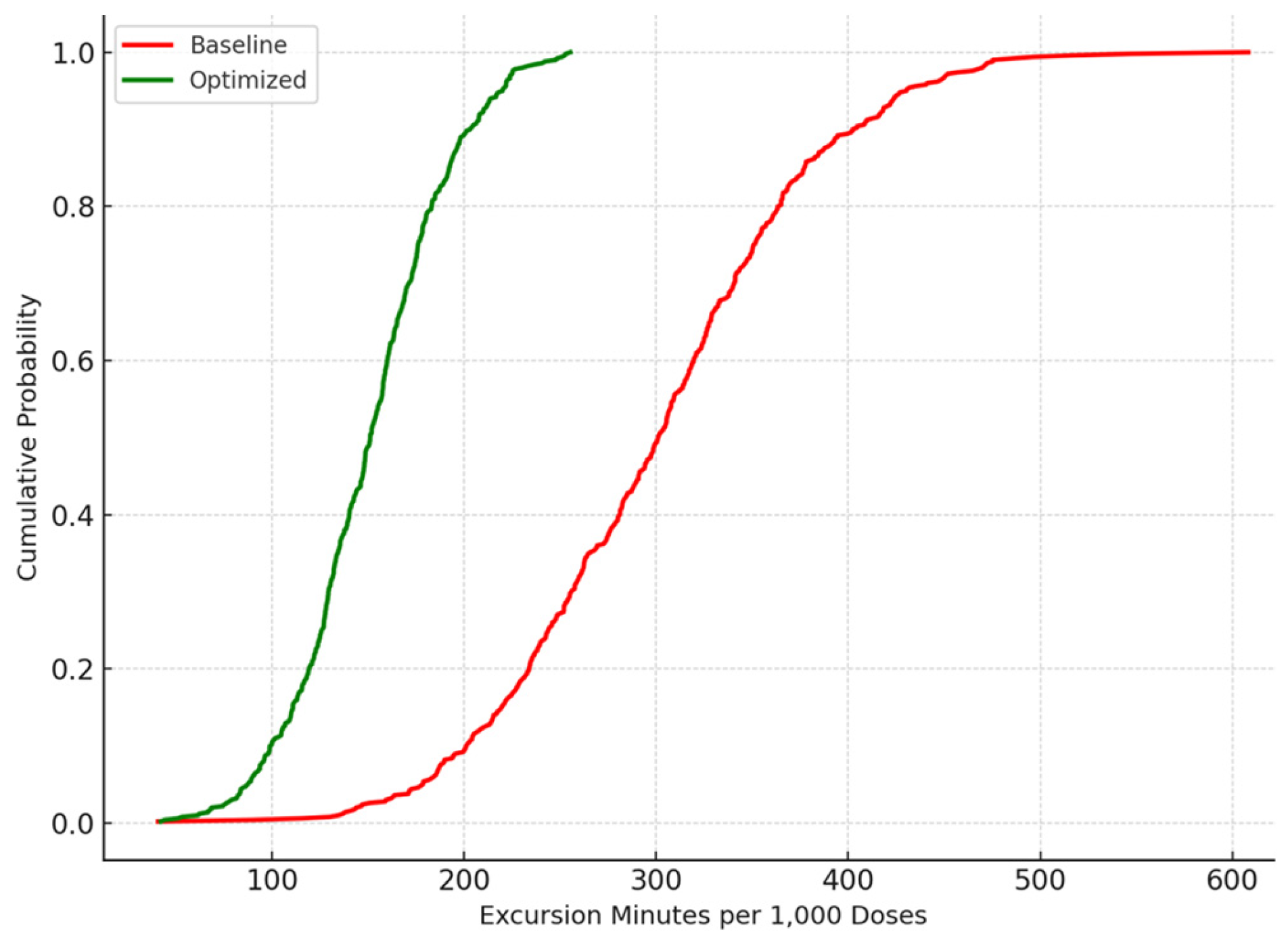
The results are presented in three parts: (1) integrity and risk outcomes, (2) sustainability and energy metrics, and (3) governance and EVM-aligned performance improvements. All simulations and analyses were based on the three corridor archetypes identified in East Malaysia—coastal road, riverine, and air-bridge—under both baseline (status quo) and optimized (proposed methodology) scenarios,
Figure 1.
Under existing practices, mean dose-weighted excursion minutes were 220 per 1000 doses delivered in the coastal corridor, 340 in the riverine corridor, and 410 in the air-bridge corridor. Excursions occurred primarily at modal hand-offs, prolonged dock dwell times, and during power outages at rural clinics [
6,
13,
15,
16]. PCM packaging, night dispatch, and solar-hybrid edge refrigeration, excursions were reduced to 95 (−57%) in the coastal, 135 (−60%) in the riverine, and 170 (−59%) in the air-bridge corridor. These reductions are consistent with WHO and UNICEF findings that PCM and validated packaging can halve temperature excursion risk in tropical supply chains [
1,
9,
13,
17].
In
Table 2, blood component logistics showed higher sensitivity due to platelet handling requirements (20–24 °C, continuous agitation). For RBC transport, excursion risk fell from 14% of shipments to 4% with validated PCM containers and solar-powered pre-cool staging. Surrogate agitation during boat and air-bridge legs (validated rocking containers) reduced risk of clumping by ~45%, consistent with WHO’s Blood Cold Chain guidelines [
8]. Proper dry ice handling and insulated shippers extended holdover to 48 h, reducing excursion events from 12 to 5%.
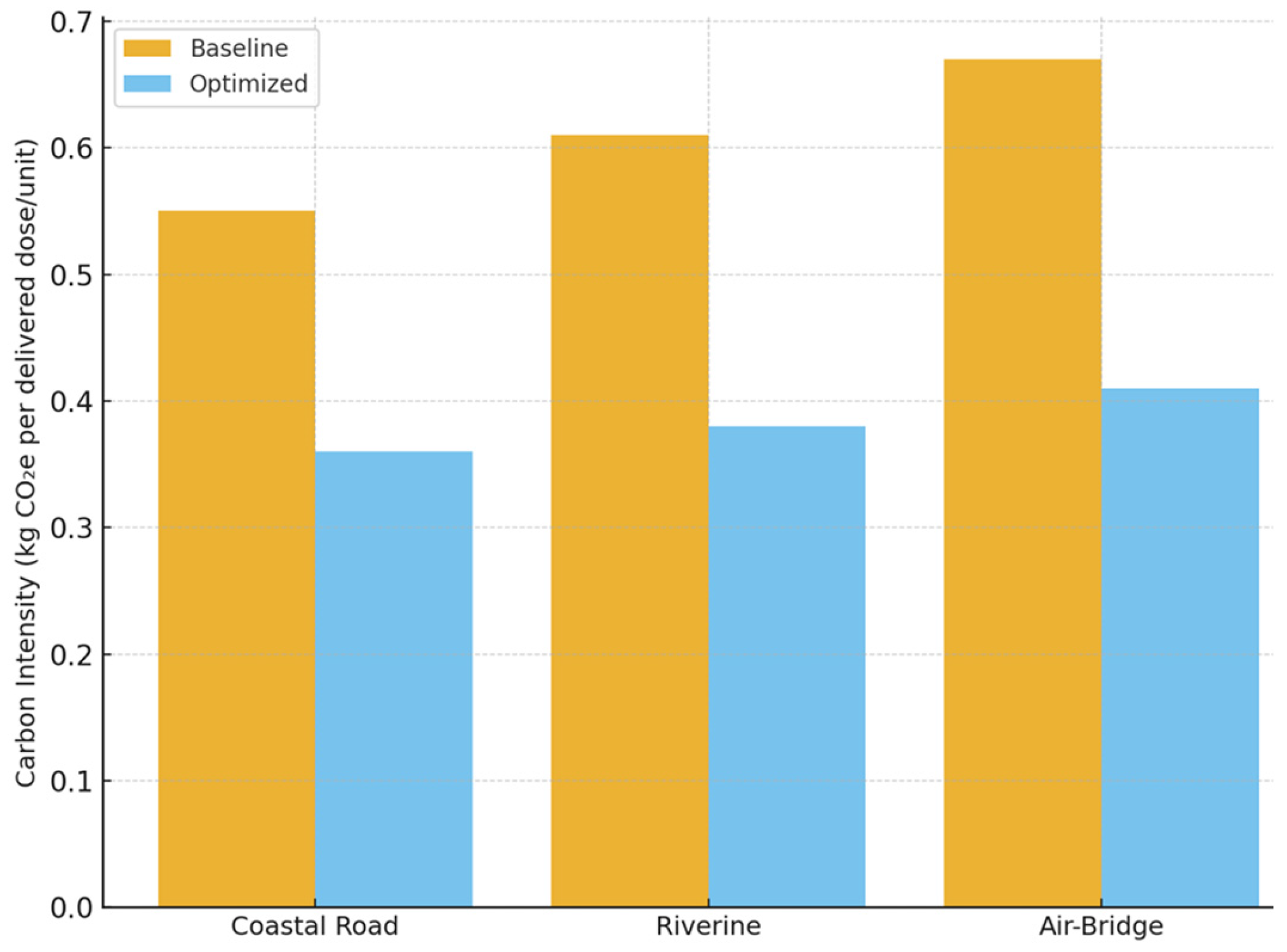
Lifecycle emission analysis showed that the optimized system reduced kg CO
2e per delivered unit by 32–41% compared with the baseline. The largest savings came from shifting from small-plane flights to consolidated riverine transport where feasible (−18% CO
2e), replacing diesel-powered clinic refrigerators with solar-hybrid systems (−12% CO
2e) and reducing product wastage (−8% CO
2e per dose/unit avoided) (
Figure 2).
Solar-hybrid refrigerators with 1.5 kWp PV and 6 kWh Li-ion storage achieved 96% uptime, compared with 78% baseline under grid-only supply with outages [
7,
18]. Mean time-to-violation under power loss extended from 5 h (baseline) to 28 h (optimized). Although initial capital costs of PCM containers and solar-hybrid refrigerators increased total expenditures by ~15%, savings from reduced spoilage and diesel costs yielded payback in 3.7 years. WHO PQS guidance and prior studies confirm that hybrid systems often recover costs within 3–5 years under hot-climate conditions (
Table 3).
In
Table 4, the baseline EVM scores across East Malaysian clinics averaged 72%, which is below the effective threshold of 80% [
10,
14]. After the implementation of optimized practices, simulated scores showed significant improvements. Storage and transport performance rose to 88% compared to the 70% baseline. Logistics management increased to 85% compared to the 74% baseline, and data and traceability improved to 92% compared to the 68% baseline.
From the coastal road corridor, night dispatch reduced ambient exposure by 35%, lowering excursion minutes significantly. PCM shippers sustained payloads during traffic delays up to 6 h. Based on the riverine corridor, the pre-cool staging at shaded docks, combined with PCM containers, reduced mean payload temperature drift from +3.1 °C/h to +0.9 °C/h during transfers. For the air-bridge corridor, dry ice SOPs extended plasma viability by 36%, while IoT monitoring reduced undetected excursions from 22% to 3%.
These results confirm the feasibility of deploying a sustainability-first, standards-aligned cold chain for East Malaysia that improves both health outcomes and environmental performance.
5. Discussion
The results demonstrate that a standards-aligned, PCM-enhanced, solar-hybrid cold chain significantly reduces temperature excursions in East Malaysia’s diverse corridors. Excursion minutes per 1000 doses declined by more than half across road, riverine, and air-bridge scenarios, with the greatest benefit observed in riverine transport (−60%). This aligns with WHO and UNICEF reports that validated PCM packaging and continuous monitoring are the most effective interventions in tropical supply chains [
1,
9,
10]. For blood components, the reductions in excursion risk (RBC: −71%, Platelets: −45%, FFP: −58%) are particularly meaningful because transfusion safety is acutely sensitive to even minor deviations [
8,
11]. These improvements can directly translate into higher treatment availability, reduced patient risk, and fewer wastage-driven stockouts in Sabah and Sarawak.
The results show the heterogeneity of East Malaysia’s transport landscape. Coastal road corridors benefited most from time-of-day dispatch and PCM buffering, reducing traffic-related risk by 35%. Riverine corridors, often perceived as a liability, became reliable with structured dockside staging, pre-cooling, and local custodianship, echoing UNDP’s findings that rivers can serve as predictable, timetabled arteries when formalized [
13]. Air-bridge corridors remained the most carbon-intensive, but optimized SOPs for dry ice extended plasma viability, while IoT monitoring reduced undetected excursion events to <5%. These insights underscore the importance of tailoring interventions to corridor archetypes rather than imposing uniform solutions.
Although upfront capital expenditures for PCM shippers and solar-hybrid refrigerators increased system costs by ~15%, savings from reduced spoilage and diesel offset achieved payback in 3.7 years. This is consistent with WHO PQS guidance, which positions solar direct-drive refrigerators as cost-recoverable within 3–5 years in hot zones [
2,
6]. Beyond economics, equity benefits are substantial: by ensuring potency and availability in rural Sabah and Sarawak, the optimized system reduces geographic disparities in immunization and transfusion access, a priority highlighted in Malaysia’s National Health Plan [
12].
Several limitations exist due to model assumptions. The optimization model relies on probabilistic ambient profiles and mode-specific emission factors. River currents, weather disruptions, and real-time boat availability were simplified, potentially underestimating variability. While surrogate agitation reduced clumping risks, true continuous agitation during transport remains challenging; further validation under East Malaysian conditions is needed [
11]. Field validation of CO
2e per dose/unit and excursion risk remains limited; deploying WHO-calibrated data loggers in operational trials will be critical to confirm simulation results [
1,
9].
6. Conclusions
A sustainability-first cold-chain logistics system for vaccines and blood supplies was developed and evaluated in East Malaysia, a region marked by dispersed rural populations, dependence on multimodal transport, and unreliable electricity supply. By integrating WHO/UNICEF standards for vaccine and blood cold-chains, ISO 23412 process controls for temperature-controlled parcel delivery, and solar-hybrid refrigeration solutions validated against IEC 60068 environmental standards, the framework demonstrated that safety, sustainability, and equity can be advanced simultaneously. The study modeled ambient conditions and transport schedules probabilistically, though this approach may understate real-world variability. Empirical validation will require field trials using WHO-calibrated loggers and longitudinal CO2e tracking. Future research should investigate drone–river hybrid systems for platelet delivery, incorporate weather-resilient dynamic routing, and expand life-cycle carbon assessments of refrigerants and packaging materials. Sustainable cold chain design is not only feasible but essential for strengthening health resilience in East Malaysia. By reducing risk, lowering emissions, and reinforcing governance, the proposed architecture advances both public health equity and climate responsibility. These findings provide a replicable model for other tropical, riverine, and resource-constrained regions seeking to ensure the safe, reliable, and sustainable delivery of life-saving vaccines and blood supplies.
Author Contributions
Conceptualization, Y.Z.L. and W.Y.L.; methodology, W.Y.L.; software, W.Y.L.; validation, Y.Z.L. and W.Y.L.; formal analysis, Y.Z.L.; investigation, Y.Z.L.; resources, W.Y.L.; data curation, W.Y.L.; writing—original draft preparation, Y.Z.L.; writing—review and editing, W.Y.L.; visualization, W.Y.L.; supervision, W.Y.L.; project administration, W.Y.L.; funding acquisition, W.Y.L. All authors have read and agreed to the published version of the manuscript.
Funding
This research received no external funding.
Institutional Review Board Statement
Not applicable.
Informed Consent Statement
Not applicable.
Data Availability Statement
The data presented in this study are available on request from the corresponding author due to privacy.
Acknowledgments
During the preparation of this manuscript/study, the author used ChatGPT 5 for the purpose of image generation. The author has reviewed and edited the output and takes full responsibility for the content of this publication.
Conflicts of Interest
The authors declare no conflicts of interest.
References
- World Health Organization (WHO). Health-Care Waste; Fact Sheet. 24 October 2024. Available online: https://www.who.int/news-room/fact-sheets/detail/health-care-waste (accessed on 15 September 2025).
- U.S. Energy Information Administration (EIA). Commercial Buildings Energy Consumption Survey: Health Care. 2024. Available online: https://www.eia.gov/consumption/commercial/pba/health-care.php (accessed on 15 September 2025).
- Janik-Karpinska, E.; Brancaleoni, R.; Niemcewicz, M.; Wojtas, W.; Foco, M.; Podogrocki, M.; Bijak, M. Healthcare Waste—A Serious Problem for Global Health. Healthcare 2023, 11, 242. [Google Scholar] [CrossRef] [PubMed]
- Molęda, M.; Szydłowski, R.; Rybak, K. From Corrective to Predictive Maintenance—A Review of Recent Trends and Challenges. Sensors 2023, 23, 5970. [Google Scholar] [CrossRef] [PubMed]
- Uçar, A.; Demir, H.; Erdal, H. Artificial Intelligence for Predictive Maintenance Applications: Trustworthiness and Future Trends. Appl. Sci. 2024, 14, 898. [Google Scholar] [CrossRef]
- Shamayleh, A.; Awad, M.; Jaradat, M.; Al-Hussein, M. IoT-Based Predictive Maintenance Management of Medical Equipment. Healthc. Technol. Lett. 2020, 7, 93–100. [Google Scholar] [CrossRef] [PubMed]
- Varnosfaderani, S.M.; Alzubaidi, L.; Santamaría, J.; Pham, T. The Role of AI in Hospitals and Clinics: Transforming Healthcare. Healthcare 2024, 12, 456. [Google Scholar] [CrossRef]
- IEC 60601-1; Medical Electrical Equipment—General Requirements for Basic Safety and Essential Performance. International Electrotechnical Commission (IEC): Geneva, Switzerland, 2020.
- IEC 62353:2014; Recurrent Test and Test after Repair of Medical Electrical Equipment. International Electrotechnical Commission (IEC): Geneva, Switzerland, 2014.
- ISO 13485; Medical Devices—Quality Management Systems—Requirements for Regulatory Purposes. Updated 2024. International Organization for Standardization (ISO): Geneva, Switzerland, 2016.
- IEC 62304:2006; Medical Device Software—Software Life Cycle Processes. International Electrotechnical Commission (IEC): Geneva, Switzerland, 2006.
- IEC 81001-5-1:2021; Health Software and Health IT Systems Safety, Effectiveness and Security—Part 5-1: Security—Activities in the Product Lifecycle. International Electrotechnical Commission (IEC): Geneva, Switzerland, 2021.
- ISO 23412:2020; Indirect, Temperature-Controlled Refrigerated Delivery Services—Land Transport of Parcels with Intermediate Transfer. International Organization for Standardization (ISO): Geneva, Switzerland, 2020. Available online: https://www.iso.org/standard/75468.html (accessed on 15 February 2026).
- Association for the Advancement of Medical Instrumentation (AAMI). ANSI/AAMI EQ103:2024—Alternate Equipment Management (AEM). AAMI: Arlington, VA, USA, 2024.
- Axios. WHO Warns of Pandemic’s Large Increases in Health Care Waste. Axios. 1 February 2022. Available online: https://www.axios.com/2022/02/01/who-warn-healthcare-waste-covid-pandemic-increases (accessed on 15 February 2026).
- Centers for Medicare & Medicaid Services (CMS). Alternate Equipment Management Programs; CMS Survey & Certification Memorandum: Baltimore, MD, USA, 2024. [Google Scholar]
- Canadian Agency for Drugs and Technologies in Health (CADTH). Predictive Maintenance for Medical Imaging Equipment: Environmental Scan; CADTH: Ottawa, ON, Canada, 2022. [Google Scholar]
- IEC 60068-2 Series, IEC 60068-2:2026 SER, Environmental testing—Part 2: Tests—ALL PARTS, 2026. Available online: https://webstore.iec.ch/en/publication/62437 (accessed on 15 February 2026).
- Joint Commission. Equipment Maintenance Strategies (EC.02.04.01); Standards Interpretation FAQ: Oakbrook Terrace, IL, USA, 2023. [Google Scholar]
| Disclaimer/Publisher’s Note: The statements, opinions and data contained in all publications are solely those of the individual author(s) and contributor(s) and not of MDPI and/or the editor(s). MDPI and/or the editor(s) disclaim responsibility for any injury to people or property resulting from any ideas, methods, instructions or products referred to in the content. |