


Abstract
Ensuring fast, reliable communication for emergency vehicles is vital in a smart-city vehicular ad hoc network. However, conventional technologies such as dedicated short-range communications and radio links often fail to meet strict low-latency, high-reliability requirements in congested, resource-limited environments. We developed a priority-based power allocation scheme that reserves sufficient transmission power and bandwidth for emergency vehicles while maintaining acceptable service for regular vehicles. Simulation and performance analysis show that the proposed method achieves lower outage probability and higher sum rate than existing resource allocation strategies under various channel conditions and signal-to-noise ratios, providing an effective communication solution for urban emergency services.
1. Introduction
Smart healthcare in urban environments is increasingly dependent on fast, reliable, and context-aware communications to support emergency medical services. When an ambulance or other emergency vehicle is dispatched, it must exchange information in real time with traffic infrastructure, surrounding vehicles, and hospitals to enable priority passage, pre-arrival triage, and rapid clinical decision-making. Therefore, under smart healthcare scenarios, vehicular communications must still provide low-latency and highly reliable transmission for emergency vehicles even in congested environments [1]. However, in the vehicular ad hoc network (VANET), emergency vehicles and regular vehicles share limited spectrum and power resources, so traditional orthogonal multiple access (OMA) and DSRC-based communications cannot consistently guarantee emergency vehicle service.
To improve spectral efficiency and enable service differentiation [2], we adopted non-orthogonal multiple access (NOMA) [3]. By using power-domain multiplexing and successive interference cancellation (SIC), multiple vehicles can share the same resource block [4], while emergency vehicles with higher priority are assigned higher transmit power. We further incorporate cooperative communication, where nearby vehicles help forward the emergency vehicle’s signal to obtain diversity gain and improve data throughput.
Based on these ideas, we design a priority-based power allocation scheme that first secures the transmission requirements of emergency vehicles and then allocates the remaining resources to regular vehicles according to their channel conditions. Simulation results show that, compared to conventional OMA or non-prioritized schemes, our method achieves better performance across different channel qualities and SNR levels.
2. Related Work
Resource allocation has long been a key issue in VANET, where recent studies often rely on queueing models, machine learning, and game-theoretic formulations. Miri et al. [5] tackled the time division multiple access (TDMA) limitations for the Internet of Vehicles, where mobility causes slot collisions and desynchronization, by adding a Markov transition matrix and fuzzy rules to a multichannel TDMA so that slot demand can be predicted and frames adapted dynamically, reducing collisions and control overhead. Ding and Leung [6], in a vehicular network with NOMA, cast joint user scheduling and power allocation as a cross-layer problem under latency and Quality of Service (QoS) constraints. Because channels are time-varying and CSI is limited, they used reinforcement learning to learn the scheduling order and then applied a low-complexity power allocation, achieving lower end-to-end delay. Sharma et al. [7] studied the resource block surge during cluster handoffs in base station overlap areas and modeled inter-cluster resource contention as a non-cooperative game, using a simplified Dinkelbach method to obtain closed-form transmit powers and a Nash equilibrium.
However, these three types of methods generally require substantial time and computational resources to obtain near-optimal resource allocation, making them difficult to apply in highly mobile and rapidly varying urban vehicular networks where emergency vehicles demand immediate service. Consequently, recent Vehicle-to-Everything (V2X) research has begun to focus on NOMA, a communication technique that can improve spectral efficiency [8]. Yang et al. [9] proposed a dynamic power allocation scheme for cooperative NOMA with energy harvesting and demonstrated that it outperforms the conventional OMA approach.
3. Priority-Based Power Allocation
The priority-based power allocation scheme was proposed for guaranteeing the communication requirements of emergency vehicles in this study.
3.1. System Model
We consider a downlink vehicular communication scenario where a roadside base station (BS) simultaneously serves N vehicles using power-domain non-orthogonal multiple access (NOMA) [10]. The set of vehicles consists of one emergency vehicle (emergency vehicle) and N − 1 regular vehicles (RVs). Due to its high mobility, frequent blockage, and stringent reliability requirements, the emergency vehicle typically experiences more severe channel variation and weaker effective channel conditions than regular vehicles. Therefore, in this system model, the emergency vehicle is designated as the far user, while the remaining vehicles are treated as near users in the NOMA structure.
3.1.1. Multi-User Downlink NOMA Transmission Model
The BS employs power-domain NOMA to transmit a superimposed signal to all vehicles. Let the vehicles be indexed according to their effective channel quality, with the emergency vehicle fixed as the weakest user (index k = 1) and the remaining N − 1 users indexed in non-decreasing channel order. The transmitted signal is as follows.
where P is the BS transmit total power, denotes the information symbol for the k-th vehicle, is the power allocation coefficient satisfying the following.
and corresponds to the emergency vehicle.
The received signal at the k-th vehicle is defined as follows.
where denotes the Rayleigh fading channel coefficient, and with the distribution is additive white Gaussian noise (AWGN), denotes the one-sided noise power spectral density.
3.1.2. Signal to Interference Plus Noise Ratio (SINR)
Since the far user (emergency vehicle) decodes its own message directly without SIC, its SINR is
where is the channel power gain and .
For a near user RV with index k ≥ 2, SIC is performed by sequentially decoding all signals corresponding to users with indices i < k. After successfully removing all stronger-power users, the SINR for decoding its own message is as follows.
The achievable data rate for each user is as follows.
where B denotes the bandwidth. However, due to the limited communication resources, increasing the bandwidth to improve the data rate is not a practical solution. Therefore, this work focuses on the data rate per unit bandwidth.
3.1.3. Communication Channel Model
Each BS with a vehicle wireless link incorporates large-scale attenuation, small-scale fading, and high-mobility Doppler shift.
- Large-scale path loss
The distance between the BS and the k-th vehicle at time t is denoted (t), and the large-scale attenuation follows
where is the path-loss exponent.
- 2.
- Rayleigh small-scale fading
The small-scale fading coefficient follows Equation (9).
- 3.
- Doppler-induced time variation
Due to vehicular mobility, each channel experiences Doppler-induced phase rotation. The overall time-varying channel is modeled as follows.
where is the velocity of the k-th vehicle, is the carrier frequency (e.g., 5.9 GHz), and c is the speed of light.
The channel power gain is defined as follows.
Because both position and velocity vary with time, the wireless links exhibit highly dynamic fading, consistent with realistic V2X communication scenarios.
3.2. Problem Formulation
We determined an appropriate power allocation strategy under the NOMA framework such that the outage probability of the emergency vehicle is minimized, while simultaneously maintaining acceptable service quality for the regular vehicles. Let denote the power allocation coefficients, and emergency vehicle’s achievable rate is constrained by a QoS requirement , the corresponding optimization problem is formulated as follows.
This formulation reflects the fundamental tradeoff inherent in NOMA systems to ensure highly reliable communication for the emergency vehicle, a larger portion of transmit power must be allocated to it; however, excessive allocation increases the interference experienced by near-end regular vehicles. In subsequent sections, we develop a dynamic power allocation mechanism that balances this tradeoff and achieves reliable performance for all users.
3.3. Priority-Based Power Allocation Scheme
To guarantee reliable downlink transmission for the emergency vehicle under highly dynamic vehicular channels, we adopt a priority-based power allocation scheme within the NOMA framework. The emergency vehicle is assigned the highest priority and is always treated as the first user and corresponds to the emergency vehicle. Because the emergency vehicle must satisfy the minimum data rate requirement , we set as the design condition.
The minimum required emergency vehicle power coefficient can be expressed as follows.
If all power is assigned to the emergency vehicle; otherwise, the remaining power is equally or proportionally allocated to the other vehicles. As time and distance vary, the power allocation coefficients are dynamically updated. This ensures that the emergency vehicle always receives sufficient power to meet its demand for data rate while preserving basic service for regular vehicles.
In high-mobility vehicular networks, the channel quality of the emergency vehicle may degrade rapidly due to fast movement, Doppler effects, or shadowing. To enhance its reception reliability, this work incorporates a cooperative communication mechanism [11], where a nearby regular vehicle serves as a relay node using a decode and forward (DF) strategy to assist the emergency vehicle.
In the first NOMA transmission phase, the k-th vehicle can successfully decode the emergency vehicle’s signal under the following condition.
If exceeds the target SINR, the k-th vehicle can decode and subsequently act as a relay during the second transmission phase.
In the second transmission phase, the k-th vehicle forwards to the emergency vehicle during the next time slot using DF strategy, and the emergency vehicle combines the direct and relay paths via maximum ratio combining (MRC).
SINR after MRC is defined as follows.
Since cooperative transmission requires two time slots, the emergency vehicle’s effective data rate becomes
This cooperative communication mechanism offers additional cooperative gain for the emergency vehicle in deep fading scenarios, significantly increasing the data rate and reducing its outage probability.
4. Experiment
We evaluated the proposed priority-based power allocation scheme in terms of outage probability and sum rate. We set vehicles and . Outage probability is that and the sum rate is .
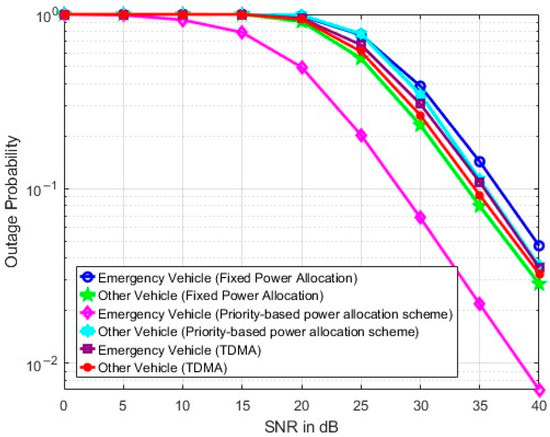
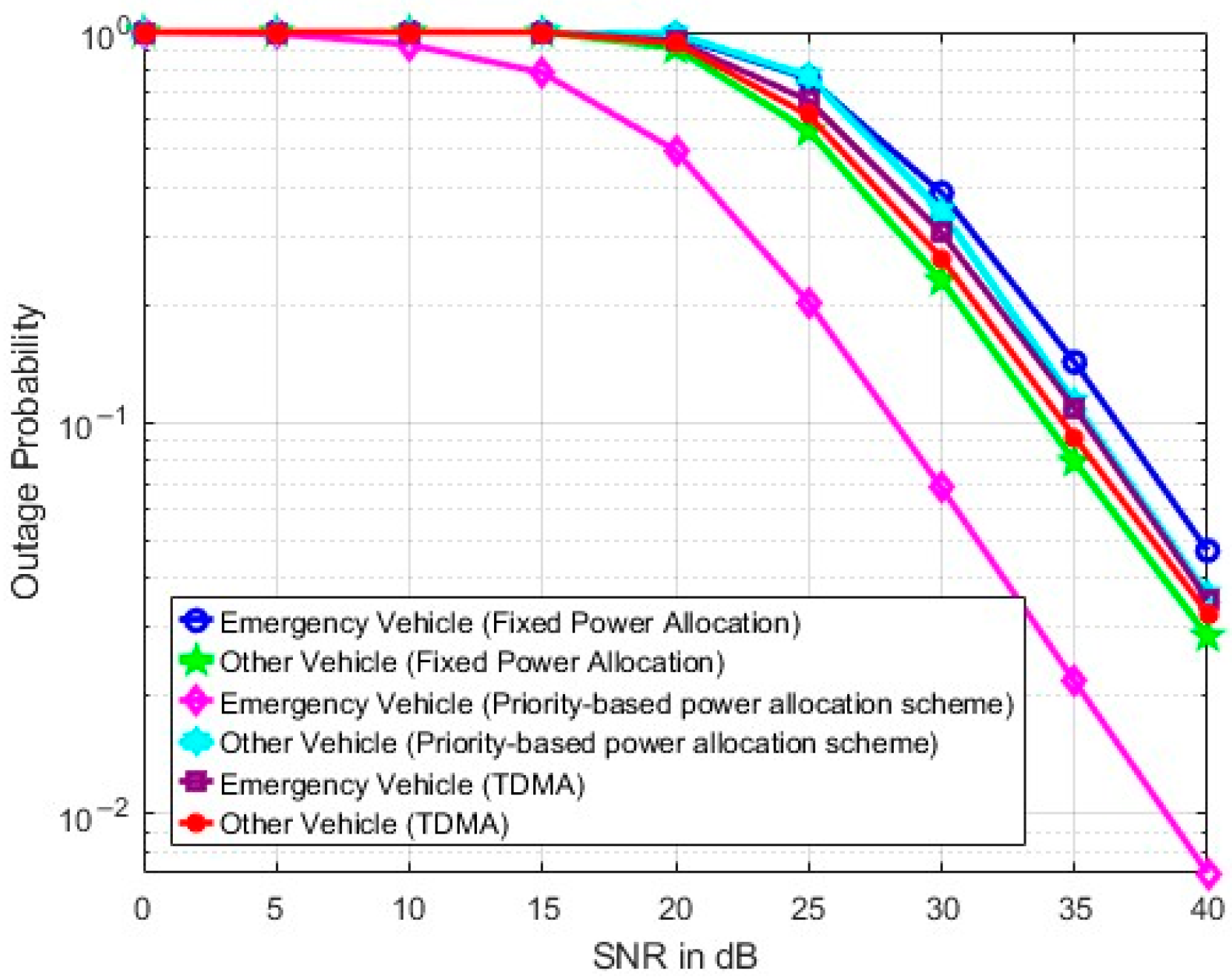
Figure 1 shows the outage performance of the emergency vehicle and other vehicles under different resource allocation strategies. With fixed power allocation or TDMA, both emergency vehicles and other vehicles exhibit similar reliability, and their outage probabilities only start to drop significantly when SNR exceeds about 25 dB. In contrast, the proposed priority-based power allocation scheme causes the pink curve to shift markedly left and downward, outage probability of the emergency vehicle quickly decreases to below , while the outage probability of the regular vehicles is only slightly higher than fixed power allocation and TDMA. This demonstrates that our scheme can greatly enhance the reliability of the emergency vehicle link without severely penalizing regular users.
Figure 1.
Outage Probability vs. SNR.
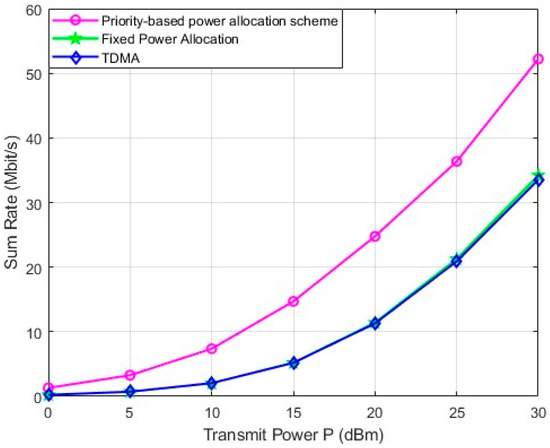
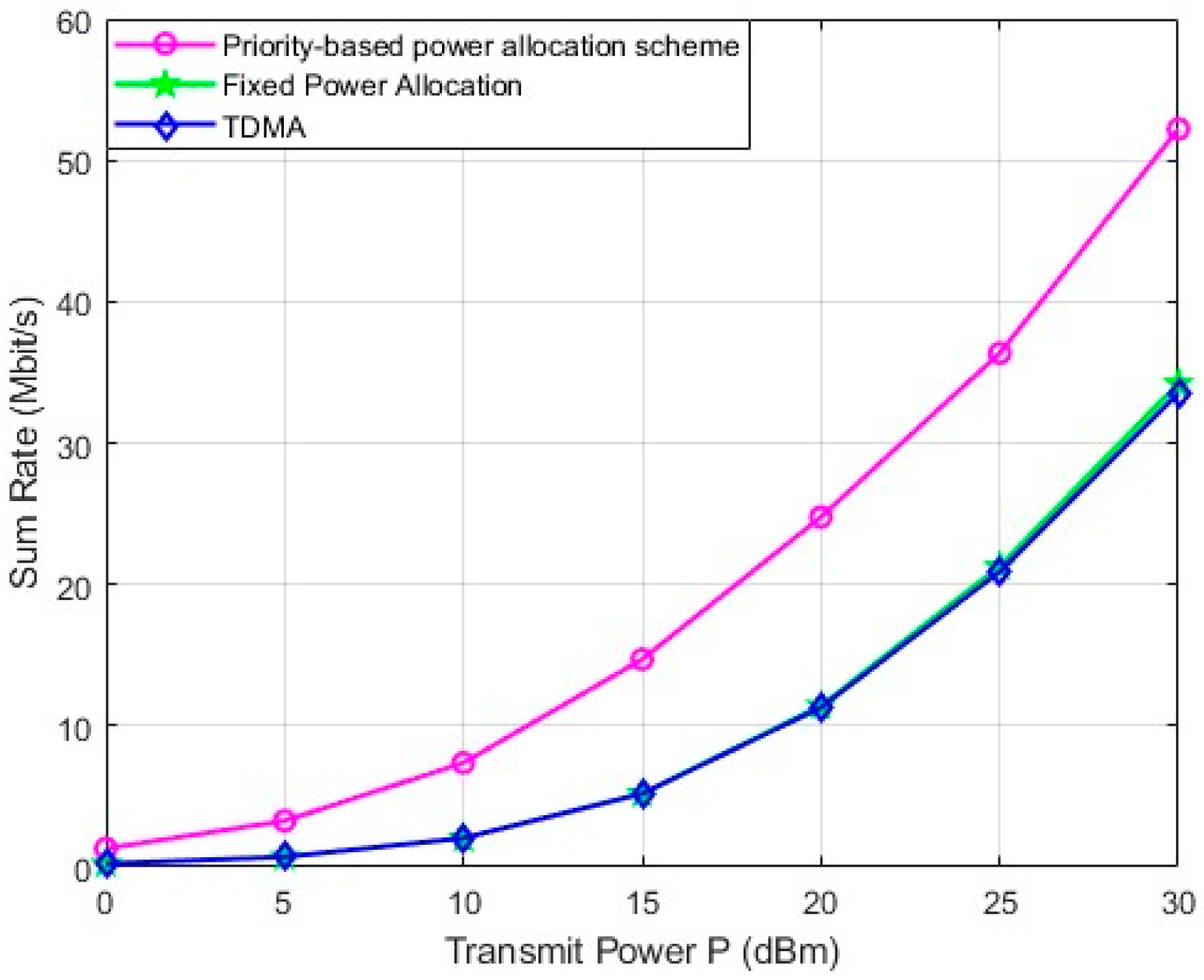
Figure 2 shows the comparison of the overall spectral efficiency of three schemes: the priority-based power allocation scheme, conventional fixed power allocation, and TDMA with equal bandwidth but time sharing. As the transmit power increases, all schemes achieve higher sum rates, but the growth of the proposed scheme is significantly faster. At low power, the priority-based power allocation scheme already outperforms both baselines; at 30 dBm, it reaches more than 50 Mbit/s, whereas fixed power allocation and TDMA achieve only about 35 Mbit/s. Combining the results of both figures, the proposed priority-based power allocation scheme simultaneously provides ultra-reliable transmission for the emergency vehicle and a substantial gain in total throughput, which is crucial for supporting rich medical data such as diagnostic images and real-time video in future smart healthcare vehicular networks.
Figure 2.
Sum rate and transmit power.
5. Conclusions
We developed a priority-based power allocation scheme tailored for emergency vehicles operating in congested and highly dynamic urban VANET environments. By jointly considering differentiated service requirements and shared-spectrum constraints, we developed an adaptive power-allocation strategy that enables emergency vehicles to maintain reliable and low-latency communication even under heavy traffic conditions [12]. Simulation results by MATLAB R2024b indicate that the proposed method achieves higher target-rate satisfaction, improved link reliability, and lower outage probability compared with conventional OMA and fixed-power baselines, while still preserving acceptable performance for regular vehicles. These findings confirm the feasibility and advantages of applying NOMA to V2X scenarios that require prioritized emergency services. Future work will explore multi-priority V2X service slicing to further enhance the system’s adaptability in complex urban environments.
Author Contributions
Conceptualization, J.-S.L., I.-H.L. and H.-W.K.; methodology, I.-H.L., Z.-Y.S. and H.-W.K.; software, Z.-Y.S. and H.-W.K.; validation, I.-H.L., Z.-Y.S. and H.-W.K.; investigation, H.-W.K.; writing—original draft preparation, H.-W.K.; writing—review and editing, H.-W.K., Z.-Y.S. and I.-H.L.; supervision, J.-S.L. All authors have read and agreed to the published version of the manuscript.
Funding
This research was funded by National Science and Technology Council (NSTC) grant number NSTC 114-2634-F-006-001-MBK and NSTC 113-2221-E-006-147-MY2.
Institutional Review Board Statement
Not applicable.
Informed Consent Statement
Not applicable.
Data Availability Statement
The data presented in this study are available within the article.
Conflicts of Interest
The authors declare no conflict of interest.
References
- Garcia, M.H.; Molina-Galan, A.; Boban, M.; Gozalvez, J.; Coll-Perales, B.; Şahin, T.; Kousaridas, A. A Tutorial on 5G NR V2X Communications. IEEE Commun. Surv. Tutor. 2021, 23, 1972–2026. [Google Scholar] [CrossRef] [Scilit]
- Ding, H.; Leung, K.-C. Resource Allocation for Low-Latency NOMA-Enabled Vehicle Platoon-Based V2X System. In Proceedings of the 2021 IEEE Global Communications Conference (GLOBECOM), Madrid, Spain, 7–11 December 2021. [Google Scholar]
- Dai, L.; Wang, B.; Ding, Z.; Wang, Z.; Chen, S.; Hanzo, L. A Survey of Non-Orthogonal Multiple Access for 5G. IEEE Commun. Surv. Tutor. 2018, 20, 2294–2323. [Google Scholar] [CrossRef] [Scilit]
- Di, B.; Song, L.; Li, Y.; Han, Z. V2X Meets NOMA: Non-Orthogonal Multiple Access for 5G-Enabled Vehicular Networks. IEEE Wirel. Commun. 2017, 24, 14–21. [Google Scholar] [CrossRef] [Scilit]
- Miri, F.; Javadpour, A.; Sangaiah, A.K.; Pazzi, R. Improving Resources in Internet of Vehicles Transportation Systems Using Markov Transition and TDMA Protocol. IEEE Trans. Intell. Transp. Syst. 2023, 24, 13050–13067. [Google Scholar] [CrossRef] [Scilit]
- Ding, H.; Leung, K.-C. Resource Allocation for Low-Latency NOMA-V2X Networks Using Reinforcement Learning. In Proceedings of the IEEE Conference on Computer Communications Workshops, Vancouver, BC, Canada, 10–13 May 2021. [Google Scholar]
- Sharma, S.; Ghosh, S.; Bhatnagar, M.R.; Panigrahi, B.K. Power Efficient Handoff Management in Hybrid V2X Communication: Game-Theoretic Approach to Resource Allocation with Load Reduction. IEEE. Trans. Mob. Comput. 2024, 23, 14638–14655. [Google Scholar] [CrossRef] [Scilit]
- Clancy, J.; Mullins, D.; Deegan, B.; Horgan, J.; Ward, E.; Eising, C.; Denny, P.; Jones, E.; Glavin, M. Wireless Access for V2X Communications: Research, Challenges and Opportunities. IEEE Commun. Surv. Tutor. 2024, 26, 2082–2119. [Google Scholar] [CrossRef] [Scilit]
- Yang, Z.; Ding, Z.; Fan, P.; Al-Dhahir, N. The Impact of Power Allocation on Cooperative Non-orthogonal Multiple Access Networks with SWIPT. IEEE Trans. Wirel. Commun. 2017, 16, 4332–4343. [Google Scholar] [CrossRef] [Scilit]
- Qian, L.P.; Wu, Y.; Zhou, H.; Shen, X. Dynamic Cell Association for Non-Orthogonal Multiple-Access V2S Networks. IEEE J. Sel. Areas Commun. 2017, 35, 2342–2356. [Google Scholar] [CrossRef] [Scilit]
- Ding, Z.; Peng, M.; Poor, H.V. Cooperative Non-Orthogonal Multiple Access in 5G Systems. IEEE Commun. Lett. 2015, 19, 1462–1465. [Google Scholar] [CrossRef] [Scilit]
- Di, B.; Song, L.; Li, Y.; Li, G.Y. Non-Orthogonal Multiple Access for High-Reliable and Low-Latency V2X Communications in 5G Systems. IEEE J. Sel. Areas Commun. 2017, 35, 2383–2397. [Google Scholar] [CrossRef] [Scilit]
Disclaimer/Publisher’s Note: The statements, opinions and data contained in all publications are solely those of the individual author(s) and contributor(s) and not of MDPI and/or the editor(s). MDPI and/or the editor(s) disclaim responsibility for any injury to people or property resulting from any ideas, methods, instructions or products referred to in the content. |
© 2026 by the authors. Licensee MDPI, Basel, Switzerland. This article is an open access article distributed under the terms and conditions of the Creative Commons Attribution (CC BY) license.