


Abstract
This study aims to enhance and develop the properties of materials used as supercapacitors. The synthesis of graphene oxide (GO) was achieved via a modified Hummer’s method, whereas the fabrication of polyaniline (PANI)/GO nanocomposites was conducted utilizing an in situ chemical polymerization technique. Subsequently, the PANI/GO layered films were deposited on fluorine-doped tin oxide (FTO) glass for supercapacitor applications. The materials were analyzed using X-ray diffraction (XRD), Raman spectroscopy, scanning electron microscopy (SEM), Fourier transform infrared spectroscopy (FT-IR), and cyclic voltammetry (CV). The experimental results demonstrated that a reaction time of 30 min, along with a weight ratio of aniline (ANI) monomer to GO of 1:1.5, yielded an optimal specific capacitance of 13.30 F/g. The robust electrochemical performance of the PANI/GO electrode may stem from the increased active sites for PANI deposition, attributable to the large surface areas of GO.
1. Introduction
The increasing need for effective energy storage solutions, especially in portable devices, electric transportation, and sustainable energy systems, has sparked significant interest in supercapacitors. These components provide exceptional power density, swift charge and discharge capabilities, and extended operational lifespan. Among the diverse energy storage technologies, supercapacitors have attracted considerable interest owing to their distinct benefits, positioning them as a viable option that connects the characteristics of conventional capacitors and batteries [1,2,3].
Conducting polymers, including polyaniline (PANI), are favored as electrode materials for supercapacitors owing to their elevated specific capacitance and exceptional electrical conductivity. However, their limited cyclic stability restricts their practical application [4,5]. Graphene and its derivatives exhibit significant potential in improving the functionality of supercapacitors, particularly those utilizing conducting polymers [6]. Graphene oxide (GO) modified with oxygen-containing functional groups is predominantly favored due to its ability to readily create stable aqueous colloid dispersions without the necessity for polymeric or surfactant stabilizers [7]. Consequently, the integration of conducting polymers with GO in electrode materials frequently results in synergistic effects that enhance the overall performance of supercapacitors [8].
This research focuses on developing and improving the features of materials utilized in the electrodes of supercapacitors. The production of GO was accomplished through a modified Hummer’s method, while the formation of PANI/GO nanocomposites was carried out using an in situ chemical polymerization process. Following this, the PANI/GO layered films were coated onto fluorine-doped tin oxide (FTO) glass for use in supercapacitor applications.
2. Experimental Procedure
Aniline (ANI) monomer 99.5% (analytical reagent (AR) grade) was obtained from Loba Chemie Pvt. Ltd. (Mumbai, India), distilled under reduced pressure, and stored below 0 °C prior to use [9]. Graphite powder (325 mesh, fine powder extra pure) was purchased from Merck, Ltd. (Darmstadt, Germany). Additional chemicals and reagents were of analytical grade and used without further purification. The deionized (DI) water utilized in the experiment was generated in-house.
One gram of graphite powder was mixed with 0.5 g of sodium nitrate (NaNO3). Subsequently, 25 mL of sulfuric acid (H2SO4) was added to the mixture, and 3 g of potassium permanganate (KMnO4) was gradually introduced while the reaction mixture was maintained in an ice bath for 2 h. After the oxidation step, 10 mL of 30% hydrogen peroxide (H2O2) was slowly added, followed by the gradual addition of 500 mL of DI water under continuous stirring [10]. The formation of a yellowish-brown GO suspension was observed. The resulting suspension was then centrifuged and repeatedly washed with DI water and methanol 50% v/v until a neutral pH was attained. Finally, the obtained GO was dried under ambient conditions.
PANI/GO composites were synthesized via an in situ polymerization method. GO at amounts of 15, 30, and 45 mg was dispersed in 30 mL of DI water and sonicated for 30 min to obtain a homogeneous suspension. Subsequently, 51.3 mg of ammonium persulfate ((NH4)2S2O8) was added to the suspension under continuous stirring. Thereafter, 0.031 mL of ANI monomer and an equimolar amount of hydrochloric acid (HCl) were introduced, and the mixture was stirred for an additional 15 min [11]. The resulting mixture was then subjected to high-frequency ultrasonic vibration at 50 °C for 30–75 min, using a run–stop cycle of 10 s and an amplitude of 25%. After polymerization, the obtained product was collected by centrifugation and subsequently dried at 60 °C for 48 h.
FTO glass substrates were sequentially cleaned with acetone (C3H6O), isopropanol (C3H8O), and DI water using a sonication bath. After cleaning, a PANI/GO dispersion (5 mg/mL) was deposited onto the FTO glass and subsequently dried in a vacuum oven [12]. The PANI/GO-coated FTO glass was then used as the electrode for supercapacitor applications.
The crystal structure, defect/disorder, morphology, chemical structure, and electrochemical performance of the prepared materials were characterized using X-ray diffraction (XRD), Raman spectroscopy, scanning electron microscopy (SEM), Fourier transform infrared spectroscopy (FT-IR), and cyclic voltammetry (CV), respectively.
3. Results and Discussion
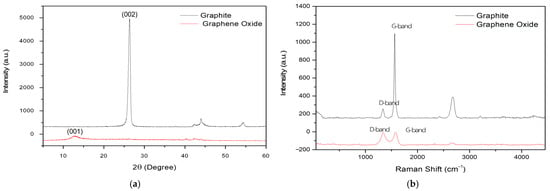
The successful synthesis of GO from graphite was confirmed by XRD and Raman spectroscopy, as shown in Figure 1. In the XRD pattern of pristine graphite (Figure 1a), a characteristic sharp diffraction peak corresponding to the (002) plane is observed at around 2θ ≈ 26.5°. After the oxidation process, this peak markedly diminishes, and a new diffraction feature appears at lower diffraction angles, which is attributed to the (001) plane of GO. This shift reflects the expansion of interlayer spacing caused by the introduction of oxygen-containing functional groups and intercalated species, indicating the successful oxidation and exfoliation of graphite into GO.
Figure 1.
(a) XRD patterns, and (b) Raman spectra of graphite and GO.
Raman spectroscopy further supports this structural transformation (Figure 1b). Pristine graphite exhibits a dominant G band at approximately 1580 cm−1 with a relatively weak D band near 1350 cm−1, consistent with an ordered sp2 carbon structure. In contrast, the Raman spectrum of GO shows a pronounced increase in the D band intensity along with broadening of both D and G bands, indicating the introduction of defects and structural disorder induced by oxidation. The increased ID/IG ratio in GO confirms the disruption of the graphitic lattice and the loss of long-range order, which are characteristic features of GO. These results collectively demonstrate the successful conversion of graphite into GO, providing a suitable precursor for subsequent composite fabrication.
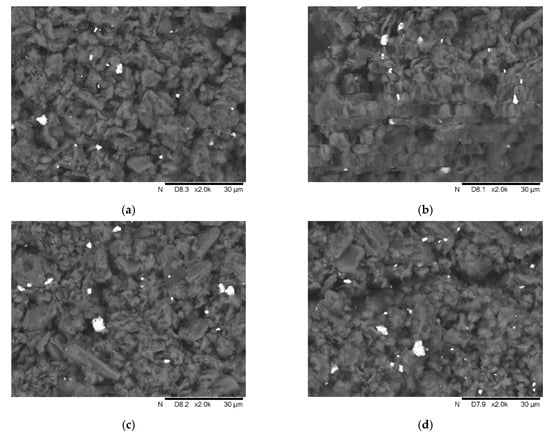
Figure 2 illustrates the morphological characteristics of PANI/GO composite materials subjected to ultrasonic dispersion for 30, 45, 60, and 75 min. SEM images acquired at a magnification of 2000× reveal that, after 30 min of ultrasonic dispersion, PANI was uniformly distributed on the GO surface. In contrast, prolonging the ultrasonic dispersion time to 45, 60, and 75 min resulted in reduced uniformity and poorer dispersion of PANI on the GO surface. This deterioration in dispersion can be attributed to prolonged ultrasonic treatment, which induces inelastic collisions between polymer and carbon materials, thereby promoting particle aggregation and the formation of larger agglomerates [13,14].
Figure 2.
SEM images of PANI/GO nanocomposites after various ultrasonic dispersion times: (a) 30, (b) 45, (c) 60, and (d) 75 min.
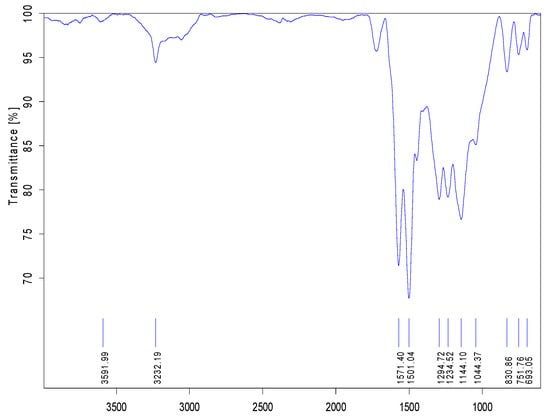
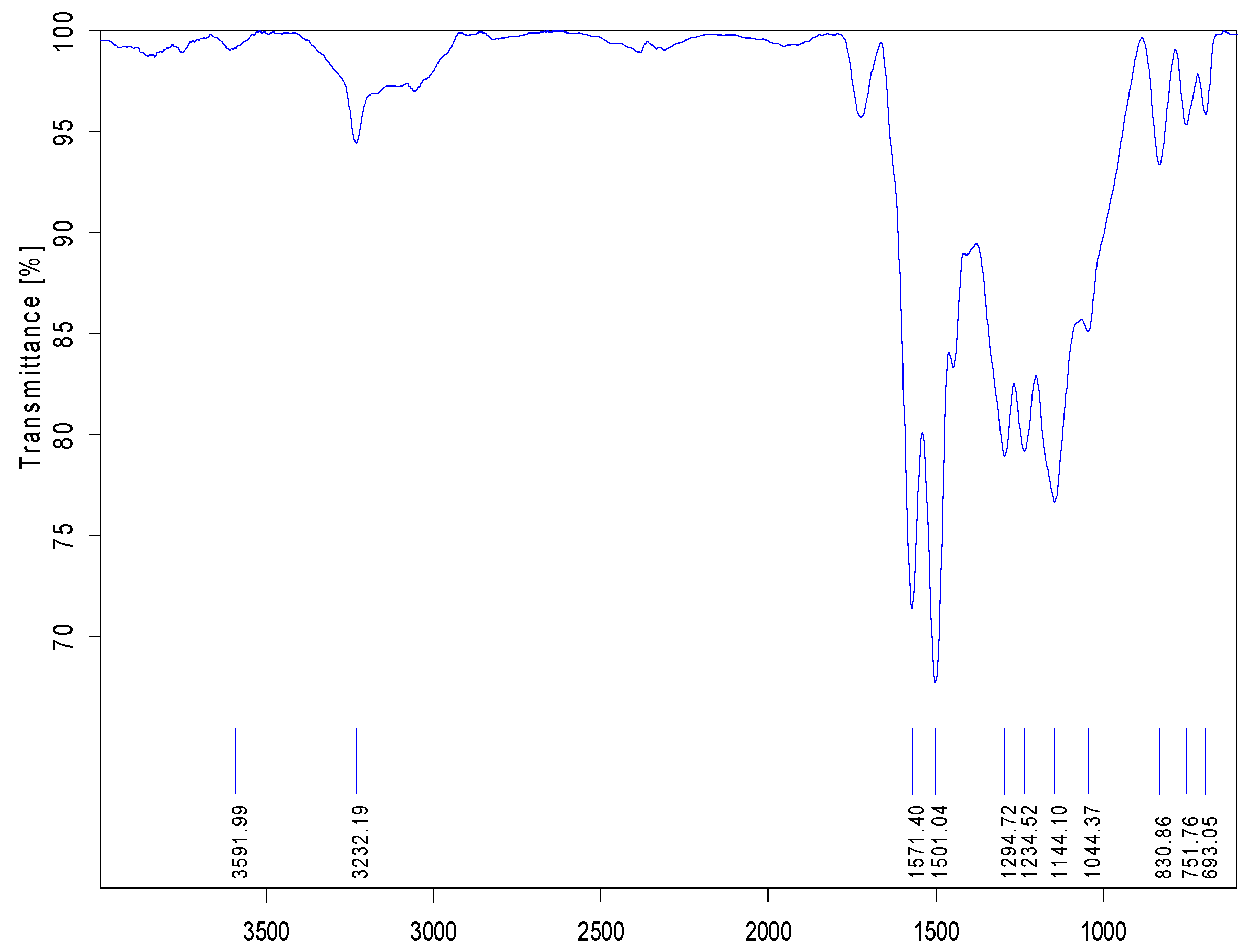
FT-IR was employed to identify the chemical functional groups present in the PANI/GO composite materials. The FT-IR spectra of the synthesized composites (Figure 3) exhibited characteristic absorption bands associated with the aniline structure, including nitrogen–hydrogen (N–H), carbon–nitrogen (C–N), and carbon–hydrogen (C–H) bonds. Distinct absorption peaks were observed at 3592, 1571, 1501, 1295, 1144, and 751 cm−1, which were assigned to N–H stretching, C=C stretching of the quinoid and benzenoid rings, N–H bending, C–N stretching, aromatic C–H in-plane bending, and C–N out-of-plane bending vibrations, respectively. In addition, absorption bands at 3232 and 1730 cm−1 corresponded to O–H stretching and C=O stretching vibrations, respectively. These results confirm the successful formation of PANI/GO composite materials through the presence of amine, hydroxyl, and carboxyl functional groups [9,15,16].
Figure 3.
FT-IR spectra of PANI/GO nanocomposites with a 30 min ultrasonic dispersion time.
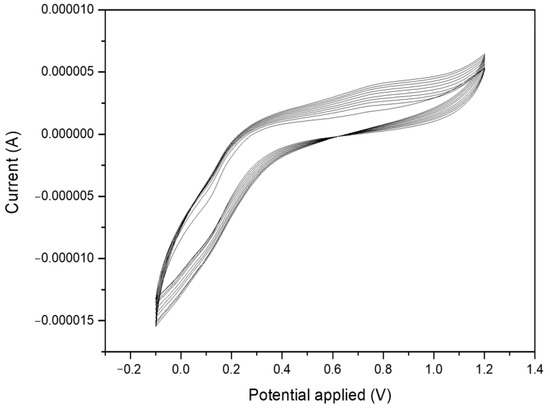
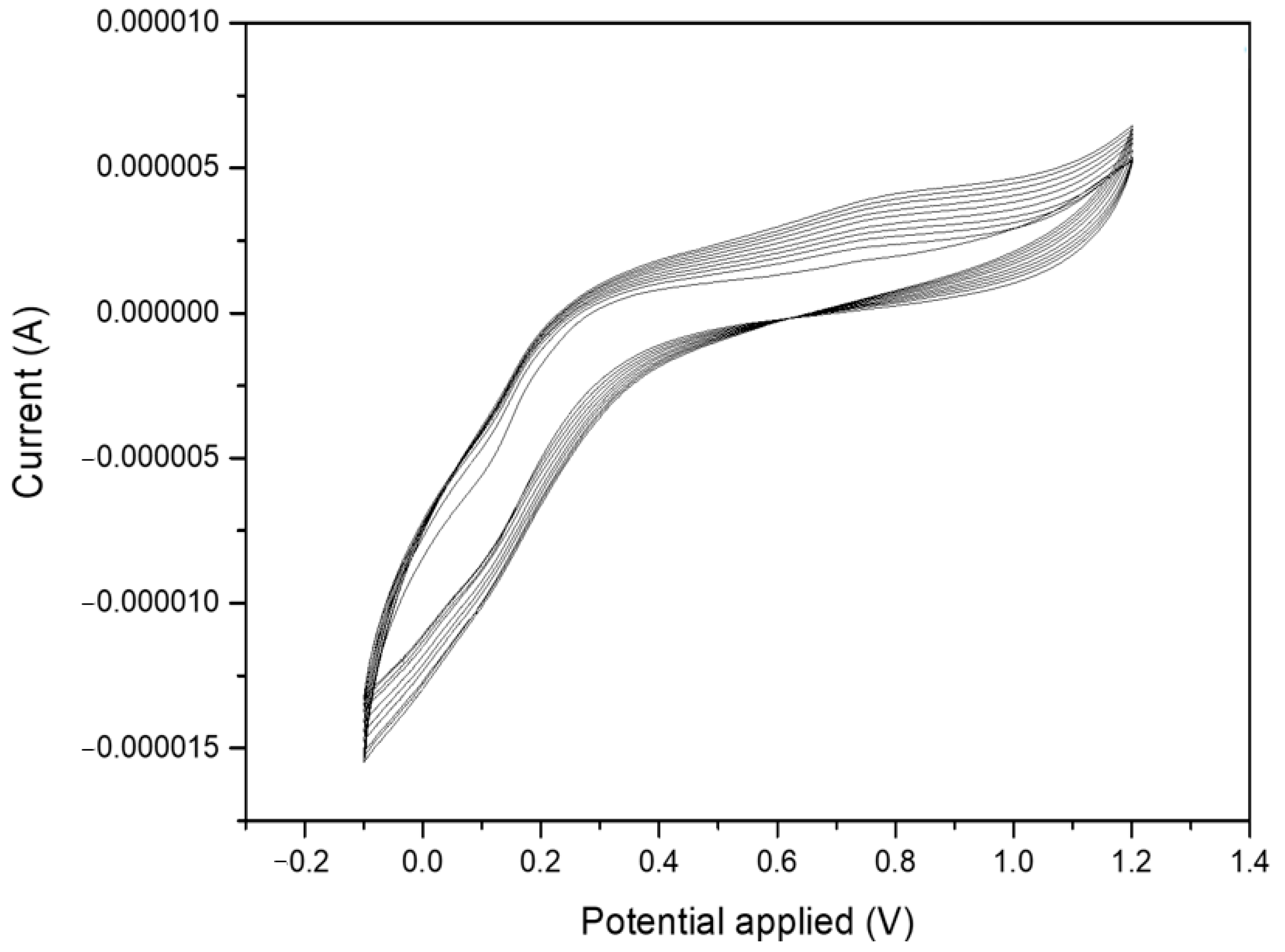
The electrochemical performance of the PANI/GO composite materials was evaluated by CV at a scan rate of 50 mV/s. As shown in Figure 4, the CV curves exhibit a pronounced current response, which can be attributed to the high specific surface area of GO contributing to enhanced capacitive behavior. In addition, distinct redox peaks associated with oxidation and reduction processes are observed, indicating the pseudocapacitive contribution of PANI in its electrically conductive emeraldine salt form [17,18,19,20]. The CV profiles remain stable over successive cycles, and the maximum specific capacitance of the material was calculated to be 13.30 F/g.
Figure 4.
CV curves of PANI/GO nanocomposites at a scan rate of 50 mV/s.
4. Conclusions
This study aims to enhance the performance of high-efficiency supercapacitors by depositing a PANI/GO layer onto FTO conductive glass. GO was synthesized using a modified Hummers’ method, followed by the fabrication of PANI/GO composite materials via in situ polymerization. SEM analysis revealed a homogeneous distribution of PANI on the GO surface. Electrochemical characterization using CV demonstrated a high specific capacitance of 13.30 F/g, indicating the potential of the PANI/GO composite as an alternative electrode material for supercapacitor applications in various consumer electronics.
Author Contributions
All of the authors participated in a collaborative endeavor to produce this work. A.B. was responsible for the design of the experiments, the analysis of the data, and the initial drafting of the manuscript, which was then extensively revised. M.S., R.C. and S.C. were responsible for the laboratory experiments. V.L. contributed to the conceptual approach and discussion of the results, and he approved the final version of the revised manuscript. All authors have read and agreed to the published version of the manuscript.
Funding
This research did not receive any specific grants from public, commercial, or non-profit funding agencies.
Institutional Review Board Statement
Not applicable.
Informed Consent Statement
Not applicable.
Data Availability Statement
The original contributions presented in this study are included in the article. Further inquiries can be directed to the corresponding author.
Acknowledgments
The authors would like to acknowledge the Department of Materials Science and Engineering, Faculty of Engineering and Industrial Technology, Silpakorn University, for their assistance and support.
Conflicts of Interest
The authors declare no conflicts of interest.
References
- Hemha, N.; Khajonrit, J.; Nuansing, W. Additive fabrication of polyaniline and carbon-based composites for energy storage. Polymers 2024, 16, 3369. [Google Scholar] [CrossRef] [Scilit] [PubMed]
- Loryuenyong, V.; Plongmai, B.; Pajantorn, N.; Pattananuwat, P.; Buasri, A. Sustainable zinc-ion battery separators based on silica and cellulose fibers derived from coffee parchment waste. J. Compos. Sci. 2025, 9, 452. [Google Scholar] [CrossRef] [Scilit]
- Adedoja, O.S.; Sadiku, E.R.; Hamam, Y. An overview of the emerging technologies and composite materials for supercapacitors in energy storage applications. Polymers 2023, 15, 2272. [Google Scholar] [CrossRef] [Scilit] [PubMed]
- Patil, P.H.; Kulkarni, V.V.; Dongale, T.D.; Jadhav, S.A. α-Manganese dioxide (α-MnO2) coated with polyaniline (PANI) and reduced graphene oxide (rGO)-based nanocomposite for supercapacitor application. J. Compos. Sci. 2023, 7, 167. [Google Scholar] [CrossRef] [Scilit]
- Beidaghi, M.; Gogotsi, Y. Capacitive energy storage in micro-scale devices: Recent advances in design and fabrication of micro-supercapacitors. Energy Environ. Sci. 2014, 7, 867. [Google Scholar] [CrossRef] [Scilit]
- Benchikh, I.; Ezzat, A.O.; Sabantina, L.; Benmimoun, Y.; Benyoucef, A. Investigation of hybrid electrodes of polyaniline and reduced graphene oxide with bio-waste-derived activated carbon for supercapacitor applications. Polymers 2024, 16, 421. [Google Scholar] [CrossRef] [Scilit] [PubMed]
- Loryuenyong, V.; Saewong, C.; Aranchaiya, C.; Buasri, A. The improvement in mechanical and barrier properties of poly(vinyl alcohol)/graphene oxide packaging films. Packag. Technol. Sci. 2015, 28, 939–947. [Google Scholar] [CrossRef] [Scilit]
- Bonastre, J.; Molina, J.; Cases, F. Surface modification of jute fabrics by reduced graphene oxide-conducting polymer coatings for their application in low-cost and eco-friendly supercapacitors. J. Energy Storage 2023, 69, 107936. [Google Scholar] [CrossRef] [Scilit]
- Manivel, P.; Dhakshnamoorthy, M.; Balamurugan, A.; Ponpandian, N.; Mangalaraja, D.; Viswanathan, C. Conducting polyaniline-graphene oxide fibrous nanocomposites: Preparation, characterization and simultaneous electrochemical detection of ascorbic acid, dopamine and uric acid. RSC Adv. 2013, 3, 14428–14437. [Google Scholar] [CrossRef] [Scilit]
- Shahriary, L.; Athawale, A.A. Graphene oxide synthesized by using modified hummers approach. Int. J. Energy Environ. Eng. 2014, 2, 58–63. [Google Scholar]
- Singu, B.S.; Yoon, K.R. Highly exfoliated GO-PPy-Ag ternary nanocomposite for electrochemical supercapacitor. Electrochim. Acta 2018, 268, 304–315. [Google Scholar] [CrossRef] [Scilit]
- Mitchell, E.; Candler, J.; Souza, F.D.; Gupta, R.K.; Gupta, B.K.; Dong, L.F. High performance supercapacitor based on multilayer of polyaniline and graphene oxide. Synth. Met. 2015, 199, 214–218. [Google Scholar] [CrossRef] [Scilit]
- Bhadra, S.; Khastgir, D.; Singha, N.K.; Lee, J.H. Progress in preparation, processing and applications of polyaniline. Prog. Polym. Sci. 2009, 34, 783–810. [Google Scholar] [CrossRef] [Scilit]
- Cirillo, C.; Iuliano, M.; Scarpa, D.; Iovane, P.; Borriello, C.; Portofino, S.; Galvagno, S.; Sarno, M. Silver-doped reduced graphene oxide/PANI-DBSA-PLA composite 3D-printed supercapacitors. Nanomaterials 2024, 14, 1681. [Google Scholar] [CrossRef] [Scilit] [PubMed]
- Zhang, Q.; Li, Y.; Feng, Y.; Feng, W. Electropolymerization of graphene oxide/polyaniline composite for high-performance supercapacitor. Electrochim. Acta 2013, 90, 95–100. [Google Scholar] [CrossRef] [Scilit]
- Bai, Y.; Rakhi, R.B.; Chen, W.; Alshareef, H.N. Effect of pH-induced chemical modification of hydrothermally reduced graphene oxide on supercapacitor performance. J. Power Sources 2013, 233, 313–319. [Google Scholar] [CrossRef] [Scilit]
- Chang, T.W.; Lin, L.Y.; Peng, P.W.; Zhang, Y.X.; Huang, Y.Y. Enhanced electrocapacitive performance for the supercapacitor with tube-like polyaniline and graphene oxide composites. Electrochim. Acta. 2018, 259, 348–354. [Google Scholar] [CrossRef] [Scilit]
- Wu, X.; Tang, L.; Zheng, S.; Huang, Y.; Yang, J.; Liu, Z.; Yang, W.; Yang, M. Hierarchical unidirectional graphene aerogel/polyaniline composite for high performance supercapacitors. J. Power Sources 2018, 397, 189–195. [Google Scholar] [CrossRef] [Scilit]
- Zhang, Y.; Si, L.; Zhou, B.; Zhao, B.; Zhu, Y.; Zhu, L.; Jiang, X. Synthesis of novel graphene oxide/pristine graphene/polyaniline ternary composites and application to supercapacitor. Chem. Eng. J. 2016, 288, 689–700. [Google Scholar] [CrossRef] [Scilit]
- Panloetparnich, W.; Loryuenyong, V.; Buasri, A. Facile synthesis of polyaniline-nickel oxide composites via interfacial polymerization. Mater. Today Proc. 2021, 52, 2485–2489. [Google Scholar] [CrossRef] [Scilit]
Disclaimer/Publisher’s Note: The statements, opinions and data contained in all publications are solely those of the individual author(s) and contributor(s) and not of MDPI and/or the editor(s). MDPI and/or the editor(s) disclaim responsibility for any injury to people or property resulting from any ideas, methods, instructions or products referred to in the content. |
© 2026 by the authors. Licensee MDPI, Basel, Switzerland. This article is an open access article distributed under the terms and conditions of the Creative Commons Attribution (CC BY) license.