Formulation Strategies for Mayonnaise-Type Sauces: The Role of Hydrocolloid Combinations †


Abstract
1. Introduction
2. Materials and Methods
2.1. Materials
2.2. Samples Preparation
2.3. Methods
3. Results and Discussions
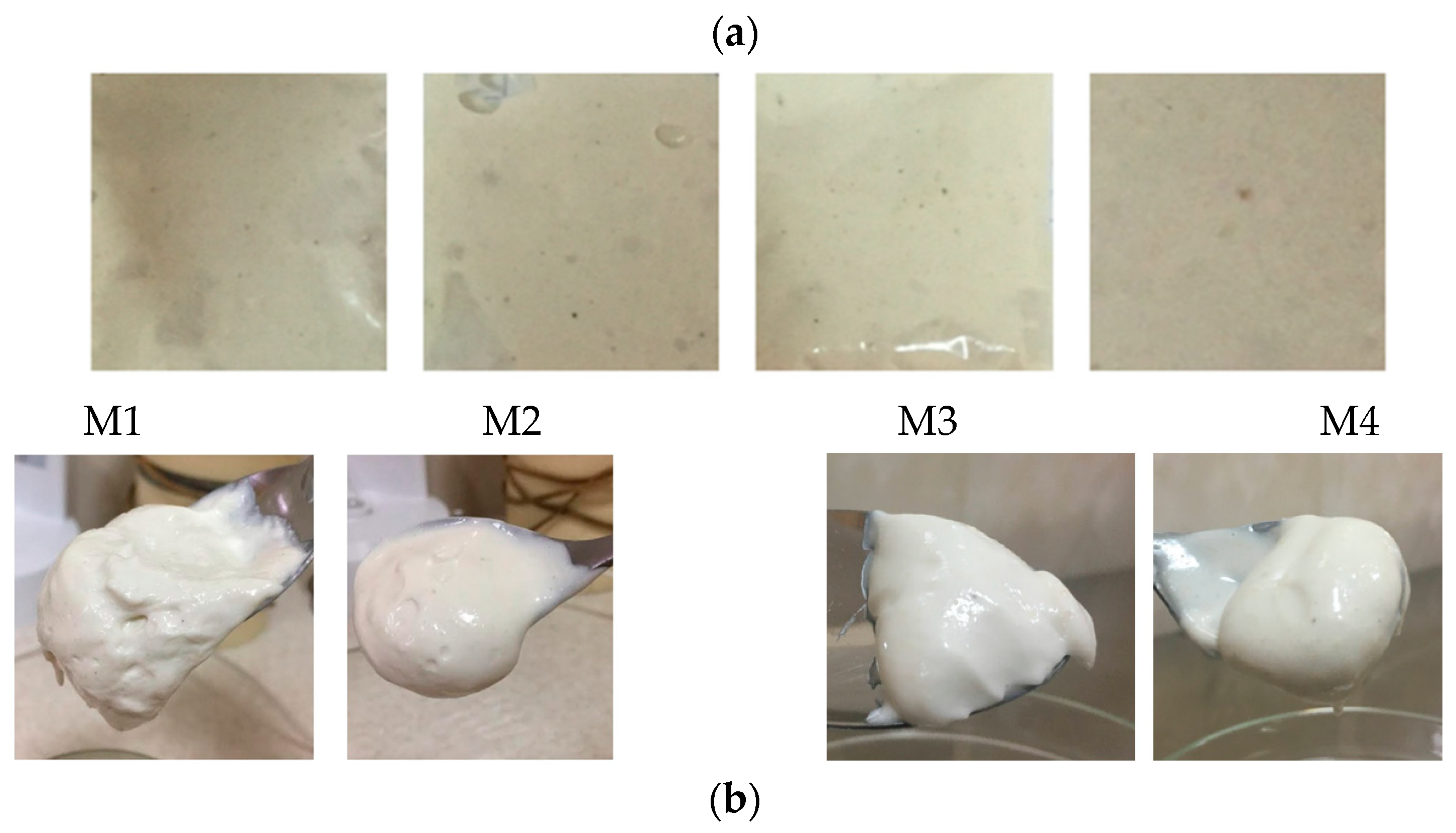
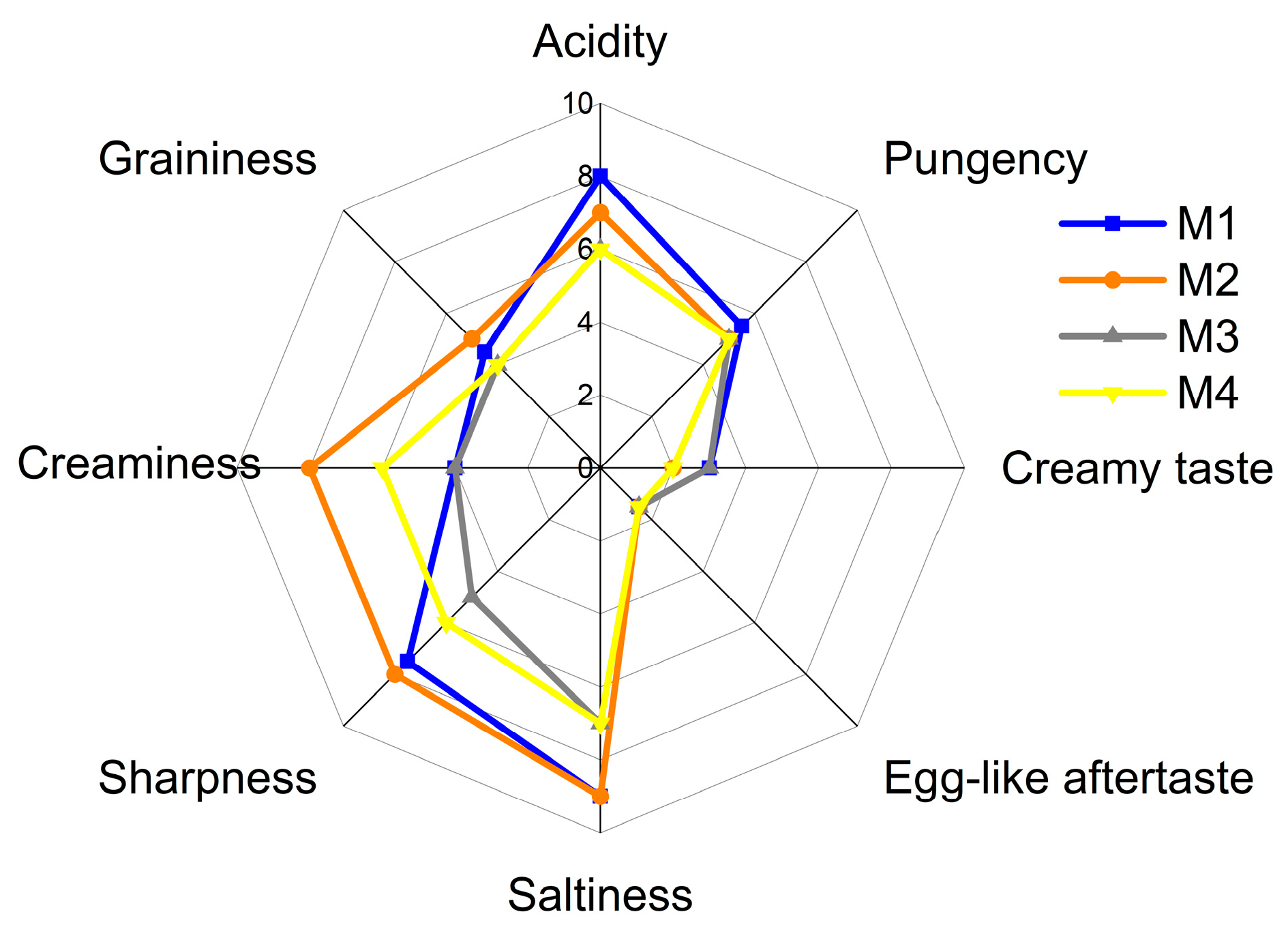
3.1. Sensory Evaluations
3.2. Stability and Acidity of Sauces
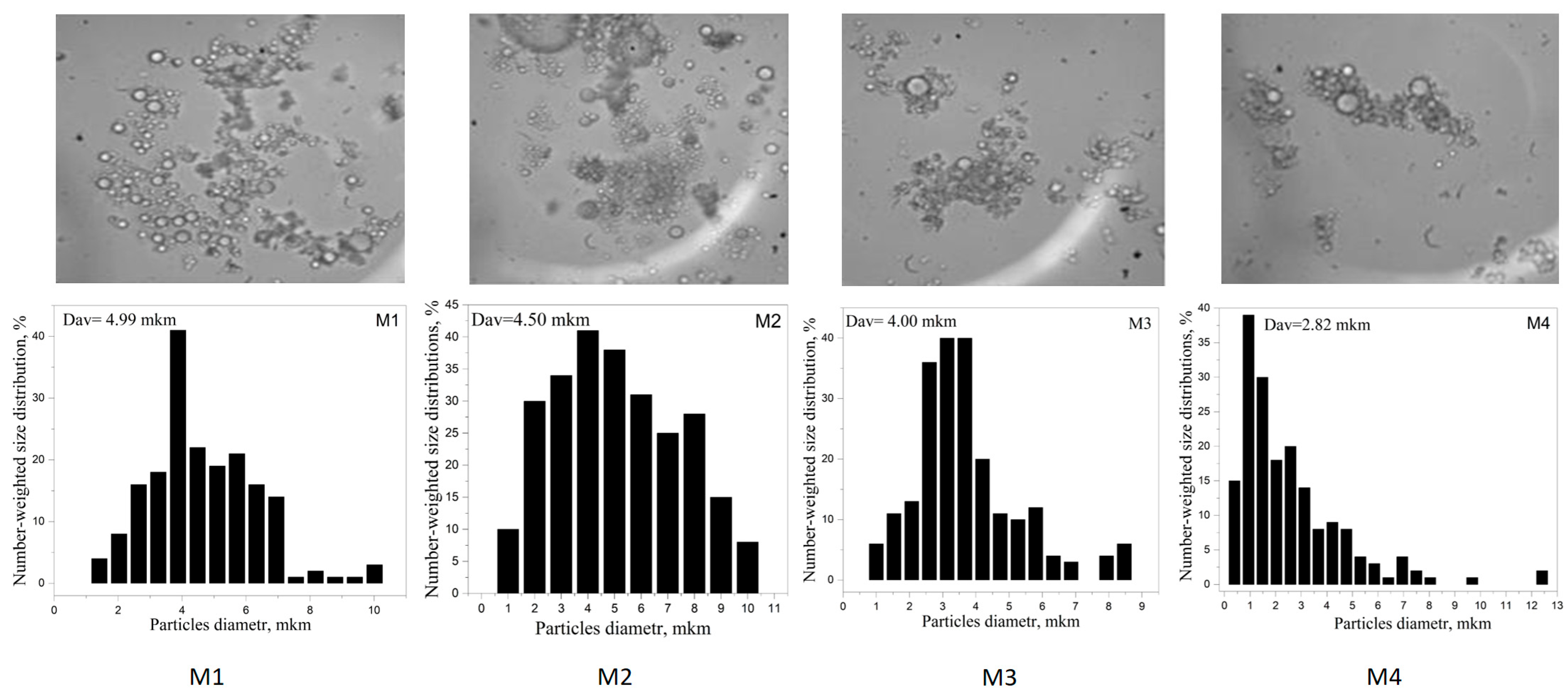
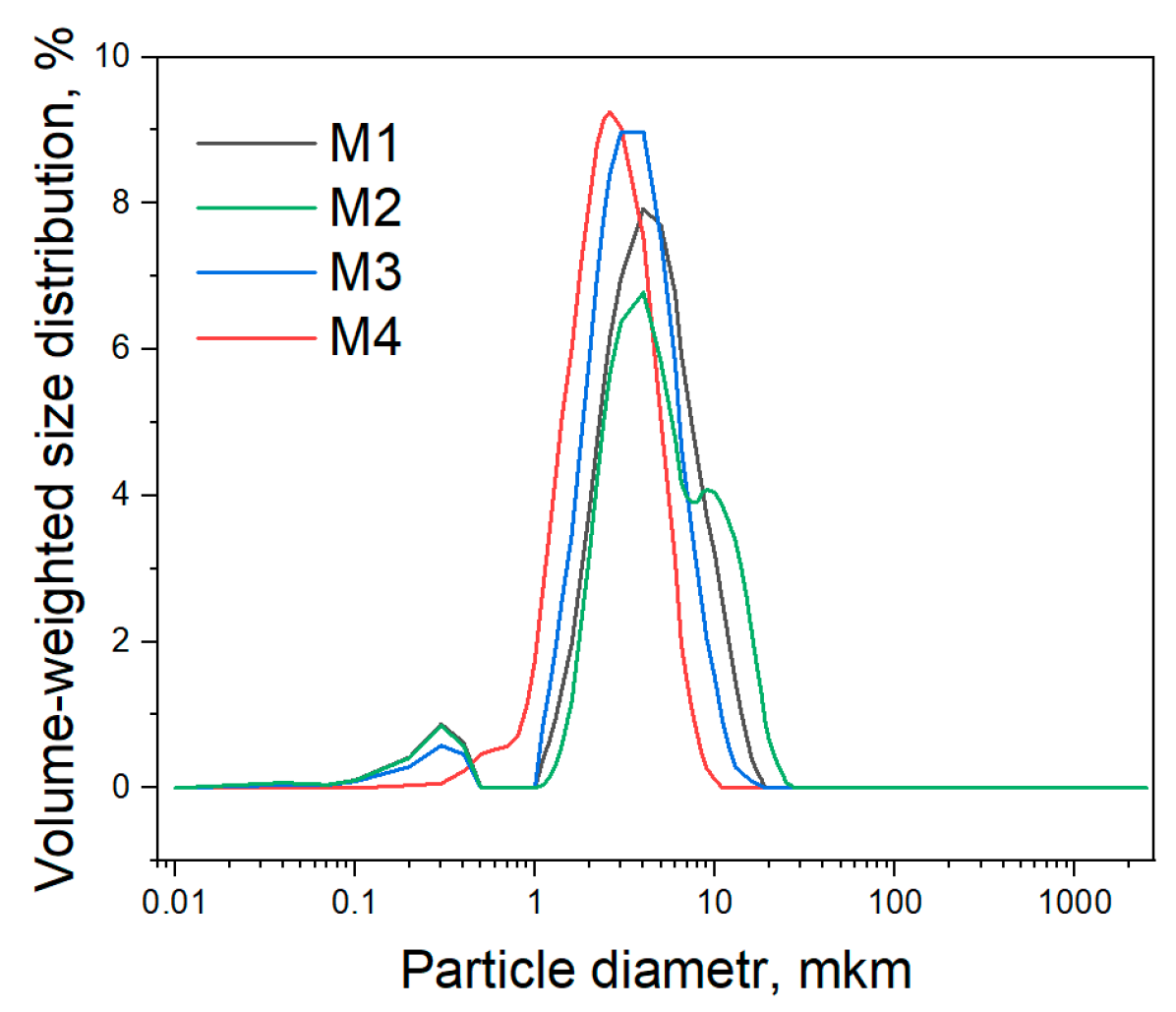
3.3. Particle Size Estimation
3.4. The Analysis of the Viscometric Measurements for the Investigated Samples
4. Conclusions
Author Contributions
Funding
Institutional Review Board Statement
Informed Consent Statement
Data Availability Statement
Acknowledgments
Conflicts of Interest
References
- DSTU 4543:2006; Soybean Flour for Food. UkrNDNC: Kyiv, Ukraine, 2007; pp. 1–18. Available online: https://online.budstandart.com/ua/catalog/doc-page.html?id_doc=72413 (accessed on 23 January 2025).
- Dickinson, E.; Golding, M. Rheology of Sodium Caseinate Stabilized Oil-in-Water Emulsions. J. Colloid Interface Sci. 1997, 191, 166–176. [Google Scholar] [CrossRef] [PubMed]
- Girard, M.; Turgeon, S.L.; Paquin, P. Emulsifying Properties of Whey Protein-Carboxymethylcellulose Complexes. J. Food Sci. 2002, 67, 113–119. [Google Scholar] [CrossRef]
- Liu, W.; Foster, T. Phase separation of a milk protein and guar gum: The effect of guar gum molecular weight and oil addition on the phase diagram. Food Hydrocoll. Health 2022, 2, 100048. [Google Scholar] [CrossRef]
- Dickinson, E. Flocculation of protein-stabilized oil-in-water emulsions. Colloids Surf. B Biointerfaces 2010, 81, 130–140. [Google Scholar] [CrossRef] [PubMed]
- Dickinson, E. Strategies to control and inhibit the flocculation of protein-stabilized oil-in-water emulsions. Food Hydrocoll. 2019, 96, 209–223. [Google Scholar] [CrossRef]
- Raymundo, A.; Franco, J.M.; Empis, J.; Sousa, I. Optimization of the composition of low-fat oil-in-water emulsions stabilized by white lupin protein. J. Am. Oil Chem. Soc. 2002, 79, 783–790. [Google Scholar] [CrossRef]
- Phillips, G.O.; Williams, P.A. (Eds.) Handbook of Hydrocolloids, 3rd ed.; Woodhead Publishing: London, UK, 2020. [Google Scholar] [CrossRef]
- Yao, X.; Wang, L.; Liu, Y.; Dong, M. Influence of xanthan gum and pectin on the stability and rheological properties of food emulsions: Structural and functional correlations. Food Chem. 2022, 394, 133496. [Google Scholar] [CrossRef]
- Al-Salami, A.; Ahmad, R.W.; Alhassan, S.M.; Muhammad, L.N. Rheological and sensory properties of mayonnaise formulated with different types of hydrocolloids. Molecules 2022, 27, 3125. [Google Scholar] [CrossRef]
- Bortnowska, G.; Makiewicz, A. Effect of modified potato starch on the rheological properties and microstructure of low-fat oil-in-water emulsions. Food Hydrocoll. 2009, 23, 873–880. [Google Scholar] [CrossRef]
- Wei, Y.; Guo, Y.; Li, R.; Ma, A.; Zhang, H. Rheological characterization of polysaccharide thickeners oriented for dysphagia management: Carboxymethylated curdlan, konjac glucomannan and their mixtures compared to xanthan gum. Food Hydrocoll. 2021, 110, 106198. [Google Scholar] [CrossRef]
- Dimitreli, G.; Kontogiorgos, V. Effect of gum addition on the rheological properties of low-fat mayonnaise. Food Anal. Methods 2014, 7, 2056–2064. [Google Scholar] [CrossRef]
- Li, J.; Wang, Y.; Jin, W.; Zhou, B.; Li, B. Structure and properties of hazelnut oil-in-water emulsions stabilized by sugar beet pectin and xanthan gum. Food Hydrocoll. 2015, 48, 103–112. [Google Scholar] [CrossRef]
- Ofoli, R.Y.; Morgan, R.G.; Steffe, J.F. A generalized rheological model for inelastic fluid foods. J. Texture Stud. 1987, 18, 213–230. [Google Scholar] [CrossRef]
- DSTU 4560:2006; Mayonnaises. Acceptance Rules and Testing Methods. UkrNDNC: Kyiv, Ukraine, 2008; pp. 1–16. Available online: https://online.budstandart.com/ua/catalog/doc-page?id_doc=92570 (accessed on 23 January 2026).
- Marhamati, M.; Ranjbar, G.; Rezaie, M. Effects of emulsifiers on the physicochemical stability of Oil-in-water Nanoemulsions: A critical review. J. Mol. Liq. 2021, 340, 117218. [Google Scholar] [CrossRef]
- Grinberg, V.Y.; Tolstoguzov, V.B. Thermodynamic incompatibility of proteins and polysaccharides in solutions. Food Hydrocoll. 1997, 11, 145–158. [Google Scholar] [CrossRef]
- Aksonova, O.; Gubsky, S.; Murlykina, N.; Otroshko, N. Development of vitamin D3-fortified dairy sour cream desert. J. Hyg. Eng. Des. 2022, 40, 119–131. [Google Scholar] [CrossRef]
- Casson, N. A flow equation for pigment-oil suspensions of the printing ink type. In Rheology of Disperse Systems; Mill, C.C., Ed.; Pergamon Press: Oxford, UK, 1959; pp. 84–104. [Google Scholar]
- Gubsky, S.; Sachko, A. Rheological and microstructural characteristics of commercial mayonnaise-type emulsions: A chemometric analysis. Eng. Proc. 2023, 56, 42. [Google Scholar] [CrossRef]
- Boudoukhani, M.; Yahoum, M.M.; Ezzroug, K.; Toumi, S.; Lefnaoui, S.; Moulai-Mostefa, N.; Sid, A.N.E.H.; Tahraoui, H.; Kebir, M.; Amrane, A.; et al. Formulation and characterization of double emulsions W/O/W stabilized by two natural polymers with two manufacturing processes (comparative study). ChemEngineering 2024, 8, 34. [Google Scholar] [CrossRef]
- Cichero, J.A.Y.; Steele, C.; Duivestein, J.; Lamb, P.; Hanson, B.; Muller, R. The need for international terminology and definitions for texture-modified foods and thickened liquids used in dysphagia management: Foundations of a global initiative. Curr. Phys. Med. Rehabil. Rep. 2013, 1, 280. [Google Scholar] [CrossRef] [PubMed]



| Sample | Stability, % of Undestroyed Emulsion | pH | Acidity, %, Converted to Acetic Acid |
|---|---|---|---|
| M1 | 99 | 3,80 | 0.788 |
| M2 | 99 | 3,94 | 0.980 |
| M3 | 99 | 3,70 | 0.474 |
| M4 | 99 | 3,70 | 0.476 |
| Microscopy | Laser Diffraction | ||
|---|---|---|---|
| Sample | d [1,0] | d [4,3] | D50 |
| M1 | 4.99 | 3.75 | 4.715 |
| M2 | 4.50 | 5.751 | 4.028 |
| M3 | 4.00 | 3.919 | 3.151 |
| M4 | 2.82 | 2.958 | 2.415 |
| Sample | χ | ||||
|---|---|---|---|---|---|
| M1 | 11.5 ± 0.9 | 0.153 ± 0.021 | 1.24 ± 0.66 | 0.9994 | 0.372 |
| M2 | 4.93 ± 0.17 | 0.072 ± 0.008 | 1.60 ± 0.13 | 0.9977 | 0.309 |
| M3 | 8.37 ± 0.75 | 0.063 ± 0.022 | 1.34 ± 0.65 | 0.9980 | 0.414 |
| M4 | 3.74 ± 0.69 | 1 × 10⁻¹² ± 0.03 | 3.02 ± 0.93 | 0.9901 | 0.712 |
| Sample | Yield Point | Viscosity, Pa·s | |
|---|---|---|---|
| τstatical, Pa | 3 s−1 | 50 s−1 | |
| M1 | 112 | 532.01 | 3.64 |
| M2 | – | 19.92 | 1.59 |
| M3 | 158 | 40.32 | 2.44 |
| M4 | – | 26.70 | 1.50 |
Disclaimer/Publisher’s Note: The statements, opinions and data contained in all publications are solely those of the individual author(s) and contributor(s) and not of MDPI and/or the editor(s). MDPI and/or the editor(s) disclaim responsibility for any injury to people or property resulting from any ideas, methods, instructions or products referred to in the content. |
© 2026 by the authors. Licensee MDPI, Basel, Switzerland. This article is an open access article distributed under the terms and conditions of the Creative Commons Attribution (CC BY) license.
Share and Cite
Sachko, A.; Sema, O. Formulation Strategies for Mayonnaise-Type Sauces: The Role of Hydrocolloid Combinations. Eng. Proc. 2026, 124, 46. https://doi.org/10.3390/engproc2026124046
Sachko A, Sema O. Formulation Strategies for Mayonnaise-Type Sauces: The Role of Hydrocolloid Combinations. Engineering Proceedings. 2026; 124(1):46. https://doi.org/10.3390/engproc2026124046
Chicago/Turabian StyleSachko, Anastasiia, and Oksana Sema. 2026. "Formulation Strategies for Mayonnaise-Type Sauces: The Role of Hydrocolloid Combinations" Engineering Proceedings 124, no. 1: 46. https://doi.org/10.3390/engproc2026124046
APA StyleSachko, A., & Sema, O. (2026). Formulation Strategies for Mayonnaise-Type Sauces: The Role of Hydrocolloid Combinations. Engineering Proceedings, 124(1), 46. https://doi.org/10.3390/engproc2026124046