
Proceeding Paper

Approaches to the Synthesis of New Symmetrical Bridged Bis(6-hydroxypyrimidin-4(3H)-ones) †
by
Darya Mikhailovna Stepkina
,
Sofya Sergeevna Merkusheva
,
Denis Andreevich Kolesnik
*,
Galina Vladimirovna Ksenofontova
and
Igor Pavlovich Yakovlev
Department of Organic Chemistry, State Federal-Funded Educational Institution of Higher Education, Saint Petersburg State Chemical and Pharmaceutical University of the Ministry of Healthcare of the Russian Federation, Professor Popov str., 14, lit. A, 197022 St. Petersburg, Russia
*
Author to whom correspondence should be addressed.
Presented at the 29th International Electronic Conference on Synthetic Organic Chemistry, 14–28 November 2025; Available online: https://sciforum.net/event/ecsoc-29.
Chem. Proc. 2025, 18(1), 130; https://doi.org/10.3390/ecsoc-29-26837
Published: 12 November 2025

Abstract

Introduction. The synthesis of new symmetrical bridged bis(6-hydroxypyrimidin-4(3H)-ones) is of significant interest in modern chemistry and pharmaceuticals. Due to their unique structure, such systems have the potential to create new drugs with improved pharmacological properties. They are widely known for their antiviral, antitumor, and antibacterial properties, making them attractive candidates for the development of new therapeutic agents. This work considers two approaches to the synthesis of new bis(6-hydroxypyrimidin-4(3H)-ones) with aromatic and aliphatic linkers. Methods. Bis(6-hydroxypyrimidin-4(3H)-ones) (1ac), substituted with an aromatic 1,4-phenylene bridge at the 2,2′ positions, were obtained by the reaction of N1,N4-diphenylbenzene-1,4-dicarboximidamide with an excess of 2-substituted malonylchlorides. The 5,5′-substituted derivatives of bis(6-hydroxypyrimidin-4(3H)-one) with a trimethylene bridge (2ac) were obtained through the interaction of N-phenylimidamides and tetraethyl propane-1,1,3,3-tetracarboxylate. The structure of the synthesized compounds was confirmed using 1H and 13C NMR spectroscopy. Results and Conclusions. The yield of 2,2′-(1,4-phenylene)bis(6-hydroxy-5-substituted-3-phenylpyrimidin-4(3H)-ones) (1ac) ranged from 34 to 71%. It was found that the substituent in the malonylchloride affects the yield of the products. Alkyl substituents facilitate the obtainment of target compounds with higher yields compared to the aromatic phenyl group. The yield of 5,5′-propane-1,3-diylbis(6-hydroxy-2-substituted-1-phenylpyrimidin-4(3H)-ones) (2ac) ranged from 58 to 72%. It was discovered that the presence of aliphatic substituents in N-phenylimidamide leads to the obtainment of these compounds with higher yields compared to the use of N-phenylbenzocarboximidamide.

1. Introduction

Currently, the search for new biologically active compounds is receiving increasing attention. The modification of known pharmaceutical substances often leads to the creation of more effective drugs, facilitated by their initially broad spectrum of biological activity. Known bipyrimidine derivatives exhibit a wide range of biological activities, including antitumor [1], antibacterial [2], antiviral [3], antimicrobial [4], antileishmanial [5], tuberculostatic [6], anti-inflammatory [7], and analgesic activities [8], making them attractive candidates for the development of new therapeutic agents.
Thus, the synthesis of new bis(6-hydroxypyrimidin-4(3H)-ones) with linkers of varying structures is of significant interest to modern chemistry and pharmaceutics. Symmetrical systems containing bridging fragments, due to their unique structure, have the potential to create new drug agents with improved pharmacological properties.
This work discusses two approaches to the synthesis of new symmetrical bis(6-hydroxypyrimidin-4(3H)-ones) with aromatic and aliphatic linkers.

2. Materials and Methods

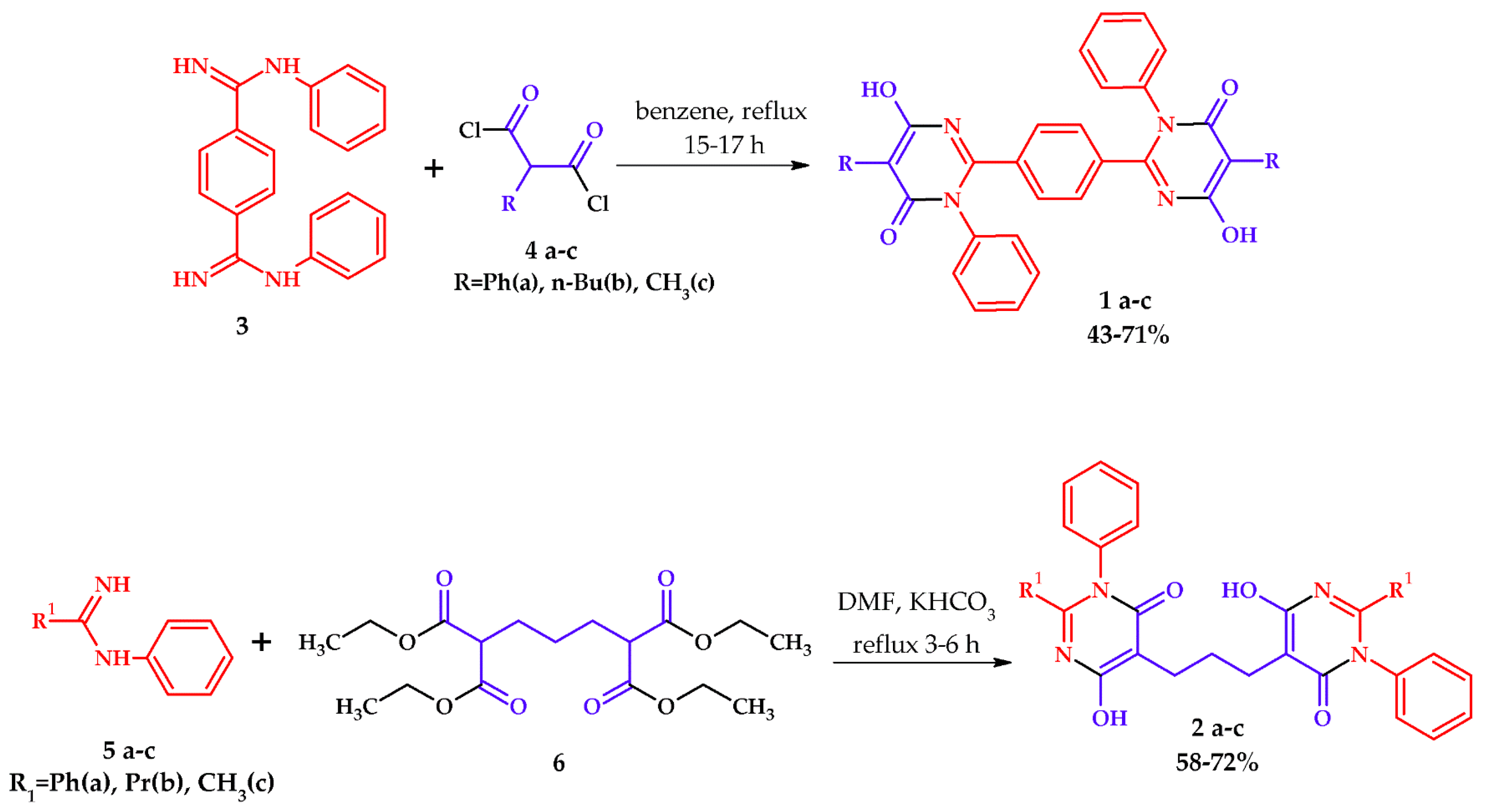
Derivatives of bis(6-hydroxypyrimidin-4(3H)-one) substituted at the 2,2′-positions with a 1,4-phenylene linker (1ac) were synthesized by reacting an excess of 2-substituted propanedioyl dichlorides (4) with N1,N4-diphenylbenzene-1,4-dicarboximidamide (3) in boiling benzene for 15–17 h (Figure 1).
Derivatives of 5,5′-substituted bipyrimidines (2ac) were obtained by the fusion of N-substituted imidamides (5ac) with tetraethyl propane-1,1,3,3-tetracarboxylate (6) in DMF in the presence of a catalytic amount of potassium bicarbonate for 3–6 h (Figure 1).
Nuclear magnetic resonance (NMR) spectroscopy was performed on a Bruker Avance III (1H—400 MHz, 13C—100 MHz) (Bruker, Germany). Approximately 0.01 g of the sample was dissolved in an appropriate solvent, and NMR spectra were recorded. The spectral data were processed using MestReNova software version 12.0.0–20080.

3. Results and Conclusions

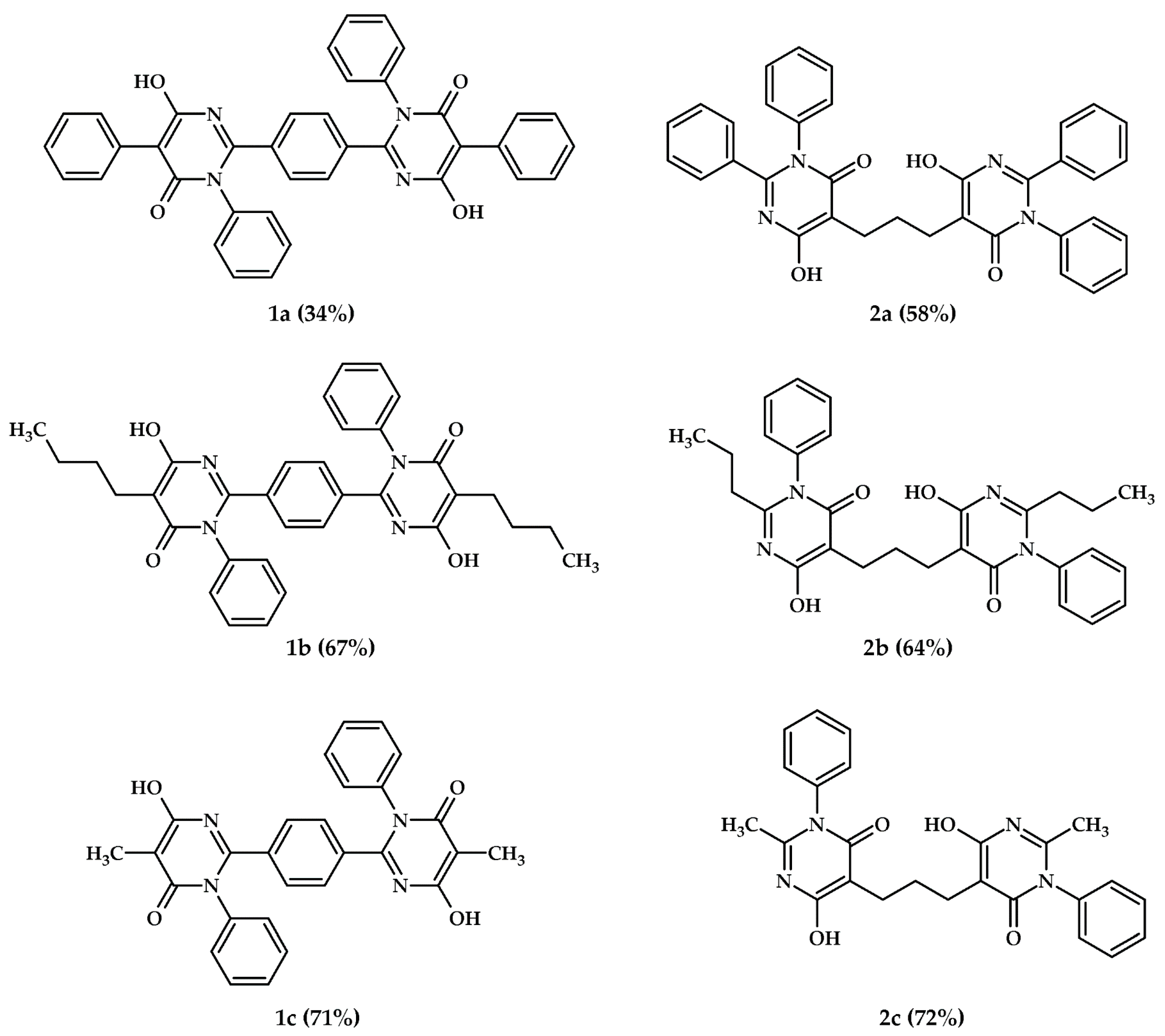
The yields of 2,2′-(1,4-phenylene)bis(6-hydroxy-5-substituted-3-phenylpyrimidin-4(3H)-ones) (1ac) were 34–71% (Figure 2. It was found that the substituent in the starting malonyl chloride affects the product yield. Alkyl substituents (methyl and butyl) afforded the target compounds in higher yields compared to the aromatic phenyl substituent.
The yields of 5,5′-(propane-1,3-diyl)bis(6-hydroxy-2-substituted-1-phenylpyrimidin-4(3H)-ones) (2ac) were 58–72% (Figure 2).
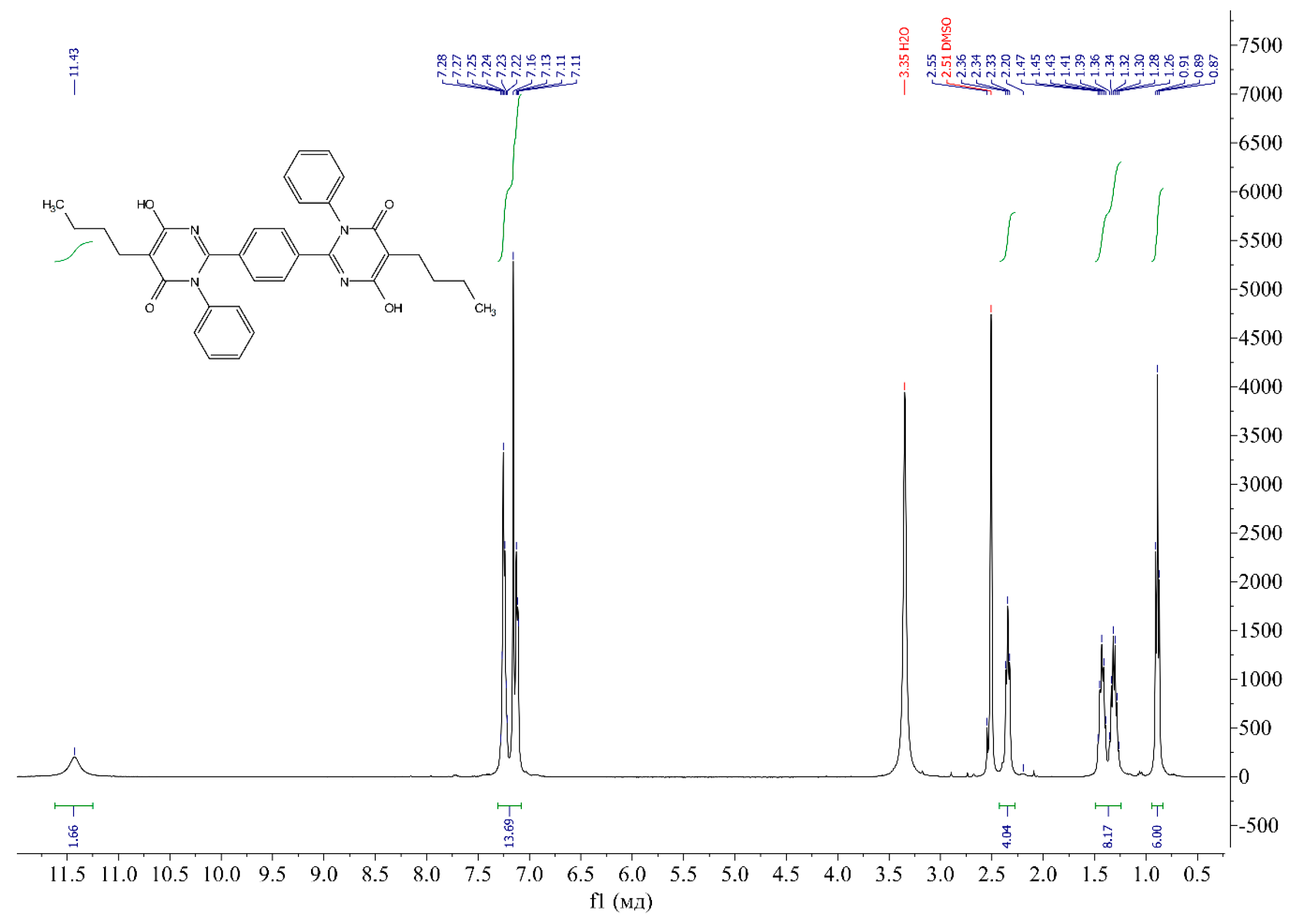
1H NMR (400 MHz, DMSO-d6) of 2,2′-(1,4-phenylene)bis(6-hydroxy-5-butyl-3-phenylpyrimidin-4(3H)-one), δ, ppm: 0.89 (t, 6H, J = 7.28 Hz, CH3); 1.26–1.27 (m, 8H, -CH2-CH2-); 2.34 (t, 4H, J = 7.28 Hz, -CH2-CAr); 7.11–7.28 (m, 14H, CAr-H); 11.43 (br s, 2H, -OH) (Figure 3).
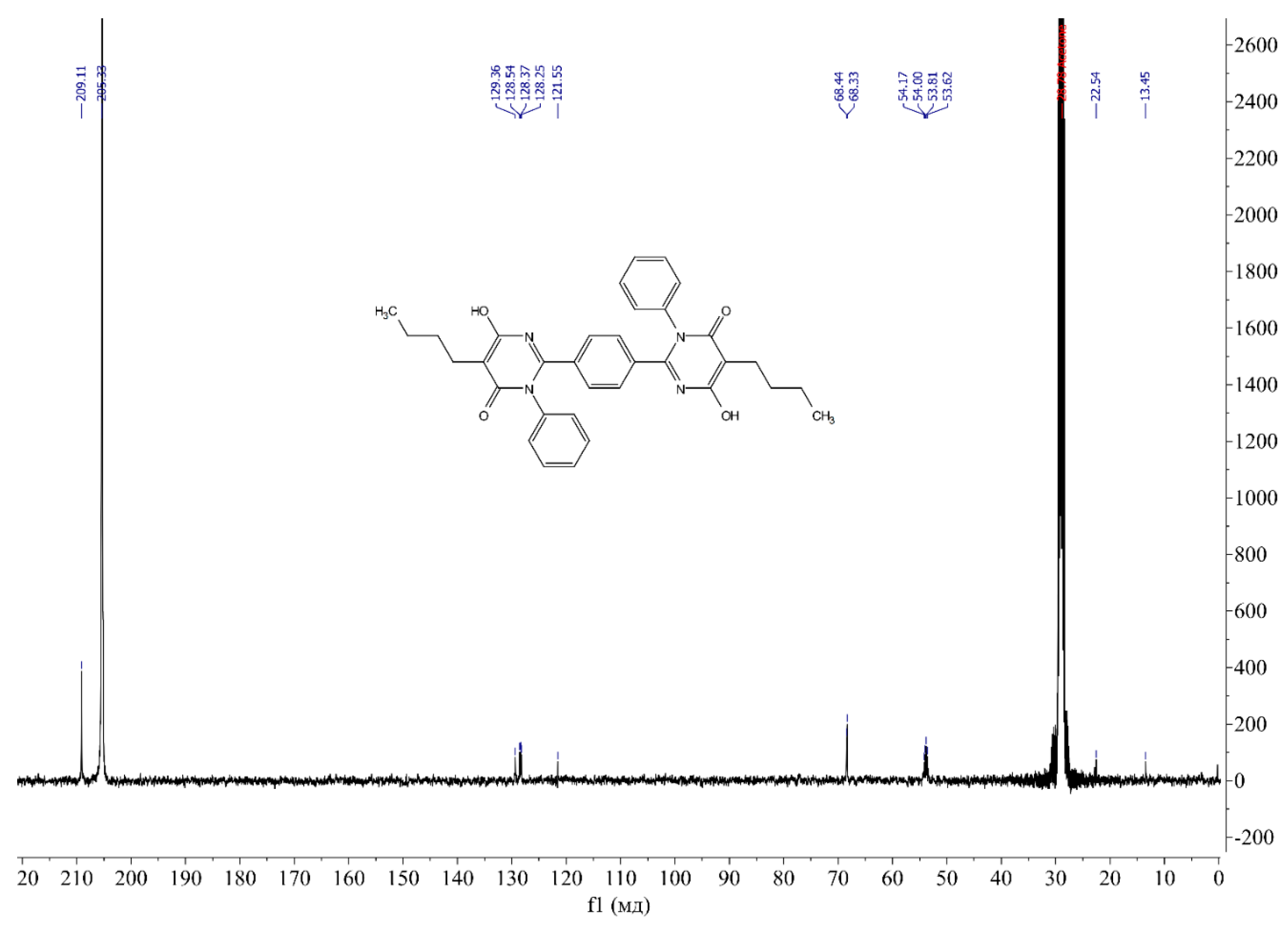
13C NMR (100 MHz, acetone-d6) of 2,2′-(1,4-phenylene)bis(6-hydroxy-5-butyl-3-phenylpyrimidin-4(3H)-one), δ, ppm: 13.45; 22.54; 53.62; 53.81; 54.00; 54.17; 68.33; 69.44; 121.55; 128.25; 128.37; 128.54; 129.36; 209.11. (Figure 4).
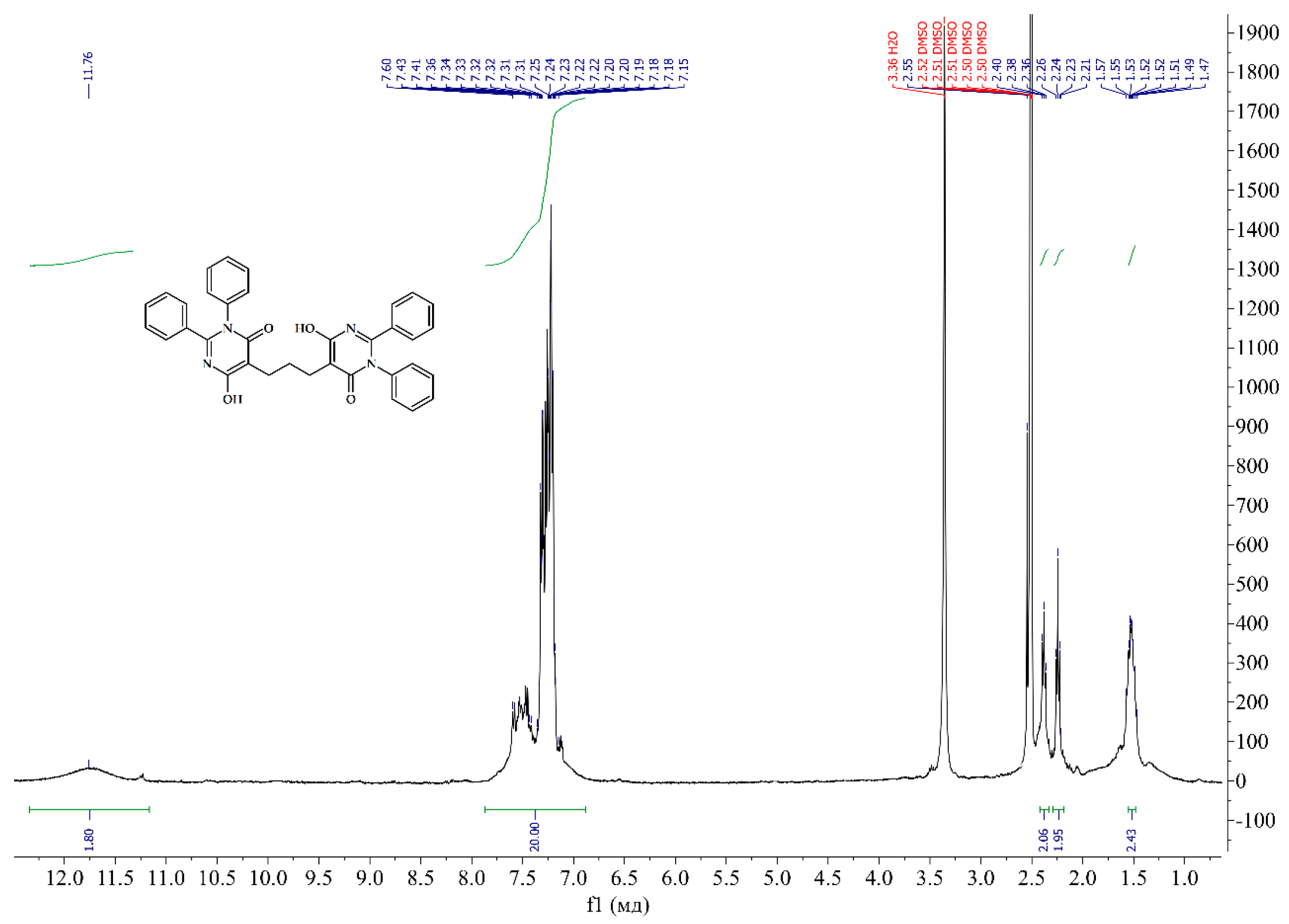
1H NMR (400 MHz, DMSO-d6) of 5,5′-(propane-1,3-diyl)bis(1,2-diphenyl-1,2-dihydropyrimidine-4,6-diol), δ, ppm: 1.51 (s, 2H, -CH2-); 2.21 (m, 2H, -CH2-); 2.40 (m, 2H, -CH2-); 7.15–7.59 (m, 20H, CAr-H); 11.76 (br s, 2H, -OH) (Figure 5).
Thus, six new bis(6-hydroxypyrimidin-4(3H)-ones) with aromatic and aliphatic linkers were synthesized. It was established that the yield of the target products is influenced by the nature of the substituent in the starting malonyl chloride (4ac). For the compounds with the 1,4-phenylene linker (1ac), the yield was significantly lower with an aromatic substituent due to steric factors, while higher yields were observed with aliphatic substituents. The nature of the substituent in the starting N-substituted benzenecarboximidamide also affected the yield of the final product for the compounds with the aliphatic bridge (2ac), where both steric factors and the nucleophilicity of imidamide played a role.

Author Contributions

All authors contributed equally to this work. All authors have read and agreed to the published version of the manuscript. D.A.K., G.V.K. and I.P.Y. designed the experiment. D.M.S., synthesized new derivatives of bis(6-hydroxypyrimidin-4(3H)-ones) substituted at the 2,2’-positions. S.S.M. synthesized derivatives of bis(6-hydroxypyrimidin-4(3H)-ones substituted at the 5,5’-positions. All authors participated in the discussion of the results and writing the manuscript.

Funding

This research received no external funding.

Institutional Review Board Statement

Not applicable.

Informed Consent Statement

Not applicable.

Data Availability Statement

The raw data supporting the conclusions of this article will be made available by the authors on request.

Conflicts of Interest

The authors declare no conflicts of interest.

Abbreviations

NMRNuclear Magnetic Resonance
DMSODimethyl Sulfoxide

References

  1. Kumar, S.; Singh, J.; Narasimhan, B.; Shah, S.A.A.; Lim, S.M.; Ramasamy, K.; Mani, V. Reverse pharmacophore mapping and molecular docking studies for discovery of GTPase HRas as promising drug target for bis-pyrimidine derivatives. Chem. Cent. J. 2018, 12, 106. [Google Scholar] [CrossRef] [PubMed]
  2. Nagaraj, A.; Reddy, C.S. Synthesis and biological study of novel bis-chalcones, bis-thiazines and bis-pyrimidines. JICS 2008, 5, 262–267. [Google Scholar] [CrossRef]
  3. Ramesh, D.; Mohanty, A.K.; De, A.; Vijayakumar, B.G.; Sethumadhavan, A.; Muthuvel, S.K.; Mani, M.; Kannan, T. Uracil derivatives as HIV-1 capsid protein inhibitors: Design, in silico, in vitro and cytotoxicity studies. RSC Adv. 2022, 12, 17466–17480. [Google Scholar] [CrossRef] [PubMed]
  4. Grivsky, E.M.; Lee, S.; Sigel, C.W.; Duch, D.S.; Nichol, C.A. Synthesis and antitumor activity of 2,4-diamino-6-(2,5-dimethoxybenzyl)-5-methylpyrido[2,3-d]pyrimidine. J. Med. Chem. 1980, 23, 327–329. [Google Scholar] [CrossRef] [PubMed]
  5. Haggam, R.A.; Assy, M.G.; Mohamed, E.K.; Mohamed, A.S. Synthesis of Pyrano[2,3-d]pyrimidine-2,4-diones and Pyridino [2,3-d]pyrimidine-2,4,6,8-tetraones: Evaluation Antitumor Activity. J. Heterocycl. Chem. 2019, 57, 842–850. [Google Scholar] [CrossRef]
  6. Matsumoto, J.; Minami, S. Pyrido[2,3-d]pyrimidine antibacterial agents. 3. 8-Alkyl- and 8-vinyl-5,8-dihydro-5-oxo-2-(1-piperazinyl)pyrido[2,3-d]pyrimidine-6-carboxylic acids and their derivatives. J. Med. Chem. 1975, 18, 74–79. [Google Scholar] [CrossRef] [PubMed]
  7. Brahmachari, G.; Nayek, N. Catalyst-Free One-Pot Three-Component Synthesis of Diversely Substituted 5-Aryl-2-oxo-/thioxo-2,3-dihydro-1H-benzo[6,7]chromeno[2,3-d]pyrimidine-4,6,11(5H)-triones Under Ambient Conditions. ACS Omega 2017, 2, 5025–5035. [Google Scholar] [CrossRef] [PubMed]
  8. Youssouf, M.S.; Kaiser, P.; Singh, G.D.; Singh, S.; Bani, S.; Gupta, V.K.; Satti, N.K.; Suri, K.A.; Johri, R.K. Anti-histaminic, anti-inflammatory and bronchorelaxant activities of 2, 7-dimethyl-3-nitro-4H pyrido [1,2-a] pyrimidine-4-one. Int. Immunopharmacol. 2008, 8, 1049–1055. [Google Scholar] [CrossRef] [PubMed]
Figure 1. Synthesis of N-substituted bis(6-hydroxypyrimidin-4(3H)-ones).
Chemproc 18 00130 g001
Figure 2. Structures of new bis(6-hydroxypyrimidin-4(3H)-ones): 1a—2,2′-(1,4-phenylene)bis(6-hydroxy-5-phenyl-3-phenylpyrimidin-4(3H)-one); 1b—2,2′-(1,4-phenylene)bis(6-hydroxy-5-butyl-3-phenylpyrimidin-4(3H)-one); 1c—2,2′-(1,4-phenylene)bis(6-hydroxy-5-methyl-3-phenylpyrimidin-4(3H)-one); 2a—5,5′-propane-1,3-diylbis(1,2-diphenyl-1,2-dihydropyrimidine-4,6-diol); 2b—5,5′-propane-1,3-diylbis(1-phenyl-2-propyl-1,2-dihydropyrimidine-4,6-diol); 2c—5,5′-propane-1,3-diylbis(2-methyl-1-phenyl-1,2-dihydropyrimidine-4,6-diol).
Chemproc 18 00130 g002
Figure 3. 1H NMR (400 MHz, DMSO-d6) of 2,2′-(1,4-phenylene)bis(6-hydroxy-5-butyl-3-phenylpyrimidin-4(3H)-one).
Chemproc 18 00130 g003
Figure 4. 13C NMR (100 MHz, acetone-d6) of 2,2′-(1,4-phenylene)bis(6-hydroxy-5-butyl-3-phenylpyrimidin-4(3H)-one).
Chemproc 18 00130 g004
Figure 5. 1H NMR (400 MHz, DMSO-d6) of 5,5′-propane-1,3-diylbis(1,2-diphenyl-1,2-dihydropyrimidine-4,6-diol).
Chemproc 18 00130 g005
Disclaimer/Publisher’s Note: The statements, opinions and data contained in all publications are solely those of the individual author(s) and contributor(s) and not of MDPI and/or the editor(s). MDPI and/or the editor(s) disclaim responsibility for any injury to people or property resulting from any ideas, methods, instructions or products referred to in the content.