


Abstract
The electrical behavior of cellular membranes plays a fundamental role in neuronal communication and in many physiological processes involving excitable cells. Mathematical modeling has become an essential tool for understanding the physical mechanisms underlying membrane dynamics and the generation of action potentials. The classical Hodgkin–Huxley model represents the cornerstone of conductance-based descriptions of neuronal activity, providing a quantitative framework in which ionic currents across the membrane are represented through nonlinear differential equations. Over the years, numerous extensions of this model have been developed in order to incorporate additional biophysical mechanisms, including dendritic processing, temperature dependence and electromagnetic effects. However, increasing experimental evidence has shown that neuronal activity is intrinsically stochastic due to the probabilistic nature of ion-channel gating and other microscopic processes. As a consequence, stochastic modeling approaches have been introduced to complement deterministic formulations and to capture the variability observed in real neuronal systems. In this review, we focus on a selected class of membrane models grounded in physical or biophysical principles, namely models that describe membrane dynamics through electrical analogies, conductance-based equations, stochastic channel kinetics, or memory-dependent circuit elements. These approaches can be viewed as extensions, reformulations, or generalizations of the Hodgkin–Huxley framework, developed to address specific physiological or computational limitations. The review focuses on the physical and mathematical structure of selected HH-derived models rather than on their experimental validation, and aims to compare representative physically motivated modeling strategies in terms of their assumptions, interpretability, and domains of applicability.
1. Introduction
Understanding the electrical behavior of biological membranes is a central problem at the interface between physics, biology and computational neuroscience. In this context, physical modeling provides a framework for translating biological processes into quantitative descriptions based on measurable variables such as voltage, current, and conductance, while computational approaches enable the simulation and analysis of these models across different spatial and temporal scales. In particular, the application of physical and mathematical modeling has provided fundamental insights into the mechanisms governing neuronal excitability and signal transmission.
Numerous efforts have been made to produce mathematical models capable of reproducing experimental observations in a quantitative way and capable of giving a qualitative explanation of some phenomena, including intracellular transmission. Most of these models are based on electrical analogy and represent the properties of the cell by means of electrical voltages and currents.
From a physical perspective, the cell membrane can be viewed as a complex electrochemical system in which ionic transport, diffusion processes and electric fields interact across nanometric spatial scales. Acting as an interface between the intracellular and extracellular environments, the membrane regulates the selective transport of ions through specialized proteins such as ion pumps and ion channels. In excitable cells, these mechanisms give rise to rapid variations in membrane potential that generate electrical signals, which constitute the fundamental basis of neural communication [1,2,3,4].
The pioneering work of Hodgkin and Huxley [5] constitutes a milestone in this interdisciplinary effort introducing the first quantitative description of the action potential through a system of nonlinear differential equations representing ionic currents across the cell membrane. The Hodgkin–Huxley (HH) model established a powerful framework for interpreting electrophysiological phenomena using concepts typical of physics, such as electrical circuits, conductances and dynamical systems.
Subsequent experimental advances, including the development of the Patch Clamp technique [6] and more recently microelectronic biosensors [7], have significantly improved the measurement and monitoring of cellular electrical activity, providing increasingly detailed data for membrane modeling.
Over the past decades, an extensive body of literature has developed around the HH framework, including detailed conductance-based models of specific neuron types, large-scale network models, and numerous physiologically validated extensions. These studies have significantly contributed to our understanding of neuronal excitability, synaptic integration, and electrophysiological diversity. The present review does not aim to provide a comprehensive survey of all HH-based models and their biological applications. Instead, it focuses on a subset of approaches that emphasize the underlying physical description of membrane dynamics, including stochastic formulations, circuit analogies, and memory-dependent extensions. Classical biophysical studies on ion channels and membrane electrophysiology have established the fundamental principles governing ionic transport across biological membranes and their role in neuronal excitability [8]. More recent review works have highlighted the importance of integrating deterministic conductance-based models with stochastic descriptions of ion-channel dynamics in order to account for the intrinsic variability observed in neuronal activity [9]. In addition, advances in computational and biophysical modeling have emphasized the relevance of multi-scale approaches for describing membrane transport, electrical activity and the collective behavior of ion channels in biological systems [10,11].
Since its introduction, the HH model has inspired a vast literature, including detailed conductance-based models, stochastic extensions, dendritic and temperature-dependent formulations, and large-scale computational approaches (see, e.g., Refs. [12,13,14,15,16,17]). These developments have substantially expanded the applicability of HH-type models while preserving the conductance-based description of membrane excitability.
At the same time, advances in experimental techniques and the increasing availability of electrophysiological data have stimulated the development of stochastic and data-driven approaches, which account for the probabilistic nature of ion-channel gating and noise effects arising from microscopic processes, now recognized as key elements in neuronal variability and information processing.
While several reviews have focused either on detailed biophysical models of neuronal dynamics [18] or on stochastic descriptions of ion-channel behavior [9], a unified perspective that explicitly connects deterministic conductance-based models with modern stochastic and data-driven approaches from a physical modeling standpoint is still limited in the literature. In particular, the interplay between classical electrophysiological models and recent developments in stochastic modeling and computational methods deserves further clarification within a coherent physical framework. The present work aims to address this gap by providing a problem-driven comparison of membrane modeling strategies, focusing on how different formulations resolve (or fail to resolve) key limitations of the original HH framework, including the treatment of stochasticity, spatial effects, and memory-dependent dynamics.
Despite the extensive literature on HH-based models and their biological applications, a systematic and physically grounded comparison of deterministic, stochastic, and memory-based membrane models remains limited. In particular, the respective domains of validity, underlying assumptions, and trade-offs between interpretability, biological realism, and computational efficiency are not consistently addressed within a unified framework.
In this work, the term physical models refers to membrane models formulated in terms of explicit physical variables and mechanisms, such as voltage, ionic currents, conductances, channel-state transitions, capacitive effects, and equivalent electrical circuits. Within this definition, the HH model is not an alternative to physical modeling, but its paradigmatic starting point. The purpose of this review is therefore not to contrast HH with other approaches, but to examine how the original conductance-based formalism has been extended toward stochastic, spatially distributed, memory-dependent, and circuit-inspired descriptions. The review is intentionally selective rather than exhaustive. Its aim is to compare representative modeling strategies from a physical and mathematical perspective, with particular attention to their assumptions, interpretability, and domain of applicability.
Section 2 introduces the physical structure and functional properties of the cellular membrane, with particular emphasis on excitable cells. Section 3 reviews deterministic models of neuronal dynamics, starting from the classical HH framework and its extensions. Section 4 discusses stochastic and data-driven approaches that incorporate channel noise and probabilistic ion-channel dynamics. In Section 5 a comparative analysis of different kinds of models is proposed.
2. The Cellular Membrane
The membrane can be viewed as an electrochemical system in which ionic transport, diffusion, and electric fields coexist at nanometric scales. The selective permeability of the membrane is ensured by ion channels and pumps, which control ionic fluxes and are responsible for the generation of electrical signals in excitable cells.
At the macroscopic level, the membrane is commonly modeled using electrical circuit analogies, where voltage, current, and conductance provide a physically interpretable representation of biological processes. This abstraction forms the basis of conductance-based models such as the HH framework.
In standard modeling approaches, the membrane is approximated as a capacitor with parallel faces. The difference in electric potential between the inside and outside of the cell is therefore determined by the charges accumulated on the sides of the membrane. In resting conditions the internal environment of the cell has a substantially zero global charge; the cytosol assumes a negative potential with respect to the extracellular environment. On the contrary, outside the membrane the electrical charges are not balanced and an excess of positive charges is observed; it is precisely this charge imbalance that causes the cytosol to assume a negative electrical potential compared to the external potential. The electrostatic field generated by these positive charges causes induction phenomena near the cell membrane, which behaves like a capacitor between whose ends an electric potential difference develops. These different ionic distributions are due to the different permeability of the plasma membrane to ions. The origin of the membrane potential therefore derives from the combined action of both purely diffusive forces generated by the concentration gradient of the chemical species and attractive forces of an electrical nature. Specifically, the maintenance of the steady state of rest or equilibrium is guaranteed by the action of the sodium potassium pump which actively maintains the right ionic concentrations on the sides of the membrane so that the necessary interactions develop [19].
It can be demonstrated that, in stationary conditions, on the sides of the cytoplasmic membrane there is a uniform distribution of negative charges on the inside as opposed to positive charges on the outside which, like a capacitor, generate a difference in transmembrane potential of the order of magnitude between −50 mV and −90 mV (internal negative) [20,21].
More refined electrical representations of the membrane have also been proposed, in which the lipid bilayer is modeled as a two-layer structure with distinct capacitive components associated with the inner and outer membrane interfaces (see, e.g., Ref. [11]). In such approaches, the membrane is represented by multiple capacitive elements, allowing for a more detailed description of charge distribution and polarization effects. These models are particularly relevant in circuit-based and multi-scale descriptions of neuronal membranes.
Excitable cells are characterized by their ability to respond to variations in membrane potential through rapid and transient electrical signals. These signals, known as action potentials, result from time-dependent ionic currents flowing across the membrane.
From a physical viewpoint, the action potential can be interpreted as a dynamical process in which changes in membrane conductance lead to a rapid depolarization followed by repolarization. In modeling frameworks, action potentials are described in terms of coupled nonlinear dynamics between membrane potential and ionic currents, forming the basis of conductance-based models such as the HH equations.
Ion channels are the primary microscopic elements responsible for membrane electrical activity. They regulate the flow of specific ionic species across the membrane and determine its effective conductance.
In physical models, ion channels are typically described through simplified assumptions, such as homogeneous membrane properties and diffusion-driven transport. While these assumptions facilitate mathematical modeling, they neglect structural and molecular details, including channel heterogeneity and complex interactions within the membrane environment.
Despite these simplifications, ion-channel dynamics can be effectively incorporated into conductance-based models through phenomenological variables that represent the probability of channel opening. This approach provides a bridge between microscopic stochastic processes and macroscopic electrical behavior.
The cell contains inorganic ions, mainly Na+, K+, Cl− to which the membrane is permeable and various anions A– to which it is not permeable. Outside the cell there are Na+, Cl− ions in much higher concentrations than inside the cell, the opposite happens for K+.
Inorganic ions, which generate the ionic currents at the basis of neuronal electrical activity, tend to move across the membrane thanks to the different concentration between the inside and outside of the cell and the difference in electrical potential across the membrane. They can move actively, i.e., by binding to particular molecules called transport molecules (ion pumps), or passively, i.e., through ion channels.
On the neuronal membrane there are numerous ion channels that allow the passage of ions with specific selectivities. These channels are capable of conducting ions at high speeds in order to ensure very consistent current flows. These flows are precisely those that determine the rapid variations in membrane potential necessary for the generation and transmission of the action potential. There are, therefore, channels that allow regulated access and which, in rest conditions, are generally closed (such as the voltage-dependent channels regulated by variations in electrical potential) and unregulated channels which, at rest, are generally always open (these are passive channels that are relevant for the generation of the resting potential as they keep the electrical potential constant at the ends of the cell membrane in the absence of signal transmission) [8,19].
3. Deterministic Models
The Hodgkin–Huxley (HH) model [5] provides the first quantitative conductance-based description of neuronal membrane dynamics and remains a fundamental reference framework for excitable systems. In this formulation, the membrane is represented as an electrical circuit in which ionic currents flow through voltage-dependent conductances, while the lipid bilayer acts as a capacitor. This approach establishes a direct connection between measurable physical quantities—such as voltage, current, and conductance—and the underlying biophysical processes governing membrane excitability.
A key feature of the HH model is that ionic conductances are not constant, but depend on gating variables that represent the probability of ion-channel opening. These variables evolve according to voltage-dependent rate equations, introducing nonlinear feedback mechanisms that are responsible for the characteristic dynamics of the action potential.
Despite its success, the HH framework presents several well-known limitations. In particular, the model exhibits parameter non-identifiability, as different parameter sets can produce similar membrane dynamics. Moreover, its deterministic formulation neglects intrinsic fluctuations associated with the stochastic nature of ion-channel gating. Finally, the description of channel dynamics is phenomenological and does not explicitly account for the underlying molecular mechanisms.
These limitations have motivated the development of numerous extensions and alternative formulations, aimed at incorporating additional physical effects such as stochastic channel dynamics, spatial structure, temperature dependence, and memory-related phenomena, while preserving the core conductance-based structure of the HH framework.
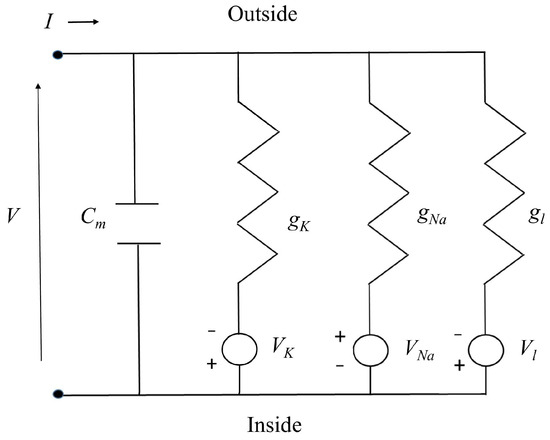
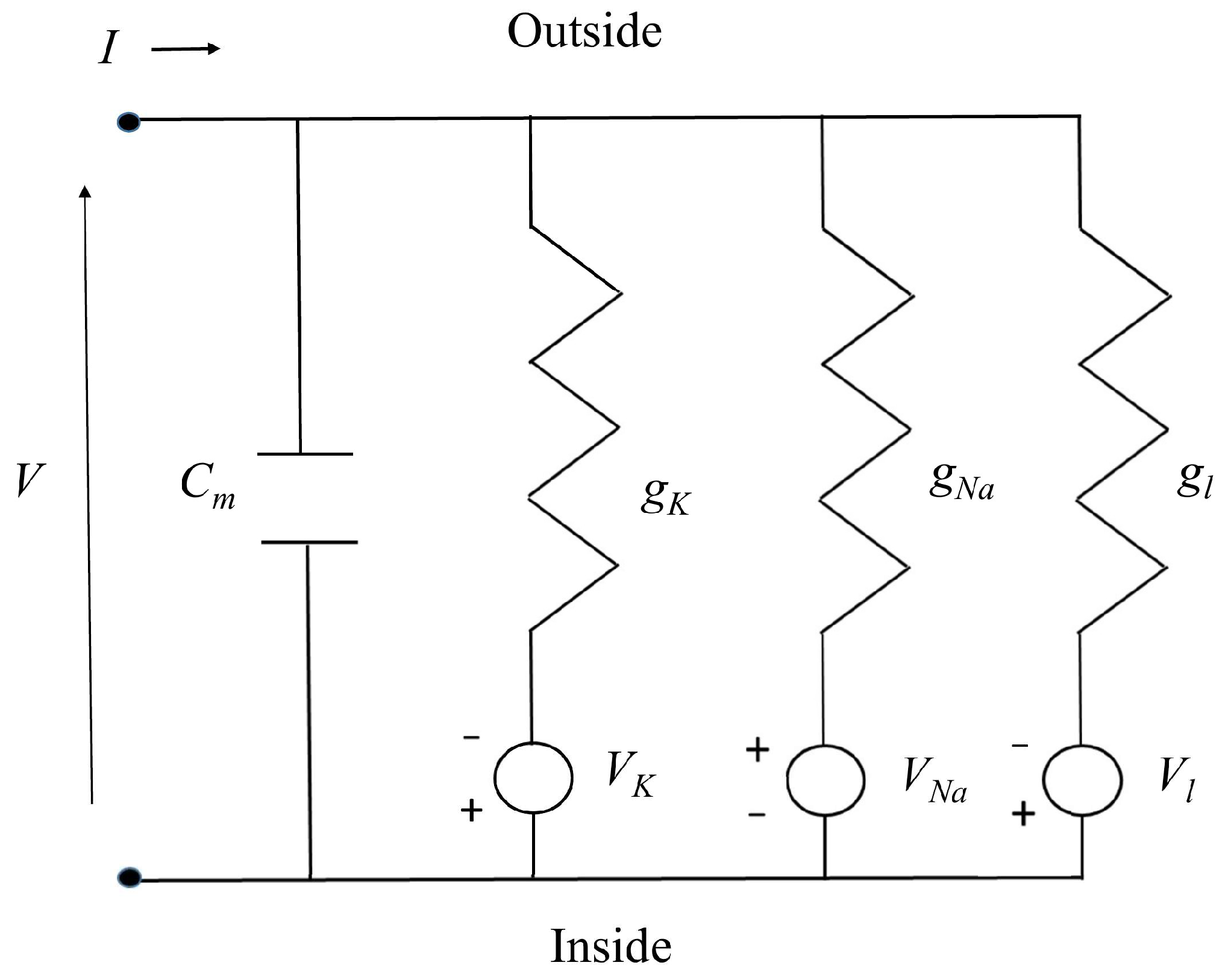
A schematic representation of the HH equivalent circuit is shown in Figure 1.
Figure 1.
The HH model.
In Figure 1, VK, VNa and Vl represent the Nernst potential [20] of potassium, sodium and chloride/other ions, respectively. Based on the measurements in the squid axon giant, Hodgkin and Huxley had used values of −12, 115 and 10.6 mV for VK, VNa and Vl, respectively while Cm = 1 μF/cm2 represents the membrane capacitance per unit area. The parameters gK, gNa and gl represent the potassium, sodium and other ions conductance respectively. These parameters correspond to the resistive elements, that are variable resistors since their values are not constant but depend on the electrical tension.
Indicating with I the total membrane current and with V the membrane potential compared to its resting value (negative depolarization), it results
The total current, positive towards the inside of the membrane, is divided into a capacitance current and an ionic current, in parallel. This equation does not take into account any dielectric losses in the membrane, but estimates made by the authors themselves suggested that any error introduced by this approximation was negligible.
The ionic current can be divided into three components: the component transported by sodium ions INa, the component transported by potassium ions IK and that of the other ions Il:
where
V, VK, VNa and Vl can be measured directly as changes with respect to the absolute resting potential. In the model the potassium and sodium conductances take the expressions:
n is dimensionless and can vary between 0 and 1, and represents the fraction of particles inside the membrane, consequently 1 − n represents the fraction outside; m represents the fraction of activating molecules inside the membrane and 1 − m outside; h represents the fraction of inactivating molecules outside and 1 − h inside the membrane. αm or βh and βm or αh represent the transfer rates in the two directions. The physical idea consists in the fact that the conductance of sodium is proportional to the number of sites occupied simultaneously within the membrane by three activating molecules but are not blocked by inactivating molecules.
The dynamics of the opening probability (m, n, h) of the ion channels are in summary described by
with and the voltage-dependent opening and closing rates of the ion channels, which give an indication of the membrane’s permeability to the specific ion species.
The first effect of the change in membrane potential is the activation of the sodium current from outside to inside, αm > βm for small values of V: this process causes an increase in the membrane potential, depolarization. For large values of V, the sodium current is deactivated, αh > βh and the potassium current is activated, bringing the system back to equilibrium through a repolarization.
The complete equation for total membrane current, Equation (1), can then be rewritten as:
The four terms represent respectively the capacitance current, the current carried by the potassium ions, the current carried by the sodium ions and the leakage current, per 1 cm2 of membrane. These four components are in parallel, and the constants that appear in the equation are independent of temperature. Potentials are expressed in mV, current densities in μA/cm2, conductances in mS/cm2, capacitance in μF/cm2 and time in ms.
The value of m is small in the steady state but is the first to increase after the stimulus, m is called the sodium activation function. h is instead the sodium deactivation function, h = 0 means that the sodium channels are not active. Since τm is much smaller than τh and τn, m(t) responds to the stimulus much faster than h and n.
Equation (6) is a differential equation whose solution serves to describe the behavior of the action potential over time. This equation correctly predicts the total current during a voltage clamp, i.e., when the voltage is constant. In fact, for constant V, dV/dt = 0 and the coefficients α and β are constant. Therefore the solution is obtained directly in terms of n, m and h. For a generic time-varying action potential V, it cannot be solved analytically but only numerically.
In summary, in the HH formulation, the total membrane current is expressed as the sum of capacitive and ionic contributions. The ionic current includes three main components corresponding to sodium, potassium and leakage currents. The conductances associated with sodium and potassium channels are not constant but depend on gating variables that represent the probability of channel opening. These gating variables evolve according to voltage-dependent rate equations that describe the activation and inactivation dynamics of the ion channels. As a result, the HH model captures the nonlinear feedback mechanisms responsible for the rapid depolarization and subsequent repolarization that characterize the action potential.
While the HH equations provide an accurate description of the time evolution of the action potential, the temperature dependence of the model parameters is not included in the original formulation. Various extensions have nevertheless been proposed to incorporate temperature effects, for example by introducing temperature-dependent rate constants. Lu et al. [22] changed the parameter values describing the ionic and leakage conductances, the equilibrium potentials, the membrane rest potential and capacitance, to reflect those of the human, as well as to include the temperature dependence. In the original Hodgkin–Huxley formulation the kinetics of ion-channel gating were determined from experiments performed at a reference temperature of 6.3 °C, and therefore the temperature dependence of the rate constants is not explicitly included. To account for thermal effects, the HH parameters are multiplied by a temperature correction factor , typically expressed through a Q10-type relation that scales the opening and closing rates of the ion channels
This factor reflects the acceleration of channel kinetics with increasing temperature. As shown in Figure 3 of Ref. [22] for T = 0.3, 10.3, 16.3, 22.3 °C, the membrane potential changes significantly with temperature, with higher temperatures leading to faster dynamics and modifications in the shape and frequency of the action potentials. The authors conclude that it seems possible to modify the HH equations to describe action potentials generated in the Ranvier node of a human sensory nerve fibre and create more realistic neural models of the electrically stimulated human auditory system.
Smit et al. [23] also include temperature in their analysis. Temperature dependence of the resting membrane potential (Vres) was expressed through the use of a Q10 factor, with a value of 1.036 for all T ≤ 20 °C and 1.035 for all T > 20 °C. Membrane permeability of the different ion species was increased or decreased by multiplying the rate equations αx(V) and βx(V) by selected factors.
A few years after introducing the HH formalism, the discovery that not only axons but also dendrites influence signal integration inspired pioneering modelling work on the properties of dendrites [24,25]. The discovery of dendritic regenerative events mediated by ionic and synaptic conductances has further solidified the importance of HH-based models, yielding new predictions regarding dendritic integration, synaptic plasticity, and neuronal computation. These predictions are often validated through in vivo and in vitro experiments, advancing our understanding of the neuron as a biological system and highlighting the importance of detailed computational models based on the HH model as a dendritic research tool ([26] and Ref. therein). Dendritic arbors, compared to neuronal axons, have very specific biophysical characteristics (e.g., non-uniformly distributed ion channels and synaptic mechanisms) essential to their function [27,28]. Also morphology is very important in order to understand the general principles of neuronal response. The combination of biophysical mechanisms and dendritic morphology affecting synaptic plasticity is of fundamental importance. Dendrite-related functions have contributed to the modern view of the neuron, as discussed in [28,29,30].
The overall impact of the HH model on dendritic research can be found in the review by Poirazi and Papoutsi [18].
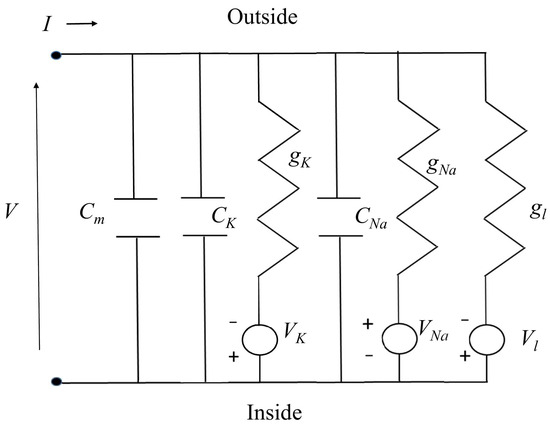
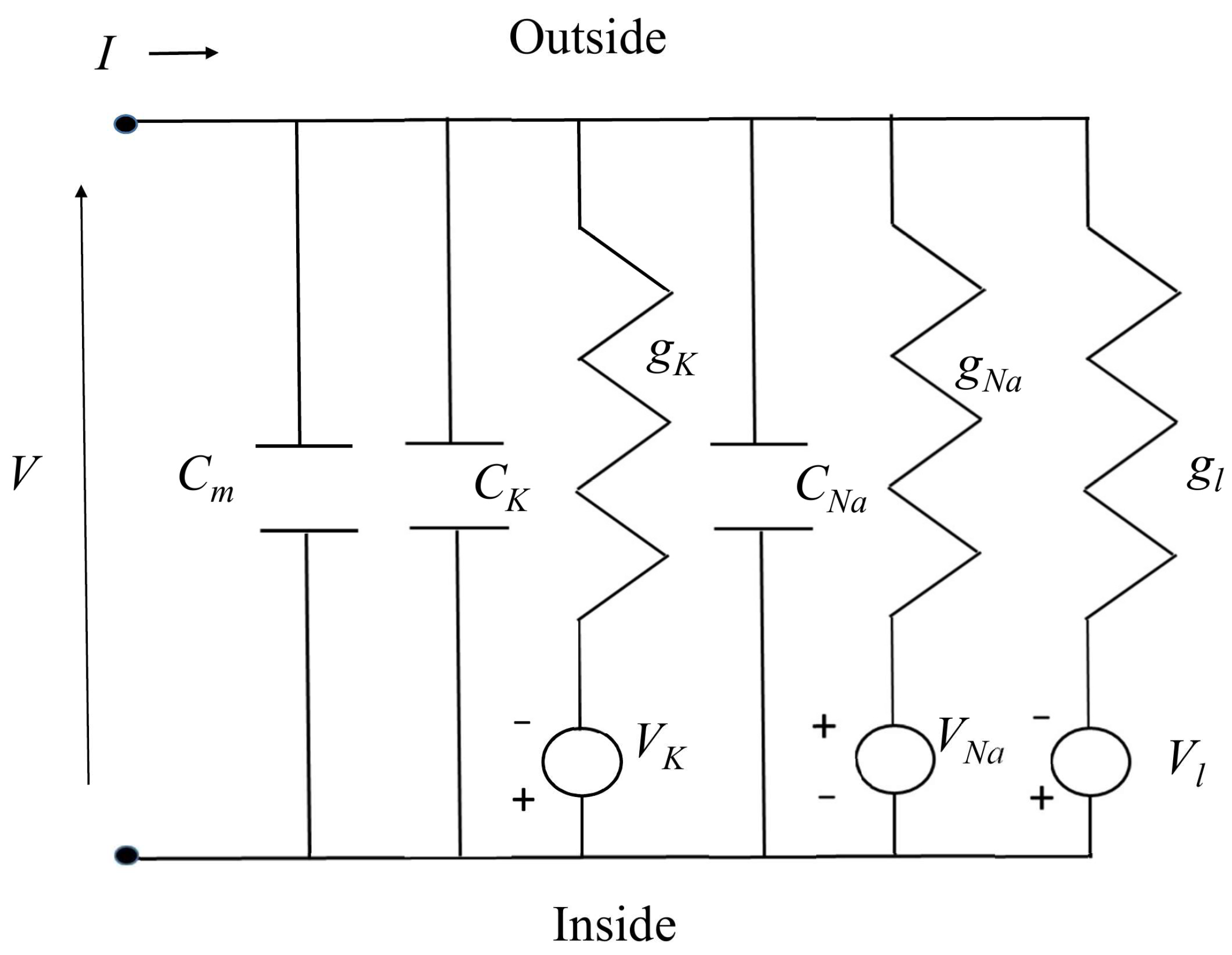
Among the models incorporating the dendrite action not employed in the original HH model we want to mention the mathematical/electrical model proposed by Vertiz-Hernandez et al. [31]. This model includes dendrites and capacitors not considered in the HH model. The dendrites are added as additional conductance channels to the membrane capacitance, and capacitors are added for each of the channel Na and K, as in Figure 2.
Figure 2.
Modified HH model with the capacitors in the Na+ and K+ channels.
The circuit is composed of three main blocks: a dendrite–membrane RC structure that describes the passive electrical response of the membrane, a sodium channel branch characterized by conductance gNa, capacitance CNa, and equilibrium potential VNa, responsible for depolarization, and a potassium channel branch defined by conductance gK, capacitance CK, and equilibrium potential VK, responsible for repolarization and hyperpolarization. Dendrites are incorporated as part of the input structure that drives the membrane dynamics. Electrically, they are represented by a set of conductances connected to external voltage sources (see Figure 5 in Ref. [31]), which model the synaptic inputs arriving at the neuron. These dendritic branches feed the membrane node through resistive pathways, allowing input signals to influence the membrane potential. More specifically, the dendritic contribution is modeled through conductances associated with voltage sources that represent incoming stimuli. These elements form a resistive network connected to the membrane capacitance, creating a dendrite–membrane RC subsystem. A key result of the proposed RC-based model is that it successfully reproduces the main phases of the neuronal action potential—depolarization, peak potential, repolarization, and return to the resting state—by representing the membrane capacitance and the sodium and potassium ionic channels within a unified and physically interpretable electrical circuit framework.
Even with the introduction of dendrites, the HH model is not robust enough since small changes in parameter values can drastically change the output and on the other hand various parameter configurations can lead to the same observed signal [32,33].
Despite its success, the HH framework presents several well-known limitations. In particular, the model exhibits parameter non-identifiability, since different parameter sets may reproduce similar membrane dynamics. Moreover, its deterministic formulation neglects intrinsic fluctuations associated with stochastic ion-channel gating. Finally, the original formulation does not explicitly describe molecular conformational dynamics of ion channels, motivating the development of more detailed stochastic and state-based models.
For this reason, many models have been developed as simplifications or extensions of the HH model. These models are deterministic in the sense that once specific initial conditions have been chosen, the integration of the set of differential equations that model the membrane determines a unique solution that represents the evolution of the membrane potential.
In a quite recent paper, Weinberg more appropriately modeled the passive properties of membranes with a non-ideal capacitor [34]. A fractional-order derivative provides the current–voltage relationship, introducing in this way capacitive memory effects. In other words membrane dynamic is influenced by a weighted sum of the membrane potential prior history. Equation (1) is substituted by
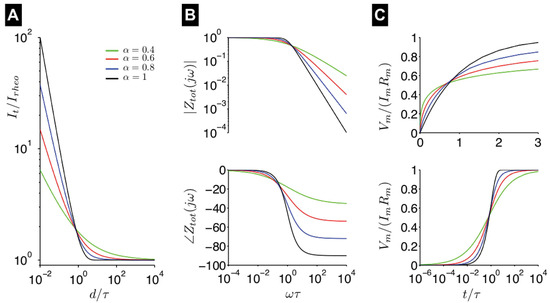
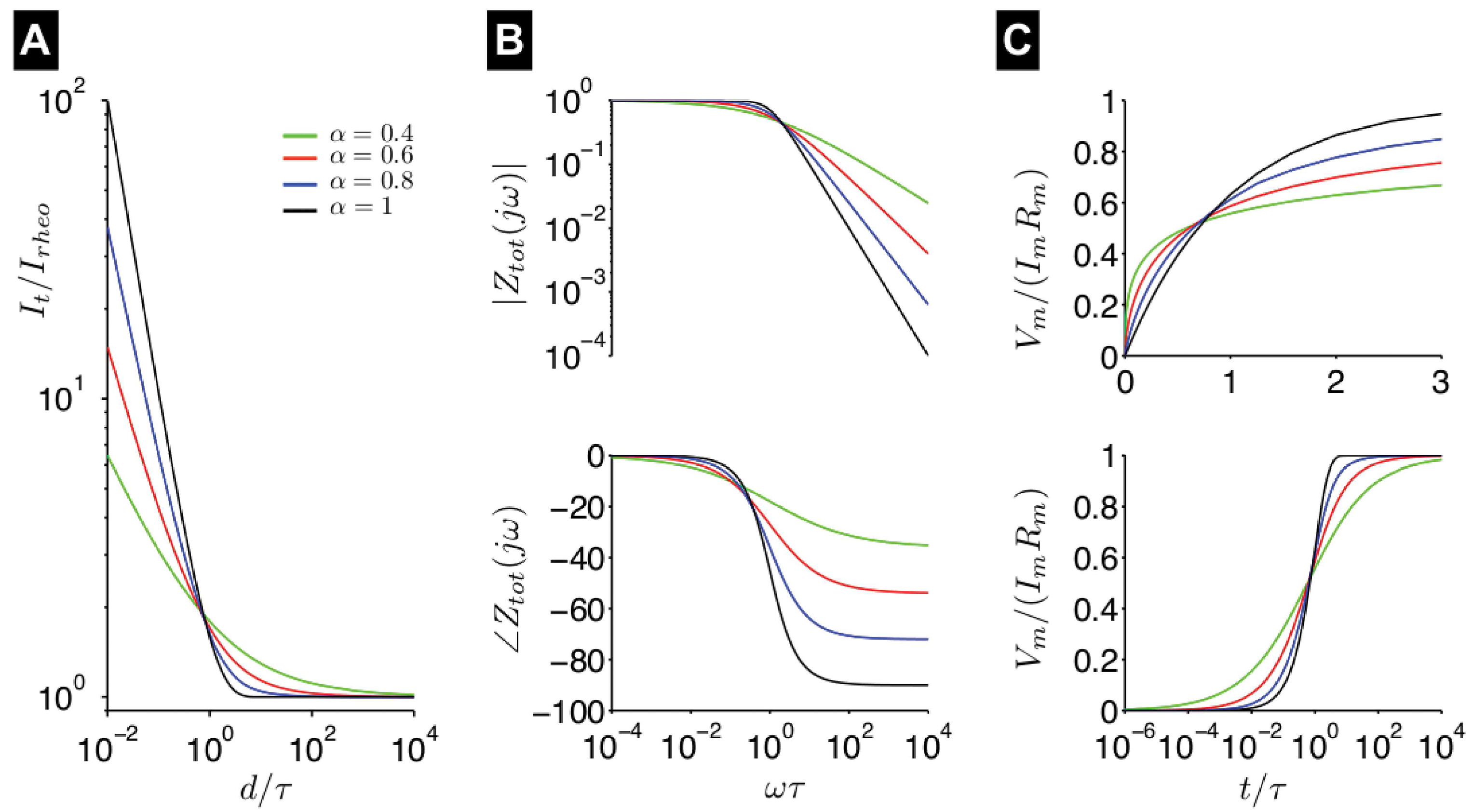
considering the current–voltage relationship for a non-ideal capacitor [35]. Alpha represents the fractional order of the membrane dynamics, controlling how much past activity (memory) influences the current behavior of the system. The authors also consider a network of N = 50 randomly connected fractional-order HH neurons, adding a synaptic current to the fractional-order HH model in order to study the dynamics of the neurons. A general power law is found for short duration stimuli and asymptotic behavior for long duration stimuli (see Figure 3).
Figure 3.
Properties of the fractional-order passive membrane. (A) Strength-duration curves, derived from the fractional passive membrane, are shown as a function of fractional order α. (B) The magnitude (top) and phase (bottom) of the complex impedance of the fractional-order passive membrane are shown as a function of the normalized frequency, for different values of α. (C) The normalized membrane potential response following a current step is shown as a function of normalized time on a linear (top) and logarithmic (bottom scale), for different values of α. Figure reproduced from Ref. [34], licensed under the Creative Commons Attribution 4.0 International License (CC BY 4.0).
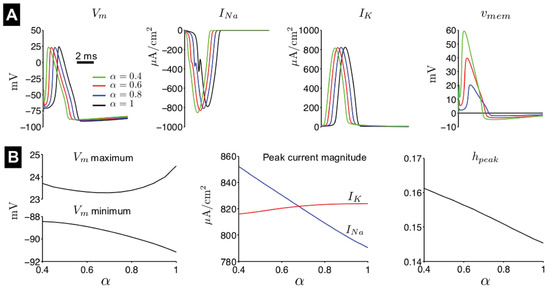
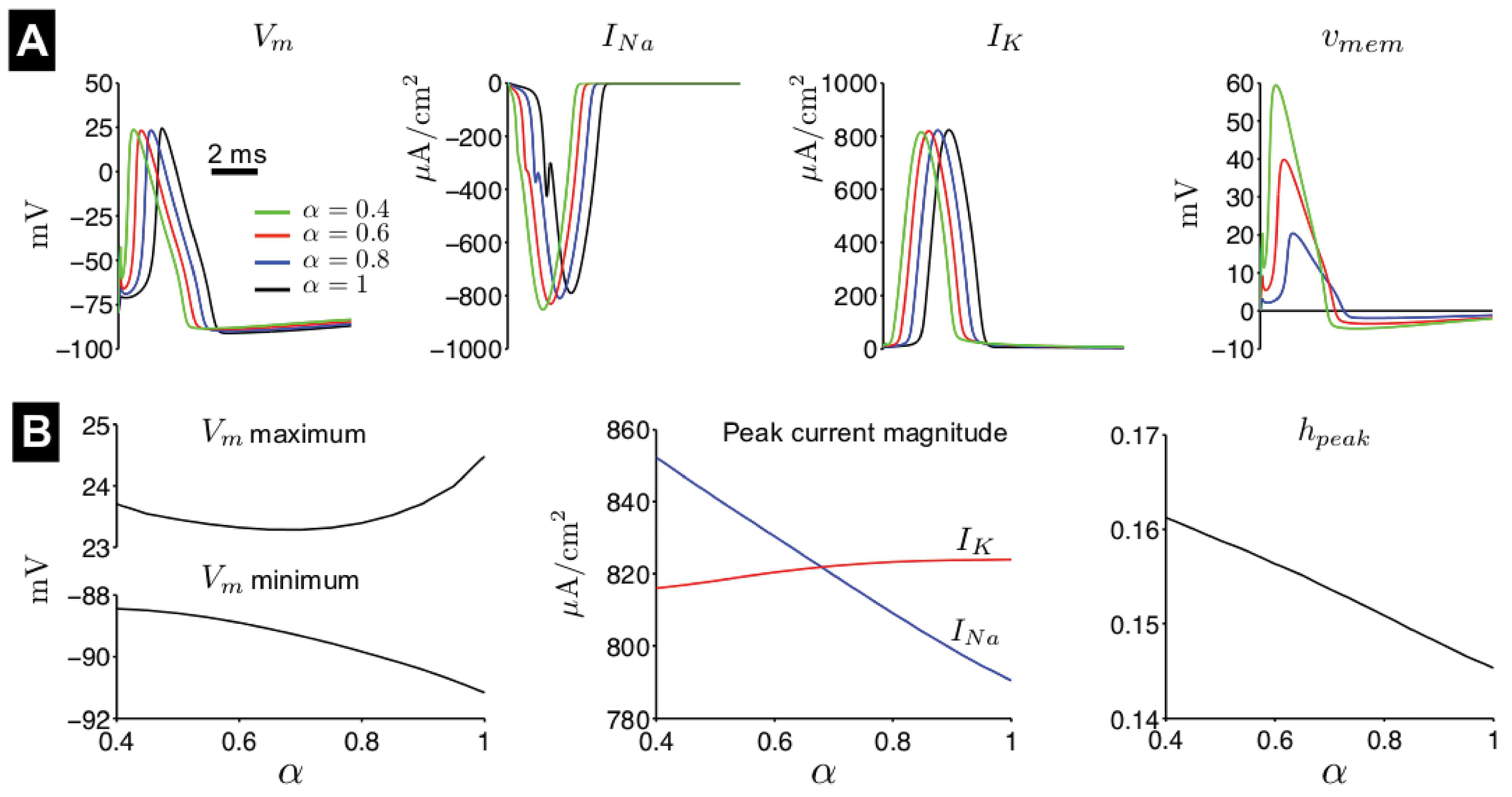
The authors find that as fractional order decreases, which means a greater influence of membrane potential memory, peak sodium and potassium currents are modified (see Figure 4), with spike frequency and amplitude reduced. The velocity of spike propagation increases in the nerve axon, while in a neural network the electrical activity seems to stop. The authors suggest that membrane capacitive memory and fractional-order membrane potential dynamics are important to reproduce and describe neuronal electrical activity.
Figure 4.
Properties of the fractional-order Hodgkin–Huxley spike. (A) The membrane potential Vm, sodium current INa, potassium current IK, and voltage memory trace vmem are shown as a function of time, for different values of fractional-order α. (B) Vm maximum and minimum (left), INa and IK peak current magnitude, and hpeak (the sodium inactivation gating variable at the time of peak INa current) are shown as a function of α. Figure reproduced from Ref. [34], licensed under the Creative Commons Attribution 4.0 International License (CC BY 4.0).
Memristive extensions of the HH model have been proposed in the literature to account for memory-dependent conductance effects and electromagnetic interactions (see, e.g., Refs. [36,37] and references therein, as well as the original memristor theory introduced by Chua [38]). In these approaches, ion channels are modeled as memristive elements whose conductance depends on internal state variables. The inclusion of electromagnetic effects has also been considered in related HH-type extensions [22].
In Equation (6) a new term is added
The term is the feedback current on the membrane potential induced by electromagnetic induction. Parameter k is feedback gain associated with the media. Electrical activity may also depend on the variation in temperature of the environment in which neurons are located. Thus a temperature factor is introduced in the α, β parameters.
As the temperature increases, the amplitude and frequency of electrical activity undergo a transformation: the amplitude decreases while the frequency increases substantially. With increasing of the temperature, temporal evolution of membrane potentials appear an obvious transformation: the amplitude decrease greatly, the frequency increase substantially. Furthermore, under a low fixed temperature, stronger electromagnetic induction will make the neuron transit from spiking state to quiescent state. In Figure 3 Lu et al. illustrate the temporal evolution of the membrane (transmembrane) potential for different temperatures. Four representative time series are shown for increasing temperature values. At lower temperature, the neuron exhibits relatively sparse and slow spiking activity with large inter-spike intervals. As the temperature increases, the firing frequency gradually increases and the spikes become more regular and closely spaced. At higher temperatures, the membrane potential displays a stable and rapid periodic spiking pattern. The results indicate that temperature significantly modulates neuronal excitability and firing rate in the model, promoting faster rhythmic activity as temperature rises. This theoretical analysis provides further insights on the study of neurological diseases.
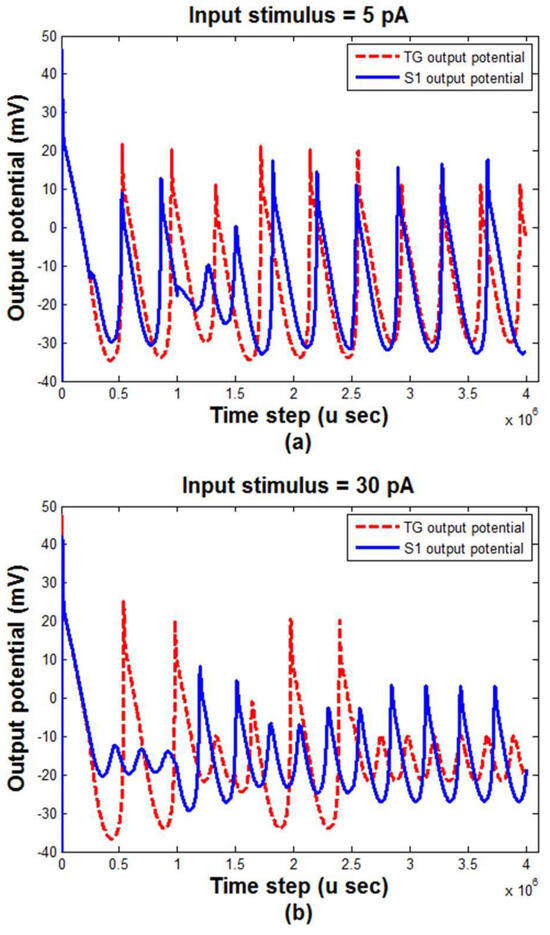
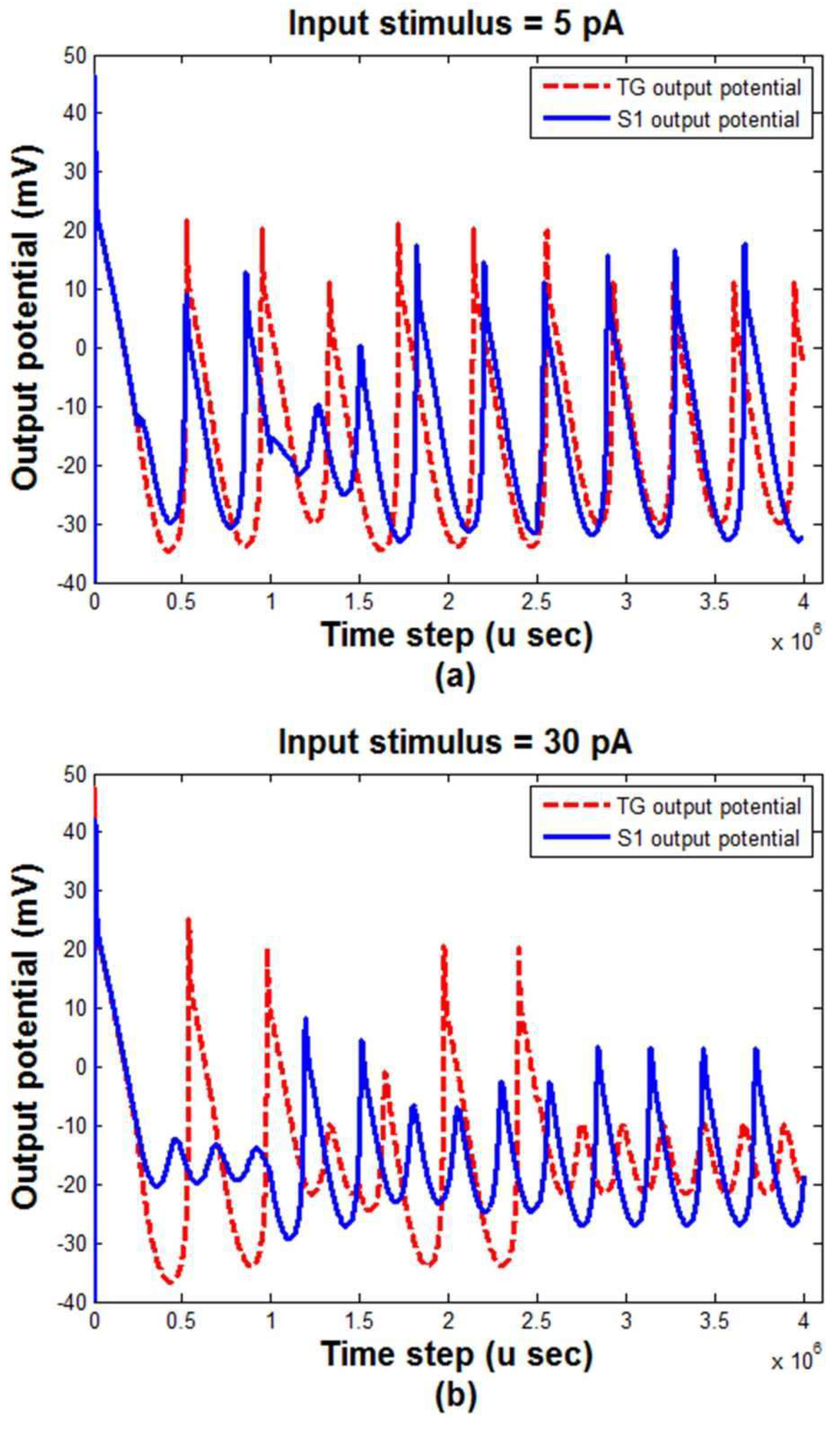
In some specific cases, the HH model has been modified by adding one or more equations in order to consider specific effects. For instance Khodashenas et al. [39] modeled pain modulation process in severe neuropathic pain with electric shock-like characteristic, like Trigeminal neuralgia.
Two more equations are added for the Na channels with slow activation/inactivation, that represent pain-related ion channels, contributing to prolonged neuronal activity and pain signaling in the model
where and are the transition rates between open and closed states of the activation of slow sodium channels and are the transition rates between open and closed states of the inactivation of slow sodium channels.
The results indicate that reducing the conductance of slow sodium channels associated with pain signaling, together with the application of transcranial direct current stimulation (tDCS) over the motor cortex—a therapeutic technique recently used in pain treatment—can decrease the activity of the somatosensory cortex. This reduction in cortical activity may contribute to the alleviation of pain (see Figure 5).
Figure 5.
The output of TG and S1 blocks with different input stimulus maximum amplitudes. (a) Maximum amplitude =5 pA, (b) maximum amplitude=30 pA. TG: trigeminal ganglion, S1: somatosensory cortex. Figure reproduced from Ref. [39], licensed under the Creative Commons Attribution 4.0 International License (CC BY 4.0 ).
In other cases, the size effect of axon diameter has been taken into account when the model has been applied to most nervous systems, like in [40]. Allometry is widely applied in biology, where scaling laws are used for instance to find universal equations in physiological processes (see for instance Ref. [41]).
In alternative to modified HH models, mathematical models for excitable membranes have also been performed by introducing circuit characteristics for ion pump exchange, ion channel activation, and voltage-gating. These phenomena, not accounted for in HH models, can be considered for neurons and excitable membranes especially when one looks for simpler models for mathematical studies and for forming large networks with fewer parameters (see, e.g., Ref. [42]).
Mathematical models based on deterministic equations have played a central role in the theoretical description of neuronal membrane dynamics. In these models, the electrical activity of the membrane is represented through systems of differential equations that describe the evolution of the membrane potential and ionic currents in time. Deterministic approaches assume that, once the initial conditions and model parameters are fixed, the temporal evolution of the system is uniquely determined. These models have been extremely successful in reproducing the main features of neuronal excitability and action potential generation, providing a quantitative link between electrophysiological measurements and the underlying biophysical mechanisms.
In addition to the classical HH formulation, a wide range of reduced and phenomenological models have been developed to capture neuronal excitability with lower dimensionality. Notable examples include the FitzHugh–Nagumo model [43], which provides a simplified description of excitable dynamics, the Morris–Lecar model [44], which incorporates voltage-dependent calcium and potassium currents, and the Izhikevich model [45], which combines biological plausibility with computational efficiency.
These models are widely used in computational neuroscience, particularly in large-scale simulations and theoretical studies of neuronal dynamics. However, they typically sacrifice detailed biophysical interpretability in favor of mathematical simplicity, and for this reason they are not discussed in detail in the present review. Large-scale modeling efforts, such as those developed within the Blue Brain Project [46] and related initiatives, further extend these approaches to network- and brain-scale simulations, highlighting the importance of computational efficiency in model selection. Despite their success, deterministic models present some limitations. Their predictions depend strongly on the choice of parameters, and different parameter sets may produce similar electrical responses. Moreover, purely deterministic formulations neglect the intrinsic stochasticity associated with ion-channel dynamics, which can play a significant role in neuronal behavior. For this reason, deterministic approaches are often complemented by stochastic models that explicitly account for channel noise and probabilistic channel gating.
Beyond the original HH formulation, a large number of conductance-based models have been developed to describe specific neuronal types and physiological conditions. These include reduced models such as the FitzHugh–Nagumo and Morris–Lecar systems, as well as detailed multi-compartment models used to investigate dendritic integration and synaptic processing. Such models are widely employed in computational neuroscience to reproduce experimental electrophysiological data and to explore neuron-specific dynamics.
While these approaches are essential for physiological modeling, they often prioritize biological specificity over general physical interpretation. For this reason, they are not discussed in detail here, although they represent a major branch of HH-based modeling.
These models illustrate how physical principles, such as electrical circuit analogies and nonlinear dynamics, can be used to interpret biological mechanisms in a mathematically consistent framework.
4. Stochastic Models
While deterministic conductance-based models successfully reproduce many features of neuronal dynamics, experimental observations indicate that neuronal activity is intrinsically noisy. Fluctuations arise from several microscopic processes, including the stochastic opening and closing of ion channels, synaptic variability and thermal effects. These sources of randomness introduce variability in membrane currents and action potential generation, which cannot always be captured by purely deterministic formulations. As a result, stochastic modeling approaches have been developed to incorporate these effects into the mathematical description of neuronal membrane dynamics. Stochastic extensions of HH-type models represent one of the most active research directions in modern computational neuroscience, particularly in the context of channel noise, neuronal variability, and information processing.
From a biophysical perspective, the probabilistic nature of ion-channel gating represents one of the main sources of noise in neuronal systems. Ion channels switch between open and closed states in a stochastic manner, leading to fluctuations in the ionic currents that cross the membrane. When a large number of channels is involved, the mean behavior of these processes can be approximated by deterministic equations such as those introduced in the Hodgkin–Huxley model. However, when the number of channels is limited or when precise neuronal responses are considered, stochastic effects become significant and must be explicitly taken into account.
One of the earliest approaches to modeling channel noise describes ion-channel dynamics in terms of Markov processes, in which each channel undergoes stochastic transitions between different conformational states. Some of the properties sometimes lost in deterministic models can then be recovered using stochastic models based on Markov states of ion channels where the channel opening is probabilistic in nature [47,48,49,50,51] and includes noise effects that can be generated by stochastic dynamics. Although conductance-based equations for electrically active cells synthesizes indeed very well the impact of ionic currents on a cell’s voltage, spike generation is not a deterministic process. The noise in cellular dynamics and function plays a role of central importance in computational biology. This framework provides a physically grounded representation of channel kinetics but often leads to computationally expensive simulations when applied to large neuronal systems.
At the same time, these approaches establish a direct connection between microscopic biophysical processes and macroscopic neuronal behavior, bridging statistical physics, electrophysiology, and computational modeling. For this reason, alternative formulations have been proposed in which stochastic fluctuations are introduced directly into the HH equations through noise terms. These approaches typically employ stochastic differential equations to represent random variations in ionic conductances or gating variables.
Several methods have been proposed to incorporate noise into conductance-based models. Among them, current noise models introduce fluctuations directly into the membrane current, while subunit noise models account for stochasticity in the individual channel subunits. Another widely used approach consists in adding noise to the conductance variables themselves, allowing the fraction of open channels to fluctuate around its deterministic value. These conductance noise models have been shown to provide a good approximation of the stochastic dynamics produced by more detailed Markov descriptions of ion-channel behavior.
More recently, stochastic extensions of the HH model have also been explored in the context of neuromorphic electronics and memristive systems. In these approaches, memristive devices are used as electronic analogues of biological ion channels, exploiting their intrinsic stochastic switching behavior to reproduce the probabilistic dynamics of neuronal membranes. Such models provide a promising framework for studying the interplay between biological computation and emerging electronic technologies.
An important aspect of stochastic neuronal dynamics is the phenomenon of stochastic resonance, whereby the presence of an optimal level of noise can enhance the response of nonlinear systems to weak signals. This effect has been observed in neuronal models and suggests that noise is not merely a disturbance but may play a functional role in neural information processing.
Overall, stochastic models provide a complementary perspective to deterministic approaches by capturing the variability and probabilistic nature of ion-channel dynamics. The integration of deterministic and stochastic modeling frameworks therefore represents an important direction for advancing the physical understanding of neuronal membrane behavior.
The statistical nature of the physical basis of HH equations was not taken into account when these equations were originally solved, the mean values of the different ionic conductances were then used. Models including this aspect have been developed in the time, see for instance Ref. [51]. The only independent parameters introduced in addition to the parameters in the HH equations, are the numbers of sodium and potassium pores in the patch of nerve membrane considered.
Regardless of which model structure best captures the essence of voltage-gated channels, it is clear that their probabilistic gating adds noise to the total membrane current in the cell. White et al. investigate the phenomenon of channel noise in neurons, which originates from the random opening and closing of voltage-gated ion channels. This stochastic behavior affects neuronal reliability, dynamics, and excitability, thereby influencing the accuracy of neuronal responses to external stimuli. Their study shows that channel noise can limit coding precision while also broadening neuronal dynamic regimes and, in some cases, improving the detection of weak signals. In order to quantify channel noise, a useful parameter is introduced, the coefficient of variation CV, which is the ratio between the standard deviation and the mean of the current generated by a homogeneous population of ion channels
where
with γ the open-channel conductance, N the number of channels, V the membrane potential, p(V) the (steady state) voltage-dependent probability that each channel is open, and Vrev the reversal potential. Then CV can be rewritten as
Thus, the noisiness of a membrane current decreases as the reverse of the square root of the number of channels. The effects of noise on neuronal thresholds, and its role in oscillatory neurons are also discussed. The relationship between channel numbers, cellular economy, and metabolic efficiency is highlighted. A central result of the study by White et al. is that the stochastic opening and closing of voltage-gated ion channels generates intrinsic channel noise that can significantly influence neuronal dynamics and reliability, even when large populations of channels are present, thereby affecting spike generation and the variability of neuronal responses.
The first works to use models based on stochastic differential equations (SDEs) for including channel noise are from Fox and Lu [52,53]. The authors introduced a stochastic formulation of the HH model by deriving Langevin-type equations that incorporate intrinsic ion-channel noise into the membrane dynamics. This approach significantly reduces the computational complexity of simulating stochastic ion-channel behavior while preserving the essential statistical properties of the full channel-based models, enabling efficient simulations of noisy action potential generation and propagation.
In their review, Goldwyn and Brown [9] describe channel fluctuations with noise terms added to the equations of HH type. Many of these approaches, while intuitively appealing, provide stochastic versions of the HH equations. The authors point out that deterministic HH equations are unable to fully represent the inherently stochastic gating of ion channels. They therefore examine three strategies for introducing noise into the model—current noise, subunit noise, and conductance noise—and conclude that the conductance noise approach, which introduces fluctuations directly in the proportion of open channels, provides the most accurate and biophysically realistic description. The HH Equation (12) is modified
where the noise processes ξNa(t) and ξK(t) are Gaussian processes that may depend on x (x = m, n, h) and V.
The review highlights the advantages of conductance noise models, particularly the stochastic differential equation (SDE) approach developed by Fox and Lu [39,40], which closely approximates the behavior of Markov chain models.
Sokol et al. [54] propose a modified HH model that incorporates statistical noise into neural responses generated by external electrical stimulation. Noise plays an important role in neural systems, as it can enhance the response to weak inputs and promote stochastic resonance phenomena. However, conventional approaches used to model channel noise, such as Markov chain models or stochastic differential equation frameworks, often involve significant computational cost. Instead of using complex multi-state Markov descriptions or stochastic differential equations, the authors introduce a minor modification of the classical HH formulation that allows noise to be included in a computationally efficient way. The model proposed by Sokol et al. modifies the HH equations by adding noise terms to the gating variables, offering a computationally efficient alternative. In the paper, the evolution of each gating variable was modified to include random changes, with an additive noise term of the gating variables. This was carried out in two steps. First, the conventional approach was used. Next, the final gating variable value g(t + dt), with g representing any of the three variables m(t), n(t) and h(t), was calculated through the intermediate variable gint(t + dt)
where rm denotes a uniformly generated random number between [−1, 1], while Δ is an amplitude whose value has to be opportunely chosen. As illustrated in Figure 2 of the paper, the inclusion of stochastic noise in the HH framework leads to fluctuations in the membrane potential that affect the timing and variability of action potentials while preserving the overall spiking dynamics of the model.
Numerical simulations show that the resulting spike statistics and firing patterns are in good agreement with those obtained from more sophisticated stochastic models. The proposed method therefore provides a simple and efficient framework for studying noise effects in neuronal dynamics.
Feali and Ahmadi [36] show that memristors can be regarded as electronic analogues of HH ion channels, not only with respect to the threshold switching effect but also in terms of stochastic behavior. Ion channels (Na+ and K+) are treated as memristors because their conductance depends on internal state variables (m, h, n), which evolve over time. So, they behave like “resistors with memory” that encode the history of the neuron’s activity. A memristor is modeled as an ion channel whose conductance depends on internal state variables and thus retains a memory of the neuron’s past activity. The switching mechanism in memristive devices is thermodynamically driven and therefore intrinsically stochastic. When this stochastic behavior is taken into account, memristor-based neuristors can reproduce stochastic versions of the HH axon model and generate action potentials. In this framework, the variability of ion channels in biological neurons can be modeled through the intrinsic stochastic dynamics of the memristor. In practice, noise is incorporated into the memristor model by adding white Gaussian noise to the deterministic component of the state evolution equation.
Hu et al. [37] also investigate neuron models based on memristive devices, showing that memristors can emulate key features of ion-channel dynamics and neuronal excitability. In particular, the intrinsic stochastic switching behavior of memristive elements can reproduce variability effects similar to those observed in biological ion channels. By incorporating noise into the memristor dynamics, the model is able to generate action potentials and reproduce stochastic versions of the HH mechanism. As illustrated in Figure 5, the simulated membrane potential exhibits spiking activity whose timing and variability depend on the stochastic switching of the memristive device, highlighting the capability of memristor-based neuristors to mimic neuronal dynamics.
Stochastic resonance has been recently considered, with an optimal intrinsic noise level. It can be proven in fact that adding random noise to a nonlinear system can increase its performance or sensitivity to weak signals [55]. Erkan et al. investigate the role of stochastic effects in neuronal dynamics by extending HH-type models to include noise in ion-channel kinetics. The results show that stochastic fluctuations can significantly influence neuronal excitability and spike timing. As illustrated in Figure 5, the membrane potential generated by the stochastic model exhibits noticeable variability in the timing and amplitude of action potentials compared with the deterministic case, highlighting the impact of channel noise on neuronal dynamics.
Six types of noise have been considered by Kang et al. [56] using an electrical current and subunit noise model. Based on simulations and numerical analysis, the authors show that different types of noise show different effects. Stochastic resonance is also investigated through statistical analysis. The authors show that channel noise can significantly influence neuronal excitability and the timing of action potentials, particularly in small membrane patches where stochastic effects become more pronounced. Numerical simulations highlight how fluctuations in ion-channel states can lead to variability in spike generation and firing patterns. These results emphasize the importance of stochastic descriptions for accurately capturing neuronal dynamics.
Finally, it is worth noticing that an alternative to physical models is provided by data-driven approaches grounded in data science, statistics, and machine learning, whose development has been fostered by the increasing availability and quality of experimental data [57]. In contrast to physical models, these approaches make fewer assumptions about the underlying system and instead infer relationships among measured variables directly from the data.
5. Comparative Analysis of Membrane Modeling Approaches
To facilitate a systematic comparison of the main modeling approaches derived from the HH framework, Table 1 summarizes their key assumptions, advantages, limitations, and typical fields of application. The comparison reported in Table 1 is not intended to be exhaustive, but rather to highlight representative modeling strategies according to a set of common criteria. In particular, models are compared based on: (i) their level of biophysical detail, (ii) their ability to capture stochastic or deterministic dynamics, (iii) computational complexity, and (iv) domain of applicability. These criteria are chosen to reflect the typical trade-offs encountered in membrane modeling between physical interpretability, biological realism, and computational efficiency. As membrane modeling has progressively evolved from deterministic descriptions toward stochastic and memory-based formulations, a clear overview is essential to highlight the trade-offs between biological realism, computational complexity, and interpretability. This comparative perspective provides a practical guide for selecting the most appropriate modeling strategy depending on the scale of the system and the specific research objectives.
Table 1.
Comparative overview of membrane modeling approaches derived from the Hodgkin–Huxley framework.
The selection of an appropriate membrane model depends on the balance between biological realism, computational efficiency, and the specific research question. The classical HH model remains the reference framework for describing action potential generation due to its strong biophysical grounding and interpretability. However, its deterministic nature makes it insufficient when intrinsic fluctuations arising from finite ion channel populations play a significant role. In such cases, stochastic extensions of the HH model become necessary. Exact stochastic formulations are particularly suitable for small membrane patches or neurons with a limited number of ion channels, where channel noise strongly influences firing behavior. For larger systems, Langevin-type approximations such as the Fox–Lu model provide a computationally efficient alternative, capturing noise effects while remaining tractable. When the focus shifts to the detailed kinetics of ion channels, Markov models offer a more accurate and mechanistic description. These models are especially relevant in studies involving pharmacological modulation or single-channel recordings, although their high dimensionality and parameter requirements limit their use in large-scale simulations. Spatially extended systems, such as neurons with complex dendritic trees, require compartmental or cable-based extensions of the HH framework. These models enable the study of signal propagation and synaptic integration but significantly increase computational complexity.
A key outcome of this comparison is that no single modeling framework simultaneously satisfies all desirable properties, and model selection necessarily involves trade-offs between biological realism, computational efficiency, and interpretability.
It should be noted that the categorization presented in Table 1 is intended as a conceptual guideline rather than a strict classification, and that significant overlap exists between different modeling approaches.
A key outcome of this comparison is that no single modeling framework simultaneously satisfies all desirable properties. Conductance-based HH models provide strong interpretability but neglect intrinsic stochasticity; Markov and stochastic models improve realism but at a higher computational cost; fractional and memristive approaches introduce novel physical features such as memory effects, but often lack direct physiological validation. These trade-offs highlight an open problem in membrane modeling: the development of unified approaches capable of integrating physical realism, stochastic dynamics, and computational tractability.
More recent approaches, including fractional-order models, attempt to incorporate memory effects and anomalous temporal dynamics. While these models can reproduce complex behaviors not captured by classical formulations, their direct physiological interpretation remains an open question. Finally, memristive models provide an alternative perspective by linking ion channel dynamics to circuit theory. Although still largely theoretical, they are particularly promising in the context of neuromorphic engineering and hardware implementations of neuronal behavior.
Overall, no single model is universally optimal. Instead, model selection should be guided by the scale of the system, the importance of stochastic effects, and the desired balance between interpretability and computational efficiency.
Open Challenges and Outstanding Questions
Despite the considerable progress achieved since the introduction of the HH formalism, several important challenges remain unresolved. One of the most significant issues concerns the balance between biological realism and computational tractability. Detailed Markov-state descriptions provide a more faithful representation of ion-channel kinetics than classical conductance-based formulations, but their computational cost and parameter complexity often limit their practical applicability in large-scale simulations.
A second open question concerns the role of stochasticity in neuronal dynamics. While deterministic HH-type models successfully reproduce many electrophysiological phenomena, stochastic formulations become increasingly important when the number of ion channels is limited or when neuronal variability plays a functional role. Determining the regimes in which stochastic effects are essential, and those in which deterministic approximations is adequate, remains an active area of research.
The physiological interpretation of memory-dependent formulations also deserves further investigation. Fractional-order models have demonstrated the ability to reproduce anomalous temporal dynamics and long-term memory effects, but the direct biological mechanisms underlying fractional operators are still debated. Similar considerations apply to memristive extensions, which provide elegant circuit-based representations of memory effects and ion-channel dynamics, but whose correspondence with specific physiological processes remains only partially understood.
Another challenge concerns the integration of physical and data-driven approaches. Machine learning and data-driven methods are increasingly used to analyze electrophysiological recordings and to infer neuronal dynamics directly from experimental data. However, these approaches often sacrifice interpretability, whereas physical models provide mechanistic insight at the cost of increased modeling assumptions. Developing hybrid frameworks that combine mechanistic understanding with data-driven predictive capabilities represents a promising direction for future research.
Finally, energy consumption and metabolic constraints are receiving increasing attention in computational neuroscience. Most HH-derived models focus primarily on electrical activity, while energetic costs are treated only indirectly or neglected altogether. A more complete description of membrane dynamics may therefore require the integration of electrophysiological, biochemical, and energetic processes within unified multi-scale frameworks.
Taken together, these challenges suggest that no single modeling strategy currently provides a complete description of membrane behavior. Future progress will likely depend on the development of integrated approaches capable of combining physical realism, stochastic dynamics, computational efficiency, and experimental validation within a coherent theoretical framework.
6. Conclusions
In this work we have reviewed the main physical models used to describe the electrical behavior of cellular membranes, with particular emphasis on the theoretical frameworks developed to interpret neuronal excitability. Starting from the classical HH model, which represents the cornerstone of conductance-based descriptions of membrane dynamics, we have discussed several extensions and alternative formulations that aim to improve the physical realism of the model and to incorporate additional physiological mechanisms.
The HH formalism remains one of the most influential models in theoretical neuroscience because it provides a quantitative link between ionic currents, membrane potential and action potential generation. Its conceptual simplicity, together with its strong biophysical basis, has allowed it to become a reference framework for a wide range of studies in electrophysiology, computational neuroscience and biophysics. At the same time, subsequent developments have highlighted the importance of considering additional factors such as dendritic morphology, temperature dependence, electromagnetic interactions and channel variability in order to achieve a more complete description of neuronal dynamics.
From a broader perspective, the modeling of cellular membrane dynamics represents a paradigmatic example of the fruitful interaction between physics, mathematics and biology. Physical models based on electrical circuit analogies and dynamical systems theory provide powerful tools for interpreting experimental observations and for exploring the mechanisms underlying complex biological phenomena.
Several extensions of the HH model have been proposed in order to account for additional physiological mechanisms not included in the original formulation. For example, modifications of the HH equations have been introduced to incorporate temperature dependence, reflecting the influence of environmental conditions on ionic conductances and channel kinetics. Other studies have considered the role of dendritic structures in neuronal signal integration, highlighting the importance of spatial effects and morphological properties in shaping neuronal responses. Fractional-order descriptions have also been proposed to account for capacitive memory effects in the membrane, leading to modified current–voltage relationships in which the membrane dynamics depend not only on the instantaneous potential but also on its temporal history. In addition, some models incorporate electromagnetic induction or additional ionic channels to describe specific physiological processes, such as neuropathic pain modulation or other specialized neuronal functions.
Overall, the study of physical models of cellular membranes continues to represent a highly active research field, in which the interplay between theory and experiment plays a crucial role in advancing our understanding of the fundamental mechanisms governing electrical activity in living systems.
Open challenges remain in membrane modeling. These include the integration of stochastic channel dynamics with multi-scale spatial effects, the incorporation of energy constraints and metabolic costs, and the development of models that balance biological realism with computational efficiency. Addressing these challenges requires a closer integration of physical modeling, experimental electrophysiology, and computational methods.
An additional aspect that has received increasing attention in recent studies is the role of energy consumption and metabolic constraints in neuronal activity. The generation of action potentials and the operation of ion channels are associated with energy expenditure, which may influence neuronal firing patterns and efficiency. While these aspects are not explicitly included in classical HH-type models, recent works suggest that energy-related mechanisms can affect excitability and may provide additional control parameters for neuronal dynamics.
Although the present review focuses on selected physically grounded modeling strategies, it should be viewed as complementary to the extensive literature on biologically detailed HH-based models, which remain essential for quantitatively reproducing experimental electrophysiological data.
Future research will likely focus on the development of hybrid modeling strategies capable of integrating deterministic and stochastic descriptions within coherent multi-scale frameworks. In this context, the combination of physics-based models, experimental electrophysiology, and data-driven approaches represents a promising direction for advancing our understanding of neuronal behavior.
Understanding membrane dynamics ultimately requires moving beyond isolated modeling approaches toward integrated frameworks that combine physical insight with experimental validation.
Funding
This research received no external funding.
Institutional Review Board Statement
Not applicable.
Informed Consent Statement
Not applicable.
Data Availability Statement
No new data were created or analyzed in this study.
Conflicts of Interest
The authors declare no conflict of interest.
References
- Maton, A.; Lahart, D.; Hopkins, J.; Warner, M.Q.; Johnson, S.; Wright, J.D. Cells Building Blocks of Life; Prentice Hall: Hoboken, NJ, USA, 1997. [Google Scholar]
- Tosti, E. Dynamic roles of ion currents in early development. Mol. Reprod. Dev. 2010, 77, 856–867. [Google Scholar] [CrossRef] [Scilit] [PubMed]
- Luo, L. Principles of Neurobiology; Garland Science: New York City, NY, USA, 2015. [Google Scholar] [CrossRef] [Scilit]
- van der Pol, B.; van der Mark, J. The Heartbeat Considered as a Relaxation Oscillation, and an Electrical Model of the Heart. Philos. Mag. 1928, 6, 763–775. [Google Scholar] [CrossRef] [Scilit]
- Hodgkin, A.L.; Huxley, A.F. A quantitative description of membrane current and its application to conduction and excitation in nerve. J. Physiol. 1952, 117, 500–544. [Google Scholar] [CrossRef] [Scilit] [PubMed]
- Sakmann, B.; Neher, E. Patch Clamp Techniques for Studying Ionic Channels in Excitable Membranes. Ann. Rev. Physiol. 1984, 46, 455–472. [Google Scholar] [CrossRef] [PubMed]
- Vigneshvar, S.; Sudhakumari, C.C.; Senthilkumaran, B.; Prakash, H. Recent Advances in Biosensor Technology for Potential Applications–An Overview. Front. Bioeng. Biotechnol. 2016, 4, 11. [Google Scholar] [CrossRef] [Scilit] [PubMed]
- Hille, B. Ion Channels of Excitable Membranes, 3rd ed.; Sinauer Associates: Sunderland, MA, USA, 2001. [Google Scholar]
- Goldwyn, J.H.; Shea-Brown, E. The What and Where of Adding Channel Noise to the Hodgkin-Huxley Equations. PLoS Comput. Biol. 2011, 7, e1002247. [Google Scholar] [CrossRef] [Scilit] [PubMed]
- Monroe, J.I.; Thamaraiselvan, C.; Wickramasinghe, S.R. Grand challenges in membrane transport, modeling and simulation. Front. Membr. Sci. Technol. 2024, 2, 1357625. [Google Scholar] [CrossRef] [Scilit]
- Coronado, S.; Herrera, J.; Pino, M.G.; Martín, S.; Ballesteros-Rueda, L.; Cea, P. Advancements in Engineering Planar Model Cell Membranes: Current Techniques, Applications, and Future Perspectives. Nanomaterials 2024, 14, 1489. [Google Scholar] [CrossRef] [Scilit] [PubMed]
- Dayan, P.; Abbott, L.F. Theoretical Neuroscience: Computational and Mathematical Modeling of Neural Systems; MIT Press: Cambridge, MA, USA, 2001. [Google Scholar]
- Herz, A.V.M.; Gollisch, T.; Machens, C.K.; Jaeger, D. Modeling Single-Neuron Dynamics and Computations: A Balance of Detail and Abstraction. Science 2006, 314, 80–85. [Google Scholar] [CrossRef] [Scilit] [PubMed]
- Brette, R.; Rudolph, M.; Carnevale, T.; Hines, M.; Beeman, D.; Bower, J.M.; Diesmann, M.; Morrison, A.; Goodman, P.H.; Harris, F.C., Jr.; et al. Simulation of networks of spiking neurons: A review of tools and strategies. J. Comput. Neurosci. 2007, 23, 349–398. [Google Scholar] [CrossRef] [Scilit] [PubMed]
- Koch, C. Biophysics of Computation: Information Processing in Single Neurons; Oxford University Press: New York, NY, USA, 1999. [Google Scholar]
- Traub, R.D.; Miles, R. Neuronal Networks of the Hippocampus; Cambridge University Press: Cambridge, UK, 1991. [Google Scholar]
- Marder, E.; Taylor, A. Multiple models to capture the variability in biological neurons and networks. Nat. Neurosci. 2011, 14, 133–138. [Google Scholar] [CrossRef] [Scilit] [PubMed]
- Poirazi, P.; Papoutsi, A. Illuminating dendritic function with computational models. Nat. Rev. Neurosci. 2020, 21, 303–321. [Google Scholar] [CrossRef] [Scilit] [PubMed]
- Phillips, R.; Kondev, J.; Theriot, J.; Garcia, H. Physical Biology of the Cell, 2nd ed.; Garland Science (Taylor & Francis Group): New York City, NY, USA, 2013. [Google Scholar]
- Nernst, W. Die elektromotorische Wirksamkeit der Jonen. Z. Phys. Chem. 1889, 4, 129. [Google Scholar] [CrossRef] [Scilit]
- Mazzanti, M. Mechanisms in Cell Physiology; Cambridge Scholars Publishing: Newcastle upon Tyne, UK, 2023. [Google Scholar]
- Lu, L.; Kirunda, J.B.; Xu, Y.; Kang, W.; Ye, R.; Zhan, X.; Jia, Y. Effects of temperature and electromagnetic induction on action potential of Hodgkin–Huxley model. Eur. Phys. J. Spec. Top. 2018, 227, 767–776. [Google Scholar] [CrossRef] [Scilit]
- Smit, J.E.; Hanekom, T.; Hanekom, J.J. Predicting action potential characteristics of human auditory nerve fibres through modification of the Hodgkin–Huxley equations. S. Afr. J. Sci. 2008, 104, 284. [Google Scholar]
- Rall, W. Electrophysiology of a dendritic neuron model. Biophys. J. 1962, 2, 145–167. [Google Scholar] [CrossRef] [Scilit] [PubMed]
- Rall, W. Theory of physiological properties of dendrites. Ann. N.Y. Acad. Sci. 1962, 96, 1071–1092. [Google Scholar] [CrossRef] [Scilit] [PubMed]
- Petousakis, K.E.; Apostolopoulou, A.A.; Poirazi, P. The impact of Hodgkin–Huxley models on dendritic research. J. Physiol. 2023, 601, 3091–3102. [Google Scholar] [CrossRef] [Scilit] [PubMed]
- Johnston, D.; Magee, J.C.; Colbert, C.M.; Christie, B.R. Active properties of neuronal dendrites. Annu. Rev. Neurosci. 1996, 19, 165–186. [Google Scholar] [CrossRef] [Scilit] [PubMed]
- Stuart, G.; Spruston, N. Dendritic integration: 60 years of progress. Nat. Neurosci. 2015, 18, 1713–1721. [Google Scholar] [CrossRef] [Scilit] [PubMed]
- Magee, J.C.; Johnston, D. Plasticity of dendritic function. Curr. Opin. Neurobiol. 2005, 15, 334–342. [Google Scholar] [CrossRef] [Scilit] [PubMed]
- Sjöström, P.J.; Rancz, E.A.; Roth, A.; Häusser, M. Dendritic excitability and synaptic plasticity. Physiol. Rev. 2008, 88, 769–840. [Google Scholar] [CrossRef] [Scilit] [PubMed]
- Vértiz-Hernández, J.A.; Vértiz-Hernández, A.A.; de Jesús Rangel-López, A.; Campos-Cantón, I. Mathematical and electronic model resistance/capacitor circuit of the action potential in an excitable cell. Eur. J. Phys. 2021, 42, 035202. [Google Scholar] [CrossRef] [Scilit]
- Ori, H.; Marder, E.; Marom, S. Cellular function given parametric variation in the Hodgkin and Huxley model of excitability. Proc. Natl. Acad. Sci. USA 2018, 115, E8211–E8218. [Google Scholar] [CrossRef] [Scilit] [PubMed]
- Marom, S. Emergence and maintenance of excitability: Kinetics over structure. Curr. Opin. Neurobiol. 2016, 40, 66–71. [Google Scholar] [CrossRef] [Scilit] [PubMed]
- Weinberg, S.H. Membrane Capacitive Memory Alters Spiking in Neurons Described by the Fractional-Order Hodgkin-Huxley Model. PLoS ONE 2015, 10, e0126629. [Google Scholar] [CrossRef] [Scilit] [PubMed]
- Westerlund, S.; Ekstam, L. Capacitor theory. IEEE Trans. Dielectr. Electr. Insul. 2002, 1, 826. [Google Scholar] [CrossRef] [Scilit]
- Feali, M.S.; Ahmadi, A. Realistic Hodgkin–Huxley Axons Using Stochastic Behavior of Memristors. Neural Process. Lett. 2017, 45, 1–14. [Google Scholar] [CrossRef] [Scilit]
- Hu, X.; Liu, C. Dynamic property analysis and circuit implementation of simplified memristive Hodgkin–Huxley neuron model. Nonlinear Dyn. 2019, 97, 1721–1733. [Google Scholar] [CrossRef] [Scilit]
- Chua, L.O. Memristor—The Missing Circuit Element. IEEE Trans. Circuit Theory 1971, 18, 507–519. [Google Scholar] [CrossRef] [Scilit]
- Khodashenas, M.; Baghdadi, G.; Towhidkhah, F. A modified Hodgkin–Huxley model to show the effect of motor cortex stimulation on the trigeminal neuralgia network. J. Math. Neurosci. 2019, 9, 4. [Google Scholar] [CrossRef] [Scilit] [PubMed]
- He, J.-H. A modified Hodgkin–Huxley model. Chaos Solitons Fractals 2006, 29, 303–306. [Google Scholar] [CrossRef] [Scilit]
- Kuikka, J.T. Scaling laws in physiology: Relationships between size, function, metabolism and life expectancy. Int. J. Nonlinear Sci. Numer. Simul. 2003, 4, 317–327. [Google Scholar] [CrossRef] [Scilit]
- Deng, B. Alternative Models to Hodgkin–Huxley Equations. Bull. Math. Biol. 2017, 79, 1390–1411. [Google Scholar] [CrossRef] [Scilit] [PubMed]
- FitzHugh, R. Impulses and physiological states in theoretical models of nerve membrane. Biophys. J. 1961, 1, 445–466. [Google Scholar] [CrossRef] [Scilit] [PubMed]
- Morris, C.; Lecar, H. Voltage oscillations in the barnacle giant muscle fiber. Biophys. J. 1981, 35, 193–213. [Google Scholar] [CrossRef] [Scilit] [PubMed]
- Izhikevich, E.M. Simple model of spiking neurons. IEEE Trans. Neural Netw. 2003, 14, 1569–1572. [Google Scholar] [CrossRef] [Scilit] [PubMed]
- Markram, H. The Blue Brain Project. Nat. Rev. Neurosci. 2006, 7, 153–160. [Google Scholar] [CrossRef] [Scilit] [PubMed]
- Codhera, J.D.; Noè, F. Markov state models of biomolecular conformational dynamics. Curr. Opin. Struct. Biol. 2014, 25, 135–144. [Google Scholar] [CrossRef] [Scilit] [PubMed]
- Colquhoun, D.; Hawkes, A.G. On the stochastic properties of single ion channels. Proc. R. Soc. Lond. Ser. B Biol. Sci. 1981, 211, 205–235. [Google Scholar] [CrossRef] [Scilit] [PubMed]
- Skaugen, E.; Walloe, L. Firing behavior in a stochastic nerve membrane model based upon the Hodgkin-Huxley equations. Acta Physiol. Scand. 1979, 107, 343–363. [Google Scholar] [CrossRef] [Scilit] [PubMed]
- White, J.A.; Klink, R.; Alonso, A.; Kay, A.R. Noise from voltage-gated ion channels may influence neuronal dynamics in the entorhinal cortex. J. Neurophysiol. 1998, 80, 262–269. [Google Scholar] [CrossRef] [Scilit] [PubMed]
- White, J.A.; Rubinstein, J.T.; Kay, A.R. Channel noise in neurons. Trends Neurosci. 2000, 23, 131–137. [Google Scholar] [CrossRef] [Scilit] [PubMed]
- Fox, R.F.; Lu, Y.N. Emergent collective behavior in large numbers of globally coupled independently stochastic ion channels. Phys. Rev. E 1994, 49, 3421–3431. [Google Scholar] [CrossRef] [Scilit] [PubMed]
- Fox, R.F. Stochastic versions of the Hodgkin-Huxley equations. Biophys. J. 1997, 72, 2068–2074. [Google Scholar] [CrossRef] [Scilit] [PubMed]
- Sokol, M.; Baker, C.; Baker, M.; Joshi, R.P. Simple model to incorporate statistical noise based on a modified hodgkin-huxley approach for external electrical field driven neural responses. Biomed. Phys. Eng. Express 2024, 10, 045037. [Google Scholar] [CrossRef] [Scilit] [PubMed]
- Erkan, Y.; Erkan, E. Channel noise induced stochastic effect of Hodgkin–Huxley neurons in a real classification task. J. Theor. Biol. 2025, 599, 112028. [Google Scholar] [CrossRef] [Scilit] [PubMed]
- Kang, Q.; Huang, B.Y.; Zhou, M.C. Dynamic behavior of artificial Hodgkin–Huxley neuron model subject to additive noise. IEEE Trans. Cybern. 2016, 46, 2083. [Google Scholar] [CrossRef] [Scilit] [PubMed]
- Brunton, B.W.; Beyeler, M. Data-driven models in human neuroscience and neuroengineering. Curr. Opin. Neurobiol. 2019, 58, 21–29. [Google Scholar] [CrossRef] [Scilit] [PubMed]

Disclaimer/Publisher’s Note: The statements, opinions and data contained in all publications are solely those of the individual author(s) and contributor(s) and not of MDPI and/or the editor(s). MDPI and/or the editor(s) disclaim responsibility for any injury to people or property resulting from any ideas, methods, instructions or products referred to in the content. |
© 2026 by the author. Licensee MDPI, Basel, Switzerland. This article is an open access article distributed under the terms and conditions of the Creative Commons Attribution (CC BY) license.