Article

Standardization and Evaluation of Antispasmodic Activity of Gandhaga Dravagam Using a Rat Ileum Model

by
Kayalvizhi Duraisamy
1,*,
Visweswaran Shanmugasundaram
1,
Narasimhan Srinivasan
2,
Imad A. Abu-Yousef
3 and
Amin F. Majdalawieh
3,4,5,*
1
Department of Gunapadam, National Institute of Siddha, Tambaram Sanatorium, Chennai 600047, India
2
Asthagiri Herbal Research Foundation, 162A, Perungudi Industrial Estate, Perungudi, Chennai 600096, India
3
Department of Biology, Chemistry, and Environmental Sciences, College of Arts and Sciences, American University of Sharjah, Sharjah P.O. Box 26666, United Arab Emirates
4
Advanced Biosciences and Bioengineering Research Center, American University of Sharjah, Sharjah P.O. Box 26666, United Arab Emirates
5
Bioinformatics and Computational Biology Research Group, American University of Sharjah, Sharjah P.O. Box 26666, United Arab Emirates
*
Authors to whom correspondence should be addressed.
Biophysica 2026, 6(4), 63; https://doi.org/10.3390/biophysica6040063
Submission received: 17 June 2026 / Revised: 13 July 2026 / Accepted: 14 July 2026 / Published: 16 July 2026
(This article belongs to the Collection Feature Papers in Biophysics)

Abstract

Functional gastrointestinal disorders (FGIDs) affect over 40% of the global population and represent a substantial health and economic burden. Gandhaga Dravagam (GD) is a classical Siddha mineral-based distillate prepared from sulfur, potassium nitrate, and alum, traditionally indicated for gastrointestinal complaints such as diarrhea, indigestion, and colonic spasm. This study aimed to standardize GD using organoleptic and physicochemical evaluation, qualitative acid-radical and basic-radical tests, elemental analysis by Inductively Coupled Plasma-Optical Emission Spectrometry (ICP-OES), and X-ray Diffraction (XRD), as well as to assess its antispasmodic potential against acetylcholine (ACh)-induced contractions in an isolated rat ileum model. GD was a clear acidic liquid (pH 2.05 at 10% aqueous dilution) with a specific gravity of 1.0142 at 25 °C. Qualitative analysis confirmed carbonate, sulfate, phosphate, and nitrate radicals. ICP-OES identified sulfur (501.254 mg/L) as the predominant element, followed by aluminum (155.341 mg/L), potassium (100.121 mg/L), phosphorus (56.341 mg/L), and sodium (1.320 mg/L); arsenic, mercury, lead, manganese, and magnesium were below detection limits. XRD revealed crystalline inorganic phases consistent with the sulfur-, potassium-, and aluminum-based constituents. At a single concentration (2% v/v), GD reduced ACh-induced contractile responses by 40.74–56.25% across all ACh concentrations tested (5–80 µg), indicating a consistent antispasmodic effect. These findings provide a preliminary analytical and pharmacological characterization of GD and warrant further mechanistic, toxicological, and clinical evaluation.

1. Introduction

The Siddha system of medicine, one of the oldest traditional medical systems originating from southern India, emphasizes a holistic approach to health, integrating principles of nature and empirical knowledge. It is founded on the concept of balancing the three vital humors, namely vatham (air), pitham (fire), and kabham (water), along with the five elements and cosmic energies, aiming to prevent and treat diseases through lifestyle, diet, and therapeutic interventions [1,2]. In the Siddha system, the branch of Gunapadam (Siddha materia medica and pharmacology) plays a pivotal role, focusing on the identification, purification, and pharmacological properties of raw materials derived from plants, minerals, metals, and animal sources. These formulations are categorized into 32 internal and 32 external medicines. A distinctive class is the distillates, broadly categorized as Theeneer (herbal-based distillates) and Dravagam (mineral- or salt-based distillates), which extract the essence of raw materials through controlled heating and condensation. Dravagam, in particular, involves distillation using a specialized apparatus called Dravaga Valaiyanthiram to yield highly potent acidic or alkaline liquids suitable for acute conditions [3,4]. Toxicological and standardization studies on related Siddha distillate formulations have demonstrated their safety and therapeutic credibility when assessed using modern analytical methods [5]. The sequential preparation steps of traditional formulations alter key physicochemical properties such as particle size, surface area, and crystallinity, which may contribute to improved therapeutic efficiency [6]. Gandhaga Dravagam (GD) is a classical poly-mineral distillate described in Chikicha Rathna Deepam for conditions such as diarrhea, indigestion, abdominal discomfort, and colonic spasm.
Gastrointestinal disorders represent a significant global health burden, with functional gastrointestinal disorders (FGIDs) affecting over 40% of the world’s population, leading to reduced quality of life, increased healthcare utilization, and economic costs [7]. Conditions such as irritable bowel syndrome (IBS), dyspepsia, and other motility disorders frequently manifest with abdominal spasms, cramps, and pain, which are exacerbated by factors such as stress, diet, and microbial imbalances [8]. In India, the prevalence of FGIDs is similarly high, with reported rates of 15–20% for IBS alone, underscoring the need for effective symptomatic management [9].
Antispasmodic agents are a cornerstone of symptomatic treatment, acting by relaxing gut smooth muscle to alleviate pain and cramping. Conventional antispasmodics, such as anticholinergics or calcium-channel blockers, provide relief but are often limited by side effects such as dry mouth, constipation, or cardiovascular risks, prompting interest in safer alternatives from traditional systems [10]. Systematic reviews have confirmed the clinical utility of antispasmodics in IBS management while highlighting the need for safer agents with fewer adverse effects [11]. Minerals and metals have a long history of therapeutic use across traditional medicinal systems, including Ayurveda, Siddha, and Tibetan medicine, where they undergo extensive processing procedures that alter their chemical forms into preparations suitable for oral administration [12]. Siddha formulations such as GD offer potential as natural antispasmodics, but their integration into modern practice requires validation. Despite being used traditionally, many formulations lack standardization and pharmacological study, hindering their global acceptance and safety assurance [13,14]. The global integration of traditional medicines into mainstream healthcare requires a coordinated, risk-based regulatory framework that recognizes pharmacopeial standards across regions and balances traditional knowledge with scientific evidence [15]. This study addresses this gap by standardizing GD using physicochemical parameters, elemental analysis, and X-ray diffraction, while assessing its antispasmodic potential in an isolated rat ileum model against acetylcholine-induced contractions.

2. Materials and Methods

2.1. Drug Selection

Gandhaga Dravagam (GD) was selected based on its gastrointestinal indications described in Sigicha Rathna Deepam Ennum Vaithya Nool (p. 302), listed as Chikicha Rathna Deepam under Entry No. 79, First Schedule, Drugs and Cosmetics Act, 1940 [16]. The text indicates GD for diarrhea, indigestion, emesis, stomach disorders, flatulence, borborygmus, and colonic spasm. GD is a liquid dosage form administered orally at a dose of 5–10 drops twice daily with one ounce of water as a vehicle [17]. The present study was designed to evaluate the antispasmodic activities of GD using validated animal models to provide a pharmacological basis for the textual claims.

2.2. Ingredients

The composition of GD, including vernacular names, chemical names, and quantities of each ingredient, is detailed in Table 1.

2.3. Preparation of GD

Raw materials were procured from a reputed authentic source in Parrys, Chennai, and authenticated at the Department of Gunapadam, the National Institute of Siddha, Chennai-47 (Authentication Certificate No. Gun/Aut/12/23). The ingredients were purified according to classical Siddha purification procedures (Suddhi) and processed into GD.
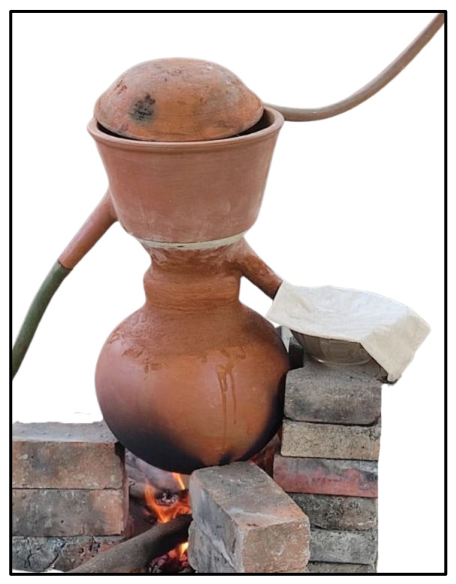
The ingredients were finely powdered and placed in a clay pot, which was sealed with the traditional Dravaga Valaiyanthiram (distillation apparatus). The joints were reinforced with three layers of clay-smeared cloth and allowed to dry completely (Figure 1). Heating was carried out using firewood at moderate intensity. The upper dome of the Valaiyanthiram was filled with ice, which was replaced periodically as it melted, to maintain a cold condensation surface. Vapors from the heated raw materials condensed on the inner surface of the cooled upper dome and were channeled through the lateral spout. The collected distillate was filtered through muslin cloth and immediately transferred to a clean, sterile glass bottle for storage at room temperature until analysis (Figure 2).

2.4. Organoleptic Evaluation

Organoleptic evaluation of GD was performed as per standard procedures for color, odor, appearance, touch, and flow property. Color was determined by visual observation against a white background under white light, odor by individual sensory evaluation with a 2 min interval between observations to avoid olfactory fatigue, appearance (clarity, homogeneity) by visual inspection under adequate illumination, touch (texture, viscosity feel) manually, and flow property visually during pouring [18,19].

2.5. Physicochemical Analysis

The pH was determined in 10% aqueous dilution (5 mL of GD in 50 mL of distilled water) using a digital pH Meter (Digisun Electronics, Hyderabad, India) calibrated digital pH meter, as per standard procedures reported for Siddha and Ayurveda distillate formulation preparations [20,21]. Specific gravity was determined at 25 °C using a pycnometer (Omsons Glassware Pvt Ltd., Ambala, India) by dividing the weight of the formulation by the weight of an equal volume of distilled water at the same temperature [22].

2.6. Qualitative Chemical Analysis

Qualitative chemical analysis was carried out to detect specific acid and basic radicals in GD according to standard procedures [23]. Acid-radical tests were performed for carbonates, chlorides, sulfates, sulfides, phosphates, fluorides/oxalates, borates, and nitrates using established colorimetric and precipitation reactions. Basic-radical tests were performed for lead, arsenic, mercury, copper, ferric and ferrous ions, zinc, silver, and magnesium using standard qualitative procedures.

2.7. Elemental Analysis by ICP-OES

The elemental composition of Gandhaga Dravagam (GD) was determined by ICP-OES using a PerkinElmer Optima 5300 DV ICP-OES (PerkinElmer Inc., Shelton, CT, USA). Approximately 0.45341 g of sample was subjected to closed-vessel acid digestion with 2–3 mL of concentrated nitric acid (65–70% HNO3). Digestion was performed by heating at 85–95 °C for 1–2 h until the solution became clear. The resulting solution was diluted to a final volume of 10 mL with ultrapure water before introduction into the ICP-OES system for simultaneous multi-element analysis. The results were expressed in mg/L [24].

2.8. X-Ray Diffraction (XRD) Analysis

XRD analysis of GD was performed to determine the crystalline nature of the formulation using a Siemens D5005 diffractometer (Siemens AG, Karlsruhe, Germany) with CuKα radiation (λ = 1.5406 Å) over a scan range of 10.0–80.0° (2θ). Prior to analysis, GD was evaporated to dryness, and the resulting crystalline residue was ground to a fine, homogeneous powder and mounted on the sample holder for scanning. The diffractogram was recorded as intensity versus 2θ, and the observed peaks were interpreted to confirm the crystalline phases of the constituent ingredients [25].

2.9. Antispasmodic Activity

GD was evaluated for antispasmodic activity using isolated rat ileum. Overnight-fasted adult male Wistar albino rats (aged 6–8 weeks, 180–200 g) were obtained from Kerala Veterinary and Animal Sciences University and housed at Nandha College of Pharmacy, Erode, India (24 ± 2 °C, 30–70% relative humidity, 12:12 h light/dark cycle). All experimental procedures were conducted in accordance with the Committee for the Purpose of Control and Supervision of Experiments on Animals (CPCSEA) guidelines and approved by the Institutional Animal Ethics Committee (IAEC) of Nandha College of Pharmacy, Erode (IAEC Approval No. 688/PO/Re/S/02/CPCSEA, Proposal No. NCP/IAEC/2022-23/09, dated 8 October 2022), and animals were sacrificed under mild pentobarbital anesthesia, followed by cervical dislocation. Ileum segments (2 cm) dissected 10–15 cm proximal to the ileocecal valve were mounted in a 50 mL organ bath containing aerated Tyrode’s solution (NaCl, KCl, CaCl2, MgCl2·H2O, NaHCO3, NaH2PO4, and glucose; pH 7.4) at 37 °C under a resting tension of 1 g. The tissue was equilibrated for 1 h in aerated Tyrode’s solution at 37 °C, during which period the bathing solution was replaced with fresh Tyrode’s solution every 15 min. Baseline tension was considered stable when consistent resting tone was maintained for at least two consecutive wash cycles [26,27].
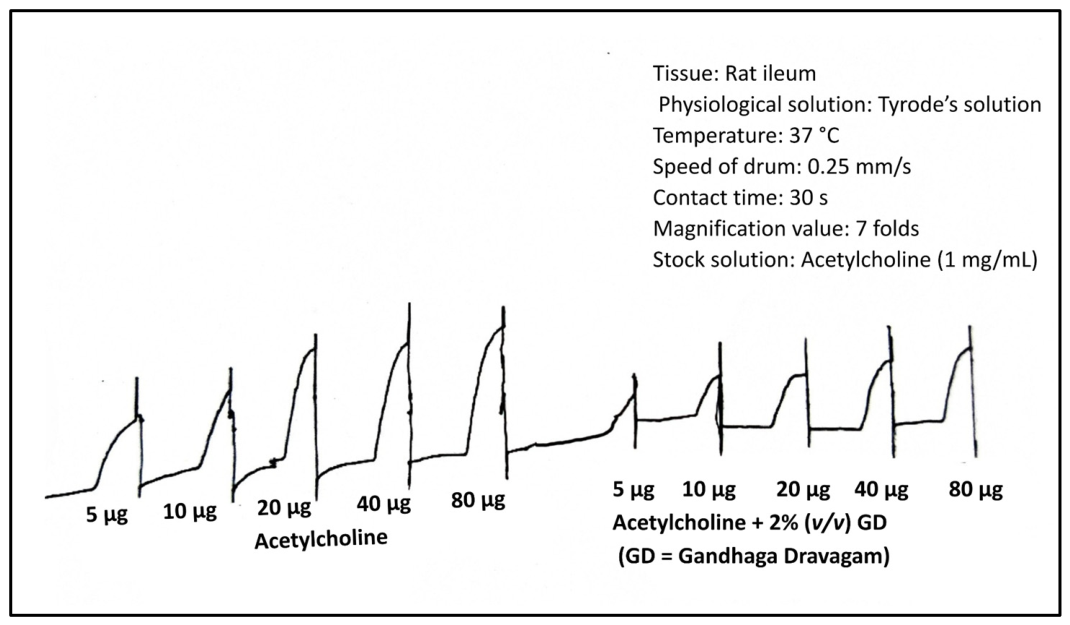
Acetylcholine (ACh) was applied cumulatively at concentrations of 5, 10, 20, 40, and 80 µg to construct a control concentration–response curve. The tissue was then incubated with 1 mL of undiluted GD per 50 mL of Tyrode’s solution (2% v/v) for 45 min, after which the ACh concentration–response curve was re-recorded at the same concentrations. Contractile responses were recorded on a kymograph as the deflection amplitude in millimeters and expressed as a percentage of the maximum contraction obtained in the control curve (normalized to 100% at 80 µg ACh). The percentage reduction in contraction was calculated using the following formula:
% Reduction = [(ACh − ACh + GD)/ACh] × 100
where ACh is the percentage contraction induced by acetylcholine alone (control) and ACh + GD is the percentage contraction in the presence of 2% v/v GD.

2.10. Statistical Analysis

Physicochemical measurements (pH, specific gravity) were performed in triplicate and expressed as mean ± SD. The ex vivo antispasmodic experiment was an exploratory single-animal (n = 1) screen; contractile values represent single determinations and are reported without inferential statistics.

3. Results

3.1. Organoleptic Evaluation

The results of the organoleptic assessment are presented in Table 2.

3.2. Physicochemical Parameters

The results of physicochemical analysis are presented in Table 3.

3.3. Qualitative Chemical Analysis

The results of qualitative tests for acid and basic radicals are shown in Table 4 and Table 5, respectively.

3.4. ICP-OES Analysis

The results of ICP-OES analysis are tabulated in Table 6, where BDL = below detection limit.
The elements reported as BDL (arsenic, mercury, manganese, magnesium, and lead) were below the instrument detection limits of the PerkinElmer Optima 5300 DV ICP-OES under the analytical conditions employed. The instrument detection limits for these elements range from 0.005 to 0.020 mg/L for mercury, 0.001 to 0.01 mg/L for arsenic and lead, and 0.0005 to 0.005 mg/L for manganese and magnesium.

3.5. X-Ray Diffraction (XRD) Analysis

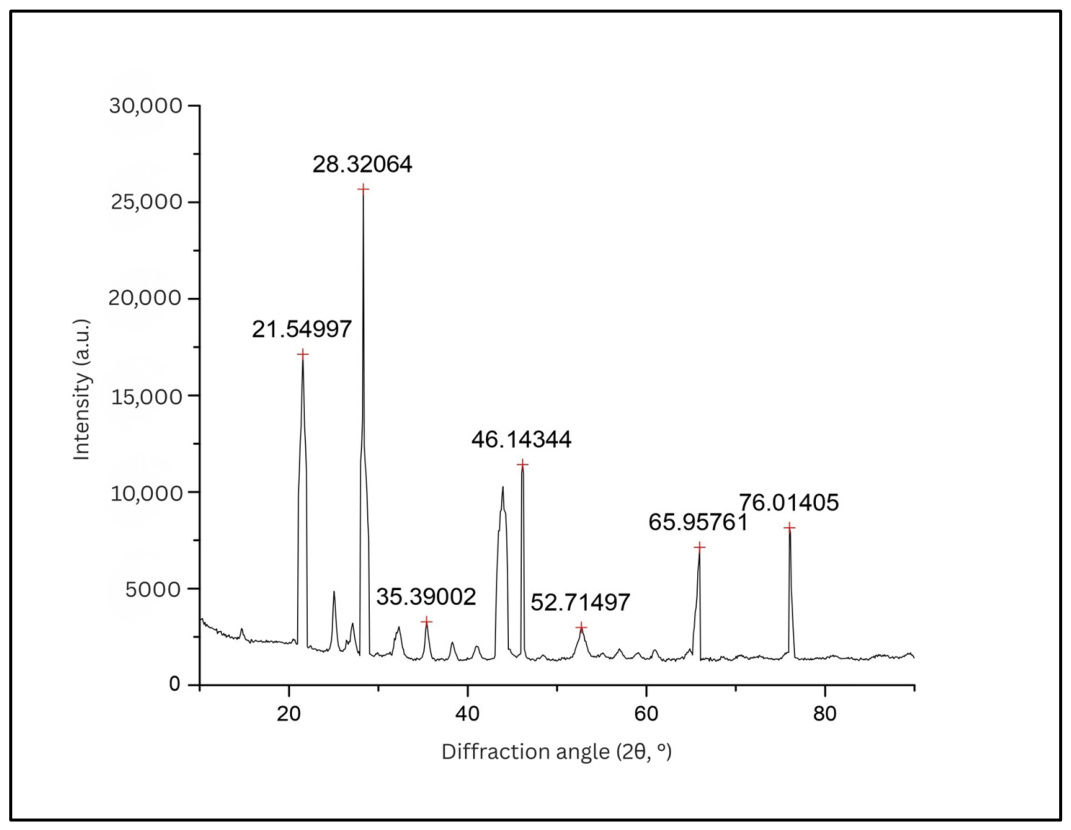
The XRD pattern of Gandhaga Dravagam (Figure 3) showed prominent peaks at 2θ = 21.55°, 28.32°, 35.39°, 46.14°, 52.71°, 65.96°, and 76.01°. These peak positions were assigned, by comparison with International Centre for Diffraction Data (ICDD) reference patterns, to elemental sulfur (major peak at 28.32°), a potassium nitrate phase (52.71°), and aluminum-containing crystalline phases (35.39°, 46.14°, 65.96°, and 76.01°). This assignment is consistent with the sulfur-, potassium-, and aluminum-rich elemental composition determined by ICP-OES (sulfur 501.254 mg/L, aluminum 155.341 mg/L, potassium 100.121 mg/L).

3.6. Antispasmodic Activity

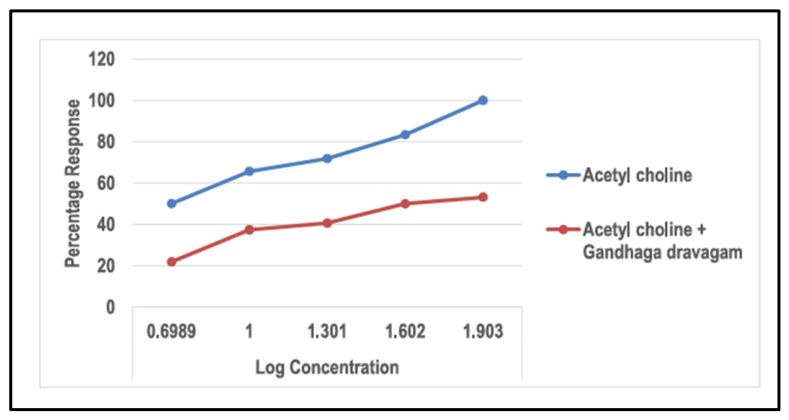
The effect of GD on acetylcholine-induced contractions in isolated rat ileum is presented in Table 7 and Figure 4 and Figure 5. GD (2% v/v) produced a consistent antispasmodic effect across all ACh concentrations tested (5–80 µg).

4. Discussion

The present study integrates traditional Siddha knowledge with modern analytical and pharmacological evaluation to establish baseline quality parameters for GD and to test its traditional use in gastrointestinal spasm. GD was an acidic distillate (pH 2.05 at 10% aqueous dilution; specific gravity 1.0142 at 25 °C), consistent with the properties expected of a mineral-derived Dravagam. Qualitative testing confirmed carbonate, sulfate, phosphate, and nitrate radicals, while lead, arsenic, mercury, copper, iron, zinc, silver, and magnesium were not detected, indicating the absence of detectable heavy metals. As a liquid distillate, GD bypasses the disintegration and dissolution steps of solid dosage forms, potentially allowing more rapid action and easier administration to pediatric, geriatric, and dysphagic patients [28], although these formulation advantages remain to be demonstrated experimentally.
ICP-OES identified sulfur as the predominant element (501.254 mg/L), followed by aluminum (155.341 mg/L), potassium (100.121 mg/L), phosphorus (56.341 mg/L), and sodium (1.320 mg/L), consistent with the sulfur–potassium nitrate–alum composition of the formulation. Arsenic, mercury, manganese, magnesium, and lead were below the detection limits of the instrument, which correspond to concentrations well under the maximum permissible limits of the Ayurvedic Pharmacopoeia of India (Pb ≤ 10 ppm, As ≤ 3 ppm, Hg ≤ 1 ppm), supporting the heavy-metal safety of GD. However, a below-detection-limit result reflects non-detection under the analytical conditions used rather than confirmed absolute absence; spike-recovery and matrix-effect validation were not performed and are reserved for future quantitative work.
XRD showed prominent peaks at 2θ = 21.55°, 28.32°, 35.39°, 46.14°, 52.71°, 65.96°, and 76.01°, consistent with the crystalline phases of the starting materials (sulfur, potassium nitrate, and aluminum compounds derived from alum) and with the elemental profile obtained by ICP-OES. The qualitative pattern cannot, however, establish whether new crystalline phases formed during distillation or quantify the amorphous fraction. The low-angle reflection at 21.55° could not be unambiguously assigned and may represent a minor impurity or an unidentified crystalline phase.
The ex vivo concentration (2% v/v; 1 mL per 50 mL Tyrode’s solution) was chosen to approximate the traditional oral dose. Five to ten drops in ~30 mL water [17], at a standard drop volume of 0.05 mL [29], corresponds to approximately 0.83–1.66% v/v; then, 2% v/v was selected above the upper end of this range to maximize the likelihood of detecting activity, and this is consistent with comparable Arka studies (Yavani and Mishreya Arka, 1.25–5% v/v) using an identical organ-bath protocol [30,31]. GD reduced ACh-induced contractions across the full agonist range tested; the progressive decline in inhibition as ACh increased suggests a surmountable, competitive component, whereas the failure of even the highest ACh concentration to fully restore the control response indicates that competition alone cannot account for the effect [32]. In ileal smooth muscle, ACh-induced contraction is mediated chiefly by M3 muscarinic receptors through Gq-coupled phospholipase C activation and calcium mobilization, with a complementary M2 contribution [33,34]. The sulfur-rich composition of GD is notable here, as the sulfur-derived gasotransmitter hydrogen sulfide (H2S) produces the relaxation of isolated ileum and attenuates ACh-mediated contraction [35]. Together, these observations suggest that GD acts through a combination of muscarinic antagonism and non-specific spasmolytic mechanisms such as calcium-channel modulation or direct smooth-muscle relaxation, in keeping with its mineral-rich nature. As muscarinic antagonists are established treatments for IBS and related motility disorders [10,11], these findings provide a pharmacological rationale for the traditional use of GD in colonic spasm and abdominal discomfort. Because GD is a multi-component distillate rather than a single molecule, these mechanisms are likely to coexist and will be dissected in future work using positive controls such as atropine and verapamil.
This study has limitations characteristic of a preliminary, exploratory investigation. Antispasmodic activity was assessed at a single GD concentration (2% v/v) in tissue from a single animal (n = 1); consequently, a full dose–response relationship, statistical power, and the precise molecular target could not be established, and without a positive control, comparative potency against standard anticholinergics remains undefined. The contribution of the acidic vehicle itself was not isolated by a pH-matched control, although the 1:50 dilution of GD in bicarbonate-buffered Tyrode’s solution (pH 7.4) makes a purely pH-driven artifact unlikely; a pH-matched HCl control is planned. Organoleptic assessment was performed by a single evaluator rather than a blinded panel. Process parameters (distillation duration, heating range, yield, and post-processing such as aging) were not systematically recorded, and batch-to-batch homogeneity was not evaluated, as a single laboratory-prepared batch was used; parallel testing of at least three batches is required to establish reproducibility. Finally, although heavy-metal levels were below detection and below API limits, formal quantitative compliance testing against WHO/AYUSH guidelines and OECD-based acute, subacute, chronic, and genotoxicity studies were not undertaken. The present findings should, therefore, be regarded as preliminary, particularly with respect to safety, and multi-concentration, multi-batch, and mechanistic studies with independent replicates are planned.


5. Conclusions

This study connects traditional Siddha knowledge with modern analytical and pharmacological methods, providing a preliminary standardization and bioactivity profile for GD. The physicochemical, elemental, and crystallographic data establish baseline quality parameters. The rat ileum experiments indicate antispasmodic activity against ACh-induced contractions using GD (2% v/v); a multi-concentration GD study and multi-animal studies with independent biological replicates are planned as future work. Confirmation of the receptor mechanism, together with formal toxicity evaluation and in vivo efficacy studies, is required. The present findings provide a preliminary scientific foundation for these subsequent investigations.

Author Contributions

Conceptualization, K.D. and V.S.; methodology, K.D. and V.S.; software, K.D.; validation, K.D. and V.S.; formal analysis, K.D. and V.S.; investigation, K.D.; data curation, K.D., V.S. and N.S.; writing—original draft preparation, K.D.; writing—review and editing, K.D., V.S., I.A.A.-Y. and A.F.M.; visualization, K.D.; supervision, V.S. and N.S.; project administration, N.S., I.A.A.-Y. and A.F.M. All authors have read and agreed to the published version of the manuscript.

Funding

This research received no external funding.

Institutional Review Board Statement

The animal study protocol was approved by the Institutional Animal Ethics Committee (IAEC) of Nandha College of Pharmacy, Erode (CPCSEA Reg. No. 688/PO/Re/S/02/CPCSEA), Proposal No. NCP/IAEC/2022-23/09, dated 8 October 2022.

Informed Consent Statement

Not applicable.

Data Availability Statement

The original data presented in this study are included in the article. Further inquiries can be directed to the corresponding authors.

Acknowledgments

The authors thank the Department of Gunapadam, the National Institute of Siddha; Asthagiri Herbal Research Foundation; and the American University of Sharjah for providing institutional support. During the preparation of this manuscript, the authors used ChatGPT (GPT-5.5, OpenAI, San Francisco, CA, USA) for the purposes of language editing and manuscript revision. The authors have reviewed and edited the output and take full responsibility for the content of this publication.

Conflicts of Interest

The authors declare no conflicts of interest.

Abbreviations

The following abbreviations are used in this manuscript:
GDGandhaga Dravagam
AChAcetylcholine
ICP-OESInductively Coupled Plasma-Optical Emission Spectrometry
XRDX-ray Diffraction
FGIDsFunctional Gastrointestinal Disorders
IBSIrritable Bowel Syndrome
CPCSEACommittee for the Purpose of Control and Supervision of Experiments on Animals
BDLBelow Detection Limit
IAECInstitutional Animal Ethics Committee
AYUSHAyurveda, Yoga and Naturopathy, Unani, Siddha and Homeopathy
APIAyurvedic Pharmacopoeia of India
OECDOrganisation for Economic Co-operation and Development

References

  1. Subbarayappa, B.V. Siddha medicine: An overview. Lancet 1997, 350, 1841–1844. [Google Scholar] [CrossRef] [Scilit] [PubMed]
  2. Thas, J.J. Siddha medicine-background and principles and the application for skin diseases. Clin. Dermatol. 2008, 26, 62–78. [Google Scholar] [CrossRef] [Scilit] [PubMed]
  3. Nair, V.S.; Gayatri, R.; Sivakumar, S.; Sivaraman, D.; Visweswaran, S.; Banumathi, V. A review on theeneer and dravagam (distillates) used in Siddha medicine and their biomedical application in chemistry and healthcare system. Int. J. Med. Res. Pharm. Sci. 2017, 4, 32–48. [Google Scholar]
  4. Thiagarajan, R. Gunapadam: Thadhu Seeva Vaguppu, 1st ed.; Directorate of Indian Medicine and Homeopathy: Chennai, India, 2004.
  5. Kaaruniya, G.; Mariappan, A.; Suba, V.; Gayathri, N.; Meenakumari, R. Toxicological evaluation of Pancha Lavana Dravagam: A Siddha poly mineral distillate. Res. J. Pharm. Biol. Chem. Sci. 2021, 12, 1–10. [Google Scholar] [CrossRef] [Scilit]
  6. Kannan, N.; Anil Kumar, N.V.; Balaji, S. Chemical, elemental, morphological and toxicological characteristics of traditional Indian Siddha formulation: Kasthuri Karuppu. Adv. Tradit. Med. 2025, 25, 221–231. [Google Scholar] [CrossRef] [Scilit]
  7. Sperber, A.D.; Bangdiwala, S.I.; Drossman, D.A.; Ghoshal, U.C.; Simren, M.; Tack, J.; Whitehead, W.E.; Dumitrascu, D.L.; Fang, X.; Fukudo, S.; et al. Worldwide prevalence and burden of functional gastrointestinal disorders, results of Rome Foundation Global Study. Gastroenterology 2021, 160, 99–114. [Google Scholar] [CrossRef] [Scilit] [PubMed]
  8. Almario, C.V.; Ballal, M.L.; Chey, W.D.; Nordstrom, C.; Khanna, D.; Spiegel, B.M.R. Burden of gastrointestinal symptoms in the United States: Results of a nationally representative survey of over 71,000 Americans. Am. J. Gastroenterol. 2018, 113, 1701–1710. [Google Scholar] [CrossRef] [Scilit] [PubMed]
  9. Ghoshal, U.C.; Singh, R. Frequency and risk factors of functional gastro-intestinal disorders in a rural Indian population. J. Gastroenterol. Hepatol. 2017, 32, 378–387. [Google Scholar] [CrossRef] [Scilit] [PubMed]
  10. Brenner, D.M.; Lacy, B.E. Antispasmodics for chronic abdominal pain: Analysis of North American treatment options. Am. J. Gastroenterol. 2021, 116, 1587–1600. [Google Scholar] [CrossRef] [Scilit] [PubMed]
  11. Annaházi, A.; Róka, R.; Rosztóczy, A.; Wittmann, T. Role of antispasmodics in the treatment of irritable bowel syndrome. World J. Gastroenterol. 2014, 20, 6031–6043. [Google Scholar] [CrossRef] [Scilit] [PubMed]
  12. Liu, J.; Zhang, F.; Ravikanth, V.; Olajide, O.A.; Li, C.; Wei, L.X. Chemical compositions of metals in Bhasmas and Tibetan Zuotai are a major determinant of their therapeutic effects and toxicity. Evid. Based Complement. Altern. Med. 2019, 2019, 1697804. [Google Scholar] [CrossRef] [Scilit] [PubMed]
  13. Prakash, P.; Meena, R.; Stanley Abraham, L.; Sunkar, S.; Govindaraju, K.; Pully, D.; Samrot, A.V. Evidence-based traditional Siddha formulations for prophylaxis and management of respiratory symptoms in COVID-19 pandemic-a review. Biocatal. Agric. Biotechnol. 2021, 35, 102056. [Google Scholar] [CrossRef] [Scilit] [PubMed]
  14. World Health Organization. WHO Global Report on Traditional and Complementary Medicine 2019; World Health Organization: Geneva, Switzerland, 2019. [Google Scholar]
  15. Chen, Q.; Cheng, H.J.; Bian, Z.X.; Lyu, A.P.; Yang, Y.; Chan, K.W. Regulatory frameworks and evidence requirements for traditional, complementary and integrative medicines. Bull. World Health Organ. 2025, 103, 696–707. [Google Scholar] [CrossRef] [Scilit] [PubMed]
  16. Government of India. The Drugs and Cosmetics Act, 1940 and Rules, 1945; Ministry of Health and Family Welfare: New Delhi, India, 2016.
  17. Kannusamy Pillai, C. Sigicha Rathna Deepam Ennum Vaithya Nool, 2nd ed.; B. Rathna Nayakkar & Sons: Chennai, India, 2014; p. 302. [Google Scholar]
  18. Indian Pharmacopoeia Commission. Indian Pharmacopoeia; Volume I; Ministry of Health and Family Welfare, Government of India: Ghaziabad, India, 2014.
  19. Lohar, D.R. Protocol for Testing of Ayurvedic, Siddha and Unani Medicines; Pharmacopoeial Laboratory for Indian Medicine, Department of AYUSH: Ghaziabad, India, 2007.
  20. Ethelshiny, S.; Ravichandran, M. Physico Chemical Standardization and Phytochemical Screening of Siddha Preparation Udara Noi Nivarana Thiravagam. World J. Pharm. Pharm. Sci. 2015, 4, 606–614. [Google Scholar]
  21. Paul, S.; Sharma, K.; Suresh, P. Study on Pudina (Mint) Arka Prepared by Three Different Methods. Int. J. Ayurvedic Med. 2019, 10, 207–210. [Google Scholar] [CrossRef] [Scilit]
  22. Government of India. The Ayurvedic Pharmacopoeia of India, 1st ed.; Part II, Vol. IV (Formulations); Ministry of AYUSH, Government of India: New Delhi, India, 2017; p. 145.
  23. Bai, D.D.; Joshi, A.; Tyagi, G.; Vijaya Kumar, V.; Verma, S.C.; Shankar, M.B. Preliminary qualitative screening, physicochemical standardization and antimicrobial activity of a herbo-mineral Siddha formulation Gandhaga Karuppu. Indo Am. J. Pharm. Res. 2017, 7, 298–307. [Google Scholar]
  24. Al-Thani, G.; Ibrahim, A.E.; Alomairi, M.; Salman, B.I.; Hegazy, M.M.; Al-Harrasi, A.; El Deeb, S. Toxic Elemental Impurities in Herbal Weight Loss Supplements; A Study Using ICP-OES Microwave-Assisted Digestion. Toxics 2023, 11, 272. [Google Scholar] [CrossRef] [Scilit] [PubMed]
  25. Kannan, N.; Balaji, S.; Anil Kumar, N.V. Structural and elemental characterization of traditional Indian Siddha formulation: Thalagak Karuppu. J. Ayurveda Integr. Med. 2017, 8, 184–189. [Google Scholar] [CrossRef] [Scilit] [PubMed]
  26. Carvalho, A.C.; Almeida, D.S.; Melo, M.G.; Cavalcanti, S.C.; Marçal, R.M. Evidence of the mechanism of action of Erythrina velutina Willd (Fabaceae) leaves aqueous extract. J. Ethnopharmacol. 2009, 122, 374–378. [Google Scholar] [CrossRef] [Scilit] [PubMed]
  27. Aćimović, M.; Šovljanski, O.; Pezo, L.; Travičić, V.; Tomić, A.; Zheljazkov, V.D.; Veternik, D.; Ćetković, G.; Tešević, V.; Čabarkapa, I. The Effect of Thymol on Acetylcholine-Induced Contractions of the Rat Ileum and Uterus under Ex Vivo Conditions. Front. Pharmacol. 2022, 13, 990654. [Google Scholar] [CrossRef] [Scilit] [PubMed]
  28. Aulton, M.E.; Taylor, K.M.G. (Eds.) Aulton’s Pharmaceutics: The Design and Manufacture of Medicines, 6th ed.; Elsevier: London, UK, 2022. [Google Scholar]
  29. Government of India, Ministry of AYUSH. The Ayurvedic Pharmacopoeia of India; Part I, Volume I; Government of India: New Delhi, India, 2001.
  30. Paul, S.; Sharma, K. Effect of Yavani Arka (Hydro Distillate of Trachyspermum ammi) on Rat Ileum, Against Acetyl Choline Induced Contractions. Int. J. Res. Ayurveda Pharm. 2019, 10, 66–70. [Google Scholar] [CrossRef] [Scilit]
  31. Paul, S.; Sharma, K. Effect of Mishreya Arka (Hydro Distillate of Dill) on Rat Ileum, Against Acetyl Choline Induced Contractions. Ayushdhara 2019, 6, 2162–2168. [Google Scholar]
  32. Broadley, K.J.; Kelly, D.R. Muscarinic receptor agonists and antagonists. Molecules 2001, 6, 142–193. [Google Scholar] [CrossRef] [Scilit]
  33. Tobin, G.; Giglio, D.; Lundgren, O. Muscarinic receptor subtypes in the alimentary tract. J. Physiol. Pharmacol. 2009, 60, 3–21. [Google Scholar] [PubMed]
  34. Unno, T.; Matsuyama, H.; Sakamoto, T.; Uchiyama, M.; Izumi, Y.; Okamoto, H.; Yamada, M.; Wess, J.; Komori, S. M2 and M3 muscarinic receptor-mediated contractions in longitudinal smooth muscle of the ileum studied with receptor knockout mice. Br. J. Pharmacol. 2005, 146, 98–108. [Google Scholar] [CrossRef] [Scilit] [PubMed]
  35. Teague, B.; Asiedu, S.; Moore, P.K. The Smooth Muscle Relaxant Effect of Hydrogen Sulphide in Vitro: Evidence for a Physiological Role to Control Intestinal Contractility. Br. J. Pharmacol. 2002, 137, 139–145. [Google Scholar] [CrossRef] [Scilit] [PubMed]
Figure 1. The preparation of Gandhaga Dravagam (GD). A Traditional Dravaga Valaiyanthiram apparatus was used for the distillation of purified sulfur, potassium nitrate, and alum. The image shows the clay pot placed on a firewood stove.
Biophysica 06 00063 g001
Figure 2. The final distilled Gandhaga Dravagam (GD) obtained after filtration and collected for analysis. The clear liquid distillate is shown in a glass Petri dish.
Biophysica 06 00063 g002
Figure 3. The XRD pattern of Gandhaga Dravagam (GD). X-axis: Diffraction angle (2θ, °). Y-axis: Intensity (a.u.). Major diffraction peaks are marked with red vertical lines and annotated with their 2θ values.
Biophysica 06 00063 g003
Figure 4. Log concentration–response curves of acetylcholine-induced contractions in isolated rat ileum in the absence (control) and presence of 2% (v/v) GD. X-axis: Log acetylcholine concentration (µg). Y-axis: Percentage response (normalized to 100% at 80 µg ACh in the control).
Biophysica 06 00063 g004
Figure 5. Representative kymographic recordings showing acetylcholine-induced contractions of isolated rat ileum before and after incubation with 2% (v/v) GD. Increasing acetylcholine concentrations (5–80 µg) were applied sequentially. The deflection amplitude is recorded in millimeters.
Biophysica 06 00063 g005
Table 1. The ingredients and quantities used for GD preparation.
Vernacular NameChemical NameQuantity
GandhagamSulfur175 g (5 Palam)
VediyuppuPotassium nitrate175 g (5 Palam)
PadikaramAlum175 g (5 Palam)
Table 2. The organoleptic evaluation of GD.
ParameterObservation
ColorTransparent
OdorCharacteristic
AppearanceClear liquid
TouchNon-greasy
Flow propertyFree-flowing
Table 3. The physicochemical parameters of GD.
ParameterResult
pH (10% aqueous dilution)2.05 ± 0.02
Specific gravity (at 25 °C)1.0142 ± 0.0003
Table 4. Qualitative analysis of specific acid radicals in GD.
Acid RadicalResult
CarbonatesPresent
ChloridesAbsent
SulfatesPresent
SulfidesAbsent
PhosphatesPresent
Fluorides/OxalatesAbsent
BoratesAbsent
NitratesPresent
Table 5. Qualitative analysis of specific basic radicals in GD.
Basic RadicalResult
LeadAbsent
ArsenicAbsent
MercuryAbsent
CopperAbsent
FerricAbsent
FerrousAbsent
ZincAbsent
SilverAbsent
MagnesiumAbsent
Table 6. ICP-OES analysis of GD.
ElementWavelength (nm)Result
Aluminum (Al)396.153155.341 mg/L
Arsenic (As)188.979BDL
Mercury (Hg)253.652BDL
Potassium (K)766.491100.121 mg/L
Magnesium (Mg)285.213BDL
Manganese (Mn)257.610BDL
Sodium (Na)589.5921.320 mg/L
Lead (Pb)220.353BDL
Phosphorus (P)213.61756.341 mg/L
Sulfur (S)180.731501.254 mg/L
Table 7. The effect of GD on acetylcholine-induced contractions in isolated rat ileum.
Conc. of ACh (µg)Log Conc.Response (ACh) (mm)% Contraction (ACh)Response (ACh + GD) (mm)% Contraction (ACh + GD)% Reduction in Contraction
50.69891650.00721.8856.25
101.00002165.631134.3847.62
201.30102371.881340.6343.48
401.60202784.371650.0040.74
801.903032100.001753.1346.88
ACh = Acetylcholine; GD = Gandhaga Dravagam; Conc. = Concentration; Log Conc. = Logarithm of Concentration; % Reduction in Contraction = Percentage inhibition of contractile response by GD compared to ACh alone.
Disclaimer/Publisher’s Note: The statements, opinions and data contained in all publications are solely those of the individual author(s) and contributor(s) and not of MDPI and/or the editor(s). MDPI and/or the editor(s) disclaim responsibility for any injury to people or property resulting from any ideas, methods, instructions or products referred to in the content.